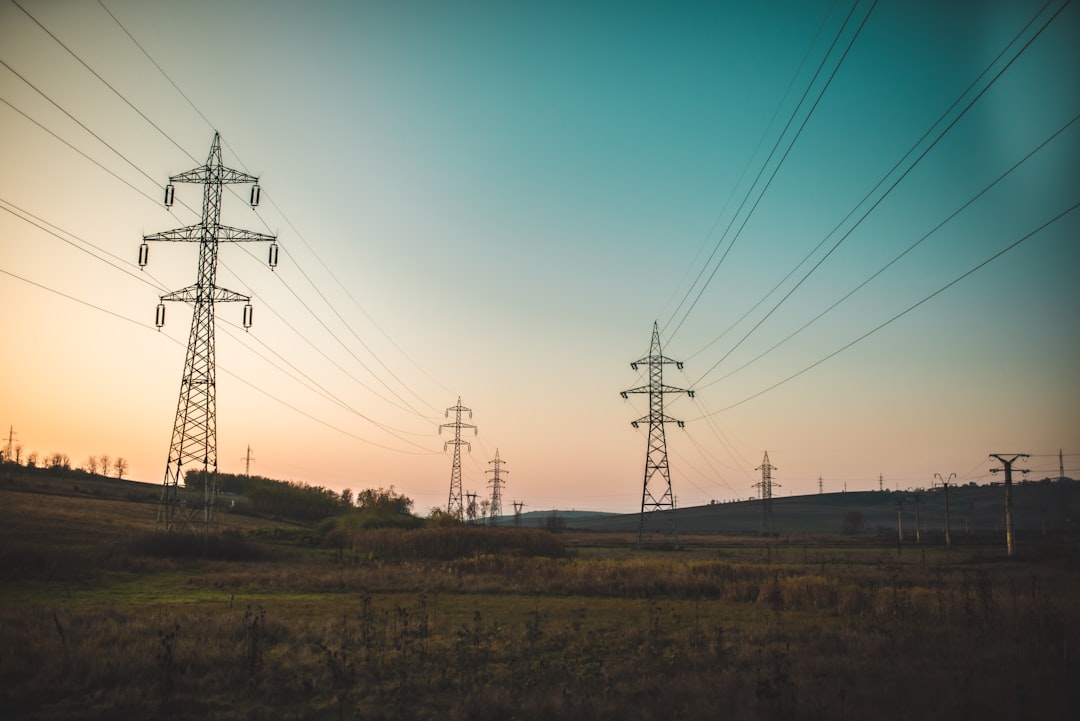
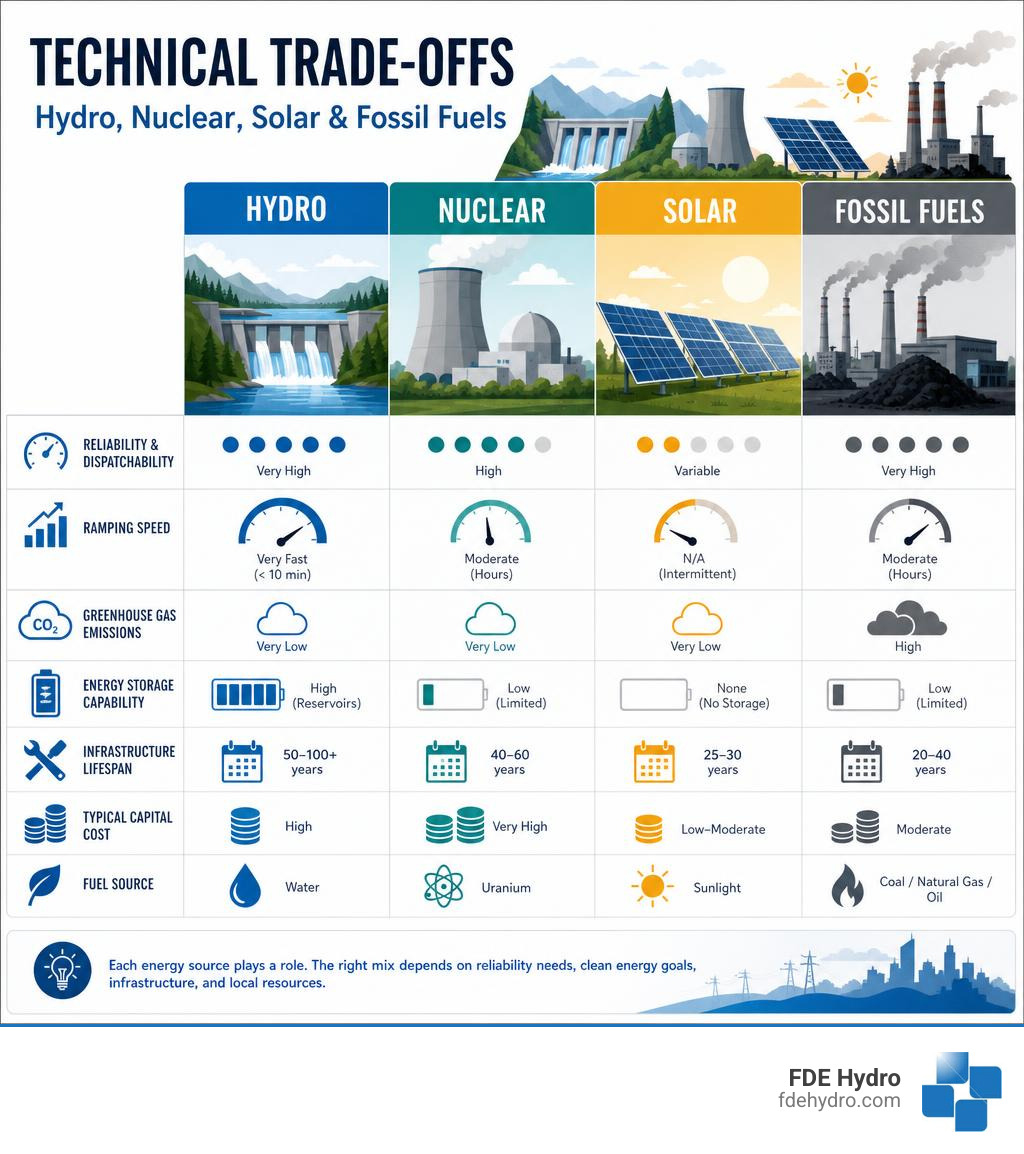
Why Power Grid Voltage Differs Around the World — And Why It Matters
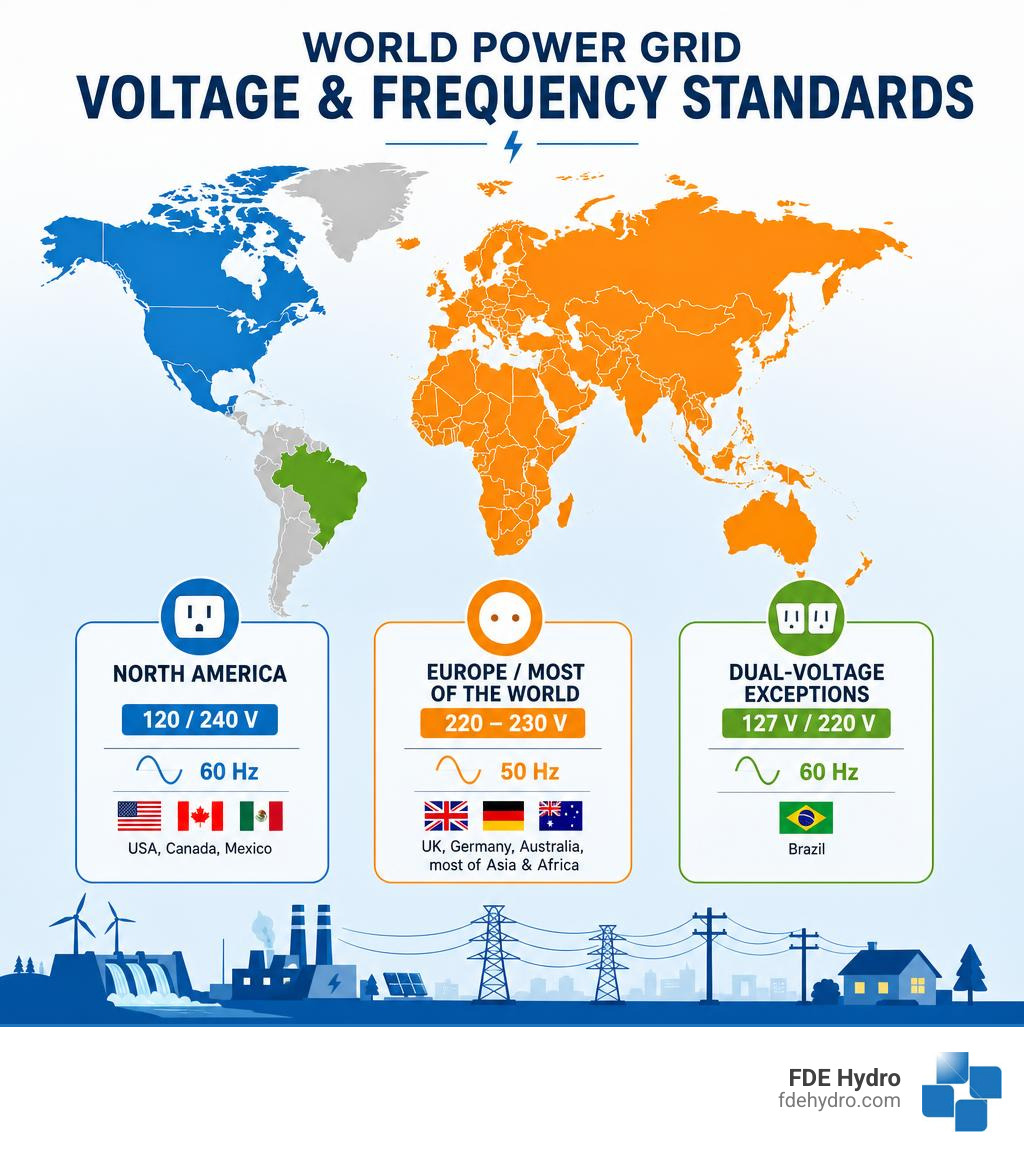
Power grid voltage — the electrical potential that drives current from generation plants to your home or facility — is not the same everywhere on Earth. In fact, two major standards divide the world:
Region
Standard Voltage
Frequency
Example Countries
North America
120/240 V
60 Hz
USA, Canada, Mexico
Europe / Most of World
220–230 V
50 Hz
UK, Germany, Australia, most of Asia & Africa
Dual-voltage exceptions
127 V / 220 V
60 Hz
Brazil
These differences trace back to the late 1800s — the famous rivalry between Thomas Edison and Nikola Tesla — when countries independently locked in their own electrical standards before any international coordination existed.
Today, those early choices still shape every power plant, transformer, and outlet on the planet.
And it’s not just about plug shapes. The voltage and frequency your grid runs at affects:
Equipment compatibility across borders
Transmission efficiency over long distances
Voltage stability as renewable energy sources are added to the grid
Safety standards for workers and consumers
The U.S. grid alone spans more than 160,000 miles of high-voltage transmission lines, connecting over 7,000 power plants to roughly 145 million customers. Managing voltage reliably across that scale — and doing it as solar, wind, and hydropower reshape the energy mix — is one of the defining engineering challenges of our time.
I’m Bill French, Sr., Founder and CEO of FDE Hydro™, and my decades of experience in heavy civil construction and hydropower infrastructure have given me a front-row seat to how power grid voltage decisions shape the design, cost, and performance of clean energy projects. In the sections ahead, we’ll break down everything you need to know — from global standards to grid stability to what it all means for modern hydropower.
What is Mains Electricity and How is It Delivered?
Mains electricity is the general-purpose alternating current (AC) electric power delivered to homes and businesses. It is the lifeblood of modern society, powering everything from our phone chargers to heavy industrial machinery.
But how does it get to your wall outlet? The process is a highly coordinated journey across multiple layers of infrastructure. To understand this complex dance, it helps to first ask: what does grid mean in electrical engineering? In short, the grid is a massive, interconnected network designed to generate, transmit, and distribute electricity over vast geographic distances.
The Battle of Currents: Why We Use Alternating Current (AC)
In the late 19th century, the “War of the Currents” pitted Thomas Edison’s Direct Current (DC) against Nikola Tesla and George Westinghouse’s Alternating Current (AC). Edison’s DC systems could only transmit power effectively over a mile or two before the voltage dropped significantly due to line resistance.
Tesla’s AC system won because of a fundamental physical principle: electromagnetic induction. With AC, we can use transformers to easily step up the voltage for long-distance transmission and step it down for safe utilization.
Because transmission line losses are proportional to the square of the current ($I^2R$), raising the voltage allows us to transmit the same amount of power with much lower current, dramatically reducing energy losses over hundreds of miles. To learn more about the basic physics behind this, you can read the Electricity 101 | Department of Energy guide.
Single-Phase vs. Three-Phase Power Delivery
Once the electricity reaches your local area, it is delivered using one of two configurations:
Single-Phase Power: Typically used for residential and light commercial applications. It delivers a single AC sine wave. In a 60 Hz system, the voltage oscillates back and forth, crossing the “zero-voltage” mark 120 times every second. While this is unnoticeable for lighting and small electronics, it is not ideal for large electric motors.
Three-Phase Power: Used for industrial facilities, large commercial buildings, and generation plants. It consists of three separate AC sine waves offset by 120 degrees. This means that as one phase drops toward zero, another is peaking. This constant, smooth delivery of power is highly efficient for running large motors, heavy machinery, and industrial water pumps.
Demystifying Power Grid Voltage: Generation, Transmission, and Distribution Layers
To move electricity from a turbine to a toaster, the grid relies on a series of distinct layers, each operating at a specialized power grid voltage.
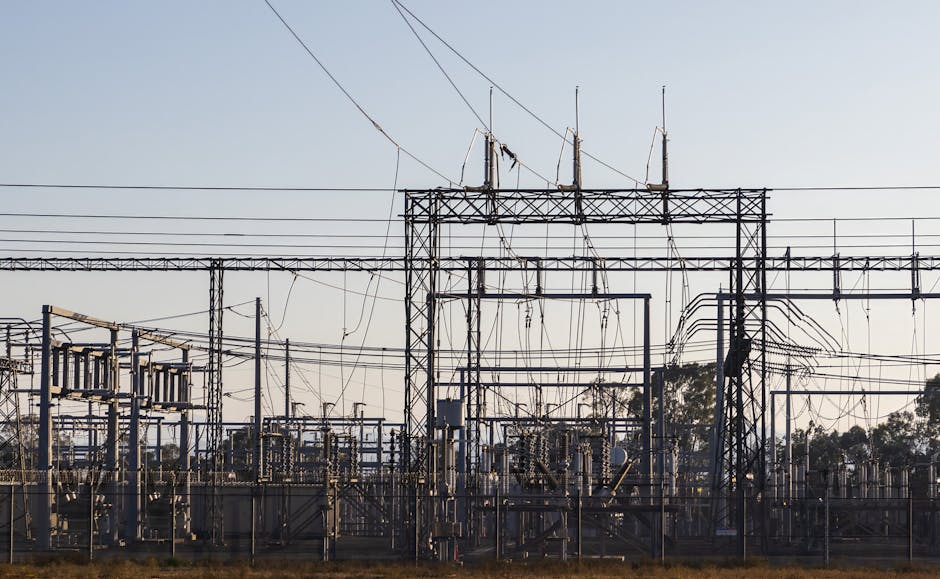
At the generation station, step-up transformers raise the voltage to extreme levels for long-distance travel. Once the electricity nears its destination, step-down transformers lower the voltage to safe, usable levels. You can explore the physical infrastructure behind this in our guide on High Voltage Lines: The Backbone of Our Power Grid.
Voltage Classifications: High, Medium, and Low Voltage
Generation: Power plants (such as hydro, nuclear, or gas) typically generate electricity at medium voltages, usually between 4.16 kV and 34.5 kV. A generator step-up transformer immediately boosts this to transmission levels.
Transmission (High Voltage): Transmission lines carry bulk power over long distances. In North America, transmission voltages typically range from 69 kV up to 765 kV. Operating at these high levels minimizes thermal losses.
Subtransmission and Distribution (Medium Voltage): Substations step the voltage down to distribution-primary classes, which commonly range from 4.16 kV to 34.5 kV. This medium voltage travels down street-level lines (either overhead or underground).
Utilization (Low Voltage): Finally, small distribution transformers (the grey canisters on utility poles) step the voltage down to the final utilization voltage. For residential homes in North America, this is 120/240V split-phase.
Nominal, Service, and Utilization Voltages Explained
Engineers categorize voltage into three distinct definitions to ensure equipment functions safely and within standard parameters:
Nominal System Voltage: The designated value assigned to a circuit or system for the purpose of convenient nomenclature (e.g., 120V, 240V, 480V).
Service Voltage: The voltage measured at the point where the utility’s system connects to the customer’s electrical installation (the billing meter).
Utilization Voltage: The voltage measured at the terminals of the operating equipment (the wall outlet or appliance plug).
Because of resistance in building wiring, the utilization voltage is normally slightly lower than the service voltage. National standards, such as the ANSI C84.1-1995 standard, establish strict operating tolerances. These guidelines ensure that utilities maintain service voltages within acceptable limits (typically within $pm 5%$ of nominal) so that end-user equipment is not damaged by overvoltage or starved by undervoltage.
Comparing Global Voltage Standards: Why Regions Differ
The global map of mains electricity is a patchwork of historical compromises. When grids were first constructed in the late 19th and early 20th centuries, there was no global supply chain for household appliances. Consequently, different regions adopted standards based on local engineering preferences and economic conditions.
North America settled on 120V at 60 Hz. This standard relies on a “split-phase” residential delivery system. The utility delivers two 120V hot wires that are 180 degrees out of phase, along with a shared neutral wire.
Standard household outlets connect one hot wire and the neutral to deliver 120V for low-power devices. For heavy appliances like clothes dryers, water heaters, and air conditioners, both hot wires are connected to deliver a full 240V.
In Canada, where more than half of the country’s electricity is generated by massive, highly efficient hydroelectric facilities, the standard remains identical to the U.S. to ensure seamless economic and equipment compatibility. Travelers can find more details about Canadian electrical currents in the Electric plug and socket type in Canada | Adapter or converter? guide.
European and Global Standards (230V/50Hz)
Europe and much of the rest of the world opted for a nominal voltage of 220–230V at a frequency of 50 Hz. The primary advantage of a higher residential voltage is efficiency. Because double the voltage requires half the current to deliver the same amount of power ($P = V times I$), European household wiring can be thinner and experiences lower internal resistive losses.
However, higher voltage carries a greater risk of severe electrical shock, which is why European countries historically developed highly robust safety standards, ground-fault protections, and heavily insulated plug designs.
Brazil represents an interesting dual-voltage hybrid. Depending on the state or municipality, the local grid might supply 127V or 220V, both running at 60 Hz. This split requires travelers and industrial developers to be highly vigilant about checking local ratings. For guidance on navigating this environment, check out the Travel Adaptor for Brazil | Electrical Safety First resource.
Grid Stability: Managing Fluctuations, Regulation, and Modern Challenges
A stable grid is a balanced grid. Both frequency and power grid voltage must be kept within strict tolerances to prevent equipment damage and grid-wide blackouts.
How Power Grid Voltage Fluctuations and Overvoltages Affect Equipment
Voltage levels on the grid fluctuate constantly as large loads turn on and off.
Voltage Sags (Undervoltage): When large industrial motors start up, they draw high inrush currents, causing a temporary dip in local voltage. Severe sags can cause electric motors to overheat, computers to reset, and industrial processes to shut down.
Transient Overvoltages (Swells and Spikes): Sudden load rejections (such as a factory shutting down) or lightning strikes can cause dramatic voltage spikes. These transients can puncture electrical insulation, destroy sensitive microelectronics, and cause electrical fires.
To combat these issues, utilities use voltage regulation equipment, including load tap changers (LTCs) on substation transformers, line-voltage regulators, and capacitor banks that inject reactive power to boost sagging voltages.
The Impact of Renewable Energy on Power Grid Voltage Stability
The transition to clean energy introduces new complexities to voltage regulation. Traditional power grids rely on massive, spinning synchronous generators (like those in coal, gas, or large hydro plants) that naturally provide physical inertia and automatic voltage regulation.
Modern wind and solar resources, however, are Inverter-Based Resources (IBRs). They interface with the grid through power electronics rather than heavy rotating machinery. This shift creates several challenges:
Loss of Inertia: With fewer spinning generators online, the grid is more susceptible to rapid frequency and voltage deviations.
Bidirectional Power Flow: Traditional distribution grids were designed for one-way traffic—from the high-voltage transmission system down to the low-voltage customer. High penetrations of rooftop solar can push power backward up the line, causing localized overvoltages.
Intermittency: Sudden changes in solar irradiance or wind speed cause rapid power fluctuations, requiring highly dynamic voltage control.
Additionally, technologies like smart inverters are being programmed with Volt-Var control capabilities, allowing them to dynamically absorb or inject reactive power to stabilize local voltages. For a deeper look at these techniques, see the Department of Energy’s report on Voltage Optimization.
These challenges are not theoretical. In places like New York, grid operators are facing historically thin safety margins heading into the high-demand summer months, highlighting the urgent need for rapid, reliable grid modernization.
TSO and DSO Coordination in Modern Smart Grids
As distributed energy resources (DERs) like rooftop solar and localized battery storage multiply, the boundary between the Transmission System Operator (TSO) and the Distribution System Operator (DSO) is blurring.
Traditionally, the TSO managed the high-voltage transmission system and bulk generation, while the DSO simply managed the local delivery. Today, voltage stability on the transmission system increasingly depends on the aggregate behavior of millions of small-scale resources connected to the distribution system.
Active coordination is essential. DSOs must monitor and optimize local voltage profiles, while TSOs coordinate wide-area monitoring and control schemes to ensure that local voltage adjustments do not trigger larger, cascading instabilities across the macrogrid.
Frequently Asked Questions about Power Grid Voltage
Why do different countries use different plug shapes and voltages?
Different countries built their electrical grids independently during the late 19th and early 20th centuries. By the time international travel and trade made standardization desirable, the cost of replacing millions of existing outlets, appliances, and transformers was too high. Consequently, countries stuck with their legacy standards, leading to the diverse array of plug shapes and voltages we see today.
What is the difference between service voltage and utilization voltage?
Service voltage is the electrical potential delivered by the utility to your facility’s billing meter. Utilization voltage is the actual voltage available at your wall outlets or equipment terminals. Utilization voltage is typically slightly lower than service voltage due to natural voltage drops caused by resistance in the building’s internal wiring.
Can we harness lightning to power the electrical grid?
No, we cannot. While a single lightning strike contains a massive amount of energy—approximately 1,500 megajoules (MJ), which is enough to power a 100W light bulb for nearly six months—lightning is far too brief, localized, and unpredictable. To equal the output of a standard 1-gigawatt (GW) power plant, we would need to capture and store more than 58,000 perfectly timed lightning strikes every single day. The technology required to safely capture and store such high-voltage, high-current transients in microseconds does not exist.
Conclusion
As we march toward a decarbonized future, grid modernization and voltage stability are more critical than ever. The integration of intermittent wind and solar requires a flexible, resilient grid infrastructure that can adapt to rapid changes in generation and demand.
At FDE Hydro™, we believe that hydropower has a vital role to play in this transition. Beyond producing clean, reliable baseload power, hydroelectric plants act as massive, spinning synchronous condensers that naturally stabilize power grid voltage and frequency.
To accelerate the deployment of these essential grid assets, we developed our patented modular precast concrete technology, known as the French Dam. By replacing slow, carbon-intensive, on-site concrete pouring with precision-engineered, precast modules, we dramatically reduce the construction costs and development timelines of hydroelectric projects and water control structures across North America, Brazil, and Europe.
Whether retrofitting an existing non-powered dam or building a new run-of-river facility, our technology makes clean, grid-stabilizing energy more accessible and cost-effective than ever before.
Are you interested in learning more about the engineering behind modern power systems? Explore our Power Grid Articles to stay informed on the latest trends in grid stability, renewable integration, and clean energy infrastructure.
The World’s Most Powerful Battery Is Made of Water
Pumped storage hydro is the largest and most proven form of energy storage on the planet — and it works by moving water uphill and downhill between two reservoirs.
Quick answer: What is pumped storage hydro?
Question
Answer
What is it?
A system that stores energy by pumping water to an upper reservoir, then releases it through turbines to generate electricity
How efficient is it?
70–80% round-trip efficiency
How much storage exists globally?
~200 GW of power capacity, ~9,000 GWh of energy storage
What share of grid storage is it?
Over 94% of the world’s long-duration energy storage
How long can it supply power?
Hours to days, depending on reservoir size
Main system types?
Open-loop (connected to natural water) and closed-loop (off-river, self-contained)
Right now, the grid faces a serious problem. Wind and solar generate power when nature allows — not necessarily when people need it. That mismatch causes waste, instability, and rising costs for utilities and grid operators.
Pumped storage hydro solves that problem at a scale no other technology currently matches.
It has been doing so since the 1890s, when early systems appeared in Italy and Switzerland. The U.S. adopted the technology in 1930. Today, pumped storage accounts for 97% of utility-scale energy storage in the United States — 23 GW across 42 sites — and over 94% of long-duration storage capacity worldwide.
As Malcolm Turnbull has noted, the failure to adequately focus on long-duration electricity storage is “the ignored crisis within the energy crisis” — and pumped storage hydro has the unique capacity to resolve it at a scale far beyond what batteries alone can deliver.
I’m Bill French, Sr., Founder and CEO of FDE Hydro™ and a veteran of large-scale civil construction and hydropower innovation — including participation in the U.S. Department of Energy’s Hydropower Vision Task Force, where I helped define the next generation of pumped storage hydro solutions for Congress. In this guide, I’ll walk you through everything decision-makers need to know about this technology: how it works, where it fits, and how modern construction methods are removing the biggest barriers to building it faster and cheaper.
What is Pumped Storage Hydro and How Does It Work?
At its core, pumped storage hydro is gravity storage.
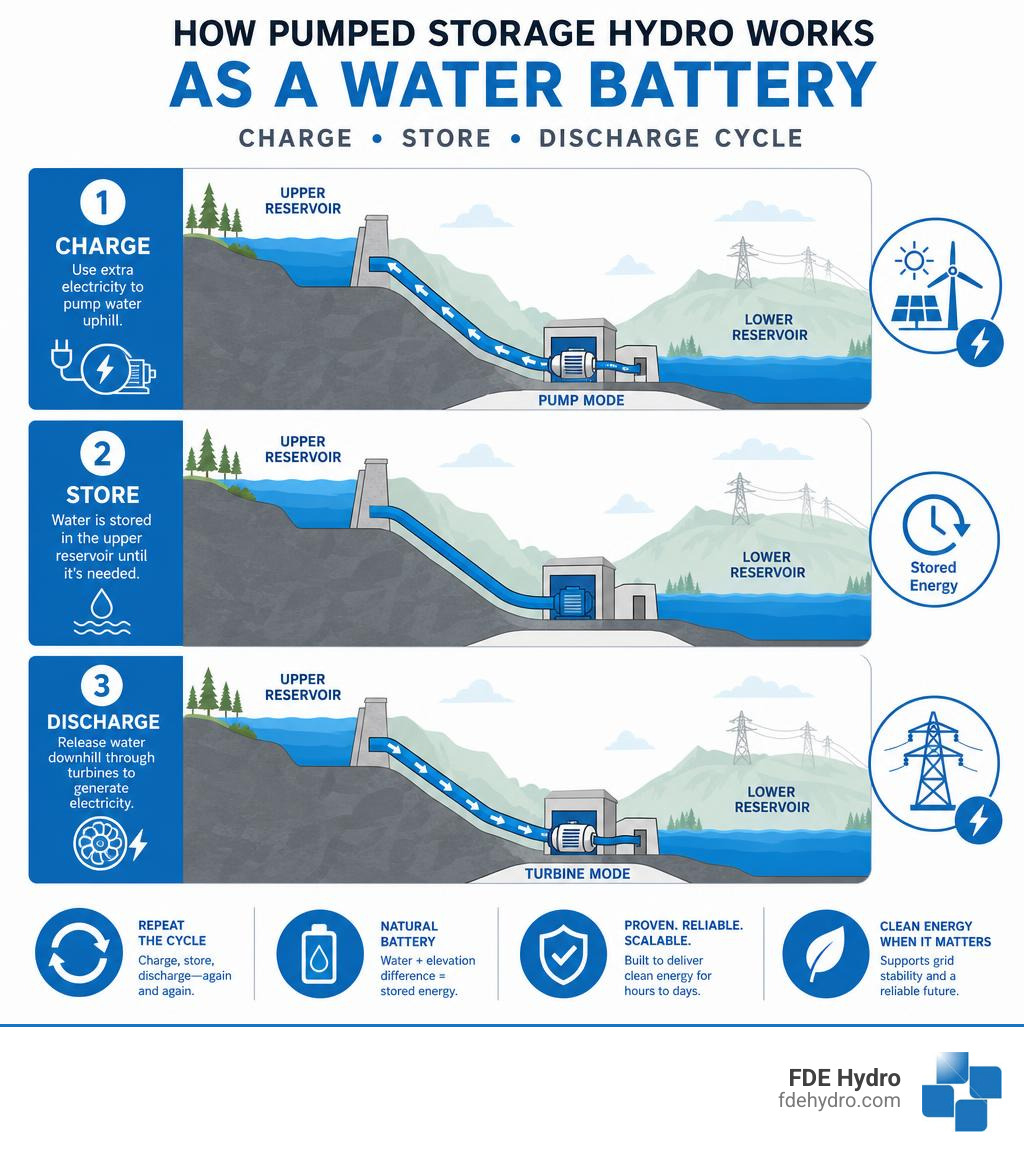
A project uses two reservoirs at different elevations. When there is extra electricity on the grid, the plant uses that power to pump water from the lower reservoir to the upper reservoir. That is the “charging” cycle. When the grid needs electricity, the water is released back downhill through turbines. That is the “discharging” cycle.
The stored energy is not in the water itself. It is in the water’s position. Engineers call this gravitational potential energy. The higher the reservoir and the more water it holds, the more energy can be stored.
The basic cycle is simple:
Low demand or surplus renewable power: pumps move water uphill.
High demand or low renewable output: water flows downhill.
Reversible turbines spin generators to make electricity.
The water collects in the lower reservoir and can be reused.
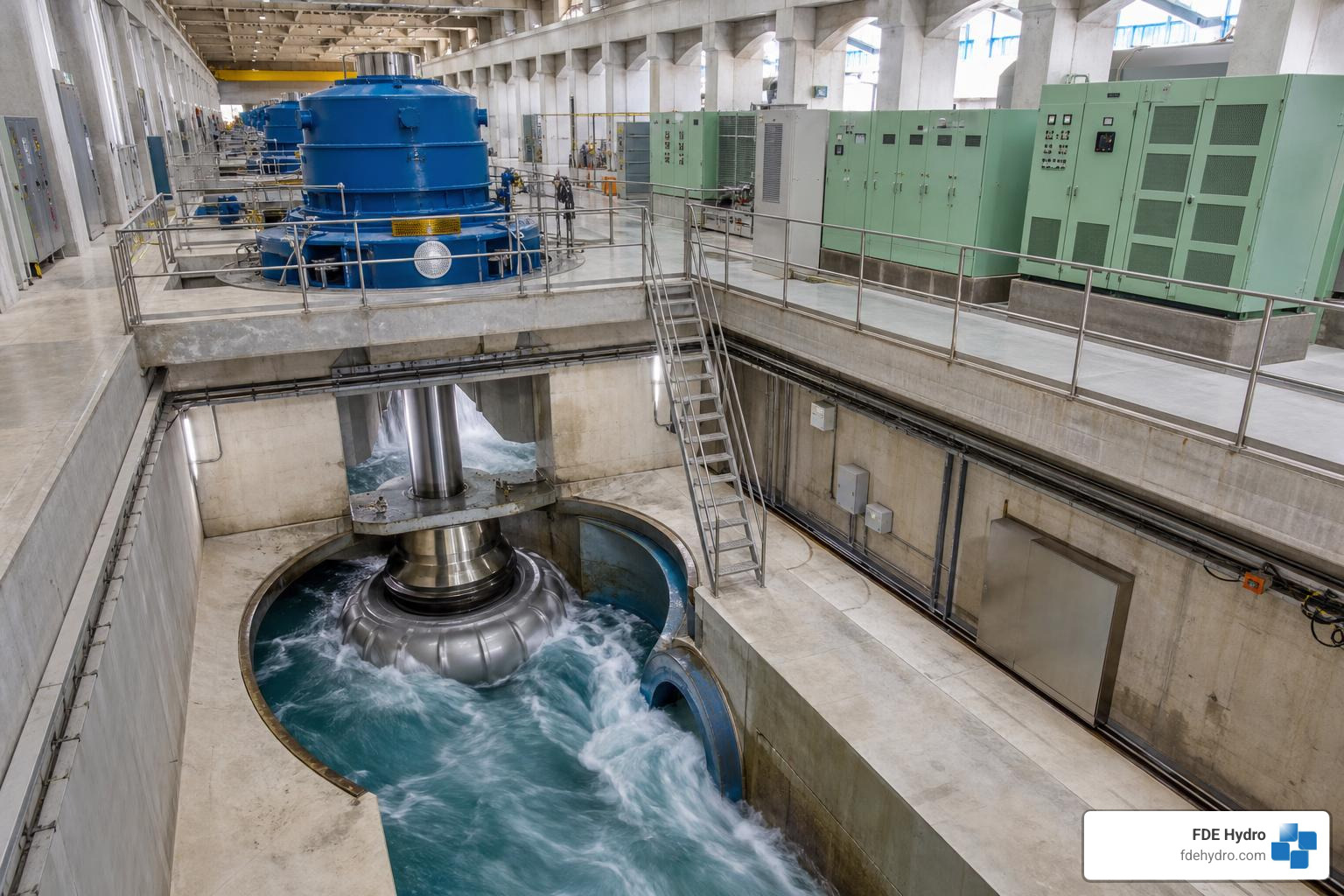
Most modern plants use reversible pump-turbines, often Francis-type machines, that can operate in both directions. In generation mode, water spins the turbine. In pumping mode, the machine reverses and pushes water uphill.
According to the U.S. Department of Energy’s overview of pumped storage hydropower, this is why PSH behaves like a giant battery. It does not create energy from nothing. It stores electricity when it is abundant and returns most of it when it is valuable.
Typical round-trip efficiency is about 70% to 80%. In plain English, if a plant uses 100 units of electricity to pump water uphill, it can usually return about 70 to 80 units later. The losses come from turbine, pump, motor, generator, friction, and evaporation effects.
A pumped storage project looks simple from far away: two reservoirs and a powerhouse. Up close, it is a carefully integrated civil, mechanical, electrical, and control system.
The major components include:
Upper reservoir: Stores water at elevation so it can be released for generation.
Lower reservoir: Receives water after generation and supplies water for pumping.
Dams and embankments: Create or support reservoir storage.
Intake structures: Control water entry into tunnels or conduits.
Penstock or water conveyance tunnel: Carries high-pressure water between reservoirs and turbines.
Powerhouse: Contains pump-turbines, generators, motors, valves, transformers, and controls.
Transmission connection: Moves power to and from the grid.
Control systems: Coordinate pumping, generation, ramping, grid services, and protection systems.
The civil works are often the largest cost and schedule driver. That includes excavation, concrete, reservoir lining, dam construction, water conveyance, and site access. This is where modern construction methods matter.
At FDE Hydro, our patented modular precast concrete technology, known as French Dam, is designed to reduce the time, cost, and uncertainty involved in building and retrofitting hydroelectric dams and water control systems. For pumped storage, modular construction can help standardize critical structures, improve quality control, and reduce on-site construction complexity.
In an industry where “pour concrete on a remote mountain for years” has too often been the default plan, modularity is not just nice. It is overdue.
Open-Loop vs. Closed-Loop Pumped Storage Hydro Systems
There are two main categories of pumped storage hydro: open-loop and closed-loop.
Open-loop pumped storage has an ongoing hydrologic connection to a natural water body, such as a river, lake, or existing reservoir. Some open-loop projects are paired with conventional hydropower reservoirs. These systems can be efficient uses of existing infrastructure, but they may face more complex aquatic habitat, fish passage, water quality, and flow management requirements.
Closed-loop pumped storage uses two reservoirs that are not continuously connected to a natural river system. These are often called off-river systems. The same water is cycled between the reservoirs again and again, with periodic makeup water for evaporation, seepage, and maintenance losses.
The key differences are:
Feature
Open-loop PSH
Closed-loop PSH
Water connection
Connected to natural water body
Generally off-river and self-contained
Environmental review
Often more aquatic impacts to evaluate
Often lower fish and river-flow impact
Siting
Can use existing lakes, rivers, or dams
Can be located away from rivers if topography works
Water reuse
Reuses water but interacts with natural flows
Reuses a mostly fixed water volume
Permitting
Often more complex hydrologic issues
Still rigorous, but usually fewer river impacts
Closed-loop systems are receiving growing attention because they can reduce impacts to river ecosystems and expand the number of possible sites. We discuss this shift in Why Pumped Storage is Making a Huge Splash.
Common Pumped Storage Hydro Configurations
Pumped storage is not one-size-fits-all. In fact, that is part of its value.
Common configurations include:
New-build closed-loop projects: Two purpose-built reservoirs, often off-river.
Existing dam upgrades: Adding pumping and generation capability to existing water infrastructure.
Non-powered dam conversions: Using dams that already hold water but do not currently generate electricity.
Mine-site or quarry reservoirs: Repurposing excavated land, shafts, pits, or industrial sites.
Brownfield redevelopment: Reusing disturbed sites with existing access roads, grid proximity, or water infrastructure.
Hybrid hydropower projects: Combining conventional hydropower and pumped storage operations.
The most important physical factor is hydraulic head, meaning the vertical distance between the upper and lower reservoirs. More head means more energy from the same amount of water. Reservoir volume determines duration. A small reservoir with high head may provide a short burst of high power. A larger reservoir pair may provide many hours or even days of storage.
The Role of PSH in Modern Grid Reliability
A modern grid must do more than produce enough energy over a year. It must match supply and demand every second.
That is where pumped storage hydro shines.
Pumped storage can provide:
Fast ramping: Increasing or decreasing output quickly as demand changes.
Frequency control: Helping keep the grid near its required operating frequency.
Voltage support: Stabilizing local and regional grid conditions.
Grid inertia: Supporting system stability that can be reduced as conventional rotating generators retire.
Black-start capability: Helping restart parts of the grid after an outage.
Peak capacity: Supplying high-demand periods when power prices and reliability needs rise.
Renewable integration: Absorbing excess wind and solar and delivering it later.
Curtailment reduction: Preventing clean electricity from being wasted when generation exceeds demand.
Wind and solar are excellent resources, but they are variable. Solar ramps down in the evening just as homes, businesses, and industry may still need electricity. Wind can surge at night when demand is low. Pumped storage acts like the grid’s shock absorber.
The International Hydropower Association notes that pumped storage is the dominant long-duration storage technology globally, with nearly 200 GW of installed power capacity and up to about 9,000 GWh of stored energy worldwide. You can explore more global hydropower context through the International Hydropower Association.
Why Pumped Storage Hydro is Valuable for Long-Duration Energy Storage
Batteries are important, especially for short-duration and fast-response applications. But pumped storage hydro brings different strengths. It is not a replacement for every battery. It is the heavy-duty storage workhorse for the grid.
Benefit
Why it matters
Long asset life
Plants can operate for many decades with maintenance and upgrades
Large storage capacity
Reservoirs can store massive amounts of energy
Long duration
Many projects can discharge for 6, 8, 10, or more hours
Low degradation
Water does not wear out like battery cells
Scalable reservoirs
Energy capacity can often be increased by reservoir sizing
Dispatchable power
Operators can generate when the grid needs it
Water reuse
The same water cycles repeatedly between reservoirs
Domestic materials
Concrete, steel, aggregates, and civil works can often be sourced regionally
Grid reliability
Supports stability, reserves, and emergency response
O&M familiarity
Hydropower equipment is mature and well understood
The main tradeoff is upfront cost. Pumped storage projects require significant civil construction, permitting, engineering, and interconnection work. They also take longer to develop than containerized battery projects.
However, the economics can be attractive over the full life of the asset. A pumped storage plant may earn revenue from multiple services:
Energy arbitrage: pumping when electricity is cheap and generating when it is valuable.
Capacity payments: being available during peak demand or reliability events.
Ancillary services: frequency regulation, spinning reserve, voltage support, and other grid services.
Transmission congestion relief: storing power where and when the grid cannot move it efficiently.
Renewable firming: turning variable wind and solar into more dependable power portfolios.
The challenge is that many electricity markets still do not fully compensate long-duration flexibility. That is a policy problem, not a physics problem.
Global and U.S. Market Capacity
As of May 2026, pumped storage hydro remains the world’s largest grid-scale energy storage technology.
Key figures include:
Global PSH power capacity is roughly 200 GW.
Global PSH energy storage is estimated at up to about 9,000 GWh.
PSH accounts for over 94% of global long-duration energy storage capacity.
In the United States, pumped storage provides about 23 GW across roughly 42 to 43 facilities, depending on the reporting method.
U.S. pumped storage represents the overwhelming majority of utility-scale energy storage capacity, often reported between 88% and 97% depending on how the category is counted.
The U.S. fleet includes some very large facilities. Bath County in Virginia is often described as one of the largest pumped storage plants in the world, with about 3 GW of generating capacity and many hours of storage. The Bad Creek facility in the Carolinas is another major U.S. project, with a proposed expansion that would increase storage and generation capability using existing infrastructure. More information is available from the Bad Creek Pumped Storage Project.
In North America, Canada also has pumped storage resources and opportunities. The Canada Energy Regulator has described pumped-storage hydro as the largest form of energy storage in Canada and an important contributor to grid reliability in its market snapshot.
Brazil is another important market to watch because of its large hydropower base, seasonal water patterns, and growing need for flexible storage as wind and solar expand. A recent academic review of pumped hydro storage in the Brazilian power industry highlights how PSH could support reliability and renewable integration in that market.
In Europe, pumped storage is already a core flexibility resource and is being evaluated as part of net-zero power system planning. The reason is straightforward: the more variable renewables a grid adds, the more it needs storage that can last longer than a quick battery burst.
Siting Challenges and Environmental Impacts
Pumped storage hydro is powerful, but it is not magic. You cannot build it just anywhere.
A strong site usually needs:
Enough elevation difference between reservoirs.
Stable geology for dams, tunnels, foundations, and slopes.
Suitable reservoir locations with manageable land impact.
Water for initial fill and periodic makeup.
Access to transmission.
Reasonable road, construction, and logistics access.
Community support and transparent engagement.
A viable permitting path.
Environmental impacts vary widely by project type. Open-loop systems may affect aquatic habitat, fish movement, water temperature, sediment, and natural flow patterns. Closed-loop systems can reduce many of those issues because they are often located away from rivers, but they still require land, water, construction disturbance, and careful management.
Important environmental topics include:
Land use and habitat conversion.
Wetlands and protected species.
Water withdrawals for initial fill.
Evaporation and seepage.
Reservoir lining and water quality.
Visual impacts.
Cultural resources.
Construction traffic, noise, and dust.
Long-term dam safety.
Water use is often misunderstood. Pumped storage typically requires an initial fill, then reuses the same water repeatedly. It is not like a once-through water system. Losses mainly come from evaporation, seepage, and maintenance operations.
Permitting remains one of the largest barriers. In the U.S., projects may involve the Federal Energy Regulatory Commission, state water agencies, environmental review, dam safety agencies, local land-use approvals, and consultation with Tribes and communities. Early engagement matters. Surprises late in the process are expensive, and not the fun kind of surprise like finding cash in an old jacket.
Repurposing Brownfield, Mine, and Existing Dam Sites
One of the most promising paths for new pumped storage is reusing sites that have already been disturbed.
That can include:
Former mines.
Quarries.
Industrial sites.
Existing reservoirs.
Non-powered dams.
Retired energy infrastructure sites.
Mine and quarry sites can be especially interesting because excavation has already created elevation differences or water-holding spaces. In some cases, an upper reservoir can be built on nearby high ground while a mine pit or underground void becomes the lower reservoir. In other cases, two existing voids can be adapted.
The U.S. Department of Energy has studied the potential for pumped storage hydropower at mine and brownfield sites because these projects may reduce greenfield disturbance, use existing roads, and create new economic activity in energy communities.
Existing dams are also a major opportunity. Many dams in North America do not generate electricity. Others generate power but do not include pumping. If the site has the right reservoir pairing, transmission access, and dam safety profile, a retrofit may be more practical than a fully new development.
How Modern Dam Construction Can Reduce Project Barriers
The traditional pumped storage development model can be slow and costly because so much depends on custom civil construction. Every site is different, and every delay compounds financing risk.
Modern modular dam construction can help.
At FDE Hydro, our French Dam technology uses patented modular precast concrete systems for building and retrofitting hydroelectric dams and water control structures. For pumped storage, this approach can support:
Faster construction schedules.
More predictable quality.
Reduced on-site labor requirements.
Less weather-dependent concrete work.
Standardized components.
Adaptable reservoir and water control designs.
Better cost control.
Easier retrofits at existing dams and non-powered sites.
This does not eliminate the need for engineering, permitting, geotechnical analysis, or environmental review. But it can reduce one of the biggest obstacles: the civil construction burden.
If pumped storage is the world’s biggest battery, then better dam construction is how we make the battery case faster, stronger, and more affordable.
Frequently Asked Questions about Pumped Storage
Pumped storage raises practical questions for utilities, developers, regulators, communities, and investors. Here are the ones we hear most often.
What is the round-trip efficiency of a pumped storage plant?
Most pumped storage plants recover about 70% to 80% of the electricity used to pump water uphill.
The lost energy is not mysterious. It comes from:
Pump inefficiency.
Turbine inefficiency.
Motor and generator losses.
Electrical transformer losses.
Friction in tunnels and penstocks.
Water turbulence.
Evaporation and seepage.
Modern turbine design, variable-speed equipment, optimized controls, and efficient water conveyance can improve performance. But no storage technology is 100% efficient. The value of PSH is that it returns large amounts of energy when the grid needs it most.
How long can pumped storage hydro provide power?
It depends on three main factors:
The volume of water in the upper reservoir.
The elevation difference between reservoirs.
The generating capacity of the turbines.
Many pumped storage plants are designed for 6 to 12 hours of discharge. Some can provide longer-duration storage depending on reservoir size and operating strategy.
A simple way to think about it:
Power capacity is the size of the faucet.
Energy capacity is the size of the tank.
Duration is how long the tank can run through the faucet.
That is why pumped storage can be scaled for long-duration needs in a way that is difficult for many electrochemical batteries. If you need more storage duration, you can often increase reservoir volume rather than add entirely new power conversion systems.
What is the difference between open-loop and closed-loop systems?
Open-loop systems connect to a natural water body, such as a river, lake, or existing hydropower reservoir. They may use natural inflows and can interact with aquatic ecosystems.
Closed-loop systems are generally off-river. They cycle water between two reservoirs with little or no continuous connection to natural flowing water.
Closed-loop systems often have a smaller river impact, but they still require environmental review, land use planning, water sourcing, and dam safety analysis.
Can pumped storage hydro be added to existing dams?
Yes, in some cases.
Adding pumped storage to an existing dam depends on:
Whether there is a suitable upper and lower reservoir pairing.
The available elevation head.
Dam safety and structural condition.
Space for a powerhouse, tunnels, intakes, and equipment.
Transmission access.
Environmental and permitting constraints.
Economics.
Non-powered dams are especially interesting because the water control structure already exists. A pumped storage retrofit can sometimes add energy storage value without creating an entirely new dam site.
Why is pumped storage hydro important for renewable energy integration?
Wind and solar are variable. The grid needs electricity on demand.
Pumped storage helps by:
Storing excess solar during midday.
Storing wind energy during low-demand periods.
Reducing renewable curtailment.
Supplying evening and morning demand peaks.
Providing fast ramping when clouds, storms, or wind changes affect output.
Supporting voltage and frequency stability.
Reducing reliance on fossil peaking plants.
In other words, pumped storage turns renewable energy from “available when nature says so” into “available when the grid needs it.”
That is the heart of the energy transition.
Conclusion
Pumped storage hydro is not new. But its importance is growing fast.
As of May 2026, grids across the United States, Canada, Brazil, and Europe are adding more wind and solar, retiring older fossil assets, and searching for reliable long-duration storage. Batteries will play a major role, but they cannot carry the entire storage burden alone.
Pumped storage hydro offers something rare: massive capacity, long duration, proven equipment, long asset life, and grid reliability services in one package.
The barriers are real. Projects need the right sites, careful environmental review, community trust, strong market signals, and better construction economics. But those barriers are solvable.
At FDE Hydro, we believe the next generation of pumped storage will be built faster and more affordably through smarter civil design, modular precast concrete, and practical retrofits of existing water infrastructure. Our French Dam technology was developed for exactly this kind of future: one where hydropower infrastructure is cleaner, faster to build, easier to adapt, and ready to support renewable energy at grid scale.
What You Need to Know About Hydroelectric Power Dams
Hydroelectric power dams are structures that capture the energy of moving water to generate electricity — one of the oldest and most reliable forms of renewable energy on the planet.
Quick answers:
What they do: Convert the kinetic and potential energy of flowing water into electricity
How they work: Water flows through a turbine, spinning a generator to produce power
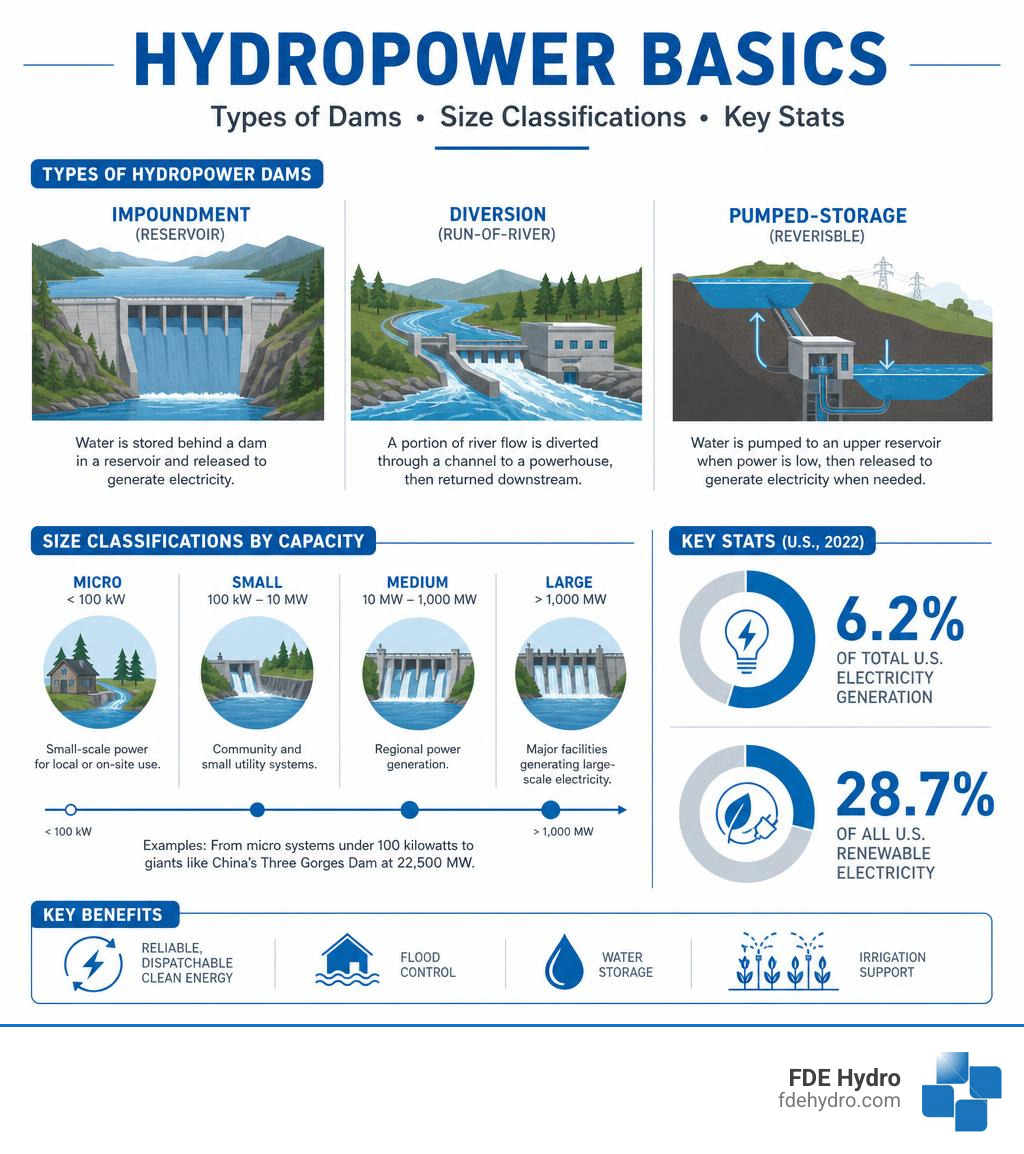
Main types: Impoundment (reservoir), diversion (run-of-river), and pumped-storage
Size range: From micro systems under 100 kilowatts to giants like China’s Three Gorges Dam at 22,500 MW
Share of U.S. electricity: About 6.2% of total generation and 28.7% of all renewable electricity (2022)
Key benefit: Reliable, dispatchable, clean energy — with added value from flood control, irrigation, and water storage
Hydropower has powered human civilization for centuries — long before the first commercial electric plant opened in Wisconsin in 1882. Today, it remains the world’s largest source of renewable electricity, with thousands of facilities operating across every inhabited continent.
Yet despite its scale and importance, hydropower is often misunderstood. Many people picture only massive concrete walls holding back enormous reservoirs. In reality, hydropower comes in many forms, sizes, and designs — each suited to different rivers, terrains, and energy needs.
I’m Bill French, Sr., Founder and CEO of FDE Hydro™, and I’ve spent decades in heavy civil construction before focusing my work on modernizing how hydroelectric power dams are designed and built using modular precast solutions. In 2015, I was selected by the U.S. Department of Energy’s Water Power Technology Office to help shape the national roadmap for next-generation hydropower. That experience — combined with the innovations we’ve developed at FDE Hydro™ — gives me a practical, ground-level perspective on what it actually takes to build and operate these facilities efficiently.
How Hydroelectric Power Dams Generate Clean Electricity
At its absolute core, generating electricity from water is a masterclass in physics made simple. We are taking the heavy, relentless pull of gravity and putting it to work.
To gain a foundational perspective, it helps to start with The Current Definition: Understanding Hydroelectric Power. In short, we are converting potential energy (water held high up) into kinetic energy (water rushing downward) to drive mechanical rotation, which finally creates electrical energy.
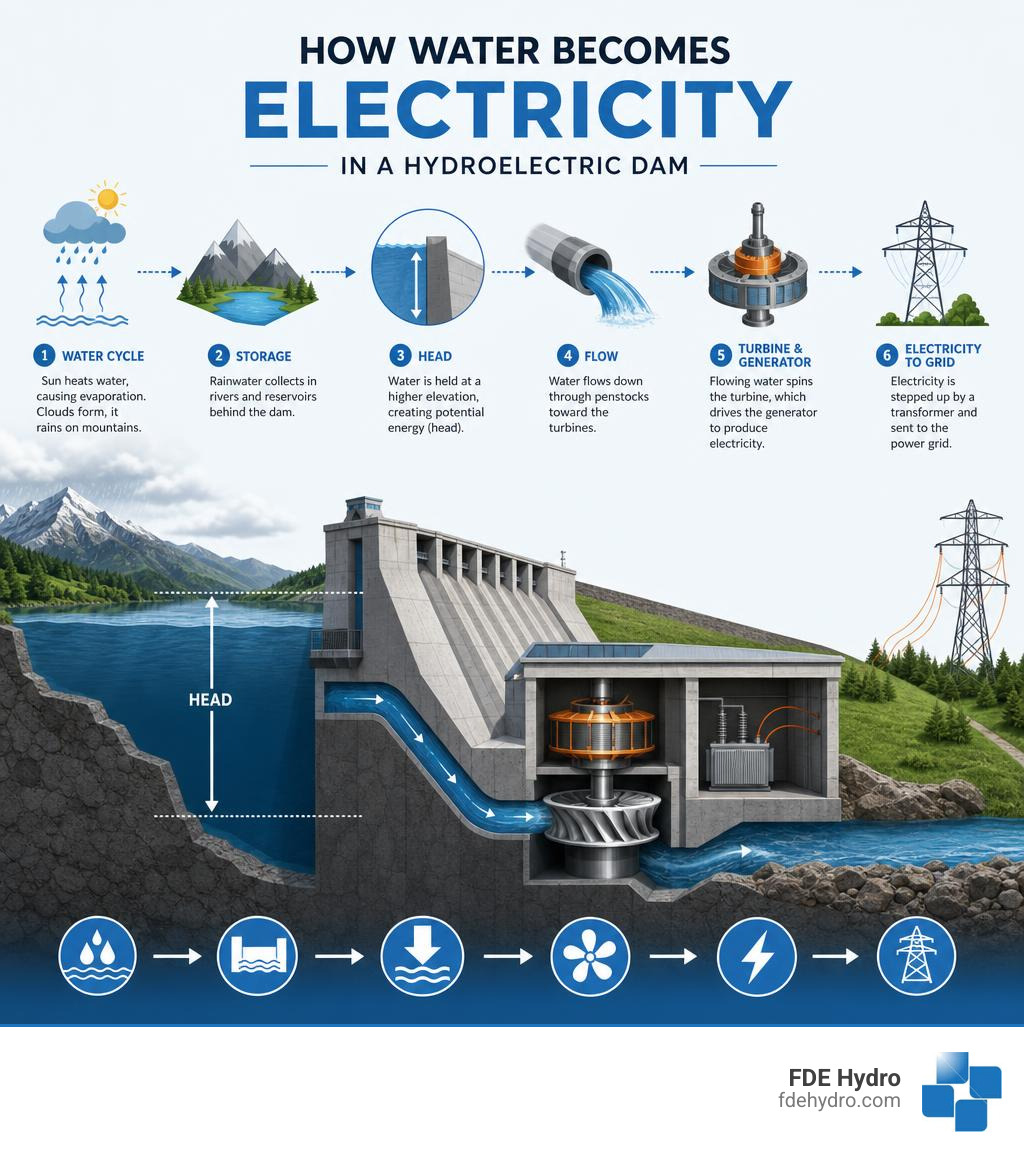
When water is held behind a dam, it contains a massive amount of stored potential energy. When we open the gates, gravity pulls that water downward through a dedicated channel. As the water rushes down, its potential energy transforms into kinetic energy. This fast-moving water slams into the blades of a turbine, forcing it to spin. Because the turbine is connected to a generator by a heavy shaft, the spinning motion rotates magnets inside copper coils, which coaxes electrons into motion. This mechanical-to-electrical conversion is the bedrock of Hydroelectric Power Generation.
The Role of the Water Cycle in Hydropower
You might wonder: does this water ever run out? This is where the earth’s natural water cycle acts as our ultimate battery charger.
Hydropower is entirely dependent on solar-powered evaporation and precipitation. The sun heats water in oceans, lakes, and rivers, turning it into water vapor. This vapor rises, condenses into clouds, and falls back to the earth as rain or snow.
This moisture gathers in rivers and streams, flowing back toward the sea. When we build hydroelectric power dams, we are intercepting this cycle. The amount of energy we can harvest from this loop depends on two key variables:
Flow Volume: How much water is actually passing through the system over a given period.
Head (Elevation Change): The vertical distance the water falls from the top of the reservoir to the turbine below. The higher the head, the more force the water exerts on the turbine.
Key Components of Hydroelectric Power Dams
While every site is unique, a conventional facility relies on several interconnected parts to keep the lights on. For a deep dive into these individual structures, check out our Hydroelectric Dam Components Ultimate Guide. Here is a quick breakdown of the primary players:
The Reservoir: The large lake behind the dam that stores water, acting as a bank of potential energy.
The Intake and Penstock: The intake is the gate that opens to let water in. The penstock is the massive, closed conduit or pipe that channels the rushing water directly down to the turbines.
The Powerhouse: The secure building that houses the turbines, generators, and control systems.
The Turbine: The modern-day water wheel that spins when struck by the rushing water.
The Generator: The machine that converts the turbine’s rotating mechanical energy into electricity.
The Tailrace: The channel that safely returns the water to the river downstream after it has passed through the turbine.
The Three Main Types of Hydropower Plants
Not all hydropower facilities look like Hoover Dam. Depending on the local geography, water flow, and grid requirements, engineers choose between three main configurations. Understanding these differences is crucial when exploring modern Hydroelectric Dam Design Complete Guide.
Impoundment Facilities (Conventional Dams)
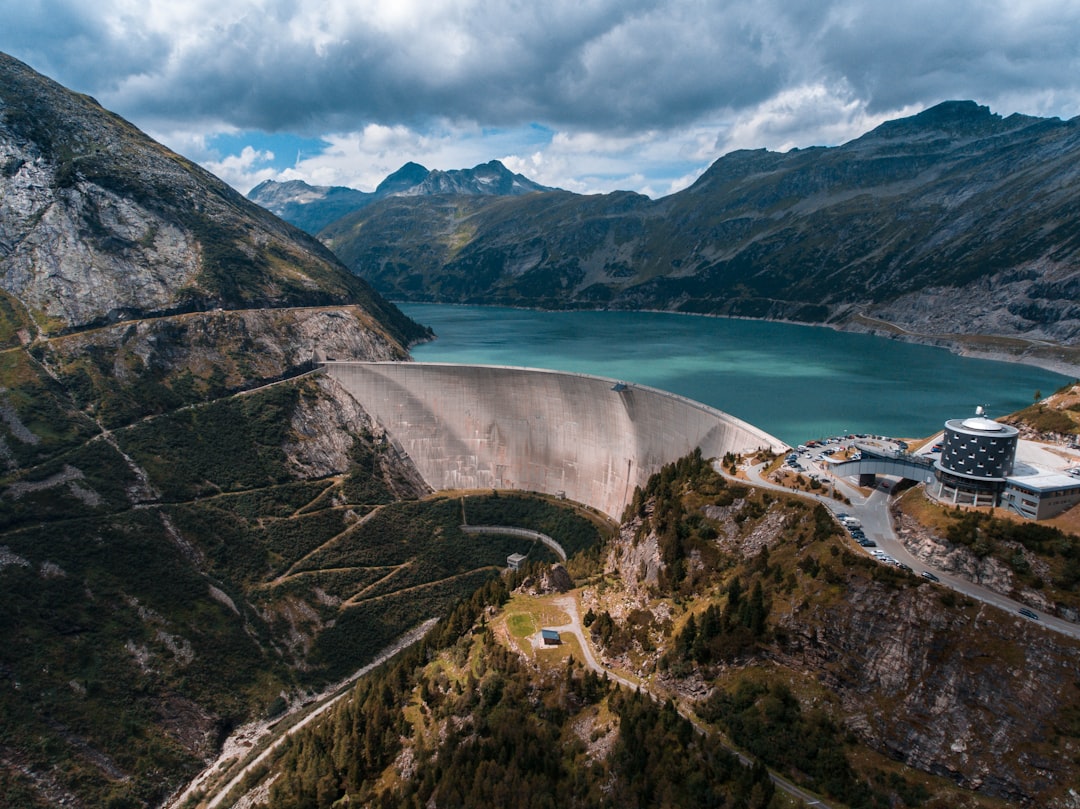
This is the classic image most people have of a hydroelectric dam. An impoundment facility uses a physical dam to block a river, creating a large reservoir behind it.
By storing water in this artificial lake, operators gain immense control. They can release water to generate electricity whenever demand spikes, making impoundment dams highly reliable “peaking” plants. However, building these massive structures requires significant capital, time, and earth-moving effort, which is why modern developers look closely at the economics of Hydroelectric Dam Construction.
Diversion or Run-of-River Systems
What if you want to generate power without flooding a massive valley? Enter the diversion system, often called a run-of-river facility.
Instead of holding back a massive reservoir, a diversion system channels a portion of a river’s natural flow through a canal or penstock to spin a turbine, after which the water is immediately returned to the main riverbed. These systems have a much smaller physical footprint and minimal environmental impact.
A great real-world example of this approach is the Patriot Hydro Lawrence Hydroelectric Project , which utilizes the natural flow of the river to generate clean power with minimal storage requirements.
Pumped-Storage Hydropower as a Giant Battery
Think of pumped-storage hydropower as a massive, water-based battery. These facilities don’t rely on the natural flow of a river to generate all their power; instead, they move water back and forth between two reservoirs at different elevations (an upper and a lower reservoir).
Here is how the cycle works:
During Low Demand (Off-Peak): When electricity demand is low (like in the middle of the night or when solar power is peaking during the day), the facility uses surplus grid electricity to pump water from the lower reservoir up to the upper reservoir.
During High Demand (Peak): When everyone turns on their air conditioners and electricity prices spike, the operators release the water from the upper reservoir. It rushes down through reversible turbines, generating electricity to stabilize the grid.
Because it takes more energy to pump the water uphill than the system recovers on the way down, pumped-storage is a “net-negative” generator. However, its ability to store massive amounts of intermittent renewable energy (like wind and solar) and discharge it on demand makes it an invaluable asset for modern grid stability.
Classifying Hydropower Plants by Size and Capacity
Hydropower facilities are also categorized by their generating capacity, which is measured in megawatts (MW) or kilowatts (kW).
Large hydropower plants are the heavy lifters of the renewable energy world. Defined as facilities with a capacity of more than 30 MW, these massive installations can supply electricity to millions of homes.
They provide essential baseload power and grid stabilization services, helping balance out more volatile renewable sources. Organizations like the Hydroelectric Power – California Energy Commission – CA.gov oversee these large-scale assets to ensure they safely integrate with regional transmission networks.
Small and Micro Hydropower Systems
At the other end of the spectrum, small and micro hydropower systems prove that you don’t need to block a massive river to make a big difference. Small hydro (100 kW to 10 MW) and micro hydro (under 100 kW) are excellent for rural electrification and local industrial use.
These smaller systems often utilize existing water infrastructure, municipal water lines, or small streams without requiring massive dams. For example, historical sites like the About Bowersock facility show how smaller-scale, run-of-river installations can provide reliable, community-aligned clean energy for over a century with minimal disruption to the local ecosystem.
Historical Evolution of Water Turbines and Technology
Long before we used water to power our laptops, ancient civilizations used it to grind grain and saw wood. The history of hydropower is a fascinating journey of human ingenuity, which we explore in detail in Harnessing the Current: A Guide to Hydroelectric Power Production.
From Ancient Water Wheels to Modern Turbines
The earliest records of water power date back to the Han Dynasty (202 BC to 9 AD) in China, where water-driven trip hammers were used to hull grain. For centuries, simple wooden water wheels did the heavy lifting of the early industrial era.
The leap from mechanical work to electricity happened in the late 19th century. In 1878, the world’s first hydroelectric power project was built at Cragside House in Northumberland, England, where it was used to light a single lamp. Just a few years later, on September 30, 1882, the first commercial hydroelectric plant opened on the Fox River in Appleton, Wisconsin, proving that water could reliably power local grids.
Francis, Pelton, and Kaplan Turbines
As the demand for electricity grew, engineers moved away from simple water wheels and designed highly specialized, metal water turbines. Today, three main turbine designs dominate the industry, each optimized for different water speeds and heights. Maximizing their performance is a key focus of Hydroelectric Dam Efficiency.
The Francis Turbine: Invented by James Francis in 1849, this is a reaction turbine where water flows inward radially, spinning the runner. It remains the most widely used water turbine in the world today, operating best in medium-head and medium-flow environments.
The Pelton Wheel: Designed for high-head, low-flow situations (like a steep mountain stream), the Pelton wheel is an impulse turbine. High-pressure nozzles blast jets of water at spoon-shaped buckets on the wheel, forcing it to spin at high speeds.
The Kaplan Turbine: Essentially a high-tech boat propeller inside a pipe, the Kaplan turbine is designed for low-head, high-flow conditions. Its defining feature is its adjustable blades, which allow operators to maintain high efficiency even when river flows change seasonally.
The World’s Largest Hydroelectric Power Stations
When it comes to sheer engineering scale, hydroelectric power dams rank among the largest artificial structures ever built. You can discover more about these incredible feats of engineering in Dive Into Hydropower: Unlocking Nature’s Electric Potential.
Global Giants: Three Gorges and Itaipu
At the top of the global list sits the Three Gorges Dam in China, holding the record for the world’s largest instantaneous generating capacity at a staggering 22,500 MW.
However, capacity isn’t the only metric that matters. The Itaipu Dam, located on the border of Brazil and Paraguay, has an installed capacity of 14,000 MW from its 20 generator units. Yet, because the Paraná River has a incredibly consistent year-round flow, Itaipu often matches or exceeds Three Gorges in actual annual energy generation. In 2013, Itaipu reached a historic world record by generating 98,630,035 MWh of electricity in a single year—enough to supply Paraguay’s electricity needs for nearly eight years. To explore more about this facility and others in the region, you can read the ITAIPUMAGAZINEENGLISH_LR or browse the List of hydroelectric power stations in Brazil – Wikipedia .
North American Leaders: Grand Coulee Dam
In the United States, the crown belongs to the Grand Coulee Dam on the Columbia River in Washington state. Completed in 1941, this massive concrete gravity dam stands 550 feet tall and stretches 5,223 feet long.
With a total generating capacity of 6,809 MW, Grand Coulee produces roughly 21 billion kilowatt-hours of electricity annually, supplying clean power to eight western states and parts of Canada. To put its size in perspective, the concrete used to build it could construct a four-foot-wide sidewalk wrapping twice around the equator! For more mind-boggling details, check out the Grand Coulee Dam Statistics and Facts and the Grand Coulee Dam > Northwestern Division > Fact Sheet – Northwestern Division .
Multi-Purpose Benefits and Environmental Impacts of Dams
While generating clean electricity is a primary goal, hydroelectric power dams are rarely single-purpose structures. They are complex water management tools that shape local economies and ecosystems.
Flood Control, Irrigation, and Recreation
Most large dams are built to solve multiple challenges at once.
Flood Control: By holding back water during heavy rains or spring snowmelts, dams protect downstream communities from devastating floods. A classic example is the Albeni Falls Dam , which was authorized under the Flood Control Act of 1950 to protect the Columbia River Basin.
Irrigation: Reservoirs store water that can be diverted to irrigate millions of acres of farmland during dry summer months, supporting local agricultural economies.
Recreation and Tourism: Reservoir lakes provide fantastic spaces for boating, fishing, and camping, driving local tourism.
Environmental and Social Challenges of Hydroelectric Power Dams
Despite their benefits, large dams present real environmental and social challenges that cannot be ignored:
Fish Migration: Physical barriers block fish like salmon from reaching their upstream spawning grounds.
Habitat Alteration: Flooding a valley to create a reservoir changes the local terrestrial and aquatic habitat, which can displace wildlife.
Community Displacement: Building massive reservoirs historically required relocating communities living in the valleys destined to be flooded.
Greenhouse Gases: While hydropower is low-carbon, decaying vegetation in newly flooded reservoirs can release methane, a potent greenhouse gas, particularly in tropical climates.
Safety, Operations, and Regulatory Oversight
Because of the massive volume of water they hold, dam safety is a matter of national security. Dams in the United States are heavily regulated and continuously monitored. Federal agencies like the Bureau of Reclamation and the Bureau of Reclamation manage these assets with rigorous safety standards.
Operators use thousands of monitoring instruments to track structural movement, water pressure, and concrete health, ensuring that these vital infrastructure assets remain safe and operational for generations.
Frequently Asked Questions about Hydropower
How many of the dams in the United States produce power?
Believe it or not, of the more than 90,000 dams in the United States, less than 3% actually produce power. The vast majority of U.S. dams were built strictly for flood control, municipal water supply, crop irrigation, or recreation. This represents a massive opportunity: we can retro-fit many of these existing “non-powered” dams with modern turbines to generate clean energy without having to build a single new concrete wall in a river.
Why do some hydroelectric power dams generate more electricity than others with larger capacities?
It all comes down to water availability and consistency. A dam’s installed capacity (measured in MW) is the maximum power it can produce under perfect conditions. However, its actual generation (measured in MWh) depends on how much water flows through it over the course of a year.
For example, while China’s Three Gorges Dam has a much larger capacity than the Itaipu Dam, Three Gorges experiences dry seasons where water flows drop significantly. Because the Paraná River feeding Itaipu has a very steady, high-volume flow year-round, Itaipu is often able to generate a similar amount of total electricity annually despite its smaller nameplate capacity.
How do modern fish passage systems protect wildlife?
Modern dam design prioritizes fish passage to protect local migratory species. Engineers use several clever solutions:
Fish Ladders: A series of stepped, water-filled pools that allow fish to literally swim and jump their way up and around a dam.
Spawning Channels: Artificial streams built alongside the dam that mimic natural riverbeds, giving fish a safe path to travel and spawn.
Fish-Friendly Turbines: Newer turbine designs feature blunter blades that rotate slower, allowing fish to pass through safely without injury.
Conclusion
As we look toward a clean energy future, the role of hydroelectric power dams is evolving. We are moving away from the era of massive, disruptive mega-dams and entering an era focused on efficiency, retrofitting, and minimal environmental impact.
At FDE Hydro™, we are leading this shift. Our patented modular precast concrete technology—known as the “French Dam”—redefines how water control systems and hydroelectric projects are built. By manufacturing concrete modules off-site and assembling them rapidly in the field, we significantly reduce construction costs, minimize environmental disruption, and slash project timelines across North America, Brazil, and Europe. Whether we are retrofitting a non-powered dam or building a new run-of-river system, our goal is to make clean, reliable hydropower more accessible and sustainable than ever before.
To learn more about how we are shaping the future of water power, explore our complete guide to Hydropower and join us in building a cleaner, more resilient energy grid.
Hydropower infrastructure funding upgrades are now more accessible than ever — thanks to a wave of federal investment targeting America’s aging dams and hydroelectric facilities.
Here’s a quick overview of the key funding available right now:
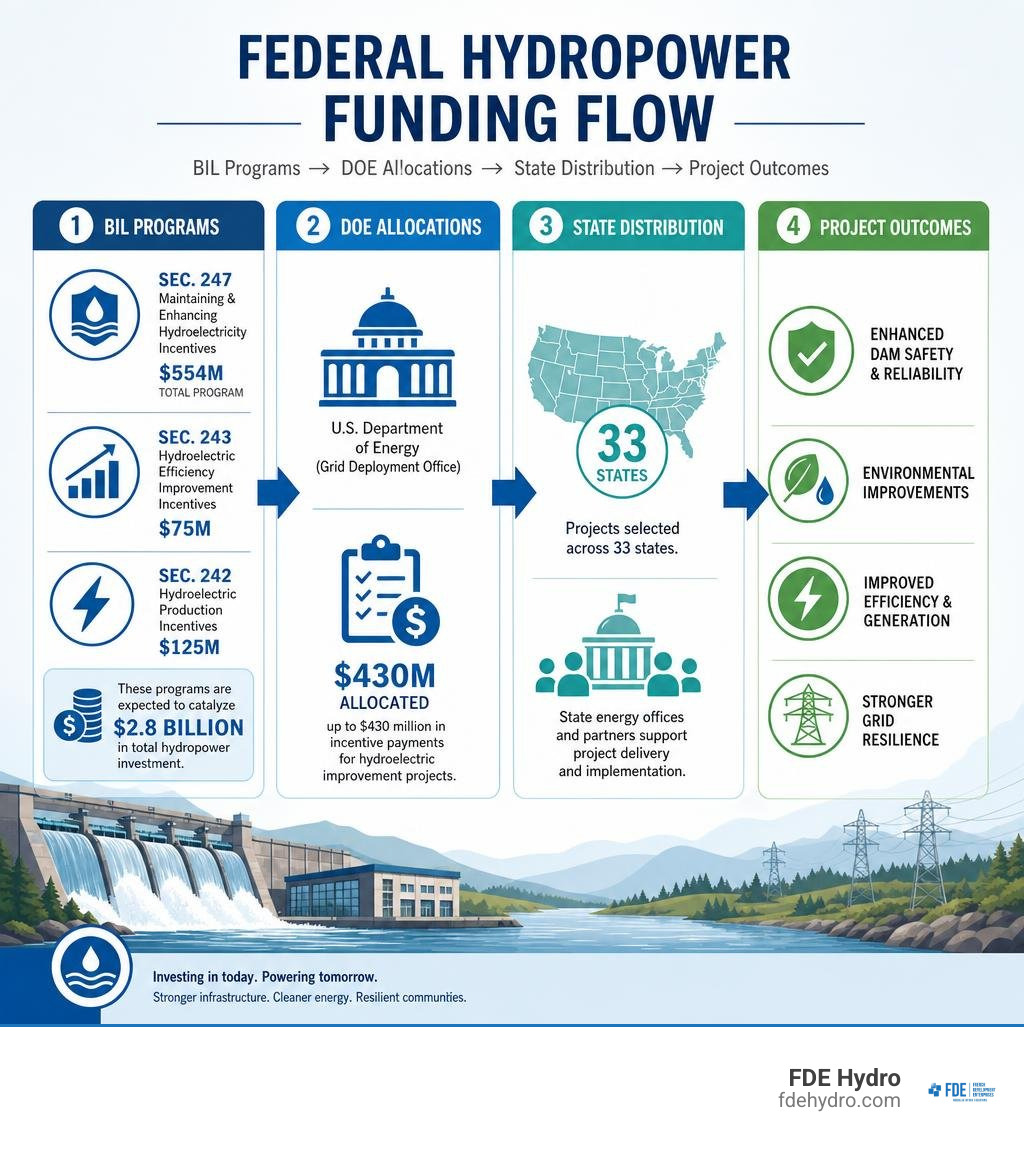
Together, these programs — funded through the Bipartisan Infrastructure Law — are expected to catalyze $2.8 billion in total hydropower investment when combined with private capital contributions.
America’s hydropower fleet is quietly aging. The average facility receiving federal funding today has been running for 79 years. The American Society of Civil Engineers gave U.S. dams a D+ grade in their 2025 Infrastructure Report Card — and nearly 70% of all U.S. dams were expected to surpass 50 years of age by 2025.
Yet hydropower still supplies nearly 27% of all U.S. renewable electricity and represents 93% of utility-scale energy storage. That’s an enormous amount of critical grid infrastructure that has been quietly deferred, patched, and stretched well past its original design life.
The funding is here. The need is urgent. And for facility operators and project developers, the window to act is open now.
I’m Bill French, Sr., Founder and CEO of FDE Hydro™ — and for the past decade I’ve worked directly at the intersection of modular construction innovation and hydropower infrastructure funding upgrades, including being selected by the DOE’s Water Power Technology Office to help define the next-generation hydropower roadmap for Congress. In this guide, I’ll walk you through exactly where the money is, how it’s distributed, and how to position your project to access it.
The Bipartisan Infrastructure Law: Driving Hydropower Infrastructure Funding Upgrades
The Bipartisan Infrastructure Law is the financial engine behind the current wave of hydropower modernization. Through the U.S. Department of Energy and its Grid Deployment Office, the law created major incentive pathways for hydroelectric facilities that need capital improvements but cannot always justify the upfront cost through power sales alone.
The headline number is clear: the DOE selected 293 hydroelectric improvement projects across 33 states for up to $430 million in incentive payments under the Maintaining and Enhancing Hydroelectricity Incentives program. That allocation sits within a broader $554 million Section 247 program.
This matters because hydropower projects are not small weekend repairs. A serious modernization can include:
Turbine replacement
Generator rewinds or replacements
Digital control system upgrades
Spillway rehabilitation
Concrete repair and seepage mitigation
Fish passage construction
Water quality improvements
Recreation access improvements
Cybersecurity and grid control upgrades
Equipment needed to integrate variable renewable resources
Maintaining and Enhancing Hydroelectricity Incentives (Section 247)
Section 247 is the big one for owners pursuing capital upgrades.
Under this program, the DOE selected projects that fall into three main categories:
Grid resilience improvements
Dam safety upgrades
Environmental and recreational enhancements
The current award round includes $430 million for 293 projects. The DOE has said these projects will strengthen grid resilience at 215 facilities, while also improving dam safety at sites that average 79 years in operation.
That age matters. A facility built in the 1940s or 1950s may still be producing clean energy, but its original design probably did not anticipate today’s operating reality: more solar and wind on the grid, more severe rain events, more drought stress, stricter environmental requirements, higher safety expectations, and much faster digital control needs.
For owners, Section 247 is not just a grant opportunity. It is a way to de-risk long-term reinvestment. Hydropower financing can be challenging because the biggest costs often arrive before revenue improvements are visible. We explore this issue in more detail in Financing Long-Term Hydropower Requires Mitigating Risks Prior to ROI.
The practical takeaway is simple: if your facility needs upgrades that improve resilience, safety, environmental performance, or public use, Section 247 should be on your radar.
Complementary DOE Programs for Hydropower Infrastructure Funding Upgrades
Section 247 is not the only tool in the federal toolbox. The DOE also supports hydropower through complementary incentive programs authorized under the Energy Policy Act.
The three major programs are:
Program
Section
Purpose
Notable Funding
Hydroelectric Production Incentives
242
Supports eligible hydroelectric generation
$125 million
Hydroelectric Efficiency Improvement Incentives
243
Supports capital improvements that improve efficiency
$75 million
Maintaining and Enhancing Hydroelectricity Incentives
247
Supports resilience, safety, environmental, and recreation upgrades
$554 million total
The Hydroelectric Efficiency Improvement Incentives program is especially important for facilities where equipment modernization can increase output. Earlier DOE materials identified nearly $75 million for efficiency upgrades, with an emphasis on projects that can demonstrate meaningful efficiency gains.
The Hydroelectric Production Incentives program supports eligible generation from qualified facilities. This can be useful for operators who are already producing renewable power and need incentive payments to improve project economics.
Our view: do not treat these programs as isolated buckets. A strong funding strategy looks at the full capital stack. Federal incentives, private capital, utility partnerships, tax planning, and phased construction can work together. Hydropower funding is a puzzle, but at least it is a puzzle with water flowing through it.
Where the Money Goes: State Allocations and Project Distribution
The $430 million Section 247 allocation is spread across 293 projects in 33 states. That broad distribution is important because hydropower is not a one-region resource. It supports rural communities, industrial loads, urban grids, irrigation systems, flood control, recreation, and clean energy goals across the country.
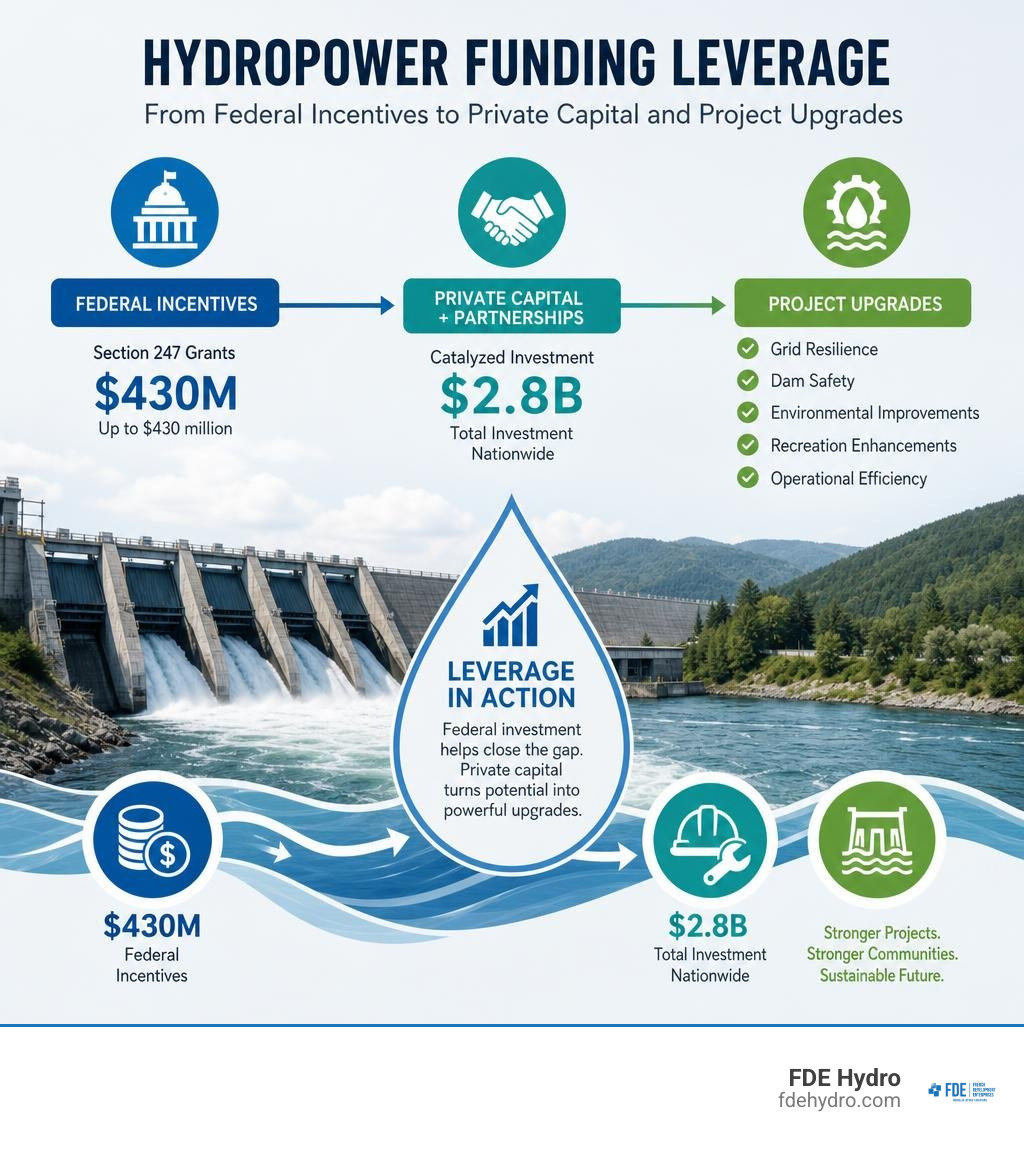
The federal investment is also expected to unlock far more than the initial grant amount. When combined with private contributions, the $430 million is expected to catalyze about $2.8 billion in total hydropower investment nationwide.
That leverage is the real story.
Federal dollars help close the funding gap. Private capital, owner equity, utility investment, and project debt then help turn deferred maintenance into completed construction.
State or Region Highlight
Project Count
Reported Funding
Why It Matters
California
29
Over $60 million
Major support for Western grid reliability, drought adaptation, and renewable integration
New York
23
$25.4 million
Supports a state with major legacy hydropower assets and high clean-energy demand
National total
293
Up to $430 million
Covers grid resilience, dam safety, environmental, and recreation improvements
Expected total investment
N/A
$2.8 billion
Shows how federal incentives can leverage private capital
Key State Winners: California, New York, and Maine
California and New York stand out for our work because both are central to FDE Hydro’s North American focus and both have significant hydropower infrastructure needs.
California received 29 projects totaling more than $60 million. For a state balancing hydropower, solar, wind, wildfire risk, drought, and major load growth, these upgrades are not optional. They are part of keeping the grid flexible and dependable.
California’s hydropower fleet also faces a climate reality that every owner should take seriously: water conditions are changing. Facilities that once operated under more predictable hydrology now need equipment and civil works that can perform under wider extremes.
New York received 23 projects totaling $25.4 million. This is especially relevant because New York has large legacy hydropower assets, high electrification goals, and a grid that increasingly depends on firm, dispatchable clean energy.
Maine also appeared among the notable national allocations in DOE-related reporting, including $33.8 million for 21 projects. Because our geographic focus in this guide is the United States with emphasis on California and New York, we will keep the deeper discussion centered on those markets. The broader lesson still applies: states with older hydro fleets and clear upgrade needs are seeing meaningful federal support.
Case Studies in Modernization: From Hoover Dam to Niagara
Two high-profile modernization examples show why funding cannot stop at routine maintenance.
First, Hoover Dam. Federal reporting and regional coverage note that the Bureau of Reclamation freed up approximately $52 million for turbine upgrades and infrastructure work at Hoover Dam. The plan includes replacing older turbines with wide-head turbines that can operate at lower Lake Mead elevations. According to reporting in Hoover Dam gets $52M for wide-head turbines from Bureau of Reclamation, the new equipment is intended to help restore around 160 megawatts of capacity and keep generation viable as reservoir levels fluctuate.
That is climate resilience in plain terms: when the water level changes, the equipment has to keep up.
Second, New York’s Niagara modernization. The New York Power Authority has been advancing a $1.1 billion modernization and digitization program at the Niagara Power Project. Coverage in NYPA upgrades first of 14 turbines in $1.1B Niagara modernization, digitization program describes mechanical upgrades, digital controls, turbine work, and major equipment replacement.
This is exactly the kind of long-horizon thinking hydropower needs. We are not upgrading facilities for the next three years. We are trying to keep clean, dispatchable assets useful for decades.
Upgrading Aging Assets: Grid Resilience, Dam Safety, and Environmental Goals
The current funding push is not about shiny new gadgets. It is about keeping critical infrastructure safe, productive, and compatible with modern energy and environmental standards.
The average facility selected for federal funding has been operating for 79 years. That means many projects were designed before today’s environmental rules, before modern grid controls, before large-scale wind and solar, and before current climate projections.
Addressing the D+ Dam Safety Crisis and Aging Infrastructure
The ASCE D+ grade for U.S. dams is not a gold star. It is more like the infrastructure equivalent of a check-engine light that has been blinking for years.
Dam safety upgrades supported by federal funding can include:
Spillway capacity improvements
Emergency spillway rehabilitation
Concrete replacement
Embankment stabilization
Seepage control
Gate and hoist replacement
Monitoring instrumentation
Structural strengthening
Erosion repairs
Flood routing improvements
The challenge is that dam repairs are often expensive, disruptive, and site-specific. A concrete problem at one facility may be a seepage problem at another. A spillway that worked for 1950s rainfall assumptions may not be appropriate for today’s extreme storm patterns.
Implementing Hydropower Infrastructure Funding Upgrades for Grid Resilience
Hydropower is uniquely valuable because it can provide firm, flexible power. It is not just renewable generation. It is also a stabilizing resource for a grid with more variable energy.
Hydropower accounts for nearly 27% of U.S. renewable electricity generation. Pumped storage hydropower represents the overwhelming majority of utility-scale energy storage, with DOE materials and industry reporting frequently citing figures around 93% of utility-scale storage.
Grid resilience upgrades can include:
Turbine replacement
Generator upgrades
Governor and exciter modernization
Control system digitization
Supervisory control and data acquisition improvements
Switchyard and transformer upgrades
Black-start capability improvements
Equipment that helps integrate wind and solar
Cybersecurity upgrades
Pumped storage modernization
This is where modernization becomes more than maintenance. A better turbine, a faster control system, or a stronger generator can help a facility respond to grid needs more quickly. That flexibility becomes more valuable as renewable penetration rises.
For owners thinking about technical options, we recommend reviewing our resource on Hydropower Retrofitting.
Environmental and Recreational Enhancements
The Section 247 program also supports environmental and recreational improvements. That is a major point for owners, because long-term hydropower viability depends on more than megawatts.
Eligible or commonly supported environmental improvements may include:
Fish ladders
Fish passage systems
Fish screens
Bypass flows
Water quality improvements
Dissolved oxygen improvements
Habitat restoration
Sediment management
Turbines designed to reduce aquatic impacts
Recreation improvements may include:
Boating access
Kayak portage routes
Public access improvements
Shoreline safety upgrades
Fishing access
Trail or viewing area improvements where appropriate
These upgrades can improve licensing outcomes, community support, and long-term public trust. A hydropower project that supports fish movement, water quality, recreation, and clean energy has a stronger social license to operate.
And yes, “fish ladder” sounds like something a trout would buy at a hardware store. But in practice, fish passage is one of the most important ways hydro facilities can reduce ecological disruption while continuing to generate renewable electricity.
Economic Impacts, Job Protection, and the Justice40 Initiative
The DOE has stated that the $430 million in selected incentive payments will help protect 6,000 existing jobs at hydropower facilities and among contractors and vendors.
That job protection matters because hydropower facilities anchor local economies. A dam upgrade can support:
Plant operators
Civil contractors
Electrical contractors
Mechanical suppliers
Engineering firms
Environmental consultants
Concrete producers
Steel fabricators
Transportation providers
Local service businesses
The funding also supports the federal Justice40 Initiative, which aims to direct 40% of the overall benefits of certain federal climate and clean energy investments to disadvantaged communities.
For hydropower, Justice40 benefits may include:
More reliable local electricity
Safer dam infrastructure
Reduced flood risk
Cleaner water
Improved recreation access
Local job retention
Workforce development
Lower risk of infrastructure failure
Continued clean power from existing assets
This is important because disadvantaged communities are often more vulnerable to infrastructure failure, flooding, poor water quality, and energy reliability problems. A dam safety project is not just a concrete project. It can be a community protection project.
Frequently Asked Questions about Hydropower Upgrades
What is the timeline for these federal funding programs?
The DOE has already selected 293 projects for up to $430 million under Section 247. Once projects are selected, owners typically move through award finalization, compliance requirements, contracting, engineering, procurement, permitting coordination, and construction.
Actual timelines vary by project type. A controls upgrade may move faster than a spillway reconstruction. A turbine replacement may require long equipment lead times. Environmental enhancements may require seasonal construction windows to protect aquatic species.
DOE materials tied to the original funding announcement indicated that a second round of funding was expected in the following calendar year. As of June 2026, owners should check the Grid Deployment Office and DOE hydro incentive pages for the latest application windows, award status, and program guidance.
Our recommendation: do not wait for the next notice before preparing. Have your technical scope, cost estimate, community benefits, environmental benefits, and financing plan ready early.
How do these upgrades address climate change and drought?
Hydropower is directly exposed to climate conditions. Too little water reduces generation. Too much water can stress spillways and flood routing systems. Warmer water can create water quality and habitat issues. More extreme storms can challenge older dam designs.
Modern upgrades can address these risks in several ways:
Wide-head turbines can operate across a wider range of reservoir elevations.
Spillway upgrades can improve performance during extreme rainfall.
Concrete and seepage repairs can reduce failure risk.
Better controls can help operators respond faster to changing grid and water conditions.
Environmental upgrades can improve water quality and aquatic habitat.
Pumped storage modernization can help store excess wind and solar energy.
The Hoover Dam turbine example is a useful illustration. As Lake Mead levels have declined, older turbines face performance and damage risks at lower elevations. Newer turbine technology can help maintain generation under more difficult hydrologic conditions.
Climate resilience is not a slogan here. It is a design requirement.
Can private capital be leveraged alongside federal grants?
Yes. In fact, that is one of the most important features of the current funding environment.
The $430 million federal allocation is expected to catalyze about $2.8 billion in total hydropower investment when combined with private contributions. That means federal funding is functioning as a leverage tool, not a complete replacement for owner investment.
A strong capital stack may include:
DOE incentive payments
Owner equity
Private debt
Utility partnerships
Power purchase agreements
State or regional incentives where available
Tax credit planning where applicable
Public-private partnership structures
Phased procurement and construction planning
The key is to make the project investable. That means reducing technical risk, showing a clear upgrade scope, documenting public benefits, and demonstrating that the facility will remain viable after construction.
This is where cost-saving construction methods can make a major difference. If a project can reduce construction time, reduce onsite complexity, and improve schedule certainty, the financing case gets stronger.
Conclusion
Hydropower has done quiet, reliable work for more than a century. Now it needs reinvestment equal to its importance.
The current wave of hydropower infrastructure funding upgrades gives owners and developers a rare opportunity to modernize aging assets, improve dam safety, strengthen grid reliability, support disadvantaged communities, and extend the life of clean energy infrastructure.
At FDE Hydro, we believe this is exactly the moment for smarter construction. Our patented French Dam modular precast concrete technology is designed for building and retrofitting hydroelectric dams and water control systems with less construction time and lower project cost. For owners in the United States, Canada, Brazil, and Europe, that can mean a stronger funding application, a more realistic capital plan, and a faster path from award to operation.
Federal funding can open the door. Good engineering, practical construction methods, and disciplined project planning are what get the work done.
If your facility needs modernization, now is the time to prepare the scope, sharpen the budget, and align funding with execution.
How a Hydro Electric Dam Works — And Why It Still Matters in 2026
A hydro electric dam is one of the most powerful and proven tools humanity has ever built for generating clean electricity. In 2026, hydropower supplies around 15% of the world’s electricity — more than all other renewable sources combined, and more than nuclear power.
Here’s what you need to know at a glance:
Key Fact
Detail
How it works
Captures energy from flowing or falling water to spin turbines and generate electricity
Global capacity
Nearly 1,400 GW installed worldwide (2021)
Annual generation
~4,210 TWh in 2023
Largest facility
Three Gorges Dam, China — 22,500 MW
Countries most reliant
Norway (88.5%), Paraguay (99.7%), Brazil (60.4%)
Key advantage
Dispatchable, low-emission, long-life power
Key concern
Ecosystem disruption, displacement, and high upfront cost
Hydropower isn’t a new idea. People have been using moving water for power for thousands of years — from grain mills in ancient China to the first hydroelectric lamp lit at Cragside House in England in 1878. Today’s mega-projects like the Three Gorges Dam and Itaipu Dam produce enough electricity to power entire nations.
But hydropower is also evolving fast. Aging infrastructure needs upgrades. New modular construction methods are cutting costs and timelines. And as the world races to replace fossil fuels, dispatchable clean power is more valuable than ever.
This guide breaks it all down in plain language — no engineering degree required.
I’m Bill French, Sr., Founder and CEO of FDE Hydro™, where I’ve spent the last decade developing patented modular construction solutions that are transforming how hydro electric dam projects get built — faster, cheaper, and with less environmental disruption.From five decades of heavy civil construction experience, I’ll walk you through everything a beginner needs to understand about how these remarkable structures work, what they cost the environment, and where the industry is headed.
What Is a Hydro Electric Dam and How Does It Generate Electricity?
At its heart, a hydro electric dam is an energy converter. It doesn’t create energy from scratch; instead, it captures the gravitational energy of falling water and turns it into electricity.
This process relies heavily on the natural water cycle. Solar energy evaporates water from the oceans, which then condenses into precipitation and falls on high-altitude land. As this water collects in rivers and streams, gravity pulls it back toward sea level. By placing a dam in the path of this flowing water, we create a controlled bottleneck where we can extract its mechanical energy.
The conversion happens in a few straightforward steps:
The Reservoir: The dam blocks the river, creating a large reservoir behind it. This stores water at a high elevation, creating potential energy.
The Intake and Penstock: When electricity is needed, gates on the dam open, and water enters an intake. It flows down a large pipe called a penstock, building up pressure and speed.
The Turbine: At the end of the penstock, the high-pressure water strikes the blades of a massive turbine, causing it to spin rapidly. This converts the potential energy of the water into mechanical energy.
The Generator: The spinning turbine is connected to a generator by a heavy shaft. Inside the generator, powerful magnets spin inside copper coils, generating alternating current (AC) electricity.
The Transformer and Grid: The electricity travels to a transformer, which steps up the voltage so it can travel long distances over the transmission grid.
The Tailrace: The water, now stripped of its high pressure, exits the powerhouse through a tailrace and flows back into the river below the dam.
A modern hydro electric dam is a highly engineered system of specialized components. Every part has a role to play in keeping the facility safe, efficient, and reliable.
The primary components include:
The Dam Wall: The massive concrete or earth-fill barrier that holds back the river.
The Spillway and Gates: Safety features designed to safely release excess water during floods, preventing the dam from being overtopped.
The Reservoir: The artificial lake behind the dam that acts as an energy storage battery.
The Powerhouse: The heavy building that houses the turbines, generators, transformers, and control systems.
Fish Passages: Specialized structures like fish ladders or bypass channels that help migratory fish travel past the dam.
Sediment Outlets: Gates at the bottom of the dam used to flush out accumulated silt and sand.
How much power can a hydro electric dam actually produce? It comes down to two main physical variables: head and flow rate.
Head is the vertical distance the water falls from the reservoir surface to the turbine. The higher the head, the more pressure the water exerts on the turbine.
Flow Rate is the volume of water passing through the penstock per second, typically measured in cubic feet per second (cfs) or cubic meters per second ($m^3/s$).
The basic formula for calculating the available electrical power (in kilowatts) is:
$$P = eta cdot rho cdot g cdot Q cdot H$$
Where:
$P$ is the electrical power output (kW)
$eta$ is the overall efficiency of the turbine and generator (typically between 80% and 95%)
$rho$ is the density of water ($1,000 text{ kg/m}^3$)
$g$ is the acceleration due to gravity ($9.81 text{ m/s}^2$)
$Q$ is the flow rate ($m^3/s$)
$H$ is the net head (meters)
Because power output depends directly on the volume of water flowing through the system, hydroelectric plants are highly sensitive to seasonal inflows and drought. During dry years, a dam’s capacity factor — the ratio of its actual electricity output to its maximum potential output — can drop significantly. Learn more about how these variables impact energy production in our guide on Hydroelectric Dam Efficiency.
Main Types of Hydroelectric Facilities
Not all hydroelectric plants look or operate the same way. Depending on the local geography, water availability, and grid requirements, engineers choose from several distinct facility types.
Facility Type
Storage Scale
Dispatchability
Environmental Footprint
Conventional Storage
Large
High (On-demand)
High (Floods large areas)
Pumped-Storage
Dual Reservoir
Extremely High
Moderate
Run-of-the-River
Minimal to None
Low (Weather-dependent)
Low
Tidal Power
Estuary / Ocean
Predictable (Cycles)
Moderate to High
Conduit Hydropower
None (In-pipe)
Dependent on system flow
Extremely Low
To understand how these systems compare on a broader scale, read our introductory guide on Hydropower.
Conventional Storage Dams
Conventional storage dams are what most people picture when they think of a hydro electric dam. These massive concrete gravity or arch structures block major rivers to create large reservoirs, offering high head and massive dispatchable electrical output.
These multi-purpose facilities do more than generate power; they also provide flood control, irrigation water, and recreational opportunities. Famous examples in North America and South America include the Grand Coulee Dam in Washington state, managed by the Bureau of Reclamation , and the binational Itaipu Dam between Brazil and Paraguay.
Pumped-storage hydropower acts as a giant water battery for the electrical grid. These facilities use two reservoirs at different elevations: an upper reservoir and a lower reservoir.
During low-demand periods (such as at night or when solar output is high), the plant uses cheap, excess grid electricity to pump water from the lower reservoir uphill to the upper reservoir.
During peak-demand periods (such as hot summer afternoons), the water is released back down through reversible turbines, generating electricity on demand.
Although pumped-storage is a net consumer of electricity due to minor efficiency losses during pumping, it is incredibly valuable for grid stability. It accounts for nearly 85% of global grid energy storage capacity, offering rapid ramping speeds to balance intermittent solar and wind energy. In Europe, these systems are critical to maintaining grid frequency; you can learn more about their distribution in this list of the Top 10 hydroelectric and PSPPs in Europe (2025) .
Run-of-the-River, Tidal, and Conduit Systems
For locations where a massive reservoir isn’t feasible or environmentally acceptable, alternative systems provide excellent solutions:
Run-of-the-River: These plants divert a portion of a river’s natural flow through a canal or penstock to spin turbines, returning the water downstream. They have little to no storage capacity, meaning their power output fluctuates with seasonal river flows.
Tidal Power: These facilities capture the mechanical energy of ocean tides. They can use tidal barrages (dams across estuaries) or tidal stream turbines submerged in high-velocity ocean currents.
Conduit Hydropower: This involves installing small turbines inside existing water infrastructure, such as municipal drinking water pipes, industrial cooling systems, or agricultural irrigation canals.
These systems are often categorized by size:
Small Hydro: Typically generates up to 10 MW.
Micro Hydro: Generates up to 100 kW, ideal for small communities or remote homesteads.
Pico Hydro: Generates under 5 kW, perfect for off-grid homes.
Advantages, Grid Value, and Energy Source Comparisons
Hydropower is one of the most reliable, clean, and flexible electricity sources available. Unlike wind and solar, which depend on weather conditions, or fossil fuels, which release high greenhouse gas emissions, a hydro electric dam offers the best of both worlds: low-carbon emissions and dependable, on-demand power.
The modern electrical grid requires a delicate, second-by-second balance between power generation and electricity consumption. Conventional fossil fuel plants and nuclear reactors can take hours or even days to ramp their output up or down.
Hydroelectric generators, however, can go from a cold start-up to full load in less than 10 minutes. This makes them incredibly valuable for:
Peak Shaving: Meeting sudden spikes in electricity demand.
Spinning Reserves: Standing by to immediately supply power if another major generator on the grid fails.
Black Start Capability: Providing the initial power needed to restart the electrical grid after a major blackout.
Furthermore, the reservoirs of existing conventional dams worldwide can store a total of 1,500 TWh of electrical energy in one full cycle. This is roughly 170 times more storage capacity than the entire global fleet of pumped-storage plants, providing a massive buffer against seasonal energy shortages.
Multi-Purpose Benefits Beyond Electricity
Very few power plants offer benefits beyond electricity generation, but a conventional hydro electric dam is a multi-purpose tool.
Many dams are built primarily for water management. For example, the Albeni Falls Dam in Idaho, managed by the U.S. Army Corps of Engineers, carefully balances power generation with flood control, navigation, and local fisheries mitigation. You can read more about its operations on the official Albeni Falls Dam page.
Similarly, the Grand Coulee Dam in Washington state supplies irrigation water to approximately 720,000 acres of farmland through the Columbia Basin Project, supporting regional agricultural economies while generating over 21 billion kilowatt-hours of clean electricity annually.
Hydropower vs Nuclear, Wind, Solar, and Fossil Fuels
When evaluating electricity sources, we must look at reliability, cost, and environmental impact:
vs. Fossil Fuels (Coal & Gas): Fossil fuel plants are highly reliable but release massive amounts of carbon dioxide, sulfur, and nitrogen oxides. Hydropower has no fuel costs and one of the lowest lifecycle greenhouse gas emissions of any generation technology.
vs. Wind & Solar: Wind and solar are clean and cheap to build, but they are intermittent. When the wind stops blowing or the sun sets, they require backup generation. Hydropower provides the steady, dispatchable baseload power that wind and solar lack.
vs. Nuclear: Nuclear power provides excellent, emission-free baseload power with a high capacity factor. However, nuclear plants are incredibly expensive to build, take over a decade to construct, and cannot ramp their output up and down quickly to match grid fluctuations.
Environmental, Social, and Safety Risks of Hydroelectric Dams
While the benefits of hydroelectricity are clear, we must also address the real environmental and social challenges associated with building and operating massive dams.
To learn more about how modern engineering works to minimize these impacts during planning and development, read our guide on Hydroelectric Dam Construction.
Ecosystem and Climate Impacts
Building a conventional hydro electric dam completely alters the local river ecosystem:
Habitat Fragmentation: Dams act as physical barriers, blocking the migration of fish like salmon and eels. Up to 70% of silver eels passing through traditional turbines can perish.
Sediment Trapping: Dams trap gravel, sand, and silt behind their walls. This starves downstream riverbeds of essential nutrients, leading to severe coastal and river erosion.
Water Quality Changes: Reservoirs can become stratified, with warm, oxygen-poor water collecting at the bottom. Releasing this low-oxygen water downstream can harm aquatic life.
Methane Emissions: When a new reservoir is flooded, submerged vegetation decays. In warm, tropical climates, this decay can release significant amounts of methane, a potent greenhouse gas. Fortunately, lifecycle emissions remain extremely low in temperate climates.
To mitigate these impacts, modern dams are designed with fish ladders, fish-safe turbines, hatcheries, and managed environmental flows to mimic natural river cycles. Learn more about these solutions in our guide Dive Into Hydropower: Unlocking Nature’s Electric Potential.
Population Displacement and Community Impacts
The creation of massive reservoirs often requires flooding large areas of dry land, which can have significant social consequences:
Displacement: It is estimated that between 40 and 80 million people have been displaced by dam construction worldwide. For instance, the construction of the Itaipu Dam displaced approximately 10,000 families living along the Paraná River.
Loss of Cultural Heritage: Flooding can submerge sacred Indigenous sites, historical landmarks, and valuable agricultural land.
Social License: Today, developers must secure a “social license to operate” through extensive public consultation, fair compensation, and equitable benefit-sharing programs.
Dam Safety, Failure Risks, and Consequences
Dams hold back millions of tons of water. If a dam fails, the consequences for downstream communities can be catastrophic.
Historically, dam failures have resulted from extreme flooding, poor foundation engineering, landslides, or seismic activity. Notable disasters include:
The Vajont Dam Disaster (Italy, 1963): A massive landslide fell into the reservoir, creating a giant wave that overtopped the dam and claimed nearly 2,000 lives downstream.
The Banqiao Dam Failure (China, 1975): Extreme rainfall from a typhoon caused the dam to collapse, resulting in catastrophic flooding and thousands of casualties.
Today, dam operators use advanced structural monitoring instruments, such as piezometers, inclinometers, and seismic sensors, to track dam health in real time. Reservoirs also maintain strict emergency action plans and inundation mapping to protect downstream populations.
History, Global Scale, and Future Potential
To understand where hydropower is going, it helps to look at where it started.
From Ancient Water Power to Modern Hydroelectricity
Humans have harnessed the force of moving water for millennia:
Ancient Civilizations: The Han Dynasty in China (202 BC – 9 AD) used water wheels to power trip hammers for grain hulling. Roman mills used water wheels to grind flour.
The Industrial Revolution: In 1771, Cromford Mill in England utilized water power to spin cotton, helping to spark the modern factory system.
The Birth of Hydroelectricity: In 1878, inventor William Armstrong lit a single lamp at Cragside House in England using a water-driven turbine.
The First Commercial Plants: In September 1882, the Vulcan Street Plant opened on the Fox River in Appleton, Wisconsin, generating about 12.5 kilowatts of power.
The Era of Mega-Dams: The 20th century saw the construction of massive projects like the Hoover Dam and Grand Coulee Dam under New Deal policies in the United States, transforming regional economies.
Current Global Capacity, Generation, and Leading Countries
Today, hydropower is a cornerstone of the global energy landscape:
Global Output: Hydropower generated 4,210 TWh of electricity in 2023, representing roughly 15% of total global electricity.
Installed Capacity: Global capacity reached nearly 1,400 GW in 2021.
Leading Countries: China is the world leader in total capacity, adding 24 GW of new hydropower in 2022 alone. However, other nations rely on hydro for the vast majority of their grid power, including Paraguay (99.7%), Norway (88.5%), and Brazil (60.4%).
The world’s largest power-generating facilities are all hydroelectric dams:
Three Gorges Dam (China): 22,500 MW capacity.
Itaipu Dam (Brazil/Paraguay): 14,000 MW capacity. You can read about its history and operations in the official ITAIPUMAGAZINEENGLISH_LR or the Itaipu Dam – Wikipedia page.
As we look to the future, the focus is shifting from building massive new dams to modernizing and retrofitting existing infrastructure:
Retrofitting Non-Powered Dams: In the United States, only about 3% of the nation’s 90,000 dams actually generate electricity. Adding turbines to these existing structures can generate clean energy with minimal environmental impact.
Digital Upgrades: Integrating advanced sensors and digital control systems allows operators to optimize water releases and improve overall efficiency.
Modular Precast Concrete: Traditional dam construction is notorious for high costs and long construction timelines. At FDE Hydro™, we are changing that. Our patented modular precast concrete technology, known as the French Dam, allows developers to build and retrofit hydroelectric dams and water control systems much faster and at a fraction of the cost across the United States, Canada, Brazil, and Europe.
Frequently Asked Questions About Hydro Electric Dams
What percentage of the world’s electricity comes from hydropower?
Hydropower supplies approximately 15% of the world’s electricity (almost 4,210 TWh in 2023). This makes it the largest single source of renewable electricity globally, generating more power than all other renewable sources combined and outproducing nuclear power.
What is the largest hydroelectric dam in the world?
The Three Gorges Dam in China is the world’s largest power-producing facility of any kind, with an installed capacity of 22,500 MW. However, the Itaipu Dam (14,000 MW), straddling Brazil and Paraguay, has historically set records for actual annual energy production due to the steady, high-volume flow of the Paraná River.
Are hydroelectric dams good or bad for the environment?
Like any major infrastructure project, hydroelectric dams present a mix of benefits and challenges. On the positive side, they provide reliable, low-carbon electricity that is vital for reducing global greenhouse gas emissions. On the negative side, they can disrupt river ecosystems, block fish migration, trap sediment, and displace local communities. The goal of modern engineering is to minimize these negative impacts through careful site selection, fish-safe technologies, and adaptive water management.
Conclusion: What Beginners Should Remember About Hydro Electric Dams
A hydro electric dam is more than just a barrier of concrete and steel; it is a vital tool for grid reliability, a source of clean energy, and a multi-purpose resource for water management. As we navigate the energy transition in 2026, balancing the clear benefits of dispatchable, low-carbon power against the real environmental and social impacts of these projects remains a key focus for engineers and policymakers alike.
The future of hydropower lies in smarter, faster, and more sustainable development. Whether we are upgrading historical facilities, retrofitting non-powered dams, or deploying innovative modular precast concrete solutions like our patented French Dam technology, we are committed to helping communities harness the power of moving water safely and efficiently.
Ready to learn more about how we are modernizing water infrastructure? Explore hydro electric dams and discover our sustainable, cost-effective solutions for the modern grid.