

America’s Aging Dams Are Sitting on Untapped Clean Energy
Pumped storage hydropower retrofits are one of the most cost-effective ways to add long-duration energy storage to the grid — by converting existing dams and hydropower plants into large-scale “water batteries.”
Here’s a quick overview of what that means and why it matters:
| Question | Quick Answer |
|---|---|
| What is a PSH retrofit? | Adding pumped storage capability to an existing dam or hydropower facility |
| Why retrofit instead of build new? | 25-35% lower capital costs, faster permitting, less environmental disruption |
| How much potential exists in the U.S.? | Over 90,000 dams exist; less than 3% generate power; retrofitting could add 4,800 MW by 2050 |
| How does it support renewables? | Stores surplus solar/wind energy and releases it during peak demand |
| How long does it take? | Modular approaches can cut timelines from a decade down to 1-3 years |
Consider the Red Rock Dam in Iowa. For 50 years, it sat idle — built for flood control and nothing else. After a retrofit, it now generates enough electricity to power 18,000 homes every year. No new dam. No new reservoir. Just smarter use of what was already there.
That story is not unique. It is a preview of what is possible across thousands of underutilized dams in the United States and around the world.
The energy transition is putting enormous pressure on the grid. Solar and wind are growing fast, but they are intermittent. The grid needs storage — lots of it. Pumped storage hydropower already accounts for more than 94% of the world’s long-duration energy storage capacity. Yet most of the infrastructure needed to dramatically expand that capacity is already built, sitting quietly behind aging concrete and earthen embankments.
The opportunity is enormous. The question is: how do we unlock it efficiently, affordably, and responsibly?
I’m Bill French Sr., Founder and CEO of FDE Hydro™, and I’ve spent decades in heavy civil construction before pivoting to develop patented modular precast solutions specifically for the hydropower industry — including innovations directly applicable to pumped storage hydropower retrofits. In 2015, I was selected by the U.S. Department of Energy’s Water Power Technology Office and Oak Ridge National Lab to help define the next-generation hydropower roadmap for Congress, which gave me a front-row seat to just how critical — and how underserved — this space truly is.
Must-know pumped storage hydropower retrofits terms:
The Strategic Value of Pumped Storage Hydropower Retrofits
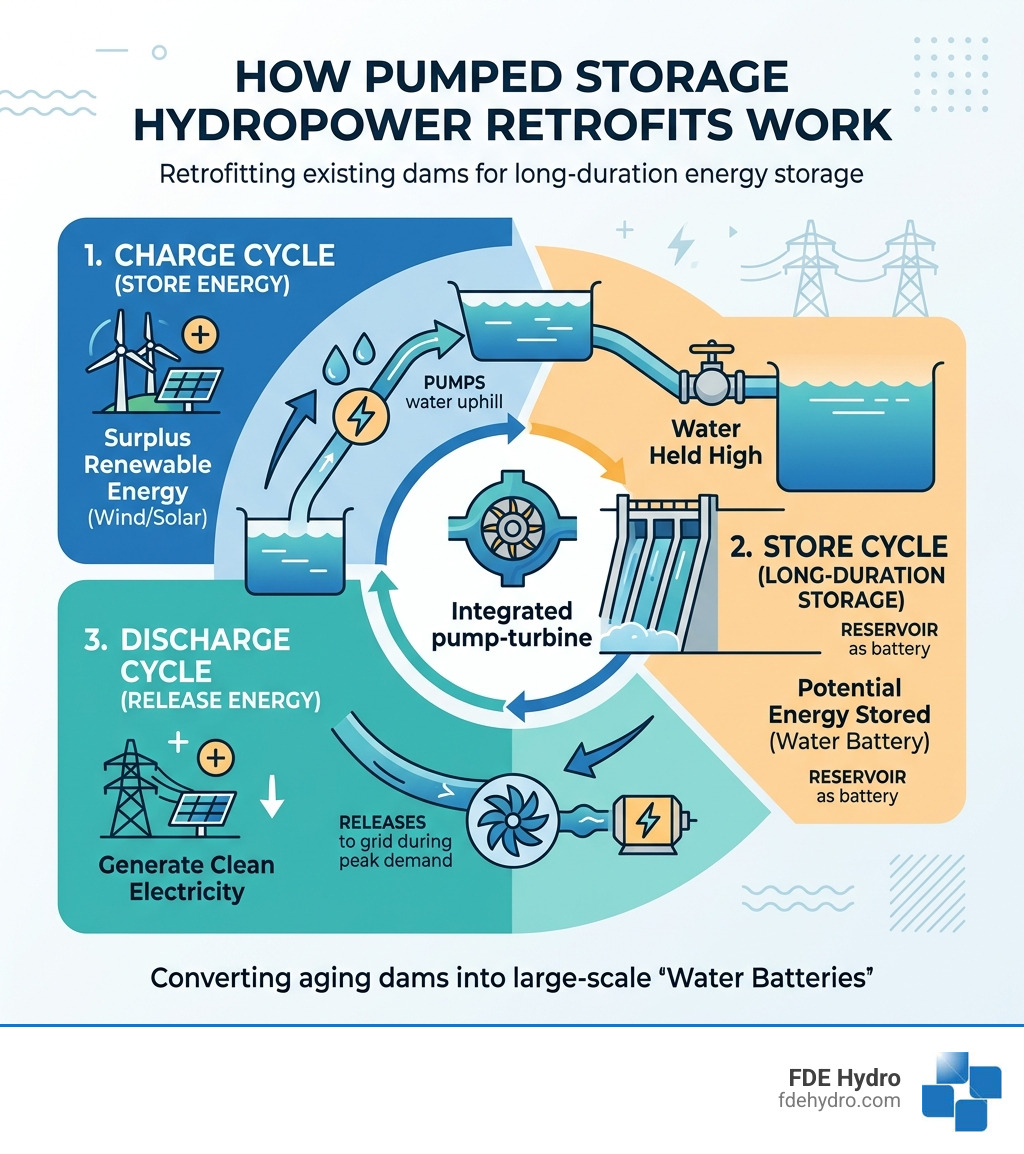
When we talk about the “water battery,” we aren’t just using a fancy metaphor. Pumped storage hydropower (PSH) is a proven, mechanical way to store massive amounts of energy. By pumping water from a lower reservoir to an upper one during times of low demand (or high solar/wind production), we “charge” the battery. When the sun goes down or the wind stops, we release that water back down through turbines to “discharge” electricity.
The Department of Energy highlights PSH as a critical pillar for grid reliability. It provides essential services like frequency control, voltage regulation, and black-start capability—things chemical batteries struggle to do at this scale. But building new PSH from scratch is a massive undertaking that can take over a decade.
That is where hydropower energy storage retrofits come in. By utilizing existing infrastructure, we can skip many of the most expensive and time-consuming parts of construction.
Why Retrofitting Wins Over New Construction
Research shows that converting existing plants to pumped storage can cost 25-35% less than new installations. We aren’t just saving money; we’re saving time and the environment. Because the dams and reservoirs already exist, the land-use changes are minimal.
Furthermore, hydropower assets have an incredible lifespan—often 50 to 100 years. Retrofitting allows us to extend that life while significantly boosting capital efficiency. Instead of a dam simply sitting there, it becomes a dynamic revenue generator that balances the modern grid.
| Feature | New PSH Construction | PSH Retrofit |
|---|---|---|
| Capital Cost | High ($3,000 – $5,000+/kW) | 25-35% Lower |
| Permitting Timeline | 10+ Years | 3-5 Years (or less with modularity) |
| Environmental Impact | Significant (New Reservoirs) | Minimal (Existing Footprint) |
| Grid Services | Full Range | Full Range + Modernized Efficiency |
Unlocking Potential in Non-Powered Dams and Aging Infrastructure
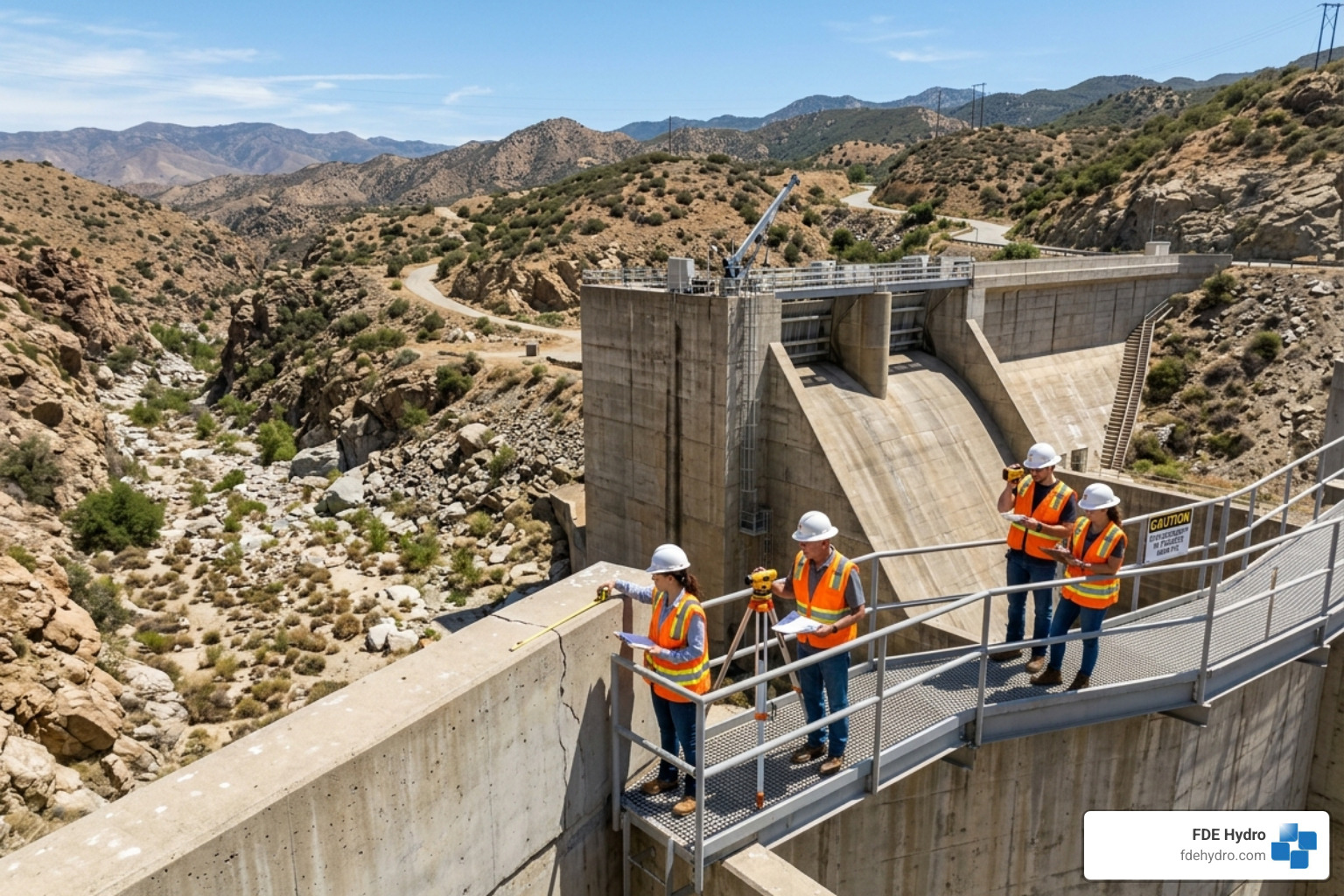
The United States has over 90,000 dams, but here is the kicker: less than 3% of them actually generate power. Most were built for irrigation, navigation, or flood control and have been ignored as energy assets for decades.
According to the North American Guide To Sustainable Energy Dam Retrofits, retrofitting these non-powered dams (NPDs) could add 4,800 megawatts of economically feasible capacity by 2050. To put that in perspective, that’s enough to power millions of homes with clean, reliable energy.
The momentum is already building. As of early 2026, there are 88 hydropower retrofit projects in the Federal Energy Regulatory Commission (FERC) pipeline. This isn’t just a U.S. trend, either. Globally, there are 600 GW of pumped storage projects in various stages of development. We are seeing a “renaissance” of water power because the world has realized that solar and wind can’t do the job alone—they need a partner that can store energy by the gigawatt-hour.
Overcoming Technical Challenges in Pumped Storage Hydropower Retrofits
Of course, if it were easy, everyone would have done it by now. Retrofitting an old dam comes with unique engineering hurdles. We have to look at these structures not just as they are, but as they need to be for the next 50 years.
Structural Integrity and Sediment Management
Many of our dams are over 40 years old, meaning they predate modern engineering standards. Before we can add the stress of pumping and generating, we must perform rigorous structural assessments. Dam rehabilitation and encapsulation are often necessary to ensure the concrete can handle the new operational cycles.
Sediment management is another big one. Over decades, reservoirs fill with silt. If we’re going to use them for PSH, we need to ensure that sediment doesn’t clog the intakes or damage the turbines. We also have to manage “environmental flows”—ensuring that the fish and downstream ecosystems still get the water they need while we’re busy moving it between reservoirs.
Innovations in Pumped Storage Hydropower Retrofits
This is where the “cool tech” comes in. We aren’t just putting in the same old turbines from the 1960s.
- Variable Speed Turbines: Traditional turbines run at one speed. Variable speed upgrades allow the plant to adjust its power consumption while pumping. This is a game-changer for grid stability because it allows the “water battery” to be as flexible as a chemical one.
- The Boosterpump Concept: This is a novel approach for reconstruction that can cost 25-35% less than installing traditional reversible units. It’s currently at a Technology Readiness Level (TRL) of 4-5 and offers a path for plants that might not have the space for a full reversible turbine overhaul.
- Digital Twins and IoT: We now use 3D modeling and AI-powered predictive maintenance. These digital tools can increase annual generation by up to 11% just by optimizing how and when we move the water.
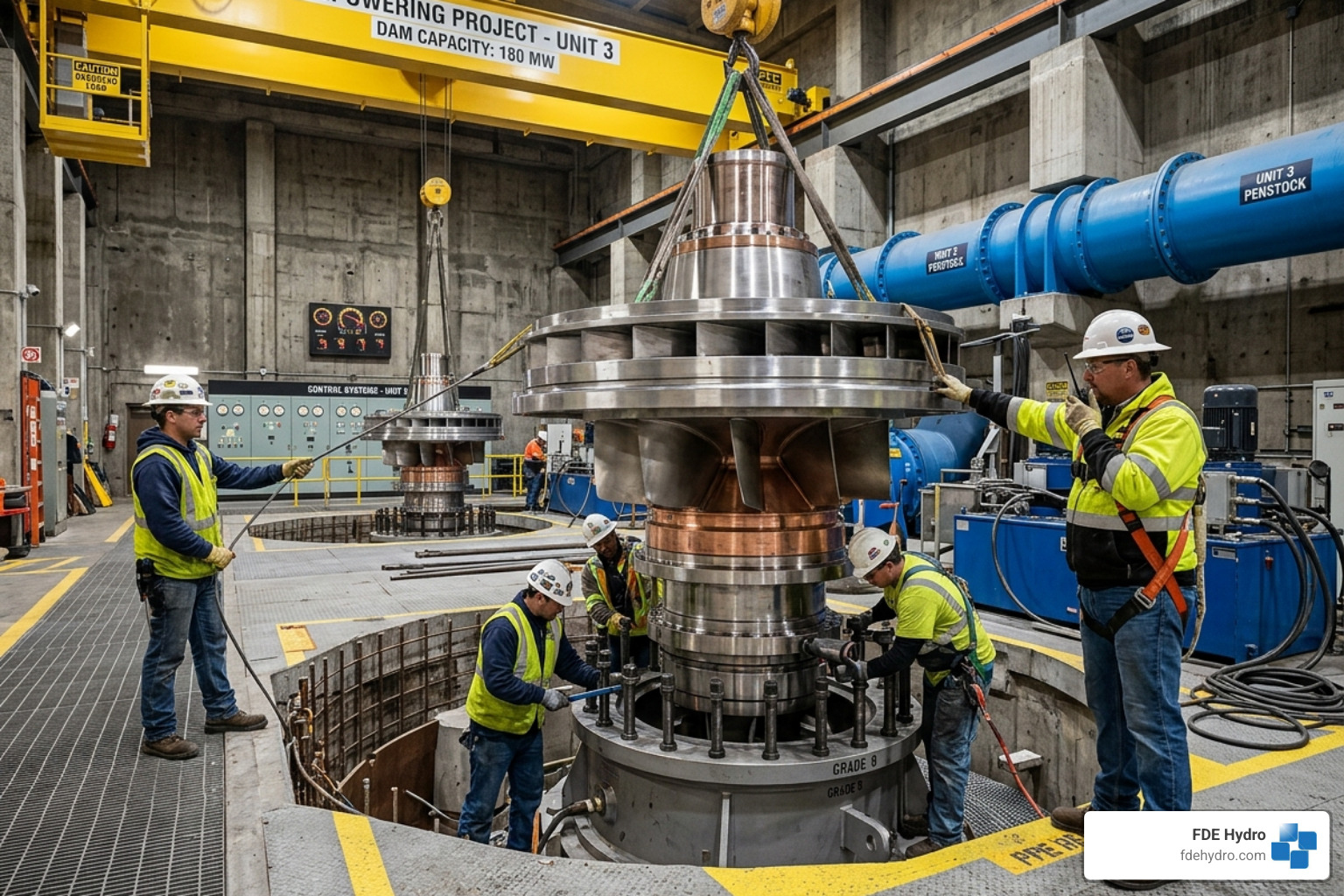
- Modular Construction: At FDE Hydro™, our patented “French Dam” technology uses modular precast concrete. Instead of pouring concrete on-site for years, we can install pre-made sections. This can reduce construction time from a decade to as little as one to three years.
Real-World Success Stories and Economic Viability
The theory is great, but does it work in the real world? Absolutely. We are seeing massive projects prove the viability of pumped storage hydropower retrofits across North America and Europe.
Proven Impact of Pumped Storage Hydropower Retrofits
- Blenheim-Gilboa (New York): The New York Power Authority recently completed a four-year, $135 million upgrade. They replaced all four pump-turbine units, increasing capacity by 120 MW (an 11.5% boost) without expanding the facility’s footprint.
- Salina Pumped Storage (Oklahoma): The GRDA is currently undergoing a $56 million modernization of its units. They are integrating variable speed technology to better respond to modern market conditions.
- Cruachan (Scotland): This iconic facility is being upgraded to increase output by 40 MW, enough to provide reliable energy for almost 1 million households.
- Big Creek (California): A feasibility study for this massive system suggests that retrofitting could provide 75 GWh of energy storage capacity and 5 GW of power capacity. While the cost is estimated between $12.5 and $20 billion, it would provide a massive backbone for California’s renewable-heavy grid.
Learn more about the history of hydropower retrofitting and how these projects are paving the way for a more stable future.
Financial and Policy Landscape
The economics are finally catching up to the technology. The 21st Century Dams Act and various tax credits are making these projects more attractive to private investors.
We are also seeing “revenue stacking.” A PSH facility doesn’t just make money by selling electricity; it gets paid for:
- Arbitrage: Buying power when it’s cheap (night) and selling when it’s expensive (day).
- Ancillary Services: Getting paid by the grid operator to stay ready to balance frequency or voltage.
- Capacity Payments: Payments for simply being available to provide power during a crisis.
Frequently Asked Questions about PSH Retrofits
How much does it cost to retrofit a dam for pumped storage?
While every site is different, retrofitting is generally 25-35% cheaper than building new. For a large system like Big Creek, costs might range from $2,500 to $4,000 per kilowatt. For smaller, modular projects, the entry point can be much lower, especially when using existing non-powered dams.
Can any existing dam be converted into a water battery?
Not every dam, but many more than you’d think. The key requirements are a significant “head” (height difference) and the ability to have or build a second reservoir (either above or below). With modern hydroelectric dam design, we can even look at off-river closed-loop systems that don’t interfere with natural river flows.
What is the difference between open-loop and closed-loop retrofits?
- Open-loop: The system is continuously connected to a natural flowing water source (like a river).
- Closed-loop: The system uses two reservoirs that are not connected to a natural stream. These are often preferred today because they have much lower environmental impacts and are easier to permit.
Conclusion
The path to a 100% clean energy future doesn’t require us to reinvent the wheel—it requires us to rethink the dam. Pumped storage hydropower retrofits offer a pragmatic, cost-effective, and environmentally responsible way to build the “water batteries” our grid desperately needs.
At FDE Hydro™, we believe that modularity is the key to unlocking this potential. Our French Dam technology is designed to make these retrofits faster and more affordable, allowing us to turn aging infrastructure into modern powerhouses in a fraction of the time.
The infrastructure is already there. The water is waiting. It’s time to give these old dams the makeover they—and our planet—deserve.
