

The World’s Biggest Battery: Why Pumped Storage Hydropower Matters Now
Pumped Storage Hydropower (PSH) is the world’s dominant form of large-scale energy storage — and it’s becoming more critical by the day.
Quick answer:
| Key Fact | Detail |
|---|---|
| What it is | A system that stores energy by pumping water uphill, then releasing it through turbines to generate electricity |
| Global capacity | Nearly 200 GW installed — over 94% of all long-duration energy storage worldwide |
| Round-trip efficiency | 70–80% |
| Best for | Grid stability, renewable energy integration, long-duration storage |
| Main types | Open-loop (connected to a river) and closed-loop (off-river, no natural inflow) |
As solar and wind power grow, the grid faces a serious challenge: what do you do with energy when the sun isn’t shining and the wind isn’t blowing? That’s exactly the problem PSH solves — at massive scale, with proven technology, and for decades at a time.
As Malcolm Turnbull, President of the International Hydropower Association, put it:
“The failure to adequately focus on this need for long duration electricity storage is the ignored crisis within the energy crisis. PSH has the unique capacity to resolve this challenge at huge scale, well beyond the reach of even the largest batteries.”
This guide breaks down how PSH works, why it’s experiencing a global renaissance, and what it means for large-scale energy infrastructure.
I’m Bill French, Sr., Founder and CEO of FDE Hydro™ and a participant in the U.S. Department of Energy’s Hydropower Vision Task Force, where I helped shape the national roadmap for next-generation Pumped Storage Hydropower solutions. With five decades in heavy civil construction and a portfolio of patented modular technologies purpose-built for the hydro industry, I’ll walk you through everything you need to know.
Easy Pumped Storage Hydropower word list:
What is Pumped Storage Hydropower and How Does it Work?
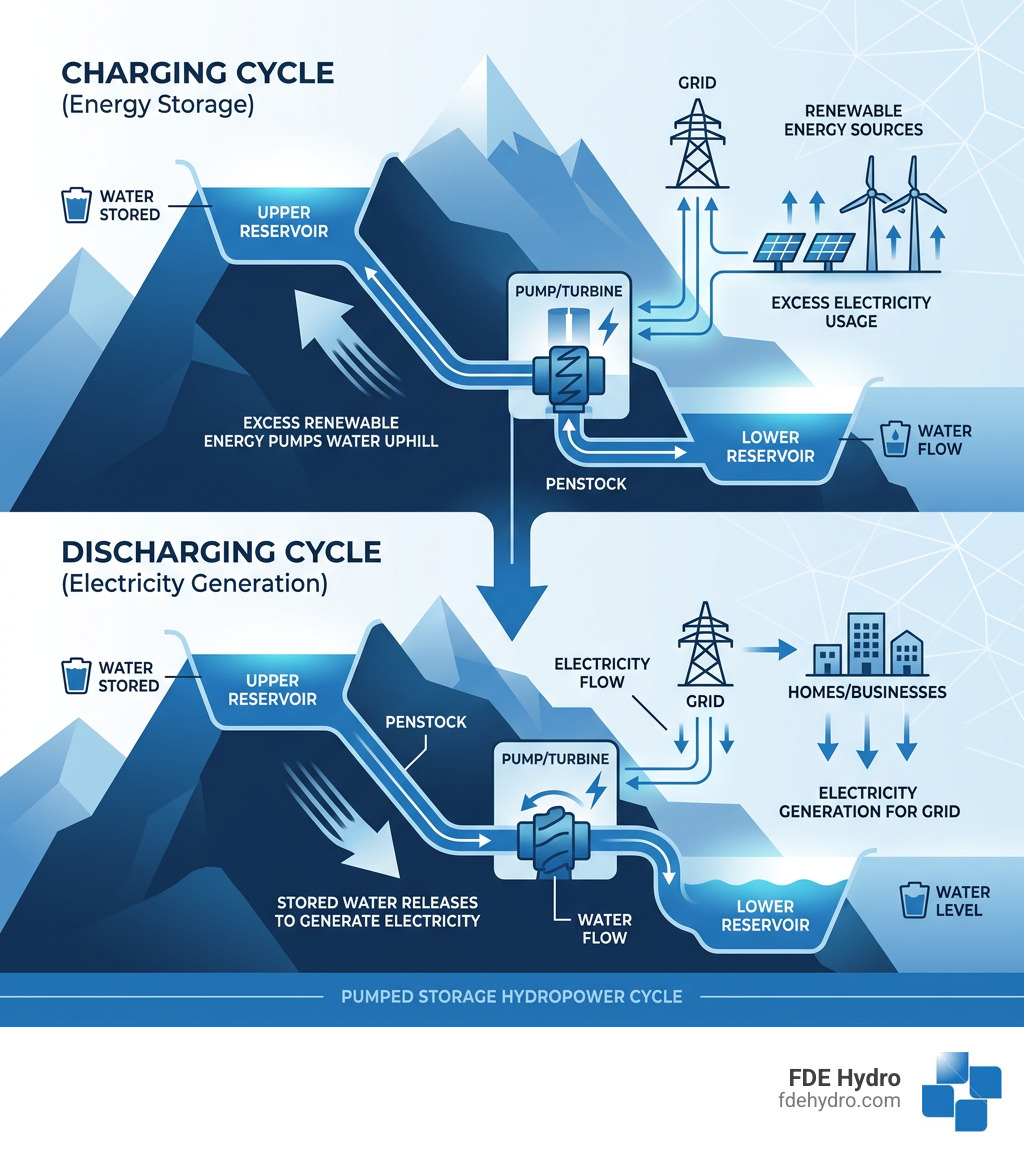
At its heart, Pumped Storage Hydropower is a giant physical battery that uses gravity to store energy. Instead of storing electrons in chemicals like a lithium-ion battery, we store energy by moving water between two reservoirs at different elevations.
The system relies on gravitational potential energy. When we have an excess of electricity on the grid—usually during the night when demand is low or in the middle of a sunny day when solar production is peaking—we use that “cheap” energy to power pumps. These pumps move water from a lower reservoir up to an upper reservoir. This is the “charging” phase.
When the sun goes down or the wind stops, and people turn on their lights and appliances, the grid needs more power. We then open the gates of the upper reservoir. Gravity pulls the water back down through a tunnel (called a penstock), where it spins a turbine to generate electricity. This is the “generation” or “discharging” phase.
One of the most impressive aspects of this technology is its round-trip efficiency of 70%-80%. This means that for every 10 kWh we use to pump the water up, we get about 7 to 8 kWh back when we need it. While that might seem like we are “losing” energy, the value lies in when that energy is available. We take energy that isn’t needed and turn it into high-value power exactly when the grid is under pressure.
The Mechanics of Pumped Storage Hydropower Systems
Modern Pumped Storage Hydropower plants often use reversible turbines. These incredible machines act as both a pump and a generator. In one direction, they use electricity to push water uphill; in the other, the falling water spins them to create power.
This dual functionality allows for electricity arbitrage. Utilities can buy power to pump water when prices are low and sell it back to the grid when prices are high. But it’s about more than just money—it’s about load balancing. The grid must always maintain a perfect balance between supply and demand. PSH acts as a massive shock absorber, soaking up surges in renewable energy and releasing it during peak demand.
By converting electrical energy into kinetic energy (moving water) and then into stored potential energy, these systems provide a level of stability that few other technologies can match. They can go from a standstill to full power in just a few minutes, providing the quick ramping needed to keep our lights on.
Comparing Open-Loop and Closed-Loop Systems
Not all PSH plants are created equal. We generally categorize them into two types:
- Open-Loop Systems: These are connected to a natural moving water source, like a river or a stream. While effective, they are often harder to permit because they interact with local fish populations and natural waterways.
- Closed-Loop Systems: Also known as “off-river” systems, these consist of two reservoirs that are physically separated from any natural river. Once they are filled with their initial “charge” of water, they simply cycle that same water back and forth.
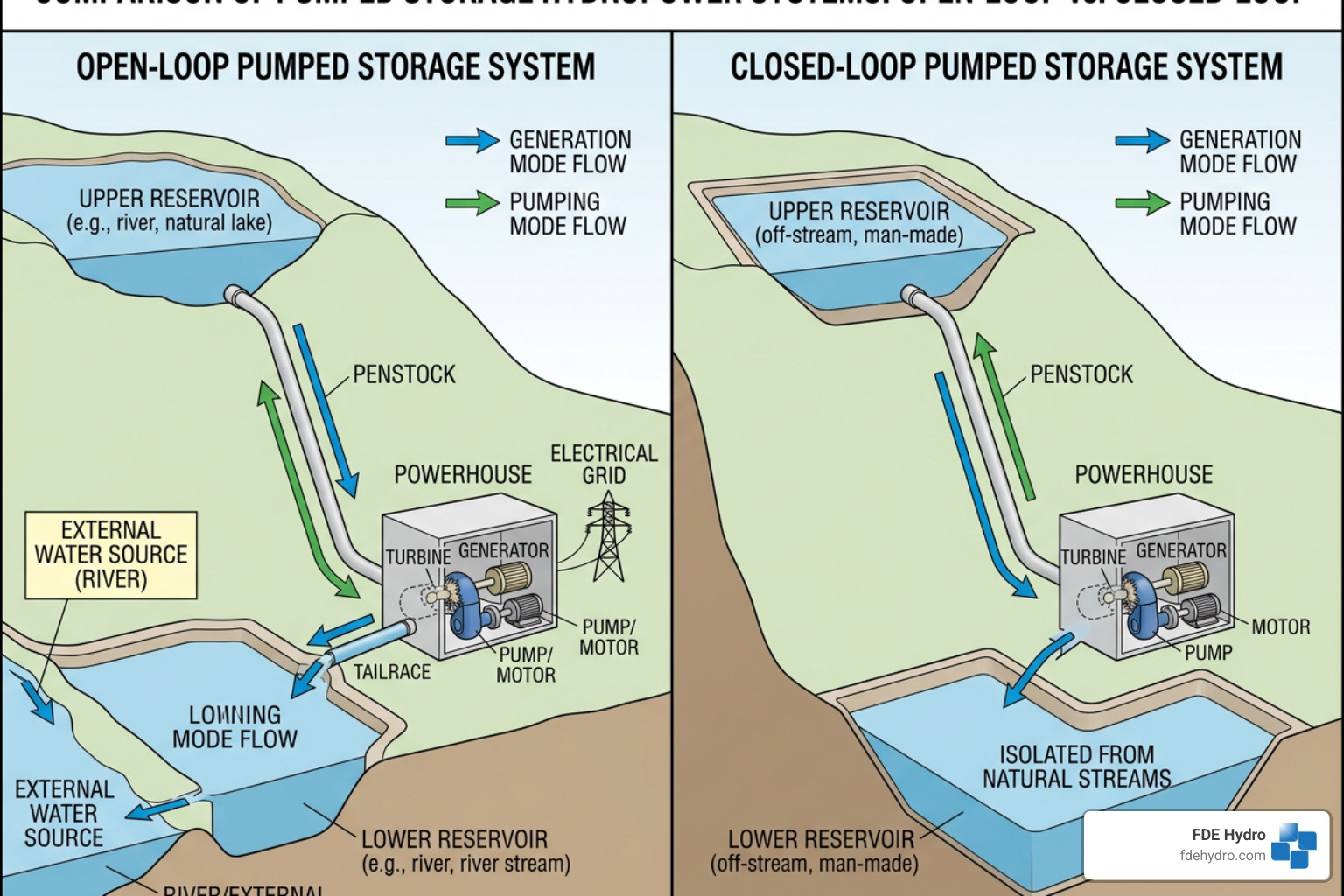
At FDE Hydro, we see a massive trend toward closed-loop systems. Because they don’t interfere with natural river ecosystems, they have a much smaller environmental footprint. They also offer incredible site flexibility. As long as you have a significant change in elevation—like a hill, an old quarry, or even a decommissioned mine—you can potentially build a “water battery.”
Key Benefits: Efficiency, Stability, and Environment
The benefits of Pumped Storage Hydropower go far beyond just storing energy. These facilities are the “Swiss Army Knives” of the electrical grid.
First, they provide grid resilience. In the event of a total grid collapse, PSH plants offer black start capability. Because they don’t need an outside power source to start generating (they just need gravity), they can provide the initial spark to jump-start the rest of the power grid.
Second, they are masters of frequency regulation and voltage stabilization. Wind and solar can cause “flickers” in grid frequency because their output changes so fast. PSH plants provide “spinning inertia”—the physical weight of the rotating turbines helps keep the grid’s heartbeat steady at 60Hz.
Research from the National Renewable Energy Laboratory (NREL) has even shown that closed-loop PSH is the smallest emitter among storage technologies when looking at its full lifecycle. It doesn’t require the massive mining operations needed for battery chemicals, and it doesn’t produce toxic waste at the end of its life.
Closed-Loop Pumped Storage Hydropower Advantages
Why is the industry so excited about closed-loop designs? It’s all about ecosystem protection. By decoupling from rivers, we avoid the complex issues of fish passage and sediment management. These systems use very little land compared to the amount of energy they store—roughly 10 hectares per GWh of storage.
Furthermore, because the water is reused in a continuous cycle, the ongoing water requirement is minimal, mostly just to account for evaporation. This makes them surprisingly sustainable even in areas where water resources must be managed carefully.
Supporting Intermittent Renewables
We often talk about “firming” solar and wind. Since these sources are intermittent, PSH acts as the “baseload” replacement.
- Solar Firming: Storing the “mid-day hump” of solar production to use during the evening peak.
- Wind Curtailment: Instead of turning off wind turbines when they produce more than the grid can handle, we use that excess power to pump water.
- Energy Shifting: Moving energy across hours or even days to ensure a steady supply.
By providing these services, Pumped Storage Hydropower makes it possible to reach a 100% renewable grid without sacrificing reliability.
PSH’s Enduring Advantages: Capacity, Cost-Effectiveness, and Longevity
While lithium-ion batteries are great for your phone or your car, they aren’t always the best fit for the power grid. Here is why PSH remains the champion of long-duration storage:
- Exceptional Lifespan: A typical PSH plant is built to last 40 to 100 years. Compare that to a large-scale battery array, which might need to be replaced every 10–15 years.
- Long-Duration Storage: Batteries usually struggle to provide power for more than 4 hours. PSH facilities can easily provide 10, 20, or even 50+ hours of continuous energy.
- Minimal Degradation: Unlike chemical batteries that lose capacity every time you charge them, a reservoir of water doesn’t “wear out.” It provides the same performance in year 50 as it did on day one.
- Scalability: We can build these systems to hold massive amounts of energy. The largest plants can store enough power to run millions of homes for an entire day.
- Cost-Effectiveness: While the initial construction (CapEx) is high, the low operational costs and incredibly long life make it one of the cheapest forms of storage per megawatt-hour over its lifetime.
- Resource Independence: We don’t need lithium, cobalt, or nickel. We use water, concrete, and steel—materials that are readily available and easily recycled.
- Inherent Safety: There is no risk of “thermal runaway” or chemical fires. It is a mechanical system using water.
- Sustainable Solution: Our French Dam technology uses modular precast concrete, which further reduces the environmental impact and construction time compared to traditional poured-in-place dams.
Global Status and Leading PSH Facilities
The scale of Pumped Storage Hydropower worldwide is staggering. Currently, it accounts for nearly 200 GW of power and a massive 9,000 GWh of energy storage. To put that in perspective, PSH represents over 94% of the world’s long-duration energy storage capacity.
China is currently the world leader, with an installed capacity of approximately 58.69 GW as of 2024. They have an additional 200 GW under construction or approved. However, the United States and Europe also hold significant assets.
In the U.S., the Bath County 3 GW capacity station in Virginia is often called the “ninth wonder of the world.” It can provide 24 GWh of storage, which is enough to power 750,000 homes for 11 hours.
Italy is another powerhouse in this sector, operating 22 plants with a total storage capacity of 53 GWh. Most of these are located in the mountainous North, providing critical stability to the European grid.
National Highlights: China, USA, and Europe
- China: The Fengning Pumped Storage Power Station is the largest in the world, boasting a 3.6 GW capacity and a mind-boggling 40 GWh of storage.
- USA: Beyond Bath County, the Ludington Plant in Michigan uses Lake Michigan as its lower reservoir, providing 2.1 GW of power. In the U.S., PSH accounts for about 96% of all utility-scale energy storage.
- Europe: Organizations like the International Forum on Pumped Storage Hydropower are working with governments in the UK and EU to streamline new projects, recognizing that 80% renewable energy is only possible with massive storage.
Future Potential and Innovations
The future of Pumped Storage Hydropower isn’t just about big dams in the mountains. We are seeing incredible innovations:
- Underground PSH: Using abandoned coal mines or deep caverns as reservoirs. This hides the facility from view and uses “brownfield” sites that are already connected to the grid.
- Seawater Systems: Using the ocean as the lower reservoir. A demonstration project in Okinawa, Japan, proved this was possible, and new projects are being explored in coastal areas with high cliffs.
- Geomechanical Storage: Some companies are exploring pumping water into underground rock layers, using the pressure of the earth itself to store energy.
- Modular Construction: At FDE Hydro, we are pioneering the use of precast concrete modules to build these facilities faster and with less risk. This makes smaller-scale PSH projects economically viable for the first time.
The Global atlas of 600,000 potential sites identified by the Australian National University suggests that we have enough potential sites to store the entire world’s energy needs many times over.
Frequently Asked Questions about PSH
What is the typical efficiency of a pumped storage plant?
Most modern plants achieve a round-trip efficiency of 70% to 80%. This accounts for friction in the pipes, energy used by the pumps, and mechanical losses in the turbines. While no storage system is 100% efficient, PSH is incredibly competitive with large-scale battery systems, especially when you factor in its 80-year lifespan.
How does PSH contribute to a carbon-free grid?
PSH doesn’t generate “new” carbon-free energy; rather, it makes existing renewable energy more useful. By storing excess wind and solar power that would otherwise be wasted (curtailed), it allows us to turn off coal and gas plants that usually provide “peaking” power. It is the “enabler” of a 100% carbon-free grid.
Can pumped storage be built in areas without natural rivers?
Yes! This is the beauty of closed-loop systems. You only need two reservoirs and an elevation change. Many new projects are being planned using old mining pits, quarries, or artificial reservoirs built on hillsides. As long as you have the initial water to fill the system, you don’t need a river.
Conclusion
As we move toward a world powered by the sun and the wind, the need for massive, reliable, and sustainable storage has never been greater. Pumped Storage Hydropower is not a “legacy” technology; it is a modern solution that is making a huge splash in the global energy transition.
From its incredible 100-year lifespan to its ability to provide essential grid services, PSH is the backbone of a resilient energy future. At FDE Hydro, we are proud to be at the forefront of this renaissance, using our innovative dam designs to make these projects more affordable and faster to build.
The “ignored crisis” of long-duration storage finally has an answer. By combining the power of gravity with modern engineering, we can ensure that our renewable energy future is as stable and reliable as the ground beneath our feet.
Ready to learn more about how we’re revolutionizing hydro infrastructure? Explore our guide to hydroelectric power solutions or see how our French Dam technology is changing the game for energy storage.
