

Why Hydropower Infrastructure Funding Upgrades Can’t Wait
Hydropower infrastructure funding upgrades are now more accessible than ever — thanks to a wave of federal investment targeting America’s aging dams and hydroelectric facilities.
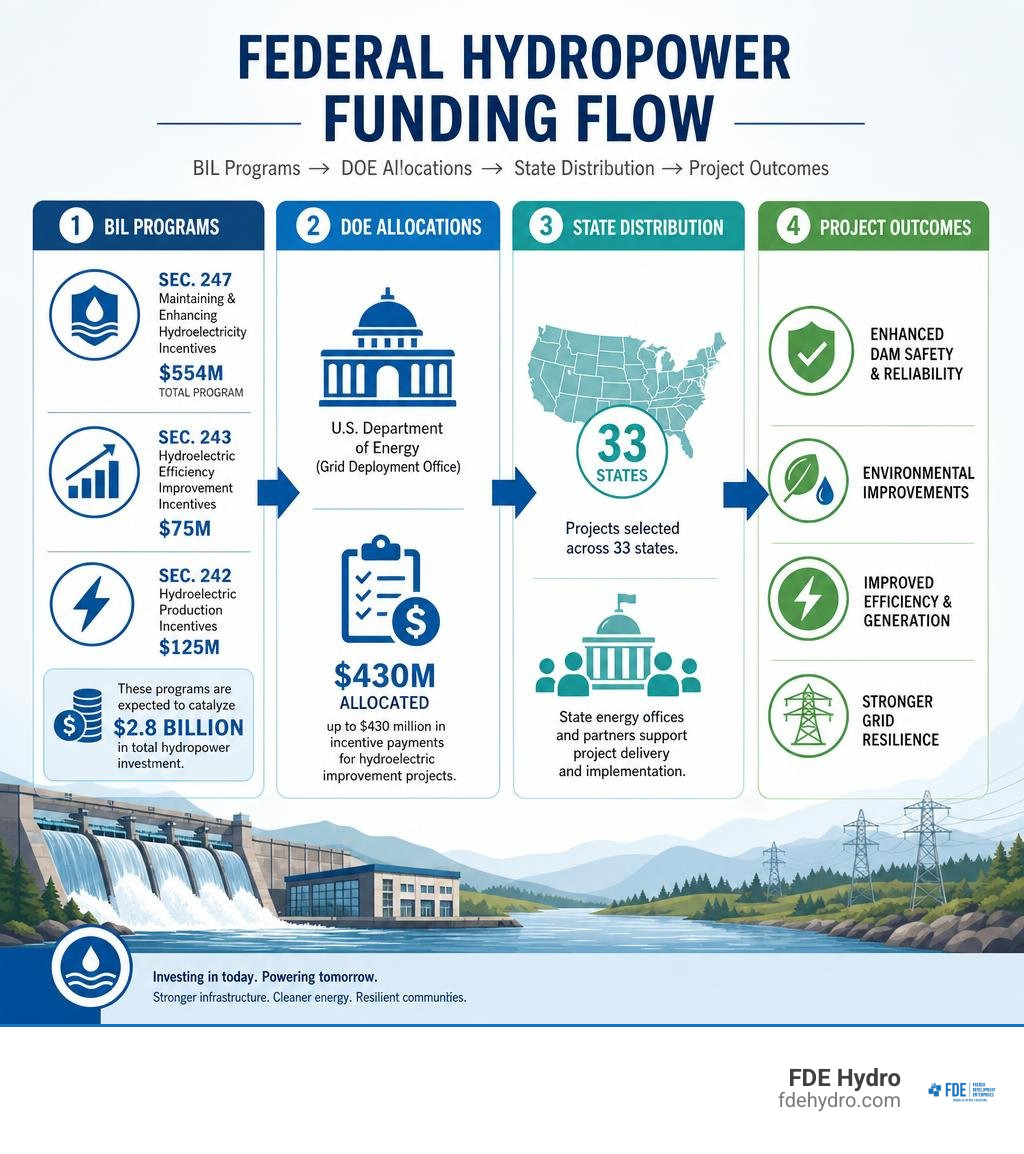
Here’s a quick overview of the key funding available right now:
| Program | Funding Available | Focus Area |
|---|---|---|
| Maintaining & Enhancing Hydroelectricity Incentives (Sec. 247) | $554 million total; $430M allocated | Grid resilience, dam safety, environmental upgrades |
| Hydroelectric Efficiency Improvement Incentives (Sec. 243) | $75 million | Efficiency gains of 3%+ |
| Hydroelectric Production Incentives (Sec. 242) | $125 million | Generation incentive payments |
Together, these programs — funded through the Bipartisan Infrastructure Law — are expected to catalyze $2.8 billion in total hydropower investment when combined with private capital contributions.
America’s hydropower fleet is quietly aging. The average facility receiving federal funding today has been running for 79 years. The American Society of Civil Engineers gave U.S. dams a D+ grade in their 2025 Infrastructure Report Card — and nearly 70% of all U.S. dams were expected to surpass 50 years of age by 2025.
Yet hydropower still supplies nearly 27% of all U.S. renewable electricity and represents 93% of utility-scale energy storage. That’s an enormous amount of critical grid infrastructure that has been quietly deferred, patched, and stretched well past its original design life.
The funding is here. The need is urgent. And for facility operators and project developers, the window to act is open now.
I’m Bill French, Sr., Founder and CEO of FDE Hydro™ — and for the past decade I’ve worked directly at the intersection of modular construction innovation and hydropower infrastructure funding upgrades, including being selected by the DOE’s Water Power Technology Office to help define the next-generation hydropower roadmap for Congress. In this guide, I’ll walk you through exactly where the money is, how it’s distributed, and how to position your project to access it.
The Bipartisan Infrastructure Law: Driving Hydropower Infrastructure Funding Upgrades
The Bipartisan Infrastructure Law is the financial engine behind the current wave of hydropower modernization. Through the U.S. Department of Energy and its Grid Deployment Office, the law created major incentive pathways for hydroelectric facilities that need capital improvements but cannot always justify the upfront cost through power sales alone.
The headline number is clear: the DOE selected 293 hydroelectric improvement projects across 33 states for up to $430 million in incentive payments under the Maintaining and Enhancing Hydroelectricity Incentives program. That allocation sits within a broader $554 million Section 247 program.
This matters because hydropower projects are not small weekend repairs. A serious modernization can include:
- Turbine replacement
- Generator rewinds or replacements
- Digital control system upgrades
- Spillway rehabilitation
- Concrete repair and seepage mitigation
- Fish passage construction
- Water quality improvements
- Recreation access improvements
- Cybersecurity and grid control upgrades
- Equipment needed to integrate variable renewable resources
The DOE announcement, summarized in Biden-Harris Administration Invests $430 Million to Upgrade America’s Hydropower Infrastructure, shows a clear federal strategy: keep existing hydropower assets online, make them safer, improve environmental performance, and strengthen the grid.

Maintaining and Enhancing Hydroelectricity Incentives (Section 247)
Section 247 is the big one for owners pursuing capital upgrades.
Under this program, the DOE selected projects that fall into three main categories:
- Grid resilience improvements
- Dam safety upgrades
- Environmental and recreational enhancements
The current award round includes $430 million for 293 projects. The DOE has said these projects will strengthen grid resilience at 215 facilities, while also improving dam safety at sites that average 79 years in operation.
That age matters. A facility built in the 1940s or 1950s may still be producing clean energy, but its original design probably did not anticipate today’s operating reality: more solar and wind on the grid, more severe rain events, more drought stress, stricter environmental requirements, higher safety expectations, and much faster digital control needs.
For owners, Section 247 is not just a grant opportunity. It is a way to de-risk long-term reinvestment. Hydropower financing can be challenging because the biggest costs often arrive before revenue improvements are visible. We explore this issue in more detail in Financing Long-Term Hydropower Requires Mitigating Risks Prior to ROI.
The practical takeaway is simple: if your facility needs upgrades that improve resilience, safety, environmental performance, or public use, Section 247 should be on your radar.
Complementary DOE Programs for Hydropower Infrastructure Funding Upgrades
Section 247 is not the only tool in the federal toolbox. The DOE also supports hydropower through complementary incentive programs authorized under the Energy Policy Act.
The three major programs are:
| Program | Section | Purpose | Notable Funding |
|---|---|---|---|
| Hydroelectric Production Incentives | 242 | Supports eligible hydroelectric generation | $125 million |
| Hydroelectric Efficiency Improvement Incentives | 243 | Supports capital improvements that improve efficiency | $75 million |
| Maintaining and Enhancing Hydroelectricity Incentives | 247 | Supports resilience, safety, environmental, and recreation upgrades | $554 million total |
The Hydroelectric Efficiency Improvement Incentives program is especially important for facilities where equipment modernization can increase output. Earlier DOE materials identified nearly $75 million for efficiency upgrades, with an emphasis on projects that can demonstrate meaningful efficiency gains.
The Hydroelectric Production Incentives program supports eligible generation from qualified facilities. This can be useful for operators who are already producing renewable power and need incentive payments to improve project economics.
For the most current program details, eligibility information, and DOE updates, the Hydroelectric Incentives Guide – Department of Energy is the best starting point.
Our view: do not treat these programs as isolated buckets. A strong funding strategy looks at the full capital stack. Federal incentives, private capital, utility partnerships, tax planning, and phased construction can work together. Hydropower funding is a puzzle, but at least it is a puzzle with water flowing through it.
Where the Money Goes: State Allocations and Project Distribution
The $430 million Section 247 allocation is spread across 293 projects in 33 states. That broad distribution is important because hydropower is not a one-region resource. It supports rural communities, industrial loads, urban grids, irrigation systems, flood control, recreation, and clean energy goals across the country.
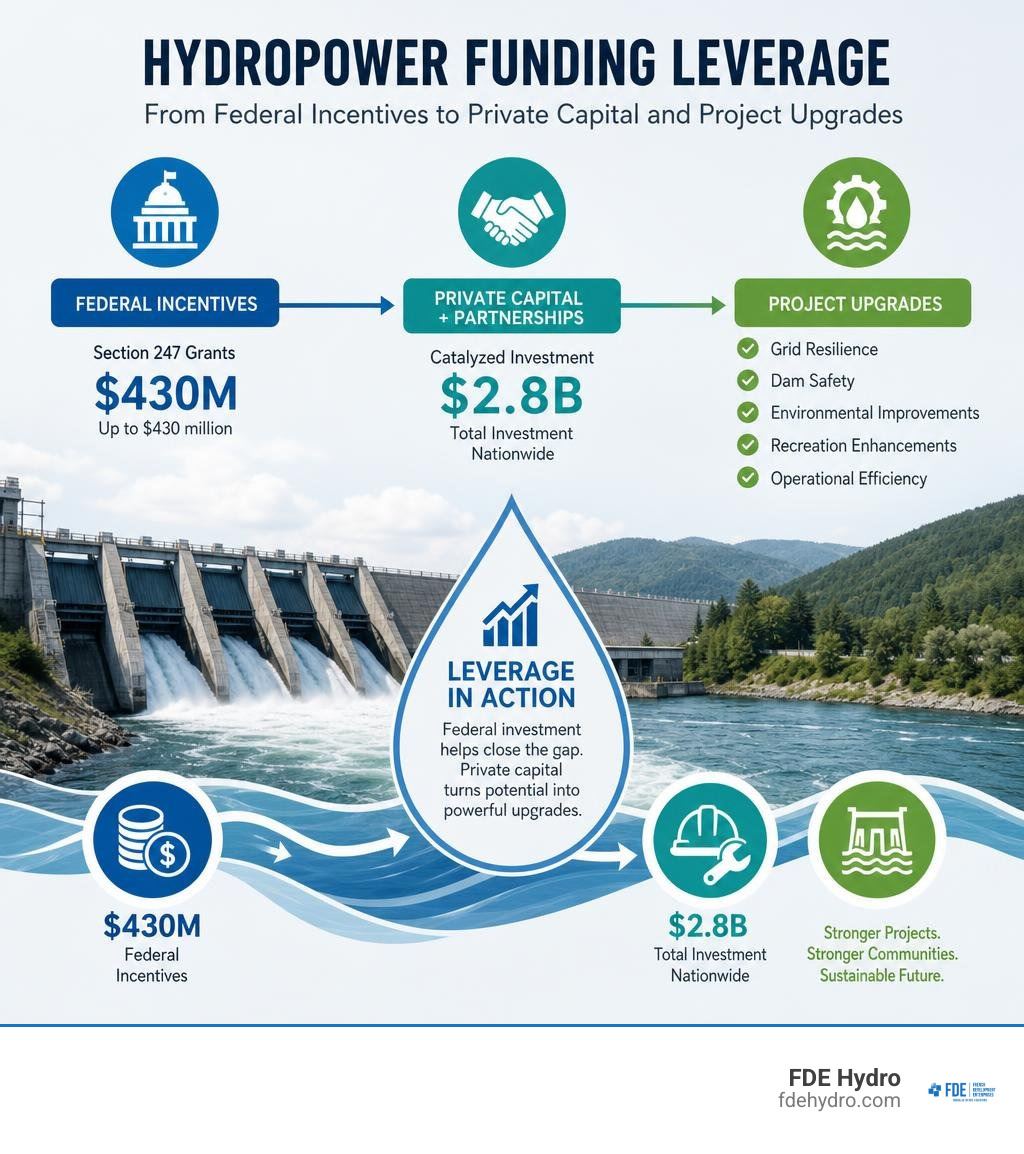
The federal investment is also expected to unlock far more than the initial grant amount. When combined with private contributions, the $430 million is expected to catalyze about $2.8 billion in total hydropower investment nationwide.
That leverage is the real story.
Federal dollars help close the funding gap. Private capital, owner equity, utility investment, and project debt then help turn deferred maintenance into completed construction.
| State or Region Highlight | Project Count | Reported Funding | Why It Matters |
|---|---|---|---|
| California | 29 | Over $60 million | Major support for Western grid reliability, drought adaptation, and renewable integration |
| New York | 23 | $25.4 million | Supports a state with major legacy hydropower assets and high clean-energy demand |
| National total | 293 | Up to $430 million | Covers grid resilience, dam safety, environmental, and recreation improvements |
| Expected total investment | N/A | $2.8 billion | Shows how federal incentives can leverage private capital |
Key State Winners: California, New York, and Maine
California and New York stand out for our work because both are central to FDE Hydro’s North American focus and both have significant hydropower infrastructure needs.
California received 29 projects totaling more than $60 million. For a state balancing hydropower, solar, wind, wildfire risk, drought, and major load growth, these upgrades are not optional. They are part of keeping the grid flexible and dependable.
California’s hydropower fleet also faces a climate reality that every owner should take seriously: water conditions are changing. Facilities that once operated under more predictable hydrology now need equipment and civil works that can perform under wider extremes.
New York received 23 projects totaling $25.4 million. This is especially relevant because New York has large legacy hydropower assets, high electrification goals, and a grid that increasingly depends on firm, dispatchable clean energy.
Maine also appeared among the notable national allocations in DOE-related reporting, including $33.8 million for 21 projects. Because our geographic focus in this guide is the United States with emphasis on California and New York, we will keep the deeper discussion centered on those markets. The broader lesson still applies: states with older hydro fleets and clear upgrade needs are seeing meaningful federal support.
Case Studies in Modernization: From Hoover Dam to Niagara
Two high-profile modernization examples show why funding cannot stop at routine maintenance.
First, Hoover Dam. Federal reporting and regional coverage note that the Bureau of Reclamation freed up approximately $52 million for turbine upgrades and infrastructure work at Hoover Dam. The plan includes replacing older turbines with wide-head turbines that can operate at lower Lake Mead elevations. According to reporting in Hoover Dam gets $52M for wide-head turbines from Bureau of Reclamation, the new equipment is intended to help restore around 160 megawatts of capacity and keep generation viable as reservoir levels fluctuate.
That is climate resilience in plain terms: when the water level changes, the equipment has to keep up.
Second, New York’s Niagara modernization. The New York Power Authority has been advancing a $1.1 billion modernization and digitization program at the Niagara Power Project. Coverage in NYPA upgrades first of 14 turbines in $1.1B Niagara modernization, digitization program describes mechanical upgrades, digital controls, turbine work, and major equipment replacement.
This is exactly the kind of long-horizon thinking hydropower needs. We are not upgrading facilities for the next three years. We are trying to keep clean, dispatchable assets useful for decades.
Upgrading Aging Assets: Grid Resilience, Dam Safety, and Environmental Goals
The current funding push is not about shiny new gadgets. It is about keeping critical infrastructure safe, productive, and compatible with modern energy and environmental standards.
The average facility selected for federal funding has been operating for 79 years. That means many projects were designed before today’s environmental rules, before modern grid controls, before large-scale wind and solar, and before current climate projections.
As reported in The DOE is releasing $430 million to modernize hundreds of aging American hydropower plants across the country, the funding is aimed at modernizing aging plants while supporting reliability, safety, and environmental performance.

Addressing the D+ Dam Safety Crisis and Aging Infrastructure
The ASCE D+ grade for U.S. dams is not a gold star. It is more like the infrastructure equivalent of a check-engine light that has been blinking for years.
Dam safety upgrades supported by federal funding can include:
- Spillway capacity improvements
- Emergency spillway rehabilitation
- Concrete replacement
- Embankment stabilization
- Seepage control
- Gate and hoist replacement
- Monitoring instrumentation
- Structural strengthening
- Erosion repairs
- Flood routing improvements
The challenge is that dam repairs are often expensive, disruptive, and site-specific. A concrete problem at one facility may be a seepage problem at another. A spillway that worked for 1950s rainfall assumptions may not be appropriate for today’s extreme storm patterns.
That is why retrofit strategy matters. Our guide to The North American Guide to Sustainable Energy Dam Retrofits explains how dam owners can think about sustainable modernization rather than one-off repairs. For broader planning across water assets, our Water Infrastructure Projects Guide is also a helpful resource.
Implementing Hydropower Infrastructure Funding Upgrades for Grid Resilience
Hydropower is uniquely valuable because it can provide firm, flexible power. It is not just renewable generation. It is also a stabilizing resource for a grid with more variable energy.
Hydropower accounts for nearly 27% of U.S. renewable electricity generation. Pumped storage hydropower represents the overwhelming majority of utility-scale energy storage, with DOE materials and industry reporting frequently citing figures around 93% of utility-scale storage.
Grid resilience upgrades can include:
- Turbine replacement
- Generator upgrades
- Governor and exciter modernization
- Control system digitization
- Supervisory control and data acquisition improvements
- Switchyard and transformer upgrades
- Black-start capability improvements
- Equipment that helps integrate wind and solar
- Cybersecurity upgrades
- Pumped storage modernization
This is where modernization becomes more than maintenance. A better turbine, a faster control system, or a stronger generator can help a facility respond to grid needs more quickly. That flexibility becomes more valuable as renewable penetration rises.
For owners thinking about technical options, we recommend reviewing our resource on Hydropower Retrofitting.
Environmental and Recreational Enhancements
The Section 247 program also supports environmental and recreational improvements. That is a major point for owners, because long-term hydropower viability depends on more than megawatts.
Eligible or commonly supported environmental improvements may include:
- Fish ladders
- Fish passage systems
- Fish screens
- Bypass flows
- Water quality improvements
- Dissolved oxygen improvements
- Habitat restoration
- Sediment management
- Turbines designed to reduce aquatic impacts
Recreation improvements may include:
- Boating access
- Kayak portage routes
- Public access improvements
- Shoreline safety upgrades
- Fishing access
- Trail or viewing area improvements where appropriate
These upgrades can improve licensing outcomes, community support, and long-term public trust. A hydropower project that supports fish movement, water quality, recreation, and clean energy has a stronger social license to operate.
And yes, “fish ladder” sounds like something a trout would buy at a hardware store. But in practice, fish passage is one of the most important ways hydro facilities can reduce ecological disruption while continuing to generate renewable electricity.
Economic Impacts, Job Protection, and the Justice40 Initiative
The DOE has stated that the $430 million in selected incentive payments will help protect 6,000 existing jobs at hydropower facilities and among contractors and vendors.
That job protection matters because hydropower facilities anchor local economies. A dam upgrade can support:
- Plant operators
- Civil contractors
- Electrical contractors
- Mechanical suppliers
- Engineering firms
- Environmental consultants
- Concrete producers
- Steel fabricators
- Transportation providers
- Local service businesses
The funding also supports the federal Justice40 Initiative, which aims to direct 40% of the overall benefits of certain federal climate and clean energy investments to disadvantaged communities.
For hydropower, Justice40 benefits may include:
- More reliable local electricity
- Safer dam infrastructure
- Reduced flood risk
- Cleaner water
- Improved recreation access
- Local job retention
- Workforce development
- Lower risk of infrastructure failure
- Continued clean power from existing assets
This is important because disadvantaged communities are often more vulnerable to infrastructure failure, flooding, poor water quality, and energy reliability problems. A dam safety project is not just a concrete project. It can be a community protection project.
At FDE Hydro, we see sustainable hydro infrastructure as a practical bridge between clean energy and community resilience. We discuss that broader approach in Sustainable Hydro Infrastructure: Building for the Future.
Frequently Asked Questions about Hydropower Upgrades
What is the timeline for these federal funding programs?
The DOE has already selected 293 projects for up to $430 million under Section 247. Once projects are selected, owners typically move through award finalization, compliance requirements, contracting, engineering, procurement, permitting coordination, and construction.
Actual timelines vary by project type. A controls upgrade may move faster than a spillway reconstruction. A turbine replacement may require long equipment lead times. Environmental enhancements may require seasonal construction windows to protect aquatic species.
DOE materials tied to the original funding announcement indicated that a second round of funding was expected in the following calendar year. As of June 2026, owners should check the Grid Deployment Office and DOE hydro incentive pages for the latest application windows, award status, and program guidance.
Our recommendation: do not wait for the next notice before preparing. Have your technical scope, cost estimate, community benefits, environmental benefits, and financing plan ready early.
How do these upgrades address climate change and drought?
Hydropower is directly exposed to climate conditions. Too little water reduces generation. Too much water can stress spillways and flood routing systems. Warmer water can create water quality and habitat issues. More extreme storms can challenge older dam designs.
Modern upgrades can address these risks in several ways:
- Wide-head turbines can operate across a wider range of reservoir elevations.
- Spillway upgrades can improve performance during extreme rainfall.
- Concrete and seepage repairs can reduce failure risk.
- Better controls can help operators respond faster to changing grid and water conditions.
- Environmental upgrades can improve water quality and aquatic habitat.
- Pumped storage modernization can help store excess wind and solar energy.
The Hoover Dam turbine example is a useful illustration. As Lake Mead levels have declined, older turbines face performance and damage risks at lower elevations. Newer turbine technology can help maintain generation under more difficult hydrologic conditions.
Climate resilience is not a slogan here. It is a design requirement.
Can private capital be leveraged alongside federal grants?
Yes. In fact, that is one of the most important features of the current funding environment.
The $430 million federal allocation is expected to catalyze about $2.8 billion in total hydropower investment when combined with private contributions. That means federal funding is functioning as a leverage tool, not a complete replacement for owner investment.
A strong capital stack may include:
- DOE incentive payments
- Owner equity
- Private debt
- Utility partnerships
- Power purchase agreements
- State or regional incentives where available
- Tax credit planning where applicable
- Public-private partnership structures
- Phased procurement and construction planning
The key is to make the project investable. That means reducing technical risk, showing a clear upgrade scope, documenting public benefits, and demonstrating that the facility will remain viable after construction.
This is where cost-saving construction methods can make a major difference. If a project can reduce construction time, reduce onsite complexity, and improve schedule certainty, the financing case gets stronger.
Conclusion
Hydropower has done quiet, reliable work for more than a century. Now it needs reinvestment equal to its importance.
The current wave of hydropower infrastructure funding upgrades gives owners and developers a rare opportunity to modernize aging assets, improve dam safety, strengthen grid reliability, support disadvantaged communities, and extend the life of clean energy infrastructure.
At FDE Hydro, we believe this is exactly the moment for smarter construction. Our patented French Dam modular precast concrete technology is designed for building and retrofitting hydroelectric dams and water control systems with less construction time and lower project cost. For owners in the United States, Canada, Brazil, and Europe, that can mean a stronger funding application, a more realistic capital plan, and a faster path from award to operation.
Federal funding can open the door. Good engineering, practical construction methods, and disciplined project planning are what get the work done.
If your facility needs modernization, now is the time to prepare the scope, sharpen the budget, and align funding with execution.
