

What “Definition for Hydroelectric Power” Actually Means (And Why It Matters)
The definition for hydroelectric power is straightforward: it is electricity generated by converting the energy of flowing or falling water into mechanical energy via a turbine, which then drives a generator to produce electrical power.
Quick answer:
Hydroelectric power is a form of renewable energy that harnesses the gravitational potential and kinetic energy of moving water to generate electricity. Water flows through a turbine, spinning it to drive a generator — with no fuel burned and no thermal pollution produced.
Here is a simple breakdown:
- Energy source: Flowing or falling water
- Conversion process: Water pressure and movement spin a turbine
- Output: Electricity fed into the grid
- Classification: Renewable energy (powered by the natural water cycle)
- Also called: Hydropower, hydroelectricity
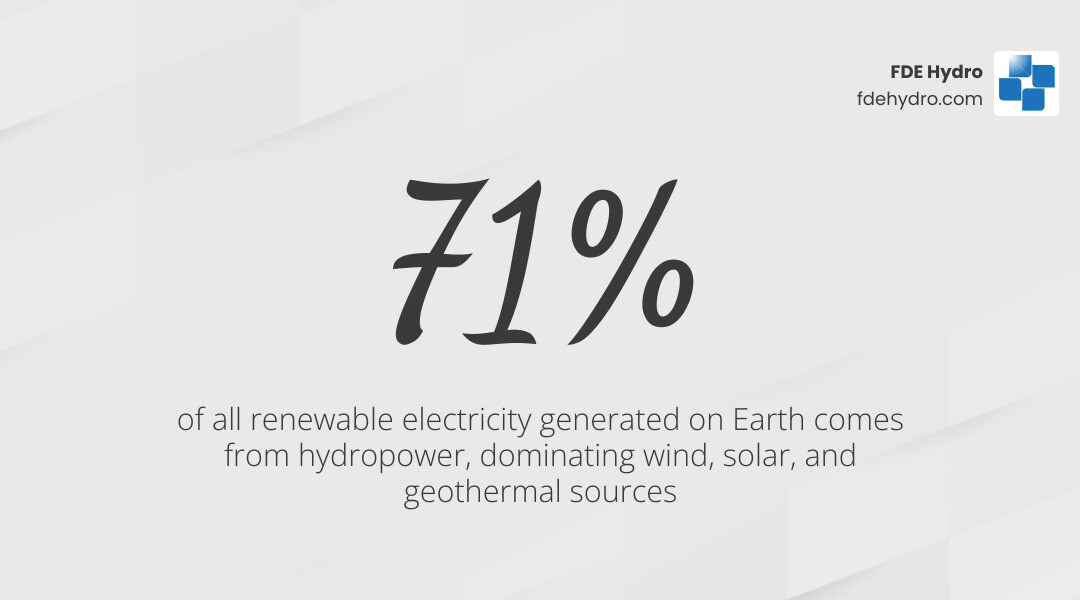
Hydropower is not a new idea. More than 2,000 years ago, ancient Greeks used flowing water to turn mill wheels for grinding grain. Today, that same basic principle powers roughly 15% of all electricity on Earth — and more than 71% of all renewable electricity globally.
For large-scale infrastructure decision-makers, understanding this energy source goes well beyond a textbook definition. It means grasping the engineering, economics, and environmental trade-offs that come with every project.
I’m Bill French, Sr., Founder and CEO of FDE Hydro™, and I’ve spent decades in heavy civil construction before turning my focus specifically to modular hydropower innovation — including being selected by the U.S. Department of Energy to help define next-generation hydropower solutions, which deepened my practical understanding of the definition for hydroelectric power far beyond theory. In this guide, I’ll walk you through everything you need to know, from the core mechanics to the real-world implications for modern hydro infrastructure.
Related content about definition for hydroelectric power:
What is the Technical Definition for Hydroelectric Power?
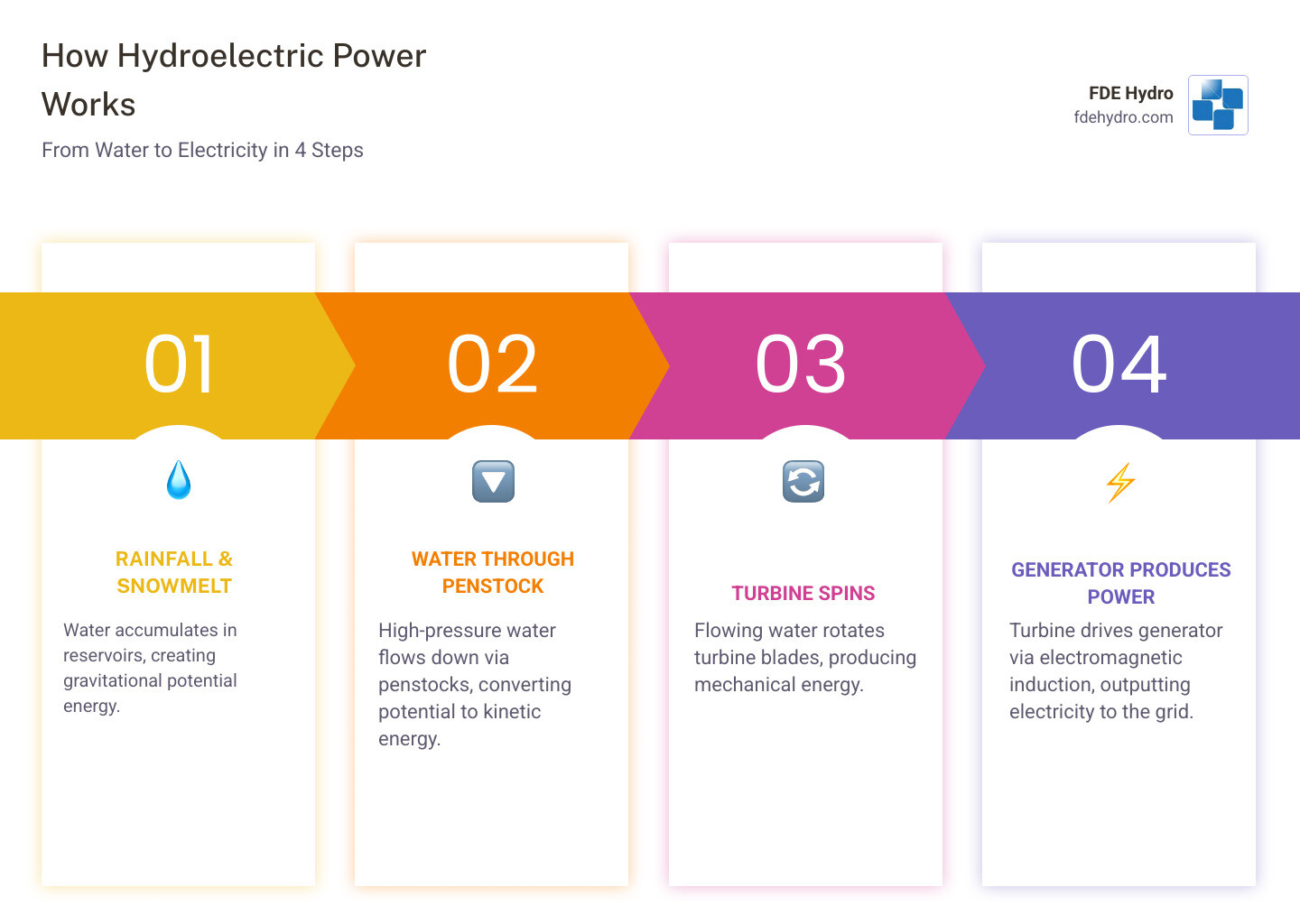
When we look at the technical definition for hydroelectric power, we are really talking about energy transformation. It begins with gravitational potential. Imagine a large volume of water sitting in a reservoir behind a dam. Because that water is at a higher elevation than the river below, it possesses potential energy. When we release that water, gravity pulls it downward, converting that potential energy into kinetic energy (energy in motion).
This flowing water is directed toward a hydraulic turbine. As the water strikes the turbine blades, the kinetic energy becomes mechanical energy. Finally, the spinning turbine rotates a shaft connected to an electric generator. Inside the generator, magnets spin past copper coils to create the final product: electricity.
This cycle is fundamentally different from fossil fuel power plants. While a coal plant burns fuel to create steam to turn a turbine, we simply use the natural weight and movement of water. This makes it a premier form of renewable energy, as it relies on the Earth’s hydrologic cycle—evaporation, precipitation, and runoff—to “refuel” the reservoir.
Understanding the Scientific research on the diversity of hydropower projects reveals that there isn’t just one way to build these systems. From massive dams to small-scale Hydroelectric Electricity projects, the core energy transformation remains the same, but the application varies wildly depending on the geography of the region.
How Hydropower Works: From Gravity to Electricity
To understand how this process plays out in the real world, let’s look at the anatomy of a typical facility. Whether it is a massive structure like the Hoover Dam or a smaller modular installation, the components are remarkably consistent.
- The Intake and Penstocks: Water is drawn from the reservoir through an intake. It then travels through large pipes called penstocks. These pipes are designed to handle immense pressure as the water accelerates toward the powerhouse.
- The Powerhouse: This is the heart of the operation. It houses the turbines and generators. You can find more detail on these specific parts in our Hydroelectric Dam Components Ultimate Guide.
- Faraday’s Law in Action: Inside the generator, we utilize electromagnetic induction. According to Faraday’s Law, a changing magnetic field through a circuit induces an electromotive force. By spinning magnets (the rotor) inside a series of stationary wire coils (the stator), we create a steady flow of electrons.
- Transformers and Transmission: The electricity produced by the generator is usually at a lower voltage than what is needed for long-distance travel. Transformers “step up” the voltage so it can be sent efficiently across transmission lines to homes in New York City, Los Angeles, or Toronto.
Calculating Power: The Importance of Head and Flow
The amount of electricity we can generate isn’t a guessing game; it’s a matter of physics. Two primary factors dictate the power output: Hydraulic Head and Volumetric Flow.
- Hydraulic Head: This is the vertical distance the water falls. The higher the “head,” the more pressure the water exerts on the turbine. A high-head plant can produce a lot of power even with a relatively small amount of water. You can explore more on this in the Technical data on hydraulic head encyclopedia.
- Volumetric Flow: This is the volume of water passing through the system over a specific time (measured in cubic meters per second or cubic feet per second).
The basic formula for power (P) is: P = η × ρ × Q × g × H
Where:
- η (eta) is the system efficiency.
- ρ (rho) is the density of water.
- Q is the flow rate.
- g is the acceleration due to gravity.
- H is the hydraulic head.
In simple terms: if you double the height of the dam or double the amount of water flowing through it, you effectively double the power potential.
The Role of Efficiency in the Definition for Hydroelectric Power
One reason we love hydropower is its incredible efficiency. While most fossil fuel plants struggle to reach 40% efficiency (losing most energy as heat), modern hydroelectric plants can be upwards of 90% efficient.
However, efficiency isn’t static. Over time, turbine blades can wear down, and mechanical losses can occur in the bearings or the generator. This is why modernization is such a hot topic in our industry today. By retrofitting older dams with newer, modular technology, we can significantly boost Hydroelectric Dam Efficiency without needing to build entirely new structures.
Improving generator performance through digital controls and better materials allows us to squeeze more “juice” out of every drop of water that passes through the system.
Main Types of Hydroelectric Power Plants
Not every hydroelectric plant looks like the massive concrete walls you see in movies. Depending on the river and the power needs of the local communities, different designs are used.
| Plant Type | Key Feature | Best Use Case |
|---|---|---|
| Impoundment | Uses a large dam and reservoir | Large-scale, steady power, flood control |
| Diversion (Run-of-River) | Channels river water through a canal/penstock | Smaller environmental footprint, constant flow rivers |
| Pumped-Storage | Moves water between two reservoirs | Acts as a “battery” for grid stability |
Each of these types plays a specific role in the energy grid. For a deeper dive into these structures, check out our guide on Hydroelectric Dams or consult the U.S. Bureau of Reclamation Hydroelectric Power Guide.
Pumped-Storage: Reusing Water for Peak Demand
Think of Pumped-Storage as a giant green battery. In most regions, electricity demand fluctuates. In a city like New York or Atlanta, demand might be low at 3:00 AM but sky-high at 5:00 PM when everyone turns on their air conditioning.
During off-peak hours, when there is excess electricity on the grid (perhaps from wind turbines spinning at night), we use that power to pump water from a lower reservoir back up to a higher one. When demand peaks, we release that water back down through the turbines to generate power instantly. This battery-like function is essential for grid stability and is one of the most cost-effective ways to store large-scale energy. You can read more about the More info on pumped-storage economics to see why it’s becoming the backbone of modern renewable grids.
Run-of-River and the Modern Definition for Hydroelectric Power
Run-of-river (or diversion) facilities are often seen as the “gentler” cousin of the large impoundment dam. These facilities don’t require a massive reservoir that floods thousands of acres. Instead, they divert a portion of a river’s natural flow through a canal or penstock to spin a turbine before returning the water to the main river downstream.
Because they have minimal impoundment, they are often easier to permit and have a lower impact on the local ecosystem. They rely on the natural flow of the river, meaning their output can vary with the seasons. When we talk about Hydroelectric Dam Design Complete Guide, we often emphasize these low-impact solutions for smaller communities or sensitive environmental zones in places like California or the Pacific Northwest.
The Global Significance and History of Water Power
The definition for hydroelectric power has evolved from simple mechanical work to high-tech digital generation.
- Ancient History: The Greeks and Romans used water wheels to grind grain and lift water.
- 19th Century: In 1878, the first hydroelectric scheme was developed in England to power a single lamp. By 1882, the Vulcan Street Plant in the U.S. began operating with a 12.5 kW output.
- 20th Century: This was the era of the “Mega-Dam.” Projects like the Norris Dam in Tennessee and the Hoover Dam became symbols of industrial progress.
- Modern Day: Today, China leads the world in capacity, with the Three Gorges Dam standing as the largest power station on the planet (22.5 GW).
In North America, Canada is a powerhouse. In 2022, hydroelectricity accounted for a staggering 61.7% of Canada’s total electricity generation. With 595 stations across the country, Canada remains the third-largest producer of hydropower globally.
Whether it is for massive industrial needs or small-scale Hydroelectric Dam Construction, water remains the most reliable renewable resource we have.
Advantages and Environmental Impacts of Hydro Energy
Like any energy source, hydropower comes with a balance of pros and cons.
The Advantages:
- Low-Carbon: Once built, a dam produces virtually no greenhouse gases during operation. It is a vital tool in fighting climate change.
- Reliable: Unlike solar or wind, which depend on the weather, hydro provides a “baseload” of power that we can turn on or off in seconds.
- Multi-Use: Reservoirs often provide irrigation for farms, flood control for cities, and recreation (boating and fishing) for families.
The Environmental Impacts:
- Ecosystem Disruption: Dams can block fish migration, particularly for species like salmon. This is why modern designs include “fish ladders” or bypasses.
- Methane Emissions: In tropical regions (like parts of Brazil), submerged vegetation in new reservoirs can rot, releasing methane—a potent greenhouse gas.
- Siltation: Dams trap sediment that would naturally flow downstream to nourish deltas.
- Displacement: Large projects often require the relocation of local communities.
We take these impacts seriously. Our Hydroelectric Power Solutions Guide explores how new technologies—like modular precast concrete—can help mitigate these issues by allowing for faster, less invasive construction and easier retrofitting of existing “non-powered” dams. You can also read more about the Research on how dams impact river ecosystems to understand the challenges we are working to solve.
Frequently Asked Questions about Hydropower
What is the most common definition for hydroelectric power?
The most common definition for hydroelectric power is the use of flowing water to spin a turbine that drives an electric generator. It is the process of turning the energy of the water cycle into usable electricity.
How does a hydroelectric generator differ from a coal turbine?
While both use a spinning turbine to drive a generator, the “prime mover” is different. A coal plant burns fuel to boil water into high-pressure steam. A hydroelectric plant uses the natural weight and flow of river water. This means hydro has no fuel costs and produces no smoke or ash.
Why is pumped storage considered a “green battery”?
It’s called a “green battery” because it stores energy for later use without using chemicals like lithium-ion batteries. It uses gravity and water to “save” excess electricity produced during low-demand periods and “release” it when the grid needs it most.
Conclusion
At FDE Hydro™, we believe the future of the definition for hydroelectric power lies in innovation and sustainability. Our patented French Dam technology—a modular precast concrete system—is changing how we think about water infrastructure. By significantly reducing construction time and costs, we make it feasible to bring renewable energy to more communities across the United States, Canada, Brazil, and Europe.
Whether we are building new low-impact facilities or retrofitting infrastructure that has been sitting idle for decades, our goal is to make Hydroelectric Power Generation accessible and environmentally responsible.
If you are a dam owner, a grid operator, or a policy-maker looking for faster, more cost-effective ways to harness the power of water, we invite you to Explore Hydropower Solutions with us. Together, we can ensure that the next century of hydropower is even more impactful than the last.
