

How a Hydro Electric Dam Works — And Why It Still Matters in 2026
A hydro electric dam is one of the most powerful and proven tools humanity has ever built for generating clean electricity. In 2026, hydropower supplies around 15% of the world’s electricity — more than all other renewable sources combined, and more than nuclear power.
Here’s what you need to know at a glance:
| Key Fact | Detail |
|---|---|
| How it works | Captures energy from flowing or falling water to spin turbines and generate electricity |
| Global capacity | Nearly 1,400 GW installed worldwide (2021) |
| Annual generation | ~4,210 TWh in 2023 |
| Largest facility | Three Gorges Dam, China — 22,500 MW |
| Countries most reliant | Norway (88.5%), Paraguay (99.7%), Brazil (60.4%) |
| Key advantage | Dispatchable, low-emission, long-life power |
| Key concern | Ecosystem disruption, displacement, and high upfront cost |
Hydropower isn’t a new idea. People have been using moving water for power for thousands of years — from grain mills in ancient China to the first hydroelectric lamp lit at Cragside House in England in 1878. Today’s mega-projects like the Three Gorges Dam and Itaipu Dam produce enough electricity to power entire nations.
But hydropower is also evolving fast. Aging infrastructure needs upgrades. New modular construction methods are cutting costs and timelines. And as the world races to replace fossil fuels, dispatchable clean power is more valuable than ever.
This guide breaks it all down in plain language — no engineering degree required.
I’m Bill French, Sr., Founder and CEO of FDE Hydro™, where I’ve spent the last decade developing patented modular construction solutions that are transforming how hydro electric dam projects get built — faster, cheaper, and with less environmental disruption. From five decades of heavy civil construction experience, I’ll walk you through everything a beginner needs to understand about how these remarkable structures work, what they cost the environment, and where the industry is headed.
What Is a Hydro Electric Dam and How Does It Generate Electricity?
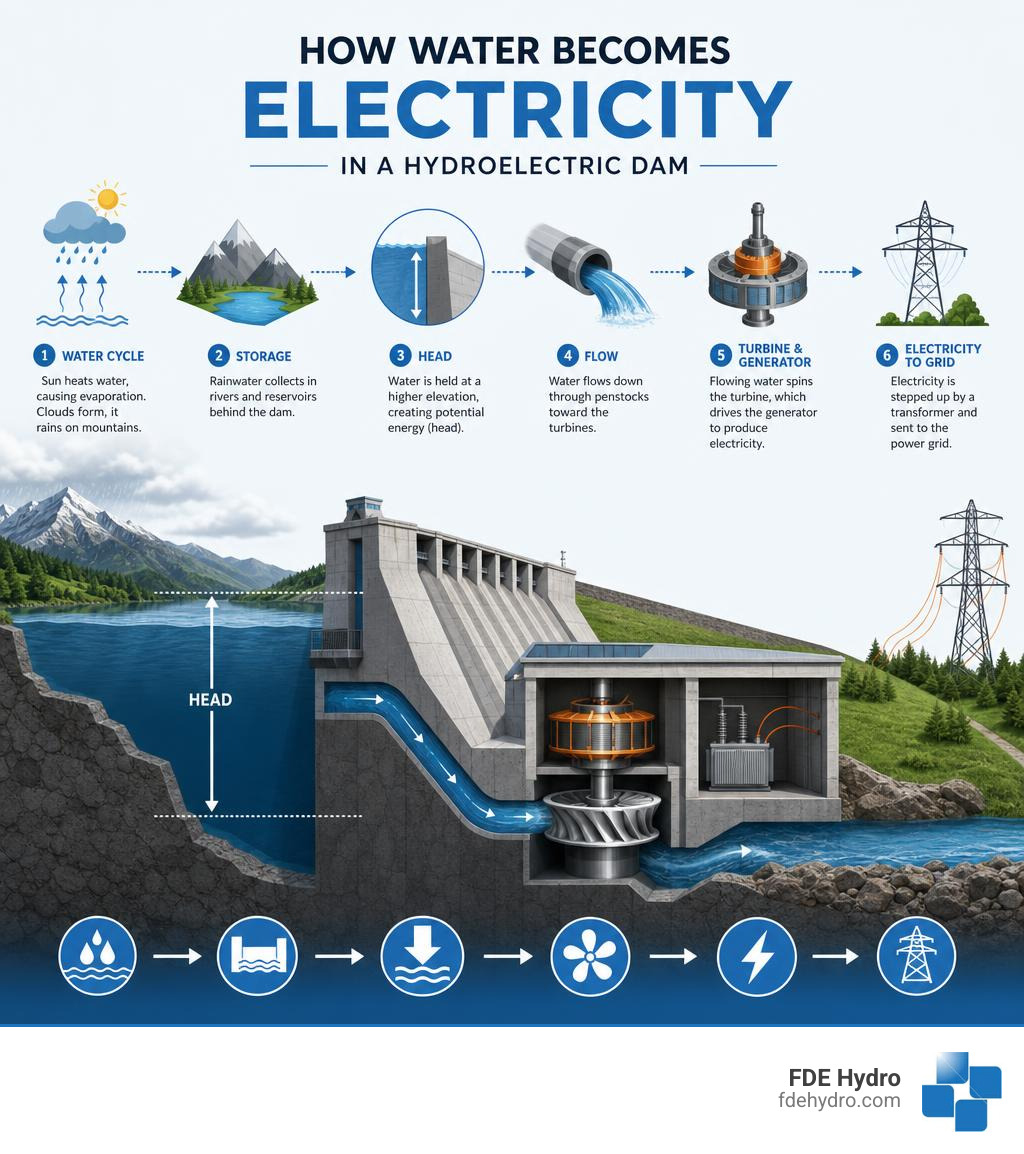
At its heart, a hydro electric dam is an energy converter. It doesn’t create energy from scratch; instead, it captures the gravitational energy of falling water and turns it into electricity.
This process relies heavily on the natural water cycle. Solar energy evaporates water from the oceans, which then condenses into precipitation and falls on high-altitude land. As this water collects in rivers and streams, gravity pulls it back toward sea level. By placing a dam in the path of this flowing water, we create a controlled bottleneck where we can extract its mechanical energy.
The conversion happens in a few straightforward steps:
- The Reservoir: The dam blocks the river, creating a large reservoir behind it. This stores water at a high elevation, creating potential energy.
- The Intake and Penstock: When electricity is needed, gates on the dam open, and water enters an intake. It flows down a large pipe called a penstock, building up pressure and speed.
- The Turbine: At the end of the penstock, the high-pressure water strikes the blades of a massive turbine, causing it to spin rapidly. This converts the potential energy of the water into mechanical energy.
- The Generator: The spinning turbine is connected to a generator by a heavy shaft. Inside the generator, powerful magnets spin inside copper coils, generating alternating current (AC) electricity.
- The Transformer and Grid: The electricity travels to a transformer, which steps up the voltage so it can travel long distances over the transmission grid.
- The Tailrace: The water, now stripped of its high pressure, exits the powerhouse through a tailrace and flows back into the river below the dam.
To dive deeper into these fundamental physical concepts, check out our guide on The Current Definition: Understanding Hydroelectric Power and explore the mechanics of Hydroelectric Power Generation.
Core Hydro Electric Dam Components
A modern hydro electric dam is a highly engineered system of specialized components. Every part has a role to play in keeping the facility safe, efficient, and reliable.

The primary components include:
- The Dam Wall: The massive concrete or earth-fill barrier that holds back the river.
- The Spillway and Gates: Safety features designed to safely release excess water during floods, preventing the dam from being overtopped.
- The Reservoir: The artificial lake behind the dam that acts as an energy storage battery.
- The Powerhouse: The heavy building that houses the turbines, generators, transformers, and control systems.
- Fish Passages: Specialized structures like fish ladders or bypass channels that help migratory fish travel past the dam.
- Sediment Outlets: Gates at the bottom of the dam used to flush out accumulated silt and sand.
For a comprehensive breakdown of these structures and how they are engineered, read our Hydroelectric Dam Components Ultimate Guide.
How to Calculate Hydro Electric Dam Power Output
How much power can a hydro electric dam actually produce? It comes down to two main physical variables: head and flow rate.
- Head is the vertical distance the water falls from the reservoir surface to the turbine. The higher the head, the more pressure the water exerts on the turbine.
- Flow Rate is the volume of water passing through the penstock per second, typically measured in cubic feet per second (cfs) or cubic meters per second ($m^3/s$).
The basic formula for calculating the available electrical power (in kilowatts) is:
$$P = eta cdot rho cdot g cdot Q cdot H$$
Where:
- $P$ is the electrical power output (kW)
- $eta$ is the overall efficiency of the turbine and generator (typically between 80% and 95%)
- $rho$ is the density of water ($1,000 text{ kg/m}^3$)
- $g$ is the acceleration due to gravity ($9.81 text{ m/s}^2$)
- $Q$ is the flow rate ($m^3/s$)
- $H$ is the net head (meters)
Because power output depends directly on the volume of water flowing through the system, hydroelectric plants are highly sensitive to seasonal inflows and drought. During dry years, a dam’s capacity factor — the ratio of its actual electricity output to its maximum potential output — can drop significantly. Learn more about how these variables impact energy production in our guide on Hydroelectric Dam Efficiency.
Main Types of Hydroelectric Facilities
Not all hydroelectric plants look or operate the same way. Depending on the local geography, water availability, and grid requirements, engineers choose from several distinct facility types.
| Facility Type | Storage Scale | Dispatchability | Environmental Footprint |
|---|---|---|---|
| Conventional Storage | Large | High (On-demand) | High (Floods large areas) |
| Pumped-Storage | Dual Reservoir | Extremely High | Moderate |
| Run-of-the-River | Minimal to None | Low (Weather-dependent) | Low |
| Tidal Power | Estuary / Ocean | Predictable (Cycles) | Moderate to High |
| Conduit Hydropower | None (In-pipe) | Dependent on system flow | Extremely Low |
To understand how these systems compare on a broader scale, read our introductory guide on Hydropower.
Conventional Storage Dams
Conventional storage dams are what most people picture when they think of a hydro electric dam. These massive concrete gravity or arch structures block major rivers to create large reservoirs, offering high head and massive dispatchable electrical output.
These multi-purpose facilities do more than generate power; they also provide flood control, irrigation water, and recreational opportunities. Famous examples in North America and South America include the Grand Coulee Dam in Washington state, managed by the Bureau of Reclamation , and the binational Itaipu Dam between Brazil and Paraguay.
To explore the architectural and engineering principles behind these massive structures, take a look at our Hydroelectric Dam Design Complete Guide.
Pumped-Storage Hydropower
Pumped-storage hydropower acts as a giant water battery for the electrical grid. These facilities use two reservoirs at different elevations: an upper reservoir and a lower reservoir.

- During low-demand periods (such as at night or when solar output is high), the plant uses cheap, excess grid electricity to pump water from the lower reservoir uphill to the upper reservoir.
- During peak-demand periods (such as hot summer afternoons), the water is released back down through reversible turbines, generating electricity on demand.
Although pumped-storage is a net consumer of electricity due to minor efficiency losses during pumping, it is incredibly valuable for grid stability. It accounts for nearly 85% of global grid energy storage capacity, offering rapid ramping speeds to balance intermittent solar and wind energy. In Europe, these systems are critical to maintaining grid frequency; you can learn more about their distribution in this list of the Top 10 hydroelectric and PSPPs in Europe (2025) .
Run-of-the-River, Tidal, and Conduit Systems
For locations where a massive reservoir isn’t feasible or environmentally acceptable, alternative systems provide excellent solutions:
- Run-of-the-River: These plants divert a portion of a river’s natural flow through a canal or penstock to spin turbines, returning the water downstream. They have little to no storage capacity, meaning their power output fluctuates with seasonal river flows.
- Tidal Power: These facilities capture the mechanical energy of ocean tides. They can use tidal barrages (dams across estuaries) or tidal stream turbines submerged in high-velocity ocean currents.
- Conduit Hydropower: This involves installing small turbines inside existing water infrastructure, such as municipal drinking water pipes, industrial cooling systems, or agricultural irrigation canals.
These systems are often categorized by size:
- Small Hydro: Typically generates up to 10 MW.
- Micro Hydro: Generates up to 100 kW, ideal for small communities or remote homesteads.
- Pico Hydro: Generates under 5 kW, perfect for off-grid homes.
For a detailed look at how run-of-the-river and smaller-scale systems are deployed, explore Harnessing the Current: A Guide to Hydroelectric Power Production.
Advantages, Grid Value, and Energy Source Comparisons
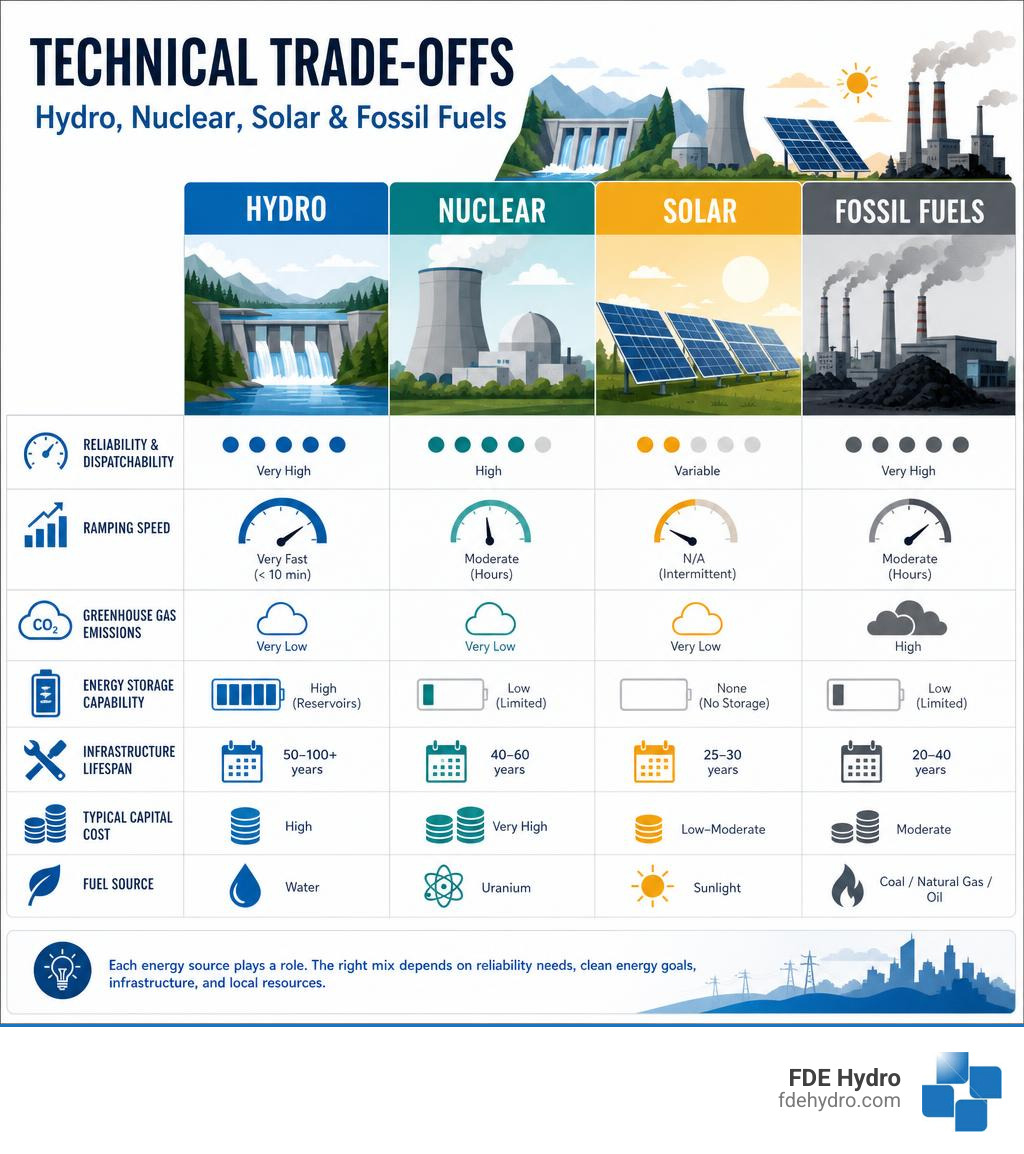
Hydropower is one of the most reliable, clean, and flexible electricity sources available. Unlike wind and solar, which depend on weather conditions, or fossil fuels, which release high greenhouse gas emissions, a hydro electric dam offers the best of both worlds: low-carbon emissions and dependable, on-demand power.
To see how these benefits are packaged into modern energy strategies, read our Hydroelectric Power Solutions Guide.
Why Hydropower Is Valuable to the Electric Grid
The modern electrical grid requires a delicate, second-by-second balance between power generation and electricity consumption. Conventional fossil fuel plants and nuclear reactors can take hours or even days to ramp their output up or down.
Hydroelectric generators, however, can go from a cold start-up to full load in less than 10 minutes. This makes them incredibly valuable for:
- Peak Shaving: Meeting sudden spikes in electricity demand.
- Spinning Reserves: Standing by to immediately supply power if another major generator on the grid fails.
- Black Start Capability: Providing the initial power needed to restart the electrical grid after a major blackout.
Furthermore, the reservoirs of existing conventional dams worldwide can store a total of 1,500 TWh of electrical energy in one full cycle. This is roughly 170 times more storage capacity than the entire global fleet of pumped-storage plants, providing a massive buffer against seasonal energy shortages.
Multi-Purpose Benefits Beyond Electricity
Very few power plants offer benefits beyond electricity generation, but a conventional hydro electric dam is a multi-purpose tool.
Many dams are built primarily for water management. For example, the Albeni Falls Dam in Idaho, managed by the U.S. Army Corps of Engineers, carefully balances power generation with flood control, navigation, and local fisheries mitigation. You can read more about its operations on the official Albeni Falls Dam page.
Similarly, the Grand Coulee Dam in Washington state supplies irrigation water to approximately 720,000 acres of farmland through the Columbia Basin Project, supporting regional agricultural economies while generating over 21 billion kilowatt-hours of clean electricity annually.
Hydropower vs Nuclear, Wind, Solar, and Fossil Fuels
When evaluating electricity sources, we must look at reliability, cost, and environmental impact:
- vs. Fossil Fuels (Coal & Gas): Fossil fuel plants are highly reliable but release massive amounts of carbon dioxide, sulfur, and nitrogen oxides. Hydropower has no fuel costs and one of the lowest lifecycle greenhouse gas emissions of any generation technology.
- vs. Wind & Solar: Wind and solar are clean and cheap to build, but they are intermittent. When the wind stops blowing or the sun sets, they require backup generation. Hydropower provides the steady, dispatchable baseload power that wind and solar lack.
- vs. Nuclear: Nuclear power provides excellent, emission-free baseload power with a high capacity factor. However, nuclear plants are incredibly expensive to build, take over a decade to construct, and cannot ramp their output up and down quickly to match grid fluctuations.
Environmental, Social, and Safety Risks of Hydroelectric Dams
While the benefits of hydroelectricity are clear, we must also address the real environmental and social challenges associated with building and operating massive dams.
To learn more about how modern engineering works to minimize these impacts during planning and development, read our guide on Hydroelectric Dam Construction.
Ecosystem and Climate Impacts
Building a conventional hydro electric dam completely alters the local river ecosystem:
- Habitat Fragmentation: Dams act as physical barriers, blocking the migration of fish like salmon and eels. Up to 70% of silver eels passing through traditional turbines can perish.
- Sediment Trapping: Dams trap gravel, sand, and silt behind their walls. This starves downstream riverbeds of essential nutrients, leading to severe coastal and river erosion.
- Water Quality Changes: Reservoirs can become stratified, with warm, oxygen-poor water collecting at the bottom. Releasing this low-oxygen water downstream can harm aquatic life.
- Methane Emissions: When a new reservoir is flooded, submerged vegetation decays. In warm, tropical climates, this decay can release significant amounts of methane, a potent greenhouse gas. Fortunately, lifecycle emissions remain extremely low in temperate climates.
To mitigate these impacts, modern dams are designed with fish ladders, fish-safe turbines, hatcheries, and managed environmental flows to mimic natural river cycles. Learn more about these solutions in our guide Dive Into Hydropower: Unlocking Nature’s Electric Potential.
Population Displacement and Community Impacts
The creation of massive reservoirs often requires flooding large areas of dry land, which can have significant social consequences:
- Displacement: It is estimated that between 40 and 80 million people have been displaced by dam construction worldwide. For instance, the construction of the Itaipu Dam displaced approximately 10,000 families living along the Paraná River.
- Loss of Cultural Heritage: Flooding can submerge sacred Indigenous sites, historical landmarks, and valuable agricultural land.
- Social License: Today, developers must secure a “social license to operate” through extensive public consultation, fair compensation, and equitable benefit-sharing programs.
Dam Safety, Failure Risks, and Consequences
Dams hold back millions of tons of water. If a dam fails, the consequences for downstream communities can be catastrophic.
Historically, dam failures have resulted from extreme flooding, poor foundation engineering, landslides, or seismic activity. Notable disasters include:
- The Vajont Dam Disaster (Italy, 1963): A massive landslide fell into the reservoir, creating a giant wave that overtopped the dam and claimed nearly 2,000 lives downstream.
- The Banqiao Dam Failure (China, 1975): Extreme rainfall from a typhoon caused the dam to collapse, resulting in catastrophic flooding and thousands of casualties.
Today, dam operators use advanced structural monitoring instruments, such as piezometers, inclinometers, and seismic sensors, to track dam health in real time. Reservoirs also maintain strict emergency action plans and inundation mapping to protect downstream populations.
History, Global Scale, and Future Potential
To understand where hydropower is going, it helps to look at where it started.
For an in-depth exploration of how technology has advanced over the centuries, check out The Ultimate Guide to Modern Hydropower Technology.
From Ancient Water Power to Modern Hydroelectricity
Humans have harnessed the force of moving water for millennia:
- Ancient Civilizations: The Han Dynasty in China (202 BC – 9 AD) used water wheels to power trip hammers for grain hulling. Roman mills used water wheels to grind flour.
- The Industrial Revolution: In 1771, Cromford Mill in England utilized water power to spin cotton, helping to spark the modern factory system.
- The Birth of Hydroelectricity: In 1878, inventor William Armstrong lit a single lamp at Cragside House in England using a water-driven turbine.
- The First Commercial Plants: In September 1882, the Vulcan Street Plant opened on the Fox River in Appleton, Wisconsin, generating about 12.5 kilowatts of power.
- The Era of Mega-Dams: The 20th century saw the construction of massive projects like the Hoover Dam and Grand Coulee Dam under New Deal policies in the United States, transforming regional economies.
Current Global Capacity, Generation, and Leading Countries
Today, hydropower is a cornerstone of the global energy landscape:
- Global Output: Hydropower generated 4,210 TWh of electricity in 2023, representing roughly 15% of total global electricity.
- Installed Capacity: Global capacity reached nearly 1,400 GW in 2021.
- Leading Countries: China is the world leader in total capacity, adding 24 GW of new hydropower in 2022 alone. However, other nations rely on hydro for the vast majority of their grid power, including Paraguay (99.7%), Norway (88.5%), and Brazil (60.4%).
The world’s largest power-generating facilities are all hydroelectric dams:
- Three Gorges Dam (China): 22,500 MW capacity.
- Itaipu Dam (Brazil/Paraguay): 14,000 MW capacity. You can read about its history and operations in the official ITAIPUMAGAZINEENGLISH_LR or the Itaipu Dam – Wikipedia page.
- Grand Coulee Dam (USA): 6,809 MW capacity. For detailed statistics, see the Grand Coulee Dam Statistics and Facts sheet or the Grand Coulee Dam > Northwestern Division > Fact Sheet – Northwestern Division page.
Modernization, Retrofits, and Future Potential
As we look to the future, the focus is shifting from building massive new dams to modernizing and retrofitting existing infrastructure:
- Retrofitting Non-Powered Dams: In the United States, only about 3% of the nation’s 90,000 dams actually generate electricity. Adding turbines to these existing structures can generate clean energy with minimal environmental impact.
- Digital Upgrades: Integrating advanced sensors and digital control systems allows operators to optimize water releases and improve overall efficiency.
- Modular Precast Concrete: Traditional dam construction is notorious for high costs and long construction timelines. At FDE Hydro™, we are changing that. Our patented modular precast concrete technology, known as the French Dam, allows developers to build and retrofit hydroelectric dams and water control systems much faster and at a fraction of the cost across the United States, Canada, Brazil, and Europe.
Frequently Asked Questions About Hydro Electric Dams
What percentage of the world’s electricity comes from hydropower?
Hydropower supplies approximately 15% of the world’s electricity (almost 4,210 TWh in 2023). This makes it the largest single source of renewable electricity globally, generating more power than all other renewable sources combined and outproducing nuclear power.
What is the largest hydroelectric dam in the world?
The Three Gorges Dam in China is the world’s largest power-producing facility of any kind, with an installed capacity of 22,500 MW. However, the Itaipu Dam (14,000 MW), straddling Brazil and Paraguay, has historically set records for actual annual energy production due to the steady, high-volume flow of the Paraná River.
Are hydroelectric dams good or bad for the environment?
Like any major infrastructure project, hydroelectric dams present a mix of benefits and challenges. On the positive side, they provide reliable, low-carbon electricity that is vital for reducing global greenhouse gas emissions. On the negative side, they can disrupt river ecosystems, block fish migration, trap sediment, and displace local communities. The goal of modern engineering is to minimize these negative impacts through careful site selection, fish-safe technologies, and adaptive water management.
Conclusion: What Beginners Should Remember About Hydro Electric Dams
A hydro electric dam is more than just a barrier of concrete and steel; it is a vital tool for grid reliability, a source of clean energy, and a multi-purpose resource for water management. As we navigate the energy transition in 2026, balancing the clear benefits of dispatchable, low-carbon power against the real environmental and social impacts of these projects remains a key focus for engineers and policymakers alike.
The future of hydropower lies in smarter, faster, and more sustainable development. Whether we are upgrading historical facilities, retrofitting non-powered dams, or deploying innovative modular precast concrete solutions like our patented French Dam technology, we are committed to helping communities harness the power of moving water safely and efficiently.
Ready to learn more about how we are modernizing water infrastructure? Explore hydro electric dams and discover our sustainable, cost-effective solutions for the modern grid.
