

The Energy Storage Problem That Precast Concrete Is Solving
Precast concrete pumped storage is transforming how engineers design and build one of the world’s most important energy technologies — pumped storage hydropower (PSH).
Here’s a quick overview of what it means and why it matters:
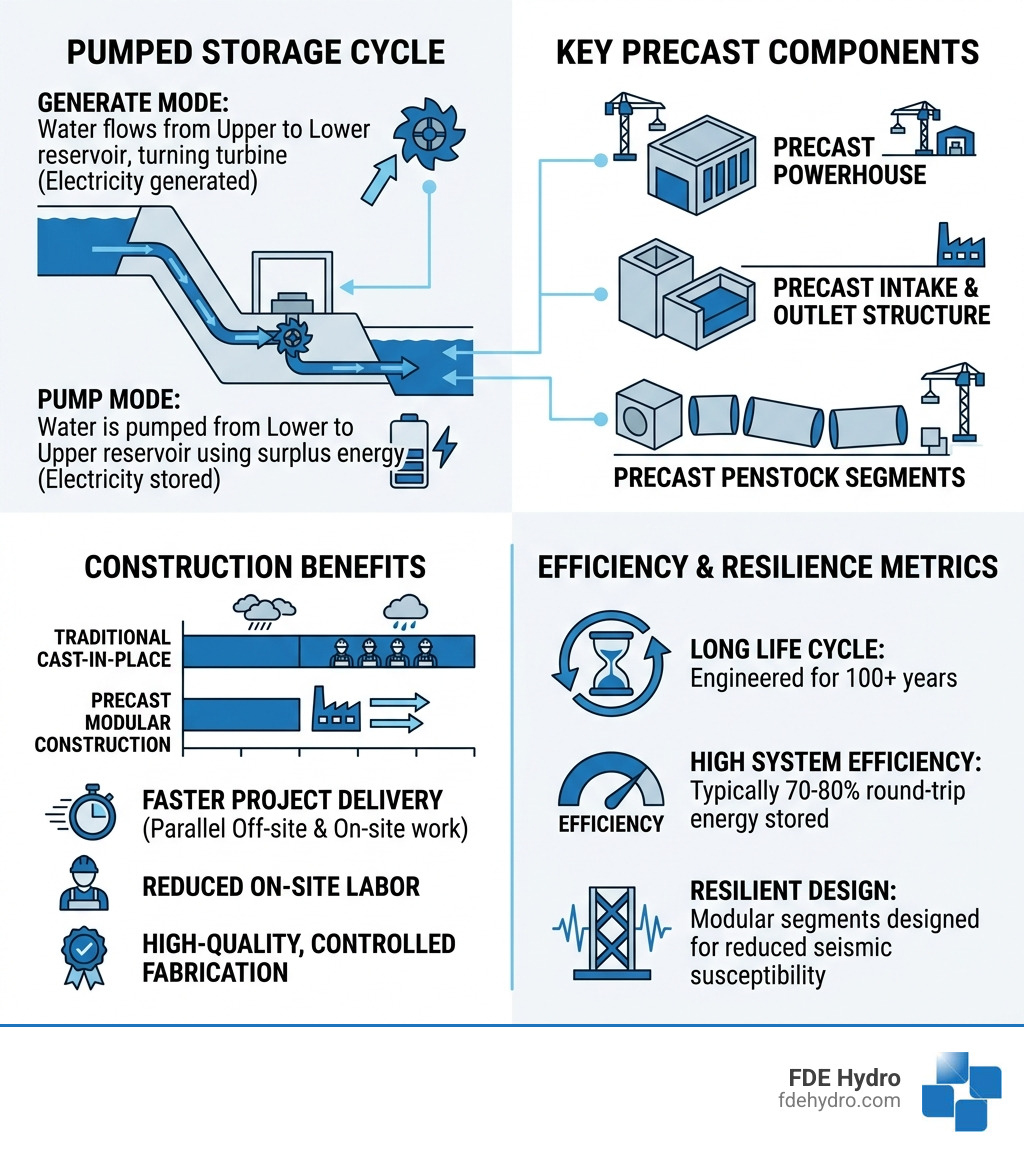
- What it is: Pumped storage hydropower uses two reservoirs at different elevations to store and generate electricity. Precast concrete means key components — powerhouses, intake structures, penstocks — are manufactured off-site in controlled conditions, then assembled on location.
- Why it’s faster: Off-site fabrication runs in parallel with site preparation, cutting construction timelines significantly.
- Why it lasts: Precast modular concrete structures are engineered for 100+ years of use.
- Why it’s safer: Modular systems show reduced susceptibility to seismic damage compared to traditional cast-in-place construction.
- The big picture: With global pumped storage capacity at roughly 140 GW today and expected to reach 300 GW by 2035, the industry needs a faster, smarter way to build — and precast modular construction delivers that.
Traditional PSH construction is slow, expensive, and unpredictable. Poured-in-place concrete is weather-dependent, labor-intensive, and hard to quality-control on remote sites. Precast changes that equation entirely.
I’m Bill French, Sr., Founder and CEO of FDE Hydro, and I’ve spent decades in heavy civil construction before turning his focus specifically to modular precast concrete pumped storage solutions that reduce cost, accelerate delivery, and improve resilience for major water infrastructure projects. If you’re evaluating modern approaches to PSH development, what follows is the most practical breakdown I can offer.
Similar topics to precast concrete pumped storage:
Understanding Precast Concrete Pumped Storage Technology
When we talk about precast concrete pumped storage, we are essentially describing a “giant battery” made of water and gravity, but built with the precision of a Lego set. Traditional PSH relies on pouring massive amounts of concrete directly into forms at the project site. If it rains, you wait. If the site is at the top of a mountain in Switzerland or deep in a forest in China, getting the raw materials there is a logistical nightmare.
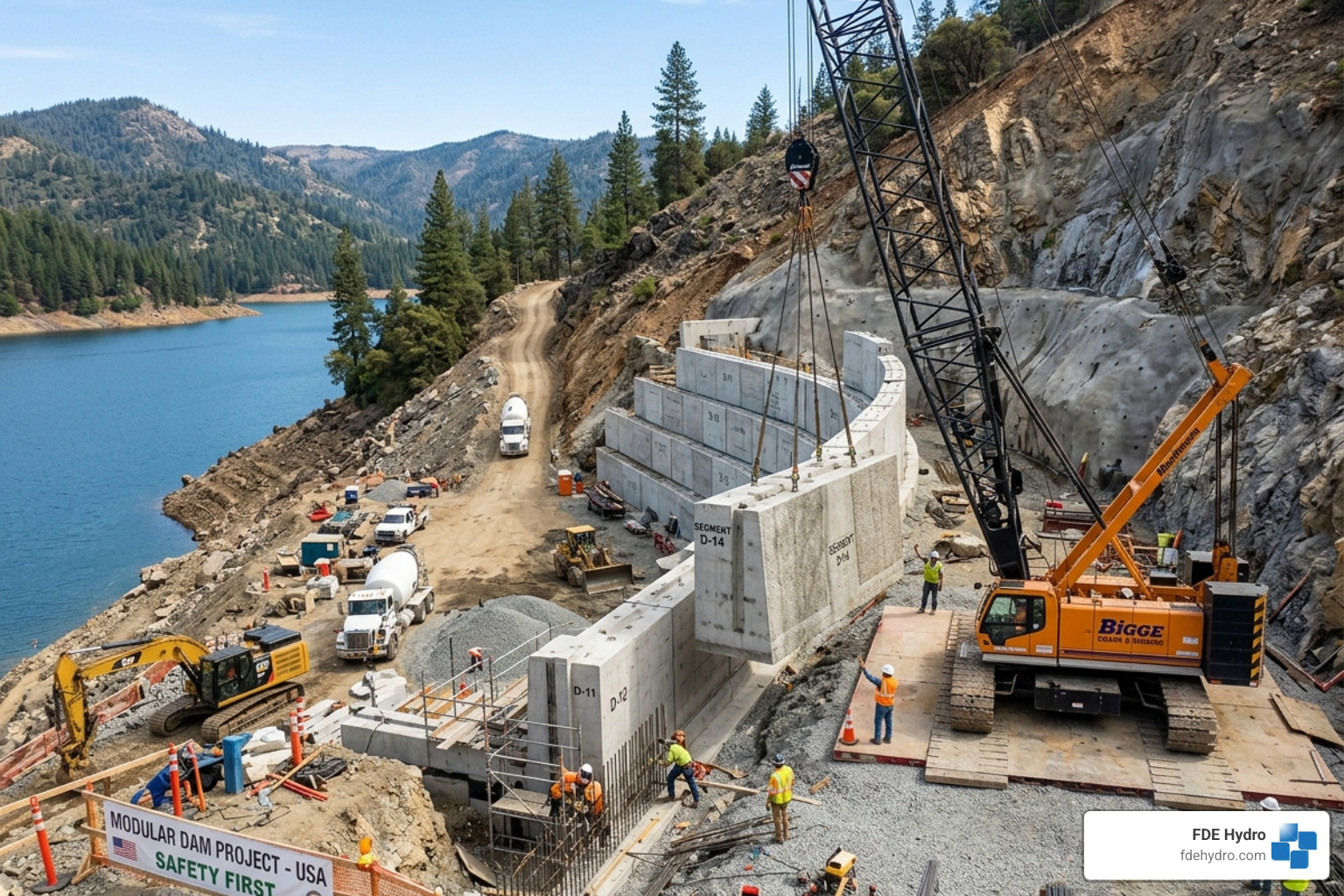
By shifting the work to a factory, we bring predictability to an environment that is anything but. We use Modular Dam Construction to create the reservoirs and Modular Precast Concrete for the powerhouses. This isn’t just a minor tweak to the building process; it’s a fundamental shift in how we approach grid stability and renewable integration. As we add more wind and solar to our grids in North America and Europe, we need storage that can be deployed quickly to balance the “intermittency” of those sources.
Core Components of Precast Systems
A precast concrete pumped storage facility consists of several modular building blocks. Instead of one monolithic slab, we think in terms of:
- Modular Powerhouses: These house the turbines and generators. By using Precast Concrete Technology, we can manufacture the powerhouse walls and roofs off-site, ensuring they meet exact tolerances for equipment mounting.
- Intake and Outflow Structures: These are the “mouths” of the system where water enters and exits the reservoirs. For example, at the Nant De Drance project, engineers used a pre-cast concrete intake structure that was floated into place and lowered, which saved an incredible amount of time compared to traditional methods.
- Precast Pipelines and Penstocks: These are the “veins” of the project. A great example of this is the Technology of casting precast pipeline elements of the Kaisiadorys pumped-storage station, where superplasticized concrete was used to create high-strength, fluid-resistant pipes that can handle the intense pressure of moving water.
Operational Principles and Efficiency Metrics
The way these systems work is elegantly simple. When the sun is shining and the wind is blowing, we have “extra” electricity. We use that excess power to run a pump that moves water from a lower reservoir to an upper one. When demand spikes—say, everyone in New York or Kansas turns on their air conditioners at 5:00 PM—we release the water. It flows down through the turbines, generating electricity.
The “round-trip efficiency” of these systems—the amount of energy you get back compared to what you put in—is typically between 70% and 80%. This is remarkably high for large-scale storage. Modern Pumped Storage Hydropower units often use reversible Francis turbines that act as both a pump and a generator, making the system compact and highly responsive.
| Feature | Traditional Cast-in-Place | Precast Modular PSH |
|---|---|---|
| Construction Speed | Slow (Years) | Fast (Months/Year) |
| Quality Control | Variable (Site-dependent) | High (Factory-controlled) |
| Lifespan | 50-70 Years | 100+ Years |
| Seismic Resilience | Standard | Enhanced |
| Site Disturbance | High | Minimal |
Key Advantages of Modular Precast PSH Systems
Why are we so excited about precast concrete pumped storage? It boils down to three things: speed, cost, and longevity. In our industry, time literally is money. If we can reduce construction time by 40%, we aren’t just saving on labor; we’re getting the plant online and generating revenue years sooner.
Research shows that Why Precast Cost Less isn’t just about the materials. It’s about the reduction in “indirect” costs—less heavy machinery on-site for shorter periods, fewer workers needing housing in remote areas, and a massive reduction in weather-related delays. Furthermore, Precast Concrete Advantages include a design life of over a century. While a battery might last 10-15 years, our concrete structures are built to outlast several generations of turbines.
Seismic Resistance and Durability in Precast Concrete Pumped Storage
One of the most common questions we get is: “Is a modular structure strong enough?” The answer is that it’s actually more resilient. Because precast components are manufactured in a controlled environment, we can use high-strength concrete mixes and advanced reinforcement techniques that are difficult to achieve in the field.
These modular joints can act as a form of “controlled flexibility.” In a seismic event, a monolithic, rigid structure is prone to cracking. A modular system, designed with appropriate connections, can better absorb and dissipate energy. This leads to Precast Concrete Advantages 2, where the structural integrity of the reservoir and powerhouse remains intact even in geologically active regions.
Environmental Benefits and Net-Zero Operations
Sustainability is at the heart of what we do. By using Modular Precast 4 techniques, we minimize the footprint of the construction site. We don’t need to build massive, temporary concrete batch plants in the middle of a pristine forest.
We are also pioneering the concept of “Urban m-PHS” (micro-Pumped Hydro Storage). This involves integrating small-scale storage into existing urban infrastructure—think of using precast modules to create a water storage tank that also serves as an energy reserve for a new housing development. This creates “net-zero” operations by combining energy storage with secondary water uses, like fire suppression or irrigation.
Innovative Applications: From Deep Sea to Urban Centers
The versatility of precast concrete pumped storage is truly mind-blowing. We aren’t just talking about mountains and dams anymore. One of the most fascinating developments is the “StEnSea” (Stored Energy in the Sea) project.
This system uses hollow precast concrete spheres placed on the seabed at depths of around 700 meters.
- The Principle: The surrounding ocean acts as the “upper reservoir,” and the hollow interior of the sphere is the “lower reservoir.”
- The Stats: A sphere with a 28.6-meter internal diameter can provide 20 MWh of storage capacity.
- The Efficiency: It maintains a 75% to 80% efficiency, similar to conventional land-based PSH.
This allows coastal cities to have massive energy storage without taking up any land. It’s like having a giant, invisible battery sitting on the ocean floor.
Scaling with Precast Concrete Pumped Storage Parks
Just as we have wind farms and solar parks, we are moving toward the era of “Storage Parks.” Because our systems are modular, you don’t have to build one massive 1000 MW plant all at once. You can start small and add more modules as the grid’s needs grow. Precast Pushes The Limits Of Scale by allowing for distributed energy resources that are easier to finance and permit than “mega-projects.”
Above-Ground vs. Underground Modular Solutions
Whether you are building on a hilltop or deep in a mine, precast modules provide the answer.
- Above-Ground: We use Small But Mighty A Guide To Modular Pumped Storage And Its Benefits to design containment dams and upper reservoirs that blend into the landscape.
- Underground: Precast is used for turbine seats and diffusers inside caverns. This is especially useful in projects like the Huanggou Pumped Storage Power Station, where precision in the underground powerhouse is critical for the operation of the four 300 MW Francis pump turbines.
Real-World Case Studies in Precast Hydropower
To see the power of concrete in action, we only need to look at some of the world’s most ambitious engineering feats. The Limmern Pumped Storage Plant (LPSP) in Switzerland is a masterclass in high-altitude construction.
The Muttsee dam at Limmern is the longest dam in Switzerland, sitting at an elevation of 2474 meters. It used 250,000 m³ of concrete to hold back 23 million m³ of water. While much of this was poured on-site due to the sheer volume, the project relied heavily on pre-planned logistical “masterpieces” to move 3.5 million tonnes of material up the mountain. Today, it provides 1000 MW of power, acting as a “battery in the mountains” for Europe. For more details, you can explore the Limmern pumped storage power plant | Axpo or Project 5.
Global Implementations: Tianhuangping and Beyond
In China, the Tianhuangping Pumped Storage Station is another giant. With an 1800 MW capacity, it features a massive upper reservoir created by a rockfill dam with asphalt concrete facing. Projects like these show the scale that Modular Precast Dam technology is aiming to simplify. By using precast elements for the intake towers and water conveyance systems, these massive projects can reduce their environmental footprint and construction risk.
Passive Prestressing in Tunnel Linings
One of the technical secrets to making these plants last 100+ years is a technique called “Passive Prestressing.” In the pressure tunnels that connect the reservoirs, we need to ensure the concrete doesn’t crack under the immense weight of the water.
- The Process: We install an unreinforced concrete shell, then use high-pressure grouting (up to 27 bar) to fill the gap between the concrete and the rock.
- The Benefit: This “squeezes” the concrete shell, putting it into compression so that when the water pressure hits, the concrete stays tight and crack-free.
- The Result: Minimized maintenance and a much longer lifespan for the most critical part of the plant.
Frequently Asked Questions about Precast PSH
How does precast concrete improve construction timelines?
By using Modular Precast Concrete, we can perform site excavation and foundation work at the same time the “building” is being manufactured in a factory. This parallel workflow, combined with the fact that precast doesn’t need weeks to “cure” on-site before you can move to the next step, can shave 30-40% off the total project duration.
What is the storage capacity of underwater precast spheres?
Each standard StEnSea unit (a hollow concrete sphere with a 28.6m internal diameter) provides about 20 MWh of storage capacity. To put that in perspective, that’s enough to power thousands of homes for several hours. Because they are modular, you can place 10, 50, or 100 spheres in a “storage park” to reach gigawatt-scale capacity.
Can precast modules be used for urban micro-pumped storage?
Absolutely. This is what we call Urban m-PHS. Because precast modules are clean, quiet to install, and can be designed to look like standard basement or foundation structures, they are perfect for “light infrastructure” projects. They allow developers to build energy resilience directly into the heart of a city.
Conclusion
The future of energy storage isn’t just about chemistry and lithium; it’s about gravity and concrete. As we move toward a net-zero world, the need for long-duration, high-capacity storage is only going to grow. Precast concrete pumped storage offers a proven, durable, and cost-effective way to meet that demand.
At FDE Hydro, we are proud to be at the forefront of this revolution. Whether we are retrofitting an existing dam in Canada or designing a new modular system for the United States or Brazil, our goal remains the same: to provide the “Green Infrastructure” our world needs to thrive.
If you are ready to see how Modular Dam Construction can change your next project, we invite you to Explore Modular Dam Solutions and join us in building a more predictable, sustainable energy future. We’ve got the tools, the technology, and the passion to make it happen—one module at a time.
