What Is a Water Power Dam and How Does It Generate Electricity?
A water power dam is a structure that captures the energy of moving or stored water and converts it into electricity — and it remains one of the most powerful and reliable sources of clean energy on the planet.
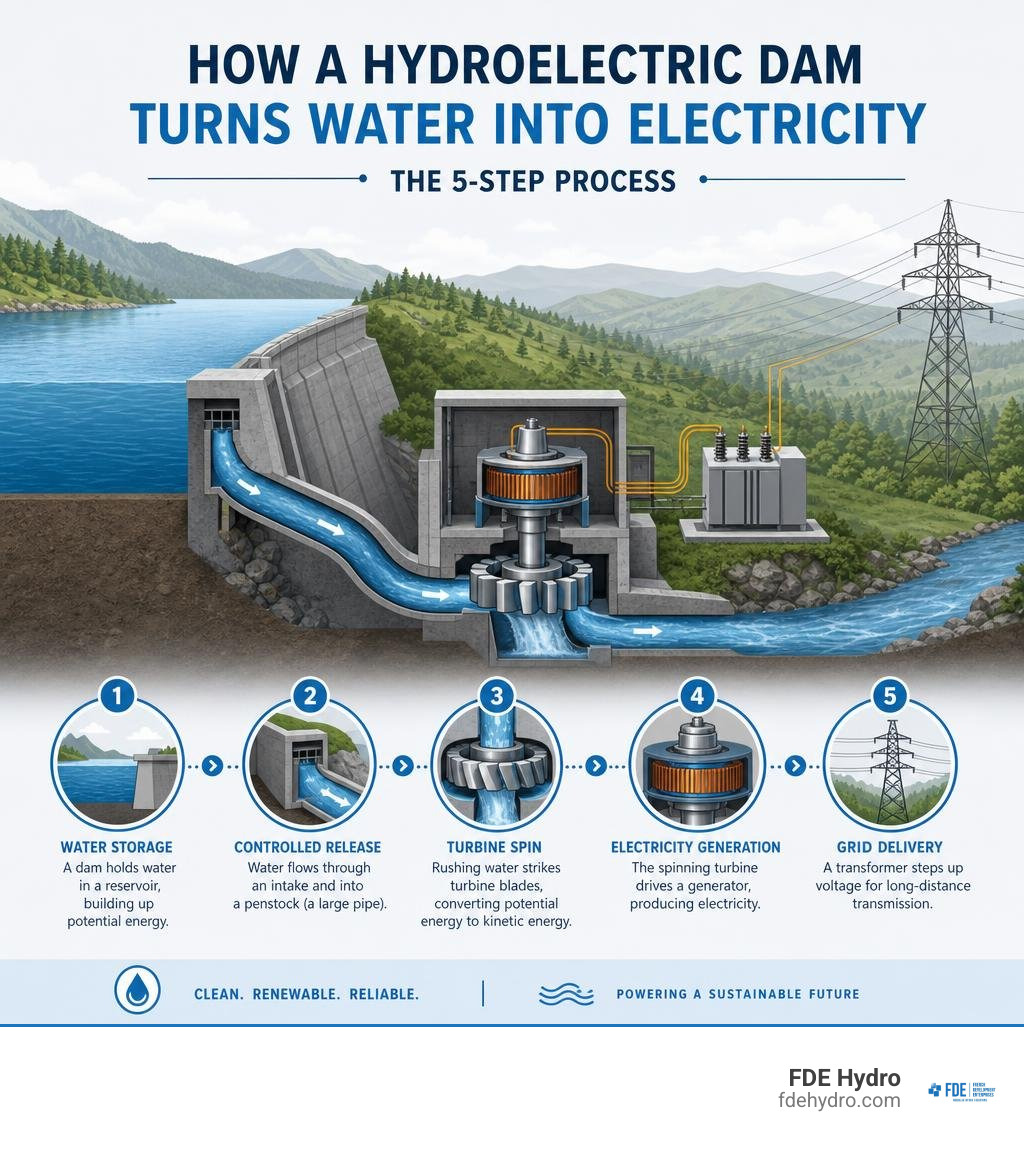
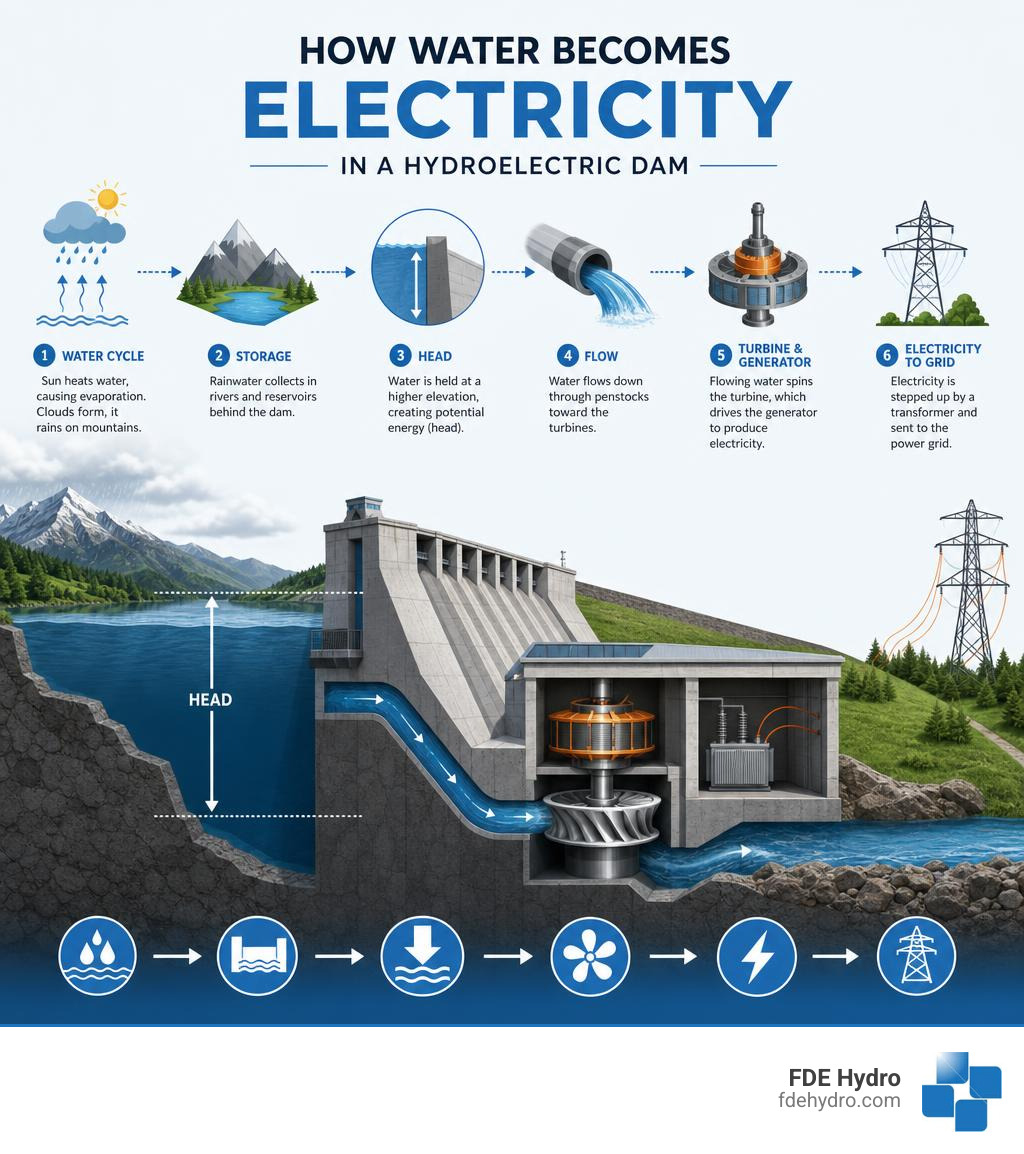
Here’s how it works at a glance:
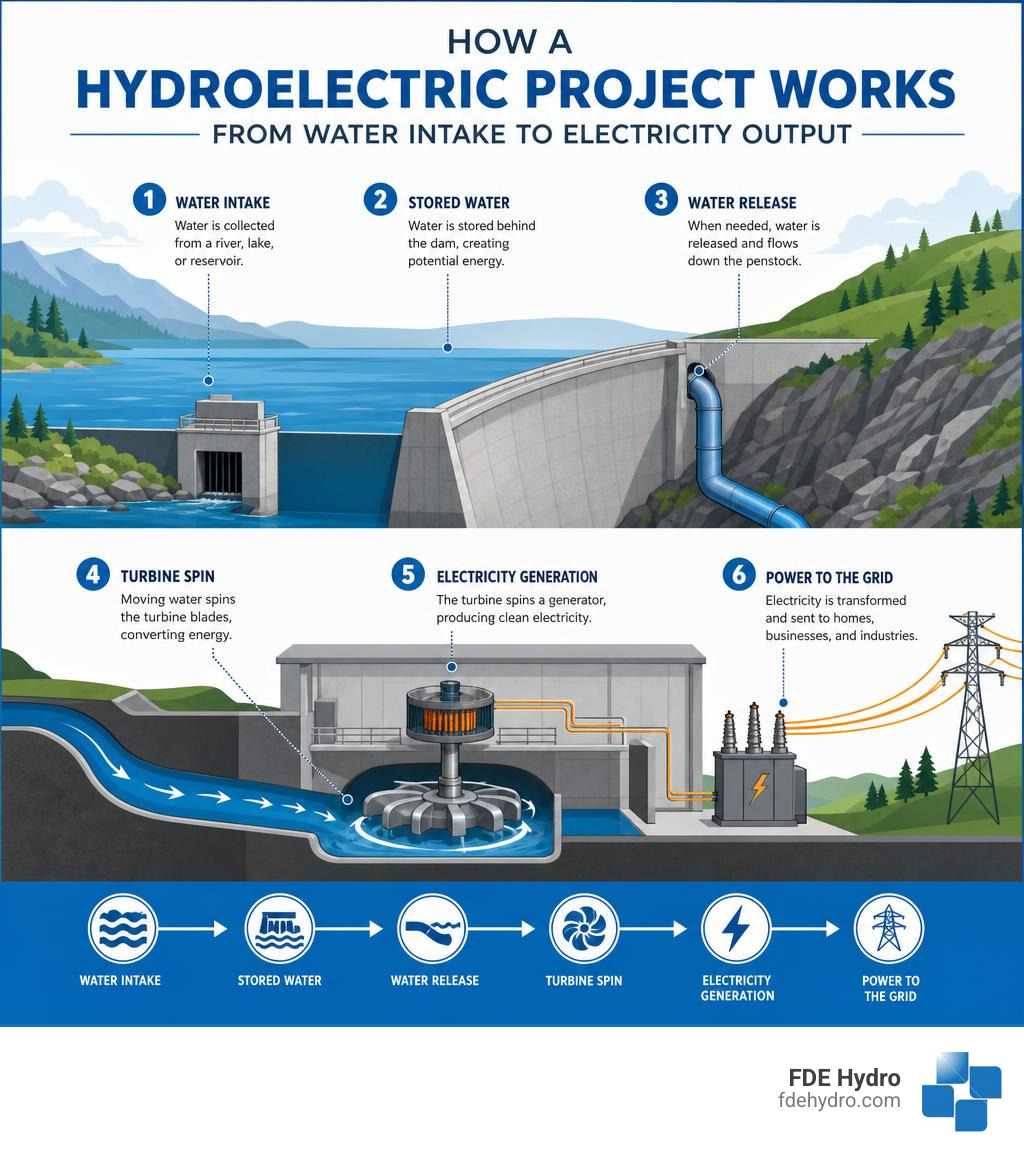
Step
What Happens
1. Water storage
A dam holds water in a reservoir, building up potential energy
2. Controlled release
Water flows through an intake and into a penstock (a large pipe)
3. Turbine spin
Rushing water strikes turbine blades, converting potential energy to kinetic energy
4. Electricity generation
The spinning turbine drives a generator, producing electricity
5. Grid delivery
A transformer steps up voltage for long-distance transmission
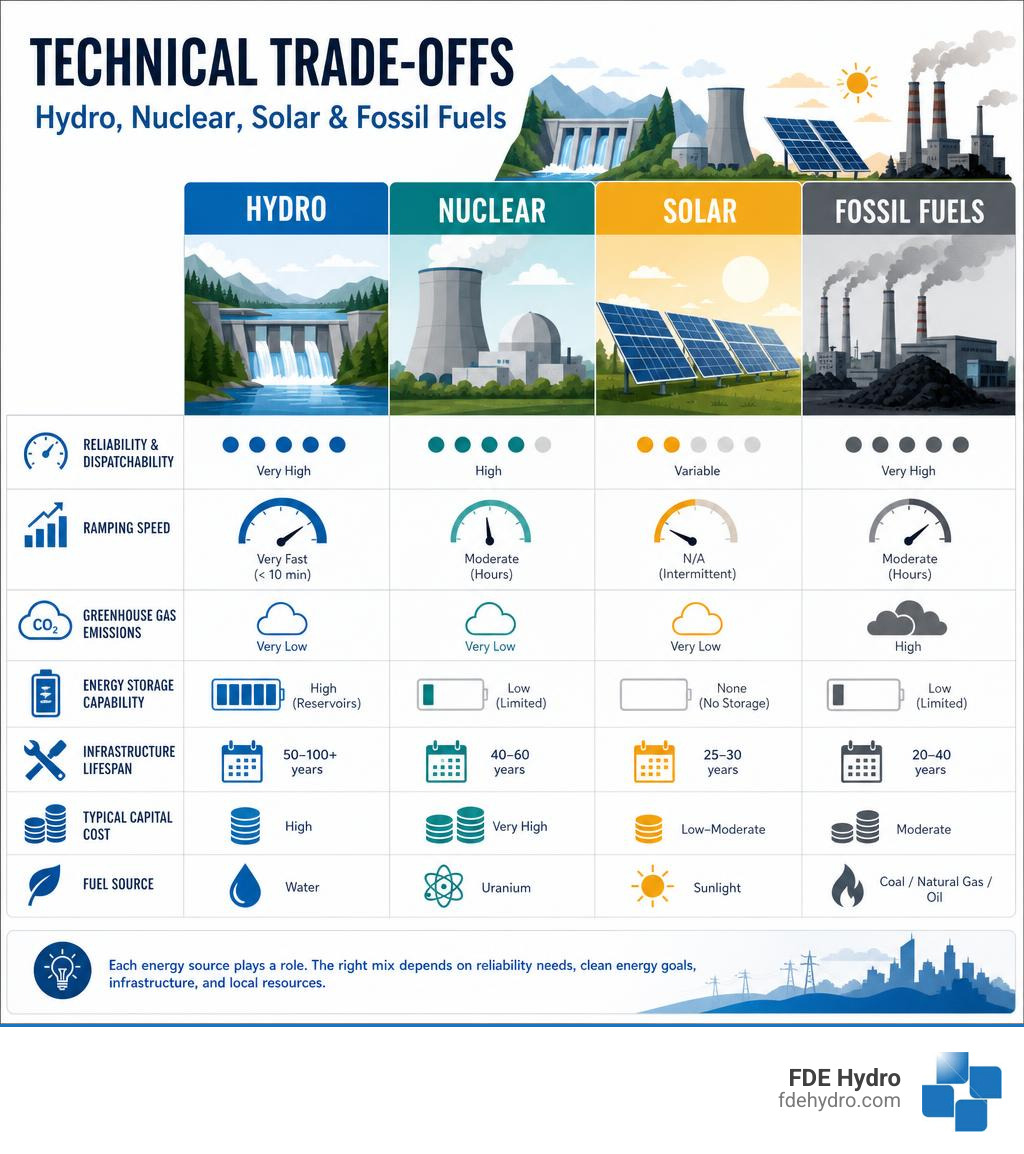
Hydropower isn’t a niche technology. It supplies roughly 15% of the world’s electricity — nearly 4,210 TWh generated in 2023 alone. That’s more than all other renewable energy sources combined, and more than nuclear power.
Yet despite its scale, many people don’t fully understand how these systems work, what types exist, or what trade-offs they involve — especially for the engineers and project developers making billion-dollar infrastructure decisions.
This guide covers all of it: how dams generate power, the different facility types, the history, the advantages and risks, and where hydropower fits in the future of clean energy.
I’m Bill French, Sr., Founder and CEO of FDE Hydro™ and a longtime heavy civil construction executive with five decades of experience in large-scale infrastructure — including direct work with the U.S. Department of Energy’s Water Power Technology Office on next-generation water power dam solutions. My goal here is to give you a clear, practical, and honest picture of how hydroelectric power works and where the industry is headed.
To understand the sheer power of a water power dam, we have to look at the physics of water. It all comes down to two fundamental concepts: potential energy and kinetic energy.
When water is held back by a dam in a high-elevation reservoir, it accumulates massive amounts of gravitational potential energy. The higher the water level (known in the industry as the “head”), the more potential energy is stored. When we open the gates, gravity pulls that water downward, converting that potential energy into kinetic energy—the physical energy of motion.
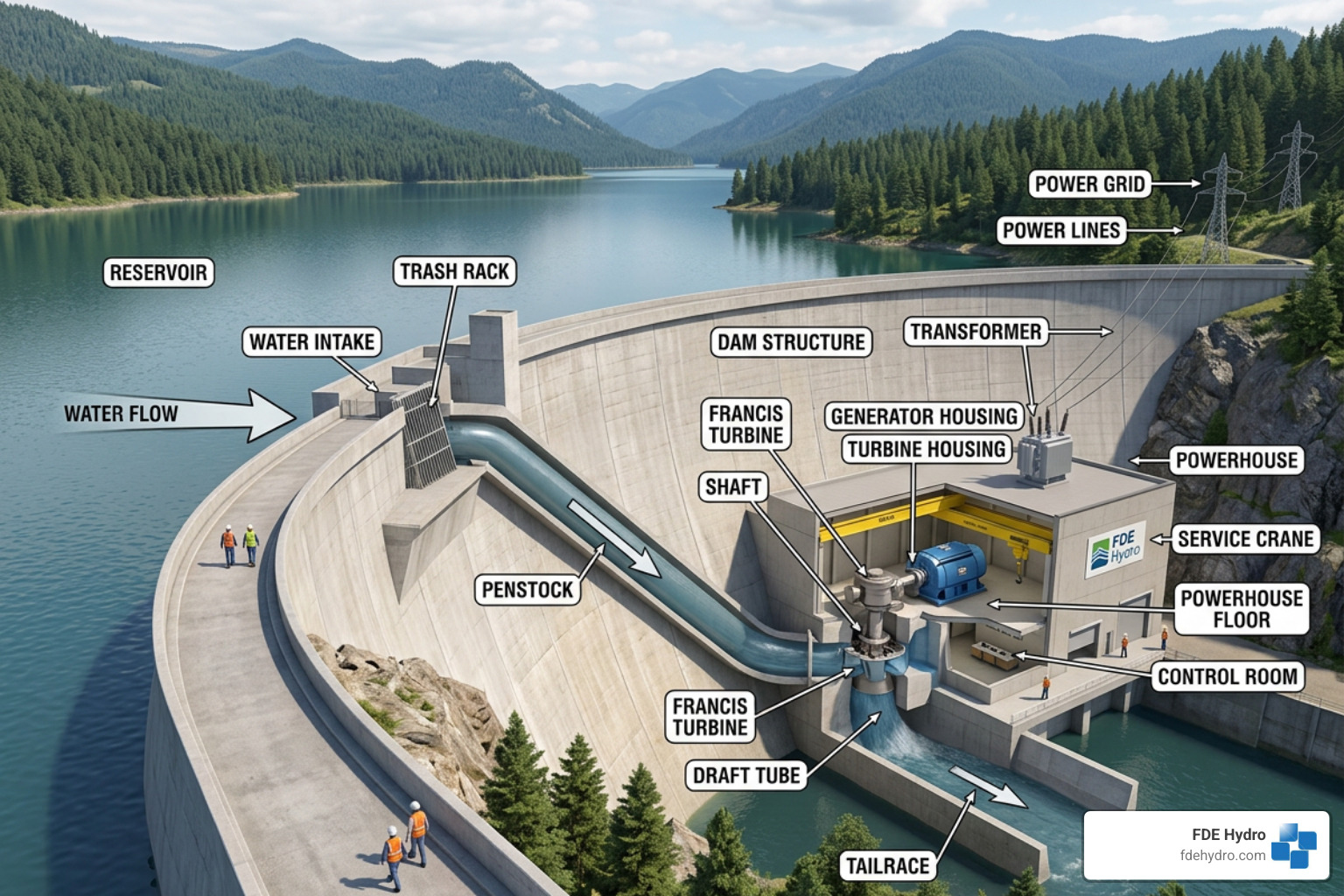
The physical journey from a quiet reservoir to a glowing lightbulb in your living room is a marvel of engineering:
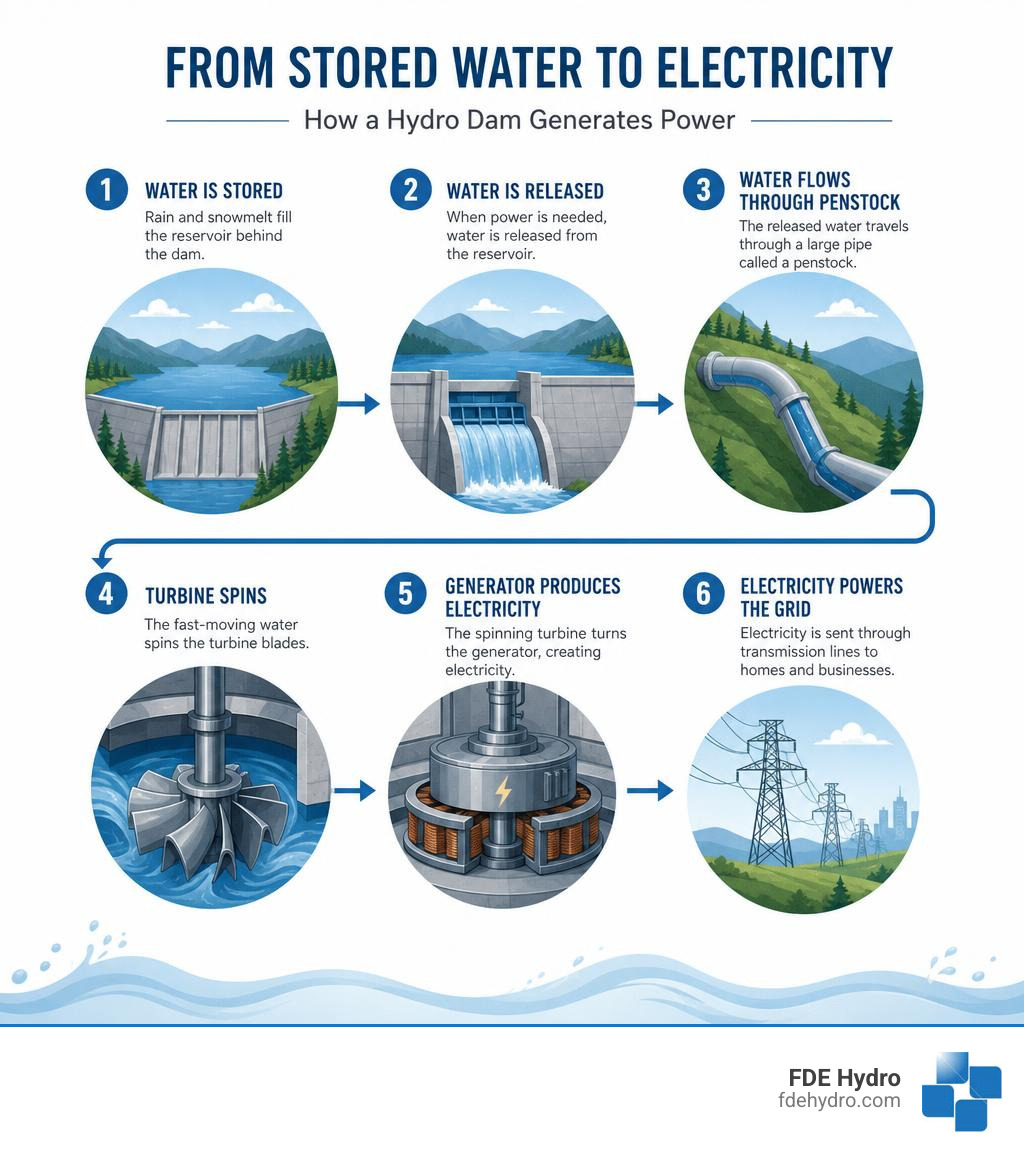
The Intake and Penstock: Water is released from the reservoir through control gates. It enters the penstock, a massive, heavy-duty steel or concrete pipe. The penstock narrows as it travels downward, which increases the pressure and velocity of the water.
The Turbine: At the bottom of the penstock, the high-pressure water strikes the blades of a water turbine. This causes the turbine runner to spin rapidly. This is where kinetic energy is converted into mechanical energy.
The Generator: The spinning turbine is connected to a generator by a heavy steel shaft. Inside the generator, powerful magnets spin inside copper coils. This motion triggers electromagnetic induction, generating an alternating electrical current (AC).
The Transformer and Transmission Lines: The electricity generated is usually around 13,800 volts. To travel long distances without losing too much energy, a transformer steps up this voltage to hundreds of thousands of volts. It then flows onto high-voltage transmission lines and out to the electrical grid.
Key Structural Components of a Hydro Dam
Every water power dam relies on a precise configuration of civil engineering structures to operate safely and efficiently. If you are interested in how these structures are planned and built, our Hydroelectric Dam Design: Complete Guide covers the engineering in detail.
The Spillway: Think of the spillway as the dam’s safety valve. When heavy rains or rapid snowmelt fill the reservoir to capacity, we cannot let water run over the top of a non-overflow dam section, as this can cause catastrophic structural failure. The spillway safely routes excess water downstream, bypassing the powerhouse.
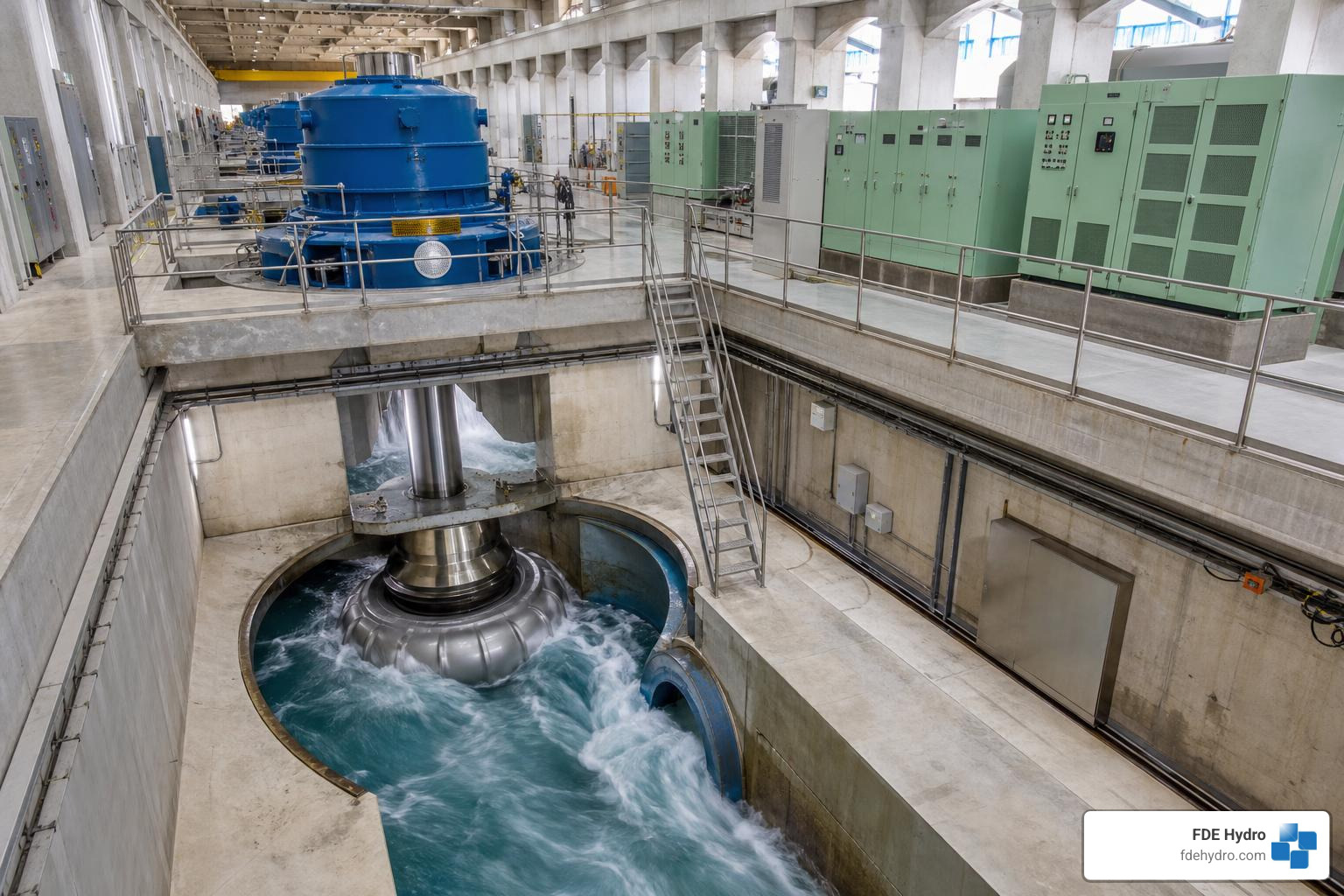
The Powerhouse: This is the concrete and steel building that houses the heavy machinery, including the turbines, generators, governors, and control systems.
The Forebay: This is the basin located immediately upstream of the water intake structures. It acts as a buffer zone, smoothing out the flow of water before it enters the penstocks.
Intake Gates: These heavy, adjustable gates control the volume of water entering the penstocks. They can be shut down quickly in the event of an emergency or during routine maintenance.
Types of Hydropower Facilities and How They Differ
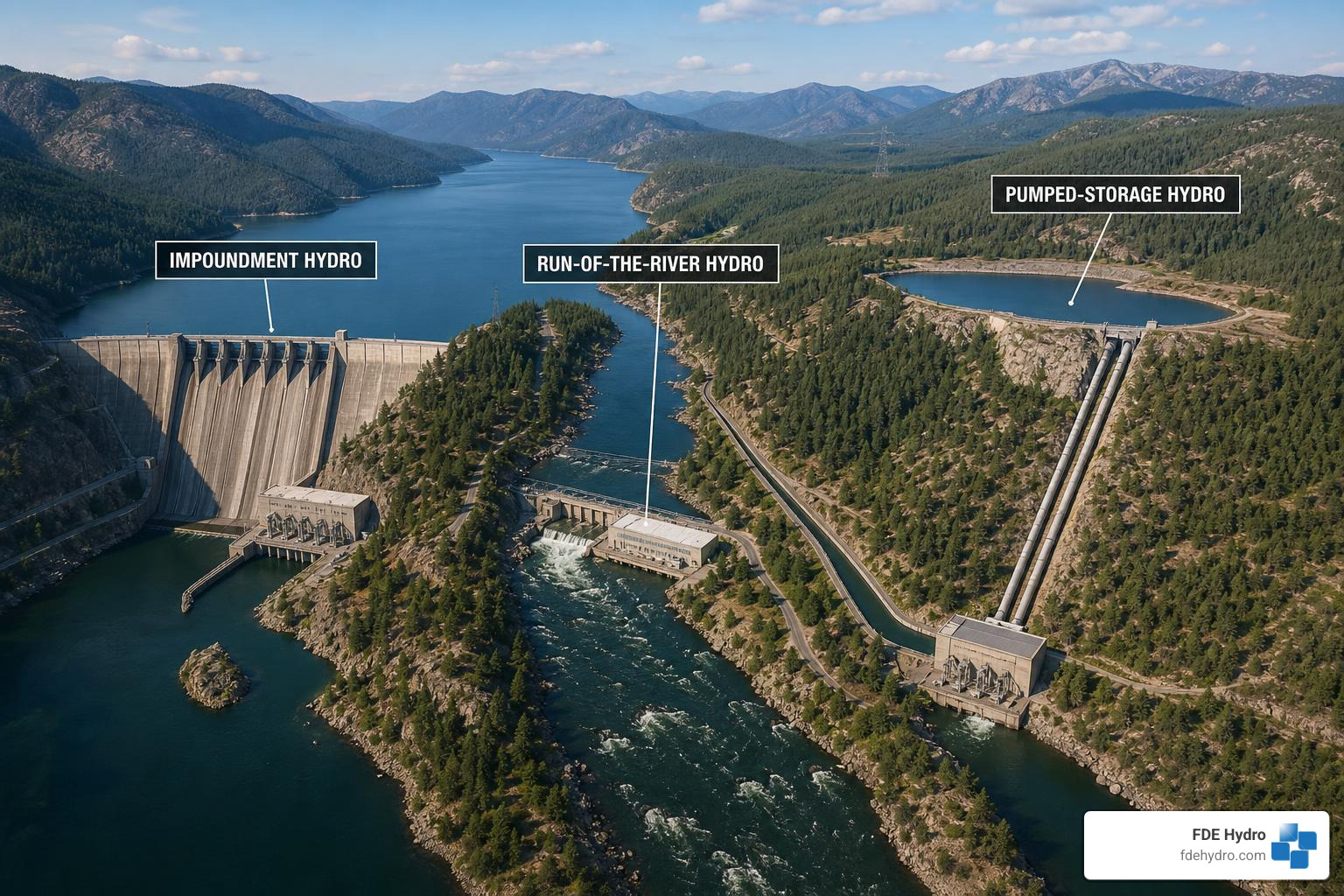
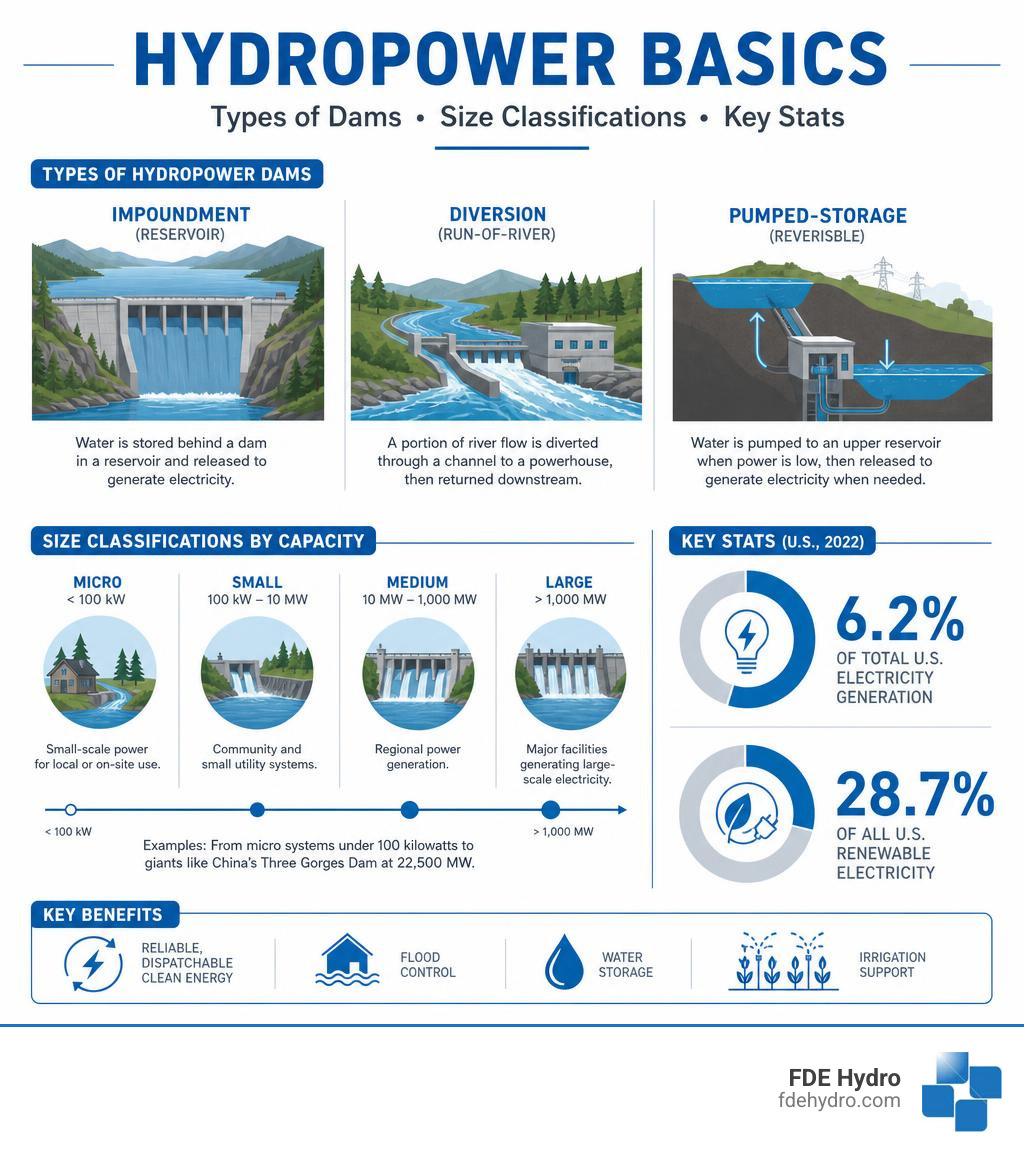
Not every water power dam looks or functions the same way. Hydropower facilities are generally classified into three major types based on how they store and manage water.
The Impoundment Facility: The Classic Water Power Dam
The impoundment facility is what most people picture when they hear the word “dam.” It uses a large structural barrier to block a river, creating an artificial reservoir behind it.
These conventional dams allow operators to store water and release it on demand. This provides incredible control over electricity generation, allowing the plant to respond to sudden spikes in power demand.
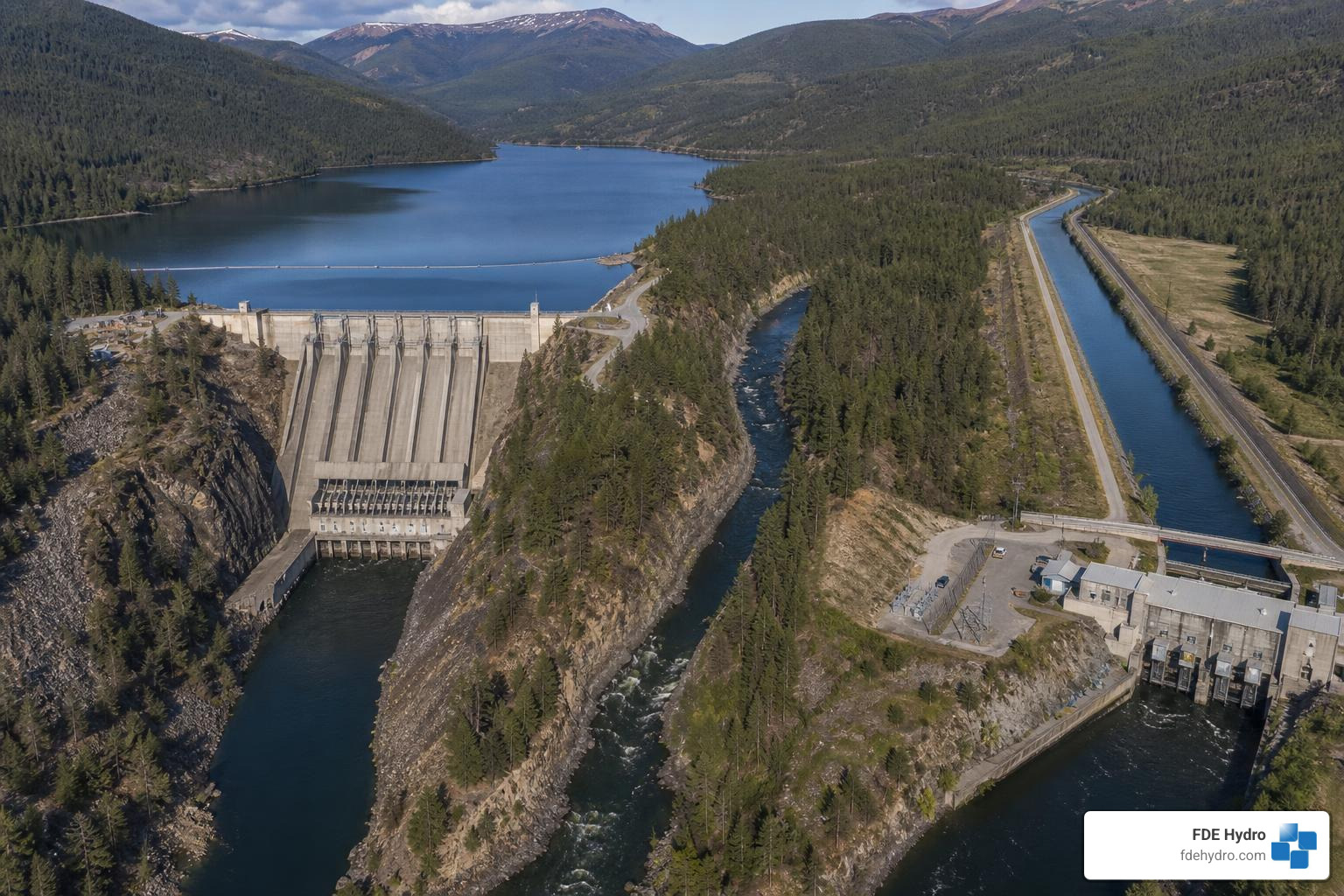
A prime example in the United States is the iconic Grand Coulee Dam on the Columbia River in Washington State. Boasting an installed capacity of 6,809 MW, it is the largest hydropower producer in the country. To explore its immense scale, take a look at the official Grand Coulee Dam Statistics and Facts .
Run-of-the-River and Diversion Systems
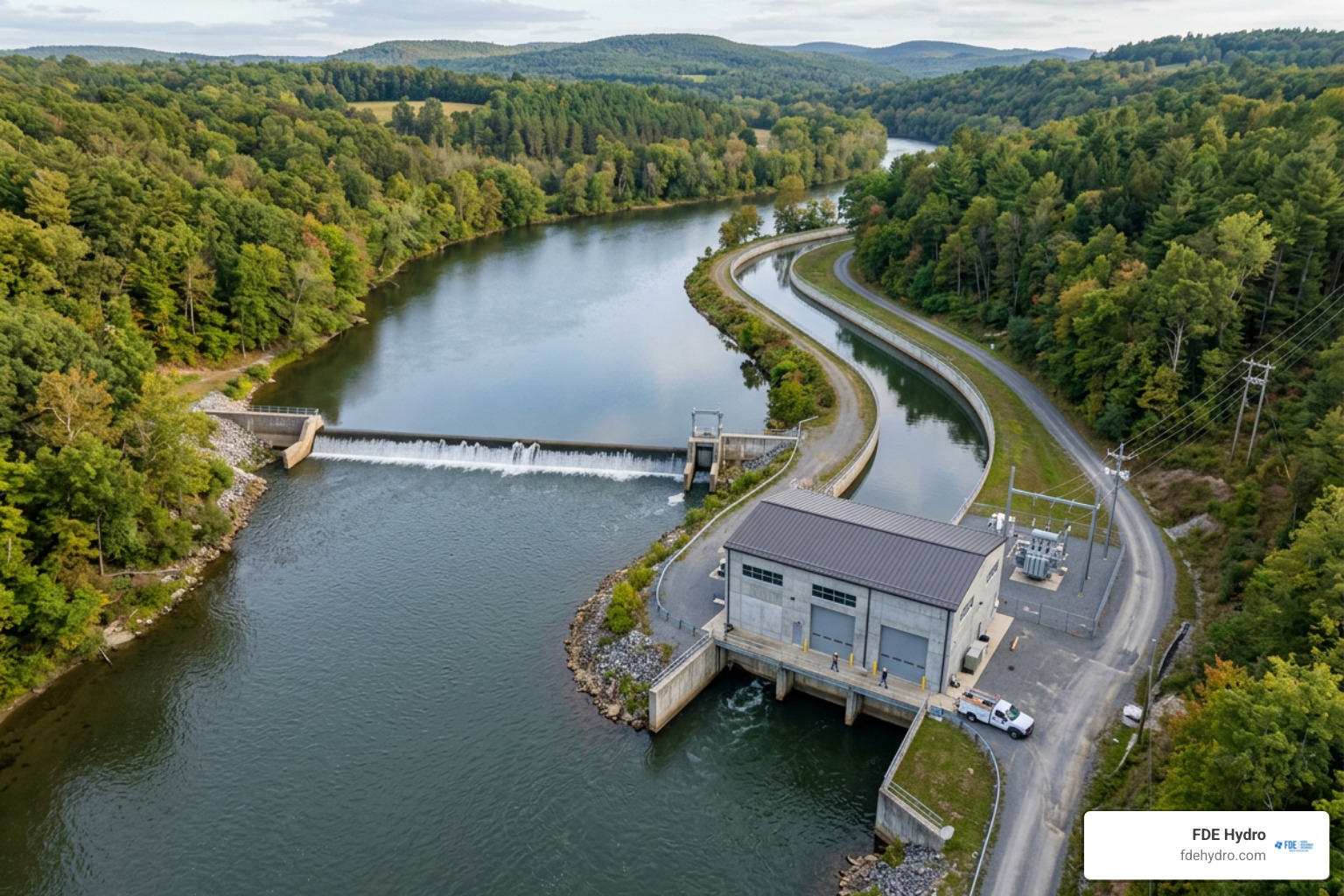
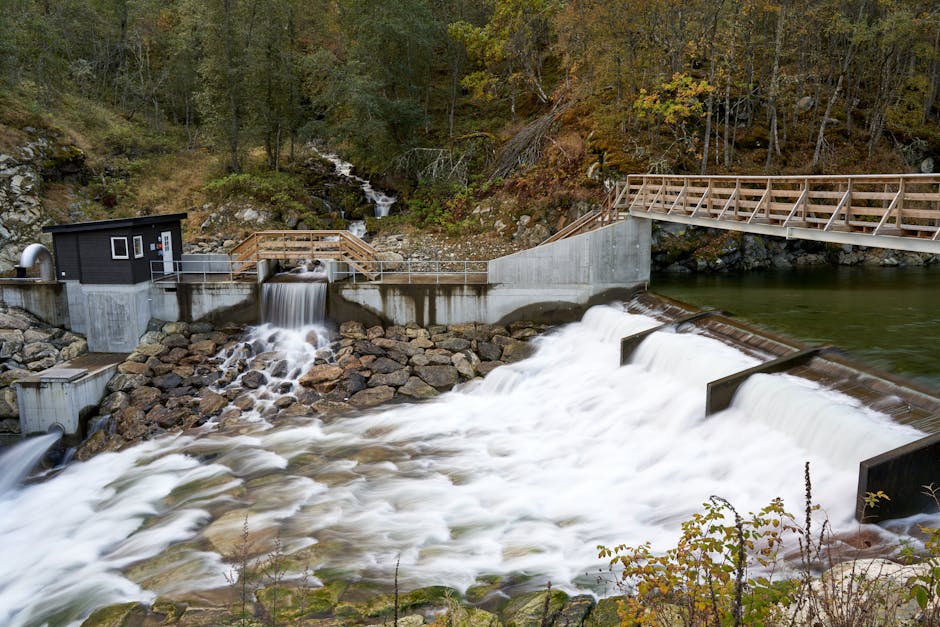
Run-of-the-river (sometimes called diversion) systems take a completely different approach. Instead of building a massive wall to create a reservoir, these systems use the natural flow of the river.
A portion of the river’s water is diverted through a canal or penstock, directed through a low-head turbine, and then returned immediately downstream to the main river channel. Because they have minimal or no water storage, run-of-the-river plants are highly dependent on seasonal river flows. They are often preferred for smaller projects due to their lower environmental footprint. To learn more about how these low-impact systems function, read All About Hydro Dams.
Pumped-Storage Hydropower: The Grid’s Giant Battery
Think of pumped-storage hydropower as a giant, water-based battery. These facilities feature two reservoirs at different elevations: an upper reservoir and a lower reservoir.
During low-demand periods (e.g., at night): The facility uses cheap, surplus electricity from the grid (or from wind and solar) to pump water from the lower reservoir up to the upper reservoir.
During peak-demand periods (e.g., hot summer afternoons): The water is released from the upper reservoir back down to the lower reservoir, spinning reversible turbines to generate electricity when the grid needs it most.
Pumped-storage schemes are incredibly efficient and provided almost 85% of the world’s 190 GW of grid energy storage in 2021. They are essential for grid stability as we integrate more intermittent renewable energy. To see how these systems are reshaping our energy future, explore our Beginners Guide to Hydroelectric Power Dams.
The Historical Evolution of Hydropower
Humans have been capturing the energy of moving water for thousands of years. Long before we used it to light up our cities, water was the driving force behind early industrialization.
Some of the earliest water-power innovations were conceived in China during the Han Dynasty (between 202 BC and 9 AD), where water wheels were used to grind grain and power trip hammers. By the time of the Industrial Revolution, water wheels had become highly sophisticated.
In 1771, Richard Arkwright built the Cromford Mill in England, utilizing water power for cotton spinning. This project created one of the world’s first factory systems, proving that water could drive mechanical energy on an industrial scale.
The Birth of Hydroelectricity
The transition from mechanical water power to electricity occurred in the late 19th century.
1878: Hydropower was first used to generate electricity at Cragside House in Northumberland, England, where it powered a single arc lamp.
1882: The Vulcan Street Plant in Appleton, Wisconsin, began operating on the Fox River. It was the first commercial hydroelectric plant in the United States, generating 12.5 kW of power.
The late 19th and early 20th centuries saw rapid leaps in turbine technology. Engineers developed specialized turbines for different water conditions:
The Francis Turbine (1849): Developed by James Francis, this remains the most widely used water turbine in the world today for medium-head applications.
The Pelton Wheel (1880): Invented by Lester Pelton, this impulse turbine is ideal for high-head, low-flow operations.
The Kaplan Turbine (1913): Invented by Viktor Kaplan, this propeller-like turbine is perfect for low-head, high-flow conditions.
The Era of Mega-Dams
The mid-20th century ushered in the era of mega-dams, driven by massive public works projects in North and South America. In the United States, the construction of the Hoover Dam in the 1930s showed that we could tame wild rivers to provide both irrigation and massive amounts of electricity.
Decades later, in 1984, the massive Itaipu Dam opened on the Paraná River between Brazil and Paraguay. Generating 14 GW of power from 20 massive turbines, it was recognized as one of the Seven Wonders of the Modern World. You can read more about its history and engineering marvels on the Itaipu Dam – Wikipedia page or explore the official corporate history in the ITAIPUMAGAZINEENGLISH_LR .
The Pros and Cons of Hydroelectric Power
Like any energy source, hydroelectric power comes with trade-offs. To build a reliable and clean grid, we must weigh these advantages against their environmental and social costs.
For a deeper dive into these trade-offs, explore our guide on Hydro-Electric Dams.
Advantages: Flexibility, Low Cost, and Grid Stability
Hydropower offers several unique benefits that wind and solar simply cannot match:
Incredible Flexibility: Hydroelectric turbines can go from completely cold to full power in just a few minutes. This rapid response time is critical for providing peaking power when demand suddenly spikes.
Black Start Capability: If the electrical grid suffers a total blackout, most thermal power plants (coal, gas, nuclear) need external power to restart. Hydro plants can start up using only the gravity of their own water, helping to jumpstart the rest of the grid.
Low Operating Costs: While the upfront cost of building a water power dam is high, the “fuel” (water) is free. These plants have incredibly low operating and maintenance costs, and many remain operational for over a century with periodic retrofits.
Multipurpose Benefits: Hydro reservoirs do more than just make electricity. They provide critical flood control, reliable agricultural irrigation, municipal water supplies, and recreational opportunities.
Environmental Challenges of the Water Power Dam
Despite being a clean, low-carbon energy source, large-scale dams can have a significant impact on local ecosystems:
Ecosystem Disruption & Fish Migration: Building a physical barrier blocks migratory fish species, like salmon, from reaching their upstream spawning grounds. It also alters water temperatures and oxygen levels downstream, impacting aquatic life.
Siltation & Sediment Trapping: Rivers naturally carry nutrient-rich sediment. When we dam a river, that sediment settles at the bottom of the reservoir instead of flowing downstream to nourish deltas and agricultural lands.
Reservoir Methane Emissions: When a new reservoir is flooded, the submerged vegetation and organic matter rot underwater. In warm climates, this anaerobic decomposition can release significant amounts of greenhouse gases, particularly methane, into the atmosphere.
Population Displacement: Creating massive reservoirs requires flooding vast areas of land. Historically, this has led to the forced relocation of local communities and indigenous populations, along with the loss of valuable historical and cultural sites.
Global Capacity and Comparison with Other Energy Sources
Hydropower remains the bedrock of global renewable energy. Let’s look at how it shapes up on the world stage and how it compares to other power generation technologies.
Hydropower on the Global Stage
Globally, installed hydropower capacity reached nearly 1,400 GW in 2021. Today, a handful of nations dominate global production, with China leading the charge (accounting for nearly 30% of global output), followed by Brazil (10%), Canada (9.2%), and the United States (5.8%).
In terms of energy storage, conventional reservoirs are unmatched. The International Energy Agency (IEA) estimated that the reservoirs of all existing conventional hydropower plants combined can store a total of 1,500 TWh of electrical energy in one full cycle. That is about 170 times more energy than the entire global fleet of pumped-storage plants.
How Hydropower Compares to Wind, Solar, and Nuclear
To understand where a water power dam fits into our energy mix, it helps to compare it directly to other major generation sources:
Technology
Capacity Factor
Dispatchability
Capital Cost
Carbon Footprint
Hydropower
High (40% – 60%)
Fully Dispatchable
Very High
Very Low
Wind Power
Moderate (30% – 45%)
Intermittent
Moderate
Very Low
Solar Power
Low (15% – 25%)
Intermittent
Low
Very Low
Nuclear Power
Very High (90%+)
Base Load
Extremely High
Very Low
While solar and wind have lower capital costs and faster installation times, they are intermittent. Hydropower and nuclear provide the reliable, dispatchable power needed to keep the grid steady when the wind isn’t blowing and the sun isn’t shining.
Climate Change, Reliability, and Safety Risks
As our climate changes, we are seeing more extreme weather. This presents new challenges for managing water resources and keeping dams running safely.
For more on how modern dams manage extreme weather and high water events, read about Dam Flood Control.
Drought, Siltation, and Changing Weather Patterns
Because hydropower relies entirely on the water cycle, its output is highly sensitive to changes in precipitation.
Droughts: Prolonged dry spells can severely reduce river flows and reservoir levels, forcing plants to run at reduced capacity. In places like California, seasonal droughts can lead to major swings in annual hydro generation. To see how these dynamics play out locally, check out the Hydroelectric Power – California Energy Commission – CA.gov reports.
Siltation: Over time, reservoirs naturally collect silt and sediment. This reduces their active water storage capacity, which limits both power generation and flood control capabilities. Regular dredging is often required to keep these systems clean and operating efficiently.
Dam Safety, Failure Risks, and Mitigation
Dams are massive structures holding back billions of gallons of water. A structural failure can have devastating consequences for downstream communities.
The historical benchmark for dam failures is the Banqiao Dam disaster in China in 1975, where a catastrophic typhoon caused a series of dam failures that led to immense loss of life.
Today, dam safety is highly regulated. Operators use advanced structural monitoring tools, including seismic sensors, tiltmeters, and automated piezometers, to spot tiny shifts in the structure long before they become dangerous. Spillways are also designed to handle “Probable Maximum Flood” events to prevent overtopping.
Integrating Hydro with Wind and Solar
To build a reliable, zero-carbon grid, we need to combine different renewable technologies. Hydropower is the perfect partner for wind and solar.
When wind and solar produce excess power during sunny or windy days, we can throttle back our hydro dams, conserving water in the reservoirs. When the sun sets or the wind dies down, we can quickly open the hydro gates to fill the gap. This hybrid approach turns our water reservoirs into virtual batteries, smoothing out the natural ups and downs of wind and solar power.
Frequently Asked Questions about Hydroelectric Dams
How does a water power dam generate electricity?
A dam stores water in a reservoir to build up gravitational potential energy. When released, this water flows down through a penstock and spins a turbine. The spinning turbine drives a generator, which uses electromagnetic induction to convert that mechanical movement into electricity.
What is the difference between conventional and pumped-storage dams?
Conventional dams use a one-way flow of water, capturing the natural downstream run of a river to generate electricity. Pumped-storage dams use a two-reservoir system (upper and lower) and reversible pump-turbines. They act like a giant battery, pumping water uphill when electricity is cheap and releasing it to generate power when demand is high.
What are the main environmental impacts of large dams?
Large dams can block fish migration, alter water temperatures, and disrupt downstream river ecosystems. Reservoirs also trap sediment that would naturally nourish downstream habitats. Additionally, flooding large areas of land can displace local populations and release methane as submerged vegetation decays.
Conclusion
The water power dam remains one of our most reliable tools for generating clean, dispatchable, and renewable energy. As we work to phase out fossil fuels, the flexibility and storage capacity of hydropower will only become more critical for keeping our electric grids stable.
However, building traditional, massive concrete dams is incredibly expensive, takes years of permitting, and can cause significant environmental disruption. The future of hydropower lies in smarter, low-impact, and highly efficient technologies.
At FDE Hydro™, we are leading this transition. We develop innovative, patented modular precast concrete technology—known as the French Dam—designed for building and retrofitting hydroelectric dams and water control systems. By moving construction from the riverbed to a controlled precast facility, we significantly reduce construction costs, minimize environmental footprints, and cut project timelines across the United States, Canada, Brazil, and Europe.
What Is a Hydro Dam? How It Works, Types, and Why It Matters
A hydro dam is one of the oldest and most powerful tools humans have ever built for generating clean electricity. At its core, it does something elegant: it stores water, then releases it in a controlled way to spin turbines and produce power.
Here’s a quick overview of what you need to know:
Topic
Key Fact
What it does
Converts the energy of moving or falling water into electricity
Main types
Impoundment, run-of-the-river, pumped-storage
Global share
~15% of world electricity (4,210 TWh in 2023)
U.S. share
6.2% of total U.S. electricity generation (2022)
Largest in the world
Three Gorges Dam, China — 22,500 MW
Largest in the U.S.
Grand Coulee Dam, Washington — 6,765 MW
Grid storage role
Pumped-storage hydro provides ~85% of global grid energy storage
High upfront cost, environmental impact, climate/drought risk
Hydropower is not a new idea. The first hydroelectric plant in the United States opened on September 30, 1882, on the Fox River near Appleton, Wisconsin — over 140 years ago. Yet today, hydropower remains the single largest source of renewable electricity on Earth, generating more than wind and solar combined.
What makes it so enduring? A hydro dam doesn’t just generate power — it also stores water, controls floods, supports irrigation, and can even act as a giant grid-scale battery when built as a pumped-storage system. That combination of benefits is hard to match.
But large hydro projects also come with real tradeoffs: massive upfront costs, long construction timelines, complex permitting, and significant environmental and social impacts. For infrastructure decision-makers, those challenges are the crux of the problem.
I’m Bill French, Sr., Founder and CEO of FDE Hydro™ — and I’ve spent decades in heavy civil construction before turning my focus specifically to hydro dam innovation, including developing patented modular construction systems designed to reduce the cost and time of building hydropower infrastructure. In this guide, I’ll walk you through everything you need to know about hydro dams, from how they work to how the industry is evolving.
How a Hydro Dam Generates Electricity
To understand how a hydro dam generates electricity, we have to look to the sky. Hydropower is ultimately driven by the solar-powered water cycle. The sun heats the Earth, evaporating water from oceans and lakes. This water condenses into clouds and falls as rain or snow, accumulating in high-elevation watersheds, streams, and rivers.
As that water flows downhill toward the sea, it carries an immense amount of energy. A hydro dam intercepts this water, using elevation head (the vertical distance the water falls) and river flow to convert potential energy into kinetic energy, then into mechanical energy, and finally into electrical energy. Because we can control exactly when we release this water, hydroelectricity is highly dispatchable, meaning we can ramp generation up or down in seconds to match demand on the transmission grid.
How a hydro dam turns head and flow into power
The math behind hydropower is straightforward: power is a function of “head” (pressure created by the vertical drop) and “flow” (the volume or discharge rate of water).
Water behind the dam is held at a high elevation.
When electricity is needed, intake gates open, and water flows down a large, reinforced pipe called a penstock.
The rushing water strikes the blades of a turbine runner, forcing it to spin at high speeds.
The turbine is connected to a generator rotor. As the rotor spins inside a copper stator, it creates an electromagnetic field that generates alternating current (AC) electricity.
A transformer steps up the voltage so the electricity can travel efficiently across the transmission grid.
The water, now spent of its pressure, exits through the tailrace and returns safely to the downstream river.
This process is incredibly efficient, often converting over 90% of the water’s physical energy into electricity. To dive deeper into these mechanical systems, check out our Hydroelectric Dam Components Ultimate Guide.
Conventional hydro dam operation
A conventional hydro dam relies on a reservoir to store water. This acts as a physical savings account for energy. During periods of low electricity demand, water is held back, allowing the reservoir to fill. During peak demand hours, we release water through the powerhouse to generate peaking power.
This operational flexibility allows operators to support the grid’s base load while simultaneously providing rapid-response power. Beyond electricity, these conventional dams serve multiple purposes: they offer flood storage to protect downstream communities, supply water for irrigation, and create reservoirs used for public recreation. You can see this multi-use design in action at massive federal projects like the Bureau of Reclamation Grand Coulee facility.
Pumped-storage hydropower operation
Pumped-storage hydropower works like a giant water battery. Instead of relying solely on natural river inflow, a pumped-storage plant utilizes two reservoirs at different elevations (an upper and a lower reservoir) connected by tunnels with reversible pump-turbines.
Pumping Mode (Charging): During off-peak hours (like overnight or during peak solar generation in the afternoon), the facility uses cheap, excess grid electricity to pump water from the lower reservoir up to the upper reservoir.
Generating Mode (Discharging): During peak demand hours, when electricity prices are high, the water is released back down to the lower reservoir, spinning the turbines to generate power.
While pumped-storage is a net energy consumer due to round-trip efficiency losses, it is incredibly valuable. It accounts for nearly 85% of the world’s 190 GW of grid energy storage, facilitating the integration of variable renewables like wind and solar.
Main Types of Hydropower Plants
Not all hydropower facilities require a massive concrete wall blocking a river. Depending on the local geography, water availability, and grid needs, facilities are classified into three primary types.
Impoundment hydropower plants
This is the classic hydro dam most people picture. An impoundment facility uses a physical dam to store river water in a large reservoir. Controlled releases through the dam’s powerhouse generate electricity. These systems are highly valued because their large storage capacity allows for seasonal regulation, flood control, and reliable, high-capacity power generation. They represent the most common type of large-scale Hydro Electric Dams globally.
Run-of-the-river and diversion plants
Run-of-the-river (or diversion) plants require little to no water storage. Instead, they divert a portion of a river’s natural current through a canal or penstock to spin a turbine before returning the water downstream.
Because they don’t flood massive valleys to create reservoirs, they have a significantly lower environmental impact. However, their generation is highly variable, relying entirely on the natural daily and seasonal river flow. These systems are common for small hydro, micro hydro, and conduit hydro projects. A fantastic historical and modern example of this in the U.S. is the Bowersock Dam on the Kansas River; you can read about its unique history on the Bowersock Dam – Wikipedia page or learn more About Bowersock.
Pumped-storage plants as grid-scale batteries
As grid-scale batteries, pumped-storage plants are designed for energy arbitrage (buying electricity low, selling it high). But they also provide essential ancillary services that keep our electric grid stable, including frequency regulation, voltage support, black-start capabilities (restarting the grid after a blackout), and smoothing out the intermittent output of wind and solar farms.
Key Hydro Dam Components, Design, and Construction
A modern hydro dam is a marvel of civil engineering, requiring precise coordination between water retention structures, mechanical machinery, and electrical systems.
Key hydro dam components to know
Inside a hydroelectric facility, several heavy-duty components work in unison:
Turbines: The heart of the facility. The type of turbine used depends on the site’s head and flow. Francis turbines are the most common for medium to high head; Kaplan turbines feature adjustable blades for low head and high flow; and Pelton turbines use impulse buckets for extremely high head.
Penstocks: Massive steel or concrete pipes that channel water under high pressure from the intake gates directly to the turbine runner.
Gates and Valves: Used to regulate or completely shut off water flow for maintenance.
Generators and Transformers: Located in the powerhouse to convert mechanical energy into high-voltage AC electricity.
For a detailed breakdown of these systems, read our comprehensive guide on Hydro Dam Components.
Reservoirs, spillways, and water control structures
Water management is a delicate balancing act. Reservoirs are divided into active storage (water that can be used for power generation) and dead storage (water below the intake level).
To prevent a dam from being overtopped during extreme floods, every dam must have a spillway. Spillways use robust gates, such as drum gates or radial gates, to safely route excess water around the dam body. Designing these structures requires a deep understanding of water retention, as discussed in The Art Of Containment Understanding Water Retention Structures.
Hydro dam design and construction methods
Historically, building a hydro dam was a multi-year, multi-billion-dollar endeavor involving massive cofferdams to divert rivers, extensive foundation grouting, and pouring millions of cubic yards of Roller-Compacted Concrete (RCC).
However, traditional construction methods are slow, expensive, and logistically challenging. That is why at FDE Hydro™, we developed our patented modular precast concrete technology (the “French Dam” system). By manufacturing standardized modular concrete blocks off-site and assembling them rapidly on-site, we drastically reduce construction schedules, minimize river diversion risks, and lower capital costs. This technology is revolutionizing how developers approach both new builds and retrofits across North America, Brazil, and Europe.
Like any energy source, hydropower has distinct environmental, economic, and operational trade-offs.
Major advantages of hydropower
Grid Stability & Dispatchability: Unlike wind and solar, hydro can ramp up or down in seconds, making it the ultimate tool for balancing grid load.
Incredibly Long Asset Life: While solar panels and wind turbines last 20 to 25 years, a well-maintained hydro dam can easily operate for over a century.
Low Operating Emissions: Once built, hydropower produces zero direct greenhouse gas emissions during generation.
Multipurpose Infrastructure: Hydro dams provide invaluable water security, supporting agricultural irrigation, domestic water supplies, and downstream Dam Flood Control.
Environmental and social drawbacks of large hydro dams
Despite the clean energy benefits, large conventional dams pose serious ecological challenges:
Habitat Fragmentation: Dams block migratory fish pathways. For example, studies show up to 70% of eels passing through traditional hydro turbines can perish.
Siltation and Erosion: Dams trap natural river sediment, depriving downstream ecosystems of vital nutrients and causing accelerated riverbed erosion.
Methane Emissions: In tropical regions, flooding vast forests to create reservoirs leads to organic matter decomposing underwater, releasing significant amounts of methane.
Social Displacement: Large reservoirs have historically flooded communities and ancestral lands, forcing the relocation of millions of people globally.
Hydropower compared with nuclear, wind, and solar
To see how hydropower stacks up against other low-carbon energy sources, consider this comparison:
Metric
Hydropower
Nuclear
Wind
Solar
Capacity Factor
Moderate to High (30% – 70%)
Very High (90%+)
Moderate (35% – 45%)
Low to Moderate (20% – 30%)
Dispatchability
Excellent (seconds to minutes)
Limited (slow ramping)
None (weather-dependent)
None (weather-dependent)
Asset Lifespan
80 – 100+ years
60 – 80 years
20 – 25 years
25 – 30 years
Upfront Cost
High
Extremely High
Moderate
Low to Moderate
Storage Value
Built-in (reservoirs / pumped)
None
Requires batteries
Requires batteries
Global and U.S. Hydropower Scale, Examples, and Climate Risks
Hydropower is a cornerstone of the global transition to clean energy, but its future is increasingly tied to the realities of a changing climate.
Largest hydropower facilities in the world and the U.S.
Globally, hydropower is a giant. In 2023, it supplied 15% of the world’s electricity (almost 4,210 TWh), which is more than all other renewable sources combined and more than nuclear power. Global installed capacity sits at nearly 1,400 GW.
The largest power-producing facility of any kind on Earth is the Three Gorges Dam in China (22,500 MW), followed closely by the Itaipu Dam – Wikipedia on the border of Brazil and Paraguay (14,000 MW).
The Grand Coulee Dam is a concrete gravity dam standing 550 feet high with a crest length of 5,223 feet. It holds back Franklin D. Roosevelt Lake, a reservoir containing 9.6 million acre-feet of water.
According to the Grand Coulee Dam > Northwestern Division > Fact Sheet – Northwestern Division, the dam generates over 21 billion kilowatt-hours of electricity annually—enough to power 2 million homes. It is the heart of the Columbia Basin Project, which irrigates 720,000 acres of farmland, manages regional flood control, and runs hatcheries releasing millions of salmon and steelhead annually.
Seasonal water, drought, and climate change impacts
Because hydropower relies on water, it is highly sensitive to climate change. Droughts, shrinking mountain snowpacks, and shifting monsoon patterns present operational risks. When water levels in reservoirs drop too low, hydro generation must be curtailed to protect municipal water supplies and ecological flows.
Modern hydro operators must use sophisticated hydrological forecasting and climate adaptation strategies to manage these risks, ensuring dams can handle both severe droughts and the extreme, sudden flood events that are becoming more common.
Economics, Modernization, Safety, and Maintenance
As we look toward the future of the grid, the focus of the hydropower sector is shifting from building massive new dams to optimizing, modernizing, and maintaining the infrastructure we already have.
Costs and benefits of building hydro dams
Traditional concrete dams require enormous upfront capital, complex environmental permitting, and a decade or more of construction risk before generating their first dollar. You can read a complete breakdown of these capital requirements in our article on Hydropower Project Costs and Breaking Down The Dam Costs Of Hydropower Projects.
However, because operating and maintenance (O&M) costs are extremely low and there are no fuel costs, once a hydro project is paid off, it becomes an incredibly profitable, low-cost source of clean energy for generations.
Modernizing and upgrading existing hydropower plants
In North America and Europe, many hydro dams were built before the mid-1970s and are ripe for modernization. Upgrades include:
Digital Controls & Automation: Improving grid ramping speeds and remote monitoring.
Non-Powered Dam Retrofits: Less than 3% of the 90,000+ dams in the U.S. actually generate electricity. Retrofitting these existing non-powered dams with modular precast concrete systems, like our French Dam technology, is one of the fastest, most cost-effective ways to add clean capacity to the grid without building new barriers.
Regulatory, safety, and maintenance considerations
Safety is paramount. In the U.S., the Federal Energy Regulatory Commission (FERC), the Army Corps of Engineers, and the Bureau of Reclamation enforce strict safety standards.
Operating a hydro dam requires continuous structural monitoring for concrete cracks, seepage, and seismic activity. Regular spillway gate testing and maintaining up-to-date Emergency Action Plans (EAPs) are mandatory to protect downstream populations. Compliance with environmental laws like the Clean Water Act and the Endangered Species Act is also central to modern operations.
Frequently Asked Questions About Hydro Dams
What is the difference between hydropower and hydroelectricity?
Hydropower is a broad term referring to any form of energy captured from moving water, which historically included mechanical power for grinding grain or sawing wood. Hydroelectricity refers specifically to using that water energy to generate electrical current through turbines and generators.
Do all dams produce hydropower?
No, the vast majority do not! Out of more than 90,000 dams in the United States, less than 3% actually produce power. Most dams are built strictly for flood control, local water supply, agricultural irrigation, or navigation locks. These non-powered dams represent a massive, untapped opportunity for modular, low-impact hydroelectric retrofits.
Why does pumped-storage hydropower use more electricity than it generates?
Because of the laws of thermodynamics, pumping water uphill and then releasing it back down through a turbine incurs round-trip energy losses (typically operating at 70% to 80% efficiency). However, it is highly profitable and grid-beneficial because it consumes cheap, abundant electricity during off-peak hours and generates high-value, dispatchable power when the grid needs it most.
Conclusion
The humble hydro dam remains a cornerstone of global renewable energy. As we work to decarbonize our electric grids, the dispatchable power, massive energy storage, and grid-stabilizing capabilities of hydropower are more valuable than ever.
While building large-scale, traditional dams presents significant financial and environmental challenges, the future of the industry lies in smart modernization, retrofitting non-powered dams, and adopting faster, more sustainable construction methods.
At FDE Hydro™, we are proud to lead this charge with our patented modular precast concrete technology, making it faster, cheaper, and safer to build and rehabilitate water control systems across North America, Brazil, and Europe. If you’re ready to explore how we can bring your next hydropower project to life, Explore hydropower solutions with us today.
Why Hydro Brake Stormwater Management Is Changing How Engineers Control Runoff
Hydro brake stormwater flow control is a technology that uses a spinning vortex — not moving parts or motors — to regulate how fast water drains from a storage area into a downstream pipe or sewer.
Here’s a quick answer to what it does and why it matters:
What it is: A self-activating vortex device installed at the outlet of a detention tank, pond, or manhole to limit discharge rates
How it works: As water rises, a spinning air core forms inside the device and throttles flow — automatically, without any power or mechanical components
Key benefit: It can reduce required stormwater storage volumes by up to 40% and cut project storage costs by up to 50% compared to conventional orifice controls
Who uses it: Civil engineers, drainage designers, and infrastructure owners managing surface water, combined sewers, or flood risk
Certifications: Leading vortex flow control products are independently certified by bodies such as BBA and WRc
Urban stormwater systems are under growing pressure. More impervious surfaces, more intense storms, and aging combined sewers are pushing existing infrastructure to its limits. When a system surcharges, the consequences are serious — street flooding, basement backups, and combined sewer overflows (CSOs) that discharge raw sewage into waterways. Traditional orifice plates can help slow things down, but they come with a fundamental trade-off: the smaller the orifice, the greater the blockage risk, and the shallower the storage you can practically achieve. Vortex-based flow controls were developed specifically to break that trade-off.
I’m Bill French, Sr., Founder and CEO of FDE Hydro™, with five decades of experience in heavy civil construction and water infrastructure — including leading large-scale site and drainage projects across New England and contributing to the U.S. Department of Energy’s Hydropower Vision initiative. My team at FDE Hydro™ works at the intersection of modular construction and water control, and hydro brake stormwater management is a technology we see transforming how large infrastructure projects approach runoff, detention, and flood risk. In the sections ahead, we’ll break down exactly how these systems work, where they deliver the most value, and how to design and size them for your project.
Understanding the hydro brake stormwater System and How It Works
To understand why a vortex valve is such a leap forward in civil engineering, we have to look closely at fluid hydraulics. In a traditional system, flow control is passive and linear. A standard orifice plate is simply a metal sheet with a hole in it. The rate of water passing through that hole is entirely dependent on the depth of the water (the hydraulic head) pushing down on it. As the head increases, the water is forced through faster, which can surcharge downstream systems when they are at their most vulnerable.
A hydro brake stormwater system, by contrast, is a self-activating vortex valve. It operates on simple yet highly optimized fluid hydraulics without requiring external power, sensors, or moving parts.
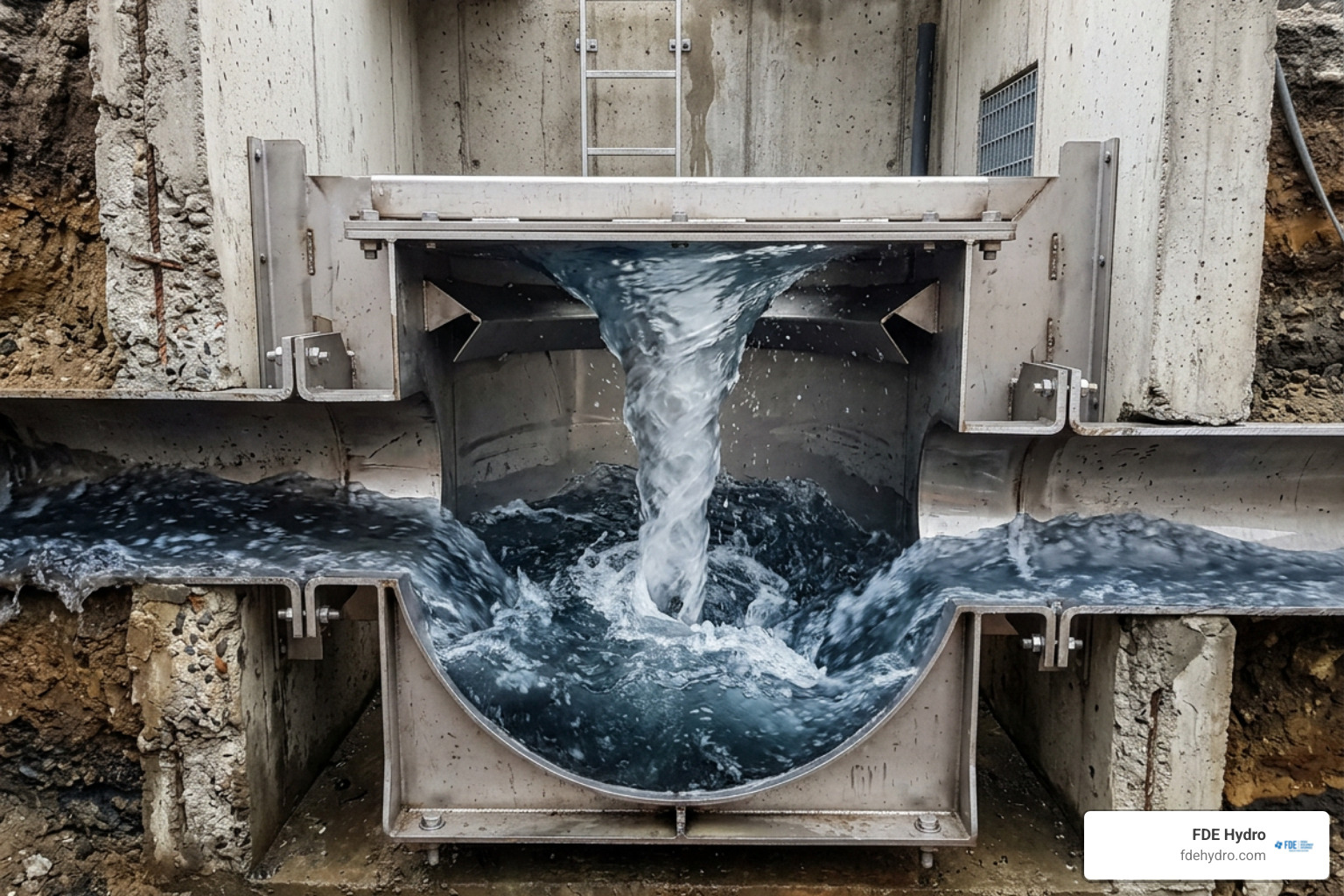
At the center of this technology is the formation of an air core. When stormwater enters the intake chamber of the device at low depths, it passes straight through, behaving like a standard, oversized pipe. However, as the water level rises and the hydraulic head increases, the geometry of the chamber forces the incoming water to spin rapidly. This rotational motion generates centrifugal force, creating a stable, air-filled vortex core in the center of the outlet.
This air core acts as a physical restriction, significantly throttling the discharge rate. By utilizing this phenomenon, the system achieves a highly controlled flow rate while maintaining a physical opening that is significantly larger than a traditional orifice plate. To dive deeper into how these components integrate into broader water management networks, you can explore our Vortex Flow Control Technology resources.
The Physics of Vortex Flow Control in hydro brake stormwater Applications
The physics of vortex flow control revolves around the relationship between velocity, pressure drop, and centrifugal force. In a standard orifice, the discharge rate ($Q$) is calculated using the standard orifice equation:
$$Q = C_d A sqrt{2gh}$$
Where $C_d$ is the discharge coefficient, $A$ is the area of the orifice, $g$ is gravity, and $h$ is the hydraulic head. To restrict flow ($Q$) at high heads ($h$), you must make the opening area ($A$) very small.
A vortex flow control device changes this equation. As water enters the vortex chamber tangentially, its velocity increases as it spirals inward toward the outlet. This high-velocity rotation creates a massive centrifugal force that pushes the water outward against the chamber walls. This action creates a low-pressure zone in the center, drawing in air through the outlet to form a stable air core.
The air core reduces the effective cross-sectional area available for water discharge. Consequently, the device creates a significant pressure drop and restricts the discharge rate without needing to physically constrict the metal opening. This allows engineers to design systems that maintain a relatively constant discharge rate once the vortex is established, regardless of how high the water rises. For a comprehensive look at how these physical principles are engineered into civil works, read our Water Control Structures Guide.
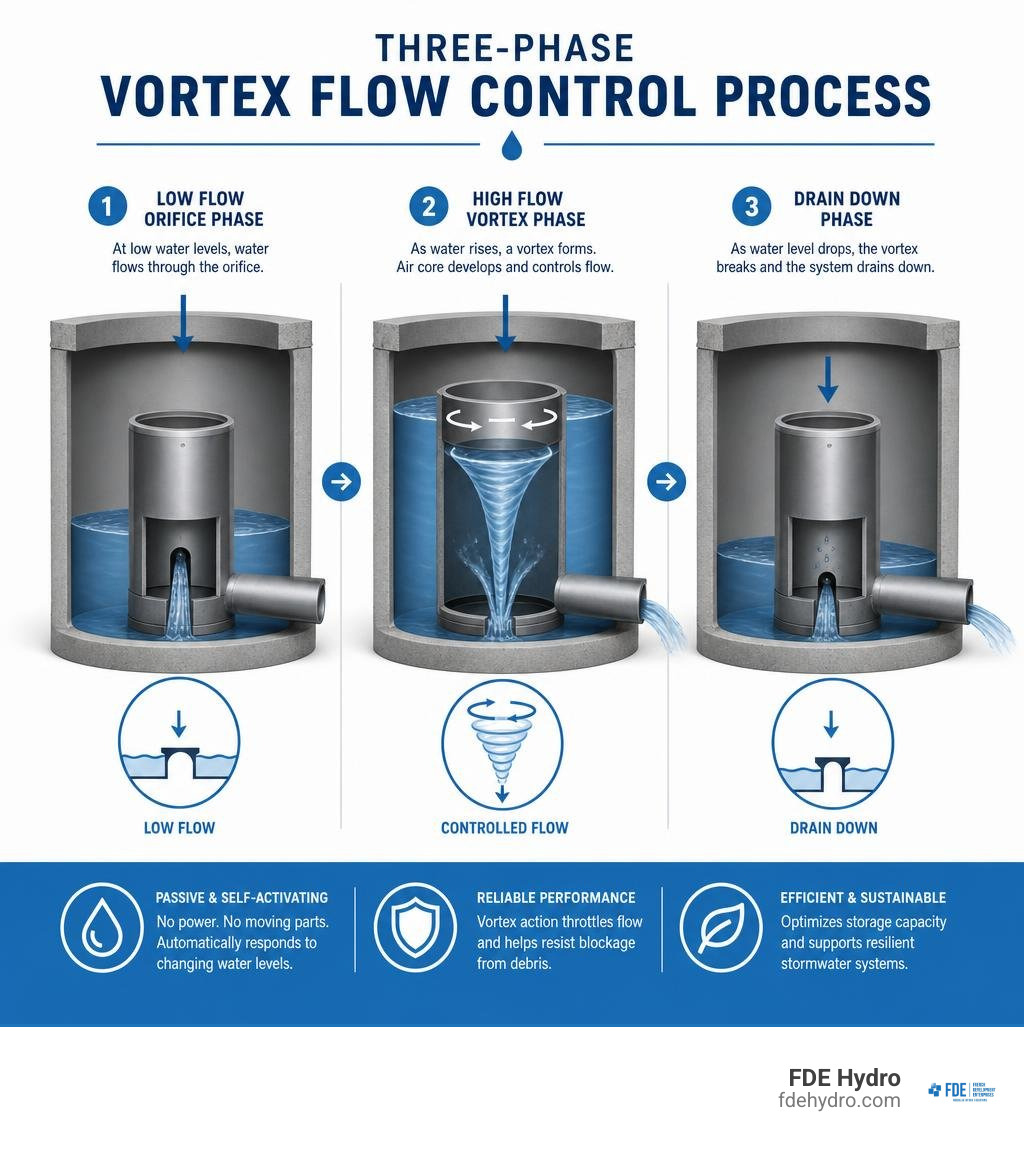
The Three Phases of hydro brake stormwater Operation
A hydro brake stormwater system operates in three distinct, automatic phases based on the hydraulic head:
Low Flow (The Orifice Phase): During the initial stages of a storm, water depths are low. The water flows directly through the device from the inlet to the outlet without spinning. In this phase, the device behaves like a standard, oversized orifice, allowing water to drain quickly so that the storage area does not unnecessarily fill up during minor rain events.
High Flow (The Vortex Phase): As the rain intensifies and the water level reaches a critical design point (often referred to as the “Switch-Flo” or “Kick-Flo” point), the water depth forces a tangential flow pattern inside the chamber. The water spins rapidly, the air core forms, and the device throttles the discharge. Even as the hydraulic head continues to rise to its maximum design level, the discharge rate remains tightly controlled and relatively constant.
Drain Down Phase: Once the storm passes and the water level in the detention facility drops, the hydraulic head decreases. The centrifugal energy dissipates, the air core collapses, and the system transitions back into the high-capacity orifice mode. This allows the remaining water to drain out rapidly, ensuring the storage basin is dry and fully prepared for the next storm event.
Key Benefits of Vortex Flow Controls vs. Traditional Orifices
When designing stormwater detention facilities, municipal sewer connections, or green infrastructure projects, civil engineers face a constant battle against physical space and regulatory limits. The table below highlights the practical differences between vortex flow control systems and standard orifice plates:
Feature
Vortex Flow Control (e.g., Hydro-Brake®)
Traditional Orifice Plate
Physical Opening Size
3 to 6 times larger than equivalent orifice
Small, restricted opening
Blockage Risk
Very Low (due to large clear opening)
High (prone to leaves, trash, and silt)
Discharge Profile
Non-linear; controls flow early and maintains flat peak
Linear; discharge increases rapidly with head
Upstream Storage Needed
Reduced by up to 40%
Maximum storage volume required
Adjustability
Up to ±20% post-installation (on select models)
None (requires physical plate replacement)
Moving Parts / Power
None (100% self-activating)
None
Reducing Upstream Storage Footprints
A challenge in modern urban development is footprint constraints. Whether you are designing a commercial development in California or a public transit expansion in New York City, land is expensive, and dedicating massive areas to surface dry ponds or underground concrete detention vaults can break a project’s budget.
Because a hydro brake stormwater device allows a higher discharge rate during the early and mid-stages of a storm before transitioning to vortex control, it utilizes the available downstream discharge allowance much more efficiently throughout the entire storm event. This optimized hydraulic performance allows engineers to design deeper detention systems with smaller footprints.
Using vortex technology can reduce required stormwater storage volumes by up to 40%, translating directly into up to 50% savings in project storage costs. This means less excavation, fewer precast concrete structures, and more land preserved for development. To see how these savings scale on large municipal projects, refer to our guide on Water Infrastructure Solutions.
Minimizing Blockage and Maintenance Risks
A traditional orifice plate designed for low discharge limits often requires a very small opening—sometimes less than 2 inches (50 mm) in diameter. These small openings are incredibly prone to clogging from autumn leaves, plastic bags, beverage cans, and sediment. When an orifice blocks, upstream areas flood, and maintenance crews must perform emergency clearance in dangerous, wet conditions.
Vortex flow controls solve this by maintaining a physical opening that is 3 to 6 times larger than an equivalent orifice plate designed for the exact same flow rate. Debris that would immediately clog a 2-inch orifice easily passes through the large opening of a vortex valve. Furthermore, advanced units feature an integrated bypass door. This door can be opened from ground level via a pull cable, allowing the chamber to drain completely in the event of an upstream blockage without requiring a technician to enter the manhole. Learn more about maintaining system integrity in Mastering Your Mains A Guide To Water Flow Control Devices.
The Hydro-Brake Flow Control Series represents a highly versatile toolbox of precision-engineered devices tailored to meet specific site constraints, budget requirements, and discharge consents. Because no two drainage catchments are identical, these systems are configured to prioritize different performance objectives—whether that is minimizing upstream storage, handling massive floodwaters, or dropping water down deep vertical shafts.
Adjustable Vortex Flow Controls: Precision and Future-Proofing
The Hydro-Brake Optimum | Hydro International is the flagship of vortex flow control technology, drawing on more than 40 years of continuous engineering development. It is highly customizable, allowing engineers to specify the exact point at which the vortex begins for any given head and flow.
One of its most innovative features is its built-in future-proof adjustability. The unit features an adjustable inlet plate that can be modified post-installation to allow up to a ±20% change in the design flow rate without replacing the device. This is incredibly valuable for addressing long-term climate change, urban creep (increased impervious surfaces from local development), or changes in regional environmental regulations.
The Hydro-Brake ® Optimum is independently certified by the British Board of Agrément (BBA, Certification no. 08/4596) and the Water Research Centre (WRc, Certification no. PT/503/0422), giving engineers complete confidence in its hydraulic performance and structural durability. For more information on specifying adjustable water control components, see our Adjustable Flow Controls engineering resource.
Large-Scale Vortex Controls for Flood Alleviation
When managing watercourse-level flows or protecting entire communities from flooding, standard drainage controls are simply too small. The Hydro-Brake Flood | Hydro International is designed specifically for large-scale flood alleviation schemes.
These high-capacity units can handle maximum flows of up to 11,500 l/s (182,278 gpm) and maximum heads of up to 11 meters (36 feet). Operating on the same vortex principles, they temporarily hold back excess water in natural river valleys, dry reservoirs, or designated flood basins, releasing it at a safe, controlled rate into downstream watercourses. Because they have no moving parts and require no power, they provide reliable flood protection in remote locations where electrical failure during a major storm is a constant threat. Read more about large-scale water control in our Flood Alleviation Systems guide.
Specialized Vortex Flow Solutions: Energy Dissipation and Shear Gate Controls
In addition to standard surface water controls, specialized configurations exist for unique structural and hydraulic challenges:
Vertical Drop Energy Dissipation: Dropping large volumes of water down deep vertical shafts—such as in deep tunnel sewer systems or steep hillside drainage—can cause severe noise, structural vibration, air entrainment, and pipe erosion. The Hydro-Brake Drop | Hydro International safely conveys water down drops of up to 330 feet (100 meters) and flow rates up to 5,000 l/s (10,500 ft³/min). It uses vortex action to dissipate kinetic energy against the pipe walls, eliminating cavitation and structural wear while controlling corrosive sewer gases like hydrogen sulfide.
Constant Discharge Shear Gate Controls: For sites with incredibly strict discharge consents and highly limited space, the Hydro-Brake Agile | Hydro International offers a unique mechanical-hydraulic hybrid solution. It uses a float arm and sliding gate mechanism to maintain a completely constant discharge rate across varying water depths, minimizing the required upstream storage volume to the absolute physical minimum. Learn about these specialized systems in our guide to Specialized Flow Controls.
Design, Sizing, and Installation Considerations
Integrating a hydro brake stormwater system into a project requires careful hydraulic modeling and structural planning. Because these devices rely on the physical properties of the vortex, their head-discharge curves are non-linear, which must be accurately accounted for in drainage design software.
Sizing and Hydraulic Calculations
When sizing a vortex flow control, engineers must establish three primary parameters: the design flow rate ($Q$), the maximum allowable design head ($h$), and the available upstream storage volume.
The Hydro-Brake® Optimum supports a maximum flow of up to 550 l/s (8,717.7 gpm) and can manage drainage catchments with a maximum storage area of up to 275 hectares (assuming an average of 2 l/s per hectare for storage sizing).
Using proprietary design software or the official design tool, engineers can generate a highly customized head-discharge curve that maximizes the outflow rate during the early stages of a storm while strictly capping the peak discharge at the maximum allowable limit. This curve is then imported into standard hydraulic modeling software to size the associated retention ponds, blue roofs, or underground concrete vaults. For detailed calculations, check out the Water Control System Complete Guide.
Installation Configurations and Downstream Clearance
For a vortex flow control to function correctly, it must be installed in accordance with specific physical and hydraulic guidelines:
Downstream Clearance: All vortex flow controls must maintain adequate downstream clearance to allow the air core to vent and the discharge jet to expand. Typically, this requires a minimum clearance of 3 meters (9.84 feet) or ten times the outlet pipe diameter (whichever is greater) with no valves, bends, or pipe diameter changes within this zone.
Surcharge Conditions: If the downstream receiving sewer surcharges (fills completely), the backpressure can interfere with the vortex’s air core. In these installations, an air vent pipe must be extended from the device to a point above the maximum water level to ensure the air core can form under all conditions.
Mounting Styles: Depending on the chamber design, units can be specified in wall-mounted configurations (bolted directly over the outlet pipe on a flat concrete headwall), floor-mounted configurations, or pre-installed inside a precast concrete manhole chamber for rapid site installation.
Integrating Vortex Flow Controls with SuDS and Green Infrastructure
Modern urban planning emphasizes Sustainable Drainage Systems (SuDS), Low-Impact Development (LID), and green infrastructure. Rather than routing stormwater into massive concrete pipes as quickly as possible, the goal is to mimic natural hydrology by capturing, filtering, and releasing water slowly.
Vortex flow controls are a natural fit for green infrastructure:
Bioretention Cells and Rain Gardens: By installing a small vortex valve at the outlet of a bioretention basin, you can maximize the water depth and contact time within the soil and vegetation layer, improving pollutant filtration without risking downstream flooding.
Blue Roofs: In dense urban areas like New York City or San Francisco, roofs are increasingly being used as temporary stormwater detention basins. A vortex control limits the drain-down rate of the roof, allowing shallow ponding that evaporates or drains slowly over 24 to 48 hours.
California Stormwater Treatment: In regions with strict water quality regulations, such as those detailed in California Stormwater Treatment | Hydro International , vortex flow controls are used to regulate the flow of runoff entering treatment trains, ensuring that oil-grit separators and media filters operate within their optimal design flow rates.
By carefully regulating water quantity, these devices protect expensive green infrastructure assets from erosion and washouts during extreme weather events. Learn more about designing for long-term sustainability in our guide to Sustainable Water Infrastructure.
Frequently Asked Questions about Hydro Brake Stormwater Systems
How does a hydro brake stormwater system prevent blockages compared to a standard orifice?
A standard orifice plate restricts flow by physically reducing the size of the opening. To achieve low flow rates, the opening must be very small (often 2 inches or less), which easily traps leaves, twigs, and litter. A vortex flow control restricts flow dynamically using centrifugal force and an air core. This allows the physical opening of the device to be 3 to 6 times larger than an equivalent orifice plate, allowing debris to pass through easily without causing a blockage.
Can a hydro brake stormwater device be adjusted after installation?
Yes, select models like the Hydro-Brake® Optimum feature an adjustable inlet plate. This plate can be adjusted post-installation to increase or decrease the design flow rate by up to ±20%. This built-in flexibility allows engineers to adapt the system to future site developments, changing climate patterns, or updated municipal regulations without having to excavate and replace the entire flow control unit.
What are the maintenance requirements for these vortex flow control systems?
Because vortex valves have no moving parts and rely entirely on simple fluid hydraulics, they are virtually maintenance-free. Maintenance typically consists of periodic visual inspections (usually twice a year) to remove any large debris or silt accumulation from the floor of the concrete chamber. Many units also feature a manual bypass door operated via a pull cable from ground level, allowing maintenance crews to safely drain the chamber in an emergency without entering the manhole.
Conclusion
Managing urban runoff requires a careful balance of hydraulic performance, structural footprint, and long-term reliability. Traditional orifice plates, while simple, place a heavy burden on projects by requiring larger detention footprints and presenting a constant risk of blockage and maintenance failure. Hydro brake stormwater systems break this bottleneck, utilizing the natural physics of vortex flow to restrict discharge safely, reduce required storage volumes by up to 40%, and lower overall project costs.
At FDE Hydro™, we believe that the future of water management lies in combining smart hydraulic technologies with innovative, rapidly deployable construction methods. Our patented modular precast concrete technology is designed to streamline the installation of heavy civil water control structures, dams, and municipal containment chambers, significantly reducing construction timelines and costs across North America, Brazil, and Europe.
Whether you are designing a complex urban retrofitting project in New York, a green infrastructure development in California, or a municipal CSO mitigation system in Canada, pairing advanced vortex flow control with modular precast structures ensures your project is built to last, fully compliant, and highly cost-effective.
Ready to optimize your next water control project? Explore our comprehensive Water Control Solutions Complete Guide or contact our engineering team today to discuss how we can streamline your infrastructure design.
What You Need to Know About Hydroelectric Power Dams
Hydroelectric power dams are structures that capture the energy of moving water to generate electricity — one of the oldest and most reliable forms of renewable energy on the planet.
Quick answers:
What they do: Convert the kinetic and potential energy of flowing water into electricity
How they work: Water flows through a turbine, spinning a generator to produce power
Main types: Impoundment (reservoir), diversion (run-of-river), and pumped-storage
Size range: From micro systems under 100 kilowatts to giants like China’s Three Gorges Dam at 22,500 MW
Share of U.S. electricity: About 6.2% of total generation and 28.7% of all renewable electricity (2022)
Key benefit: Reliable, dispatchable, clean energy — with added value from flood control, irrigation, and water storage
Hydropower has powered human civilization for centuries — long before the first commercial electric plant opened in Wisconsin in 1882. Today, it remains the world’s largest source of renewable electricity, with thousands of facilities operating across every inhabited continent.
Yet despite its scale and importance, hydropower is often misunderstood. Many people picture only massive concrete walls holding back enormous reservoirs. In reality, hydropower comes in many forms, sizes, and designs — each suited to different rivers, terrains, and energy needs.
I’m Bill French, Sr., Founder and CEO of FDE Hydro™, and I’ve spent decades in heavy civil construction before focusing my work on modernizing how hydroelectric power dams are designed and built using modular precast solutions. In 2015, I was selected by the U.S. Department of Energy’s Water Power Technology Office to help shape the national roadmap for next-generation hydropower. That experience — combined with the innovations we’ve developed at FDE Hydro™ — gives me a practical, ground-level perspective on what it actually takes to build and operate these facilities efficiently.
How Hydroelectric Power Dams Generate Clean Electricity
At its absolute core, generating electricity from water is a masterclass in physics made simple. We are taking the heavy, relentless pull of gravity and putting it to work.
To gain a foundational perspective, it helps to start with The Current Definition: Understanding Hydroelectric Power. In short, we are converting potential energy (water held high up) into kinetic energy (water rushing downward) to drive mechanical rotation, which finally creates electrical energy.
When water is held behind a dam, it contains a massive amount of stored potential energy. When we open the gates, gravity pulls that water downward through a dedicated channel. As the water rushes down, its potential energy transforms into kinetic energy. This fast-moving water slams into the blades of a turbine, forcing it to spin. Because the turbine is connected to a generator by a heavy shaft, the spinning motion rotates magnets inside copper coils, which coaxes electrons into motion. This mechanical-to-electrical conversion is the bedrock of Hydroelectric Power Generation.
The Role of the Water Cycle in Hydropower
You might wonder: does this water ever run out? This is where the earth’s natural water cycle acts as our ultimate battery charger.
Hydropower is entirely dependent on solar-powered evaporation and precipitation. The sun heats water in oceans, lakes, and rivers, turning it into water vapor. This vapor rises, condenses into clouds, and falls back to the earth as rain or snow.
This moisture gathers in rivers and streams, flowing back toward the sea. When we build hydroelectric power dams, we are intercepting this cycle. The amount of energy we can harvest from this loop depends on two key variables:
Flow Volume: How much water is actually passing through the system over a given period.
Head (Elevation Change): The vertical distance the water falls from the top of the reservoir to the turbine below. The higher the head, the more force the water exerts on the turbine.
Key Components of Hydroelectric Power Dams
While every site is unique, a conventional facility relies on several interconnected parts to keep the lights on. For a deep dive into these individual structures, check out our Hydroelectric Dam Components Ultimate Guide. Here is a quick breakdown of the primary players:
The Reservoir: The large lake behind the dam that stores water, acting as a bank of potential energy.
The Intake and Penstock: The intake is the gate that opens to let water in. The penstock is the massive, closed conduit or pipe that channels the rushing water directly down to the turbines.
The Powerhouse: The secure building that houses the turbines, generators, and control systems.
The Turbine: The modern-day water wheel that spins when struck by the rushing water.
The Generator: The machine that converts the turbine’s rotating mechanical energy into electricity.
The Tailrace: The channel that safely returns the water to the river downstream after it has passed through the turbine.
The Three Main Types of Hydropower Plants
Not all hydropower facilities look like Hoover Dam. Depending on the local geography, water flow, and grid requirements, engineers choose between three main configurations. Understanding these differences is crucial when exploring modern Hydroelectric Dam Design Complete Guide.
Impoundment Facilities (Conventional Dams)
This is the classic image most people have of a hydroelectric dam. An impoundment facility uses a physical dam to block a river, creating a large reservoir behind it.
By storing water in this artificial lake, operators gain immense control. They can release water to generate electricity whenever demand spikes, making impoundment dams highly reliable “peaking” plants. However, building these massive structures requires significant capital, time, and earth-moving effort, which is why modern developers look closely at the economics of Hydroelectric Dam Construction.
Diversion or Run-of-River Systems
What if you want to generate power without flooding a massive valley? Enter the diversion system, often called a run-of-river facility.
Instead of holding back a massive reservoir, a diversion system channels a portion of a river’s natural flow through a canal or penstock to spin a turbine, after which the water is immediately returned to the main riverbed. These systems have a much smaller physical footprint and minimal environmental impact.
A great real-world example of this approach is the Patriot Hydro Lawrence Hydroelectric Project , which utilizes the natural flow of the river to generate clean power with minimal storage requirements.
Pumped-Storage Hydropower as a Giant Battery
Think of pumped-storage hydropower as a massive, water-based battery. These facilities don’t rely on the natural flow of a river to generate all their power; instead, they move water back and forth between two reservoirs at different elevations (an upper and a lower reservoir).
Here is how the cycle works:
During Low Demand (Off-Peak): When electricity demand is low (like in the middle of the night or when solar power is peaking during the day), the facility uses surplus grid electricity to pump water from the lower reservoir up to the upper reservoir.
During High Demand (Peak): When everyone turns on their air conditioners and electricity prices spike, the operators release the water from the upper reservoir. It rushes down through reversible turbines, generating electricity to stabilize the grid.
Because it takes more energy to pump the water uphill than the system recovers on the way down, pumped-storage is a “net-negative” generator. However, its ability to store massive amounts of intermittent renewable energy (like wind and solar) and discharge it on demand makes it an invaluable asset for modern grid stability.
Classifying Hydropower Plants by Size and Capacity
Hydropower facilities are also categorized by their generating capacity, which is measured in megawatts (MW) or kilowatts (kW).
Large hydropower plants are the heavy lifters of the renewable energy world. Defined as facilities with a capacity of more than 30 MW, these massive installations can supply electricity to millions of homes.
They provide essential baseload power and grid stabilization services, helping balance out more volatile renewable sources. Organizations like the Hydroelectric Power – California Energy Commission – CA.gov oversee these large-scale assets to ensure they safely integrate with regional transmission networks.
Small and Micro Hydropower Systems
At the other end of the spectrum, small and micro hydropower systems prove that you don’t need to block a massive river to make a big difference. Small hydro (100 kW to 10 MW) and micro hydro (under 100 kW) are excellent for rural electrification and local industrial use.
These smaller systems often utilize existing water infrastructure, municipal water lines, or small streams without requiring massive dams. For example, historical sites like the About Bowersock facility show how smaller-scale, run-of-river installations can provide reliable, community-aligned clean energy for over a century with minimal disruption to the local ecosystem.
Historical Evolution of Water Turbines and Technology
Long before we used water to power our laptops, ancient civilizations used it to grind grain and saw wood. The history of hydropower is a fascinating journey of human ingenuity, which we explore in detail in Harnessing the Current: A Guide to Hydroelectric Power Production.
From Ancient Water Wheels to Modern Turbines
The earliest records of water power date back to the Han Dynasty (202 BC to 9 AD) in China, where water-driven trip hammers were used to hull grain. For centuries, simple wooden water wheels did the heavy lifting of the early industrial era.
The leap from mechanical work to electricity happened in the late 19th century. In 1878, the world’s first hydroelectric power project was built at Cragside House in Northumberland, England, where it was used to light a single lamp. Just a few years later, on September 30, 1882, the first commercial hydroelectric plant opened on the Fox River in Appleton, Wisconsin, proving that water could reliably power local grids.
Francis, Pelton, and Kaplan Turbines
As the demand for electricity grew, engineers moved away from simple water wheels and designed highly specialized, metal water turbines. Today, three main turbine designs dominate the industry, each optimized for different water speeds and heights. Maximizing their performance is a key focus of Hydroelectric Dam Efficiency.
The Francis Turbine: Invented by James Francis in 1849, this is a reaction turbine where water flows inward radially, spinning the runner. It remains the most widely used water turbine in the world today, operating best in medium-head and medium-flow environments.
The Pelton Wheel: Designed for high-head, low-flow situations (like a steep mountain stream), the Pelton wheel is an impulse turbine. High-pressure nozzles blast jets of water at spoon-shaped buckets on the wheel, forcing it to spin at high speeds.
The Kaplan Turbine: Essentially a high-tech boat propeller inside a pipe, the Kaplan turbine is designed for low-head, high-flow conditions. Its defining feature is its adjustable blades, which allow operators to maintain high efficiency even when river flows change seasonally.
The World’s Largest Hydroelectric Power Stations
When it comes to sheer engineering scale, hydroelectric power dams rank among the largest artificial structures ever built. You can discover more about these incredible feats of engineering in Dive Into Hydropower: Unlocking Nature’s Electric Potential.
Global Giants: Three Gorges and Itaipu
At the top of the global list sits the Three Gorges Dam in China, holding the record for the world’s largest instantaneous generating capacity at a staggering 22,500 MW.
However, capacity isn’t the only metric that matters. The Itaipu Dam, located on the border of Brazil and Paraguay, has an installed capacity of 14,000 MW from its 20 generator units. Yet, because the Paraná River has a incredibly consistent year-round flow, Itaipu often matches or exceeds Three Gorges in actual annual energy generation. In 2013, Itaipu reached a historic world record by generating 98,630,035 MWh of electricity in a single year—enough to supply Paraguay’s electricity needs for nearly eight years. To explore more about this facility and others in the region, you can read the ITAIPUMAGAZINEENGLISH_LR or browse the List of hydroelectric power stations in Brazil – Wikipedia .
North American Leaders: Grand Coulee Dam
In the United States, the crown belongs to the Grand Coulee Dam on the Columbia River in Washington state. Completed in 1941, this massive concrete gravity dam stands 550 feet tall and stretches 5,223 feet long.
With a total generating capacity of 6,809 MW, Grand Coulee produces roughly 21 billion kilowatt-hours of electricity annually, supplying clean power to eight western states and parts of Canada. To put its size in perspective, the concrete used to build it could construct a four-foot-wide sidewalk wrapping twice around the equator! For more mind-boggling details, check out the Grand Coulee Dam Statistics and Facts and the Grand Coulee Dam > Northwestern Division > Fact Sheet – Northwestern Division .
Multi-Purpose Benefits and Environmental Impacts of Dams
While generating clean electricity is a primary goal, hydroelectric power dams are rarely single-purpose structures. They are complex water management tools that shape local economies and ecosystems.
Flood Control, Irrigation, and Recreation
Most large dams are built to solve multiple challenges at once.
Flood Control: By holding back water during heavy rains or spring snowmelts, dams protect downstream communities from devastating floods. A classic example is the Albeni Falls Dam , which was authorized under the Flood Control Act of 1950 to protect the Columbia River Basin.
Irrigation: Reservoirs store water that can be diverted to irrigate millions of acres of farmland during dry summer months, supporting local agricultural economies.
Recreation and Tourism: Reservoir lakes provide fantastic spaces for boating, fishing, and camping, driving local tourism.
Environmental and Social Challenges of Hydroelectric Power Dams
Despite their benefits, large dams present real environmental and social challenges that cannot be ignored:
Fish Migration: Physical barriers block fish like salmon from reaching their upstream spawning grounds.
Habitat Alteration: Flooding a valley to create a reservoir changes the local terrestrial and aquatic habitat, which can displace wildlife.
Community Displacement: Building massive reservoirs historically required relocating communities living in the valleys destined to be flooded.
Greenhouse Gases: While hydropower is low-carbon, decaying vegetation in newly flooded reservoirs can release methane, a potent greenhouse gas, particularly in tropical climates.
Safety, Operations, and Regulatory Oversight
Because of the massive volume of water they hold, dam safety is a matter of national security. Dams in the United States are heavily regulated and continuously monitored. Federal agencies like the Bureau of Reclamation and the Bureau of Reclamation manage these assets with rigorous safety standards.
Operators use thousands of monitoring instruments to track structural movement, water pressure, and concrete health, ensuring that these vital infrastructure assets remain safe and operational for generations.
Frequently Asked Questions about Hydropower
How many of the dams in the United States produce power?
Believe it or not, of the more than 90,000 dams in the United States, less than 3% actually produce power. The vast majority of U.S. dams were built strictly for flood control, municipal water supply, crop irrigation, or recreation. This represents a massive opportunity: we can retro-fit many of these existing “non-powered” dams with modern turbines to generate clean energy without having to build a single new concrete wall in a river.
Why do some hydroelectric power dams generate more electricity than others with larger capacities?
It all comes down to water availability and consistency. A dam’s installed capacity (measured in MW) is the maximum power it can produce under perfect conditions. However, its actual generation (measured in MWh) depends on how much water flows through it over the course of a year.
For example, while China’s Three Gorges Dam has a much larger capacity than the Itaipu Dam, Three Gorges experiences dry seasons where water flows drop significantly. Because the Paraná River feeding Itaipu has a very steady, high-volume flow year-round, Itaipu is often able to generate a similar amount of total electricity annually despite its smaller nameplate capacity.
How do modern fish passage systems protect wildlife?
Modern dam design prioritizes fish passage to protect local migratory species. Engineers use several clever solutions:
Fish Ladders: A series of stepped, water-filled pools that allow fish to literally swim and jump their way up and around a dam.
Spawning Channels: Artificial streams built alongside the dam that mimic natural riverbeds, giving fish a safe path to travel and spawn.
Fish-Friendly Turbines: Newer turbine designs feature blunter blades that rotate slower, allowing fish to pass through safely without injury.
Conclusion
As we look toward a clean energy future, the role of hydroelectric power dams is evolving. We are moving away from the era of massive, disruptive mega-dams and entering an era focused on efficiency, retrofitting, and minimal environmental impact.
At FDE Hydro™, we are leading this shift. Our patented modular precast concrete technology—known as the “French Dam”—redefines how water control systems and hydroelectric projects are built. By manufacturing concrete modules off-site and assembling them rapidly in the field, we significantly reduce construction costs, minimize environmental disruption, and slash project timelines across North America, Brazil, and Europe. Whether we are retrofitting a non-powered dam or building a new run-of-river system, our goal is to make clean, reliable hydropower more accessible and sustainable than ever before.
To learn more about how we are shaping the future of water power, explore our complete guide to Hydropower and join us in building a cleaner, more resilient energy grid.
How a Hydro Electric Dam Works — And Why It Still Matters in 2026
A hydro electric dam is one of the most powerful and proven tools humanity has ever built for generating clean electricity. In 2026, hydropower supplies around 15% of the world’s electricity — more than all other renewable sources combined, and more than nuclear power.
Here’s what you need to know at a glance:
Key Fact
Detail
How it works
Captures energy from flowing or falling water to spin turbines and generate electricity
Global capacity
Nearly 1,400 GW installed worldwide (2021)
Annual generation
~4,210 TWh in 2023
Largest facility
Three Gorges Dam, China — 22,500 MW
Countries most reliant
Norway (88.5%), Paraguay (99.7%), Brazil (60.4%)
Key advantage
Dispatchable, low-emission, long-life power
Key concern
Ecosystem disruption, displacement, and high upfront cost
Hydropower isn’t a new idea. People have been using moving water for power for thousands of years — from grain mills in ancient China to the first hydroelectric lamp lit at Cragside House in England in 1878. Today’s mega-projects like the Three Gorges Dam and Itaipu Dam produce enough electricity to power entire nations.
But hydropower is also evolving fast. Aging infrastructure needs upgrades. New modular construction methods are cutting costs and timelines. And as the world races to replace fossil fuels, dispatchable clean power is more valuable than ever.
This guide breaks it all down in plain language — no engineering degree required.
I’m Bill French, Sr., Founder and CEO of FDE Hydro™, where I’ve spent the last decade developing patented modular construction solutions that are transforming how hydro electric dam projects get built — faster, cheaper, and with less environmental disruption.From five decades of heavy civil construction experience, I’ll walk you through everything a beginner needs to understand about how these remarkable structures work, what they cost the environment, and where the industry is headed.
What Is a Hydro Electric Dam and How Does It Generate Electricity?
At its heart, a hydro electric dam is an energy converter. It doesn’t create energy from scratch; instead, it captures the gravitational energy of falling water and turns it into electricity.
This process relies heavily on the natural water cycle. Solar energy evaporates water from the oceans, which then condenses into precipitation and falls on high-altitude land. As this water collects in rivers and streams, gravity pulls it back toward sea level. By placing a dam in the path of this flowing water, we create a controlled bottleneck where we can extract its mechanical energy.
The conversion happens in a few straightforward steps:
The Reservoir: The dam blocks the river, creating a large reservoir behind it. This stores water at a high elevation, creating potential energy.
The Intake and Penstock: When electricity is needed, gates on the dam open, and water enters an intake. It flows down a large pipe called a penstock, building up pressure and speed.
The Turbine: At the end of the penstock, the high-pressure water strikes the blades of a massive turbine, causing it to spin rapidly. This converts the potential energy of the water into mechanical energy.
The Generator: The spinning turbine is connected to a generator by a heavy shaft. Inside the generator, powerful magnets spin inside copper coils, generating alternating current (AC) electricity.
The Transformer and Grid: The electricity travels to a transformer, which steps up the voltage so it can travel long distances over the transmission grid.
The Tailrace: The water, now stripped of its high pressure, exits the powerhouse through a tailrace and flows back into the river below the dam.
A modern hydro electric dam is a highly engineered system of specialized components. Every part has a role to play in keeping the facility safe, efficient, and reliable.
The primary components include:
The Dam Wall: The massive concrete or earth-fill barrier that holds back the river.
The Spillway and Gates: Safety features designed to safely release excess water during floods, preventing the dam from being overtopped.
The Reservoir: The artificial lake behind the dam that acts as an energy storage battery.
The Powerhouse: The heavy building that houses the turbines, generators, transformers, and control systems.
Fish Passages: Specialized structures like fish ladders or bypass channels that help migratory fish travel past the dam.
Sediment Outlets: Gates at the bottom of the dam used to flush out accumulated silt and sand.
How much power can a hydro electric dam actually produce? It comes down to two main physical variables: head and flow rate.
Head is the vertical distance the water falls from the reservoir surface to the turbine. The higher the head, the more pressure the water exerts on the turbine.
Flow Rate is the volume of water passing through the penstock per second, typically measured in cubic feet per second (cfs) or cubic meters per second ($m^3/s$).
The basic formula for calculating the available electrical power (in kilowatts) is:
$$P = eta cdot rho cdot g cdot Q cdot H$$
Where:
$P$ is the electrical power output (kW)
$eta$ is the overall efficiency of the turbine and generator (typically between 80% and 95%)
$rho$ is the density of water ($1,000 text{ kg/m}^3$)
$g$ is the acceleration due to gravity ($9.81 text{ m/s}^2$)
$Q$ is the flow rate ($m^3/s$)
$H$ is the net head (meters)
Because power output depends directly on the volume of water flowing through the system, hydroelectric plants are highly sensitive to seasonal inflows and drought. During dry years, a dam’s capacity factor — the ratio of its actual electricity output to its maximum potential output — can drop significantly. Learn more about how these variables impact energy production in our guide on Hydroelectric Dam Efficiency.
Main Types of Hydroelectric Facilities
Not all hydroelectric plants look or operate the same way. Depending on the local geography, water availability, and grid requirements, engineers choose from several distinct facility types.
Facility Type
Storage Scale
Dispatchability
Environmental Footprint
Conventional Storage
Large
High (On-demand)
High (Floods large areas)
Pumped-Storage
Dual Reservoir
Extremely High
Moderate
Run-of-the-River
Minimal to None
Low (Weather-dependent)
Low
Tidal Power
Estuary / Ocean
Predictable (Cycles)
Moderate to High
Conduit Hydropower
None (In-pipe)
Dependent on system flow
Extremely Low
To understand how these systems compare on a broader scale, read our introductory guide on Hydropower.
Conventional Storage Dams
Conventional storage dams are what most people picture when they think of a hydro electric dam. These massive concrete gravity or arch structures block major rivers to create large reservoirs, offering high head and massive dispatchable electrical output.
These multi-purpose facilities do more than generate power; they also provide flood control, irrigation water, and recreational opportunities. Famous examples in North America and South America include the Grand Coulee Dam in Washington state, managed by the Bureau of Reclamation , and the binational Itaipu Dam between Brazil and Paraguay.
Pumped-storage hydropower acts as a giant water battery for the electrical grid. These facilities use two reservoirs at different elevations: an upper reservoir and a lower reservoir.
During low-demand periods (such as at night or when solar output is high), the plant uses cheap, excess grid electricity to pump water from the lower reservoir uphill to the upper reservoir.
During peak-demand periods (such as hot summer afternoons), the water is released back down through reversible turbines, generating electricity on demand.
Although pumped-storage is a net consumer of electricity due to minor efficiency losses during pumping, it is incredibly valuable for grid stability. It accounts for nearly 85% of global grid energy storage capacity, offering rapid ramping speeds to balance intermittent solar and wind energy. In Europe, these systems are critical to maintaining grid frequency; you can learn more about their distribution in this list of the Top 10 hydroelectric and PSPPs in Europe (2025) .
Run-of-the-River, Tidal, and Conduit Systems
For locations where a massive reservoir isn’t feasible or environmentally acceptable, alternative systems provide excellent solutions:
Run-of-the-River: These plants divert a portion of a river’s natural flow through a canal or penstock to spin turbines, returning the water downstream. They have little to no storage capacity, meaning their power output fluctuates with seasonal river flows.
Tidal Power: These facilities capture the mechanical energy of ocean tides. They can use tidal barrages (dams across estuaries) or tidal stream turbines submerged in high-velocity ocean currents.
Conduit Hydropower: This involves installing small turbines inside existing water infrastructure, such as municipal drinking water pipes, industrial cooling systems, or agricultural irrigation canals.
These systems are often categorized by size:
Small Hydro: Typically generates up to 10 MW.
Micro Hydro: Generates up to 100 kW, ideal for small communities or remote homesteads.
Pico Hydro: Generates under 5 kW, perfect for off-grid homes.
Advantages, Grid Value, and Energy Source Comparisons
Hydropower is one of the most reliable, clean, and flexible electricity sources available. Unlike wind and solar, which depend on weather conditions, or fossil fuels, which release high greenhouse gas emissions, a hydro electric dam offers the best of both worlds: low-carbon emissions and dependable, on-demand power.
The modern electrical grid requires a delicate, second-by-second balance between power generation and electricity consumption. Conventional fossil fuel plants and nuclear reactors can take hours or even days to ramp their output up or down.
Hydroelectric generators, however, can go from a cold start-up to full load in less than 10 minutes. This makes them incredibly valuable for:
Peak Shaving: Meeting sudden spikes in electricity demand.
Spinning Reserves: Standing by to immediately supply power if another major generator on the grid fails.
Black Start Capability: Providing the initial power needed to restart the electrical grid after a major blackout.
Furthermore, the reservoirs of existing conventional dams worldwide can store a total of 1,500 TWh of electrical energy in one full cycle. This is roughly 170 times more storage capacity than the entire global fleet of pumped-storage plants, providing a massive buffer against seasonal energy shortages.
Multi-Purpose Benefits Beyond Electricity
Very few power plants offer benefits beyond electricity generation, but a conventional hydro electric dam is a multi-purpose tool.
Many dams are built primarily for water management. For example, the Albeni Falls Dam in Idaho, managed by the U.S. Army Corps of Engineers, carefully balances power generation with flood control, navigation, and local fisheries mitigation. You can read more about its operations on the official Albeni Falls Dam page.
Similarly, the Grand Coulee Dam in Washington state supplies irrigation water to approximately 720,000 acres of farmland through the Columbia Basin Project, supporting regional agricultural economies while generating over 21 billion kilowatt-hours of clean electricity annually.
Hydropower vs Nuclear, Wind, Solar, and Fossil Fuels
When evaluating electricity sources, we must look at reliability, cost, and environmental impact:
vs. Fossil Fuels (Coal & Gas): Fossil fuel plants are highly reliable but release massive amounts of carbon dioxide, sulfur, and nitrogen oxides. Hydropower has no fuel costs and one of the lowest lifecycle greenhouse gas emissions of any generation technology.
vs. Wind & Solar: Wind and solar are clean and cheap to build, but they are intermittent. When the wind stops blowing or the sun sets, they require backup generation. Hydropower provides the steady, dispatchable baseload power that wind and solar lack.
vs. Nuclear: Nuclear power provides excellent, emission-free baseload power with a high capacity factor. However, nuclear plants are incredibly expensive to build, take over a decade to construct, and cannot ramp their output up and down quickly to match grid fluctuations.
Environmental, Social, and Safety Risks of Hydroelectric Dams
While the benefits of hydroelectricity are clear, we must also address the real environmental and social challenges associated with building and operating massive dams.
To learn more about how modern engineering works to minimize these impacts during planning and development, read our guide on Hydroelectric Dam Construction.
Ecosystem and Climate Impacts
Building a conventional hydro electric dam completely alters the local river ecosystem:
Habitat Fragmentation: Dams act as physical barriers, blocking the migration of fish like salmon and eels. Up to 70% of silver eels passing through traditional turbines can perish.
Sediment Trapping: Dams trap gravel, sand, and silt behind their walls. This starves downstream riverbeds of essential nutrients, leading to severe coastal and river erosion.
Water Quality Changes: Reservoirs can become stratified, with warm, oxygen-poor water collecting at the bottom. Releasing this low-oxygen water downstream can harm aquatic life.
Methane Emissions: When a new reservoir is flooded, submerged vegetation decays. In warm, tropical climates, this decay can release significant amounts of methane, a potent greenhouse gas. Fortunately, lifecycle emissions remain extremely low in temperate climates.
To mitigate these impacts, modern dams are designed with fish ladders, fish-safe turbines, hatcheries, and managed environmental flows to mimic natural river cycles. Learn more about these solutions in our guide Dive Into Hydropower: Unlocking Nature’s Electric Potential.
Population Displacement and Community Impacts
The creation of massive reservoirs often requires flooding large areas of dry land, which can have significant social consequences:
Displacement: It is estimated that between 40 and 80 million people have been displaced by dam construction worldwide. For instance, the construction of the Itaipu Dam displaced approximately 10,000 families living along the Paraná River.
Loss of Cultural Heritage: Flooding can submerge sacred Indigenous sites, historical landmarks, and valuable agricultural land.
Social License: Today, developers must secure a “social license to operate” through extensive public consultation, fair compensation, and equitable benefit-sharing programs.
Dam Safety, Failure Risks, and Consequences
Dams hold back millions of tons of water. If a dam fails, the consequences for downstream communities can be catastrophic.
Historically, dam failures have resulted from extreme flooding, poor foundation engineering, landslides, or seismic activity. Notable disasters include:
The Vajont Dam Disaster (Italy, 1963): A massive landslide fell into the reservoir, creating a giant wave that overtopped the dam and claimed nearly 2,000 lives downstream.
The Banqiao Dam Failure (China, 1975): Extreme rainfall from a typhoon caused the dam to collapse, resulting in catastrophic flooding and thousands of casualties.
Today, dam operators use advanced structural monitoring instruments, such as piezometers, inclinometers, and seismic sensors, to track dam health in real time. Reservoirs also maintain strict emergency action plans and inundation mapping to protect downstream populations.
History, Global Scale, and Future Potential
To understand where hydropower is going, it helps to look at where it started.
From Ancient Water Power to Modern Hydroelectricity
Humans have harnessed the force of moving water for millennia:
Ancient Civilizations: The Han Dynasty in China (202 BC – 9 AD) used water wheels to power trip hammers for grain hulling. Roman mills used water wheels to grind flour.
The Industrial Revolution: In 1771, Cromford Mill in England utilized water power to spin cotton, helping to spark the modern factory system.
The Birth of Hydroelectricity: In 1878, inventor William Armstrong lit a single lamp at Cragside House in England using a water-driven turbine.
The First Commercial Plants: In September 1882, the Vulcan Street Plant opened on the Fox River in Appleton, Wisconsin, generating about 12.5 kilowatts of power.
The Era of Mega-Dams: The 20th century saw the construction of massive projects like the Hoover Dam and Grand Coulee Dam under New Deal policies in the United States, transforming regional economies.
Current Global Capacity, Generation, and Leading Countries
Today, hydropower is a cornerstone of the global energy landscape:
Global Output: Hydropower generated 4,210 TWh of electricity in 2023, representing roughly 15% of total global electricity.
Installed Capacity: Global capacity reached nearly 1,400 GW in 2021.
Leading Countries: China is the world leader in total capacity, adding 24 GW of new hydropower in 2022 alone. However, other nations rely on hydro for the vast majority of their grid power, including Paraguay (99.7%), Norway (88.5%), and Brazil (60.4%).
The world’s largest power-generating facilities are all hydroelectric dams:
Three Gorges Dam (China): 22,500 MW capacity.
Itaipu Dam (Brazil/Paraguay): 14,000 MW capacity. You can read about its history and operations in the official ITAIPUMAGAZINEENGLISH_LR or the Itaipu Dam – Wikipedia page.
As we look to the future, the focus is shifting from building massive new dams to modernizing and retrofitting existing infrastructure:
Retrofitting Non-Powered Dams: In the United States, only about 3% of the nation’s 90,000 dams actually generate electricity. Adding turbines to these existing structures can generate clean energy with minimal environmental impact.
Digital Upgrades: Integrating advanced sensors and digital control systems allows operators to optimize water releases and improve overall efficiency.
Modular Precast Concrete: Traditional dam construction is notorious for high costs and long construction timelines. At FDE Hydro™, we are changing that. Our patented modular precast concrete technology, known as the French Dam, allows developers to build and retrofit hydroelectric dams and water control systems much faster and at a fraction of the cost across the United States, Canada, Brazil, and Europe.
Frequently Asked Questions About Hydro Electric Dams
What percentage of the world’s electricity comes from hydropower?
Hydropower supplies approximately 15% of the world’s electricity (almost 4,210 TWh in 2023). This makes it the largest single source of renewable electricity globally, generating more power than all other renewable sources combined and outproducing nuclear power.
What is the largest hydroelectric dam in the world?
The Three Gorges Dam in China is the world’s largest power-producing facility of any kind, with an installed capacity of 22,500 MW. However, the Itaipu Dam (14,000 MW), straddling Brazil and Paraguay, has historically set records for actual annual energy production due to the steady, high-volume flow of the Paraná River.
Are hydroelectric dams good or bad for the environment?
Like any major infrastructure project, hydroelectric dams present a mix of benefits and challenges. On the positive side, they provide reliable, low-carbon electricity that is vital for reducing global greenhouse gas emissions. On the negative side, they can disrupt river ecosystems, block fish migration, trap sediment, and displace local communities. The goal of modern engineering is to minimize these negative impacts through careful site selection, fish-safe technologies, and adaptive water management.
Conclusion: What Beginners Should Remember About Hydro Electric Dams
A hydro electric dam is more than just a barrier of concrete and steel; it is a vital tool for grid reliability, a source of clean energy, and a multi-purpose resource for water management. As we navigate the energy transition in 2026, balancing the clear benefits of dispatchable, low-carbon power against the real environmental and social impacts of these projects remains a key focus for engineers and policymakers alike.
The future of hydropower lies in smarter, faster, and more sustainable development. Whether we are upgrading historical facilities, retrofitting non-powered dams, or deploying innovative modular precast concrete solutions like our patented French Dam technology, we are committed to helping communities harness the power of moving water safely and efficiently.
Ready to learn more about how we are modernizing water infrastructure? Explore hydro electric dams and discover our sustainable, cost-effective solutions for the modern grid.
Why Every Energy Decision-Maker Needs to Understand Hydroelectric Projects
A hydroelectric project is one of the most powerful and reliable tools in the clean energy toolkit — and one of the most complex to plan, build, and operate.
Here’s what you need to know at a glance:
Question
Quick Answer
What is it?
A system that converts the energy of moving water into electricity
Carbon-free, dispatchable power that runs for 50–100+ years
Global scale
Projects range from 110 MW local plants to 14,000 MW binational giants
Biggest challenge
High upfront capital cost, long timelines, and regulatory complexity
Hydropower is the most widely used form of renewable energy on the planet. It powers entire nations. It stabilizes grids. And unlike solar or wind, it can deliver electricity on demand — day or night, rain or shine.
But here’s the hard truth: conventional hydroelectric construction is slow, expensive, and risky. Cost overruns and multi-year delays are common. Regulatory hurdles are steep. And the pressure to deliver clean energy faster has never been greater.
That’s exactly why this guide exists.
My name is Bill French, Sr., Founder and CEO of FDE Hydro™ — and I’ve spent five decades in heavy civil construction before dedicating my work to modernizing how hydroelectric projects are designed and built through modular, precast concrete solutions. In 2015, I was selected by the U.S. Department of Energy’s Water Power Technology Office to help define the next-generation roadmap for hydropower — and everything I’ve learned since then is reflected in what you’re about to read.
What is a Hydroelectric Project? Definition, Types, and Core Components
At its absolute simplest, a hydroelectric project is an infrastructure system designed to capture the natural flow of water and convert its kinetic energy into usable electricity.
Historically, humans used waterwheels to grind grain; today, we use massive, high-tech installations to power millions of homes. The underlying physics remain the same, but the engineering has reached an extraordinary level of sophistication. To understand how these systems function in the modern era, it helps to explore The Current Definition Understanding Hydroelectric Power and review our comprehensive Hydroelectric Power Solutions Guide.
The primary purpose of any hydropower project is to provide reliable, carbon-free electricity to the local or national grid. Unlike fossil-fuel plants, there is no combustion involved, and unlike solar or wind, hydropower is highly “dispatchable”—meaning grid operators can ramp electricity generation up or down in a matter of minutes to meet fluctuating demand.
Main Types of Hydropower Installations
Not all water-power systems are built the same way. Depending on the local geography, water availability, and grid requirements, developers choose from several primary configurations:
Run-of-the-River Projects: These facilities generate electricity by diverting a portion of a river’s natural flow through a penstock and turbine, before returning the water safely back to the main river channel. Because they require little to no water storage, they have a remarkably small environmental footprint. However, their power output depends heavily on seasonal river flows.
Reservoir-Based (Impoundment) Projects: This is the classic image of a hydropower plant. A large dam is constructed to hold back river water, creating a massive artificial reservoir. This stored water acts as a giant physical battery, allowing operators to release water and generate electricity exactly when the grid needs it most. If you are interested in how these massive structures are initiated, read about our perspective on Building New Dams.
Pumped Storage Hydropower (PSH): Operating like a giant water-based battery, PSH systems utilize two reservoirs at different elevations. During periods of low electricity demand (and low power prices), cheap electricity is used to pump water from the lower reservoir to the upper one. When demand peaks, the water is released back down through turbines to generate high-value electricity.
Peaking Plants: These are highly specialized facilities designed to operate primarily during hours of peak electricity demand. By storing water during off-peak hours and releasing it rapidly when the grid is strained, peaking plants prevent blackouts and keep energy prices stable.
Key Components of a Hydroelectric Project
Every hydroelectric project relies on a finely tuned network of structural, mechanical, and electrical components. If any single piece fails, the entire system can go dark.
The Dam: A barrier constructed to hold back water, raise its elevation, and create the head (vertical drop) necessary to generate power.
The Reservoir: The body of water stored behind the dam, providing a reliable source of potential energy.
The Intake and Penstock: The intake gate opens to allow water to enter a massive pipe called a penstock, which channels the high-pressure water down toward the turbines.
The Turbines: Large fan-like wheels that spin when struck by fast-moving water, converting hydraulic energy into mechanical energy.
The Generators: Connected directly to the spinning turbine shaft, the generator uses electromagnetic induction to convert mechanical energy into electrical energy.
The Spillway: A critical safety structure designed to release excess water safely during heavy rainfall or floods, preventing the dam from being overtopped.
How a Hydroelectric Project Generates Clean Electricity
The actual generation of electricity is a beautiful demonstration of classical physics. It all starts with gravitational potential energy. Water stored at a high elevation in a reservoir naturally wants to flow downward. As it enters the penstock, that potential energy transforms into kinetic energy—the energy of motion.
When this fast-moving, high-pressure water strikes the blades of a turbine, it forces the turbine runner to spin. Depending on the height of the water drop (head) and the volume of water flow (discharge), engineers select different turbine designs to maximize efficiency:
Francis Turbines: The most common turbine style, ideal for medium-to-high head applications. They feature curved blades and water enters radially before exiting axially.
Kaplan Turbines: Essentially high-tech propellers with adjustable blades, perfect for low-head, high-volume river projects.
Propeller Turbines: Fixed-blade turbines used in highly consistent water flow conditions.
As the turbine spins, it rotates a massive shaft connected to the rotor of a generator. This rotor is covered in powerful electromagnets that spin inside a stationary ring of copper wire coils (the stator). This movement forces electrons to flow through the copper wires, creating an alternating electrical current. From there, transformers step up the voltage so the electricity can travel efficiently across high-voltage transmission lines to homes and businesses.
Environmental, Economic, and Regulatory Frameworks
While the benefits of generating carbon-free electricity are undeniable, building and operating a hydroelectric project requires a careful balancing act between human energy needs and the health of local ecosystems.
On the positive side, hydropower is a cornerstone of the global transition to clean energy. It emits virtually no greenhouse gases during operation, prevents millions of tons of carbon dioxide from entering the atmosphere, and provides the baseline grid stability required to integrate more intermittent renewable sources like wind and solar.
However, historical dam construction has sometimes disrupted local environments. Blocking a river can alter natural water flows, impede fish migration, and degrade downstream water quality. Fortunately, modern engineering has developed highly effective solutions to mitigate these impacts:
Fish Passages and Ladders: Structured channels that allow migrating fish to swim safely around or over dams to reach their upstream spawning grounds.
Spawning Channels: Artificially created gravel beds next to the river that mimic natural habitats, providing safe zones for fish reproduction.
Dissolved Oxygen Management: Aquatic life relies on oxygen dissolved in the water. To prevent low-oxygen zones downstream of dams, modern projects utilize advanced aerating turbines and linear aerating valves to infuse oxygen back into the water as it passes through the plant.
Regulatory Bodies and Hydropower Laws
Because rivers are shared public resources, developing a hydroelectric project is subject to some of the strictest regulatory oversight of any industry.
In the United States, the primary regulatory authority is the Federal Energy Regulatory Commission (FERC). Established under the Federal Water Power Act of 1920 (which later became Part I of the Federal Power Act), FERC is responsible for licensing non-federal hydropower projects, conducting rigorous dam safety inspections, and monitoring environmental compliance.
The licensing process is incredibly thorough and often takes several years. Developers must prove that their projects comply with a host of federal environmental laws, including:
The National Environmental Policy Act (NEPA): Requiring comprehensive environmental impact statements.
The Clean Water Act (CWA): Ensuring the project does not compromise local water quality standards.
The Endangered Species Act (ESA): Guaranteeing that operations will not threaten protected wildlife.
For a broader look at how these regulations shape the national energy landscape, you can read about the history of Hydroelectric power in the United States – Wikipedia. Across the Atlantic, similar efforts to balance regulatory compliance with aggressive green energy goals are coordinated by organizations like HYDROPOWER EUROPE.
Economic Costs, Benefits, and Financing Models
The financial profile of a large-scale hydroelectric project is characterized by a high upfront capital expenditure (CapEx) followed by exceptionally low operational and maintenance costs (OpEx). Once a dam is built, the “fuel” (water) is completely free, allowing these plants to produce some of the cheapest electricity on the market for up to a century.
Because these projects require hundreds of millions—or even billions—of dollars to construct, financing models must be highly robust. Developers typically secure funding through a combination of:
Debt-Equity Ratios: Often structured around a 70:30 split, combining bank loans with direct developer equity.
Multilateral Development Banks: Institutions like the World Bank frequently provide long-term, low-interest loans for critical energy infrastructure.
Municipal Bonds and Public Fundraising: Local governments and municipal utilities often issue tax-exempt bonds to fund local run-of-the-river projects, ensuring the economic benefits remain within the community.
Operating a hydroelectric project is a long-term commitment that requires constant vigilance. Because dams hold back millions of gallons of water, ensuring structural integrity is the single most important operational priority.
Over decades of continuous use, concrete dams can experience wear and tear from seismic activity, freeze-thaw cycles, and water erosion. Regular maintenance is essential. Key operational challenges include:
Sediment Management: Rivers naturally carry silt and sediment. Over time, this material can settle in the reservoir, reducing its storage capacity and potentially damaging turbine blades if allowed to pass through the penstock. Operators must use dredging or bypass channels to manage sediment buildup.
Mechanical Refurbishment: Turbines and generators do not last forever. Every few decades, plants must undergo major overhauls, including turbine runner replacement to restore operating efficiency and generator rewinding to ensure electrical reliability.
Grid Integration: Modern grid operators must constantly balance supply and demand. Hydropower plants must be highly responsive, ramping up quickly when solar or wind output drops, which places physical stress on mechanical components.
Global Giants: Analyzing Successful Hydroelectric Projects
To see these principles in action, we can look at several extraordinary projects across our key operating regions in North America, Brazil, and Europe. These facilities demonstrate the sheer scale and diversity of modern hydropower:
Project Name
Location
Installed Capacity (MW)
Key Feature / Output
Itaipu Binational
Brazil / Paraguay
14,000 MW
Generated a record 98.6 million MWh in 2013; governed by a unique binational treaty.
Site C Clean Energy Project
British Columbia, Canada
1,100 MW
Third dam on the Peace River; produces 5,100 GWh annually using only 5% of the reservoir footprint of the upstream dam.
Yadkin Project
North Carolina, USA
215 MW
A four-station system utilizing advanced aerating turbines to protect river water quality.
Bradley Lake Project
Alaska, USA
120 MW
Largest hydro facility in Alaska; provides 10% of Railbelt utility power at just $0.04 per kWh.
Carmen-Smith Project
Oregon, USA
110 MW
Operating under a new 40-year FERC license; functions as a carbon-free peaking plant with major fish passage upgrades.
Lawrence Hydroelectric Project
Massachusetts, USA
16.8 MW
A historic run-of-the-river facility providing clean local power to New England communities.
Let’s look closer at some of these remarkable achievements.
The Itaipu Hydroelectric Power Plant on the Paraná River is a true wonder of modern engineering. Detailed in the ITAIPUMAGAZINEENGLISH_LR, this project features twenty 700 MW generating units. The concrete used to build it could construct 210 major sports stadiums, and its record-setting 2013 generation was enough to power the entire nation of Paraguay for eight years! For more context on Brazil’s massive water-power network, see the List of hydroelectric power stations in Brazil – Wikipedia.
In Canada, the Project Overview | Site C highlights how sequential development on a single river system can maximize efficiency. By utilizing water already stored upstream in the Williston Reservoir, Site C achieves 35% of the energy output of the massive W.A.C. Bennett Dam while flooding just 5% of the land area. You can explore more Canadian installations in the List of hydroelectric power stations in Canada – Wikipedia.
Even smaller municipal projects play a critical role in local grids. For instance, the historic Lawrence Hydroelectric Project along the Merrimack River is currently undergoing relicensing to secure decades of clean energy for local residents (learn more at the Patriot Hydro Lawrence Hydroelectric Project portal). Similarly, the Bowersock Mills & Power Company in Lawrence, Kansas, represents the enduring power of run-of-the-river hydro (read their story at About Bowersock).
Whether you look at the massive municipal networks of California or the historic masonry dams of New York, local water power continues to serve as the backbone of regional grid reliability. To discover more about these local systems, browse the Category:Hydroelectric power plants in New York (state) – Wikipedia) and Category:Hydroelectric power plants in California – Wikipedia directories.
Frequently Asked Questions about Hydropower
What is the difference between run-of-the-river and reservoir-based projects?
Run-of-the-river projects rely on the natural, daily flow of the river and feature very little water storage, resulting in a minimal environmental footprint but variable power output. Reservoir-based projects build a large dam to store water, giving operators complete control over when they generate electricity (peaking capacity), though they flood a larger land area.
How do hydroelectric projects impact local fish populations?
Dams can block fish from swimming upstream to spawn and alter downstream water quality. Modern projects mitigate this by installing fish ladders, building dedicated spawning channels, and utilizing specialized aerating turbines to maintain healthy dissolved oxygen levels in the river.
What are the primary safety risks associated with large dams?
The primary risks include structural failure due to extreme weather, seismic events, or age, as well as spillway inadequacy during historic floods. To prevent these hazards, dams are built with massive safety factors—such as roller-compacted concrete buttresses—and are subjected to rigorous, ongoing structural inspections by regulatory bodies like FERC.
Conclusion
As we look toward the future from our vantage point in June 2026, the global demand for clean, reliable, and dispatchable electricity has never been higher. Yet, the traditional way of building a hydroelectric project—involving massive, poured-in-place concrete dams, decades of environmental disruption, and astronomical construction costs—is no longer viable for many communities.
That is where we are changing the game.
At FDE Hydro™, we have developed and patented an innovative modular precast concrete technology known as the “French Dam.” By manufacturing heavy, high-strength concrete modules in a controlled factory environment and assembling them rapidly on-site, we can build and retrofit hydroelectric dams and water control systems in a fraction of the time and at a significantly lower cost than conventional methods.
Whether you are looking to build a new run-of-the-river facility, retrofit an existing non-powered dam, or upgrade water control structures in North America, Brazil, or Europe, our modular technology provides a faster, safer, and more environmentally friendly path forward.