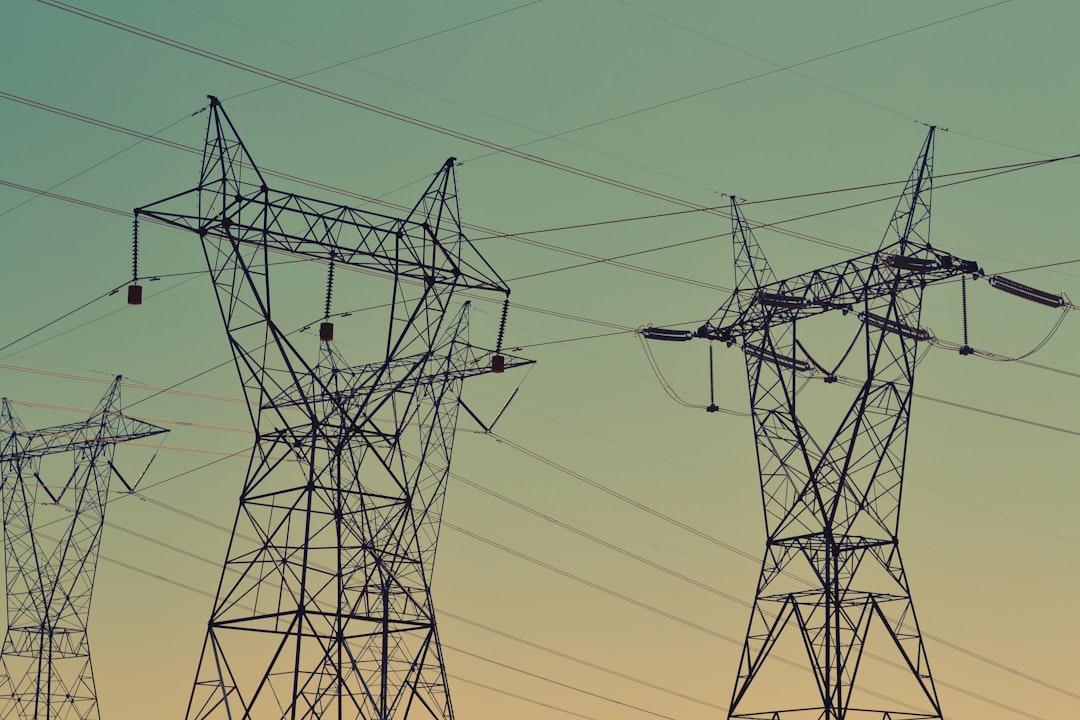
What Is a Water Power Dam and How Does It Generate Electricity?
A water power dam is a structure that captures the energy of moving or stored water and converts it into electricity — and it remains one of the most powerful and reliable sources of clean energy on the planet.
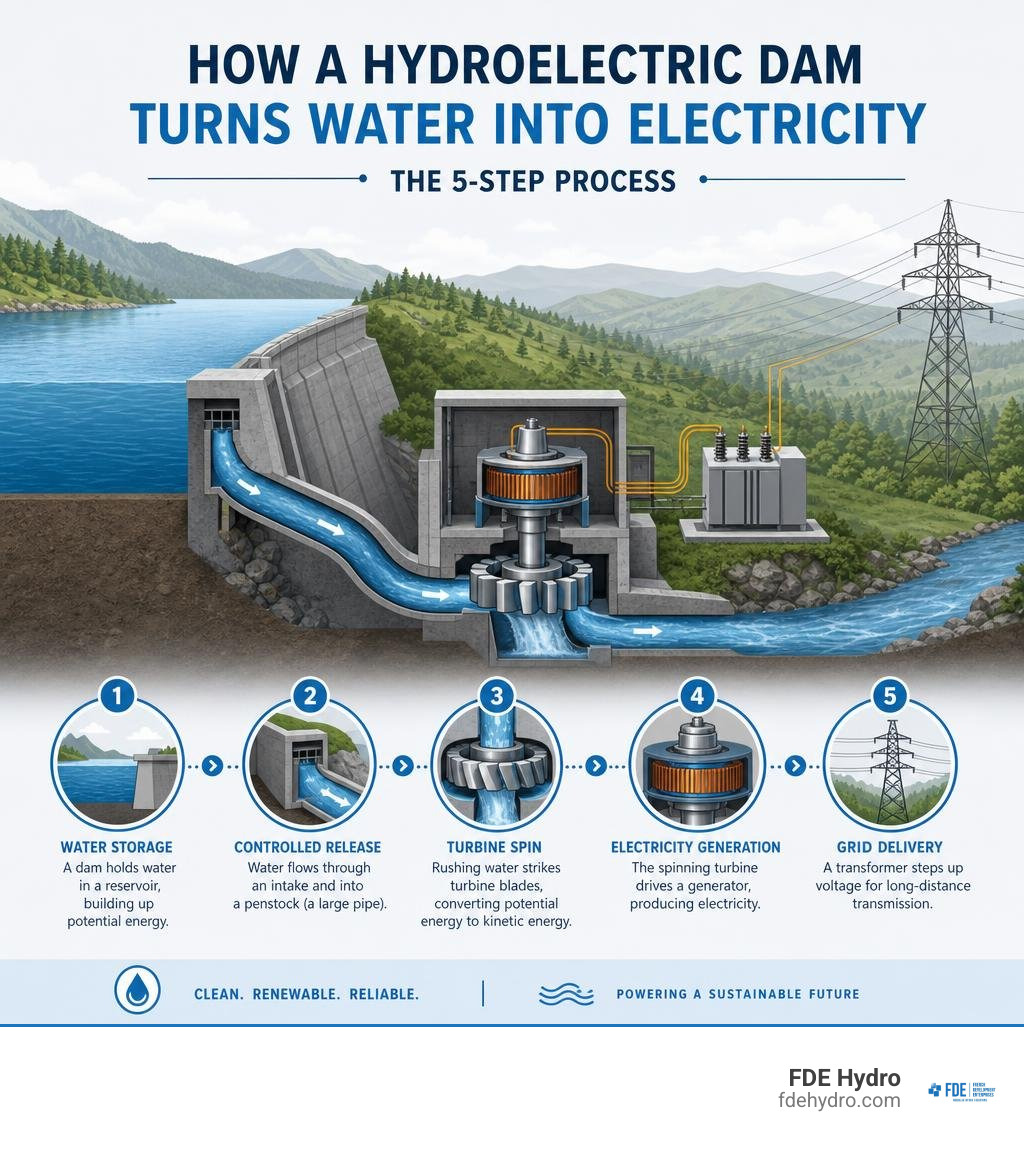
Here’s how it works at a glance:
Step
What Happens
1. Water storage
A dam holds water in a reservoir, building up potential energy
2. Controlled release
Water flows through an intake and into a penstock (a large pipe)
3. Turbine spin
Rushing water strikes turbine blades, converting potential energy to kinetic energy
4. Electricity generation
The spinning turbine drives a generator, producing electricity
5. Grid delivery
A transformer steps up voltage for long-distance transmission
Hydropower isn’t a niche technology. It supplies roughly 15% of the world’s electricity — nearly 4,210 TWh generated in 2023 alone. That’s more than all other renewable energy sources combined, and more than nuclear power.
Yet despite its scale, many people don’t fully understand how these systems work, what types exist, or what trade-offs they involve — especially for the engineers and project developers making billion-dollar infrastructure decisions.
This guide covers all of it: how dams generate power, the different facility types, the history, the advantages and risks, and where hydropower fits in the future of clean energy.
I’m Bill French, Sr., Founder and CEO of FDE Hydro™ and a longtime heavy civil construction executive with five decades of experience in large-scale infrastructure — including direct work with the U.S. Department of Energy’s Water Power Technology Office on next-generation water power dam solutions. My goal here is to give you a clear, practical, and honest picture of how hydroelectric power works and where the industry is headed.
To understand the sheer power of a water power dam, we have to look at the physics of water. It all comes down to two fundamental concepts: potential energy and kinetic energy.
When water is held back by a dam in a high-elevation reservoir, it accumulates massive amounts of gravitational potential energy. The higher the water level (known in the industry as the “head”), the more potential energy is stored. When we open the gates, gravity pulls that water downward, converting that potential energy into kinetic energy—the physical energy of motion.
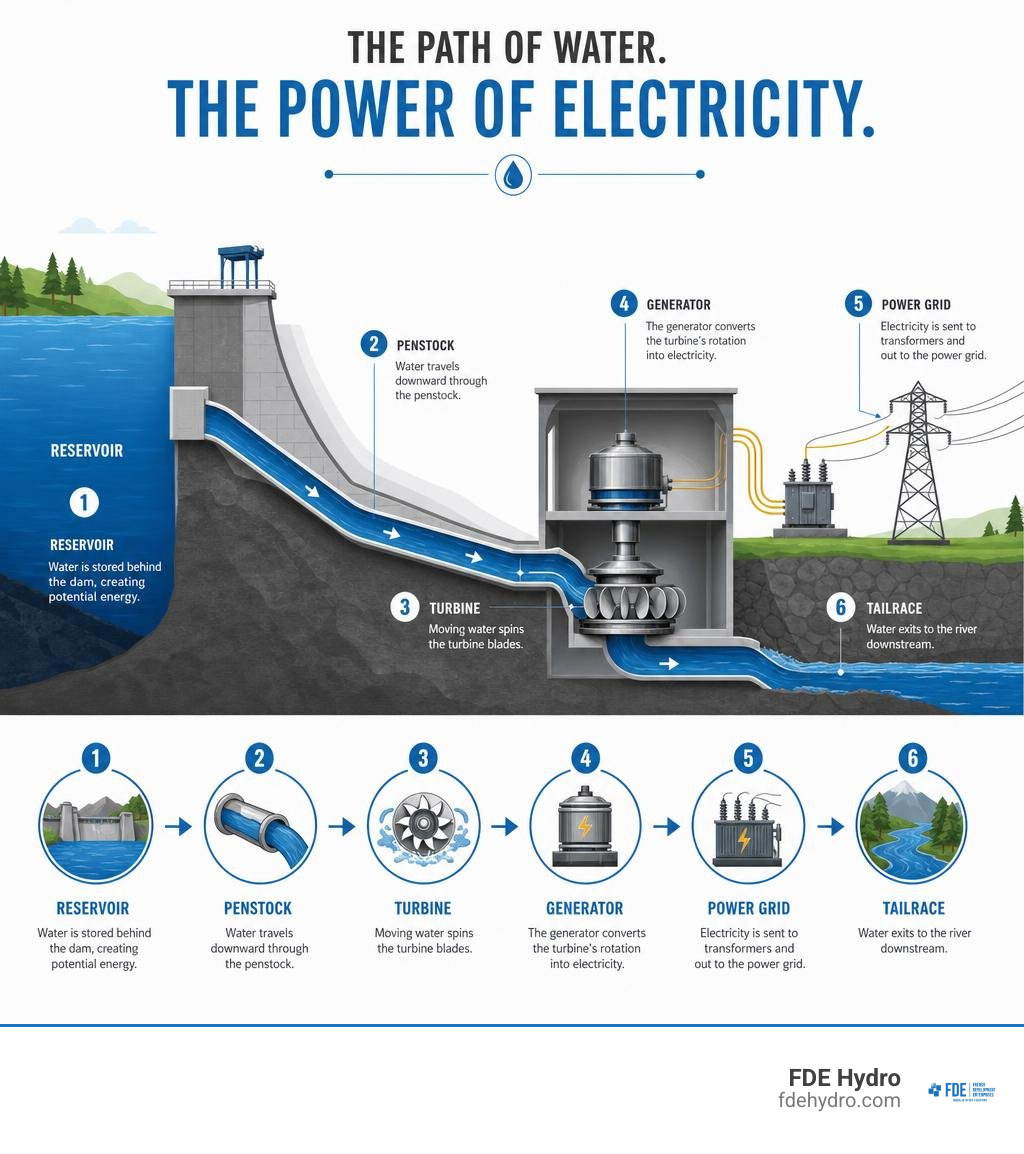
The physical journey from a quiet reservoir to a glowing lightbulb in your living room is a marvel of engineering:
The Intake and Penstock: Water is released from the reservoir through control gates. It enters the penstock, a massive, heavy-duty steel or concrete pipe. The penstock narrows as it travels downward, which increases the pressure and velocity of the water.
The Turbine: At the bottom of the penstock, the high-pressure water strikes the blades of a water turbine. This causes the turbine runner to spin rapidly. This is where kinetic energy is converted into mechanical energy.
The Generator: The spinning turbine is connected to a generator by a heavy steel shaft. Inside the generator, powerful magnets spin inside copper coils. This motion triggers electromagnetic induction, generating an alternating electrical current (AC).
The Transformer and Transmission Lines: The electricity generated is usually around 13,800 volts. To travel long distances without losing too much energy, a transformer steps up this voltage to hundreds of thousands of volts. It then flows onto high-voltage transmission lines and out to the electrical grid.
Key Structural Components of a Hydro Dam
Every water power dam relies on a precise configuration of civil engineering structures to operate safely and efficiently. If you are interested in how these structures are planned and built, our Hydroelectric Dam Design: Complete Guide covers the engineering in detail.
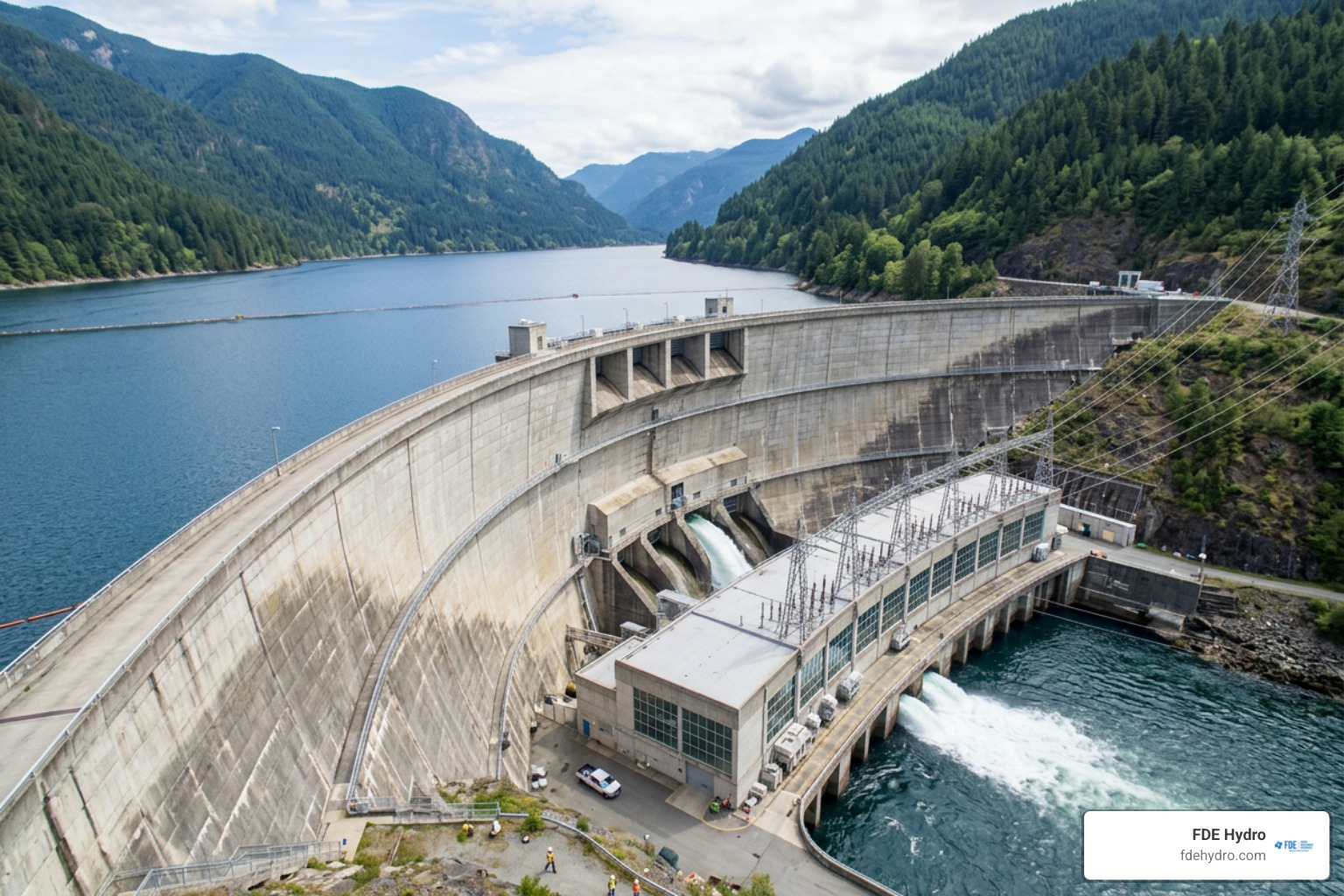
The Spillway: Think of the spillway as the dam’s safety valve. When heavy rains or rapid snowmelt fill the reservoir to capacity, we cannot let water run over the top of a non-overflow dam section, as this can cause catastrophic structural failure. The spillway safely routes excess water downstream, bypassing the powerhouse.
The Powerhouse: This is the concrete and steel building that houses the heavy machinery, including the turbines, generators, governors, and control systems.
The Forebay: This is the basin located immediately upstream of the water intake structures. It acts as a buffer zone, smoothing out the flow of water before it enters the penstocks.
Intake Gates: These heavy, adjustable gates control the volume of water entering the penstocks. They can be shut down quickly in the event of an emergency or during routine maintenance.
Types of Hydropower Facilities and How They Differ
Not every water power dam looks or functions the same way. Hydropower facilities are generally classified into three major types based on how they store and manage water.
The Impoundment Facility: The Classic Water Power Dam
The impoundment facility is what most people picture when they hear the word “dam.” It uses a large structural barrier to block a river, creating an artificial reservoir behind it.
These conventional dams allow operators to store water and release it on demand. This provides incredible control over electricity generation, allowing the plant to respond to sudden spikes in power demand.
A prime example in the United States is the iconic Grand Coulee Dam on the Columbia River in Washington State. Boasting an installed capacity of 6,809 MW, it is the largest hydropower producer in the country. To explore its immense scale, take a look at the official Grand Coulee Dam Statistics and Facts .
Run-of-the-River and Diversion Systems
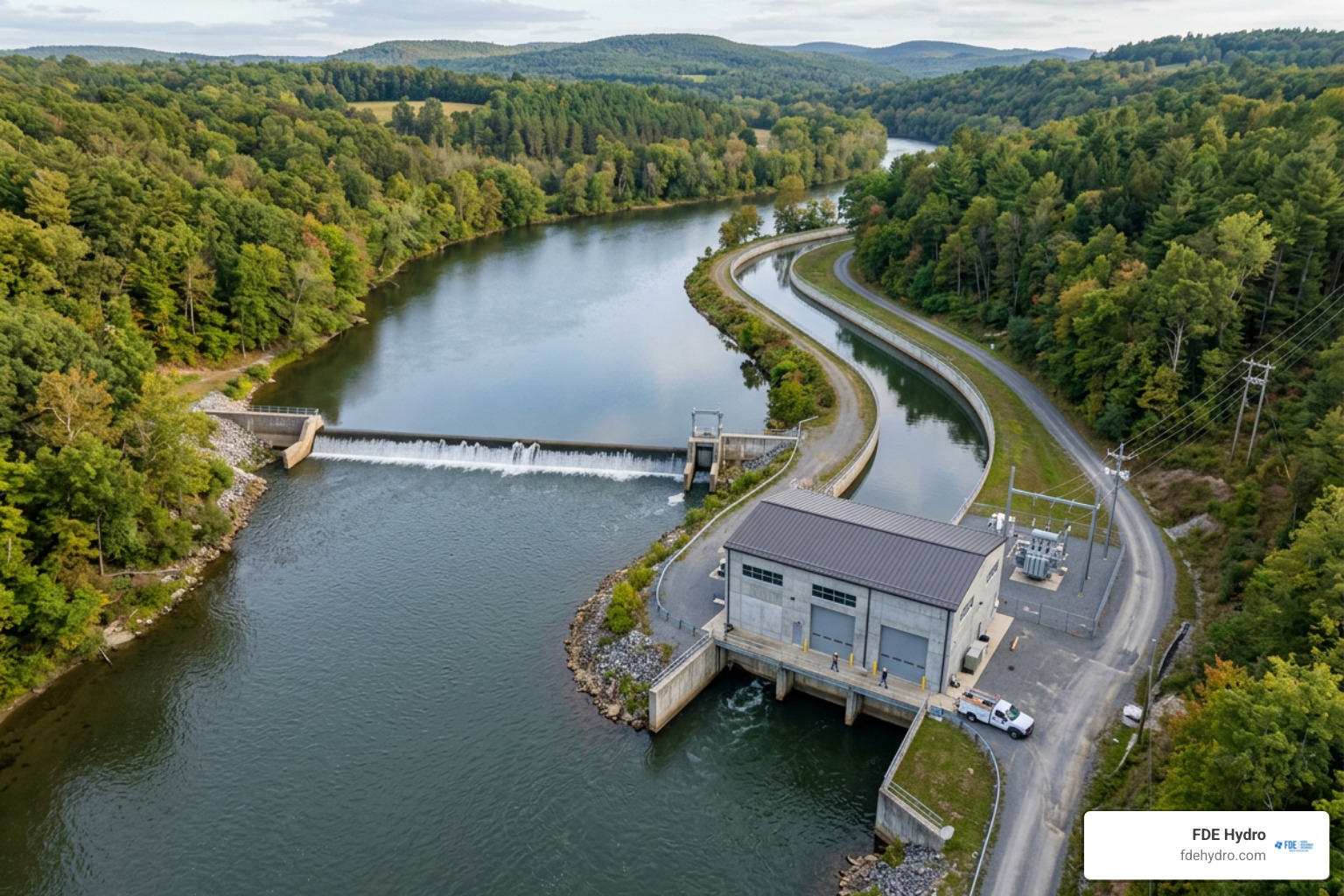
Run-of-the-river (sometimes called diversion) systems take a completely different approach. Instead of building a massive wall to create a reservoir, these systems use the natural flow of the river.
A portion of the river’s water is diverted through a canal or penstock, directed through a low-head turbine, and then returned immediately downstream to the main river channel. Because they have minimal or no water storage, run-of-the-river plants are highly dependent on seasonal river flows. They are often preferred for smaller projects due to their lower environmental footprint. To learn more about how these low-impact systems function, read All About Hydro Dams.
Pumped-Storage Hydropower: The Grid’s Giant Battery
Think of pumped-storage hydropower as a giant, water-based battery. These facilities feature two reservoirs at different elevations: an upper reservoir and a lower reservoir.
During low-demand periods (e.g., at night): The facility uses cheap, surplus electricity from the grid (or from wind and solar) to pump water from the lower reservoir up to the upper reservoir.
During peak-demand periods (e.g., hot summer afternoons): The water is released from the upper reservoir back down to the lower reservoir, spinning reversible turbines to generate electricity when the grid needs it most.
Pumped-storage schemes are incredibly efficient and provided almost 85% of the world’s 190 GW of grid energy storage in 2021. They are essential for grid stability as we integrate more intermittent renewable energy. To see how these systems are reshaping our energy future, explore our Beginners Guide to Hydroelectric Power Dams.
The Historical Evolution of Hydropower
Humans have been capturing the energy of moving water for thousands of years. Long before we used it to light up our cities, water was the driving force behind early industrialization.
Some of the earliest water-power innovations were conceived in China during the Han Dynasty (between 202 BC and 9 AD), where water wheels were used to grind grain and power trip hammers. By the time of the Industrial Revolution, water wheels had become highly sophisticated.
In 1771, Richard Arkwright built the Cromford Mill in England, utilizing water power for cotton spinning. This project created one of the world’s first factory systems, proving that water could drive mechanical energy on an industrial scale.
The Birth of Hydroelectricity
The transition from mechanical water power to electricity occurred in the late 19th century.
1878: Hydropower was first used to generate electricity at Cragside House in Northumberland, England, where it powered a single arc lamp.
1882: The Vulcan Street Plant in Appleton, Wisconsin, began operating on the Fox River. It was the first commercial hydroelectric plant in the United States, generating 12.5 kW of power.
The late 19th and early 20th centuries saw rapid leaps in turbine technology. Engineers developed specialized turbines for different water conditions:
The Francis Turbine (1849): Developed by James Francis, this remains the most widely used water turbine in the world today for medium-head applications.
The Pelton Wheel (1880): Invented by Lester Pelton, this impulse turbine is ideal for high-head, low-flow operations.
The Kaplan Turbine (1913): Invented by Viktor Kaplan, this propeller-like turbine is perfect for low-head, high-flow conditions.
The Era of Mega-Dams
The mid-20th century ushered in the era of mega-dams, driven by massive public works projects in North and South America. In the United States, the construction of the Hoover Dam in the 1930s showed that we could tame wild rivers to provide both irrigation and massive amounts of electricity.
Decades later, in 1984, the massive Itaipu Dam opened on the Paraná River between Brazil and Paraguay. Generating 14 GW of power from 20 massive turbines, it was recognized as one of the Seven Wonders of the Modern World. You can read more about its history and engineering marvels on the Itaipu Dam – Wikipedia page or explore the official corporate history in the ITAIPUMAGAZINEENGLISH_LR .
The Pros and Cons of Hydroelectric Power
Like any energy source, hydroelectric power comes with trade-offs. To build a reliable and clean grid, we must weigh these advantages against their environmental and social costs.
For a deeper dive into these trade-offs, explore our guide on Hydro-Electric Dams.
Advantages: Flexibility, Low Cost, and Grid Stability
Hydropower offers several unique benefits that wind and solar simply cannot match:
Incredible Flexibility: Hydroelectric turbines can go from completely cold to full power in just a few minutes. This rapid response time is critical for providing peaking power when demand suddenly spikes.
Black Start Capability: If the electrical grid suffers a total blackout, most thermal power plants (coal, gas, nuclear) need external power to restart. Hydro plants can start up using only the gravity of their own water, helping to jumpstart the rest of the grid.
Low Operating Costs: While the upfront cost of building a water power dam is high, the “fuel” (water) is free. These plants have incredibly low operating and maintenance costs, and many remain operational for over a century with periodic retrofits.
Multipurpose Benefits: Hydro reservoirs do more than just make electricity. They provide critical flood control, reliable agricultural irrigation, municipal water supplies, and recreational opportunities.
Environmental Challenges of the Water Power Dam
Despite being a clean, low-carbon energy source, large-scale dams can have a significant impact on local ecosystems:
Ecosystem Disruption & Fish Migration: Building a physical barrier blocks migratory fish species, like salmon, from reaching their upstream spawning grounds. It also alters water temperatures and oxygen levels downstream, impacting aquatic life.
Siltation & Sediment Trapping: Rivers naturally carry nutrient-rich sediment. When we dam a river, that sediment settles at the bottom of the reservoir instead of flowing downstream to nourish deltas and agricultural lands.
Reservoir Methane Emissions: When a new reservoir is flooded, the submerged vegetation and organic matter rot underwater. In warm climates, this anaerobic decomposition can release significant amounts of greenhouse gases, particularly methane, into the atmosphere.
Population Displacement: Creating massive reservoirs requires flooding vast areas of land. Historically, this has led to the forced relocation of local communities and indigenous populations, along with the loss of valuable historical and cultural sites.
Global Capacity and Comparison with Other Energy Sources
Hydropower remains the bedrock of global renewable energy. Let’s look at how it shapes up on the world stage and how it compares to other power generation technologies.
Hydropower on the Global Stage
Globally, installed hydropower capacity reached nearly 1,400 GW in 2021. Today, a handful of nations dominate global production, with China leading the charge (accounting for nearly 30% of global output), followed by Brazil (10%), Canada (9.2%), and the United States (5.8%).
In terms of energy storage, conventional reservoirs are unmatched. The International Energy Agency (IEA) estimated that the reservoirs of all existing conventional hydropower plants combined can store a total of 1,500 TWh of electrical energy in one full cycle. That is about 170 times more energy than the entire global fleet of pumped-storage plants.
How Hydropower Compares to Wind, Solar, and Nuclear
To understand where a water power dam fits into our energy mix, it helps to compare it directly to other major generation sources:
Technology
Capacity Factor
Dispatchability
Capital Cost
Carbon Footprint
Hydropower
High (40% – 60%)
Fully Dispatchable
Very High
Very Low
Wind Power
Moderate (30% – 45%)
Intermittent
Moderate
Very Low
Solar Power
Low (15% – 25%)
Intermittent
Low
Very Low
Nuclear Power
Very High (90%+)
Base Load
Extremely High
Very Low
While solar and wind have lower capital costs and faster installation times, they are intermittent. Hydropower and nuclear provide the reliable, dispatchable power needed to keep the grid steady when the wind isn’t blowing and the sun isn’t shining.
Climate Change, Reliability, and Safety Risks
As our climate changes, we are seeing more extreme weather. This presents new challenges for managing water resources and keeping dams running safely.
For more on how modern dams manage extreme weather and high water events, read about Dam Flood Control.
Drought, Siltation, and Changing Weather Patterns
Because hydropower relies entirely on the water cycle, its output is highly sensitive to changes in precipitation.
Droughts: Prolonged dry spells can severely reduce river flows and reservoir levels, forcing plants to run at reduced capacity. In places like California, seasonal droughts can lead to major swings in annual hydro generation. To see how these dynamics play out locally, check out the Hydroelectric Power – California Energy Commission – CA.gov reports.
Siltation: Over time, reservoirs naturally collect silt and sediment. This reduces their active water storage capacity, which limits both power generation and flood control capabilities. Regular dredging is often required to keep these systems clean and operating efficiently.
Dam Safety, Failure Risks, and Mitigation
Dams are massive structures holding back billions of gallons of water. A structural failure can have devastating consequences for downstream communities.
The historical benchmark for dam failures is the Banqiao Dam disaster in China in 1975, where a catastrophic typhoon caused a series of dam failures that led to immense loss of life.
Today, dam safety is highly regulated. Operators use advanced structural monitoring tools, including seismic sensors, tiltmeters, and automated piezometers, to spot tiny shifts in the structure long before they become dangerous. Spillways are also designed to handle “Probable Maximum Flood” events to prevent overtopping.
Integrating Hydro with Wind and Solar
To build a reliable, zero-carbon grid, we need to combine different renewable technologies. Hydropower is the perfect partner for wind and solar.
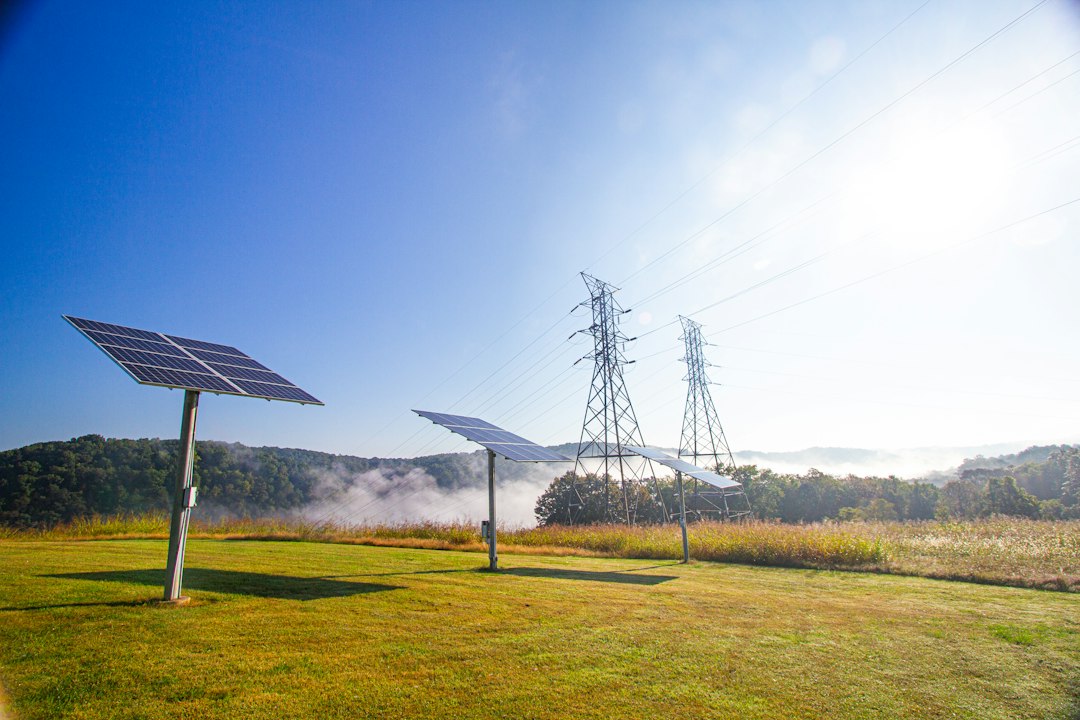
When wind and solar produce excess power during sunny or windy days, we can throttle back our hydro dams, conserving water in the reservoirs. When the sun sets or the wind dies down, we can quickly open the hydro gates to fill the gap. This hybrid approach turns our water reservoirs into virtual batteries, smoothing out the natural ups and downs of wind and solar power.
Frequently Asked Questions about Hydroelectric Dams
How does a water power dam generate electricity?
A dam stores water in a reservoir to build up gravitational potential energy. When released, this water flows down through a penstock and spins a turbine. The spinning turbine drives a generator, which uses electromagnetic induction to convert that mechanical movement into electricity.
What is the difference between conventional and pumped-storage dams?
Conventional dams use a one-way flow of water, capturing the natural downstream run of a river to generate electricity. Pumped-storage dams use a two-reservoir system (upper and lower) and reversible pump-turbines. They act like a giant battery, pumping water uphill when electricity is cheap and releasing it to generate power when demand is high.
What are the main environmental impacts of large dams?
Large dams can block fish migration, alter water temperatures, and disrupt downstream river ecosystems. Reservoirs also trap sediment that would naturally nourish downstream habitats. Additionally, flooding large areas of land can displace local populations and release methane as submerged vegetation decays.
Conclusion
The water power dam remains one of our most reliable tools for generating clean, dispatchable, and renewable energy. As we work to phase out fossil fuels, the flexibility and storage capacity of hydropower will only become more critical for keeping our electric grids stable.
However, building traditional, massive concrete dams is incredibly expensive, takes years of permitting, and can cause significant environmental disruption. The future of hydropower lies in smarter, low-impact, and highly efficient technologies.
At FDE Hydro™, we are leading this transition. We develop innovative, patented modular precast concrete technology—known as the French Dam—designed for building and retrofitting hydroelectric dams and water control systems. By moving construction from the riverbed to a controlled precast facility, we significantly reduce construction costs, minimize environmental footprints, and cut project timelines across the United States, Canada, Brazil, and Europe.
What You Need to Know About Selling Electricity to the Grid
Selling electricity to the grid means sending surplus power from your home renewable energy system — such as solar panels, wind turbines, or hydro — back into the utility network in exchange for billing credits or cash payments.
Here is a quick overview of how it works and what to expect:
Method
Who It’s For
How You Get Paid
Net Metering
Homeowners with solar/renewables
Billing credits at retail rate
Feed-in Tariff (FiT)
Residential & small commercial generators
Fixed rate per kWh exported
Smart Export Guarantee (SEG)
UK households
Variable cash rate per kWh
Clean Export Guarantee (CEG)
Irish households
Supplier-set rate per kWh
Power Purchase Agreement (PPA)
Larger generators
Negotiated price per kWh
Wholesale Market
Licensed generators only
Hourly auction clearing price
A few things to know upfront:
Most homeowners do not receive direct cash — they get billing credits that reduce future electricity bills.
Over 35 U.S. states have net metering programs, making it the most common route for residential producers.
Export rates are almost always lower than what you pay to buy electricity — often 3–12¢/kWh compared to retail rates of 30–50¢/kWh.
The biggest financial win for most households is using your own generated power first, not exporting it.
Understanding these basics upfront will save you from overestimating what you can earn — and help you make smarter decisions about your system.
I’m Bill French, Sr., Founder and CEO of FDE Hydro™, with decades of experience in large-scale civil infrastructure and clean energy development, including projects that touch on the economics of selling electricity to the grid through hydropower generation. In the guide below, I’ll walk you through the key mechanisms, regional rules, and practical steps to start earning from your home’s renewable energy.
FDE Hydro is Bringing Predictability to an Unpredictable Environment™
Quick selling electricity to the grid definitions:
Understanding the Mechanics of Selling Electricity to the Grid
When we talk about sending electricity back to the grid, we are exploring a bidirectional relationship with our local utilities. Historically, the electrical grid was designed as a one-way street: massive power plants generated electricity, and it traveled down high-voltage lines to our homes. Today, the rise of distributed energy resources—like rooftop solar panels, residential wind turbines, and small-scale micro-hydro systems—has turned millions of everyday consumers into “prosumers.”
To understand this dynamic, we must look at how power physically flows. When your home generation system produces more electricity than your household appliances are consuming at any given moment, the excess energy has to go somewhere. If you do not have a battery storage system to hold it, that power flows backward through your electrical panel, out through your utility meter, and onto the local distribution lines to be consumed by your nearest neighbors.
How Net Metering Facilitates Selling Electricity to the Grid
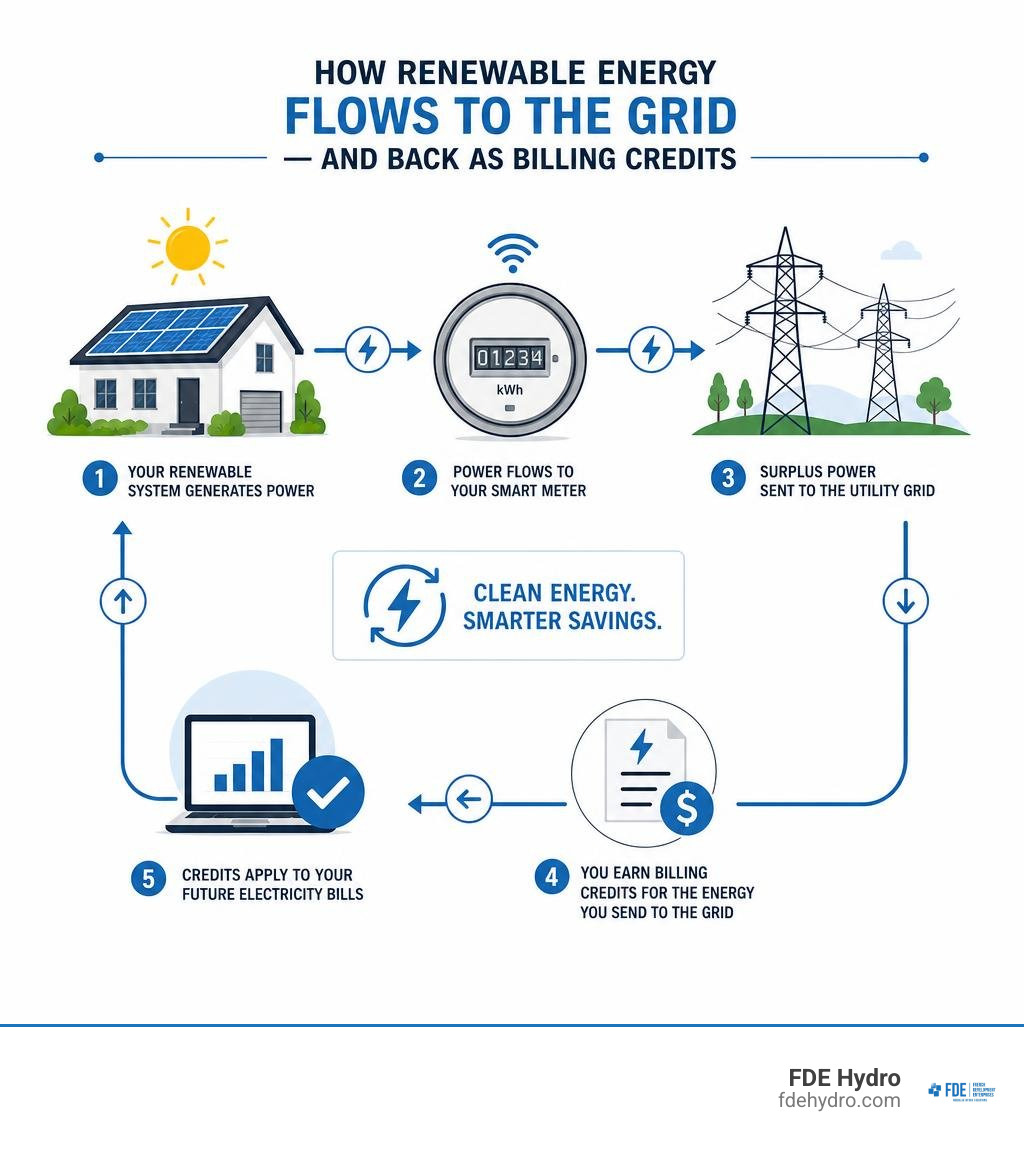
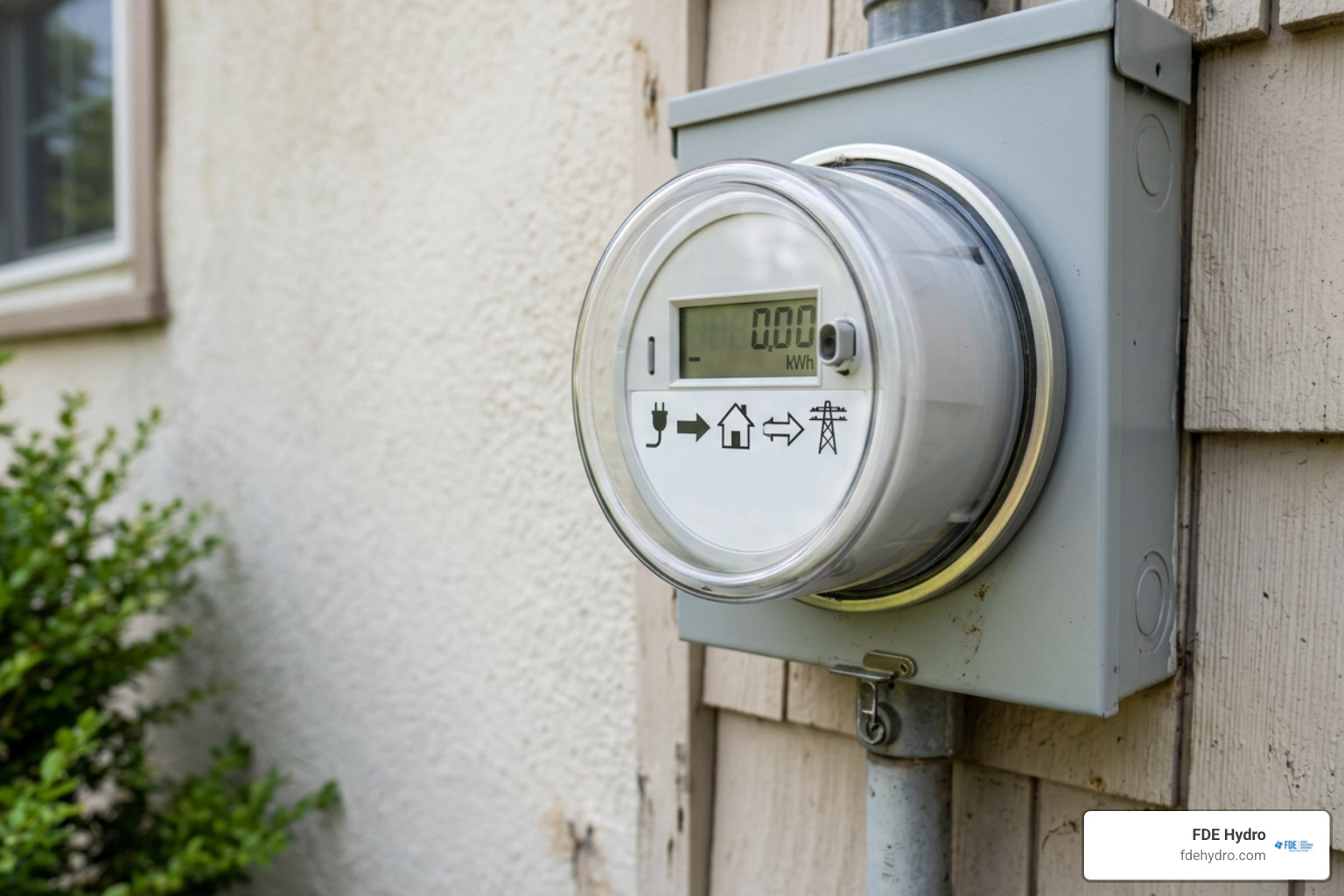
The most common policy mechanism for residential generators in North America is net metering. Under a net metering program, your utility installs a bidirectional smart meter. This meter acts like a two-way scale, measuring both the electricity you pull from the grid when your system isn’t producing enough (such as at night) and the electricity you push back onto the grid when you have a surplus.
At the end of your billing cycle, the utility calculates your “net” usage:
If you exported more than you consumed, you receive billing credits on your account. In many jurisdictions, these credits are applied at the full retail rate of electricity. This means a kilowatt-hour (kWh) exported during the sunny afternoon offsets a kWh imported during the expensive evening peak.
However, policies vary widely by state and province. For example, if you are looking at the Great Plains region of the United States, you will find specific guidelines governing how these credits are calculated and rolled over. You can read up on the exact regulatory landscape by exploring Net Metering in Kansas.
Direct Cash Payments vs. Billing Credits
It is vital to distinguish between earning billing credits and receiving direct cash payments. For the vast majority of residential homeowners, selling electricity to the grid does not result in a monthly check arriving in the mail. Instead, your utility account accrues credits that roll over to the next month, helping to offset future utility bills during seasons with lower generation.
Direct cash payments are typically reserved for specific commercial setups, wholesale generators, or regions with active Feed-in Tariff (FiT) programs. In a direct payment model, you are paid a designated rate for every single kWh your system exports, regardless of how much electricity you import.
These programs are highly regulated to ensure grid stability and fair compensation. To see how these rules are structured in neighboring regions, you can consult the Net metering guide from Ontario Energy Board to see how Canadian regulators balance consumer benefits with utility infrastructure costs.
Compensation Models: Feed-in Tariffs, SEGs, and RECs
Depending on where you live across our operating regions in North America and Europe, the financial incentives and structural programs for exporting green energy look quite different.
Before you install any system, you must understand the exact program your local utility offers. If you are starting from scratch, it helps to understand the physical connection requirements first; you can read our guide on How to connect your home to the grid to get a handle on the hardware side of things.
Regional Tariff Structures and the Smart Export Guarantee
In Europe, the regulatory framework has shifted away from older, government-subsidized Feed-in Tariffs toward market-driven compensation models.
The United Kingdom: The UK operates under the Smart Export Guarantee (SEG). Under this scheme, licensed energy suppliers with over 150,000 customers are legally required to offer export tariffs to home generators. These rates are variable and market-competitive, typically ranging between 3p and 12p per kWh.
Ireland: Irish homeowners benefit from the Clean Export Guarantee (CEG) scheme. Similar to the SEG, the CEG allows micro-generators to receive competitive payments or billing credits from their chosen retail electricity supplier for any surplus green electricity sent to the national grid. For a comprehensive look at how this operates in the Irish market, check out the detailed guide: Can I Sell Electricity Back to the National Grid in Ireland?.
Renewable Energy Certificates (RECs) and Power Purchase Agreements
For larger residential systems, agricultural properties, or commercial operations, compensation often moves beyond simple billing credits into the realm of Renewable Energy Certificates (RECs) and Power Purchase Agreements (PPAs).
A Renewable Energy Certificate represents the environmental attributes of one megawatt-hour (MWh) of electricity generated from a renewable source. In some states and provinces, you can sell these certificates on open markets to utilities that need them to meet their regulatory green energy quotas. This acts as an entirely separate stream of income alongside your standard utility credits, often yielding an additional $0.04 to $0.08 per kWh.
For commercial-scale developers or community energy projects, a Power Purchase Agreement (PPA) is the standard contract vehicle. A PPA is a long-term contract between an electricity generator (you) and a buyer (typically a utility or a large corporation). This agreement defines the fixed price at which the buyer will purchase the generated electricity over a period of 5 to 20 years.
While the financial rewards of selling electricity to the grid are attractive, we must remember that the physical grid is a highly complex machine. Grid operators must constantly balance supply and demand in real time to maintain a stable frequency and voltage.
As more homes install renewable systems, local low-voltage networks can experience congestion, leading to strict technical rules for new connections. To understand how your home’s system interacts with these localized lines, you can Explore the low voltage grid.
Interconnection Processes and Export Limits
Before you can legally flip the switch on a grid-tied renewable energy system, you must go through an official interconnection process with your local distribution utility. This process ensures that your system will not backfeed power onto the lines during a blackout, which would pose a fatal hazard to utility line workers.
During this review, the utility may conduct an interconnection study to determine if your local substation and transformer can handle the maximum potential output of your system. Depending on the local infrastructure, the utility may impose strict export limits:
Single-Phase Connections: Standard residential connections are single-phase. In many congested suburban networks, utilities cap exports on single-phase connections to a maximum of 5 kW to prevent local voltage spikes.
Three-Phase Connections: Larger properties with three-phase connections may be allowed higher export limits (often up to 11 kW or more), but these installations require more expensive inverters and grid-protection equipment.
To participate in any export program, your standard electricity meter must be upgraded. Modern bidirectional smart meters record import and export data in half-hourly intervals.
In the UK, this setup requires the creation of an Export Meter Point Administration Number (MPAN) by your local Distribution Network Operator (DNO). Without this unique identifier, your supplier cannot legally track or credit your exports, even if your physical system is already pushing power back onto the lines.
Maximizing Value: Self-Consumption, Batteries, and VPPs
As utility companies adjust to the massive influx of daytime solar energy, export tariff rates have steadily declined. In many areas, we are seeing the introduction of “two-way pricing” or “sun taxes,” where customers are actually charged a small fee for exporting power during peak midday hours when the grid is already flooded with solar energy.
Because of this, the economic focus has shifted from maximizing grid exports to maximizing self-consumption. To see how advanced systems manage this balance, read about Optimizing microgrid operations.
Self-Consumption vs. Exporting to the Grid
The golden rule of modern home energy economics is simple: a kilowatt-hour saved is worth far more than a kilowatt-hour sold.
When you use a unit of electricity generated by your own rooftop solar panels or micro-hydro system, you are offsetting a unit of electricity you would have otherwise bought at the full retail rate (e.g., 35¢/kWh). If you export that same unit to the grid, you might only receive a feed-in credit of 5¢/kWh.
High (Can cause localized voltage rise during peak sun)
Best Strategy
Run heavy appliances (washers, EV chargers) during peak generation
Limit daytime export; store surplus in a home battery
By shifting your heavy energy usage—such as running heat pumps, pool pumps, washing machines, or electric vehicle chargers—to the middle of the day when your system is producing peak power, you drastically improve your financial payback period.
How Batteries and VPPs Change the Economics
Adding a home battery storage system allows you to capture your daytime surplus and store it for use during the expensive evening hours, rather than exporting it for pennies.
Furthermore, smart battery systems allow you to participate in Virtual Power Plants (VPPs). A VPP is a network of decentralized home energy storage systems grouped together by a software provider. When the main electrical grid experiences extreme demand, the VPP operator can coordinate thousands of home batteries to discharge simultaneously back into the grid.
In exchange for helping to stabilize the grid during these critical hours, VPP participants are compensated at premium incentive rates—sometimes up to several dollars per kWh during peak events. In the United States, regulatory milestones like FERC Order 841 have paved the way for small battery storage systems to access these wholesale markets, completely changing the return-on-investment calculations for home energy storage.
Practical Steps to Begin Exporting Power
If you are ready to stop simply consuming energy and start selling electricity to the grid, you need to follow a structured roadmap.
Rushing into an installation without securing the proper utility approvals can result in expensive fines, or worse, an expensive system that you are legally forbidden to turn on.
Sizing and Installing Your Renewable Energy System
Your first step is to design a system that fits your historical energy usage. Sizing a system too large can be a financial mistake because most utilities will not pay you retail rates for generation that exceeds your annual historical consumption.
To ensure your system qualifies for export incentives:
Choose Accredited Installers: In the UK, your system and installer must be certified under the Microgeneration Certification Scheme (MCS). In Ireland and North America, similar national or state-level licensing is required.
Review Local Micro-generation Guidelines: Every country has strict thresholds for what qualifies as “micro-generation” (usually systems under 6 kW for single-phase lines). For European and Irish standards, read the official Micro-generation guidelines to ensure compliance.
Step-by-Step Guide to Selling Electricity to the Grid
Once your system is designed and your installer is selected, follow these steps to get paid:
Submit Connection Notification: Your installer must notify your local Distribution Network Operator (DNO) or utility. In Ireland, this is done via an NC6 form for small systems.
Install a Bidirectional Smart Meter: If you do not have one, your utility will install a meter capable of tracking dual-directional flows.
Obtain Your Export MPAN / Registration: Your utility will register your export connection point and issue a unique identifier.
Choose and Activate an Export Tariff: Contact an energy supplier to enroll in their export program. You do not always have to use the same supplier for both import and export, allowing you to shop around for the best export rate. For an example of an independent supplier offering competitive rates, check out the 100Green Home Generation Export Tariff.
Monitor Your First Bill: Ensure the export credits are actively appearing on your monthly statements.
Frequently Asked Questions about Home Energy Sales
Is selling electricity to the grid profitable for average homeowners?
For the average homeowner, selling electricity to the grid is highly effective at offsetting your monthly utility costs, but it is rarely a path to direct wealth. Because export rates (3–12¢/kWh) are significantly lower than retail import rates (30–50¢/kWh), the primary financial benefit comes from avoiding retail purchases through self-consumption.
With an average residential solar installation costing between $11,000 and $15,000, most homeowners see a complete payback on their investment in about 8 to 10 years (around 100 months), after which the system generates pure savings.
Do I need a battery storage system to sell electricity to the grid?
No, you do not need a battery to export power. Any surplus energy your system generates will automatically flow back onto the grid through your bidirectional meter. However, without a battery, you are forced to export your excess power during the day when export rates are at their lowest. A battery gives you the flexibility to store that power and either use it yourself at night or export it during high-value peak demand windows via a VPP.
How long does it take to set up grid export payments?
The administrative setup typically takes between 4 to 8 weeks. While the physical installation of solar panels or a micro-hydro system might only take a few days, waiting for your local utility to process the interconnection paperwork, issue an export MPAN, and approve the bidirectional meter swap accounts for the majority of the timeline.
Conclusion
Selling electricity to the grid is a fantastic way to lower your carbon footprint, support local grid stability, and dramatically slash your monthly energy bills. However, navigating the complex world of net metering, export tariffs, and utility interconnection rules requires careful planning and realistic expectations.
At FDE Hydro™, we understand the immense value of predictable, reliable renewable energy. While we specialize in developing innovative, patented modular precast concrete technology (“French Dam”) to make utility-scale hydroelectric projects more efficient and cost-effective across North America, Europe, and Brazil, we believe that every step toward a decentralized, bidirectional grid is a step toward a sustainable future.
If you want to keep learning about how the modern electrical network is evolving to handle clean energy, Explore more power grid articles on our site today.
FDE Hydro is Bringing Predictability to an Unpredictable Environment™
What “Off-Grid Electricity” Really Means — And Why It Matters
Understanding the off grid electricity meaning starts with one simple idea: your building produces and stores its own power, with no physical connection to a public utility grid.
Off-grid electricity means generating, storing, and using electricity entirely on-site — independently of any centralized utility network.
Here’s a quick breakdown:
Off-grid = completely disconnected from the public electricity grid
Power source = solar panels, wind turbines, micro-hydro, or a combination
Storage = battery banks that supply power when generation is low
Result = no utility bills, no grid dependence, and no outage risk from the wider network
This is different from simply having solar panels. Most homes with rooftop solar are still connected to the grid. True off-grid means cutting that connection entirely — and relying 100% on what you generate and store yourself.
That distinction matters more than ever. As of 2016, roughly 20% of people worldwide had no access to centralized electricity. And closing that gap is projected to require $17 trillion and 30 years. For remote communities, off-grid systems aren’t a lifestyle choice — they’re often the only practical option.
I’m Bill French, Sr., Founder and CEO of FDE Hydro™, and for over five decades I’ve worked at the intersection of heavy civil construction and innovative energy infrastructure — experience that gives me a grounded, real-world perspective on the off grid electricity meaning and what it takes to deliver reliable power outside the grid. In the sections ahead, I’ll walk you through everything you need to know, from core concepts and system components to costs, sizing, and long-term sustainability.
Defining the Off Grid Electricity Meaning and Core Concepts
To truly grasp the off grid electricity meaning, we have to look at the physical reality of how power is delivered. When a home is connected to the municipal system, it relies on transmission lines, substations, and large-scale power plants. Going off-the-grid means physically severing that umbilical cord.
In business and legal terms, as outlined by resources like the Cambridge Dictionary, being off-grid means operating without a connection to main utility services. This isn’t just a conceptual state of mind; it is a physical and engineering reality. If there are no wires running from the utility pole to your meter box, you are running a stand-alone system.
Historically, remote electrification was the primary driver for these systems. For example, Canada has about 175 aboriginal and northern off-grid communities. In these vast, remote territories, extending the centralized grid is physically and financially impractical. Instead, these areas rely on decentralized power systems. Whether it is a single cabin in the Catskills of New York or an entire rural community in northern Canada, stand-alone systems provide the localized generation required to sustain modern life.
What is the Off Grid Electricity Meaning?
At its core, the off grid electricity meaning is defined by complete self-sufficiency. According to The Free Dictionary, living off the grid involves disconnecting from public utilities, which includes electricity, water, and gas.
When we talk specifically about electricity, going off-grid means your home or business functions as its own utility company. You are responsible for:
Generation: Producing every single watt of power you consume.
Regulation: Ensuring the voltage and frequency of the electricity won’t fry your appliances.
Storage: Saving excess daytime or seasonal energy to use during the night or during prolonged storms.
Maintenance: Troubleshooting, repairing, and replacing components when they wear out.
The reward for taking on these responsibilities? Complete energy independence, a zero-dollar monthly utility bill, and absolute immunity from regional blackouts.
Off-Grid vs. Grid-Tied Systems
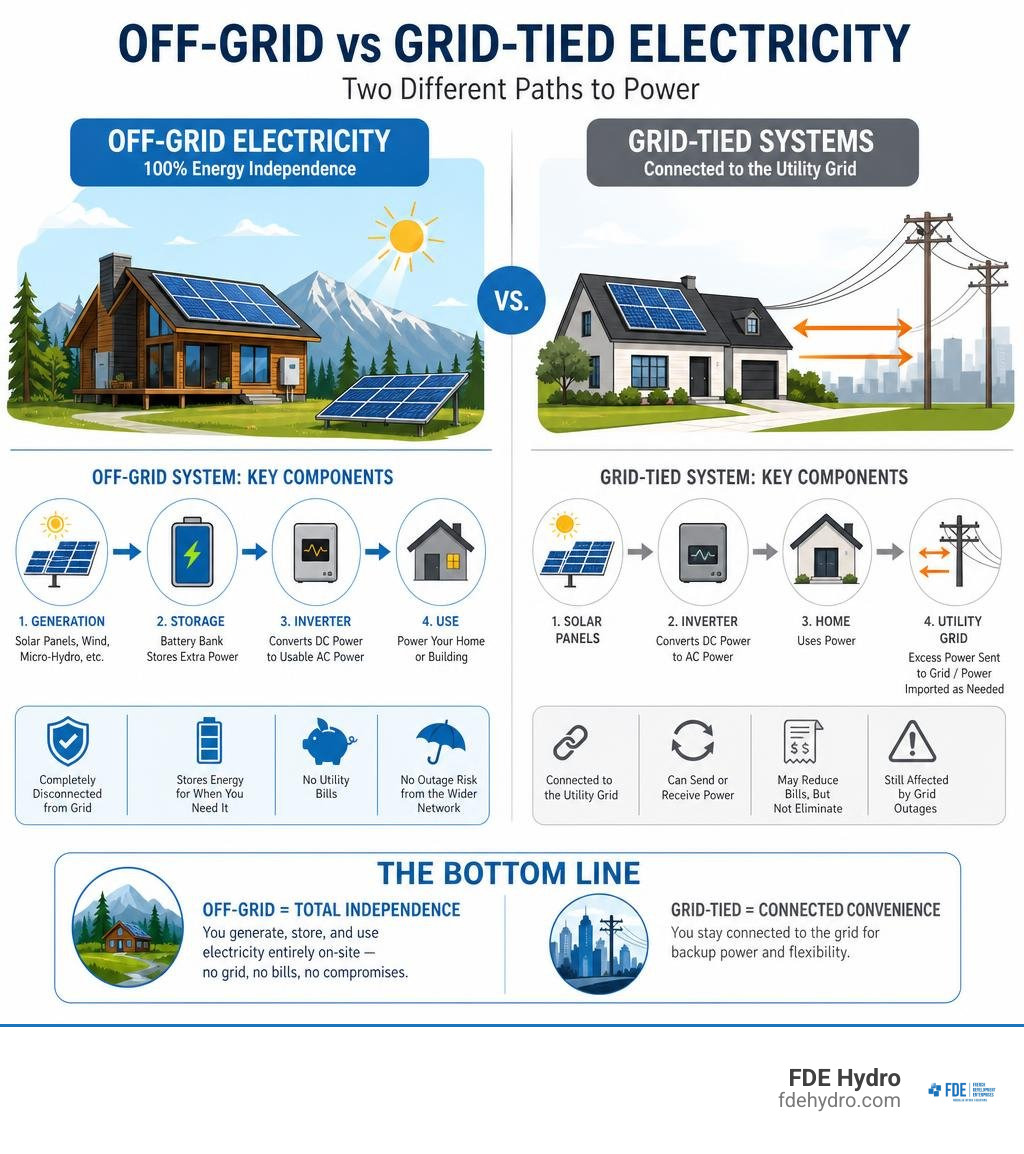
The fundamental difference between off-grid and grid-tied systems comes down to where your excess energy goes and where your backup power comes from.
Grid-Tied Systems: These systems are connected directly to the local utility grid. When your solar panels produce more electricity than you need, the excess is sent back to the utility grid (often earning you credits through a billing mechanism called net metering). At night or on cloudy days, you simply draw power back from the grid. This setup is highly convenient because the grid acts as a massive, free “battery.”
Off-Grid Systems: There is no grid to catch your excess power or to bail you out when the sun isn’t shining. If your battery bank is full and your panels are still generating power, that excess energy is simply lost. Conversely, if your batteries run dry during a week of heavy snow, your lights go out unless you have a backup generator.
For those interested in how localized power systems operate on a slightly larger scale, we can look to microgrids. To understand how communities or commercial facilities manage localized generation, you can read about What is a Microgrid and How Does it Work? to see how these localized networks bridge the gap between individual self-sufficiency and central grid reliance.
Off-Grid Living vs. Self-Consumption
Many homeowners confuse “going off-grid” with “practicing self-consumption.” While they sound similar, they represent two very different approaches to the energy transition.
Feature
Off-Grid Living
Self-Consumption (Grid-Tied + Battery)
Grid Connection
Physically disconnected (no wires, no utility account)
Physically connected to the local utility
Excess Energy
Must be stored in on-site batteries or is wasted
Can be sent back to the grid for net-metering credits
Backup Power
On-site battery bank and backup generator
The utility grid (and batteries during local blackouts)
Utility Bills
Absolutely $0
Reduced bills (only pay for net power drawn + connection fees)
System Sizing
Must be oversized to handle worst-case winter weather
Can be sized strictly for economic optimization
Understanding Self-Consumption
Self-consumption is a hybrid approach. You install rooftop solar panels and a battery storage system, but you keep your connection to the utility grid.
The goal here is economic optimization. Instead of selling your solar electricity to the utility company for a low rate and buying it back at night for a high rate, you store your daytime solar power in your home battery. You use that stored energy during peak evening hours when utility rates are highest.
If you run out of battery power, the grid is right there to seamlessly supply what you need. This hybrid approach is highly popular because it offers excellent financial returns without the risk of total power failure. To explore how these hybrid systems are changing the energy landscape, check out our deep dive on Navigating the Hybrid Microgrid Market: A Deep Dive.
The Reality of Complete Grid Disconnection
True off-grid living, as explained by Enel’s Learning Hub, requires complete physical severance from the utility lines.
Without the grid as a safety net, your lifestyle must adapt to your power generation capacity. You cannot simply turn on high-draw appliances whenever you feel like it. Off-grid homeowners learn to run heavy loads—like laundry, water pumps, and power tools—in the middle of the day when the sun is high and the solar panels are producing a surplus.
Living completely disconnected means taking full ownership of your energy storage. If your system is designed poorly, or if you experience an unusual stretch of bad weather, you must be prepared to manage your consumption or listen to the hum of a backup diesel or propane generator.
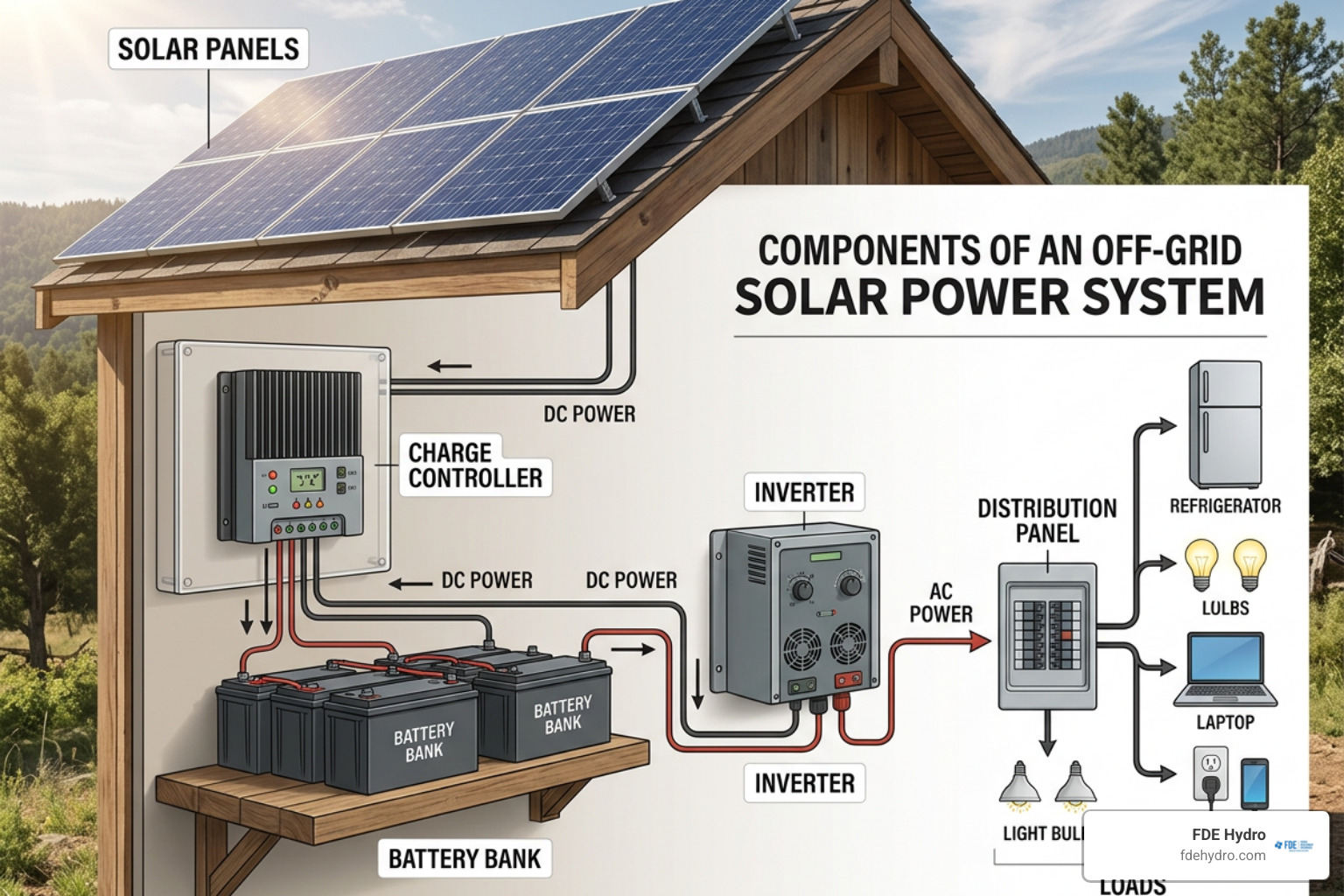
Essential Components of an Off-Grid Solar Power System
To build a reliable off-grid power plant, you need a carefully engineered ecosystem of components. Each part has a specific role in capturing, regulating, storing, and converting electricity. For a closer look at the physics and engineering behind these setups, you can read our guide on Power Up: The Engineering Behind Microgrids Explained.
Solar Panels and Charge Controllers
The journey of off-grid electricity begins with solar panels (photovoltaic modules). For off-grid applications, monocrystalline solar panels are generally preferred over polycrystalline or thin-film options. Monocrystalline panels are constructed from a single silicon crystal, making them highly efficient—a crucial trait when physical roof or ground space is limited.
However, solar panels produce raw, unregulated direct current (DC) electricity that fluctuates wildly depending on cloud cover and the angle of the sun. You cannot feed this raw electricity directly into a battery bank without destroying it.
That is where the charge controller comes in. The charge controller acts as a protective gatekeeper between your panels and your batteries. It regulates the voltage and current coming from the solar array to prevent the batteries from overcharging.
Modern high-quality off-grid systems use Maximum Power Point Tracking (MPPT) charge controllers. These controllers actively monitor the output of the solar panels and adjust the electrical characteristics to ensure the maximum possible power is transferred to the battery bank, even on overcast days.
Batteries and Inverters in the Off Grid Electricity Meaning
Once the charge controller regulates the solar energy, it is stored in the battery bank. In the context of the off grid electricity meaning, the battery bank is the absolute heart of the system.
Historically, off-grid systems relied on deep-cycle lead-acid batteries (like flooded lead-acid or AGM batteries). While cheap upfront, lead-acid batteries require regular maintenance, cannot be discharged past 50% without damage, and have a relatively short lifespan of 3 to 5 years.
Today, Lithium Iron Phosphate (LFP) batteries have become the industry standard. LFP batteries offer massive advantages:
They require zero maintenance.
They can be discharged up to 90% or even 100% without damage.
They routinely last 10 to 15 years (or over 6,000 cycles) without diminishing efficiency.
They do not off-gas toxic fumes, meaning they do not require complex ventilation systems.
Finally, because batteries store DC power and most household appliances run on alternating current (AC), you need an inverter. The inverter converts the low-voltage DC power from your batteries (usually 12V, 24V, or 48V) into standard 120V or 240V AC power.
Interestingly, running a Direct Current (DC) building can actually yield 10% to 20% efficiency gains over traditional AC systems because you completely bypass the energy losses that occur during DC-to-AC conversion. Since about one-third of household electricity is already used as DC by modern electronics and LED lights, DC microgrids are gaining serious traction. You can read more about these advancements in Microgrid Technology.
Sizing, Costs, and Financial Considerations of Going Off-Grid
Moving to a stand-alone system is a major financial and engineering undertaking. Unlike grid-tied systems where you can start small and expand later, an off-grid system must be sized correctly from day one to ensure you don’t end up sitting in the dark.
Sizing Your Off-Grid System
Sizing an off-grid system requires a precise calculation of your daily electricity consumption.
Calculate Daily Watt-Hours: List every appliance you plan to run, multiply its wattage by the number of hours it will run per day, and sum the totals. For reference, the average American household consumes about 30 kilowatt-hours (kWh) of electricity per day.
Determine Peak Sun Hours: Solar panels do not produce power at their rated capacity all day. You must look up the average “peak sun hours” for your specific geographic region. For example, a home in Arizona might enjoy 5.5 peak sun hours per day, while a cabin in upstate New York might average only 3.2 peak sun hours—dropping even lower during the winter.
Calculate Panel Array Size: Divide your daily kWh needs by your local peak sun hours, and adjust for system inefficiencies (typically a 15% loss factor).
Size the Battery Storage: You must plan for “days of autonomy”—the number of consecutive cloudy or stormy days your batteries can run the house without any solar input. Typically, off-grid designs plan for 3 to 5 days of autonomy.
According to regional data compiled by EnergySage, geographic differences dramatically impact system sizing and cost. A home in Massachusetts trying to go off-grid would require roughly 12 standard residential batteries to survive 5 days of winter overcast, whereas a similar home in sunny Arizona might only require 9 batteries to cover 3 days of autonomy.
Cost Breakdown and Financial Incentives
Let’s be candid: going completely off-grid is not cheap. For an average-sized residential home, a robust off-grid solar-plus-storage system can easily cost $45,000 to $65,000, and can scale past $115,000 if you have high heating and cooling loads.
According to technical breakdowns, here is where the money goes:
Solar Panels (10 kW array): Minimum $5,000 to $8,000
Inverter & Charge Controller: Minimum $4,000
Battery Storage (20 kWh to 40 kWh): $20,000 to $40,000
Installation & Permitting: $3,200 to $5,000 (roughly 7% to 10% of total)
Backup Generator & Balance of System (wiring, mounts, safety switches): $5,000 to $10,000
While these numbers might trigger some sticker shock, they must be compared against alternative options. As the U.S. Department of Energy points out, extending a local utility power line to a remote property can cost anywhere from $15,000 to $50,000 per mile. If your home is located even half a mile off the main road, building a stand-alone off-grid system is often significantly cheaper than paying the utility company to run poles and wires to your door.
Furthermore, homeowners can leverage federal, state, and local incentives to offset these upfront costs. In the United States, the Residential Clean Energy Credit (Section 25D) allows taxpayers to deduct 30% of the total cost of solar and battery storage installations from their federal taxes. Similar green energy rebates and tax write-offs exist across Canada and Europe, making the payback period for these systems highly attractive over their 25-year lifespan.
Beyond Electricity: Water, Waste, and Environmental Impacts
True off-grid living extends far beyond the electrical panel. To achieve complete independence, you must also solve the challenges of water supply, waste management, and environmental sustainability.
Water and Waste Management Solutions
When you disconnect from city water and sewer systems, you must establish localized, closed-loop solutions:
Water Supply: Most off-grid homes rely on a private water well. However, running a well pump requires a significant amount of electricity. To minimize power consumption, many off-grid systems use gravity-fed water tanks: a solar-powered pump fills an elevated storage tank during peak daylight hours, and gravity provides water pressure to the house at night. Rainwater harvesting and atmospheric water generators are also viable options depending on local rainfall patterns.
Water Treatment: To ensure water is safe for drinking, off-grid homes implement multi-stage filtration systems, including sediment filters, activated carbon blocks, and ultraviolet (UV) disinfection units to kill bacteria and pathogens without using harsh chemicals.
Wastewater & Sanitation: Standard septic systems with anaerobic leach fields are the traditional solution for off-grid waste. However, to conserve precious water, many off-grid homeowners install composting toilets, which decompose human waste aerobically into dry, odorless compost, completely eliminating the need for water-based flushing. Greywater recycling systems can also divert sink and shower water to irrigate non-edible landscaping.
Alternative Energy Sources and Micro-Hydro
While solar power is the most popular choice for off-grid electricity, relying on a single energy source can be risky. The most resilient off-grid setups are hybrid systems that combine multiple renewable technologies.
If your property has a year-round running stream, creek, or river, you have access to one of the most reliable and consistent forms of renewable energy on earth: water. Unlike solar panels, which only work when the sun is shining, a micro-hydro system generates clean, predictable electricity 24 hours a day, 365 days a year.
To learn how these compact, high-efficiency systems work, check out A Beginner’s Guide to Micro-Hydro Power Systems. At FDE Hydro™, we are passionate about the potential of localized water control and small-scale hydro. Our patented, modular precast concrete technology—known as the French Dam—is designed to make retrofitting and building water control systems faster and more cost-effective across North America, Brazil, and Europe, helping communities unlock the power of local water resources.
Frequently Asked Questions about Off-Grid Electricity
How do off-grid systems handle power outages compared to grid-tied systems?
This is one of the biggest surprises for new solar owners: standard grid-tied solar systems do not work during a power outage.
Grid-tied inverters are legally required to shut down automatically during a blackout to prevent “islanding.” Islanding is when solar panels feed electricity back into the local power lines while utility workers are trying to repair them, creating a lethal hazard.
Off-grid systems, by definition, have islanding capability. Because they are physically isolated from the utility lines, they can safely continue generating and using electricity during a wider grid blackout. When the regional grid goes dark, an off-grid home experiences zero interruption. For a fascinating look at how major utilities and regional grids recover from total blackouts, you can read The Black Start Blueprint: How Power Grids Come Back to Life.
Is it cheaper to go off-grid or extend a power line?
If your property is already located in a suburban neighborhood with existing utility poles, staying connected to the grid is almost always the more cost-effective choice.
However, if you are building a home in a remote area, the math changes completely. Because utility companies charge between $15,000 and $50,000 per mile to extend a power line, a property located just a quarter-mile from the nearest power pole could cost $10,000 to $12,000 just to connect to the grid. In these scenarios, investing that money into a stand-alone solar and battery system makes immediate economic sense.
What are the main advantages and disadvantages of going off-grid?
Advantages:
Complete Energy Autonomy: You are immune to utility price hikes, corporate mismanagement, and rolling blackouts.
Zero Utility Bills: After the initial equipment investment, your ongoing operational costs are virtually zero.
Environmental Sustainability: You drastically reduce your carbon footprint by relying on clean, local renewable energy.
Disadvantages:
High Upfront Capital: The initial cost of batteries, inverters, and panels requires significant upfront funding.
Maintenance Responsibility: If a component fails on Christmas Eve, you cannot call the utility company; you are the utility company.
Resource Constraints: You must actively monitor your energy consumption and adjust your lifestyle to match the weather.
Conclusion
Understanding the off grid electricity meaning is the first step toward true self-reliance. Whether you are looking to build a remote cabin, protect your family from an increasingly unstable utility grid, or transition your property to clean, renewable energy, going off-grid is a powerful statement of independence.
At FDE Hydro™, we believe the future of energy is decentralized, resilient, and sustainable. Through our innovative, patented modular precast concrete “French Dam” technology, we are proud to help developers, municipalities, and communities build and retrofit the water control and hydroelectric systems that make localized power generation possible across the United States, Canada, Brazil, and Europe.
If you are ready to explore the exciting world of localized power, microgrids, and independent energy generation, we invite you to explore more power grid articles on our blog. Let’s build a cleaner, more resilient future together—one localized system at a time.
How a Hydroelectric Dam Turns Moving Water Into Electricity
A hydro electric dam is a structure built across a river to hold back water, create a reservoir, and release that water in a controlled way to generate electricity. Here’s the short version:
Element
What It Does
Dam wall
Holds back water to create height (called “head”)
Reservoir
Stores the potential energy of water
Penstock
Channels water downward to the turbine
Turbine
Spins as water rushes through it
Generator
Converts that spin into electricity
Tailrace
Returns water to the river downstream
In other words: water falls, blades spin, electricity flows.
Hydroelectric dams are one of the oldest and most reliable sources of reliable energy on the planet. They supply roughly 15% of the world’s electricity and account for nearly 29% of all U.S. renewable electricity generation. Unlike solar or wind, they can generate power on demand — day or night, rain or shine.
I’m Bill French, Sr., Founder and CEO of FDE Hydro™, and I’ve spent decades in heavy civil construction before launching FDE Hydro™ in 2015 to bring modular, precast construction methods to the hydro electric dam industry. In this guide, I’ll walk you through everything you need to know — from how these structures work to what it takes to build and operate them.
To truly understand what is a hydro electric dam, we have to look at it as a giant energy converter. It doesn’t actually “create” energy out of nothing; rather, it intercepts water moving through the natural water cycle and converts its physical energy into electrical current.
At its core, the system relies on two fundamental physics concepts: potential energy and kinetic energy.
Potential Energy: Water stored high up in a reservoir behind a massive concrete wall possesses gravitational potential energy. The higher the water level rises, the more stored energy it accumulates.
Kinetic Energy: When we open the gates, gravity pulls that water downward. As it rushes through the internal pipes, that stored potential energy transforms into kinetic energy—the energy of motion.
Two key factors dictate exactly how much electricity a facility can generate: head and flow.
Head refers to the vertical distance the water falls. The greater the height difference between the reservoir surface and the turbine below, the higher the pressure, and the more power we can produce. For instance, the Oroville Dam in California stands at a staggering 230 meters tall, creating immense hydraulic head.
Flow is the volume of water moving through the system over a given time. A massive volume of water moving slowly can sometimes produce just as much power as a small volume falling from a great height.
The Core Definition: What is a Hydro Electric Dam?
Stripped of its electrical components, a dam is simply a retaining structure. Humans have been building them for thousands of years to control the flow of local rivers. Beyond generating clean power, these structures serve several vital societal purposes:
Water Supply & Irrigation: Reservoirs store water during wet seasons to supply municipal water systems and irrigate agricultural land during droughts. In fact, about 20% of the world’s arable land is irrigated by water from reservoirs impounded by dams.
Flood Control: By acting as a giant safety valve, a dam can hold back sudden surges of rainwater or melting snow, protecting downstream communities from devastating floods.
Recreation: Large reservoirs provide spaces for boating, fishing, and local tourism.
How to Explain What is a Hydro Electric Dam to a Beginner
If you are explaining this to someone without an engineering degree, use the “bicycle generator” analogy. Remember those old bicycle lights that lit up when you pedaled? A small roller rubbed against the spinning tire, spinning a tiny magnet inside a coil of wire to power the bulb.
A hydroelectric dam works on that exact same principle of electromagnetic induction, first discovered by Michael Faraday.
Instead of your leg muscles spinning the bicycle wheel, the weight of falling water spins a massive water turbine (which looks like a giant metal fan). This turbine is connected by a heavy steel shaft to a generator above. Inside the generator, powerful electromagnets spin past heavy copper coils. This movement forces electrons to flow through the wire, creating an electrical current that can be sent straight to your living room.
A functional hydroelectric facility is a complex ecosystem of mechanical and civil engineering. Let’s look inside the powerhouse and surrounding structures to see the core components that make it all happen:
The Intake and Trash Racks: Water enters the system through gates located on the reservoir side of the dam. Before entering, it passes through heavy metal screens called trash racks, which prevent logs, rocks, and debris from entering and damaging the internal machinery.
The Penstock: This is a long, heavy-duty steel or concrete pipe that channels water from the intake down to the turbine. The penstock is carefully designed to control the slope and build up maximum hydraulic pressure.
The Turbine: Located at the bottom of the penstock, the turbine converts the kinetic energy of the rushing water into mechanical spin. Depending on the head and flow of the site, engineers use different turbine designs, such as Francis, Kaplan, or Pelton wheels.
The Generator: Sitting directly above the turbine, this component uses Faraday’s principles of electromagnetism to convert the spinning mechanical energy into electrical energy.
The Transformer: The electricity produced by the generator is relatively low voltage. Transformers step up this voltage so it can travel long distances over transmission lines with minimal energy loss.
The Tailrace: After the water has passed through the turbine and surrendered its energy, it is discharged back into the natural river channel through an exit channel called the tailrace.
The Spillway: If the reservoir gets too full during heavy storms, the spillway acts as an overflow safety valve, allowing excess water to bypass the turbines entirely and safely escape downstream.
Not all hydroelectric plants look or operate the same way. Depending on the local geography, water availability, and grid demands, developers build different types of facilities.
This is the classic image that comes to mind when you think of a hydroelectric dam. An impoundment facility uses a large dam structure to hold back a river and create a massive reservoir.
Because we can control exactly when and how much water passes through the gates, impoundment facilities offer unmatched flexibility. They can ramp electricity production up or down in a matter of minutes to match fluctuating grid demands. Famous examples of large conventional facilities include the Grand Coulee Dam on the Columbia River in Washington State (the largest U.S. hydropower facility with 6,765 MW of capacity) and the massive Itaipu Dam shared between Brazil and Paraguay.
To read more about the history and scale of these massive conventional structures, Read about conventional dams.
Diversion and Run-of-River Systems
A diversion, or run-of-river system, takes a completely different approach. Instead of blocking a river entirely with a massive wall, it channels a portion of the natural river flow through a canal or penstock to spin a turbine, before returning it directly to the main river channel.
These systems typically require little to no reservoir storage. Because they rely on the natural, seasonal flow of the river, they are highly dependent on local weather patterns and are generally used to provide steady baseload capacity. A great local example is the historic Bowersock Lawrence Hydroelectric Project in Lawrence, Kansas, which has harnessed the natural flow of the Kansas River for over a century.
To learn more about how these low-impact systems generate electricity without massive flooding, Learn about run-of-river systems.
Pumped Storage Hydropower
Pumped storage is not actually a primary energy source; instead, it acts as a giant, highly efficient physical battery.
These facilities use two reservoirs at different elevations:
During low-demand periods (like 5:00 AM when everyone is asleep, or when solar and wind are producing excess power), we use cheap electricity from the grid to pump water from the lower reservoir up to the higher one.
During peak-demand periods (like 5:00 PM on a hot summer day when air conditioners are humming), we release that water back down to the lower reservoir, spinning the turbines to generate high-value electricity when the grid needs it most.
While pumped-storage systems actually consume more electricity to pump the water than they generate (making them net negative energy devices), they provide crucial grid stability and account for roughly 88% of all utility-scale energy storage in the United States. To see how modern technology is optimizing these systems, Explore modern hydropower technology.
Advantages and Disadvantages of Hydropower
Like any energy source, hydroelectric power comes with trade-offs. Balancing the immense economic and grid benefits against the local environmental impacts is one of the most critical challenges of modern energy design.
The Advantages
Renewable & Clean: Hydropower relies on the natural water cycle, meaning it won’t run out. Once constructed, these facilities produce virtually zero greenhouse gas emissions during operation.
Grid Flexibility & Reliability: Unlike wind and solar, which depend on the weather, impoundment and pumped-storage facilities can provide immediate “firm capacity” to stabilize the grid.
Low Operational Costs: Because the fuel (water) is free, operational and maintenance costs are incredibly low over the long term.
Multipurpose Infrastructure: The reservoirs created by dams provide water storage, flood protection, and recreational spaces for local communities.
The Disadvantages
Ecosystem Disruption: Blocking a river can disrupt natural fish migration patterns, particularly for species like salmon. (Though we can mitigate this using modern fish ladders and bypass systems).
Siltation: Dams trap sediment that would naturally flow downstream, which can lead to reservoir siltation over decades and alter downstream habitats.
High Initial Capital Costs: Traditional concrete dams are incredibly expensive and take years to construct.
Drought Vulnerability: If water levels drop significantly due to severe droughts, electricity generation capacity can be severely limited.
Building a traditional hydroelectric dam is one of the most demanding civil engineering challenges on earth. The process typically begins by diverting the river using temporary structures called cofferdams so that workers can prepare a dry foundation. Heavy crews must excavate down to solid bedrock, grout any fissures to prevent under-dam seepage, and pour millions of cubic meters of concrete in carefully managed blocks to prevent cracking as the concrete cures.
In Canada, there are more than 10,000 dams, with 933 categorized as large dams. The tallest of these is the Mica Dam on the Columbia River, standing at an impressive 243 meters tall. In the United States, the highest dam is located near Oroville, California, standing at 230 meters tall and stretching 1.6 kilometers across.
However, traditional construction methods are slow, carbon-intensive, and expensive. That is why at FDE Hydro™, we developed our patented French Dam technology.
By utilizing modular precast concrete blocks manufactured in a controlled indoor environment, we can bypass the slow, unpredictable process of pouring mass concrete on-site. This innovative approach allows us to build and retrofit hydroelectric dams and water control systems in North America, Brazil, and Europe in a fraction of the time and at a significantly reduced cost.
Frequently Asked Questions about Hydroelectric Dams
What is the largest hydroelectric dam in the world?
The largest hydroelectric facility in the world by generating capacity is the Three Gorges Dam on the Yangtze River, boasting an incredible capacity of 22,500 megawatts (MW). For comparison, the largest facility in the United States is the Grand Coulee Dam at 6,765 MW. In South America, the Itaipu Dam on the border of Brazil and Paraguay is another global giant, with a capacity of 14,000 MW.
How efficient is hydroelectric power compared to other sources?
Hydroelectric turbines are incredibly efficient, often converting 90% or more of the water’s kinetic energy into electricity. By comparison, fossil-fuel plants (like coal or natural gas) are typically only 33% to 50% efficient because they lose a massive amount of energy as wasted heat. To read more about how we measure and optimize this output, Read about hydroelectric dam efficiency.
What is the lifespan of a typical hydroelectric dam?
A well-maintained hydroelectric dam is an incredibly long-term asset, with a typical lifespan of 65 to 85 years—and many can operate for over a century with proper retrofitting. While the mechanical components (like turbines and generators) may need to be refurbished or replaced every few decades, the concrete structure itself can last for generations.
As we navigate the global transition toward a clean energy future, the humble hydroelectric dam remains an indispensable cornerstone of our electrical grid. It provides the reliable, flexible, and renewable baseload power that wind and solar simply cannot match on their own.
At FDE Hydro™, we believe the future of hydropower lies in rapid, cost-effective modernization. Our patented modular precast concrete technology—the French Dam—is actively changing how communities across North America, Brazil, and Europe build, repair, and retrofit their water control infrastructure. By slashing construction timelines and reducing environmental footprints, we are helping to ensure that the power of moving water continues to light up our world for centuries to come.
What Is Electricity from the Grid — and How Does It Reach You?
Electricity from the grid travels through one of the most complex engineering systems ever built — from a power plant, through hundreds of miles of transmission lines, and into your home or facility in a fraction of a second.
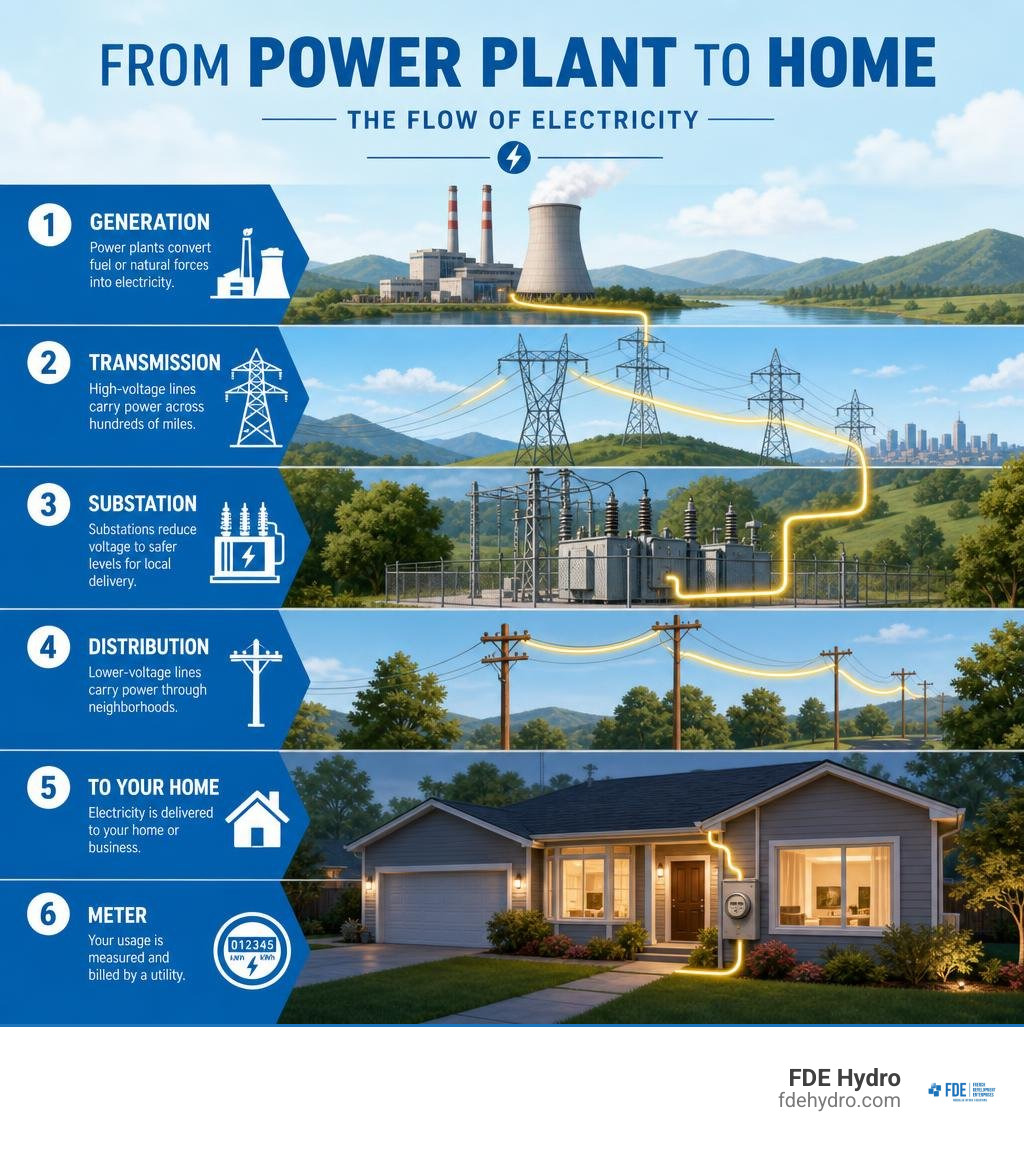
Here’s a quick overview of how it works:
Stage
What Happens
Generation
Power plants convert fuel or natural forces into electrical energy
Step-Up
Transformers raise voltage to 115,000–765,000 volts for long-distance travel
Transmission
High-voltage lines carry power across hundreds of miles with minimal loss
Step-Down
Substations reduce voltage to safer levels for local delivery
Distribution
Lower-voltage lines carry power to homes and businesses
Meter
Your usage is measured and billed by a utility
The U.S. grid alone spans thousands of miles of high-voltage lines and millions of miles of lower-voltage lines, connecting thousands of power plants to hundreds of millions of customers. It is, by almost any measure, the largest machine ever built.
Yet most people never think about it — until the lights go out.
Grid reliability failures make the scale of this system impossible to ignore. In February 2021, nearly 10 million people in Texas lost power during a severe winter storm, resulting in more than 50 deaths. Events like that reveal just how much modern life depends on a steady, uninterrupted flow of electricity from grid infrastructure.
I’m Bill French, Sr., Founder and CEO of FDE Hydro™, and my five decades in heavy civil construction — including work selected by the U.S. Department of Energy’s Water Power Technology Office — have given me a front-row seat to how clean energy and electricity from the grid are being reshaped by modular innovation. In this guide, I’ll break down exactly how the grid works, what threatens it, and where it’s headed.
The Architecture of Power: How the Grid is Structured
To understand how we get electricity from grid utilities, we first need to look at the physical architecture. The electrical grid is not a single, unified machine. Instead, it is a vast network of generation facilities, high-voltage pathways, substations, and local distribution lines.
Historically, this system was designed for one-way traffic: massive, centralized power plants burned coal, gas, or harnessed nuclear and hydro energy, sending that power outward to passive consumers. Today, the network is shifting toward a decentralized, two-way system where consumers also feed power back into the system.
Across different regions, grids are organized into massive interconnected networks. For example, in Europe, the synchronous grid of Continental Europe managed by ENTSO-E boasts an incredible 667 gigawatts (GW) of generation capacity. You can view its vast footprint directly on the Grid Map – ENTSO-e .
In South America, the Electricity sector in Brazil – Wikipedia outlines one of the world’s most hydro-dependent national grids, showcasing how regional geography dictates grid structure. Meanwhile, in North America, we rely on distinct regional interconnections, though critics argue that the lack of centralized planning poses long-term risks, as explored in this Reality Check: The United States Has the Only Major Power Grid … .
Three-Phase AC Power and Synchronous Grids
Most of the world’s wide-area synchronous grids operate using three-phase Alternating Current (AC) electricity. Why three-phase? It is highly efficient because it delivers three alternating currents that are out of phase with each other, providing a continuous, non-pulsing stream of power. This allows industrial motors to run smoothly and delivers more power per pound of metal wire than single-phase systems.
To maintain stability, a synchronous grid must operate at a highly precise frequency—either 60 Hertz (Hz) in North America or 50 Hz in Europe. If the balance between electricity generation and demand shifts even slightly, the frequency will fluctuate. Grid operators must keep these deviations within fractions of a hertz to prevent equipment damage and widespread blackouts.
The Physics of Delivering Electricity from Grid Infrastructure
The journey of electricity from grid generation to your wall outlet is a masterclass in physics. When electricity is generated at a power plant, it is typically produced at a relatively low voltage (around 5,000 to 25,000 volts).
If we tried to send electricity across hundreds of miles at this low voltage, the resistance in the wires would generate massive amounts of heat, causing most of the energy to waste away. To solve this, operators use step-up transformers at the power plant to raise the voltage to extreme levels—often between 115,000 and 765,000 volts. High voltage reduces the current (amperage) required to transmit the same amount of power, which drastically cuts down on line losses.
Once the electricity nears its destination, step-down transformers at local substations lower the voltage to safer levels. It is stepped down first to medium-voltage lines for commercial areas, and finally to 120/240 volts for residential use. You can read a complete breakdown of this delivery process directly from the Delivery to consumers – U.S. Energy Information Administration (EIA) .
How We Receive Electricity from Grid Systems
The journey of electricity can be split into two primary segments: transmission and distribution. While they might look similar to the untrained eye, they serve entirely different purposes.
High-voltage transmission lines are the superhighways of the electrical grid. Suspended from towering steel structures, these lines carry electricity over vast distances. In the United States, about 4% of electricity output is lost during transmission and distribution.
To combat these losses, utilities are increasingly looking at High-Voltage Direct Current (HVDC) lines. While traditional transmission relies on AC, the latest generation of HVDC power lines can transmit energy over long distances with losses of only 1.6% per 1,000 kilometers.
Once the electricity reaches a local substation, it enters the low-voltage distribution network. These are the lines you see running along neighborhood streets on wooden poles or buried safely underground.
Distribution systems step the voltage down to levels that residential and commercial appliances can handle. A final transformer, often resembling a gray metal can on a utility pole or a green box on lawns, performs the final step-down to 120/240 volts before the electricity enters your electrical panel.
Real-Time Balancing: How Operators Maintain Grid Reliability
One of the most mind-boggling aspects of receiving electricity from grid systems is that electricity must be consumed the exact millisecond it is generated. Because large-scale grid storage is historically limited, grid operators—known as balancing authorities—must constantly balance supply and demand in real time.
If demand spikes (for example, on a hot afternoon when millions of air conditioners turn on) and operators do not bring more generation online, the grid’s frequency will drop. If it drops too low, safety systems will automatically disconnect power plants to protect them, potentially triggering a cascading blackout. Conversely, if there is too much supply and not enough demand, the frequency will rise, which can also damage grid infrastructure.
Operators use a mix of “baseload” power plants (which run continuously) and rapid-response “peaker” plants (often natural gas or hydroelectric facilities) to maintain this delicate equilibrium. To see real-world examples of how this operational dance powers our daily lives, check out our article on Shocking Examples How the Electrical Grid Powers Our Lives.
Managing Power Outages and Black Starts
Despite the best efforts of balancing authorities, outages still happen. In the United States, the majority of reliability issues are caused by factors outside the control of grid operators, such as physical distribution or transmission lines downed during extreme weather events.
When a catastrophic blackout occurs and the grid goes completely dark, operators cannot simply flip a switch to turn it back on. Most large power stations require electricity from the grid just to start their own operations (to run pumps, blowers, and control systems).
To recover from a total collapse, operators must execute a highly coordinated “black start.” This involves using small, self-starting generators (like diesel generators or hydroelectric plants) to gradually energize local lines and bring larger power plants back online step-by-step.
How do we actually buy and sell electricity from grid utilities? The financial side of the grid is just as complex as the physical side.
In many regions, electricity is traded on wholesale markets where power generators sell their output to utilities and retail providers. Retail providers then sell that electricity directly to homes and businesses.
Delivery Costs: The cost to maintain the physical transmission lines, substations, poles, and meters that bring the power to your door. For a breakdown of delivery charges, see Service Rates | Bills, Meters & Rates | National Grid .
The Cost of Sourcing Electricity from Grid Utilities
For residential customers, utilities typically offer a default option known as “Basic Service” if you do not actively choose a competitive third-party electricity supplier. Under Basic Service, the utility purchases power on your behalf through competitive solicitations and passes the cost directly to you without any markup.
Consumers can often choose between different rate structures:
Fixed Rates: Your price per kilowatt-hour (kWh) remains constant for a set period (usually 6 to 12 months), protecting you from seasonal price spikes.
Variable Rates: Your price fluctuates monthly based on wholesale market conditions.
For low-income households, many utilities offer dedicated assistance programs. For instance, eligible customers can qualify for discount rate programs that provide bill credits ranging from 32% to 71% of total charges. You can view an official breakdown of these rate structures and discount programs in the 2025 Summary of Rates for Massachusetts .
The Evolution of the Grid: Smart Tech and Renewables
The grid is undergoing its most significant transformation since the days of Thomas Edison. Traditional grids were centralized and analog; the modern grid is becoming highly digital, interactive, and decentralized.
Two major drivers of this evolution are:
Distributed Energy Resources (DERs): Technologies like residential rooftop solar panels and local battery storage allow consumers to generate their own power.
Smart Grids: Utilizing advanced sensors, digital communication systems, and smart meters, modern grids can automatically detect outages, reroute power to isolate faults, and communicate real-time pricing to consumers.
Furthermore, digital platforms like the GridPulse — Electricity Price API are enabling developers and AI agents to access real-time electricity prices, carbon intensity metrics, and generation mix data across dozens of global grid zones.
Integrating Renewable Energy and AI Workloads
As we transition toward a decarbonized future, integrating variable renewable sources like wind and solar presents a massive engineering challenge. Unlike gas or hydro plants, wind and solar cannot be turned on demand.
At the same time, the grid is facing unprecedented demand growth. AI data centers are projected to double their energy consumption by 2030. Because a single LLM inference query can vary up to 20x in carbon intensity depending on where and when it is run, developers are looking for ways to optimize compute workloads.
Open-source protocols like carbonsteward/grid402 are stepping in to solve this. By providing sub-hourly (5-minute) data on generation mixes, emissions, and spot prices, these tools allow AI agents to automatically schedule heavy computing tasks during hours when clean energy is abundant on the grid.
This integration is vital in states like California, where renewable generation is growing rapidly, as documented in the 2023 Total System Electric Generation report.
Frequently Asked Questions about Grid Electricity
What are the three major interconnections in the United States?
The contiguous United States is divided into three primary independent grid networks:
The Eastern Interconnection: Covers the area east of the Rocky Mountains and parts of eastern Canada.
The Western Interconnection: Covers the area from the Rocky Mountains to the West Coast, including western Canada.
The Electric Reliability Council of Texas (ERCOT): Covers most of the state of Texas. Because ERCOT is largely isolated from the other interconnections, it has limited ability to import power during extreme weather emergencies.
Why does the grid use high voltage for long-distance transmission?
The grid uses high voltage because of basic electrical physics. As electricity travels through a wire, electrical resistance causes some of the energy to turn into heat, resulting in line losses. By using step-up transformers to increase the voltage, the current (amperage) is reduced. Lower current means significantly less heat generation and lower energy loss, allowing power to travel hundreds of miles efficiently.
How do microgrids differ from the main electrical grid?
While the main electrical grid is a massive, centralized network, a microgrid is a localized grid that can operate independently. Microgrids feature their own local generation sources (such as solar arrays, wind turbines, or backup generators) and energy storage.
Most importantly, they have the ability to “island”—meaning they can disconnect from the main grid during an outage and continue supplying power to a local facility, hospital, or neighborhood autonomously. You can learn more about the mechanics behind these systems in Power Up The Engineering Behind Microgrids Explained.
Conclusion
As we look toward the future, the demand for reliable, clean electricity from grid networks will only continue to rise. Transitioning to a decarbonized grid requires not just smart software, but a fundamental upgrade of our physical infrastructure.
That is where we at FDE Hydro™ come in. Our patented, modular precast concrete technology—the French Dam—is revolutionizing how we build and retrofit hydroelectric dams and water control systems. By significantly reducing construction costs and installation times across North America, Brazil, and Europe, we are helping communities rapidly deploy reliable, baseload renewable energy to stabilize local grids.
Modernizing the grid is the defining engineering challenge of our generation. To stay informed on how clean energy and grid technology are evolving, explore our complete library of resources in the Category Power Grid Articles.