

Why Green Energy Dam Retrofits Are One of America’s Best Untapped Clean Energy Opportunities
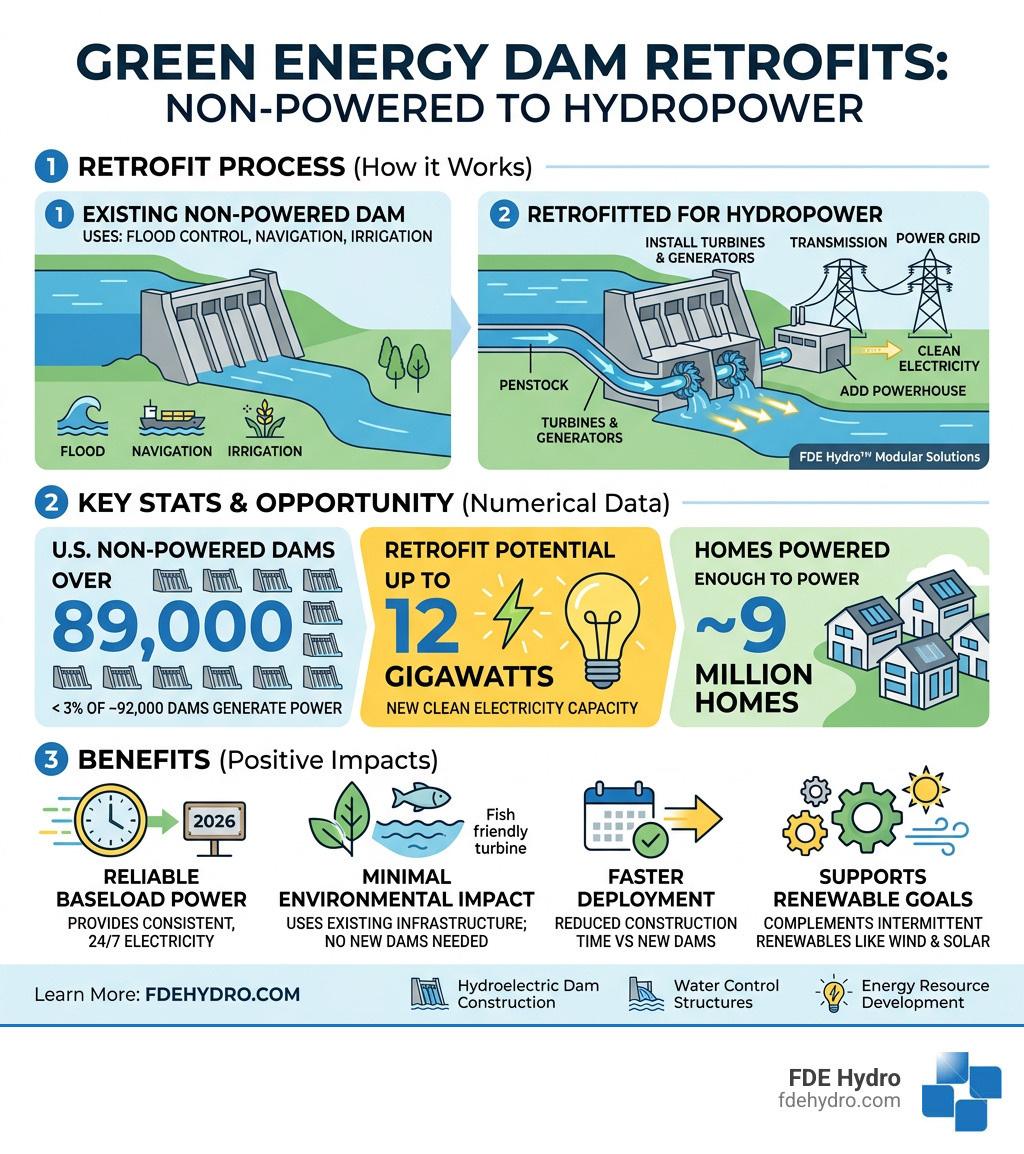
Green energy dam retrofits are one of the fastest, lowest-impact ways to add renewable electricity to the U.S. grid right now. Here’s a quick summary of what you need to know:
- What they are: Adding turbines and power generation equipment to existing dams that currently produce no electricity
- Scale of opportunity: Over 89,000 U.S. dams generate no power — less than 3% of 92,000+ total dams do
- Potential impact: Up to 12 gigawatts of new clean electricity — enough to power 9 million homes
- Key advantage: No new dam construction needed, meaning less environmental disruption and faster deployment
- Who benefits: Grid operators, utilities, communities, and infrastructure owners looking for reliable, 24/7 renewable power
Most people think expanding hydropower means building new dams. It doesn’t.
The U.S. already has tens of thousands of dams sitting idle — built for flood control, irrigation, or navigation — that have never generated a single watt of electricity. That’s an enormous amount of clean energy potential going to waste, right now, in infrastructure that already exists.
The case for action is straightforward. Retrofitting is faster than new construction, avoids the environmental and community disruption of building from scratch, and can deliver reliable baseload power that complements intermittent renewables like wind and solar.
This guide walks you through everything you need to know — from the scale of the opportunity and the tools to identify it, to the technical, regulatory, and environmental realities of getting a retrofit project done.
I’m Bill French, Sr., Founder and CEO of FDE Hydro™ and a participant in the U.S. Department of Energy’s Hydropower Vision Technology and Performance Task Force, where I helped shape the national roadmap for green energy dam retrofits and next-generation hydropower solutions. Over the past decade, I’ve developed patented modular civil construction technologies specifically designed to make hydropower retrofits faster, more cost-effective, and more environmentally sound. Let’s get into it.
Green energy dam retrofits terms simplified:
The Massive Potential of Green Energy Dam Retrofits
When we look at the landscape of American infrastructure, we see more than 92,000 dams. It is a staggering figure, but even more shocking is that only about 2,500 of them actually produce electricity. The rest—roughly 89,000 dams—are “non-powered.” They were built for flood control, recreation, or navigation, and they have been sitting there for decades, letting water flow past without capturing its kinetic energy.
The potential here is massive. According to the DOE report on hydropower vision, green energy dam retrofits could add up to 12 gigawatts of additional electricity to our grid. To put that in perspective, that is enough to power 9 million homes—or every single home in Tennessee, Alabama, and Georgia combined.
However, we have to be realistic about the hurdles. As noted in the ORNL report on development challenges, factors like aging infrastructure, specific dam designs, and the sheer cost of traditional construction can slow things down. That is why we focus so heavily on hydropower retrofitting techniques that utilize modern materials and modular designs to bypass the headaches of “pouring mud” (traditional cast-in-place concrete) in a riverbed.
By leveraging these existing structures, we aren’t just adding power; we are increasing energy resilience. A retrofitted dam provides a secure, local source of energy that doesn’t depend on global supply chains for fuel. It is the ultimate “reduce, reuse, recycle” for the power industry.
Prioritizing Green Energy Dam Retrofits with NPD HYDRO
With 89,000 dams to choose from, where do we start? We can’t just throw a turbine at every pile of rocks and concrete in the country. This is where data-driven tools become our best friends.
The Oak Ridge National Laboratory (ORNL) and other national labs have developed the NPD HYDRO tool. This is a comprehensive, web-based platform that helps developers and communities prioritize which dams are the best candidates for a retrofit. It looks at variables across four major categories:
- Grid Connectivity: How close is the dam to existing power lines?
- Community Security: Could this dam power a nearby hospital or school during a blackout?
- Industrial Proximity: Are there factories or natural gas stations nearby that need reliable 24/7 power?
- Environment: What is the local fish population like, and what are the water quality requirements?
By using non-powered dam retrofit research, we can narrow down the list to the “low-hanging fruit”—the dams that offer the highest return on investment with the lowest environmental footprint.
Economic Benefits of Green Energy Dam Retrofits
Retrofitting isn’t just good for the planet; it’s a shot in the arm for local economies. When we take an idle piece of infrastructure and turn it into a power plant, we create high-paying, local jobs in construction, engineering, and long-term maintenance.
Moreover, many of these dams are aging. The average age of a U.S. dam is over 50 years. Instead of just letting them crumble, we can change out aging infrastructure and replace it with next-generation systems. This modernization increases the value of the asset and provides a steady stream of tax revenue for the local community.
While the 12 GW figure is the “total” potential, experts suggest that about 4.8 GW of that is economically feasible to develop by 2050 using current technology. That is still enough to power over 2 million homes without building a single new wall in a river.
Overcoming Technical and Regulatory Hurdles
If retrofitting dams is such a great idea, why haven’t we done all of them yet? Well, as anyone in the hydro industry will tell you, working with water is never “simple.”
First, there is the age of the dams. With an average age of 57 years, many structures require significant rehabilitation before they can support power generation equipment. We often see dams that were never designed to hold the weight or the vibrations of a turbine. This is where we use next-generation civil solutions like modular precast concrete to reinforce the structure without the massive costs and timelines of traditional rebuilds.
Then there is the regulatory maze. The Federal Energy Regulatory Commission (FERC) licensing process is notoriously rigorous. While it’s vital for safety and environmental protection, it can take years to navigate.
We also have to deal with “optimism bias.” A study on power output projections found that past retrofit projects often overestimated their actual power generation by an average of 3.6 times. This highlights the need for better site-specific engineering and realistic flow modeling before we break ground.
| Dam Type | Retrofit Suitability | Key Challenges |
|---|---|---|
| Navigation Dams | High | Usually concrete; stable water levels; easier to install penstocks. |
| Flood Control Dams | Medium | Large seasonal changes in water levels; may require deep structural work. |
| Irrigation Dams | Low/Medium | Water usage is prioritized for crops; flow can be highly seasonal or intermittent. |
| Recreation Dams | Variable | Often small; community pushback regarding water level changes. |
Environmental Mitigation in Green Energy Dam Retrofits
We love rivers, and we want to keep them healthy. Historically, “big hydro” got a bad rap for blocking fish migration and altering water chemistry. But green energy dam retrofits are different. Because the dam is already there, we aren’t creating new fragmentation of the ecosystem.
Instead, a retrofit is often an opportunity to improve the environmental standing of the dam. Modern projects often include:
- Fish-Safe Turbines: New designs that allow fish to pass through the blades unharmed.
- Eel Ramps and Fish Ladders: Adding passage systems that weren’t part of the original 1950s design.
- Dissolved Oxygen Systems: Ensuring the water released from the turbines is healthy for downstream life.
In some cases, we use dam rehabilitation and encapsulation to fix old, leaking structures while we add power, effectively giving the river a cleaner, safer neighbor. As research on the global hydropower boom shows, the environmental cost of a new dam is massive. Retrofitting allows us to skip that cost entirely.
Environmental Advantages and Grid Resilience
In renewables, hydropower is the “steady hand.” While solar is great when the sun shines and wind is fantastic when the breeze blows, hydro provides 24/7 baseload power. This makes it a perfect partner for intermittent sources.
One of the coolest things about a retrofitted dam is its “black start” capability. If the entire grid goes down, a hydro plant can often restart itself without an external power source, helping to “jump-start” the rest of the grid. This is a level of resilience that batteries and solar arrays are still struggling to match at scale.
Furthermore, we are seeing a lot of interest in “pumped storage.” This is basically using two reservoirs as a giant water battery. When there is too much wind or solar on the grid, we use that extra energy to pump water uphill. When the grid needs power, we let the water flow back down through the turbines. This is discussed in detail in this scientific paper on revitalizing existing dams, which highlights how existing infrastructure can be the backbone of a carbon-free grid.
Real-World Success: Case Studies in Modernization
To see the future of green energy dam retrofits, we only need to look at a few standout projects.
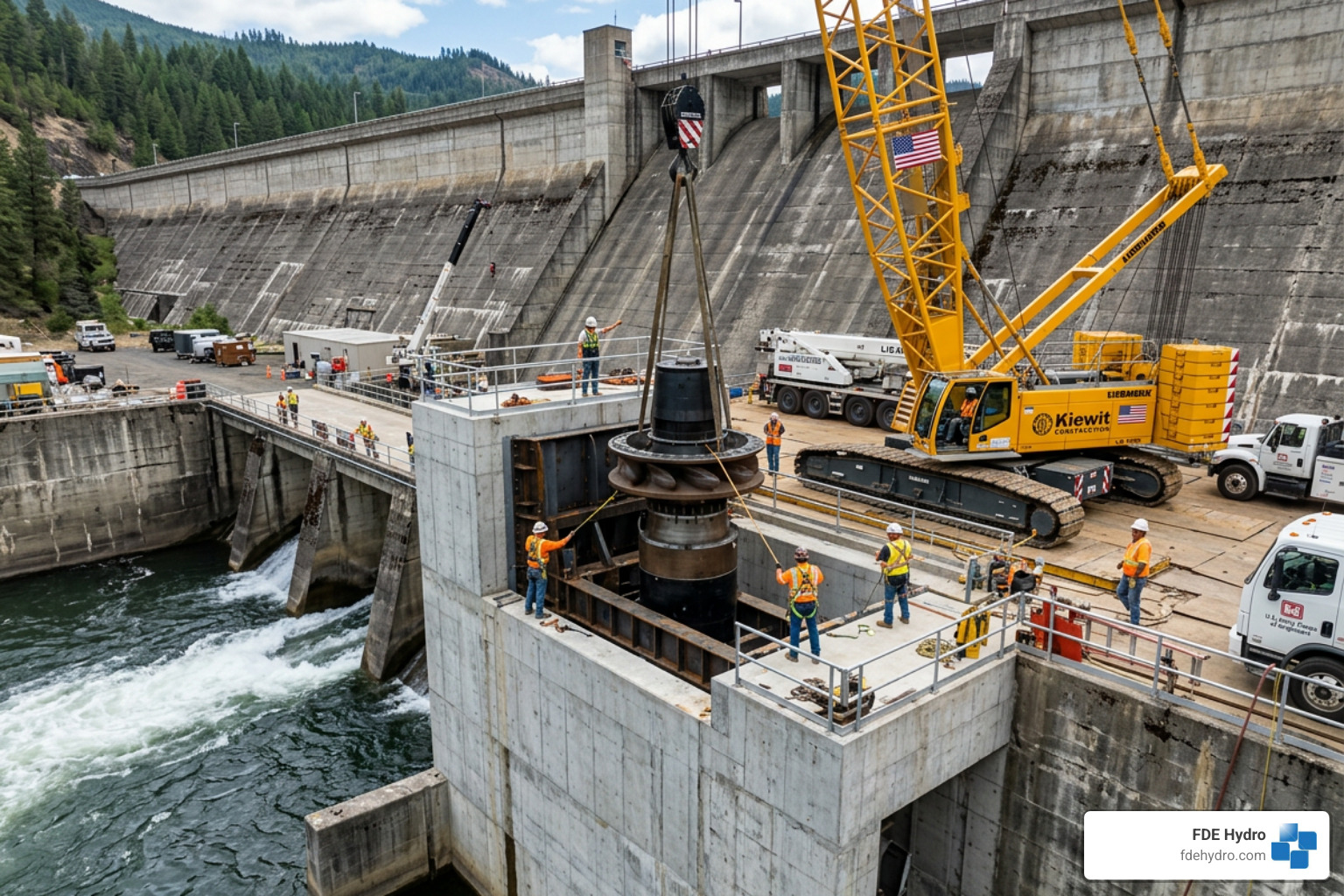
Red Rock Dam, Iowa Originally built in 1969 for flood control, Red Rock Dam sat for decades without producing power. Recently, engineers “punched” two massive penstocks through the concrete structure and installed turbines. Today, it generates enough clean energy to power 18,000 homes across four states. It is a perfect example of how a “single-purpose” dam can become a multi-purpose powerhouse.
Bulls Bridge, Connecticut This plant is a lesson in longevity. It first came online in 1903! While it has used the same Francis turbines for over a century, it recently underwent an electrical retrofit. We replaced the old, dangerous oil-filled circuit breakers with modern vacuum circuit breakers. This didn’t just make the plant safer; it ensured this 120-year-old facility can keep providing green energy for another century.
These stories, as highlighted in the Yale Environment 360 report on dam boosts, show that with the right hydro power plant maintenance and technical interventions, we can make our existing infrastructure do more with less.
Frequently Asked Questions about Dam Retrofitting
How many non-powered dams exist in the US?
There are approximately 89,000 non-powered dams in the United States. While not all of them are suitable for power generation (some are too small, too remote, or structurally unsound), thousands represent a viable opportunity for green energy dam retrofits.
What is the difference between a retrofit and a new dam?
A new dam requires flooding new land, displacing communities, and completely altering a river’s ecosystem from scratch. A retrofit uses a dam that is already there. We simply add the “plumbing” (penstocks) and the “engine” (turbines) to the existing wall. It is much faster, cheaper, and more environmentally friendly.
How does climate change affect retrofitted hydropower?
Climate change is a wildcard. Droughts can reduce water flow, which in turn reduces power output. For example, California has seen significant drops in hydro production during dry years. However, hydropower is also a tool for climate adaptation. Dams help manage water supplies during unpredictable weather, and the clean energy they produce helps reduce the carbon emissions that drive climate change in the first place.
Conclusion
The era of building massive, landscape-altering dams is largely over in North America. But the era of “smart hydro” is just beginning. With the 21st Century Dams Act and other bipartisan support gaining steam, we are seeing a renewed focus on the “Three Rs”: Rehabilitate, Retrofit, and Remove.
At FDE Hydro™, we believe that we don’t have to choose between a healthy river and a healthy grid. By using our patented modular precast concrete technology—the French Dam—we can make green energy dam retrofits a reality in a fraction of the time it takes for traditional construction. Our mission is to help dam owners and communities unlock the “wasted” energy flowing through their backyards.
If you are ready to see how existing infrastructure can power the future, explore sustainable hydropower solutions with us. Let’s get to work.
