

Unplugging the Mystery: Understanding Electrical Energy Distribution
The electrical energy distribution system is the final step in delivering electricity to homes and businesses. It’s the crucial link that takes high-voltage power from transmission lines and makes it safe and usable for everyday needs.
Here’s a quick look at what electrical energy distribution means:
- Final Stage: It’s the last part of electricity delivery, connecting the grid to individual consumers.
- Voltage Reduction: It lowers electricity from high transmission voltages to safe levels for use.
- Local Networks: It includes substations, transformers, and local power lines running through neighborhoods.
- Everyday Power: It’s how electricity reaches your outlets and appliances.
Think of the electrical grid as a vast highway system for power. Electricity begins its journey at power plants, travels across country on giant transmission lines, and then reaches your local community. But it doesn’t just flow directly into your home. It needs a special network to transform that high-powered energy into the right voltage for your devices. This is where electrical distribution comes in. It’s a complex and vital system that keeps our modern world running. Without it, the electricity we generate would never safely reach us.
As Bill French Sr., Founder and CEO of FDE Hydro™, my five-decade career in heavy civil construction has often intersected with the foundational elements of our energy infrastructure, including the critical stage of electrical energy distribution. From constructing modular precast bridges to defining strategic plans for next-generation hydropower, my work focuses on robust, sustainable solutions that power communities efficiently.
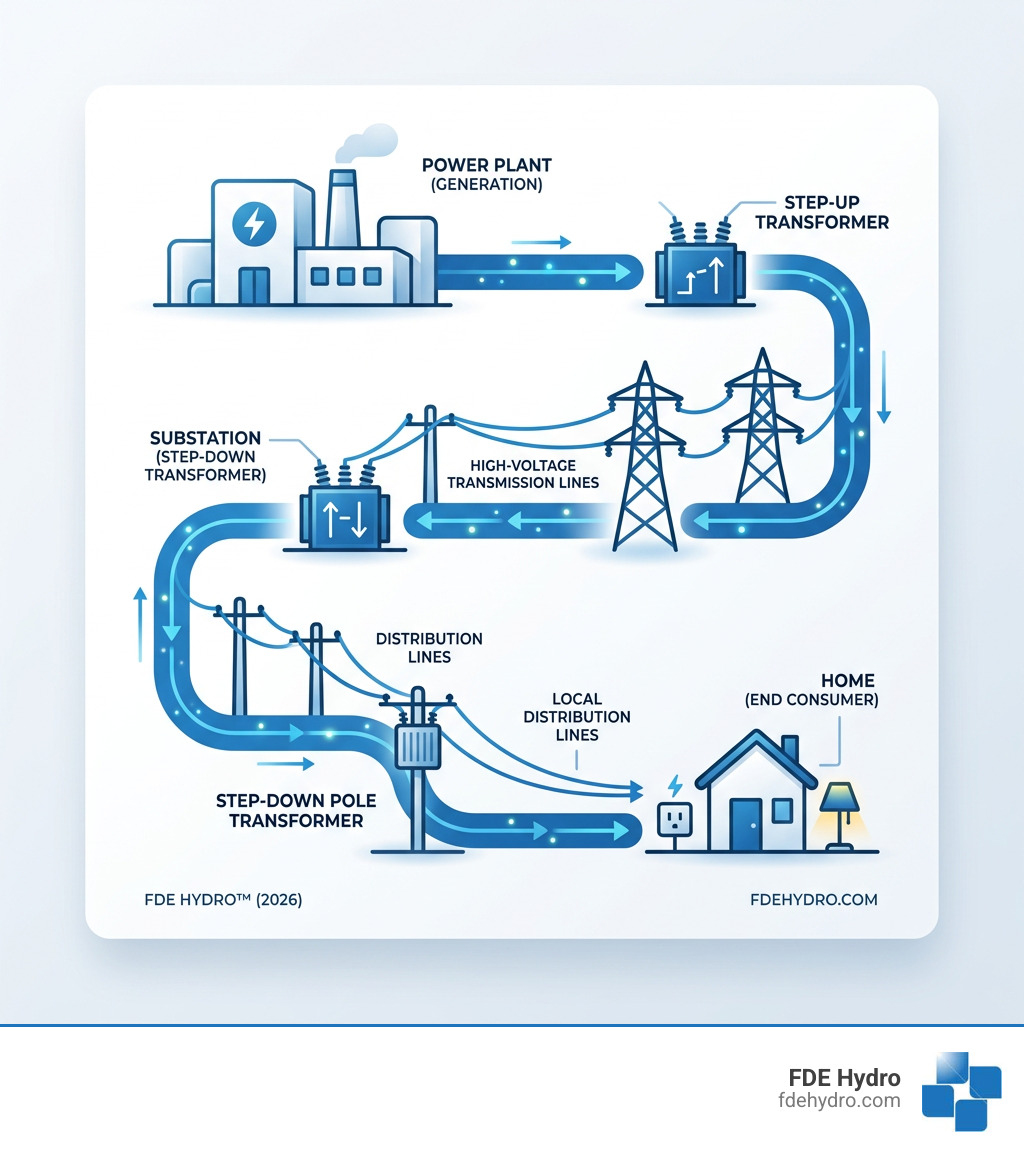
Electrical energy distribution word roundup:
What is Electrical Energy Distribution?
When we talk about How Power Grids Work, we are looking at a massive, interconnected machine. In fact, the North American electric power system is often described as the largest and most complex machine ever built by humanity. Within this machine, electrical energy distribution represents the “last mile.” While transmission moves bulk power over long distances at incredibly high voltages, distribution is the local wiring that weaves through our streets in New York City, Lawrence, and across California.
According to the Electric Power Distribution Handbook, this stage is defined by its proximity to the end-user. Approximately 60 percent of all energy utilized in the United States passes through this interconnected system. The process involves taking electricity from the transmission grid—which usually operates at 69 kV or higher—and stepping it down to medium and then low voltages. This ensures that the 120/240V required by your toaster or the 480V required by a local factory is delivered reliably and safely.
The Role of Transformers in Electrical Energy Distribution
The unsung hero of this entire process is the transformer. Without it, we would be stuck in the 1880s, unable to send power more than a mile or two. Transformers work on the principle of electromagnetic induction to change voltage levels. In the distribution phase, we primarily use “step-down” transformers.
You’ve likely seen these units—they are the gray “trash cans” mounted on utility poles or the green metal boxes sitting on concrete pads in suburban neighborhoods. Their job is to take the “primary” distribution voltage (often between 4 kV and 35 kV) and drop it down to the “utilization” voltage of 120/240V for residential use. In the UK and parts of Europe where we operate, these transformers are often sized to provide 1 to 2 kW per household, ensuring the local kettle and heater can run simultaneously without a hitch.
Distribution Substations: The Transition Point
The distribution substation is the handshake between the high-voltage transmission world and your local neighborhood. Think of it as a massive sorting facility. Here, high-voltage lines enter the station and connect to busbars—thick conductors that act as a common connection point.
At the substation, several key things happen:
- Voltage Reduction: Huge transformers drop the voltage from transmission levels (like 115 kV or 230 kV) down to primary distribution levels.
- Circuit Protection: High-voltage circuit breakers and relays stand ready to “trip” and cut power if a fault, like a lightning strike, occurs.
- Voltage Regulation: Because electricity loses pressure (voltage) as it travels down long wires, substations use regulators to keep the voltage steady for the customers furthest away.
- Monitoring: Modern substations use sophisticated equipment to send data back to a central control room, allowing utilities to see exactly how much power is being used in real-time.
The Anatomy of the Distribution System: Primary vs. Secondary
To understand the grid, we have to look at its two main layers. Primary Distribution Voltage Levels typically range from 2.4 kV to 35 kV. This is the “medium voltage” that travels from the substation to your street. The secondary distribution system is the final stretch—the wires that run from the local transformer directly into your meter box.
| Feature | Primary Distribution | Secondary Distribution |
|---|---|---|
| Voltage Range | 2 kV to 35 kV | 120 V to 600 V |
| Users | Large industrial/commercial | Residential/Small business |
| Infrastructure | Large poles, heavy insulators | Service drops, local transformers |
| Purpose | Moving power through towns | Delivering power to outlets |
In North America, the secondary standard is almost universally 120/240V split-phase. This allows a home to have 120V for standard lights and outlets, while providing 240V for heavy-duty appliances like clothes dryers or electric vehicle chargers.
Network Configurations: Radial, Loop, and Network
How we connect these wires matters for reliability. There are three main ways engineers design these layouts:
- Radial Systems: This is the simplest and most common setup, especially in suburban and rural areas. Power flows from the substation along a single path to the customers. It’s cost-effective, but if a tree falls on the main line, everyone “downstream” loses power.
- Loop Systems: Imagine a circle. Power can reach a customer from two different directions. If there’s a break in the line, switches can be flipped to “backfeed” the power from the other side, minimizing the duration of the outage.
- Network Systems: This is the gold standard for reliability, used in high-density areas like downtown New York City. Every customer is connected to multiple power sources simultaneously. If one transformer or line fails, the others pick up the slack instantly without the lights even flickering.
Research into Microgenetic multiobjective reconfiguration algorithms shows that utilities are now using AI and advanced math to constantly “reconfigure” these networks to reduce power loss and improve stability.
Urban vs. Rural Distribution Infrastructure
The geography of where we live dictates what the grid looks like. In urban centers, the electrical energy distribution system is largely invisible, tucked away in underground conduits to protect it from the elements and save space. This is expensive to build but very reliable.
In rural areas, the challenges are different. We have to move power over vast distances to reach just a few homes. To save on costs, rural systems often use higher primary voltages (like 12.47 kV or 34.5 kV) to reduce energy loss over long wires. In very remote areas, you might even see a Single-Wire Earth Return (SWER) system, which uses one wire and the literal ground to complete the circuit—a clever, though limited, way to bring power to the most isolated farms.
Historical Evolution: From the War of Currents to Modern Infrastructure
We didn’t always have a unified grid. In the late 1800s, the “War of Currents” pitted Thomas Edison against George Westinghouse. Edison’s Pearl Street Station, opened in 1882, provided 100V Direct Current (DC). It was safe, but DC couldn’t be easily transformed to higher voltages, meaning power plants had to be within 1.5 miles of the customer.
Westinghouse, utilizing the Notes on the Jablochkoff System and the transformer, championed Alternating Current (AC). AC could be stepped up to thousands of volts for efficient long-distance travel and then stepped down for use. Westinghouse’s “universal system” eventually won out, allowing us to build large power plants—like the massive hydropower facilities FDE Hydro™ supports—far away from cities and still deliver power efficiently.
Regional Variations in Electrical Energy Distribution
Even though AC won the war, the world didn’t agree on the details. This led to the regional variations we see today. North America settled on 60Hz and 120V for residential use. Most of Europe and Brazil use 50Hz and 230V.
One of the most fascinating cases is Japan. Because early power companies in the 1890s imported equipment from different places (German 50Hz gear for Tokyo and US 60Hz gear for Osaka), the country remains split. Japan’s incompatible power grids are still divided by a frequency line today. During the 2011 earthquake, this made it difficult to share power between the two halves of the country, requiring massive HVDC converter stations to bridge the gap.
Modern Challenges and the Future of Electrical Energy Distribution
Today, the grid is facing its biggest transformation since the time of Westinghouse. We are moving from a “one-way street” (power plant to consumer) to a “two-way highway.” This is driven by distributed energy resources (DERs) like rooftop solar panels and local wind farms.
One major trend we are seeing is the rise of the microgrid. A microgrid is a local energy system that can operate while connected to the main grid or “island” itself during a blackout. This is becoming essential for hospitals and military bases.
Furthermore, the surge in Electric Vehicles (EVs) is putting a new kind of pressure on our local wires. While a U.S. Department of Energy report on EV future suggests that our overall power generation is sufficient, the “coincident peak”—everyone plugging in their cars at 6:00 PM—could strain local transformers. We need smart charging and grid upgrades to handle this new load.
Smart Grids and SCADA Systems
To manage this complexity, we are building “Smart Grids.” This involves integrating microgrid-technology and digital sensors throughout the distribution network.
A key component is SCADA (Supervisory Control and Data Acquisition). These systems allow utility operators to monitor thousands of data points every second. If a tree branch touches a wire, an “automated recloser” can detect the fault, briefly disconnect the power to let the branch fall, and then automatically restore power in seconds. This prevents a temporary flicker from becoming a multi-hour blackout.
Reliability, Redundancy, and Environmental Impact
As we modernize, we are also focusing on the Environmental Impacts of Distributed Generation. Centralized power plants often lose about 5% to 6% of their energy just in transmission and distribution. By generating power closer to where it’s used—through small-scale hydropower or solar—we can significantly reduce these “line losses.”
However, we must balance this with land use and infrastructure needs. At FDE Hydro™, we believe that retrofitting existing water control systems with our modular technology is a prime example of how to increase “green” generation without the massive environmental footprint of a new, large-scale dam. This kind of distributed generation provides reliability and redundancy, making the entire grid more resilient to storms and physical threats.
Frequently Asked Questions about Electrical Distribution
What is the difference between transmission and distribution?
Transmission is the “bulk” movement of electricity at very high voltages (115 kV to 765 kV) over long distances from power plants to substations. Distribution is the “local” delivery of that power at lower voltages (under 35 kV) from substations to individual homes and businesses.
Why do different countries use different voltages and frequencies?
It largely comes down to history and which equipment was available when those countries first electrified. Europe adopted higher voltages (230V) because it was more efficient for their denser cities, while North America stayed with 120V for safety reasons during the early development of the grid.
How do electric vehicles affect the local distribution grid?
EVs don’t necessarily require more power plants, but they do require stronger local infrastructure. If many neighbors charge high-powered EVs at the same time, it can overheat the local neighborhood transformer. Utilities are solving this with “smart charging” programs that encourage charging during off-peak hours (like late at night).
Conclusion
The electrical energy distribution system is a marvel of engineering that we often take for granted. From the historical battles of the War of Currents to the high-tech SCADA systems of today, this network is the lifeblood of our modern society. As we look toward a future filled with EVs, microgrids, and renewable energy, the need for a resilient and modernized grid has never been greater.
At FDE Hydro™, we are proud to play a role in this energy evolution. Our innovative, patented modular precast concrete technology—the “French Dam”—is designed to make building and retrofitting hydroelectric systems faster and more cost-effective. By supporting renewable generation that can feed directly into these local distribution networks, we help ensure a stable, sustainable, and powerful future for communities across North America, Brazil, and Europe.
Curious to learn more about how we are hardening the grid for the next generation? Check out more power grid articles on our blog.
