by Adaptify Support | Jun 8, 2026 | Power Grid Articles
The Layer of the Grid That Powers Almost Everything
The medium voltage grid is the critical middle layer of the electrical power system — sitting between the high-voltage transmission lines that carry electricity across long distances and the low-voltage lines that deliver power to homes and small businesses.
Here’s a quick answer if that’s what you need:
| Question |
Answer |
| What is a medium voltage grid? |
The distribution network segment operating between 1 kV and 36 kV (IEC standard) |
| Where does it fit? |
Between high-voltage transmission and low-voltage end-user supply |
| Who uses it directly? |
Factories, hospitals, airports, water plants, large campuses, and renewable energy farms |
| Why does it matter? |
It carries power to nearly every major load center — and distribution failures cause 92% of all U.S. power outages |
| What’s the U.S. average? |
Around 13 kV, across roughly 5.5 million miles of local distribution lines |
Think of the power system as a river system. High-voltage transmission lines are the wide, fast-moving main river. The medium voltage grid is the network of tributaries branching off to reach communities and industries. Low-voltage lines are the final small streams that reach your front door.
That middle layer — the medium voltage grid — is where most of the action happens. It’s where renewable energy sources connect, where large industrial customers tap in, and where the vast majority of outages originate. Unreliable electricity at this level costs U.S. customers an estimated $85 billion every year.
In 2026, with renewable energy generation expanding rapidly and aging grid infrastructure under growing pressure, understanding how this layer works has never been more important — especially for infrastructure developers and project owners making high-stakes decisions about grid connection and power delivery.
I’m Bill French, Sr., Founder and CEO of FDE Hydro™, and over decades of delivering large-scale civil and energy infrastructure — including run-of-river hydropower facilities that connect directly to the medium voltage grid — I’ve seen how grid architecture shapes project viability and long-term performance. In this guide, I’ll walk you through everything you need to know about how the medium voltage grid works, what’s in it, and where it’s headed.
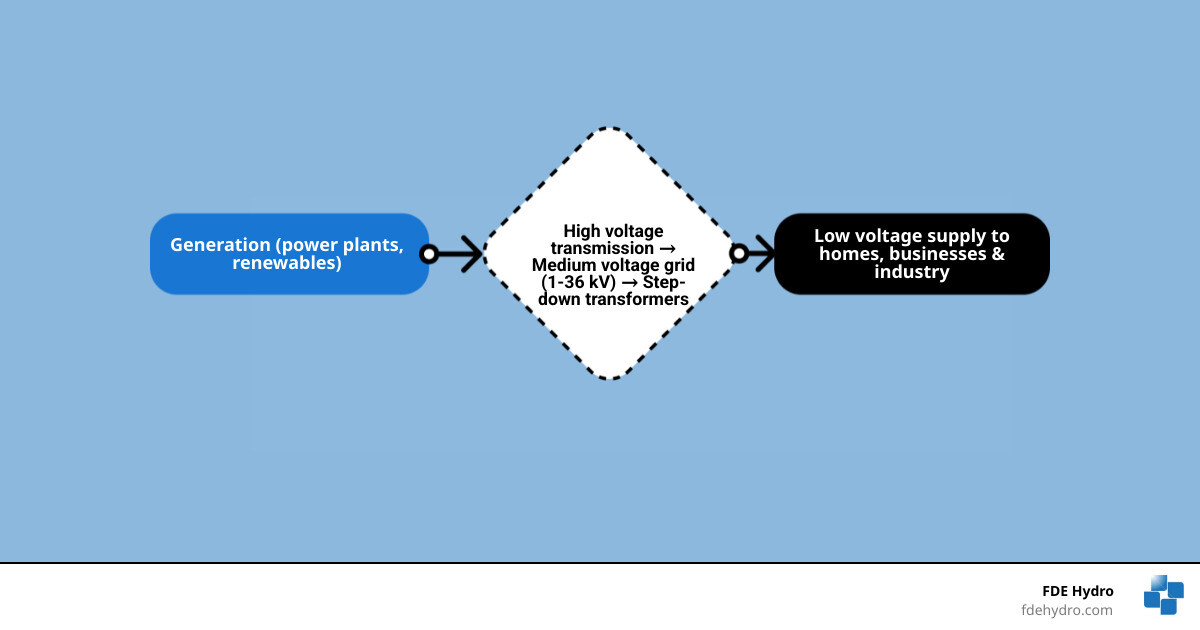
Medium voltage grid terminology:
What Is a Medium Voltage Grid and Where Does It Sit in the Power System?
A medium voltage grid is the part of the power system that moves electricity from bulk transmission substations toward neighborhoods, commercial districts, industrial sites, community infrastructure, and utility-scale renewable projects. If you want a broader refresher on grid layers, see More on electrical networks.
In practical terms, this is the distribution backbone. It is not the continent-spanning transmission network, and it is not the final low-voltage service line to a house. It is the middle ground that makes both of those layers useful.
How medium voltage is defined
The most widely cited international definition places medium voltage between 1 kV and 36 kV. In practice, utilities may use classes such as 4.16 kV, 12.47 kV, 13.2 kV, 13.8 kV, 15 kV, 24.9 kV, 27 kV, or 34.5 kV depending on local standards and legacy equipment.
Some sources use 1-35 kV and others use 1-36 kV. That difference is mostly about convention rather than physics. The important point is that medium voltage sits well above end-use building voltage and well below transmission-level voltage.
How the medium voltage grid connects transmission to low voltage
Electricity usually follows this chain:
- Generation plant produces power.
- Transformers step voltage up for long-distance transmission.
- Transmission substations step voltage down to medium voltage.
- Medium-voltage feeders carry power through cities, towns, rural service territories, and industrial corridors.
- Local distribution transformers step power down again to low voltage for homes and small businesses.
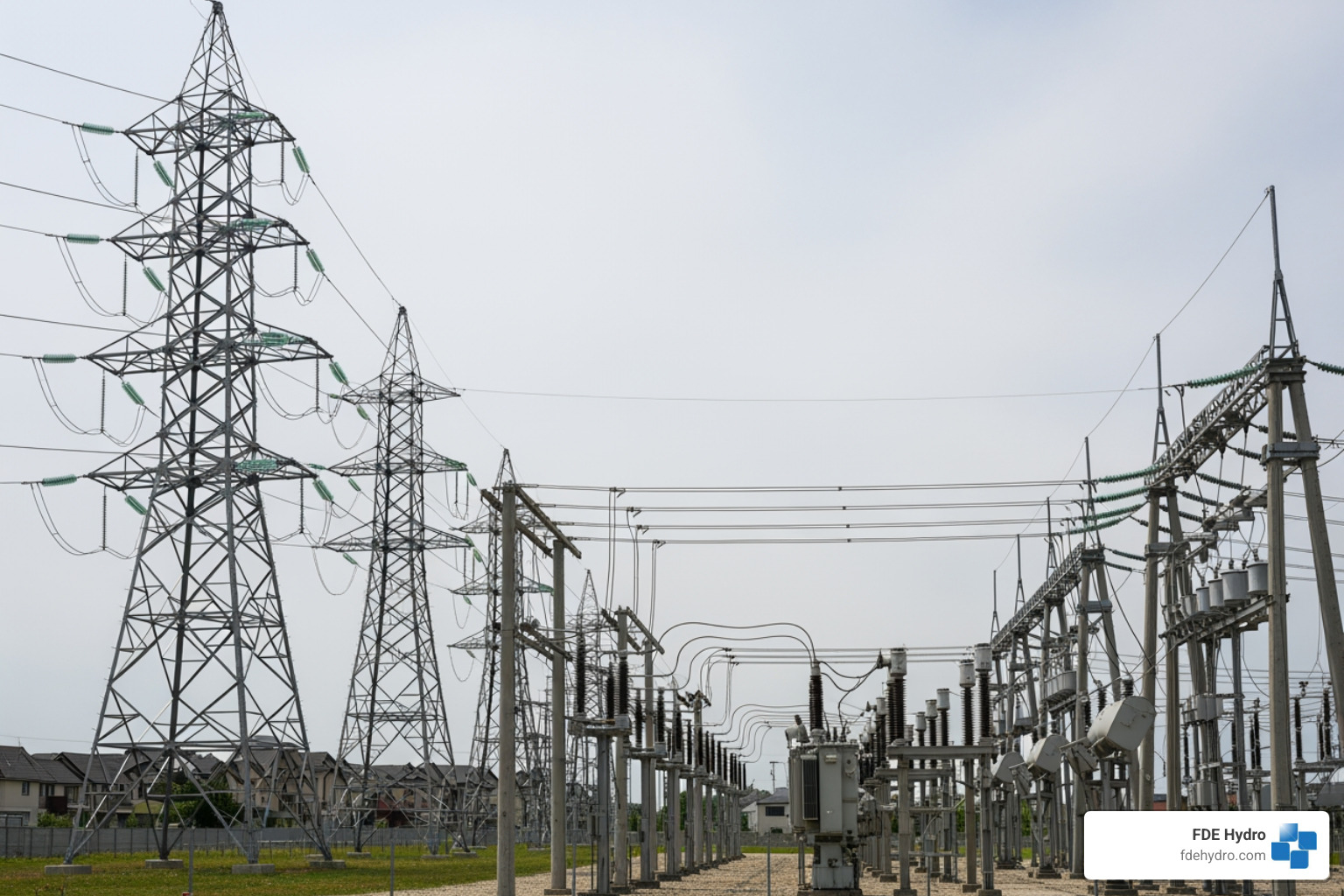
A feeder may leave an HV/MV substation and run for miles overhead in rural areas or underground in dense urban areas. Along the way, it supplies pad-mounted transformers, pole-top transformers, switchgear, and branch circuits.
High vs medium vs low voltage at a glance
| Grid layer |
Typical role |
Typical voltage range |
Best for |
Typical users |
| High voltage |
Bulk transmission |
Above medium voltage classes, often 69 kV and far higher in utility systems |
Long distances with lower losses |
Regional transmission operators, interties, large substations |
| Medium voltage |
Primary distribution |
1 kV to 36 kV |
Moving power across communities and to large loads |
Factories, hospitals, airports, campuses, renewable plants |
| Low voltage |
Final utilization |
Building service and end-use voltage |
Safe end-user delivery |
Homes, small shops, offices |
Why the different layers? Because higher voltage reduces current for the same power transfer, and lower current means lower losses and smaller conductors for long distances. But you would not want transmission voltage showing up at your toaster. Or your coffee maker would become a space program.
Core Components of a Modern Medium Voltage Grid
The medium voltage grid depends on a mix of electrical and control equipment that keeps power flowing safely and reliably. A useful technical overview of one major equipment class is this Medium-voltage switchgear overview.
At the core are substations and feeders:
- HV/MV substations step transmission voltage down to distribution voltage
- Busbars distribute power inside the substation
- Feeders carry medium-voltage power outward
- MV/LV transformer stations step voltage down for final local service
- Sectionalizing points divide networks into controllable segments
Common feeder layouts include:
- Radial feeders: simple and common, especially where cost matters
- Ring networks: offer alternate supply paths and better service continuity
- Looped arrangements with normally open points: a practical compromise between cost and reliability
Transformer stations are often the most visible sign of the medium-voltage system in built-up areas, especially where cables are underground.
Protection, control, and automation equipment
Modern MV networks rely on more than wires and transformers. They also need brains.
Key equipment includes:
- Circuit breakers
- Reclosers
- Ring main units
- Protection relays
- Fault indicators
- Voltage regulators
- Capacitor banks
- SCADA and communications equipment
- Sensors for current, temperature, and line condition
- Cable terminations and joints
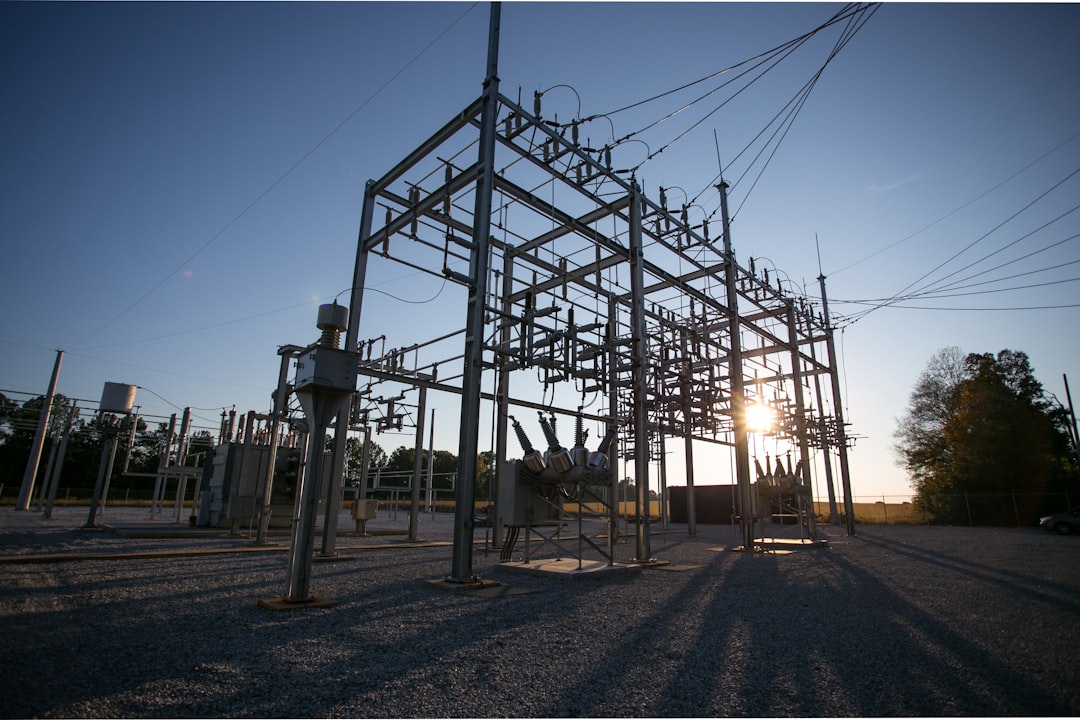
Protection coordination is crucial. If a fault occurs, the utility wants the device closest to the problem to isolate it first, while keeping healthy parts of the feeder energized. That is why relays, breaker settings, and recloser timing matter so much.
Automation adds speed. Utilities increasingly use advanced distribution management systems to support fault location, isolation, and service restoration. A smart feeder can often restore many customers automatically after a fault by switching around the damaged section.
Overhead vs underground medium voltage networks
Both overhead and underground MV systems are common, and each has tradeoffs.
Overhead networks:
- Lower installation cost
- Easier visual inspection
- Faster access for some repairs
- More exposure to storms, wind, ice, and vegetation
Underground networks:
- Better protection from weather and falling trees
- Often preferred in dense urban or visually sensitive areas
- Higher installation cost
- Fault location and repair can be slower and more specialized
In North America, both approaches are used depending on terrain, density, weather risk, and budget. In major cities, undergrounding is common. In rural service territories, overhead feeders remain widespread.
Medium Voltage Grid Applications, Customers, and Renewable Integration
A medium voltage grid does not just serve neighborhoods. It is also the connection point for many of the loads and resources shaping the modern energy system. For related distributed-control thinking, see Microgrid optimization basics.
Typical direct or near-direct MV users include:
- Manufacturing plants
- Hospitals
- Airports
- Universities and large campuses
- Water and wastewater facilities
- Data centers
- Transit systems
- Community microgrids
- Renewable energy projects
- Hydropower facilities
How PV, wind, and hydropower connect to the medium voltage grid
Solar PV plants, wind projects, battery systems, and many small hydro installations often connect at medium voltage through a point of interconnection. The general path looks like this:
- Generation is produced at the plant.
- Inverters or generator step-up transformers raise voltage to an MV class.
- A collector system gathers output from multiple units if needed.
- Protection, metering, and switching equipment interface with the utility feeder or substation.
- Utility studies confirm export limits, fault current impacts, voltage performance, and protection coordination.
For PV and battery projects, inverter behavior matters a lot. For wind and hydropower, generator controls and transformer design also matter. In all cases, the utility wants to know how the plant behaves during faults, voltage fluctuations, and restoration events.
At FDE Hydro, this is especially relevant for run-of-river and water-control infrastructure. Hydropower projects frequently connect at medium voltage because the power level is too large for ordinary low-voltage service but not large enough to justify transmission-class interconnection.
Why medium voltage is used for large loads and community-scale supply
Medium voltage is the sweet spot for customers that need substantial power without building their own transmission network.
Examples include:
- Hospitals that need strong reliability and backup integration
- Airports with extensive lighting, HVAC, and operations loads
- Water plants with large pumps and motors
- Industrial sites with process equipment
- EV charging hubs with major coincident demand
- Campuses that distribute power across multiple buildings
Using MV reduces current compared with low-voltage supply for the same power, which can reduce conductor size and losses across a facility or district.
Power quality impacts from renewable-heavy feeders
As more DERs connect to feeders, power quality becomes more dynamic.
Common issues include:
- Voltage rise during strong solar output
- Flicker from variable generation or motor loads
- Harmonics from inverter-based resources
- Reverse power flow toward upstream substations
- Phase imbalance and voltage asymmetry
- Protection miscoordination if fault current patterns change
Research on asymmetry in renewable-rich MV networks has shown that load conditions can materially change zero-voltage asymmetry, and ignoring load can produce meaningful calculation errors. If you want the technical study, see Research on asymmetry in MV networks with renewables.
The takeaway is simple: renewable integration is not just about adding megawatts. It is also about managing feeder behavior in real time.
Reliability, Safety, and Power Quality Challenges in Medium Voltage Networks
The distribution layer is where customers feel the grid most directly. And it is also where many of the problems live. For a broader everyday perspective, see How grids power daily life.
Why medium voltage grid reliability matters
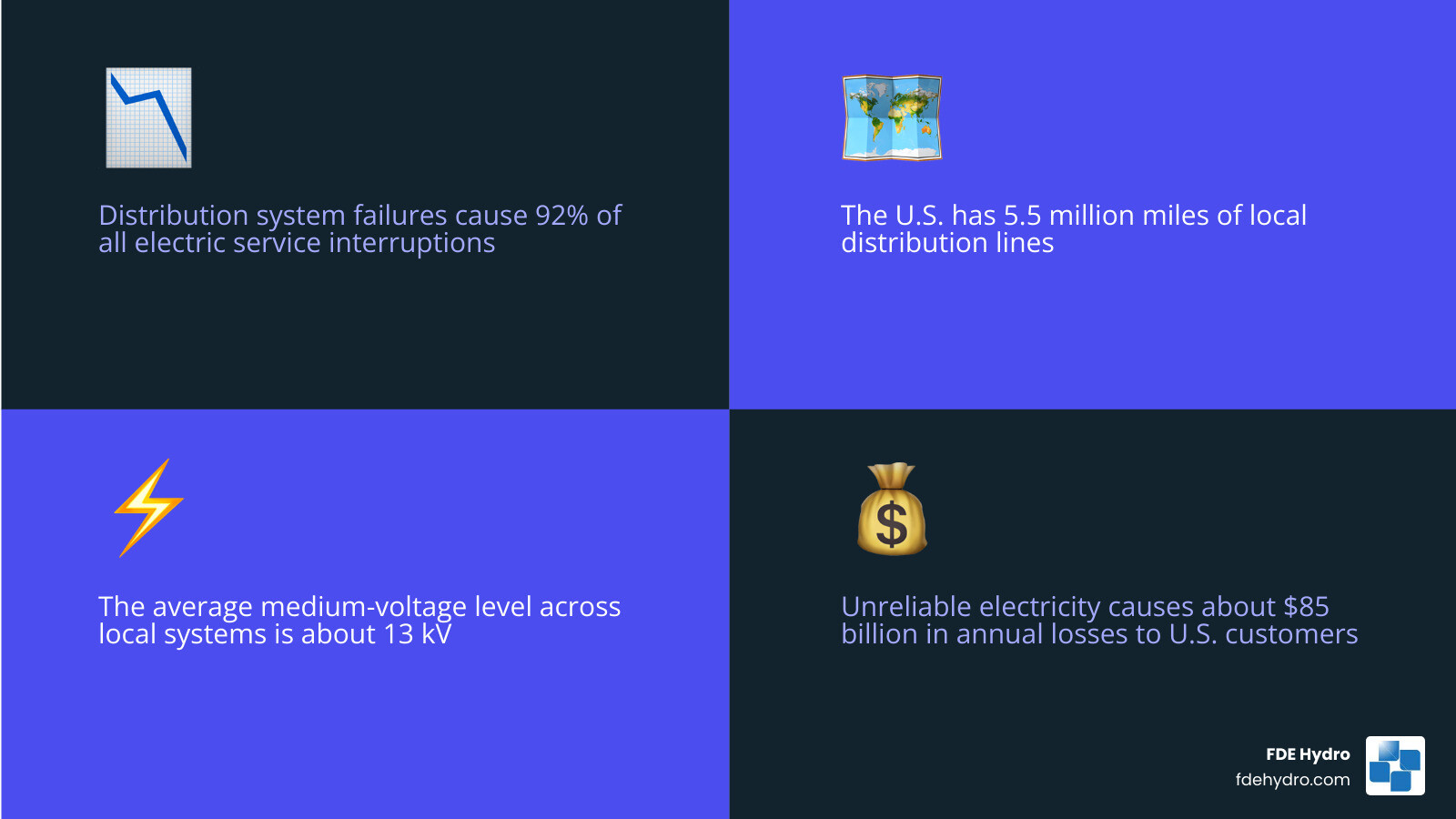
One of the most striking U.S. statistics is that distribution system failures account for 92% of all electric service interruptions. That makes the medium voltage grid a reliability front line, not a side note.
A few more important figures from the research:
- The U.S. has about 5.5 million miles of local distribution lines
- The average medium-voltage level across these local distribution systems is about 13 kV
- Unreliable electricity causes about $85 billion in annual losses to U.S. residential and business customers
Reliability challenges often include:
- Aging poles, cables, and insulation
- Extreme weather
- Vegetation contact
- Animal intrusion
- Equipment overheating
- Feeder congestion from load growth
- Limited visibility on lightly monitored circuits
Restoration time matters too. A short outage at a residence is inconvenient. A short outage at a hospital, water plant, or industrial process can be expensive or dangerous.
Safety issues in medium voltage operations
Medium voltage is not forgiving. Utility crews, contractors, and facility operators treat it with strict procedures for good reason.
Core safety concerns include:
- Arc flash risk
- Induced voltage and backfeed
- Improper switching sequences
- Inadequate grounding and bonding
- Failed insulation
- Public contact hazards after storms
- Step and touch potential near faults
Safe operation depends on:
- Lockout/tagout procedures
- Confirmed de-energization
- Proper earthing and grounding
- Qualified personnel
- Adequate approach distances and clearances
- Tested PPE and insulated tools
- Clear switching plans and communications
This is especially important as DERs increase. A line that looks de-energized from the utility side may still be energized by local generation if interconnection and isolation are not handled correctly.
Power quality problems and how utilities manage them
Power quality issues in MV networks show up as equipment stress, nuisance trips, losses, and customer complaints. Utilities manage them through both planning and active control.
Common medium-voltage faults and disturbances include:
- Single-line-to-ground faults
- Phase-to-phase faults
- Three-phase faults
- Cable insulation breakdown
- Transformer failures
- Broken conductors
- Reclosing misoperations
- Sustained undervoltage or overvoltage
- Harmonic distortion
- Voltage unbalance
Typical mitigation tools include:
- Capacitor banks for reactive support
- Voltage regulators and load tap changers
- Feeder reconfiguration
- Harmonic filtering
- Phase balancing
- Better relay settings
- Power quality monitoring
- Faster fault indicators and line sensors
The more variable the feeder, the more valuable measurement becomes. You cannot fix what you cannot see.
The Future of the Medium Voltage Grid: Smart Grids, Power Electronics, and MVDC
The future medium voltage grid will be more digital, more flexible, and more power-electronics-heavy than the one utilities built decades ago. If you want a conceptual companion piece, see What the grid means in electrical engineering.
How smart grid technologies are upgrading the medium voltage grid
Smart grid upgrades are making MV networks more observable and more controllable.
Important technologies include:
- Line sensors
- Fault passage indicators
- Smart switches and reclosers
- Advanced metering data integration
- SCADA expansion
- ADMS platforms
- Predictive maintenance analytics
- Dynamic line monitoring
- Distributed energy resource management systems
This matters because utilities need real-time visibility into feeder loading, abnormal conditions, and switching status. Research cited in the background also notes that sensor-driven approaches can improve reliability metrics such as SAIDI and reduce outage-related costs by helping utilities spot trouble earlier.
Smart grid modernization also supports DER orchestration, where utilities coordinate solar, batteries, controllable loads, and microgrids rather than treating them as passive attachments.
Cybersecurity belongs in this conversation too. The more connected the field device, the more important secure communications, authentication, patching, and network segmentation become.
The role of medium voltage power electronics
Medium-voltage power electronics are becoming a major enabler of modernization.
Examples include:
- Static VAR support and reactive compensation
- Solid-state transformers
- Back-to-back converters between networks
- Fast voltage support for weak feeders
- Interfaces for batteries and renewables
- Power flow control devices
Wide-bandgap devices such as silicon carbide are especially important because they support higher-efficiency, faster-switching converter designs. Research in this area points to the possibility of direct connection to 15-kV-class grids in some applications without a bulky line-frequency transformer.
That opens the door to more compact and intelligent grid interfaces, though deployment still depends on cost, standards, and utility acceptance.
Where MVDC fits in future distribution architecture
Most medium-voltage networks today are AC. That is still the dominant reality in 2026. But MVDC is getting more attention for niche and emerging applications.
Two useful resources are Medium-voltage direct current explained and Technical overview of MVDC systems.
Potential MVDC use cases include:
- Remote load connections
- Islanded or weak-grid systems
- Renewable collection systems
- Fast charging corridors
- Industrial DC loads
- Interfacing different grid conditions
- Black start support in certain architectures
Research summarized in the source material suggests MVDC can increase transfer capability on some converted assets and may serve projects up to roughly 150 MW in suitable cases. It is promising, but it is not yet the default answer for ordinary distribution planning. Think of it as an important tool in the future toolbox, not a magic wand.
Frequently Asked Questions About the Medium Voltage Grid
What voltage is considered medium voltage?
Most widely, medium voltage is defined as 1 kV to 36 kV under IEC-style classification. In utility practice, many common systems fall in the 4 kV to 35 kV range, with around 13 kV being a familiar U.S. distribution class.
Is the medium voltage grid AC or DC?
Today, the medium voltage grid is overwhelmingly AC. That is the standard form for utility distribution feeders and substations. However, MVDC is emerging for selected applications where power electronics and controllability offer a strong advantage.
Can renewable energy connect directly to medium voltage?
Yes. Solar farms, wind projects, battery storage, and many hydropower facilities commonly interconnect at medium voltage. They typically need inverters or step-up transformers, utility protection review, metering, switching equipment, and interconnection studies covering voltage, fault duty, export limits, and power quality.
Conclusion
The medium voltage grid is the working middle of the electric system. It links transmission to end users, serves major facilities directly, and acts as the main entry point for many renewable resources. It generally operates between 1 kV and 36 kV, often around 13 kV in U.S. distribution practice, and it carries an outsized share of reliability, safety, and modernization challenges.
It is also where the opportunity is.
As utilities expand renewable integration, electrify transportation, harden systems against extreme weather, and digitize operations, medium-voltage networks will keep getting smarter and more dynamic. Better protection, better sensing, stronger automation, and targeted use of power electronics will shape that transition.
For us at FDE Hydro, this matters because energy infrastructure does not stop at the generating asset. Whether we are talking about hydropower, water-control systems, or broader grid-connected renewable development, project success depends on understanding the grid layer that actually delivers and accepts power.
To keep exploring the topic, Browse more power grid articles.
by Adaptify Support | Jun 5, 2026 | Hydropower Articles
Why Hydropower Operator Certification Is the Foundation of a Safe, Reliable Hydro Workforce
Hydropower operator certification is the credential that proves a professional has the knowledge, skills, and hands-on experience to safely run a hydroelectric facility. If you want a quick answer, here is what you need to know:
Quick Overview: Hydropower Operator Certification
| Question |
Answer |
| What is it? |
A formal credential verifying competency to operate hydroelectric plants |
| Who requires it? |
Federal agencies, state utilities, and private plant operators |
| Main certification types |
Power Plant Operator, Electrician, Mechanic, Operating Engineer |
| Typical path |
4-year apprenticeship or recognized operations experience + exam |
| Where to apply |
USAJOBS, state civil service portals, utility employer programs |
| Key training resource |
NHA Hydro Academy, U.S. Army Corps of Engineers programs |
Hydropower accounts for roughly 6% of all U.S. electricity generation and 31% of all U.S. renewable electricity (as of 2023). That power flows through turbines, generators, control systems, and high-voltage switchgear — all operated by certified professionals working around the clock.
These are safety-critical roles. A single mistake in a powerhouse can affect a dam, a river, a grid, and an entire downstream community. That is exactly why certification exists: to set a clear, verified standard for who is qualified to operate this infrastructure.
The path to certification is not one-size-fits-all. It varies by craft specialty, employer type, state, and whether the facility is federally managed or privately licensed. This guide breaks it all down — clearly and practically.
I’m Bill French, Sr., Founder and CEO of FDE Hydro™, and over the past five decades of leading large-scale civil construction and hydropower development — including participation in the U.S. Department of Energy’s Hydropower Vision Task Force — I have seen how hydropower operator certification shapes the workforce that keeps these facilities running safely and efficiently. Whether you are exploring an apprenticeship, hiring for a plant, or planning a new hydro project, understanding the certification landscape is essential to getting it right.
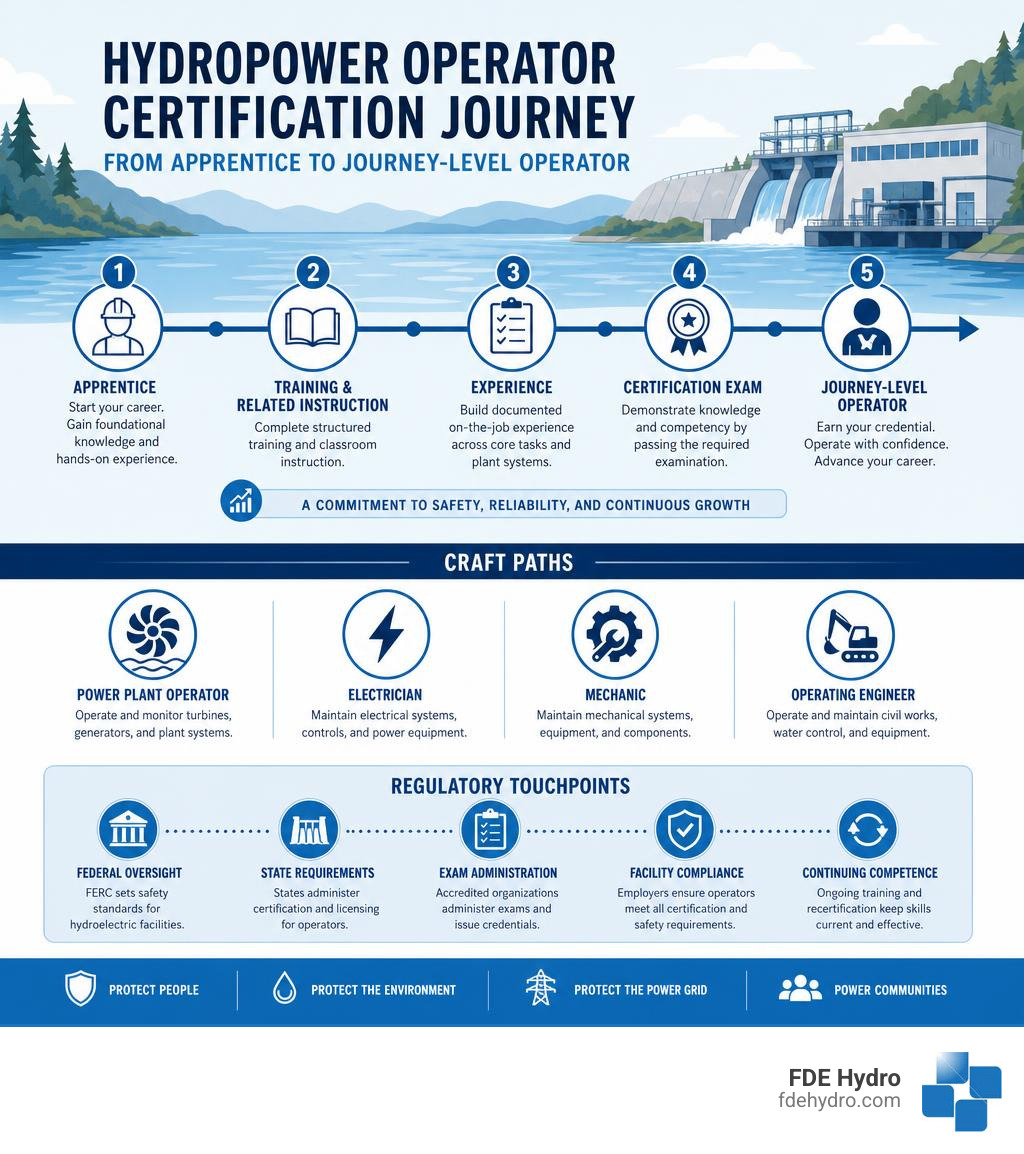
What Hydropower Operator Certification Means and Why It Matters
Hydropower operator certification is an individual qualification. It confirms that a person can operate, monitor, maintain, or support hydroelectric plant systems according to approved safety, operating, environmental, and grid procedures.
At a basic level, certification tells an employer: this person can be trusted around water under pressure, rotating machinery, high-voltage equipment, and control systems that do not care how good your excuses are.
Certified hydropower professionals may operate:
- Turbine-generator units
- Spillway gates and outlet works
- Powerhouse auxiliaries
- Transformers and switchyards
- SCADA and control room systems
- Reservoir, pumping, and water conveyance systems
- Emergency shutdown and alarm systems
The U.S. Department of Energy’s Hydroelectric Power Plant Operator career profile describes operators as the people who control and maintain the systems that generate hydroelectric power. That sounds simple until you remember that the “system” includes a river, a dam, a grid interconnection, environmental license conditions, and people downstream.
For a broader foundation, our Hydropower overview explains how hydropower fits into modern renewable energy infrastructure.
Why Professionals Need Hydropower Operator Certification
Hydropower plants are usually staffed 24/7, often with rotating shifts. Operators must make decisions during normal operation, storms, grid events, equipment failures, and emergency releases.
Certification matters because operators need verified competence in:
- Controlled water releases
- Generator startup and shutdown
- Switching orders and electrical clearances
- Lockout/tagout procedures
- Turbine and governor operation
- Alarm response
- Spillway and gate operations
- Environmental flow requirements
- Emergency action procedures
- Incident prevention and reporting
A certified operator is not just “turning knobs.” They are managing risk in real time.
Facility Certification vs. Individual Operator Certification
This is one of the biggest points of confusion.
A facility license or certification applies to the project. An operator certification applies to the person.
| Type |
Applies To |
Examples |
| Individual operator credential |
A person |
Hydroelectric Plant Operator, Power Plant Operator, Operating Engineer |
| Facility license |
A hydropower project |
FERC license or exemption |
| Environmental certification |
A facility or project |
Low-impact hydro, RPS eligibility |
| Employer qualification |
A specific role or site |
Clearance cards, switching authorization, internal requalification |
A plant may have a federal license, state dam safety approval, and renewable energy certification, but it still needs qualified people to run it. Likewise, an operator may hold a credential but still need site-specific training before touching a particular facility’s controls.
Where Certification Is Required, Preferred, or Job-Specific
In the United States and Canada, hydropower operator certification is often tied to the employer, agency, union program, civil service system, or plant classification rather than one universal national license.
You may see certification requirements in:
- Federal hydropower jobs
- State civil service exams
- Public utility operator roles
- Municipal utility positions
- Independent power producer jobs
- Apprenticeship programs
- Operating engineer systems in Canada
- Employer-specific qualification programs
California, for example, uses a civil service exam pathway for Hydroelectric Plant Operator roles through CalCareers. In Ontario, Canada, operating engineer certification is administered through the provincial safety authority, with defined exam, renewal, and experience requirements under Certification: Operating Engineer.
Hydropower Certification Types, Apprenticeships, and Training Paths
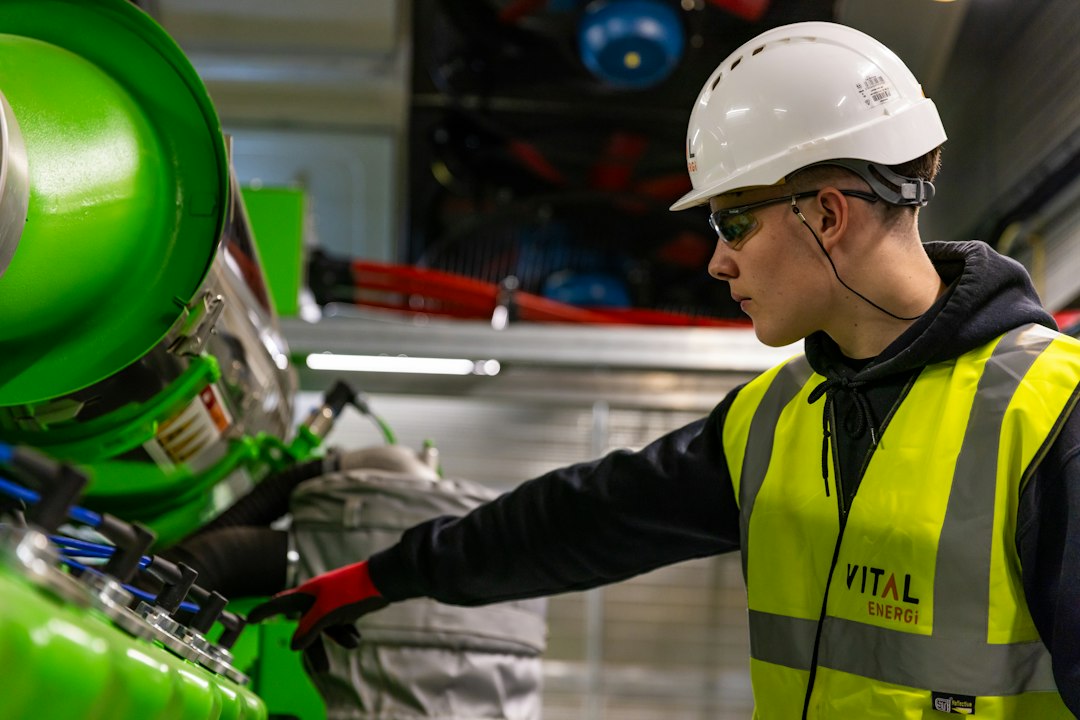
Hydropower is a team sport. A certified operator may be the person in the control room, but electricians, mechanics, technicians, compliance staff, and maintenance planners all keep the plant safe and productive.
For related plant upkeep concepts, see our guide to Hydro Power Plant Maintenance.
Main Types of Hydropower Operator Certification
The most common certification or qualification paths include:
| Path |
Main Focus |
Typical Work |
| Power Plant Operator |
Operations and control |
Startups, shutdowns, water schedules, alarms, switching |
| Hydroelectric Plant Operator |
Hydro-specific operation |
Turbines, pumps, gates, remote control, clearances |
| Power Plant Electrician |
Electrical systems |
Breakers, relays, transformers, protection, instrumentation |
| Power Plant Mechanic |
Mechanical systems |
Turbines, valves, bearings, cranes, pumps, governors |
| Operating Engineer |
Power plant safety and plant operation |
Plant supervision, pressure systems, registered plant operation |
| Operator-in-Training or Trainee |
Entry pathway |
Supervised training, classroom learning, rotations |
Different employers use different titles. The key is to read the job announcement carefully and look for required exams, apprenticeship completion, qualifying experience, and site authorization.
Power Plant Operator Pathway
The operator pathway is centered on control authority. Operators may work from local panels, central control rooms, or remote operations centers.
Typical responsibilities include:
- Starting and stopping generating units
- Monitoring reservoir and tailwater conditions
- Implementing water, power, and pumping schedules
- Coordinating load changes
- Responding to alarms
- Performing high-voltage switching when authorized
- Issuing or following clearances
- Maintaining plant logs
- Coordinating with dispatchers and maintenance crews
California’s Hydroelectric Plant Operator exam bulletin lists duties such as operating pumps, generators, auxiliaries, switches, valves, aqueduct facilities, and turnouts from control panels or remotely.
Power Plant Electrician and Mechanic Pathways
Electricians and mechanics may not always be called “operators,” but in hydropower they often complete similar apprenticeship structures and earn journey-level qualifications.
Power plant electricians work on:
- Breakers
- Relays
- Transformers
- Protection systems
- Motors
- Control wiring
- Instrumentation
- Switchyard equipment
Power plant mechanics work on:
- Turbines
- Governors
- Valves
- Bearings
- Pumps
- Cranes
- Gates
- Penstock and auxiliary equipment
Both crafts support safe operation during outages, emergency repairs, inspections, upgrades, and modernization projects. In our work with modular dam and retrofit systems, we see how closely construction, maintenance, and operations must coordinate. Nobody wants to discover a valve access problem after the concrete is already poured.
How the Four-Year Hydropower Apprenticeship Structure Works
A common federal-style hydropower apprenticeship model uses four progressive parts over four years:
- Part I: General hydropower orientation and broad plant fundamentals
- Part II: Beginning specialized craft training
- Part III: Intermediate craft training and deeper equipment responsibility
- Part IV: Advanced craft training leading toward journey-level qualification
The structure typically includes:
- Academic study
- Plant equipment study
- On-the-job training
- Rotations through work groups or facilities
- Mentoring by journey-level workers
- Periodic evaluations
- External exams or licensing steps where required
Some U.S. Army Corps of Engineers hydropower apprenticeship programs follow ER/EP 1130-2-510 guidance and use a one-year-per-part progression. Apprentices may rotate through operator, mechanic, and electrician exposures before specializing. Field officers or supervisors may monitor progress, while journeymen provide hands-on coaching.
In some programs, completing schooling, profiling, and exams may lead to an I-Grade or comparable journey-level qualification.
Professional Development and Short-Course Certification Options
Not every hydropower professional needs a full apprenticeship. Engineers, project managers, asset managers, compliance staff, and new hires from other power sectors often benefit from short-course training.
The NHA Hydro Academy’s system principles training is one example. Based on available program information, the full course provides 40 professional development hours over eight months and covers modules such as:
- Water-to-wires fundamentals
- Equipment and technology
- Environmental topics
- Dam safety
- Production planning
- Markets
- Licensing and compliance
- Asset management and reliability
These programs can support continuing education, cross-training, and faster onboarding. They are not always substitutes for journey-level operator certification, but they help teams speak the same language.
Eligibility Requirements, Prerequisites, and Skills Needed to Qualify
Hydropower is welcoming to people who like practical work, problem-solving, and learning systems from the ground up. But it is not casual work. The entry requirements reflect that.
Entry Requirements for Hydropower Operator Certification Programs
Common prerequisites include:
- Minimum age of 18
- High school diploma or GED
- Transcripts or placement testing
- Math and mechanical aptitude
- Electrical aptitude
- Ability to read and write English for safety and operations
- Valid driver’s license in many roles
- Background check or security clearance
- Ability to work rotating shifts
- Ability to travel between facilities in some apprenticeship programs
Some programs use placement tests such as ACCUPLACER or ALEKS to assess readiness for technical coursework.
For experienced applicants, employers may accept:
- Completion of a recognized apprenticeship
- Prior hydroelectric plant operations experience
- Large pumping plant operations experience
- High-voltage switching experience
- Substation or switching yard experience
- Large power plant experience
California’s civil service pathway notes that qualifying experience may include hydroelectric generating plants, large pumping plants, and certain high-voltage environments. It also recognizes that experience in substations or switching yards of at least 230 kV may substitute for part of the required operations experience.
Knowledge Areas Tested in Exams and On-the-Job Evaluations
Certification exams and evaluations commonly test:
- Hydraulics and water flow
- Turbine-generator principles
- Electrical theory
- Mechanical systems
- Protection systems
- Instrumentation and controls
- SCADA monitoring
- Power and water calculations
- Switching procedures
- Clearances and lockout/tagout
- Plant logs and documentation
- Environmental permit conditions
- Dam safety fundamentals
- Emergency procedures
- Operating codes and safety rules
Operators also need regulatory literacy. A plant’s FERC license, water rights, fish passage requirements, minimum flow rules, and dam safety procedures can all affect daily operation.
Physical Abilities and Working Conditions
Hydropower can be physically demanding. Typical conditions include:
- Lifting up to around 45 pounds frequently in some programs
- Working near moving machinery
- Climbing ladders and stairs
- Working at heights
- Entering confined spaces
- Wearing PPE
- Working around noise
- Walking on wet or uneven surfaces
- Responding to emergency callouts
- Working 12-hour rotating shifts
- Exposure to weather at dams, spillways, and switchyards
Some roles require normal hearing, normal sense of smell, color vision, and enough mobility to respond quickly in industrial environments. These requirements exist because alarms, odors, color-coded indicators, and radio calls can all be safety-critical.
Soft Skills That Separate Successful Apprentices
The best operators are not always the loudest people in the room. Often, they are the ones who notice the odd vibration, ask the careful question, and document the detail everyone else missed.
Strong candidates bring:
- Situational awareness
- Calm judgment
- Curiosity
- Reliability
- Teamwork
- Communication
- Documentation discipline
- Respect for procedures
- Willingness to learn from journeymen
- Attention to detail
- A safety-first mindset
For interviews, many employers use behavioral questions. The STAR method – Situation, Task, Action, Result – is useful for explaining how you handled safety issues, conflict, troubleshooting, or time pressure.
Federal, State, Safety, and Environmental Rules Operators Must Understand
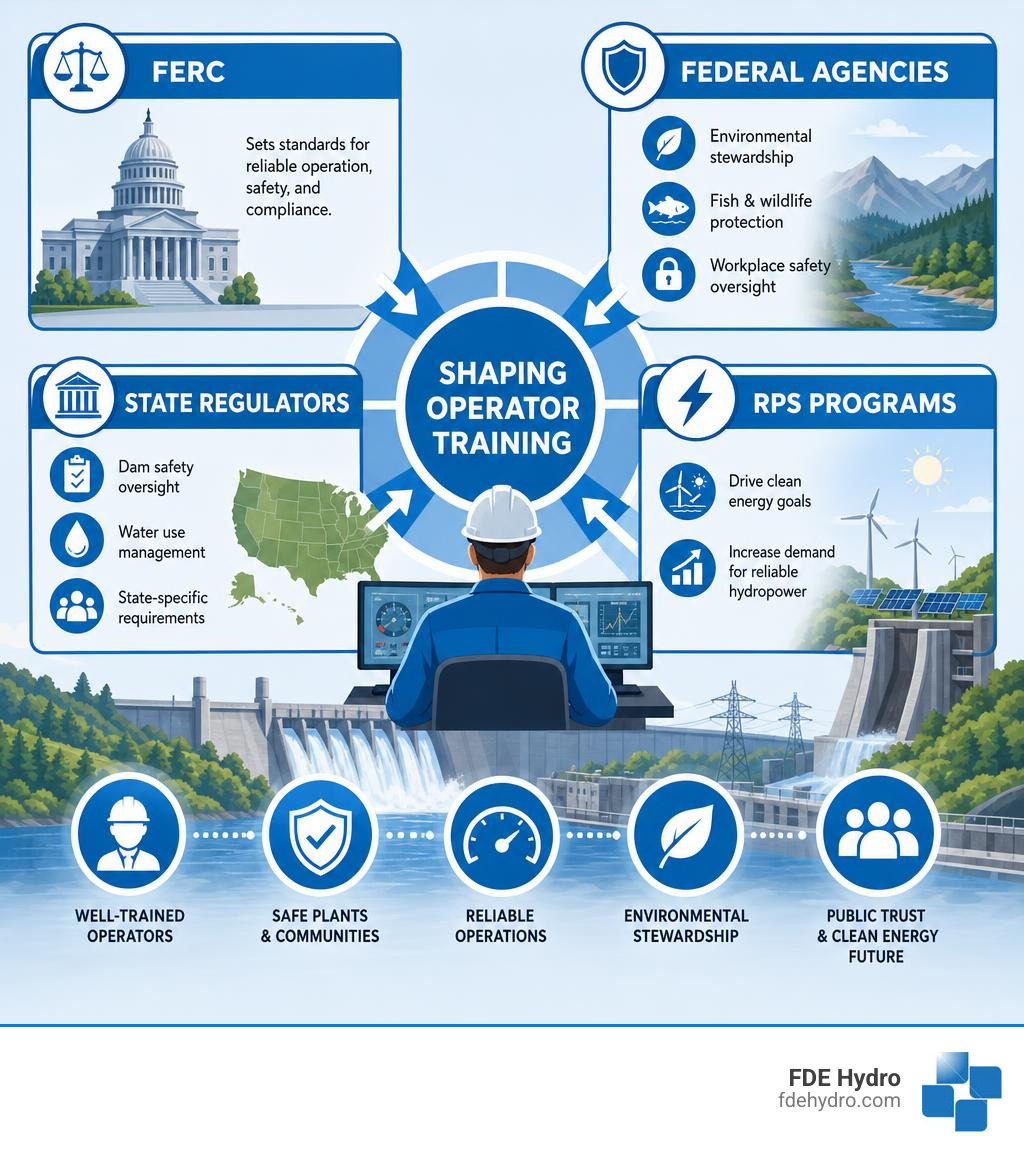
Hydropower operators do not need to be attorneys. That is good news for everyone. But they do need to understand the rules that govern their plant.
For deeper project delivery context, see The Ultimate Guide to Hydropower Project Management Success and Hydropower Asset Management.
Federal Agencies That Influence Operator Standards
In the United States, several federal agencies shape hydropower operations:
- FERC: Licenses and oversees most non-federal hydropower projects.
- U.S. Army Corps of Engineers: Operates federal dams and may approve modifications involving Corps-managed structures.
- Bureau of Reclamation: Manages major water infrastructure in the western United States and may be involved when hydropower uses Reclamation dams or conduits.
- Federal employers: Establish apprenticeship, safety, and qualification procedures for federal hydropower staff.
FERC licenses for original hydropower projects may run up to 50 years. Relicenses typically authorize continued operation for 30 to 50 years. That means today’s operating rules can shape a river and facility for a generation.
FERC Licensing, Exemptions, and Why Operators Should Care
FERC jurisdiction generally applies to non-federal hydropower projects on navigable waters, U.S. lands, federal reservations, or streams affecting interstate commerce.
Operators should care because license conditions become operating instructions. They may govern:
- Minimum flows
- Ramp rates
- Reservoir elevations
- Fish passage
- Recreation releases
- Water quality monitoring
- Reporting
- Emergency procedures
- Inspection schedules
Important FERC-related facts include:
- Small conduit hydroelectric facilities up to 40 MW using flow from a man-made conduit may qualify for exemption from the full licensing process.
- Small hydroelectric power projects of not more than 10 MW may qualify for exemption.
- Qualifying Facilities under 20 MW may be exempt from certain Federal Power Act provisions, including sections 205 and 206.
- A small power production facility is generally 80 MW or less and must use at least 75% renewable primary energy input, including hydro, wind, solar, biomass, waste, or geothermal.
Developers often submit a Pre-Application Document, or PAD, to FERC describing project facilities, operations, and environmental impacts. Operators later live with the procedures and commitments that come out of that process.
State Agencies, Public Utility Commissions, and Operator Qualifications
State-level requirements vary. Depending on location, a hydropower project may need:
- Public utility commission approval
- Certificate of Public Convenience and Necessity
- State dam safety review
- Water rights approvals
- Environmental permits
- State operator exams or civil service eligibility
- Continuing education or requalification
In California, the Hydroelectric Plant Operator civil service process includes an online training and experience exam, minimum qualifications, and an eligible list. Applicants must score at least 70% to be placed on the eligible list, and eligibility lasts 12 months after the list is established.
In Canada, operating engineer programs may involve exams, qualifying experience, renewals, and reinstatement procedures. Ontario’s Operating Engineer certification guidance notes that exams are valid for five years and certificates require renewal.
For facilities in Brazil and Europe, operator qualification is shaped by national grid rules, occupational safety law, employer authorization, and equipment-specific training. The exact credential name changes, but the core principle does not: only trained and authorized personnel should operate safety-critical hydro assets.
Dam Safety, Environmental Compliance, and RPS Eligibility
Hydropower operator certification connects directly to dam safety and environmental compliance.
Operators may support:
- Dam inspections
- Emergency action plans
- Gate testing
- Reservoir monitoring
- Spillway operation
- Minimum flow compliance
- Fish passage operations
- Water quality monitoring
- Recreation release schedules
- Incident reporting
Environmental and renewable certifications may consider criteria such as:
- Flow regimes
- Water quality
- Fish passage
- Threatened and endangered species
- Cultural resources
- Shoreline protection
- Recreation access
Renewable Portfolio Standard, or RPS, eligibility is usually facility-based, not operator-based. Still, operators are the people who keep the facility operating within the conditions that protect eligibility.
Career Pathways, Advancement, and How to Apply in 2026
Hydropower needs experienced hands and new talent. As older workers retire and plants modernize, operators who understand both legacy equipment and digital systems will be especially valuable.
For broader industry context, see our guides to Hydropower Project Costs and Modern Hydropower Technology.
Where to Find Hydropower Apprenticeships and Operator Jobs
In 2026, good places to look include:
- USAJOBS for federal trainee and operator announcements
- State civil service portals such as CalCareers
- Public utility career pages
- Municipal utility job boards
- Independent power producer postings
- Apprenticeship announcements
- Union and non-union training programs
- Employer job alerts
Application materials often include:
- Resume
- Transcripts
- Proof of diploma or GED
- Apprenticeship documentation
- Experience verification
- Test results
- Certifications
- Safety training records
Tailor your resume to the job announcement. If the posting mentions high-voltage switching, SCADA, rotating shifts, or turbine operation, make sure your experience is easy to find.
What to Expect During the Application and Exam Process
Depending on the employer, the process may include:
- Online application
- Civil service form, such as California’s STD 678
- Training and experience exam
- Technical assessment
- Minimum score requirement
- Eligible list placement
- Interview
- Background check
- Medical or physical evaluation
- Security clearance
- Probationary or trainee period
California’s Hydroelectric Plant Operator exam requires a final score of 70% to be placed on the eligible list, with eligibility lasting 12 months. Salary examples listed in the bulletin include monthly ranges of $8,128 to $10,478 and $8,503 to $10,968, depending on range and classification details.
Interview questions often test judgment. Expect scenarios about alarms, unsafe work, unclear instructions, confined spaces, switching, or communication during emergencies.
Career Growth After Hydropower Operator Certification
After certification, career paths may include:
- Journey-level operator
- Senior operator
- Chief operator
- Control room supervisor
- Dispatcher
- Hydro mechanic
- Hydro electrician
- Maintenance planner
- Dam safety technician
- Compliance specialist
- Asset manager
- Operations manager
- Plant manager
- Reliability engineer
Hydropower experience also transfers well into modernization, retrofitting, construction coordination, and asset management. At FDE Hydro, we see that strong operators often become essential voices during retrofit planning because they know how the facility actually behaves – not just how the drawings say it behaves.
Salary, Scheduling, and Long-Term Outlook
Hydropower jobs often offer stable public-sector or utility-sector career paths, but schedules can be demanding.
Expect:
- Rotating shifts
- Nights, weekends, and holidays
- Overtime during outages or storms
- Emergency callouts
- 24-hour coverage requirements
- Strong benefits in many public-sector roles
The long-term outlook is supported by renewable energy demand, grid reliability needs, dam modernization, pumped storage, small hydro, and infrastructure retrofits. As North America, Brazil, and Europe continue upgrading water and power infrastructure, qualified operators will remain central to safe performance.
Frequently Asked Questions About Hydropower Operator Certification
Is Hydropower Operator Certification the Same in Every State or Country?
No. Hydropower operator certification varies by employer, jurisdiction, plant type, and craft.
In the United States, federal agencies, state civil service systems, public utilities, and private owners may each define qualifications differently. California has a specific civil service exam pathway. Canada may use operating engineer certification systems, such as Ontario’s program. Brazil and European countries use their own national safety, grid, and employer qualification frameworks.
Always check the authority that applies to the facility where you want to work.
Can I Become a Hydropower Operator Without Prior Power Plant Experience?
Yes, in many cases. Entry-level apprenticeships and trainee roles are designed for people who do not already have power plant experience.
A strong candidate may come from:
- High school or technical school
- Military mechanical or electrical roles
- Water systems work
- Industrial maintenance
- Electrical trades
- Mechanical trades
- Pumping plants
- Substations
- Control room environments
You will still need to meet age, education, physical, safety, and testing requirements. But you do not always need to start as an expert. Apprenticeships exist because the industry knows operators are built through training.
Does Hydropower Operator Certification Need Renewal?
Sometimes. It depends on the credential.
Possible renewal requirements include:
- Annual certificate renewal
- Multi-year renewal cycles
- Continuing education units
- Professional development hours
- Refresher safety training
- Lockout/tagout requalification
- Switching authorization renewal
- Employer-specific checkouts
- Reinstatement exams after expiration
Ontario’s operating engineer system, for example, includes renewal and reinstatement procedures. NHA-style professional development courses may provide PDHs. Employers may also require recurring safety and site-specific requalification even when an external certificate does not expire.
Conclusion: Your Next Step Toward a Hydropower Operations Career
Hydropower operator certification is the safest, clearest pathway into one of renewable energy’s most important hands-on careers.
If you are starting out, look for apprenticeships, trainee roles, and civil service exams. If you already have industrial, electrical, mechanical, water, or military experience, document it carefully and compare it with the job requirements. If you manage a facility, treat certification as part of your risk management system, not just an HR checkbox.
Modern hydropower needs people who understand water, wires, machinery, safety, and compliance. That combination is rare, valuable, and worth developing.
At FDE Hydro, we believe the future of hydropower depends on better infrastructure and better-trained people working together. To keep learning, explore hydropower solutions and industry insights.
by Adaptify Support | Jun 4, 2026 | Energy Resource Articles
Why Renewable Energy Project Development Is One of the Most Complex — and Critical — Processes in Clean Energy
Renewable energy project development is the multi-stage process of turning a clean energy idea into a fully operating power plant — covering everything from initial site screening to financing, construction, and long-term operations.
Here is a quick overview of the core steps:
- Market screening and site evaluation — assess resource quality, land, and grid access
- Site control — secure land rights through leases or options
- Feasibility studies — model energy yield, costs, and financial returns
- Environmental review and permitting — obtain approvals at local, state, and federal levels
- Interconnection — apply for and negotiate grid connection
- Offtake agreements — sign a Power Purchase Agreement (PPA) to lock in revenue
- Financing — close on equity, tax equity, and debt
- Construction and commissioning — build and bring the project online
- Operations and repowering — manage the asset and extend its life
The global energy transition is accelerating fast. Renewable sources are now on track to supply 35% of the world’s electricity by 2025, up from 29% just a few years earlier. Global clean energy investment is projected to surpass $3 trillion in the same period. In the U.S. alone, the renewable energy market is expected to top $320 billion.
Yet despite this momentum, most projects never reach the finish line. Around 80% of energy projects that enter interconnection queues fail to reach commercial operation. The reasons are almost always the same: poor site screening, skipped feasibility steps, permitting surprises, or financing that falls apart late in the process.
Getting it right requires a clear, repeatable process — and a team that understands every stage.
I’m Bill French, Sr., founder and CEO of FDE Hydro™, and I’ve spent decades in heavy civil construction and infrastructure development, including being selected by the U.S. Department of Energy to help shape the national roadmap for next-generation hydropower — experience that directly informs how I approach renewable energy project development at every scale. In the guide below, I’ll walk you through each stage of the development process so you can move forward with confidence.
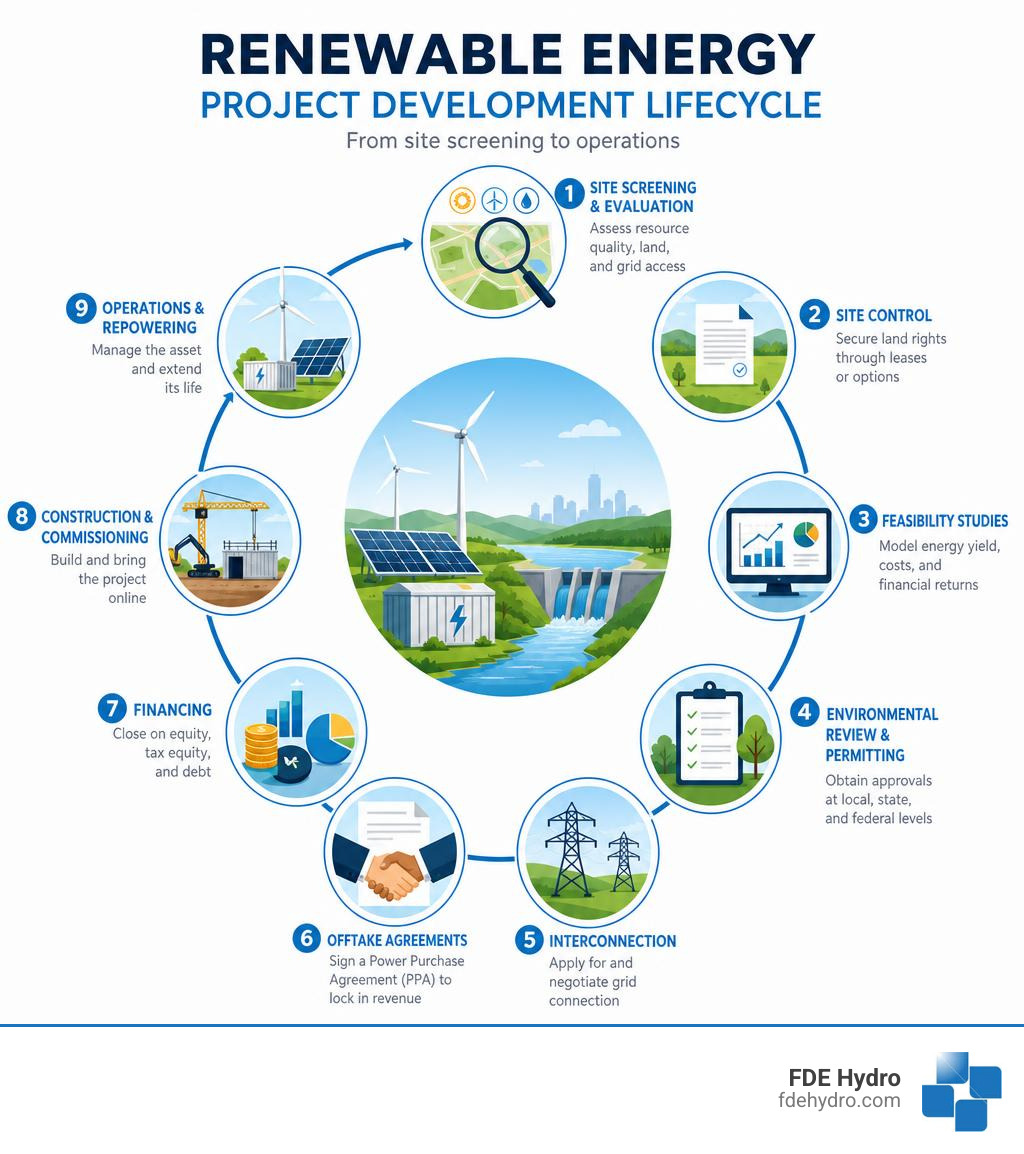
The Complete Renewable Energy Project Development Lifecycle
A renewable project is not “developed” when someone finds a sunny field, windy ridge, battery site, or promising water resource. That is only the beginning.
The full lifecycle usually includes:
- Market screening
- Resource assessment
- Site control
- Feasibility studies
- Environmental review
- Permitting
- Interconnection
- Offtake contracting
- Financing
- Engineering, procurement, and construction
- Commissioning and commercial operation
- Long-term operations, repowering, and decommissioning
For a broader foundation, see our renewable energy project basics.
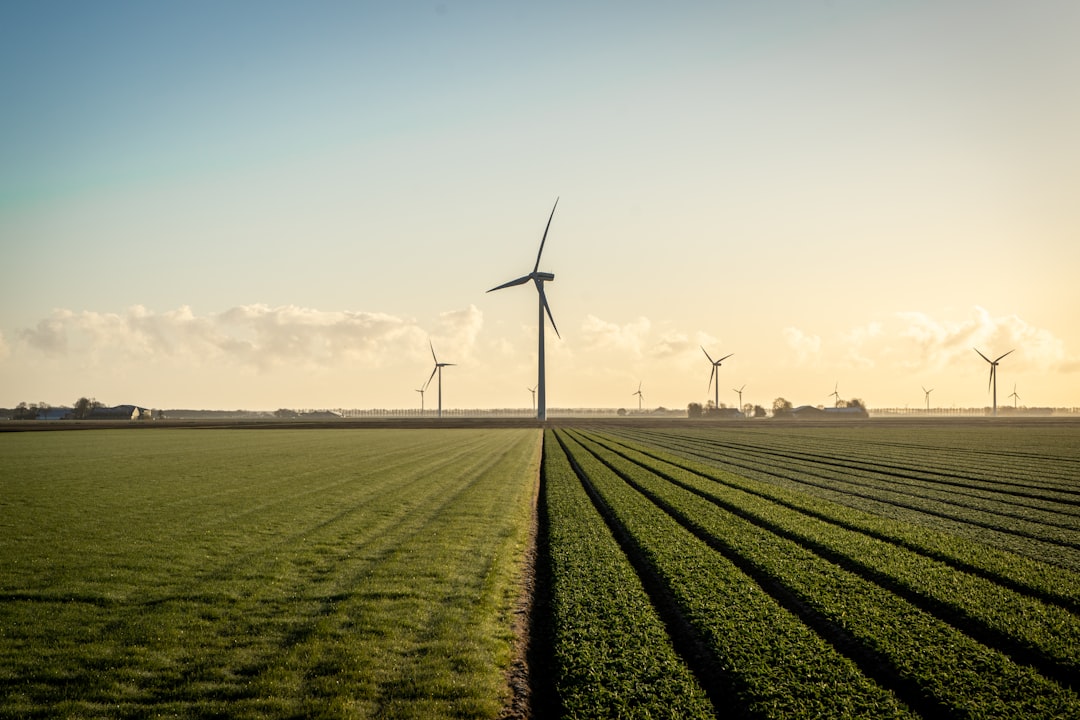
Why Renewable Energy Project Development Starts With “Project Motivation”
Before spending serious money, we need a clear answer to one question: why should this project exist?
Good project motivation usually rests on five pillars:
- Baseline need: What problem are we solving – high power prices, grid reliability, emissions, energy security, or resilience?
- Economics: Can the project compete on cost and deliver acceptable NPV, IRR, and payback?
- Policy: Do federal, state, provincial, local, or European market rules support the project?
- Technology: Is the selected technology proven, bankable, and appropriate for the site?
- Consensus: Can landowners, communities, utilities, regulators, and investors align?
This is also when we look for fatal flaws. A fatal flaw may be lack of transmission capacity, protected habitat, poor hydrology, unbuildable terrain, community opposition, or an offtake price that cannot support financing.
Early development capital is risk capital. It is often only a small portion of total project cost, but it is the money most likely to be lost if the project fails. That is why disciplined screening matters.
Stage 1: Market Screening, Resource Assessment, and Site Evaluation
The first technical step is identifying where a project might work.
Developers use GIS mapping, utility data, environmental databases, land records, and market pricing information to screen sites. For different technologies, the key resource changes:
- Solar: irradiance, land slope, shading, parcel size, soil conditions
- Wind: wind speed, turbulence, setbacks, aviation constraints
- Battery storage: grid congestion, nodal pricing, load pockets, substation proximity
- Pumped storage hydro: elevation difference, hydrology, geology, reservoir potential, water rights
Site evaluation should also include:
- Floodplain and wetland review
- Zoning and land-use compatibility
- Title reports and ownership history
- Access roads and constructability
- Distance to substations and transmission lines
- Capacity constraints and likely network upgrades
- Local tax, permitting, and community conditions
In 2026, we strongly favor a grid-first approach. A beautiful site with no viable interconnection is not a project. It is just expensive scenery.
Stage 2: Site Control, Landowner Agreements, and Early Engineering
Once a site looks promising, developers move toward site control. This may involve:
- Land leases
- Purchase options
- Easements
- Rights-of-way
- Access agreements
- Water rights or reservoir agreements for hydro projects
Most projects are placed into a special purpose vehicle, or SPV, so contracts, permits, financing, and liabilities are tied to the project entity.
Early engineering then tests whether the site can actually be built. This includes preliminary layouts, geotechnical review, access plans, electrical design, drainage studies, and conceptual civil works.
For FDE Hydro, this stage is especially important because modular precast concrete hydropower and water-control systems can change the construction plan. By using repeatable modular elements, we aim to reduce construction time, site disruption, and cost compared with many conventional heavy civil approaches.
Stage 3: Feasibility Studies in Renewable Energy Project Development
Feasibility studies turn a concept into a decision-ready project.
A strong feasibility package usually includes:
- Technical feasibility
- Energy production forecast
- P50 and P90 generation estimates
- CAPEX and OPEX assumptions
- LCOE analysis
- Interconnection cost estimates
- Curtailment assumptions
- Revenue model
- Sensitivity analysis
- Permitting risk assessment
- Construction schedule
- Financing assumptions
For storage, feasibility also includes the revenue stack: energy arbitrage, capacity value, ancillary services, resilience, and possible grid support. For pumped storage hydro, it includes long-duration storage value, reservoir operations, hydraulic efficiency, environmental flows, and grid reliability services.
Public tools can help. The Renewable Energy Project Development Toolbox includes resources for feasibility, procurement, contracts, financing, and green power markets.
Stage 4: Environmental Review, Permitting, and Community Engagement
Permitting is where many good ideas meet reality.
Environmental and land-use review may include:
- Wildlife and habitat studies
- Wetlands and waterways
- Cultural and historic resources
- Visual impact
- Noise
- Traffic
- Stormwater
- Fire safety
- Endangered species
- Decommissioning plans
- Mitigation measures
In the United States, projects may need local permits, state approvals, and federal reviews depending on land, water, transmission, and environmental impacts. In California, developers must account for state energy policy and environmental review requirements, including programs and guidance from the California Energy Commission.
Community engagement should not start after the design is finished. It should begin early, before rumors do the engineering for you. People deserve clear answers about setbacks, traffic, noise, views, water, taxes, emergency response, and land restoration.
Stage 5: Interconnection, Offtake, Financing, and Notice to Proceed
Interconnection determines whether the project can deliver power to the grid. The process often includes:
- Interconnection application
- Queue position
- Feasibility or scoping study
- System impact study
- Facilities study
- Network upgrade estimate
- Generator interconnection agreement
In organized U.S. power markets, developers may work with RTOs or ISOs. In vertically integrated markets, the local utility may control much of the process. In Canada, Brazil, and Europe, the structure varies by market, but the basic risk is the same: grid capacity can make or break the project.
At the same time, the project needs revenue. That usually means a PPA, virtual PPA, green tariff, community solar subscription structure, capacity contract, or merchant revenue strategy.
Only after site control, permits, interconnection, offtake, engineering, and financing align can the project reach financial close and receive notice to proceed, or NTP.
Stage 6: Construction, Commissioning, Operations, and Repowering
Construction begins with an EPC contract, procurement plan, schedule, budget, safety plan, and quality-control program.
Commissioning verifies that equipment works as designed. Commercial operation date, or COD, marks the point when the project begins delivering energy and earning revenue under its contracts.
Operations include:
- Asset management
- O&M
- Performance monitoring
- Warranty claims
- Vegetation management
- Safety inspections
- Compliance reporting
- Equipment replacement
- Battery augmentation, where applicable
- Repowering or rehabilitation
Eventually, the project may be repowered, expanded, relicensed, or decommissioned. Responsible development includes planning for land restoration from the beginning.
How Developers Coordinate Sites, Permits, Utilities, and Communities
Good development is coordination. Great development is coordination before the crisis.
Developers must work with landowners, local governments, utilities, RTOs or ISOs, regulators, neighbors, environmental agencies, and, where applicable, tribal or Indigenous communities. Every stakeholder sees the project through a different lens.
For more on responsible energy growth, see Powering Progress.
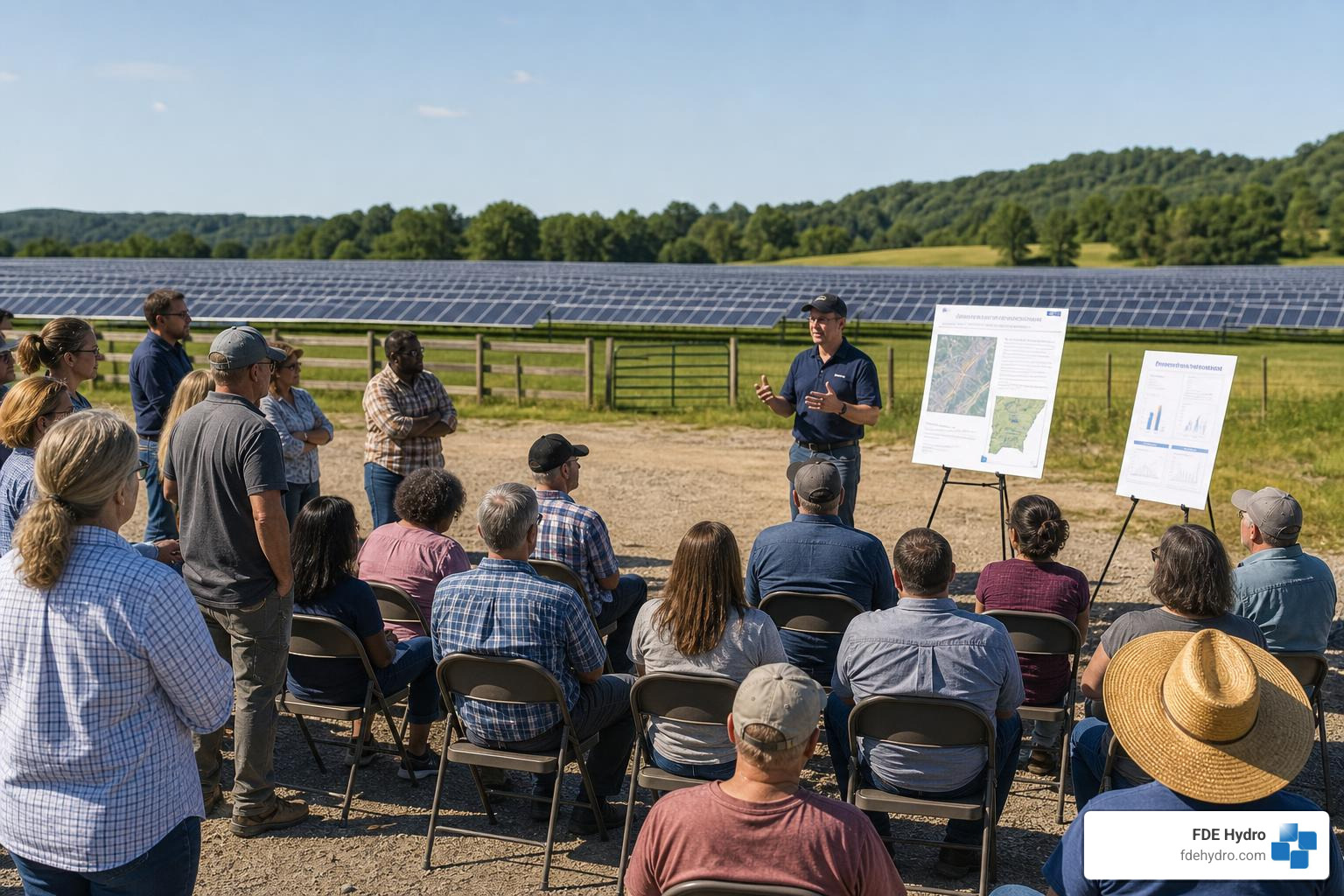
Working With Landowners and Host Communities
Landowners want clarity. Communities want respect. Both are reasonable.
Best practices include:
- Clear lease payment terms
- Honest discussion of construction impacts
- Agricultural coexistence where possible
- Drainage and road-use protections
- Setbacks and screening
- Local emergency response planning
- Complaint resolution procedures
- Community benefit agreements
- Tax revenue transparency
- Local hiring and procurement where practical
A project should not feel like something dropped onto a community from outer space. That only works in science fiction, and even there it usually ends badly.
Navigating Government Permits and Environmental Reviews
Permitting differs across New York, California, Kansas, Canada, Brazil, and Europe, but the principles are similar.
Developers must identify:
- Which agency has authority
- Which permits are discretionary
- Which studies are required
- Which public hearings apply
- Which appeals are possible
- Which mitigation measures are likely
- Which permits must be secured before financing
Hydropower and pumped storage projects may involve water permits, dam safety rules, environmental flow requirements, fish passage, reservoir operations, and federal or national energy licensing. These are more complex than many solar or battery projects, but they also offer valuable long-duration storage and reliability benefits.
Managing Utility and Transmission Interconnection Risk
Interconnection risk is one of the largest development risks in 2026.
Common challenges include:
- Queue backlogs
- Cluster study delays
- Thermal overloads
- Voltage constraints
- Deliverability limits
- High network upgrade costs
- Congestion and curtailment
- Changing study assumptions
Developers increasingly use early injection studies, power-flow analysis, and nodal price review before locking up land. The goal is simple: fail fast, before spending millions.
Best Practices for Responsible Renewable Energy Project Development
We recommend:
- Start outreach early
- Keep a single source of truth for project data
- Screen for fatal flaws before site control
- Share study results transparently
- Adapt design based on real constraints
- Plan for local jobs and procurement
- Budget for mitigation
- Include lifecycle and decommissioning planning
- Use performance-based engineering
- Avoid promising what the project cannot deliver
Responsible development is not slower. In many cases, it is faster because it reduces surprises.
Comparing Wind, Solar, Battery Storage, and Pumped Storage Hydro Development
Each technology follows the same general development path, but the details differ.
See our overview of defining renewable energy sources for a broader comparison.
| Technology |
Key siting factor |
Main permitting issue |
Revenue focus |
Storage duration |
| Wind |
Wind speed and setbacks |
Wildlife, visual, noise, aviation |
Energy and capacity |
Not storage unless paired |
| Solar |
Irradiance and land |
Land use, stormwater, habitat |
Energy, RECs, capacity |
Not storage unless paired |
| Battery storage |
Grid location |
Fire safety, zoning, interconnection |
Arbitrage, capacity, ancillary services |
Usually short to medium duration |
| Pumped storage hydro |
Head, water, geology |
Water, dam safety, environmental flows |
Long-duration capacity, reliability, grid services |
Long duration |
Wind Project Development: Resource, Siting, and Repowering Priorities
Wind projects require strong wind data, often supported by met towers, lidar, or long-term modeled datasets. Developers must optimize turbine layout to reduce wake losses and meet setbacks from homes, roads, airports, and sensitive habitats.
Key studies include avian and bat surveys, sound modeling, shadow flicker analysis, aviation review, and collector system design.
Repowering can extend project life by replacing older turbines or major components. In some cases, repowering increases output without needing an entirely new site.
Solar Project Development: Land, Interconnection, and Design Optimization
Solar development depends on irradiance, usable acreage, interconnection, grading, stormwater, and equipment selection.
Important design choices include:
- Fixed-tilt vs. single-axis tracking
- Bifacial modules
- Inverter loading ratio
- DC-to-AC ratio
- Terrain-following racking
- Vegetation and stormwater plan
- Module degradation assumptions
- Design freeze timing
Modern solar design increasingly uses 3D terrain modeling so projects avoid costly grading surprises.
Battery Energy Storage Project Development: Revenue Stacking and Safety
Battery energy storage systems, or BESS, can be standalone or paired with wind, solar, or hydro.
Development priorities include:
- Interconnection capacity
- Market rules
- Revenue stacking
- Fire code compliance
- Emergency response planning
- Battery degradation
- Augmentation schedule
- EMS controls
- AC-coupled vs. DC-coupled design
Storage can earn revenue from arbitrage, capacity, ancillary services, demand reduction, resilience, or avoided curtailment. The exact stack depends on the market.
Pumped Storage Hydro Development: Long-Duration Storage and Water Infrastructure
Pumped storage hydro uses electricity to move water uphill when power is abundant, then releases it through turbines when the grid needs energy.
Key development factors include:
- Reservoir siting
- Head differential
- Tunnels, penstocks, dams, and waterways
- Geology and geotechnical risk
- Hydrology
- Environmental flows
- Water rights
- Grid connection
- Licensing
- Dam safety
Closed-loop pumped storage can reduce impacts by operating away from major natural waterways. Pumped storage can also provide long-duration capacity, inertia, black start capability, and grid reliability.
At FDE Hydro, our patented modular precast concrete “French Dam” technology is designed for building and retrofitting hydroelectric dams and water-control systems more efficiently across North America, Brazil, and Europe.
How Hybrid Projects Pair Renewables With Storage
Hybrid projects combine generation with storage. Examples include:
- Solar-plus-storage
- Wind-plus-storage
- Hydro-plus-storage
- Pumped storage paired with renewable generation
Storage helps shift energy to higher-value hours, reduce curtailment, capture solar clipping, share interconnection capacity, and improve capacity accreditation.
Financing, PPAs, and Bankability in Renewable Energy Project Development
A project becomes bankable when investors and lenders believe it can be built, operated, and paid back.
For more on cost-conscious planning, see our cost-efficient renewable energy guide.
How PPAs and Offtake Contracts Secure Project Revenue
A Power Purchase Agreement is one of the most important contracts in renewable energy project development.
A PPA may define:
- Buyer and seller
- Contract term
- Energy price
- Escalator
- Delivery point
- REC ownership
- Curtailment rules
- Credit support
- Performance obligations
- Default rights
Common structures include utility PPAs, corporate PPAs, virtual PPAs, green tariffs, and community solar subscriptions. Lenders prefer creditworthy offtakers and predictable revenue.
Building the Financial Model and Investment Case
A strong financial model includes:
- CAPEX
- OPEX
- Production forecast
- Degradation
- Curtailment
- Interconnection costs
- Tax benefits
- Depreciation
- Debt sizing
- DSCR
- EBITDA
- IRR
- NPV
- Payback
- Contingency
The model should include sensitivity cases. What happens if construction costs rise 10%? What if curtailment doubles? What if interconnection upgrades cost more? The model should answer those questions before the lender does.
Common Capital Stack for Renewable Projects
Renewable projects are commonly financed with a mix of:
- Sponsor equity
- Development equity
- Tax equity
- Construction financing
- Term debt
- Bridge loans
- Grants and incentives
- Transferable tax credits, where available
- Insurance products
- Reserve accounts
The exact mix depends on technology, jurisdiction, contract quality, tax credit eligibility, and market risk.
Financial Close: What Lenders and Investors Review
Before financial close, investors typically review:
- Site control
- Permits
- Interconnection agreement
- Executed offtake
- EPC contract
- Equipment warranties
- Independent engineer report
- Environmental studies
- Legal opinions
- Insurance
- Operating model
- Decommissioning plan
This diligence can feel intense, but it protects the project. Bankability is just another word for “we checked the homework.”
Cost Reduction and Risk Mitigation Strategies
Cost reduction starts early. Useful strategies include:
- Standardized design
- Modular construction
- Early interconnection screening
- Competitive procurement
- Fixed-price EPC contracts where appropriate
- Contingency buffers
- Local labor planning
- Supply chain resilience
- Digital project controls
- Design for operations and maintenance
For hydro and water-control infrastructure, modular precast construction can reduce on-site complexity and help compress schedules compared with many traditional methods.
The best developers combine engineering judgment with better data.
For enterprise planning, see sustainable enterprise energy solutions.
Essential development tools include:
- NREL SAM: performance and financial modeling
- PVWatts: solar production estimates
- REopt: distributed energy and resilience optimization
- DSIRE: U.S. incentives and policy research
- GIS constraint mapping: parcels, slope, wetlands, habitat, zoning
- Power-flow studies: interconnection and grid impact
- Hydrology models: flows, head, water availability
- LCOE calculators: cost comparison
- Pro forma models: IRR, NPV, DSCR, payback
- Digital twins: design validation and operational planning
Community Solar, Green Tariffs, and Corporate Clean Energy Procurement
Market demand is changing. More buyers want clean energy without owning a power plant.
Common options include:
- Community solar subscriptions
- Municipal procurement
- Corporate PPAs
- Virtual PPAs
- Green tariffs
- Bundled RECs
- Unbundled RECs
- Retail choice products where available
These structures can broaden access to renewable energy, but each has different rules for credit, REC ownership, customer eligibility, and revenue certainty.
Regulatory and Transmission Challenges Across U.S. Markets
In the United States, development rules differ across RTO markets, vertically integrated utility territories, and state policy frameworks.
Key challenges include:
- Interconnection queue backlogs
- Transmission scarcity
- Local moratoria
- Zoning disputes
- Tax abatement negotiations
- PILOT agreements
- Permitting reform uncertainty
- Changing capacity accreditation rules
Developers must understand local rules in places like New York, California, Kansas, and other target markets before committing major capital.
Emerging Best Practices for 2026 and Beyond
The strongest 2026 development strategies include:
- Grid-first siting
- Storage-first planning
- Long-duration storage evaluation
- Resilience valuation
- Biodiversity-friendly design
- Agrivoltaics where appropriate
- Workforce training
- Apprenticeship compliance for tax credit eligibility
- Lifecycle emissions review
- Repowering and retrofit planning
The next wave of projects will not just be about producing clean electrons. It will be about delivering flexible, reliable, community-supported infrastructure.
Frequently Asked Questions About Renewable Energy Project Development
What Are the Main Steps in Renewable Energy Project Development?
The main steps are site screening, feasibility, site control, permitting, interconnection, offtake, financing, construction, commissioning, operations, and eventual repowering or decommissioning.
Each step reduces uncertainty. The goal is to move from “interesting idea” to “financeable project” without skipping the work that protects the project later.
Why Are PPAs Important for Renewable Energy Projects?
PPAs create predictable revenue. That gives lenders and investors more confidence that the project can repay debt and deliver returns.
A strong PPA also clarifies price, term, delivery obligations, REC ownership, curtailment treatment, and credit support. Without reliable revenue, many projects struggle to reach financial close.
How Long Does Renewable Energy Project Development Usually Take?
Timelines vary widely:
- Distributed solar or storage: often months to a few years
- Utility-scale solar: commonly several years
- Wind: often longer due to resource studies and permitting
- Standalone battery storage: can be faster, but interconnection may delay it
- Pumped storage hydro: typically the longest due to licensing, engineering, water, and civil works
Interconnection and permitting are usually the biggest schedule risks.
Conclusion
Renewable energy project development is a disciplined process. It requires strong sites, strong data, strong community relationships, strong contracts, and strong financing.
At FDE Hydro, we bring that mindset to hydropower, pumped storage, dam retrofits, and water-control infrastructure. Our patented modular precast concrete technology is designed to reduce construction time and cost while supporting reliable renewable energy development across North America, Brazil, and Europe.
The future grid will need more than generation. It will need storage, flexibility, resilience, and infrastructure built to last.
To learn more, explore our pumped storage hydropower solutions.
by Adaptify Support | Jun 3, 2026 | Hydro Facility Articles
Why Every Energy Decision-Maker Needs to Understand Hydroelectric Projects
A hydroelectric project is one of the most powerful and reliable tools in the clean energy toolkit — and one of the most complex to plan, build, and operate.
Here’s what you need to know at a glance:
| Question |
Quick Answer |
| What is it? |
A system that converts the energy of moving water into electricity |
| Main types |
Run-of-the-river, reservoir-based, pumped storage, peaking plants |
| Key components |
Dam, reservoir, penstock, turbines, generators, spillway |
| Why it matters |
Carbon-free, dispatchable power that runs for 50–100+ years |
| Global scale |
Projects range from 110 MW local plants to 14,000 MW binational giants |
| Biggest challenge |
High upfront capital cost, long timelines, and regulatory complexity |
Hydropower is the most widely used form of renewable energy on the planet. It powers entire nations. It stabilizes grids. And unlike solar or wind, it can deliver electricity on demand — day or night, rain or shine.
But here’s the hard truth: conventional hydroelectric construction is slow, expensive, and risky. Cost overruns and multi-year delays are common. Regulatory hurdles are steep. And the pressure to deliver clean energy faster has never been greater.
That’s exactly why this guide exists.
My name is Bill French, Sr., Founder and CEO of FDE Hydro™ — and I’ve spent five decades in heavy civil construction before dedicating my work to modernizing how hydroelectric projects are designed and built through modular, precast concrete solutions. In 2015, I was selected by the U.S. Department of Energy’s Water Power Technology Office to help define the next-generation roadmap for hydropower — and everything I’ve learned since then is reflected in what you’re about to read.
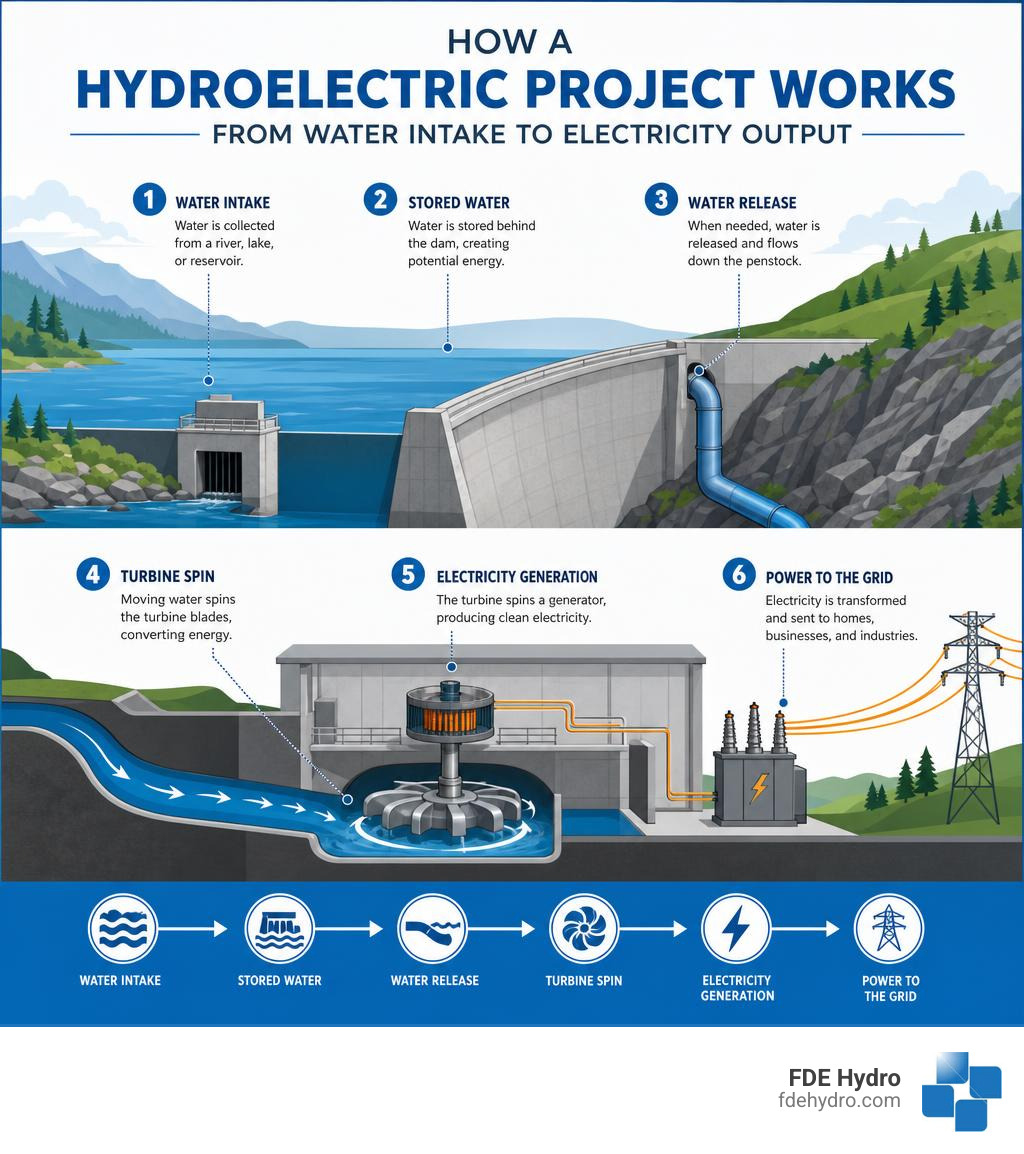
What is a Hydroelectric Project? Definition, Types, and Core Components

At its absolute simplest, a hydroelectric project is an infrastructure system designed to capture the natural flow of water and convert its kinetic energy into usable electricity.
Historically, humans used waterwheels to grind grain; today, we use massive, high-tech installations to power millions of homes. The underlying physics remain the same, but the engineering has reached an extraordinary level of sophistication. To understand how these systems function in the modern era, it helps to explore The Current Definition Understanding Hydroelectric Power and review our comprehensive Hydroelectric Power Solutions Guide.
The primary purpose of any hydropower project is to provide reliable, carbon-free electricity to the local or national grid. Unlike fossil-fuel plants, there is no combustion involved, and unlike solar or wind, hydropower is highly “dispatchable”—meaning grid operators can ramp electricity generation up or down in a matter of minutes to meet fluctuating demand.
Main Types of Hydropower Installations
Not all water-power systems are built the same way. Depending on the local geography, water availability, and grid requirements, developers choose from several primary configurations:
- Run-of-the-River Projects: These facilities generate electricity by diverting a portion of a river’s natural flow through a penstock and turbine, before returning the water safely back to the main river channel. Because they require little to no water storage, they have a remarkably small environmental footprint. However, their power output depends heavily on seasonal river flows.
- Reservoir-Based (Impoundment) Projects: This is the classic image of a hydropower plant. A large dam is constructed to hold back river water, creating a massive artificial reservoir. This stored water acts as a giant physical battery, allowing operators to release water and generate electricity exactly when the grid needs it most. If you are interested in how these massive structures are initiated, read about our perspective on Building New Dams.
- Pumped Storage Hydropower (PSH): Operating like a giant water-based battery, PSH systems utilize two reservoirs at different elevations. During periods of low electricity demand (and low power prices), cheap electricity is used to pump water from the lower reservoir to the upper one. When demand peaks, the water is released back down through turbines to generate high-value electricity.
- Peaking Plants: These are highly specialized facilities designed to operate primarily during hours of peak electricity demand. By storing water during off-peak hours and releasing it rapidly when the grid is strained, peaking plants prevent blackouts and keep energy prices stable.
Key Components of a Hydroelectric Project
Every hydroelectric project relies on a finely tuned network of structural, mechanical, and electrical components. If any single piece fails, the entire system can go dark.
- The Dam: A barrier constructed to hold back water, raise its elevation, and create the head (vertical drop) necessary to generate power.
- The Reservoir: The body of water stored behind the dam, providing a reliable source of potential energy.
- The Intake and Penstock: The intake gate opens to allow water to enter a massive pipe called a penstock, which channels the high-pressure water down toward the turbines.
- The Turbines: Large fan-like wheels that spin when struck by fast-moving water, converting hydraulic energy into mechanical energy.
- The Generators: Connected directly to the spinning turbine shaft, the generator uses electromagnetic induction to convert mechanical energy into electrical energy.
- The Spillway: A critical safety structure designed to release excess water safely during heavy rainfall or floods, preventing the dam from being overtopped.
To dive deeper into these individual parts, check out our Hydroelectric Dam Components Ultimate Guide and explore how we approach structural layout in our Hydroelectric Dam Design Complete Guide.
How a Hydroelectric Project Generates Clean Electricity
The actual generation of electricity is a beautiful demonstration of classical physics. It all starts with gravitational potential energy. Water stored at a high elevation in a reservoir naturally wants to flow downward. As it enters the penstock, that potential energy transforms into kinetic energy—the energy of motion.
When this fast-moving, high-pressure water strikes the blades of a turbine, it forces the turbine runner to spin. Depending on the height of the water drop (head) and the volume of water flow (discharge), engineers select different turbine designs to maximize efficiency:
- Francis Turbines: The most common turbine style, ideal for medium-to-high head applications. They feature curved blades and water enters radially before exiting axially.
- Kaplan Turbines: Essentially high-tech propellers with adjustable blades, perfect for low-head, high-volume river projects.
- Propeller Turbines: Fixed-blade turbines used in highly consistent water flow conditions.
As the turbine spins, it rotates a massive shaft connected to the rotor of a generator. This rotor is covered in powerful electromagnets that spin inside a stationary ring of copper wire coils (the stator). This movement forces electrons to flow through the copper wires, creating an alternating electrical current. From there, transformers step up the voltage so the electricity can travel efficiently across high-voltage transmission lines to homes and businesses.
For a complete breakdown of this fascinating mechanical process, read The Ultimate Guide to Modern Hydropower Technology.
Environmental, Economic, and Regulatory Frameworks
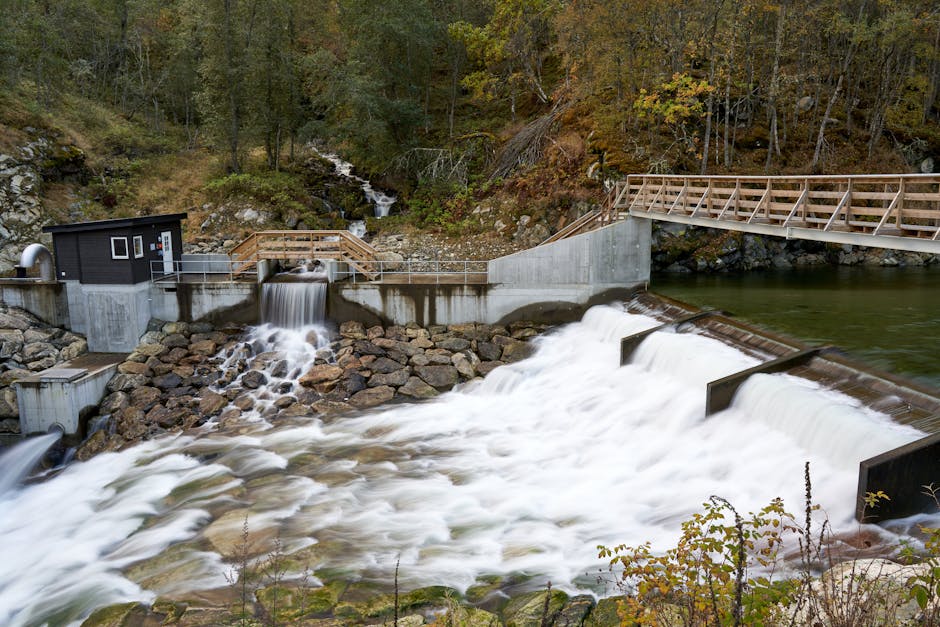
While the benefits of generating carbon-free electricity are undeniable, building and operating a hydroelectric project requires a careful balancing act between human energy needs and the health of local ecosystems.
On the positive side, hydropower is a cornerstone of the global transition to clean energy. It emits virtually no greenhouse gases during operation, prevents millions of tons of carbon dioxide from entering the atmosphere, and provides the baseline grid stability required to integrate more intermittent renewable sources like wind and solar.
However, historical dam construction has sometimes disrupted local environments. Blocking a river can alter natural water flows, impede fish migration, and degrade downstream water quality. Fortunately, modern engineering has developed highly effective solutions to mitigate these impacts:
- Fish Passages and Ladders: Structured channels that allow migrating fish to swim safely around or over dams to reach their upstream spawning grounds.
- Spawning Channels: Artificially created gravel beds next to the river that mimic natural habitats, providing safe zones for fish reproduction.
- Dissolved Oxygen Management: Aquatic life relies on oxygen dissolved in the water. To prevent low-oxygen zones downstream of dams, modern projects utilize advanced aerating turbines and linear aerating valves to infuse oxygen back into the water as it passes through the plant.
Regulatory Bodies and Hydropower Laws
Because rivers are shared public resources, developing a hydroelectric project is subject to some of the strictest regulatory oversight of any industry.
In the United States, the primary regulatory authority is the Federal Energy Regulatory Commission (FERC). Established under the Federal Water Power Act of 1920 (which later became Part I of the Federal Power Act), FERC is responsible for licensing non-federal hydropower projects, conducting rigorous dam safety inspections, and monitoring environmental compliance.
The licensing process is incredibly thorough and often takes several years. Developers must prove that their projects comply with a host of federal environmental laws, including:
- The National Environmental Policy Act (NEPA): Requiring comprehensive environmental impact statements.
- The Clean Water Act (CWA): Ensuring the project does not compromise local water quality standards.
- The Endangered Species Act (ESA): Guaranteeing that operations will not threaten protected wildlife.
For a broader look at how these regulations shape the national energy landscape, you can read about the history of Hydroelectric power in the United States – Wikipedia. Across the Atlantic, similar efforts to balance regulatory compliance with aggressive green energy goals are coordinated by organizations like HYDROPOWER EUROPE.
Economic Costs, Benefits, and Financing Models
The financial profile of a large-scale hydroelectric project is characterized by a high upfront capital expenditure (CapEx) followed by exceptionally low operational and maintenance costs (OpEx). Once a dam is built, the “fuel” (water) is completely free, allowing these plants to produce some of the cheapest electricity on the market for up to a century.
Because these projects require hundreds of millions—or even billions—of dollars to construct, financing models must be highly robust. Developers typically secure funding through a combination of:
- Debt-Equity Ratios: Often structured around a 70:30 split, combining bank loans with direct developer equity.
- Multilateral Development Banks: Institutions like the World Bank frequently provide long-term, low-interest loans for critical energy infrastructure.
- Municipal Bonds and Public Fundraising: Local governments and municipal utilities often issue tax-exempt bonds to fund local run-of-the-river projects, ensuring the economic benefits remain within the community.
To understand the financial realities of these developments, take a look at our analysis of Hydropower Project Costs A Deep Dive Into The Dollars And Cents and read about the physical realities of building these assets in our guide to Hydroelectric Dam Construction.
Safety, Maintenance, and Operational Challenges
Operating a hydroelectric project is a long-term commitment that requires constant vigilance. Because dams hold back millions of gallons of water, ensuring structural integrity is the single most important operational priority.
Over decades of continuous use, concrete dams can experience wear and tear from seismic activity, freeze-thaw cycles, and water erosion. Regular maintenance is essential. Key operational challenges include:
- Sediment Management: Rivers naturally carry silt and sediment. Over time, this material can settle in the reservoir, reducing its storage capacity and potentially damaging turbine blades if allowed to pass through the penstock. Operators must use dredging or bypass channels to manage sediment buildup.
- Mechanical Refurbishment: Turbines and generators do not last forever. Every few decades, plants must undergo major overhauls, including turbine runner replacement to restore operating efficiency and generator rewinding to ensure electrical reliability.
- Grid Integration: Modern grid operators must constantly balance supply and demand. Hydropower plants must be highly responsive, ramping up quickly when solar or wind output drops, which places physical stress on mechanical components.
Global Giants: Analyzing Successful Hydroelectric Projects
To see these principles in action, we can look at several extraordinary projects across our key operating regions in North America, Brazil, and Europe. These facilities demonstrate the sheer scale and diversity of modern hydropower:
| Project Name |
Location |
Installed Capacity (MW) |
Key Feature / Output |
| Itaipu Binational |
Brazil / Paraguay |
14,000 MW |
Generated a record 98.6 million MWh in 2013; governed by a unique binational treaty. |
| Site C Clean Energy Project |
British Columbia, Canada |
1,100 MW |
Third dam on the Peace River; produces 5,100 GWh annually using only 5% of the reservoir footprint of the upstream dam. |
| Yadkin Project |
North Carolina, USA |
215 MW |
A four-station system utilizing advanced aerating turbines to protect river water quality. |
| Bradley Lake Project |
Alaska, USA |
120 MW |
Largest hydro facility in Alaska; provides 10% of Railbelt utility power at just $0.04 per kWh. |
| Carmen-Smith Project |
Oregon, USA |
110 MW |
Operating under a new 40-year FERC license; functions as a carbon-free peaking plant with major fish passage upgrades. |
| Lawrence Hydroelectric Project |
Massachusetts, USA |
16.8 MW |
A historic run-of-the-river facility providing clean local power to New England communities. |
Let’s look closer at some of these remarkable achievements.
The Itaipu Hydroelectric Power Plant on the Paraná River is a true wonder of modern engineering. Detailed in the ITAIPUMAGAZINEENGLISH_LR, this project features twenty 700 MW generating units. The concrete used to build it could construct 210 major sports stadiums, and its record-setting 2013 generation was enough to power the entire nation of Paraguay for eight years! For more context on Brazil’s massive water-power network, see the List of hydroelectric power stations in Brazil – Wikipedia.
In Canada, the Project Overview | Site C highlights how sequential development on a single river system can maximize efficiency. By utilizing water already stored upstream in the Williston Reservoir, Site C achieves 35% of the energy output of the massive W.A.C. Bennett Dam while flooding just 5% of the land area. You can explore more Canadian installations in the List of hydroelectric power stations in Canada – Wikipedia.
Even smaller municipal projects play a critical role in local grids. For instance, the historic Lawrence Hydroelectric Project along the Merrimack River is currently undergoing relicensing to secure decades of clean energy for local residents (learn more at the Patriot Hydro Lawrence Hydroelectric Project portal). Similarly, the Bowersock Mills & Power Company in Lawrence, Kansas, represents the enduring power of run-of-the-river hydro (read their story at About Bowersock).
Whether you look at the massive municipal networks of California or the historic masonry dams of New York, local water power continues to serve as the backbone of regional grid reliability. To discover more about these local systems, browse the Category:Hydroelectric power plants in New York (state) – Wikipedia) and Category:Hydroelectric power plants in California – Wikipedia directories.
Frequently Asked Questions about Hydropower
What is the difference between run-of-the-river and reservoir-based projects?
Run-of-the-river projects rely on the natural, daily flow of the river and feature very little water storage, resulting in a minimal environmental footprint but variable power output. Reservoir-based projects build a large dam to store water, giving operators complete control over when they generate electricity (peaking capacity), though they flood a larger land area.
How do hydroelectric projects impact local fish populations?
Dams can block fish from swimming upstream to spawn and alter downstream water quality. Modern projects mitigate this by installing fish ladders, building dedicated spawning channels, and utilizing specialized aerating turbines to maintain healthy dissolved oxygen levels in the river.
What are the primary safety risks associated with large dams?
The primary risks include structural failure due to extreme weather, seismic events, or age, as well as spillway inadequacy during historic floods. To prevent these hazards, dams are built with massive safety factors—such as roller-compacted concrete buttresses—and are subjected to rigorous, ongoing structural inspections by regulatory bodies like FERC.
Conclusion
As we look toward the future from our vantage point in June 2026, the global demand for clean, reliable, and dispatchable electricity has never been higher. Yet, the traditional way of building a hydroelectric project—involving massive, poured-in-place concrete dams, decades of environmental disruption, and astronomical construction costs—is no longer viable for many communities.
That is where we are changing the game.
At FDE Hydro™, we have developed and patented an innovative modular precast concrete technology known as the “French Dam.” By manufacturing heavy, high-strength concrete modules in a controlled factory environment and assembling them rapidly on-site, we can build and retrofit hydroelectric dams and water control systems in a fraction of the time and at a significantly lower cost than conventional methods.
Whether you are looking to build a new run-of-the-river facility, retrofit an existing non-powered dam, or upgrade water control structures in North America, Brazil, or Europe, our modular technology provides a faster, safer, and more environmentally friendly path forward.
We invite you to learn more about our approach to Hydropower Construction North America and discover how we are building the future of clean, reliable Hydropower by visiting fdehydro.com/hydropower/. Let’s build a cleaner grid, together.
by Adaptify Support | Jun 2, 2026 | Hydropower Articles
The Simple Science Behind How a Hydroelectric Dam Works
How does a hydroelectric dam work? Here’s the short answer:
- Water is stored in a reservoir behind a dam, building up potential energy.
- Gravity pulls the water down through a large pipe called a penstock.
- Pressure from the falling water spins a turbine inside the powerhouse.
- The turbine turns a generator, which converts that spinning motion into electricity.
- Electricity flows out through transformers and transmission lines to homes and businesses.
- Water returns to the river downstream — and the cycle starts again.
That’s it. Gravity does the heavy lifting. The dam just controls when and how fast the water falls.
Hydroelectric power is one of the oldest and most reliable forms of renewable energy on the planet. Today it supplies roughly one-sixth of the world’s electricity — and in some countries, like Norway, it accounts for nearly 90% of all power production. In the U.S., about 1,450 conventional hydropower plants are operating right now, generating clean electricity without burning a single drop of fuel.
The core principle hasn’t changed much in over a century: moving water spins a turbine, the turbine drives a generator, and the generator produces electricity. But the engineering behind it — the dams, components, and facility types — is far more detailed and fascinating than that simple chain suggests.
I’m Bill French, Sr., Founder and CEO of FDE Hydro™, and I’ve spent decades in heavy civil construction before turning my focus to modernizing the way hydropower infrastructure gets built — including developing patented modular solutions that directly address how a hydroelectric dam works from the ground up. In this guide, I’ll walk you through every part of the process, from reservoir to the grid.
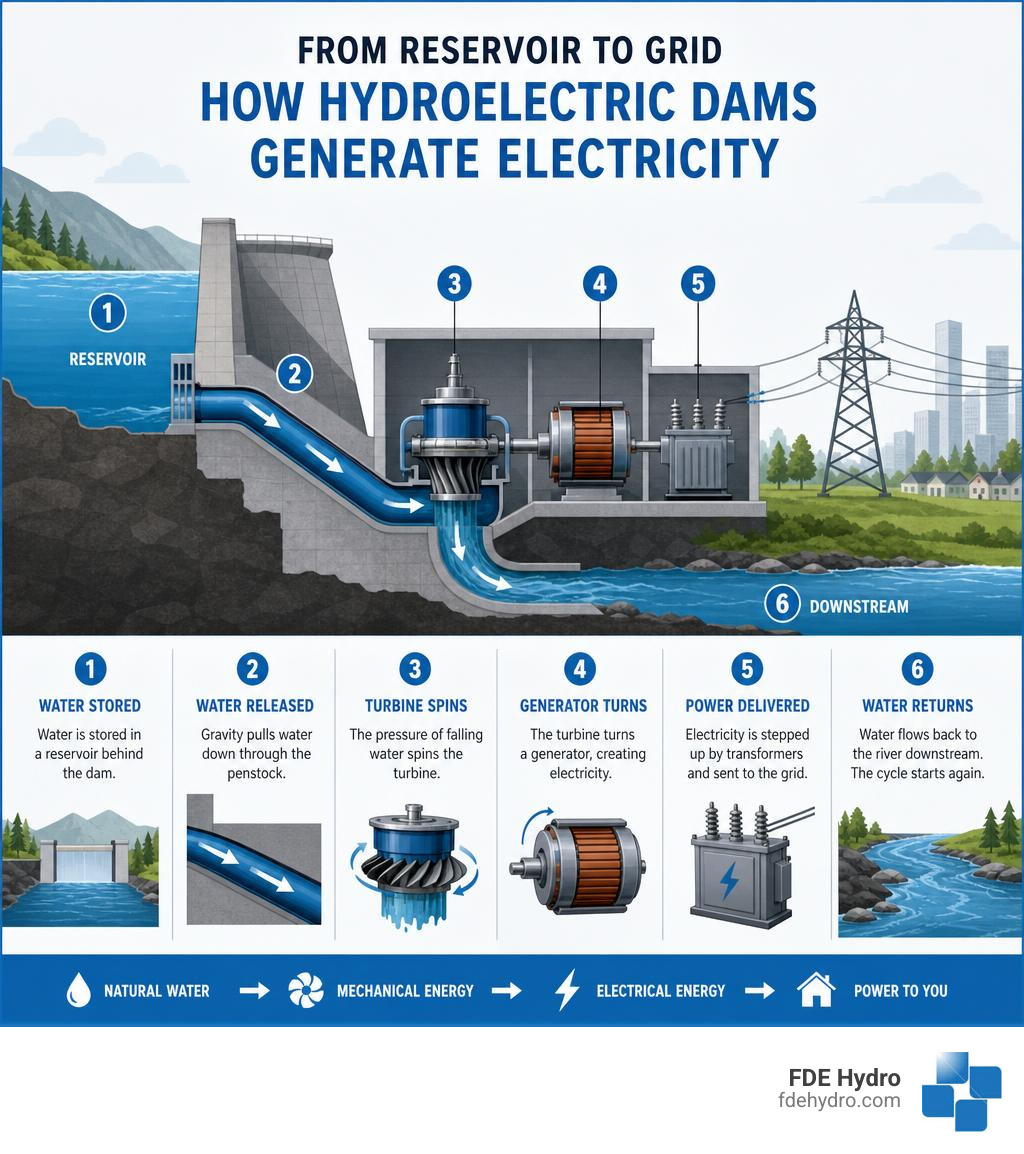
How Does a Hydroelectric Dam Work? Step-by-Step
At its heart, a hydroelectric dam is an energy conversion machine. It does not create energy from nothing. It converts the natural energy of elevated water into electricity.
The main idea is simple:
- Water stored high behind a dam has potential energy.
- When released, gravity turns that stored energy into kinetic energy, or moving energy.
- Moving water spins a turbine.
- The turbine spins a generator.
- The generator produces electricity.
Two factors largely determine how much power a hydroelectric plant can produce:
- Head – the vertical distance water falls.
- Flow – the volume of water moving through the system.
More head or more flow usually means more potential power. That is why hydroelectric sites are carefully chosen for reliable water supply, good elevation difference, strong geology, and access to transmission infrastructure.
For a clear public overview of the process, see the Hydropower basics from the U.S. Department of Energy.
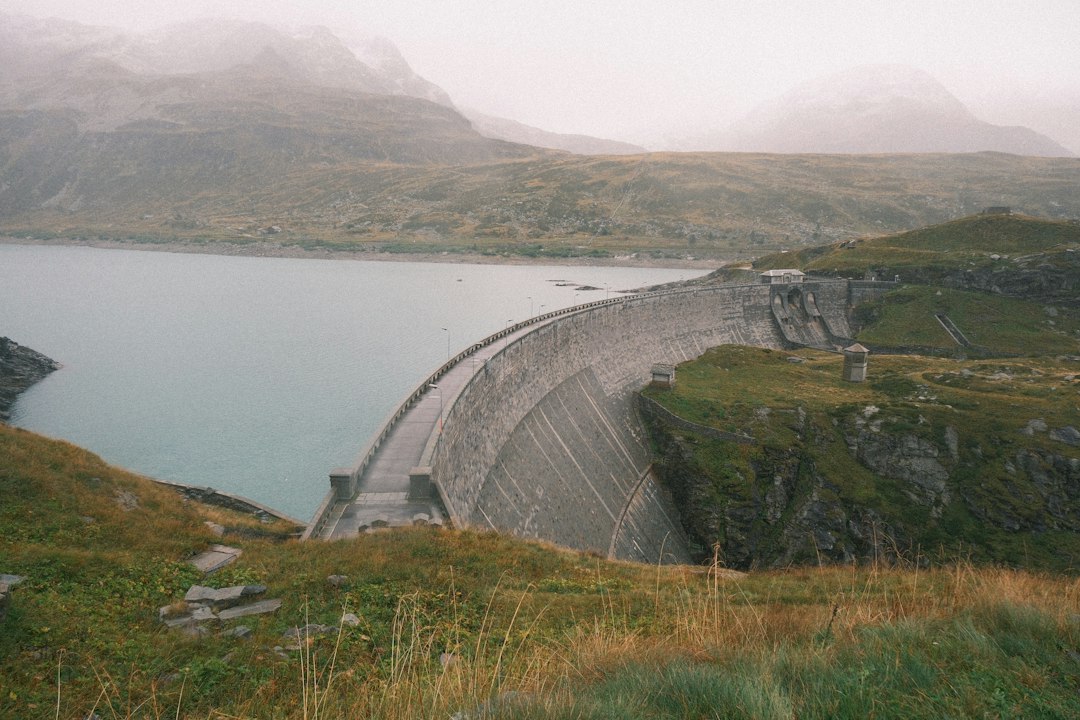
How does a hydroelectric dam work from reservoir to river?
A conventional hydroelectric dam begins with a reservoir. This is the body of water stored upstream behind the dam. The reservoir acts a little like a battery, except instead of storing chemical energy, it stores water at elevation.
Here is the reservoir-to-river journey:
- Water collects in the reservoir from rainfall, runoff, snowmelt, and river flow.
- Intake gates open when operators or automated controls need to generate power.
- Water enters the penstock, a large pipe or tunnel that carries water downward.
- Pressure builds as gravity accelerates the water.
- The water strikes turbine blades, causing the turbine runner to spin.
- Used water exits through the tailrace and returns downstream to the river.
- Flow is adjusted to match power demand, reservoir conditions, and environmental requirements.
The dam’s job is control. It controls water level, pressure, timing, and release. Without that control, the river still has energy, but the plant cannot reliably convert it into grid-ready electricity.
For more background on the basic definition, see our guide: The Current Definition: Understanding Hydroelectric Power.
How does a hydroelectric dam work inside the generator?
The turbine does not make electricity by itself. It makes rotation.
That rotating motion travels through a shaft into the generator. Inside the generator, the shaft spins a component called the rotor. Around it sits the stator, a stationary ring of copper windings.
The physics comes from electromagnetic induction, often associated with Faraday’s principle: when magnetic fields move past conductive wire, they induce electric current.
In plain English:
- The turbine spins the shaft.
- The shaft spins magnets or electromagnets inside the generator.
- The moving magnetic field interacts with copper windings.
- That interaction produces alternating current, or AC electricity.
- Voltage equipment helps control and prepare that electricity for the grid.
This is why hydroelectric plants and thermal power plants are similar in one important way: both turn turbines connected to generators. A coal or gas plant uses steam to spin the turbine. A hydro plant uses falling water. Same basic generator idea, much cleaner fuel source.
For a deeper look at the electricity side, visit Hydroelectric Power Generation.
How water cycle and gravity keep hydropower renewable
Hydropower is renewable because it is powered by the water cycle.
The process looks like this:
- The sun heats water in oceans, lakes, rivers, soil, and plants.
- Water evaporates and rises into the atmosphere.
- Vapor condenses into clouds.
- Precipitation falls as rain or snow.
- Water runs downhill into streams, rivers, reservoirs, and eventually back to larger bodies of water.
- Gravity keeps the water moving from high elevations to low elevations.
So yes, hydropower is partly solar energy wearing a raincoat. The sun lifts the water. Gravity brings it back down. The dam captures part of that downhill movement and turns it into electricity.
A helpful technical overview is available in the USGS explanation of hydroelectric power.
Main Components of a Hydroelectric Power Plant
A hydroelectric power plant is more than a wall in a river. It is a system of civil, mechanical, electrical, and environmental components working together.
The main parts include:
- Dam structure – holds back water and creates head.
- Reservoir – stores water upstream.
- Spillway – safely releases excess water.
- Intake – controls water entering the power system.
- Trash racks – screen out logs, debris, and large objects.
- Penstock – carries pressurized water to the turbine.
- Powerhouse – contains turbines, generators, and control systems.
- Turbine – converts water energy into rotating mechanical energy.
- Generator – converts mechanical energy into electrical energy.
- Transformer – increases voltage for efficient transmission.
- Transmission lines – move electricity to the grid.
For a component-by-component breakdown, see Hydroelectric Dam Components: Ultimate Guide.

Dam, reservoir, and spillway
The dam creates the elevation difference that gives water useful pressure. Depending on the site, dams may be designed as gravity dams, arch dams, buttress dams, embankment dams, or other configurations.
The reservoir provides storage. That storage can support:
- Electric generation
- Flood control
- Water supply
- Recreation
- Drought management
- Flow regulation
The spillway is the safety valve. When inflows are too high or reservoir levels need to be lowered, the spillway releases water without sending all of it through the turbines. A well-designed spillway protects the dam from overtopping, which is one of the most serious safety risks for many dam types.
Reservoir operations also have to consider sediment. Rivers naturally carry sand, silt, gravel, and organic material. When water slows in a reservoir, some of that material settles. Over time, sediment can reduce storage capacity and affect intakes, outlets, habitats, and downstream river shape.
You can learn more about dam types and functions here: Hydro Electric Dams.
Penstock, turbine, and generator
The penstock is the high-pressure pathway from the reservoir or intake to the turbine. Think of it as the plant’s water highway. The steeper and longer the drop, the more pressure the penstock must be designed to handle.
At the turbine, flow is often regulated by wicket gates or guide vanes. These direct water into the turbine runner at the right angle and volume.
Common turbine types include:
- Francis turbines – widely used for medium head and medium flow sites.
- Kaplan turbines – good for low-head, high-flow applications; their blades can adjust like a boat propeller.
- Pelton turbines – used for high-head, lower-flow sites; water jets strike spoon-shaped buckets.
The turbine converts hydraulic energy into mechanical rotation. The generator then converts that rotation into electricity.
For more on these parts, see Hydro Dam Components.
The electricity leaving a generator is not ready to travel long distances efficiently. That is where transformers come in.
The path from dam to outlet usually looks like this:
- Generator produces AC electricity at the power plant.
- Step-up transformer increases voltage for long-distance transmission.
- High-voltage transmission lines carry electricity across the grid.
- Substations reduce voltage closer to cities, towns, and industrial users.
- Distribution lines deliver power to homes and businesses.
- Local transformers step voltage down again for safe use.
High voltage reduces energy losses during transmission. That is why electricity is stepped up for travel and stepped down before it reaches your toaster, phone charger, office lights, or manufacturing equipment.
Types of Hydroelectric Facilities and How Pumped Storage Works
Not every hydropower project uses the same layout. The three major categories are conventional storage hydropower, run-of-the-river hydropower, and pumped-storage hydropower.
| Facility type |
How it works |
Main strength |
Main limitation |
| Conventional storage dam |
Stores water in a reservoir and releases it through turbines |
Dispatchable, controllable power |
Larger land and ecosystem footprint |
| Run-of-the-river |
Uses natural river flow with little or limited storage |
Smaller reservoir impact |
Output depends heavily on river flow |
| Pumped storage |
Moves water between lower and upper reservoirs to store energy |
Grid-scale energy storage and peak support |
Uses more electricity to pump than it later generates |
Conventional storage hydropower
A conventional storage plant uses a dam and reservoir to hold water until electricity is needed. This makes it dispatchable, meaning operators can increase or decrease generation more easily than with many other renewable sources.
This is useful for:
- Morning and evening demand peaks
- Grid balancing
- Backup during outages
- Seasonal water management
- Supporting variable solar and wind generation
The tradeoff is that large reservoirs can flood land, alter river habitats, trap sediment, and change downstream flows. Good design, licensing, monitoring, and operations matter.
For more about plant layouts and functions, see Hydro Energy Power Plant.
Run-of-the-river hydropower
Run-of-the-river hydropower uses the natural movement of a river, often with a small diversion structure or low dam. These systems may have little storage compared with conventional reservoir plants.
Advantages can include:
- Smaller reservoir footprint
- Less large-scale flooding
- Potentially lower visual impact
- Good fit for certain existing water control structures
Limitations include:
- Seasonal generation changes
- Less ability to store water for peak demand
- More sensitivity to drought or low-flow periods
- Need to maintain environmental flows for aquatic life
Run-of-the-river does not mean no impact. It still needs careful design for fish movement, sediment, recreation, water temperature, and downstream flow.
Pumped storage for peak electricity demand
Pumped storage is hydropower’s answer to the battery question. It uses two reservoirs at different elevations.
Here is how it works:
- During low-demand periods, excess electricity powers pumps.
- Water is pumped from the lower reservoir to the upper reservoir.
- During high-demand periods, water is released back downhill.
- The falling water spins reversible pump-turbines.
- The plant generates electricity when the grid needs it most.
Pumped storage does not create net new electricity. In fact, it uses more electricity to pump water uphill than it generates on the way down. But that is not the point. Its value is timing.
It stores energy when electricity is plentiful or less expensive and returns power when demand is high. That helps grid operators manage peak loads, stabilize frequency, and integrate variable renewable sources.
The USGS provides a helpful explanation here: Hydroelectric Power: How it Works.
Efficiency, Output, History, and Global Scale of Hydropower
Modern hydroelectric generation is extremely efficient. Well-designed hydro plants can convert around 90% of available water energy into electricity. That is one reason hydropower has remained important even as solar, wind, batteries, and other technologies grow.
But output is not constant. It depends on water, elevation, equipment, operations, and environmental limits.
For more on performance, see Hydroelectric Dam Efficiency.
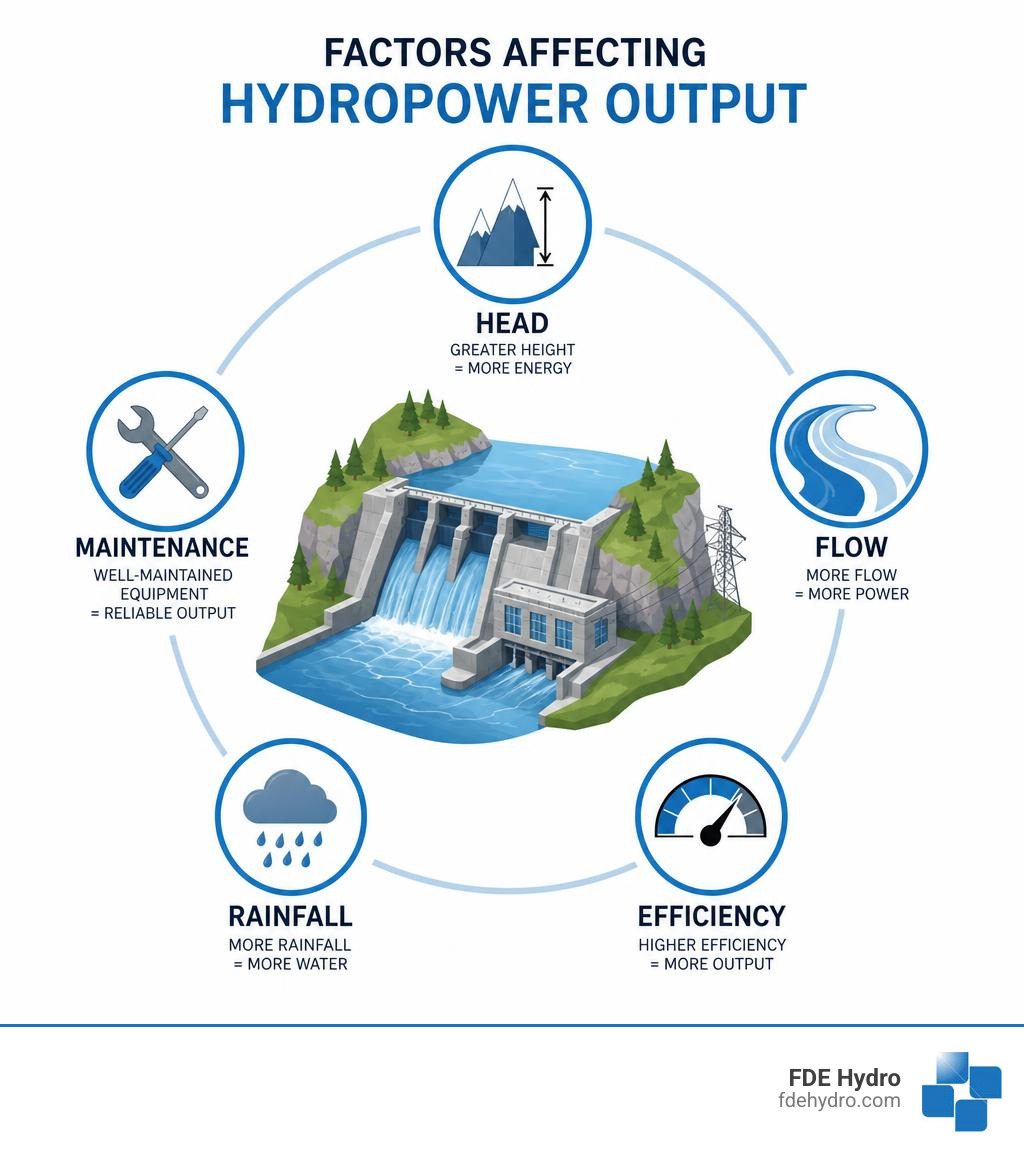
What affects hydroelectric dam output?
Several factors determine how much electricity a dam can generate:
- Water volume – More flow through the turbines usually means more power.
- Hydraulic head – Greater elevation drop creates more pressure.
- Turbine efficiency – Turbine type and condition affect conversion losses.
- Generator efficiency – Electrical equipment condition matters.
- Reservoir level – Lower water levels can reduce head and output.
- Seasonal conditions – Rainfall, snowmelt, and drought change available water.
- Sediment and debris – Abrasion, clogging, and buildup can reduce performance.
- Maintenance – Worn turbines, seals, bearings, and gates can lower efficiency.
- Environmental flows – Plants may be required to release water for habitat instead of generation.
- Operational limits – Flood control, water supply, navigation, and safety can constrain generation.
A hydro plant is not just “on” or “off.” Operators balance power production with water management, equipment protection, regulatory requirements, and river health.
For a forward-looking efficiency discussion, see Beyond the Turbine: A Look at Hydro Dam Efficiency and Tomorrow’s Hydropower.
Hydropower history and current scale
People have used moving water for thousands of years, long before electric grids existed. Ancient water wheels powered mills for grinding grain, cutting lumber, and driving machinery.
The electric era came later. In the United States, early hydroelectric use included lighting applications in 1880, and one of the first commercial hydroelectric plants began operating in 1882. The oldest operating U.S. hydropower facility is the Whiting plant in Wisconsin, which began operating in 1891 and has about 4 MW of capacity.
As of the research data available before May 2026:
- Hydroelectricity accounted for about 6.2% of total U.S. utility-scale electricity generation in 2022.
- It provided about 28.7% of U.S. utility-scale renewable electricity generation in 2022.
- From 2001 through 2022, hydro averaged about 6.7% of total annual U.S. electricity generation.
- The U.S. has about 1,450 conventional hydropower plants and about 40 pumped-storage plants.
- The Grand Coulee hydroelectric facility has 6,765 MW of total generating capacity.
- Globally, hydropower supplies roughly 15% to one-sixth of electricity production, depending on the dataset and year.
Hydropower is not new, but it is not outdated. In many regions, the future is about modernizing existing infrastructure, improving efficiency, adding generation to non-powered dams, and building smarter water control systems.
For national data, see EIA hydropower explained.
Pros, Cons, and Environmental Impacts of Hydroelectric Dams
Hydropower has major advantages, but it also has real environmental responsibilities. A good article on how does a hydroelectric dam work should explain both sides.
For a broader benefits overview, see Benefits of Hydropower Plant.
Advantages compared with other energy sources
Hydropower offers several strengths:
- Renewable energy – It relies on the water cycle, not fuel combustion.
- Low operating emissions – Plants generate electricity without burning coal, oil, or gas.
- High efficiency – Modern facilities can be around 90% efficient.
- Fast ramping – Operators can often increase or reduce output quickly.
- Long service life – Many hydro assets can operate for decades with proper maintenance.
- Low fuel cost – The fuel is flowing water.
- Grid stability – Large rotating generators can support voltage and frequency stability.
- Energy storage – Reservoirs and pumped storage help shift power to when it is needed.
- Black-start capability – Some hydro plants can help restart the grid after outages.
- Multiple uses – Dams may also support flood control, water supply, irrigation, navigation, and recreation.
Hydropower is especially valuable because it is controllable. Solar and wind are excellent resources, but they depend on sun and weather. Hydropower can often respond when the grid asks for more or less electricity.
Disadvantages and ecological concerns
Hydroelectric dams can also create significant impacts, especially when poorly planned or outdated.
Concerns include:
- River fragmentation – Dams can interrupt natural river connectivity.
- Fish migration barriers – Species that move upstream or downstream may be blocked.
- Altered flows – Natural high and low flow patterns may change.
- Reservoir flooding – Land, habitat, farmland, cultural sites, or communities may be affected.
- Sediment trapping – Downstream channels, deltas, and habitats may lose sediment supply.
- Water temperature changes – Deep reservoir releases can be colder or warmer than natural flows.
- Water quality issues – Low oxygen or stratification can occur in some reservoirs.
- Evaporation losses – Reservoirs can lose water to evaporation, especially in warm regions.
- Drought vulnerability – Less water means less generation.
- Methane risk – Some reservoirs, especially in warm climates with submerged organic matter, can emit methane.
- Dam safety risk – Dams require inspection, maintenance, emergency planning, and responsible operation.
Hydropower is clean at the point of generation, but “clean” should never mean “impact-free.” The goal is responsible design and operation.
How modern design reduces impacts
Modern hydro design is much more sophisticated than simply placing concrete in a river and calling it a day. Thankfully, we have moved beyond the “just build a wall and hope the fish read the signs” era.
Impact reduction tools include:
- Fish ladders and fish lifts to help upstream migration.
- Fish screens to keep fish out of turbines and intakes.
- Bypass systems for safer downstream passage.
- Minimum flow releases to maintain habitat below the dam.
- Selective withdrawal systems to manage water temperature.
- Sediment flushing or bypassing to restore sediment movement.
- Aeration systems to improve dissolved oxygen.
- Turbine upgrades designed to improve fish survival and efficiency.
- Real-time monitoring for flow, temperature, dissolved oxygen, vibration, and performance.
- Retrofitting existing dams instead of building entirely new impoundments where appropriate.
At FDE Hydro, our focus on modular precast concrete technology is part of this modernization conversation. Faster, more controlled construction can reduce site disruption, improve quality control, and support retrofits at existing water infrastructure.
For more on responsible design, see Hydroelectric Dam Design Complete Guide.
Frequently Asked Questions About How Hydroelectric Dams Work
How does a hydroelectric dam work when electricity demand changes?
Hydroelectric plants can respond quickly to changing demand. When the grid needs more power, operators or automated systems open intake gates or wicket gates to allow more water through the turbines. When demand drops, they reduce flow.
This makes hydropower useful for peaking power, which is electricity needed during high-demand hours. Pumped storage adds another layer by storing energy during low-demand periods and generating during peak periods.
Does a hydroelectric dam use up water?
A hydroelectric dam generally does not consume water in the same way a fuel-burning plant consumes fuel. Water passes through the turbine and returns to the river downstream.
However, there can be water losses or changes, including:
- Evaporation from reservoirs
- Temporary storage behind the dam
- Flow timing changes
- Water allocated for other uses, such as supply or irrigation
So the water is not “used up,” but the river system is managed and altered.
Why are some locations better for hydroelectric dams?
The best hydropower sites usually have:
- Reliable river flow
- Strong elevation drop, or head
- Good geology and foundation conditions
- A valley shape suitable for a dam or diversion
- Manageable sediment conditions
- Access to transmission lines
- Lower environmental and community conflict
- Clear permitting and water rights conditions
- Long-term climate and hydrology resilience
A flat river with low flow may still have energy, but not enough for a practical large hydro project. A steep river with reliable flow is usually more promising, assuming environmental and community factors can be responsibly addressed.
Conclusion
So, how does a hydroelectric dam work?
It works by combining the water cycle, gravity, civil engineering, turbines, generators, and the electric grid into one coordinated system. The sun lifts water through evaporation. Rain and snow return it to the land. Gravity pulls it downhill. A dam controls that movement. A turbine captures it. A generator turns it into electricity. Transformers and transmission lines deliver it to the people and businesses that need it.
Hydropower is efficient, renewable, flexible, and proven. It also requires careful environmental design, responsible operations, and modern construction methods.
That is where the next chapter matters. At FDE Hydro, we believe hydropower infrastructure can be built and upgraded faster, smarter, and more affordably using innovative modular precast concrete technology like our patented French Dam system. The goal is not just more power. It is better water infrastructure for North America, Brazil, and Europe.
To keep learning, Explore hydro electric dams.

