

The Grid Never Sleeps: What Base Load Power Really Means
What is base load is one of the most fundamental questions in understanding how electricity grids work. Here is the short answer:
Base load is the minimum level of electricity demand on a grid at any given time — the steady, around-the-clock power requirement that never goes away, even at 3:00 in the morning.
| Term | Simple Definition |
|---|---|
| Base Load | The minimum power a grid needs at all times, delivered at a steady, constant rate |
| Base Load Plant | A power station that runs continuously (often 5,000–8,000+ hours per year) to meet that minimum demand |
| Base Load Capacity | The generating equipment operated on a 24/7 basis to keep the lights on |
Think about what stays on while a city sleeps — hospitals, streetlights, refrigerators, industrial equipment. That constant, unavoidable draw on the grid is base load.
It is the foundation everything else is built on. Peak demand and variable loads come and go, but base load is always there.
In Germany, for example, total base load runs at roughly 45 gigawatts across the entire country — a significant and non-negotiable slice of national power demand.
Understanding base load matters deeply for anyone planning large-scale power infrastructure, especially hydropower projects where continuous, reliable generation is a core value proposition.
I’m Bill French, Sr., Founder and CEO of FDE Hydro™, and my decades of experience in heavy civil construction and hydropower development — including work with the U.S. Department of Energy’s Water Power Technology Office — give me a practical, ground-level perspective on what is base load and how it shapes real infrastructure decisions. In this guide, I’ll walk you through everything you need to know, from core definitions to how the concept is evolving in modern grids.
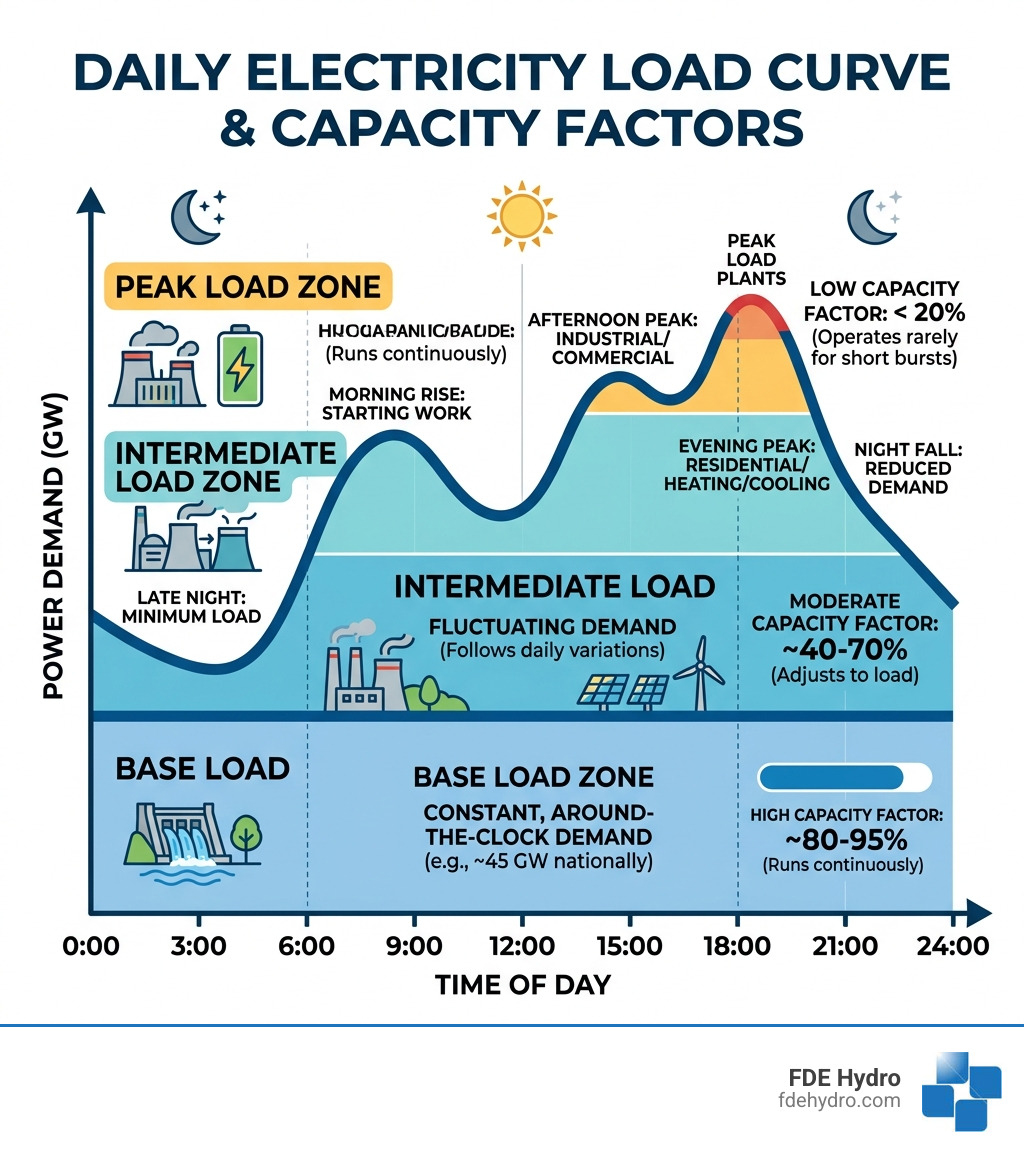
Important what is base load terms:
What is Base Load? Defining the Grid’s Foundation
When we talk about the electrical grid, we often focus on the dramatic moments—the summer heatwaves that push demand to its limits or the sudden surge when everyone turns on their ovens for Thanksgiving dinner. But beneath those spikes lies a quiet, constant hum.
According to the Glossary – U.S. Energy Information Administration (EIA), base load is the minimum amount of electric power delivered or required over a given period of time at a steady rate. It is the “floor” of electricity consumption. Grid operators must ensure that there is enough base load capacity—generating equipment operated on an around-the-clock basis—to satisfy this minimum demand without interruption.
The Technical Definition of what is base load
Technically, what is base load refers to the lowest point on a load curve over a specific period, such as a day or a week. In the context of a power system, it represents the demand that exists before we even consider variable factors like heating, cooling, or the morning rush.
The Base load – Wikipedia entry clarifies that this isn’t just a theoretical number; it dictates how we build our world. To meet this constant rate of power delivery, engineers traditionally designed “base load plants.” These facilities are engineered to maximize system mechanical and thermal efficiency while minimizing operating costs. Because they are intended to run 24/7, they don’t need to be nimble—they just need to be reliable.
Comparing Base Load, Peak Load, and Plant Economics
To truly understand the grid, we have to look at the different “flavors” of demand. If base load is the foundation, peak load is the roof, and intermediate load (or load-following) is the walls. We have a great breakdown of these fundamental concepts in our Energy 101/ guide, but let’s look at the specifics here.
Distinguishing Peak Load from what is base load
While base load is the steady trickle that keeps your refrigerator running and your clocks ticking, peak load is the surge. Think about California’s energy demand. Even at 5:00 am, when most of the state is asleep, there is considerable standby consumption—this is the base load. As the day progresses, demand ramps up.
By the afternoon and evening, demand “peaks” as air conditioners roar to life and office buildings stay lit while homes power up. This difference between the minimum 5:00 am demand and the afternoon high is what grid operators call the “peak.”
In Germany, the average cost of maintaining this base load per household is at least 100 euros per year. It might seem like a small price for a refrigerator that stays cold, but across millions of homes, it adds up to a massive infrastructure requirement.
Economic Characteristics of Base Load Plants
The choice of which power plant to use for which type of load comes down to dollars and cents—or what we call fixed vs. marginal costs.
- Fixed Costs: These are the “entry fees.” Building a nuclear plant or a large-scale dam involves massive upfront investment.
- Marginal Costs: This is the cost of producing one more kilowatt-hour once the plant is built.
Traditional base load plants (like coal and nuclear) have very high fixed costs but very low marginal costs. Because the fuel is relatively cheap compared to the construction cost, it makes the most economic sense to run them at full capacity all the time. These plants usually achieve more than 5,000 full load hours per year, and in many cases, they exceed 8,000 hours.
In contrast, “peaker” plants—often powered by natural gas—are cheaper to build but more expensive to run. We only turn them on when we absolutely have to, such as during those afternoon spikes.
Can Renewables Provide Reliable Base Load Power?
For a long time, the industry consensus was that renewables like solar and wind couldn’t handle the base load because the sun sets and the wind stops blowing. However, as we move through 2026, that narrative is changing rapidly. The key isn’t just the source; it’s the management.
By combining intermittent sources with dispatchable generation (power that can be turned on or off on demand) and smart grids, we can meet base load requirements without relying solely on traditional fossil fuels. We explore these construction shifts in detail in our article on Powering Progress Understanding Renewable Energy Construction/.
Hydropower: A Renewable Answer to what is base load
If you’re looking for the “gold standard” of renewable base load, look no further than hydropower. Unlike wind or solar, Hydropower Electricity/ can be incredibly steady.
Run-of-river projects and large-scale dams provide a constant flow of energy. Because water is dense and manageable, hydro is highly dispatchable. If the grid needs a little more power, we open the gates. If demand drops, we throttle back. This unique ability to act as both a base load provider and a load-following source makes it the “Swiss Army Knife” of the grid. You can find a deeper dive into this in The Current Definition Understanding Hydroelectric Power/.
At FDE Hydro™, we’ve seen how our modular precast concrete technology—the “French Dam”—is making it faster and more cost-effective to build this reliable capacity in North America, Brazil, and Europe.
Traditional vs. Emerging Base Load Sources
Traditionally, the Base load power plant category was dominated by:
- Coal-fired plants: Reliable but environmentally taxing.
- Nuclear power: Zero-carbon but with high complexity and long lead times.
- Geothermal: Excellent base load where available, but geographically limited.
Today, we are seeing emerging players like biomass, biogas, and even solar thermal with salt storage beginning to chip away at the traditional monopoly of coal and nuclear.
Why the Traditional “Baseload” Concept is Evolving in 2026
The year 2026 marks a turning point. Many experts now argue that the very idea of a “baseload power plant” is becoming an outdated relic of the 20th century.
Steve Holliday, the former CEO of National Grid, famously remarked that “baseload is outdated.” What he meant was that in a world with high renewable penetration, we don’t need “unvarying” plants that run at one speed. Instead, we need flexibility.
When the wind is howling and solar panels are drenched in sun, we actually have too much power. If we have traditional coal plants that take days to turn off, we run into a problem called curtailment, where we have to literally throw away clean energy because the “baseload” plants won’t get out of the way.
This is why we are seeing a massive shift toward microgrids. If you’ve ever wondered Why Go Micro The Undeniable Advantages Of Microgrids/, it’s because they allow for localized balancing. Understanding What Is A Microgrid And How Does It Work/ is essential for anyone looking at the future of grid stability.
Environmental Implications and the Shift from Coal
The environmental cost of traditional base load is the elephant in the room. Coal plants, while steady, are major contributors to CO2 emissions. The International Energy Agency (IEA) has increasingly suggested that coal should no longer be used for base load due to its climate impact.
Interestingly, nuclear power is finding a new lease on life in this conversation. While early plants like the VVER-440 were designed to be “unvarying,” modern reactors—particularly in the French nuclear model—are being designed for load-following. This allows them to stay in the mix even as renewables take a larger share of the daily load.
Frequently Asked Questions about Grid Demand
How is base load calculated for a household?
You don’t need a PhD in engineering to find your own base load! You can calculate it by reading your electricity meter in the evening before bed and again in the morning before you start using appliances. The formula is: (Morning Reading – Evening Reading) / Number of Hours. Most of this consumption comes from “standby losses”—the little red lights on your TV, your router, and your refrigerator’s compressor. In Germany, this “vampire power” and basic refrigeration cost the average household at least 100 euros annually.
Why is the concept of “baseload plants” becoming outdated?
It’s becoming outdated because modern grids value agility over constancy. With high renewable penetration, we need plants that can “ramp” up and down quickly. Traditional coal and older nuclear plants are like large freight trains—they take a long time to start and stop. Modern grids prefer the “sports cars” of the energy world: fast-reacting hydro, battery storage, and flexible gas turbines.
What role does energy storage play in meeting base load?
Energy storage is the “bridge.” It allows us to take the variable power from the sun and wind and “smooth it out” to act like base load. Whether it’s massive lithium-ion battery arrays in California or pumped-storage hydro in Europe, storage allows us to meet that 24/7 demand using sources that aren’t inherently 24/7.
Conclusion
Understanding what is base load is about more than just knowing a definition; it’s about understanding the heartbeat of our civilization. While the way we meet this demand is changing—moving away from the “always-on” coal plants of the past toward a flexible mix of hydro, storage, and smart technology—the need for a reliable foundation remains.
At FDE Hydro™, we are proud to be part of this transition. Our modular precast concrete technology is designed to help grid operators and developers build the next generation of reliable, renewable infrastructure. By making hydropower more accessible and faster to deploy, we’re helping ensure that the grid’s foundation is as green as it is steady.
If you’re ready to learn more about how we’re powering the future, check out More info about hydropower services. The grid never sleeps, and neither do we when it comes to innovating for a cleaner tomorrow.
