

The Case for Micro Hydro Power Plants in Modern Energy Infrastructure
Micro hydro power plants are small-scale hydroelectric systems that generate between 5 kW and 100 kW of electricity using the natural flow of water — no large dams required.
Here’s a quick snapshot of what you need to know:
| Feature | Details |
|---|---|
| Power output | 5 kW to 100 kW (below 5 kW = pico hydro) |
| How it works | Flowing water drives a turbine connected to a generator |
| Plant factor | Up to 90% (vs. 10–30% for solar) |
| Typical cost | $1,500–$2,500 per kW installed |
| System lifespan | 20–30 years with low maintenance |
| Best for | Remote communities, off-grid sites, rural electrification |
| Environmental impact | Minimal — most systems are run-of-river |
For large infrastructure decision-makers, micro hydro is increasingly hard to ignore. It delivers continuous, reliable power around the clock — something intermittent renewables like solar and wind simply cannot match on their own. With over 229 GW of small hydropower potential identified globally and only 78 GW installed as of 2019, the opportunity gap is significant.
Unlike conventional hydropower, micro hydro systems work with the natural water flow. They use a fraction of a stream’s flow, return water downstream, and avoid the massive civil works and ecological disruption tied to large dam projects. That makes them faster to permit, cheaper to build, and easier to justify — especially in environmentally sensitive areas.
The challenge, historically, has been the cost and complexity of civil construction. That’s exactly where innovation is changing the equation.
I’m Bill French, Sr., Founder and CEO of FDE Hydro™, and over the past decade I’ve focused specifically on solving the civil construction bottlenecks that have held micro hydro power plants back from their full potential through patented modular and precast construction technologies. My work building FDE Hydro™ follows five decades leading major heavy civil and infrastructure projects across New England, giving me a ground-level understanding of what it takes to deliver these systems efficiently and at scale.
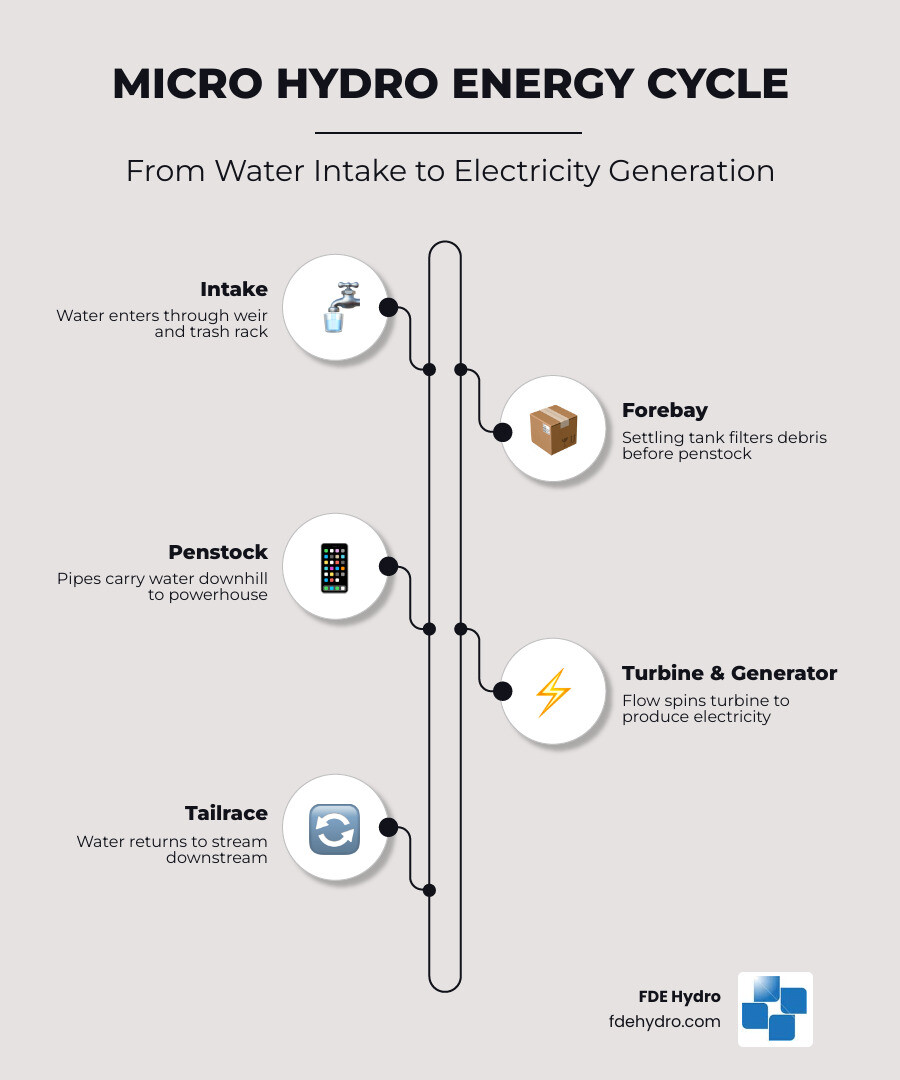
Simple guide to micro hydro power plants terms:
Understanding Micro Hydro Power Plants: A Sustainable Energy Solution
At its core, a micro hydro power plant is a marvel of efficiency. While we often think of massive concrete walls and flooded valleys when we hear “hydropower,” micro systems are different. They are primarily “run-of-river” installations. This means we don’t need to stop the river in its tracks; instead, we divert a small portion of the flow through a pipe, extract its energy, and pop it right back into the stream further down.
The power range for these systems is strictly defined: they generate between 5 kW and 100 kW. If you go below 5 kW, you’re looking at “pico hydro,” which might power a single off-grid cabin. If you scale up toward 200 kW, you’re entering the “mini-hydro” territory.
What makes these plants truly shine is their plant factor. In the energy world, plant factor describes how much power a plant actually produces versus its maximum potential. Solar panels usually hover around 10% to 30% because the sun likes to take nights and cloudy days off. Micro hydro power plants, however, can reach a plant factor of up to 90%. They are the “steady Eddies” of the renewable world, providing a continuous baseload of electricity. This reliability is one of the reasons hydropower has played a significant role in global energy expansion for over a century. To see where this technology is headed, you can read more about the future of hydropower.
Distinguishing Micro from Large-Scale Hydro
The biggest difference between micro and large-scale hydro is the footprint. Large-scale hydro requires massive reservoirs that can displace communities and alter local climates. Micro hydro, by contrast, requires minimal to no reservoir.
These systems are often integrated into existing infrastructure, such as irrigation canals or small streams. Because they only use a fraction of the stream flow, the ecological impact on fish and local flora is significantly reduced. We aren’t building a barrier; we’re building a bypass.
Engineering and Components of Micro Hydro Systems
Building a micro hydro system is like putting together a high-performance puzzle. Every piece must be sized correctly to ensure the water does its job without wearing out the equipment.
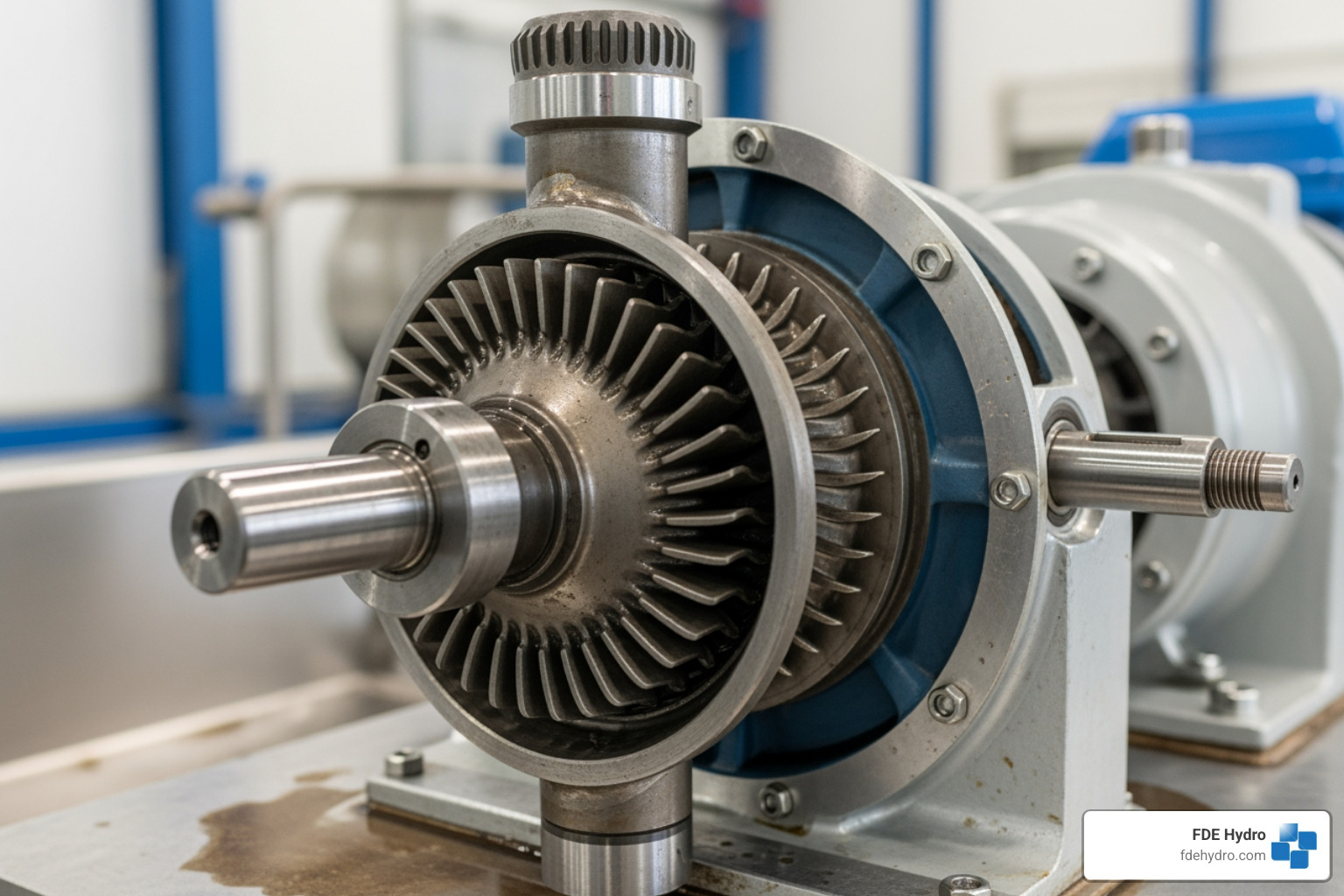
The key components include:
- Intake/Weir: A small structure that diverts water into the system.
- Trash Rack: A screen that keeps leaves, sticks, and the occasional adventurous fish out of the machinery.
- Penstock: The pipe that carries water under pressure down to the turbine.
- Powerhouse: The “brain” of the operation, housing the turbine and generator.
- Tailrace: The channel that safely returns the water to the stream.
Modern approaches to infrastructure construction have revolutionized how we install these components. Traditionally, building a powerhouse or intake meant weeks of pouring concrete on-site, often in remote, hard-to-reach locations. At FDE Hydro™, we’ve pioneered modular and precast solutions—like our “French Dam” technology—that allow these structures to be manufactured in a controlled environment and then assembled on-site. This reduces construction time from months to days and slashes costs for developers in North America and Europe.
Power Calculation and System Efficiency
How do we know how much “juice” a stream can give us? It comes down to a simple physics formula: P = Q × H × g × e
Where:
- P is Power in kilowatts (kW).
- Q is the Flow Rate (how much water is moving, measured in cubic meters per second).
- H is the Static Head (the vertical drop from the intake to the turbine).
- g is the Gravitational Constant (9.8 m/s²).
- e is the Efficiency Factor (usually between 0.5 and 0.7 for the whole system).
Basically, if you have a 10-meter drop (head) and a flow of 0.3 cubic meters per second, and your system is 50% efficient, you’ll generate about 15 kW. That’s enough to power several modern homes or a small rural clinic!
Common Turbine Technologies
Choosing the right turbine depends entirely on your site’s “personality”—specifically, its head and flow.
| Turbine Type | Best For… | Head Level | Flow Level |
|---|---|---|---|
| Pelton Wheel | High mountain streams | High | Low |
| Francis Turbine | Versatile, mid-range sites | Medium | Medium |
| Kaplan/Propeller | Large rivers or canals | Low | High |
| Archimedes Screw | Debris-heavy water | Very Low | High |
| Banki (Cross-flow) | Variable water levels | Low to Medium | Low to Medium |
For a deep dive into these mechanics, check out this technical guide on micro-hydro power systems.
Advantages and Challenges of Micro Hydropower
The “Pros” list for micro hydro power plants is long. First, there’s the 24/7 reliability. Unlike wind or solar, water doesn’t stop flowing just because it’s dark or the air is still. This makes it a perfect partner for microgrids. Furthermore, once the initial capital is paid off, the operating costs are incredibly low. A well-maintained turbine can last 20 to 30 years, providing decades of nearly free energy. You can learn more about the benefits of modular hydro to see how we maximize these advantages.
However, it isn’t all smooth sailing. The primary challenge is site specificity. You can’t just put a hydro plant anywhere; you need a consistent water source and a vertical drop. Seasonal variations are also a factor. In the summer months, a stream might slow to a trickle, reducing your power output. This is why gathering at least a year’s worth of flow data is non-negotiable during the planning phase.
Environmental and Social Benefits
Micro hydro is one of the cleanest ways to generate power. There are zero emissions and no radioactive waste. Because it’s a non-consumptive use of water, every drop that goes into the turbine comes back out, unchanged.
Socially, these plants are transformative for remote communities. By providing electricity for lighting, refrigeration (for medicines), and machinery (like rice mills), they can lift entire villages out of energy poverty. Studies have shown that large dams can have significant environmental impacts, but small-scale, run-of-river systems bypass most of these issues by maintaining the natural river health.
Planning and Implementing Micro Hydro Power Plants
Planning a system requires a mix of “boots on the ground” work and careful engineering. We start by assessing the site’s potential.
Site Assessment for Micro Hydro Power Plants
To see if your stream is a “power player,” you need two numbers: Head and Flow.
- Gross Head: This is the total vertical distance the water falls. You can estimate this using USGS maps or the “hose-tube” method (measuring pressure at the bottom of a water-filled hose).
- Net Head: This is what’s left after you subtract “friction losses”—the energy lost as water rubs against the sides of your pipes.
- Flow Data: You need to know the minimum flow during the driest part of the year to ensure your system doesn’t go dark when you need it most.
The Economic Viability of Micro Hydro Power Plants
Installing a micro hydro power plant typically costs between $1,500 and $2,500 per kW of installed capacity. For very small systems (under 5 kW), that price can jump to $2,500 or more because the fixed costs of the intake and powerhouse are spread over fewer kilowatts.
While the upfront cost might seem higher than a few solar panels, the long-term ROI is often superior due to the high plant factor. In many cases, a 200 kW mini-hydro turbine can power up to 1,750 households. When you divide the installation cost by the number of households served, it becomes one of the most affordable ways to electrify a community. For more global perspectives, UNIDO’s World Small Hydropower Development Report offers excellent case studies on successful implementations.
Global Impact and Future Potential
Micro hydro is a global game-changer. In regions like Sub-Saharan Africa and Southeast Asia, where the central grid often doesn’t reach, these plants are the backbone of rural development. Projects like the IBEKA initiative in Indonesia have shown that when a community owns and manages its own hydro plant, the sense of belonging ensures the system stays running for decades.
This decentralized approach is part of a larger trend toward microgrid technology, where local power sources provide resilience against grid failures.
Integration with Modern Grids and Renewables
The future isn’t just hydro; it’s hybrid. Micro hydro is the perfect “battery” for solar power. During the day, solar can handle the heavy lifting. At night, or during the rainy season when the sun is hidden but the rivers are full, hydro takes over.
Many modern systems are now grid-connected using net metering. This allows owners to sell excess power back to the utility company during high-flow months, further improving the project’s economics. To understand the “how” behind these setups, explore how microgrids work.
Frequently Asked Questions about Micro Hydro Power Plants
What maintenance is required for a micro hydro system?
While these systems are “low maintenance,” they aren’t “no maintenance.” You’ll need to:
- Clear the intake: Check the trash rack weekly to remove leaves and debris.
- Lubricate bearings: Most turbines have moving parts that need grease every few months.
- Inspect the penstock: Look for leaks or sediment buildup.
- Annual checkup: Once a year, have a technician inspect the generator and electrical controls.
Can I install a micro hydro plant on any stream?
Not quite. You generally need at least 2 feet (0.6 meters) of vertical drop to make it feasible. You also need a legal right to the water and, in most jurisdictions like New York or Canada, a water license and environmental permits. Distance to the “load” (the place where you use the electricity) also matters—if the powerhouse is too far away, you’ll lose too much energy in the transmission wires.
How does micro hydro compare to solar power?
Think of solar as a sprinter and hydro as a marathon runner. Solar is easy to install almost anywhere, but it only works when the sun is out (10-30% plant factor). Micro hydro power plants run 24/7 (up to 90% plant factor). In many northern climates, water flow is highest in the winter when solar production is at its lowest, making hydro a crucial winter energy source.
Conclusion
The transition to a sustainable future requires infrastructure that is as resilient as it is renewable. Micro hydro power plants offer a proven, high-efficiency solution for decentralized energy. By moving away from massive, disruptive dams and toward smart, run-of-river systems, we can protect our waterways while powering our communities.
At FDE Hydro™, we are committed to making this technology more accessible through our modular precast concrete designs. Our “French Dam” approach removes the traditional barriers of high cost and long construction timelines, making sustainable hydro a reality for more sites across North America and beyond.
Ready to see how modular construction can bring your hydro project to life? Explore our precast models for hydro infrastructure and join us in building a more reliable, water-powered future.
