

What You Need to Know About Hydroelectric Power Dams
Hydroelectric power dams are structures that capture the energy of moving water to generate electricity — one of the oldest and most reliable forms of renewable energy on the planet.
Quick answers:
- What they do: Convert the kinetic and potential energy of flowing water into electricity
- How they work: Water flows through a turbine, spinning a generator to produce power
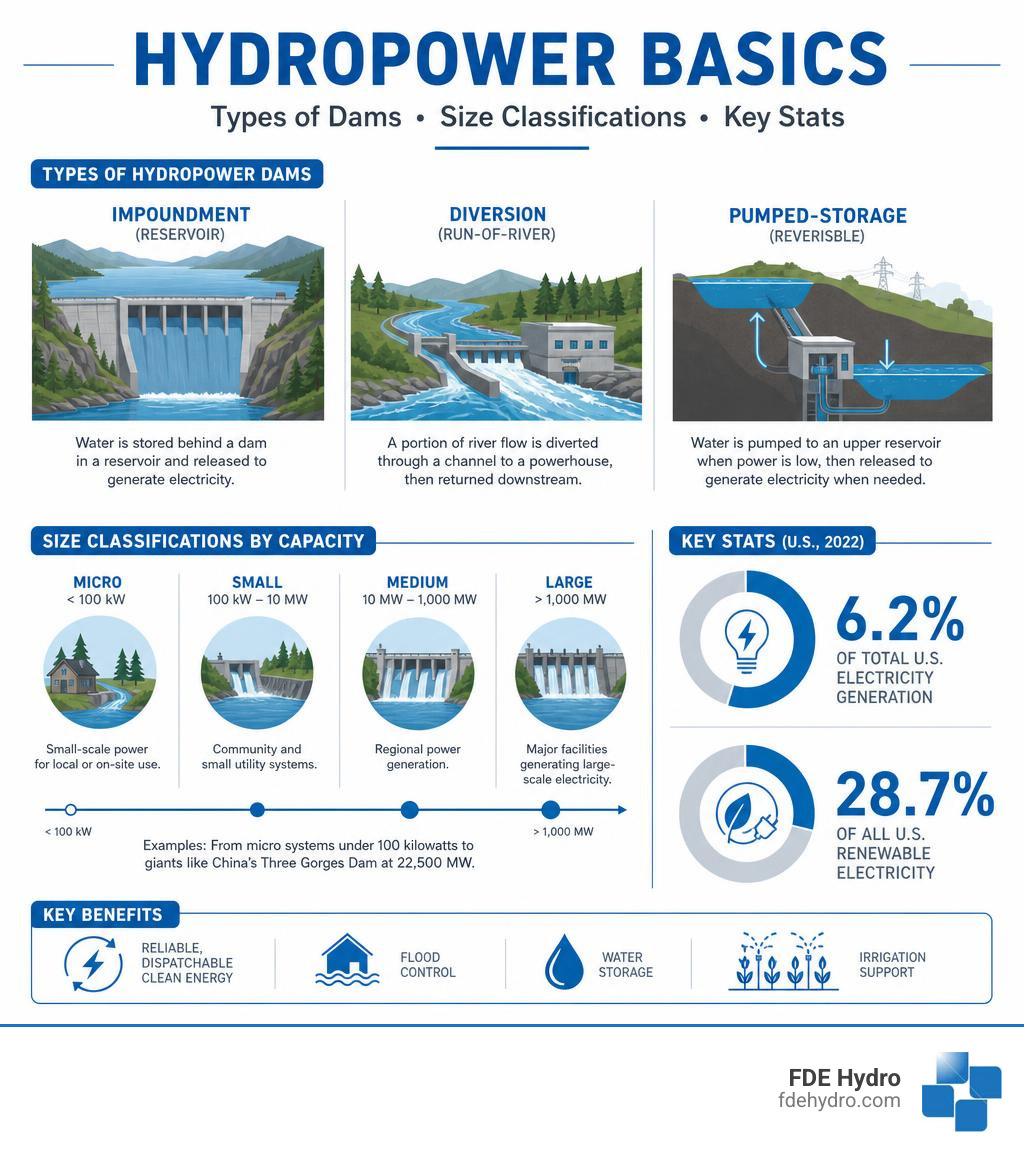
- Main types: Impoundment (reservoir), diversion (run-of-river), and pumped-storage
- Size range: From micro systems under 100 kilowatts to giants like China’s Three Gorges Dam at 22,500 MW
- Share of U.S. electricity: About 6.2% of total generation and 28.7% of all renewable electricity (2022)
- Key benefit: Reliable, dispatchable, clean energy — with added value from flood control, irrigation, and water storage
Hydropower has powered human civilization for centuries — long before the first commercial electric plant opened in Wisconsin in 1882. Today, it remains the world’s largest source of renewable electricity, with thousands of facilities operating across every inhabited continent.
Yet despite its scale and importance, hydropower is often misunderstood. Many people picture only massive concrete walls holding back enormous reservoirs. In reality, hydropower comes in many forms, sizes, and designs — each suited to different rivers, terrains, and energy needs.
I’m Bill French, Sr., Founder and CEO of FDE Hydro™, and I’ve spent decades in heavy civil construction before focusing my work on modernizing how hydroelectric power dams are designed and built using modular precast solutions. In 2015, I was selected by the U.S. Department of Energy’s Water Power Technology Office to help shape the national roadmap for next-generation hydropower. That experience — combined with the innovations we’ve developed at FDE Hydro™ — gives me a practical, ground-level perspective on what it actually takes to build and operate these facilities efficiently.
How Hydroelectric Power Dams Generate Clean Electricity
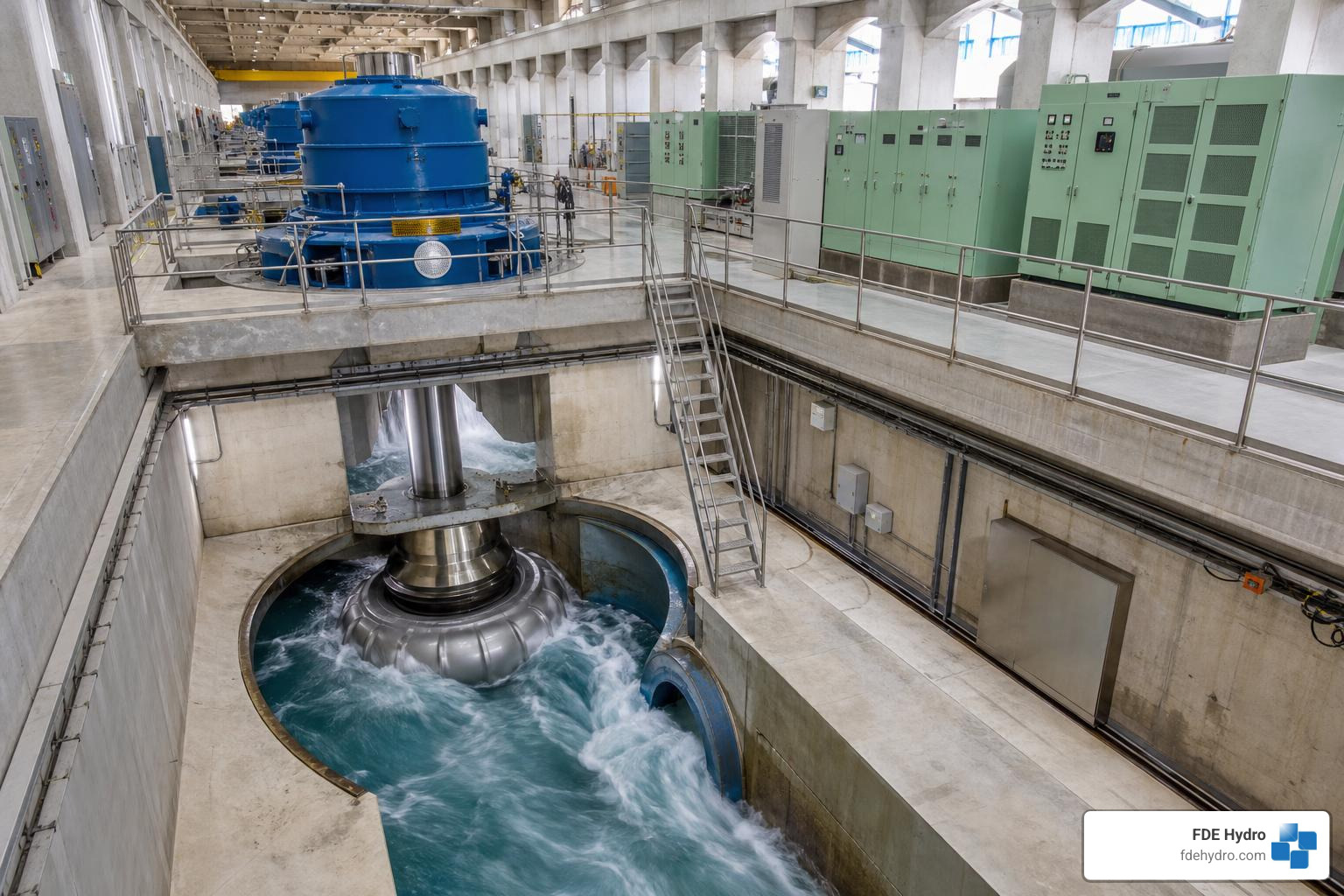
At its absolute core, generating electricity from water is a masterclass in physics made simple. We are taking the heavy, relentless pull of gravity and putting it to work.
To gain a foundational perspective, it helps to start with The Current Definition: Understanding Hydroelectric Power. In short, we are converting potential energy (water held high up) into kinetic energy (water rushing downward) to drive mechanical rotation, which finally creates electrical energy.
When water is held behind a dam, it contains a massive amount of stored potential energy. When we open the gates, gravity pulls that water downward through a dedicated channel. As the water rushes down, its potential energy transforms into kinetic energy. This fast-moving water slams into the blades of a turbine, forcing it to spin. Because the turbine is connected to a generator by a heavy shaft, the spinning motion rotates magnets inside copper coils, which coaxes electrons into motion. This mechanical-to-electrical conversion is the bedrock of Hydroelectric Power Generation.
The Role of the Water Cycle in Hydropower
You might wonder: does this water ever run out? This is where the earth’s natural water cycle acts as our ultimate battery charger.
Hydropower is entirely dependent on solar-powered evaporation and precipitation. The sun heats water in oceans, lakes, and rivers, turning it into water vapor. This vapor rises, condenses into clouds, and falls back to the earth as rain or snow.
This moisture gathers in rivers and streams, flowing back toward the sea. When we build hydroelectric power dams, we are intercepting this cycle. The amount of energy we can harvest from this loop depends on two key variables:
- Flow Volume: How much water is actually passing through the system over a given period.
- Head (Elevation Change): The vertical distance the water falls from the top of the reservoir to the turbine below. The higher the head, the more force the water exerts on the turbine.
Key Components of Hydroelectric Power Dams
While every site is unique, a conventional facility relies on several interconnected parts to keep the lights on. For a deep dive into these individual structures, check out our Hydroelectric Dam Components Ultimate Guide. Here is a quick breakdown of the primary players:
- The Reservoir: The large lake behind the dam that stores water, acting as a bank of potential energy.
- The Intake and Penstock: The intake is the gate that opens to let water in. The penstock is the massive, closed conduit or pipe that channels the rushing water directly down to the turbines.
- The Powerhouse: The secure building that houses the turbines, generators, and control systems.
- The Turbine: The modern-day water wheel that spins when struck by the rushing water.
- The Generator: The machine that converts the turbine’s rotating mechanical energy into electricity.
- The Tailrace: The channel that safely returns the water to the river downstream after it has passed through the turbine.
The Three Main Types of Hydropower Plants
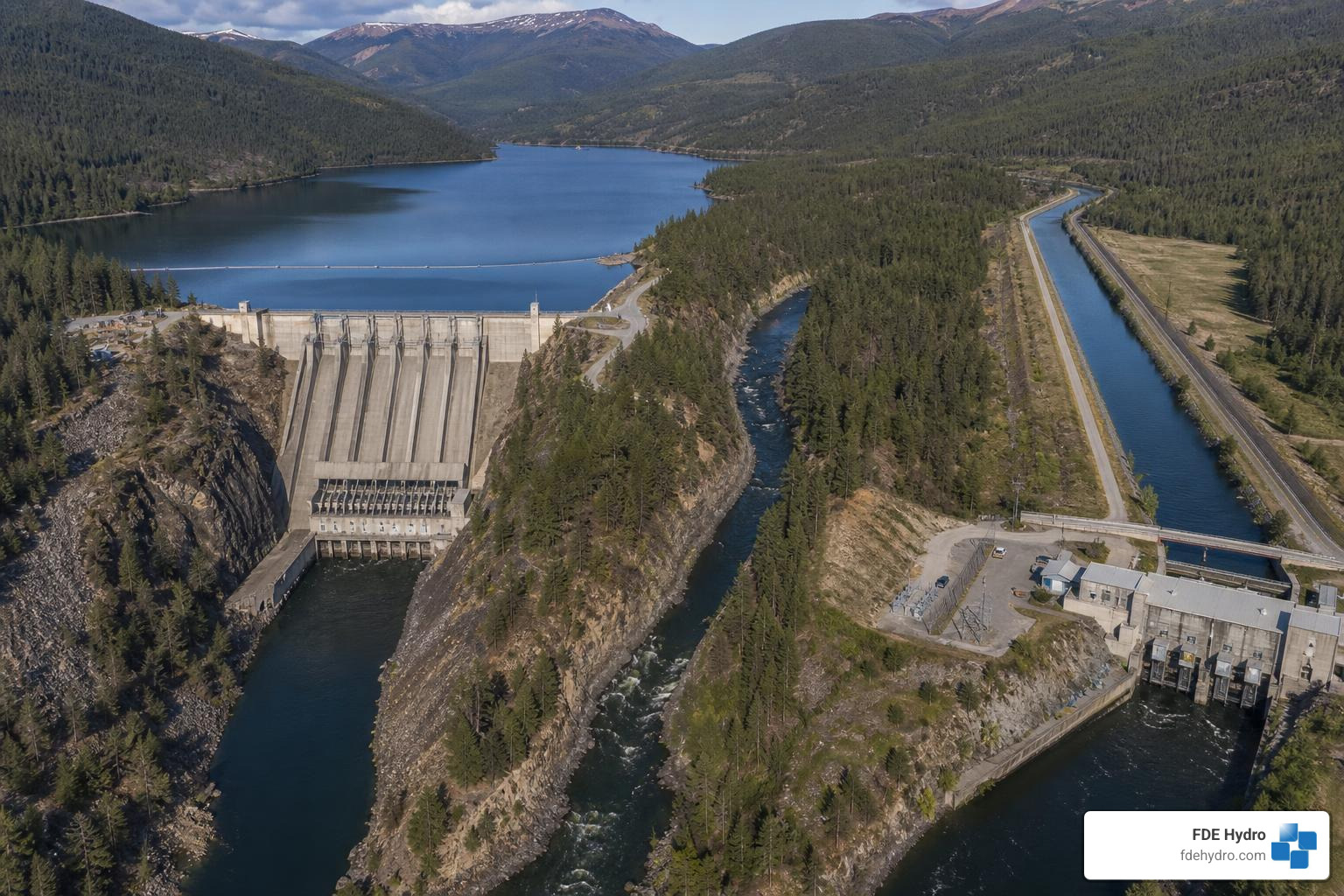
Not all hydropower facilities look like Hoover Dam. Depending on the local geography, water flow, and grid requirements, engineers choose between three main configurations. Understanding these differences is crucial when exploring modern Hydroelectric Dam Design Complete Guide.
Impoundment Facilities (Conventional Dams)
This is the classic image most people have of a hydroelectric dam. An impoundment facility uses a physical dam to block a river, creating a large reservoir behind it.
By storing water in this artificial lake, operators gain immense control. They can release water to generate electricity whenever demand spikes, making impoundment dams highly reliable “peaking” plants. However, building these massive structures requires significant capital, time, and earth-moving effort, which is why modern developers look closely at the economics of Hydroelectric Dam Construction.
Diversion or Run-of-River Systems
What if you want to generate power without flooding a massive valley? Enter the diversion system, often called a run-of-river facility.
Instead of holding back a massive reservoir, a diversion system channels a portion of a river’s natural flow through a canal or penstock to spin a turbine, after which the water is immediately returned to the main riverbed. These systems have a much smaller physical footprint and minimal environmental impact.
A great real-world example of this approach is the Patriot Hydro Lawrence Hydroelectric Project , which utilizes the natural flow of the river to generate clean power with minimal storage requirements.
Pumped-Storage Hydropower as a Giant Battery
Think of pumped-storage hydropower as a massive, water-based battery. These facilities don’t rely on the natural flow of a river to generate all their power; instead, they move water back and forth between two reservoirs at different elevations (an upper and a lower reservoir).
Here is how the cycle works:
- During Low Demand (Off-Peak): When electricity demand is low (like in the middle of the night or when solar power is peaking during the day), the facility uses surplus grid electricity to pump water from the lower reservoir up to the upper reservoir.
- During High Demand (Peak): When everyone turns on their air conditioners and electricity prices spike, the operators release the water from the upper reservoir. It rushes down through reversible turbines, generating electricity to stabilize the grid.
Because it takes more energy to pump the water uphill than the system recovers on the way down, pumped-storage is a “net-negative” generator. However, its ability to store massive amounts of intermittent renewable energy (like wind and solar) and discharge it on demand makes it an invaluable asset for modern grid stability.
Classifying Hydropower Plants by Size and Capacity
Hydropower facilities are also categorized by their generating capacity, which is measured in megawatts (MW) or kilowatts (kW).
To help navigate these size classes, we’ve outlined how they stack up in our Hydroelectric Power Solutions Guide.
| Class | Capacity Range | Typical Grid Integration | Primary Use Case |
|---|---|---|---|
| Large Hydropower | > 30 MW | Utility-scale transmission grid | Base-load power, grid stability, major cities |
| Small Hydropower | 100 kW to 10 MW | Local distribution grid / regional | Small towns, industrial plants, cooperative grids |
| Micro Hydropower | Up to 100 kW | Off-grid / local microgrids | Remote cabins, farms, isolated communities |
Large-Scale Hydropower Facilities
Large hydropower plants are the heavy lifters of the renewable energy world. Defined as facilities with a capacity of more than 30 MW, these massive installations can supply electricity to millions of homes.
They provide essential baseload power and grid stabilization services, helping balance out more volatile renewable sources. Organizations like the Hydroelectric Power – California Energy Commission – CA.gov oversee these large-scale assets to ensure they safely integrate with regional transmission networks.
Small and Micro Hydropower Systems
At the other end of the spectrum, small and micro hydropower systems prove that you don’t need to block a massive river to make a big difference. Small hydro (100 kW to 10 MW) and micro hydro (under 100 kW) are excellent for rural electrification and local industrial use.
These smaller systems often utilize existing water infrastructure, municipal water lines, or small streams without requiring massive dams. For example, historical sites like the About Bowersock facility show how smaller-scale, run-of-river installations can provide reliable, community-aligned clean energy for over a century with minimal disruption to the local ecosystem.
Historical Evolution of Water Turbines and Technology
Long before we used water to power our laptops, ancient civilizations used it to grind grain and saw wood. The history of hydropower is a fascinating journey of human ingenuity, which we explore in detail in Harnessing the Current: A Guide to Hydroelectric Power Production.
From Ancient Water Wheels to Modern Turbines
The earliest records of water power date back to the Han Dynasty (202 BC to 9 AD) in China, where water-driven trip hammers were used to hull grain. For centuries, simple wooden water wheels did the heavy lifting of the early industrial era.
The leap from mechanical work to electricity happened in the late 19th century. In 1878, the world’s first hydroelectric power project was built at Cragside House in Northumberland, England, where it was used to light a single lamp. Just a few years later, on September 30, 1882, the first commercial hydroelectric plant opened on the Fox River in Appleton, Wisconsin, proving that water could reliably power local grids.
Francis, Pelton, and Kaplan Turbines
As the demand for electricity grew, engineers moved away from simple water wheels and designed highly specialized, metal water turbines. Today, three main turbine designs dominate the industry, each optimized for different water speeds and heights. Maximizing their performance is a key focus of Hydroelectric Dam Efficiency.
- The Francis Turbine: Invented by James Francis in 1849, this is a reaction turbine where water flows inward radially, spinning the runner. It remains the most widely used water turbine in the world today, operating best in medium-head and medium-flow environments.
- The Pelton Wheel: Designed for high-head, low-flow situations (like a steep mountain stream), the Pelton wheel is an impulse turbine. High-pressure nozzles blast jets of water at spoon-shaped buckets on the wheel, forcing it to spin at high speeds.
- The Kaplan Turbine: Essentially a high-tech boat propeller inside a pipe, the Kaplan turbine is designed for low-head, high-flow conditions. Its defining feature is its adjustable blades, which allow operators to maintain high efficiency even when river flows change seasonally.
The World’s Largest Hydroelectric Power Stations
When it comes to sheer engineering scale, hydroelectric power dams rank among the largest artificial structures ever built. You can discover more about these incredible feats of engineering in Dive Into Hydropower: Unlocking Nature’s Electric Potential.
Global Giants: Three Gorges and Itaipu
At the top of the global list sits the Three Gorges Dam in China, holding the record for the world’s largest instantaneous generating capacity at a staggering 22,500 MW.
However, capacity isn’t the only metric that matters. The Itaipu Dam, located on the border of Brazil and Paraguay, has an installed capacity of 14,000 MW from its 20 generator units. Yet, because the Paraná River has a incredibly consistent year-round flow, Itaipu often matches or exceeds Three Gorges in actual annual energy generation. In 2013, Itaipu reached a historic world record by generating 98,630,035 MWh of electricity in a single year—enough to supply Paraguay’s electricity needs for nearly eight years. To explore more about this facility and others in the region, you can read the ITAIPUMAGAZINEENGLISH_LR or browse the List of hydroelectric power stations in Brazil – Wikipedia .
North American Leaders: Grand Coulee Dam
In the United States, the crown belongs to the Grand Coulee Dam on the Columbia River in Washington state. Completed in 1941, this massive concrete gravity dam stands 550 feet tall and stretches 5,223 feet long.
With a total generating capacity of 6,809 MW, Grand Coulee produces roughly 21 billion kilowatt-hours of electricity annually, supplying clean power to eight western states and parts of Canada. To put its size in perspective, the concrete used to build it could construct a four-foot-wide sidewalk wrapping twice around the equator! For more mind-boggling details, check out the Grand Coulee Dam Statistics and Facts and the Grand Coulee Dam > Northwestern Division > Fact Sheet – Northwestern Division .
Multi-Purpose Benefits and Environmental Impacts of Dams
While generating clean electricity is a primary goal, hydroelectric power dams are rarely single-purpose structures. They are complex water management tools that shape local economies and ecosystems.
Flood Control, Irrigation, and Recreation
Most large dams are built to solve multiple challenges at once.
- Flood Control: By holding back water during heavy rains or spring snowmelts, dams protect downstream communities from devastating floods. A classic example is the Albeni Falls Dam , which was authorized under the Flood Control Act of 1950 to protect the Columbia River Basin.
- Irrigation: Reservoirs store water that can be diverted to irrigate millions of acres of farmland during dry summer months, supporting local agricultural economies.
- Recreation and Tourism: Reservoir lakes provide fantastic spaces for boating, fishing, and camping, driving local tourism.
Environmental and Social Challenges of Hydroelectric Power Dams
Despite their benefits, large dams present real environmental and social challenges that cannot be ignored:
- Fish Migration: Physical barriers block fish like salmon from reaching their upstream spawning grounds.
- Habitat Alteration: Flooding a valley to create a reservoir changes the local terrestrial and aquatic habitat, which can displace wildlife.
- Community Displacement: Building massive reservoirs historically required relocating communities living in the valleys destined to be flooded.
- Greenhouse Gases: While hydropower is low-carbon, decaying vegetation in newly flooded reservoirs can release methane, a potent greenhouse gas, particularly in tropical climates.
Safety, Operations, and Regulatory Oversight
Because of the massive volume of water they hold, dam safety is a matter of national security. Dams in the United States are heavily regulated and continuously monitored. Federal agencies like the Bureau of Reclamation and the Bureau of Reclamation manage these assets with rigorous safety standards.
Operators use thousands of monitoring instruments to track structural movement, water pressure, and concrete health, ensuring that these vital infrastructure assets remain safe and operational for generations.
Frequently Asked Questions about Hydropower
How many of the dams in the United States produce power?
Believe it or not, of the more than 90,000 dams in the United States, less than 3% actually produce power. The vast majority of U.S. dams were built strictly for flood control, municipal water supply, crop irrigation, or recreation. This represents a massive opportunity: we can retro-fit many of these existing “non-powered” dams with modern turbines to generate clean energy without having to build a single new concrete wall in a river.
Why do some hydroelectric power dams generate more electricity than others with larger capacities?
It all comes down to water availability and consistency. A dam’s installed capacity (measured in MW) is the maximum power it can produce under perfect conditions. However, its actual generation (measured in MWh) depends on how much water flows through it over the course of a year.
For example, while China’s Three Gorges Dam has a much larger capacity than the Itaipu Dam, Three Gorges experiences dry seasons where water flows drop significantly. Because the Paraná River feeding Itaipu has a very steady, high-volume flow year-round, Itaipu is often able to generate a similar amount of total electricity annually despite its smaller nameplate capacity.
How do modern fish passage systems protect wildlife?
Modern dam design prioritizes fish passage to protect local migratory species. Engineers use several clever solutions:
- Fish Ladders: A series of stepped, water-filled pools that allow fish to literally swim and jump their way up and around a dam.
- Spawning Channels: Artificial streams built alongside the dam that mimic natural riverbeds, giving fish a safe path to travel and spawn.
- Fish-Friendly Turbines: Newer turbine designs feature blunter blades that rotate slower, allowing fish to pass through safely without injury.
Conclusion
As we look toward a clean energy future, the role of hydroelectric power dams is evolving. We are moving away from the era of massive, disruptive mega-dams and entering an era focused on efficiency, retrofitting, and minimal environmental impact.
At FDE Hydro™, we are leading this shift. Our patented modular precast concrete technology—known as the “French Dam”—redefines how water control systems and hydroelectric projects are built. By manufacturing concrete modules off-site and assembling them rapidly in the field, we significantly reduce construction costs, minimize environmental disruption, and slash project timelines across North America, Brazil, and Europe. Whether we are retrofitting a non-powered dam or building a new run-of-river system, our goal is to make clean, reliable hydropower more accessible and sustainable than ever before.
To learn more about how we are shaping the future of water power, explore our complete guide to Hydropower and join us in building a cleaner, more resilient energy grid.
