

Why Affordable Pumped Storage Builds Are the Key to Grid-Scale Energy Storage in 2026
Affordable pumped storage builds are large-scale energy storage projects that use two reservoirs at different elevations to store and release electricity — and they are rapidly becoming the most cost-effective solution for long-duration grid storage.
Here’s what makes them affordable:
- Closed-loop and off-river designs eliminate costly river permitting and reduce environmental hurdles
- Brownfield and former industrial sites (like old mines or smelters) cut land acquisition and site prep costs significantly
- Modular and precast construction methods reduce build time and civil engineering expenses
- Existing reservoir infrastructure can serve as the lower basin, avoiding one full reservoir build
- Multiple revenue streams — energy arbitrage, frequency regulation, capacity payments — shorten payback periods
- DOE grants and utility partnerships offset early-stage development and licensing costs
The result: modern projects are targeting costs in the range of $2.5–$4.9 million per MW, with some modular systems projecting payback periods as short as 3 years.
The U.S. currently operates about 20.1 GW of pumped storage capacity, but with FERC reviewing preliminary permits for nearly 47.8 GW of potential new capacity, the pipeline is enormous. The challenge isn’t the technology — it’s the cost and complexity of building it. High capital expenditure, long permitting timelines, and traditional construction methods have kept many projects on the drawing board for decades.
That’s the problem this article tackles head-on.
I’m Bill French, Sr., Founder and CEO of FDE Hydro™, and I’ve spent the last decade developing patented modular precast construction technologies specifically designed to make affordable pumped storage builds a reality — not just a target. My background spans 50+ years in heavy civil construction and site development, including selection by the DOE’s Water Power Technology Office to help shape the national roadmap for next-generation hydropower.
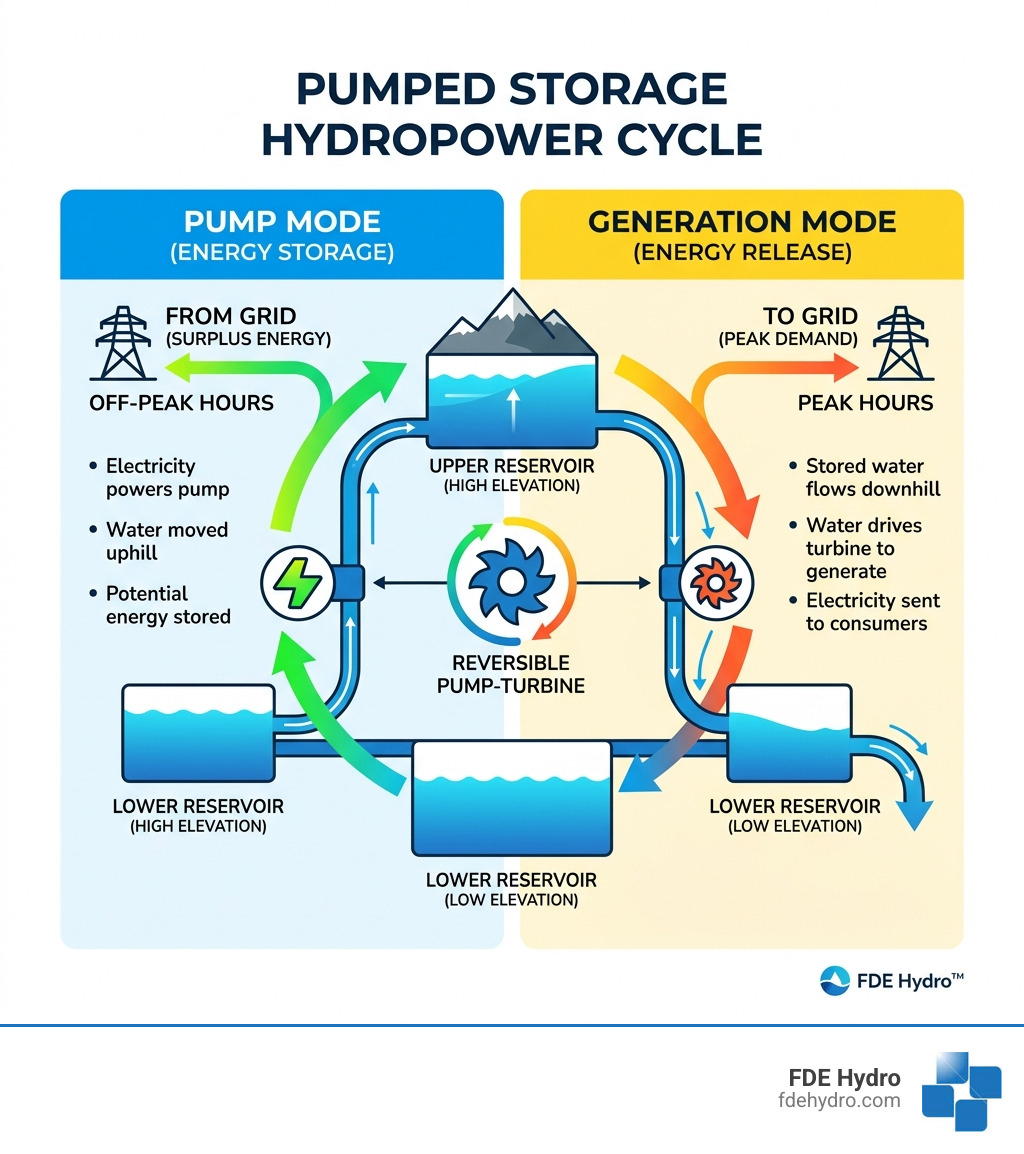
Quick look at affordable pumped storage builds:
The Economics of Affordable Pumped Storage Builds
When we talk about the economics of Pumped Storage Hydropower (PSH), we have to look at the “Big Picture” of the grid. As of May 2026, the demand for long-duration energy storage (LDES) has skyrocketed, driven by the massive expansion of AI data centers and the retirement of old coal plants. PSH is the “heavy lifter” of the storage world. Unlike lithium-ion batteries, which are great for short bursts of 2–4 hours, PSH can comfortably provide 10 to 12 hours of full-power output.
The primary cost drivers for PSH are civil engineering and capital expenditure (CAPEX). Building massive reservoirs, tunneling through mountains, and installing heavy machinery is expensive. However, by focusing on affordable pumped storage builds, we can bring the cost per MW down to levels that compete directly with fossil gas.
To understand these costs, tools like the Pumped Storage Hydropower Cost Model from NREL are invaluable. They allow us to estimate costs based on specific geography and materials. We’ve seen that Why Pumped Storage Is Making A Huge Splash is because it offers a lifespan of 50 to 100 years, far outlasting the 10-to-15-year cycle of chemical batteries.
Reducing Capital Expenditure in Affordable Pumped Storage Builds
The secret sauce to lowering CAPEX is civil engineering optimization. Traditionally, building a dam meant years of pouring “wet” concrete on-site, which is prone to weather delays and high labor costs. By switching to precast structural components—what we call the “French Dam” approach—we can move much of the work to a controlled factory environment.
This streamlined site preparation means we aren’t just cutting corners; we’re cutting timelines. When you Reduce Construction Costs, you aren’t just saving money on materials; you’re saving on the interest of the loans needed to fund these billion-dollar projects. A deep dive into Hydro Power Project Costs A Deep Dive Into The Dollars And Cents shows that labor and time are often the biggest variables.
Financial Benchmarks for Modern Projects
Let’s look at some real-world numbers from the research. The Lewis Ridge project in Kentucky is a prime example of a modern, ambitious build. It carries a price tag of about $1.3 billion for a 266 MW capacity, which works out to approximately $4.9 million per MW. While that sounds like a lot, it provides 8 hours of discharge and acts as a massive hedge against gas price volatility.
Another benchmark is the Gordon Butte Pumped Storage Project in Montana. With a projected construction cost of $986 million for 400 MW, it shows how scale can improve the math. These projects are proving that Project Cost Reduction is possible when you select the right site and use modern engineering.
| Feature | Traditional PSH | Modular Precast PSH |
|---|---|---|
| Construction Time | 8–12 Years | 4–6 Years |
| Civil Works Cost | High (On-site labor intensive) | Lower (Factory controlled) |
| Lifespan | 50–100 Years | 50–100 Years |
| Environmental Impact | High (On-river) | Low (Closed-loop) |
Modular Innovations and Precast Solutions for Faster Deployment
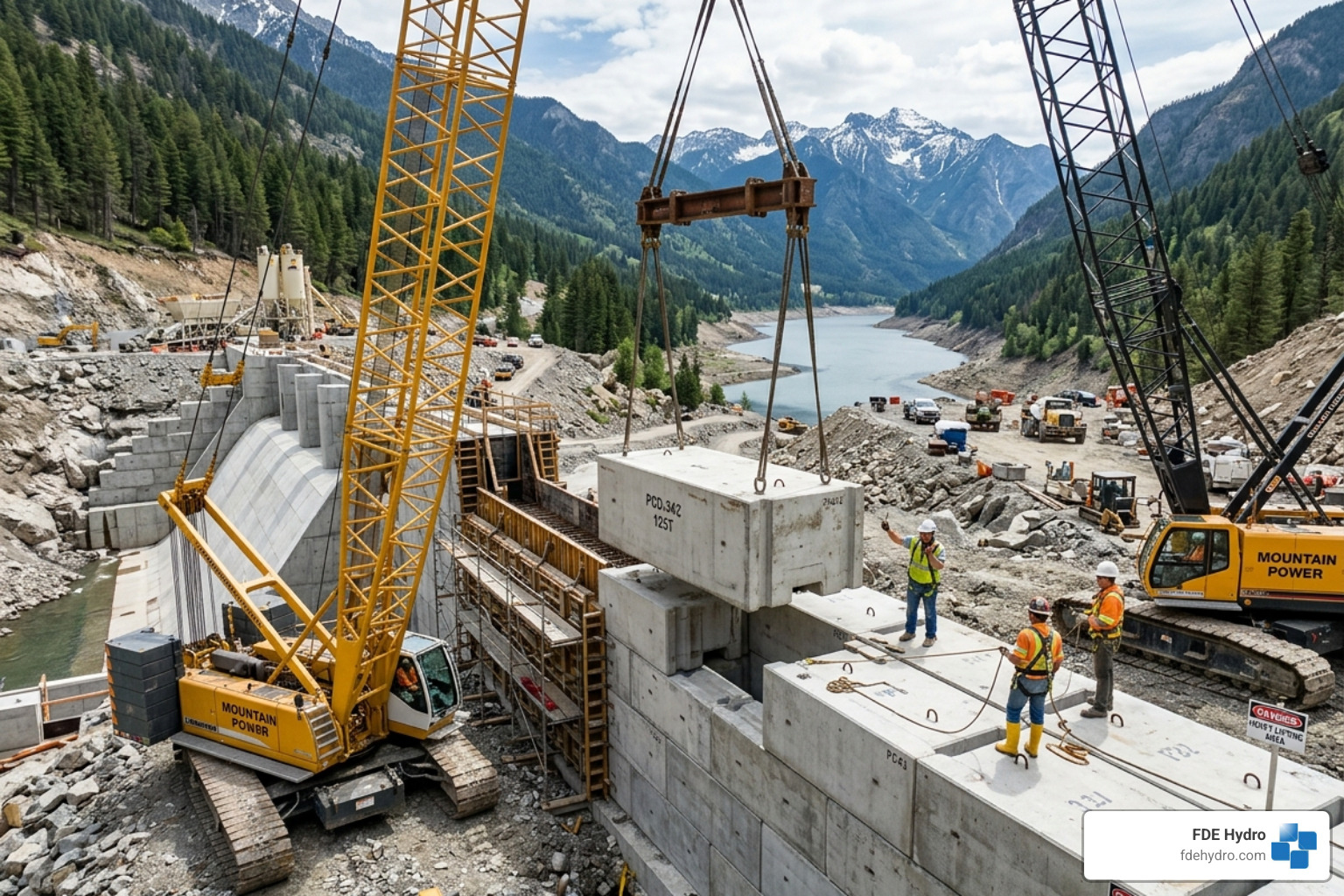
The biggest barrier to affordable pumped storage builds has always been the “bespoke” nature of the projects. Every site was treated like a unique piece of art. But in 2026, we don’t have time for art—we need infrastructure. Modular technology allows us to use standardized reservoir modules and rapid-assembly civil works.
At FDE Hydro, our Modular Dam Construction method uses precast concrete sections that lock together like giant Lego blocks. This isn’t just a gimmick; it’s a fundamental shift in how we handle water.
Scaling Affordable Pumped Storage Builds with Modular Technology
By using precast concrete, we can ensure high-quality, high-strength structures that are ready to install the moment they arrive at the site. This eliminates the “curing time” associated with traditional pours. Furthermore, modularity allows for smaller, more distributed PSH systems.
Projects like ORNL’s GLIDES (Ground-Level Integrated Diverse Energy Storage) are pushing the boundaries of what “modular” means. GLIDES uses prepressurized vessels where water acts as a piston to compress gas. It’s a closed-loop, modular system that can achieve round-trip efficiencies as high as 82%. When you combine this with Small But Mighty A Guide To Modular Pumped Storage And Its Benefits, you see a path toward installing energy storage almost anywhere, not just in the mountains.
Payback Periods and Revenue Streams
The financial viability of these builds is often better than people realize. For instance, a 60-MWh GLIDES system has a projected 3-year payback period. How? By tapping into multiple revenue streams:
- Arbitrage: Buying low (when solar is peaking) and selling high (during the evening peak).
- Frequency Regulation: Getting paid to keep the grid’s heartbeat steady.
- Spinning Reserves: Providing instant power if another plant fails.
With $10 million in annual revenue potential from ancillary services, PSH is easily the Most Cost Effective Renewable Energy storage solution over its lifetime.
Leveraging Brownfields and Closed-Loop Designs to Lower Costs
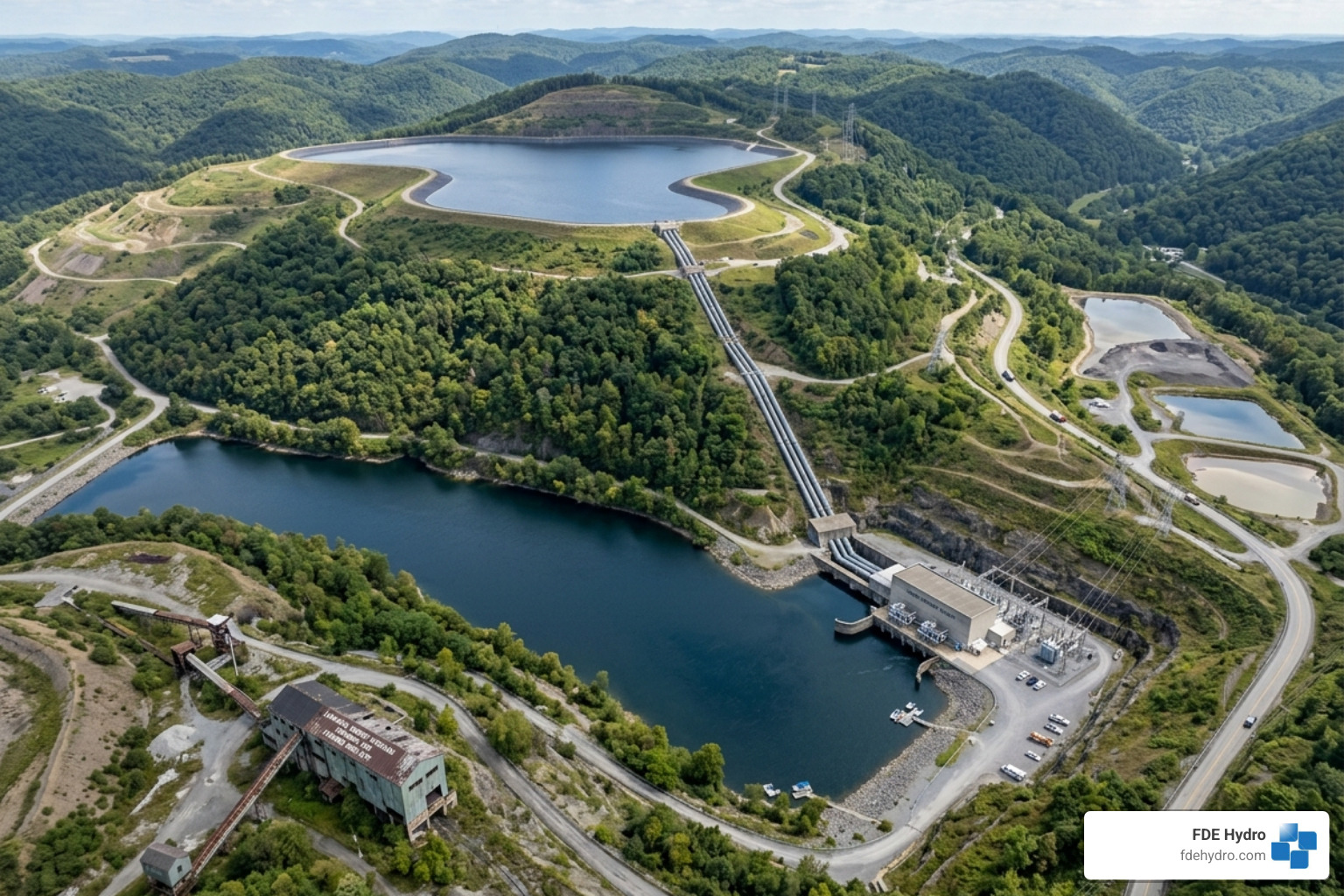
One of the cleverest ways to achieve affordable pumped storage builds is to stop looking for pristine mountains and start looking at “disturbed” land. Brownfields—former industrial sites like coal mines, quarries, or aluminum smelters—are gold mines for energy storage.
Off-River Sites and Former Mines
Using an old mine (like the Lewis Ridge project) or a former smelter (like the Goldendale project) solves several problems at once. First, the “hole” is already dug, which drastically reduces excavation costs. Second, these sites often already have transmission lines and road access.
By repurposing these sites, we also simplify land acquisition. You aren’t fighting for new permits on untouched wilderness; you’re performing “remediation” by turning an old industrial liability into a green energy asset. This is a key strategy for Cutting Costs Not Corners Your Guide To Construction Budget Reduction.
Minimizing Environmental and Regulatory Barriers
Traditional PSH often involved damming a river, which is an environmental and permitting nightmare. Modern affordable pumped storage builds are almost exclusively “closed-loop.” This means they move a fixed amount of water between two reservoirs that aren’t connected to a natural river system.
Closed-loop systems:
- Require a one-time fill (e.g., 5,000 to 10,000 acre-feet).
- Have minimal impact on fish and aquatic ecosystems.
- Speed up the FERC licensing process because the environmental “footprint” is so much smaller.
As we explain in Pumped Up Everything You Need To Know About Hydropower Energy Storage/, these systems act like a giant battery that just happens to use gravity and water instead of lithium and cobalt.
Policy Support and Grid Reliability Benefits
We aren’t doing this alone. The U.S. government has realized that long-duration storage is a national security issue. In 2024 and 2025, we saw massive DOE grants, including an $81 million award for clean energy on mine lands. This policy support is what makes the initial design and permitting phases of affordable pumped storage builds feasible for developers.
Research from Replacing Gas with Low-cost, Abundant Long-duration Pumped Hydro in Electricity Systems shows that low-cost PSH can replace fossil gas entirely without a cost penalty. This is a game-changer for reaching 100% renewable goals in states like New York and California.
Long-Duration Storage and Baseload Replacement
The beauty of PSH is “mechanical inertia.” When a massive turbine is spinning, it provides a physical stability to the grid that software-controlled batteries just can’t match. This makes PSH a true baseload replacement for retiring coal and gas plants.
Take the White Pine Pumped Storage Project in Nevada. It targets 1,000 MW of capacity. Or the Goldendale project in Washington, which uses 2,400 feet of vertical “head” to create massive energy density. These projects provide 10–12 hours of discharge, ensuring that even if the wind doesn’t blow for a day, the lights stay on. This is the core of Hydropower Energy Storage.
Economic Impact and Job Creation
Building these facilities is a massive boost for local economies. A typical 1,000 MW project creates hundreds of construction jobs over 4–6 years and dozens of permanent, high-paying technical roles. Beyond jobs, these projects provide millions in local tax revenues, helping rural counties fund schools and infrastructure.
Through utility collaborations—like the San Vicente project where the San Diego County Water Authority is partnering with private developers—we see how public-private partnerships can lower the financial risk and ensure Pumped Storage Hydropower remains a public benefit.
Frequently Asked Questions about Affordable PSH
What is the typical cost per MW for affordable pumped storage builds?
In 2026, we are seeing costs range from $2.5 million to $4.9 million per MW. The lower end is achieved by using existing reservoirs as the lower basin or repurposing deep mine shafts. The higher end typically involves complete “greenfield” closed-loop systems with significant tunneling.
How do closed-loop systems reduce environmental impacts?
Closed-loop systems don’t dam or divert natural rivers. They use a fixed volume of water that cycles back and forth. This means no impact on fish migration, no change in river temperatures, and much lower “evaporative loss” than open-river reservoirs. This makes the permitting process much faster and cheaper.
Why is modular PSH the most viable solution for long-duration grid storage?
Modular PSH, like our French Dam system, allows for faster construction and predictable costs. Because the components are precast, we avoid the “surprises” of on-site concrete pours. Additionally, modularity allows us to build smaller, 10–50 MW systems that can be placed closer to demand centers, reducing the need for massive new transmission lines.
Conclusion
The era of the “megaproject” that takes 20 years to build is over. To meet our 2030 and 2045 climate goals, we need affordable pumped storage builds that can be deployed in half that time.
At FDE Hydro™, we believe the answer lies in the marriage of proven physics and modern manufacturing. By using our French Dam technology, we are helping developers across North America, Brazil, and Europe turn the dream of cheap, long-duration storage into a precast reality. Whether it’s retrofitting an existing dam or building a new closed-loop system in an old quarry, the goal is the same: grid reliability that doesn’t break the bank.
Ready to see how modularity can change your next project? More info about modular dam solutions
