

Why Hydropower Solutions Are Central to the Clean Energy Future
Hydropower Solutions are among the most reliable and cost-effective tools available for generating clean electricity at scale — delivering over 15% of the world’s electricity today, around the clock, without fuel.
Here is a quick overview of what modern hydropower solutions include:
| Solution Type | Best For | Key Benefit |
|---|---|---|
| Conventional large hydro | Grid-scale baseload power | Firm, 24/7 capacity |
| Pumped storage | Grid-scale energy storage | 88% of U.S. utility-scale storage |
| Inline / in-pipe hydro | Existing pipelines and channels | Rapid, low-cost deployment |
| Plant modernization | Aging infrastructure | Up to 15% more capacity unlocked |
| Small / run-of-river hydro | Remote or rural sites | Minimal environmental footprint |
Unlike solar or wind, hydropower doesn’t stop when the sun sets or the wind drops. It is dispatchable — meaning operators can turn it up or down on demand. That makes it a cornerstone of any serious grid decarbonization strategy.
Yet the industry is at a crossroads. By 2030, roughly 40% of global hydropower plants will be over 40 years old. At the same time, new modular and inline technologies are opening doors that didn’t exist a decade ago — letting developers generate power from existing pipelines, irrigation channels, and river systems without building a new dam.
This guide walks through where the technology stands today, what’s changed, and what the smartest infrastructure decision-makers are doing about it.
I’m Bill French, Sr., Founder and CEO of FDE Hydro™ — a company built around delivering modular civil construction innovations to the hydropower industry, including patented solutions for run-of-river facilities, modular powerhouses, and pumped storage that are reshaping how hydropower solutions get built and financed. Over the past decade I’ve worked directly with the U.S. Department of Energy and Oak Ridge National Lab to help define the next generation of clean hydropower technology, and I’ll be drawing on that experience throughout this guide.
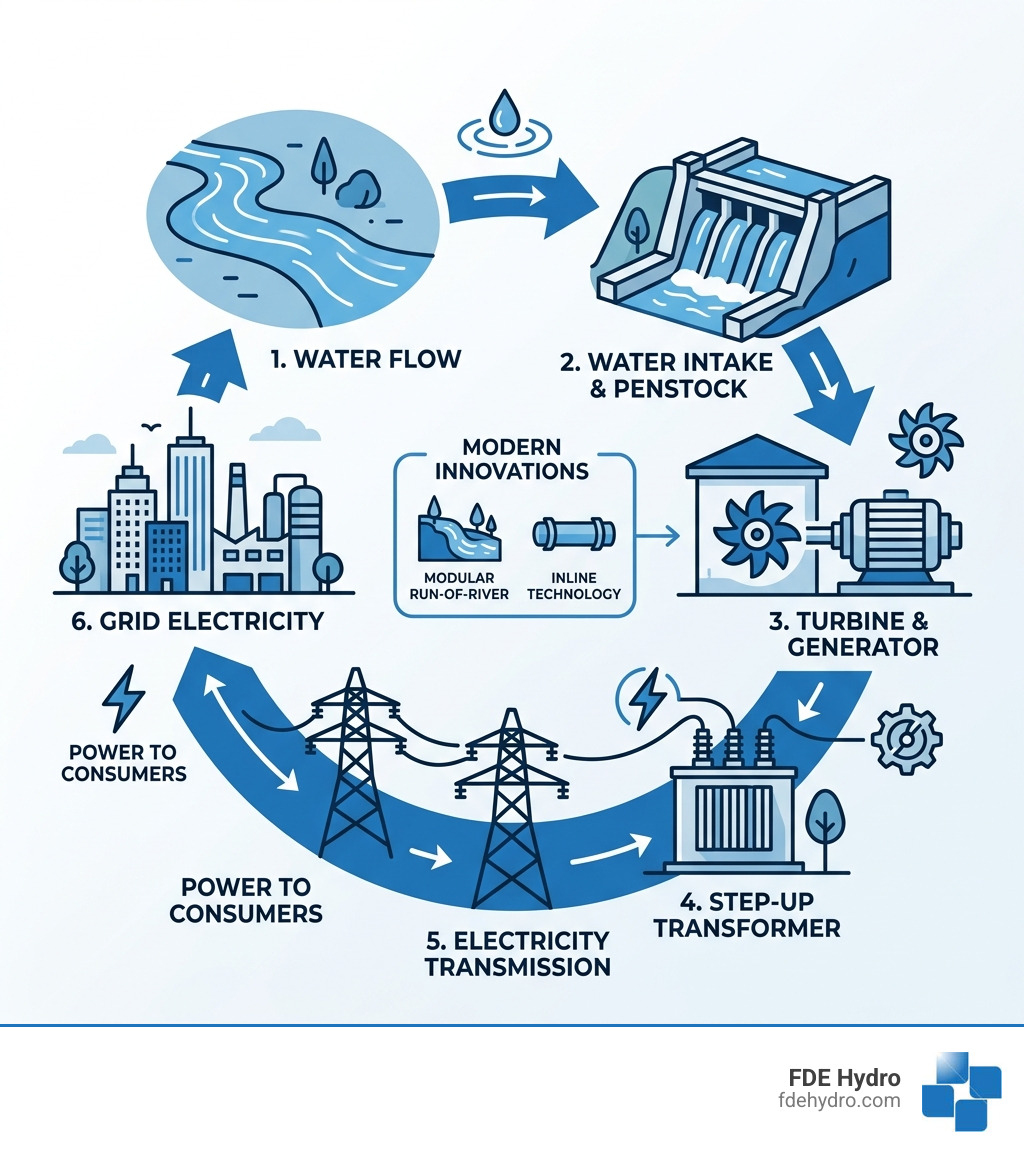
Hydropower Solutions terms at a glance:
The Evolution of Hydropower Solutions

Hydropower is far from a “legacy” technology. While it is one of the oldest methods of generating decarbonized electricity, it is currently undergoing a massive technological renaissance. In the United States, hydropower accounts for 27.37% of total utility-scale renewable electricity generation. Its “firm capacity”—the ability to provide a guaranteed amount of power at any given time—is estimated at over 24 GW in the U.S. alone. That is enough to power between 16 and 24 million homes.
What makes Hydropower Solutions unique in the modern era is their role as the “guardian of the grid.” As we add more intermittent solar and wind to our networks, we need a “wildcard” that can stabilize the system. Hydropower provides this through 24/7 reliability and massive energy storage capabilities. Organizations like the National Hydropower Association advocate for the critical role hydro plays in the path to clean energy.
At FDE Hydro, we focus on Hydropower Innovation to solve the biggest hurdle facing the industry: the high cost and long timelines of traditional civil works. By moving toward modular designs, we can deploy Hydroelectric Power Solutions faster and more affordably than ever before.
Innovative Inline Hydropower Solutions
One of the most exciting shifts in the industry is the move toward “inline” or “in-pipe” generation. Imagine a hydropower plant that doesn’t look like a massive concrete wall, but rather a standard ISO shipping container. These containerised designs allow us to harness energy from water already moving through human-made infrastructure.
These Hydro Energy Solutions are “plug-and-play.” By using a containerised approach, we can house the turbine, generator, and control systems in a single, weather-proof unit that is easy to transport and install. This makes Hydropower accessible to industries that never thought they could be energy producers, such as municipal water districts or large-scale manufacturing plants.
Scalable Hydropower Solutions for Diverse Applications
Modern technology has broken the “bigger is better” myth. We now see a power output range that is incredibly scalable, from small 4 kW units to multi-megawatt systems. This scalability means we can apply these solutions to:
- Irrigation Channels: Turning agricultural water flow into local power for pumps and sensors.
- Municipal Pipelines: Capturing the energy usually wasted by pressure-reducing valves in city water mains.
- Wastewater Systems: Generating electricity from the gravity-fed flow of treated effluent.
- River Systems: Using run-of-river technology that doesn’t require a large reservoir.
Whether in the bustling cities of the United States or throughout Hydropower in Europe, these diverse applications are proving that Hydroelectric Power Generation is a versatile tool for any fluid-rich environment.
How Modern Inline Systems Transform Infrastructure
The beauty of modern inline Hydropower Solutions lies in their ability to integrate with existing infrastructure with minimal modifications. In the past, if you wanted hydro power, you had to change the landscape. Today, we change the equipment.
These systems typically involve a “Fluid Flow Funnel Unit” and a “Power Generation Unit.” The system is connected between pipeline segments using flexible couplings or flanged adaptors. Because the units are designed for full submersion or placement in compact vaults, they don’t disrupt the primary function of the pipeline.
Technological advancements have also solved the “cavitation” problem. Modern turbines use curved blade profiles and multi-stage designs optimized for low-head environments. This ensures the equipment lasts longer and operates more quietly. This move toward Sustainable Hydro Infrastructure is a key part of the Future of Hydropower, allowing us to generate green energy beneath our feet without the public ever seeing a turbine.
Advantages of Next-Generation Hydro Technology
When comparing Hydropower Solutions to other renewables, the advantages in reliability and footprint are clear.
| Feature | Hydropower | Solar | Wind |
|---|---|---|---|
| Availability | 24/7 (Baseload) | Daytime only | Intermittent |
| Lifespan | 60–80+ years | 20–25 years | 20–25 years |
| Energy Density | High | Low | Low |
| Grid Stability | Excellent (Inertia) | Limited | Limited |
| Deployment Speed | Rapid (Modular) | Rapid | Moderate |
Beyond just being a “green” alternative, next-generation hydro offers:
- Rapid Deployment: Modular and containerised systems can be installed in weeks, not years.
- Low Maintenance: Modern smart sensors and variable-speed hydraulics allow for predictive maintenance, reducing the need for on-site technicians.
- Zero Emissions: Once the equipment is in place, it generates Hydropower Electricity with no carbon footprint.
- Weather Independence: Unlike wind and solar, which are at the mercy of the clouds and the breeze, hydro relies on fluid flow that is often constant and predictable.
The Benefits of Hydropower Plant installations go beyond just the electricity; they provide a hedge against energy price volatility and increase the resilience of local grids.
Modernizing Aging Assets and Pumped Storage
We can’t talk about the future without addressing the past. Roughly 40% of global hydropower plants will be over 40 years old by 2030. In the U.S., many of our most iconic dams are reaching an age where they need more than just a “tune-up.”
Digitalization and technology upgrades can unlock up to 15% more capacity from these existing plants. By replacing old turbines with modern, high-efficiency designs and adding advanced control systems, we can add 7–10 TWh of clean energy to the grid without pouring a single new yard of concrete.
Then there is the “giant battery” of the energy world: Pumped Storage Hydropower. PSH currently provides 88% of all utility-scale energy storage in the United States. It works by pumping water uphill when energy is cheap (like when solar is peaking at noon) and releasing it through turbines when demand is high.
At FDE Hydro, we believe the future of storage is “Small But Mighty.” Our Modular Pumped Storage designs allow for grid-scale storage in locations that wouldn’t support a traditional massive reservoir. This type of Hydropower Retrofitting is essential for a grid that needs to balance millions of electric vehicles and smart homes.
Frequently Asked Questions about Hydropower Technology
How does inline hydropower differ from traditional dams?
Traditional dams rely on creating a large reservoir to build up “head” (water pressure). Inline hydropower, however, captures the kinetic energy already present in flowing fluid within a pipe or channel. It doesn’t require flooding land or blocking fish passage, making it a much simpler and more eco-friendly option for industrial and municipal use.
What is the typical lifespan and maintenance of modern systems?
Hydropower assets are famous for their longevity. While a solar panel might last 25 years, a well-maintained hydropower plant can easily operate for 60 to 85 years. Modern systems use advanced materials like saltwater-resistant alloys and gear-driven ceramic cartridges that resist chemical build-up, significantly lowering the maintenance requirements compared to older technology.
Can hydropower systems be integrated into existing irrigation?
Absolutely. In fact, irrigation channels are perfect candidates for modular Hydropower Solutions. Because irrigation flow is often highly predictable and controlled, we can install modular turbines that provide power for the farm or feed back into the local rural co-op grid. This turns a water delivery cost into a potential revenue stream for landowners.
Conclusion
The world of hydropower is changing, and at FDE Hydro, we are proud to be leading the charge. Our patented modular precast concrete technology—the “French Dam”—is designed to slash construction costs and timelines. By moving away from traditional, labor-intensive onsite pouring and toward precision-engineered modular components, we make it possible to build and retrofit hydroelectric systems across North America, Brazil, and Europe with unprecedented efficiency.
Whether you are looking to modernize an aging facility, install an inline system in a municipal pipeline, or explore the potential of modular pumped storage, the right Hydropower Solutions are now more accessible than ever. We invite you to explore the Hydropower Advancements Innovations 2025 and see how we can help you harness the power of water for a sustainable future.
For more information on how we can tailor a project to your specific needs, visit our main Hydropower page and let’s start building the next generation of clean energy together.
