How a Hydroelectric Dam Turns Moving Water Into Electricity
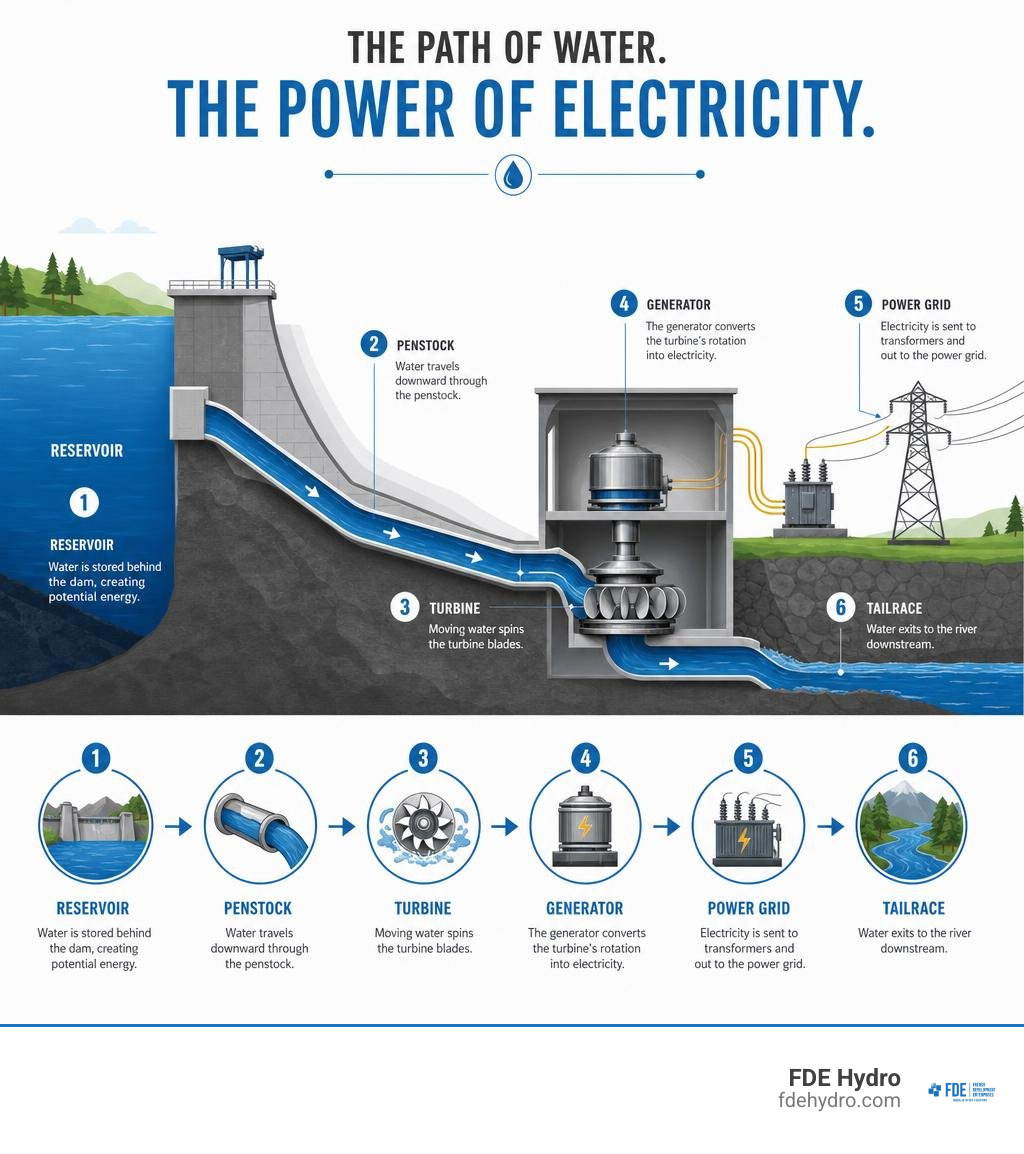
A hydro electric dam is a structure built across a river to hold back water, create a reservoir, and release that water in a controlled way to generate electricity. Here’s the short version:
Element
What It Does
Dam wall
Holds back water to create height (called “head”)
Reservoir
Stores the potential energy of water
Penstock
Channels water downward to the turbine
Turbine
Spins as water rushes through it
Generator
Converts that spin into electricity
Tailrace
Returns water to the river downstream
In other words: water falls, blades spin, electricity flows.
Hydroelectric dams are one of the oldest and most reliable sources of reliable energy on the planet. They supply roughly 15% of the world’s electricity and account for nearly 29% of all U.S. renewable electricity generation. Unlike solar or wind, they can generate power on demand — day or night, rain or shine.
I’m Bill French, Sr., Founder and CEO of FDE Hydro™, and I’ve spent decades in heavy civil construction before launching FDE Hydro™ in 2015 to bring modular, precast construction methods to the hydro electric dam industry. In this guide, I’ll walk you through everything you need to know — from how these structures work to what it takes to build and operate them.
To truly understand what is a hydro electric dam, we have to look at it as a giant energy converter. It doesn’t actually “create” energy out of nothing; rather, it intercepts water moving through the natural water cycle and converts its physical energy into electrical current.
At its core, the system relies on two fundamental physics concepts: potential energy and kinetic energy.
Potential Energy: Water stored high up in a reservoir behind a massive concrete wall possesses gravitational potential energy. The higher the water level rises, the more stored energy it accumulates.
Kinetic Energy: When we open the gates, gravity pulls that water downward. As it rushes through the internal pipes, that stored potential energy transforms into kinetic energy—the energy of motion.
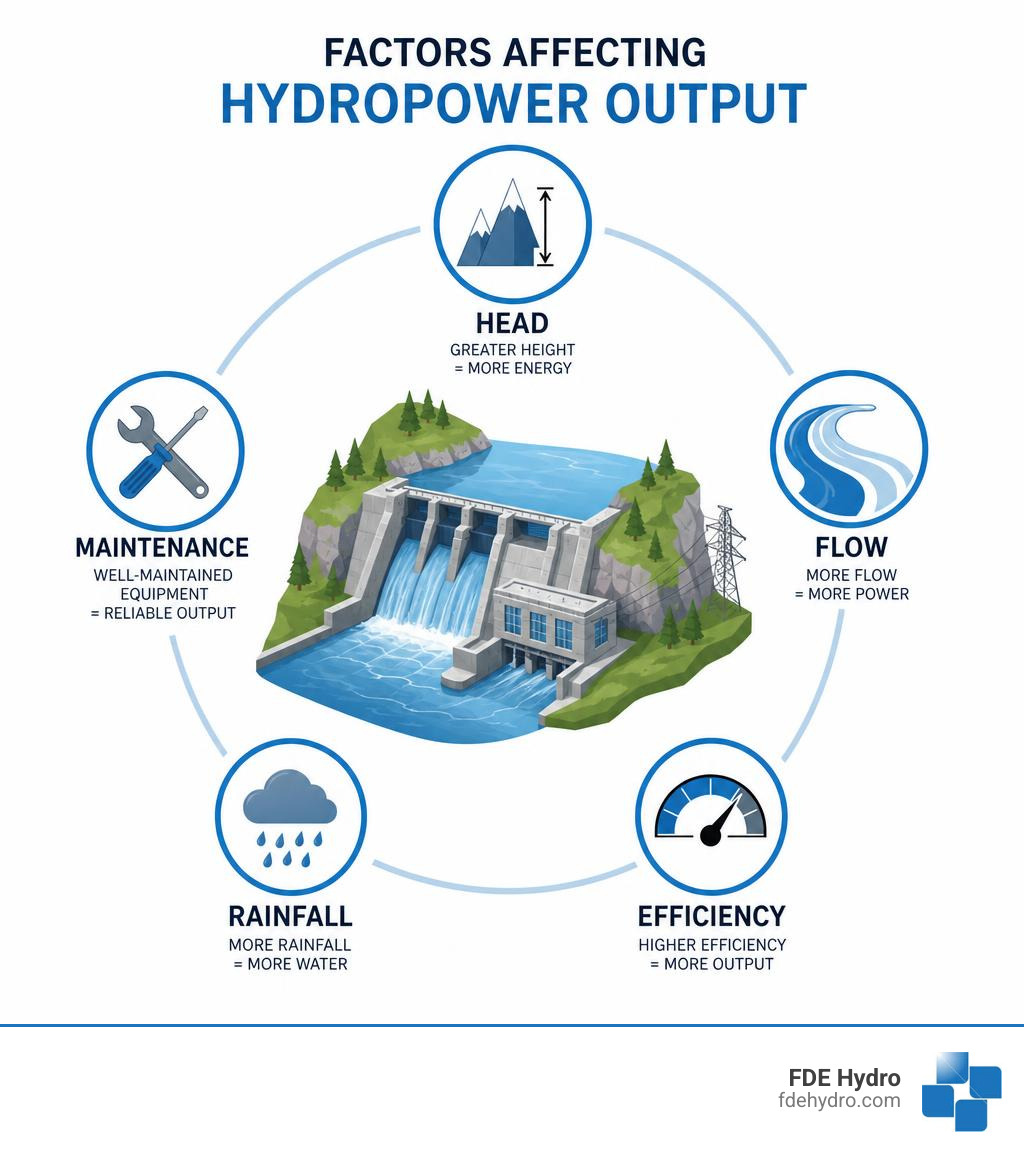
Two key factors dictate exactly how much electricity a facility can generate: head and flow.
Head refers to the vertical distance the water falls. The greater the height difference between the reservoir surface and the turbine below, the higher the pressure, and the more power we can produce. For instance, the Oroville Dam in California stands at a staggering 230 meters tall, creating immense hydraulic head.
Flow is the volume of water moving through the system over a given time. A massive volume of water moving slowly can sometimes produce just as much power as a small volume falling from a great height.
The Core Definition: What is a Hydro Electric Dam?
Stripped of its electrical components, a dam is simply a retaining structure. Humans have been building them for thousands of years to control the flow of local rivers. Beyond generating clean power, these structures serve several vital societal purposes:
Water Supply & Irrigation: Reservoirs store water during wet seasons to supply municipal water systems and irrigate agricultural land during droughts. In fact, about 20% of the world’s arable land is irrigated by water from reservoirs impounded by dams.
Flood Control: By acting as a giant safety valve, a dam can hold back sudden surges of rainwater or melting snow, protecting downstream communities from devastating floods.
Recreation: Large reservoirs provide spaces for boating, fishing, and local tourism.
How to Explain What is a Hydro Electric Dam to a Beginner
If you are explaining this to someone without an engineering degree, use the “bicycle generator” analogy. Remember those old bicycle lights that lit up when you pedaled? A small roller rubbed against the spinning tire, spinning a tiny magnet inside a coil of wire to power the bulb.
A hydroelectric dam works on that exact same principle of electromagnetic induction, first discovered by Michael Faraday.
Instead of your leg muscles spinning the bicycle wheel, the weight of falling water spins a massive water turbine (which looks like a giant metal fan). This turbine is connected by a heavy steel shaft to a generator above. Inside the generator, powerful electromagnets spin past heavy copper coils. This movement forces electrons to flow through the wire, creating an electrical current that can be sent straight to your living room.
A functional hydroelectric facility is a complex ecosystem of mechanical and civil engineering. Let’s look inside the powerhouse and surrounding structures to see the core components that make it all happen:
The Intake and Trash Racks: Water enters the system through gates located on the reservoir side of the dam. Before entering, it passes through heavy metal screens called trash racks, which prevent logs, rocks, and debris from entering and damaging the internal machinery.
The Penstock: This is a long, heavy-duty steel or concrete pipe that channels water from the intake down to the turbine. The penstock is carefully designed to control the slope and build up maximum hydraulic pressure.
The Turbine: Located at the bottom of the penstock, the turbine converts the kinetic energy of the rushing water into mechanical spin. Depending on the head and flow of the site, engineers use different turbine designs, such as Francis, Kaplan, or Pelton wheels.
The Generator: Sitting directly above the turbine, this component uses Faraday’s principles of electromagnetism to convert the spinning mechanical energy into electrical energy.
The Transformer: The electricity produced by the generator is relatively low voltage. Transformers step up this voltage so it can travel long distances over transmission lines with minimal energy loss.
The Tailrace: After the water has passed through the turbine and surrendered its energy, it is discharged back into the natural river channel through an exit channel called the tailrace.
The Spillway: If the reservoir gets too full during heavy storms, the spillway acts as an overflow safety valve, allowing excess water to bypass the turbines entirely and safely escape downstream.
Not all hydroelectric plants look or operate the same way. Depending on the local geography, water availability, and grid demands, developers build different types of facilities.
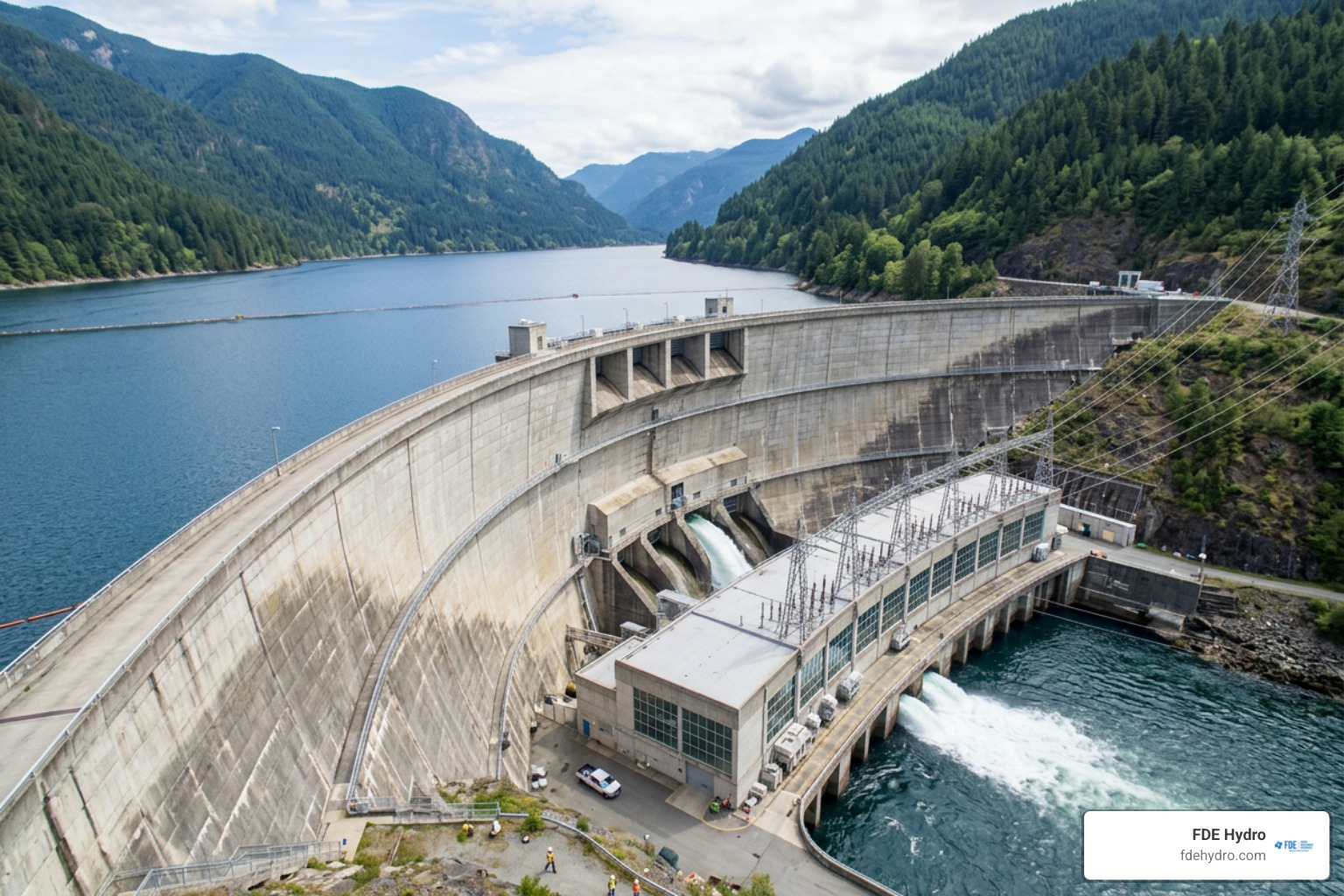
This is the classic image that comes to mind when you think of a hydroelectric dam. An impoundment facility uses a large dam structure to hold back a river and create a massive reservoir.
Because we can control exactly when and how much water passes through the gates, impoundment facilities offer unmatched flexibility. They can ramp electricity production up or down in a matter of minutes to match fluctuating grid demands. Famous examples of large conventional facilities include the Grand Coulee Dam on the Columbia River in Washington State (the largest U.S. hydropower facility with 6,765 MW of capacity) and the massive Itaipu Dam shared between Brazil and Paraguay.
To read more about the history and scale of these massive conventional structures, Read about conventional dams.
Diversion and Run-of-River Systems
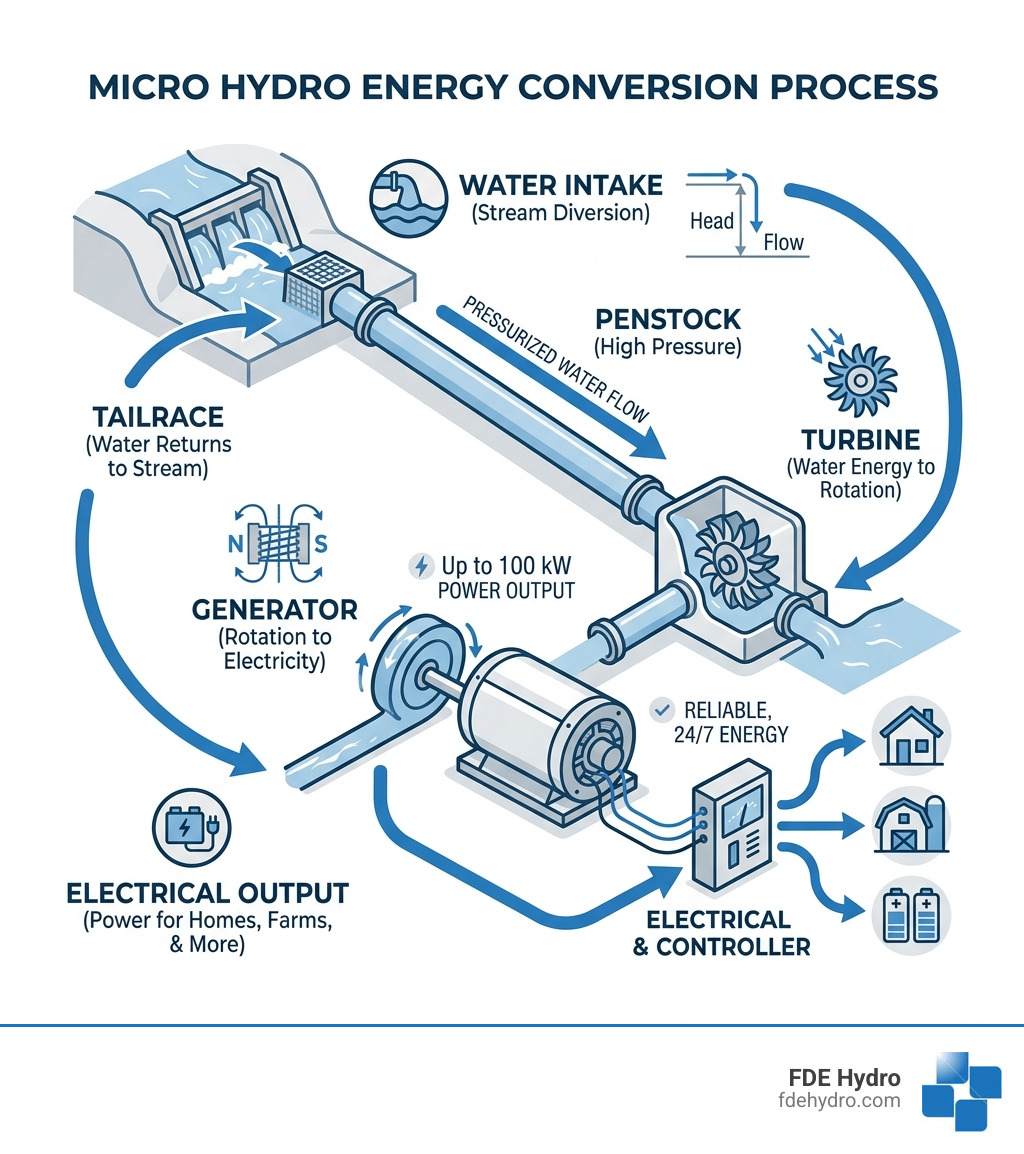
A diversion, or run-of-river system, takes a completely different approach. Instead of blocking a river entirely with a massive wall, it channels a portion of the natural river flow through a canal or penstock to spin a turbine, before returning it directly to the main river channel.
These systems typically require little to no reservoir storage. Because they rely on the natural, seasonal flow of the river, they are highly dependent on local weather patterns and are generally used to provide steady baseload capacity. A great local example is the historic Bowersock Lawrence Hydroelectric Project in Lawrence, Kansas, which has harnessed the natural flow of the Kansas River for over a century.
To learn more about how these low-impact systems generate electricity without massive flooding, Learn about run-of-river systems.
Pumped Storage Hydropower
Pumped storage is not actually a primary energy source; instead, it acts as a giant, highly efficient physical battery.
These facilities use two reservoirs at different elevations:
During low-demand periods (like 5:00 AM when everyone is asleep, or when solar and wind are producing excess power), we use cheap electricity from the grid to pump water from the lower reservoir up to the higher one.
During peak-demand periods (like 5:00 PM on a hot summer day when air conditioners are humming), we release that water back down to the lower reservoir, spinning the turbines to generate high-value electricity when the grid needs it most.
While pumped-storage systems actually consume more electricity to pump the water than they generate (making them net negative energy devices), they provide crucial grid stability and account for roughly 88% of all utility-scale energy storage in the United States. To see how modern technology is optimizing these systems, Explore modern hydropower technology.
Advantages and Disadvantages of Hydropower
Like any energy source, hydroelectric power comes with trade-offs. Balancing the immense economic and grid benefits against the local environmental impacts is one of the most critical challenges of modern energy design.
The Advantages
Renewable & Clean: Hydropower relies on the natural water cycle, meaning it won’t run out. Once constructed, these facilities produce virtually zero greenhouse gas emissions during operation.
Grid Flexibility & Reliability: Unlike wind and solar, which depend on the weather, impoundment and pumped-storage facilities can provide immediate “firm capacity” to stabilize the grid.
Low Operational Costs: Because the fuel (water) is free, operational and maintenance costs are incredibly low over the long term.
Multipurpose Infrastructure: The reservoirs created by dams provide water storage, flood protection, and recreational spaces for local communities.
The Disadvantages
Ecosystem Disruption: Blocking a river can disrupt natural fish migration patterns, particularly for species like salmon. (Though we can mitigate this using modern fish ladders and bypass systems).
Siltation: Dams trap sediment that would naturally flow downstream, which can lead to reservoir siltation over decades and alter downstream habitats.
High Initial Capital Costs: Traditional concrete dams are incredibly expensive and take years to construct.
Drought Vulnerability: If water levels drop significantly due to severe droughts, electricity generation capacity can be severely limited.
Building a traditional hydroelectric dam is one of the most demanding civil engineering challenges on earth. The process typically begins by diverting the river using temporary structures called cofferdams so that workers can prepare a dry foundation. Heavy crews must excavate down to solid bedrock, grout any fissures to prevent under-dam seepage, and pour millions of cubic meters of concrete in carefully managed blocks to prevent cracking as the concrete cures.
In Canada, there are more than 10,000 dams, with 933 categorized as large dams. The tallest of these is the Mica Dam on the Columbia River, standing at an impressive 243 meters tall. In the United States, the highest dam is located near Oroville, California, standing at 230 meters tall and stretching 1.6 kilometers across.
However, traditional construction methods are slow, carbon-intensive, and expensive. That is why at FDE Hydro™, we developed our patented French Dam technology.
By utilizing modular precast concrete blocks manufactured in a controlled indoor environment, we can bypass the slow, unpredictable process of pouring mass concrete on-site. This innovative approach allows us to build and retrofit hydroelectric dams and water control systems in North America, Brazil, and Europe in a fraction of the time and at a significantly reduced cost.
Frequently Asked Questions about Hydroelectric Dams
What is the largest hydroelectric dam in the world?
The largest hydroelectric facility in the world by generating capacity is the Three Gorges Dam on the Yangtze River, boasting an incredible capacity of 22,500 megawatts (MW). For comparison, the largest facility in the United States is the Grand Coulee Dam at 6,765 MW. In South America, the Itaipu Dam on the border of Brazil and Paraguay is another global giant, with a capacity of 14,000 MW.
How efficient is hydroelectric power compared to other sources?
Hydroelectric turbines are incredibly efficient, often converting 90% or more of the water’s kinetic energy into electricity. By comparison, fossil-fuel plants (like coal or natural gas) are typically only 33% to 50% efficient because they lose a massive amount of energy as wasted heat. To read more about how we measure and optimize this output, Read about hydroelectric dam efficiency.
What is the lifespan of a typical hydroelectric dam?
A well-maintained hydroelectric dam is an incredibly long-term asset, with a typical lifespan of 65 to 85 years—and many can operate for over a century with proper retrofitting. While the mechanical components (like turbines and generators) may need to be refurbished or replaced every few decades, the concrete structure itself can last for generations.
As we navigate the global transition toward a clean energy future, the humble hydroelectric dam remains an indispensable cornerstone of our electrical grid. It provides the reliable, flexible, and renewable baseload power that wind and solar simply cannot match on their own.
At FDE Hydro™, we believe the future of hydropower lies in rapid, cost-effective modernization. Our patented modular precast concrete technology—the French Dam—is actively changing how communities across North America, Brazil, and Europe build, repair, and retrofit their water control infrastructure. By slashing construction timelines and reducing environmental footprints, we are helping to ensure that the power of moving water continues to light up our world for centuries to come.
Why 2026 hydropower operating costs Determine Your Project’s Viability
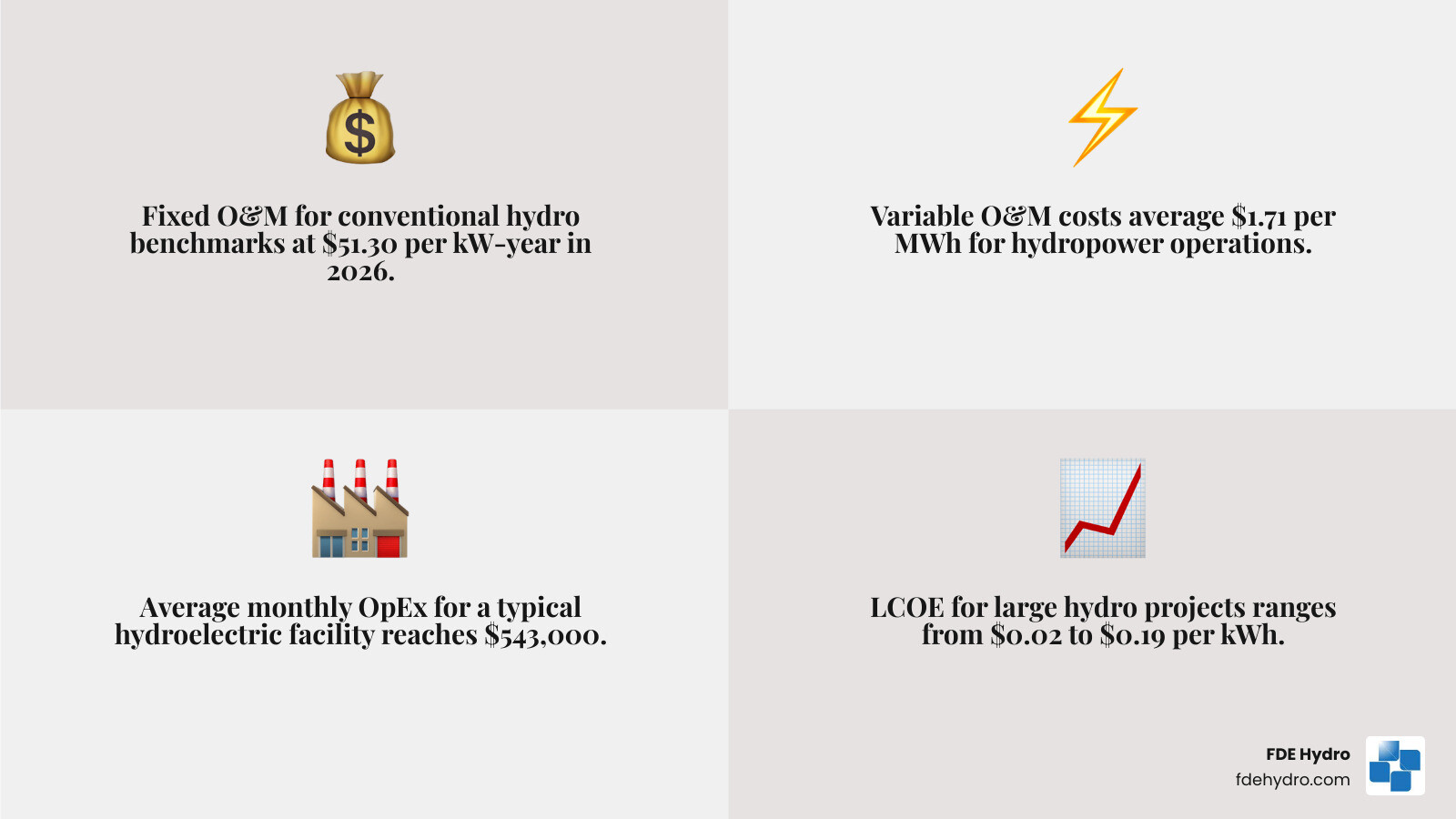
2026 hydropower operating costs are a make-or-break factor for any infrastructure decision-maker evaluating long-term energy investments. Here is a quick snapshot of what you need to know:
Cost Component
2026 Benchmark
Fixed O&M (conventional hydro)
$51.30 per kW-year
Variable O&M (conventional hydro)
$1.71 per MWh
Average monthly facility OpEx
~$543,000
Overnight capital cost (base)
$3,280 per kW
Regional capital cost range
$1,546/kW – $5,847/kW
LCOE range (large hydro)
$0.02 – $0.19 per kWh
Potential benchmarked cost savings
Up to 20% of total costs
Hydropower is one of the most cost-competitive energy sources available today. Its fuel cost is zero, and its lifespan can stretch well beyond 50 years. But low operating costs do not mean no costs.
Many U.S. plants were built decades ago. Turbines age. Generators wear out. Regulatory requirements grow stricter. And the capital needed to keep these facilities running — without passing the bill to ratepayers — is climbing fast.
That pressure is exactly why the DOE announced $430 million in federal incentives targeting 212 hydropower facilities across 33 states, expected to catalyze a total of $2.8 billion in combined public and private investment. The scale of that program tells you everything about the financial challenge facing operators right now.
Understanding where your money actually goes — and where it doesn’t have to — is the foundation of every smart hydropower budget in 2026.
I’m Bill French, Sr., Founder and CEO of FDE Hydro™, and for over five decades I have led large-scale civil construction projects — including hydropower infrastructure — that demand the same hard look at capital efficiency that shapes 2026 hydropower operating costs. My work developing the patented French Dam modular precast system was built specifically to address the cost and timeline burdens that conventional hydro construction imposes on project owners.
Understanding 2026 Hydropower Operating Costs and Benchmarks
Navigating the financial waters of hydropower requires a clear view of both day-to-day expenses and long-term capital requirements. In 2026, the industry is increasingly leaning on sophisticated modeling to predict these flows. According to the Baseline Cost Model for Hydropower: Documentation (2025) – Hydrosource, modern cost estimation now relies on a log-log specification that accounts for plant capacity, age, and capacity factor.
Operating a facility isn’t just about keeping the lights on; it’s about managing a complex ecosystem of fixed and variable expenses. For a typical mid-sized facility, Hydroelectric Power Running Costs: $543K Monthly OpEx highlights that monthly expenditures can reach over half a million dollars when factoring in maintenance, payroll, and regulatory overhead.
To stay competitive, we often look at how we stack up against global peers. PA Consulting’s hydropower benchmarking, which utilizes a “Weighted Maintenance Object” (WMO) model across a massive sample of 2,500 power stations (totaling 110,000 MW), shows that operators can save an average of 20% of total costs through optimized efficiency. This standardized approach allows us to compare diverse assets regardless of their unique configurations or geography.
Fixed vs. Variable 2026 Hydropower Operating Costs
Breaking down the budget further, we distinguish between costs that stay the same regardless of how much water flows through the turbines and those that fluctuate with production.
Fixed O&M Costs: Based on AEO2026 assumptions, conventional hydropower fixed O&M is projected at $51.30 per kW-year (in 2025 dollars). This covers essential “keep-the-lights-on” items like property taxes, insurance premiums, and a core operational payroll. A typical facility might employ around 13 full-time staff, with a monthly payroll run rate of approximately $107,500.
Variable O&M Costs: These are pegged at roughly $1.71 per MWh. These costs cover items that wear down based on usage, such as lubricants, small replacement parts, and water-use fees.
In our experience at FDE Hydro, we’ve seen how proper Hydropower asset management can transform a facility’s bottom line. Industry data suggests that while overheads are increasing due to necessary reinvestments in maturing markets, top-tier operators are achieving up to a 35% reduction in operating costs and CapEx over 18-month periods by identifying specific cost drivers at the power plant level.
The goal for 2026 is to establish a performance baseline that allows us to move from reactive maintenance to proactive value optimization. By leveraging asset management principles, we can ensure that every dollar spent on a turbine rewind or a dam safety upgrade contributes to the plant’s long-term IRR, which typically hovers around 8% for these capital-intensive projects.
Regional Variations and Market Comparisons in 2026
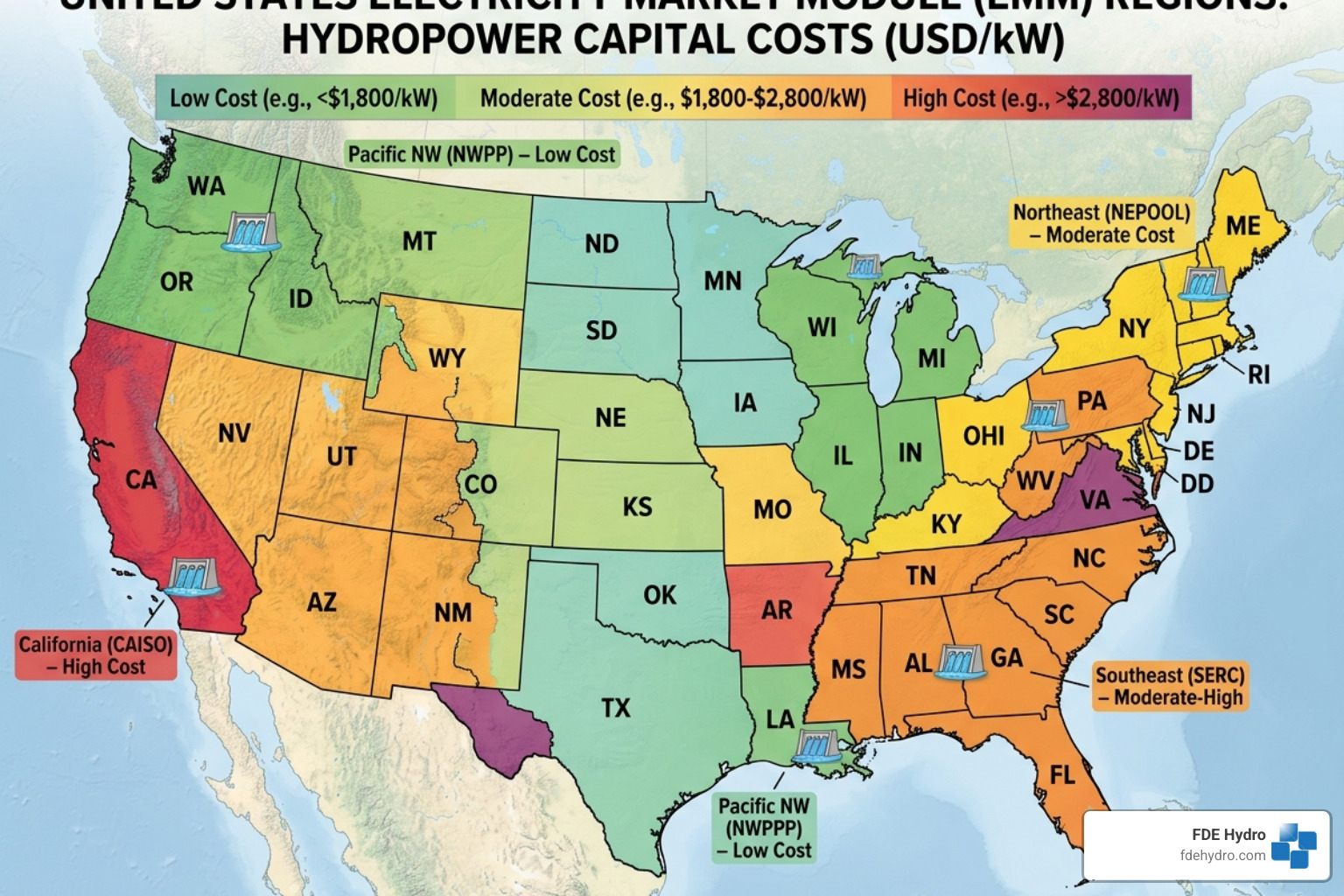
Geography is perhaps the most significant variable in the hydropower equation. A project in the MISC (Midcontinent) region faces a vastly different economic reality than one in California or New York. The U.S. Electricity Market Module (EMM) defines 25 distinct regions, each with its own “locality multiplier” that adjusts the base overnight capital cost.
As we analyze Understanding costs of hydroelectricity: Factors that influence hydro power – Green Energy, it becomes clear that factors like water availability, local labor rates, and environmental mitigation requirements create a wide spectrum of costs. While the national base overnight cost is $3,280 per kW, the actual price tag to get a project off the ground can vary by thousands of dollars per kilowatt depending on where you break ground.
Comparing 2026 Hydropower Operating Costs to Other Energy Sources
How does hydro hold its own against the competition in 2026? While technologies like solar PV and wind have lower initial capital requirements, they lack the “baseload” reliability and 50-to-100-year lifespan of a well-maintained dam.
When looking at the Levelized Cost of Energy (LCOE), large-scale Hydropower project costs remain highly competitive, ranging from $0.02 to $0.19 per kWh. In comparison, natural gas combined-cycle plants face volatile fuel prices and carbon taxes, while nuclear power involves significantly higher decommissioning and regulatory hurdles. Hydropower’s ability to provide ancillary services—like grid balancing and frequency regulation—adds a layer of revenue that intermittent renewables simply cannot match.
Regional Multipliers and Site-Specific Feasibility
To Reduce construction costs, we must look at the specific regional multipliers provided by the EIA for 2026:
Midcontinent (MISC): The most cost-effective region, with costs as low as $1,546/kW.
Upstate New York (Region 9): Costs rise to approximately $4,410/kW due to labor rates and stricter environmental standards.
California North (Region 21): Sits at around $4,114/kW.
Florida (FRCC): Can peak at $5,847/kW, often due to the complexities of low-head geography and specialized foundation requirements.
Understanding these site-specific nuances is critical. For instance, in New York City, new hydro builds are often excluded from projections simply because there are no available sites, forcing a focus on “importing” hydro power via new transmission lines like the Hydro-Québec project.
Impact of Government Incentives and Modernization Programs
The year 2026 marks a turning point for federal support of the U.S. hydro fleet. The Department of Energy’s (DOE) “Maintaining and Enhancing Hydroelectricity Incentives” program, specifically Section 247, has released $430 million to modernize aging infrastructure. This isn’t just a handout; it’s a strategic buffer designed to keep 2026 hydropower operating costs from being passed on to the average ratepayer.
These funds target 293 projects across 212 facilities. By covering a portion of the costs for turbine replacements, generator rewinds, and dam safety improvements, the program is expected to catalyze a staggering $2.8 billion in total investment. For many owners, this makes the difference between Breaking down the dam costs of hydropower projects being a burden or a generational opportunity.
How Federal Funding Lowers 2026 Hydropower Operating Costs
The financial landscape for 2026 has been further reshaped by the “One Big Beautiful Bill Act of 2025” (OBBBA), which made a one-year depreciation schedule permanent for new construction. This, combined with Investment Tax Credits (ITC) and Production Tax Credits (PTC), significantly lowers the effective cost of capital.
For project developers, Project cost reduction is now as much about “tax engineering” as it is about civil engineering. By Financing long term hydropower requires mitigating risks prior to ROI, operators can leverage these federal payments to handle major overhauls—like a $2.275 million CAPEX cycle for turbine upgrades—without depleting their cash reserves to dangerous levels.
Environmental Compliance and Regulatory Expenses
We cannot talk about budgets without addressing the “green” in the room. Environmental compliance is a significant component of fixed O&M. FERC filings, water quality monitoring, and habitat restoration are non-negotiable.
In many cases, environmental mitigation costs are “lump-sum” payments. This can be particularly challenging for smaller plants, as the cost of a fish ladder or a bypass system doesn’t always scale down with the size of the powerhouse. However, investing in Hydroelectric dam efficiency through fish-friendly turbines can actually reduce long-term regulatory friction and potential fines, turning a compliance cost into an operational asset.
Technological Advancements and Infrastructure Upgrades
The “old” way of maintaining dams—waiting for something to break—is dead. In 2026, we are seeing a massive shift toward digital integration. Predictive maintenance powered by AI and IoT sensors allows us to monitor vibration, heat, and flow in real-time. This prevents the “multi-million dollar failures” that occur when service is deferred too long.
Regular Hydro power plant maintenance is no longer just about grease and wrenches; it’s about data. By identifying a bearing failure weeks before it happens, operators can schedule repairs during low-flow periods, minimizing lost revenue.
Long-term Savings from Aging Infrastructure Modernization
Upgrading a facility built in the 1950s isn’t just about safety; it’s about capacity. For example, Dakota County’s $26 million upgrade to the Byllesby Dam doubled its capacity to 4.4 MW by simply installing more efficient turbines and generators.
At FDE Hydro, we advocate for these types of upgrades because Why precast cost less applies to retrofits too. Using modular components for powerhouse expansions or spillway repairs can cut construction timelines by months, significantly reducing the “soft costs” like site security and temporary power during the build. Whether it’s a Francis turbine for high-head sites or a Kaplan for lower flows, modern electromechanical equipment is 5-10% more efficient than the tech it replaces.
Efficiency Improvements and Digital Integration
Beyond the hardware, the way we sell power is changing. 2026 energy markets reward flexibility. Modernized plants with variable-speed operations can ramp up or down in 15 to 30 seconds, allowing them to capture “ancillary revenue” from frequency regulation.
This flexibility is a key driver of Hydroelectric dam efficiency. When bulk electricity prices drop, a plant that can quickly pivot to providing grid stability services can stay profitable even when others are losing money. These ancillary streams act as a critical buffer, often covering fixed overhead when market prices for energy are low.
Frequently Asked Questions about 2026 Hydropower Budgets
What are the primary drivers of hydropower O&M in 2026?
The biggest recurring costs are fixed maintenance contracts (often around $150,000 per month for mid-sized plants), operational payroll for skilled technicians, and regulatory compliance fees including FERC filings and environmental monitoring. Insurance premiums and property taxes also represent significant fixed overhead.
How does regional location affect hydroelectric project costs?
Capital costs are highly sensitive to local labor markets and geography. While a project in the MISC region might cost $1,546/kW, a similar project in the FRCC (Florida) region can exceed $5,800/kW due to different site conditions and resource availability. Regional multipliers are essential for any accurate feasibility study.
What role does the DOE $430 million program play in cost reduction?
This program, part of the Section 247 incentives, provides direct federal payments for infrastructure improvements. By funding upgrades to turbines, generators, and dam safety, it allows facilities to modernize without raising rates for consumers. It is expected to trigger a total of $2.8 billion in public-private investment.
Conclusion
The landscape of 2026 hydropower operating costs is one of both challenge and immense opportunity. While aging infrastructure and rising regulatory demands put pressure on budgets, the combination of federal incentives, technological leaps, and smarter asset management offers a path to long-term profitability.
At FDE Hydro™, we believe that the future of this industry lies in efficiency—not just in how turbines spin, but in how dams are built and maintained. Our French Dam modular precast concrete technology is designed to slash the very capital costs that often stall these vital projects. By Financing long term hydropower requires mitigating risks prior to ROI, we help owners in North America, Brazil, and Europe build a cleaner, more reliable grid.
Hydropower remains the backbone of renewable energy. With the right budget strategy and modern construction techniques, it will continue to power our world for the next century.
Hydropower infrastructure funding upgrades are now more accessible than ever — thanks to a wave of federal investment targeting America’s aging dams and hydroelectric facilities.
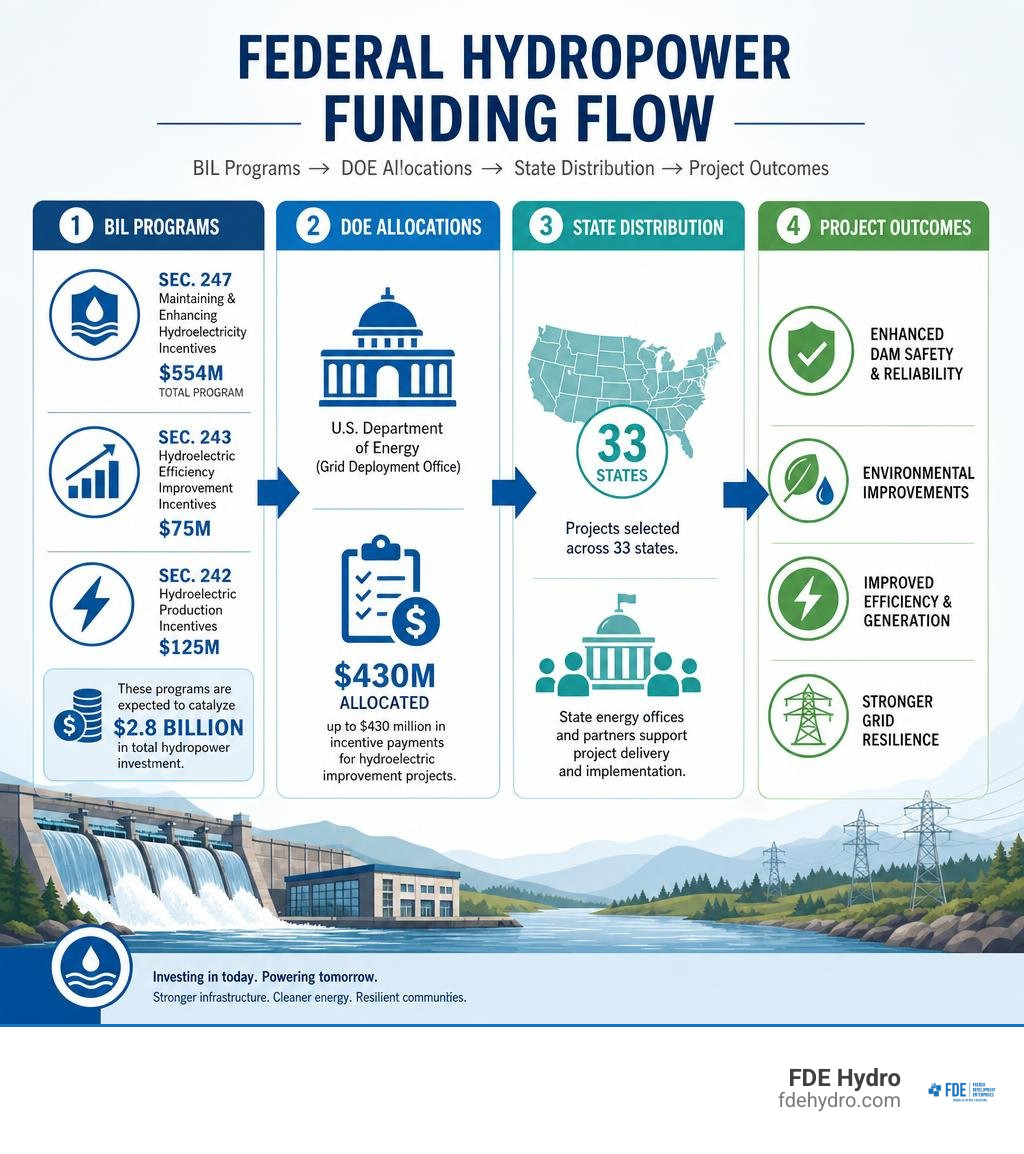
Here’s a quick overview of the key funding available right now:
Together, these programs — funded through the Bipartisan Infrastructure Law — are expected to catalyze $2.8 billion in total hydropower investment when combined with private capital contributions.
America’s hydropower fleet is quietly aging. The average facility receiving federal funding today has been running for 79 years. The American Society of Civil Engineers gave U.S. dams a D+ grade in their 2025 Infrastructure Report Card — and nearly 70% of all U.S. dams were expected to surpass 50 years of age by 2025.
Yet hydropower still supplies nearly 27% of all U.S. renewable electricity and represents 93% of utility-scale energy storage. That’s an enormous amount of critical grid infrastructure that has been quietly deferred, patched, and stretched well past its original design life.
The funding is here. The need is urgent. And for facility operators and project developers, the window to act is open now.
I’m Bill French, Sr., Founder and CEO of FDE Hydro™ — and for the past decade I’ve worked directly at the intersection of modular construction innovation and hydropower infrastructure funding upgrades, including being selected by the DOE’s Water Power Technology Office to help define the next-generation hydropower roadmap for Congress. In this guide, I’ll walk you through exactly where the money is, how it’s distributed, and how to position your project to access it.
The Bipartisan Infrastructure Law: Driving Hydropower Infrastructure Funding Upgrades
The Bipartisan Infrastructure Law is the financial engine behind the current wave of hydropower modernization. Through the U.S. Department of Energy and its Grid Deployment Office, the law created major incentive pathways for hydroelectric facilities that need capital improvements but cannot always justify the upfront cost through power sales alone.
The headline number is clear: the DOE selected 293 hydroelectric improvement projects across 33 states for up to $430 million in incentive payments under the Maintaining and Enhancing Hydroelectricity Incentives program. That allocation sits within a broader $554 million Section 247 program.
This matters because hydropower projects are not small weekend repairs. A serious modernization can include:
Turbine replacement
Generator rewinds or replacements
Digital control system upgrades
Spillway rehabilitation
Concrete repair and seepage mitigation
Fish passage construction
Water quality improvements
Recreation access improvements
Cybersecurity and grid control upgrades
Equipment needed to integrate variable renewable resources
Maintaining and Enhancing Hydroelectricity Incentives (Section 247)
Section 247 is the big one for owners pursuing capital upgrades.
Under this program, the DOE selected projects that fall into three main categories:
Grid resilience improvements
Dam safety upgrades
Environmental and recreational enhancements
The current award round includes $430 million for 293 projects. The DOE has said these projects will strengthen grid resilience at 215 facilities, while also improving dam safety at sites that average 79 years in operation.
That age matters. A facility built in the 1940s or 1950s may still be producing clean energy, but its original design probably did not anticipate today’s operating reality: more solar and wind on the grid, more severe rain events, more drought stress, stricter environmental requirements, higher safety expectations, and much faster digital control needs.
For owners, Section 247 is not just a grant opportunity. It is a way to de-risk long-term reinvestment. Hydropower financing can be challenging because the biggest costs often arrive before revenue improvements are visible. We explore this issue in more detail in Financing Long-Term Hydropower Requires Mitigating Risks Prior to ROI.
The practical takeaway is simple: if your facility needs upgrades that improve resilience, safety, environmental performance, or public use, Section 247 should be on your radar.
Complementary DOE Programs for Hydropower Infrastructure Funding Upgrades
Section 247 is not the only tool in the federal toolbox. The DOE also supports hydropower through complementary incentive programs authorized under the Energy Policy Act.
The three major programs are:
Program
Section
Purpose
Notable Funding
Hydroelectric Production Incentives
242
Supports eligible hydroelectric generation
$125 million
Hydroelectric Efficiency Improvement Incentives
243
Supports capital improvements that improve efficiency
$75 million
Maintaining and Enhancing Hydroelectricity Incentives
247
Supports resilience, safety, environmental, and recreation upgrades
$554 million total
The Hydroelectric Efficiency Improvement Incentives program is especially important for facilities where equipment modernization can increase output. Earlier DOE materials identified nearly $75 million for efficiency upgrades, with an emphasis on projects that can demonstrate meaningful efficiency gains.
The Hydroelectric Production Incentives program supports eligible generation from qualified facilities. This can be useful for operators who are already producing renewable power and need incentive payments to improve project economics.
Our view: do not treat these programs as isolated buckets. A strong funding strategy looks at the full capital stack. Federal incentives, private capital, utility partnerships, tax planning, and phased construction can work together. Hydropower funding is a puzzle, but at least it is a puzzle with water flowing through it.
Where the Money Goes: State Allocations and Project Distribution
The $430 million Section 247 allocation is spread across 293 projects in 33 states. That broad distribution is important because hydropower is not a one-region resource. It supports rural communities, industrial loads, urban grids, irrigation systems, flood control, recreation, and clean energy goals across the country.
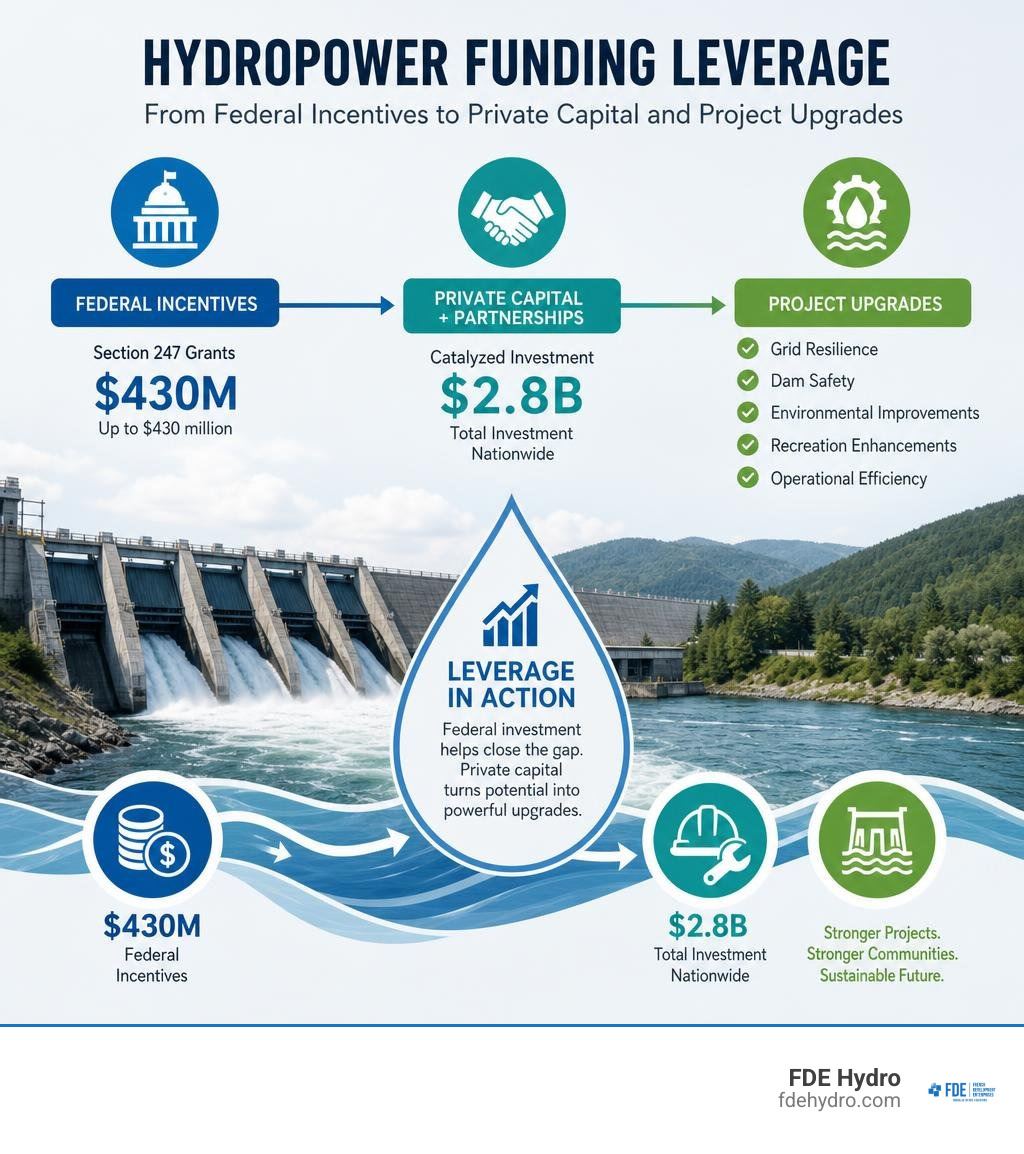
The federal investment is also expected to unlock far more than the initial grant amount. When combined with private contributions, the $430 million is expected to catalyze about $2.8 billion in total hydropower investment nationwide.
That leverage is the real story.
Federal dollars help close the funding gap. Private capital, owner equity, utility investment, and project debt then help turn deferred maintenance into completed construction.
State or Region Highlight
Project Count
Reported Funding
Why It Matters
California
29
Over $60 million
Major support for Western grid reliability, drought adaptation, and renewable integration
New York
23
$25.4 million
Supports a state with major legacy hydropower assets and high clean-energy demand
National total
293
Up to $430 million
Covers grid resilience, dam safety, environmental, and recreation improvements
Expected total investment
N/A
$2.8 billion
Shows how federal incentives can leverage private capital
Key State Winners: California, New York, and Maine
California and New York stand out for our work because both are central to FDE Hydro’s North American focus and both have significant hydropower infrastructure needs.
California received 29 projects totaling more than $60 million. For a state balancing hydropower, solar, wind, wildfire risk, drought, and major load growth, these upgrades are not optional. They are part of keeping the grid flexible and dependable.
California’s hydropower fleet also faces a climate reality that every owner should take seriously: water conditions are changing. Facilities that once operated under more predictable hydrology now need equipment and civil works that can perform under wider extremes.
New York received 23 projects totaling $25.4 million. This is especially relevant because New York has large legacy hydropower assets, high electrification goals, and a grid that increasingly depends on firm, dispatchable clean energy.
Maine also appeared among the notable national allocations in DOE-related reporting, including $33.8 million for 21 projects. Because our geographic focus in this guide is the United States with emphasis on California and New York, we will keep the deeper discussion centered on those markets. The broader lesson still applies: states with older hydro fleets and clear upgrade needs are seeing meaningful federal support.
Case Studies in Modernization: From Hoover Dam to Niagara
Two high-profile modernization examples show why funding cannot stop at routine maintenance.
First, Hoover Dam. Federal reporting and regional coverage note that the Bureau of Reclamation freed up approximately $52 million for turbine upgrades and infrastructure work at Hoover Dam. The plan includes replacing older turbines with wide-head turbines that can operate at lower Lake Mead elevations. According to reporting in Hoover Dam gets $52M for wide-head turbines from Bureau of Reclamation, the new equipment is intended to help restore around 160 megawatts of capacity and keep generation viable as reservoir levels fluctuate.
That is climate resilience in plain terms: when the water level changes, the equipment has to keep up.
Second, New York’s Niagara modernization. The New York Power Authority has been advancing a $1.1 billion modernization and digitization program at the Niagara Power Project. Coverage in NYPA upgrades first of 14 turbines in $1.1B Niagara modernization, digitization program describes mechanical upgrades, digital controls, turbine work, and major equipment replacement.
This is exactly the kind of long-horizon thinking hydropower needs. We are not upgrading facilities for the next three years. We are trying to keep clean, dispatchable assets useful for decades.
Upgrading Aging Assets: Grid Resilience, Dam Safety, and Environmental Goals
The current funding push is not about shiny new gadgets. It is about keeping critical infrastructure safe, productive, and compatible with modern energy and environmental standards.
The average facility selected for federal funding has been operating for 79 years. That means many projects were designed before today’s environmental rules, before modern grid controls, before large-scale wind and solar, and before current climate projections.
Addressing the D+ Dam Safety Crisis and Aging Infrastructure
The ASCE D+ grade for U.S. dams is not a gold star. It is more like the infrastructure equivalent of a check-engine light that has been blinking for years.
Dam safety upgrades supported by federal funding can include:
Spillway capacity improvements
Emergency spillway rehabilitation
Concrete replacement
Embankment stabilization
Seepage control
Gate and hoist replacement
Monitoring instrumentation
Structural strengthening
Erosion repairs
Flood routing improvements
The challenge is that dam repairs are often expensive, disruptive, and site-specific. A concrete problem at one facility may be a seepage problem at another. A spillway that worked for 1950s rainfall assumptions may not be appropriate for today’s extreme storm patterns.
Implementing Hydropower Infrastructure Funding Upgrades for Grid Resilience
Hydropower is uniquely valuable because it can provide firm, flexible power. It is not just renewable generation. It is also a stabilizing resource for a grid with more variable energy.
Hydropower accounts for nearly 27% of U.S. renewable electricity generation. Pumped storage hydropower represents the overwhelming majority of utility-scale energy storage, with DOE materials and industry reporting frequently citing figures around 93% of utility-scale storage.
Grid resilience upgrades can include:
Turbine replacement
Generator upgrades
Governor and exciter modernization
Control system digitization
Supervisory control and data acquisition improvements
Switchyard and transformer upgrades
Black-start capability improvements
Equipment that helps integrate wind and solar
Cybersecurity upgrades
Pumped storage modernization
This is where modernization becomes more than maintenance. A better turbine, a faster control system, or a stronger generator can help a facility respond to grid needs more quickly. That flexibility becomes more valuable as renewable penetration rises.
For owners thinking about technical options, we recommend reviewing our resource on Hydropower Retrofitting.
Environmental and Recreational Enhancements
The Section 247 program also supports environmental and recreational improvements. That is a major point for owners, because long-term hydropower viability depends on more than megawatts.
Eligible or commonly supported environmental improvements may include:
Fish ladders
Fish passage systems
Fish screens
Bypass flows
Water quality improvements
Dissolved oxygen improvements
Habitat restoration
Sediment management
Turbines designed to reduce aquatic impacts
Recreation improvements may include:
Boating access
Kayak portage routes
Public access improvements
Shoreline safety upgrades
Fishing access
Trail or viewing area improvements where appropriate
These upgrades can improve licensing outcomes, community support, and long-term public trust. A hydropower project that supports fish movement, water quality, recreation, and clean energy has a stronger social license to operate.
And yes, “fish ladder” sounds like something a trout would buy at a hardware store. But in practice, fish passage is one of the most important ways hydro facilities can reduce ecological disruption while continuing to generate renewable electricity.
Economic Impacts, Job Protection, and the Justice40 Initiative
The DOE has stated that the $430 million in selected incentive payments will help protect 6,000 existing jobs at hydropower facilities and among contractors and vendors.
That job protection matters because hydropower facilities anchor local economies. A dam upgrade can support:
Plant operators
Civil contractors
Electrical contractors
Mechanical suppliers
Engineering firms
Environmental consultants
Concrete producers
Steel fabricators
Transportation providers
Local service businesses
The funding also supports the federal Justice40 Initiative, which aims to direct 40% of the overall benefits of certain federal climate and clean energy investments to disadvantaged communities.
For hydropower, Justice40 benefits may include:
More reliable local electricity
Safer dam infrastructure
Reduced flood risk
Cleaner water
Improved recreation access
Local job retention
Workforce development
Lower risk of infrastructure failure
Continued clean power from existing assets
This is important because disadvantaged communities are often more vulnerable to infrastructure failure, flooding, poor water quality, and energy reliability problems. A dam safety project is not just a concrete project. It can be a community protection project.
Frequently Asked Questions about Hydropower Upgrades
What is the timeline for these federal funding programs?
The DOE has already selected 293 projects for up to $430 million under Section 247. Once projects are selected, owners typically move through award finalization, compliance requirements, contracting, engineering, procurement, permitting coordination, and construction.
Actual timelines vary by project type. A controls upgrade may move faster than a spillway reconstruction. A turbine replacement may require long equipment lead times. Environmental enhancements may require seasonal construction windows to protect aquatic species.
DOE materials tied to the original funding announcement indicated that a second round of funding was expected in the following calendar year. As of June 2026, owners should check the Grid Deployment Office and DOE hydro incentive pages for the latest application windows, award status, and program guidance.
Our recommendation: do not wait for the next notice before preparing. Have your technical scope, cost estimate, community benefits, environmental benefits, and financing plan ready early.
How do these upgrades address climate change and drought?
Hydropower is directly exposed to climate conditions. Too little water reduces generation. Too much water can stress spillways and flood routing systems. Warmer water can create water quality and habitat issues. More extreme storms can challenge older dam designs.
Modern upgrades can address these risks in several ways:
Wide-head turbines can operate across a wider range of reservoir elevations.
Spillway upgrades can improve performance during extreme rainfall.
Concrete and seepage repairs can reduce failure risk.
Better controls can help operators respond faster to changing grid and water conditions.
Environmental upgrades can improve water quality and aquatic habitat.
Pumped storage modernization can help store excess wind and solar energy.
The Hoover Dam turbine example is a useful illustration. As Lake Mead levels have declined, older turbines face performance and damage risks at lower elevations. Newer turbine technology can help maintain generation under more difficult hydrologic conditions.
Climate resilience is not a slogan here. It is a design requirement.
Can private capital be leveraged alongside federal grants?
Yes. In fact, that is one of the most important features of the current funding environment.
The $430 million federal allocation is expected to catalyze about $2.8 billion in total hydropower investment when combined with private contributions. That means federal funding is functioning as a leverage tool, not a complete replacement for owner investment.
A strong capital stack may include:
DOE incentive payments
Owner equity
Private debt
Utility partnerships
Power purchase agreements
State or regional incentives where available
Tax credit planning where applicable
Public-private partnership structures
Phased procurement and construction planning
The key is to make the project investable. That means reducing technical risk, showing a clear upgrade scope, documenting public benefits, and demonstrating that the facility will remain viable after construction.
This is where cost-saving construction methods can make a major difference. If a project can reduce construction time, reduce onsite complexity, and improve schedule certainty, the financing case gets stronger.
Conclusion
Hydropower has done quiet, reliable work for more than a century. Now it needs reinvestment equal to its importance.
The current wave of hydropower infrastructure funding upgrades gives owners and developers a rare opportunity to modernize aging assets, improve dam safety, strengthen grid reliability, support disadvantaged communities, and extend the life of clean energy infrastructure.
At FDE Hydro, we believe this is exactly the moment for smarter construction. Our patented French Dam modular precast concrete technology is designed for building and retrofitting hydroelectric dams and water control systems with less construction time and lower project cost. For owners in the United States, Canada, Brazil, and Europe, that can mean a stronger funding application, a more realistic capital plan, and a faster path from award to operation.
Federal funding can open the door. Good engineering, practical construction methods, and disciplined project planning are what get the work done.
If your facility needs modernization, now is the time to prepare the scope, sharpen the budget, and align funding with execution.
Why Hydropower Operator Certification Is the Foundation of a Safe, Reliable Hydro Workforce
Hydropower operator certification is the credential that proves a professional has the knowledge, skills, and hands-on experience to safely run a hydroelectric facility. If you want a quick answer, here is what you need to know:
Quick Overview: Hydropower Operator Certification
Question
Answer
What is it?
A formal credential verifying competency to operate hydroelectric plants
Who requires it?
Federal agencies, state utilities, and private plant operators
Main certification types
Power Plant Operator, Electrician, Mechanic, Operating Engineer
Typical path
4-year apprenticeship or recognized operations experience + exam
Where to apply
USAJOBS, state civil service portals, utility employer programs
Key training resource
NHA Hydro Academy, U.S. Army Corps of Engineers programs
Hydropower accounts for roughly 6% of all U.S. electricity generation and 31% of all U.S. renewable electricity (as of 2023). That power flows through turbines, generators, control systems, and high-voltage switchgear — all operated by certified professionals working around the clock.
These are safety-critical roles. A single mistake in a powerhouse can affect a dam, a river, a grid, and an entire downstream community. That is exactly why certification exists: to set a clear, verified standard for who is qualified to operate this infrastructure.
The path to certification is not one-size-fits-all. It varies by craft specialty, employer type, state, and whether the facility is federally managed or privately licensed. This guide breaks it all down — clearly and practically.
I’m Bill French, Sr., Founder and CEO of FDE Hydro™, and over the past five decades of leading large-scale civil construction and hydropower development — including participation in the U.S. Department of Energy’s Hydropower Vision Task Force — I have seen how hydropower operator certification shapes the workforce that keeps these facilities running safely and efficiently. Whether you are exploring an apprenticeship, hiring for a plant, or planning a new hydro project, understanding the certification landscape is essential to getting it right.
What Hydropower Operator Certification Means and Why It Matters
Hydropower operator certification is an individual qualification. It confirms that a person can operate, monitor, maintain, or support hydroelectric plant systems according to approved safety, operating, environmental, and grid procedures.
At a basic level, certification tells an employer: this person can be trusted around water under pressure, rotating machinery, high-voltage equipment, and control systems that do not care how good your excuses are.
Certified hydropower professionals may operate:
Turbine-generator units
Spillway gates and outlet works
Powerhouse auxiliaries
Transformers and switchyards
SCADA and control room systems
Reservoir, pumping, and water conveyance systems
Emergency shutdown and alarm systems
The U.S. Department of Energy’s Hydroelectric Power Plant Operator career profile describes operators as the people who control and maintain the systems that generate hydroelectric power. That sounds simple until you remember that the “system” includes a river, a dam, a grid interconnection, environmental license conditions, and people downstream.
For a broader foundation, our Hydropower overview explains how hydropower fits into modern renewable energy infrastructure.
Why Professionals Need Hydropower Operator Certification
Hydropower plants are usually staffed 24/7, often with rotating shifts. Operators must make decisions during normal operation, storms, grid events, equipment failures, and emergency releases.
Certification matters because operators need verified competence in:
Controlled water releases
Generator startup and shutdown
Switching orders and electrical clearances
Lockout/tagout procedures
Turbine and governor operation
Alarm response
Spillway and gate operations
Environmental flow requirements
Emergency action procedures
Incident prevention and reporting
A certified operator is not just “turning knobs.” They are managing risk in real time.
Facility Certification vs. Individual Operator Certification
This is one of the biggest points of confusion.
A facility license or certification applies to the project. An operator certification applies to the person.
Type
Applies To
Examples
Individual operator credential
A person
Hydroelectric Plant Operator, Power Plant Operator, Operating Engineer
A plant may have a federal license, state dam safety approval, and renewable energy certification, but it still needs qualified people to run it. Likewise, an operator may hold a credential but still need site-specific training before touching a particular facility’s controls.
Where Certification Is Required, Preferred, or Job-Specific
In the United States and Canada, hydropower operator certification is often tied to the employer, agency, union program, civil service system, or plant classification rather than one universal national license.
You may see certification requirements in:
Federal hydropower jobs
State civil service exams
Public utility operator roles
Municipal utility positions
Independent power producer jobs
Apprenticeship programs
Operating engineer systems in Canada
Employer-specific qualification programs
California, for example, uses a civil service exam pathway for Hydroelectric Plant Operator roles through CalCareers. In Ontario, Canada, operating engineer certification is administered through the provincial safety authority, with defined exam, renewal, and experience requirements under Certification: Operating Engineer.
Hydropower Certification Types, Apprenticeships, and Training Paths
Hydropower is a team sport. A certified operator may be the person in the control room, but electricians, mechanics, technicians, compliance staff, and maintenance planners all keep the plant safe and productive.
Different employers use different titles. The key is to read the job announcement carefully and look for required exams, apprenticeship completion, qualifying experience, and site authorization.
Power Plant Operator Pathway
The operator pathway is centered on control authority. Operators may work from local panels, central control rooms, or remote operations centers.
Typical responsibilities include:
Starting and stopping generating units
Monitoring reservoir and tailwater conditions
Implementing water, power, and pumping schedules
Coordinating load changes
Responding to alarms
Performing high-voltage switching when authorized
Issuing or following clearances
Maintaining plant logs
Coordinating with dispatchers and maintenance crews
California’s Hydroelectric Plant Operator exam bulletin lists duties such as operating pumps, generators, auxiliaries, switches, valves, aqueduct facilities, and turnouts from control panels or remotely.
Power Plant Electrician and Mechanic Pathways
Electricians and mechanics may not always be called “operators,” but in hydropower they often complete similar apprenticeship structures and earn journey-level qualifications.
Power plant electricians work on:
Breakers
Relays
Transformers
Protection systems
Motors
Control wiring
Instrumentation
Switchyard equipment
Power plant mechanics work on:
Turbines
Governors
Valves
Bearings
Pumps
Cranes
Gates
Penstock and auxiliary equipment
Both crafts support safe operation during outages, emergency repairs, inspections, upgrades, and modernization projects. In our work with modular dam and retrofit systems, we see how closely construction, maintenance, and operations must coordinate. Nobody wants to discover a valve access problem after the concrete is already poured.
How the Four-Year Hydropower Apprenticeship Structure Works
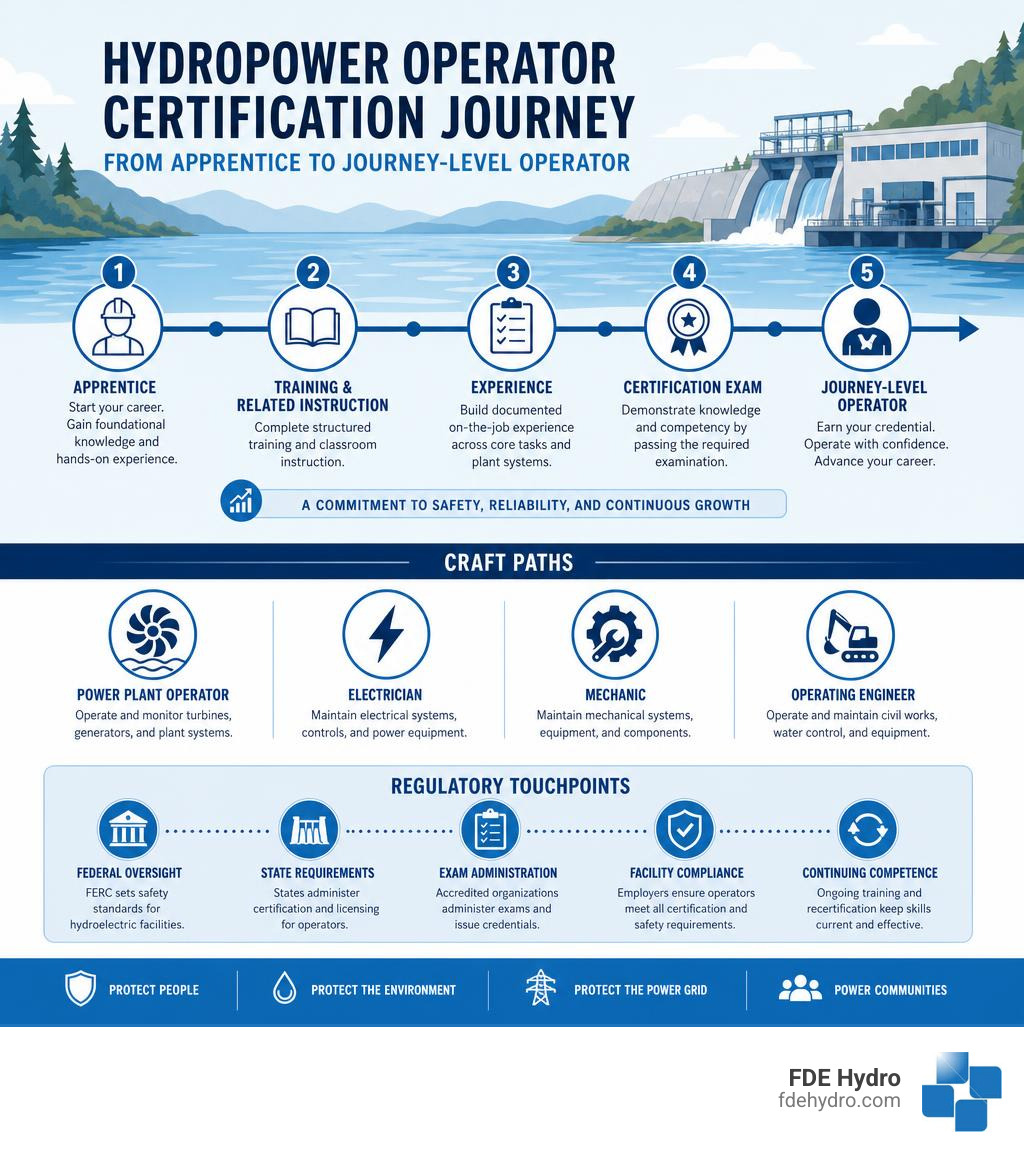
A common federal-style hydropower apprenticeship model uses four progressive parts over four years:
Part I: General hydropower orientation and broad plant fundamentals
Part II: Beginning specialized craft training
Part III: Intermediate craft training and deeper equipment responsibility
Part IV: Advanced craft training leading toward journey-level qualification
The structure typically includes:
Academic study
Plant equipment study
On-the-job training
Rotations through work groups or facilities
Mentoring by journey-level workers
Periodic evaluations
External exams or licensing steps where required
Some U.S. Army Corps of Engineers hydropower apprenticeship programs follow ER/EP 1130-2-510 guidance and use a one-year-per-part progression. Apprentices may rotate through operator, mechanic, and electrician exposures before specializing. Field officers or supervisors may monitor progress, while journeymen provide hands-on coaching.
In some programs, completing schooling, profiling, and exams may lead to an I-Grade or comparable journey-level qualification.
Professional Development and Short-Course Certification Options
Not every hydropower professional needs a full apprenticeship. Engineers, project managers, asset managers, compliance staff, and new hires from other power sectors often benefit from short-course training.
The NHA Hydro Academy’s system principles training is one example. Based on available program information, the full course provides 40 professional development hours over eight months and covers modules such as:
Water-to-wires fundamentals
Equipment and technology
Environmental topics
Dam safety
Production planning
Markets
Licensing and compliance
Asset management and reliability
These programs can support continuing education, cross-training, and faster onboarding. They are not always substitutes for journey-level operator certification, but they help teams speak the same language.
Eligibility Requirements, Prerequisites, and Skills Needed to Qualify
Hydropower is welcoming to people who like practical work, problem-solving, and learning systems from the ground up. But it is not casual work. The entry requirements reflect that.
Entry Requirements for Hydropower Operator Certification Programs
Common prerequisites include:
Minimum age of 18
High school diploma or GED
Transcripts or placement testing
Math and mechanical aptitude
Electrical aptitude
Ability to read and write English for safety and operations
Valid driver’s license in many roles
Background check or security clearance
Ability to work rotating shifts
Ability to travel between facilities in some apprenticeship programs
Some programs use placement tests such as ACCUPLACER or ALEKS to assess readiness for technical coursework.
For experienced applicants, employers may accept:
Completion of a recognized apprenticeship
Prior hydroelectric plant operations experience
Large pumping plant operations experience
High-voltage switching experience
Substation or switching yard experience
Large power plant experience
California’s civil service pathway notes that qualifying experience may include hydroelectric generating plants, large pumping plants, and certain high-voltage environments. It also recognizes that experience in substations or switching yards of at least 230 kV may substitute for part of the required operations experience.
Knowledge Areas Tested in Exams and On-the-Job Evaluations
Certification exams and evaluations commonly test:
Hydraulics and water flow
Turbine-generator principles
Electrical theory
Mechanical systems
Protection systems
Instrumentation and controls
SCADA monitoring
Power and water calculations
Switching procedures
Clearances and lockout/tagout
Plant logs and documentation
Environmental permit conditions
Dam safety fundamentals
Emergency procedures
Operating codes and safety rules
Operators also need regulatory literacy. A plant’s FERC license, water rights, fish passage requirements, minimum flow rules, and dam safety procedures can all affect daily operation.
Physical Abilities and Working Conditions
Hydropower can be physically demanding. Typical conditions include:
Lifting up to around 45 pounds frequently in some programs
Working near moving machinery
Climbing ladders and stairs
Working at heights
Entering confined spaces
Wearing PPE
Working around noise
Walking on wet or uneven surfaces
Responding to emergency callouts
Working 12-hour rotating shifts
Exposure to weather at dams, spillways, and switchyards
Some roles require normal hearing, normal sense of smell, color vision, and enough mobility to respond quickly in industrial environments. These requirements exist because alarms, odors, color-coded indicators, and radio calls can all be safety-critical.
Soft Skills That Separate Successful Apprentices
The best operators are not always the loudest people in the room. Often, they are the ones who notice the odd vibration, ask the careful question, and document the detail everyone else missed.
Strong candidates bring:
Situational awareness
Calm judgment
Curiosity
Reliability
Teamwork
Communication
Documentation discipline
Respect for procedures
Willingness to learn from journeymen
Attention to detail
A safety-first mindset
For interviews, many employers use behavioral questions. The STAR method – Situation, Task, Action, Result – is useful for explaining how you handled safety issues, conflict, troubleshooting, or time pressure.
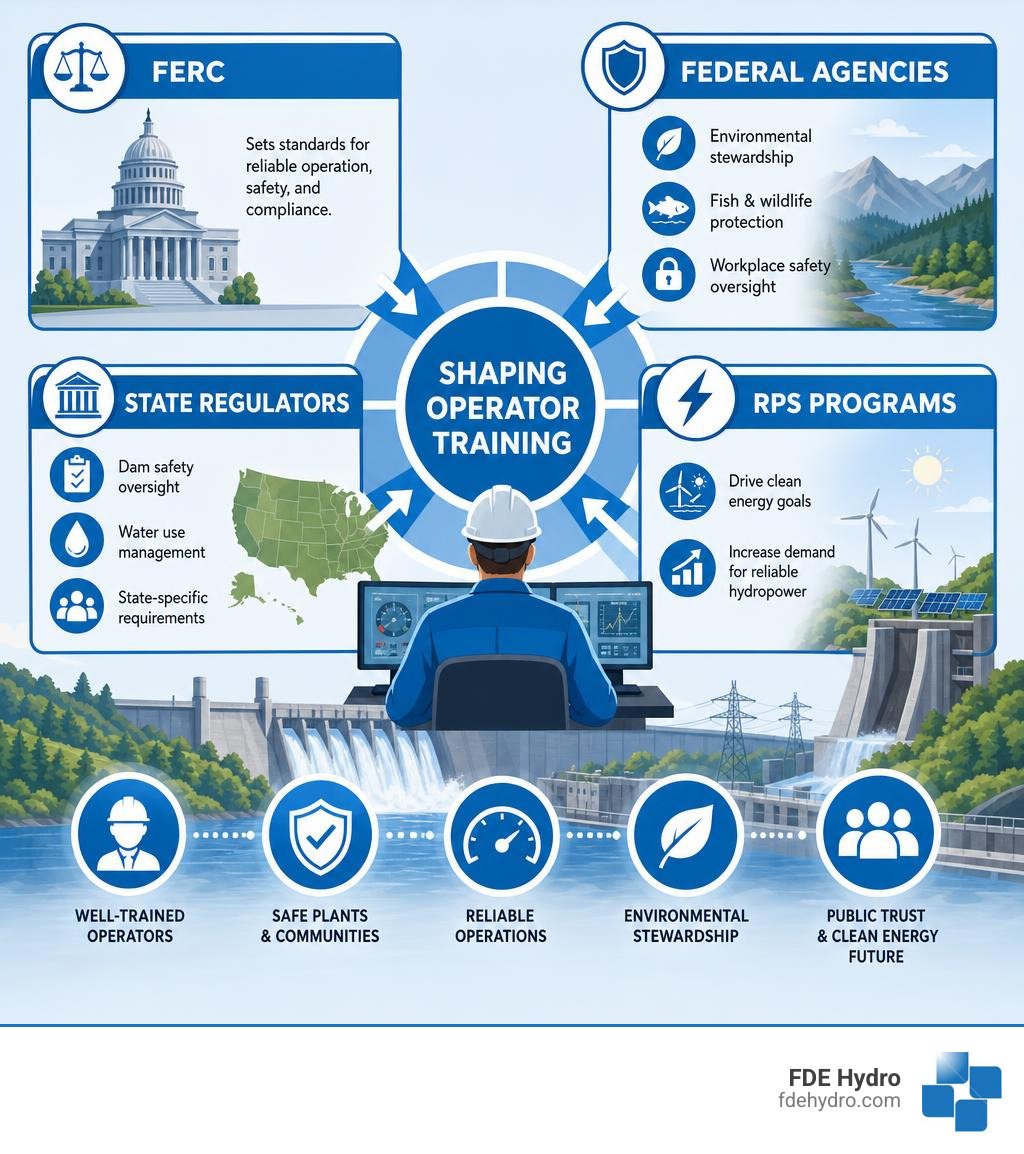
Federal, State, Safety, and Environmental Rules Operators Must Understand
Hydropower operators do not need to be attorneys. That is good news for everyone. But they do need to understand the rules that govern their plant.
Federal Agencies That Influence Operator Standards
In the United States, several federal agencies shape hydropower operations:
FERC: Licenses and oversees most non-federal hydropower projects.
U.S. Army Corps of Engineers: Operates federal dams and may approve modifications involving Corps-managed structures.
Bureau of Reclamation: Manages major water infrastructure in the western United States and may be involved when hydropower uses Reclamation dams or conduits.
Federal employers: Establish apprenticeship, safety, and qualification procedures for federal hydropower staff.
FERC licenses for original hydropower projects may run up to 50 years. Relicenses typically authorize continued operation for 30 to 50 years. That means today’s operating rules can shape a river and facility for a generation.
FERC Licensing, Exemptions, and Why Operators Should Care
FERC jurisdiction generally applies to non-federal hydropower projects on navigable waters, U.S. lands, federal reservations, or streams affecting interstate commerce.
Operators should care because license conditions become operating instructions. They may govern:
Minimum flows
Ramp rates
Reservoir elevations
Fish passage
Recreation releases
Water quality monitoring
Reporting
Emergency procedures
Inspection schedules
Important FERC-related facts include:
Small conduit hydroelectric facilities up to 40 MW using flow from a man-made conduit may qualify for exemption from the full licensing process.
Small hydroelectric power projects of not more than 10 MW may qualify for exemption.
Qualifying Facilities under 20 MW may be exempt from certain Federal Power Act provisions, including sections 205 and 206.
A small power production facility is generally 80 MW or less and must use at least 75% renewable primary energy input, including hydro, wind, solar, biomass, waste, or geothermal.
Developers often submit a Pre-Application Document, or PAD, to FERC describing project facilities, operations, and environmental impacts. Operators later live with the procedures and commitments that come out of that process.
State Agencies, Public Utility Commissions, and Operator Qualifications
State-level requirements vary. Depending on location, a hydropower project may need:
Public utility commission approval
Certificate of Public Convenience and Necessity
State dam safety review
Water rights approvals
Environmental permits
State operator exams or civil service eligibility
Continuing education or requalification
In California, the Hydroelectric Plant Operator civil service process includes an online training and experience exam, minimum qualifications, and an eligible list. Applicants must score at least 70% to be placed on the eligible list, and eligibility lasts 12 months after the list is established.
In Canada, operating engineer programs may involve exams, qualifying experience, renewals, and reinstatement procedures. Ontario’s Operating Engineer certification guidance notes that exams are valid for five years and certificates require renewal.
For facilities in Brazil and Europe, operator qualification is shaped by national grid rules, occupational safety law, employer authorization, and equipment-specific training. The exact credential name changes, but the core principle does not: only trained and authorized personnel should operate safety-critical hydro assets.
Dam Safety, Environmental Compliance, and RPS Eligibility
Hydropower operator certification connects directly to dam safety and environmental compliance.
Operators may support:
Dam inspections
Emergency action plans
Gate testing
Reservoir monitoring
Spillway operation
Minimum flow compliance
Fish passage operations
Water quality monitoring
Recreation release schedules
Incident reporting
Environmental and renewable certifications may consider criteria such as:
Flow regimes
Water quality
Fish passage
Threatened and endangered species
Cultural resources
Shoreline protection
Recreation access
Renewable Portfolio Standard, or RPS, eligibility is usually facility-based, not operator-based. Still, operators are the people who keep the facility operating within the conditions that protect eligibility.
Career Pathways, Advancement, and How to Apply in 2026
Hydropower needs experienced hands and new talent. As older workers retire and plants modernize, operators who understand both legacy equipment and digital systems will be especially valuable.
Tailor your resume to the job announcement. If the posting mentions high-voltage switching, SCADA, rotating shifts, or turbine operation, make sure your experience is easy to find.
What to Expect During the Application and Exam Process
Depending on the employer, the process may include:
Online application
Civil service form, such as California’s STD 678
Training and experience exam
Technical assessment
Minimum score requirement
Eligible list placement
Interview
Background check
Medical or physical evaluation
Security clearance
Probationary or trainee period
California’s Hydroelectric Plant Operator exam requires a final score of 70% to be placed on the eligible list, with eligibility lasting 12 months. Salary examples listed in the bulletin include monthly ranges of $8,128 to $10,478 and $8,503 to $10,968, depending on range and classification details.
Interview questions often test judgment. Expect scenarios about alarms, unsafe work, unclear instructions, confined spaces, switching, or communication during emergencies.
Career Growth After Hydropower Operator Certification
After certification, career paths may include:
Journey-level operator
Senior operator
Chief operator
Control room supervisor
Dispatcher
Hydro mechanic
Hydro electrician
Maintenance planner
Dam safety technician
Compliance specialist
Asset manager
Operations manager
Plant manager
Reliability engineer
Hydropower experience also transfers well into modernization, retrofitting, construction coordination, and asset management. At FDE Hydro, we see that strong operators often become essential voices during retrofit planning because they know how the facility actually behaves – not just how the drawings say it behaves.
Salary, Scheduling, and Long-Term Outlook
Hydropower jobs often offer stable public-sector or utility-sector career paths, but schedules can be demanding.
Expect:
Rotating shifts
Nights, weekends, and holidays
Overtime during outages or storms
Emergency callouts
24-hour coverage requirements
Strong benefits in many public-sector roles
The long-term outlook is supported by renewable energy demand, grid reliability needs, dam modernization, pumped storage, small hydro, and infrastructure retrofits. As North America, Brazil, and Europe continue upgrading water and power infrastructure, qualified operators will remain central to safe performance.
Frequently Asked Questions About Hydropower Operator Certification
Is Hydropower Operator Certification the Same in Every State or Country?
No. Hydropower operator certification varies by employer, jurisdiction, plant type, and craft.
In the United States, federal agencies, state civil service systems, public utilities, and private owners may each define qualifications differently. California has a specific civil service exam pathway. Canada may use operating engineer certification systems, such as Ontario’s program. Brazil and European countries use their own national safety, grid, and employer qualification frameworks.
Always check the authority that applies to the facility where you want to work.
Can I Become a Hydropower Operator Without Prior Power Plant Experience?
Yes, in many cases. Entry-level apprenticeships and trainee roles are designed for people who do not already have power plant experience.
A strong candidate may come from:
High school or technical school
Military mechanical or electrical roles
Water systems work
Industrial maintenance
Electrical trades
Mechanical trades
Pumping plants
Substations
Control room environments
You will still need to meet age, education, physical, safety, and testing requirements. But you do not always need to start as an expert. Apprenticeships exist because the industry knows operators are built through training.
Does Hydropower Operator Certification Need Renewal?
Sometimes. It depends on the credential.
Possible renewal requirements include:
Annual certificate renewal
Multi-year renewal cycles
Continuing education units
Professional development hours
Refresher safety training
Lockout/tagout requalification
Switching authorization renewal
Employer-specific checkouts
Reinstatement exams after expiration
Ontario’s operating engineer system, for example, includes renewal and reinstatement procedures. NHA-style professional development courses may provide PDHs. Employers may also require recurring safety and site-specific requalification even when an external certificate does not expire.
Conclusion: Your Next Step Toward a Hydropower Operations Career
Hydropower operator certification is the safest, clearest pathway into one of renewable energy’s most important hands-on careers.
If you are starting out, look for apprenticeships, trainee roles, and civil service exams. If you already have industrial, electrical, mechanical, water, or military experience, document it carefully and compare it with the job requirements. If you manage a facility, treat certification as part of your risk management system, not just an HR checkbox.
Modern hydropower needs people who understand water, wires, machinery, safety, and compliance. That combination is rare, valuable, and worth developing.
The Simple Science Behind How a Hydroelectric Dam Works
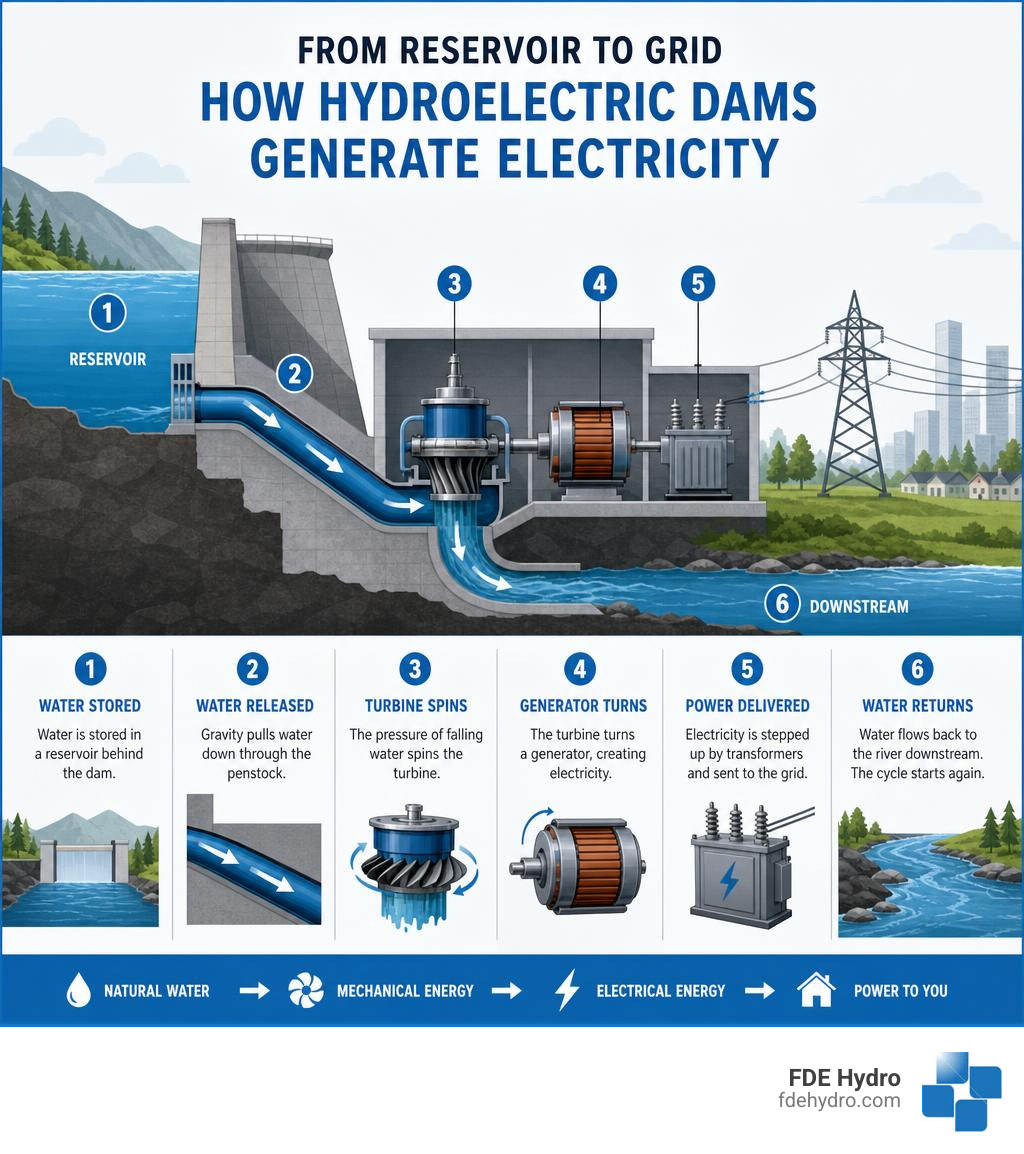
How does a hydroelectric dam work? Here’s the short answer:
Water is stored in a reservoir behind a dam, building up potential energy.
Gravity pulls the water down through a large pipe called a penstock.
Pressure from the falling water spins a turbine inside the powerhouse.
The turbine turns a generator, which converts that spinning motion into electricity.
Electricity flows out through transformers and transmission lines to homes and businesses.
Water returns to the river downstream — and the cycle starts again.
That’s it. Gravity does the heavy lifting. The dam just controls when and how fast the water falls.
Hydroelectric power is one of the oldest and most reliable forms of renewable energy on the planet. Today it supplies roughly one-sixth of the world’s electricity — and in some countries, like Norway, it accounts for nearly 90% of all power production. In the U.S., about 1,450 conventional hydropower plants are operating right now, generating clean electricity without burning a single drop of fuel.
The core principle hasn’t changed much in over a century: moving water spins a turbine, the turbine drives a generator, and the generator produces electricity. But the engineering behind it — the dams, components, and facility types — is far more detailed and fascinating than that simple chain suggests.
I’m Bill French, Sr., Founder and CEO of FDE Hydro™, and I’ve spent decades in heavy civil construction before turning my focus to modernizing the way hydropower infrastructure gets built — including developing patented modular solutions that directly address how a hydroelectric dam works from the ground up. In this guide, I’ll walk you through every part of the process, from reservoir to the grid.
How Does a Hydroelectric Dam Work? Step-by-Step
At its heart, a hydroelectric dam is an energy conversion machine. It does not create energy from nothing. It converts the natural energy of elevated water into electricity.
The main idea is simple:
Water stored high behind a dam has potential energy.
When released, gravity turns that stored energy into kinetic energy, or moving energy.
Moving water spins a turbine.
The turbine spins a generator.
The generator produces electricity.
Two factors largely determine how much power a hydroelectric plant can produce:
Head – the vertical distance water falls.
Flow – the volume of water moving through the system.
More head or more flow usually means more potential power. That is why hydroelectric sites are carefully chosen for reliable water supply, good elevation difference, strong geology, and access to transmission infrastructure.
How does a hydroelectric dam work from reservoir to river?
A conventional hydroelectric dam begins with a reservoir. This is the body of water stored upstream behind the dam. The reservoir acts a little like a battery, except instead of storing chemical energy, it stores water at elevation.
Here is the reservoir-to-river journey:
Water collects in the reservoir from rainfall, runoff, snowmelt, and river flow.
Intake gates open when operators or automated controls need to generate power.
Water enters the penstock, a large pipe or tunnel that carries water downward.
Pressure builds as gravity accelerates the water.
The water strikes turbine blades, causing the turbine runner to spin.
Used water exits through the tailrace and returns downstream to the river.
Flow is adjusted to match power demand, reservoir conditions, and environmental requirements.
The dam’s job is control. It controls water level, pressure, timing, and release. Without that control, the river still has energy, but the plant cannot reliably convert it into grid-ready electricity.
How does a hydroelectric dam work inside the generator?
The turbine does not make electricity by itself. It makes rotation.
That rotating motion travels through a shaft into the generator. Inside the generator, the shaft spins a component called the rotor. Around it sits the stator, a stationary ring of copper windings.
The physics comes from electromagnetic induction, often associated with Faraday’s principle: when magnetic fields move past conductive wire, they induce electric current.
In plain English:
The turbine spins the shaft.
The shaft spins magnets or electromagnets inside the generator.
The moving magnetic field interacts with copper windings.
That interaction produces alternating current, or AC electricity.
Voltage equipment helps control and prepare that electricity for the grid.
This is why hydroelectric plants and thermal power plants are similar in one important way: both turn turbines connected to generators. A coal or gas plant uses steam to spin the turbine. A hydro plant uses falling water. Same basic generator idea, much cleaner fuel source.
How water cycle and gravity keep hydropower renewable
Hydropower is renewable because it is powered by the water cycle.
The process looks like this:
The sun heats water in oceans, lakes, rivers, soil, and plants.
Water evaporates and rises into the atmosphere.
Vapor condenses into clouds.
Precipitation falls as rain or snow.
Water runs downhill into streams, rivers, reservoirs, and eventually back to larger bodies of water.
Gravity keeps the water moving from high elevations to low elevations.
So yes, hydropower is partly solar energy wearing a raincoat. The sun lifts the water. Gravity brings it back down. The dam captures part of that downhill movement and turns it into electricity.
A hydroelectric power plant is more than a wall in a river. It is a system of civil, mechanical, electrical, and environmental components working together.
The main parts include:
Dam structure – holds back water and creates head.
Reservoir – stores water upstream.
Spillway – safely releases excess water.
Intake – controls water entering the power system.
Trash racks – screen out logs, debris, and large objects.
Penstock – carries pressurized water to the turbine.
Powerhouse – contains turbines, generators, and control systems.
Turbine – converts water energy into rotating mechanical energy.
Generator – converts mechanical energy into electrical energy.
Transformer – increases voltage for efficient transmission.
Transmission lines – move electricity to the grid.
The dam creates the elevation difference that gives water useful pressure. Depending on the site, dams may be designed as gravity dams, arch dams, buttress dams, embankment dams, or other configurations.
The reservoir provides storage. That storage can support:
Electric generation
Flood control
Water supply
Recreation
Drought management
Flow regulation
The spillway is the safety valve. When inflows are too high or reservoir levels need to be lowered, the spillway releases water without sending all of it through the turbines. A well-designed spillway protects the dam from overtopping, which is one of the most serious safety risks for many dam types.
Reservoir operations also have to consider sediment. Rivers naturally carry sand, silt, gravel, and organic material. When water slows in a reservoir, some of that material settles. Over time, sediment can reduce storage capacity and affect intakes, outlets, habitats, and downstream river shape.
The penstock is the high-pressure pathway from the reservoir or intake to the turbine. Think of it as the plant’s water highway. The steeper and longer the drop, the more pressure the penstock must be designed to handle.
At the turbine, flow is often regulated by wicket gates or guide vanes. These direct water into the turbine runner at the right angle and volume.
Common turbine types include:
Francis turbines – widely used for medium head and medium flow sites.
Kaplan turbines – good for low-head, high-flow applications; their blades can adjust like a boat propeller.
Pelton turbines – used for high-head, lower-flow sites; water jets strike spoon-shaped buckets.
The turbine converts hydraulic energy into mechanical rotation. The generator then converts that rotation into electricity.
Transformers and transmission to homes and businesses
The electricity leaving a generator is not ready to travel long distances efficiently. That is where transformers come in.
The path from dam to outlet usually looks like this:
Generator produces AC electricity at the power plant.
Step-up transformer increases voltage for long-distance transmission.
High-voltage transmission lines carry electricity across the grid.
Substations reduce voltage closer to cities, towns, and industrial users.
Distribution lines deliver power to homes and businesses.
Local transformers step voltage down again for safe use.
High voltage reduces energy losses during transmission. That is why electricity is stepped up for travel and stepped down before it reaches your toaster, phone charger, office lights, or manufacturing equipment.
Types of Hydroelectric Facilities and How Pumped Storage Works
Not every hydropower project uses the same layout. The three major categories are conventional storage hydropower, run-of-the-river hydropower, and pumped-storage hydropower.
Facility type
How it works
Main strength
Main limitation
Conventional storage dam
Stores water in a reservoir and releases it through turbines
Dispatchable, controllable power
Larger land and ecosystem footprint
Run-of-the-river
Uses natural river flow with little or limited storage
Smaller reservoir impact
Output depends heavily on river flow
Pumped storage
Moves water between lower and upper reservoirs to store energy
Grid-scale energy storage and peak support
Uses more electricity to pump than it later generates
Conventional storage hydropower
A conventional storage plant uses a dam and reservoir to hold water until electricity is needed. This makes it dispatchable, meaning operators can increase or decrease generation more easily than with many other renewable sources.
This is useful for:
Morning and evening demand peaks
Grid balancing
Backup during outages
Seasonal water management
Supporting variable solar and wind generation
The tradeoff is that large reservoirs can flood land, alter river habitats, trap sediment, and change downstream flows. Good design, licensing, monitoring, and operations matter.
Run-of-the-river hydropower uses the natural movement of a river, often with a small diversion structure or low dam. These systems may have little storage compared with conventional reservoir plants.
Advantages can include:
Smaller reservoir footprint
Less large-scale flooding
Potentially lower visual impact
Good fit for certain existing water control structures
Limitations include:
Seasonal generation changes
Less ability to store water for peak demand
More sensitivity to drought or low-flow periods
Need to maintain environmental flows for aquatic life
Run-of-the-river does not mean no impact. It still needs careful design for fish movement, sediment, recreation, water temperature, and downstream flow.
Pumped storage for peak electricity demand
Pumped storage is hydropower’s answer to the battery question. It uses two reservoirs at different elevations.
Here is how it works:
During low-demand periods, excess electricity powers pumps.
Water is pumped from the lower reservoir to the upper reservoir.
During high-demand periods, water is released back downhill.
The falling water spins reversible pump-turbines.
The plant generates electricity when the grid needs it most.
Pumped storage does not create net new electricity. In fact, it uses more electricity to pump water uphill than it generates on the way down. But that is not the point. Its value is timing.
It stores energy when electricity is plentiful or less expensive and returns power when demand is high. That helps grid operators manage peak loads, stabilize frequency, and integrate variable renewable sources.
Efficiency, Output, History, and Global Scale of Hydropower
Modern hydroelectric generation is extremely efficient. Well-designed hydro plants can convert around 90% of available water energy into electricity. That is one reason hydropower has remained important even as solar, wind, batteries, and other technologies grow.
But output is not constant. It depends on water, elevation, equipment, operations, and environmental limits.
Reservoir level – Lower water levels can reduce head and output.
Seasonal conditions – Rainfall, snowmelt, and drought change available water.
Sediment and debris – Abrasion, clogging, and buildup can reduce performance.
Maintenance – Worn turbines, seals, bearings, and gates can lower efficiency.
Environmental flows – Plants may be required to release water for habitat instead of generation.
Operational limits – Flood control, water supply, navigation, and safety can constrain generation.
A hydro plant is not just “on” or “off.” Operators balance power production with water management, equipment protection, regulatory requirements, and river health.
People have used moving water for thousands of years, long before electric grids existed. Ancient water wheels powered mills for grinding grain, cutting lumber, and driving machinery.
The electric era came later. In the United States, early hydroelectric use included lighting applications in 1880, and one of the first commercial hydroelectric plants began operating in 1882. The oldest operating U.S. hydropower facility is the Whiting plant in Wisconsin, which began operating in 1891 and has about 4 MW of capacity.
As of the research data available before May 2026:
Hydroelectricity accounted for about 6.2% of total U.S. utility-scale electricity generation in 2022.
It provided about 28.7% of U.S. utility-scale renewable electricity generation in 2022.
From 2001 through 2022, hydro averaged about 6.7% of total annual U.S. electricity generation.
The U.S. has about 1,450 conventional hydropower plants and about 40 pumped-storage plants.
The Grand Coulee hydroelectric facility has 6,765 MW of total generating capacity.
Globally, hydropower supplies roughly 15% to one-sixth of electricity production, depending on the dataset and year.
Hydropower is not new, but it is not outdated. In many regions, the future is about modernizing existing infrastructure, improving efficiency, adding generation to non-powered dams, and building smarter water control systems.
Pros, Cons, and Environmental Impacts of Hydroelectric Dams
Hydropower has major advantages, but it also has real environmental responsibilities. A good article on how does a hydroelectric dam work should explain both sides.
Renewable energy – It relies on the water cycle, not fuel combustion.
Low operating emissions – Plants generate electricity without burning coal, oil, or gas.
High efficiency – Modern facilities can be around 90% efficient.
Fast ramping – Operators can often increase or reduce output quickly.
Long service life – Many hydro assets can operate for decades with proper maintenance.
Low fuel cost – The fuel is flowing water.
Grid stability – Large rotating generators can support voltage and frequency stability.
Energy storage – Reservoirs and pumped storage help shift power to when it is needed.
Black-start capability – Some hydro plants can help restart the grid after outages.
Multiple uses – Dams may also support flood control, water supply, irrigation, navigation, and recreation.
Hydropower is especially valuable because it is controllable. Solar and wind are excellent resources, but they depend on sun and weather. Hydropower can often respond when the grid asks for more or less electricity.
Disadvantages and ecological concerns
Hydroelectric dams can also create significant impacts, especially when poorly planned or outdated.
Concerns include:
River fragmentation – Dams can interrupt natural river connectivity.
Fish migration barriers – Species that move upstream or downstream may be blocked.
Altered flows – Natural high and low flow patterns may change.
Reservoir flooding – Land, habitat, farmland, cultural sites, or communities may be affected.
Sediment trapping – Downstream channels, deltas, and habitats may lose sediment supply.
Water temperature changes – Deep reservoir releases can be colder or warmer than natural flows.
Water quality issues – Low oxygen or stratification can occur in some reservoirs.
Evaporation losses – Reservoirs can lose water to evaporation, especially in warm regions.
Drought vulnerability – Less water means less generation.
Methane risk – Some reservoirs, especially in warm climates with submerged organic matter, can emit methane.
Dam safety risk – Dams require inspection, maintenance, emergency planning, and responsible operation.
Hydropower is clean at the point of generation, but “clean” should never mean “impact-free.” The goal is responsible design and operation.
How modern design reduces impacts
Modern hydro design is much more sophisticated than simply placing concrete in a river and calling it a day. Thankfully, we have moved beyond the “just build a wall and hope the fish read the signs” era.
Impact reduction tools include:
Fish ladders and fish lifts to help upstream migration.
Fish screens to keep fish out of turbines and intakes.
Bypass systems for safer downstream passage.
Minimum flow releases to maintain habitat below the dam.
Selective withdrawal systems to manage water temperature.
Sediment flushing or bypassing to restore sediment movement.
Aeration systems to improve dissolved oxygen.
Turbine upgrades designed to improve fish survival and efficiency.
Real-time monitoring for flow, temperature, dissolved oxygen, vibration, and performance.
Retrofitting existing dams instead of building entirely new impoundments where appropriate.
At FDE Hydro, our focus on modular precast concrete technology is part of this modernization conversation. Faster, more controlled construction can reduce site disruption, improve quality control, and support retrofits at existing water infrastructure.
Frequently Asked Questions About How Hydroelectric Dams Work
How does a hydroelectric dam work when electricity demand changes?
Hydroelectric plants can respond quickly to changing demand. When the grid needs more power, operators or automated systems open intake gates or wicket gates to allow more water through the turbines. When demand drops, they reduce flow.
This makes hydropower useful for peaking power, which is electricity needed during high-demand hours. Pumped storage adds another layer by storing energy during low-demand periods and generating during peak periods.
Does a hydroelectric dam use up water?
A hydroelectric dam generally does not consume water in the same way a fuel-burning plant consumes fuel. Water passes through the turbine and returns to the river downstream.
However, there can be water losses or changes, including:
Evaporation from reservoirs
Temporary storage behind the dam
Flow timing changes
Water allocated for other uses, such as supply or irrigation
So the water is not “used up,” but the river system is managed and altered.
Why are some locations better for hydroelectric dams?
The best hydropower sites usually have:
Reliable river flow
Strong elevation drop, or head
Good geology and foundation conditions
A valley shape suitable for a dam or diversion
Manageable sediment conditions
Access to transmission lines
Lower environmental and community conflict
Clear permitting and water rights conditions
Long-term climate and hydrology resilience
A flat river with low flow may still have energy, but not enough for a practical large hydro project. A steep river with reliable flow is usually more promising, assuming environmental and community factors can be responsibly addressed.
Conclusion
So, how does a hydroelectric dam work?
It works by combining the water cycle, gravity, civil engineering, turbines, generators, and the electric grid into one coordinated system. The sun lifts water through evaporation. Rain and snow return it to the land. Gravity pulls it downhill. A dam controls that movement. A turbine captures it. A generator turns it into electricity. Transformers and transmission lines deliver it to the people and businesses that need it.
Hydropower is efficient, renewable, flexible, and proven. It also requires careful environmental design, responsible operations, and modern construction methods.
That is where the next chapter matters. At FDE Hydro, we believe hydropower infrastructure can be built and upgraded faster, smarter, and more affordably using innovative modular precast concrete technology like our patented French Dam system. The goal is not just more power. It is better water infrastructure for North America, Brazil, and Europe.
Why Micro hydro power solutions Belong in Every Water Infrastructure Plan
Micro hydro power solutions are small-scale hydroelectric systems that generate up to 100 kilowatts of electricity from flowing water — delivering reliable, 24/7 renewable energy for homes, farms, small communities, and remote facilities.
Here’s what you need to know at a glance:
Factor
Details
Power output
Up to 100 kW (a 10 kW system can power a large home or hobby farm)
Key requirements
A stream or water source with adequate head (vertical drop) and flow rate
Off-grid properties, farms, rural infrastructure, water facilities
Humans have harnessed moving water for energy for over 2,000 years — from ancient waterwheels to modern turbines. What’s changed is how efficient, affordable, and environmentally responsible small-scale hydro has become.
Unlike solar or wind, micro hydro doesn’t depend on weather. If your stream flows, your system generates power — day and night, rain or shine. That predictability is rare in renewable energy, and it’s why water infrastructure planners are paying closer attention to it in 2026.
This guide walks you through everything: how to assess your site, choose the right turbine, navigate permits, and get the most from your investment.
I’m Bill French, Sr., Founder and CEO of FDE Hydro™ — and for over five decades I’ve led large-scale civil construction projects, including my selection by the U.S. Department of Energy to help shape the national roadmap for next-generation micro hydro power solutions. FDE Hydro™ builds on that expertise with patented modular construction technology designed to make hydropower faster, cheaper, and more sustainable to develop. Let’s start with the foundation of any successful project: understanding your site.
Site Assessment: Measuring Head and Flow for Micro Hydro Power Solutions
Before you buy a single pipe or turbine, we need to talk about the two most important numbers in your life: Head and Flow. Think of head as the “pressure” (how far the water falls) and flow as the “volume” (how much water is moving). Together, they determine your power potential.
Understanding Head: The Vertical Drop
Gross head is the total vertical distance from where you take the water (the intake) to where the turbine sits. Net head is what you actually get to use after accounting for friction losses in your pipes.
To measure this, you don’t need fancy satellites. In 2026, we still love the basics. You can use a surveyor’s transit or a laser level for high accuracy (within 0.1 to 0.5 feet). If you’re on a budget, a water-filled hose with a pressure gauge at the bottom works wonders. Remember: 1 psi of pressure equals roughly 2.31 feet of head.
Measuring Flow: The Volume of Energy
Flow is the amount of water moving past a point, usually measured in gallons per minute (gpm) or cubic feet per second (cfs). Because streams change with the seasons, we always recommend measuring flow during the driest part of the year. If your system can’t run in August, it’s not a 24/7 solution.
Here are the three most common methods:
The Bucket Method: Best for small streams. Time how long it takes to fill a container of a known size. For example, if a 55-gallon barrel fills in 40 seconds, your flow is 82.5 gpm.
The Float Method: Best for medium streams. Mark off a 30-foot section of the stream. Toss in a float (an orange or a stick) and time how long it takes to travel that distance. Multiply the velocity by the cross-sectional area of the stream and apply a correction factor (usually 0.6 to 0.8) to account for friction against the stream bed.
The Weir Method: The gold standard for accuracy. You build a temporary dam with a rectangular notch (a weir). By measuring the depth of the water flowing over the notch, you can use standard tables to find a very precise flow rate.
The Power Calculation
Once you have your head and flow, you can calculate your theoretical power. A simple rule of thumb for micro hydro power solutions is: Watts = [Head (ft) x Flow (gpm)] / 10
For a more technical calculation, use: Pth (kW) = (Flow in cfm x Net Head in ft) / 709
That no system is 100% efficient. While high-quality impulse systems can reach 70% to 85% efficiency, we usually tell beginners to expect an overall “water-to-wire” efficiency of 50% to 70%.
Engineering the System: From Penstocks to Powerhouses
Once you know your site’s potential, it’s time to design the hardware. A typical micro hydro system is a “run-of-river” setup, meaning we don’t need a massive, environment-altering dam. Instead, we divert a small portion of the water, use it, and return it.
Intake Structures and Coanda Screens
The intake is where the journey begins. Its job is to divert water while keeping out leaves, fish, and debris. In 2026, we almost exclusively recommend Coanda screens. These use the “Coanda effect” to pull water through fine slots while debris slides right over the top. They are self-cleaning and drastically reduce maintenance.
The Penstock: Your Power Pipeline
The penstock is the pipe that carries water to the turbine. We typically use HDPE (High-Density Polyethylene) or PVC. The goal is to minimize “friction loss.” If your pipe is too small, the water wastes its energy rubbing against the pipe walls instead of turning the turbine. We often suggest 3-inch to 4-inch piping for small farm systems to optimize flow.
The Powerhouse and Tailrace
The powerhouse protects your generator and electronics from the elements. It doesn’t need to be a palace—a small, ventilated shed will do. The tailrace is the channel that leads the water back to the stream. Ensure the tailrace is clear so water doesn’t “back up” and slow down your turbine.
Selecting Turbines for Micro Hydro Power Solutions
Choosing a turbine is like choosing a car—it has to fit your “terrain” (head and flow). There are two main categories:
1. Impulse Turbines (High Head, Low Flow) These turbines use a high-velocity jet of water to strike buckets on a wheel.
Pelton Wheels: The classic choice. They are highly efficient (70–90%) and perfect for sites with a lot of vertical drop but not much water.
Turgo Runners: An upgraded Pelton. They can handle more water in a smaller size and spin twice as fast, which is great for direct-drive generators.
Jack Rabbit Turbines: These are “drop-in-the-creek” units. They can generate up to 100 Watts from just 13 inches of water with no head at all.
2. Reaction Turbines (Low Head, High Flow) These turbines are fully submerged and use both pressure and the velocity of the water.
Kaplan or Propeller Turbines: These look like boat propellers inside a pipe. They are excellent for low-head sites like old mill races or irrigation canals.
Crossflow Turbines: A versatile “drum” shaped turbine that works well in sites with varying flow rates.
3. Pump-as-Turbine (PAT) If you’re on a tight budget, you can actually use a standard centrifugal pump and run it in reverse. While they are 50-70% cheaper than custom turbines, they are less efficient and harder to adjust.
For a deeper dive into turbine mechanics, the Department of Energy offers excellent technical resources.
Optimizing and Maintaining Micro Hydro Power Solutions
A well-built system should provide “free” energy for 20 to 25 years, but it isn’t “set it and forget it.”
Electronic Governors: These are the brains of the system. They manage the electrical load. If you turn off your toaster, the governor diverts that “extra” power to a “dump load” (like a water heater) to keep the turbine from over-speeding.
Debris Management: Even with a Coanda screen, check your trash racks regularly, especially after a storm.
Winterization: In cold climates like New York or Canada, ensure your penstock is buried below the frost line. Moving water rarely freezes, but a shut-down pipe will burst in a heartbeat.
Bearing Lubrication: Most modern turbines use sealed bearings, but if yours are greasable, make it a monthly habit.
Reliability is the greatest advantage of these systems. We’ve seen systems achieve 98% uptime, providing a level of energy independence that solar simply can’t match. To understand why this stability matters for modern grids, see our article on Why go micro? The undeniable advantages of microgrids.
Economics, Permitting, and Environmental Stewardship
Let’s talk money and rules. While the sun is free and the water is free, the hardware and the paperwork are not.
The Cost of Power
In 2026, the up-front cost for a DIY micro hydro system generally ranges from $1,500 to $4,000 per kilowatt. A 10 kW system might cost you $25,000 to $40,000, but it will generate as much energy as a 50 kW solar array because it runs 24 hours a day.
Financial Incentives
The good news is that there is plenty of help available in North America:
Investment Tax Credit (ITC): As of 2025/2026, federal tax credits can cover up to 30% of your project costs.
REAP Grants: The Rural Energy for America Program offers grants for farmers and rural small businesses that can cover up to 25% of eligible costs (ranging from $2,500 to $500,000).
LCOE: The Levelized Cost of Energy for micro hydro is often between $0.05 and $0.15 per kWh, making it one of the most cost-effective renewables over its 50-year lifespan.
Permitting and Regulations
In the United States, the Federal Energy Regulatory Commission (FERC) oversees hydro. However, most micro hydro power solutions fall under the 5 MW or 10 MW exemption thresholds. This means a much faster approval process (6–12 months) compared to large dams.
You also need to understand water rights. In the Eastern US (like New York), the Riparian Doctrine usually allows property owners “reasonable use” of water. In the Western US (like California or Kansas), the Prior Appropriation system (“first in time, first in right”) is more common. Always consult your state water agency early.
Environmental Stewardship
At FDE Hydro™, we believe energy shouldn’t come at the cost of the ecosystem.
Fish Passage: Use fish-friendly intake screens and ensure you aren’t blocking migration routes.
Minimum Bypass Flow: Never take all the water out of a stream. Always leave enough flow in the original stream bed to support aquatic life.
Run-of-River: By avoiding large reservoirs, we minimize the impact on water temperature and oxygen levels.
How much does a micro-hydro system cost to install in 2026?
Expect to pay between $1,500 and $4,000 per kW for a DIY setup. Professional, turnkey installations for larger systems (near 100 kW) may cost more due to civil engineering and permitting, but they offer a significantly higher ROI over 30+ years.
What is the minimum head required for a viable system?
While some specialized turbines like the Jack Rabbit can work with as little as 13 inches of drop, most efficient systems prefer at least 2 to 10 feet of head. High-head Pelton systems usually look for 50 feet or more to be truly effective.
Do I need a battery bank for my micro-hydro project?
Not necessarily. If you are grid-intertied, the grid acts as your battery. For off-grid systems, a small battery bank is helpful to handle “surge” loads (like a motor starting up), but because hydro is constant, you need a much smaller battery bank than a solar-only system would require.
Conclusion
Micro hydro power solutions represent a bridge between ancient wisdom and future technology. They offer a level of reliability and energy density that few other renewables can match. Whether you’re a farmer in Kansas looking to power your irrigation or a homeowner in the mountains of California seeking energy independence, the water flowing through your property is a hidden goldmine of clean energy.
At FDE Hydro™, we are committed to making this technology accessible. Our patented modular precast concrete technology—the French Dam—is specifically designed to reduce construction time and costs, making it easier than ever to build or retrofit water control systems in North America, Brazil, and Europe.
Sustainable development isn’t just about big wind farms; it’s about the thousands of small streams that can power our world, one kilowatt at a time.