

How Hydroelectric Power Is Produced: The Energy Behind Moving Water
How hydroelectric power is produced is simpler than most people think. Here’s the quick answer:
How Hydroelectric Power Is Produced — Quick Summary:
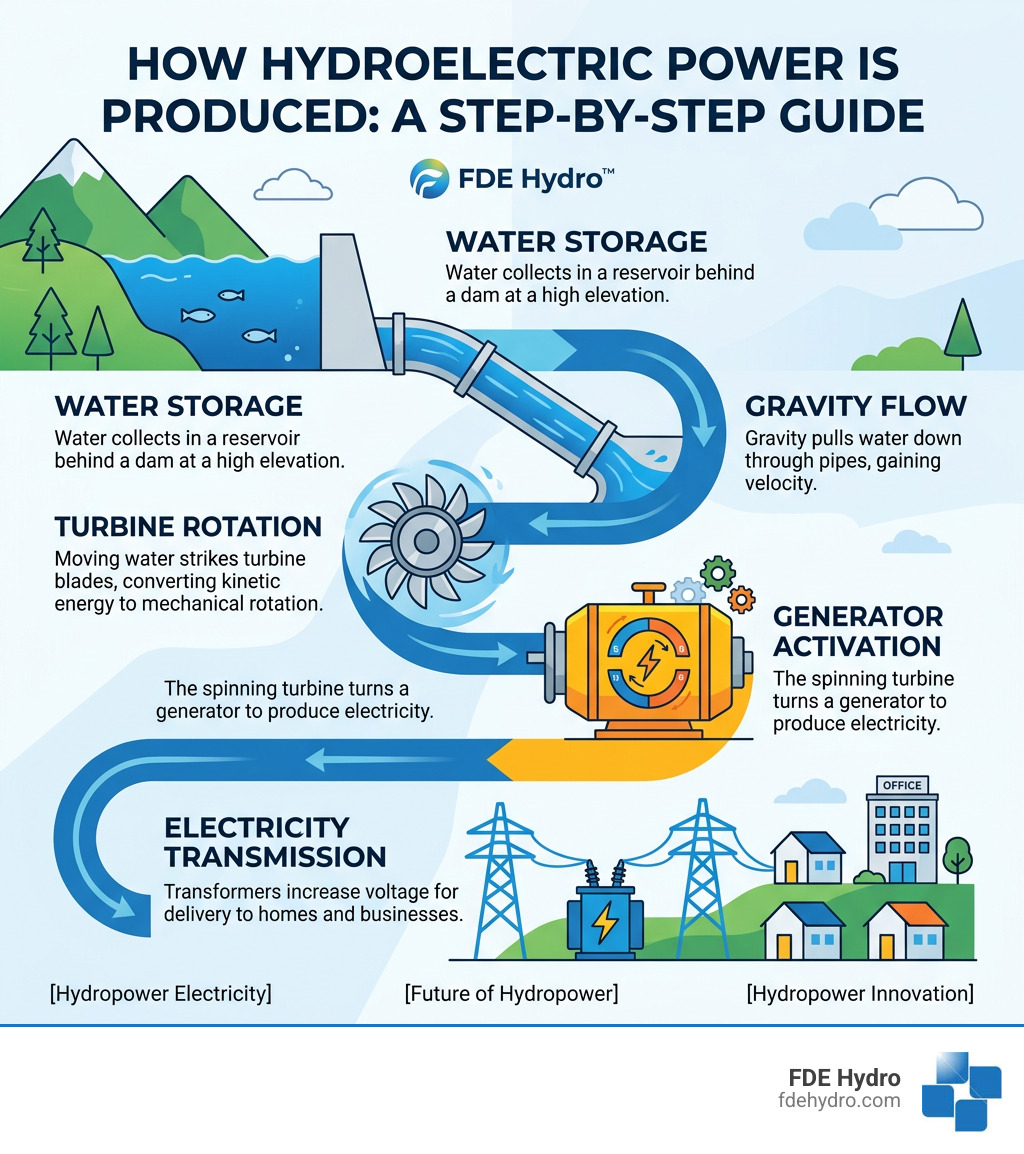
- Water is stored at a high elevation, typically in a reservoir behind a dam
- Water flows down through a large pipe called a penstock, gaining speed from gravity
- Moving water strikes turbine blades, converting kinetic energy into mechanical rotation
- The turbine spins a generator, which uses electromagnetic induction to produce electricity
- Electricity is stepped up by transformers and sent out across transmission lines to homes and businesses
It’s essentially the same energy conversion chain used in coal or nuclear plants — except the “fuel” is falling water, and it never runs out.
People have harnessed the force of moving water for mechanical work for thousands of years. But it wasn’t until the early 1880s that this power was first converted into electricity — first in Michigan in 1880, and then commercially on the Fox River in Wisconsin in 1882. Today, hydropower supplies roughly 15% of the world’s electricity, more than all other renewable sources combined.
I’m Bill French, Sr., Founder and CEO of FDE Hydro™, and I’ve spent decades in heavy civil construction before turning my focus to modernizing how hydroelectric power is produced through modular, precast construction methods. In 2015, I was selected by the U.S. Department of Energy to help define the next-generation roadmap for hydropower solutions — and that hands-on experience shapes everything we build at FDE Hydro™.
Easy how hydroelectric power is produced word list:
The Fundamentals of How Hydroelectric Power is Produced
At its heart, hydroelectric power generation is an elegant dance between gravity and the water cycle. We don’t actually “create” energy; we simply harvest it as it moves from one place to another.
The sun provides the initial “pump” by evaporating water from oceans and lakes. This water falls back to Earth as rain or snow, often at high elevations. As that water seeks the lowest point—the sea—it carries immense potential energy. By placing a facility in its path, we can capture that energy.
Gravity and Water Pressure
The “muscle” behind a hydro plant comes from two main variables: Head and Flow.
- Head (Vertical Drop): This is the distance the water falls. The higher the drop, the more pressure is created at the bottom.
- Flow (Volume): This is the amount of water moving through the system over time.
When we are calculating available power, we use a simple formula: Power equals the product of efficiency, density, flow rate, gravity, and head height. In plain English: if you have a massive amount of water falling from a great height, you have a powerhouse on your hands.
This is why you’ll see massive dams in places like California or New York, but fewer in flat states like Kansas. Without a significant “drop,” the water doesn’t have enough “push” to spin heavy industrial turbines efficiently.
Key Components of a Hydropower Facility
To understand how hydroelectric power is produced, we need to look at the specialized tools we use to catch the current. Every hydro-electric dam is a feat of engineering, but they all share a few hydro-dam components.
- The Dam: This is the primary barrier that holds back the river, creating a reservoir. At FDE Hydro™, we specialize in hydroelectric dam construction using modular precast concrete, which makes building these massive structures faster and more cost-effective.
- The Reservoir: This acts like a giant battery, storing potential energy in the form of water until the electrical grid needs it.
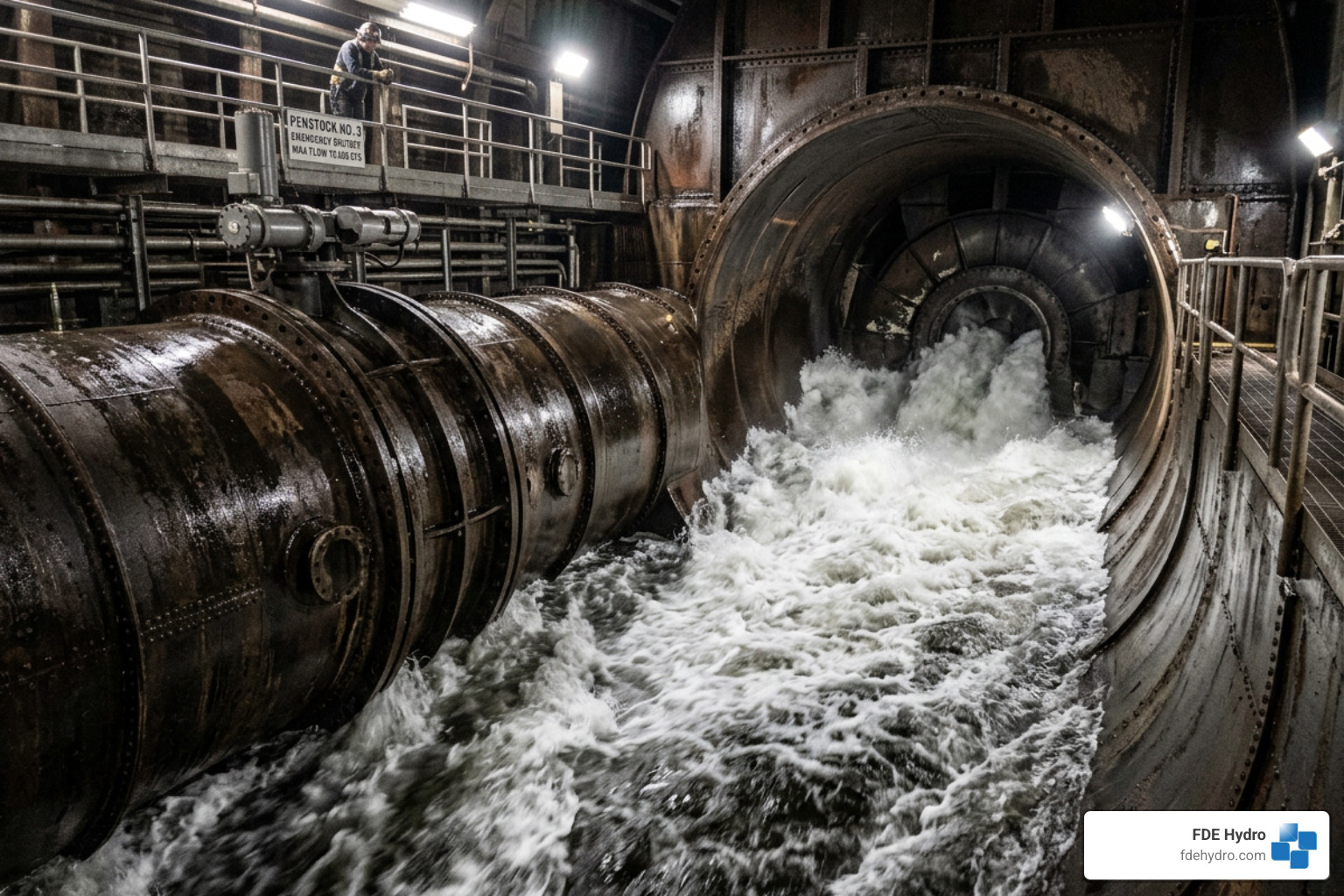
- Intake and Penstock: Gates open to allow water into the system. It then travels through a “penstock”—a large, reinforced pipe that builds up immense pressure as the water descends.
- The Turbine: Think of this as a high-tech version of an old-fashioned water wheel. The pressurized water strikes the turbine blades, causing them to spin.
- The Generator: Attached to the turbine by a shaft, the generator contains giant magnets that spin inside coils of copper wire. This movement “excites” electrons, creating an electrical current.
- The Powerhouse: This is the building that protects the turbines and generators. You can find more details in our hydroelectric dam components ultimate guide.
Step-by-Step: How Hydroelectric Power is Produced in Conventional Plants
Let’s walk through the step-by-step generation process as if we were following a single drop of water:
- Step 1: Storage. The drop sits in the reservoir, full of potential energy.
- Step 2: The Plunge. The intake gate opens, and the drop enters the penstock. Gravity pulls it downward, converting that potential energy into kinetic energy (motion).
- Step 3: The Impact. The drop hits the turbine runner. Its momentum is transferred to the blades, turning the mechanical shaft.
- Step 4: Induction. Inside the generator, the spinning shaft rotates magnets. This process, called electromagnetic induction, generates electricity.
- Step 5: The Exit. Having done its job, the water drop exits through the tailrace and returns to the river downstream, completely unchanged.
- Step 6: Transmission. The electricity travels to a transformer, which increases the voltage so it can travel long distances over power lines to your toaster.
Diverse Methods: How Hydroelectric Power is Produced Across Different Systems
While the “big dam” model is the most famous, we use several different methods depending on the geography and the needs of the grid.
- Run-of-the-River: These systems don’t require a massive reservoir. Instead, they divert a portion of the river’s natural flow through a turbine. They are great for reducing environmental impact but are more dependent on seasonal rainfall.
- Pumped-Storage Hydropower: This is the world’s largest “battery.” During the night, when electricity is cheap and demand is low, we use excess power to pump water from a lower reservoir to an upper one. When everyone wakes up and turns on their coffee makers, we release that water back down to generate power. It’s a net energy consumer, but it provides vital grid stability.
- Conduit Systems: These clever setups place small turbines inside existing water tunnels, such as those used for city water supplies or irrigation. We’re essentially getting “free” energy from infrastructure that is already moving water.
| Feature | Conventional Dam | Run-of-River | Pumped-Storage |
|---|---|---|---|
| Storage Capacity | High (Reservoir) | Low to None | High (Two Reservoirs) |
| Grid Flexibility | High | Moderate | Very High |
| Environmental Footprint | Large | Small | Moderate |
| Primary Goal | Baseload Power | Constant Supply | Peak Demand/Storage |
Advantages and Environmental Challenges of Hydropower
There are many benefits of a hydropower plant, but like any energy source, it comes with trade-offs. We believe in being transparent about both.
The Bright Side: Why We Love Hydro
First, it’s renewable. As long as the sun shines and the rain falls, we have fuel. Second, it’s flexible. Unlike nuclear or coal, which take a long time to “ramp up,” a hydro unit can go from zero to full power in just a few minutes. This makes it the perfect partner for wind and solar—when the wind stops blowing, hydro can kick in instantly to keep the lights on. Finally, these plants have an incredible lifespan. Many facilities in the U.S. and Canada have been operating for over 100 years.
The Challenges: Doing Better for the Planet
We have to be honest about the impact on local ecosystems. Building a dam changes the temperature and flow of a river, which can affect fish and wildlife. Methane emissions from tropical reservoirs can also be a concern in places like Brazil, as submerged vegetation decays.
However, modern engineering is finding solutions. We now use fish ladders and “fish-friendly” turbines to help migratory species like salmon move past dams safely. We also focus on hydroelectric dam efficiency to get more power out of existing structures without needing to flood new land.
Global Impact and Statistics of Water Power
Hydropower isn’t just a local success story; it’s a global powerhouse. According to the IEA Hydropower Special Market Report, global installed capacity reached almost 1,400 GW in recent years.
- Global Leader: China is the undisputed heavyweight, home to the Three Gorges Dam, which has a staggering capacity of 22,500 MW. In 2022 alone, China added 24 GW of new capacity—nearly three-quarters of all global additions.
- The U.S. Perspective: In 2022, hydroelectricity accounted for about 6.2% of total U.S. utility-scale generation and nearly 28.7% of all renewable generation.
- The Giants: The largest facility in the U.S. is the Grand Coulee Dam in Washington State, with a capacity of 6,765 MW.
- Regional Strength: In places like Canada and Brazil, hydropower provides the vast majority of the nation’s electricity, contributing significantly to their energy independence.
Frequently Asked Questions about Hydroelectricity
What is the difference between “head” and “flow” in power production?
Think of “head” as the pressure from a garden hose with a nozzle—it’s the force created by the height of the water. “Flow” is like a massive, slow-moving river—it’s the total volume of water. To get the most electricity, you want a balance of both. A small stream with a massive 500-foot drop (high head) can produce as much power as a huge river with only a 10-foot drop (high flow).
Is hydroelectricity truly a carbon-neutral energy source?
While the operation of the plant itself produces no direct CO2, we have to look at the “lifecycle.” This includes the carbon used in hydroelectric dam design and construction. In some tropical regions, decaying vegetation in reservoirs can release methane. However, compared to fossil fuels, the greenhouse gas research shows that hydropower remains one of the cleanest options available, especially in temperate regions like North America and Europe.
Which countries lead the world in hydroelectric generation?
China leads by a wide margin, followed by Brazil, Canada, and the United States. These four nations possess the perfect combination of mountainous terrain and large river systems necessary for high-capacity generation.
Conclusion
Understanding how hydroelectric power is produced helps us appreciate the vital role this “white coal” plays in our modern world. It is a bridge between the ancient wisdom of water wheels and the high-tech needs of a carbon-free future.
At FDE Hydro™, we are committed to the future of hydropower by making it easier and faster to build. Our patented “French Dam” technology uses modular precast concrete to retro-fit existing non-powered dams and build new, efficient systems across the United States, Canada, Brazil, and Europe. By reducing construction time and costs, we’re helping more communities harness the current.
If you’re interested in learning more about our innovative hydroelectric power solutions guide, we invite you to Explore our Hydropower Solutions and join us in building a more resilient, renewable grid.
