by Adaptify Support | Jul 13, 2026 | Energy Resource Articles
Why Kansas Hydropower Resource Evaluation Matters for Clean Energy Decision-Makers
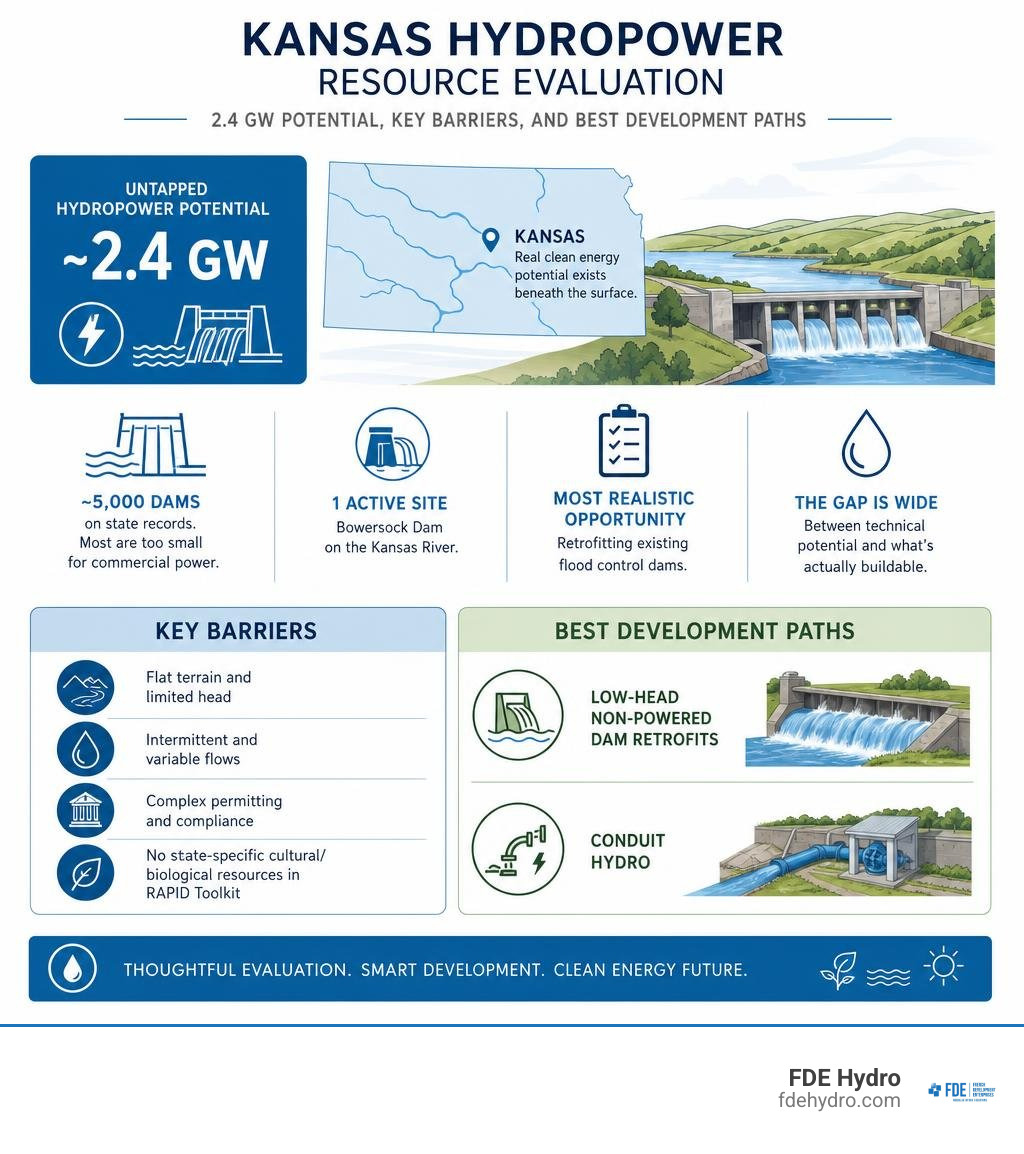
A thorough Kansas hydropower resource evaluation reveals a state sitting on far more clean energy potential than most people realize — and far more barriers than a simple capacity number suggests.
Quick Answer: Kansas Hydropower Potential at a Glance
| Factor |
Key Finding |
| Estimated untapped potential |
~2.4 GW (Oak Ridge National Laboratory) |
| Most realistic opportunity |
Retrofitting existing flood control dams |
| Only active hydro site (as of recent decades) |
Bowersock Dam on the Kansas River |
| Main barriers |
Flat terrain, intermittent flows, complex permitting |
| Regulatory gap |
No state-specific cultural/biological resource content in RAPID Toolkit |
| Best development path |
Low-head non-powered dam retrofits, conduit hydro |
Kansas has roughly 5,000 dams on state records. Most are too small for commercial power. But buried inside that number is a real opportunity — one that requires careful evaluation of hydrology, infrastructure, permitting, and economics before a single turbine turns.
The gap between technical potential and what’s actually buildable is wide. Understanding that gap is exactly what this guide is designed to help you close.
Infrastructure owners and project developers aren’t just looking for potential — they need a clear picture of what’s feasible, what’s permitted, and what it costs to get there.
I’m Bill French, Sr., Founder and CEO of FDE Hydro™, and my background spans five decades of heavy civil construction and modular infrastructure delivery, including direct participation in the U.S. Department of Energy’s Hydropower Vision Task Force — work that is directly relevant to every dimension of Kansas hydropower resource evaluation. In the sections that follow, I’ll walk you through the data, the methodologies, the regulatory landscape, and the real-world opportunities so you can make informed decisions about Kansas hydropower development.
Current Status of Kansas Hydropower Resource Evaluation
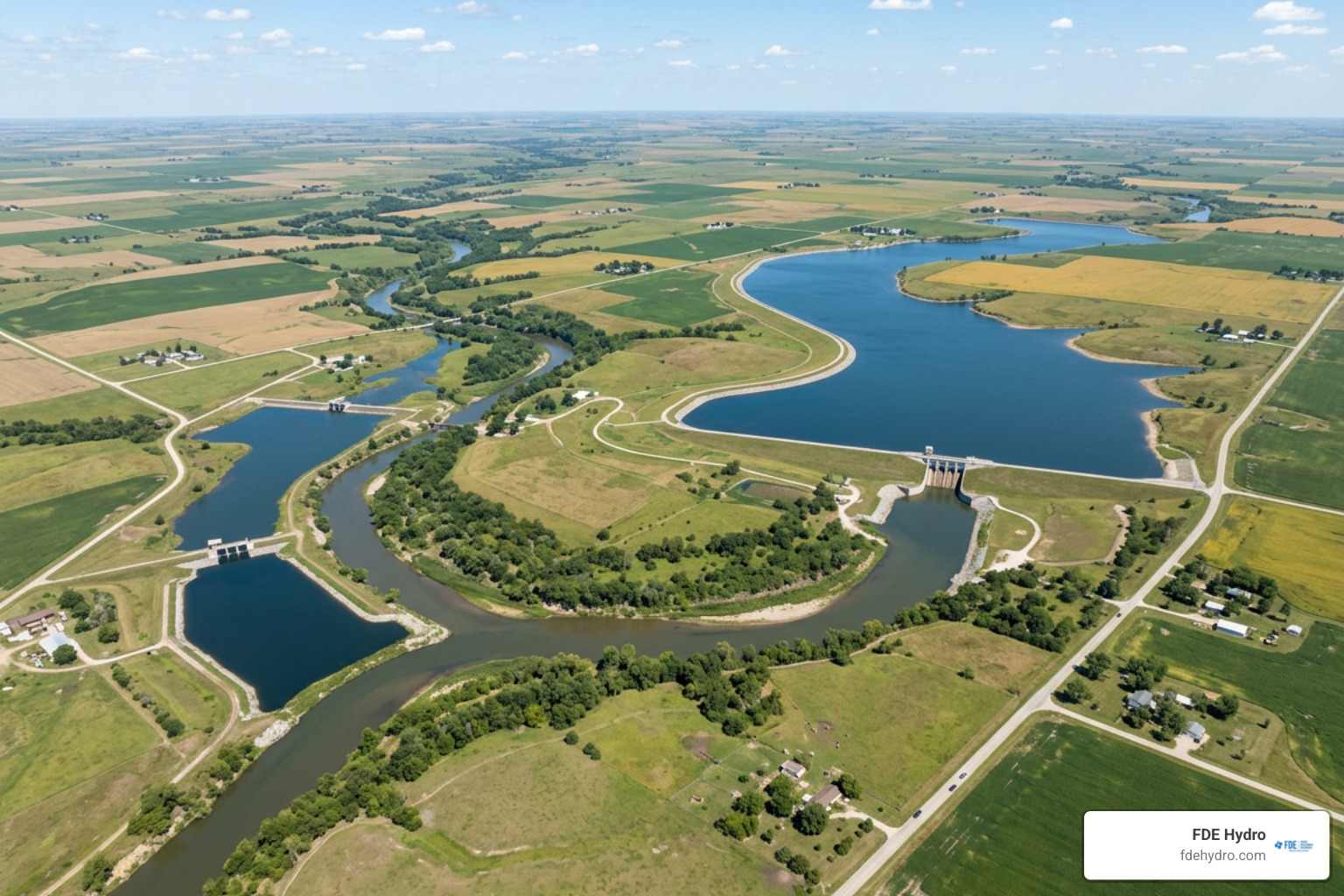
When evaluating Kansas’s clean energy landscape, water power rarely gets the headline space dedicated to wind or solar. However, systematic resource assessments show that the state’s river basins hold steady, predictable energy that could play a vital role in a diversified grid.
A comprehensive Report on Kansas Hydropower Potential highlights that while the technical potential across the state is substantial, local experts and utilities remain cautious. This skepticism is not without merit; the flat Midwestern geography and highly seasonal river flows mean we cannot simply copy-paste development strategies used in mountainous regions. Instead, a successful hydropower strategy in Kansas requires looking closely at existing, non-powered infrastructure.
Assessing Kansas Hydropower Resource Evaluation and Untapped Capacity
According to national resource assessments conducted by the Oak Ridge National Laboratory (ORNL) for the U.S. Department of Energy, Kansas possesses approximately 2.4 gigawatts (GW) of untapped technical hydropower potential. To put that in perspective, if fully developed, this capacity could support a significant portion of the state’s baseline electrical demand.
However, we must distinguish between technical potential and practical feasibility. Because Kansas lacks the dramatic elevation drops of the Northeast or Northwest, the vast majority of this capacity is classified as “low-head” hydro. Low-head hydropower typically utilizes a net head height of less than 60 feet, often operating on as little as 6 to 10 feet of head.
Historically, this is nothing new for the Sunflower State. In the late 1870s, Kansas was home to over 190 grist, flour, and saw mills powered by low-head water wheels. As the grid centralized in the mid-20th century, these localized systems fell out of use. A landmark technical report, Low-Head Hydroelectric Opportunities in Kansas, evaluated the state’s existing dams for commercial low-head development. The assessment screened over 5,000 state dam records and identified 34 existing dams that met the rigorous criteria for commercial low-head utility development. At the time of the study, retrofitting these 34 sites could have produced approximately 394 million kWh annually—equivalent to 1.5% of the total electricity generated in Kansas in 1979.
Today, as we look to maximize renewable energy solutions, these same low-head sites represent the lowest-hanging fruit. They avoid the environmental and financial costs of building entirely new dams, focusing instead on extracting clean energy from water that is already falling.
Existing Infrastructure and the Bowersock Dam Model
If you want to see what successful low-head development looks like in Kansas, you only have to travel to Lawrence. The Bowersock Mills & Power Company, situated on the Kansas River, stands as a historic and modern proof of concept.
Operating originally as a direct mechanical power source in the 19th century, Bowersock eventually transitioned to electricity. In recent decades, it operated at a capacity of roughly 2.35 MW. However, through a major expansion project, the operators added a second powerhouse on the opposite bank of the river, boosting the total capacity to 4.65 MW.
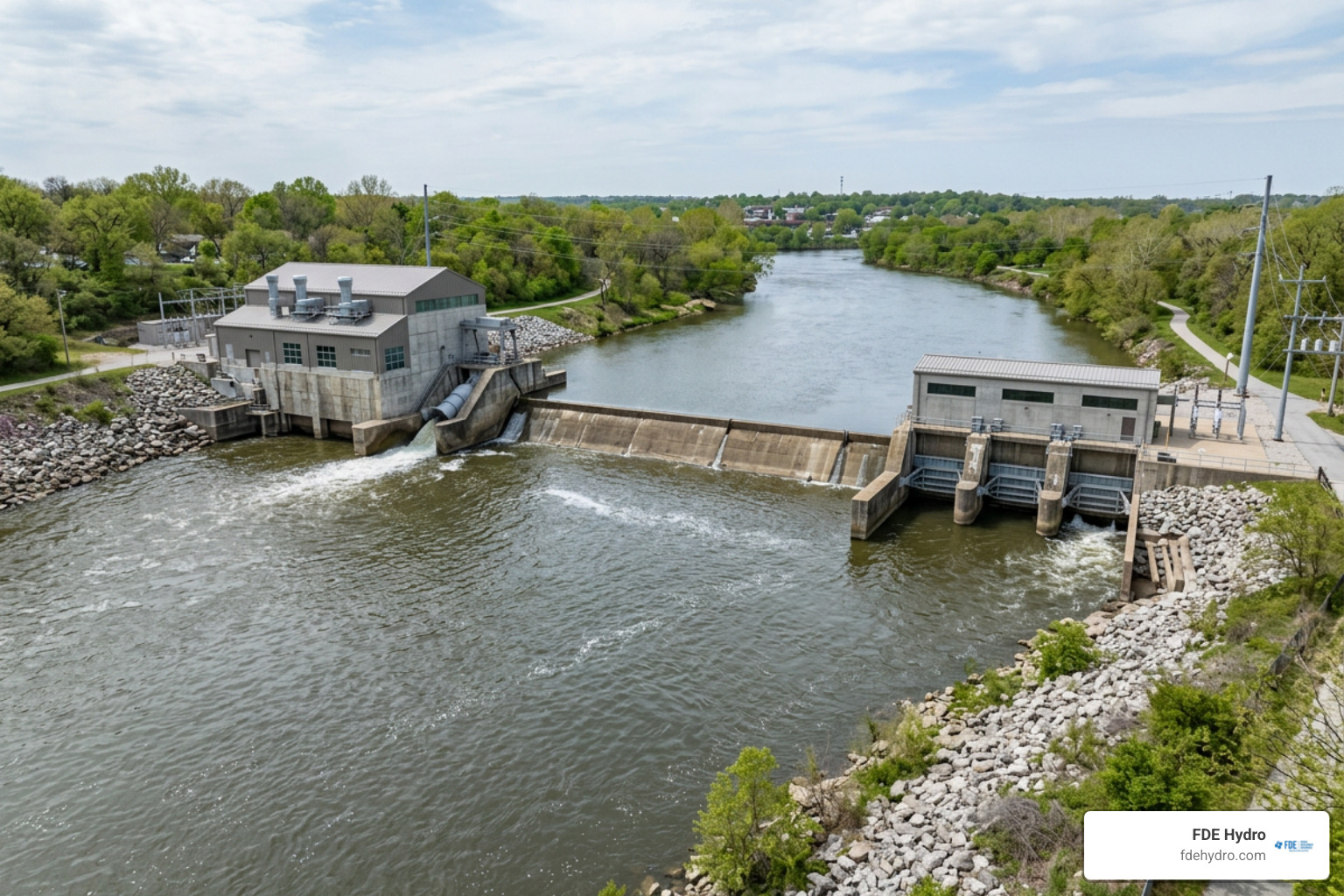
This expansion represents the perfect application of the Ultimate Guide to Modern Hydropower Technology. By using modern, highly efficient low-head turbines, Bowersock expanded its capacity without raising the upstream water level or changing the river’s overall footprint. The project was completed in just over two years—a remarkably fast timeline compared to the typical six-to-seven-year development cycle for conventional hydro projects. Today, the Kansas City Board of Public Utilities purchases all the clean, predictable power generated at Bowersock, proving that low-head Kansas hydro has a ready and willing market.
Methodologies for Estimating Low-Head and Non-Powered Dam Feasibility
To determine if a non-powered dam in Kansas can support a commercial turbine, engineers rely on precise hydrologic and economic modeling. Historically, many developers used simplified “static-head” calculations, which simply multiply the average height of the dam by the average annual river flow. While easy to calculate, this method is notoriously unreliable for Midwestern rivers, which experience dramatic seasonal fluctuations.
Today, advanced evaluations utilize power exceedance (or duration) curves, which analyze decades of daily flow and head data to map out exactly how much power a site can reliably produce throughout the year.
| Method |
Data Requirements |
Reliability for Kansas Sites |
Best Use Case |
| Static-Head Calculation |
Average annual flow, constant head height |
Low (Ignores seasonal droughts and agricultural diversions) |
Initial high-level screening of thousands of sites |
| Flow Exceedance Curve |
Minimum 3 years of daily flow and head data |
High (Accounts for seasonal variability and low-flow periods) |
Bankable feasibility studies and turbine sizing |
Standardized Software and Flow Exceedance Curves
To standardize these evaluations across the country, the Idaho National Engineering Laboratory developed the Hydropower Evaluation Software (HES). As detailed in the Hydropower Evaluation Software Status Report, Kansas was one of 12 states assessed using this uniform software framework. The software was developed and tested using regional data provided by the Southwestern Power Administration (which includes Kansas) to ensure that local environmental suitability factors, water rights, and seasonal flow variations were accurately weighted.
HES allows researchers to assign environmental attributes to potential sites and calculate a “development suitability factor.” This is crucial for Kansas, where water must be shared between municipal supply, recreation, and agricultural irrigation.
On a broader scale, the U.S. Army Corps of Engineers (USACE) conducted a comprehensive non-powered dam resource assessment. They screened 419 USACE-owned non-powered dams across the country down to 223 sites that possessed a potential capacity of 1 MW or more. Across these 223 assessed sites, the study identified approximately 6,256 MW of potential capacity.
Using rigorous flow duration curves and a standardized 3.75% federal discount rate over a 50-year period, the assessment concluded that approximately 2,818 MW (45%) of that potential is economically feasible to develop. Several of these high-priority USACE sites sit directly within the Kansas river basins, representing major opportunities for public-private development.
Case Study: The Tuttle Creek Feasibility Assessment
A prime example of applying these rigorous methodologies in Kansas is the Tuttle Creek Hydroelectric Project Feasibility Assessment. Constructed between 1952 and 1962 near Manhattan, Kansas, Tuttle Creek Dam is a massive USACE flood control structure that was built without power generation facilities.
In a detailed feasibility study funded by a Department of Energy grant, engineers evaluated two primary design options for retrofitting the dam:
- Excavating a brand-new tunnel through the left abutment.
- Installing a steel liner inside the existing right outlet works conduit, placing a powerhouse directly at the stilling basin.
The evaluation selected the existing outlet works conduit modification as the most cost-effective and environmentally sound pathway. The proposed design featured three 4,750 kW and one 500 kW standardized TUBE turbine-generator units, resulting in a total installed capacity of 14,750 kW (14.75 MW).
The inclusion of the small 500 kW unit is a classic best practice for Kansas hydrology; it allows the plant to continue generating clean energy even during periods of minimum water release, rather than shutting down entirely during dry spells.
This project highlights the extreme sensitivity of hydropower retrofitting to financing structures:
- 7% Financing: Under Rural Electrification Administration (REA) terms, the project proved highly viable, showing a benefit-cost ratio of 0.84 in its first year and a projected $1,166,000 surplus on a present-worth basis over 10 years.
- 9.5% Financing: Under higher interest rates, the project’s economics collapsed, demonstrating how critical capital costs are to low-head projects.
By utilizing modern, modular construction techniques—such as FDE Hydro’s patented precast concrete “French Dam” systems—developers can drastically compress construction timelines and lower these upfront capital costs, making projects like Tuttle Creek financially viable even in fluctuating interest rate environments.
Regulatory and Permitting Framework for Kansas Hydropower
Navigating the regulatory waters of a hydropower project can often feel more challenging than the physical engineering. Because water is a highly protected public resource, any project in Kansas must satisfy a complex web of federal and state agencies.
Cultural and Biological Resource Assessments in Kansas Hydropower Resource Evaluation
A critical step in any Kansas hydropower resource evaluation is assessing the project’s impact on local historical, cultural, and biological resources. Under federal law (such as Section 106 of the National Historic Preservation Act) and state statutes, developers must ensure their project does not damage historical sites, Native American tribal lands, or archaeological remains.
However, developers face a notable information gap in Kansas. The Regulatory and Permitting Information Desktop (RAPID) Toolkit—a federally funded online resource designed to help developers navigate permitting—currently lacks state-specific content regarding cultural and biological resource regulations for Kansas.
This means developers cannot rely on a standardized online portal. Instead, they must proactively coordinate with:
- The Kansas State Historical Society (SHPO): To conduct cultural resource surveys and obtain clearances.
- The Kansas Department of Wildlife and Parks: To evaluate potential impacts on local flora and fauna.
Fortunately, because Kansas rivers lack migratory fish species like the salmon found in the Pacific Northwest, biological permitting is generally less contentious. However, construction-phase impacts on local wildlife, water siltation, and nesting birds must still be thoroughly evaluated and mitigated.
Federal vs. State Permitting Pathways
To successfully launch a project, developers must secure approvals across multiple jurisdictions:
- Federal Energy Regulatory Commission (FERC): FERC holds ultimate authority over non-federal hydropower licensing. Developers must apply for either a full license or a license exemption (often available for small conduit projects under 10 MW).
- U.S. Army Corps of Engineers (USACE): If retrofitting a USACE-owned flood control dam, developers must secure a Section 408 permission (ensuring the retrofit doesn’t compromise flood safety) and a Section 404 Clean Water Act permit for any discharge of dredged or fill material.
- Kansas Division of Water Resources (DWR): Developers must secure formal water rights or permits to appropriate water for power generation, ensuring that downstream users and municipal water supplies are unaffected.
- Section 401 Water Quality Certification: Administered by the Kansas Department of Health and Environment (KDHE), this certification ensures that the project’s operation will not degrade water quality or alter dissolved oxygen levels downstream.
Barriers and Opportunities for Kansas Clean Energy
Developing new clean energy assets in Kansas requires a balanced view of the physical realities of the Great Plains, coupled with the unique opportunities presented by modern engineering.
Physical, Economic, and Environmental Challenges
The primary physical barrier to Kansas hydropower is the state’s flat terrain. Without high head heights, projects must rely on high flow volumes to generate significant power. However, Kansas rivers are highly seasonal and prone to dramatic flow fluctuations.
Furthermore, Western Kansas experiences significant irrigation diversions, which can deplete river flows before they reach downstream municipal dams.
Another major physical challenge is siltation. Kansas rivers carry high loads of fine agricultural sediment. Over decades, this silt accumulates behind dams, reducing reservoir capacity and threatening to prematurely wear down turbine blades.
These physical challenges feed directly into economic hurdles. Conventional dam construction and retrofitting carry high upfront hydropower project costs. If a project takes six to seven years to permit and build, interest during construction can quickly erode its economic viability.
To overcome these barriers, the industry must transition toward sustainable hydro infrastructure that utilizes pre-engineered, modular components to slash onsite construction times and minimize environmental disruption.
Conduit Hydropower and Retrofitting Opportunities
While retrofitting large flood control dams represents the largest capacity opportunity, “conduit hydropower” is emerging as a highly attractive, low-barrier alternative. As detailed in the federal report, Assessment of Hydropower Potential at National Conduits, conduit projects generate electricity from water flowing through manmade, non-power conduits, such as:
- Municipal drinking water pipelines.
- Wastewater treatment outfalls.
- Agricultural irrigation canals.
Nationally, the study estimates approximately 1.41 GW of new conduit hydropower potential. Because these projects utilize existing, pressurized pipelines or concrete canals, they do not require new dams or impoundments, resulting in virtually zero environmental impact.
Furthermore, conduit projects are eligible for a simplified, 45-day federal regulatory approval process under the Hydropower Regulatory Efficiency Act (HREA). In Kansas, where municipal water resource management and agricultural irrigation are highly developed, installing inline turbines parallel to existing pressure-reducing valves offers a highly predictable, easily permitted source of clean energy that can power local water facilities or feed back into the grid via net metering.
Frequently Asked Questions about Kansas Hydropower
How much untapped hydropower potential does Kansas have?
According to assessments by the Oak Ridge National Laboratory, Kansas has approximately 2.4 gigawatts (GW) of untapped technical hydropower potential. However, due to flat terrain, seasonal river flows, and permitting requirements, only a fraction of this capacity is economically and physically feasible to develop.
Why is retrofitting existing dams preferred over building new ones in Kansas?
Retrofitting existing non-powered dams is vastly superior to building new dams because the physical barrier and reservoir are already in place. This avoids the massive environmental impact of flooding new land, bypasses the most difficult federal permitting hurdles, and drastically reduces capital costs. It allows us to generate clean energy from infrastructure that has already been built.
What are the main regulatory hurdles for Kansas hydropower projects?
The primary hurdles include securing a FERC license or exemption, obtaining Section 408 and 404 permits from the U.S. Army Corps of Engineers, securing water rights from the Kansas Division of Water Resources, and conducting independent cultural and biological resource assessments due to the lack of Kansas-specific guidelines in the federal RAPID Toolkit.
Conclusion: Building a Resilient Clean Energy Future
The journey through Kansas hydropower resource evaluation reveals a clear truth: while the state may not have the towering waterfalls of other regions, it possesses a wealth of stable, predictable, and untapped clean energy waiting to be unlocked. By focusing our efforts on retrofitting existing non-powered dams and integrating conduit systems into municipal water lines, we can add vital baseline power to the Kansas grid.
At FDE Hydro™, we believe the key to unlocking this potential lies in changing how we build. Our innovative, patented modular precast concrete technology—the French Dam—is designed specifically to address the economic and physical challenges of low-head development. By manufacturing dam and powerhouse components in a controlled environment and assembling them rapidly onsite, we can:
- Cut construction times by up to 50%.
- Drastically lower capital costs and interest during construction.
- Minimize environmental and biological disruption to local riverbeds.
Whether you are looking to generate clean power from an existing municipal water system, add a turbine to a flood-control dam, or explore pumped storage hydropower and hydropower energy storage solutions, the future of Kansas water power relies on smart, modular, and sustainable engineering.
If you are ready to evaluate the possibilities for your next project, explore our specialized solutions for hydroelectric power generation and let’s build the future of Midwestern clean energy together.
by Adaptify Support | Jun 29, 2026 | Energy Resource Articles
What You Need to Know About Selling Electricity to the Grid
Selling electricity to the grid means sending surplus power from your home renewable energy system — such as solar panels, wind turbines, or hydro — back into the utility network in exchange for billing credits or cash payments.
Here is a quick overview of how it works and what to expect:
| Method |
Who It’s For |
How You Get Paid |
| Net Metering |
Homeowners with solar/renewables |
Billing credits at retail rate |
| Feed-in Tariff (FiT) |
Residential & small commercial generators |
Fixed rate per kWh exported |
| Smart Export Guarantee (SEG) |
UK households |
Variable cash rate per kWh |
| Clean Export Guarantee (CEG) |
Irish households |
Supplier-set rate per kWh |
| Power Purchase Agreement (PPA) |
Larger generators |
Negotiated price per kWh |
| Wholesale Market |
Licensed generators only |
Hourly auction clearing price |
A few things to know upfront:
- Most homeowners do not receive direct cash — they get billing credits that reduce future electricity bills.
- Over 35 U.S. states have net metering programs, making it the most common route for residential producers.
- Export rates are almost always lower than what you pay to buy electricity — often 3–12¢/kWh compared to retail rates of 30–50¢/kWh.
- The biggest financial win for most households is using your own generated power first, not exporting it.
Understanding these basics upfront will save you from overestimating what you can earn — and help you make smarter decisions about your system.
I’m Bill French, Sr., Founder and CEO of FDE Hydro™, with decades of experience in large-scale civil infrastructure and clean energy development, including projects that touch on the economics of selling electricity to the grid through hydropower generation. In the guide below, I’ll walk you through the key mechanisms, regional rules, and practical steps to start earning from your home’s renewable energy.
FDE Hydro is Bringing Predictability to an Unpredictable Environment™
Quick selling electricity to the grid definitions:
Understanding the Mechanics of Selling Electricity to the Grid
When we talk about sending electricity back to the grid, we are exploring a bidirectional relationship with our local utilities. Historically, the electrical grid was designed as a one-way street: massive power plants generated electricity, and it traveled down high-voltage lines to our homes. Today, the rise of distributed energy resources—like rooftop solar panels, residential wind turbines, and small-scale micro-hydro systems—has turned millions of everyday consumers into “prosumers.”
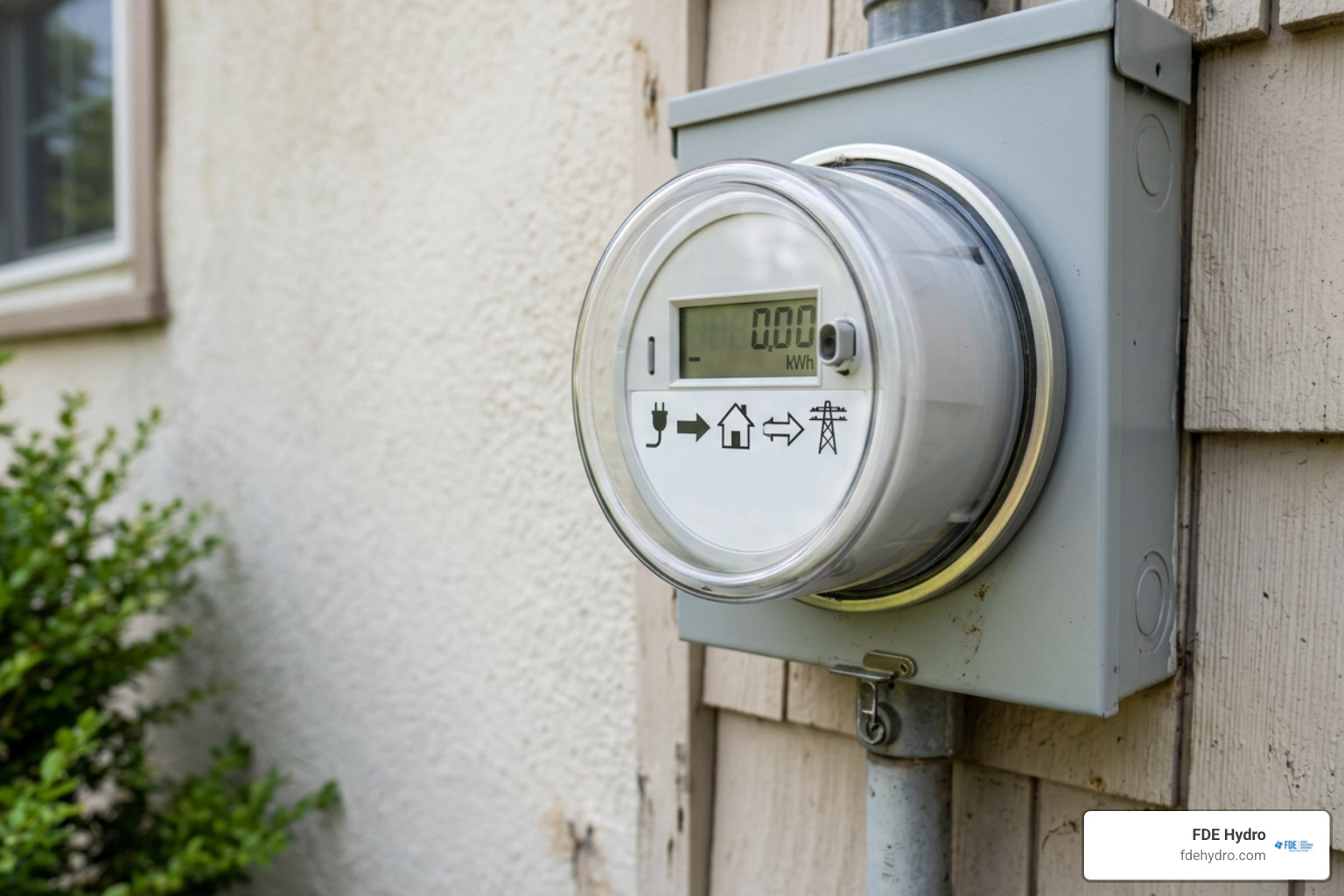
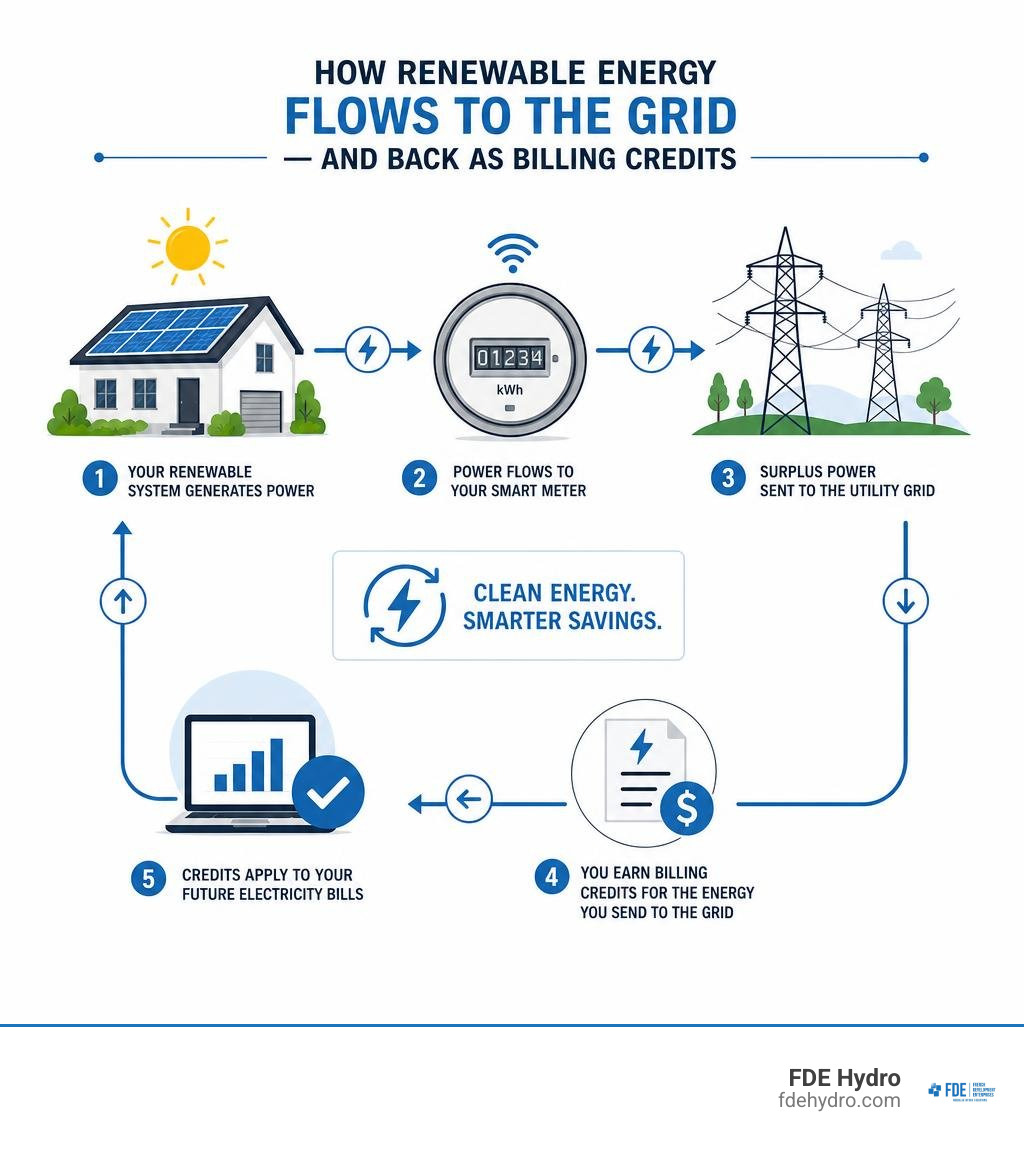
To understand this dynamic, we must look at how power physically flows. When your home generation system produces more electricity than your household appliances are consuming at any given moment, the excess energy has to go somewhere. If you do not have a battery storage system to hold it, that power flows backward through your electrical panel, out through your utility meter, and onto the local distribution lines to be consumed by your nearest neighbors.
This process is tracked using specialized metering equipment. Learn more about how the electrical grid powers our lives to see how these localized flows integrate with the broader electrical network.
How Net Metering Facilitates Selling Electricity to the Grid
The most common policy mechanism for residential generators in North America is net metering. Under a net metering program, your utility installs a bidirectional smart meter. This meter acts like a two-way scale, measuring both the electricity you pull from the grid when your system isn’t producing enough (such as at night) and the electricity you push back onto the grid when you have a surplus.
At the end of your billing cycle, the utility calculates your “net” usage:
$$text{Net Energy} = text{Energy Consumed} – text{Energy Exported}$$
If you exported more than you consumed, you receive billing credits on your account. In many jurisdictions, these credits are applied at the full retail rate of electricity. This means a kilowatt-hour (kWh) exported during the sunny afternoon offsets a kWh imported during the expensive evening peak.
However, policies vary widely by state and province. For example, if you are looking at the Great Plains region of the United States, you will find specific guidelines governing how these credits are calculated and rolled over. You can read up on the exact regulatory landscape by exploring Net Metering in Kansas.
Direct Cash Payments vs. Billing Credits
It is vital to distinguish between earning billing credits and receiving direct cash payments. For the vast majority of residential homeowners, selling electricity to the grid does not result in a monthly check arriving in the mail. Instead, your utility account accrues credits that roll over to the next month, helping to offset future utility bills during seasons with lower generation.
Direct cash payments are typically reserved for specific commercial setups, wholesale generators, or regions with active Feed-in Tariff (FiT) programs. In a direct payment model, you are paid a designated rate for every single kWh your system exports, regardless of how much electricity you import.
These programs are highly regulated to ensure grid stability and fair compensation. To see how these rules are structured in neighboring regions, you can consult the Net metering guide from Ontario Energy Board to see how Canadian regulators balance consumer benefits with utility infrastructure costs.
Compensation Models: Feed-in Tariffs, SEGs, and RECs
Depending on where you live across our operating regions in North America and Europe, the financial incentives and structural programs for exporting green energy look quite different.
Before you install any system, you must understand the exact program your local utility offers. If you are starting from scratch, it helps to understand the physical connection requirements first; you can read our guide on How to connect your home to the grid to get a handle on the hardware side of things.
Regional Tariff Structures and the Smart Export Guarantee
In Europe, the regulatory framework has shifted away from older, government-subsidized Feed-in Tariffs toward market-driven compensation models.
- The United Kingdom: The UK operates under the Smart Export Guarantee (SEG). Under this scheme, licensed energy suppliers with over 150,000 customers are legally required to offer export tariffs to home generators. These rates are variable and market-competitive, typically ranging between 3p and 12p per kWh.
- Ireland: Irish homeowners benefit from the Clean Export Guarantee (CEG) scheme. Similar to the SEG, the CEG allows micro-generators to receive competitive payments or billing credits from their chosen retail electricity supplier for any surplus green electricity sent to the national grid. For a comprehensive look at how this operates in the Irish market, check out the detailed guide: Can I Sell Electricity Back to the National Grid in Ireland?.
Renewable Energy Certificates (RECs) and Power Purchase Agreements
For larger residential systems, agricultural properties, or commercial operations, compensation often moves beyond simple billing credits into the realm of Renewable Energy Certificates (RECs) and Power Purchase Agreements (PPAs).
A Renewable Energy Certificate represents the environmental attributes of one megawatt-hour (MWh) of electricity generated from a renewable source. In some states and provinces, you can sell these certificates on open markets to utilities that need them to meet their regulatory green energy quotas. This acts as an entirely separate stream of income alongside your standard utility credits, often yielding an additional $0.04 to $0.08 per kWh.
For commercial-scale developers or community energy projects, a Power Purchase Agreement (PPA) is the standard contract vehicle. A PPA is a long-term contract between an electricity generator (you) and a buyer (typically a utility or a large corporation). This agreement defines the fixed price at which the buyer will purchase the generated electricity over a period of 5 to 20 years.
To understand how these commercial contracts are drafted, managed, and optimized, you can review A guide to Power Purchase Agreements.
Technical Requirements and Grid Constraints
While the financial rewards of selling electricity to the grid are attractive, we must remember that the physical grid is a highly complex machine. Grid operators must constantly balance supply and demand in real time to maintain a stable frequency and voltage.
As more homes install renewable systems, local low-voltage networks can experience congestion, leading to strict technical rules for new connections. To understand how your home’s system interacts with these localized lines, you can Explore the low voltage grid.
Interconnection Processes and Export Limits
Before you can legally flip the switch on a grid-tied renewable energy system, you must go through an official interconnection process with your local distribution utility. This process ensures that your system will not backfeed power onto the lines during a blackout, which would pose a fatal hazard to utility line workers.
During this review, the utility may conduct an interconnection study to determine if your local substation and transformer can handle the maximum potential output of your system. Depending on the local infrastructure, the utility may impose strict export limits:
- Single-Phase Connections: Standard residential connections are single-phase. In many congested suburban networks, utilities cap exports on single-phase connections to a maximum of 5 kW to prevent local voltage spikes.
- Three-Phase Connections: Larger properties with three-phase connections may be allowed higher export limits (often up to 11 kW or more), but these installations require more expensive inverters and grid-protection equipment.
For a real-world look at how a major utility manages these technical applications, study the guidelines on Electricity Sales and Interconnection from Consumers Energy.
The Role of Smart Meters and Network Rules
To participate in any export program, your standard electricity meter must be upgraded. Modern bidirectional smart meters record import and export data in half-hourly intervals.
In the UK, this setup requires the creation of an Export Meter Point Administration Number (MPAN) by your local Distribution Network Operator (DNO). Without this unique identifier, your supplier cannot legally track or credit your exports, even if your physical system is already pushing power back onto the lines.
Maximizing Value: Self-Consumption, Batteries, and VPPs
As utility companies adjust to the massive influx of daytime solar energy, export tariff rates have steadily declined. In many areas, we are seeing the introduction of “two-way pricing” or “sun taxes,” where customers are actually charged a small fee for exporting power during peak midday hours when the grid is already flooded with solar energy.
Because of this, the economic focus has shifted from maximizing grid exports to maximizing self-consumption. To see how advanced systems manage this balance, read about Optimizing microgrid operations.
Self-Consumption vs. Exporting to the Grid
The golden rule of modern home energy economics is simple: a kilowatt-hour saved is worth far more than a kilowatt-hour sold.
When you use a unit of electricity generated by your own rooftop solar panels or micro-hydro system, you are offsetting a unit of electricity you would have otherwise bought at the full retail rate (e.g., 35¢/kWh). If you export that same unit to the grid, you might only receive a feed-in credit of 5¢/kWh.
| Metric |
Self-Consumption |
Grid Export |
| Effective Value |
High (Saves full retail rate, e.g., 30–50¢/kWh) |
Low (Earns wholesale/export rate, e.g., 3–12¢/kWh) |
| Grid Impact |
Zero (Reduces strain on local distribution lines) |
High (Can cause localized voltage rise during peak sun) |
| Best Strategy |
Run heavy appliances (washers, EV chargers) during peak generation |
Limit daytime export; store surplus in a home battery |
By shifting your heavy energy usage—such as running heat pumps, pool pumps, washing machines, or electric vehicle chargers—to the middle of the day when your system is producing peak power, you drastically improve your financial payback period.
How Batteries and VPPs Change the Economics
Adding a home battery storage system allows you to capture your daytime surplus and store it for use during the expensive evening hours, rather than exporting it for pennies.
Furthermore, smart battery systems allow you to participate in Virtual Power Plants (VPPs). A VPP is a network of decentralized home energy storage systems grouped together by a software provider. When the main electrical grid experiences extreme demand, the VPP operator can coordinate thousands of home batteries to discharge simultaneously back into the grid.
In exchange for helping to stabilize the grid during these critical hours, VPP participants are compensated at premium incentive rates—sometimes up to several dollars per kWh during peak events. In the United States, regulatory milestones like FERC Order 841 have paved the way for small battery storage systems to access these wholesale markets, completely changing the return-on-investment calculations for home energy storage.
Practical Steps to Begin Exporting Power
If you are ready to stop simply consuming energy and start selling electricity to the grid, you need to follow a structured roadmap.
Rushing into an installation without securing the proper utility approvals can result in expensive fines, or worse, an expensive system that you are legally forbidden to turn on.
Sizing and Installing Your Renewable Energy System
Your first step is to design a system that fits your historical energy usage. Sizing a system too large can be a financial mistake because most utilities will not pay you retail rates for generation that exceeds your annual historical consumption.
To ensure your system qualifies for export incentives:
- Choose Accredited Installers: In the UK, your system and installer must be certified under the Microgeneration Certification Scheme (MCS). In Ireland and North America, similar national or state-level licensing is required.
- Review Local Micro-generation Guidelines: Every country has strict thresholds for what qualifies as “micro-generation” (usually systems under 6 kW for single-phase lines). For European and Irish standards, read the official Micro-generation guidelines to ensure compliance.
Step-by-Step Guide to Selling Electricity to the Grid
Once your system is designed and your installer is selected, follow these steps to get paid:
- Submit Connection Notification: Your installer must notify your local Distribution Network Operator (DNO) or utility. In Ireland, this is done via an NC6 form for small systems.
- Install a Bidirectional Smart Meter: If you do not have one, your utility will install a meter capable of tracking dual-directional flows.
- Obtain Your Export MPAN / Registration: Your utility will register your export connection point and issue a unique identifier.
- Choose and Activate an Export Tariff: Contact an energy supplier to enroll in their export program. You do not always have to use the same supplier for both import and export, allowing you to shop around for the best export rate. For an example of an independent supplier offering competitive rates, check out the 100Green Home Generation Export Tariff.
- Monitor Your First Bill: Ensure the export credits are actively appearing on your monthly statements.
Frequently Asked Questions about Home Energy Sales
Is selling electricity to the grid profitable for average homeowners?
For the average homeowner, selling electricity to the grid is highly effective at offsetting your monthly utility costs, but it is rarely a path to direct wealth. Because export rates (3–12¢/kWh) are significantly lower than retail import rates (30–50¢/kWh), the primary financial benefit comes from avoiding retail purchases through self-consumption.
With an average residential solar installation costing between $11,000 and $15,000, most homeowners see a complete payback on their investment in about 8 to 10 years (around 100 months), after which the system generates pure savings.
Do I need a battery storage system to sell electricity to the grid?
No, you do not need a battery to export power. Any surplus energy your system generates will automatically flow back onto the grid through your bidirectional meter. However, without a battery, you are forced to export your excess power during the day when export rates are at their lowest. A battery gives you the flexibility to store that power and either use it yourself at night or export it during high-value peak demand windows via a VPP.
How long does it take to set up grid export payments?
The administrative setup typically takes between 4 to 8 weeks. While the physical installation of solar panels or a micro-hydro system might only take a few days, waiting for your local utility to process the interconnection paperwork, issue an export MPAN, and approve the bidirectional meter swap accounts for the majority of the timeline.
Conclusion
Selling electricity to the grid is a fantastic way to lower your carbon footprint, support local grid stability, and dramatically slash your monthly energy bills. However, navigating the complex world of net metering, export tariffs, and utility interconnection rules requires careful planning and realistic expectations.
At FDE Hydro™, we understand the immense value of predictable, reliable renewable energy. While we specialize in developing innovative, patented modular precast concrete technology (“French Dam”) to make utility-scale hydroelectric projects more efficient and cost-effective across North America, Europe, and Brazil, we believe that every step toward a decentralized, bidirectional grid is a step toward a sustainable future.
If you want to keep learning about how the modern electrical network is evolving to handle clean energy, Explore more power grid articles on our site today.
FDE Hydro is Bringing Predictability to an Unpredictable Environment™
by Adaptify Support | Jun 25, 2026 | Energy Resource Articles
What “Off-Grid Electricity” Really Means — And Why It Matters
Understanding the off grid electricity meaning starts with one simple idea: your building produces and stores its own power, with no physical connection to a public utility grid.
Off-grid electricity means generating, storing, and using electricity entirely on-site — independently of any centralized utility network.
Here’s a quick breakdown:
- Off-grid = completely disconnected from the public electricity grid
- Power source = solar panels, wind turbines, micro-hydro, or a combination
- Storage = battery banks that supply power when generation is low
- Result = no utility bills, no grid dependence, and no outage risk from the wider network
This is different from simply having solar panels. Most homes with rooftop solar are still connected to the grid. True off-grid means cutting that connection entirely — and relying 100% on what you generate and store yourself.
That distinction matters more than ever. As of 2016, roughly 20% of people worldwide had no access to centralized electricity. And closing that gap is projected to require $17 trillion and 30 years. For remote communities, off-grid systems aren’t a lifestyle choice — they’re often the only practical option.
I’m Bill French, Sr., Founder and CEO of FDE Hydro™, and for over five decades I’ve worked at the intersection of heavy civil construction and innovative energy infrastructure — experience that gives me a grounded, real-world perspective on the off grid electricity meaning and what it takes to deliver reliable power outside the grid. In the sections ahead, I’ll walk you through everything you need to know, from core concepts and system components to costs, sizing, and long-term sustainability.
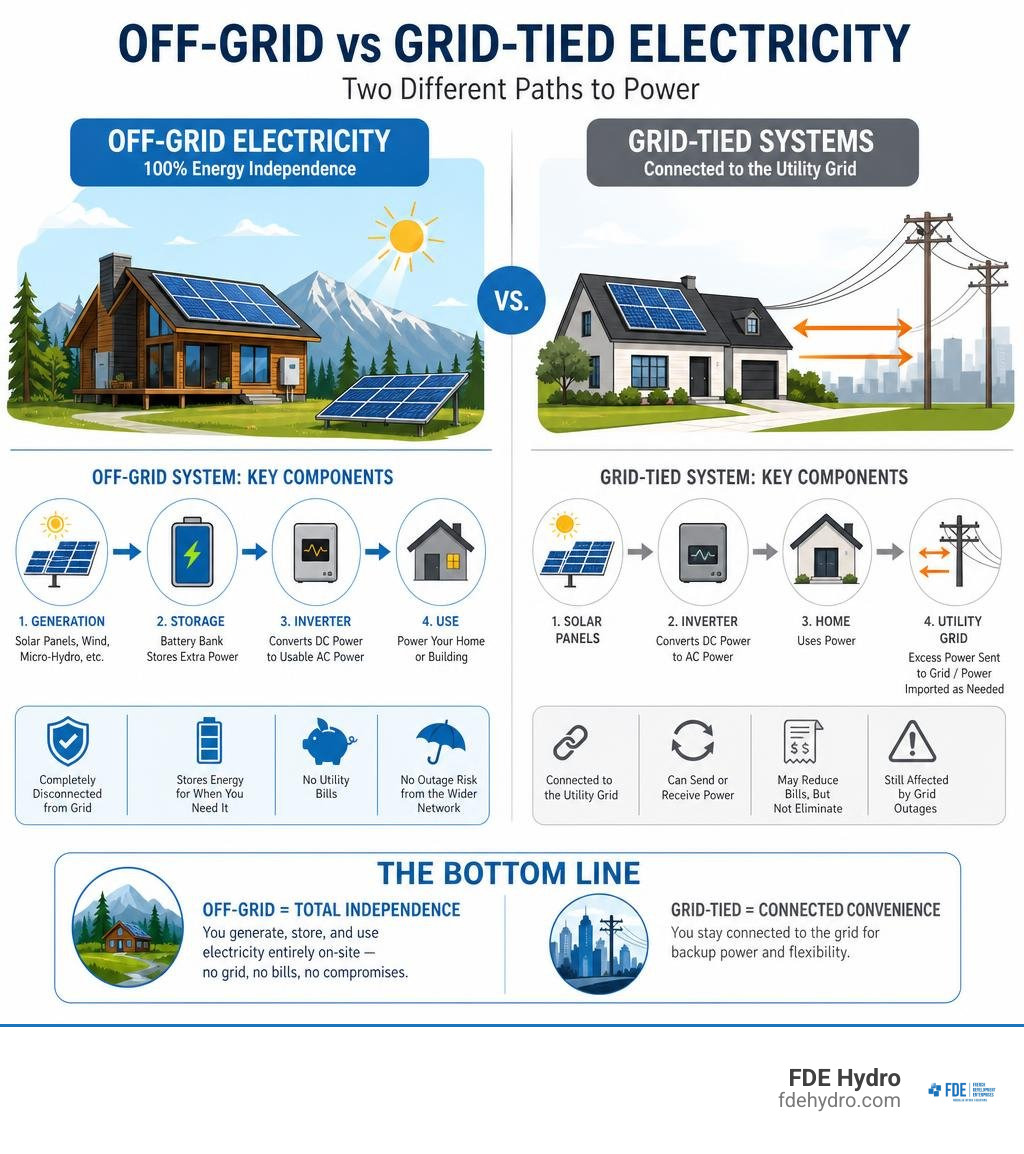
Easy off grid electricity meaning glossary:
Defining the Off Grid Electricity Meaning and Core Concepts
To truly grasp the off grid electricity meaning, we have to look at the physical reality of how power is delivered. When a home is connected to the municipal system, it relies on transmission lines, substations, and large-scale power plants. Going off-the-grid means physically severing that umbilical cord.
In business and legal terms, as outlined by resources like the Cambridge Dictionary, being off-grid means operating without a connection to main utility services. This isn’t just a conceptual state of mind; it is a physical and engineering reality. If there are no wires running from the utility pole to your meter box, you are running a stand-alone system.
Historically, remote electrification was the primary driver for these systems. For example, Canada has about 175 aboriginal and northern off-grid communities. In these vast, remote territories, extending the centralized grid is physically and financially impractical. Instead, these areas rely on decentralized power systems. Whether it is a single cabin in the Catskills of New York or an entire rural community in northern Canada, stand-alone systems provide the localized generation required to sustain modern life.
What is the Off Grid Electricity Meaning?
At its core, the off grid electricity meaning is defined by complete self-sufficiency. According to The Free Dictionary, living off the grid involves disconnecting from public utilities, which includes electricity, water, and gas.
When we talk specifically about electricity, going off-grid means your home or business functions as its own utility company. You are responsible for:
- Generation: Producing every single watt of power you consume.
- Regulation: Ensuring the voltage and frequency of the electricity won’t fry your appliances.
- Storage: Saving excess daytime or seasonal energy to use during the night or during prolonged storms.
- Maintenance: Troubleshooting, repairing, and replacing components when they wear out.
The reward for taking on these responsibilities? Complete energy independence, a zero-dollar monthly utility bill, and absolute immunity from regional blackouts.
Off-Grid vs. Grid-Tied Systems
The fundamental difference between off-grid and grid-tied systems comes down to where your excess energy goes and where your backup power comes from.
- Grid-Tied Systems: These systems are connected directly to the local utility grid. When your solar panels produce more electricity than you need, the excess is sent back to the utility grid (often earning you credits through a billing mechanism called net metering). At night or on cloudy days, you simply draw power back from the grid. This setup is highly convenient because the grid acts as a massive, free “battery.”
- Off-Grid Systems: There is no grid to catch your excess power or to bail you out when the sun isn’t shining. If your battery bank is full and your panels are still generating power, that excess energy is simply lost. Conversely, if your batteries run dry during a week of heavy snow, your lights go out unless you have a backup generator.
For those interested in how localized power systems operate on a slightly larger scale, we can look to microgrids. To understand how communities or commercial facilities manage localized generation, you can read about What is a Microgrid and How Does it Work? to see how these localized networks bridge the gap between individual self-sufficiency and central grid reliance.
Off-Grid Living vs. Self-Consumption
Many homeowners confuse “going off-grid” with “practicing self-consumption.” While they sound similar, they represent two very different approaches to the energy transition.
| Feature |
Off-Grid Living |
Self-Consumption (Grid-Tied + Battery) |
| Grid Connection |
Physically disconnected (no wires, no utility account) |
Physically connected to the local utility |
| Excess Energy |
Must be stored in on-site batteries or is wasted |
Can be sent back to the grid for net-metering credits |
| Backup Power |
On-site battery bank and backup generator |
The utility grid (and batteries during local blackouts) |
| Utility Bills |
Absolutely $0 |
Reduced bills (only pay for net power drawn + connection fees) |
| System Sizing |
Must be oversized to handle worst-case winter weather |
Can be sized strictly for economic optimization |
Understanding Self-Consumption
Self-consumption is a hybrid approach. You install rooftop solar panels and a battery storage system, but you keep your connection to the utility grid.
The goal here is economic optimization. Instead of selling your solar electricity to the utility company for a low rate and buying it back at night for a high rate, you store your daytime solar power in your home battery. You use that stored energy during peak evening hours when utility rates are highest.
If you run out of battery power, the grid is right there to seamlessly supply what you need. This hybrid approach is highly popular because it offers excellent financial returns without the risk of total power failure. To explore how these hybrid systems are changing the energy landscape, check out our deep dive on Navigating the Hybrid Microgrid Market: A Deep Dive.
The Reality of Complete Grid Disconnection
True off-grid living, as explained by Enel’s Learning Hub, requires complete physical severance from the utility lines.
Without the grid as a safety net, your lifestyle must adapt to your power generation capacity. You cannot simply turn on high-draw appliances whenever you feel like it. Off-grid homeowners learn to run heavy loads—like laundry, water pumps, and power tools—in the middle of the day when the sun is high and the solar panels are producing a surplus.
Living completely disconnected means taking full ownership of your energy storage. If your system is designed poorly, or if you experience an unusual stretch of bad weather, you must be prepared to manage your consumption or listen to the hum of a backup diesel or propane generator.
Essential Components of an Off-Grid Solar Power System
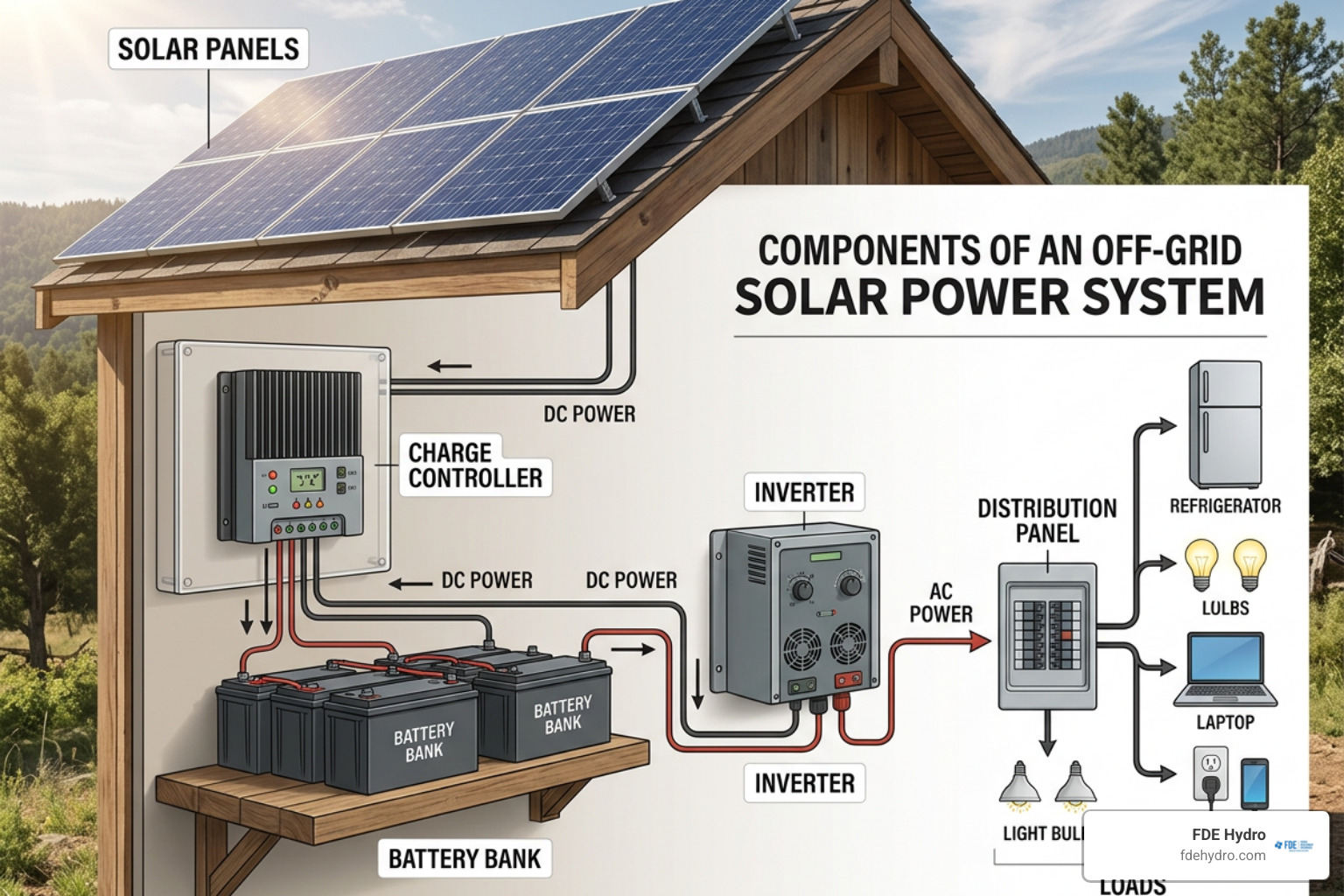
To build a reliable off-grid power plant, you need a carefully engineered ecosystem of components. Each part has a specific role in capturing, regulating, storing, and converting electricity. For a closer look at the physics and engineering behind these setups, you can read our guide on Power Up: The Engineering Behind Microgrids Explained.
Solar Panels and Charge Controllers
The journey of off-grid electricity begins with solar panels (photovoltaic modules). For off-grid applications, monocrystalline solar panels are generally preferred over polycrystalline or thin-film options. Monocrystalline panels are constructed from a single silicon crystal, making them highly efficient—a crucial trait when physical roof or ground space is limited.
However, solar panels produce raw, unregulated direct current (DC) electricity that fluctuates wildly depending on cloud cover and the angle of the sun. You cannot feed this raw electricity directly into a battery bank without destroying it.
That is where the charge controller comes in. The charge controller acts as a protective gatekeeper between your panels and your batteries. It regulates the voltage and current coming from the solar array to prevent the batteries from overcharging.
Modern high-quality off-grid systems use Maximum Power Point Tracking (MPPT) charge controllers. These controllers actively monitor the output of the solar panels and adjust the electrical characteristics to ensure the maximum possible power is transferred to the battery bank, even on overcast days.
Batteries and Inverters in the Off Grid Electricity Meaning
Once the charge controller regulates the solar energy, it is stored in the battery bank. In the context of the off grid electricity meaning, the battery bank is the absolute heart of the system.
Historically, off-grid systems relied on deep-cycle lead-acid batteries (like flooded lead-acid or AGM batteries). While cheap upfront, lead-acid batteries require regular maintenance, cannot be discharged past 50% without damage, and have a relatively short lifespan of 3 to 5 years.
Today, Lithium Iron Phosphate (LFP) batteries have become the industry standard. LFP batteries offer massive advantages:
- They require zero maintenance.
- They can be discharged up to 90% or even 100% without damage.
- They routinely last 10 to 15 years (or over 6,000 cycles) without diminishing efficiency.
- They do not off-gas toxic fumes, meaning they do not require complex ventilation systems.
Finally, because batteries store DC power and most household appliances run on alternating current (AC), you need an inverter. The inverter converts the low-voltage DC power from your batteries (usually 12V, 24V, or 48V) into standard 120V or 240V AC power.
Interestingly, running a Direct Current (DC) building can actually yield 10% to 20% efficiency gains over traditional AC systems because you completely bypass the energy losses that occur during DC-to-AC conversion. Since about one-third of household electricity is already used as DC by modern electronics and LED lights, DC microgrids are gaining serious traction. You can read more about these advancements in Microgrid Technology.
Sizing, Costs, and Financial Considerations of Going Off-Grid
Moving to a stand-alone system is a major financial and engineering undertaking. Unlike grid-tied systems where you can start small and expand later, an off-grid system must be sized correctly from day one to ensure you don’t end up sitting in the dark.
Sizing Your Off-Grid System
Sizing an off-grid system requires a precise calculation of your daily electricity consumption.
- Calculate Daily Watt-Hours: List every appliance you plan to run, multiply its wattage by the number of hours it will run per day, and sum the totals. For reference, the average American household consumes about 30 kilowatt-hours (kWh) of electricity per day.
- Determine Peak Sun Hours: Solar panels do not produce power at their rated capacity all day. You must look up the average “peak sun hours” for your specific geographic region. For example, a home in Arizona might enjoy 5.5 peak sun hours per day, while a cabin in upstate New York might average only 3.2 peak sun hours—dropping even lower during the winter.
- Calculate Panel Array Size: Divide your daily kWh needs by your local peak sun hours, and adjust for system inefficiencies (typically a 15% loss factor).
- Size the Battery Storage: You must plan for “days of autonomy”—the number of consecutive cloudy or stormy days your batteries can run the house without any solar input. Typically, off-grid designs plan for 3 to 5 days of autonomy.
According to regional data compiled by EnergySage, geographic differences dramatically impact system sizing and cost. A home in Massachusetts trying to go off-grid would require roughly 12 standard residential batteries to survive 5 days of winter overcast, whereas a similar home in sunny Arizona might only require 9 batteries to cover 3 days of autonomy.
Cost Breakdown and Financial Incentives
Let’s be candid: going completely off-grid is not cheap. For an average-sized residential home, a robust off-grid solar-plus-storage system can easily cost $45,000 to $65,000, and can scale past $115,000 if you have high heating and cooling loads.
According to technical breakdowns, here is where the money goes:
- Solar Panels (10 kW array): Minimum $5,000 to $8,000
- Inverter & Charge Controller: Minimum $4,000
- Battery Storage (20 kWh to 40 kWh): $20,000 to $40,000
- Installation & Permitting: $3,200 to $5,000 (roughly 7% to 10% of total)
- Backup Generator & Balance of System (wiring, mounts, safety switches): $5,000 to $10,000
While these numbers might trigger some sticker shock, they must be compared against alternative options. As the U.S. Department of Energy points out, extending a local utility power line to a remote property can cost anywhere from $15,000 to $50,000 per mile. If your home is located even half a mile off the main road, building a stand-alone off-grid system is often significantly cheaper than paying the utility company to run poles and wires to your door.
Furthermore, homeowners can leverage federal, state, and local incentives to offset these upfront costs. In the United States, the Residential Clean Energy Credit (Section 25D) allows taxpayers to deduct 30% of the total cost of solar and battery storage installations from their federal taxes. Similar green energy rebates and tax write-offs exist across Canada and Europe, making the payback period for these systems highly attractive over their 25-year lifespan.
Beyond Electricity: Water, Waste, and Environmental Impacts
True off-grid living extends far beyond the electrical panel. To achieve complete independence, you must also solve the challenges of water supply, waste management, and environmental sustainability.
Water and Waste Management Solutions
When you disconnect from city water and sewer systems, you must establish localized, closed-loop solutions:
- Water Supply: Most off-grid homes rely on a private water well. However, running a well pump requires a significant amount of electricity. To minimize power consumption, many off-grid systems use gravity-fed water tanks: a solar-powered pump fills an elevated storage tank during peak daylight hours, and gravity provides water pressure to the house at night. Rainwater harvesting and atmospheric water generators are also viable options depending on local rainfall patterns.
- Water Treatment: To ensure water is safe for drinking, off-grid homes implement multi-stage filtration systems, including sediment filters, activated carbon blocks, and ultraviolet (UV) disinfection units to kill bacteria and pathogens without using harsh chemicals.
- Wastewater & Sanitation: Standard septic systems with anaerobic leach fields are the traditional solution for off-grid waste. However, to conserve precious water, many off-grid homeowners install composting toilets, which decompose human waste aerobically into dry, odorless compost, completely eliminating the need for water-based flushing. Greywater recycling systems can also divert sink and shower water to irrigate non-edible landscaping.
Alternative Energy Sources and Micro-Hydro
While solar power is the most popular choice for off-grid electricity, relying on a single energy source can be risky. The most resilient off-grid setups are hybrid systems that combine multiple renewable technologies.
If your property has a year-round running stream, creek, or river, you have access to one of the most reliable and consistent forms of renewable energy on earth: water. Unlike solar panels, which only work when the sun is shining, a micro-hydro system generates clean, predictable electricity 24 hours a day, 365 days a year.
To learn how these compact, high-efficiency systems work, check out A Beginner’s Guide to Micro-Hydro Power Systems. At FDE Hydro™, we are passionate about the potential of localized water control and small-scale hydro. Our patented, modular precast concrete technology—known as the French Dam—is designed to make retrofitting and building water control systems faster and more cost-effective across North America, Brazil, and Europe, helping communities unlock the power of local water resources.
Frequently Asked Questions about Off-Grid Electricity
How do off-grid systems handle power outages compared to grid-tied systems?
This is one of the biggest surprises for new solar owners: standard grid-tied solar systems do not work during a power outage.
Grid-tied inverters are legally required to shut down automatically during a blackout to prevent “islanding.” Islanding is when solar panels feed electricity back into the local power lines while utility workers are trying to repair them, creating a lethal hazard.
Off-grid systems, by definition, have islanding capability. Because they are physically isolated from the utility lines, they can safely continue generating and using electricity during a wider grid blackout. When the regional grid goes dark, an off-grid home experiences zero interruption. For a fascinating look at how major utilities and regional grids recover from total blackouts, you can read The Black Start Blueprint: How Power Grids Come Back to Life.
Is it cheaper to go off-grid or extend a power line?
If your property is already located in a suburban neighborhood with existing utility poles, staying connected to the grid is almost always the more cost-effective choice.
However, if you are building a home in a remote area, the math changes completely. Because utility companies charge between $15,000 and $50,000 per mile to extend a power line, a property located just a quarter-mile from the nearest power pole could cost $10,000 to $12,000 just to connect to the grid. In these scenarios, investing that money into a stand-alone solar and battery system makes immediate economic sense.
What are the main advantages and disadvantages of going off-grid?
Advantages:
- Complete Energy Autonomy: You are immune to utility price hikes, corporate mismanagement, and rolling blackouts.
- Zero Utility Bills: After the initial equipment investment, your ongoing operational costs are virtually zero.
- Environmental Sustainability: You drastically reduce your carbon footprint by relying on clean, local renewable energy.
Disadvantages:
- High Upfront Capital: The initial cost of batteries, inverters, and panels requires significant upfront funding.
- Maintenance Responsibility: If a component fails on Christmas Eve, you cannot call the utility company; you are the utility company.
- Resource Constraints: You must actively monitor your energy consumption and adjust your lifestyle to match the weather.
Conclusion
Understanding the off grid electricity meaning is the first step toward true self-reliance. Whether you are looking to build a remote cabin, protect your family from an increasingly unstable utility grid, or transition your property to clean, renewable energy, going off-grid is a powerful statement of independence.
At FDE Hydro™, we believe the future of energy is decentralized, resilient, and sustainable. Through our innovative, patented modular precast concrete “French Dam” technology, we are proud to help developers, municipalities, and communities build and retrofit the water control and hydroelectric systems that make localized power generation possible across the United States, Canada, Brazil, and Europe.
If you are ready to explore the exciting world of localized power, microgrids, and independent energy generation, we invite you to explore more power grid articles on our blog. Let’s build a cleaner, more resilient future together—one localized system at a time.
by Adaptify Support | Jun 12, 2026 | Energy Resource Articles
The World’s Most Powerful Battery Is Made of Water
Pumped storage hydro is the largest and most proven form of energy storage on the planet — and it works by moving water uphill and downhill between two reservoirs.
Quick answer: What is pumped storage hydro?
| Question |
Answer |
| What is it? |
A system that stores energy by pumping water to an upper reservoir, then releases it through turbines to generate electricity |
| How efficient is it? |
70–80% round-trip efficiency |
| How much storage exists globally? |
~200 GW of power capacity, ~9,000 GWh of energy storage |
| What share of grid storage is it? |
Over 94% of the world’s long-duration energy storage |
| How long can it supply power? |
Hours to days, depending on reservoir size |
| Main system types? |
Open-loop (connected to natural water) and closed-loop (off-river, self-contained) |
Right now, the grid faces a serious problem. Wind and solar generate power when nature allows — not necessarily when people need it. That mismatch causes waste, instability, and rising costs for utilities and grid operators.
Pumped storage hydro solves that problem at a scale no other technology currently matches.
It has been doing so since the 1890s, when early systems appeared in Italy and Switzerland. The U.S. adopted the technology in 1930. Today, pumped storage accounts for 97% of utility-scale energy storage in the United States — 23 GW across 42 sites — and over 94% of long-duration storage capacity worldwide.
As Malcolm Turnbull has noted, the failure to adequately focus on long-duration electricity storage is “the ignored crisis within the energy crisis” — and pumped storage hydro has the unique capacity to resolve it at a scale far beyond what batteries alone can deliver.
I’m Bill French, Sr., Founder and CEO of FDE Hydro™ and a veteran of large-scale civil construction and hydropower innovation — including participation in the U.S. Department of Energy’s Hydropower Vision Task Force, where I helped define the next generation of pumped storage hydro solutions for Congress. In this guide, I’ll walk you through everything decision-makers need to know about this technology: how it works, where it fits, and how modern construction methods are removing the biggest barriers to building it faster and cheaper.
What is Pumped Storage Hydro and How Does It Work?
At its core, pumped storage hydro is gravity storage.
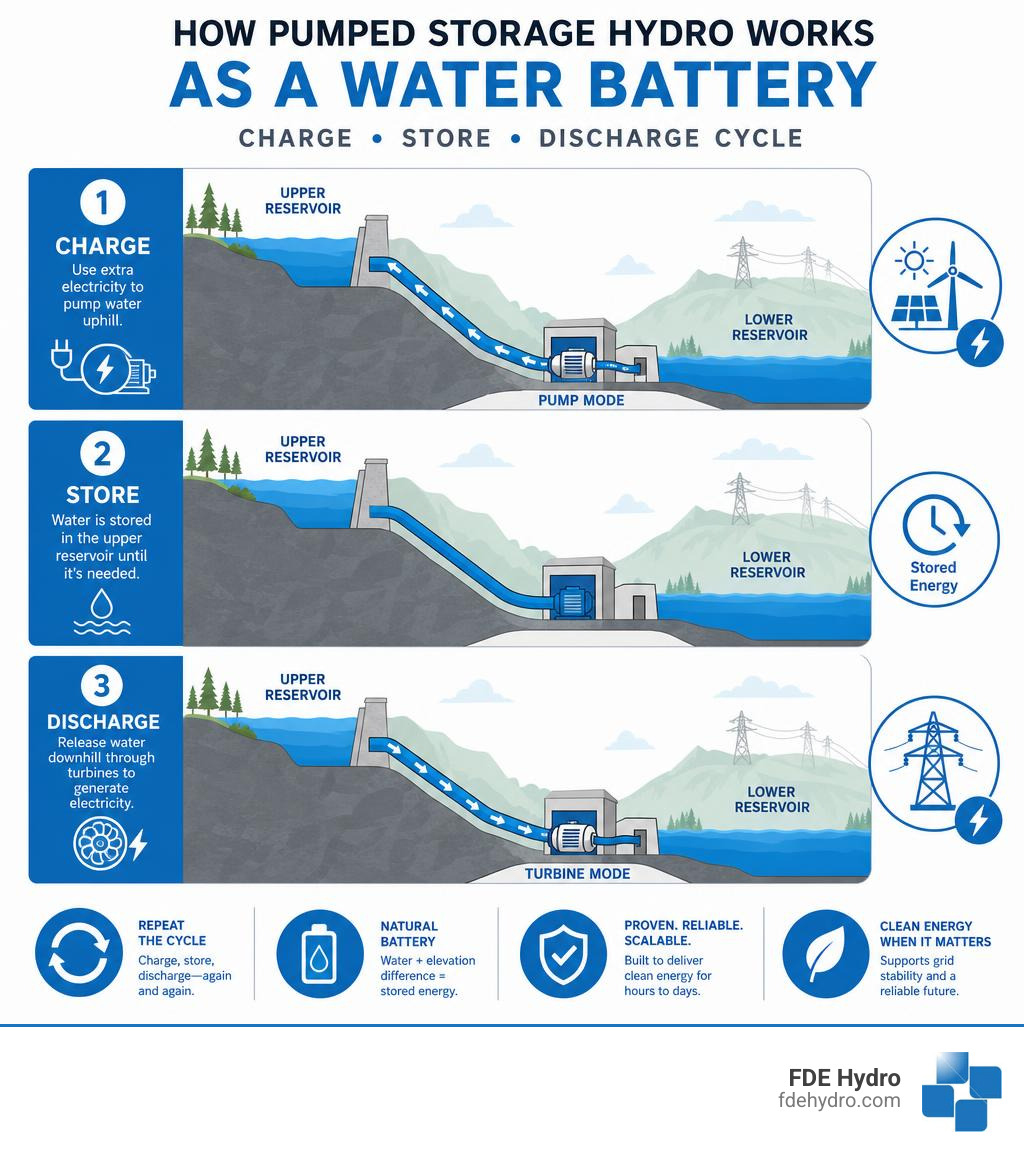
A project uses two reservoirs at different elevations. When there is extra electricity on the grid, the plant uses that power to pump water from the lower reservoir to the upper reservoir. That is the “charging” cycle. When the grid needs electricity, the water is released back downhill through turbines. That is the “discharging” cycle.
The stored energy is not in the water itself. It is in the water’s position. Engineers call this gravitational potential energy. The higher the reservoir and the more water it holds, the more energy can be stored.
The basic cycle is simple:
- Low demand or surplus renewable power: pumps move water uphill.
- High demand or low renewable output: water flows downhill.
- Reversible turbines spin generators to make electricity.
- The water collects in the lower reservoir and can be reused.
Most modern plants use reversible pump-turbines, often Francis-type machines, that can operate in both directions. In generation mode, water spins the turbine. In pumping mode, the machine reverses and pushes water uphill.
According to the U.S. Department of Energy’s overview of pumped storage hydropower, this is why PSH behaves like a giant battery. It does not create energy from nothing. It stores electricity when it is abundant and returns most of it when it is valuable.
Typical round-trip efficiency is about 70% to 80%. In plain English, if a plant uses 100 units of electricity to pump water uphill, it can usually return about 70 to 80 units later. The losses come from turbine, pump, motor, generator, friction, and evaporation effects.
For a deeper introduction to water-based storage, we also explain the concept in Pumped Up: Everything You Need to Know About Hydropower Energy Storage.
Key Components of a Pumped Storage Hydro Project
A pumped storage project looks simple from far away: two reservoirs and a powerhouse. Up close, it is a carefully integrated civil, mechanical, electrical, and control system.
The major components include:
- Upper reservoir: Stores water at elevation so it can be released for generation.
- Lower reservoir: Receives water after generation and supplies water for pumping.
- Dams and embankments: Create or support reservoir storage.
- Intake structures: Control water entry into tunnels or conduits.
- Penstock or water conveyance tunnel: Carries high-pressure water between reservoirs and turbines.
- Powerhouse: Contains pump-turbines, generators, motors, valves, transformers, and controls.
- Transmission connection: Moves power to and from the grid.
- Control systems: Coordinate pumping, generation, ramping, grid services, and protection systems.
The civil works are often the largest cost and schedule driver. That includes excavation, concrete, reservoir lining, dam construction, water conveyance, and site access. This is where modern construction methods matter.
At FDE Hydro, our patented modular precast concrete technology, known as French Dam, is designed to reduce the time, cost, and uncertainty involved in building and retrofitting hydroelectric dams and water control systems. For pumped storage, modular construction can help standardize critical structures, improve quality control, and reduce on-site construction complexity.
In an industry where “pour concrete on a remote mountain for years” has too often been the default plan, modularity is not just nice. It is overdue.
Open-Loop vs. Closed-Loop Pumped Storage Hydro Systems
There are two main categories of pumped storage hydro: open-loop and closed-loop.
Open-loop pumped storage has an ongoing hydrologic connection to a natural water body, such as a river, lake, or existing reservoir. Some open-loop projects are paired with conventional hydropower reservoirs. These systems can be efficient uses of existing infrastructure, but they may face more complex aquatic habitat, fish passage, water quality, and flow management requirements.
Closed-loop pumped storage uses two reservoirs that are not continuously connected to a natural river system. These are often called off-river systems. The same water is cycled between the reservoirs again and again, with periodic makeup water for evaporation, seepage, and maintenance losses.
The key differences are:
| Feature |
Open-loop PSH |
Closed-loop PSH |
| Water connection |
Connected to natural water body |
Generally off-river and self-contained |
| Environmental review |
Often more aquatic impacts to evaluate |
Often lower fish and river-flow impact |
| Siting |
Can use existing lakes, rivers, or dams |
Can be located away from rivers if topography works |
| Water reuse |
Reuses water but interacts with natural flows |
Reuses a mostly fixed water volume |
| Permitting |
Often more complex hydrologic issues |
Still rigorous, but usually fewer river impacts |
Closed-loop systems are receiving growing attention because they can reduce impacts to river ecosystems and expand the number of possible sites. We discuss this shift in Why Pumped Storage is Making a Huge Splash.
Common Pumped Storage Hydro Configurations
Pumped storage is not one-size-fits-all. In fact, that is part of its value.
Common configurations include:
- New-build closed-loop projects: Two purpose-built reservoirs, often off-river.
- Existing dam upgrades: Adding pumping and generation capability to existing water infrastructure.
- Non-powered dam conversions: Using dams that already hold water but do not currently generate electricity.
- Mine-site or quarry reservoirs: Repurposing excavated land, shafts, pits, or industrial sites.
- Brownfield redevelopment: Reusing disturbed sites with existing access roads, grid proximity, or water infrastructure.
- Hybrid hydropower projects: Combining conventional hydropower and pumped storage operations.
The most important physical factor is hydraulic head, meaning the vertical distance between the upper and lower reservoirs. More head means more energy from the same amount of water. Reservoir volume determines duration. A small reservoir with high head may provide a short burst of high power. A larger reservoir pair may provide many hours or even days of storage.
The Role of PSH in Modern Grid Reliability
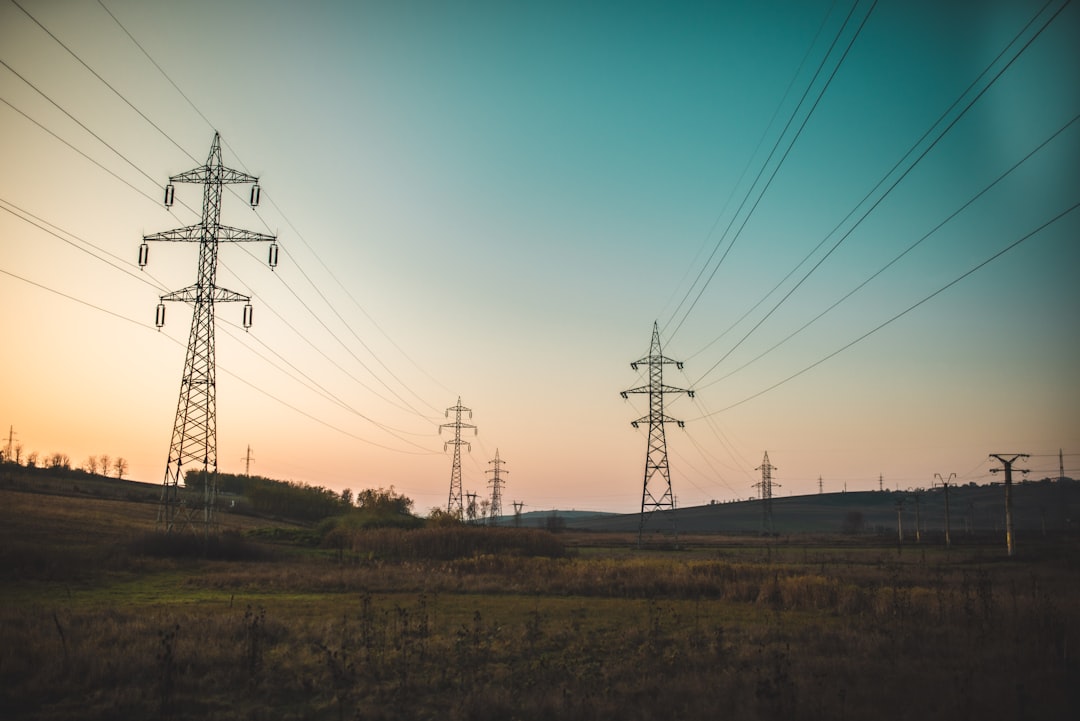
A modern grid must do more than produce enough energy over a year. It must match supply and demand every second.
That is where pumped storage hydro shines.
Pumped storage can provide:
- Fast ramping: Increasing or decreasing output quickly as demand changes.
- Frequency control: Helping keep the grid near its required operating frequency.
- Voltage support: Stabilizing local and regional grid conditions.
- Grid inertia: Supporting system stability that can be reduced as conventional rotating generators retire.
- Black-start capability: Helping restart parts of the grid after an outage.
- Peak capacity: Supplying high-demand periods when power prices and reliability needs rise.
- Renewable integration: Absorbing excess wind and solar and delivering it later.
- Curtailment reduction: Preventing clean electricity from being wasted when generation exceeds demand.
Wind and solar are excellent resources, but they are variable. Solar ramps down in the evening just as homes, businesses, and industry may still need electricity. Wind can surge at night when demand is low. Pumped storage acts like the grid’s shock absorber.
The International Hydropower Association notes that pumped storage is the dominant long-duration storage technology globally, with nearly 200 GW of installed power capacity and up to about 9,000 GWh of stored energy worldwide. You can explore more global hydropower context through the International Hydropower Association.
For more on the storage role of hydropower, see our guide to Hydropower Energy Storage.
Why Pumped Storage Hydro is Valuable for Long-Duration Energy Storage
Batteries are important, especially for short-duration and fast-response applications. But pumped storage hydro brings different strengths. It is not a replacement for every battery. It is the heavy-duty storage workhorse for the grid.
| Benefit |
Why it matters |
| Long asset life |
Plants can operate for many decades with maintenance and upgrades |
| Large storage capacity |
Reservoirs can store massive amounts of energy |
| Long duration |
Many projects can discharge for 6, 8, 10, or more hours |
| Low degradation |
Water does not wear out like battery cells |
| Scalable reservoirs |
Energy capacity can often be increased by reservoir sizing |
| Dispatchable power |
Operators can generate when the grid needs it |
| Water reuse |
The same water cycles repeatedly between reservoirs |
| Domestic materials |
Concrete, steel, aggregates, and civil works can often be sourced regionally |
| Grid reliability |
Supports stability, reserves, and emergency response |
| O&M familiarity |
Hydropower equipment is mature and well understood |
The main tradeoff is upfront cost. Pumped storage projects require significant civil construction, permitting, engineering, and interconnection work. They also take longer to develop than containerized battery projects.
However, the economics can be attractive over the full life of the asset. A pumped storage plant may earn revenue from multiple services:
- Energy arbitrage: pumping when electricity is cheap and generating when it is valuable.
- Capacity payments: being available during peak demand or reliability events.
- Ancillary services: frequency regulation, spinning reserve, voltage support, and other grid services.
- Transmission congestion relief: storing power where and when the grid cannot move it efficiently.
- Renewable firming: turning variable wind and solar into more dependable power portfolios.
The challenge is that many electricity markets still do not fully compensate long-duration flexibility. That is a policy problem, not a physics problem.
Global and U.S. Market Capacity
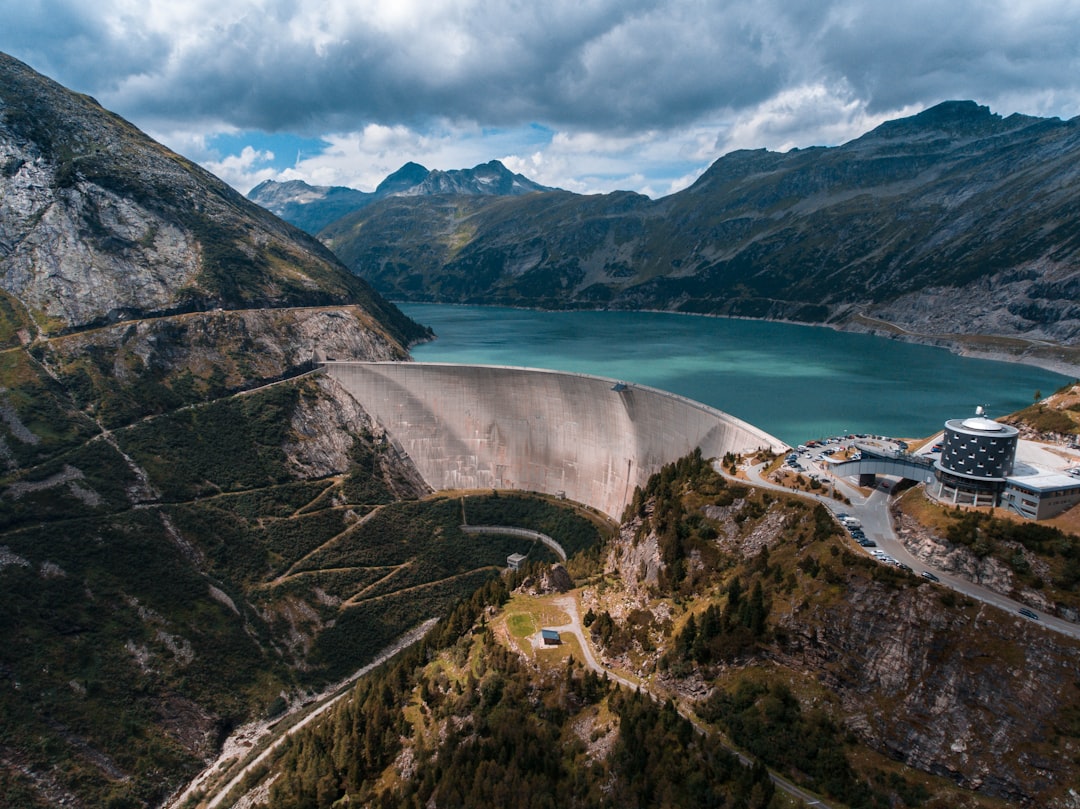
As of May 2026, pumped storage hydro remains the world’s largest grid-scale energy storage technology.
Key figures include:
- Global PSH power capacity is roughly 200 GW.
- Global PSH energy storage is estimated at up to about 9,000 GWh.
- PSH accounts for over 94% of global long-duration energy storage capacity.
- In the United States, pumped storage provides about 23 GW across roughly 42 to 43 facilities, depending on the reporting method.
- U.S. pumped storage represents the overwhelming majority of utility-scale energy storage capacity, often reported between 88% and 97% depending on how the category is counted.
The U.S. fleet includes some very large facilities. Bath County in Virginia is often described as one of the largest pumped storage plants in the world, with about 3 GW of generating capacity and many hours of storage. The Bad Creek facility in the Carolinas is another major U.S. project, with a proposed expansion that would increase storage and generation capability using existing infrastructure. More information is available from the Bad Creek Pumped Storage Project.
In North America, Canada also has pumped storage resources and opportunities. The Canada Energy Regulator has described pumped-storage hydro as the largest form of energy storage in Canada and an important contributor to grid reliability in its market snapshot.
Brazil is another important market to watch because of its large hydropower base, seasonal water patterns, and growing need for flexible storage as wind and solar expand. A recent academic review of pumped hydro storage in the Brazilian power industry highlights how PSH could support reliability and renewable integration in that market.
In Europe, pumped storage is already a core flexibility resource and is being evaluated as part of net-zero power system planning. The reason is straightforward: the more variable renewables a grid adds, the more it needs storage that can last longer than a quick battery burst.
Siting Challenges and Environmental Impacts
Pumped storage hydro is powerful, but it is not magic. You cannot build it just anywhere.
A strong site usually needs:
- Enough elevation difference between reservoirs.
- Stable geology for dams, tunnels, foundations, and slopes.
- Suitable reservoir locations with manageable land impact.
- Water for initial fill and periodic makeup.
- Access to transmission.
- Reasonable road, construction, and logistics access.
- Community support and transparent engagement.
- A viable permitting path.
Environmental impacts vary widely by project type. Open-loop systems may affect aquatic habitat, fish movement, water temperature, sediment, and natural flow patterns. Closed-loop systems can reduce many of those issues because they are often located away from rivers, but they still require land, water, construction disturbance, and careful management.
Important environmental topics include:
- Land use and habitat conversion.
- Wetlands and protected species.
- Water withdrawals for initial fill.
- Evaporation and seepage.
- Reservoir lining and water quality.
- Visual impacts.
- Cultural resources.
- Construction traffic, noise, and dust.
- Long-term dam safety.
Water use is often misunderstood. Pumped storage typically requires an initial fill, then reuses the same water repeatedly. It is not like a once-through water system. Losses mainly come from evaporation, seepage, and maintenance operations.
Permitting remains one of the largest barriers. In the U.S., projects may involve the Federal Energy Regulatory Commission, state water agencies, environmental review, dam safety agencies, local land-use approvals, and consultation with Tribes and communities. Early engagement matters. Surprises late in the process are expensive, and not the fun kind of surprise like finding cash in an old jacket.
We cover these issues further in Overcoming the Biggest Barriers to Cheap Pumped Storage and Why Your Old Dam Needs a Pumped Storage Makeover.
Repurposing Brownfield, Mine, and Existing Dam Sites
One of the most promising paths for new pumped storage is reusing sites that have already been disturbed.
That can include:
- Former mines.
- Quarries.
- Industrial sites.
- Existing reservoirs.
- Non-powered dams.
- Retired energy infrastructure sites.
Mine and quarry sites can be especially interesting because excavation has already created elevation differences or water-holding spaces. In some cases, an upper reservoir can be built on nearby high ground while a mine pit or underground void becomes the lower reservoir. In other cases, two existing voids can be adapted.
The U.S. Department of Energy has studied the potential for pumped storage hydropower at mine and brownfield sites because these projects may reduce greenfield disturbance, use existing roads, and create new economic activity in energy communities.
Existing dams are also a major opportunity. Many dams in North America do not generate electricity. Others generate power but do not include pumping. If the site has the right reservoir pairing, transmission access, and dam safety profile, a retrofit may be more practical than a fully new development.
How Modern Dam Construction Can Reduce Project Barriers
The traditional pumped storage development model can be slow and costly because so much depends on custom civil construction. Every site is different, and every delay compounds financing risk.
Modern modular dam construction can help.
At FDE Hydro, our French Dam technology uses patented modular precast concrete systems for building and retrofitting hydroelectric dams and water control structures. For pumped storage, this approach can support:
- Faster construction schedules.
- More predictable quality.
- Reduced on-site labor requirements.
- Less weather-dependent concrete work.
- Standardized components.
- Adaptable reservoir and water control designs.
- Better cost control.
- Easier retrofits at existing dams and non-powered sites.
This does not eliminate the need for engineering, permitting, geotechnical analysis, or environmental review. But it can reduce one of the biggest obstacles: the civil construction burden.
If pumped storage is the world’s biggest battery, then better dam construction is how we make the battery case faster, stronger, and more affordable.
Frequently Asked Questions about Pumped Storage
Pumped storage raises practical questions for utilities, developers, regulators, communities, and investors. Here are the ones we hear most often.
What is the round-trip efficiency of a pumped storage plant?
Most pumped storage plants recover about 70% to 80% of the electricity used to pump water uphill.
The lost energy is not mysterious. It comes from:
- Pump inefficiency.
- Turbine inefficiency.
- Motor and generator losses.
- Electrical transformer losses.
- Friction in tunnels and penstocks.
- Water turbulence.
- Evaporation and seepage.
Modern turbine design, variable-speed equipment, optimized controls, and efficient water conveyance can improve performance. But no storage technology is 100% efficient. The value of PSH is that it returns large amounts of energy when the grid needs it most.
How long can pumped storage hydro provide power?
It depends on three main factors:
- The volume of water in the upper reservoir.
- The elevation difference between reservoirs.
- The generating capacity of the turbines.
Many pumped storage plants are designed for 6 to 12 hours of discharge. Some can provide longer-duration storage depending on reservoir size and operating strategy.
A simple way to think about it:
- Power capacity is the size of the faucet.
- Energy capacity is the size of the tank.
- Duration is how long the tank can run through the faucet.
That is why pumped storage can be scaled for long-duration needs in a way that is difficult for many electrochemical batteries. If you need more storage duration, you can often increase reservoir volume rather than add entirely new power conversion systems.
What is the difference between open-loop and closed-loop systems?
Open-loop systems connect to a natural water body, such as a river, lake, or existing hydropower reservoir. They may use natural inflows and can interact with aquatic ecosystems.
Closed-loop systems are generally off-river. They cycle water between two reservoirs with little or no continuous connection to natural flowing water.
Closed-loop systems often have a smaller river impact, but they still require environmental review, land use planning, water sourcing, and dam safety analysis.
Can pumped storage hydro be added to existing dams?
Yes, in some cases.
Adding pumped storage to an existing dam depends on:
- Whether there is a suitable upper and lower reservoir pairing.
- The available elevation head.
- Dam safety and structural condition.
- Space for a powerhouse, tunnels, intakes, and equipment.
- Transmission access.
- Environmental and permitting constraints.
- Economics.
Non-powered dams are especially interesting because the water control structure already exists. A pumped storage retrofit can sometimes add energy storage value without creating an entirely new dam site.
This is one reason modular construction matters. Standardized precast components can make certain retrofits faster and more predictable. Learn more in How Precast Modules are Revolutionizing Pumped Storage and Small but Mighty: A Guide to Modular Pumped Storage and its Benefits.
Why is pumped storage hydro important for renewable energy integration?
Wind and solar are variable. The grid needs electricity on demand.
Pumped storage helps by:
- Storing excess solar during midday.
- Storing wind energy during low-demand periods.
- Reducing renewable curtailment.
- Supplying evening and morning demand peaks.
- Providing fast ramping when clouds, storms, or wind changes affect output.
- Supporting voltage and frequency stability.
- Reducing reliance on fossil peaking plants.
In other words, pumped storage turns renewable energy from “available when nature says so” into “available when the grid needs it.”
That is the heart of the energy transition.
Conclusion
Pumped storage hydro is not new. But its importance is growing fast.
As of May 2026, grids across the United States, Canada, Brazil, and Europe are adding more wind and solar, retiring older fossil assets, and searching for reliable long-duration storage. Batteries will play a major role, but they cannot carry the entire storage burden alone.
Pumped storage hydro offers something rare: massive capacity, long duration, proven equipment, long asset life, and grid reliability services in one package.
The barriers are real. Projects need the right sites, careful environmental review, community trust, strong market signals, and better construction economics. But those barriers are solvable.
At FDE Hydro, we believe the next generation of pumped storage will be built faster and more affordably through smarter civil design, modular precast concrete, and practical retrofits of existing water infrastructure. Our French Dam technology was developed for exactly this kind of future: one where hydropower infrastructure is cleaner, faster to build, easier to adapt, and ready to support renewable energy at grid scale.
To learn more about how we approach this work, visit our page on Pumped Storage Hydropower.
by Adaptify Support | Jun 4, 2026 | Energy Resource Articles
Why Renewable Energy Project Development Is One of the Most Complex — and Critical — Processes in Clean Energy
Renewable energy project development is the multi-stage process of turning a clean energy idea into a fully operating power plant — covering everything from initial site screening to financing, construction, and long-term operations.
Here is a quick overview of the core steps:
- Market screening and site evaluation — assess resource quality, land, and grid access
- Site control — secure land rights through leases or options
- Feasibility studies — model energy yield, costs, and financial returns
- Environmental review and permitting — obtain approvals at local, state, and federal levels
- Interconnection — apply for and negotiate grid connection
- Offtake agreements — sign a Power Purchase Agreement (PPA) to lock in revenue
- Financing — close on equity, tax equity, and debt
- Construction and commissioning — build and bring the project online
- Operations and repowering — manage the asset and extend its life
The global energy transition is accelerating fast. Renewable sources are now on track to supply 35% of the world’s electricity by 2025, up from 29% just a few years earlier. Global clean energy investment is projected to surpass $3 trillion in the same period. In the U.S. alone, the renewable energy market is expected to top $320 billion.
Yet despite this momentum, most projects never reach the finish line. Around 80% of energy projects that enter interconnection queues fail to reach commercial operation. The reasons are almost always the same: poor site screening, skipped feasibility steps, permitting surprises, or financing that falls apart late in the process.
Getting it right requires a clear, repeatable process — and a team that understands every stage.
I’m Bill French, Sr., founder and CEO of FDE Hydro™, and I’ve spent decades in heavy civil construction and infrastructure development, including being selected by the U.S. Department of Energy to help shape the national roadmap for next-generation hydropower — experience that directly informs how I approach renewable energy project development at every scale. In the guide below, I’ll walk you through each stage of the development process so you can move forward with confidence.
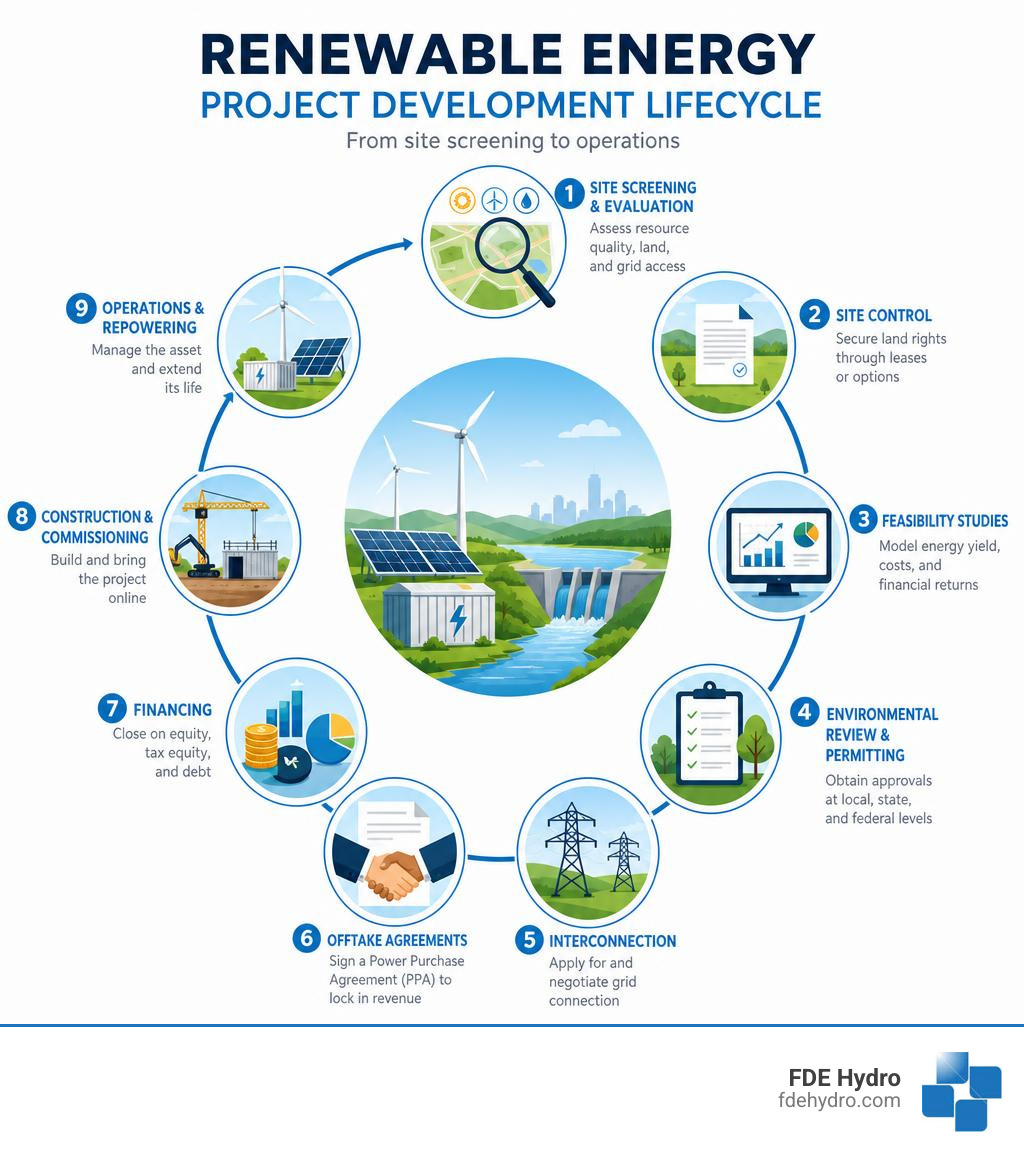
The Complete Renewable Energy Project Development Lifecycle
A renewable project is not “developed” when someone finds a sunny field, windy ridge, battery site, or promising water resource. That is only the beginning.
The full lifecycle usually includes:
- Market screening
- Resource assessment
- Site control
- Feasibility studies
- Environmental review
- Permitting
- Interconnection
- Offtake contracting
- Financing
- Engineering, procurement, and construction
- Commissioning and commercial operation
- Long-term operations, repowering, and decommissioning
For a broader foundation, see our renewable energy project basics.
Why Renewable Energy Project Development Starts With “Project Motivation”
Before spending serious money, we need a clear answer to one question: why should this project exist?
Good project motivation usually rests on five pillars:
- Baseline need: What problem are we solving – high power prices, grid reliability, emissions, energy security, or resilience?
- Economics: Can the project compete on cost and deliver acceptable NPV, IRR, and payback?
- Policy: Do federal, state, provincial, local, or European market rules support the project?
- Technology: Is the selected technology proven, bankable, and appropriate for the site?
- Consensus: Can landowners, communities, utilities, regulators, and investors align?
This is also when we look for fatal flaws. A fatal flaw may be lack of transmission capacity, protected habitat, poor hydrology, unbuildable terrain, community opposition, or an offtake price that cannot support financing.
Early development capital is risk capital. It is often only a small portion of total project cost, but it is the money most likely to be lost if the project fails. That is why disciplined screening matters.
Stage 1: Market Screening, Resource Assessment, and Site Evaluation
The first technical step is identifying where a project might work.
Developers use GIS mapping, utility data, environmental databases, land records, and market pricing information to screen sites. For different technologies, the key resource changes:
- Solar: irradiance, land slope, shading, parcel size, soil conditions
- Wind: wind speed, turbulence, setbacks, aviation constraints
- Battery storage: grid congestion, nodal pricing, load pockets, substation proximity
- Pumped storage hydro: elevation difference, hydrology, geology, reservoir potential, water rights
Site evaluation should also include:
- Floodplain and wetland review
- Zoning and land-use compatibility
- Title reports and ownership history
- Access roads and constructability
- Distance to substations and transmission lines
- Capacity constraints and likely network upgrades
- Local tax, permitting, and community conditions
In 2026, we strongly favor a grid-first approach. A beautiful site with no viable interconnection is not a project. It is just expensive scenery.
Stage 2: Site Control, Landowner Agreements, and Early Engineering
Once a site looks promising, developers move toward site control. This may involve:
- Land leases
- Purchase options
- Easements
- Rights-of-way
- Access agreements
- Water rights or reservoir agreements for hydro projects
Most projects are placed into a special purpose vehicle, or SPV, so contracts, permits, financing, and liabilities are tied to the project entity.
Early engineering then tests whether the site can actually be built. This includes preliminary layouts, geotechnical review, access plans, electrical design, drainage studies, and conceptual civil works.
For FDE Hydro, this stage is especially important because modular precast concrete hydropower and water-control systems can change the construction plan. By using repeatable modular elements, we aim to reduce construction time, site disruption, and cost compared with many conventional heavy civil approaches.
Stage 3: Feasibility Studies in Renewable Energy Project Development
Feasibility studies turn a concept into a decision-ready project.
A strong feasibility package usually includes:
- Technical feasibility
- Energy production forecast
- P50 and P90 generation estimates
- CAPEX and OPEX assumptions
- LCOE analysis
- Interconnection cost estimates
- Curtailment assumptions
- Revenue model
- Sensitivity analysis
- Permitting risk assessment
- Construction schedule
- Financing assumptions
For storage, feasibility also includes the revenue stack: energy arbitrage, capacity value, ancillary services, resilience, and possible grid support. For pumped storage hydro, it includes long-duration storage value, reservoir operations, hydraulic efficiency, environmental flows, and grid reliability services.
Public tools can help. The Renewable Energy Project Development Toolbox includes resources for feasibility, procurement, contracts, financing, and green power markets.
Stage 4: Environmental Review, Permitting, and Community Engagement
Permitting is where many good ideas meet reality.
Environmental and land-use review may include:
- Wildlife and habitat studies
- Wetlands and waterways
- Cultural and historic resources
- Visual impact
- Noise
- Traffic
- Stormwater
- Fire safety
- Endangered species
- Decommissioning plans
- Mitigation measures
In the United States, projects may need local permits, state approvals, and federal reviews depending on land, water, transmission, and environmental impacts. In California, developers must account for state energy policy and environmental review requirements, including programs and guidance from the California Energy Commission.
Community engagement should not start after the design is finished. It should begin early, before rumors do the engineering for you. People deserve clear answers about setbacks, traffic, noise, views, water, taxes, emergency response, and land restoration.
Stage 5: Interconnection, Offtake, Financing, and Notice to Proceed
Interconnection determines whether the project can deliver power to the grid. The process often includes:
- Interconnection application
- Queue position
- Feasibility or scoping study
- System impact study
- Facilities study
- Network upgrade estimate
- Generator interconnection agreement
In organized U.S. power markets, developers may work with RTOs or ISOs. In vertically integrated markets, the local utility may control much of the process. In Canada, Brazil, and Europe, the structure varies by market, but the basic risk is the same: grid capacity can make or break the project.
At the same time, the project needs revenue. That usually means a PPA, virtual PPA, green tariff, community solar subscription structure, capacity contract, or merchant revenue strategy.
Only after site control, permits, interconnection, offtake, engineering, and financing align can the project reach financial close and receive notice to proceed, or NTP.
Stage 6: Construction, Commissioning, Operations, and Repowering
Construction begins with an EPC contract, procurement plan, schedule, budget, safety plan, and quality-control program.
Commissioning verifies that equipment works as designed. Commercial operation date, or COD, marks the point when the project begins delivering energy and earning revenue under its contracts.
Operations include:
- Asset management
- O&M
- Performance monitoring
- Warranty claims
- Vegetation management
- Safety inspections
- Compliance reporting
- Equipment replacement
- Battery augmentation, where applicable
- Repowering or rehabilitation
Eventually, the project may be repowered, expanded, relicensed, or decommissioned. Responsible development includes planning for land restoration from the beginning.
How Developers Coordinate Sites, Permits, Utilities, and Communities
Good development is coordination. Great development is coordination before the crisis.
Developers must work with landowners, local governments, utilities, RTOs or ISOs, regulators, neighbors, environmental agencies, and, where applicable, tribal or Indigenous communities. Every stakeholder sees the project through a different lens.
For more on responsible energy growth, see Powering Progress.
Working With Landowners and Host Communities
Landowners want clarity. Communities want respect. Both are reasonable.
Best practices include:
- Clear lease payment terms
- Honest discussion of construction impacts
- Agricultural coexistence where possible
- Drainage and road-use protections
- Setbacks and screening
- Local emergency response planning
- Complaint resolution procedures
- Community benefit agreements
- Tax revenue transparency
- Local hiring and procurement where practical
A project should not feel like something dropped onto a community from outer space. That only works in science fiction, and even there it usually ends badly.
Navigating Government Permits and Environmental Reviews
Permitting differs across New York, California, Kansas, Canada, Brazil, and Europe, but the principles are similar.
Developers must identify:
- Which agency has authority
- Which permits are discretionary
- Which studies are required
- Which public hearings apply
- Which appeals are possible
- Which mitigation measures are likely
- Which permits must be secured before financing
Hydropower and pumped storage projects may involve water permits, dam safety rules, environmental flow requirements, fish passage, reservoir operations, and federal or national energy licensing. These are more complex than many solar or battery projects, but they also offer valuable long-duration storage and reliability benefits.
Managing Utility and Transmission Interconnection Risk
Interconnection risk is one of the largest development risks in 2026.
Common challenges include:
- Queue backlogs
- Cluster study delays
- Thermal overloads
- Voltage constraints
- Deliverability limits
- High network upgrade costs
- Congestion and curtailment
- Changing study assumptions
Developers increasingly use early injection studies, power-flow analysis, and nodal price review before locking up land. The goal is simple: fail fast, before spending millions.
Best Practices for Responsible Renewable Energy Project Development
We recommend:
- Start outreach early
- Keep a single source of truth for project data
- Screen for fatal flaws before site control
- Share study results transparently
- Adapt design based on real constraints
- Plan for local jobs and procurement
- Budget for mitigation
- Include lifecycle and decommissioning planning
- Use performance-based engineering
- Avoid promising what the project cannot deliver
Responsible development is not slower. In many cases, it is faster because it reduces surprises.
Comparing Wind, Solar, Battery Storage, and Pumped Storage Hydro Development
Each technology follows the same general development path, but the details differ.
See our overview of defining renewable energy sources for a broader comparison.
| Technology |
Key siting factor |
Main permitting issue |
Revenue focus |
Storage duration |
| Wind |
Wind speed and setbacks |
Wildlife, visual, noise, aviation |
Energy and capacity |
Not storage unless paired |
| Solar |
Irradiance and land |
Land use, stormwater, habitat |
Energy, RECs, capacity |
Not storage unless paired |
| Battery storage |
Grid location |
Fire safety, zoning, interconnection |
Arbitrage, capacity, ancillary services |
Usually short to medium duration |
| Pumped storage hydro |
Head, water, geology |
Water, dam safety, environmental flows |
Long-duration capacity, reliability, grid services |
Long duration |
Wind Project Development: Resource, Siting, and Repowering Priorities
Wind projects require strong wind data, often supported by met towers, lidar, or long-term modeled datasets. Developers must optimize turbine layout to reduce wake losses and meet setbacks from homes, roads, airports, and sensitive habitats.
Key studies include avian and bat surveys, sound modeling, shadow flicker analysis, aviation review, and collector system design.
Repowering can extend project life by replacing older turbines or major components. In some cases, repowering increases output without needing an entirely new site.
Solar Project Development: Land, Interconnection, and Design Optimization
Solar development depends on irradiance, usable acreage, interconnection, grading, stormwater, and equipment selection.
Important design choices include:
- Fixed-tilt vs. single-axis tracking
- Bifacial modules
- Inverter loading ratio
- DC-to-AC ratio
- Terrain-following racking
- Vegetation and stormwater plan
- Module degradation assumptions
- Design freeze timing
Modern solar design increasingly uses 3D terrain modeling so projects avoid costly grading surprises.
Battery Energy Storage Project Development: Revenue Stacking and Safety
Battery energy storage systems, or BESS, can be standalone or paired with wind, solar, or hydro.
Development priorities include:
- Interconnection capacity
- Market rules
- Revenue stacking
- Fire code compliance
- Emergency response planning
- Battery degradation
- Augmentation schedule
- EMS controls
- AC-coupled vs. DC-coupled design
Storage can earn revenue from arbitrage, capacity, ancillary services, demand reduction, resilience, or avoided curtailment. The exact stack depends on the market.
Pumped Storage Hydro Development: Long-Duration Storage and Water Infrastructure
Pumped storage hydro uses electricity to move water uphill when power is abundant, then releases it through turbines when the grid needs energy.
Key development factors include:
- Reservoir siting
- Head differential
- Tunnels, penstocks, dams, and waterways
- Geology and geotechnical risk
- Hydrology
- Environmental flows
- Water rights
- Grid connection
- Licensing
- Dam safety
Closed-loop pumped storage can reduce impacts by operating away from major natural waterways. Pumped storage can also provide long-duration capacity, inertia, black start capability, and grid reliability.
At FDE Hydro, our patented modular precast concrete “French Dam” technology is designed for building and retrofitting hydroelectric dams and water-control systems more efficiently across North America, Brazil, and Europe.
How Hybrid Projects Pair Renewables With Storage
Hybrid projects combine generation with storage. Examples include:
- Solar-plus-storage
- Wind-plus-storage
- Hydro-plus-storage
- Pumped storage paired with renewable generation
Storage helps shift energy to higher-value hours, reduce curtailment, capture solar clipping, share interconnection capacity, and improve capacity accreditation.
Financing, PPAs, and Bankability in Renewable Energy Project Development
A project becomes bankable when investors and lenders believe it can be built, operated, and paid back.
For more on cost-conscious planning, see our cost-efficient renewable energy guide.
How PPAs and Offtake Contracts Secure Project Revenue
A Power Purchase Agreement is one of the most important contracts in renewable energy project development.
A PPA may define:
- Buyer and seller
- Contract term
- Energy price
- Escalator
- Delivery point
- REC ownership
- Curtailment rules
- Credit support
- Performance obligations
- Default rights
Common structures include utility PPAs, corporate PPAs, virtual PPAs, green tariffs, and community solar subscriptions. Lenders prefer creditworthy offtakers and predictable revenue.
Building the Financial Model and Investment Case
A strong financial model includes:
- CAPEX
- OPEX
- Production forecast
- Degradation
- Curtailment
- Interconnection costs
- Tax benefits
- Depreciation
- Debt sizing
- DSCR
- EBITDA
- IRR
- NPV
- Payback
- Contingency
The model should include sensitivity cases. What happens if construction costs rise 10%? What if curtailment doubles? What if interconnection upgrades cost more? The model should answer those questions before the lender does.
Common Capital Stack for Renewable Projects
Renewable projects are commonly financed with a mix of:
- Sponsor equity
- Development equity
- Tax equity
- Construction financing
- Term debt
- Bridge loans
- Grants and incentives
- Transferable tax credits, where available
- Insurance products
- Reserve accounts
The exact mix depends on technology, jurisdiction, contract quality, tax credit eligibility, and market risk.
Financial Close: What Lenders and Investors Review
Before financial close, investors typically review:
- Site control
- Permits
- Interconnection agreement
- Executed offtake
- EPC contract
- Equipment warranties
- Independent engineer report
- Environmental studies
- Legal opinions
- Insurance
- Operating model
- Decommissioning plan
This diligence can feel intense, but it protects the project. Bankability is just another word for “we checked the homework.”
Cost Reduction and Risk Mitigation Strategies
Cost reduction starts early. Useful strategies include:
- Standardized design
- Modular construction
- Early interconnection screening
- Competitive procurement
- Fixed-price EPC contracts where appropriate
- Contingency buffers
- Local labor planning
- Supply chain resilience
- Digital project controls
- Design for operations and maintenance
For hydro and water-control infrastructure, modular precast construction can reduce on-site complexity and help compress schedules compared with many traditional methods.
The best developers combine engineering judgment with better data.
For enterprise planning, see sustainable enterprise energy solutions.
Essential development tools include:
- NREL SAM: performance and financial modeling
- PVWatts: solar production estimates
- REopt: distributed energy and resilience optimization
- DSIRE: U.S. incentives and policy research
- GIS constraint mapping: parcels, slope, wetlands, habitat, zoning
- Power-flow studies: interconnection and grid impact
- Hydrology models: flows, head, water availability
- LCOE calculators: cost comparison
- Pro forma models: IRR, NPV, DSCR, payback
- Digital twins: design validation and operational planning
Community Solar, Green Tariffs, and Corporate Clean Energy Procurement
Market demand is changing. More buyers want clean energy without owning a power plant.
Common options include:
- Community solar subscriptions
- Municipal procurement
- Corporate PPAs
- Virtual PPAs
- Green tariffs
- Bundled RECs
- Unbundled RECs
- Retail choice products where available
These structures can broaden access to renewable energy, but each has different rules for credit, REC ownership, customer eligibility, and revenue certainty.
Regulatory and Transmission Challenges Across U.S. Markets
In the United States, development rules differ across RTO markets, vertically integrated utility territories, and state policy frameworks.
Key challenges include:
- Interconnection queue backlogs
- Transmission scarcity
- Local moratoria
- Zoning disputes
- Tax abatement negotiations
- PILOT agreements
- Permitting reform uncertainty
- Changing capacity accreditation rules
Developers must understand local rules in places like New York, California, Kansas, and other target markets before committing major capital.
Emerging Best Practices for 2026 and Beyond
The strongest 2026 development strategies include:
- Grid-first siting
- Storage-first planning
- Long-duration storage evaluation
- Resilience valuation
- Biodiversity-friendly design
- Agrivoltaics where appropriate
- Workforce training
- Apprenticeship compliance for tax credit eligibility
- Lifecycle emissions review
- Repowering and retrofit planning
The next wave of projects will not just be about producing clean electrons. It will be about delivering flexible, reliable, community-supported infrastructure.
Frequently Asked Questions About Renewable Energy Project Development
What Are the Main Steps in Renewable Energy Project Development?
The main steps are site screening, feasibility, site control, permitting, interconnection, offtake, financing, construction, commissioning, operations, and eventual repowering or decommissioning.
Each step reduces uncertainty. The goal is to move from “interesting idea” to “financeable project” without skipping the work that protects the project later.
Why Are PPAs Important for Renewable Energy Projects?
PPAs create predictable revenue. That gives lenders and investors more confidence that the project can repay debt and deliver returns.
A strong PPA also clarifies price, term, delivery obligations, REC ownership, curtailment treatment, and credit support. Without reliable revenue, many projects struggle to reach financial close.
How Long Does Renewable Energy Project Development Usually Take?
Timelines vary widely:
- Distributed solar or storage: often months to a few years
- Utility-scale solar: commonly several years
- Wind: often longer due to resource studies and permitting
- Standalone battery storage: can be faster, but interconnection may delay it
- Pumped storage hydro: typically the longest due to licensing, engineering, water, and civil works
Interconnection and permitting are usually the biggest schedule risks.
Conclusion
Renewable energy project development is a disciplined process. It requires strong sites, strong data, strong community relationships, strong contracts, and strong financing.
At FDE Hydro, we bring that mindset to hydropower, pumped storage, dam retrofits, and water-control infrastructure. Our patented modular precast concrete technology is designed to reduce construction time and cost while supporting reliable renewable energy development across North America, Brazil, and Europe.
The future grid will need more than generation. It will need storage, flexibility, resilience, and infrastructure built to last.
To learn more, explore our pumped storage hydropower solutions.
by Adaptify Support | May 27, 2026 | Energy Resource Articles
Is Base Energy Worth It? Here’s What You Need to Know
Base energy plans from Base Power give Texas homeowners an affordable way to get backup power and lower electricity bills — without buying expensive equipment.
Here’s a quick summary before we dive in:
| Feature |
Details |
| Who it’s for |
Texas homeowners seeking backup power + lower energy bills |
| Installation cost |
$695 (25 kWh) or $995 (50 kWh) |
| Monthly membership |
$19/mo or $29/mo |
| Energy rate |
8.5¢/kWh + utility delivery fees |
| Backup coverage |
Protects against ~97% of outages |
| Contract length |
36 months |
| Solar required? |
No |
| Availability |
Texas (Oncor and CenterPoint service areas) |
The idea is simple: Base Power installs a large battery at your home, uses it to help balance the grid, and passes the savings on to you in the form of lower energy rates. You get backup power. They earn revenue from grid services. Everyone wins — at least in theory.
But is it actually a good deal? That depends on your home, your energy usage, and how much you value having the lights on when your neighbors don’t.
The Texas grid has been under growing pressure — from record summer heat loads to the memory of Winter Storm Uri in 2021, when millions lost power for days. That history makes reliable home backup more than a convenience. For many families, it’s a priority.
I’m Bill French, Sr., Founder and CEO of FDE Hydro™, and I’ve spent decades working across heavy civil construction and clean energy infrastructure — including being selected by the U.S. Department of Energy to help define next-generation solutions for base energy and hydropower. In this review, I’ll break down exactly what Base Power offers, what it costs, and whether it delivers real value.
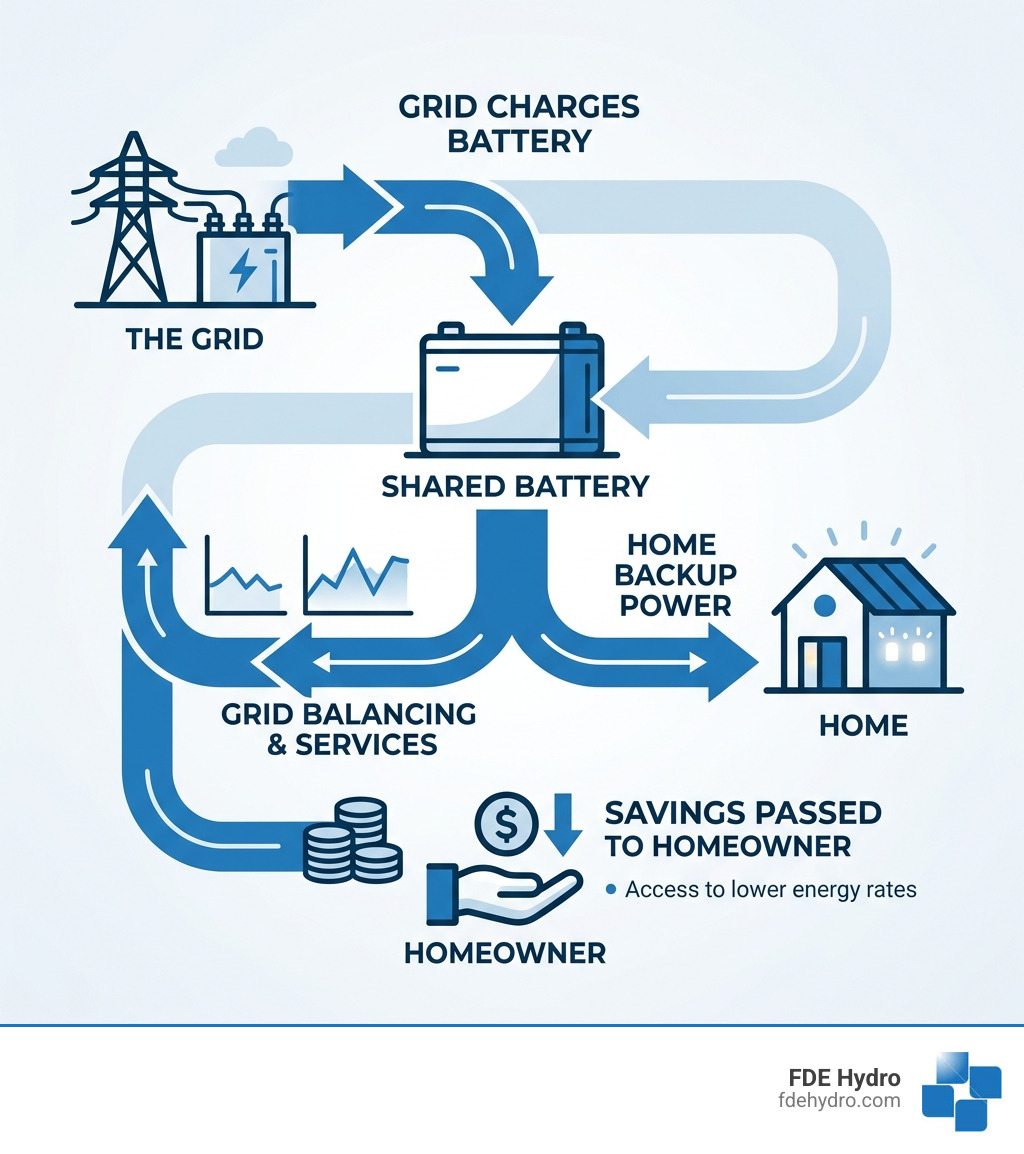
Easy base energy word list:
What is Base Power and How Does the Business Model Work?
At its core, Base Power is a technology-driven energy provider that treats residential homes as part of a massive, distributed power plant. In electrical engineering, we often talk about the base load—the minimum amount of electricity needed to keep the grid running 24/7. Historically, this was provided by massive, unvarying plants like coal, nuclear, or large-scale hydropower.
Base Power is modernizing this concept. By deploying thousands of distributed batteries across Texas, they are creating a Virtual Power Plant (VPP). Here is how the business model works:
- Distributed Batteries: Instead of building one giant, expensive natural gas peaker plant, Base installs 25 kWh or 50 kWh batteries at individual homes.
- Grid Balancing: When the Texas grid is under strain—like on a 105-degree August afternoon—Base can discharge energy from these batteries back into the grid. This helps prevent blackouts and reduces the need for expensive, high-emission peaker plants.
- Revenue Sharing: Base makes its money by selling these grid services (balancing and capacity) to the utility market. Because they earn revenue from the grid, they can afford to subsidize the cost of the battery for you.
- The CoServ Partnership: A prime example of this scale is their 100-MW partnership with the Denton County Electric Cooperative (CoServ). This network of home batteries provides the same capacity as a traditional gas-fired peaker plant but can be deployed in just two years, compared to the five years typically required for a gas plant.
By understanding what grid means in electrical engineering, we can see that Base Power isn’t just selling you electricity; they are inviting you to host a piece of the infrastructure that keeps the lights on for everyone.
Understanding Base Energy Plans and Pricing
When you look at a typical base energy bill in Texas, it’s often filled with “teaser rates” and “hidden fees” that disappear after three months. Base Power takes a different approach by offering fixed, transparent pricing.
The current pricing structure (as of April 2026) is broken down into three main components:
- Installation Fee: You pay a one-time upfront fee of $695 for a single battery (25 kWh) or $995 for two batteries (50 kWh). This is significantly lower than the $15,000 to $20,000 you might pay for a standalone solar battery system.
- Monthly Membership: There is a recurring fee of $19/month for the single battery plan or $29/month for the double battery plan. This covers the maintenance, software updates, and the “insurance” of having backup power ready at all times.
- Energy Rate: Base offers a fixed energy rate, currently around 8.5¢/kWh. It is important to remember that you still have to pay utility delivery fees (from Oncor or CenterPoint), which usually add another 4¢ to 6¢ per kWh.
Compared to the 22¢/kWh some Texans were paying during peak periods, many customers report overall savings of around 39% after switching. To understand the fundamentals of these costs, you can check out our Energy 101 guide. You can also view their low-cost, fixed-rate energy details directly.
Is Base Energy Available in Your Area?
Because Base Power acts as a Retail Electric Provider (REP), they are currently limited to the deregulated parts of Texas. Specifically, they serve homes in the Oncor and CenterPoint service areas, which cover much of Dallas-Fort Worth, Austin, and Houston.
To qualify, you generally need to own a single-family home with a garage or exterior space suitable for a battery cabinet. The company handles the permitting and installation, ensuring the system meets all local codes. You can learn more about the specific eligibility and how it works on their site.
Maximizing Savings with Base Energy Solar Integration
If you already have solar panels, Base Power integrates seamlessly. They don’t require solar to work—their batteries can charge straight from the grid—but solar owners get the added benefit of renewable energy solutions that work even when the sun goes down.
Base offers a solar buyback rate of 3¢/kWh plus a real-time wholesale bonus. While this isn’t “1-to-1 net metering,” the low fixed rate you pay for energy often offsets the difference, making it a competitive choice for solar households looking for reliable backup.
Technical Specs: Reliability and Safety of the System
Safety is a common concern when putting a large battery next to your house. Base uses Lithium Iron Phosphate (LFP) cells. In sustainable power generation, LFP is known for being much more stable than the nickel-cobalt chemistries found in many electric vehicles or older home batteries.
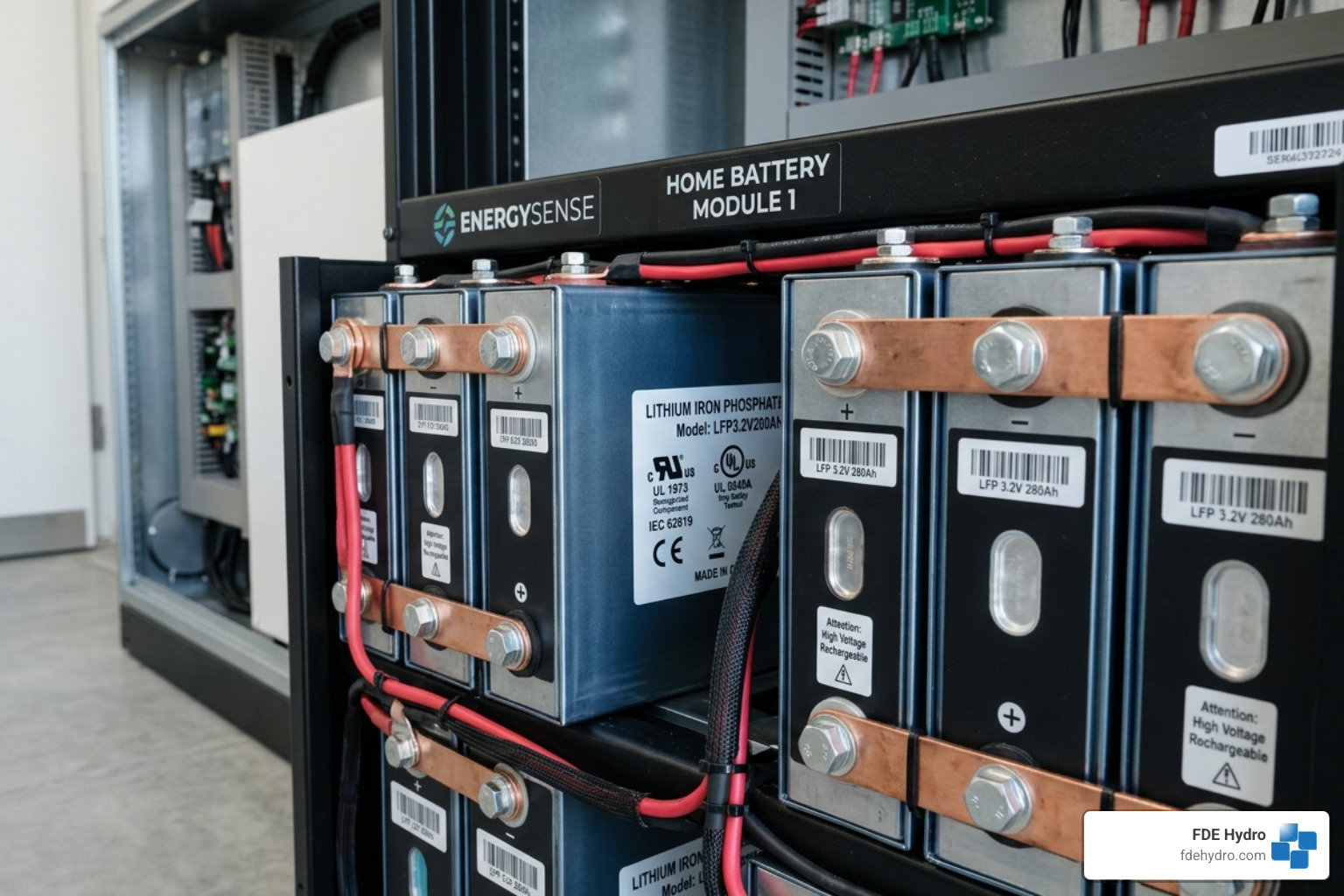
Key technical highlights include:
- Capacity: Options for 25 kWh or 50 kWh.
- Certifications: The hardware is certified to UL 1973, UL 1741, and UL 9540A standards.
- Fire Suppression: Each unit includes active fire suppressants.
- Reliability: Base batteries maintain an average 93% state of charge, ensuring they are ready for an outage at a moment’s notice.
What happens when the grid goes dark? Base provides an automatic switchover that is so fast you might only notice a slight flicker of the lights. The system is designed to protect against 97% of Texas outages.
The duration of your backup depends on your usage:
- 25 kWh Battery: Can last 24–48 hours under “low usage” (lights, fridge, Wi-Fi) or about 4 hours if you are running the AC and heavy appliances.
- 50 kWh Battery: Doubles those numbers, providing a true whole-home experience for 24 hours or more.
This type of “black start” capability is essential for grid resilience. If you’re curious about how large-scale systems recover, read The Black Start Blueprint: How Power Grids Come Back To Life.
Comparing Home Batteries to Traditional Backup Solutions
Many homeowners wonder if they should just buy a portable gas generator or a traditional solar battery. When we look at base energy security, the “shared model” Base Power uses changes the math significantly.
| Feature |
Base Power |
Traditional Generator |
Standard Solar Battery |
| Upfront Cost |
$695 – $995 |
$3,000 – $10,000 |
$15,000 – $25,000 |
| Maintenance |
Included |
High (Oil, Fuel, Testing) |
Low |
| Noise |
Silent |
Very Loud |
Silent |
| Fuel Source |
Grid/Solar |
Gas/Propane |
Solar/Grid |
| Automatic? |
Yes |
Sometimes |
Yes |
For those interested in how these systems function as a localized energy source, our guide on what is a microgrid explains the engineering behind self-sufficient power zones.
With over 10,000 homes now powered by Base, the real-world data is rolling in. On platforms like Reddit, Texas residents have shared detailed breakdowns of their experiences.
- The Pros: Customers frequently praise the 4.9-star service and the speed of installation (Base is currently installing at a pace of 60+ customers per day). Many report that they didn’t even realize their neighborhood had a power outage until they saw their neighbors’ dark houses.
- The Cons: Some users on Reddit have pointed out that you give up control of the battery. Because Base uses the battery for grid balancing, you can’t manually decide when to charge or discharge it. However, since Base guarantees a high state of charge (93%) for backup, most users find this a fair trade-off for the low cost.
- Savings: One customer testimonial highlighted a drop from 22¢/kWh to the Base rate, resulting in a 39% monthly bill reduction.
You can find more customer stories and performance data on their official site.
Frequently Asked Questions about Home Energy
How much does it cost to deinstall the battery?
If you decide to leave Base Power before your contract is up, or if you move and the new owner doesn’t want the system, there is a deinstallation fee. While early Reddit discussions mentioned fees up to $1,000, current reports suggest the fee has been lowered to around $250 in many cases. Always check your specific Electricity Facts Label (EFL) for the most up-to-date contract terms.
Can I use a portable generator with the Base system?
Yes! Starting in Fall 2025, Base is introducing a generator plug-in. This allows you to connect a portable generator to the Base system during an extended multi-day outage. The generator can recharge the battery, which then powers your home. This “hybrid” approach offers incredible flexibility, similar to how modular hydro provides flexible power generation for the larger grid.
Does the battery work without solar panels?
Absolutely. This is one of the biggest misconceptions about home batteries. Base batteries are designed to charge directly from the grid when energy is plentiful and cheap. This makes them an excellent energy resource development tool for any homeowner, regardless of whether they have panels on their roof.
Conclusion
As we look toward the future of the Texas grid in 2026 and beyond, it’s clear that the old way of doing things—relying solely on massive, centralized power plants—isn’t enough. We need smarter, more distributed solutions to maintain grid stability.
At FDE Hydro™, we believe in the power of modular infrastructure. Whether it’s our patented “French Dam” technology for hydroelectric power generation or Base Power’s distributed home batteries, the goal is the same: making clean, reliable energy more accessible and affordable.
Base Power offers a compelling “middle ground” for homeowners. You don’t have to spend $20,000 to protect your family from the next big storm, and you don’t have to settle for soaring energy bills. By participating in a shared model, you’re not just saving money—you’re helping build a more resilient Texas.
If you’re ready to take the next step, you can schedule a call with a Base advisor or explore more about sustainable power generation on our site.
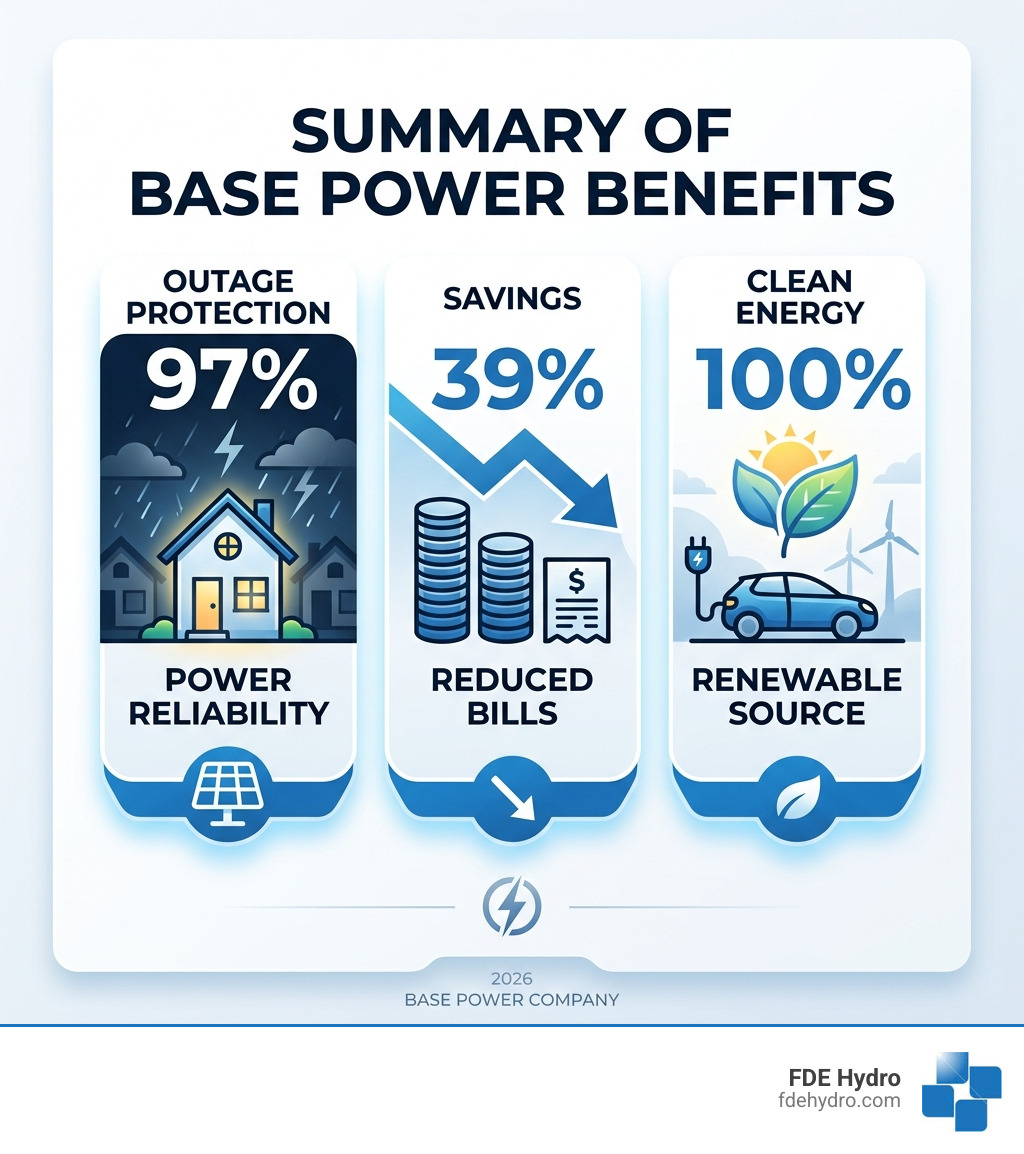
Ready to learn more about the future of energy? Check out these resources:

