

What Is a Hydro Dam? How It Works, Types, and Why It Matters
A hydro dam is one of the oldest and most powerful tools humans have ever built for generating clean electricity. At its core, it does something elegant: it stores water, then releases it in a controlled way to spin turbines and produce power.
Here’s a quick overview of what you need to know:
| Topic | Key Fact |
|---|---|
| What it does | Converts the energy of moving or falling water into electricity |
| Main types | Impoundment, run-of-the-river, pumped-storage |
| Global share | ~15% of world electricity (4,210 TWh in 2023) |
| U.S. share | 6.2% of total U.S. electricity generation (2022) |
| Largest in the world | Three Gorges Dam, China — 22,500 MW |
| Largest in the U.S. | Grand Coulee Dam, Washington — 6,765 MW |
| Grid storage role | Pumped-storage hydro provides ~85% of global grid energy storage |
| Key advantage | Dispatchable, low-emission, long-lived infrastructure |
| Key challenge | High upfront cost, environmental impact, climate/drought risk |
Hydropower is not a new idea. The first hydroelectric plant in the United States opened on September 30, 1882, on the Fox River near Appleton, Wisconsin — over 140 years ago. Yet today, hydropower remains the single largest source of renewable electricity on Earth, generating more than wind and solar combined.
What makes it so enduring? A hydro dam doesn’t just generate power — it also stores water, controls floods, supports irrigation, and can even act as a giant grid-scale battery when built as a pumped-storage system. That combination of benefits is hard to match.
But large hydro projects also come with real tradeoffs: massive upfront costs, long construction timelines, complex permitting, and significant environmental and social impacts. For infrastructure decision-makers, those challenges are the crux of the problem.
I’m Bill French, Sr., Founder and CEO of FDE Hydro™ — and I’ve spent decades in heavy civil construction before turning my focus specifically to hydro dam innovation, including developing patented modular construction systems designed to reduce the cost and time of building hydropower infrastructure. In this guide, I’ll walk you through everything you need to know about hydro dams, from how they work to how the industry is evolving.
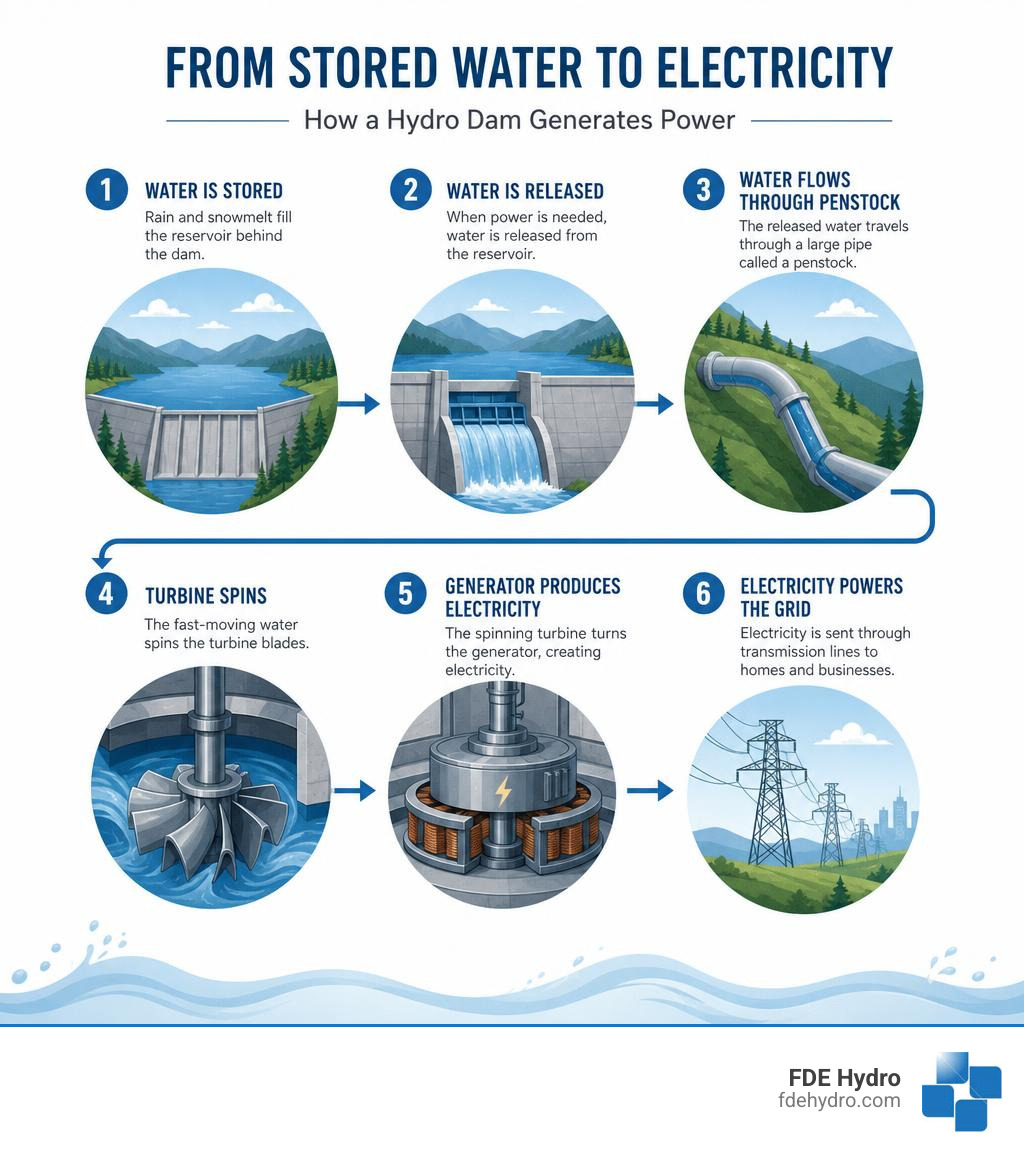
How a Hydro Dam Generates Electricity
To understand how a hydro dam generates electricity, we have to look to the sky. Hydropower is ultimately driven by the solar-powered water cycle. The sun heats the Earth, evaporating water from oceans and lakes. This water condenses into clouds and falls as rain or snow, accumulating in high-elevation watersheds, streams, and rivers.
As that water flows downhill toward the sea, it carries an immense amount of energy. A hydro dam intercepts this water, using elevation head (the vertical distance the water falls) and river flow to convert potential energy into kinetic energy, then into mechanical energy, and finally into electrical energy. Because we can control exactly when we release this water, hydroelectricity is highly dispatchable, meaning we can ramp generation up or down in seconds to match demand on the transmission grid.
How a hydro dam turns head and flow into power
The math behind hydropower is straightforward: power is a function of “head” (pressure created by the vertical drop) and “flow” (the volume or discharge rate of water).
- Water behind the dam is held at a high elevation.
- When electricity is needed, intake gates open, and water flows down a large, reinforced pipe called a penstock.
- The rushing water strikes the blades of a turbine runner, forcing it to spin at high speeds.
- The turbine is connected to a generator rotor. As the rotor spins inside a copper stator, it creates an electromagnetic field that generates alternating current (AC) electricity.
- A transformer steps up the voltage so the electricity can travel efficiently across the transmission grid.
- The water, now spent of its pressure, exits through the tailrace and returns safely to the downstream river.
This process is incredibly efficient, often converting over 90% of the water’s physical energy into electricity. To dive deeper into these mechanical systems, check out our Hydroelectric Dam Components Ultimate Guide.
Conventional hydro dam operation
A conventional hydro dam relies on a reservoir to store water. This acts as a physical savings account for energy. During periods of low electricity demand, water is held back, allowing the reservoir to fill. During peak demand hours, we release water through the powerhouse to generate peaking power.
This operational flexibility allows operators to support the grid’s base load while simultaneously providing rapid-response power. Beyond electricity, these conventional dams serve multiple purposes: they offer flood storage to protect downstream communities, supply water for irrigation, and create reservoirs used for public recreation. You can see this multi-use design in action at massive federal projects like the Bureau of Reclamation Grand Coulee facility.
Pumped-storage hydropower operation
Pumped-storage hydropower works like a giant water battery. Instead of relying solely on natural river inflow, a pumped-storage plant utilizes two reservoirs at different elevations (an upper and a lower reservoir) connected by tunnels with reversible pump-turbines.
- Pumping Mode (Charging): During off-peak hours (like overnight or during peak solar generation in the afternoon), the facility uses cheap, excess grid electricity to pump water from the lower reservoir up to the upper reservoir.
- Generating Mode (Discharging): During peak demand hours, when electricity prices are high, the water is released back down to the lower reservoir, spinning the turbines to generate power.
While pumped-storage is a net energy consumer due to round-trip efficiency losses, it is incredibly valuable. It accounts for nearly 85% of the world’s 190 GW of grid energy storage, facilitating the integration of variable renewables like wind and solar.
Main Types of Hydropower Plants
Not all hydropower facilities require a massive concrete wall blocking a river. Depending on the local geography, water availability, and grid needs, facilities are classified into three primary types.
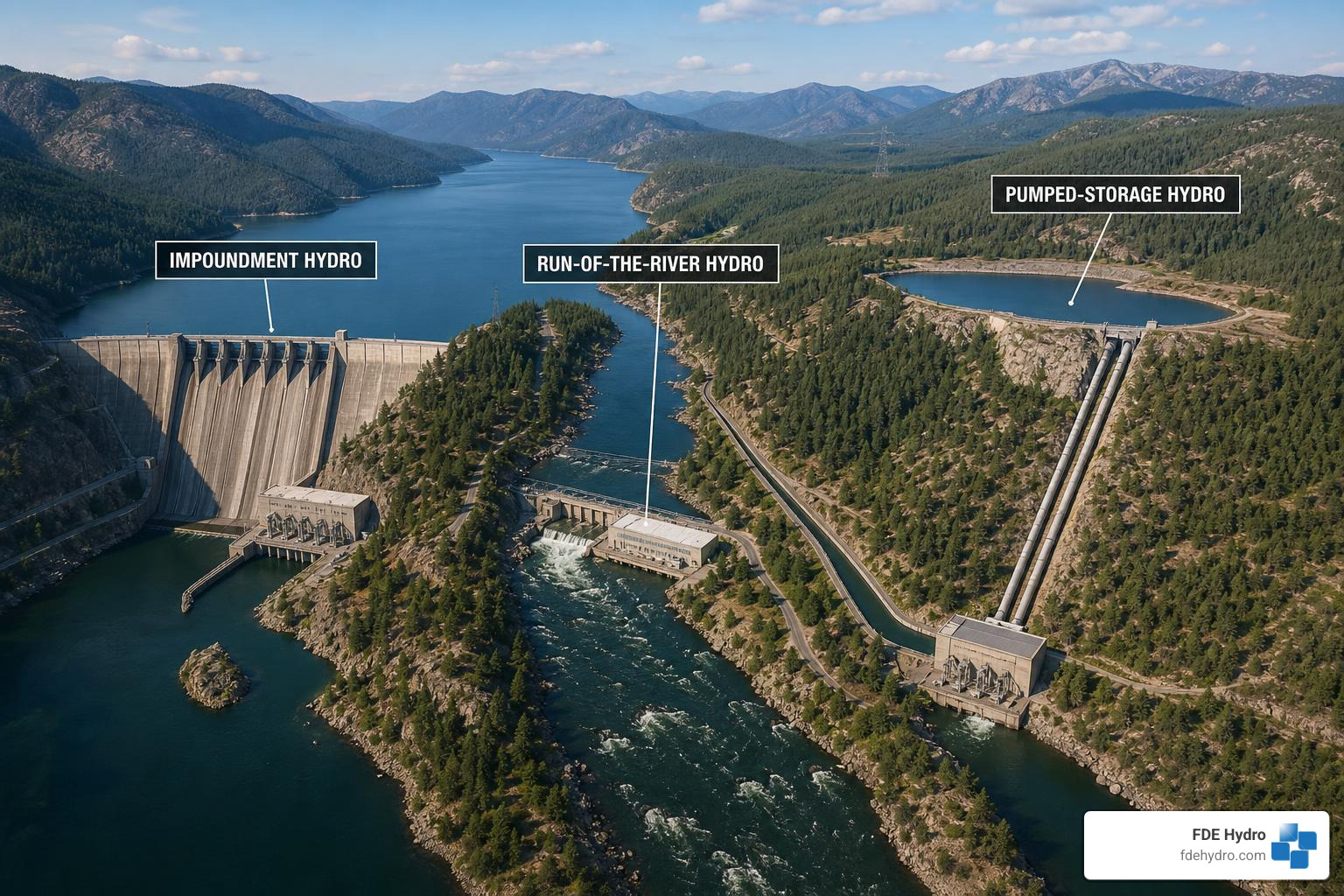
Impoundment hydropower plants
This is the classic hydro dam most people picture. An impoundment facility uses a physical dam to store river water in a large reservoir. Controlled releases through the dam’s powerhouse generate electricity. These systems are highly valued because their large storage capacity allows for seasonal regulation, flood control, and reliable, high-capacity power generation. They represent the most common type of large-scale Hydro Electric Dams globally.
Run-of-the-river and diversion plants
Run-of-the-river (or diversion) plants require little to no water storage. Instead, they divert a portion of a river’s natural current through a canal or penstock to spin a turbine before returning the water downstream.
Because they don’t flood massive valleys to create reservoirs, they have a significantly lower environmental impact. However, their generation is highly variable, relying entirely on the natural daily and seasonal river flow. These systems are common for small hydro, micro hydro, and conduit hydro projects. A fantastic historical and modern example of this in the U.S. is the Bowersock Dam on the Kansas River; you can read about its unique history on the Bowersock Dam – Wikipedia page or learn more About Bowersock.
Pumped-storage plants as grid-scale batteries
As grid-scale batteries, pumped-storage plants are designed for energy arbitrage (buying electricity low, selling it high). But they also provide essential ancillary services that keep our electric grid stable, including frequency regulation, voltage support, black-start capabilities (restarting the grid after a blackout), and smoothing out the intermittent output of wind and solar farms.
Key Hydro Dam Components, Design, and Construction
A modern hydro dam is a marvel of civil engineering, requiring precise coordination between water retention structures, mechanical machinery, and electrical systems.
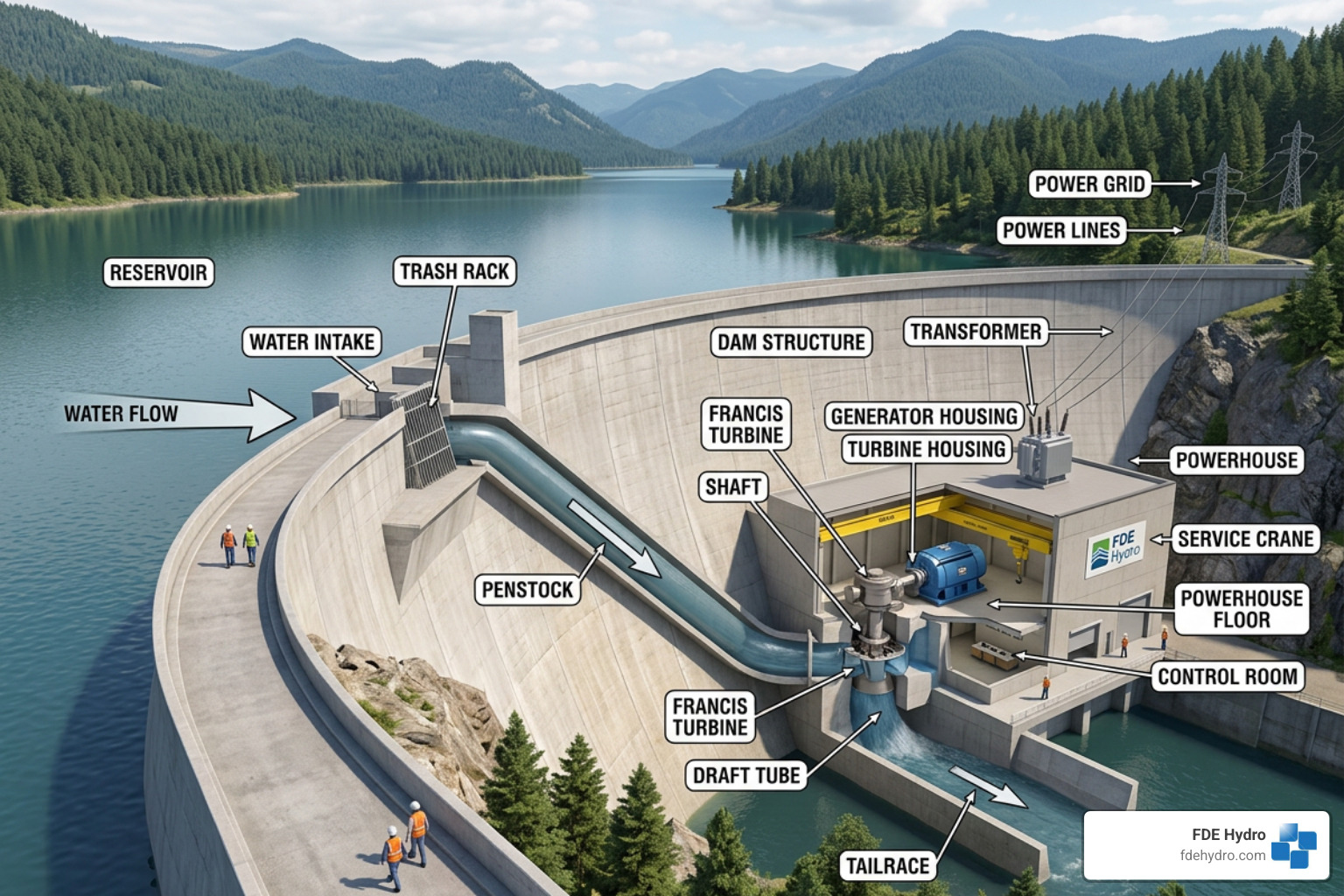
Key hydro dam components to know
Inside a hydroelectric facility, several heavy-duty components work in unison:
- Turbines: The heart of the facility. The type of turbine used depends on the site’s head and flow. Francis turbines are the most common for medium to high head; Kaplan turbines feature adjustable blades for low head and high flow; and Pelton turbines use impulse buckets for extremely high head.
- Penstocks: Massive steel or concrete pipes that channel water under high pressure from the intake gates directly to the turbine runner.
- Gates and Valves: Used to regulate or completely shut off water flow for maintenance.
- Generators and Transformers: Located in the powerhouse to convert mechanical energy into high-voltage AC electricity.
For a detailed breakdown of these systems, read our comprehensive guide on Hydro Dam Components.
Reservoirs, spillways, and water control structures
Water management is a delicate balancing act. Reservoirs are divided into active storage (water that can be used for power generation) and dead storage (water below the intake level).
To prevent a dam from being overtopped during extreme floods, every dam must have a spillway. Spillways use robust gates, such as drum gates or radial gates, to safely route excess water around the dam body. Designing these structures requires a deep understanding of water retention, as discussed in The Art Of Containment Understanding Water Retention Structures.
Hydro dam design and construction methods
Historically, building a hydro dam was a multi-year, multi-billion-dollar endeavor involving massive cofferdams to divert rivers, extensive foundation grouting, and pouring millions of cubic yards of Roller-Compacted Concrete (RCC).
However, traditional construction methods are slow, expensive, and logistically challenging. That is why at FDE Hydro™, we developed our patented modular precast concrete technology (the “French Dam” system). By manufacturing standardized modular concrete blocks off-site and assembling them rapidly on-site, we drastically reduce construction schedules, minimize river diversion risks, and lower capital costs. This technology is revolutionizing how developers approach both new builds and retrofits across North America, Brazil, and Europe.
To explore how dam engineering has evolved, check out our Hydroelectric Dam Design Complete Guide and our overview of modern Dam Construction Methods.
Benefits, Drawbacks, and Energy Comparisons
Like any energy source, hydropower has distinct environmental, economic, and operational trade-offs.
Major advantages of hydropower
- Grid Stability & Dispatchability: Unlike wind and solar, hydro can ramp up or down in seconds, making it the ultimate tool for balancing grid load.
- Incredibly Long Asset Life: While solar panels and wind turbines last 20 to 25 years, a well-maintained hydro dam can easily operate for over a century.
- Low Operating Emissions: Once built, hydropower produces zero direct greenhouse gas emissions during generation.
- Multipurpose Infrastructure: Hydro dams provide invaluable water security, supporting agricultural irrigation, domestic water supplies, and downstream Dam Flood Control.
Environmental and social drawbacks of large hydro dams
Despite the clean energy benefits, large conventional dams pose serious ecological challenges:
- Habitat Fragmentation: Dams block migratory fish pathways. For example, studies show up to 70% of eels passing through traditional hydro turbines can perish.
- Siltation and Erosion: Dams trap natural river sediment, depriving downstream ecosystems of vital nutrients and causing accelerated riverbed erosion.
- Methane Emissions: In tropical regions, flooding vast forests to create reservoirs leads to organic matter decomposing underwater, releasing significant amounts of methane.
- Social Displacement: Large reservoirs have historically flooded communities and ancestral lands, forcing the relocation of millions of people globally.
Hydropower compared with nuclear, wind, and solar
To see how hydropower stacks up against other low-carbon energy sources, consider this comparison:
| Metric | Hydropower | Nuclear | Wind | Solar |
|---|---|---|---|---|
| Capacity Factor | Moderate to High (30% – 70%) | Very High (90%+) | Moderate (35% – 45%) | Low to Moderate (20% – 30%) |
| Dispatchability | Excellent (seconds to minutes) | Limited (slow ramping) | None (weather-dependent) | None (weather-dependent) |
| Asset Lifespan | 80 – 100+ years | 60 – 80 years | 20 – 25 years | 25 – 30 years |
| Upfront Cost | High | Extremely High | Moderate | Low to Moderate |
| Storage Value | Built-in (reservoirs / pumped) | None | Requires batteries | Requires batteries |
Global and U.S. Hydropower Scale, Examples, and Climate Risks
Hydropower is a cornerstone of the global transition to clean energy, but its future is increasingly tied to the realities of a changing climate.
Largest hydropower facilities in the world and the U.S.
Globally, hydropower is a giant. In 2023, it supplied 15% of the world’s electricity (almost 4,210 TWh), which is more than all other renewable sources combined and more than nuclear power. Global installed capacity sits at nearly 1,400 GW.
The largest power-producing facility of any kind on Earth is the Three Gorges Dam in China (22,500 MW), followed closely by the Itaipu Dam – Wikipedia on the border of Brazil and Paraguay (14,000 MW).
In the United States, there are about 1,450 conventional and 40 pumped-storage plants. The crown jewel of U.S. hydropower is the Grand Coulee Dam Statistics and Facts project on the Columbia River in Washington State, boasting a total capacity of 6,765 MW (or up to 7,015 MW depending on seasonal operations). Other major Columbia River giants operated by the U.S. Army Corps of Engineers include Chief Joseph Dam and the multi-purpose John Day Dam and Lake Umatilla > Northwestern Division > Fact Sheet – Northwestern Division project.
Grand Coulee and major U.S. hydro dam examples
The Grand Coulee Dam is a concrete gravity dam standing 550 feet high with a crest length of 5,223 feet. It holds back Franklin D. Roosevelt Lake, a reservoir containing 9.6 million acre-feet of water.
According to the Grand Coulee Dam > Northwestern Division > Fact Sheet – Northwestern Division, the dam generates over 21 billion kilowatt-hours of electricity annually—enough to power 2 million homes. It is the heart of the Columbia Basin Project, which irrigates 720,000 acres of farmland, manages regional flood control, and runs hatcheries releasing millions of salmon and steelhead annually.
Seasonal water, drought, and climate change impacts
Because hydropower relies on water, it is highly sensitive to climate change. Droughts, shrinking mountain snowpacks, and shifting monsoon patterns present operational risks. When water levels in reservoirs drop too low, hydro generation must be curtailed to protect municipal water supplies and ecological flows.
Modern hydro operators must use sophisticated hydrological forecasting and climate adaptation strategies to manage these risks, ensuring dams can handle both severe droughts and the extreme, sudden flood events that are becoming more common.
Economics, Modernization, Safety, and Maintenance
As we look toward the future of the grid, the focus of the hydropower sector is shifting from building massive new dams to optimizing, modernizing, and maintaining the infrastructure we already have.
Costs and benefits of building hydro dams
Traditional concrete dams require enormous upfront capital, complex environmental permitting, and a decade or more of construction risk before generating their first dollar. You can read a complete breakdown of these capital requirements in our article on Hydropower Project Costs and Breaking Down The Dam Costs Of Hydropower Projects.
However, because operating and maintenance (O&M) costs are extremely low and there are no fuel costs, once a hydro project is paid off, it becomes an incredibly profitable, low-cost source of clean energy for generations.
Modernizing and upgrading existing hydropower plants
In North America and Europe, many hydro dams were built before the mid-1970s and are ripe for modernization. Upgrades include:
- Turbine Replacements: Installing modern, highly efficient “fish-friendly” turbine runners.
- Digital Controls & Automation: Improving grid ramping speeds and remote monitoring.
- Non-Powered Dam Retrofits: Less than 3% of the 90,000+ dams in the U.S. actually generate electricity. Retrofitting these existing non-powered dams with modular precast concrete systems, like our French Dam technology, is one of the fastest, most cost-effective ways to add clean capacity to the grid without building new barriers.
To learn more about these strategies, read our guides on Modern Dam Technology and Dam Rehabilitation Encapsulation.
Regulatory, safety, and maintenance considerations
Safety is paramount. In the U.S., the Federal Energy Regulatory Commission (FERC), the Army Corps of Engineers, and the Bureau of Reclamation enforce strict safety standards.
Operating a hydro dam requires continuous structural monitoring for concrete cracks, seepage, and seismic activity. Regular spillway gate testing and maintaining up-to-date Emergency Action Plans (EAPs) are mandatory to protect downstream populations. Compliance with environmental laws like the Clean Water Act and the Endangered Species Act is also central to modern operations.
Frequently Asked Questions About Hydro Dams
What is the difference between hydropower and hydroelectricity?
Hydropower is a broad term referring to any form of energy captured from moving water, which historically included mechanical power for grinding grain or sawing wood. Hydroelectricity refers specifically to using that water energy to generate electrical current through turbines and generators.
Do all dams produce hydropower?
No, the vast majority do not! Out of more than 90,000 dams in the United States, less than 3% actually produce power. Most dams are built strictly for flood control, local water supply, agricultural irrigation, or navigation locks. These non-powered dams represent a massive, untapped opportunity for modular, low-impact hydroelectric retrofits.
Why does pumped-storage hydropower use more electricity than it generates?
Because of the laws of thermodynamics, pumping water uphill and then releasing it back down through a turbine incurs round-trip energy losses (typically operating at 70% to 80% efficiency). However, it is highly profitable and grid-beneficial because it consumes cheap, abundant electricity during off-peak hours and generates high-value, dispatchable power when the grid needs it most.
Conclusion
The humble hydro dam remains a cornerstone of global renewable energy. As we work to decarbonize our electric grids, the dispatchable power, massive energy storage, and grid-stabilizing capabilities of hydropower are more valuable than ever.
While building large-scale, traditional dams presents significant financial and environmental challenges, the future of the industry lies in smart modernization, retrofitting non-powered dams, and adopting faster, more sustainable construction methods.
At FDE Hydro™, we are proud to lead this charge with our patented modular precast concrete technology, making it faster, cheaper, and safer to build and rehabilitate water control systems across North America, Brazil, and Europe. If you’re ready to explore how we can bring your next hydropower project to life, Explore hydropower solutions with us today.
