

Why Hydropower Operator Certification Is the Foundation of a Safe, Reliable Hydro Workforce
Hydropower operator certification is the credential that proves a professional has the knowledge, skills, and hands-on experience to safely run a hydroelectric facility. If you want a quick answer, here is what you need to know:
Quick Overview: Hydropower Operator Certification
| Question | Answer |
|---|---|
| What is it? | A formal credential verifying competency to operate hydroelectric plants |
| Who requires it? | Federal agencies, state utilities, and private plant operators |
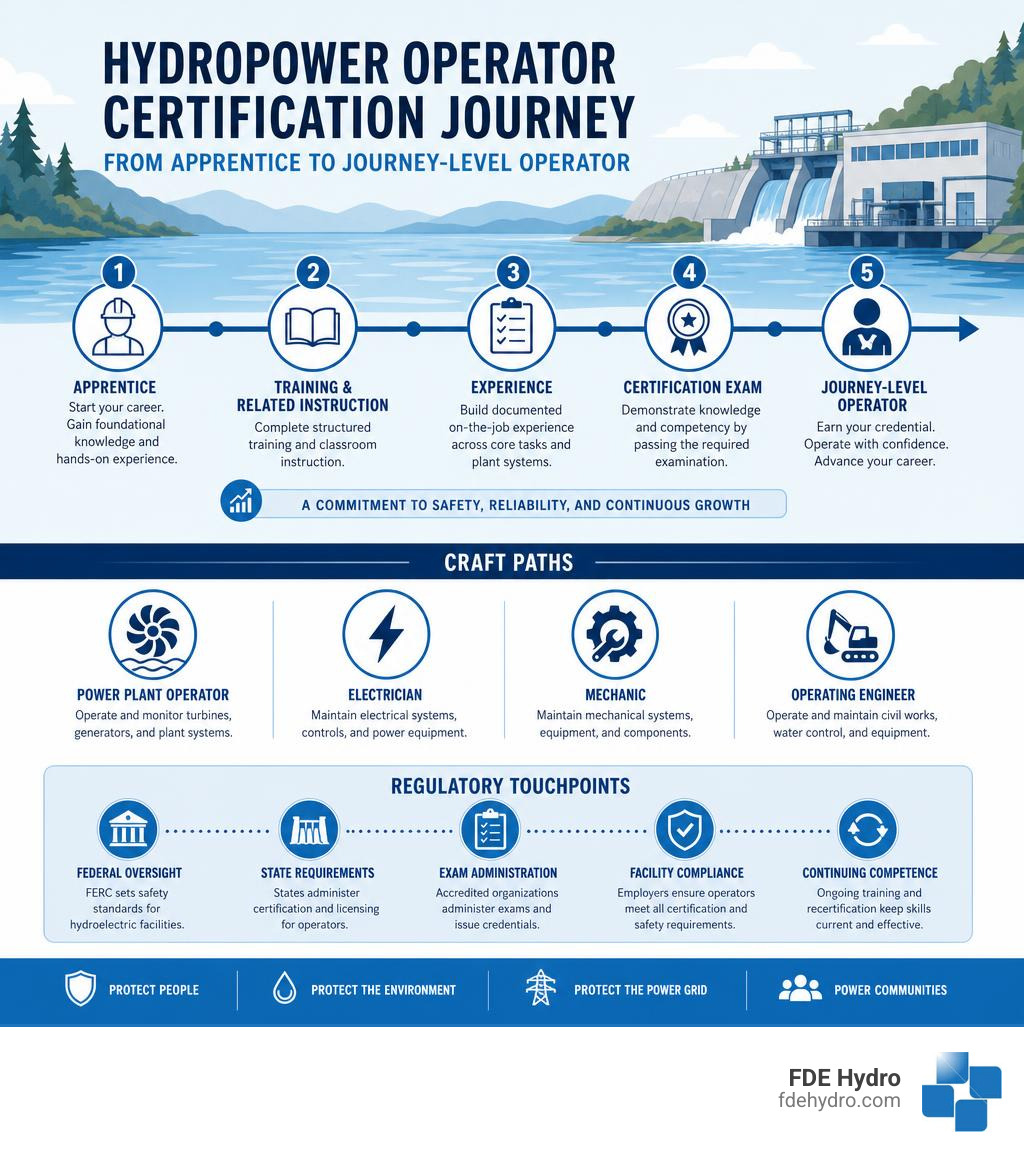
| Main certification types | Power Plant Operator, Electrician, Mechanic, Operating Engineer |
| Typical path | 4-year apprenticeship or recognized operations experience + exam |
| Where to apply | USAJOBS, state civil service portals, utility employer programs |
| Key training resource | NHA Hydro Academy, U.S. Army Corps of Engineers programs |
Hydropower accounts for roughly 6% of all U.S. electricity generation and 31% of all U.S. renewable electricity (as of 2023). That power flows through turbines, generators, control systems, and high-voltage switchgear — all operated by certified professionals working around the clock.
These are safety-critical roles. A single mistake in a powerhouse can affect a dam, a river, a grid, and an entire downstream community. That is exactly why certification exists: to set a clear, verified standard for who is qualified to operate this infrastructure.
The path to certification is not one-size-fits-all. It varies by craft specialty, employer type, state, and whether the facility is federally managed or privately licensed. This guide breaks it all down — clearly and practically.
I’m Bill French, Sr., Founder and CEO of FDE Hydro™, and over the past five decades of leading large-scale civil construction and hydropower development — including participation in the U.S. Department of Energy’s Hydropower Vision Task Force — I have seen how hydropower operator certification shapes the workforce that keeps these facilities running safely and efficiently. Whether you are exploring an apprenticeship, hiring for a plant, or planning a new hydro project, understanding the certification landscape is essential to getting it right.
What Hydropower Operator Certification Means and Why It Matters
Hydropower operator certification is an individual qualification. It confirms that a person can operate, monitor, maintain, or support hydroelectric plant systems according to approved safety, operating, environmental, and grid procedures.
At a basic level, certification tells an employer: this person can be trusted around water under pressure, rotating machinery, high-voltage equipment, and control systems that do not care how good your excuses are.
Certified hydropower professionals may operate:
- Turbine-generator units
- Spillway gates and outlet works
- Powerhouse auxiliaries
- Transformers and switchyards
- SCADA and control room systems
- Reservoir, pumping, and water conveyance systems
- Emergency shutdown and alarm systems
The U.S. Department of Energy’s Hydroelectric Power Plant Operator career profile describes operators as the people who control and maintain the systems that generate hydroelectric power. That sounds simple until you remember that the “system” includes a river, a dam, a grid interconnection, environmental license conditions, and people downstream.
For a broader foundation, our Hydropower overview explains how hydropower fits into modern renewable energy infrastructure.
Why Professionals Need Hydropower Operator Certification
Hydropower plants are usually staffed 24/7, often with rotating shifts. Operators must make decisions during normal operation, storms, grid events, equipment failures, and emergency releases.
Certification matters because operators need verified competence in:
- Controlled water releases
- Generator startup and shutdown
- Switching orders and electrical clearances
- Lockout/tagout procedures
- Turbine and governor operation
- Alarm response
- Spillway and gate operations
- Environmental flow requirements
- Emergency action procedures
- Incident prevention and reporting
A certified operator is not just “turning knobs.” They are managing risk in real time.
Facility Certification vs. Individual Operator Certification
This is one of the biggest points of confusion.
A facility license or certification applies to the project. An operator certification applies to the person.
| Type | Applies To | Examples |
|---|---|---|
| Individual operator credential | A person | Hydroelectric Plant Operator, Power Plant Operator, Operating Engineer |
| Facility license | A hydropower project | FERC license or exemption |
| Environmental certification | A facility or project | Low-impact hydro, RPS eligibility |
| Employer qualification | A specific role or site | Clearance cards, switching authorization, internal requalification |
A plant may have a federal license, state dam safety approval, and renewable energy certification, but it still needs qualified people to run it. Likewise, an operator may hold a credential but still need site-specific training before touching a particular facility’s controls.
Where Certification Is Required, Preferred, or Job-Specific
In the United States and Canada, hydropower operator certification is often tied to the employer, agency, union program, civil service system, or plant classification rather than one universal national license.
You may see certification requirements in:
- Federal hydropower jobs
- State civil service exams
- Public utility operator roles
- Municipal utility positions
- Independent power producer jobs
- Apprenticeship programs
- Operating engineer systems in Canada
- Employer-specific qualification programs
California, for example, uses a civil service exam pathway for Hydroelectric Plant Operator roles through CalCareers. In Ontario, Canada, operating engineer certification is administered through the provincial safety authority, with defined exam, renewal, and experience requirements under Certification: Operating Engineer.
Hydropower Certification Types, Apprenticeships, and Training Paths

Hydropower is a team sport. A certified operator may be the person in the control room, but electricians, mechanics, technicians, compliance staff, and maintenance planners all keep the plant safe and productive.
For related plant upkeep concepts, see our guide to Hydro Power Plant Maintenance.
Main Types of Hydropower Operator Certification
The most common certification or qualification paths include:
| Path | Main Focus | Typical Work |
|---|---|---|
| Power Plant Operator | Operations and control | Startups, shutdowns, water schedules, alarms, switching |
| Hydroelectric Plant Operator | Hydro-specific operation | Turbines, pumps, gates, remote control, clearances |
| Power Plant Electrician | Electrical systems | Breakers, relays, transformers, protection, instrumentation |
| Power Plant Mechanic | Mechanical systems | Turbines, valves, bearings, cranes, pumps, governors |
| Operating Engineer | Power plant safety and plant operation | Plant supervision, pressure systems, registered plant operation |
| Operator-in-Training or Trainee | Entry pathway | Supervised training, classroom learning, rotations |
Different employers use different titles. The key is to read the job announcement carefully and look for required exams, apprenticeship completion, qualifying experience, and site authorization.
Power Plant Operator Pathway
The operator pathway is centered on control authority. Operators may work from local panels, central control rooms, or remote operations centers.
Typical responsibilities include:
- Starting and stopping generating units
- Monitoring reservoir and tailwater conditions
- Implementing water, power, and pumping schedules
- Coordinating load changes
- Responding to alarms
- Performing high-voltage switching when authorized
- Issuing or following clearances
- Maintaining plant logs
- Coordinating with dispatchers and maintenance crews
California’s Hydroelectric Plant Operator exam bulletin lists duties such as operating pumps, generators, auxiliaries, switches, valves, aqueduct facilities, and turnouts from control panels or remotely.
Power Plant Electrician and Mechanic Pathways
Electricians and mechanics may not always be called “operators,” but in hydropower they often complete similar apprenticeship structures and earn journey-level qualifications.
Power plant electricians work on:
- Breakers
- Relays
- Transformers
- Protection systems
- Motors
- Control wiring
- Instrumentation
- Switchyard equipment
Power plant mechanics work on:
- Turbines
- Governors
- Valves
- Bearings
- Pumps
- Cranes
- Gates
- Penstock and auxiliary equipment
Both crafts support safe operation during outages, emergency repairs, inspections, upgrades, and modernization projects. In our work with modular dam and retrofit systems, we see how closely construction, maintenance, and operations must coordinate. Nobody wants to discover a valve access problem after the concrete is already poured.
How the Four-Year Hydropower Apprenticeship Structure Works
A common federal-style hydropower apprenticeship model uses four progressive parts over four years:
- Part I: General hydropower orientation and broad plant fundamentals
- Part II: Beginning specialized craft training
- Part III: Intermediate craft training and deeper equipment responsibility
- Part IV: Advanced craft training leading toward journey-level qualification
The structure typically includes:
- Academic study
- Plant equipment study
- On-the-job training
- Rotations through work groups or facilities
- Mentoring by journey-level workers
- Periodic evaluations
- External exams or licensing steps where required
Some U.S. Army Corps of Engineers hydropower apprenticeship programs follow ER/EP 1130-2-510 guidance and use a one-year-per-part progression. Apprentices may rotate through operator, mechanic, and electrician exposures before specializing. Field officers or supervisors may monitor progress, while journeymen provide hands-on coaching.
In some programs, completing schooling, profiling, and exams may lead to an I-Grade or comparable journey-level qualification.
Professional Development and Short-Course Certification Options
Not every hydropower professional needs a full apprenticeship. Engineers, project managers, asset managers, compliance staff, and new hires from other power sectors often benefit from short-course training.
The NHA Hydro Academy’s system principles training is one example. Based on available program information, the full course provides 40 professional development hours over eight months and covers modules such as:
- Water-to-wires fundamentals
- Equipment and technology
- Environmental topics
- Dam safety
- Production planning
- Markets
- Licensing and compliance
- Asset management and reliability
These programs can support continuing education, cross-training, and faster onboarding. They are not always substitutes for journey-level operator certification, but they help teams speak the same language.
Eligibility Requirements, Prerequisites, and Skills Needed to Qualify

Hydropower is welcoming to people who like practical work, problem-solving, and learning systems from the ground up. But it is not casual work. The entry requirements reflect that.
Entry Requirements for Hydropower Operator Certification Programs
Common prerequisites include:
- Minimum age of 18
- High school diploma or GED
- Transcripts or placement testing
- Math and mechanical aptitude
- Electrical aptitude
- Ability to read and write English for safety and operations
- Valid driver’s license in many roles
- Background check or security clearance
- Ability to work rotating shifts
- Ability to travel between facilities in some apprenticeship programs
Some programs use placement tests such as ACCUPLACER or ALEKS to assess readiness for technical coursework.
For experienced applicants, employers may accept:
- Completion of a recognized apprenticeship
- Prior hydroelectric plant operations experience
- Large pumping plant operations experience
- High-voltage switching experience
- Substation or switching yard experience
- Large power plant experience
California’s civil service pathway notes that qualifying experience may include hydroelectric generating plants, large pumping plants, and certain high-voltage environments. It also recognizes that experience in substations or switching yards of at least 230 kV may substitute for part of the required operations experience.
Knowledge Areas Tested in Exams and On-the-Job Evaluations
Certification exams and evaluations commonly test:
- Hydraulics and water flow
- Turbine-generator principles
- Electrical theory
- Mechanical systems
- Protection systems
- Instrumentation and controls
- SCADA monitoring
- Power and water calculations
- Switching procedures
- Clearances and lockout/tagout
- Plant logs and documentation
- Environmental permit conditions
- Dam safety fundamentals
- Emergency procedures
- Operating codes and safety rules
Operators also need regulatory literacy. A plant’s FERC license, water rights, fish passage requirements, minimum flow rules, and dam safety procedures can all affect daily operation.
Physical Abilities and Working Conditions
Hydropower can be physically demanding. Typical conditions include:
- Lifting up to around 45 pounds frequently in some programs
- Working near moving machinery
- Climbing ladders and stairs
- Working at heights
- Entering confined spaces
- Wearing PPE
- Working around noise
- Walking on wet or uneven surfaces
- Responding to emergency callouts
- Working 12-hour rotating shifts
- Exposure to weather at dams, spillways, and switchyards
Some roles require normal hearing, normal sense of smell, color vision, and enough mobility to respond quickly in industrial environments. These requirements exist because alarms, odors, color-coded indicators, and radio calls can all be safety-critical.
Soft Skills That Separate Successful Apprentices
The best operators are not always the loudest people in the room. Often, they are the ones who notice the odd vibration, ask the careful question, and document the detail everyone else missed.
Strong candidates bring:
- Situational awareness
- Calm judgment
- Curiosity
- Reliability
- Teamwork
- Communication
- Documentation discipline
- Respect for procedures
- Willingness to learn from journeymen
- Attention to detail
- A safety-first mindset
For interviews, many employers use behavioral questions. The STAR method – Situation, Task, Action, Result – is useful for explaining how you handled safety issues, conflict, troubleshooting, or time pressure.
Federal, State, Safety, and Environmental Rules Operators Must Understand
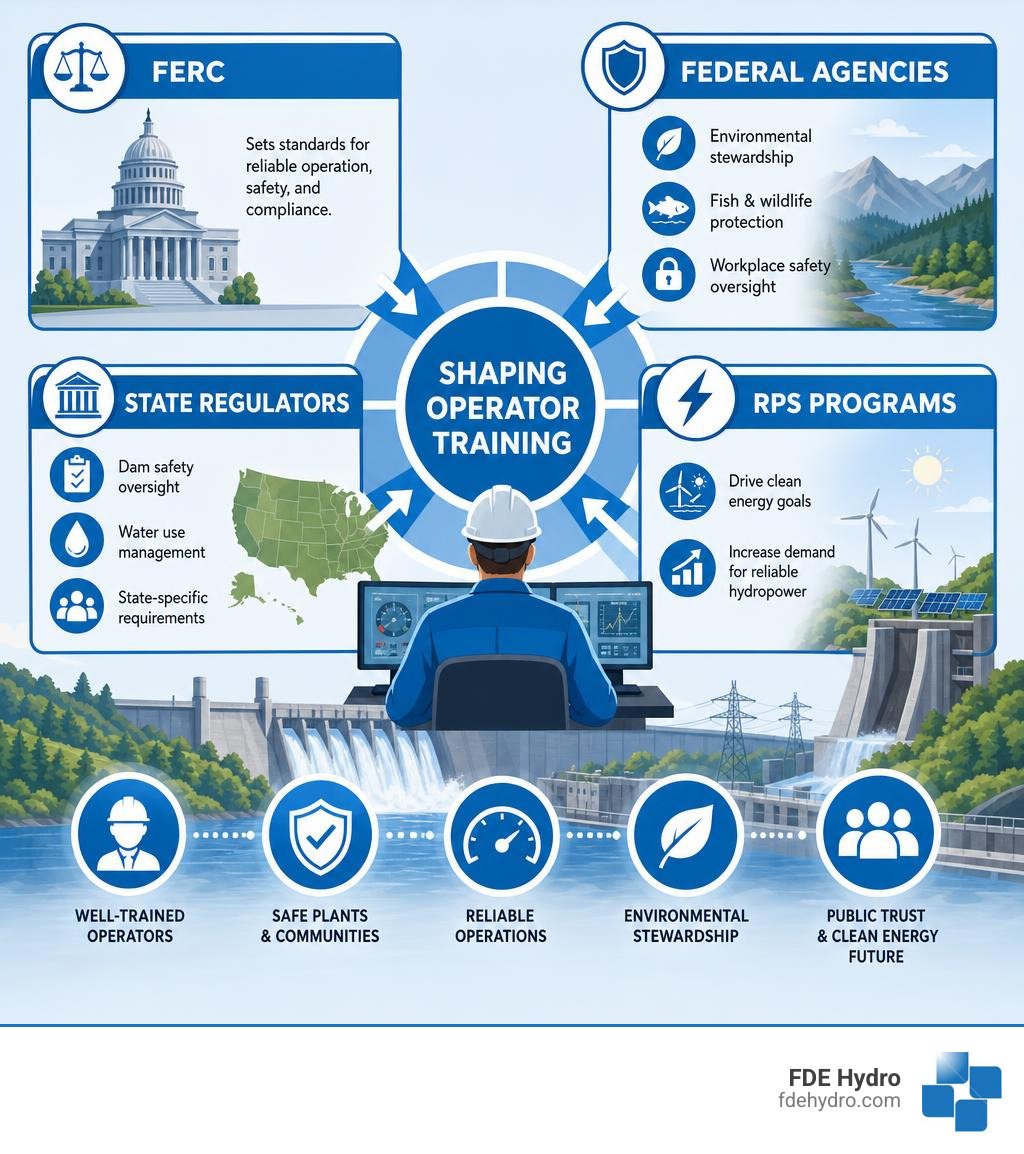
Hydropower operators do not need to be attorneys. That is good news for everyone. But they do need to understand the rules that govern their plant.
For deeper project delivery context, see The Ultimate Guide to Hydropower Project Management Success and Hydropower Asset Management.
Federal Agencies That Influence Operator Standards
In the United States, several federal agencies shape hydropower operations:
- FERC: Licenses and oversees most non-federal hydropower projects.
- U.S. Army Corps of Engineers: Operates federal dams and may approve modifications involving Corps-managed structures.
- Bureau of Reclamation: Manages major water infrastructure in the western United States and may be involved when hydropower uses Reclamation dams or conduits.
- Federal employers: Establish apprenticeship, safety, and qualification procedures for federal hydropower staff.
FERC licenses for original hydropower projects may run up to 50 years. Relicenses typically authorize continued operation for 30 to 50 years. That means today’s operating rules can shape a river and facility for a generation.
FERC Licensing, Exemptions, and Why Operators Should Care
FERC jurisdiction generally applies to non-federal hydropower projects on navigable waters, U.S. lands, federal reservations, or streams affecting interstate commerce.
Operators should care because license conditions become operating instructions. They may govern:
- Minimum flows
- Ramp rates
- Reservoir elevations
- Fish passage
- Recreation releases
- Water quality monitoring
- Reporting
- Emergency procedures
- Inspection schedules
Important FERC-related facts include:
- Small conduit hydroelectric facilities up to 40 MW using flow from a man-made conduit may qualify for exemption from the full licensing process.
- Small hydroelectric power projects of not more than 10 MW may qualify for exemption.
- Qualifying Facilities under 20 MW may be exempt from certain Federal Power Act provisions, including sections 205 and 206.
- A small power production facility is generally 80 MW or less and must use at least 75% renewable primary energy input, including hydro, wind, solar, biomass, waste, or geothermal.
Developers often submit a Pre-Application Document, or PAD, to FERC describing project facilities, operations, and environmental impacts. Operators later live with the procedures and commitments that come out of that process.
State Agencies, Public Utility Commissions, and Operator Qualifications
State-level requirements vary. Depending on location, a hydropower project may need:
- Public utility commission approval
- Certificate of Public Convenience and Necessity
- State dam safety review
- Water rights approvals
- Environmental permits
- State operator exams or civil service eligibility
- Continuing education or requalification
In California, the Hydroelectric Plant Operator civil service process includes an online training and experience exam, minimum qualifications, and an eligible list. Applicants must score at least 70% to be placed on the eligible list, and eligibility lasts 12 months after the list is established.
In Canada, operating engineer programs may involve exams, qualifying experience, renewals, and reinstatement procedures. Ontario’s Operating Engineer certification guidance notes that exams are valid for five years and certificates require renewal.
For facilities in Brazil and Europe, operator qualification is shaped by national grid rules, occupational safety law, employer authorization, and equipment-specific training. The exact credential name changes, but the core principle does not: only trained and authorized personnel should operate safety-critical hydro assets.
Dam Safety, Environmental Compliance, and RPS Eligibility
Hydropower operator certification connects directly to dam safety and environmental compliance.
Operators may support:
- Dam inspections
- Emergency action plans
- Gate testing
- Reservoir monitoring
- Spillway operation
- Minimum flow compliance
- Fish passage operations
- Water quality monitoring
- Recreation release schedules
- Incident reporting
Environmental and renewable certifications may consider criteria such as:
- Flow regimes
- Water quality
- Fish passage
- Threatened and endangered species
- Cultural resources
- Shoreline protection
- Recreation access
Renewable Portfolio Standard, or RPS, eligibility is usually facility-based, not operator-based. Still, operators are the people who keep the facility operating within the conditions that protect eligibility.
Career Pathways, Advancement, and How to Apply in 2026
Hydropower needs experienced hands and new talent. As older workers retire and plants modernize, operators who understand both legacy equipment and digital systems will be especially valuable.
For broader industry context, see our guides to Hydropower Project Costs and Modern Hydropower Technology.
Where to Find Hydropower Apprenticeships and Operator Jobs
In 2026, good places to look include:
- USAJOBS for federal trainee and operator announcements
- State civil service portals such as CalCareers
- Public utility career pages
- Municipal utility job boards
- Independent power producer postings
- Apprenticeship announcements
- Union and non-union training programs
- Employer job alerts
Application materials often include:
- Resume
- Transcripts
- Proof of diploma or GED
- Apprenticeship documentation
- Experience verification
- Test results
- Certifications
- Safety training records
Tailor your resume to the job announcement. If the posting mentions high-voltage switching, SCADA, rotating shifts, or turbine operation, make sure your experience is easy to find.
What to Expect During the Application and Exam Process
Depending on the employer, the process may include:
- Online application
- Civil service form, such as California’s STD 678
- Training and experience exam
- Technical assessment
- Minimum score requirement
- Eligible list placement
- Interview
- Background check
- Medical or physical evaluation
- Security clearance
- Probationary or trainee period
California’s Hydroelectric Plant Operator exam requires a final score of 70% to be placed on the eligible list, with eligibility lasting 12 months. Salary examples listed in the bulletin include monthly ranges of $8,128 to $10,478 and $8,503 to $10,968, depending on range and classification details.
Interview questions often test judgment. Expect scenarios about alarms, unsafe work, unclear instructions, confined spaces, switching, or communication during emergencies.
Career Growth After Hydropower Operator Certification
After certification, career paths may include:
- Journey-level operator
- Senior operator
- Chief operator
- Control room supervisor
- Dispatcher
- Hydro mechanic
- Hydro electrician
- Maintenance planner
- Dam safety technician
- Compliance specialist
- Asset manager
- Operations manager
- Plant manager
- Reliability engineer
Hydropower experience also transfers well into modernization, retrofitting, construction coordination, and asset management. At FDE Hydro, we see that strong operators often become essential voices during retrofit planning because they know how the facility actually behaves – not just how the drawings say it behaves.
Salary, Scheduling, and Long-Term Outlook
Hydropower jobs often offer stable public-sector or utility-sector career paths, but schedules can be demanding.
Expect:
- Rotating shifts
- Nights, weekends, and holidays
- Overtime during outages or storms
- Emergency callouts
- 24-hour coverage requirements
- Strong benefits in many public-sector roles
The long-term outlook is supported by renewable energy demand, grid reliability needs, dam modernization, pumped storage, small hydro, and infrastructure retrofits. As North America, Brazil, and Europe continue upgrading water and power infrastructure, qualified operators will remain central to safe performance.
Frequently Asked Questions About Hydropower Operator Certification
Is Hydropower Operator Certification the Same in Every State or Country?
No. Hydropower operator certification varies by employer, jurisdiction, plant type, and craft.
In the United States, federal agencies, state civil service systems, public utilities, and private owners may each define qualifications differently. California has a specific civil service exam pathway. Canada may use operating engineer certification systems, such as Ontario’s program. Brazil and European countries use their own national safety, grid, and employer qualification frameworks.
Always check the authority that applies to the facility where you want to work.
Can I Become a Hydropower Operator Without Prior Power Plant Experience?
Yes, in many cases. Entry-level apprenticeships and trainee roles are designed for people who do not already have power plant experience.
A strong candidate may come from:
- High school or technical school
- Military mechanical or electrical roles
- Water systems work
- Industrial maintenance
- Electrical trades
- Mechanical trades
- Pumping plants
- Substations
- Control room environments
You will still need to meet age, education, physical, safety, and testing requirements. But you do not always need to start as an expert. Apprenticeships exist because the industry knows operators are built through training.
Does Hydropower Operator Certification Need Renewal?
Sometimes. It depends on the credential.
Possible renewal requirements include:
- Annual certificate renewal
- Multi-year renewal cycles
- Continuing education units
- Professional development hours
- Refresher safety training
- Lockout/tagout requalification
- Switching authorization renewal
- Employer-specific checkouts
- Reinstatement exams after expiration
Ontario’s operating engineer system, for example, includes renewal and reinstatement procedures. NHA-style professional development courses may provide PDHs. Employers may also require recurring safety and site-specific requalification even when an external certificate does not expire.
Conclusion: Your Next Step Toward a Hydropower Operations Career
Hydropower operator certification is the safest, clearest pathway into one of renewable energy’s most important hands-on careers.
If you are starting out, look for apprenticeships, trainee roles, and civil service exams. If you already have industrial, electrical, mechanical, water, or military experience, document it carefully and compare it with the job requirements. If you manage a facility, treat certification as part of your risk management system, not just an HR checkbox.
Modern hydropower needs people who understand water, wires, machinery, safety, and compliance. That combination is rare, valuable, and worth developing.
At FDE Hydro, we believe the future of hydropower depends on better infrastructure and better-trained people working together. To keep learning, explore hydropower solutions and industry insights.
