

Why Micro hydro power solutions Belong in Every Water Infrastructure Plan
Micro hydro power solutions are small-scale hydroelectric systems that generate up to 100 kilowatts of electricity from flowing water — delivering reliable, 24/7 renewable energy for homes, farms, small communities, and remote facilities.
Here’s what you need to know at a glance:
| Factor | Details |
|---|---|
| Power output | Up to 100 kW (a 10 kW system can power a large home or hobby farm) |
| Key requirements | A stream or water source with adequate head (vertical drop) and flow rate |
| Core components | Intake, penstock, turbine, generator, controller, tailrace |
| System uptime | 95–98%, with capacity factors of 40–90% |
| Typical lifespan | 25–50 years with proper maintenance |
| DIY cost range | ~$1,500–$4,000 per kilowatt installed |
| Best for | Off-grid properties, farms, rural infrastructure, water facilities |
Humans have harnessed moving water for energy for over 2,000 years — from ancient waterwheels to modern turbines. What’s changed is how efficient, affordable, and environmentally responsible small-scale hydro has become.
Unlike solar or wind, micro hydro doesn’t depend on weather. If your stream flows, your system generates power — day and night, rain or shine. That predictability is rare in renewable energy, and it’s why water infrastructure planners are paying closer attention to it in 2026.
This guide walks you through everything: how to assess your site, choose the right turbine, navigate permits, and get the most from your investment.
I’m Bill French, Sr., Founder and CEO of FDE Hydro™ — and for over five decades I’ve led large-scale civil construction projects, including my selection by the U.S. Department of Energy to help shape the national roadmap for next-generation micro hydro power solutions. FDE Hydro™ builds on that expertise with patented modular construction technology designed to make hydropower faster, cheaper, and more sustainable to develop. Let’s start with the foundation of any successful project: understanding your site.
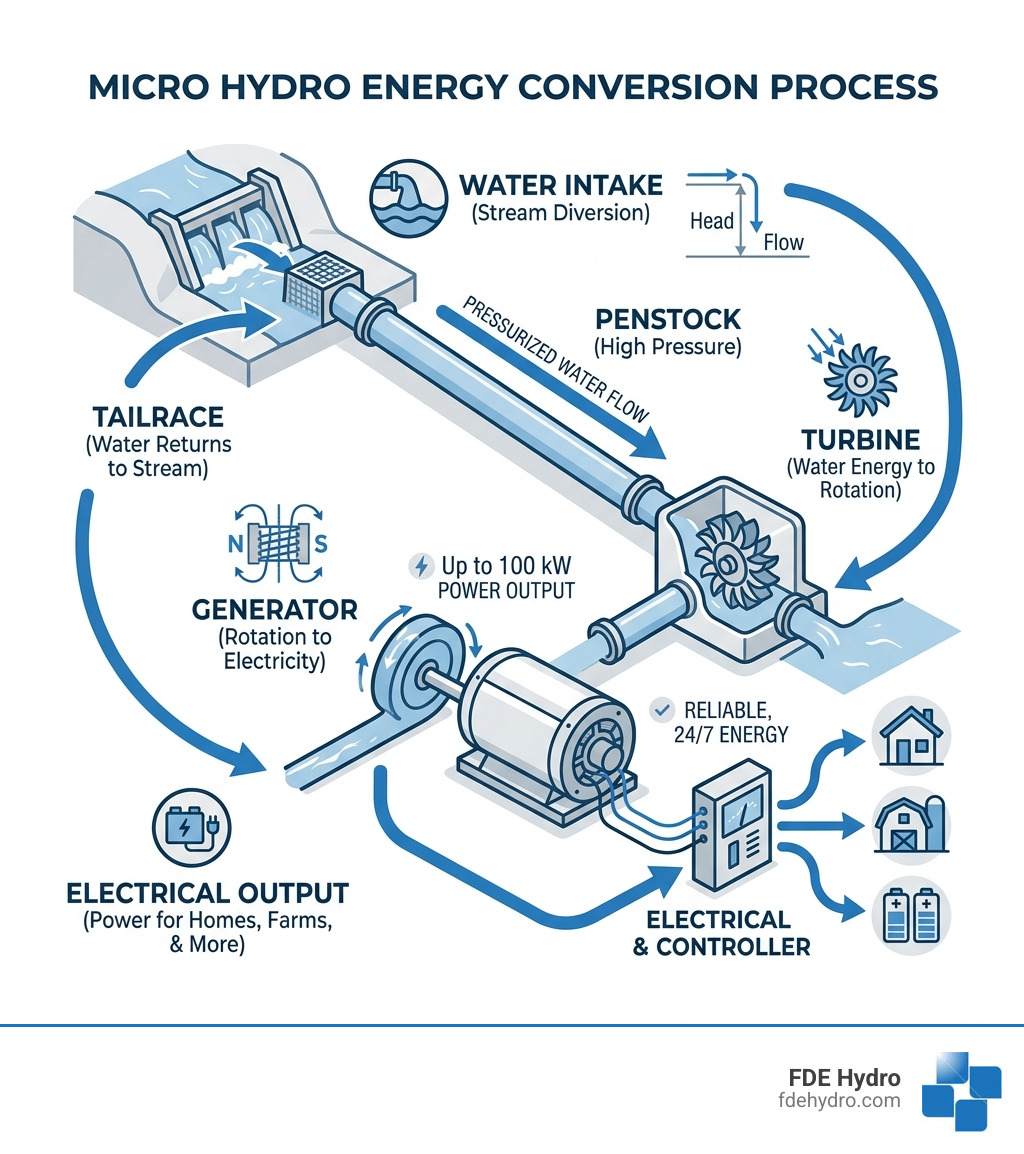
Basic Micro hydro power solutions vocab:
Site Assessment: Measuring Head and Flow for Micro Hydro Power Solutions
Before you buy a single pipe or turbine, we need to talk about the two most important numbers in your life: Head and Flow. Think of head as the “pressure” (how far the water falls) and flow as the “volume” (how much water is moving). Together, they determine your power potential.
Understanding Head: The Vertical Drop
Gross head is the total vertical distance from where you take the water (the intake) to where the turbine sits. Net head is what you actually get to use after accounting for friction losses in your pipes.
To measure this, you don’t need fancy satellites. In 2026, we still love the basics. You can use a surveyor’s transit or a laser level for high accuracy (within 0.1 to 0.5 feet). If you’re on a budget, a water-filled hose with a pressure gauge at the bottom works wonders. Remember: 1 psi of pressure equals roughly 2.31 feet of head.
Measuring Flow: The Volume of Energy
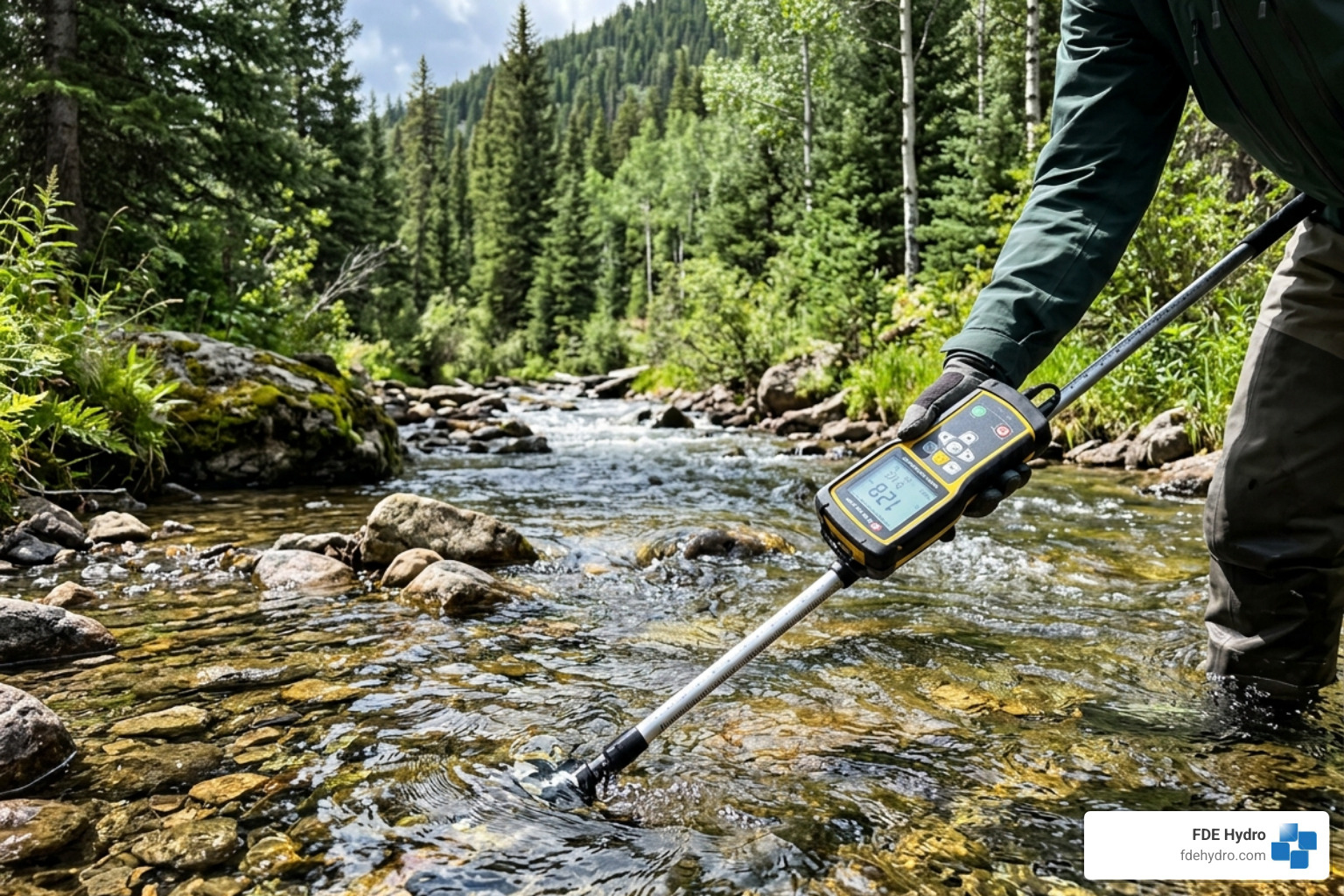
Flow is the amount of water moving past a point, usually measured in gallons per minute (gpm) or cubic feet per second (cfs). Because streams change with the seasons, we always recommend measuring flow during the driest part of the year. If your system can’t run in August, it’s not a 24/7 solution.
Here are the three most common methods:
- The Bucket Method: Best for small streams. Time how long it takes to fill a container of a known size. For example, if a 55-gallon barrel fills in 40 seconds, your flow is 82.5 gpm.
- The Float Method: Best for medium streams. Mark off a 30-foot section of the stream. Toss in a float (an orange or a stick) and time how long it takes to travel that distance. Multiply the velocity by the cross-sectional area of the stream and apply a correction factor (usually 0.6 to 0.8) to account for friction against the stream bed.
- The Weir Method: The gold standard for accuracy. You build a temporary dam with a rectangular notch (a weir). By measuring the depth of the water flowing over the notch, you can use standard tables to find a very precise flow rate.
The Power Calculation
Once you have your head and flow, you can calculate your theoretical power. A simple rule of thumb for micro hydro power solutions is: Watts = [Head (ft) x Flow (gpm)] / 10
For a more technical calculation, use: Pth (kW) = (Flow in cfm x Net Head in ft) / 709
That no system is 100% efficient. While high-quality impulse systems can reach 70% to 85% efficiency, we usually tell beginners to expect an overall “water-to-wire” efficiency of 50% to 70%.
For more on how we approach these calculations with modern technology, check out our page on Hydropower Innovation. You can also find detailed assessment guides at Microhydropower Systems | Department of Energy.
| Method | Accuracy | Difficulty | Best For |
|---|---|---|---|
| Bucket | High | Low | Very small streams/springs |
| Float | Medium | Medium | Medium streams |
| Weir | Very High | High | Professional assessments |
Engineering the System: From Penstocks to Powerhouses
Once you know your site’s potential, it’s time to design the hardware. A typical micro hydro system is a “run-of-river” setup, meaning we don’t need a massive, environment-altering dam. Instead, we divert a small portion of the water, use it, and return it.
Intake Structures and Coanda Screens
The intake is where the journey begins. Its job is to divert water while keeping out leaves, fish, and debris. In 2026, we almost exclusively recommend Coanda screens. These use the “Coanda effect” to pull water through fine slots while debris slides right over the top. They are self-cleaning and drastically reduce maintenance.
The Penstock: Your Power Pipeline
The penstock is the pipe that carries water to the turbine. We typically use HDPE (High-Density Polyethylene) or PVC. The goal is to minimize “friction loss.” If your pipe is too small, the water wastes its energy rubbing against the pipe walls instead of turning the turbine. We often suggest 3-inch to 4-inch piping for small farm systems to optimize flow.
The Powerhouse and Tailrace
The powerhouse protects your generator and electronics from the elements. It doesn’t need to be a palace—a small, ventilated shed will do. The tailrace is the channel that leads the water back to the stream. Ensure the tailrace is clear so water doesn’t “back up” and slow down your turbine.
Our team at FDE Hydro™ specializes in Modular Hydro: The Future of Flexible Power Generation, using precast concrete components to make these civil structures much easier to install.
Selecting Turbines for Micro Hydro Power Solutions
Choosing a turbine is like choosing a car—it has to fit your “terrain” (head and flow). There are two main categories:
1. Impulse Turbines (High Head, Low Flow) These turbines use a high-velocity jet of water to strike buckets on a wheel.
- Pelton Wheels: The classic choice. They are highly efficient (70–90%) and perfect for sites with a lot of vertical drop but not much water.
- Turgo Runners: An upgraded Pelton. They can handle more water in a smaller size and spin twice as fast, which is great for direct-drive generators.
- Jack Rabbit Turbines: These are “drop-in-the-creek” units. They can generate up to 100 Watts from just 13 inches of water with no head at all.
2. Reaction Turbines (Low Head, High Flow) These turbines are fully submerged and use both pressure and the velocity of the water.
- Kaplan or Propeller Turbines: These look like boat propellers inside a pipe. They are excellent for low-head sites like old mill races or irrigation canals.
- Crossflow Turbines: A versatile “drum” shaped turbine that works well in sites with varying flow rates.
3. Pump-as-Turbine (PAT) If you’re on a tight budget, you can actually use a standard centrifugal pump and run it in reverse. While they are 50-70% cheaper than custom turbines, they are less efficient and harder to adjust.
For a deeper dive into turbine mechanics, the Department of Energy offers excellent technical resources.
Optimizing and Maintaining Micro Hydro Power Solutions
A well-built system should provide “free” energy for 20 to 25 years, but it isn’t “set it and forget it.”
- Electronic Governors: These are the brains of the system. They manage the electrical load. If you turn off your toaster, the governor diverts that “extra” power to a “dump load” (like a water heater) to keep the turbine from over-speeding.
- Debris Management: Even with a Coanda screen, check your trash racks regularly, especially after a storm.
- Winterization: In cold climates like New York or Canada, ensure your penstock is buried below the frost line. Moving water rarely freezes, but a shut-down pipe will burst in a heartbeat.
- Bearing Lubrication: Most modern turbines use sealed bearings, but if yours are greasable, make it a monthly habit.
Reliability is the greatest advantage of these systems. We’ve seen systems achieve 98% uptime, providing a level of energy independence that solar simply can’t match. To understand why this stability matters for modern grids, see our article on Why go micro? The undeniable advantages of microgrids.
Economics, Permitting, and Environmental Stewardship
Let’s talk money and rules. While the sun is free and the water is free, the hardware and the paperwork are not.
The Cost of Power
In 2026, the up-front cost for a DIY micro hydro system generally ranges from $1,500 to $4,000 per kilowatt. A 10 kW system might cost you $25,000 to $40,000, but it will generate as much energy as a 50 kW solar array because it runs 24 hours a day.
Financial Incentives
The good news is that there is plenty of help available in North America:
- Investment Tax Credit (ITC): As of 2025/2026, federal tax credits can cover up to 30% of your project costs.
- REAP Grants: The Rural Energy for America Program offers grants for farmers and rural small businesses that can cover up to 25% of eligible costs (ranging from $2,500 to $500,000).
- LCOE: The Levelized Cost of Energy for micro hydro is often between $0.05 and $0.15 per kWh, making it one of the most cost-effective renewables over its 50-year lifespan.
Permitting and Regulations
In the United States, the Federal Energy Regulatory Commission (FERC) oversees hydro. However, most micro hydro power solutions fall under the 5 MW or 10 MW exemption thresholds. This means a much faster approval process (6–12 months) compared to large dams.
You also need to understand water rights. In the Eastern US (like New York), the Riparian Doctrine usually allows property owners “reasonable use” of water. In the Western US (like California or Kansas), the Prior Appropriation system (“first in time, first in right”) is more common. Always consult your state water agency early.
Environmental Stewardship
At FDE Hydro™, we believe energy shouldn’t come at the cost of the ecosystem.
- Fish Passage: Use fish-friendly intake screens and ensure you aren’t blocking migration routes.
- Minimum Bypass Flow: Never take all the water out of a stream. Always leave enough flow in the original stream bed to support aquatic life.
- Run-of-River: By avoiding large reservoirs, we minimize the impact on water temperature and oxygen levels.
For more on how small systems can be eco-friendly, read our Guide to Modular Pumped Storage and Its Benefits.
Frequently Asked Questions
How much does a micro-hydro system cost to install in 2026?
Expect to pay between $1,500 and $4,000 per kW for a DIY setup. Professional, turnkey installations for larger systems (near 100 kW) may cost more due to civil engineering and permitting, but they offer a significantly higher ROI over 30+ years.
What is the minimum head required for a viable system?
While some specialized turbines like the Jack Rabbit can work with as little as 13 inches of drop, most efficient systems prefer at least 2 to 10 feet of head. High-head Pelton systems usually look for 50 feet or more to be truly effective.
Do I need a battery bank for my micro-hydro project?
Not necessarily. If you are grid-intertied, the grid acts as your battery. For off-grid systems, a small battery bank is helpful to handle “surge” loads (like a motor starting up), but because hydro is constant, you need a much smaller battery bank than a solar-only system would require.
Conclusion
Micro hydro power solutions represent a bridge between ancient wisdom and future technology. They offer a level of reliability and energy density that few other renewables can match. Whether you’re a farmer in Kansas looking to power your irrigation or a homeowner in the mountains of California seeking energy independence, the water flowing through your property is a hidden goldmine of clean energy.
At FDE Hydro™, we are committed to making this technology accessible. Our patented modular precast concrete technology—the French Dam—is specifically designed to reduce construction time and costs, making it easier than ever to build or retrofit water control systems in North America, Brazil, and Europe.
Sustainable development isn’t just about big wind farms; it’s about the thousands of small streams that can power our world, one kilowatt at a time.
Ready to harness the current? Explore more about our hydropower services and let’s build something that lasts for generations.
