

Why 2026 hydropower operating costs Determine Your Project’s Viability
2026 hydropower operating costs are a make-or-break factor for any infrastructure decision-maker evaluating long-term energy investments. Here is a quick snapshot of what you need to know:
| Cost Component | 2026 Benchmark |
|---|---|
| Fixed O&M (conventional hydro) | $51.30 per kW-year |
| Variable O&M (conventional hydro) | $1.71 per MWh |
| Average monthly facility OpEx | ~$543,000 |
| Overnight capital cost (base) | $3,280 per kW |
| Regional capital cost range | $1,546/kW – $5,847/kW |
| LCOE range (large hydro) | $0.02 – $0.19 per kWh |
| Potential benchmarked cost savings | Up to 20% of total costs |
Hydropower is one of the most cost-competitive energy sources available today. Its fuel cost is zero, and its lifespan can stretch well beyond 50 years. But low operating costs do not mean no costs.
Many U.S. plants were built decades ago. Turbines age. Generators wear out. Regulatory requirements grow stricter. And the capital needed to keep these facilities running — without passing the bill to ratepayers — is climbing fast.
That pressure is exactly why the DOE announced $430 million in federal incentives targeting 212 hydropower facilities across 33 states, expected to catalyze a total of $2.8 billion in combined public and private investment. The scale of that program tells you everything about the financial challenge facing operators right now.
Understanding where your money actually goes — and where it doesn’t have to — is the foundation of every smart hydropower budget in 2026.
I’m Bill French, Sr., Founder and CEO of FDE Hydro™, and for over five decades I have led large-scale civil construction projects — including hydropower infrastructure — that demand the same hard look at capital efficiency that shapes 2026 hydropower operating costs. My work developing the patented French Dam modular precast system was built specifically to address the cost and timeline burdens that conventional hydro construction imposes on project owners.
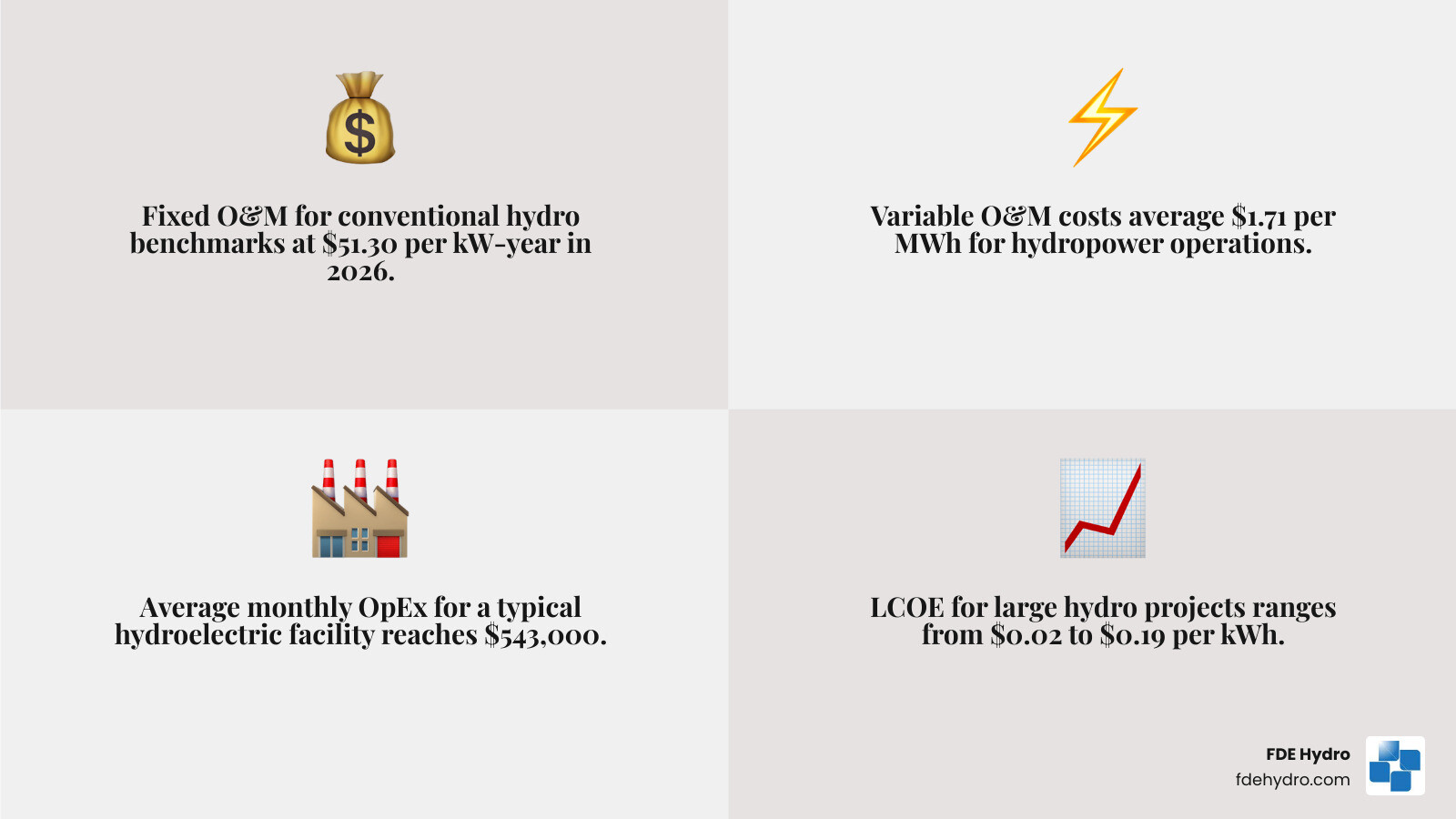
Basic 2026 hydropower operating costs vocab:
Understanding 2026 Hydropower Operating Costs and Benchmarks
Navigating the financial waters of hydropower requires a clear view of both day-to-day expenses and long-term capital requirements. In 2026, the industry is increasingly leaning on sophisticated modeling to predict these flows. According to the Baseline Cost Model for Hydropower: Documentation (2025) – Hydrosource, modern cost estimation now relies on a log-log specification that accounts for plant capacity, age, and capacity factor.
Operating a facility isn’t just about keeping the lights on; it’s about managing a complex ecosystem of fixed and variable expenses. For a typical mid-sized facility, Hydroelectric Power Running Costs: $543K Monthly OpEx highlights that monthly expenditures can reach over half a million dollars when factoring in maintenance, payroll, and regulatory overhead.
To stay competitive, we often look at how we stack up against global peers. PA Consulting’s hydropower benchmarking, which utilizes a “Weighted Maintenance Object” (WMO) model across a massive sample of 2,500 power stations (totaling 110,000 MW), shows that operators can save an average of 20% of total costs through optimized efficiency. This standardized approach allows us to compare diverse assets regardless of their unique configurations or geography.
Fixed vs. Variable 2026 Hydropower Operating Costs
Breaking down the budget further, we distinguish between costs that stay the same regardless of how much water flows through the turbines and those that fluctuate with production.
- Fixed O&M Costs: Based on AEO2026 assumptions, conventional hydropower fixed O&M is projected at $51.30 per kW-year (in 2025 dollars). This covers essential “keep-the-lights-on” items like property taxes, insurance premiums, and a core operational payroll. A typical facility might employ around 13 full-time staff, with a monthly payroll run rate of approximately $107,500.
- Variable O&M Costs: These are pegged at roughly $1.71 per MWh. These costs cover items that wear down based on usage, such as lubricants, small replacement parts, and water-use fees.
Managing these numbers requires a Hydro Power Project Costs A Deep Dive Into The Dollars And Cents approach to ensure that fixed overhead doesn’t swallow the profit margins during low-flow seasons.
Benchmarking Performance with Industry Averages
In our experience at FDE Hydro, we’ve seen how proper Hydropower asset management can transform a facility’s bottom line. Industry data suggests that while overheads are increasing due to necessary reinvestments in maturing markets, top-tier operators are achieving up to a 35% reduction in operating costs and CapEx over 18-month periods by identifying specific cost drivers at the power plant level.
The goal for 2026 is to establish a performance baseline that allows us to move from reactive maintenance to proactive value optimization. By leveraging asset management principles, we can ensure that every dollar spent on a turbine rewind or a dam safety upgrade contributes to the plant’s long-term IRR, which typically hovers around 8% for these capital-intensive projects.
Regional Variations and Market Comparisons in 2026
Geography is perhaps the most significant variable in the hydropower equation. A project in the MISC (Midcontinent) region faces a vastly different economic reality than one in California or New York. The U.S. Electricity Market Module (EMM) defines 25 distinct regions, each with its own “locality multiplier” that adjusts the base overnight capital cost.
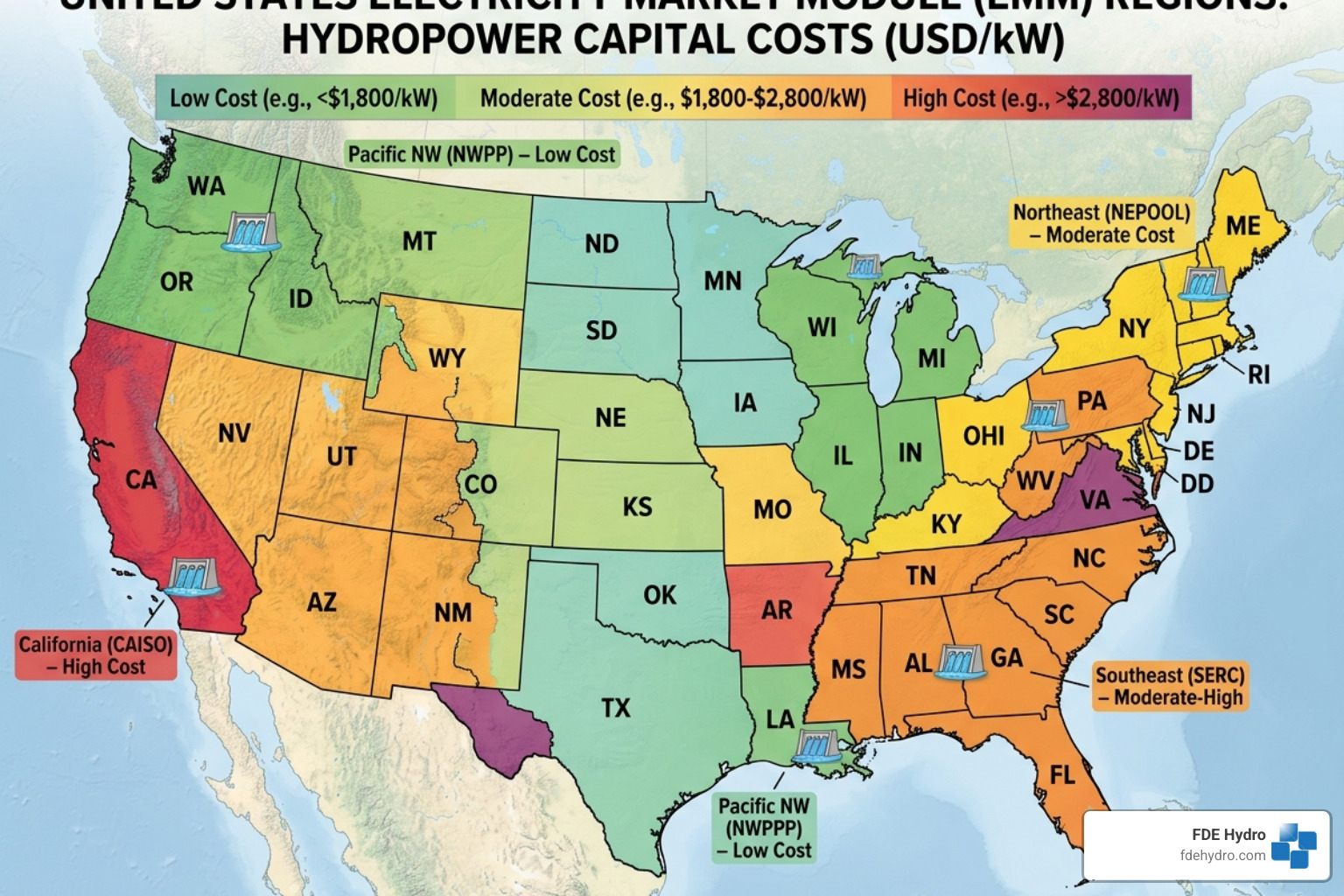
As we analyze Understanding costs of hydroelectricity: Factors that influence hydro power – Green Energy, it becomes clear that factors like water availability, local labor rates, and environmental mitigation requirements create a wide spectrum of costs. While the national base overnight cost is $3,280 per kW, the actual price tag to get a project off the ground can vary by thousands of dollars per kilowatt depending on where you break ground.
Comparing 2026 Hydropower Operating Costs to Other Energy Sources
How does hydro hold its own against the competition in 2026? While technologies like solar PV and wind have lower initial capital requirements, they lack the “baseload” reliability and 50-to-100-year lifespan of a well-maintained dam.
When looking at the Levelized Cost of Energy (LCOE), large-scale Hydropower project costs remain highly competitive, ranging from $0.02 to $0.19 per kWh. In comparison, natural gas combined-cycle plants face volatile fuel prices and carbon taxes, while nuclear power involves significantly higher decommissioning and regulatory hurdles. Hydropower’s ability to provide ancillary services—like grid balancing and frequency regulation—adds a layer of revenue that intermittent renewables simply cannot match.
Regional Multipliers and Site-Specific Feasibility
To Reduce construction costs, we must look at the specific regional multipliers provided by the EIA for 2026:
- Midcontinent (MISC): The most cost-effective region, with costs as low as $1,546/kW.
- Upstate New York (Region 9): Costs rise to approximately $4,410/kW due to labor rates and stricter environmental standards.
- California North (Region 21): Sits at around $4,114/kW.
- Florida (FRCC): Can peak at $5,847/kW, often due to the complexities of low-head geography and specialized foundation requirements.
Understanding these site-specific nuances is critical. For instance, in New York City, new hydro builds are often excluded from projections simply because there are no available sites, forcing a focus on “importing” hydro power via new transmission lines like the Hydro-Québec project.
Impact of Government Incentives and Modernization Programs
The year 2026 marks a turning point for federal support of the U.S. hydro fleet. The Department of Energy’s (DOE) “Maintaining and Enhancing Hydroelectricity Incentives” program, specifically Section 247, has released $430 million to modernize aging infrastructure. This isn’t just a handout; it’s a strategic buffer designed to keep 2026 hydropower operating costs from being passed on to the average ratepayer.
These funds target 293 projects across 212 facilities. By covering a portion of the costs for turbine replacements, generator rewinds, and dam safety improvements, the program is expected to catalyze a staggering $2.8 billion in total investment. For many owners, this makes the difference between Breaking down the dam costs of hydropower projects being a burden or a generational opportunity.
How Federal Funding Lowers 2026 Hydropower Operating Costs
The financial landscape for 2026 has been further reshaped by the “One Big Beautiful Bill Act of 2025” (OBBBA), which made a one-year depreciation schedule permanent for new construction. This, combined with Investment Tax Credits (ITC) and Production Tax Credits (PTC), significantly lowers the effective cost of capital.
For project developers, Project cost reduction is now as much about “tax engineering” as it is about civil engineering. By Financing long term hydropower requires mitigating risks prior to ROI, operators can leverage these federal payments to handle major overhauls—like a $2.275 million CAPEX cycle for turbine upgrades—without depleting their cash reserves to dangerous levels.
Environmental Compliance and Regulatory Expenses
We cannot talk about budgets without addressing the “green” in the room. Environmental compliance is a significant component of fixed O&M. FERC filings, water quality monitoring, and habitat restoration are non-negotiable.
In many cases, environmental mitigation costs are “lump-sum” payments. This can be particularly challenging for smaller plants, as the cost of a fish ladder or a bypass system doesn’t always scale down with the size of the powerhouse. However, investing in Hydroelectric dam efficiency through fish-friendly turbines can actually reduce long-term regulatory friction and potential fines, turning a compliance cost into an operational asset.
Technological Advancements and Infrastructure Upgrades
The “old” way of maintaining dams—waiting for something to break—is dead. In 2026, we are seeing a massive shift toward digital integration. Predictive maintenance powered by AI and IoT sensors allows us to monitor vibration, heat, and flow in real-time. This prevents the “multi-million dollar failures” that occur when service is deferred too long.
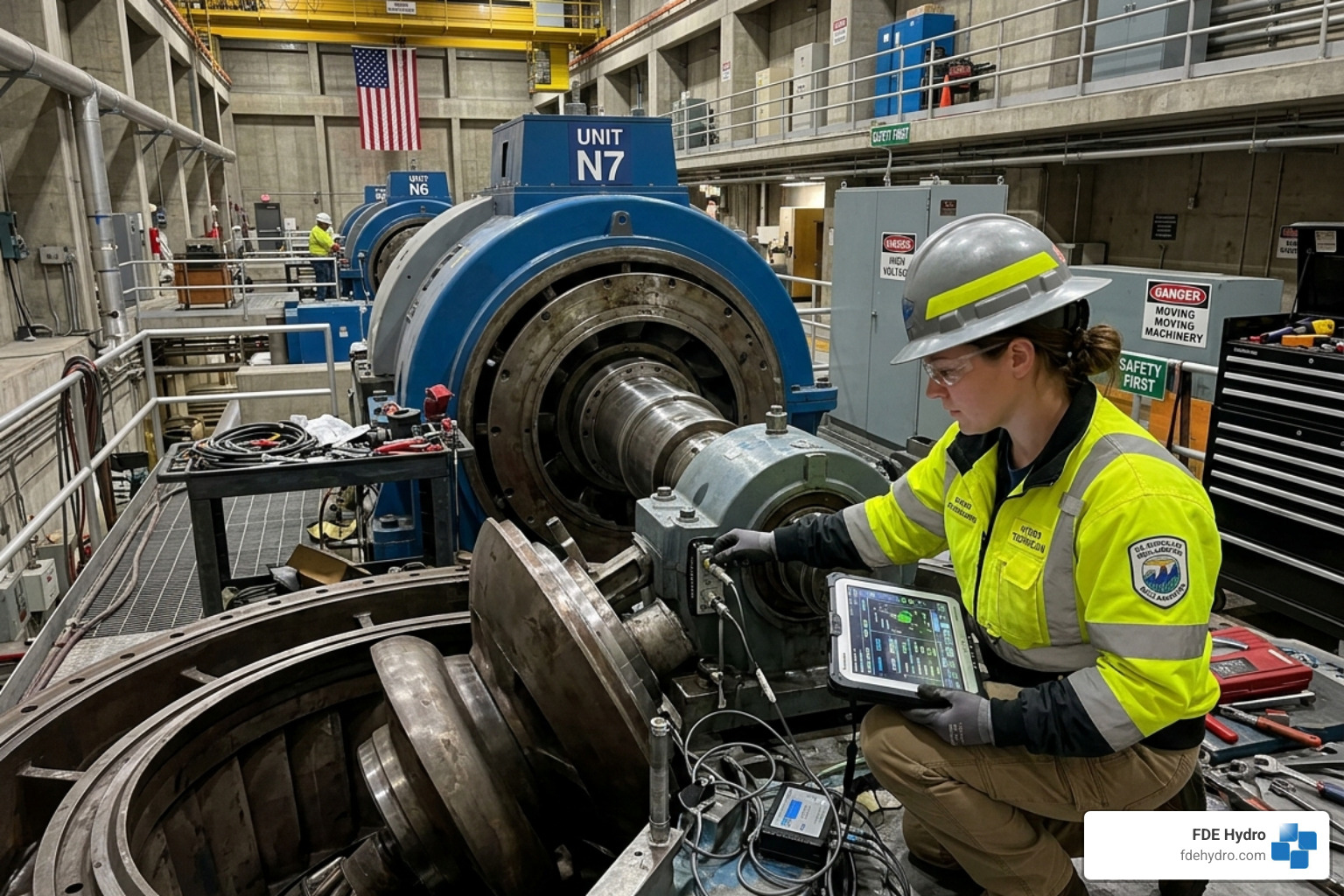
Regular Hydro power plant maintenance is no longer just about grease and wrenches; it’s about data. By identifying a bearing failure weeks before it happens, operators can schedule repairs during low-flow periods, minimizing lost revenue.
Long-term Savings from Aging Infrastructure Modernization
Upgrading a facility built in the 1950s isn’t just about safety; it’s about capacity. For example, Dakota County’s $26 million upgrade to the Byllesby Dam doubled its capacity to 4.4 MW by simply installing more efficient turbines and generators.
At FDE Hydro, we advocate for these types of upgrades because Why precast cost less applies to retrofits too. Using modular components for powerhouse expansions or spillway repairs can cut construction timelines by months, significantly reducing the “soft costs” like site security and temporary power during the build. Whether it’s a Francis turbine for high-head sites or a Kaplan for lower flows, modern electromechanical equipment is 5-10% more efficient than the tech it replaces.
Efficiency Improvements and Digital Integration
Beyond the hardware, the way we sell power is changing. 2026 energy markets reward flexibility. Modernized plants with variable-speed operations can ramp up or down in 15 to 30 seconds, allowing them to capture “ancillary revenue” from frequency regulation.
This flexibility is a key driver of Hydroelectric dam efficiency. When bulk electricity prices drop, a plant that can quickly pivot to providing grid stability services can stay profitable even when others are losing money. These ancillary streams act as a critical buffer, often covering fixed overhead when market prices for energy are low.
Frequently Asked Questions about 2026 Hydropower Budgets
What are the primary drivers of hydropower O&M in 2026?
The biggest recurring costs are fixed maintenance contracts (often around $150,000 per month for mid-sized plants), operational payroll for skilled technicians, and regulatory compliance fees including FERC filings and environmental monitoring. Insurance premiums and property taxes also represent significant fixed overhead.
How does regional location affect hydroelectric project costs?
Capital costs are highly sensitive to local labor markets and geography. While a project in the MISC region might cost $1,546/kW, a similar project in the FRCC (Florida) region can exceed $5,800/kW due to different site conditions and resource availability. Regional multipliers are essential for any accurate feasibility study.
What role does the DOE $430 million program play in cost reduction?
This program, part of the Section 247 incentives, provides direct federal payments for infrastructure improvements. By funding upgrades to turbines, generators, and dam safety, it allows facilities to modernize without raising rates for consumers. It is expected to trigger a total of $2.8 billion in public-private investment.
Conclusion
The landscape of 2026 hydropower operating costs is one of both challenge and immense opportunity. While aging infrastructure and rising regulatory demands put pressure on budgets, the combination of federal incentives, technological leaps, and smarter asset management offers a path to long-term profitability.
At FDE Hydro™, we believe that the future of this industry lies in efficiency—not just in how turbines spin, but in how dams are built and maintained. Our French Dam modular precast concrete technology is designed to slash the very capital costs that often stall these vital projects. By Financing long term hydropower requires mitigating risks prior to ROI, we help owners in North America, Brazil, and Europe build a cleaner, more reliable grid.
Hydropower remains the backbone of renewable energy. With the right budget strategy and modern construction techniques, it will continue to power our world for the next century.
