

The Simple Science Behind How a Hydroelectric Dam Works
How does a hydroelectric dam work? Here’s the short answer:
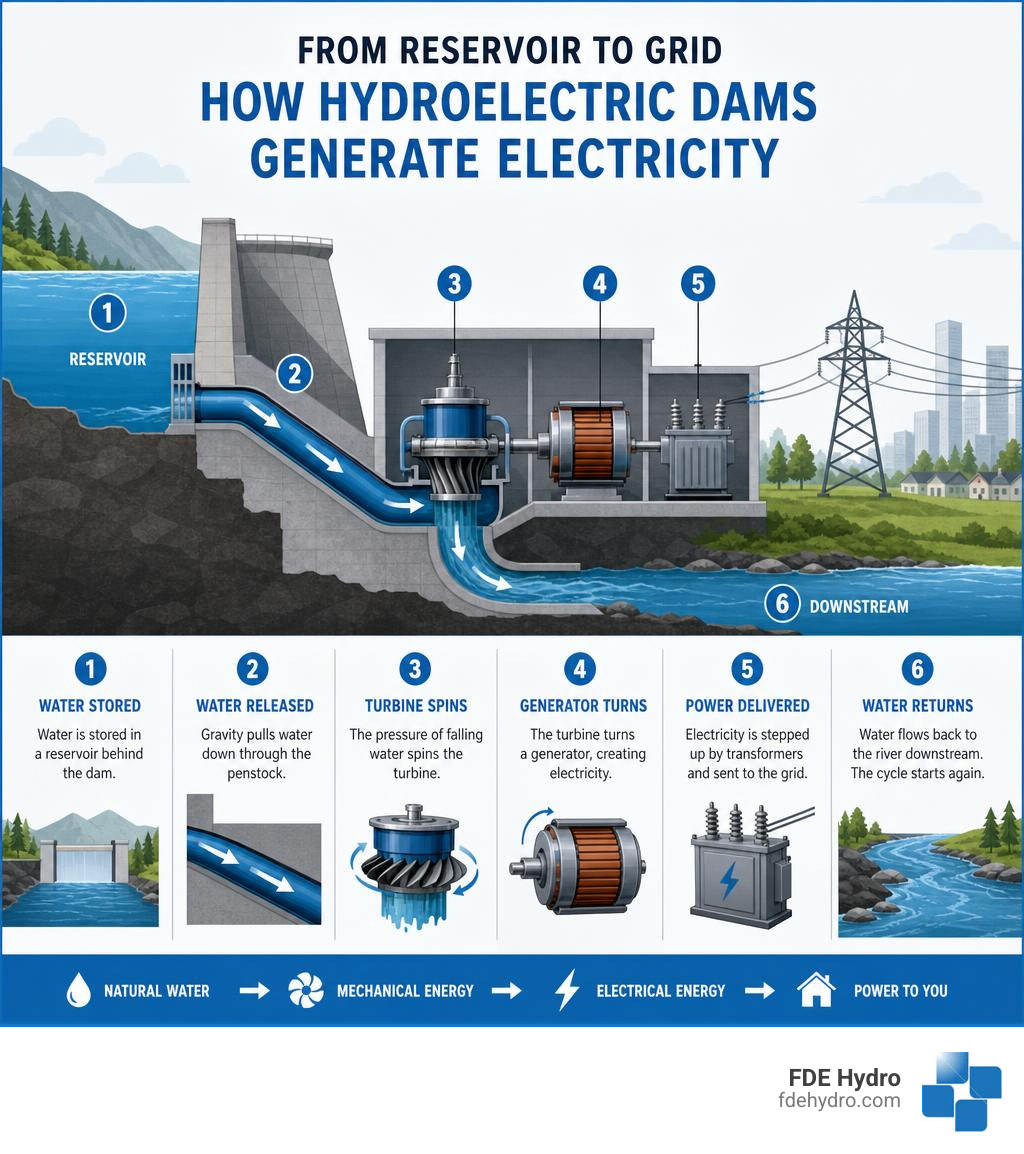
- Water is stored in a reservoir behind a dam, building up potential energy.
- Gravity pulls the water down through a large pipe called a penstock.
- Pressure from the falling water spins a turbine inside the powerhouse.
- The turbine turns a generator, which converts that spinning motion into electricity.
- Electricity flows out through transformers and transmission lines to homes and businesses.
- Water returns to the river downstream — and the cycle starts again.
That’s it. Gravity does the heavy lifting. The dam just controls when and how fast the water falls.
Hydroelectric power is one of the oldest and most reliable forms of renewable energy on the planet. Today it supplies roughly one-sixth of the world’s electricity — and in some countries, like Norway, it accounts for nearly 90% of all power production. In the U.S., about 1,450 conventional hydropower plants are operating right now, generating clean electricity without burning a single drop of fuel.
The core principle hasn’t changed much in over a century: moving water spins a turbine, the turbine drives a generator, and the generator produces electricity. But the engineering behind it — the dams, components, and facility types — is far more detailed and fascinating than that simple chain suggests.
I’m Bill French, Sr., Founder and CEO of FDE Hydro™, and I’ve spent decades in heavy civil construction before turning my focus to modernizing the way hydropower infrastructure gets built — including developing patented modular solutions that directly address how a hydroelectric dam works from the ground up. In this guide, I’ll walk you through every part of the process, from reservoir to the grid.
How Does a Hydroelectric Dam Work? Step-by-Step
At its heart, a hydroelectric dam is an energy conversion machine. It does not create energy from nothing. It converts the natural energy of elevated water into electricity.
The main idea is simple:
- Water stored high behind a dam has potential energy.
- When released, gravity turns that stored energy into kinetic energy, or moving energy.
- Moving water spins a turbine.
- The turbine spins a generator.
- The generator produces electricity.
Two factors largely determine how much power a hydroelectric plant can produce:
- Head – the vertical distance water falls.
- Flow – the volume of water moving through the system.
More head or more flow usually means more potential power. That is why hydroelectric sites are carefully chosen for reliable water supply, good elevation difference, strong geology, and access to transmission infrastructure.
For a clear public overview of the process, see the Hydropower basics from the U.S. Department of Energy.

How does a hydroelectric dam work from reservoir to river?
A conventional hydroelectric dam begins with a reservoir. This is the body of water stored upstream behind the dam. The reservoir acts a little like a battery, except instead of storing chemical energy, it stores water at elevation.
Here is the reservoir-to-river journey:
- Water collects in the reservoir from rainfall, runoff, snowmelt, and river flow.
- Intake gates open when operators or automated controls need to generate power.
- Water enters the penstock, a large pipe or tunnel that carries water downward.
- Pressure builds as gravity accelerates the water.
- The water strikes turbine blades, causing the turbine runner to spin.
- Used water exits through the tailrace and returns downstream to the river.
- Flow is adjusted to match power demand, reservoir conditions, and environmental requirements.
The dam’s job is control. It controls water level, pressure, timing, and release. Without that control, the river still has energy, but the plant cannot reliably convert it into grid-ready electricity.
For more background on the basic definition, see our guide: The Current Definition: Understanding Hydroelectric Power.
How does a hydroelectric dam work inside the generator?
The turbine does not make electricity by itself. It makes rotation.
That rotating motion travels through a shaft into the generator. Inside the generator, the shaft spins a component called the rotor. Around it sits the stator, a stationary ring of copper windings.
The physics comes from electromagnetic induction, often associated with Faraday’s principle: when magnetic fields move past conductive wire, they induce electric current.
In plain English:
- The turbine spins the shaft.
- The shaft spins magnets or electromagnets inside the generator.
- The moving magnetic field interacts with copper windings.
- That interaction produces alternating current, or AC electricity.
- Voltage equipment helps control and prepare that electricity for the grid.
This is why hydroelectric plants and thermal power plants are similar in one important way: both turn turbines connected to generators. A coal or gas plant uses steam to spin the turbine. A hydro plant uses falling water. Same basic generator idea, much cleaner fuel source.
For a deeper look at the electricity side, visit Hydroelectric Power Generation.
How water cycle and gravity keep hydropower renewable
Hydropower is renewable because it is powered by the water cycle.
The process looks like this:
- The sun heats water in oceans, lakes, rivers, soil, and plants.
- Water evaporates and rises into the atmosphere.
- Vapor condenses into clouds.
- Precipitation falls as rain or snow.
- Water runs downhill into streams, rivers, reservoirs, and eventually back to larger bodies of water.
- Gravity keeps the water moving from high elevations to low elevations.
So yes, hydropower is partly solar energy wearing a raincoat. The sun lifts the water. Gravity brings it back down. The dam captures part of that downhill movement and turns it into electricity.
A helpful technical overview is available in the USGS explanation of hydroelectric power.
Main Components of a Hydroelectric Power Plant
A hydroelectric power plant is more than a wall in a river. It is a system of civil, mechanical, electrical, and environmental components working together.
The main parts include:
- Dam structure – holds back water and creates head.
- Reservoir – stores water upstream.
- Spillway – safely releases excess water.
- Intake – controls water entering the power system.
- Trash racks – screen out logs, debris, and large objects.
- Penstock – carries pressurized water to the turbine.
- Powerhouse – contains turbines, generators, and control systems.
- Turbine – converts water energy into rotating mechanical energy.
- Generator – converts mechanical energy into electrical energy.
- Transformer – increases voltage for efficient transmission.
- Transmission lines – move electricity to the grid.
For a component-by-component breakdown, see Hydroelectric Dam Components: Ultimate Guide.

Dam, reservoir, and spillway
The dam creates the elevation difference that gives water useful pressure. Depending on the site, dams may be designed as gravity dams, arch dams, buttress dams, embankment dams, or other configurations.
The reservoir provides storage. That storage can support:
- Electric generation
- Flood control
- Water supply
- Recreation
- Drought management
- Flow regulation
The spillway is the safety valve. When inflows are too high or reservoir levels need to be lowered, the spillway releases water without sending all of it through the turbines. A well-designed spillway protects the dam from overtopping, which is one of the most serious safety risks for many dam types.
Reservoir operations also have to consider sediment. Rivers naturally carry sand, silt, gravel, and organic material. When water slows in a reservoir, some of that material settles. Over time, sediment can reduce storage capacity and affect intakes, outlets, habitats, and downstream river shape.
You can learn more about dam types and functions here: Hydro Electric Dams.
Penstock, turbine, and generator
The penstock is the high-pressure pathway from the reservoir or intake to the turbine. Think of it as the plant’s water highway. The steeper and longer the drop, the more pressure the penstock must be designed to handle.
At the turbine, flow is often regulated by wicket gates or guide vanes. These direct water into the turbine runner at the right angle and volume.
Common turbine types include:
- Francis turbines – widely used for medium head and medium flow sites.
- Kaplan turbines – good for low-head, high-flow applications; their blades can adjust like a boat propeller.
- Pelton turbines – used for high-head, lower-flow sites; water jets strike spoon-shaped buckets.
The turbine converts hydraulic energy into mechanical rotation. The generator then converts that rotation into electricity.
For more on these parts, see Hydro Dam Components.
Transformers and transmission to homes and businesses
The electricity leaving a generator is not ready to travel long distances efficiently. That is where transformers come in.
The path from dam to outlet usually looks like this:
- Generator produces AC electricity at the power plant.
- Step-up transformer increases voltage for long-distance transmission.
- High-voltage transmission lines carry electricity across the grid.
- Substations reduce voltage closer to cities, towns, and industrial users.
- Distribution lines deliver power to homes and businesses.
- Local transformers step voltage down again for safe use.
High voltage reduces energy losses during transmission. That is why electricity is stepped up for travel and stepped down before it reaches your toaster, phone charger, office lights, or manufacturing equipment.
Types of Hydroelectric Facilities and How Pumped Storage Works
Not every hydropower project uses the same layout. The three major categories are conventional storage hydropower, run-of-the-river hydropower, and pumped-storage hydropower.
| Facility type | How it works | Main strength | Main limitation |
|---|---|---|---|
| Conventional storage dam | Stores water in a reservoir and releases it through turbines | Dispatchable, controllable power | Larger land and ecosystem footprint |
| Run-of-the-river | Uses natural river flow with little or limited storage | Smaller reservoir impact | Output depends heavily on river flow |
| Pumped storage | Moves water between lower and upper reservoirs to store energy | Grid-scale energy storage and peak support | Uses more electricity to pump than it later generates |
Conventional storage hydropower
A conventional storage plant uses a dam and reservoir to hold water until electricity is needed. This makes it dispatchable, meaning operators can increase or decrease generation more easily than with many other renewable sources.
This is useful for:
- Morning and evening demand peaks
- Grid balancing
- Backup during outages
- Seasonal water management
- Supporting variable solar and wind generation
The tradeoff is that large reservoirs can flood land, alter river habitats, trap sediment, and change downstream flows. Good design, licensing, monitoring, and operations matter.
For more about plant layouts and functions, see Hydro Energy Power Plant.
Run-of-the-river hydropower
Run-of-the-river hydropower uses the natural movement of a river, often with a small diversion structure or low dam. These systems may have little storage compared with conventional reservoir plants.
Advantages can include:
- Smaller reservoir footprint
- Less large-scale flooding
- Potentially lower visual impact
- Good fit for certain existing water control structures
Limitations include:
- Seasonal generation changes
- Less ability to store water for peak demand
- More sensitivity to drought or low-flow periods
- Need to maintain environmental flows for aquatic life
Run-of-the-river does not mean no impact. It still needs careful design for fish movement, sediment, recreation, water temperature, and downstream flow.
Pumped storage for peak electricity demand
Pumped storage is hydropower’s answer to the battery question. It uses two reservoirs at different elevations.
Here is how it works:
- During low-demand periods, excess electricity powers pumps.
- Water is pumped from the lower reservoir to the upper reservoir.
- During high-demand periods, water is released back downhill.
- The falling water spins reversible pump-turbines.
- The plant generates electricity when the grid needs it most.
Pumped storage does not create net new electricity. In fact, it uses more electricity to pump water uphill than it generates on the way down. But that is not the point. Its value is timing.
It stores energy when electricity is plentiful or less expensive and returns power when demand is high. That helps grid operators manage peak loads, stabilize frequency, and integrate variable renewable sources.
The USGS provides a helpful explanation here: Hydroelectric Power: How it Works.
Efficiency, Output, History, and Global Scale of Hydropower
Modern hydroelectric generation is extremely efficient. Well-designed hydro plants can convert around 90% of available water energy into electricity. That is one reason hydropower has remained important even as solar, wind, batteries, and other technologies grow.
But output is not constant. It depends on water, elevation, equipment, operations, and environmental limits.
For more on performance, see Hydroelectric Dam Efficiency.
What affects hydroelectric dam output?
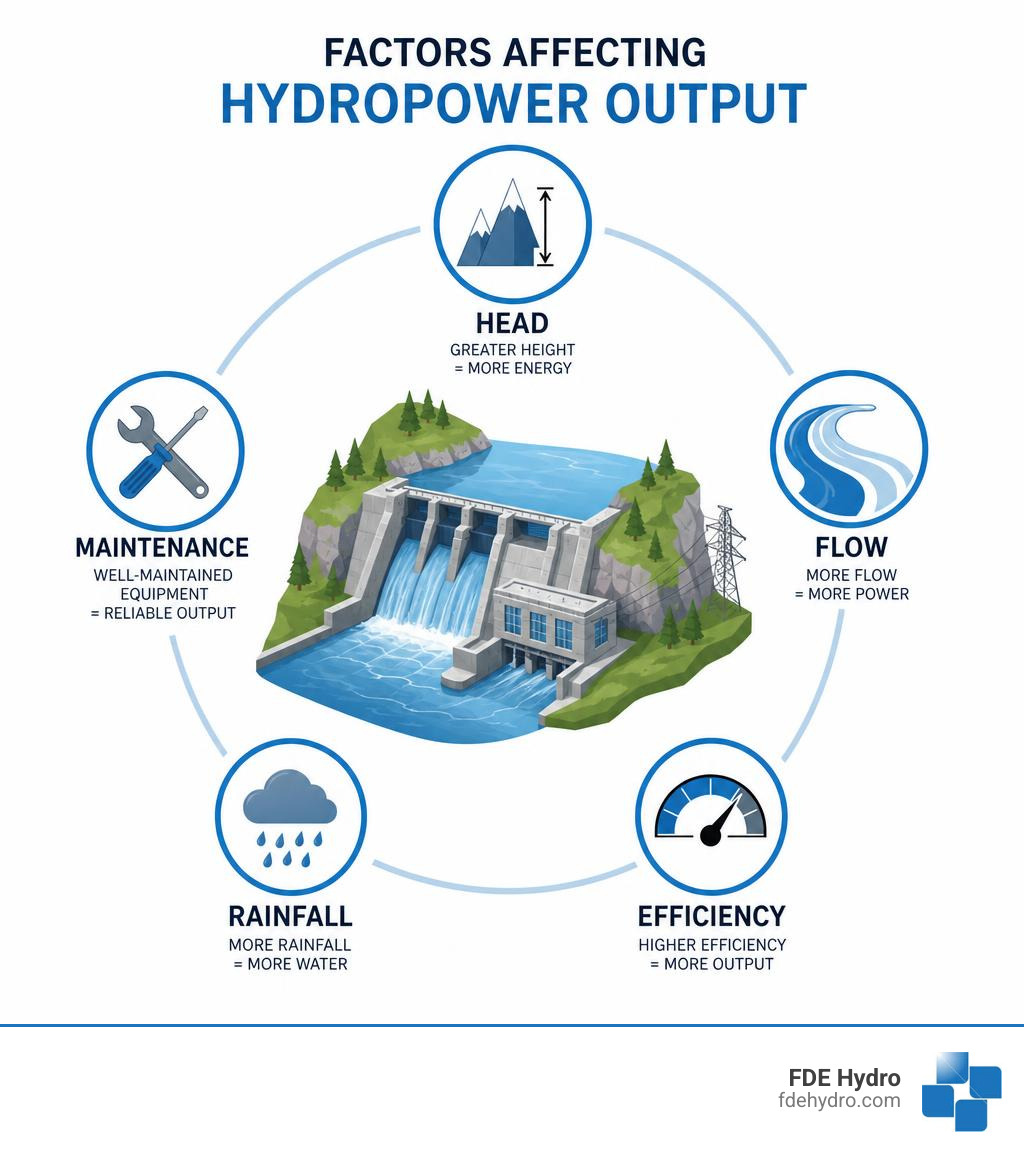
Several factors determine how much electricity a dam can generate:
- Water volume – More flow through the turbines usually means more power.
- Hydraulic head – Greater elevation drop creates more pressure.
- Turbine efficiency – Turbine type and condition affect conversion losses.
- Generator efficiency – Electrical equipment condition matters.
- Reservoir level – Lower water levels can reduce head and output.
- Seasonal conditions – Rainfall, snowmelt, and drought change available water.
- Sediment and debris – Abrasion, clogging, and buildup can reduce performance.
- Maintenance – Worn turbines, seals, bearings, and gates can lower efficiency.
- Environmental flows – Plants may be required to release water for habitat instead of generation.
- Operational limits – Flood control, water supply, navigation, and safety can constrain generation.
A hydro plant is not just “on” or “off.” Operators balance power production with water management, equipment protection, regulatory requirements, and river health.
For a forward-looking efficiency discussion, see Beyond the Turbine: A Look at Hydro Dam Efficiency and Tomorrow’s Hydropower.
Hydropower history and current scale
People have used moving water for thousands of years, long before electric grids existed. Ancient water wheels powered mills for grinding grain, cutting lumber, and driving machinery.
The electric era came later. In the United States, early hydroelectric use included lighting applications in 1880, and one of the first commercial hydroelectric plants began operating in 1882. The oldest operating U.S. hydropower facility is the Whiting plant in Wisconsin, which began operating in 1891 and has about 4 MW of capacity.
As of the research data available before May 2026:
- Hydroelectricity accounted for about 6.2% of total U.S. utility-scale electricity generation in 2022.
- It provided about 28.7% of U.S. utility-scale renewable electricity generation in 2022.
- From 2001 through 2022, hydro averaged about 6.7% of total annual U.S. electricity generation.
- The U.S. has about 1,450 conventional hydropower plants and about 40 pumped-storage plants.
- The Grand Coulee hydroelectric facility has 6,765 MW of total generating capacity.
- Globally, hydropower supplies roughly 15% to one-sixth of electricity production, depending on the dataset and year.
Hydropower is not new, but it is not outdated. In many regions, the future is about modernizing existing infrastructure, improving efficiency, adding generation to non-powered dams, and building smarter water control systems.
For national data, see EIA hydropower explained.
Pros, Cons, and Environmental Impacts of Hydroelectric Dams
Hydropower has major advantages, but it also has real environmental responsibilities. A good article on how does a hydroelectric dam work should explain both sides.
For a broader benefits overview, see Benefits of Hydropower Plant.
Advantages compared with other energy sources
Hydropower offers several strengths:
- Renewable energy – It relies on the water cycle, not fuel combustion.
- Low operating emissions – Plants generate electricity without burning coal, oil, or gas.
- High efficiency – Modern facilities can be around 90% efficient.
- Fast ramping – Operators can often increase or reduce output quickly.
- Long service life – Many hydro assets can operate for decades with proper maintenance.
- Low fuel cost – The fuel is flowing water.
- Grid stability – Large rotating generators can support voltage and frequency stability.
- Energy storage – Reservoirs and pumped storage help shift power to when it is needed.
- Black-start capability – Some hydro plants can help restart the grid after outages.
- Multiple uses – Dams may also support flood control, water supply, irrigation, navigation, and recreation.
Hydropower is especially valuable because it is controllable. Solar and wind are excellent resources, but they depend on sun and weather. Hydropower can often respond when the grid asks for more or less electricity.
Disadvantages and ecological concerns
Hydroelectric dams can also create significant impacts, especially when poorly planned or outdated.
Concerns include:
- River fragmentation – Dams can interrupt natural river connectivity.
- Fish migration barriers – Species that move upstream or downstream may be blocked.
- Altered flows – Natural high and low flow patterns may change.
- Reservoir flooding – Land, habitat, farmland, cultural sites, or communities may be affected.
- Sediment trapping – Downstream channels, deltas, and habitats may lose sediment supply.
- Water temperature changes – Deep reservoir releases can be colder or warmer than natural flows.
- Water quality issues – Low oxygen or stratification can occur in some reservoirs.
- Evaporation losses – Reservoirs can lose water to evaporation, especially in warm regions.
- Drought vulnerability – Less water means less generation.
- Methane risk – Some reservoirs, especially in warm climates with submerged organic matter, can emit methane.
- Dam safety risk – Dams require inspection, maintenance, emergency planning, and responsible operation.
Hydropower is clean at the point of generation, but “clean” should never mean “impact-free.” The goal is responsible design and operation.
How modern design reduces impacts
Modern hydro design is much more sophisticated than simply placing concrete in a river and calling it a day. Thankfully, we have moved beyond the “just build a wall and hope the fish read the signs” era.
Impact reduction tools include:
- Fish ladders and fish lifts to help upstream migration.
- Fish screens to keep fish out of turbines and intakes.
- Bypass systems for safer downstream passage.
- Minimum flow releases to maintain habitat below the dam.
- Selective withdrawal systems to manage water temperature.
- Sediment flushing or bypassing to restore sediment movement.
- Aeration systems to improve dissolved oxygen.
- Turbine upgrades designed to improve fish survival and efficiency.
- Real-time monitoring for flow, temperature, dissolved oxygen, vibration, and performance.
- Retrofitting existing dams instead of building entirely new impoundments where appropriate.
At FDE Hydro, our focus on modular precast concrete technology is part of this modernization conversation. Faster, more controlled construction can reduce site disruption, improve quality control, and support retrofits at existing water infrastructure.
For more on responsible design, see Hydroelectric Dam Design Complete Guide.
Frequently Asked Questions About How Hydroelectric Dams Work
How does a hydroelectric dam work when electricity demand changes?
Hydroelectric plants can respond quickly to changing demand. When the grid needs more power, operators or automated systems open intake gates or wicket gates to allow more water through the turbines. When demand drops, they reduce flow.
This makes hydropower useful for peaking power, which is electricity needed during high-demand hours. Pumped storage adds another layer by storing energy during low-demand periods and generating during peak periods.
Does a hydroelectric dam use up water?
A hydroelectric dam generally does not consume water in the same way a fuel-burning plant consumes fuel. Water passes through the turbine and returns to the river downstream.
However, there can be water losses or changes, including:
- Evaporation from reservoirs
- Temporary storage behind the dam
- Flow timing changes
- Water allocated for other uses, such as supply or irrigation
So the water is not “used up,” but the river system is managed and altered.
Why are some locations better for hydroelectric dams?
The best hydropower sites usually have:
- Reliable river flow
- Strong elevation drop, or head
- Good geology and foundation conditions
- A valley shape suitable for a dam or diversion
- Manageable sediment conditions
- Access to transmission lines
- Lower environmental and community conflict
- Clear permitting and water rights conditions
- Long-term climate and hydrology resilience
A flat river with low flow may still have energy, but not enough for a practical large hydro project. A steep river with reliable flow is usually more promising, assuming environmental and community factors can be responsibly addressed.
Conclusion
So, how does a hydroelectric dam work?
It works by combining the water cycle, gravity, civil engineering, turbines, generators, and the electric grid into one coordinated system. The sun lifts water through evaporation. Rain and snow return it to the land. Gravity pulls it downhill. A dam controls that movement. A turbine captures it. A generator turns it into electricity. Transformers and transmission lines deliver it to the people and businesses that need it.
Hydropower is efficient, renewable, flexible, and proven. It also requires careful environmental design, responsible operations, and modern construction methods.
That is where the next chapter matters. At FDE Hydro, we believe hydropower infrastructure can be built and upgraded faster, smarter, and more affordably using innovative modular precast concrete technology like our patented French Dam system. The goal is not just more power. It is better water infrastructure for North America, Brazil, and Europe.
To keep learning, Explore hydro electric dams.
