

What Are Microgrid Benefits? A Quick Answer Before We Dive In
Microgrid benefits are real, measurable, and increasingly hard to ignore — especially for anyone responsible for keeping critical infrastructure running.
Here is a quick summary:
| Benefit | What It Means for You |
|---|---|
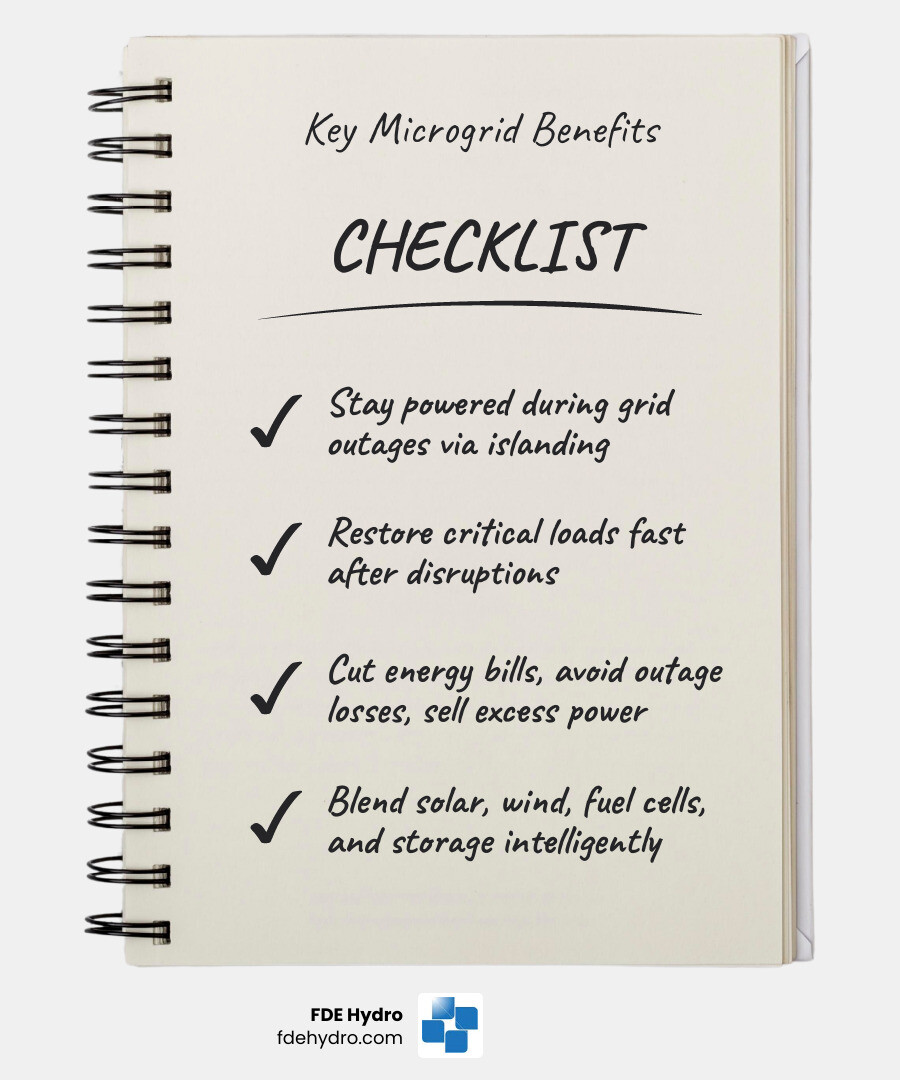
| Reliability | Stay powered during grid outages via islanding |
| Resilience | Restore critical loads fast after disruptions |
| Cost savings | Cut energy bills, avoid outage losses, sell excess power |
| Clean energy | Blend solar, wind, fuel cells, and storage intelligently |
| Grid support | Reduce congestion, provide ancillary services |
| Cybersecurity | Distributed architecture resists attacks |
| Community value | Power hospitals, rural areas, and emergency services |
The traditional power grid was built for a different era. Most U.S. transmission lines and transformers are over 25 years old, and the average power plant is past 30. That aging infrastructure is now being tested by more frequent extreme weather, cyberattacks, and surging demand.
The stakes are not abstract. Power outages cost the U.S. economy between $25 billion and $70 billion every year. A single 30-minute interruption can cost a medium or large business more than $15,000. And events like Superstorm Sandy — which cut power to roughly 8 million customers across 15 states — have shown just how fragile centralized power systems can be.
Microgrids offer a fundamentally different approach. Instead of depending on a distant power plant sending electricity over hundreds of miles of wire, a microgrid generates and manages power locally. When the central grid fails, it simply disconnects — a process called islanding — and keeps running on its own.
That one capability changes everything for infrastructure planners, community leaders, and project developers.
I’m Bill French, Sr., Founder and CEO of FDE Hydro™, and over five decades of heavy civil construction and my work with the U.S. Department of Energy’s Water Power Technology Office, I’ve seen how modular, distributed energy systems — including those delivering microgrid benefits through run-of-river hydro — can transform both energy reliability and project economics. I’ll walk you through exactly why microgrids deserve serious consideration for your next infrastructure project.
Terms related to microgrid benefits:
1. Unmatched Reliability and Resilience (The Core microgrid benefits)

When we talk about microgrid benefits, reliability is almost always the headline. In the traditional “central grid” model, a single fallen tree or a lightning strike at a distant substation can trigger a cascading outage that leaves millions in the dark. We saw this during the 2003 Northeast Blackout, which impacted 50 million people and 61,800 MW of load.
Microgrids change the math by localizing the “blast radius” of an outage. Between 2003 and 2012, severe weather caused outages costing the U.S. an average of $18B-$33B per year. For businesses like data centers, grocery stores, or research labs, these aren’t just statistics—they represent lost inventory and halted productivity.
One of the most powerful features and benefits of microgrids is the ability to prioritize power restoration. In a central grid failure, the utility decides who gets power back first. With a microgrid, a college campus or a hospital can program its system to keep the lights on in research labs and surgical suites while shedding non-essential loads. This autonomous operation was famously demonstrated by Princeton University during Superstorm Sandy, where the campus remained a “beacon of light” while much of New Jersey sat in darkness for two weeks.
To understand the full scope of these systems, it helps to look at more info about microgrid systems and how they serve as the backbone for modern energy security.
Islanding: The Key to Energy Independence
The “magic trick” of a microgrid happens at the Point of Common Coupling (PCC). This is the mechanical and digital “handshake” between the local system and the utility. When the controller senses a voltage drop or a frequency disturbance on the main grid, it triggers a “seamless transition” into island mode.
In this state, the microgrid relies entirely on its own generation—whether that’s solar, battery storage, or a modular hydroelectric unit. According to the Microgrid Overview Fact Sheet, this capability allows facilities to continue serving their community even when the macrogrid is completely incapacitated. It’s localized control at its finest.
2. Economic Advantages: Lowering Costs and Creating Revenue
While reliability gets the glory, the dollars and cents of microgrid benefits are what often seal the deal for CFOs and city managers.
Traditional grid power is surprisingly inefficient. Between 5% and 10% of electricity is lost simply traveling through transmission lines—what we call “line losses.” Furthermore, central power plants are often only 30-40% efficient because the heat generated during electricity production is simply vented into the atmosphere.
| System Type | Typical Efficiency |
|---|---|
| Average U.S. Central Grid | 30% – 40% |
| Combined Heat and Power (CHP) Microgrid | 80% – 90% |
By using Combined Heat and Power (CHP) systems, microgrids capture that waste heat to warm buildings or provide industrial steam, doubling the efficiency of the fuel used.
But the savings don’t stop at efficiency. We use microgrids for energy arbitrage—charging batteries when prices are low and using that stored power when utility rates spike. We also participate in demand response programs, where the utility actually pays the microgrid owner to reduce their draw from the grid during peak times.
For a medium-sized factory, avoiding a single 30-minute interruption can save over $15,000 in lost production time. Over a decade, that’s a massive return on investment. Furthermore, microgrids act as “Non-Wires Alternatives” (NWA). Instead of a utility spending $1 billion on a new substation, they can often support the development of a microgrid to manage local demand more cost-effectively. You can find a deeper dive into these market dynamics in the Taxonomy of microgrid market value.
3. Environmental Sustainability and Clean Energy Integration
One of the most persistent challenges with renewable energy is intermittency—the sun doesn’t always shine, and the wind doesn’t always blow. Microgrids solve this by acting as a “buffer.”
By blending diverse sustainable resources—like solar, wind, and run-of-river hydro—with energy storage and smart controllers, we can maintain a steady power supply regardless of the weather. This is a core part of what is a microgrid and how does it work? It’s not just about having solar panels; it’s about the “brain” (the controller) that balances them.
Microgrids allow us to:
- Mitigate Greenhouse Gases: By shifting away from large, coal-fired plants toward local renewables.
- Meet Renewable Portfolio Standards: Helping states and corporations hit their legally mandated clean energy targets.
- Optimize Fuel Use: Using natural gas generators only when necessary to “firm up” renewable output.
Maximizing microgrid benefits through Clean Energy Integration
Smart controllers are the unsung heroes here. They can be programmed to prioritize the “greenest” electron available. If the batteries are full and the sun is out, the system will use that power first. If the river flow is high, our modular hydro units can provide the “baseload” that solar can’t. This intelligent blending is a major focus of research on microgrid technologies, which looks at how to push renewable penetration to 100% in local systems.
4. Strengthening the Central Grid and Bolstering Cybersecurity
It might seem counterintuitive, but one of the biggest microgrid benefits is that they actually make the central grid stronger.
Think of the central grid like a highway. During rush hour, it gets congested. Microgrids act like “local roads” that take the pressure off the highway. By providing ancillary services—like frequency regulation and voltage support—microgrids help the utility maintain a stable 60Hz signal across the entire region. They can even provide “Black Start” capabilities, helping the main grid reboot after a total collapse.
Cybersecurity is another area where microgrids shine. The U.S. grid is a massive, interconnected target. A successful attack on a major substation can have a “domino effect.” However, the microgrid technology and components we use today are built on a distributed architecture. If one generator or one microgrid is compromised, it can be isolated from the rest of the system, preventing the attack from spreading. This “cellular” approach to energy makes the entire nation more resistant to both cyber and physical attacks.
5. Societal Impact: Community Well-being and Economic Growth
Microgrids aren’t just for military bases and hospitals; they are engines for economic development. When a community can guarantee 99.999% power reliability, it attracts high-quality employers like pharmaceutical manufacturers and data centers. These businesses create local jobs and expand the tax base.
In Europe, European microgrid research initiatives have shown that localized energy helps protect vulnerable populations. During a heatwave or a blizzard, a community center powered by a microgrid becomes a “refuge” where people can find climate control, charge phones, and access medical equipment.
Realizing microgrid benefits in Remote and Underserved Areas
For remote communities, the benefits are even more dramatic. Take the case of Hartley Bay in British Columbia. This remote coastal community historically relied on expensive, dirty diesel generators. By implementing a smart microgrid and demand response system, they reconfigured their diesel dispatch and saved an estimated 77,000 litres of fuel per year—a $77,000 annual saving.
This isn’t just about money; it’s about energy sovereignty. Tribal nations in the U.S. and remote communities in Canada are using microgrids to break their dependence on outside fuel and take control of their own futures. The success of The First Canadian Smart Remote Microgrid serves as a blueprint for rural electrification projects worldwide.
6. Overcoming Implementation Challenges and Planning for the Future
We won’t sugarcoat it: microgrids are complex. A 2018 study found that microgrids in the Continental U.S. cost an average of $2 million to $5 million per megawatt to develop. There are also regulatory hurdles, as many current laws were written for a world where only big utilities owned power plants.
However, the technology is evolving rapidly. At FDE Hydro™, we are tackling the “cost and time” barrier using our patented French Dam technology. By using modular precast concrete, we can build or retrofit hydroelectric systems—a perfect baseload source for microgrids—much faster and for less money than traditional poured-in-place concrete methods.
Whether you are looking at what is a micro-grid? for the first time or you are ready to start siting your generation assets, the future of the grid is clearly distributed. As we integrate more “smart” tech and better storage, these systems will only become more scalable and efficient.
Frequently Asked Questions about Microgrids
How does a microgrid differ from a traditional central grid?
The traditional grid is centralized—power is made at a big plant far away and sent to you. A microgrid is distributed—power is made right where it’s used. The biggest difference is the “islanding” capability; a microgrid can run even if the main grid is dead.
Can microgrids really lower energy bills for businesses?
Yes, in three ways: by “peak shaving” (using your own power when utility rates are highest), by selling excess energy back to the grid, and by avoiding the massive costs of business interruptions. A 30-minute outage can cost $15,000; avoiding just two of those a year pays for a lot of equipment.
What are the main components needed for a microgrid?
You need four things:
- Generation (Solar, Hydro, or Gas)
- Storage (Batteries or Thermal)
- The Controller (The “brain” that manages everything)
- The PCC (The switch that connects you to the utility)
Conclusion
The microgrid benefits we’ve discussed—from saving $77,000 in fuel in a remote village to keeping hospitals running during a hurricane—point toward a single truth: the future of energy is local. By combining the resilience of “islanding” with the economic power of energy arbitrage and the sustainability of renewables, microgrids offer a path to a more secure and affordable energy future.
If you’re interested in how modular hydro can serve as the foundation for your local energy system, we invite you to learn more about microgrid solutions and see how we’re helping to rebuild the grid, one module at a time.
