by Adaptify Support | May 13, 2026 | Hydropower Articles
How Much Does a Hydroelectric Power Plant Actually Cost?
The cost of a hydroelectric power plant is one of the most important — and most misunderstood — numbers in renewable energy development.
Here’s a quick snapshot of what you can expect to pay:
| Plant Type |
Typical CAPEX Range (per kW) |
| Large hydropower (greenfield) |
$1,050 – $7,650/kW |
| Small hydropower |
$1,300 – $8,000/kW |
| Non-powered dam (NPD) retrofit |
$2,400 – $14,500/kW |
| New stream-reach development (NSD) |
$5,500 – $7,900/kW |
| Refurbishment / upgrade |
$500 – $1,000/kW |
- Operating costs run $15 – $60 per kW annually
- LCOE ranges from $0.02 – $0.19/kWh for large hydro
- Plant lifespan is typically 50 – 100 years
- Once built, hydropower can generate electricity for as little as 0.85 – 4 cents per kWh
The numbers above tell one story. But behind them is a much more complex picture — one shaped by site geology, head height, flow rates, environmental permitting, and whether you’re building from scratch or retrofitting an existing dam.
No two hydropower projects cost the same. A high-head site with favorable geology in an accessible location can come in at the low end of the range. A low-head, remote greenfield project can blow past the top end before the first turbine is installed.
That variability is exactly why project developers and infrastructure decision-makers need a clear, structured breakdown of where the money actually goes — from initial civil works all the way through decades of operation.
I’m Bill French, Sr., Founder and CEO of FDE Hydro™, and over five decades leading large-scale civil construction projects — including my work with the U.S. Department of Energy’s Water Power Technology Office on next-generation hydropower solutions — I’ve seen how the cost of a hydroelectric power plant can make or break a project’s viability. In this guide, I’ll walk you through every major cost driver so you can plan smarter and build with confidence.
Basic cost of a hydroelectric power plant glossary:
Understanding the Total Cost of a Hydroelectric Power Plant
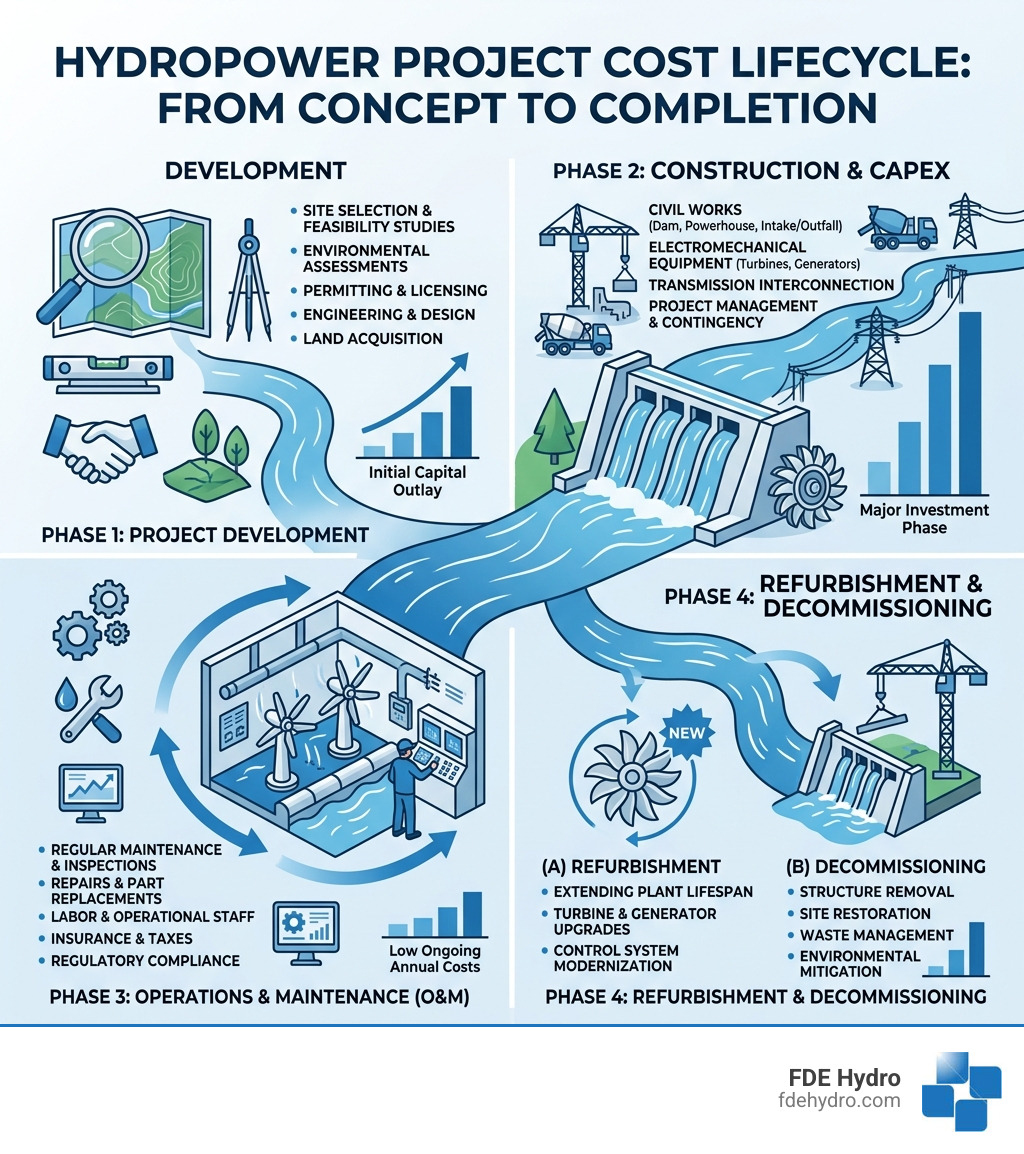
When we talk about the cost of a hydroelectric power plant, we are really looking at two massive buckets: Capital Expenditures (CAPEX) and Operational Expenditures (OpEx). Because hydropower is a “fuel-free” technology — the water keeps flowing for free (mostly) — the economic game is won or lost during the initial investment phase.
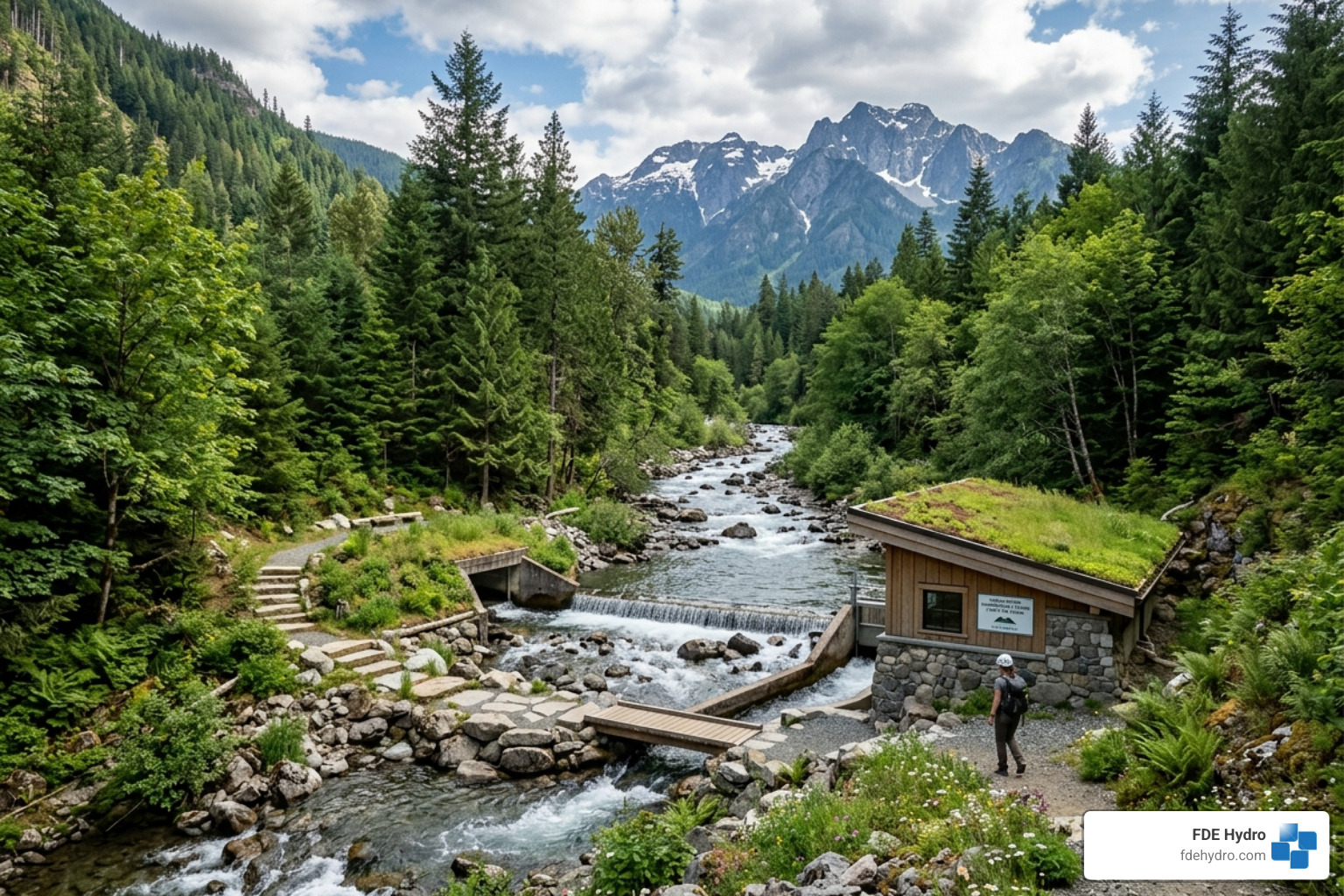
Total installed costs are usually measured in dollars per kilowatt ($/kW). According to the U.S. Hydropower Market Report, these costs can vary wildly. For instance, a “canal or conduit” project might average $7,449/kW, while a massive pumped storage project might benefit from scale and land at around $2,009/kW.
For more detail on these variables, check out our More info about hydro project costs page.
Comparing Small vs. Large Scale Facilities
It seems counterintuitive, but smaller isn’t always cheaper on a per-unit basis. Micro-hydro plants (under 1 MW) often face higher per-kilowatt pricing because they can’t take advantage of the same procurement discounts as mega-dams. While a massive 500 MW facility might cost billions in total, its cost per kW is often lower than a 100 kW stream-side turbine.
However, large-scale projects face their own “mega-project” risks. Costs for massive dams can exceed $10 billion, and construction timelines of 5 to 15 years mean that interest on loans can pile up before a single watt is sold.
Non-Powered Dams (NPD) vs. Greenfield Development
One of the smartest ways to manage the cost of a hydroelectric power plant is to look at what’s already there. In the U.S. alone, there are over 80,000 dams, but only about 3% of them actually produce power.
Retrofitting a Non-Powered Dam (NPD) is often more cost-effective than “New Stream-reach Development” (NSD) because the primary civil barrier is already built. However, NPD costs still range from $2,400 to $14,500/kW because you have to work within the constraints of an existing, sometimes aging, structure. We go into detail on this in our guide on Breaking Down The Dam Costs Of Hydropower Projects.
Breaking Down CAPEX: From Civil Works to Turbines
If you look at a budget for a new hydro plant, you’ll notice that “pouring concrete” and “buying machines” eat up the lion’s share.
Main Components of Initial Investment
The cost of a hydroelectric power plant is typically split between civil works (the dam, powerhouse, and spillways) and electromechanical equipment (the “guts” of the plant).
- Civil Engineering & Construction: This usually exceeds $1 million even for small projects and can account for 60-70% of total costs for large reservoir plants. This includes the dam itself, water diversion channels, and the powerhouse. For a deep dive into these parts, see our Hydroelectric Dam Components Ultimate Guide.
- Electromechanical Equipment: Turbines and generators are the stars of the show. In smaller projects, these components can account for 40-60% of the total budget.
- Penstocks and Gates: These are the “pipes” that deliver water to the turbine. Depending on the distance from the water source, these can be a massive line item.
- Transmission Lines & Grid Connection: Getting the power to the people isn’t free. Grid connection costs typically range from $200,000 to $500,000 depending on proximity to existing lines.
You can learn more about the physical labor involved in our article on Hydroelectric Dam Construction.
Factors Influencing the Initial Cost of a Hydroelectric Power Plant
Why does one 5 MW plant cost double another? It usually comes down to two physics terms: Head and Flow.
- High Head, Low Flow: These sites use a large “drop” in height. They require less civil work but more expensive penstock piping.
- Low Head, High Flow: These sites need massive amounts of water moving through huge turbines. This requires larger powerhouses and more extensive concrete work.
Site geology also plays a role. If the bedrock isn’t where the engineers thought it was, foundation costs can skyrocket. Environmental mitigation — like fish ladders or bypasses — are also essential “hidden” costs that can reach into the high six figures. For more on how design choices impact the bottom line, read our Hydroelectric Dam Design Complete Guide.
Operational Expenses (OpEx) and Long-Term Maintenance
Once the ribbons are cut, the cost of a hydroelectric power plant shifts into OpEx. The good news? Hydropower has some of the lowest operating costs in the energy world, ranging from 1% to 4% of the initial investment annually.
Recurring Monthly and Annual Running Costs
Running a facility isn’t just about watching water flow. A typical financial model for a mid-sized plant might project a monthly OpEx of around $543,000. This includes:
- Plant Maintenance: A fixed monthly cost (often around $150,000) for turbines and dam infrastructure.
- Operational Payroll: You need a team. A 13-person crew of engineers and operators can cost roughly $107,500 per month.
- Taxes & Insurance: Expect to pay significant property taxes and insurance premiums (around $80,000/month for larger facilities).
- Regulatory Fees: Compliance with environmental agencies and grid operators is a recurring expense.
We provide a more granular look at these numbers in our report on Hydropower Project Costs. You can also find scientific research on hydropower cost analysis for more technical benchmarks.
Managing Cash Flow and Major Overhauls
While day-to-day costs are low, “lumpy” CAPEX can cause headaches. Every 20 to 30 years, turbines need rewinds or overhauls. A major overhaul in 2026 might cost $2.275 million, which can lead to temporary cash shortfalls if not planned for decades in advance. Managing this working capital is vital for long-term survival.
Economic Viability: LCOE and Return on Investment
To truly understand the cost of a hydroelectric power plant, you have to look at the Levelized Cost of Electricity (LCOE). This is the “all-in” price of power over the plant’s entire life.
Calculating the Levelized Cost of a Hydroelectric Power Plant
Because a dam can last 100 years, the high upfront cost is spread over a century of generation.
- Large Hydro LCOE: $0.02 – $0.19/kWh.
- Small Hydro LCOE: $0.02 – $0.27/kWh.
- Micro-Hydro LCOE: $0.18 – $0.60/kWh.
The “fuel” is free, so once the debt is paid off, these plants become incredible “cash cows.” For a detailed comparison of these rates, see How Much Do Hydroelectric Power Plants Cost Per KWH?.
Comparing Hydropower to Other Energy Sources
Hydropower is the ultimate “slow and steady” winner. While solar and wind have lower CAPEX, they have shorter lifespans (20-25 years) and lower capacity factors. A hydro plant’s efficiency — often reaching 90% — and its ability to provide grid stability make it more affordable in the long run than almost any fossil fuel source. In the U.S., hydro produces power for an average of 0.85 cents per kWh, which is roughly 40% of the cost of fossil fuel generation.
Cost-Reduction Strategies and Modern Innovations
How do we bring down the cost of a hydroelectric power plant? We innovate. Traditional construction is slow, expensive, and weather-dependent.
The Role of Modular Construction in Reducing the Cost of a Hydroelectric Power Plant
At FDE Hydro, we’ve pioneered the “French Dam” technology. By using modular precast concrete, we can slash construction times and labor costs.
- Speed: Precast components are built in a controlled factory environment while site prep happens simultaneously.
- Reliability: Higher quality control than “poured-in-place” concrete.
- Cost: Reducing the time spent on-site directly translates to lower interest payments and lower labor costs.
Check out our resources on how to Reduce Construction Costs and our specific strategies for Project Cost Reduction. If you’re curious about the technical “why,” we explain Why Precast Cost Less on our dedicated page.
Leveraging Existing Infrastructure
We are huge advocates for using what we already have. Adding turbines to existing canal systems or conduits is a “low-hanging fruit” strategy. These projects avoid the massive civil costs of building a new dam and have much faster permitting timelines. You can explore NREL ATB Hydropower Data to see how these “low-impact” hydro options are projected to become even more competitive by 2050.
Frequently Asked Questions about Hydropower Costs
What is the average cost per kW for a new hydroelectric plant?
For a new greenfield project, expect between $5,500 and $7,900 per kW. However, if you are retrofitting an existing dam, that cost can drop significantly depending on the state of the infrastructure.
How much does it cost to maintain a hydroelectric dam annually?
Annual Operations and Maintenance (O&M) typically costs between 1% and 4% of the initial capital cost. For a large facility, this can equate to $15 to $60 per kilowatt of capacity every year.
Why is the upfront cost of hydropower higher than solar or wind?
Hydropower requires massive civil engineering — moving earth, pouring thousands of tons of concrete, and building infrastructure that must withstand immense water pressure for a century. Solar and wind are modular “plug-and-play” technologies by comparison, but they don’t offer the same 100-year longevity or grid-scale storage capabilities.
Conclusion
The cost of a hydroelectric power plant is undeniably high at the start, but it represents one of the most secure long-term investments in the energy sector. By shifting our focus from “how much does it cost today” to “how much value does it create over 80 years,” the economic case for hydro becomes undeniable.
At FDE Hydro™, we are committed to making that initial “splash” more affordable. Through our patented French Dam modular technology, we are helping developers in North America, Europe, and Brazil build faster and smarter. Reducing the barrier to entry means more clean, stable, and affordable power for everyone.
The key to a successful project isn’t just finding the lowest bid — it’s about mitigating risks before the first bucket of earth is moved. As we often say, Financing long-term hydropower requires mitigating risks prior to ROI. Let’s build something that lasts.
by Adaptify Support | May 6, 2026 | Hydropower Articles
Why Hydropower Solutions Are Central to the Clean Energy Future
Hydropower Solutions are among the most reliable and cost-effective tools available for generating clean electricity at scale — delivering over 15% of the world’s electricity today, around the clock, without fuel.
Here is a quick overview of what modern hydropower solutions include:
| Solution Type |
Best For |
Key Benefit |
| Conventional large hydro |
Grid-scale baseload power |
Firm, 24/7 capacity |
| Pumped storage |
Grid-scale energy storage |
88% of U.S. utility-scale storage |
| Inline / in-pipe hydro |
Existing pipelines and channels |
Rapid, low-cost deployment |
| Plant modernization |
Aging infrastructure |
Up to 15% more capacity unlocked |
| Small / run-of-river hydro |
Remote or rural sites |
Minimal environmental footprint |
Unlike solar or wind, hydropower doesn’t stop when the sun sets or the wind drops. It is dispatchable — meaning operators can turn it up or down on demand. That makes it a cornerstone of any serious grid decarbonization strategy.
Yet the industry is at a crossroads. By 2030, roughly 40% of global hydropower plants will be over 40 years old. At the same time, new modular and inline technologies are opening doors that didn’t exist a decade ago — letting developers generate power from existing pipelines, irrigation channels, and river systems without building a new dam.
This guide walks through where the technology stands today, what’s changed, and what the smartest infrastructure decision-makers are doing about it.
I’m Bill French, Sr., Founder and CEO of FDE Hydro™ — a company built around delivering modular civil construction innovations to the hydropower industry, including patented solutions for run-of-river facilities, modular powerhouses, and pumped storage that are reshaping how hydropower solutions get built and financed. Over the past decade I’ve worked directly with the U.S. Department of Energy and Oak Ridge National Lab to help define the next generation of clean hydropower technology, and I’ll be drawing on that experience throughout this guide.
Hydropower Solutions terms at a glance:
The Evolution of Hydropower Solutions
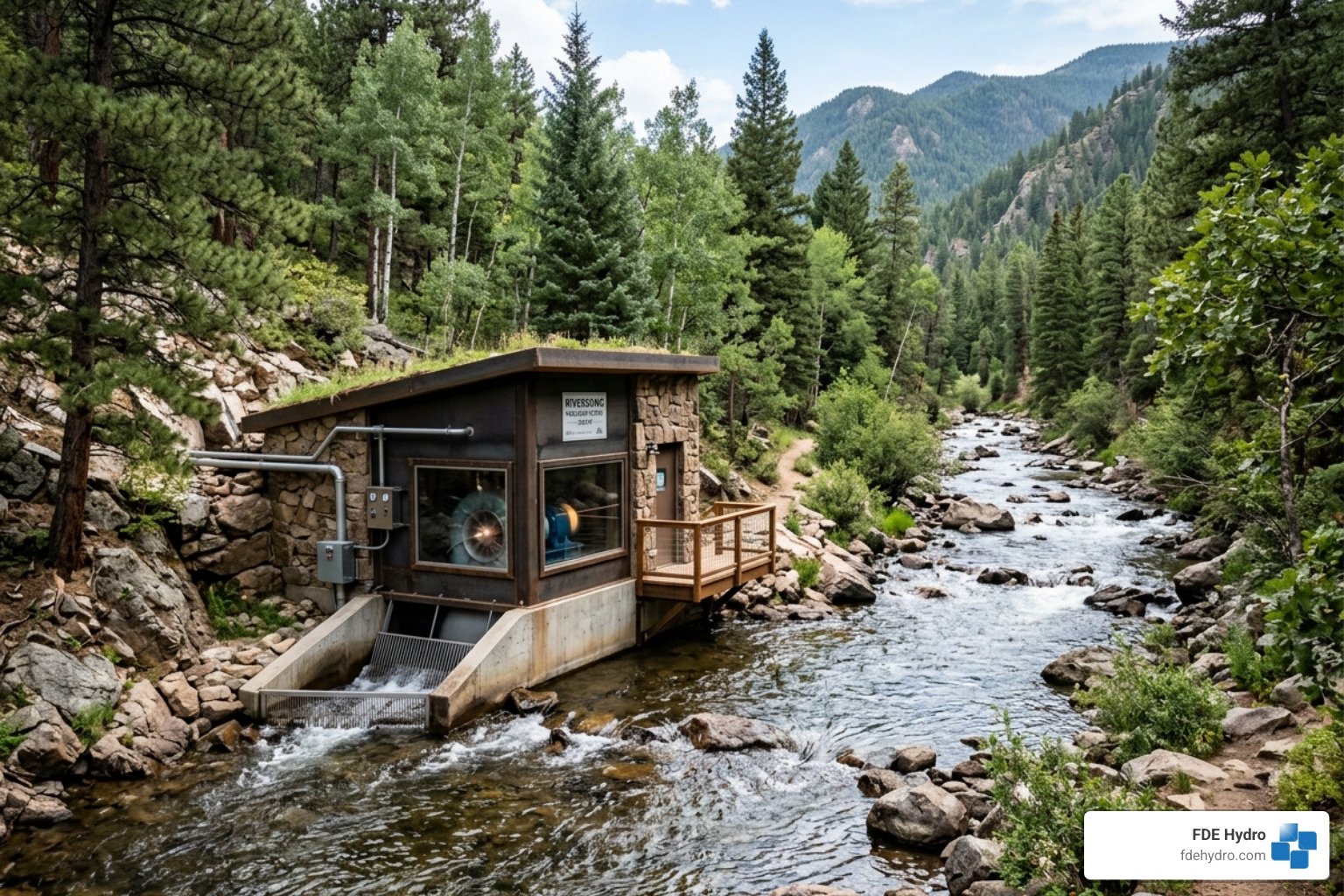
Hydropower is far from a “legacy” technology. While it is one of the oldest methods of generating decarbonized electricity, it is currently undergoing a massive technological renaissance. In the United States, hydropower accounts for 27.37% of total utility-scale renewable electricity generation. Its “firm capacity”—the ability to provide a guaranteed amount of power at any given time—is estimated at over 24 GW in the U.S. alone. That is enough to power between 16 and 24 million homes.
What makes Hydropower Solutions unique in the modern era is their role as the “guardian of the grid.” As we add more intermittent solar and wind to our networks, we need a “wildcard” that can stabilize the system. Hydropower provides this through 24/7 reliability and massive energy storage capabilities. Organizations like the National Hydropower Association advocate for the critical role hydro plays in the path to clean energy.
At FDE Hydro, we focus on Hydropower Innovation to solve the biggest hurdle facing the industry: the high cost and long timelines of traditional civil works. By moving toward modular designs, we can deploy Hydroelectric Power Solutions faster and more affordably than ever before.
Innovative Inline Hydropower Solutions
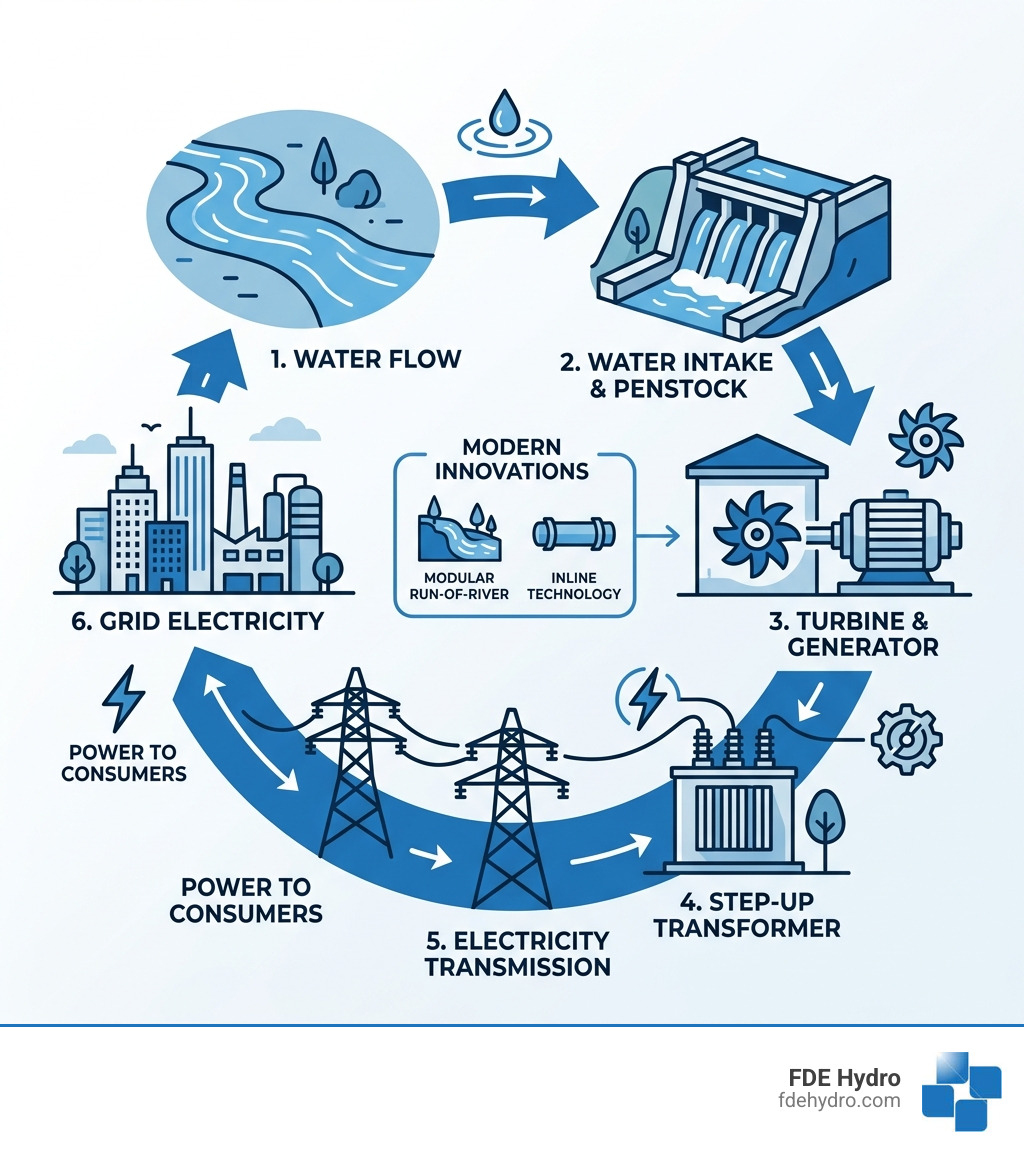
One of the most exciting shifts in the industry is the move toward “inline” or “in-pipe” generation. Imagine a hydropower plant that doesn’t look like a massive concrete wall, but rather a standard ISO shipping container. These containerised designs allow us to harness energy from water already moving through human-made infrastructure.
These Hydro Energy Solutions are “plug-and-play.” By using a containerised approach, we can house the turbine, generator, and control systems in a single, weather-proof unit that is easy to transport and install. This makes Hydropower accessible to industries that never thought they could be energy producers, such as municipal water districts or large-scale manufacturing plants.
Scalable Hydropower Solutions for Diverse Applications
Modern technology has broken the “bigger is better” myth. We now see a power output range that is incredibly scalable, from small 4 kW units to multi-megawatt systems. This scalability means we can apply these solutions to:
- Irrigation Channels: Turning agricultural water flow into local power for pumps and sensors.
- Municipal Pipelines: Capturing the energy usually wasted by pressure-reducing valves in city water mains.
- Wastewater Systems: Generating electricity from the gravity-fed flow of treated effluent.
- River Systems: Using run-of-river technology that doesn’t require a large reservoir.
Whether in the bustling cities of the United States or throughout Hydropower in Europe, these diverse applications are proving that Hydroelectric Power Generation is a versatile tool for any fluid-rich environment.
The beauty of modern inline Hydropower Solutions lies in their ability to integrate with existing infrastructure with minimal modifications. In the past, if you wanted hydro power, you had to change the landscape. Today, we change the equipment.
These systems typically involve a “Fluid Flow Funnel Unit” and a “Power Generation Unit.” The system is connected between pipeline segments using flexible couplings or flanged adaptors. Because the units are designed for full submersion or placement in compact vaults, they don’t disrupt the primary function of the pipeline.
Technological advancements have also solved the “cavitation” problem. Modern turbines use curved blade profiles and multi-stage designs optimized for low-head environments. This ensures the equipment lasts longer and operates more quietly. This move toward Sustainable Hydro Infrastructure is a key part of the Future of Hydropower, allowing us to generate green energy beneath our feet without the public ever seeing a turbine.
Advantages of Next-Generation Hydro Technology
When comparing Hydropower Solutions to other renewables, the advantages in reliability and footprint are clear.
| Feature |
Hydropower |
Solar |
Wind |
| Availability |
24/7 (Baseload) |
Daytime only |
Intermittent |
| Lifespan |
60–80+ years |
20–25 years |
20–25 years |
| Energy Density |
High |
Low |
Low |
| Grid Stability |
Excellent (Inertia) |
Limited |
Limited |
| Deployment Speed |
Rapid (Modular) |
Rapid |
Moderate |
Beyond just being a “green” alternative, next-generation hydro offers:
- Rapid Deployment: Modular and containerised systems can be installed in weeks, not years.
- Low Maintenance: Modern smart sensors and variable-speed hydraulics allow for predictive maintenance, reducing the need for on-site technicians.
- Zero Emissions: Once the equipment is in place, it generates Hydropower Electricity with no carbon footprint.
- Weather Independence: Unlike wind and solar, which are at the mercy of the clouds and the breeze, hydro relies on fluid flow that is often constant and predictable.
The Benefits of Hydropower Plant installations go beyond just the electricity; they provide a hedge against energy price volatility and increase the resilience of local grids.
Modernizing Aging Assets and Pumped Storage
We can’t talk about the future without addressing the past. Roughly 40% of global hydropower plants will be over 40 years old by 2030. In the U.S., many of our most iconic dams are reaching an age where they need more than just a “tune-up.”
Digitalization and technology upgrades can unlock up to 15% more capacity from these existing plants. By replacing old turbines with modern, high-efficiency designs and adding advanced control systems, we can add 7–10 TWh of clean energy to the grid without pouring a single new yard of concrete.
Then there is the “giant battery” of the energy world: Pumped Storage Hydropower. PSH currently provides 88% of all utility-scale energy storage in the United States. It works by pumping water uphill when energy is cheap (like when solar is peaking at noon) and releasing it through turbines when demand is high.
At FDE Hydro, we believe the future of storage is “Small But Mighty.” Our Modular Pumped Storage designs allow for grid-scale storage in locations that wouldn’t support a traditional massive reservoir. This type of Hydropower Retrofitting is essential for a grid that needs to balance millions of electric vehicles and smart homes.
Frequently Asked Questions about Hydropower Technology
How does inline hydropower differ from traditional dams?
Traditional dams rely on creating a large reservoir to build up “head” (water pressure). Inline hydropower, however, captures the kinetic energy already present in flowing fluid within a pipe or channel. It doesn’t require flooding land or blocking fish passage, making it a much simpler and more eco-friendly option for industrial and municipal use.
What is the typical lifespan and maintenance of modern systems?
Hydropower assets are famous for their longevity. While a solar panel might last 25 years, a well-maintained hydropower plant can easily operate for 60 to 85 years. Modern systems use advanced materials like saltwater-resistant alloys and gear-driven ceramic cartridges that resist chemical build-up, significantly lowering the maintenance requirements compared to older technology.
Can hydropower systems be integrated into existing irrigation?
Absolutely. In fact, irrigation channels are perfect candidates for modular Hydropower Solutions. Because irrigation flow is often highly predictable and controlled, we can install modular turbines that provide power for the farm or feed back into the local rural co-op grid. This turns a water delivery cost into a potential revenue stream for landowners.
Conclusion
The world of hydropower is changing, and at FDE Hydro, we are proud to be leading the charge. Our patented modular precast concrete technology—the “French Dam”—is designed to slash construction costs and timelines. By moving away from traditional, labor-intensive onsite pouring and toward precision-engineered modular components, we make it possible to build and retrofit hydroelectric systems across North America, Brazil, and Europe with unprecedented efficiency.
Whether you are looking to modernize an aging facility, install an inline system in a municipal pipeline, or explore the potential of modular pumped storage, the right Hydropower Solutions are now more accessible than ever. We invite you to explore the Hydropower Advancements Innovations 2025 and see how we can help you harness the power of water for a sustainable future.
For more information on how we can tailor a project to your specific needs, visit our main Hydropower page and let’s start building the next generation of clean energy together.
by Adaptify Support | May 1, 2026 | Hydropower Articles
The Untapped Power Hidden in Plain Sight: Why Innovative Hydro Power Retrofits Matter Now
Innovative hydro power retrofits are transforming the way we think about clean energy — turning thousands of dormant dams into working power sources without starting from scratch.
Here’s a quick overview of the most impactful approaches:
| Retrofit Innovation |
What It Does |
Key Benefit |
| Modular turbines on non-powered dams |
Adds generation to existing dam structures |
Minimal civil works, fast deployment |
| Digital site prioritization tools |
Identifies best retrofit candidates |
Reduces risk, saves planning time |
| Fish-safe turbine designs |
Rounded blades, streamlined flow paths |
Meets environmental standards |
| Variable speed drives |
Adapts output to changing water flow |
Up to 10%+ efficiency gains |
| Pumped hydro storage upgrades |
Pairs storage with solar/wind |
Grid stability, dispatchable power |
| Modular precast construction |
Prefabricated components for powerhouses and dams |
Lower cost, faster build |
Think about this: more than 90,000 dams exist in the United States, yet fewer than 3% of them generate a single watt of electricity. That represents up to 12 gigawatts of untapped clean energy potential — already sitting in rivers and streams across the country, waiting to be unlocked.
The infrastructure is already there. The water is already flowing. The question is simply: how do we convert what we have into what we need?
That’s exactly what the latest wave of hydro retrofitting technologies is answering. From all-in-one submerged turbines that can be installed in a single day, to modular precast powerhouses that slash construction timelines and costs, the innovation happening right now is making dam retrofits faster, cheaper, and far more environmentally sound than ever before.
I’m Bill French, Sr., Founder and CEO of FDE Hydro™, and I’ve spent decades in heavy civil construction before turning my focus entirely to innovative hydro power retrofits — developing patented modular solutions that make it practical and cost-effective to bring clean hydropower to existing water infrastructure. I’ll walk you through six proven approaches that are reshaping the industry right now.
Basic innovative hydro power retrofits terms:
1. Activating Non-Powered Dams (NPDs) with Modular Turbines
When we look at the landscape of renewable energy in North America and Brazil, we see a massive, sleeping giant: the Non-Powered Dam (NPD). According to A New Vision for United States Hydropower – Department of Energy, there is a technical potential of roughly 12 GW of capacity across these structures. To put that in perspective, that is enough to power millions of homes using infrastructure that has already been built.

The challenge historically has been the cost. Building a traditional powerhouse from scratch is a massive civil engineering undertaking. However, more info on hydropower retrofitting shows that modularity is the key to unlocking this potential. By using “all-in-one” modular units, we can add generation to an existing dam without the need for massive excavations or structural overhauls.
These modular systems are specifically designed for low-head applications—situations where the water drop is relatively small (often between 2 and 8 meters). Instead of a custom-built, site-specific turbine that takes years to design and manufacture, modular turbines are “plug-and-play.” They are often submerged, making them nearly invisible and incredibly quiet, which is a huge plus for local communities in New York or California where aesthetic and noise concerns can stall projects.
Scaling Innovative Hydro Power Retrofits for Small Streams
One of the most exciting developments in innovative hydro power retrofits is the rise of bulb-type turbines. These units house the generator and turbine in a single, streamlined “bulb” that sits directly in the water flow.
Why is this a game-changer?
- Minimal Civil Works: Because the unit is self-contained and submerged, you don’t need a massive, dry powerhouse building.
- Oil-Free Operation: Modern units often use water-lubricated bearings or permanent seals, meaning there is zero risk of oil leaking into the river.
- Speed: Some of these units can be installed in as little as a single day once the site is prepared.
In places like Indiana and the Northeast, these small-scale retrofits are being used to help universities and small municipalities eliminate coal use and slash their carbon footprints by more than half.
With over 90,000 dams in the US alone, where do you even start? You can’t just throw a dart at a map. This is where data-driven design and digital tools come into play.
National laboratories have recently released tools like NPD HYDRO, which allow us to sort through thousands of dams to find the “low-hanging fruit.” These tools look at four critical categories:
- Grid: How close is the dam to existing power lines?
- Community: Will this project provide local jobs or support local industry?
- Industry: Is there a nearby factory or data center that needs the power?
- Environment: What are the local fish populations and water quality requirements?
By using these tools, we can align our projects with the update of the hydropower vision roadmap, ensuring we are investing in sites that offer the highest Return on Investment (ROI) and the lowest regulatory hurdles.
We also utilize the NPD Retrofit Exemplary Design Specification (REDS). This framework helps us design retrofits that don’t just add power, but actually improve the dam’s original functions—like better sediment management or improved recreational access. It’s about making the dam “smarter,” not just more powerful.
3. Implementing Fish-Safe and Eco-Friendly Designs
One of the biggest hurdles for any hydro project is the “fish question.” Historically, turbines weren’t exactly friendly to migrating salmon or eels. But the “new wave” of hydropower innovations and impact has changed the narrative entirely.
Modern innovative hydro power retrofits now prioritize “fish-safe” designs. This isn’t just a marketing term; it’s backed by rigorous science. For example, researchers have developed “Sensor Fish”—small, neutrally buoyant devices filled with sensors that “ride” the turbine flow to measure exactly what a fish experiences.
Environmental Benefits of Innovative Hydro Power Retrofits
The results from these studies have led to several breakthroughs:
- Rounded Blades: Traditional turbines had sharp leading edges. Modern designs use thick, rounded blades that allow fish to pass through with survival rates exceeding 99%.
- Minimum Gap Runner (MGR): By eliminating the small gaps between the turbine blades and the wall, we prevent fish from getting caught or injured.
- Nature-Mimicking Structures: We are now designing retrofits that include “rock arches” or “log jams” that look and act like natural river features while still directing water toward the turbine.
A great example is the fish-friendly turbine upgrade boosts efficiency at Ice Harbor hydropower dam. By replacing aging units with these new designs, the project didn’t just save more fish; it also saw a 4% increase in energy efficiency. It’s a rare win-win for both the environment and the balance sheet.
4. Upgrading Efficiency with Variable Speed Drives
Many of the dams we encounter in New York, Canada, and Europe were built 50 to 80 years ago. Back then, turbines were designed to run at a single, fixed speed. This worked great if the river flow was constant, but as we know, rivers have seasons. These old units might only be “efficient” for three months out of the year.
By implementing hydro power plant maintenance that includes variable speed drives (VFDs) and permanent magnet generators, we can “tune” the turbine to the water flow.
| Feature |
Fixed Speed (Old Tech) |
Variable Speed (Innovative Retrofit) |
| Efficiency |
Peaks only at specific flow |
High efficiency across all flow levels |
| Grid Support |
Limited |
Provides frequency and voltage regulation |
| Mechanical Wear |
High (due to vibration at off-peak flows) |
Low (smooth operation) |
| Energy Gain |
Baseline |
Typically 10% to 20% annual increase |
We’ve seen cases in Europe where an 80-year-old plant was retrofitted with variable speed controls and saw a 10% increase in energy production in the very first year. This technology allows the plant to stay online and generate power even during low-flow summer months when it would have previously been forced to shut down.
5. Modernizing Pumped Storage and Precast Infrastructure
As solar and wind power grow in places like California and Ontario, the grid needs a way to store that energy for when the sun goes down or the wind stops blowing. This is where Pumped Hydropower Storage (PHS) comes in. PHS acts like a giant water battery, and it currently represents 94% of all global energy storage.
The future of hydropower isn’t just about building new PHS; it’s about retrofitting existing ones. By adding variable speed pumps, we can make these “batteries” much more responsive to the grid, allowing them to balance the second-by-second fluctuations of solar and wind.
Rapid Deployment with Precast Concrete Technology
This is where we at FDE Hydro™ really shine. One of the biggest “cost killers” in innovative hydro power retrofits is the time spent pouring concrete on-site. Traditional methods require building “cofferdams” (temporary dams) to dry out the area, which is expensive and environmentally disruptive.
Our French Dam technology uses modular precast concrete. Think of it like “Lego for dams.”
- Speed: We manufacture the components in a controlled factory environment while the site is being prepared.
- Cost: Because we spend less time on-site, labor and staging costs plummet.
- Encapsulation: We can use these modular units for dam rehabilitation and encapsulation, essentially building a new, stronger dam around the old, failing one.
This approach significantly reduces the ROI timeline, making projects that were once “too expensive” suddenly very attractive to investors and municipalities.
6. The Global Potential for Innovative Hydro Power Retrofits
The trend toward innovative hydro power retrofits is a global movement. From the industrial corridors of the Northeast US to the vast river systems of Brazil, the economic advantages are becoming impossible to ignore.
Why the ROI is looking better than ever:
- Regulatory Support: New frameworks in the US and EU are providing tax credits and streamlined licensing for retrofitting existing dams compared to “greenfield” (new) projects.
- Infrastructure Constraints: It is much easier to get a permit to upgrade an existing dam than it is to build a brand-new one.
- Reliability: Unlike solar and wind, hydro provides “baseload” power that is available 24/7.
We are seeing a massive pipeline of projects—nearly 1,000 MW of capacity is currently in the US development pipeline for NPD retrofits alone. As technology continues to advance, we expect to see even more “micro-hydro” projects where even small weirs and irrigation canals are fitted with modular turbines to provide local, decentralized power.
Frequently Asked Questions about Innovative Hydro Power Retrofits
What is the untapped hydropower potential of non-powered dams in the US?
There are more than 90,000 dams in the US, but only about 3% generate electricity. Research indicates there is roughly 12 GW of technical potential at these non-powered dams. Adding power to just the top 100 most viable NPDs could provide enough clean energy to power hundreds of thousands of homes.
How do modular retrofits reduce environmental and construction impacts?
Modular retrofits, like those using our precast concrete technology, reduce the need for massive on-site construction and long-term river diversions. Technologies like submerged, oil-free turbines and fish-safe blade designs ensure that the local ecosystem is protected, noise is eliminated, and the river’s natural beauty remains intact.
What are the main economic advantages of retrofitting existing dams?
The primary advantage is that the most expensive part of the project—the dam itself—is already built. By using innovative hydro power retrofits, you avoid the massive capital expenditure of a new dam. Additionally, modular construction and variable speed drives reduce maintenance costs and increase annual energy output, leading to a much faster return on investment.
Conclusion
The transition to a 100% clean energy grid doesn’t always require building something brand new. Often, the solution is already right in front of us, hidden in the thousands of existing dams and water control structures that line our rivers.
By combining modular precast technology, fish-safe turbine designs, and advanced digital tools, we can unlock a massive source of reliable, renewable power. At FDE Hydro™, we are committed to providing the hydropower asset management and innovative construction solutions needed to make these projects a reality.
The water is already flowing. It’s time we put it to work.
Unlock your dam’s potential with FDE Hydro — Contact us today to learn more about our modular retrofit solutions.
by Adaptify Support | Apr 30, 2026 | Hydropower Articles
Why Eco Hydropower Mining Centers Are Redefining Crypto Infrastructure
Eco hydropower mining centers are cryptocurrency mining facilities powered entirely — or primarily — by hydroelectric energy, operating independently from fossil-fuel-based power grids.
Here’s what makes them stand out at a glance:
| Feature |
Eco Hydropower Mining Centers |
| Energy source |
River-fed hydroelectric power |
| Carbon emissions |
Near zero |
| Energy cost |
As low as 1.6–2.6 Euro cents per kWh |
| Uptime reliability |
Up to 98% runtime |
| Grid dependency |
Minimal or none |
| Scale |
From 5 MW rural sites to gigawatt-scale national programs |
Bitcoin mining is under pressure. Electricity prices are climbing. Environmental scrutiny is intensifying. And the traditional grid — still roughly 75% fossil-fueled in many regions — is struggling to keep up with the energy demands of large-scale mining operations.
That pressure is forcing a shift. A significant one.
Nations, corporations, and independent operators are turning to hydropower as the foundation for next-generation mining infrastructure. Bhutan has mined over 13,000 Bitcoin using 100% hydropower, with reserves now valued at over $1.4 billion — nearly 40% of the country’s GDP. Norway’s hydro-powered data centers run on electricity that costs a fraction of what miners pay in the United States. Paraguay is monetizing surplus energy from the Itaipu Dam to power large-scale mining operations with zero emissions.
The pattern is clear: where water flows reliably, profitable and sustainable mining follows.
I’m Bill French, Sr., Founder and CEO of FDE Hydro™ and a decades-long leader in heavy civil and hydropower construction — including selection by the U.S. Department of Energy to help define next-generation hydropower solutions for Congress. My work developing modular hydropower infrastructure puts me at the center of the conversation around scalable, cost-effective eco hydropower mining centers. In this guide, I’ll walk you through exactly how these facilities work, what makes them profitable, and how modern modular construction is making them more accessible than ever.

Common eco hydropower mining centers vocab:
The Rise of Eco Hydropower Mining Centers
The traditional mining model is broken. Relying on a public grid means being at the mercy of price volatility, peak-demand surcharges, and the high carbon footprint of fossil fuels. Eco hydropower mining centers offer a way out. By sourcing energy directly from moving water, we can bypass the inefficiencies and emissions of the aging electrical grid.
Hydropower is unique among renewables because it provides a “baseload” — a constant, steady flow of electricity that matches the 24/7 appetite of ASIC miners. Unlike solar, which sleeps at night, or wind, which dies down without warning, a well-managed hydro site keeps the hash rate steady. This transition toward carbon-free energy isn’t just a PR move; it’s an optimization strategy. By utilizing surplus power that would otherwise be wasted (curtailed) during periods of low demand, miners can secure the lowest possible energy rates while helping to stabilize the broader energy ecosystem.
Learn more about the transition to eco friendly crypto mining.
Operational Advantages of Eco Hydropower Mining Centers
The most significant advantage of hydro-powered mining is reliability. In our experience, high-quality hydroelectric dams can achieve a 98% proven runtime. When you are running thousands of machines, every minute of downtime is lost revenue.
Because hydropower offers a stable baseload, it eliminates the need for massive battery arrays that solar-only setups require. This stability also protects sensitive hardware from the power surges and brownouts often associated with stressed public grids. Furthermore, many of these centers are located in cooler climates or near cold water sources, which naturally lowers the energy needed for cooling — a major overhead cost in traditional data centers.
Explore the mechanics of hydroelectric-power-generation to see why it is the gold standard for uptime.
Global Expansion of Eco Hydropower Mining Centers
We are seeing a massive geographic shift toward regions with untapped or surplus water power. In Paraguay, the enormous Itaipu Dam generates far more electricity than the country consumes. Miners are stepping in to monetize this surplus, transforming “trapped” energy into digital assets.
In the United States, we are seeing a trend of retrofitting older dams. In Wisconsin, historic 1920s-era dams are being revitalized to host hundreds of mining rigs. These sites often have “black-start” capabilities, meaning they can jump-start the local grid during a blackout, making them essential pieces of infrastructure beyond just crypto. From the mountains of Ethiopia to the rivers of New York and Canada, the demand for sustainable data-center-energy-resource options is driving a hydro-mining boom.
Global Success Stories: From Bhutan to the Nordics
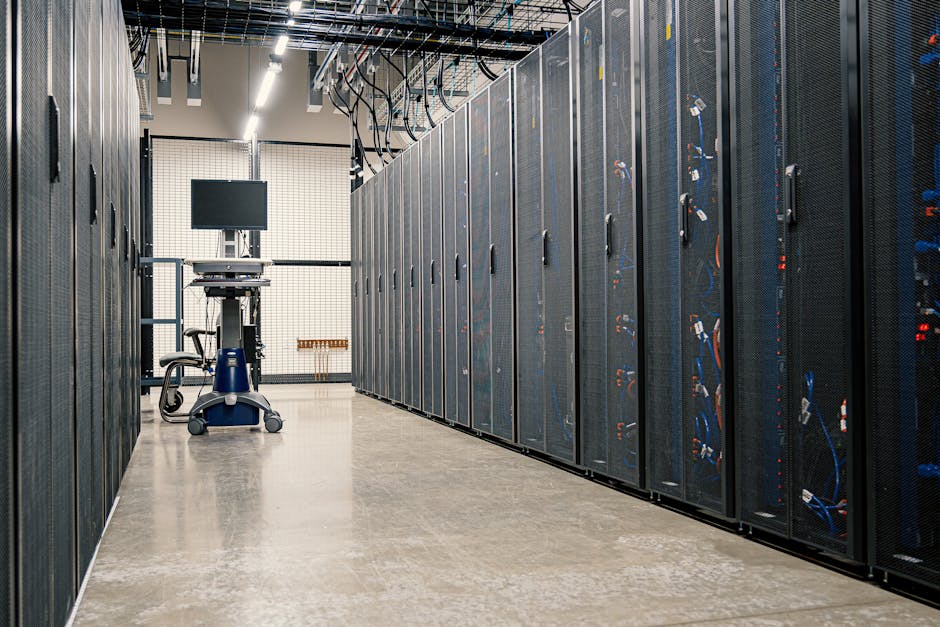
Success isn’t just theoretical; it’s happening right now at a massive scale. Take the Lefdal Mine Datacenter Case Study as a prime example. Located in a deep Norwegian mine, this facility uses 98.5% hydroelectric power and seawater for cooling, achieving zero CO2 emissions and a incredibly low Power Usage Effectiveness (PUE) rating.
The Bhutan Model: National Prosperity Through Water
Bhutan has become the poster child for government-led hydro-mining. With a current hydropower capacity of 3.5 GW and a roadmap to reach 15 GW in the next decade, this Himalayan nation is using its rivers to fund its future.
By mining over 13,000 Bitcoin, the government has generated enough revenue to fund public sector wages for two years following the pandemic’s hit to tourism. Their model is simple: use 100% renewable energy to stay carbon-negative while diversifying the economy away from agriculture and tourism. It’s a win-win that provides high-tech jobs for local youth while proving that national reserves can be built on “green” coins.
Nordic Efficiency: Cold Climates and Low Costs
In Northern Europe, particularly Norway and Finland, the combination of abundant water and a cold climate creates the perfect environment for eco hydropower mining centers. Electricity costs here can be as low as 1.6 Euro cents per kWh — a fraction of the cost in Germany or the UK.
These facilities don’t just take from the environment; they give back. Many Nordic centers are pioneering waste heat reuse, where the hot air from the servers is piped into local greenhouses or used to dry wood and seaweed, creating secondary industries and local jobs. Statistics from Hydropower in Europe show that Norway produces nearly twice as much renewable energy as any other Nordic country, making it a fortress for sustainable computing.
Technical Blueprint for Off-Grid Systems
Setting up a hydropower mining site is a major engineering feat, but it’s becoming more streamlined. Traditionally, building a dam was a decade-long project with astronomical costs. At FDE Hydro™, we’ve changed that with our French Dam technology — a modular precast concrete system that allows us to build or retrofit water control systems in a fraction of the time.
Step-by-Step Setup Requirements
- Location Selection & Water Rights: You need a site with consistent “head” (vertical drop) and flow. Securing legal water rights and environmental permits is the first and most critical step.
- Turbine & Infrastructure Installation: Choosing the right turbine (Kaplan, Francis, or Pelton) depends on the river’s characteristics. This must be integrated with high-speed communication (often satellite in remote areas) and energy storage for emergency shutdowns.
- Mining Hardware Integration: Deploying energy-efficient ASICs is key. You want machines that maximize hash rate per watt to ensure the highest energy-efficient-crypto output.
- Remote Monitoring: Off-grid sites are often remote. Robust remote monitoring for both the dam’s structural health and the miners’ performance is non-negotiable.
Overcoming Operational Challenges
Hydropower isn’t without its hurdles. Seasonal flow variations can mean less power during dry summers or frozen winters. We solve this by implementing hybrid systems — often using solar as a backup — or by sizing the mining fleet to the “minimum guaranteed flow” of the river.
Maintenance logistics in remote areas can also be tricky. Having 24/7 onsite staff or local technicians is vital. However, the reward for overcoming these challenges is a “black-start” capable facility that provides the most stable power profile in the renewable world.
Economic and Environmental ROI
Is it worth the investment? The data says yes. While the upfront capital expenditure (CAPEX) for hydro is higher than solar, the operational expenditure (OPEX) is significantly lower over time because the “fuel” (water) is free and the equipment lasts for decades.
| Metric |
Hydropower |
Solar |
Wind |
| Typical Runtime |
90-98% |
20-30% |
30-45% |
| Lifespan |
50+ Years |
20-25 Years |
20-25 Years |
| Cost per kWh |
$0.02 – $0.05 |
$0.03 – $0.07 |
$0.04 – $0.08 |
| Baseload Capability |
Excellent |
None (requires batteries) |
Poor |
With current Bitcoin prices and efficient hardware, many eco hydropower mining centers see a payback period of 18 to 24 months. After that, you are essentially mining at zero energy cost, minus maintenance. This is a massive advantage for cost effective crypto mining.
Sustainability and Social Impact
Beyond the balance sheet, the environmental impact is profound. We are seeing facilities achieve a zero Water Usage Effectiveness (WUE) rating by using closed-loop cooling or non-evaporative seawater systems.
The social impact is equally impressive. In places like Kyrgyzstan, miners are not just consumers; they are investors. They help fund the construction of small hydropower plants (HPPs) that provide electricity to local villages that previously suffered from blackouts. This “dual-use” infrastructure helps meet ESG (Environmental, Social, and Governance) goals, making the mining operation more attractive to institutional investors.
Read more about crypto mining sustainability.
Profitability Analysis
The real secret to profitability in hydro-mining is the monetization of surplus energy. During the monsoon season or spring runoff, dams often produce more power than the grid can handle. Instead of “spilling” this water (wasting the potential energy), miners can scale up their operations to capture every kilowatt. This reduces transmission losses and provides a flexible load that can be turned off in seconds if the local community needs the power back during a peak period. This flexibility makes miners a “preferred customer” for utility companies.
Frequently Asked Questions
How does hydropower mining differ from traditional grid-powered mining?
Traditional mining relies on a mix of energy sources, often including coal and gas, and is subject to grid price spikes. Eco hydropower mining centers are often off-grid or “behind-the-meter,” meaning they source 100% renewable energy directly from the source. This provides lower costs, zero carbon emissions, and total independence from grid volatility.
Is hydropower mining profitable for small-scale operators?
Yes, particularly with modular solutions. While gigawatt-scale projects make the news, 5 MW to 10 MW “micro-hydro” sites are incredibly efficient for smaller groups. By using precast modular dam technology, the construction time is slashed, allowing small operators to get their rigs hashing and reach ROI much faster.
What role does hydropower play in grid stabilization?
Bitcoin miners act as a “first-class” flexible load. Because they can be throttled or shut down almost instantly, they allow hydro plants to run at maximum efficiency 24/7. When the grid experiences a surge in demand (like a heatwave), miners can power down, instantly freeing up megawatts of renewable energy for homes and hospitals.
Conclusion
The future of cryptocurrency is liquid. As the world moves toward a mandatory green standard, eco hydropower mining centers provide the only viable path for high-intensity computing that aligns with global climate goals.
At FDE Hydro™, we believe that the energy transition shouldn’t be a burden — it should be an opportunity. Our patented modular precast concrete technology, the French Dam, is designed to make these sustainable dreams a reality. By reducing the time and cost required to build or retrofit hydroelectric sites, we are helping miners in North America, Brazil, and Europe unlock the “Liquid Gold” flowing through their backyard.
Whether you are a national government looking to diversify your GDP or a private operator seeking energy independence, the message is clear: the most stable, profitable, and sustainable way to mine is with the power of water.
Explore our Hydropower Solutions
by Bill French Sr. | Apr 24, 2026 | Hydropower Articles
The Best Way to Plug Into the Hydropower Industry
The Gateway to America’s Hydropower Industry

The National Hydropower Association is the leading U.S. nonprofit dedicated exclusively to promoting clean, renewable hydropower and marine energy. Here’s what you need to know at a glance:
| Key Fact |
Detail |
| Founded |
1983 |
| Members |
~350 |
| Employees |
23 (growing 15.6% YoY) |
| Mission |
Protect and promote all forms of water energy |
| Energy covered |
Conventional hydro, pumped storage, hydrokinetic, tidal, ocean |
| Headquarters |
Washington, D.C. |
Hydropower is already powering roughly 30 million American homes and supplying about 40% of U.S. renewable electricity. Yet the industry’s full potential — from new pumped storage projects to marine energy — depends on the right connections, policies, and partnerships.
That’s exactly what the National Hydropower Association exists to build.
Whether you’re a utility, an equipment manufacturer, or an infrastructure developer, plugging into the NHA’s network means access to policy advocacy, technical resources, and the people shaping the future of water power in America.
I’m Bill French, Sr., Founder and CEO of FDE Hydro™ and a participant in the Department of Energy’s Hydropower Vision Task Force, where I worked alongside national stakeholders — including those connected to the National Hydropower Association — to define next-generation hydropower solutions for the U.S. That background gives me a front-row view of how industry associations like the NHA drive real progress for developers, builders, and innovators in this space.
Related content about national hydropower association:
Understanding the National Hydropower Association

To understand the National Hydropower Association, we have to look at its roots. Founded in 1983, the NHA was established to provide a unified voice for an industry that provides the backbone of the American renewable grid. While many energy associations juggle various “green” technologies, the NHA is the only national trade association in the U.S. dedicated exclusively to the promotion of hydropower and marine energy.
The organization has seen significant growth recently, reflecting the renewed interest in waterpower as a climate solution. Currently, the NHA operates with a dedicated staff of 23 employees—a number that has grown by 15.6% year-over-year. This growth allows them to better serve their 10,000+ social media followers and a robust membership base that spans the entire country.
At the helm of this growth is Malcolm Woolf, who was named CEO and President of NHA in 2019. With a deep background in energy policy—including roles with the National Governors Association and the Maryland Energy Administration—Woolf has become a leading voice for the water power industry, advocating for the modernization of the fleet and the expansion of new technologies.
Membership Structure of the National Hydropower Association
The strength of the NHA lies in its diversity. With approximately 350 member organizations, the association represents the majority of domestic, non-federal hydroelectric producers. This isn’t just a club for big utilities; it’s a comprehensive ecosystem that includes:
- Public and Investor-Owned Utilities: From the Tennessee Valley Authority to Pacific Gas & Electric.
- Independent Power Producers: Companies developing and operating projects across North America.
- Equipment Manufacturers and Service Providers: The folks building the turbines, generators, and control systems.
- Engineering and Environmental Consultants: Experts focused on hydropower asset management and regulatory compliance.
- Legal Professionals: Specialized attorneys who navigate the complex world of FERC licensing.
Organizational Leadership and Governance
The NHA is governed by a structure designed to ensure all sectors of the industry have a seat at the table. The About the NHA page highlights a leadership team that draws from the brightest minds in the sector.
The governance includes:
- Board of Directors: Comprising leaders from organizations like Duke Energy, Southern Company, and the New York Power Authority.
- Executive Committee: A smaller group of officers, including a Chair, Vice Chair, Treasurer, and Secretary, who provide strategic oversight.
- Advisory Board: Industry veterans who offer long-term perspective on market trends.
This structure ensures that whether the topic is a small run-of-river project in the Northeast or a massive pumped storage facility in California, the association’s policy positions are well-informed and representative.
Advocacy and Policy: Driving the Waterpower Agenda
One of the primary reasons we value the National Hydropower Association is its sheer “clout” in Washington, D.C. They are the ones in the room when energy bills are being drafted, ensuring that hydropower isn’t the “forgotten renewable.”
The NHA’s current policy priorities are focused on reinvigorating hydropower through legislative and regulatory reform. A major focus is the Maintaining and Enhancing Hydroelectricity and River Restoration Act. This bipartisan bill proposes a 30% investment tax credit (ITC) for existing facilities to make necessary upgrades in safety, grid resilience, and environmental enhancements. By incentivizing these investments, the NHA aims to preserve the existing fleet while paving the way for new growth.
National Hydropower Association Engagement with FERC and USACE
Navigating the federal bureaucracy is a full-time job, and the NHA does it exceptionally well. They maintain a constant dialogue with the Federal Energy Regulatory Commission (FERC) and the U.S. Army Corps of Engineers (USACE) to advance the goals of hydropower development.
Recent wins in this area include:
- FERC NEPA Streamlining: FERC recently voted to streamline its environmental reviews under the National Environmental Policy Act (NEPA) for water power actions, providing much-needed regulatory certainty.
- USACE Policy Memo: Thanks to NHA advocacy, the U.S. Army Corps of Engineers advanced a policy memo encouraging non-federal investment in hydropower at Corps-owned facilities. This opens up massive potential for adding generation to existing dams that currently don’t produce power.
Advocacy Day and Water Power Week
Every year, the NHA hosts Water Power Week in Washington, D.C. This is the premier event for the industry, culminating in Advocacy Day. During this event, hundreds of industry professionals meet directly with U.S. Representatives and Senators to tell the story of waterpower.
To make this advocacy accessible year-round, the NHA provides the VoterVoice tool. This allows members to easily communicate industry priorities to their legislators with just a few clicks. If you want to see how you can get involved, you can learn more about Advocacy Day and start making an impact.
Resources and Programs for Industry Growth
Beyond the halls of Congress, the National Hydropower Association serves as a central hub for technical excellence and professional development. They recognize that for the industry to grow, we must share what works and learn from what doesn’t.
A standout program is the Operational Excellence Program (OpEx). This is a voluntary event-reporting system where owners and operators share “lessons learned” from facility operations. By cataloging these best practices, the NHA helps the entire industry improve safety and efficiency. This commitment to hydropower innovation is what keeps the U.S. fleet competitive on a global scale.
The National Hydropower Association Resource Library
For those looking to “dig deeper,” the NHA Resource Library is an absolute goldmine. It contains over 120 curated resources, including:
- Advocacy One-Pagers: Simple, data-driven sheets to help explain the benefits of hydro to local officials.
- Technical Webinars: Deep dives into topics like FERC Part 12D safety assessments or the future of cross-border power shifts.
- Workforce Solutions: Strategies and activities to attract the next generation of engineers and technicians to the waterpower field.
Regional Meetings and Networking
While the national focus is vital, hydropower is inherently local. The NHA hosts regional meetings across the country—from California and Alaska to the Northeast and Midwest. These meetings allow professionals to discuss hydropower construction in North America through a regional lens, addressing specific grid challenges and state-level regulations. It’s the best way to meet the folks working in your “backyard.”
The Strategic Role of Hydropower in a Net-Zero Future
As we move toward a net-zero economy, the National Hydropower Association is making it clear that you cannot reach climate goals without waterpower. Hydropower provides the flexible, carbon-free “baseload” that allows intermittent sources like wind and solar to succeed.
Currently, hydropower supports roughly 30 million homes and makes up about one-third of all U.S. renewable energy. This role was a major topic at the World Hydropower Congress 2023, where global leaders discussed how to accelerate sustainable development. For a look at where we are headed, check out our insights on the future of hydropower.
Pumped Storage and the AI Revolution
One of the most exciting developments in the industry is the surge in Pumped Storage Hydropower (PSH). Often called “The Ultimate Water Battery,” PSH represents 92% of all utility-scale energy storage in the United States.
With the explosion of Artificial Intelligence (AI) and the massive energy demands of data centers, PSH is uniquely positioned to provide the long-duration storage needed to keep the grid stable. There are currently over 60GW of proposed new pumped storage capacity in the development pipeline. This “next wave” of innovation is essential for supporting American technological dominance. You can read more about hydropowers-next-wave-innovations-and-impact on our blog.
Marine Energy and Next-Gen Technology
The NHA also looks “beyond the dam” to the future of marine energy. This includes a suite of predictable, clean energy technologies:
- Wave Energy: Capturing power from surface waves.
- Tidal Power: Utilizing the reliable ebb and flow of tides.
- Ocean Current and Riverine: Tapping into the constant movement of water.
- Ocean Thermal: Using temperature gradients to generate power.
These hydropower advancements and innovations for 2025 and beyond represent the next frontier of renewable energy, offering a predictable source of power that complements the existing grid.
Frequently Asked Questions about the NHA
The National Hydropower Association represents all forms of water-based renewable energy. This includes conventional “dam-based” hydropower, pumped storage (the water battery), and marine energy (tidal, wave, ocean thermal, and hydrokinetic river systems).
How does the NHA support hydropower sustainability?
The NHA is a strong proponent of sustainable practices, often aligning with the principles of the San Jose Declaration. They advocate for hydropower retrofitting of existing non-powered dams, which allows for new energy generation with minimal additional environmental footprint. They also support investments in fish passage and ecosystem restoration.
What are the NHA’s recent policy wins?
Recent achievements include securing unanimous FERC support for streamlining NEPA reviews, advancing the USACE policy memo for non-federal investment, and successfully advocating for the extension of construction timelines for nearly three dozen hydropower projects in the U.S. House of Representatives.
Conclusion
The National Hydropower Association is more than just a trade group; it is the engine driving the modernization and expansion of America’s first renewable energy source. Through advocacy, resource sharing, and a commitment to innovation, the NHA ensures that waterpower remains the “guardian of the grid.”
At FDE Hydro™, we believe that the best way to support this mission is through smarter construction. Our patented French Dam technology—a modular precast concrete system—is designed to align perfectly with the NHA’s goals of reducing costs and timelines for both new builds and retrofits. By making it easier and faster to build sustainable water control systems, we help the industry meet the bold energy targets of the future.
If you’re ready to see how hydropower is protecting our energy future, read our 4 reasons why hydropower is the guardian of the grid.
Ready to innovate? Learn more about our innovative modular dam solutions and let’s build the next generation of clean energy together.
by Adaptify Support | Apr 14, 2026 | Hydropower Articles
How Hydroelectric Power Is Produced: The Energy Behind Moving Water
How hydroelectric power is produced is simpler than most people think. Here’s the quick answer:
How Hydroelectric Power Is Produced — Quick Summary:
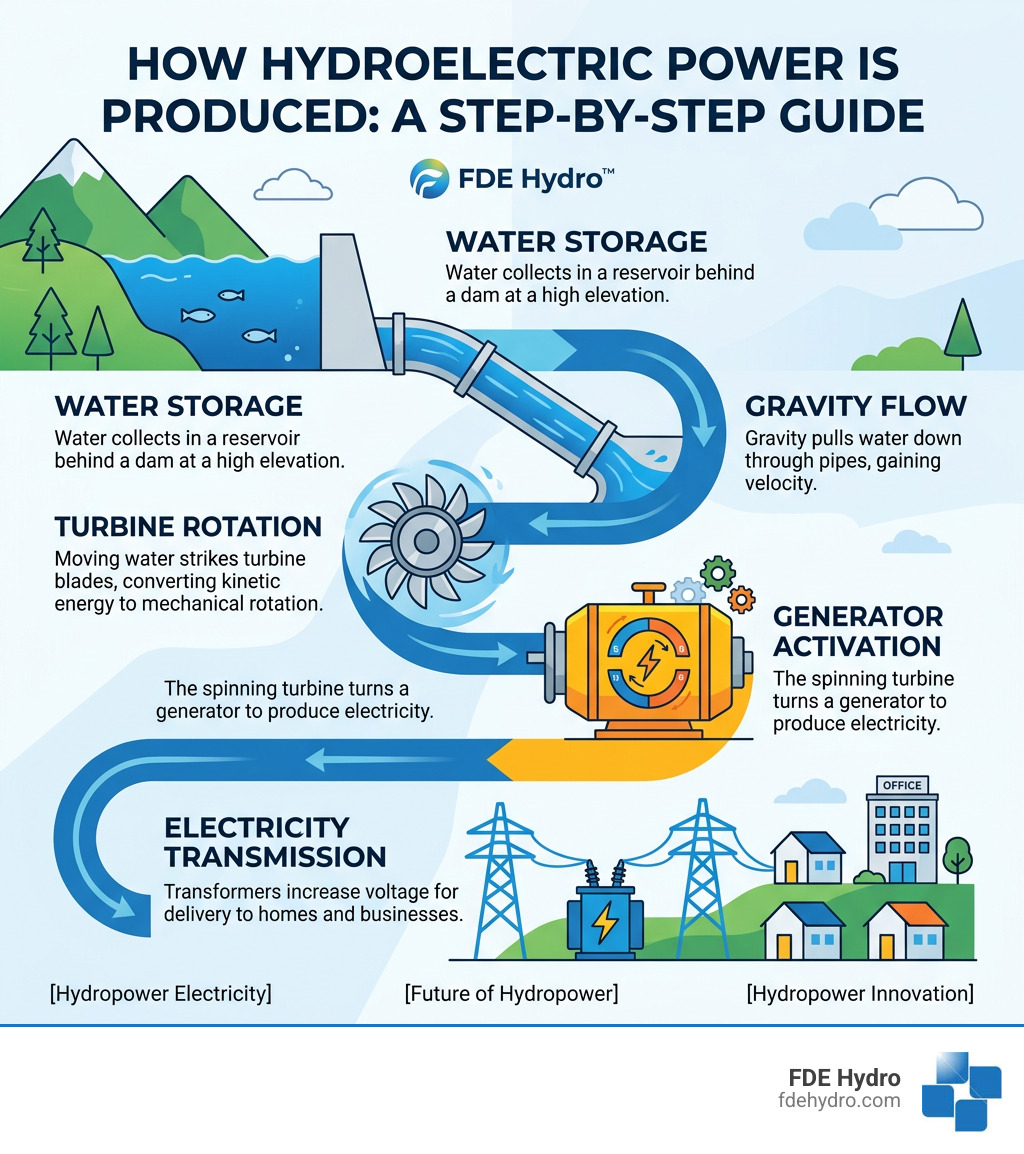
- Water is stored at a high elevation, typically in a reservoir behind a dam
- Water flows down through a large pipe called a penstock, gaining speed from gravity
- Moving water strikes turbine blades, converting kinetic energy into mechanical rotation
- The turbine spins a generator, which uses electromagnetic induction to produce electricity
- Electricity is stepped up by transformers and sent out across transmission lines to homes and businesses
It’s essentially the same energy conversion chain used in coal or nuclear plants — except the “fuel” is falling water, and it never runs out.
People have harnessed the force of moving water for mechanical work for thousands of years. But it wasn’t until the early 1880s that this power was first converted into electricity — first in Michigan in 1880, and then commercially on the Fox River in Wisconsin in 1882. Today, hydropower supplies roughly 15% of the world’s electricity, more than all other renewable sources combined.
I’m Bill French, Sr., Founder and CEO of FDE Hydro™, and I’ve spent decades in heavy civil construction before turning my focus to modernizing how hydroelectric power is produced through modular, precast construction methods. In 2015, I was selected by the U.S. Department of Energy to help define the next-generation roadmap for hydropower solutions — and that hands-on experience shapes everything we build at FDE Hydro™.
Easy how hydroelectric power is produced word list:
The Fundamentals of How Hydroelectric Power is Produced
At its heart, hydroelectric power generation is an elegant dance between gravity and the water cycle. We don’t actually “create” energy; we simply harvest it as it moves from one place to another.
The sun provides the initial “pump” by evaporating water from oceans and lakes. This water falls back to Earth as rain or snow, often at high elevations. As that water seeks the lowest point—the sea—it carries immense potential energy. By placing a facility in its path, we can capture that energy.
Gravity and Water Pressure
The “muscle” behind a hydro plant comes from two main variables: Head and Flow.
- Head (Vertical Drop): This is the distance the water falls. The higher the drop, the more pressure is created at the bottom.
- Flow (Volume): This is the amount of water moving through the system over time.
When we are calculating available power, we use a simple formula: Power equals the product of efficiency, density, flow rate, gravity, and head height. In plain English: if you have a massive amount of water falling from a great height, you have a powerhouse on your hands.
This is why you’ll see massive dams in places like California or New York, but fewer in flat states like Kansas. Without a significant “drop,” the water doesn’t have enough “push” to spin heavy industrial turbines efficiently.
Key Components of a Hydropower Facility
To understand how hydroelectric power is produced, we need to look at the specialized tools we use to catch the current. Every hydro-electric dam is a feat of engineering, but they all share a few hydro-dam components.
- The Dam: This is the primary barrier that holds back the river, creating a reservoir. At FDE Hydro™, we specialize in hydroelectric dam construction using modular precast concrete, which makes building these massive structures faster and more cost-effective.
- The Reservoir: This acts like a giant battery, storing potential energy in the form of water until the electrical grid needs it.
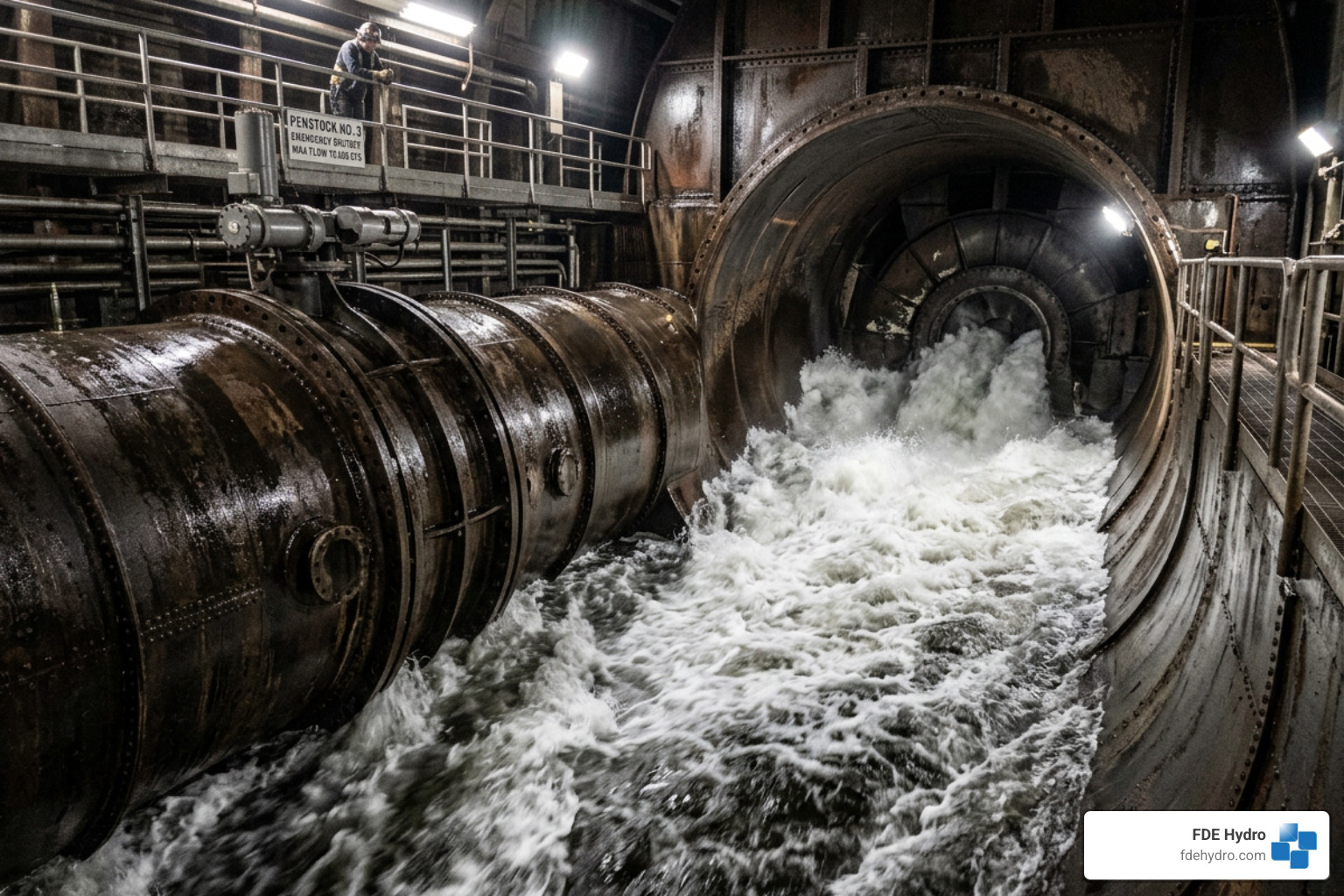
- Intake and Penstock: Gates open to allow water into the system. It then travels through a “penstock”—a large, reinforced pipe that builds up immense pressure as the water descends.
- The Turbine: Think of this as a high-tech version of an old-fashioned water wheel. The pressurized water strikes the turbine blades, causing them to spin.
- The Generator: Attached to the turbine by a shaft, the generator contains giant magnets that spin inside coils of copper wire. This movement “excites” electrons, creating an electrical current.
- The Powerhouse: This is the building that protects the turbines and generators. You can find more details in our hydroelectric dam components ultimate guide.
Step-by-Step: How Hydroelectric Power is Produced in Conventional Plants
Let’s walk through the step-by-step generation process as if we were following a single drop of water:
- Step 1: Storage. The drop sits in the reservoir, full of potential energy.
- Step 2: The Plunge. The intake gate opens, and the drop enters the penstock. Gravity pulls it downward, converting that potential energy into kinetic energy (motion).
- Step 3: The Impact. The drop hits the turbine runner. Its momentum is transferred to the blades, turning the mechanical shaft.
- Step 4: Induction. Inside the generator, the spinning shaft rotates magnets. This process, called electromagnetic induction, generates electricity.
- Step 5: The Exit. Having done its job, the water drop exits through the tailrace and returns to the river downstream, completely unchanged.
- Step 6: Transmission. The electricity travels to a transformer, which increases the voltage so it can travel long distances over power lines to your toaster.
Diverse Methods: How Hydroelectric Power is Produced Across Different Systems
While the “big dam” model is the most famous, we use several different methods depending on the geography and the needs of the grid.
- Run-of-the-River: These systems don’t require a massive reservoir. Instead, they divert a portion of the river’s natural flow through a turbine. They are great for reducing environmental impact but are more dependent on seasonal rainfall.
- Pumped-Storage Hydropower: This is the world’s largest “battery.” During the night, when electricity is cheap and demand is low, we use excess power to pump water from a lower reservoir to an upper one. When everyone wakes up and turns on their coffee makers, we release that water back down to generate power. It’s a net energy consumer, but it provides vital grid stability.
- Conduit Systems: These clever setups place small turbines inside existing water tunnels, such as those used for city water supplies or irrigation. We’re essentially getting “free” energy from infrastructure that is already moving water.
| Feature |
Conventional Dam |
Run-of-River |
Pumped-Storage |
| Storage Capacity |
High (Reservoir) |
Low to None |
High (Two Reservoirs) |
| Grid Flexibility |
High |
Moderate |
Very High |
| Environmental Footprint |
Large |
Small |
Moderate |
| Primary Goal |
Baseload Power |
Constant Supply |
Peak Demand/Storage |
Advantages and Environmental Challenges of Hydropower
There are many benefits of a hydropower plant, but like any energy source, it comes with trade-offs. We believe in being transparent about both.
The Bright Side: Why We Love Hydro
First, it’s renewable. As long as the sun shines and the rain falls, we have fuel. Second, it’s flexible. Unlike nuclear or coal, which take a long time to “ramp up,” a hydro unit can go from zero to full power in just a few minutes. This makes it the perfect partner for wind and solar—when the wind stops blowing, hydro can kick in instantly to keep the lights on. Finally, these plants have an incredible lifespan. Many facilities in the U.S. and Canada have been operating for over 100 years.
The Challenges: Doing Better for the Planet
We have to be honest about the impact on local ecosystems. Building a dam changes the temperature and flow of a river, which can affect fish and wildlife. Methane emissions from tropical reservoirs can also be a concern in places like Brazil, as submerged vegetation decays.
However, modern engineering is finding solutions. We now use fish ladders and “fish-friendly” turbines to help migratory species like salmon move past dams safely. We also focus on hydroelectric dam efficiency to get more power out of existing structures without needing to flood new land.
Global Impact and Statistics of Water Power
Hydropower isn’t just a local success story; it’s a global powerhouse. According to the IEA Hydropower Special Market Report, global installed capacity reached almost 1,400 GW in recent years.
- Global Leader: China is the undisputed heavyweight, home to the Three Gorges Dam, which has a staggering capacity of 22,500 MW. In 2022 alone, China added 24 GW of new capacity—nearly three-quarters of all global additions.
- The U.S. Perspective: In 2022, hydroelectricity accounted for about 6.2% of total U.S. utility-scale generation and nearly 28.7% of all renewable generation.
- The Giants: The largest facility in the U.S. is the Grand Coulee Dam in Washington State, with a capacity of 6,765 MW.
- Regional Strength: In places like Canada and Brazil, hydropower provides the vast majority of the nation’s electricity, contributing significantly to their energy independence.
Frequently Asked Questions about Hydroelectricity
What is the difference between “head” and “flow” in power production?
Think of “head” as the pressure from a garden hose with a nozzle—it’s the force created by the height of the water. “Flow” is like a massive, slow-moving river—it’s the total volume of water. To get the most electricity, you want a balance of both. A small stream with a massive 500-foot drop (high head) can produce as much power as a huge river with only a 10-foot drop (high flow).
Is hydroelectricity truly a carbon-neutral energy source?
While the operation of the plant itself produces no direct CO2, we have to look at the “lifecycle.” This includes the carbon used in hydroelectric dam design and construction. In some tropical regions, decaying vegetation in reservoirs can release methane. However, compared to fossil fuels, the greenhouse gas research shows that hydropower remains one of the cleanest options available, especially in temperate regions like North America and Europe.
Which countries lead the world in hydroelectric generation?
China leads by a wide margin, followed by Brazil, Canada, and the United States. These four nations possess the perfect combination of mountainous terrain and large river systems necessary for high-capacity generation.
Conclusion
Understanding how hydroelectric power is produced helps us appreciate the vital role this “white coal” plays in our modern world. It is a bridge between the ancient wisdom of water wheels and the high-tech needs of a carbon-free future.
At FDE Hydro™, we are committed to the future of hydropower by making it easier and faster to build. Our patented “French Dam” technology uses modular precast concrete to retro-fit existing non-powered dams and build new, efficient systems across the United States, Canada, Brazil, and Europe. By reducing construction time and costs, we’re helping more communities harness the current.
If you’re interested in learning more about our innovative hydroelectric power solutions guide, we invite you to Explore our Hydropower Solutions and join us in building a more resilient, renewable grid.

