

Why Renewable Energy Project Development Is One of the Most Complex — and Critical — Processes in Clean Energy
Renewable energy project development is the multi-stage process of turning a clean energy idea into a fully operating power plant — covering everything from initial site screening to financing, construction, and long-term operations.
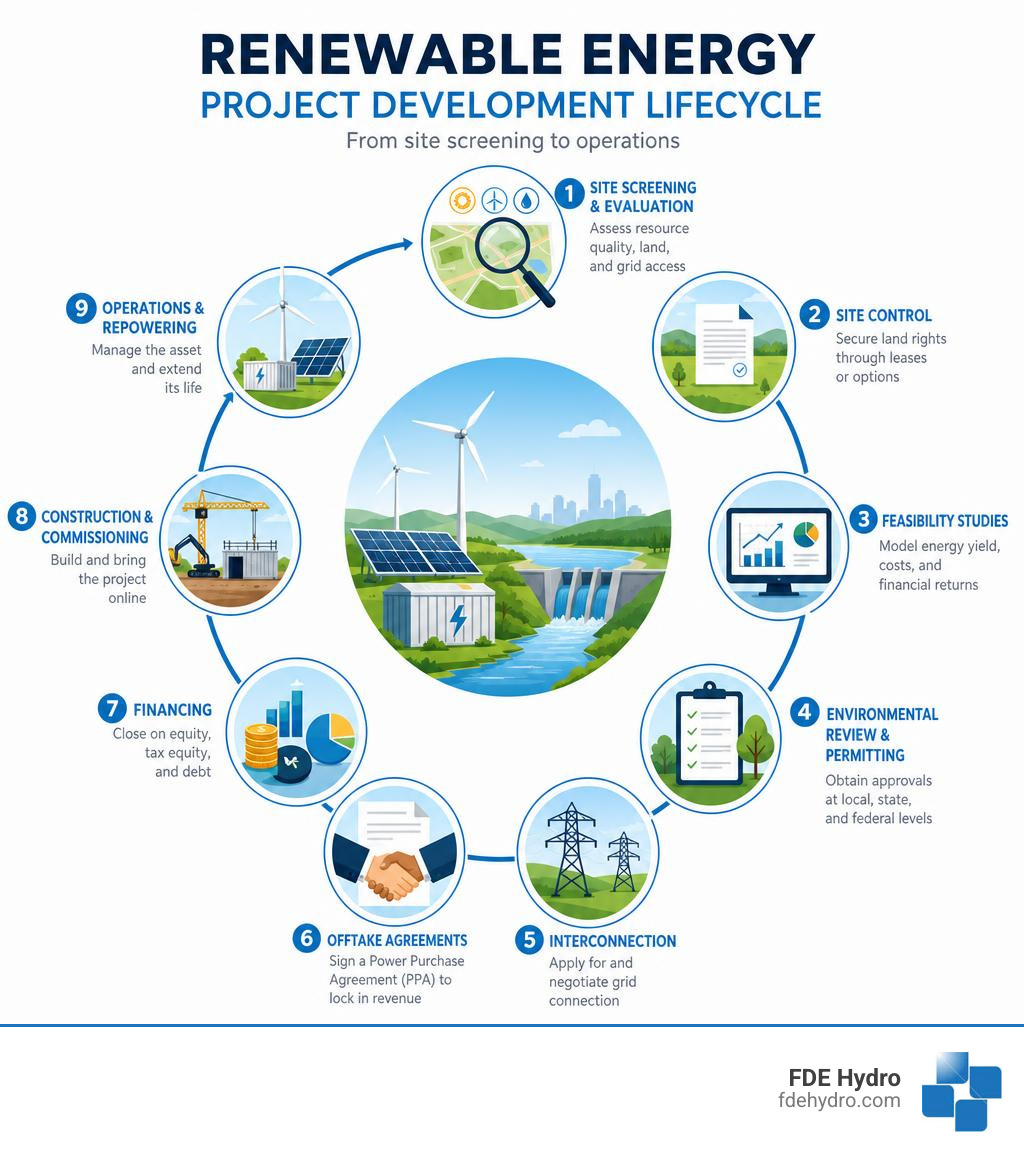
Here is a quick overview of the core steps:
- Market screening and site evaluation — assess resource quality, land, and grid access
- Site control — secure land rights through leases or options
- Feasibility studies — model energy yield, costs, and financial returns
- Environmental review and permitting — obtain approvals at local, state, and federal levels
- Interconnection — apply for and negotiate grid connection
- Offtake agreements — sign a Power Purchase Agreement (PPA) to lock in revenue
- Financing — close on equity, tax equity, and debt
- Construction and commissioning — build and bring the project online
- Operations and repowering — manage the asset and extend its life
The global energy transition is accelerating fast. Renewable sources are now on track to supply 35% of the world’s electricity by 2025, up from 29% just a few years earlier. Global clean energy investment is projected to surpass $3 trillion in the same period. In the U.S. alone, the renewable energy market is expected to top $320 billion.
Yet despite this momentum, most projects never reach the finish line. Around 80% of energy projects that enter interconnection queues fail to reach commercial operation. The reasons are almost always the same: poor site screening, skipped feasibility steps, permitting surprises, or financing that falls apart late in the process.
Getting it right requires a clear, repeatable process — and a team that understands every stage.
I’m Bill French, Sr., founder and CEO of FDE Hydro™, and I’ve spent decades in heavy civil construction and infrastructure development, including being selected by the U.S. Department of Energy to help shape the national roadmap for next-generation hydropower — experience that directly informs how I approach renewable energy project development at every scale. In the guide below, I’ll walk you through each stage of the development process so you can move forward with confidence.
The Complete Renewable Energy Project Development Lifecycle
A renewable project is not “developed” when someone finds a sunny field, windy ridge, battery site, or promising water resource. That is only the beginning.
The full lifecycle usually includes:
- Market screening
- Resource assessment
- Site control
- Feasibility studies
- Environmental review
- Permitting
- Interconnection
- Offtake contracting
- Financing
- Engineering, procurement, and construction
- Commissioning and commercial operation
- Long-term operations, repowering, and decommissioning
For a broader foundation, see our renewable energy project basics.
Why Renewable Energy Project Development Starts With “Project Motivation”
Before spending serious money, we need a clear answer to one question: why should this project exist?
Good project motivation usually rests on five pillars:
- Baseline need: What problem are we solving – high power prices, grid reliability, emissions, energy security, or resilience?
- Economics: Can the project compete on cost and deliver acceptable NPV, IRR, and payback?
- Policy: Do federal, state, provincial, local, or European market rules support the project?
- Technology: Is the selected technology proven, bankable, and appropriate for the site?
- Consensus: Can landowners, communities, utilities, regulators, and investors align?
This is also when we look for fatal flaws. A fatal flaw may be lack of transmission capacity, protected habitat, poor hydrology, unbuildable terrain, community opposition, or an offtake price that cannot support financing.
Early development capital is risk capital. It is often only a small portion of total project cost, but it is the money most likely to be lost if the project fails. That is why disciplined screening matters.
Stage 1: Market Screening, Resource Assessment, and Site Evaluation
The first technical step is identifying where a project might work.
Developers use GIS mapping, utility data, environmental databases, land records, and market pricing information to screen sites. For different technologies, the key resource changes:
- Solar: irradiance, land slope, shading, parcel size, soil conditions
- Wind: wind speed, turbulence, setbacks, aviation constraints
- Battery storage: grid congestion, nodal pricing, load pockets, substation proximity
- Pumped storage hydro: elevation difference, hydrology, geology, reservoir potential, water rights
Site evaluation should also include:
- Floodplain and wetland review
- Zoning and land-use compatibility
- Title reports and ownership history
- Access roads and constructability
- Distance to substations and transmission lines
- Capacity constraints and likely network upgrades
- Local tax, permitting, and community conditions
In 2026, we strongly favor a grid-first approach. A beautiful site with no viable interconnection is not a project. It is just expensive scenery.
Stage 2: Site Control, Landowner Agreements, and Early Engineering
Once a site looks promising, developers move toward site control. This may involve:
- Land leases
- Purchase options
- Easements
- Rights-of-way
- Access agreements
- Water rights or reservoir agreements for hydro projects
Most projects are placed into a special purpose vehicle, or SPV, so contracts, permits, financing, and liabilities are tied to the project entity.
Early engineering then tests whether the site can actually be built. This includes preliminary layouts, geotechnical review, access plans, electrical design, drainage studies, and conceptual civil works.
For FDE Hydro, this stage is especially important because modular precast concrete hydropower and water-control systems can change the construction plan. By using repeatable modular elements, we aim to reduce construction time, site disruption, and cost compared with many conventional heavy civil approaches.
Stage 3: Feasibility Studies in Renewable Energy Project Development
Feasibility studies turn a concept into a decision-ready project.
A strong feasibility package usually includes:
- Technical feasibility
- Energy production forecast
- P50 and P90 generation estimates
- CAPEX and OPEX assumptions
- LCOE analysis
- Interconnection cost estimates
- Curtailment assumptions
- Revenue model
- Sensitivity analysis
- Permitting risk assessment
- Construction schedule
- Financing assumptions
For storage, feasibility also includes the revenue stack: energy arbitrage, capacity value, ancillary services, resilience, and possible grid support. For pumped storage hydro, it includes long-duration storage value, reservoir operations, hydraulic efficiency, environmental flows, and grid reliability services.
Public tools can help. The Renewable Energy Project Development Toolbox includes resources for feasibility, procurement, contracts, financing, and green power markets.
Stage 4: Environmental Review, Permitting, and Community Engagement
Permitting is where many good ideas meet reality.
Environmental and land-use review may include:
- Wildlife and habitat studies
- Wetlands and waterways
- Cultural and historic resources
- Visual impact
- Noise
- Traffic
- Stormwater
- Fire safety
- Endangered species
- Decommissioning plans
- Mitigation measures
In the United States, projects may need local permits, state approvals, and federal reviews depending on land, water, transmission, and environmental impacts. In California, developers must account for state energy policy and environmental review requirements, including programs and guidance from the California Energy Commission.
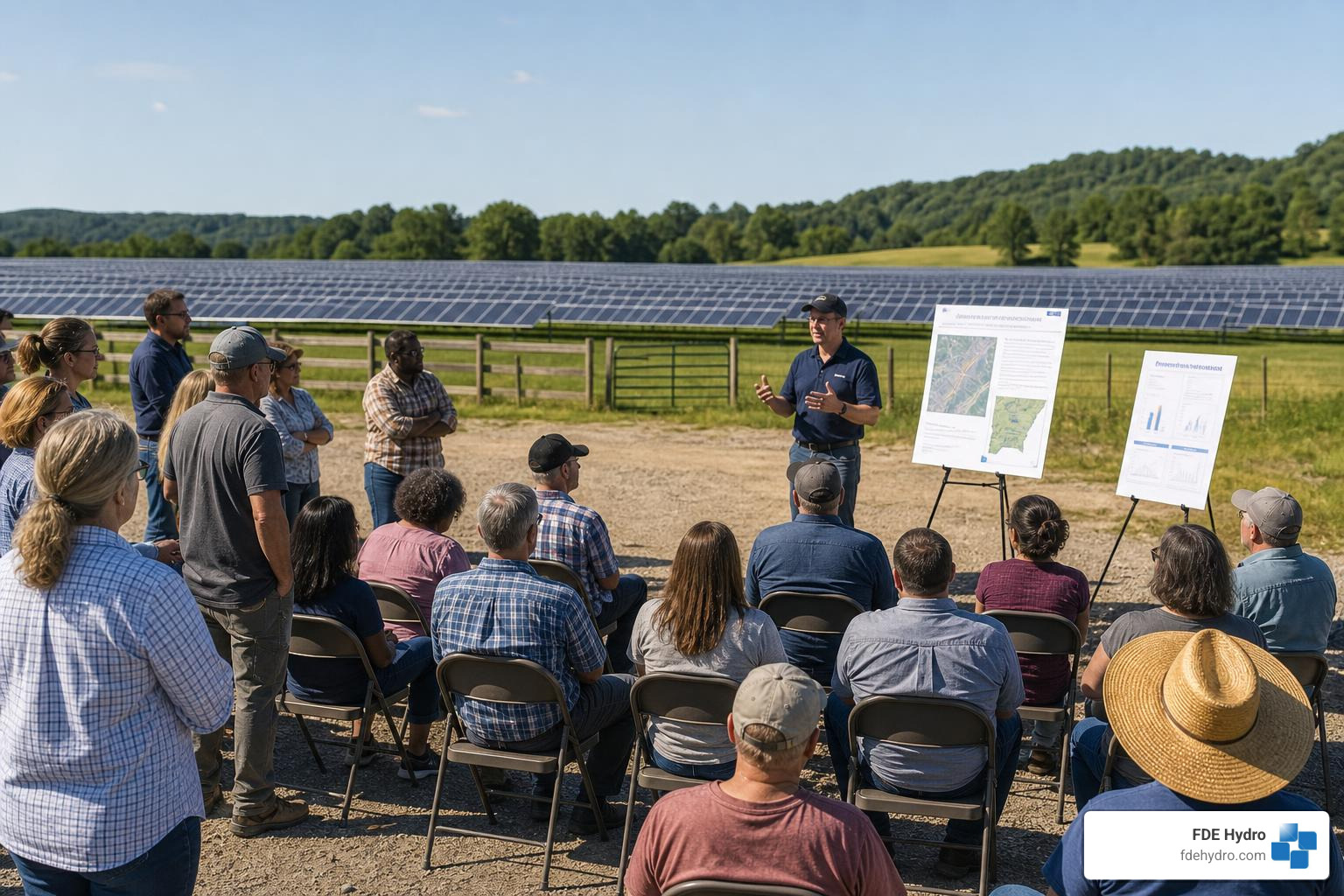
Community engagement should not start after the design is finished. It should begin early, before rumors do the engineering for you. People deserve clear answers about setbacks, traffic, noise, views, water, taxes, emergency response, and land restoration.
Stage 5: Interconnection, Offtake, Financing, and Notice to Proceed
Interconnection determines whether the project can deliver power to the grid. The process often includes:
- Interconnection application
- Queue position
- Feasibility or scoping study
- System impact study
- Facilities study
- Network upgrade estimate
- Generator interconnection agreement
In organized U.S. power markets, developers may work with RTOs or ISOs. In vertically integrated markets, the local utility may control much of the process. In Canada, Brazil, and Europe, the structure varies by market, but the basic risk is the same: grid capacity can make or break the project.
At the same time, the project needs revenue. That usually means a PPA, virtual PPA, green tariff, community solar subscription structure, capacity contract, or merchant revenue strategy.
Only after site control, permits, interconnection, offtake, engineering, and financing align can the project reach financial close and receive notice to proceed, or NTP.
Stage 6: Construction, Commissioning, Operations, and Repowering
Construction begins with an EPC contract, procurement plan, schedule, budget, safety plan, and quality-control program.
Commissioning verifies that equipment works as designed. Commercial operation date, or COD, marks the point when the project begins delivering energy and earning revenue under its contracts.
Operations include:
- Asset management
- O&M
- Performance monitoring
- Warranty claims
- Vegetation management
- Safety inspections
- Compliance reporting
- Equipment replacement
- Battery augmentation, where applicable
- Repowering or rehabilitation
Eventually, the project may be repowered, expanded, relicensed, or decommissioned. Responsible development includes planning for land restoration from the beginning.
How Developers Coordinate Sites, Permits, Utilities, and Communities
Good development is coordination. Great development is coordination before the crisis.
Developers must work with landowners, local governments, utilities, RTOs or ISOs, regulators, neighbors, environmental agencies, and, where applicable, tribal or Indigenous communities. Every stakeholder sees the project through a different lens.
For more on responsible energy growth, see Powering Progress.
Working With Landowners and Host Communities
Landowners want clarity. Communities want respect. Both are reasonable.
Best practices include:
- Clear lease payment terms
- Honest discussion of construction impacts
- Agricultural coexistence where possible
- Drainage and road-use protections
- Setbacks and screening
- Local emergency response planning
- Complaint resolution procedures
- Community benefit agreements
- Tax revenue transparency
- Local hiring and procurement where practical
A project should not feel like something dropped onto a community from outer space. That only works in science fiction, and even there it usually ends badly.
Navigating Government Permits and Environmental Reviews
Permitting differs across New York, California, Kansas, Canada, Brazil, and Europe, but the principles are similar.
Developers must identify:
- Which agency has authority
- Which permits are discretionary
- Which studies are required
- Which public hearings apply
- Which appeals are possible
- Which mitigation measures are likely
- Which permits must be secured before financing
Hydropower and pumped storage projects may involve water permits, dam safety rules, environmental flow requirements, fish passage, reservoir operations, and federal or national energy licensing. These are more complex than many solar or battery projects, but they also offer valuable long-duration storage and reliability benefits.
Managing Utility and Transmission Interconnection Risk
Interconnection risk is one of the largest development risks in 2026.
Common challenges include:
- Queue backlogs
- Cluster study delays
- Thermal overloads
- Voltage constraints
- Deliverability limits
- High network upgrade costs
- Congestion and curtailment
- Changing study assumptions
Developers increasingly use early injection studies, power-flow analysis, and nodal price review before locking up land. The goal is simple: fail fast, before spending millions.
Best Practices for Responsible Renewable Energy Project Development
We recommend:
- Start outreach early
- Keep a single source of truth for project data
- Screen for fatal flaws before site control
- Share study results transparently
- Adapt design based on real constraints
- Plan for local jobs and procurement
- Budget for mitigation
- Include lifecycle and decommissioning planning
- Use performance-based engineering
- Avoid promising what the project cannot deliver
Responsible development is not slower. In many cases, it is faster because it reduces surprises.
Comparing Wind, Solar, Battery Storage, and Pumped Storage Hydro Development
Each technology follows the same general development path, but the details differ.
See our overview of defining renewable energy sources for a broader comparison.
| Technology | Key siting factor | Main permitting issue | Revenue focus | Storage duration |
|---|---|---|---|---|
| Wind | Wind speed and setbacks | Wildlife, visual, noise, aviation | Energy and capacity | Not storage unless paired |
| Solar | Irradiance and land | Land use, stormwater, habitat | Energy, RECs, capacity | Not storage unless paired |
| Battery storage | Grid location | Fire safety, zoning, interconnection | Arbitrage, capacity, ancillary services | Usually short to medium duration |
| Pumped storage hydro | Head, water, geology | Water, dam safety, environmental flows | Long-duration capacity, reliability, grid services | Long duration |
Wind Project Development: Resource, Siting, and Repowering Priorities
Wind projects require strong wind data, often supported by met towers, lidar, or long-term modeled datasets. Developers must optimize turbine layout to reduce wake losses and meet setbacks from homes, roads, airports, and sensitive habitats.
Key studies include avian and bat surveys, sound modeling, shadow flicker analysis, aviation review, and collector system design.
Repowering can extend project life by replacing older turbines or major components. In some cases, repowering increases output without needing an entirely new site.
Solar Project Development: Land, Interconnection, and Design Optimization
Solar development depends on irradiance, usable acreage, interconnection, grading, stormwater, and equipment selection.
Important design choices include:
- Fixed-tilt vs. single-axis tracking
- Bifacial modules
- Inverter loading ratio
- DC-to-AC ratio
- Terrain-following racking
- Vegetation and stormwater plan
- Module degradation assumptions
- Design freeze timing
Modern solar design increasingly uses 3D terrain modeling so projects avoid costly grading surprises.
Battery Energy Storage Project Development: Revenue Stacking and Safety
Battery energy storage systems, or BESS, can be standalone or paired with wind, solar, or hydro.
Development priorities include:
- Interconnection capacity
- Market rules
- Revenue stacking
- Fire code compliance
- Emergency response planning
- Battery degradation
- Augmentation schedule
- EMS controls
- AC-coupled vs. DC-coupled design
Storage can earn revenue from arbitrage, capacity, ancillary services, demand reduction, resilience, or avoided curtailment. The exact stack depends on the market.
Pumped Storage Hydro Development: Long-Duration Storage and Water Infrastructure
Pumped storage hydro uses electricity to move water uphill when power is abundant, then releases it through turbines when the grid needs energy.
Key development factors include:
- Reservoir siting
- Head differential
- Tunnels, penstocks, dams, and waterways
- Geology and geotechnical risk
- Hydrology
- Environmental flows
- Water rights
- Grid connection
- Licensing
- Dam safety
Closed-loop pumped storage can reduce impacts by operating away from major natural waterways. Pumped storage can also provide long-duration capacity, inertia, black start capability, and grid reliability.
At FDE Hydro, our patented modular precast concrete “French Dam” technology is designed for building and retrofitting hydroelectric dams and water-control systems more efficiently across North America, Brazil, and Europe.
How Hybrid Projects Pair Renewables With Storage
Hybrid projects combine generation with storage. Examples include:
- Solar-plus-storage
- Wind-plus-storage
- Hydro-plus-storage
- Pumped storage paired with renewable generation
Storage helps shift energy to higher-value hours, reduce curtailment, capture solar clipping, share interconnection capacity, and improve capacity accreditation.
Financing, PPAs, and Bankability in Renewable Energy Project Development
A project becomes bankable when investors and lenders believe it can be built, operated, and paid back.
For more on cost-conscious planning, see our cost-efficient renewable energy guide.
How PPAs and Offtake Contracts Secure Project Revenue
A Power Purchase Agreement is one of the most important contracts in renewable energy project development.
A PPA may define:
- Buyer and seller
- Contract term
- Energy price
- Escalator
- Delivery point
- REC ownership
- Curtailment rules
- Credit support
- Performance obligations
- Default rights
Common structures include utility PPAs, corporate PPAs, virtual PPAs, green tariffs, and community solar subscriptions. Lenders prefer creditworthy offtakers and predictable revenue.
Building the Financial Model and Investment Case
A strong financial model includes:
- CAPEX
- OPEX
- Production forecast
- Degradation
- Curtailment
- Interconnection costs
- Tax benefits
- Depreciation
- Debt sizing
- DSCR
- EBITDA
- IRR
- NPV
- Payback
- Contingency
The model should include sensitivity cases. What happens if construction costs rise 10%? What if curtailment doubles? What if interconnection upgrades cost more? The model should answer those questions before the lender does.
Common Capital Stack for Renewable Projects
Renewable projects are commonly financed with a mix of:
- Sponsor equity
- Development equity
- Tax equity
- Construction financing
- Term debt
- Bridge loans
- Grants and incentives
- Transferable tax credits, where available
- Insurance products
- Reserve accounts
The exact mix depends on technology, jurisdiction, contract quality, tax credit eligibility, and market risk.
Financial Close: What Lenders and Investors Review
Before financial close, investors typically review:
- Site control
- Permits
- Interconnection agreement
- Executed offtake
- EPC contract
- Equipment warranties
- Independent engineer report
- Environmental studies
- Legal opinions
- Insurance
- Operating model
- Decommissioning plan
This diligence can feel intense, but it protects the project. Bankability is just another word for “we checked the homework.”
Cost Reduction and Risk Mitigation Strategies
Cost reduction starts early. Useful strategies include:
- Standardized design
- Modular construction
- Early interconnection screening
- Competitive procurement
- Fixed-price EPC contracts where appropriate
- Contingency buffers
- Local labor planning
- Supply chain resilience
- Digital project controls
- Design for operations and maintenance
For hydro and water-control infrastructure, modular precast construction can reduce on-site complexity and help compress schedules compared with many traditional methods.
Tools, Trends, and Market Shifts Shaping Future Projects
The best developers combine engineering judgment with better data.
For enterprise planning, see sustainable enterprise energy solutions.
Tools and Models Used to Evaluate Project Performance
Essential development tools include:
- NREL SAM: performance and financial modeling
- PVWatts: solar production estimates
- REopt: distributed energy and resilience optimization
- DSIRE: U.S. incentives and policy research
- GIS constraint mapping: parcels, slope, wetlands, habitat, zoning
- Power-flow studies: interconnection and grid impact
- Hydrology models: flows, head, water availability
- LCOE calculators: cost comparison
- Pro forma models: IRR, NPV, DSCR, payback
- Digital twins: design validation and operational planning
Community Solar, Green Tariffs, and Corporate Clean Energy Procurement
Market demand is changing. More buyers want clean energy without owning a power plant.
Common options include:
- Community solar subscriptions
- Municipal procurement
- Corporate PPAs
- Virtual PPAs
- Green tariffs
- Bundled RECs
- Unbundled RECs
- Retail choice products where available
These structures can broaden access to renewable energy, but each has different rules for credit, REC ownership, customer eligibility, and revenue certainty.
Regulatory and Transmission Challenges Across U.S. Markets
In the United States, development rules differ across RTO markets, vertically integrated utility territories, and state policy frameworks.
Key challenges include:
- Interconnection queue backlogs
- Transmission scarcity
- Local moratoria
- Zoning disputes
- Tax abatement negotiations
- PILOT agreements
- Permitting reform uncertainty
- Changing capacity accreditation rules
Developers must understand local rules in places like New York, California, Kansas, and other target markets before committing major capital.
Emerging Best Practices for 2026 and Beyond
The strongest 2026 development strategies include:
- Grid-first siting
- Storage-first planning
- Long-duration storage evaluation
- Resilience valuation
- Biodiversity-friendly design
- Agrivoltaics where appropriate
- Workforce training
- Apprenticeship compliance for tax credit eligibility
- Lifecycle emissions review
- Repowering and retrofit planning
The next wave of projects will not just be about producing clean electrons. It will be about delivering flexible, reliable, community-supported infrastructure.
Frequently Asked Questions About Renewable Energy Project Development
What Are the Main Steps in Renewable Energy Project Development?
The main steps are site screening, feasibility, site control, permitting, interconnection, offtake, financing, construction, commissioning, operations, and eventual repowering or decommissioning.
Each step reduces uncertainty. The goal is to move from “interesting idea” to “financeable project” without skipping the work that protects the project later.
Why Are PPAs Important for Renewable Energy Projects?
PPAs create predictable revenue. That gives lenders and investors more confidence that the project can repay debt and deliver returns.
A strong PPA also clarifies price, term, delivery obligations, REC ownership, curtailment treatment, and credit support. Without reliable revenue, many projects struggle to reach financial close.
How Long Does Renewable Energy Project Development Usually Take?
Timelines vary widely:
- Distributed solar or storage: often months to a few years
- Utility-scale solar: commonly several years
- Wind: often longer due to resource studies and permitting
- Standalone battery storage: can be faster, but interconnection may delay it
- Pumped storage hydro: typically the longest due to licensing, engineering, water, and civil works
Interconnection and permitting are usually the biggest schedule risks.
Conclusion
Renewable energy project development is a disciplined process. It requires strong sites, strong data, strong community relationships, strong contracts, and strong financing.
At FDE Hydro, we bring that mindset to hydropower, pumped storage, dam retrofits, and water-control infrastructure. Our patented modular precast concrete technology is designed to reduce construction time and cost while supporting reliable renewable energy development across North America, Brazil, and Europe.
The future grid will need more than generation. It will need storage, flexibility, resilience, and infrastructure built to last.
To learn more, explore our pumped storage hydropower solutions.
