

Why Every Energy Decision-Maker Needs to Understand Hydroelectric Projects
A hydroelectric project is one of the most powerful and reliable tools in the clean energy toolkit — and one of the most complex to plan, build, and operate.
Here’s what you need to know at a glance:
| Question | Quick Answer |
|---|---|
| What is it? | A system that converts the energy of moving water into electricity |
| Main types | Run-of-the-river, reservoir-based, pumped storage, peaking plants |
| Key components | Dam, reservoir, penstock, turbines, generators, spillway |
| Why it matters | Carbon-free, dispatchable power that runs for 50–100+ years |
| Global scale | Projects range from 110 MW local plants to 14,000 MW binational giants |
| Biggest challenge | High upfront capital cost, long timelines, and regulatory complexity |
Hydropower is the most widely used form of renewable energy on the planet. It powers entire nations. It stabilizes grids. And unlike solar or wind, it can deliver electricity on demand — day or night, rain or shine.
But here’s the hard truth: conventional hydroelectric construction is slow, expensive, and risky. Cost overruns and multi-year delays are common. Regulatory hurdles are steep. And the pressure to deliver clean energy faster has never been greater.
That’s exactly why this guide exists.
My name is Bill French, Sr., Founder and CEO of FDE Hydro™ — and I’ve spent five decades in heavy civil construction before dedicating my work to modernizing how hydroelectric projects are designed and built through modular, precast concrete solutions. In 2015, I was selected by the U.S. Department of Energy’s Water Power Technology Office to help define the next-generation roadmap for hydropower — and everything I’ve learned since then is reflected in what you’re about to read.
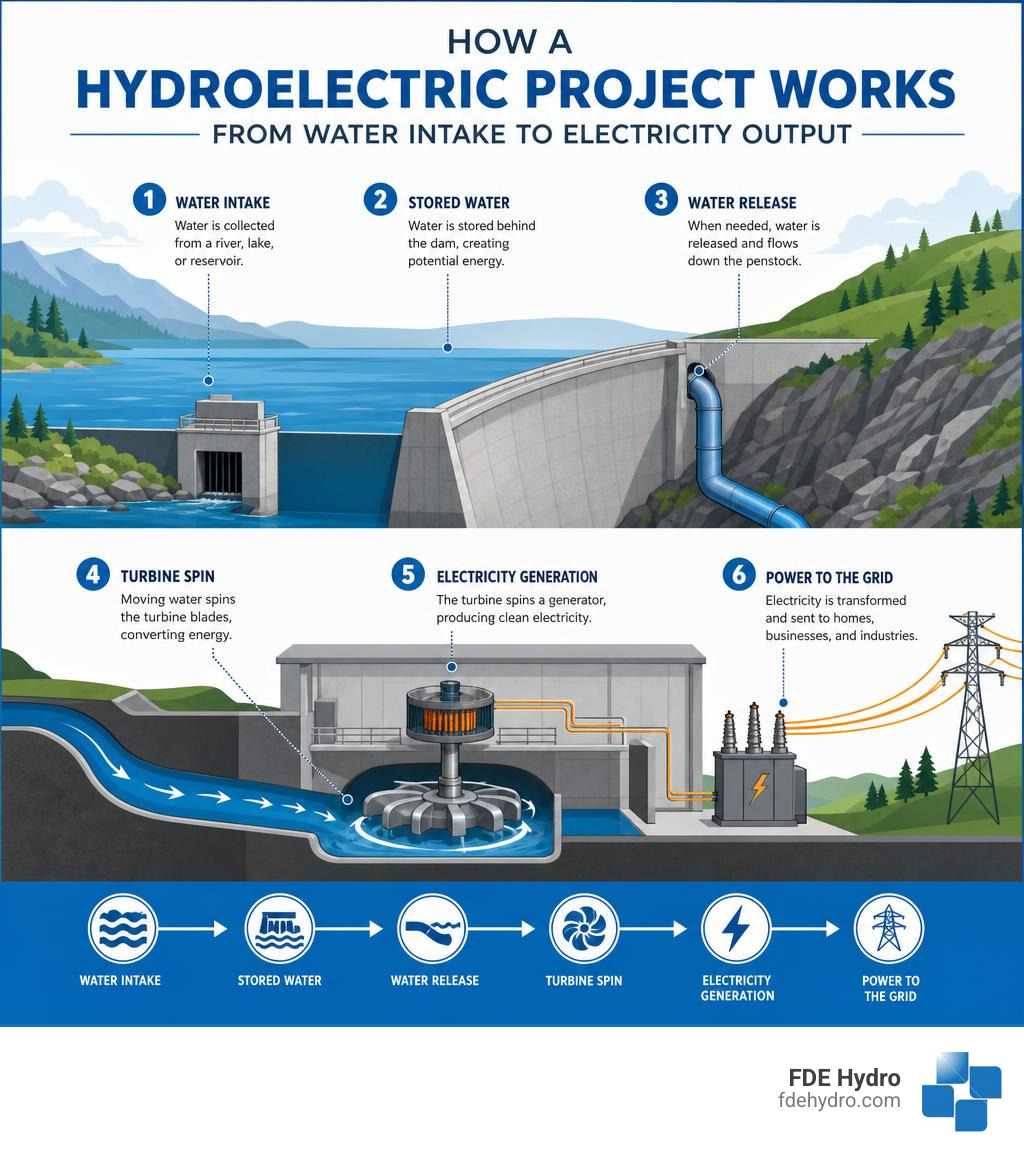
What is a Hydroelectric Project? Definition, Types, and Core Components

At its absolute simplest, a hydroelectric project is an infrastructure system designed to capture the natural flow of water and convert its kinetic energy into usable electricity.
Historically, humans used waterwheels to grind grain; today, we use massive, high-tech installations to power millions of homes. The underlying physics remain the same, but the engineering has reached an extraordinary level of sophistication. To understand how these systems function in the modern era, it helps to explore The Current Definition Understanding Hydroelectric Power and review our comprehensive Hydroelectric Power Solutions Guide.
The primary purpose of any hydropower project is to provide reliable, carbon-free electricity to the local or national grid. Unlike fossil-fuel plants, there is no combustion involved, and unlike solar or wind, hydropower is highly “dispatchable”—meaning grid operators can ramp electricity generation up or down in a matter of minutes to meet fluctuating demand.
Main Types of Hydropower Installations
Not all water-power systems are built the same way. Depending on the local geography, water availability, and grid requirements, developers choose from several primary configurations:
- Run-of-the-River Projects: These facilities generate electricity by diverting a portion of a river’s natural flow through a penstock and turbine, before returning the water safely back to the main river channel. Because they require little to no water storage, they have a remarkably small environmental footprint. However, their power output depends heavily on seasonal river flows.
- Reservoir-Based (Impoundment) Projects: This is the classic image of a hydropower plant. A large dam is constructed to hold back river water, creating a massive artificial reservoir. This stored water acts as a giant physical battery, allowing operators to release water and generate electricity exactly when the grid needs it most. If you are interested in how these massive structures are initiated, read about our perspective on Building New Dams.
- Pumped Storage Hydropower (PSH): Operating like a giant water-based battery, PSH systems utilize two reservoirs at different elevations. During periods of low electricity demand (and low power prices), cheap electricity is used to pump water from the lower reservoir to the upper one. When demand peaks, the water is released back down through turbines to generate high-value electricity.
- Peaking Plants: These are highly specialized facilities designed to operate primarily during hours of peak electricity demand. By storing water during off-peak hours and releasing it rapidly when the grid is strained, peaking plants prevent blackouts and keep energy prices stable.
Key Components of a Hydroelectric Project
Every hydroelectric project relies on a finely tuned network of structural, mechanical, and electrical components. If any single piece fails, the entire system can go dark.
- The Dam: A barrier constructed to hold back water, raise its elevation, and create the head (vertical drop) necessary to generate power.
- The Reservoir: The body of water stored behind the dam, providing a reliable source of potential energy.
- The Intake and Penstock: The intake gate opens to allow water to enter a massive pipe called a penstock, which channels the high-pressure water down toward the turbines.
- The Turbines: Large fan-like wheels that spin when struck by fast-moving water, converting hydraulic energy into mechanical energy.
- The Generators: Connected directly to the spinning turbine shaft, the generator uses electromagnetic induction to convert mechanical energy into electrical energy.
- The Spillway: A critical safety structure designed to release excess water safely during heavy rainfall or floods, preventing the dam from being overtopped.
To dive deeper into these individual parts, check out our Hydroelectric Dam Components Ultimate Guide and explore how we approach structural layout in our Hydroelectric Dam Design Complete Guide.
How a Hydroelectric Project Generates Clean Electricity
The actual generation of electricity is a beautiful demonstration of classical physics. It all starts with gravitational potential energy. Water stored at a high elevation in a reservoir naturally wants to flow downward. As it enters the penstock, that potential energy transforms into kinetic energy—the energy of motion.
When this fast-moving, high-pressure water strikes the blades of a turbine, it forces the turbine runner to spin. Depending on the height of the water drop (head) and the volume of water flow (discharge), engineers select different turbine designs to maximize efficiency:
- Francis Turbines: The most common turbine style, ideal for medium-to-high head applications. They feature curved blades and water enters radially before exiting axially.
- Kaplan Turbines: Essentially high-tech propellers with adjustable blades, perfect for low-head, high-volume river projects.
- Propeller Turbines: Fixed-blade turbines used in highly consistent water flow conditions.
As the turbine spins, it rotates a massive shaft connected to the rotor of a generator. This rotor is covered in powerful electromagnets that spin inside a stationary ring of copper wire coils (the stator). This movement forces electrons to flow through the copper wires, creating an alternating electrical current. From there, transformers step up the voltage so the electricity can travel efficiently across high-voltage transmission lines to homes and businesses.
For a complete breakdown of this fascinating mechanical process, read The Ultimate Guide to Modern Hydropower Technology.
Environmental, Economic, and Regulatory Frameworks
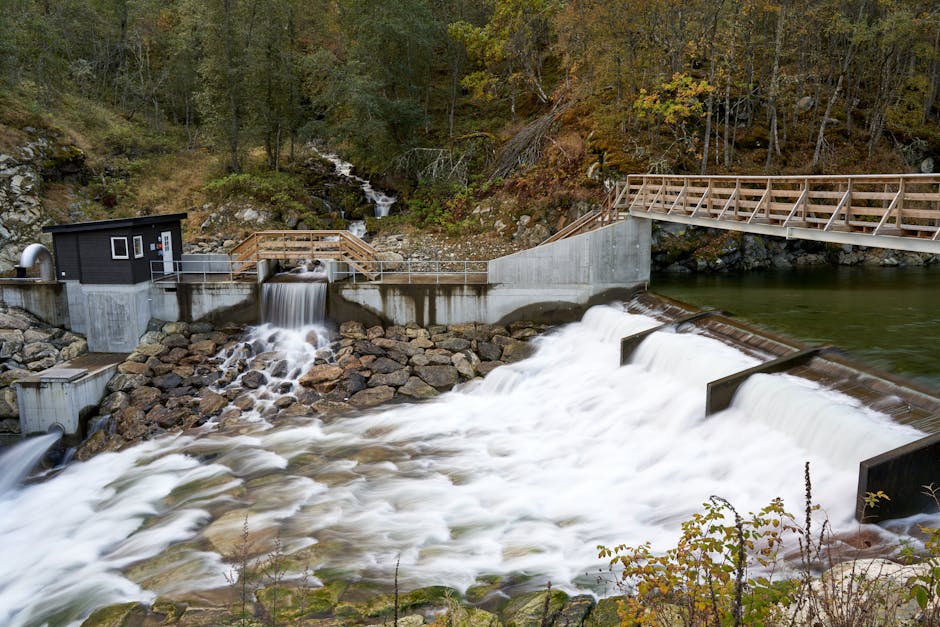
While the benefits of generating carbon-free electricity are undeniable, building and operating a hydroelectric project requires a careful balancing act between human energy needs and the health of local ecosystems.
On the positive side, hydropower is a cornerstone of the global transition to clean energy. It emits virtually no greenhouse gases during operation, prevents millions of tons of carbon dioxide from entering the atmosphere, and provides the baseline grid stability required to integrate more intermittent renewable sources like wind and solar.
However, historical dam construction has sometimes disrupted local environments. Blocking a river can alter natural water flows, impede fish migration, and degrade downstream water quality. Fortunately, modern engineering has developed highly effective solutions to mitigate these impacts:
- Fish Passages and Ladders: Structured channels that allow migrating fish to swim safely around or over dams to reach their upstream spawning grounds.
- Spawning Channels: Artificially created gravel beds next to the river that mimic natural habitats, providing safe zones for fish reproduction.
- Dissolved Oxygen Management: Aquatic life relies on oxygen dissolved in the water. To prevent low-oxygen zones downstream of dams, modern projects utilize advanced aerating turbines and linear aerating valves to infuse oxygen back into the water as it passes through the plant.
Regulatory Bodies and Hydropower Laws
Because rivers are shared public resources, developing a hydroelectric project is subject to some of the strictest regulatory oversight of any industry.
In the United States, the primary regulatory authority is the Federal Energy Regulatory Commission (FERC). Established under the Federal Water Power Act of 1920 (which later became Part I of the Federal Power Act), FERC is responsible for licensing non-federal hydropower projects, conducting rigorous dam safety inspections, and monitoring environmental compliance.
The licensing process is incredibly thorough and often takes several years. Developers must prove that their projects comply with a host of federal environmental laws, including:
- The National Environmental Policy Act (NEPA): Requiring comprehensive environmental impact statements.
- The Clean Water Act (CWA): Ensuring the project does not compromise local water quality standards.
- The Endangered Species Act (ESA): Guaranteeing that operations will not threaten protected wildlife.
For a broader look at how these regulations shape the national energy landscape, you can read about the history of Hydroelectric power in the United States – Wikipedia. Across the Atlantic, similar efforts to balance regulatory compliance with aggressive green energy goals are coordinated by organizations like HYDROPOWER EUROPE.
Economic Costs, Benefits, and Financing Models
The financial profile of a large-scale hydroelectric project is characterized by a high upfront capital expenditure (CapEx) followed by exceptionally low operational and maintenance costs (OpEx). Once a dam is built, the “fuel” (water) is completely free, allowing these plants to produce some of the cheapest electricity on the market for up to a century.
Because these projects require hundreds of millions—or even billions—of dollars to construct, financing models must be highly robust. Developers typically secure funding through a combination of:
- Debt-Equity Ratios: Often structured around a 70:30 split, combining bank loans with direct developer equity.
- Multilateral Development Banks: Institutions like the World Bank frequently provide long-term, low-interest loans for critical energy infrastructure.
- Municipal Bonds and Public Fundraising: Local governments and municipal utilities often issue tax-exempt bonds to fund local run-of-the-river projects, ensuring the economic benefits remain within the community.
To understand the financial realities of these developments, take a look at our analysis of Hydropower Project Costs A Deep Dive Into The Dollars And Cents and read about the physical realities of building these assets in our guide to Hydroelectric Dam Construction.
Safety, Maintenance, and Operational Challenges
Operating a hydroelectric project is a long-term commitment that requires constant vigilance. Because dams hold back millions of gallons of water, ensuring structural integrity is the single most important operational priority.
Over decades of continuous use, concrete dams can experience wear and tear from seismic activity, freeze-thaw cycles, and water erosion. Regular maintenance is essential. Key operational challenges include:
- Sediment Management: Rivers naturally carry silt and sediment. Over time, this material can settle in the reservoir, reducing its storage capacity and potentially damaging turbine blades if allowed to pass through the penstock. Operators must use dredging or bypass channels to manage sediment buildup.
- Mechanical Refurbishment: Turbines and generators do not last forever. Every few decades, plants must undergo major overhauls, including turbine runner replacement to restore operating efficiency and generator rewinding to ensure electrical reliability.
- Grid Integration: Modern grid operators must constantly balance supply and demand. Hydropower plants must be highly responsive, ramping up quickly when solar or wind output drops, which places physical stress on mechanical components.
Global Giants: Analyzing Successful Hydroelectric Projects
To see these principles in action, we can look at several extraordinary projects across our key operating regions in North America, Brazil, and Europe. These facilities demonstrate the sheer scale and diversity of modern hydropower:
| Project Name | Location | Installed Capacity (MW) | Key Feature / Output |
|---|---|---|---|
| Itaipu Binational | Brazil / Paraguay | 14,000 MW | Generated a record 98.6 million MWh in 2013; governed by a unique binational treaty. |
| Site C Clean Energy Project | British Columbia, Canada | 1,100 MW | Third dam on the Peace River; produces 5,100 GWh annually using only 5% of the reservoir footprint of the upstream dam. |
| Yadkin Project | North Carolina, USA | 215 MW | A four-station system utilizing advanced aerating turbines to protect river water quality. |
| Bradley Lake Project | Alaska, USA | 120 MW | Largest hydro facility in Alaska; provides 10% of Railbelt utility power at just $0.04 per kWh. |
| Carmen-Smith Project | Oregon, USA | 110 MW | Operating under a new 40-year FERC license; functions as a carbon-free peaking plant with major fish passage upgrades. |
| Lawrence Hydroelectric Project | Massachusetts, USA | 16.8 MW | A historic run-of-the-river facility providing clean local power to New England communities. |
Let’s look closer at some of these remarkable achievements.
The Itaipu Hydroelectric Power Plant on the Paraná River is a true wonder of modern engineering. Detailed in the ITAIPUMAGAZINEENGLISH_LR, this project features twenty 700 MW generating units. The concrete used to build it could construct 210 major sports stadiums, and its record-setting 2013 generation was enough to power the entire nation of Paraguay for eight years! For more context on Brazil’s massive water-power network, see the List of hydroelectric power stations in Brazil – Wikipedia.
In Canada, the Project Overview | Site C highlights how sequential development on a single river system can maximize efficiency. By utilizing water already stored upstream in the Williston Reservoir, Site C achieves 35% of the energy output of the massive W.A.C. Bennett Dam while flooding just 5% of the land area. You can explore more Canadian installations in the List of hydroelectric power stations in Canada – Wikipedia.
Even smaller municipal projects play a critical role in local grids. For instance, the historic Lawrence Hydroelectric Project along the Merrimack River is currently undergoing relicensing to secure decades of clean energy for local residents (learn more at the Patriot Hydro Lawrence Hydroelectric Project portal). Similarly, the Bowersock Mills & Power Company in Lawrence, Kansas, represents the enduring power of run-of-the-river hydro (read their story at About Bowersock).
Whether you look at the massive municipal networks of California or the historic masonry dams of New York, local water power continues to serve as the backbone of regional grid reliability. To discover more about these local systems, browse the Category:Hydroelectric power plants in New York (state) – Wikipedia) and Category:Hydroelectric power plants in California – Wikipedia directories.
Frequently Asked Questions about Hydropower
What is the difference between run-of-the-river and reservoir-based projects?
Run-of-the-river projects rely on the natural, daily flow of the river and feature very little water storage, resulting in a minimal environmental footprint but variable power output. Reservoir-based projects build a large dam to store water, giving operators complete control over when they generate electricity (peaking capacity), though they flood a larger land area.
How do hydroelectric projects impact local fish populations?
Dams can block fish from swimming upstream to spawn and alter downstream water quality. Modern projects mitigate this by installing fish ladders, building dedicated spawning channels, and utilizing specialized aerating turbines to maintain healthy dissolved oxygen levels in the river.
What are the primary safety risks associated with large dams?
The primary risks include structural failure due to extreme weather, seismic events, or age, as well as spillway inadequacy during historic floods. To prevent these hazards, dams are built with massive safety factors—such as roller-compacted concrete buttresses—and are subjected to rigorous, ongoing structural inspections by regulatory bodies like FERC.
Conclusion
As we look toward the future from our vantage point in June 2026, the global demand for clean, reliable, and dispatchable electricity has never been higher. Yet, the traditional way of building a hydroelectric project—involving massive, poured-in-place concrete dams, decades of environmental disruption, and astronomical construction costs—is no longer viable for many communities.
That is where we are changing the game.
At FDE Hydro™, we have developed and patented an innovative modular precast concrete technology known as the “French Dam.” By manufacturing heavy, high-strength concrete modules in a controlled factory environment and assembling them rapidly on-site, we can build and retrofit hydroelectric dams and water control systems in a fraction of the time and at a significantly lower cost than conventional methods.
Whether you are looking to build a new run-of-the-river facility, retrofit an existing non-powered dam, or upgrade water control structures in North America, Brazil, or Europe, our modular technology provides a faster, safer, and more environmentally friendly path forward.
We invite you to learn more about our approach to Hydropower Construction North America and discover how we are building the future of clean, reliable Hydropower by visiting fdehydro.com/hydropower/. Let’s build a cleaner grid, together.
