

What Is Electricity from the Grid — and How Does It Reach You?
Electricity from the grid travels through one of the most complex engineering systems ever built — from a power plant, through hundreds of miles of transmission lines, and into your home or facility in a fraction of a second.
Here’s a quick overview of how it works:
| Stage | What Happens |
|---|---|
| Generation | Power plants convert fuel or natural forces into electrical energy |
| Step-Up | Transformers raise voltage to 115,000–765,000 volts for long-distance travel |
| Transmission | High-voltage lines carry power across hundreds of miles with minimal loss |
| Step-Down | Substations reduce voltage to safer levels for local delivery |
| Distribution | Lower-voltage lines carry power to homes and businesses |
| Meter | Your usage is measured and billed by a utility |
The U.S. grid alone spans thousands of miles of high-voltage lines and millions of miles of lower-voltage lines, connecting thousands of power plants to hundreds of millions of customers. It is, by almost any measure, the largest machine ever built.
Yet most people never think about it — until the lights go out.
Grid reliability failures make the scale of this system impossible to ignore. In February 2021, nearly 10 million people in Texas lost power during a severe winter storm, resulting in more than 50 deaths. Events like that reveal just how much modern life depends on a steady, uninterrupted flow of electricity from grid infrastructure.
I’m Bill French, Sr., Founder and CEO of FDE Hydro™, and my five decades in heavy civil construction — including work selected by the U.S. Department of Energy’s Water Power Technology Office — have given me a front-row seat to how clean energy and electricity from the grid are being reshaped by modular innovation. In this guide, I’ll break down exactly how the grid works, what threatens it, and where it’s headed.
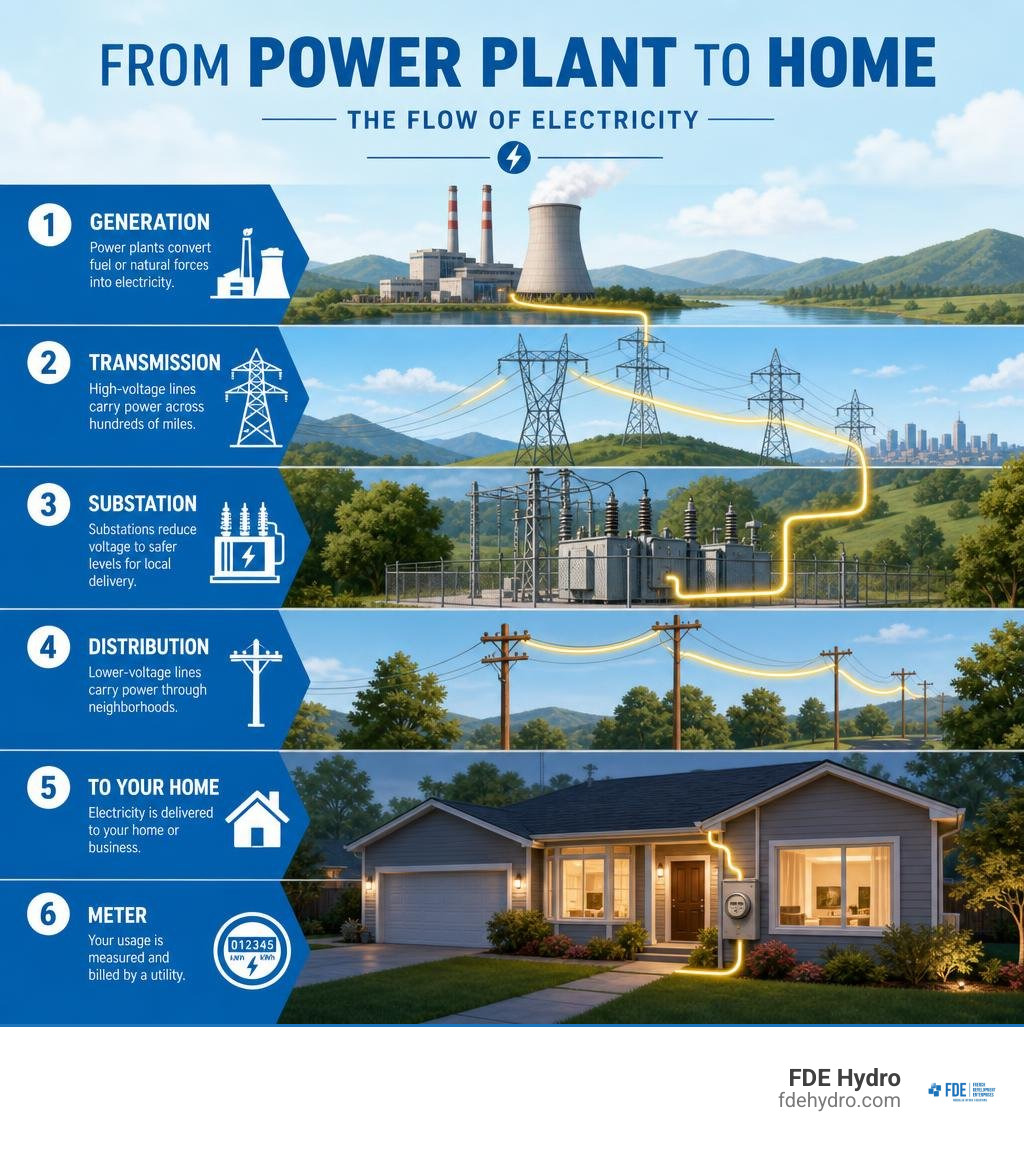
Electricity from grid vocab explained:
The Architecture of Power: How the Grid is Structured
To understand how we get electricity from grid utilities, we first need to look at the physical architecture. The electrical grid is not a single, unified machine. Instead, it is a vast network of generation facilities, high-voltage pathways, substations, and local distribution lines.
Historically, this system was designed for one-way traffic: massive, centralized power plants burned coal, gas, or harnessed nuclear and hydro energy, sending that power outward to passive consumers. Today, the network is shifting toward a decentralized, two-way system where consumers also feed power back into the system.
For a deeper dive into what “the grid” actually means mathematically and structurally, check out our guide on Unplugging the Mystery What Does Grid Mean in Electrical Engineering.
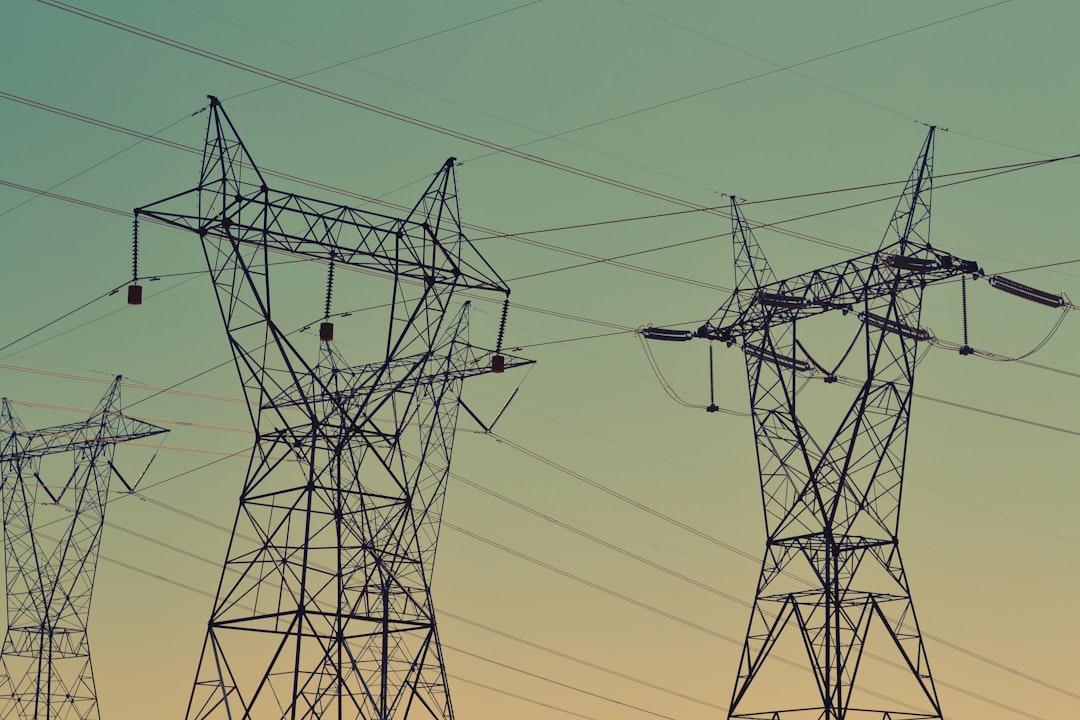
Across different regions, grids are organized into massive interconnected networks. For example, in Europe, the synchronous grid of Continental Europe managed by ENTSO-E boasts an incredible 667 gigawatts (GW) of generation capacity. You can view its vast footprint directly on the Grid Map – ENTSO-e .
In South America, the Electricity sector in Brazil – Wikipedia outlines one of the world’s most hydro-dependent national grids, showcasing how regional geography dictates grid structure. Meanwhile, in North America, we rely on distinct regional interconnections, though critics argue that the lack of centralized planning poses long-term risks, as explored in this Reality Check: The United States Has the Only Major Power Grid … .
Three-Phase AC Power and Synchronous Grids
Most of the world’s wide-area synchronous grids operate using three-phase Alternating Current (AC) electricity. Why three-phase? It is highly efficient because it delivers three alternating currents that are out of phase with each other, providing a continuous, non-pulsing stream of power. This allows industrial motors to run smoothly and delivers more power per pound of metal wire than single-phase systems.
To maintain stability, a synchronous grid must operate at a highly precise frequency—either 60 Hertz (Hz) in North America or 50 Hz in Europe. If the balance between electricity generation and demand shifts even slightly, the frequency will fluctuate. Grid operators must keep these deviations within fractions of a hertz to prevent equipment damage and widespread blackouts.
To understand how these physical networks interact and the differences between various grid topologies, read our detailed article on Grid Expectations Understanding the Various Electrical Networks. You can also explore how national systems manage these rules, such as Electricity in Canada – Natural Resources Canada .
The Physics of Delivering Electricity from Grid Infrastructure
The journey of electricity from grid generation to your wall outlet is a masterclass in physics. When electricity is generated at a power plant, it is typically produced at a relatively low voltage (around 5,000 to 25,000 volts).
If we tried to send electricity across hundreds of miles at this low voltage, the resistance in the wires would generate massive amounts of heat, causing most of the energy to waste away. To solve this, operators use step-up transformers at the power plant to raise the voltage to extreme levels—often between 115,000 and 765,000 volts. High voltage reduces the current (amperage) required to transmit the same amount of power, which drastically cuts down on line losses.
Once the electricity nears its destination, step-down transformers at local substations lower the voltage to safer levels. It is stepped down first to medium-voltage lines for commercial areas, and finally to 120/240 volts for residential use. You can read a complete breakdown of this delivery process directly from the Delivery to consumers – U.S. Energy Information Administration (EIA) .
How We Receive Electricity from Grid Systems
The journey of electricity can be split into two primary segments: transmission and distribution. While they might look similar to the untrained eye, they serve entirely different purposes.
| Feature | Transmission Lines | Distribution Lines |
|---|---|---|
| Voltage Level | Very High (115 kV to 765 kV) | Low to Medium (120 V to 34.5 kV) |
| Distance Covered | Long distances (across states/regions) | Short distances (local neighborhoods) |
| Line Construction | Massive metal towers, wide rights-of-way | Wooden or concrete poles, underground conduits |
| Line Losses | Low percentage (highly optimized) | Higher percentage of overall losses |
| Primary Purpose | Bulk transport of electricity | Delivering usable power to final consumers |
To understand how these systems transition between high and low voltages, you can read The Middle Ground A Guide to Medium Voltage Grids.
High-Voltage Transmission Lines
High-voltage transmission lines are the superhighways of the electrical grid. Suspended from towering steel structures, these lines carry electricity over vast distances. In the United States, about 4% of electricity output is lost during transmission and distribution.
To combat these losses, utilities are increasingly looking at High-Voltage Direct Current (HVDC) lines. While traditional transmission relies on AC, the latest generation of HVDC power lines can transmit energy over long distances with losses of only 1.6% per 1,000 kilometers.
To learn more about these massive structures and how they act as the backbone of our energy security, read High Voltage Lines The Backbone of Our Power Grid. For a regional perspective on how these lines are regulated and maintained, consult the Transmission & Distribution – Kansas Corporation Commission .
Low-Voltage Distribution Networks
Once the electricity reaches a local substation, it enters the low-voltage distribution network. These are the lines you see running along neighborhood streets on wooden poles or buried safely underground.
Distribution systems step the voltage down to levels that residential and commercial appliances can handle. A final transformer, often resembling a gray metal can on a utility pole or a green box on lawns, performs the final step-down to 120/240 volts before the electricity enters your electrical panel.
For a step-by-step look at this final leg of the journey, read From Transformer to Plug Exploring the Low Voltage Grid.
Real-Time Balancing: How Operators Maintain Grid Reliability
One of the most mind-boggling aspects of receiving electricity from grid systems is that electricity must be consumed the exact millisecond it is generated. Because large-scale grid storage is historically limited, grid operators—known as balancing authorities—must constantly balance supply and demand in real time.
If demand spikes (for example, on a hot afternoon when millions of air conditioners turn on) and operators do not bring more generation online, the grid’s frequency will drop. If it drops too low, safety systems will automatically disconnect power plants to protect them, potentially triggering a cascading blackout. Conversely, if there is too much supply and not enough demand, the frequency will rise, which can also damage grid infrastructure.
Operators use a mix of “baseload” power plants (which run continuously) and rapid-response “peaker” plants (often natural gas or hydroelectric facilities) to maintain this delicate equilibrium. To see real-world examples of how this operational dance powers our daily lives, check out our article on Shocking Examples How the Electrical Grid Powers Our Lives.
Managing Power Outages and Black Starts
Despite the best efforts of balancing authorities, outages still happen. In the United States, the majority of reliability issues are caused by factors outside the control of grid operators, such as physical distribution or transmission lines downed during extreme weather events.
When a catastrophic blackout occurs and the grid goes completely dark, operators cannot simply flip a switch to turn it back on. Most large power stations require electricity from the grid just to start their own operations (to run pumps, blowers, and control systems).
To recover from a total collapse, operators must execute a highly coordinated “black start.” This involves using small, self-starting generators (like diesel generators or hydroelectric plants) to gradually energize local lines and bring larger power plants back online step-by-step.
To understand this emergency playbook, read The Black Start Blueprint How Power Grids Come Back to Life.
Electricity Markets, Rates, and Consumer Access
How do we actually buy and sell electricity from grid utilities? The financial side of the grid is just as complex as the physical side.
In many regions, electricity is traded on wholesale markets where power generators sell their output to utilities and retail providers. Retail providers then sell that electricity directly to homes and businesses.
To explore how these utility companies operate and structure their consumer services, you can visit National Grid: Natural Gas & Electricity or check regional offerings like Massachusetts Electricity | Home – National Grid .
When you look at your utility bill, the cost is typically split into two main categories:
- Supply Costs: The actual cost of the electricity generated at power plants. You can learn more about how these supply rates are calculated by reviewing Supply Costs | Bills, Meters & Rates | National Grid .
- Delivery Costs: The cost to maintain the physical transmission lines, substations, poles, and meters that bring the power to your door. For a breakdown of delivery charges, see Service Rates | Bills, Meters & Rates | National Grid .
The Cost of Sourcing Electricity from Grid Utilities
For residential customers, utilities typically offer a default option known as “Basic Service” if you do not actively choose a competitive third-party electricity supplier. Under Basic Service, the utility purchases power on your behalf through competitive solicitations and passes the cost directly to you without any markup.
Consumers can often choose between different rate structures:
- Fixed Rates: Your price per kilowatt-hour (kWh) remains constant for a set period (usually 6 to 12 months), protecting you from seasonal price spikes.
- Variable Rates: Your price fluctuates monthly based on wholesale market conditions.
For low-income households, many utilities offer dedicated assistance programs. For instance, eligible customers can qualify for discount rate programs that provide bill credits ranging from 32% to 71% of total charges. You can view an official breakdown of these rate structures and discount programs in the 2025 Summary of Rates for Massachusetts .
The Evolution of the Grid: Smart Tech and Renewables
The grid is undergoing its most significant transformation since the days of Thomas Edison. Traditional grids were centralized and analog; the modern grid is becoming highly digital, interactive, and decentralized.
Two major drivers of this evolution are:
- Distributed Energy Resources (DERs): Technologies like residential rooftop solar panels and local battery storage allow consumers to generate their own power.
- Smart Grids: Utilizing advanced sensors, digital communication systems, and smart meters, modern grids can automatically detect outages, reroute power to isolate faults, and communicate real-time pricing to consumers.
This shift toward decentralized, self-healing networks often relies on localized microgrids. To understand how operators manage these advanced networks, read The Brains Behind the Grid Optimizing Microgrid Operations. For a look at how cutting-edge technologies are securing these transactions, explore Why Your Energy Grid Needs a Blockchain Upgrade.
Furthermore, digital platforms like the GridPulse — Electricity Price API are enabling developers and AI agents to access real-time electricity prices, carbon intensity metrics, and generation mix data across dozens of global grid zones.
Integrating Renewable Energy and AI Workloads
As we transition toward a decarbonized future, integrating variable renewable sources like wind and solar presents a massive engineering challenge. Unlike gas or hydro plants, wind and solar cannot be turned on demand.
At the same time, the grid is facing unprecedented demand growth. AI data centers are projected to double their energy consumption by 2030. Because a single LLM inference query can vary up to 20x in carbon intensity depending on where and when it is run, developers are looking for ways to optimize compute workloads.
Open-source protocols like carbonsteward/grid402 are stepping in to solve this. By providing sub-hourly (5-minute) data on generation mixes, emissions, and spot prices, these tools allow AI agents to automatically schedule heavy computing tasks during hours when clean energy is abundant on the grid.
This integration is vital in states like California, where renewable generation is growing rapidly, as documented in the 2023 Total System Electric Generation report.
Frequently Asked Questions about Grid Electricity
What are the three major interconnections in the United States?
The contiguous United States is divided into three primary independent grid networks:
- The Eastern Interconnection: Covers the area east of the Rocky Mountains and parts of eastern Canada.
- The Western Interconnection: Covers the area from the Rocky Mountains to the West Coast, including western Canada.
- The Electric Reliability Council of Texas (ERCOT): Covers most of the state of Texas. Because ERCOT is largely isolated from the other interconnections, it has limited ability to import power during extreme weather emergencies.
Why does the grid use high voltage for long-distance transmission?
The grid uses high voltage because of basic electrical physics. As electricity travels through a wire, electrical resistance causes some of the energy to turn into heat, resulting in line losses. By using step-up transformers to increase the voltage, the current (amperage) is reduced. Lower current means significantly less heat generation and lower energy loss, allowing power to travel hundreds of miles efficiently.
How do microgrids differ from the main electrical grid?
While the main electrical grid is a massive, centralized network, a microgrid is a localized grid that can operate independently. Microgrids feature their own local generation sources (such as solar arrays, wind turbines, or backup generators) and energy storage.
Most importantly, they have the ability to “island”—meaning they can disconnect from the main grid during an outage and continue supplying power to a local facility, hospital, or neighborhood autonomously. You can learn more about the mechanics behind these systems in Power Up The Engineering Behind Microgrids Explained.
Conclusion
As we look toward the future, the demand for reliable, clean electricity from grid networks will only continue to rise. Transitioning to a decarbonized grid requires not just smart software, but a fundamental upgrade of our physical infrastructure.
That is where we at FDE Hydro™ come in. Our patented, modular precast concrete technology—the French Dam—is revolutionizing how we build and retrofit hydroelectric dams and water control systems. By significantly reducing construction costs and installation times across North America, Brazil, and Europe, we are helping communities rapidly deploy reliable, baseload renewable energy to stabilize local grids.
Modernizing the grid is the defining engineering challenge of our generation. To stay informed on how clean energy and grid technology are evolving, explore our complete library of resources in the Category Power Grid Articles.
