

What Is a Water Power Dam and How Does It Generate Electricity?
A water power dam is a structure that captures the energy of moving or stored water and converts it into electricity — and it remains one of the most powerful and reliable sources of clean energy on the planet.
Here’s how it works at a glance:
| Step | What Happens |
|---|---|
| 1. Water storage | A dam holds water in a reservoir, building up potential energy |
| 2. Controlled release | Water flows through an intake and into a penstock (a large pipe) |
| 3. Turbine spin | Rushing water strikes turbine blades, converting potential energy to kinetic energy |
| 4. Electricity generation | The spinning turbine drives a generator, producing electricity |
| 5. Grid delivery | A transformer steps up voltage for long-distance transmission |
Hydropower isn’t a niche technology. It supplies roughly 15% of the world’s electricity — nearly 4,210 TWh generated in 2023 alone. That’s more than all other renewable energy sources combined, and more than nuclear power.
Yet despite its scale, many people don’t fully understand how these systems work, what types exist, or what trade-offs they involve — especially for the engineers and project developers making billion-dollar infrastructure decisions.
This guide covers all of it: how dams generate power, the different facility types, the history, the advantages and risks, and where hydropower fits in the future of clean energy.
I’m Bill French, Sr., Founder and CEO of FDE Hydro™ and a longtime heavy civil construction executive with five decades of experience in large-scale infrastructure — including direct work with the U.S. Department of Energy’s Water Power Technology Office on next-generation water power dam solutions. My goal here is to give you a clear, practical, and honest picture of how hydroelectric power works and where the industry is headed.
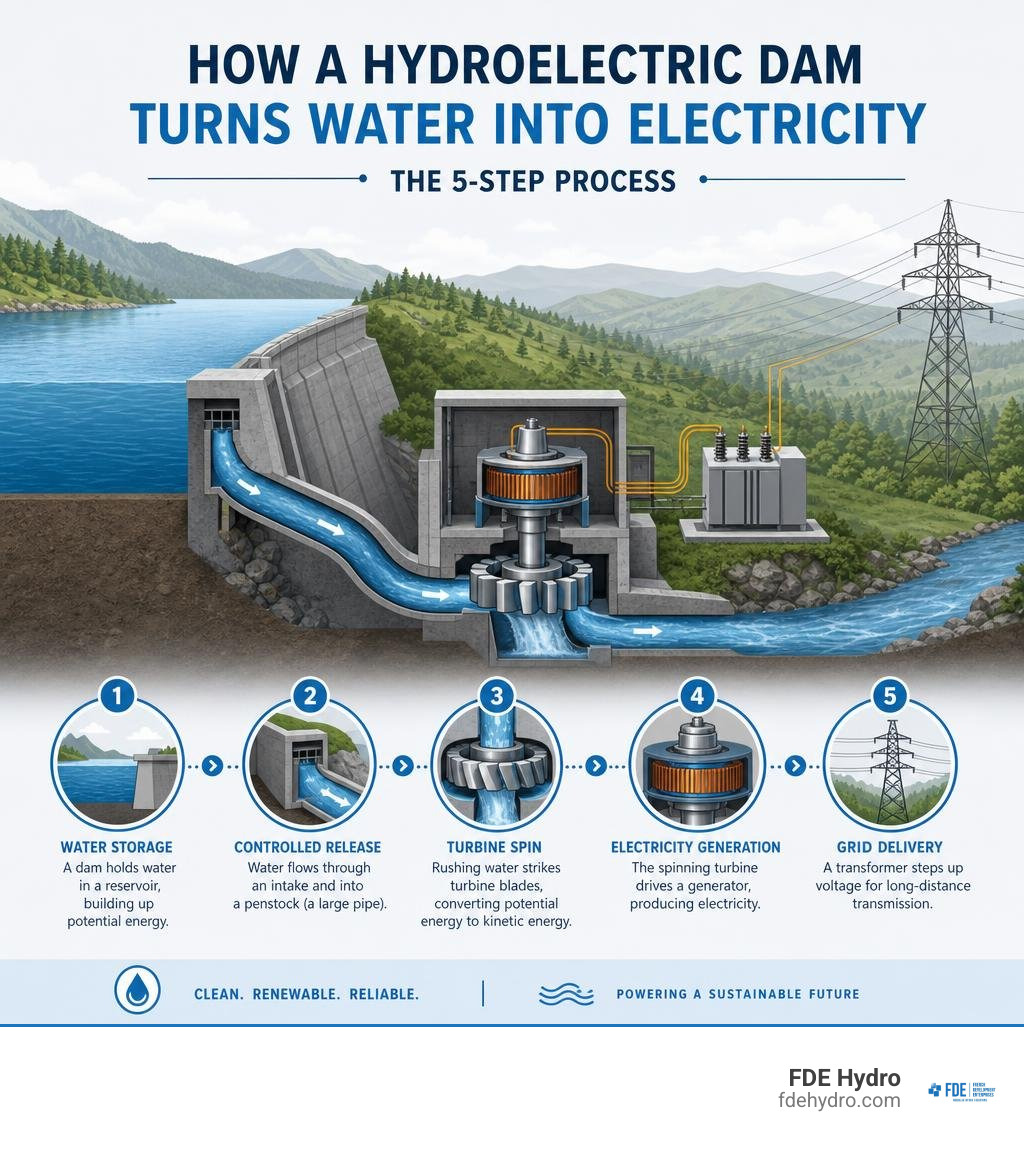
Simple guide to water power dam:
Anatomy of a Water Power Dam: How It Works
To understand the sheer power of a water power dam, we have to look at the physics of water. It all comes down to two fundamental concepts: potential energy and kinetic energy.
When water is held back by a dam in a high-elevation reservoir, it accumulates massive amounts of gravitational potential energy. The higher the water level (known in the industry as the “head”), the more potential energy is stored. When we open the gates, gravity pulls that water downward, converting that potential energy into kinetic energy—the physical energy of motion.
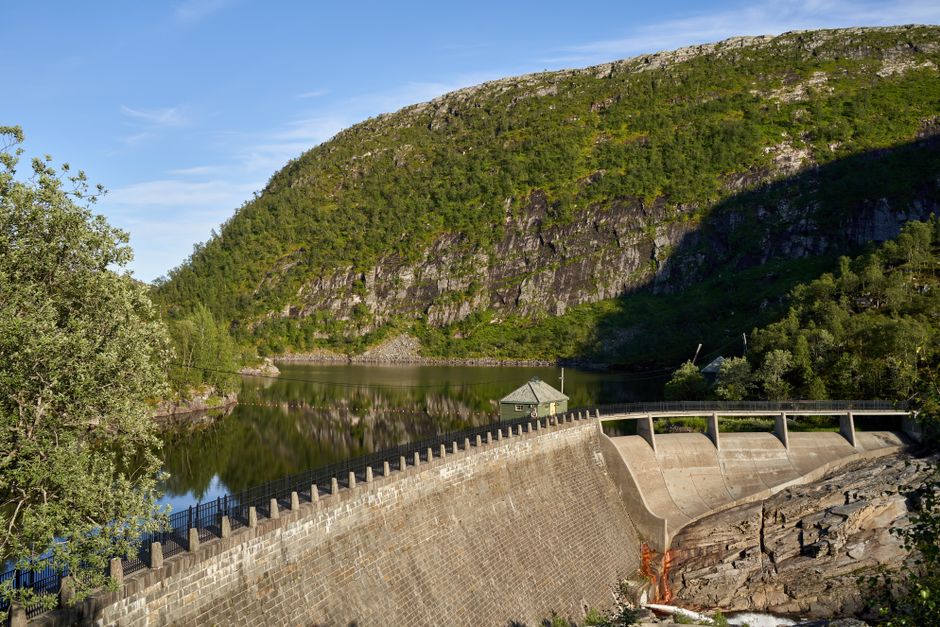
To get a comprehensive look at how these elements fit together, check out our Hydroelectric Dam Components: Ultimate Guide.
From Reservoir to Grid: The Generation Process
The physical journey from a quiet reservoir to a glowing lightbulb in your living room is a marvel of engineering:
- The Intake and Penstock: Water is released from the reservoir through control gates. It enters the penstock, a massive, heavy-duty steel or concrete pipe. The penstock narrows as it travels downward, which increases the pressure and velocity of the water.
- The Turbine: At the bottom of the penstock, the high-pressure water strikes the blades of a water turbine. This causes the turbine runner to spin rapidly. This is where kinetic energy is converted into mechanical energy.
- The Generator: The spinning turbine is connected to a generator by a heavy steel shaft. Inside the generator, powerful magnets spin inside copper coils. This motion triggers electromagnetic induction, generating an alternating electrical current (AC).
- The Transformer and Transmission Lines: The electricity generated is usually around 13,800 volts. To travel long distances without losing too much energy, a transformer steps up this voltage to hundreds of thousands of volts. It then flows onto high-voltage transmission lines and out to the electrical grid.
Key Structural Components of a Hydro Dam
Every water power dam relies on a precise configuration of civil engineering structures to operate safely and efficiently. If you are interested in how these structures are planned and built, our Hydroelectric Dam Design: Complete Guide covers the engineering in detail.
- The Spillway: Think of the spillway as the dam’s safety valve. When heavy rains or rapid snowmelt fill the reservoir to capacity, we cannot let water run over the top of a non-overflow dam section, as this can cause catastrophic structural failure. The spillway safely routes excess water downstream, bypassing the powerhouse.
- The Powerhouse: This is the concrete and steel building that houses the heavy machinery, including the turbines, generators, governors, and control systems.
- The Forebay: This is the basin located immediately upstream of the water intake structures. It acts as a buffer zone, smoothing out the flow of water before it enters the penstocks.
- Intake Gates: These heavy, adjustable gates control the volume of water entering the penstocks. They can be shut down quickly in the event of an emergency or during routine maintenance.
Types of Hydropower Facilities and How They Differ
Not every water power dam looks or functions the same way. Hydropower facilities are generally classified into three major types based on how they store and manage water.
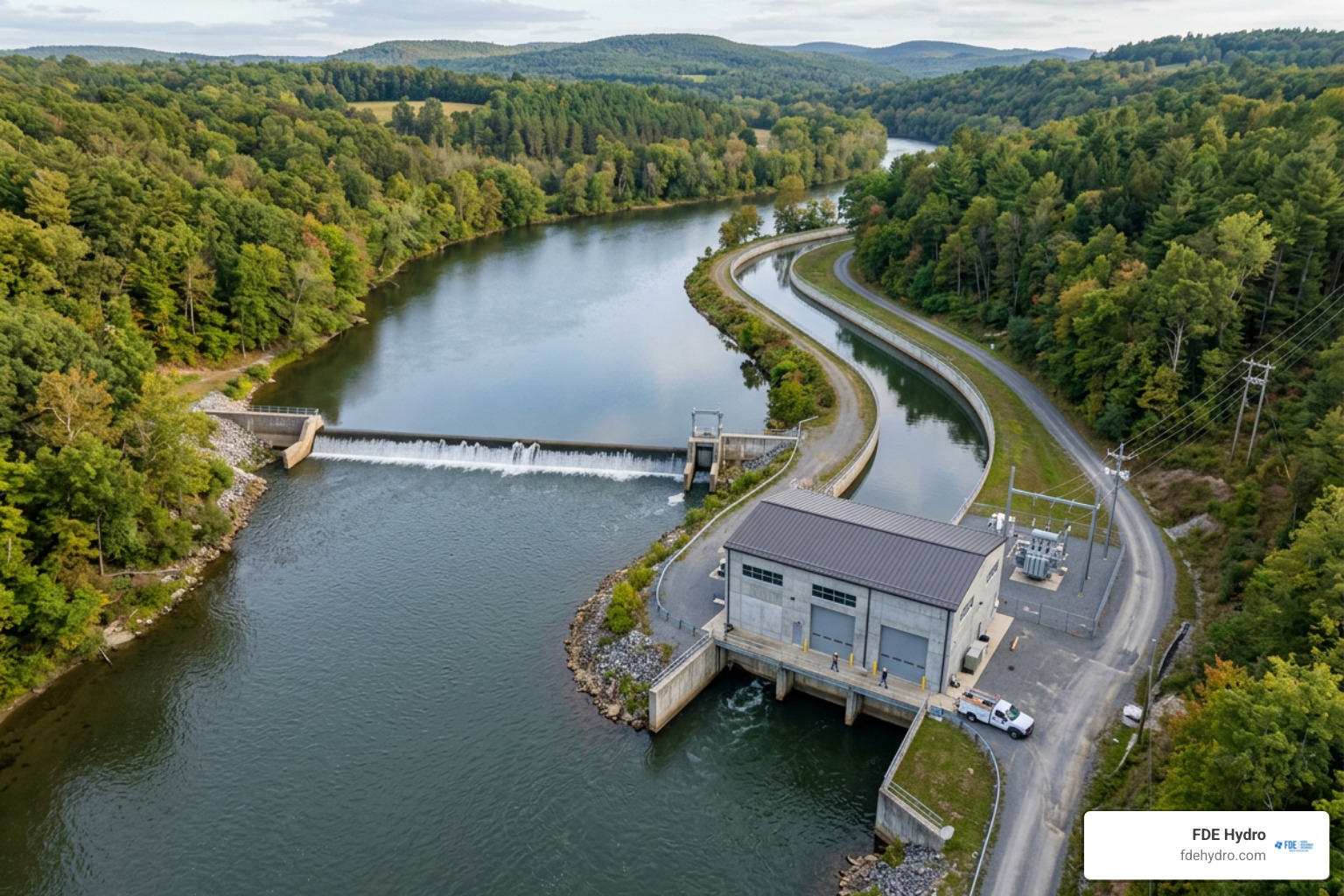
For a closer look at these variations, read our Beginner’s Guide to Hydro-Electric Dams.
The Impoundment Facility: The Classic Water Power Dam
The impoundment facility is what most people picture when they hear the word “dam.” It uses a large structural barrier to block a river, creating an artificial reservoir behind it.
These conventional dams allow operators to store water and release it on demand. This provides incredible control over electricity generation, allowing the plant to respond to sudden spikes in power demand.
A prime example in the United States is the iconic Grand Coulee Dam on the Columbia River in Washington State. Boasting an installed capacity of 6,809 MW, it is the largest hydropower producer in the country. To explore its immense scale, take a look at the official Grand Coulee Dam Statistics and Facts .
Run-of-the-River and Diversion Systems
Run-of-the-river (sometimes called diversion) systems take a completely different approach. Instead of building a massive wall to create a reservoir, these systems use the natural flow of the river.
A portion of the river’s water is diverted through a canal or penstock, directed through a low-head turbine, and then returned immediately downstream to the main river channel. Because they have minimal or no water storage, run-of-the-river plants are highly dependent on seasonal river flows. They are often preferred for smaller projects due to their lower environmental footprint. To learn more about how these low-impact systems function, read All About Hydro Dams.
Pumped-Storage Hydropower: The Grid’s Giant Battery
Think of pumped-storage hydropower as a giant, water-based battery. These facilities feature two reservoirs at different elevations: an upper reservoir and a lower reservoir.
- During low-demand periods (e.g., at night): The facility uses cheap, surplus electricity from the grid (or from wind and solar) to pump water from the lower reservoir up to the upper reservoir.
- During peak-demand periods (e.g., hot summer afternoons): The water is released from the upper reservoir back down to the lower reservoir, spinning reversible turbines to generate electricity when the grid needs it most.
Pumped-storage schemes are incredibly efficient and provided almost 85% of the world’s 190 GW of grid energy storage in 2021. They are essential for grid stability as we integrate more intermittent renewable energy. To see how these systems are reshaping our energy future, explore our Beginners Guide to Hydroelectric Power Dams.
The Historical Evolution of Hydropower
Humans have been capturing the energy of moving water for thousands of years. Long before we used it to light up our cities, water was the driving force behind early industrialization.
To see how these historical concepts evolved into modern carbon-free infrastructure, check out The Ultimate Guide to Modern Hydropower Technology.
Ancient Roots and the Industrial Revolution
Some of the earliest water-power innovations were conceived in China during the Han Dynasty (between 202 BC and 9 AD), where water wheels were used to grind grain and power trip hammers. By the time of the Industrial Revolution, water wheels had become highly sophisticated.
In 1771, Richard Arkwright built the Cromford Mill in England, utilizing water power for cotton spinning. This project created one of the world’s first factory systems, proving that water could drive mechanical energy on an industrial scale.
The Birth of Hydroelectricity
The transition from mechanical water power to electricity occurred in the late 19th century.
- 1878: Hydropower was first used to generate electricity at Cragside House in Northumberland, England, where it powered a single arc lamp.
- 1882: The Vulcan Street Plant in Appleton, Wisconsin, began operating on the Fox River. It was the first commercial hydroelectric plant in the United States, generating 12.5 kW of power.
The late 19th and early 20th centuries saw rapid leaps in turbine technology. Engineers developed specialized turbines for different water conditions:
- The Francis Turbine (1849): Developed by James Francis, this remains the most widely used water turbine in the world today for medium-head applications.
- The Pelton Wheel (1880): Invented by Lester Pelton, this impulse turbine is ideal for high-head, low-flow operations.
- The Kaplan Turbine (1913): Invented by Viktor Kaplan, this propeller-like turbine is perfect for low-head, high-flow conditions.
The Era of Mega-Dams
The mid-20th century ushered in the era of mega-dams, driven by massive public works projects in North and South America. In the United States, the construction of the Hoover Dam in the 1930s showed that we could tame wild rivers to provide both irrigation and massive amounts of electricity.
Decades later, in 1984, the massive Itaipu Dam opened on the Paraná River between Brazil and Paraguay. Generating 14 GW of power from 20 massive turbines, it was recognized as one of the Seven Wonders of the Modern World. You can read more about its history and engineering marvels on the Itaipu Dam – Wikipedia page or explore the official corporate history in the ITAIPUMAGAZINEENGLISH_LR .
The Pros and Cons of Hydroelectric Power
Like any energy source, hydroelectric power comes with trade-offs. To build a reliable and clean grid, we must weigh these advantages against their environmental and social costs.
For a deeper dive into these trade-offs, explore our guide on Hydro-Electric Dams.
Advantages: Flexibility, Low Cost, and Grid Stability
Hydropower offers several unique benefits that wind and solar simply cannot match:
- Incredible Flexibility: Hydroelectric turbines can go from completely cold to full power in just a few minutes. This rapid response time is critical for providing peaking power when demand suddenly spikes.
- Black Start Capability: If the electrical grid suffers a total blackout, most thermal power plants (coal, gas, nuclear) need external power to restart. Hydro plants can start up using only the gravity of their own water, helping to jumpstart the rest of the grid.
- Low Operating Costs: While the upfront cost of building a water power dam is high, the “fuel” (water) is free. These plants have incredibly low operating and maintenance costs, and many remain operational for over a century with periodic retrofits.
- Multipurpose Benefits: Hydro reservoirs do more than just make electricity. They provide critical flood control, reliable agricultural irrigation, municipal water supplies, and recreational opportunities.
Environmental Challenges of the Water Power Dam
Despite being a clean, low-carbon energy source, large-scale dams can have a significant impact on local ecosystems:
- Ecosystem Disruption & Fish Migration: Building a physical barrier blocks migratory fish species, like salmon, from reaching their upstream spawning grounds. It also alters water temperatures and oxygen levels downstream, impacting aquatic life.
- Siltation & Sediment Trapping: Rivers naturally carry nutrient-rich sediment. When we dam a river, that sediment settles at the bottom of the reservoir instead of flowing downstream to nourish deltas and agricultural lands.
- Reservoir Methane Emissions: When a new reservoir is flooded, the submerged vegetation and organic matter rot underwater. In warm climates, this anaerobic decomposition can release significant amounts of greenhouse gases, particularly methane, into the atmosphere.
- Population Displacement: Creating massive reservoirs requires flooding vast areas of land. Historically, this has led to the forced relocation of local communities and indigenous populations, along with the loss of valuable historical and cultural sites.
Global Capacity and Comparison with Other Energy Sources
Hydropower remains the bedrock of global renewable energy. Let’s look at how it shapes up on the world stage and how it compares to other power generation technologies.
Hydropower on the Global Stage
Globally, installed hydropower capacity reached nearly 1,400 GW in 2021. Today, a handful of nations dominate global production, with China leading the charge (accounting for nearly 30% of global output), followed by Brazil (10%), Canada (9.2%), and the United States (5.8%).
In countries like Brazil, Canada, and Norway, hydroelectricity plays a leading role, supplying the vast majority of their domestic electricity. You can read more about these regional profiles on the Hydroelectricity in Canada – Wikipedia page and the Hydroelectric power in the United States – Wikipedia page.
In Europe, hydro remains a key pillar of grid reliability. To understand its regional footprint, explore the insights provided by the Hydropower in Europe | IHA Regional ProfileHydropower … .
In terms of energy storage, conventional reservoirs are unmatched. The International Energy Agency (IEA) estimated that the reservoirs of all existing conventional hydropower plants combined can store a total of 1,500 TWh of electrical energy in one full cycle. That is about 170 times more energy than the entire global fleet of pumped-storage plants.
How Hydropower Compares to Wind, Solar, and Nuclear
To understand where a water power dam fits into our energy mix, it helps to compare it directly to other major generation sources:
| Technology | Capacity Factor | Dispatchability | Capital Cost | Carbon Footprint |
|---|---|---|---|---|
| Hydropower | High (40% – 60%) | Fully Dispatchable | Very High | Very Low |
| Wind Power | Moderate (30% – 45%) | Intermittent | Moderate | Very Low |
| Solar Power | Low (15% – 25%) | Intermittent | Low | Very Low |
| Nuclear Power | Very High (90%+) | Base Load | Extremely High | Very Low |
While solar and wind have lower capital costs and faster installation times, they are intermittent. Hydropower and nuclear provide the reliable, dispatchable power needed to keep the grid steady when the wind isn’t blowing and the sun isn’t shining.
Climate Change, Reliability, and Safety Risks
As our climate changes, we are seeing more extreme weather. This presents new challenges for managing water resources and keeping dams running safely.
For more on how modern dams manage extreme weather and high water events, read about Dam Flood Control.
Drought, Siltation, and Changing Weather Patterns
Because hydropower relies entirely on the water cycle, its output is highly sensitive to changes in precipitation.
- Droughts: Prolonged dry spells can severely reduce river flows and reservoir levels, forcing plants to run at reduced capacity. In places like California, seasonal droughts can lead to major swings in annual hydro generation. To see how these dynamics play out locally, check out the Hydroelectric Power – California Energy Commission – CA.gov reports.
- Siltation: Over time, reservoirs naturally collect silt and sediment. This reduces their active water storage capacity, which limits both power generation and flood control capabilities. Regular dredging is often required to keep these systems clean and operating efficiently.
Dam Safety, Failure Risks, and Mitigation
Dams are massive structures holding back billions of gallons of water. A structural failure can have devastating consequences for downstream communities.
The historical benchmark for dam failures is the Banqiao Dam disaster in China in 1975, where a catastrophic typhoon caused a series of dam failures that led to immense loss of life.
Today, dam safety is highly regulated. Operators use advanced structural monitoring tools, including seismic sensors, tiltmeters, and automated piezometers, to spot tiny shifts in the structure long before they become dangerous. Spillways are also designed to handle “Probable Maximum Flood” events to prevent overtopping.
Integrating Hydro with Wind and Solar
To build a reliable, zero-carbon grid, we need to combine different renewable technologies. Hydropower is the perfect partner for wind and solar.
When wind and solar produce excess power during sunny or windy days, we can throttle back our hydro dams, conserving water in the reservoirs. When the sun sets or the wind dies down, we can quickly open the hydro gates to fill the gap. This hybrid approach turns our water reservoirs into virtual batteries, smoothing out the natural ups and downs of wind and solar power.
Frequently Asked Questions about Hydroelectric Dams
How does a water power dam generate electricity?
A dam stores water in a reservoir to build up gravitational potential energy. When released, this water flows down through a penstock and spins a turbine. The spinning turbine drives a generator, which uses electromagnetic induction to convert that mechanical movement into electricity.
What is the difference between conventional and pumped-storage dams?
Conventional dams use a one-way flow of water, capturing the natural downstream run of a river to generate electricity. Pumped-storage dams use a two-reservoir system (upper and lower) and reversible pump-turbines. They act like a giant battery, pumping water uphill when electricity is cheap and releasing it to generate power when demand is high.
What are the main environmental impacts of large dams?
Large dams can block fish migration, alter water temperatures, and disrupt downstream river ecosystems. Reservoirs also trap sediment that would naturally nourish downstream habitats. Additionally, flooding large areas of land can displace local populations and release methane as submerged vegetation decays.
Conclusion
The water power dam remains one of our most reliable tools for generating clean, dispatchable, and renewable energy. As we work to phase out fossil fuels, the flexibility and storage capacity of hydropower will only become more critical for keeping our electric grids stable.
However, building traditional, massive concrete dams is incredibly expensive, takes years of permitting, and can cause significant environmental disruption. The future of hydropower lies in smarter, low-impact, and highly efficient technologies.
At FDE Hydro™, we are leading this transition. We develop innovative, patented modular precast concrete technology—known as the French Dam—designed for building and retrofitting hydroelectric dams and water control systems. By moving construction from the riverbed to a controlled precast facility, we significantly reduce construction costs, minimize environmental footprints, and cut project timelines across the United States, Canada, Brazil, and Europe.
Whether it is small-scale run-of-the-river projects like the historic Bowersock Dam – Wikipedia on the Kansas River, retrofitting existing non-powered dams like the Patriot Hydro Lawrence Hydroelectric Project on the Merrimack River, or optimizing multi-purpose federal projects like the Chief Joseph Dam and the Albeni Falls Dam (learn more about its operations via the Albeni Falls Dam and Lake Pend Oreille > Northwestern Division > Fact Sheet – Northwestern Division ), our modular solutions are built to meet the highest safety and environmental standards.
To learn more about how we are shaping the next generation of water infrastructure, explore our guides on Dam Construction Methods and Hydroelectric Dam Construction, or check out FDE Hydro’s Hydropower Solutions to see our technology in action.
