

What “Off-Grid Electricity” Really Means — And Why It Matters
Understanding the off grid electricity meaning starts with one simple idea: your building produces and stores its own power, with no physical connection to a public utility grid.
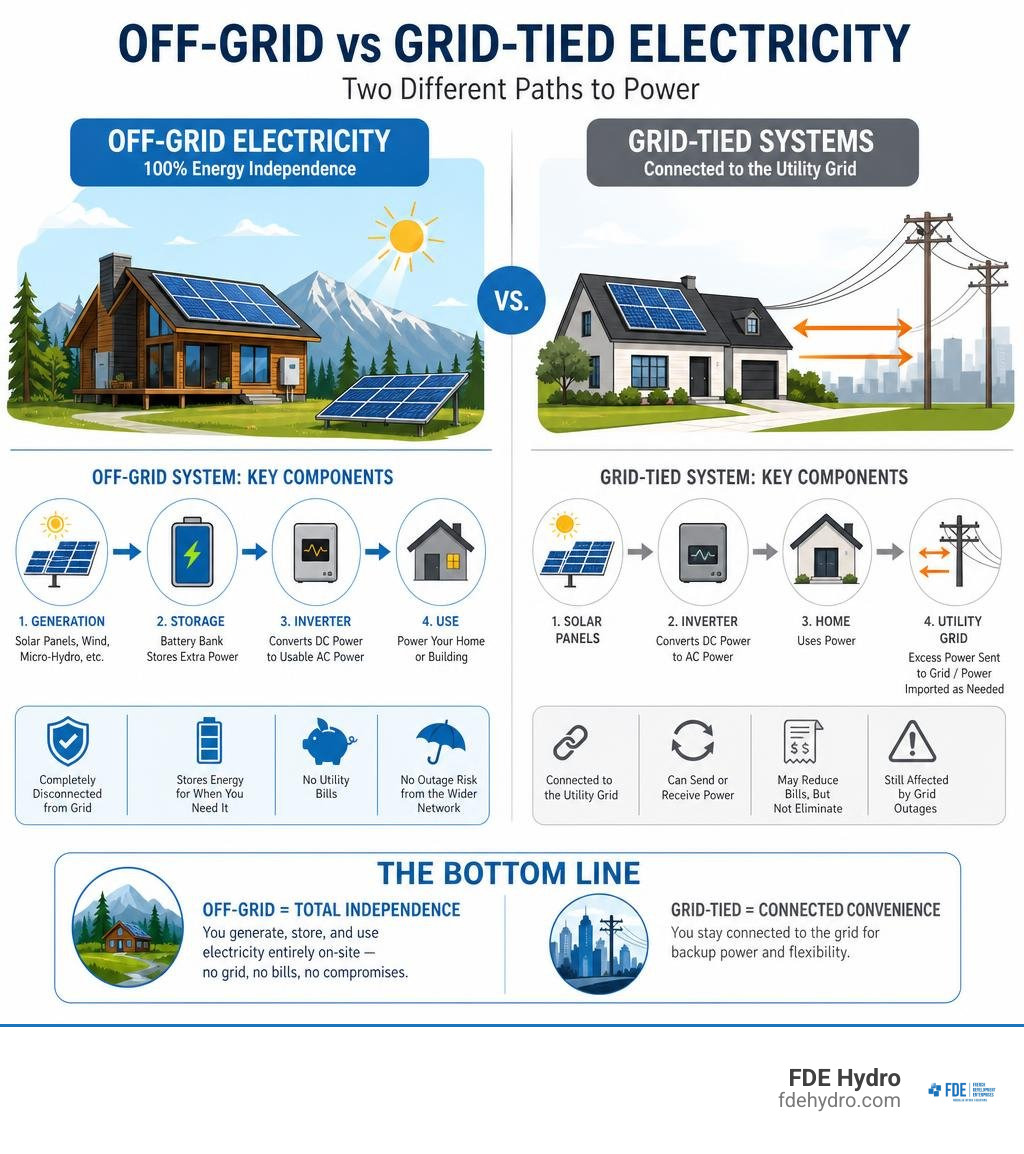
Off-grid electricity means generating, storing, and using electricity entirely on-site — independently of any centralized utility network.
Here’s a quick breakdown:
- Off-grid = completely disconnected from the public electricity grid
- Power source = solar panels, wind turbines, micro-hydro, or a combination
- Storage = battery banks that supply power when generation is low
- Result = no utility bills, no grid dependence, and no outage risk from the wider network
This is different from simply having solar panels. Most homes with rooftop solar are still connected to the grid. True off-grid means cutting that connection entirely — and relying 100% on what you generate and store yourself.
That distinction matters more than ever. As of 2016, roughly 20% of people worldwide had no access to centralized electricity. And closing that gap is projected to require $17 trillion and 30 years. For remote communities, off-grid systems aren’t a lifestyle choice — they’re often the only practical option.
I’m Bill French, Sr., Founder and CEO of FDE Hydro™, and for over five decades I’ve worked at the intersection of heavy civil construction and innovative energy infrastructure — experience that gives me a grounded, real-world perspective on the off grid electricity meaning and what it takes to deliver reliable power outside the grid. In the sections ahead, I’ll walk you through everything you need to know, from core concepts and system components to costs, sizing, and long-term sustainability.
Easy off grid electricity meaning glossary:
Defining the Off Grid Electricity Meaning and Core Concepts
To truly grasp the off grid electricity meaning, we have to look at the physical reality of how power is delivered. When a home is connected to the municipal system, it relies on transmission lines, substations, and large-scale power plants. Going off-the-grid means physically severing that umbilical cord.
In business and legal terms, as outlined by resources like the Cambridge Dictionary, being off-grid means operating without a connection to main utility services. This isn’t just a conceptual state of mind; it is a physical and engineering reality. If there are no wires running from the utility pole to your meter box, you are running a stand-alone system.
Historically, remote electrification was the primary driver for these systems. For example, Canada has about 175 aboriginal and northern off-grid communities. In these vast, remote territories, extending the centralized grid is physically and financially impractical. Instead, these areas rely on decentralized power systems. Whether it is a single cabin in the Catskills of New York or an entire rural community in northern Canada, stand-alone systems provide the localized generation required to sustain modern life.
What is the Off Grid Electricity Meaning?
At its core, the off grid electricity meaning is defined by complete self-sufficiency. According to The Free Dictionary, living off the grid involves disconnecting from public utilities, which includes electricity, water, and gas.
When we talk specifically about electricity, going off-grid means your home or business functions as its own utility company. You are responsible for:
- Generation: Producing every single watt of power you consume.
- Regulation: Ensuring the voltage and frequency of the electricity won’t fry your appliances.
- Storage: Saving excess daytime or seasonal energy to use during the night or during prolonged storms.
- Maintenance: Troubleshooting, repairing, and replacing components when they wear out.
The reward for taking on these responsibilities? Complete energy independence, a zero-dollar monthly utility bill, and absolute immunity from regional blackouts.
Off-Grid vs. Grid-Tied Systems
The fundamental difference between off-grid and grid-tied systems comes down to where your excess energy goes and where your backup power comes from.
- Grid-Tied Systems: These systems are connected directly to the local utility grid. When your solar panels produce more electricity than you need, the excess is sent back to the utility grid (often earning you credits through a billing mechanism called net metering). At night or on cloudy days, you simply draw power back from the grid. This setup is highly convenient because the grid acts as a massive, free “battery.”
- Off-Grid Systems: There is no grid to catch your excess power or to bail you out when the sun isn’t shining. If your battery bank is full and your panels are still generating power, that excess energy is simply lost. Conversely, if your batteries run dry during a week of heavy snow, your lights go out unless you have a backup generator.
For those interested in how localized power systems operate on a slightly larger scale, we can look to microgrids. To understand how communities or commercial facilities manage localized generation, you can read about What is a Microgrid and How Does it Work? to see how these localized networks bridge the gap between individual self-sufficiency and central grid reliance.
Off-Grid Living vs. Self-Consumption
Many homeowners confuse “going off-grid” with “practicing self-consumption.” While they sound similar, they represent two very different approaches to the energy transition.
| Feature | Off-Grid Living | Self-Consumption (Grid-Tied + Battery) |
|---|---|---|
| Grid Connection | Physically disconnected (no wires, no utility account) | Physically connected to the local utility |
| Excess Energy | Must be stored in on-site batteries or is wasted | Can be sent back to the grid for net-metering credits |
| Backup Power | On-site battery bank and backup generator | The utility grid (and batteries during local blackouts) |
| Utility Bills | Absolutely $0 | Reduced bills (only pay for net power drawn + connection fees) |
| System Sizing | Must be oversized to handle worst-case winter weather | Can be sized strictly for economic optimization |
Understanding Self-Consumption
Self-consumption is a hybrid approach. You install rooftop solar panels and a battery storage system, but you keep your connection to the utility grid.
The goal here is economic optimization. Instead of selling your solar electricity to the utility company for a low rate and buying it back at night for a high rate, you store your daytime solar power in your home battery. You use that stored energy during peak evening hours when utility rates are highest.
If you run out of battery power, the grid is right there to seamlessly supply what you need. This hybrid approach is highly popular because it offers excellent financial returns without the risk of total power failure. To explore how these hybrid systems are changing the energy landscape, check out our deep dive on Navigating the Hybrid Microgrid Market: A Deep Dive.
The Reality of Complete Grid Disconnection
True off-grid living, as explained by Enel’s Learning Hub, requires complete physical severance from the utility lines.
Without the grid as a safety net, your lifestyle must adapt to your power generation capacity. You cannot simply turn on high-draw appliances whenever you feel like it. Off-grid homeowners learn to run heavy loads—like laundry, water pumps, and power tools—in the middle of the day when the sun is high and the solar panels are producing a surplus.
Living completely disconnected means taking full ownership of your energy storage. If your system is designed poorly, or if you experience an unusual stretch of bad weather, you must be prepared to manage your consumption or listen to the hum of a backup diesel or propane generator.
Essential Components of an Off-Grid Solar Power System
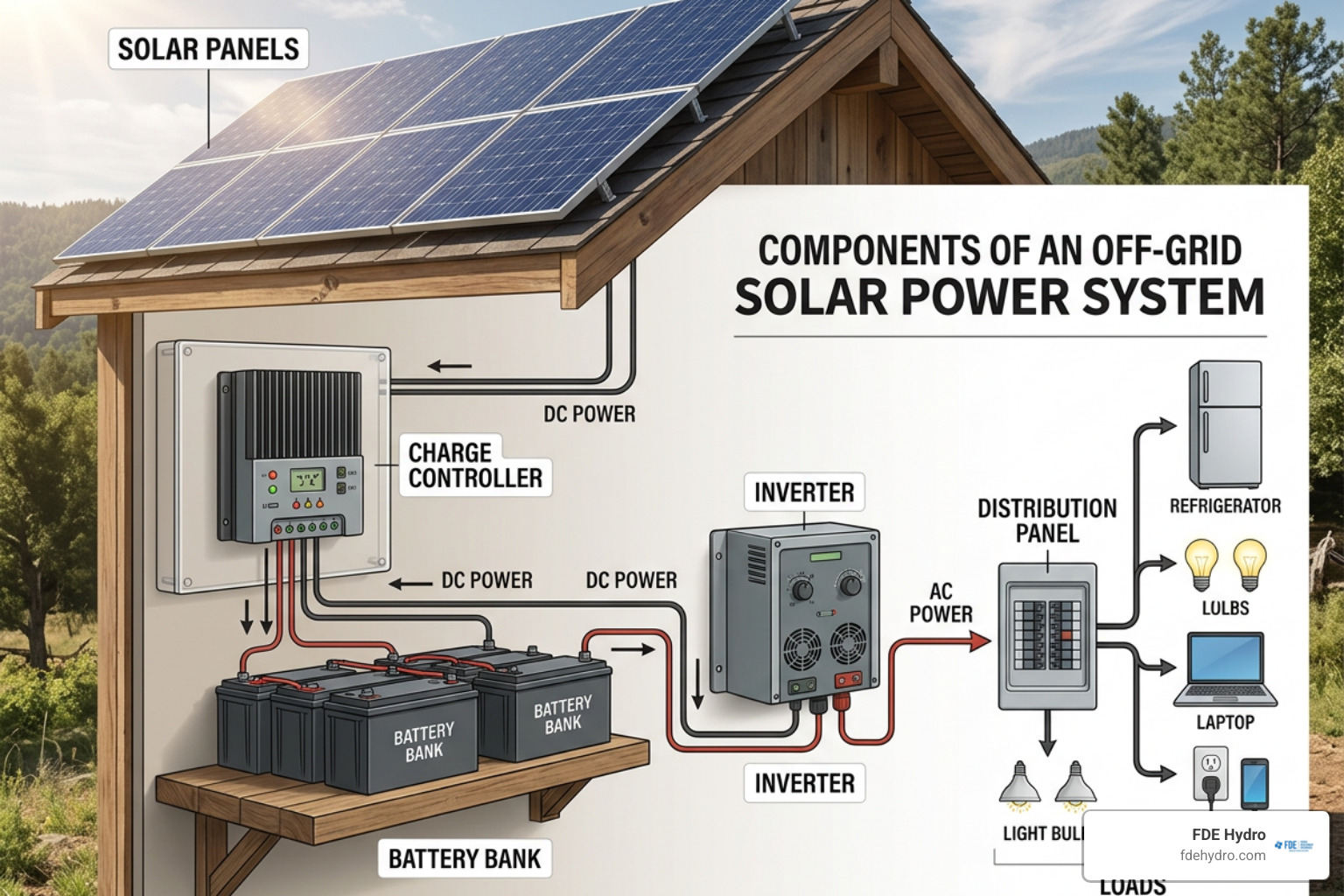
To build a reliable off-grid power plant, you need a carefully engineered ecosystem of components. Each part has a specific role in capturing, regulating, storing, and converting electricity. For a closer look at the physics and engineering behind these setups, you can read our guide on Power Up: The Engineering Behind Microgrids Explained.
Solar Panels and Charge Controllers
The journey of off-grid electricity begins with solar panels (photovoltaic modules). For off-grid applications, monocrystalline solar panels are generally preferred over polycrystalline or thin-film options. Monocrystalline panels are constructed from a single silicon crystal, making them highly efficient—a crucial trait when physical roof or ground space is limited.
However, solar panels produce raw, unregulated direct current (DC) electricity that fluctuates wildly depending on cloud cover and the angle of the sun. You cannot feed this raw electricity directly into a battery bank without destroying it.
That is where the charge controller comes in. The charge controller acts as a protective gatekeeper between your panels and your batteries. It regulates the voltage and current coming from the solar array to prevent the batteries from overcharging.
Modern high-quality off-grid systems use Maximum Power Point Tracking (MPPT) charge controllers. These controllers actively monitor the output of the solar panels and adjust the electrical characteristics to ensure the maximum possible power is transferred to the battery bank, even on overcast days.
Batteries and Inverters in the Off Grid Electricity Meaning
Once the charge controller regulates the solar energy, it is stored in the battery bank. In the context of the off grid electricity meaning, the battery bank is the absolute heart of the system.
Historically, off-grid systems relied on deep-cycle lead-acid batteries (like flooded lead-acid or AGM batteries). While cheap upfront, lead-acid batteries require regular maintenance, cannot be discharged past 50% without damage, and have a relatively short lifespan of 3 to 5 years.
Today, Lithium Iron Phosphate (LFP) batteries have become the industry standard. LFP batteries offer massive advantages:
- They require zero maintenance.
- They can be discharged up to 90% or even 100% without damage.
- They routinely last 10 to 15 years (or over 6,000 cycles) without diminishing efficiency.
- They do not off-gas toxic fumes, meaning they do not require complex ventilation systems.
Finally, because batteries store DC power and most household appliances run on alternating current (AC), you need an inverter. The inverter converts the low-voltage DC power from your batteries (usually 12V, 24V, or 48V) into standard 120V or 240V AC power.
Interestingly, running a Direct Current (DC) building can actually yield 10% to 20% efficiency gains over traditional AC systems because you completely bypass the energy losses that occur during DC-to-AC conversion. Since about one-third of household electricity is already used as DC by modern electronics and LED lights, DC microgrids are gaining serious traction. You can read more about these advancements in Microgrid Technology.
Sizing, Costs, and Financial Considerations of Going Off-Grid
Moving to a stand-alone system is a major financial and engineering undertaking. Unlike grid-tied systems where you can start small and expand later, an off-grid system must be sized correctly from day one to ensure you don’t end up sitting in the dark.
Sizing Your Off-Grid System
Sizing an off-grid system requires a precise calculation of your daily electricity consumption.
- Calculate Daily Watt-Hours: List every appliance you plan to run, multiply its wattage by the number of hours it will run per day, and sum the totals. For reference, the average American household consumes about 30 kilowatt-hours (kWh) of electricity per day.
- Determine Peak Sun Hours: Solar panels do not produce power at their rated capacity all day. You must look up the average “peak sun hours” for your specific geographic region. For example, a home in Arizona might enjoy 5.5 peak sun hours per day, while a cabin in upstate New York might average only 3.2 peak sun hours—dropping even lower during the winter.
- Calculate Panel Array Size: Divide your daily kWh needs by your local peak sun hours, and adjust for system inefficiencies (typically a 15% loss factor).
- Size the Battery Storage: You must plan for “days of autonomy”—the number of consecutive cloudy or stormy days your batteries can run the house without any solar input. Typically, off-grid designs plan for 3 to 5 days of autonomy.
According to regional data compiled by EnergySage, geographic differences dramatically impact system sizing and cost. A home in Massachusetts trying to go off-grid would require roughly 12 standard residential batteries to survive 5 days of winter overcast, whereas a similar home in sunny Arizona might only require 9 batteries to cover 3 days of autonomy.
Cost Breakdown and Financial Incentives
Let’s be candid: going completely off-grid is not cheap. For an average-sized residential home, a robust off-grid solar-plus-storage system can easily cost $45,000 to $65,000, and can scale past $115,000 if you have high heating and cooling loads.
According to technical breakdowns, here is where the money goes:
- Solar Panels (10 kW array): Minimum $5,000 to $8,000
- Inverter & Charge Controller: Minimum $4,000
- Battery Storage (20 kWh to 40 kWh): $20,000 to $40,000
- Installation & Permitting: $3,200 to $5,000 (roughly 7% to 10% of total)
- Backup Generator & Balance of System (wiring, mounts, safety switches): $5,000 to $10,000
While these numbers might trigger some sticker shock, they must be compared against alternative options. As the U.S. Department of Energy points out, extending a local utility power line to a remote property can cost anywhere from $15,000 to $50,000 per mile. If your home is located even half a mile off the main road, building a stand-alone off-grid system is often significantly cheaper than paying the utility company to run poles and wires to your door.
Furthermore, homeowners can leverage federal, state, and local incentives to offset these upfront costs. In the United States, the Residential Clean Energy Credit (Section 25D) allows taxpayers to deduct 30% of the total cost of solar and battery storage installations from their federal taxes. Similar green energy rebates and tax write-offs exist across Canada and Europe, making the payback period for these systems highly attractive over their 25-year lifespan.
Beyond Electricity: Water, Waste, and Environmental Impacts
True off-grid living extends far beyond the electrical panel. To achieve complete independence, you must also solve the challenges of water supply, waste management, and environmental sustainability.
Water and Waste Management Solutions
When you disconnect from city water and sewer systems, you must establish localized, closed-loop solutions:
- Water Supply: Most off-grid homes rely on a private water well. However, running a well pump requires a significant amount of electricity. To minimize power consumption, many off-grid systems use gravity-fed water tanks: a solar-powered pump fills an elevated storage tank during peak daylight hours, and gravity provides water pressure to the house at night. Rainwater harvesting and atmospheric water generators are also viable options depending on local rainfall patterns.
- Water Treatment: To ensure water is safe for drinking, off-grid homes implement multi-stage filtration systems, including sediment filters, activated carbon blocks, and ultraviolet (UV) disinfection units to kill bacteria and pathogens without using harsh chemicals.
- Wastewater & Sanitation: Standard septic systems with anaerobic leach fields are the traditional solution for off-grid waste. However, to conserve precious water, many off-grid homeowners install composting toilets, which decompose human waste aerobically into dry, odorless compost, completely eliminating the need for water-based flushing. Greywater recycling systems can also divert sink and shower water to irrigate non-edible landscaping.
Alternative Energy Sources and Micro-Hydro
While solar power is the most popular choice for off-grid electricity, relying on a single energy source can be risky. The most resilient off-grid setups are hybrid systems that combine multiple renewable technologies.
If your property has a year-round running stream, creek, or river, you have access to one of the most reliable and consistent forms of renewable energy on earth: water. Unlike solar panels, which only work when the sun is shining, a micro-hydro system generates clean, predictable electricity 24 hours a day, 365 days a year.
To learn how these compact, high-efficiency systems work, check out A Beginner’s Guide to Micro-Hydro Power Systems. At FDE Hydro™, we are passionate about the potential of localized water control and small-scale hydro. Our patented, modular precast concrete technology—known as the French Dam—is designed to make retrofitting and building water control systems faster and more cost-effective across North America, Brazil, and Europe, helping communities unlock the power of local water resources.
Frequently Asked Questions about Off-Grid Electricity
How do off-grid systems handle power outages compared to grid-tied systems?
This is one of the biggest surprises for new solar owners: standard grid-tied solar systems do not work during a power outage.
Grid-tied inverters are legally required to shut down automatically during a blackout to prevent “islanding.” Islanding is when solar panels feed electricity back into the local power lines while utility workers are trying to repair them, creating a lethal hazard.
Off-grid systems, by definition, have islanding capability. Because they are physically isolated from the utility lines, they can safely continue generating and using electricity during a wider grid blackout. When the regional grid goes dark, an off-grid home experiences zero interruption. For a fascinating look at how major utilities and regional grids recover from total blackouts, you can read The Black Start Blueprint: How Power Grids Come Back to Life.
Is it cheaper to go off-grid or extend a power line?
If your property is already located in a suburban neighborhood with existing utility poles, staying connected to the grid is almost always the more cost-effective choice.
However, if you are building a home in a remote area, the math changes completely. Because utility companies charge between $15,000 and $50,000 per mile to extend a power line, a property located just a quarter-mile from the nearest power pole could cost $10,000 to $12,000 just to connect to the grid. In these scenarios, investing that money into a stand-alone solar and battery system makes immediate economic sense.
What are the main advantages and disadvantages of going off-grid?
Advantages:
- Complete Energy Autonomy: You are immune to utility price hikes, corporate mismanagement, and rolling blackouts.
- Zero Utility Bills: After the initial equipment investment, your ongoing operational costs are virtually zero.
- Environmental Sustainability: You drastically reduce your carbon footprint by relying on clean, local renewable energy.
Disadvantages:
- High Upfront Capital: The initial cost of batteries, inverters, and panels requires significant upfront funding.
- Maintenance Responsibility: If a component fails on Christmas Eve, you cannot call the utility company; you are the utility company.
- Resource Constraints: You must actively monitor your energy consumption and adjust your lifestyle to match the weather.
Conclusion
Understanding the off grid electricity meaning is the first step toward true self-reliance. Whether you are looking to build a remote cabin, protect your family from an increasingly unstable utility grid, or transition your property to clean, renewable energy, going off-grid is a powerful statement of independence.
At FDE Hydro™, we believe the future of energy is decentralized, resilient, and sustainable. Through our innovative, patented modular precast concrete “French Dam” technology, we are proud to help developers, municipalities, and communities build and retrofit the water control and hydroelectric systems that make localized power generation possible across the United States, Canada, Brazil, and Europe.
If you are ready to explore the exciting world of localized power, microgrids, and independent energy generation, we invite you to explore more power grid articles on our blog. Let’s build a cleaner, more resilient future together—one localized system at a time.
