

Why Kansas Hydropower Resource Evaluation Matters for Clean Energy Decision-Makers
A thorough Kansas hydropower resource evaluation reveals a state sitting on far more clean energy potential than most people realize — and far more barriers than a simple capacity number suggests.
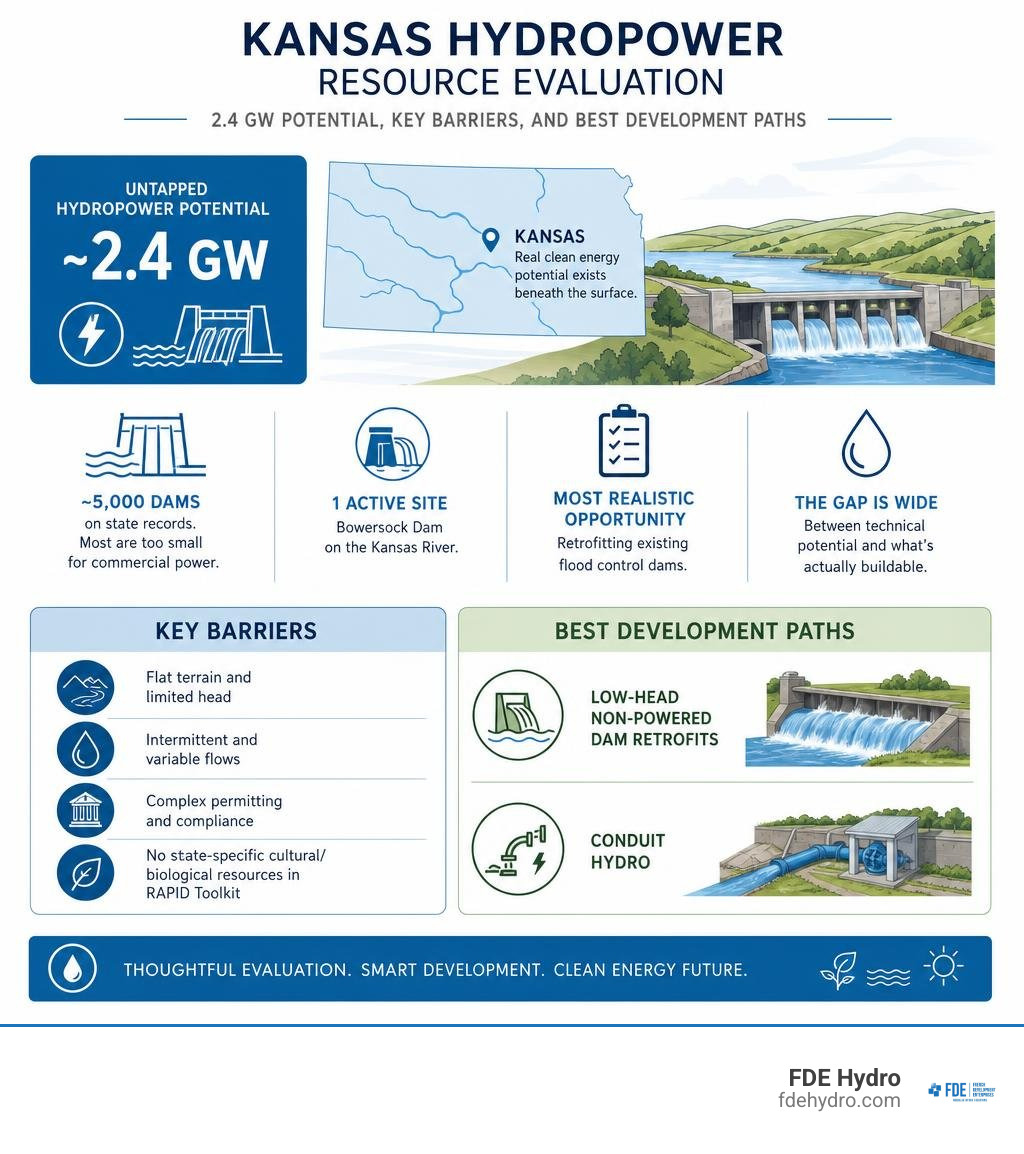
Quick Answer: Kansas Hydropower Potential at a Glance
| Factor | Key Finding |
|---|---|
| Estimated untapped potential | ~2.4 GW (Oak Ridge National Laboratory) |
| Most realistic opportunity | Retrofitting existing flood control dams |
| Only active hydro site (as of recent decades) | Bowersock Dam on the Kansas River |
| Main barriers | Flat terrain, intermittent flows, complex permitting |
| Regulatory gap | No state-specific cultural/biological resource content in RAPID Toolkit |
| Best development path | Low-head non-powered dam retrofits, conduit hydro |
Kansas has roughly 5,000 dams on state records. Most are too small for commercial power. But buried inside that number is a real opportunity — one that requires careful evaluation of hydrology, infrastructure, permitting, and economics before a single turbine turns.
The gap between technical potential and what’s actually buildable is wide. Understanding that gap is exactly what this guide is designed to help you close.
Infrastructure owners and project developers aren’t just looking for potential — they need a clear picture of what’s feasible, what’s permitted, and what it costs to get there.
I’m Bill French, Sr., Founder and CEO of FDE Hydro™, and my background spans five decades of heavy civil construction and modular infrastructure delivery, including direct participation in the U.S. Department of Energy’s Hydropower Vision Task Force — work that is directly relevant to every dimension of Kansas hydropower resource evaluation. In the sections that follow, I’ll walk you through the data, the methodologies, the regulatory landscape, and the real-world opportunities so you can make informed decisions about Kansas hydropower development.
Current Status of Kansas Hydropower Resource Evaluation
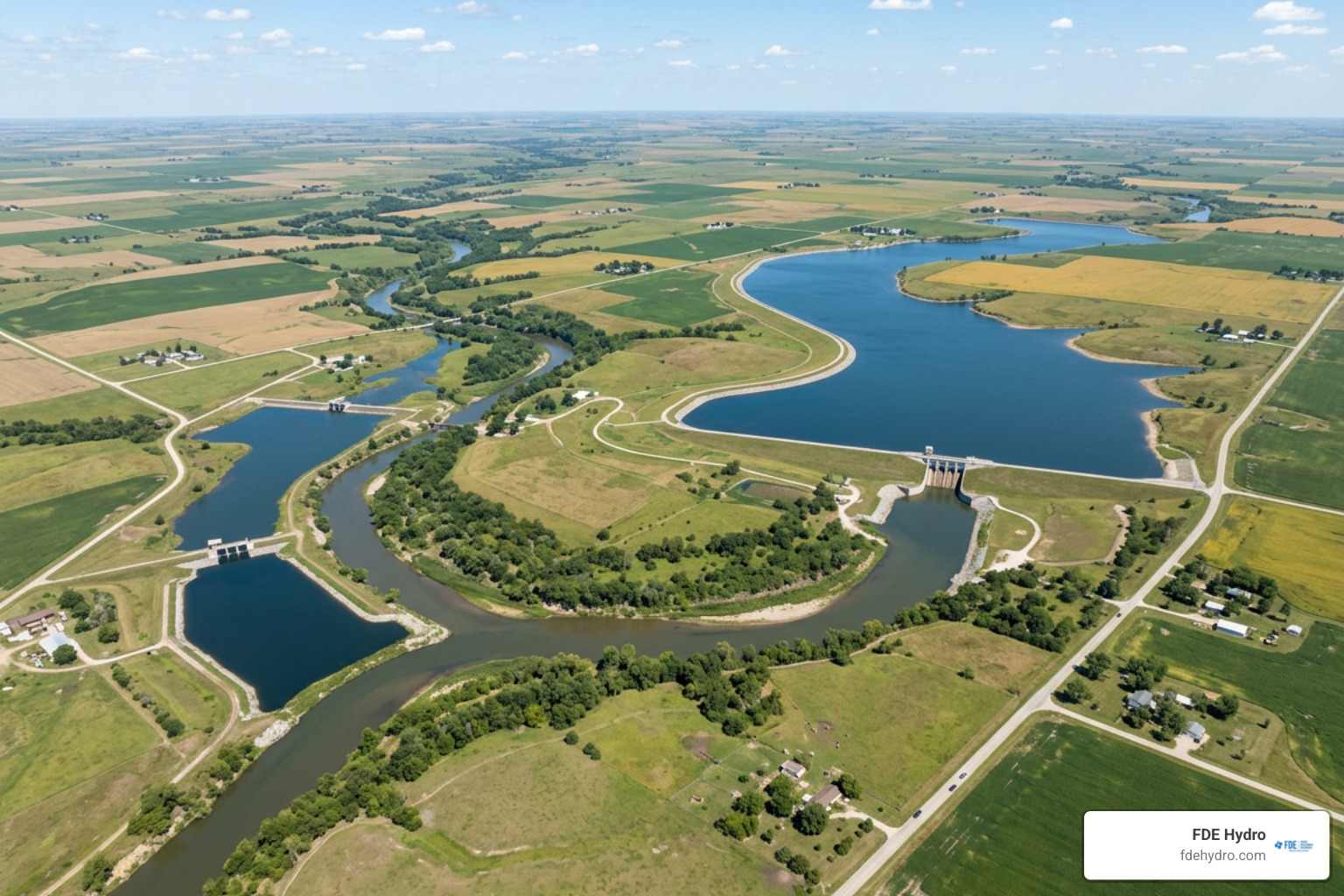
When evaluating Kansas’s clean energy landscape, water power rarely gets the headline space dedicated to wind or solar. However, systematic resource assessments show that the state’s river basins hold steady, predictable energy that could play a vital role in a diversified grid.
A comprehensive Report on Kansas Hydropower Potential highlights that while the technical potential across the state is substantial, local experts and utilities remain cautious. This skepticism is not without merit; the flat Midwestern geography and highly seasonal river flows mean we cannot simply copy-paste development strategies used in mountainous regions. Instead, a successful hydropower strategy in Kansas requires looking closely at existing, non-powered infrastructure.
Assessing Kansas Hydropower Resource Evaluation and Untapped Capacity
According to national resource assessments conducted by the Oak Ridge National Laboratory (ORNL) for the U.S. Department of Energy, Kansas possesses approximately 2.4 gigawatts (GW) of untapped technical hydropower potential. To put that in perspective, if fully developed, this capacity could support a significant portion of the state’s baseline electrical demand.
However, we must distinguish between technical potential and practical feasibility. Because Kansas lacks the dramatic elevation drops of the Northeast or Northwest, the vast majority of this capacity is classified as “low-head” hydro. Low-head hydropower typically utilizes a net head height of less than 60 feet, often operating on as little as 6 to 10 feet of head.
Historically, this is nothing new for the Sunflower State. In the late 1870s, Kansas was home to over 190 grist, flour, and saw mills powered by low-head water wheels. As the grid centralized in the mid-20th century, these localized systems fell out of use. A landmark technical report, Low-Head Hydroelectric Opportunities in Kansas, evaluated the state’s existing dams for commercial low-head development. The assessment screened over 5,000 state dam records and identified 34 existing dams that met the rigorous criteria for commercial low-head utility development. At the time of the study, retrofitting these 34 sites could have produced approximately 394 million kWh annually—equivalent to 1.5% of the total electricity generated in Kansas in 1979.
Today, as we look to maximize renewable energy solutions, these same low-head sites represent the lowest-hanging fruit. They avoid the environmental and financial costs of building entirely new dams, focusing instead on extracting clean energy from water that is already falling.
Existing Infrastructure and the Bowersock Dam Model
If you want to see what successful low-head development looks like in Kansas, you only have to travel to Lawrence. The Bowersock Mills & Power Company, situated on the Kansas River, stands as a historic and modern proof of concept.
Operating originally as a direct mechanical power source in the 19th century, Bowersock eventually transitioned to electricity. In recent decades, it operated at a capacity of roughly 2.35 MW. However, through a major expansion project, the operators added a second powerhouse on the opposite bank of the river, boosting the total capacity to 4.65 MW.
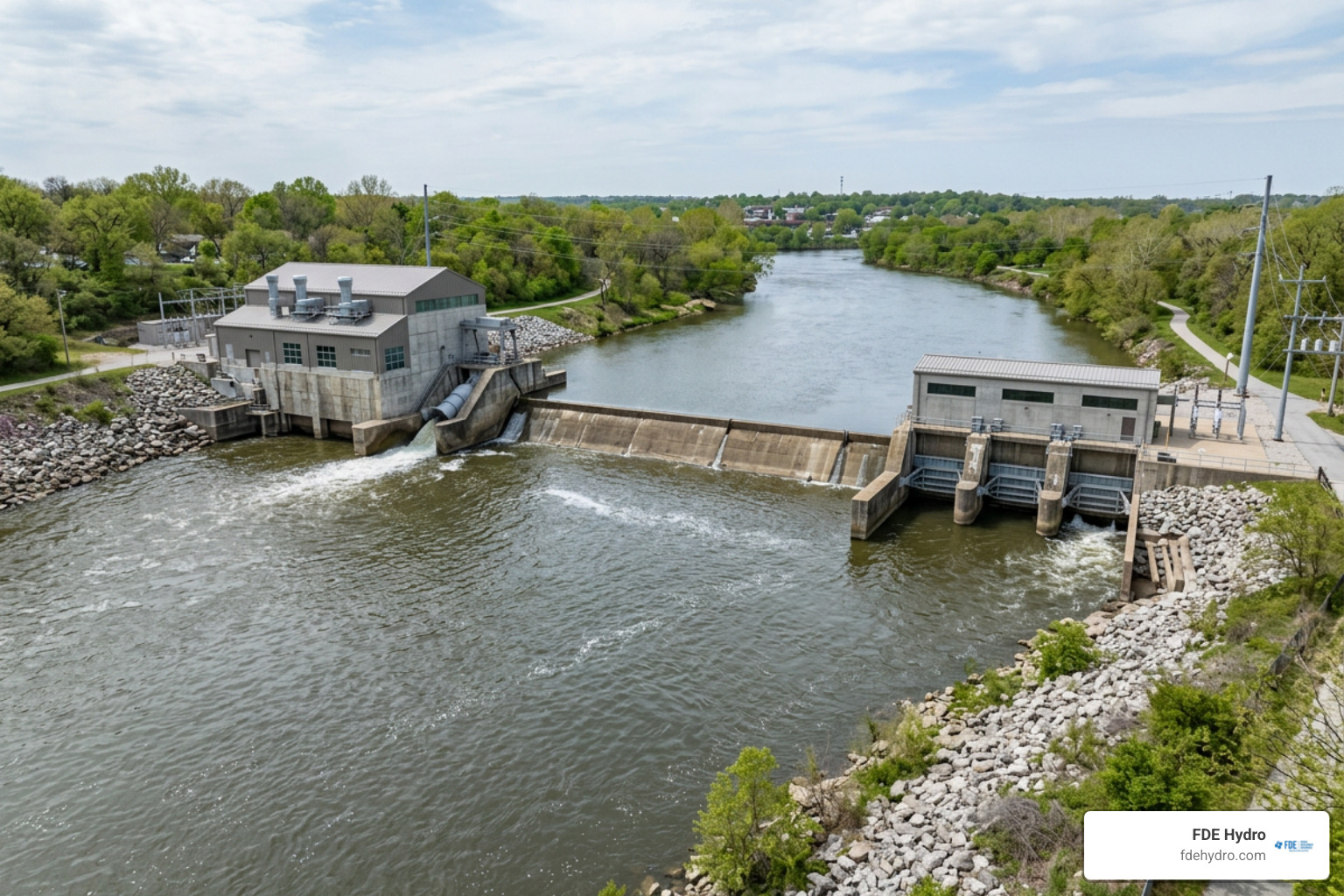
This expansion represents the perfect application of the Ultimate Guide to Modern Hydropower Technology. By using modern, highly efficient low-head turbines, Bowersock expanded its capacity without raising the upstream water level or changing the river’s overall footprint. The project was completed in just over two years—a remarkably fast timeline compared to the typical six-to-seven-year development cycle for conventional hydro projects. Today, the Kansas City Board of Public Utilities purchases all the clean, predictable power generated at Bowersock, proving that low-head Kansas hydro has a ready and willing market.
Methodologies for Estimating Low-Head and Non-Powered Dam Feasibility
To determine if a non-powered dam in Kansas can support a commercial turbine, engineers rely on precise hydrologic and economic modeling. Historically, many developers used simplified “static-head” calculations, which simply multiply the average height of the dam by the average annual river flow. While easy to calculate, this method is notoriously unreliable for Midwestern rivers, which experience dramatic seasonal fluctuations.
Today, advanced evaluations utilize power exceedance (or duration) curves, which analyze decades of daily flow and head data to map out exactly how much power a site can reliably produce throughout the year.
| Method | Data Requirements | Reliability for Kansas Sites | Best Use Case |
|---|---|---|---|
| Static-Head Calculation | Average annual flow, constant head height | Low (Ignores seasonal droughts and agricultural diversions) | Initial high-level screening of thousands of sites |
| Flow Exceedance Curve | Minimum 3 years of daily flow and head data | High (Accounts for seasonal variability and low-flow periods) | Bankable feasibility studies and turbine sizing |
Standardized Software and Flow Exceedance Curves
To standardize these evaluations across the country, the Idaho National Engineering Laboratory developed the Hydropower Evaluation Software (HES). As detailed in the Hydropower Evaluation Software Status Report, Kansas was one of 12 states assessed using this uniform software framework. The software was developed and tested using regional data provided by the Southwestern Power Administration (which includes Kansas) to ensure that local environmental suitability factors, water rights, and seasonal flow variations were accurately weighted.
HES allows researchers to assign environmental attributes to potential sites and calculate a “development suitability factor.” This is crucial for Kansas, where water must be shared between municipal supply, recreation, and agricultural irrigation.
On a broader scale, the U.S. Army Corps of Engineers (USACE) conducted a comprehensive non-powered dam resource assessment. They screened 419 USACE-owned non-powered dams across the country down to 223 sites that possessed a potential capacity of 1 MW or more. Across these 223 assessed sites, the study identified approximately 6,256 MW of potential capacity.
Using rigorous flow duration curves and a standardized 3.75% federal discount rate over a 50-year period, the assessment concluded that approximately 2,818 MW (45%) of that potential is economically feasible to develop. Several of these high-priority USACE sites sit directly within the Kansas river basins, representing major opportunities for public-private development.
Case Study: The Tuttle Creek Feasibility Assessment
A prime example of applying these rigorous methodologies in Kansas is the Tuttle Creek Hydroelectric Project Feasibility Assessment. Constructed between 1952 and 1962 near Manhattan, Kansas, Tuttle Creek Dam is a massive USACE flood control structure that was built without power generation facilities.
In a detailed feasibility study funded by a Department of Energy grant, engineers evaluated two primary design options for retrofitting the dam:
- Excavating a brand-new tunnel through the left abutment.
- Installing a steel liner inside the existing right outlet works conduit, placing a powerhouse directly at the stilling basin.
The evaluation selected the existing outlet works conduit modification as the most cost-effective and environmentally sound pathway. The proposed design featured three 4,750 kW and one 500 kW standardized TUBE turbine-generator units, resulting in a total installed capacity of 14,750 kW (14.75 MW).
The inclusion of the small 500 kW unit is a classic best practice for Kansas hydrology; it allows the plant to continue generating clean energy even during periods of minimum water release, rather than shutting down entirely during dry spells.
This project highlights the extreme sensitivity of hydropower retrofitting to financing structures:
- 7% Financing: Under Rural Electrification Administration (REA) terms, the project proved highly viable, showing a benefit-cost ratio of 0.84 in its first year and a projected $1,166,000 surplus on a present-worth basis over 10 years.
- 9.5% Financing: Under higher interest rates, the project’s economics collapsed, demonstrating how critical capital costs are to low-head projects.
By utilizing modern, modular construction techniques—such as FDE Hydro’s patented precast concrete “French Dam” systems—developers can drastically compress construction timelines and lower these upfront capital costs, making projects like Tuttle Creek financially viable even in fluctuating interest rate environments.
Regulatory and Permitting Framework for Kansas Hydropower
Navigating the regulatory waters of a hydropower project can often feel more challenging than the physical engineering. Because water is a highly protected public resource, any project in Kansas must satisfy a complex web of federal and state agencies.
Cultural and Biological Resource Assessments in Kansas Hydropower Resource Evaluation
A critical step in any Kansas hydropower resource evaluation is assessing the project’s impact on local historical, cultural, and biological resources. Under federal law (such as Section 106 of the National Historic Preservation Act) and state statutes, developers must ensure their project does not damage historical sites, Native American tribal lands, or archaeological remains.
However, developers face a notable information gap in Kansas. The Regulatory and Permitting Information Desktop (RAPID) Toolkit—a federally funded online resource designed to help developers navigate permitting—currently lacks state-specific content regarding cultural and biological resource regulations for Kansas.
This means developers cannot rely on a standardized online portal. Instead, they must proactively coordinate with:
- The Kansas State Historical Society (SHPO): To conduct cultural resource surveys and obtain clearances.
- The Kansas Department of Wildlife and Parks: To evaluate potential impacts on local flora and fauna.
Fortunately, because Kansas rivers lack migratory fish species like the salmon found in the Pacific Northwest, biological permitting is generally less contentious. However, construction-phase impacts on local wildlife, water siltation, and nesting birds must still be thoroughly evaluated and mitigated.
Federal vs. State Permitting Pathways
To successfully launch a project, developers must secure approvals across multiple jurisdictions:
- Federal Energy Regulatory Commission (FERC): FERC holds ultimate authority over non-federal hydropower licensing. Developers must apply for either a full license or a license exemption (often available for small conduit projects under 10 MW).
- U.S. Army Corps of Engineers (USACE): If retrofitting a USACE-owned flood control dam, developers must secure a Section 408 permission (ensuring the retrofit doesn’t compromise flood safety) and a Section 404 Clean Water Act permit for any discharge of dredged or fill material.
- Kansas Division of Water Resources (DWR): Developers must secure formal water rights or permits to appropriate water for power generation, ensuring that downstream users and municipal water supplies are unaffected.
- Section 401 Water Quality Certification: Administered by the Kansas Department of Health and Environment (KDHE), this certification ensures that the project’s operation will not degrade water quality or alter dissolved oxygen levels downstream.
Barriers and Opportunities for Kansas Clean Energy
Developing new clean energy assets in Kansas requires a balanced view of the physical realities of the Great Plains, coupled with the unique opportunities presented by modern engineering.
Physical, Economic, and Environmental Challenges
The primary physical barrier to Kansas hydropower is the state’s flat terrain. Without high head heights, projects must rely on high flow volumes to generate significant power. However, Kansas rivers are highly seasonal and prone to dramatic flow fluctuations.
Furthermore, Western Kansas experiences significant irrigation diversions, which can deplete river flows before they reach downstream municipal dams.
Another major physical challenge is siltation. Kansas rivers carry high loads of fine agricultural sediment. Over decades, this silt accumulates behind dams, reducing reservoir capacity and threatening to prematurely wear down turbine blades.
These physical challenges feed directly into economic hurdles. Conventional dam construction and retrofitting carry high upfront hydropower project costs. If a project takes six to seven years to permit and build, interest during construction can quickly erode its economic viability.
To overcome these barriers, the industry must transition toward sustainable hydro infrastructure that utilizes pre-engineered, modular components to slash onsite construction times and minimize environmental disruption.
Conduit Hydropower and Retrofitting Opportunities
While retrofitting large flood control dams represents the largest capacity opportunity, “conduit hydropower” is emerging as a highly attractive, low-barrier alternative. As detailed in the federal report, Assessment of Hydropower Potential at National Conduits, conduit projects generate electricity from water flowing through manmade, non-power conduits, such as:
- Municipal drinking water pipelines.
- Wastewater treatment outfalls.
- Agricultural irrigation canals.
Nationally, the study estimates approximately 1.41 GW of new conduit hydropower potential. Because these projects utilize existing, pressurized pipelines or concrete canals, they do not require new dams or impoundments, resulting in virtually zero environmental impact.
Furthermore, conduit projects are eligible for a simplified, 45-day federal regulatory approval process under the Hydropower Regulatory Efficiency Act (HREA). In Kansas, where municipal water resource management and agricultural irrigation are highly developed, installing inline turbines parallel to existing pressure-reducing valves offers a highly predictable, easily permitted source of clean energy that can power local water facilities or feed back into the grid via net metering.
Frequently Asked Questions about Kansas Hydropower
How much untapped hydropower potential does Kansas have?
According to assessments by the Oak Ridge National Laboratory, Kansas has approximately 2.4 gigawatts (GW) of untapped technical hydropower potential. However, due to flat terrain, seasonal river flows, and permitting requirements, only a fraction of this capacity is economically and physically feasible to develop.
Why is retrofitting existing dams preferred over building new ones in Kansas?
Retrofitting existing non-powered dams is vastly superior to building new dams because the physical barrier and reservoir are already in place. This avoids the massive environmental impact of flooding new land, bypasses the most difficult federal permitting hurdles, and drastically reduces capital costs. It allows us to generate clean energy from infrastructure that has already been built.
What are the main regulatory hurdles for Kansas hydropower projects?
The primary hurdles include securing a FERC license or exemption, obtaining Section 408 and 404 permits from the U.S. Army Corps of Engineers, securing water rights from the Kansas Division of Water Resources, and conducting independent cultural and biological resource assessments due to the lack of Kansas-specific guidelines in the federal RAPID Toolkit.
Conclusion: Building a Resilient Clean Energy Future
The journey through Kansas hydropower resource evaluation reveals a clear truth: while the state may not have the towering waterfalls of other regions, it possesses a wealth of stable, predictable, and untapped clean energy waiting to be unlocked. By focusing our efforts on retrofitting existing non-powered dams and integrating conduit systems into municipal water lines, we can add vital baseline power to the Kansas grid.
At FDE Hydro™, we believe the key to unlocking this potential lies in changing how we build. Our innovative, patented modular precast concrete technology—the French Dam—is designed specifically to address the economic and physical challenges of low-head development. By manufacturing dam and powerhouse components in a controlled environment and assembling them rapidly onsite, we can:
- Cut construction times by up to 50%.
- Drastically lower capital costs and interest during construction.
- Minimize environmental and biological disruption to local riverbeds.
Whether you are looking to generate clean power from an existing municipal water system, add a turbine to a flood-control dam, or explore pumped storage hydropower and hydropower energy storage solutions, the future of Kansas water power relies on smart, modular, and sustainable engineering.
If you are ready to evaluate the possibilities for your next project, explore our specialized solutions for hydroelectric power generation and let’s build the future of Midwestern clean energy together.
