

Why the Energy Grid Needs a Blockchain Upgrade
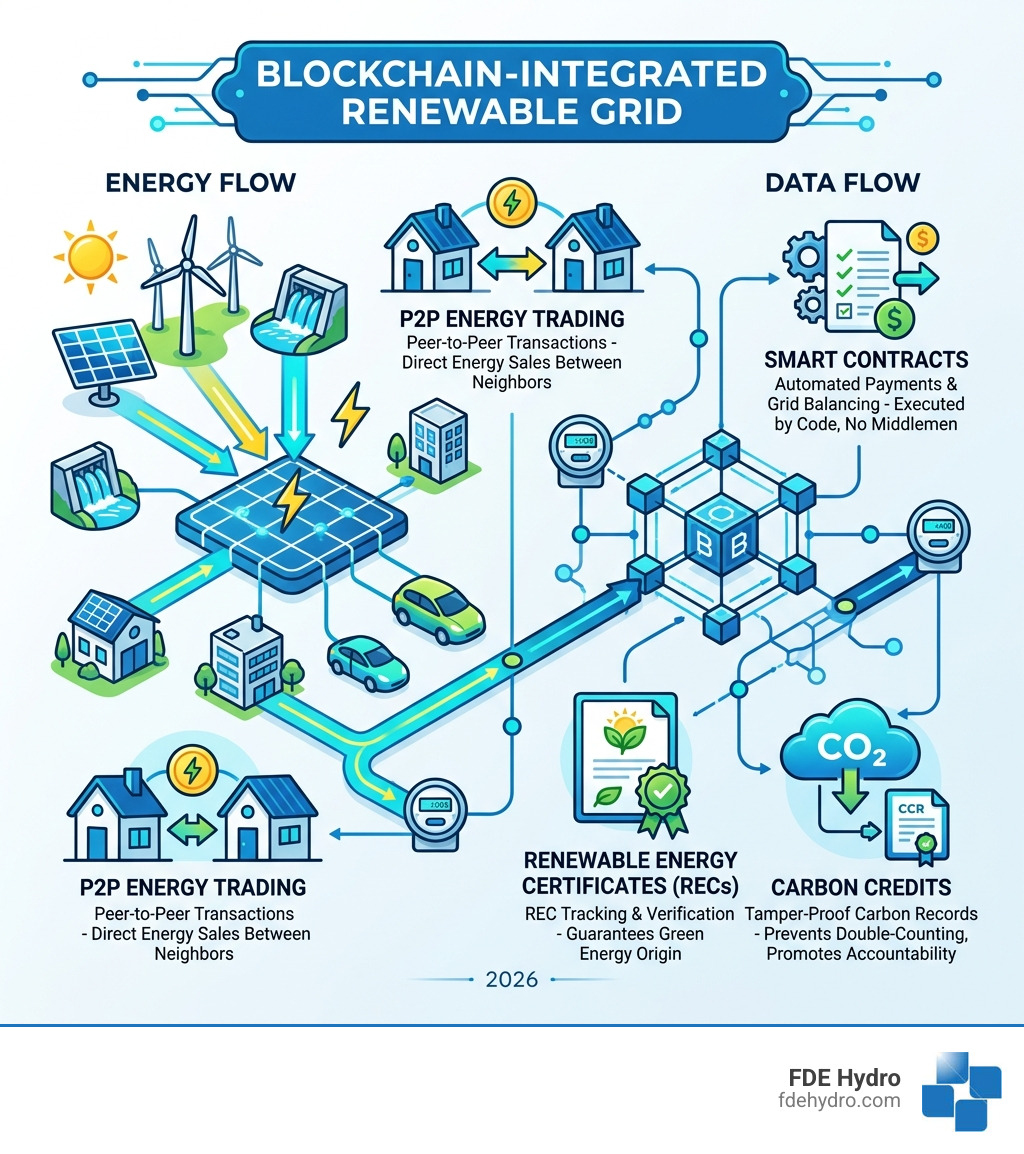
Renewable energy blockchain is a system that uses decentralized digital ledger technology to record, verify, and automate energy transactions — without relying on a central authority.
Here’s what it enables at a glance:
| Function | What Blockchain Does |
|---|---|
| P2P Energy Trading | Lets producers sell surplus power directly to neighbors |
| Smart Contracts | Automates payments and grid balancing in real time |
| Renewable Energy Certificates | Tracks and verifies green energy origin, preventing fraud |
| Carbon Credits | Creates tamper-proof records to stop double-counting |
| Grid Management | Monitors energy flows across distributed networks securely |
The global energy system is changing fast. Clean energy investment has surged by 40% since 2020. More than 500 GW of new renewable capacity was added in 2023 alone. But the infrastructure managing all that power — the billing systems, the verification processes, the trading markets — is still largely built on decades-old technology.
That mismatch is a real problem.
Renewable energy is intermittent by nature. Solar panels go dark at night. Wind turbines stop when the air is still. Managing that variability across a grid with millions of distributed producers and consumers requires fast, transparent, and trustworthy data — exactly what blockchain is designed to deliver.
The market is responding. Blockchain’s value in the energy sector was just $278 million in 2019. It is projected to reach over $81 billion by 2032, growing at a compound annual growth rate of 56.1%. Academic research in this space is growing at 47% per year — a signal that this is not a passing trend.
I’m Bill French, Sr., Founder and CEO of FDE Hydro™, where I’ve spent the last decade developing modular hydropower solutions at the intersection of civil construction innovation and renewable energy blockchain integration. My background in large-scale infrastructure projects gives me a practical lens on how decentralized energy technology can — and must — work alongside next-generation power generation assets like run-of-river hydro.
Explore more about Renewable energy blockchain:
How Renewable Energy Blockchain Technology Works
At its core, a renewable energy blockchain acts as a shared, digital “truth machine.” Instead of one utility company holding all the data in a private database, the information is spread across a decentralized ledger. This means every participant in the grid—from the homeowner with solar panels in California to a modular dam operator in Canada—sees the same immutable record of who produced what and who paid whom.
This immutability is key. Once a transaction is recorded, it cannot be altered or deleted. In the context of the energy transition, this provides a level of transparency that traditional systems simply can’t match. When we talk about Renewable Energy Solutions, we aren’t just talking about the hardware; we’re talking about the trust layer that makes the hardware viable in a modern market.
Interestingly, researchers are even exploring how physics-based cryptocurrency transmits energy, moving beyond just data to actually linking the laws of thermodynamics with digital tokens. This peer-to-peer (P2P) approach turns the traditional “top-down” utility model on its head, allowing energy to flow and be settled locally.
The Role of Smart Contracts in Renewable Energy Blockchain
If the blockchain is the ledger, “smart contracts” are the automated bookkeepers. These are self-executing lines of code that trigger automatically when certain conditions are met. For example, if your neighbor’s battery drops below 20% and your solar array is producing a surplus, a smart contract can execute a trade instantly.
This leads to a financial revolution in renewable energy by removing intermediaries. No more waiting 30 days for a utility bill or paying high processing fees to a third-party clearinghouse. Real-time settlement means better cash flow for producers—some solar providers have even seen payment processing times drop by 60% after switching to blockchain-based systems.
Data Integrity and Security in Distributed Grids
As we move toward “smart grids,” we also open the door to cyber threats. A centralized grid is a single point of failure; if the main server is hacked, the lights go out. A renewable energy blockchain, however, offers superior cyber resilience. Because the data is distributed, there is no central target for hackers to hit.
This tamper-proof nature is essential for unpacking the future of sustainable blockchain. It ensures that data from smart meters is accurate and that no one can “double-spend” a kilowatt-hour or forge a green certificate. For our work at FDE Hydro, ensuring that the data coming from a decentralized hydro facility is secure is just as important as the concrete we use to build it.
Primary Applications: From P2P Trading to Carbon Credits
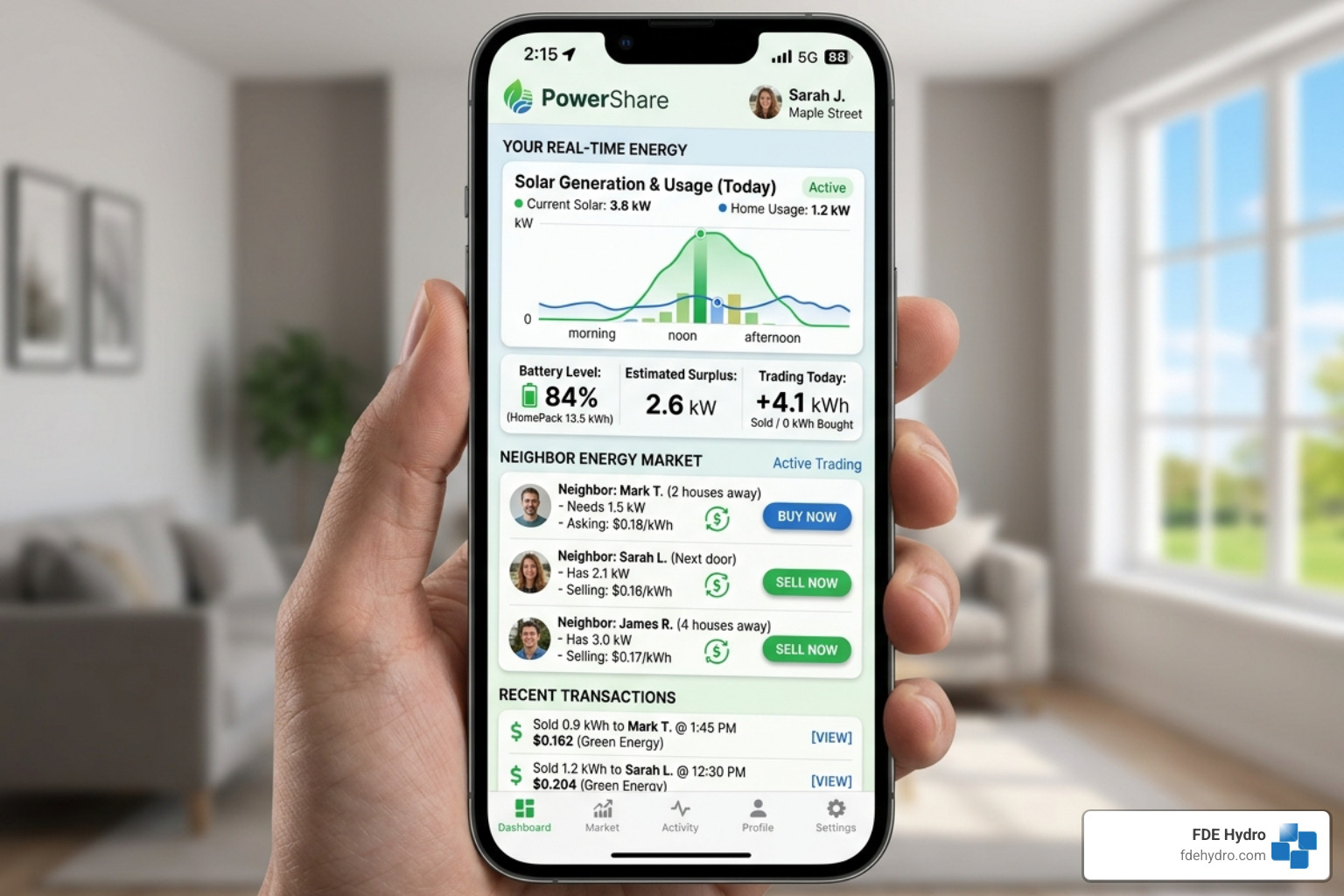
The most exciting part of this technology is how it changes the lives of everyday energy users. Through P2P trading, energy democratization becomes a reality. Instead of being a passive “consumer,” you become a “prosumer”—someone who both produces and consumes.
In projects like The Transactive Grid, we see how blockchain creates an end-to-end market service. This is vital for sustainable energy production because it incentivizes people to install more local renewables, knowing they can easily sell their excess to the house next door.
Tokenizing Assets and Renewable Energy Certificates (RECs)
Blockchain allows us to turn physical assets into digital tokens. Think of “Solar NFTs” or fractional ownership. Instead of needing $10 million to build a wind farm, a community can crowdfund the project. Each person owns a “token” representing a piece of the turbine and receives a share of the revenue.
This extends to Renewable Energy Certificates (RECs). Traditionally, RECs are a paperwork nightmare, prone to fraud and double-counting. With platforms like RECTOKEN, every certificate is a unique digital asset on the blockchain. This makes defining every renewable energy source in your portfolio transparent and verifiable for ESG reporting.
High-Integrity Carbon Credit Marketplaces
The carbon market has long struggled with “ghost credits”—credits for trees that were never planted or energy that wasn’t actually green. By integrating Industrial IoT (Internet of Things) with blockchain, we can achieve 100% data integrity.
Platforms like Blockvolt ERTH capture granular, 15-minute readings directly from the source. This creates a “provenance” or a digital birth certificate for every carbon credit.
| Feature | Traditional RECs | Blockchain-Based RECs |
|---|---|---|
| Verification | Manual, slow audits | Real-time, IoT-verified |
| Fraud Risk | High (Double-counting) | Extremely Low (Immutable) |
| Accessibility | Large corporations only | Open to small producers |
| Settlement | Weeks or Months | Instantaneous |
Key Platforms Driving the Renewable Energy Blockchain Revolution
Several key players are building the infrastructure for this new economy. Ethereum was the pioneer, bringing smart contracts to the world. However, as the sector matures, we are seeing a shift toward more specialized and efficient chains.
- Energy Web: A non-profit focused specifically on the energy sector’s regulatory and technical needs.
- PowerLedger: An Australian-born platform that has facilitated over 1.67 GWh of energy trading globally.
- Solana: Known for its high speed (50,000 transactions per second) and low energy use, making it ideal for micro-transactions in clean energy solutions.
- R3 Corda: Often used for “consortium” blockchains where privacy and permissioned access are required between specific utilities.
Powering the energy sector through blockchain isn’t just a theory anymore; it’s a multi-billion dollar industry that is currently being scaled for global grids.
Scaling the Renewable Energy Blockchain for Global Grids
To handle millions of houses trading energy every second, the blockchain needs high throughput. Early versions of blockchain used “Proof of Work” (like Bitcoin), which consumed a lot of electricity. Modern energy-efficient crypto uses “Proof of Stake” or “Proof of Useful Generation.”
The Arkreen Network, for instance, uses Web3 to connect distributed resources, creating a “DeEnergy” data network. This allows the grid to scale without the massive carbon footprint associated with older blockchain models.
Real-World Case Studies and Market Statistics
The numbers are starting to back up the hype. In Thailand, a smart city project at Chiang Mai University used 12 MW of solar and blockchain trading to achieve 30% energy autonomy. In the UK, Rowan Blockchain is rewarding homeowners with rewards for every kWh of solar they generate, tracked via a custom “SmartMiner.”
As of 2024, more than 1.67 GWh of energy has been traded on P2P platforms. For a deeper dive into how these projects come together, check out our Renewable Energy Projects Complete Guide.
Benefits and Challenges of Decentralized Energy Management
The benefits are clear: lower costs, higher efficiency, and better transparency. By automating the “back office” of a utility, companies can pass those savings to consumers. In fact, blockchain-based platforms have the potential to reduce consumer electricity bills by up to 40%.
However, it’s not all sunshine and wind power. We face significant hurdles:
- Interoperability: Different blockchains need to “talk” to each other and to the existing grid hardware.
- Regulatory Hurdles: In many places, it is still illegal to sell electricity to your neighbor without a utility license.
- High Initial Costs: While cost-effective crypto mining is possible, the initial setup for IoT sensors and blockchain integration requires capital.
Overcoming Scalability and Regulatory Hurdles
Governments are beginning to catch up. The New York City Blockchain Plan is a great example of a major metro area looking at how to integrate these tools into urban life. Similarly, countries like Germany and India are testing “regulatory sandboxes” where companies can pilot P2P trading without the usual red tape.
Environmental Impact and Energy Consumption
We must address the elephant in the room: does blockchain use too much energy? When using “Proof of Stake” (PoS), the energy consumption is negligible—often 99% less than older systems. In Brazil, we’ve even seen a clean energy glut drawing cryptocurrency miners to use surplus wind and solar power, effectively acting as a “virtual battery” for the grid.
This focus on crypto mining sustainability ensures that the technology we use to save the planet doesn’t end up hurting it.
Frequently Asked Questions about Renewable Energy Blockchain
How does blockchain enable peer-to-peer energy trading?
It creates a secure, automated marketplace. When your solar panels produce more than you need, the blockchain records that surplus. A smart contract then matches your supply with a neighbor’s demand and handles the payment instantly. Platforms like ReNRG are already building these “Decentralised Physical Energy Networks.”
What are the main benefits of blockchain for renewable energy?
The big three are transparency (you know exactly where your power comes from), security (the grid is harder to hack), and lower costs (no middlemen). It’s about making the grid as efficient as the most efficient renewable energy resources we have available today.
Is blockchain technology energy-intensive?
Not anymore. While Bitcoin uses a lot of power, the renewable energy blockchain systems used for the grid are designed to be “green” from the ground up. By using eco-friendly crypto mining techniques and Proof of Stake consensus, the energy used to run the ledger is a tiny fraction of the energy being traded.
Conclusion
The “grid of the future” isn’t just about better batteries or more solar panels; it’s about a smarter way to manage the relationship between them. At FDE Hydro™, we believe that our patented “French Dam” modular technology is the perfect physical partner for this digital revolution. By building and retrofitting hydroelectric systems more quickly and cost-effectively in North America, Brazil, and Europe, we provide the steady, reliable base-load power that decentralized grids need to stay stable.
As we move toward a world of “transactive energy,” where every dam, turbine, and solar panel is part of a secure, transparent renewable energy blockchain, the goal remains the same: sustainable power generation that is accessible to everyone. The upgrade isn’t just coming—it’s already here. Let’s build it together.
