

What You Need to Know About Selling Electricity to the Grid
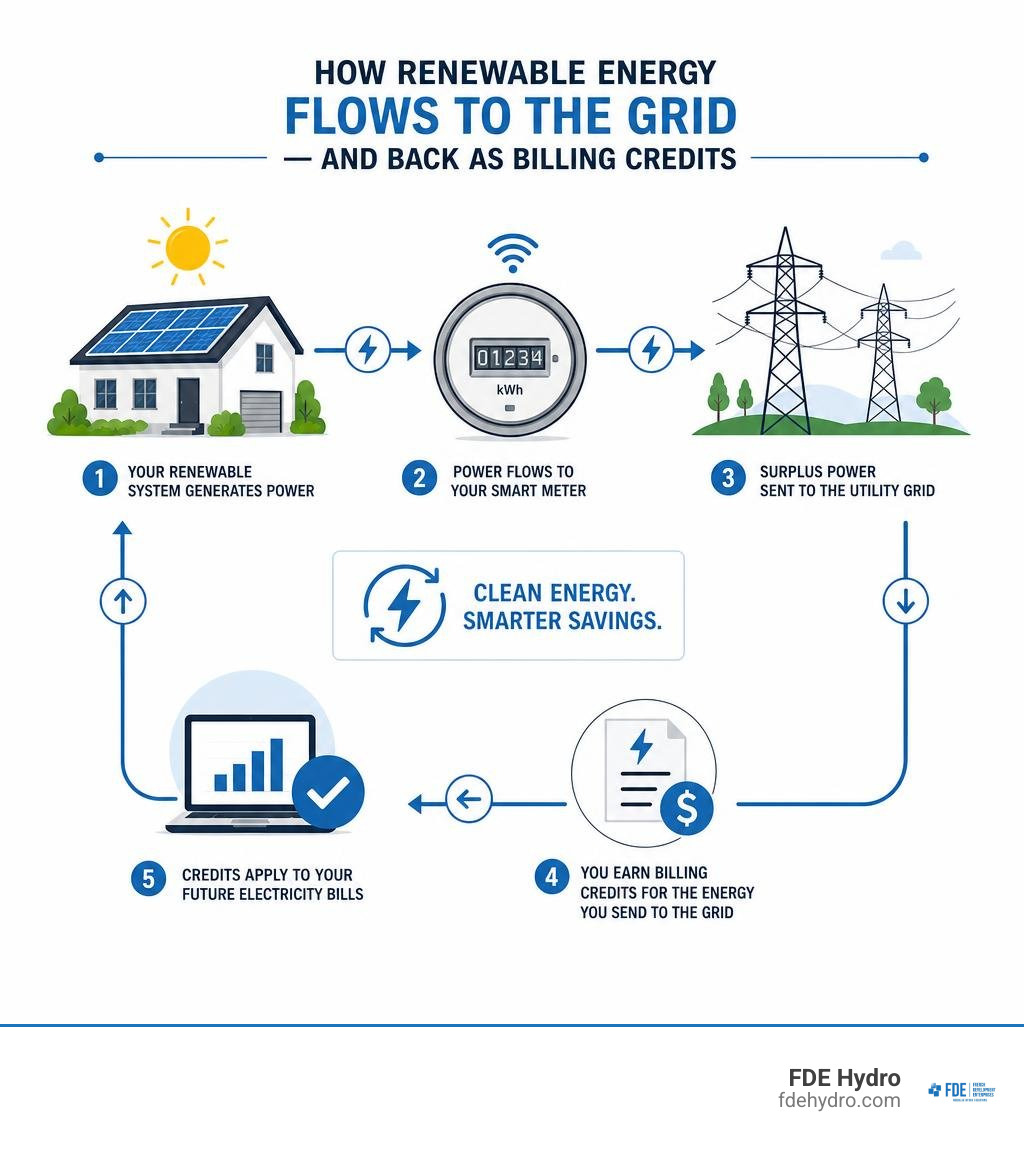
Selling electricity to the grid means sending surplus power from your home renewable energy system — such as solar panels, wind turbines, or hydro — back into the utility network in exchange for billing credits or cash payments.
Here is a quick overview of how it works and what to expect:
| Method | Who It’s For | How You Get Paid |
|---|---|---|
| Net Metering | Homeowners with solar/renewables | Billing credits at retail rate |
| Feed-in Tariff (FiT) | Residential & small commercial generators | Fixed rate per kWh exported |
| Smart Export Guarantee (SEG) | UK households | Variable cash rate per kWh |
| Clean Export Guarantee (CEG) | Irish households | Supplier-set rate per kWh |
| Power Purchase Agreement (PPA) | Larger generators | Negotiated price per kWh |
| Wholesale Market | Licensed generators only | Hourly auction clearing price |
A few things to know upfront:
- Most homeowners do not receive direct cash — they get billing credits that reduce future electricity bills.
- Over 35 U.S. states have net metering programs, making it the most common route for residential producers.
- Export rates are almost always lower than what you pay to buy electricity — often 3–12¢/kWh compared to retail rates of 30–50¢/kWh.
- The biggest financial win for most households is using your own generated power first, not exporting it.
Understanding these basics upfront will save you from overestimating what you can earn — and help you make smarter decisions about your system.
I’m Bill French, Sr., Founder and CEO of FDE Hydro™, with decades of experience in large-scale civil infrastructure and clean energy development, including projects that touch on the economics of selling electricity to the grid through hydropower generation. In the guide below, I’ll walk you through the key mechanisms, regional rules, and practical steps to start earning from your home’s renewable energy.
FDE Hydro is Bringing Predictability to an Unpredictable Environment™
Quick selling electricity to the grid definitions:
Understanding the Mechanics of Selling Electricity to the Grid
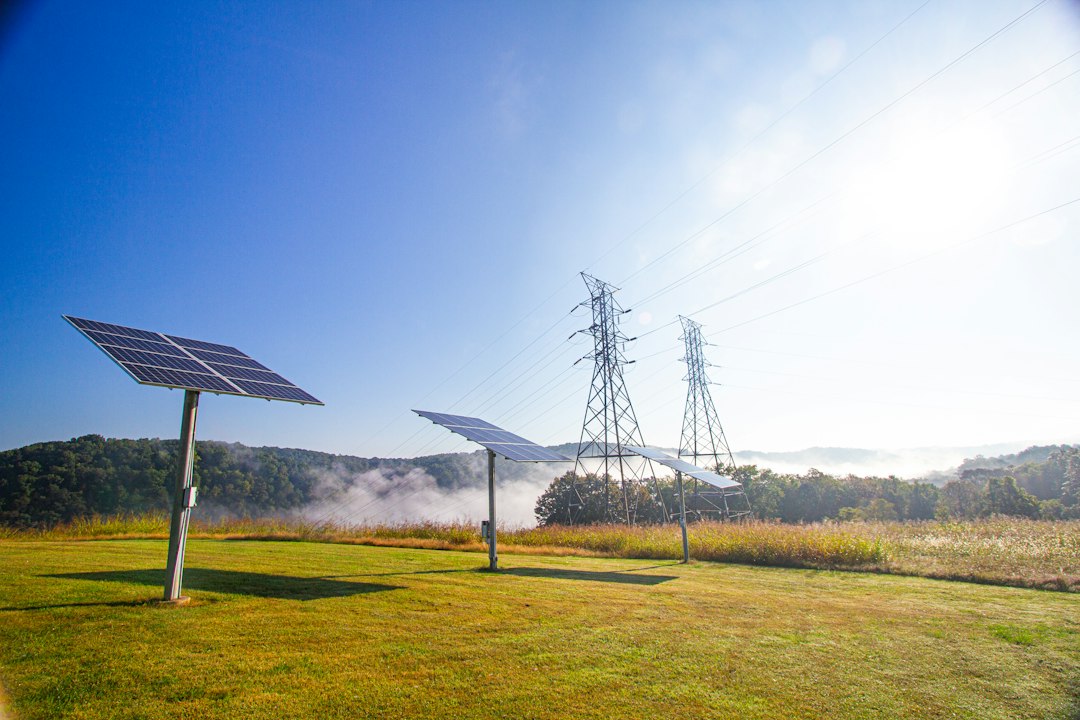
When we talk about sending electricity back to the grid, we are exploring a bidirectional relationship with our local utilities. Historically, the electrical grid was designed as a one-way street: massive power plants generated electricity, and it traveled down high-voltage lines to our homes. Today, the rise of distributed energy resources—like rooftop solar panels, residential wind turbines, and small-scale micro-hydro systems—has turned millions of everyday consumers into “prosumers.”
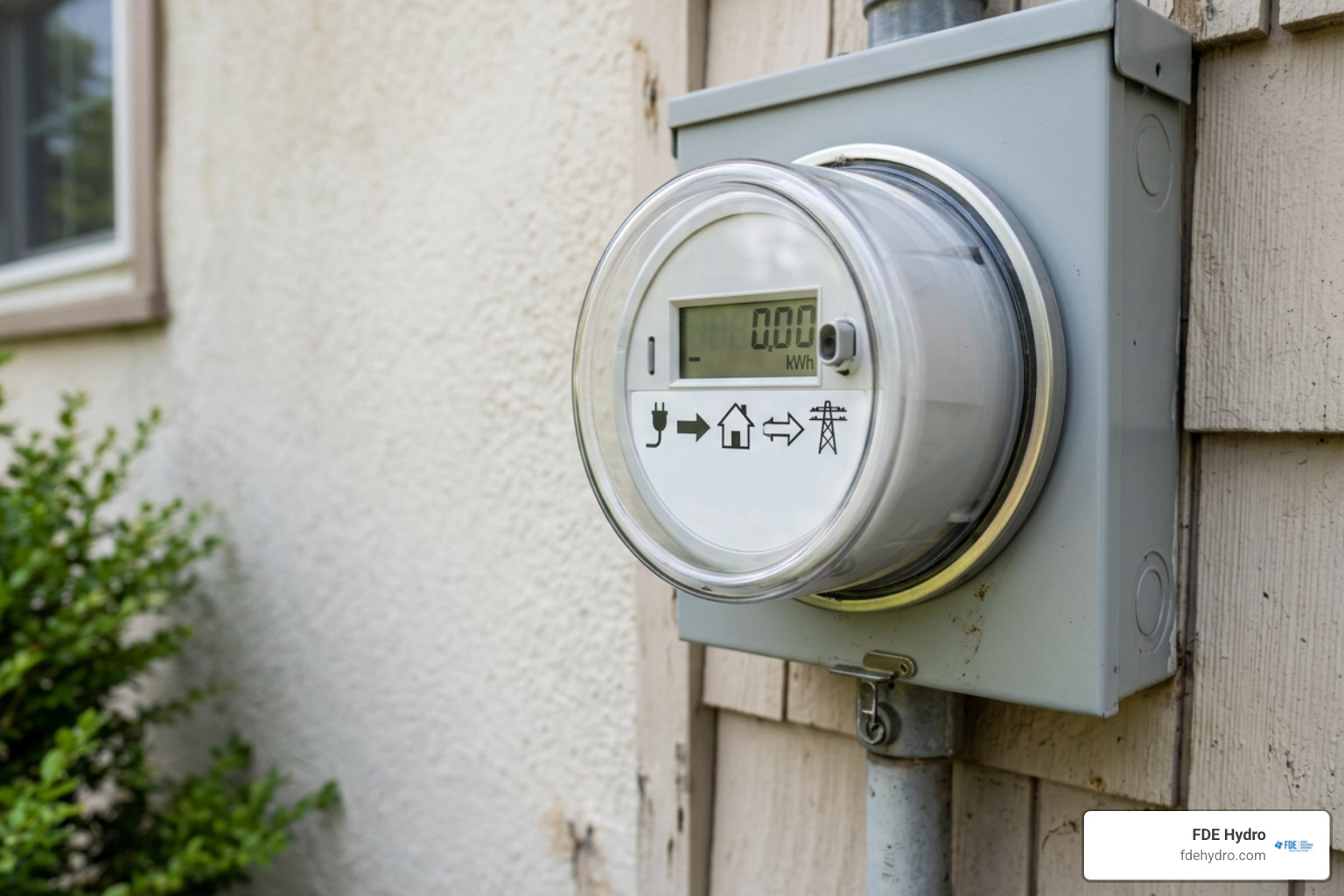
To understand this dynamic, we must look at how power physically flows. When your home generation system produces more electricity than your household appliances are consuming at any given moment, the excess energy has to go somewhere. If you do not have a battery storage system to hold it, that power flows backward through your electrical panel, out through your utility meter, and onto the local distribution lines to be consumed by your nearest neighbors.
This process is tracked using specialized metering equipment. Learn more about how the electrical grid powers our lives to see how these localized flows integrate with the broader electrical network.
How Net Metering Facilitates Selling Electricity to the Grid
The most common policy mechanism for residential generators in North America is net metering. Under a net metering program, your utility installs a bidirectional smart meter. This meter acts like a two-way scale, measuring both the electricity you pull from the grid when your system isn’t producing enough (such as at night) and the electricity you push back onto the grid when you have a surplus.
At the end of your billing cycle, the utility calculates your “net” usage:
$$text{Net Energy} = text{Energy Consumed} – text{Energy Exported}$$
If you exported more than you consumed, you receive billing credits on your account. In many jurisdictions, these credits are applied at the full retail rate of electricity. This means a kilowatt-hour (kWh) exported during the sunny afternoon offsets a kWh imported during the expensive evening peak.
However, policies vary widely by state and province. For example, if you are looking at the Great Plains region of the United States, you will find specific guidelines governing how these credits are calculated and rolled over. You can read up on the exact regulatory landscape by exploring Net Metering in Kansas.
Direct Cash Payments vs. Billing Credits
It is vital to distinguish between earning billing credits and receiving direct cash payments. For the vast majority of residential homeowners, selling electricity to the grid does not result in a monthly check arriving in the mail. Instead, your utility account accrues credits that roll over to the next month, helping to offset future utility bills during seasons with lower generation.
Direct cash payments are typically reserved for specific commercial setups, wholesale generators, or regions with active Feed-in Tariff (FiT) programs. In a direct payment model, you are paid a designated rate for every single kWh your system exports, regardless of how much electricity you import.
These programs are highly regulated to ensure grid stability and fair compensation. To see how these rules are structured in neighboring regions, you can consult the Net metering guide from Ontario Energy Board to see how Canadian regulators balance consumer benefits with utility infrastructure costs.
Compensation Models: Feed-in Tariffs, SEGs, and RECs
Depending on where you live across our operating regions in North America and Europe, the financial incentives and structural programs for exporting green energy look quite different.
Before you install any system, you must understand the exact program your local utility offers. If you are starting from scratch, it helps to understand the physical connection requirements first; you can read our guide on How to connect your home to the grid to get a handle on the hardware side of things.
Regional Tariff Structures and the Smart Export Guarantee
In Europe, the regulatory framework has shifted away from older, government-subsidized Feed-in Tariffs toward market-driven compensation models.
- The United Kingdom: The UK operates under the Smart Export Guarantee (SEG). Under this scheme, licensed energy suppliers with over 150,000 customers are legally required to offer export tariffs to home generators. These rates are variable and market-competitive, typically ranging between 3p and 12p per kWh.
- Ireland: Irish homeowners benefit from the Clean Export Guarantee (CEG) scheme. Similar to the SEG, the CEG allows micro-generators to receive competitive payments or billing credits from their chosen retail electricity supplier for any surplus green electricity sent to the national grid. For a comprehensive look at how this operates in the Irish market, check out the detailed guide: Can I Sell Electricity Back to the National Grid in Ireland?.
Renewable Energy Certificates (RECs) and Power Purchase Agreements
For larger residential systems, agricultural properties, or commercial operations, compensation often moves beyond simple billing credits into the realm of Renewable Energy Certificates (RECs) and Power Purchase Agreements (PPAs).
A Renewable Energy Certificate represents the environmental attributes of one megawatt-hour (MWh) of electricity generated from a renewable source. In some states and provinces, you can sell these certificates on open markets to utilities that need them to meet their regulatory green energy quotas. This acts as an entirely separate stream of income alongside your standard utility credits, often yielding an additional $0.04 to $0.08 per kWh.
For commercial-scale developers or community energy projects, a Power Purchase Agreement (PPA) is the standard contract vehicle. A PPA is a long-term contract between an electricity generator (you) and a buyer (typically a utility or a large corporation). This agreement defines the fixed price at which the buyer will purchase the generated electricity over a period of 5 to 20 years.
To understand how these commercial contracts are drafted, managed, and optimized, you can review A guide to Power Purchase Agreements.
Technical Requirements and Grid Constraints
While the financial rewards of selling electricity to the grid are attractive, we must remember that the physical grid is a highly complex machine. Grid operators must constantly balance supply and demand in real time to maintain a stable frequency and voltage.
As more homes install renewable systems, local low-voltage networks can experience congestion, leading to strict technical rules for new connections. To understand how your home’s system interacts with these localized lines, you can Explore the low voltage grid.
Interconnection Processes and Export Limits
Before you can legally flip the switch on a grid-tied renewable energy system, you must go through an official interconnection process with your local distribution utility. This process ensures that your system will not backfeed power onto the lines during a blackout, which would pose a fatal hazard to utility line workers.
During this review, the utility may conduct an interconnection study to determine if your local substation and transformer can handle the maximum potential output of your system. Depending on the local infrastructure, the utility may impose strict export limits:
- Single-Phase Connections: Standard residential connections are single-phase. In many congested suburban networks, utilities cap exports on single-phase connections to a maximum of 5 kW to prevent local voltage spikes.
- Three-Phase Connections: Larger properties with three-phase connections may be allowed higher export limits (often up to 11 kW or more), but these installations require more expensive inverters and grid-protection equipment.
For a real-world look at how a major utility manages these technical applications, study the guidelines on Electricity Sales and Interconnection from Consumers Energy.
The Role of Smart Meters and Network Rules
To participate in any export program, your standard electricity meter must be upgraded. Modern bidirectional smart meters record import and export data in half-hourly intervals.
In the UK, this setup requires the creation of an Export Meter Point Administration Number (MPAN) by your local Distribution Network Operator (DNO). Without this unique identifier, your supplier cannot legally track or credit your exports, even if your physical system is already pushing power back onto the lines.
Maximizing Value: Self-Consumption, Batteries, and VPPs
As utility companies adjust to the massive influx of daytime solar energy, export tariff rates have steadily declined. In many areas, we are seeing the introduction of “two-way pricing” or “sun taxes,” where customers are actually charged a small fee for exporting power during peak midday hours when the grid is already flooded with solar energy.
Because of this, the economic focus has shifted from maximizing grid exports to maximizing self-consumption. To see how advanced systems manage this balance, read about Optimizing microgrid operations.
Self-Consumption vs. Exporting to the Grid
The golden rule of modern home energy economics is simple: a kilowatt-hour saved is worth far more than a kilowatt-hour sold.
When you use a unit of electricity generated by your own rooftop solar panels or micro-hydro system, you are offsetting a unit of electricity you would have otherwise bought at the full retail rate (e.g., 35¢/kWh). If you export that same unit to the grid, you might only receive a feed-in credit of 5¢/kWh.
| Metric | Self-Consumption | Grid Export |
|---|---|---|
| Effective Value | High (Saves full retail rate, e.g., 30–50¢/kWh) | Low (Earns wholesale/export rate, e.g., 3–12¢/kWh) |
| Grid Impact | Zero (Reduces strain on local distribution lines) | High (Can cause localized voltage rise during peak sun) |
| Best Strategy | Run heavy appliances (washers, EV chargers) during peak generation | Limit daytime export; store surplus in a home battery |
By shifting your heavy energy usage—such as running heat pumps, pool pumps, washing machines, or electric vehicle chargers—to the middle of the day when your system is producing peak power, you drastically improve your financial payback period.
How Batteries and VPPs Change the Economics
Adding a home battery storage system allows you to capture your daytime surplus and store it for use during the expensive evening hours, rather than exporting it for pennies.
Furthermore, smart battery systems allow you to participate in Virtual Power Plants (VPPs). A VPP is a network of decentralized home energy storage systems grouped together by a software provider. When the main electrical grid experiences extreme demand, the VPP operator can coordinate thousands of home batteries to discharge simultaneously back into the grid.
In exchange for helping to stabilize the grid during these critical hours, VPP participants are compensated at premium incentive rates—sometimes up to several dollars per kWh during peak events. In the United States, regulatory milestones like FERC Order 841 have paved the way for small battery storage systems to access these wholesale markets, completely changing the return-on-investment calculations for home energy storage.
Practical Steps to Begin Exporting Power
If you are ready to stop simply consuming energy and start selling electricity to the grid, you need to follow a structured roadmap.
Rushing into an installation without securing the proper utility approvals can result in expensive fines, or worse, an expensive system that you are legally forbidden to turn on.
Sizing and Installing Your Renewable Energy System
Your first step is to design a system that fits your historical energy usage. Sizing a system too large can be a financial mistake because most utilities will not pay you retail rates for generation that exceeds your annual historical consumption.
To ensure your system qualifies for export incentives:
- Choose Accredited Installers: In the UK, your system and installer must be certified under the Microgeneration Certification Scheme (MCS). In Ireland and North America, similar national or state-level licensing is required.
- Review Local Micro-generation Guidelines: Every country has strict thresholds for what qualifies as “micro-generation” (usually systems under 6 kW for single-phase lines). For European and Irish standards, read the official Micro-generation guidelines to ensure compliance.
Step-by-Step Guide to Selling Electricity to the Grid
Once your system is designed and your installer is selected, follow these steps to get paid:
- Submit Connection Notification: Your installer must notify your local Distribution Network Operator (DNO) or utility. In Ireland, this is done via an NC6 form for small systems.
- Install a Bidirectional Smart Meter: If you do not have one, your utility will install a meter capable of tracking dual-directional flows.
- Obtain Your Export MPAN / Registration: Your utility will register your export connection point and issue a unique identifier.
- Choose and Activate an Export Tariff: Contact an energy supplier to enroll in their export program. You do not always have to use the same supplier for both import and export, allowing you to shop around for the best export rate. For an example of an independent supplier offering competitive rates, check out the 100Green Home Generation Export Tariff.
- Monitor Your First Bill: Ensure the export credits are actively appearing on your monthly statements.
Frequently Asked Questions about Home Energy Sales
Is selling electricity to the grid profitable for average homeowners?
For the average homeowner, selling electricity to the grid is highly effective at offsetting your monthly utility costs, but it is rarely a path to direct wealth. Because export rates (3–12¢/kWh) are significantly lower than retail import rates (30–50¢/kWh), the primary financial benefit comes from avoiding retail purchases through self-consumption.
With an average residential solar installation costing between $11,000 and $15,000, most homeowners see a complete payback on their investment in about 8 to 10 years (around 100 months), after which the system generates pure savings.
Do I need a battery storage system to sell electricity to the grid?
No, you do not need a battery to export power. Any surplus energy your system generates will automatically flow back onto the grid through your bidirectional meter. However, without a battery, you are forced to export your excess power during the day when export rates are at their lowest. A battery gives you the flexibility to store that power and either use it yourself at night or export it during high-value peak demand windows via a VPP.
How long does it take to set up grid export payments?
The administrative setup typically takes between 4 to 8 weeks. While the physical installation of solar panels or a micro-hydro system might only take a few days, waiting for your local utility to process the interconnection paperwork, issue an export MPAN, and approve the bidirectional meter swap accounts for the majority of the timeline.
Conclusion
Selling electricity to the grid is a fantastic way to lower your carbon footprint, support local grid stability, and dramatically slash your monthly energy bills. However, navigating the complex world of net metering, export tariffs, and utility interconnection rules requires careful planning and realistic expectations.
At FDE Hydro™, we understand the immense value of predictable, reliable renewable energy. While we specialize in developing innovative, patented modular precast concrete technology (“French Dam”) to make utility-scale hydroelectric projects more efficient and cost-effective across North America, Europe, and Brazil, we believe that every step toward a decentralized, bidirectional grid is a step toward a sustainable future.
If you want to keep learning about how the modern electrical network is evolving to handle clean energy, Explore more power grid articles on our site today.
FDE Hydro is Bringing Predictability to an Unpredictable Environment™
