

How Dam Construction Technology Is Transforming Water Infrastructure
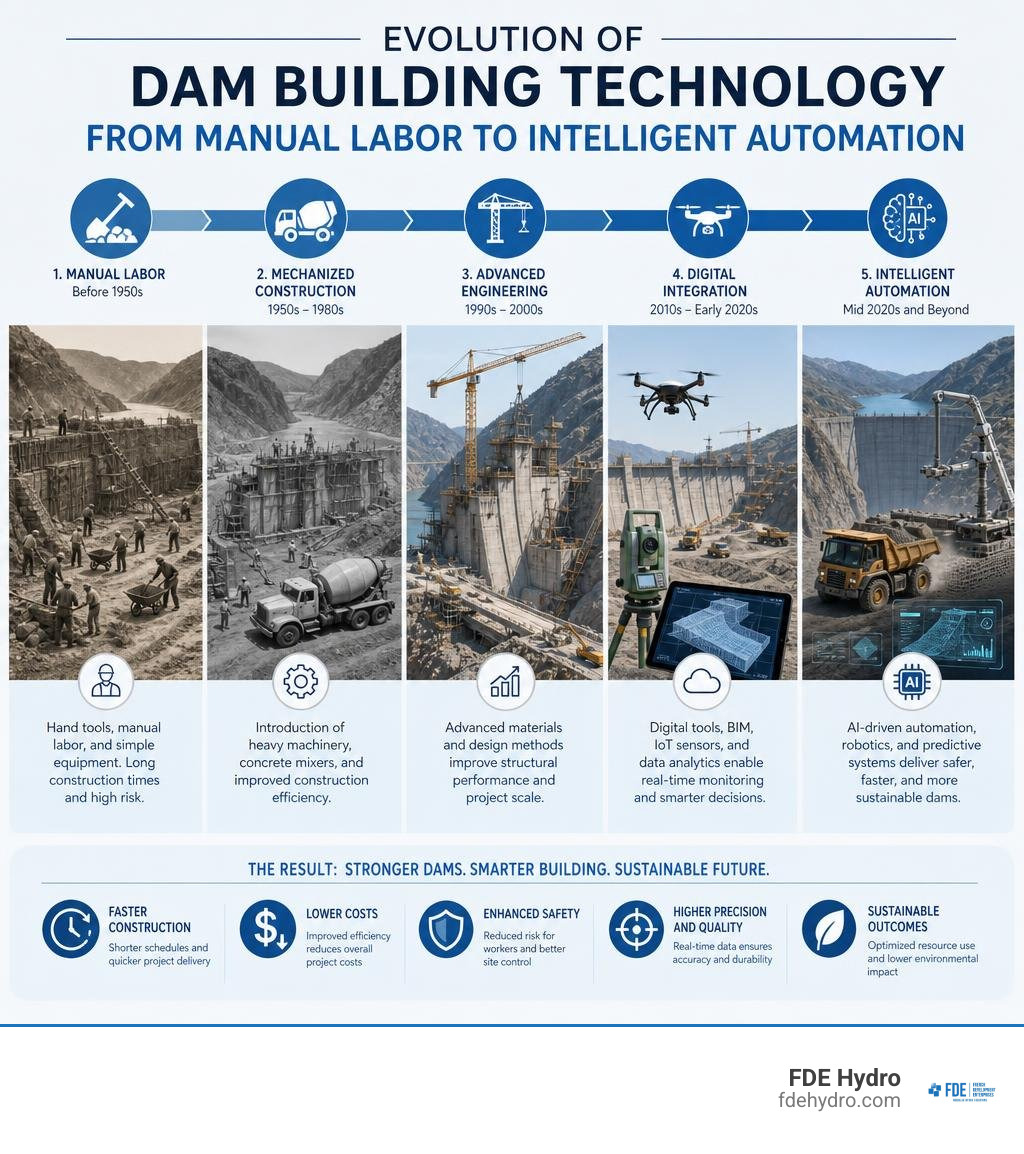
Dam construction technology has changed more in the last two decades than in the previous century. Here’s a quick overview of where things stand today:
Key facts about dam construction technology:
- There are 62,362 large dams in the world as of 2025
- Reservoirs store roughly 8,000 km³ of water — about 10% of Earth’s total natural freshwater lake volume
- Hydropower accounts for approximately 20% of global electricity supply
- Modern methods like roller-compacted concrete (RCC), rock-filled concrete (RFC), and AI-driven automation are cutting costs by 10–30% and dramatically speeding up build times
- Digital systems using BIM, IoT sensors, and autonomous equipment now monitor quality in real time across entire dam projects
Dams are among the most consequential structures humans build. They store water, generate clean energy, control floods, and support agriculture on a massive scale. About 20% of the world’s irrigated farmland depends on reservoir water.
But building them has always been expensive, slow, and risky. Traditional methods require enormous workforces, complex logistics, and years of construction — all in remote, demanding environments.
That’s changing fast.
New concrete technologies, smart sensors, autonomous machinery, and modular construction approaches are reshaping what’s possible. Projects that once took a decade can now move significantly faster. And the environmental and safety performance of modern dams is improving alongside the economics.
Understanding these advances matters — whether you’re planning a new hydropower facility, managing aging infrastructure, or evaluating the true cost of a major water project.
I’m Bill French, Sr., Founder and CEO of FDE Hydro™, and I’ve spent over five decades in heavy civil construction — including working with the U.S. Department of Energy’s Water Power Technology Office on next-generation hydropower solutions — which gives me a direct, practical perspective on how dam construction technology is evolving and where the biggest opportunities lie. In this guide, I’ll walk you through everything from site selection and structural design to the latest digital and material innovations reshaping the industry.
Core Engineering: Site Selection, Investigations, and Dam Types

Before a single cubic meter of concrete is poured, years of rigorous technical investigations must take place. Selecting a site for a dam requires an interdisciplinary approach combining topography, geology, and hydrology. We must understand the shape of the valley, the strength of the bedrock, and the historical flow patterns of the river.
Topographic mapping determines the reservoir’s potential storage capacity and the optimal height of the dam. Geological investigations—including deep core drilling, seismic testing, and laboratory analysis of rock samples—ensure the foundation can bear the immense weight of the structure and resist water pressure without shifting. Hydrological analysis models the watershed to calculate the “Inflow Design Flood” (IDF), ensuring the dam can safely pass extreme weather events.
Once the site characteristics are established, engineers select the structural type. There are four primary designs:
- Gravity Dams: These massive concrete structures rely entirely on their own weight to resist the horizontal force of the water. They require a highly durable rock foundation.
- Embankment Dams: Built from compacted earth or rockfill, these dams use a dense clay core or concrete face to prevent water seepage. Because they are flexible, they can be built on weaker soil or rock foundations.
- Arch Dams: Curved upstream, these structures transfer the hydrostatic pressure of the water laterally into the canyon’s rock walls. They require narrow valleys with exceptionally strong, steep rock abutments.
- Buttress Dams: These dams consist of a flat or curved upstream face supported by a series of triangular concrete buttresses on the downstream side. They use less concrete than gravity dams but require complex formwork.
| Dam Type | Primary Materials | Structural Support Mechanism | Foundation Requirements |
|---|---|---|---|
| Gravity | Concrete, Rock-Filled Concrete | Resists water pressure through dead weight | Solid, unyielding bedrock |
| Embankment | Earthfill, Rockfill, Clay Core | Distributes weight over a wide footprint | Adaptable to soil or moderate rock |
| Arch | Concrete | Transfers hydrostatic forces to valley walls | Extremely strong, narrow rock canyons |
| Buttress | Concrete, Precast Elements | Face transfers load to discrete buttress walls | Strong rock or high-capacity piles |
Geotechnical and Hydrological Site Selection
Water is incredibly persistent. It will find any crack, fissure, or porous layer of soil to seep through. Consequently, seepage mitigation is a primary focus of geotechnical site preparation. Engineers design grout curtains—created by drilling deep holes into the bedrock and pumping in high-pressure cement grout—to seal cracks up to hundreds of feet below the surface.
Additionally, foundation preparation involves stripping away weathered rock, organic soils, and loose sediment until solid bedrock is exposed. This ensures that the contact zone between the dam and the earth is structurally sound and impermeable. For comprehensive regulatory standards on these processes, consult the Guidelines for dam safety and technical investigations.
Structural Mechanics of Gravity, Arch, and Embankment Designs
The physics governing dam design are uncompromising. For concrete gravity dams, we must satisfy the “middle-third rule.” This rule dictates that the resultant of all forces (gravity, water pressure, uplift, and silt pressure) must act within the middle third of the dam’s base to prevent tension from developing on the upstream face, which could cause cracking and catastrophic overturning.
For embankment dams, the core is typically constructed of dense clay, which resists water seepage up to 10,000 times better than sand and 100 million times better than gravel. The outer shells are built with heavy rockfill to provide stability and prevent landslides. You can read More details on dam construction methods to see how these structural mechanics dictate on-site construction decisions.
The Step-by-Step Dam Construction Process

Building a dam is a highly synchronized ballet of earthmoving, concrete placement, and mechanical engineering. The typical sequence of events is as follows:
- Site Access and Temporary Facilities: Building roads, offices, and concrete batching plants.
- River Diversion: Redirecting the river away from its natural bed to create a dry work area.
- Foundation Excavation: Removing weak soils and blasting down to solid bedrock.
- Grouting and Seepage Barriers: Creating the underground grout curtain to prevent leakage.
- Dam Body Construction: Building the main structure in layers or monolithic blocks.
- Auxiliary Structure Integration: Installing spillways, powerhouses, and outlet works.
- Reservoir Filling and Commissioning: Gradually filling the reservoir while monitoring the dam’s structural response.
To explore this sequence in greater depth, check out our Step-by-step guide to building new dams.
River Diversion and Foundation Preparation
To build a dam, you must first get the water out of the way. For narrow valleys, this is accomplished by excavating massive diversion tunnels through the rock walls of the canyon. Upstream and downstream cofferdams—temporary embankments—are then constructed to block the river and force it into the tunnels, leaving the construction zone completely dry. For wider rivers, engineers often construct dry pits on alternating sides of the river, building the dam in stages while allowing the river to flow through completed sections.
Once the area is dry, heavy machinery and controlled blasting are used to excavate down to solid bedrock. Any remaining cracks are treated with cement milk injection to guarantee a watertight seal. A classic example of this scale of engineering is the Case study of transboundary river diversion at Itaipu, which showcases how massive volumes of water are managed during construction.
Material Placement and Final Commissioning
With the foundation secured, the main dam body is constructed. Concrete gravity dams are built in blocks or continuous layers, while embankment dams are built by placing earth or rockfill in thin, highly compacted lifts. Once the structural work is complete, final commissioning begins.
This phase involves trial filling—raising the reservoir level slowly over weeks or months—while engineers monitor instruments embedded in the dam for unexpected movement or seepage. Concurrently, floodgates, valves, and turbines are tested under actual hydraulic pressure to ensure they operate perfectly. For a deeper look into this phase, read our Insights on hydroelectric dam construction.
Advanced Dam Construction Technology: Concrete Innovations and Digitalization
The civil engineering sector is historically conservative, but the sheer scale of modern projects has forced a rapid evolution in dam construction technology. Two major areas of advancement are revolutionizing the field: next-generation concrete materials and comprehensive digital construction systems.
Historically, large concrete dams suffered from high “hydration heat.” When cement mixes with water, it undergoes an exothermic chemical reaction. In massive concrete blocks, this heat cannot escape easily, causing the interior to expand while the exterior cools and contracts, leading to structural cracking. Modern concrete innovations directly solve this thermal challenge while slashing material costs. To see how these breakthroughs fit into broader civil works, explore these Innovative construction techniques for modern infrastructure.
Next-Generation Materials in Modern Dam Construction Technology
Two major concrete technologies have changed the industry:
- Roller-Compacted Concrete (RCC): RCC is a dry, low-cement mix that is transported by dump trucks, spread by bulldozers, and compacted using heavy vibratory rollers in thin, continuous horizontal layers. Because it contains less water and cement, it generates far less hydration heat, allowing for continuous pouring without the need for complex cooling pipe systems.
- Rock-Filled Concrete (RFC): RFC represents an even more elegant leap forward. Large rocks (often sourced directly from site excavations) are preplaced into the formwork, and high-performance self-compacting concrete (HSCC) is poured over them. The HSCC flows effortlessly into the voids under its own weight—no vibration or compaction required. This reduces cement consumption by up to 50%, dramatically lowers hydration heat, and cuts overall unit costs by 10% to 30%.
To understand the material properties behind these innovations, read this Scientific review of rock-filled concrete dams. Additionally, precast and modular concrete technologies are transforming how we build smaller to mid-sized dams and retrofits. By casting high-strength concrete elements in controlled factory environments, we eliminate weather delays, reduce on-site labor, and ensure flawless quality control. Discover more about this paradigm shift in Precast concrete technology in civil engineering.
Digital Transformation and Smart Dam Construction Technology
Beyond materials, the dam construction site of 2026 is a highly connected digital environment. Cyber-Physical Systems (CPS) integrate physical construction equipment with digital twins in real time.
Using Building Information Modeling (BIM) and 3D-LiDAR point clouds, cloud platforms can track the precise location, speed, and compaction force of unmanned vibratory rollers. Autonomous cranes use AI-driven path planning to transport concrete buckets along optimal, collision-free routes, automatically releasing the hook once the concrete is placed.
These digital systems ensure that compaction is 100% compliant with design specifications, eliminating human error and accelerating schedules. To learn more about how digital twins and automation are applied in heavy civil projects, check out Smart technologies in heavy civil engineering, as well as current Intelligent earth-rock dam construction trends and our overview of Modern dam technology and automation.
Integrating Auxiliary Structures and Hydroelectric Systems
A dam is rarely just a wall blocking a river; it is a complex water-management system. To function safely and productively, several auxiliary structures must be seamlessly integrated into the design. These structures manage floods, generate electricity, facilitate navigation, and protect local wildlife.
To design and build these intricate components efficiently, engineers are increasingly turning to advanced off-site fabrication. Read about these Advanced manufacturing techniques for hydro infrastructure to see how modern manufacturing is applied to complex steel and concrete auxiliary components.
Spillway Design and Flood Management
The spillway is a dam’s ultimate safety valve. If a massive storm hits and the reservoir threatens to overtop the main dam—which can cause catastrophic erosion and failure, especially in embankment dams—the spillway safely channels the excess water downstream.
Designing these systems requires calculating the “Inflow Design Flood” based on worst-case design storm precipitation. Spillways must be lined with highly durable concrete to resist “cavitation”—a phenomenon where high-velocity water creates low-pressure vapor bubbles that collapse violently, literally tearing concrete apart. Modern projects utilize advanced computational fluid dynamics (CFD) and real-world case studies, such as the Intelligent construction at TB Hydropower Station, to optimize spillway hydraulics and energy-dissipating basins.
Power Generation and Fish Passage Systems
For dams dedicated to clean energy, the powerhouse is the heart of the operation. Water from the reservoir travels down massive steel pipes called penstocks, spins heavy turbines, and exits back into the river.
To protect aquatic ecosystems, modern dam projects in North America and Europe must integrate robust fish passage systems. These include fish ladders—a series of stepped pools that allow migratory fish like salmon to swim over the dam—and specialized acoustic or light barriers that guide fish away from turbine intakes.
Additionally, modular construction is transforming powerhouse design. Rather than pouring massive concrete structures on-site over several years, we can now deploy pre-engineered, modular powerhouses. Learn more about how this works with Modular dam construction systems.
Environmental Stewardship, Safety Monitoring, and Decommissioning
While dams provide immense societal benefits, they also alter natural ecosystems. They trap river sediment, alter water temperatures, disrupt fish migration, and can displace local communities. In 2026, responsible engineering demands that environmental stewardship be built into every phase of a dam’s lifecycle.
Environmental impact assessments (EIAs) are now legally mandated in most jurisdictions to identify and mitigate ecological risks before a project begins. To understand how modern engineering balances human needs with ecological preservation, read about Reducing negative impacts of dam construction on human populations.
Structural Safety, Monitoring, and Failure Prevention
Once a dam is operational, long-term safety monitoring is paramount. Historically, the primary causes of dam failure have been overtopping, foundation defects, and piping (where water erodes an internal pathway through an embankment dam).
To prevent these issues, modern dams are equipped with thousands of real-time sensors:
- Piezometers to monitor water pressure within the dam body and foundation.
- Inclinometers and extensometers to detect millimeter-scale structural movements.
- Fiber-optic temperature sensors to identify early-stage internal seepage.
- Post-Tensioned (PS) Anchors to provide active seismic reinforcement without interrupting operations.
- Remotely Operated Vehicles (ROVs), like underwater inspection robots, to safely inspect deep concrete faces and intake gates without risking human divers.
To see how advanced structural monitoring is integrated into ultra-high dams, refer to the Innovative construction technology of high-core rockfill dams.
Regulatory Frameworks, Geopolitics, and Dam Removal
Dams built on transboundary rivers—rivers that cross international borders—often spark geopolitical disputes. Upstream water storage can directly impact downstream water security, agriculture, and power generation, requiring complex international treaties and regulatory frameworks.
Meanwhile, in North America and Europe, many aging dams that have reached the end of their design lives are being decommissioned and removed. Over 1,200 dams have been removed in the US alone to restore natural river flows and fish habitats. When retrofitting or replacing water control infrastructure is required, engineers rely on Rapidly deployable water control systems to manage water flow safely during construction.
Frequently Asked Questions about Dam Construction Technology
What is the most cost-effective dam construction technology today?
The most cost-effective technologies are Rock-Filled Concrete (RFC) and modular precast concrete systems. RFC reduces cement use by up to 50% and eliminates the need for expensive cooling and vibration equipment, resulting in a 10% to 30% reduction in unit costs.
For small-to-medium projects, modular precast concrete systems (like our patented French Dam technology) allow components to be manufactured off-site and assembled rapidly on-site, slashing construction schedules from years to months and significantly lowering labor and financing costs. You can learn more about how these methods compare by looking at Leading dam construction companies.
How do modern dams mitigate environmental and ecological impacts?
Modern dams utilize a combination of fish bypass systems (such as fish ladders and fish elevators), multi-level water intakes to regulate downstream water temperature, and sediment bypass tunnels to allow trapped river sediment to pass naturally downstream.
Additionally, “environmental flows”—carefully calculated water releases—are maintained to mimic natural seasonal river cycles and support downstream aquatic life.
How does digital twin technology improve dam safety and monitoring?
A digital twin is a real-time virtual replica of the physical dam. By integrating BIM models with data from embedded IoT sensors (piezometers, fiber-optic temperature sensors, and accelerometers), the digital twin can simulate structural behavior under various conditions.
AI algorithms analyze this data to predict potential issues—such as internal erosion or micro-cracking—long before they are visible to human inspectors, allowing for proactive, preventative maintenance.
Conclusion
The future of dam construction technology belongs to methods that are faster, safer, more cost-effective, and ecologically responsible. As we face the dual challenges of climate change and aging infrastructure, traditional, slow-moving construction methods are no longer sufficient.
At FDE Hydro™, we are leading this transformation with our patented, modular precast concrete technology, the French Dam. By shifting construction from the unpredictable riverbed to a controlled factory environment, we help developers and asset owners in North America, Brazil, and Europe build and retrofit hydroelectric dams in a fraction of the time and at a significantly lower cost than conventional poured-in-place concrete.
Whether you are looking to build a new water control system, retrofit an existing facility, or optimize your power generation capability, we are here to help you navigate the next generation of civil engineering. Explore modular powerhouse solutions today to see how we can bring your next project online faster and more efficiently.
