by Adaptify Support | May 15, 2026 | Power Grid Articles
Why the Energy Grid Needs a Blockchain Upgrade
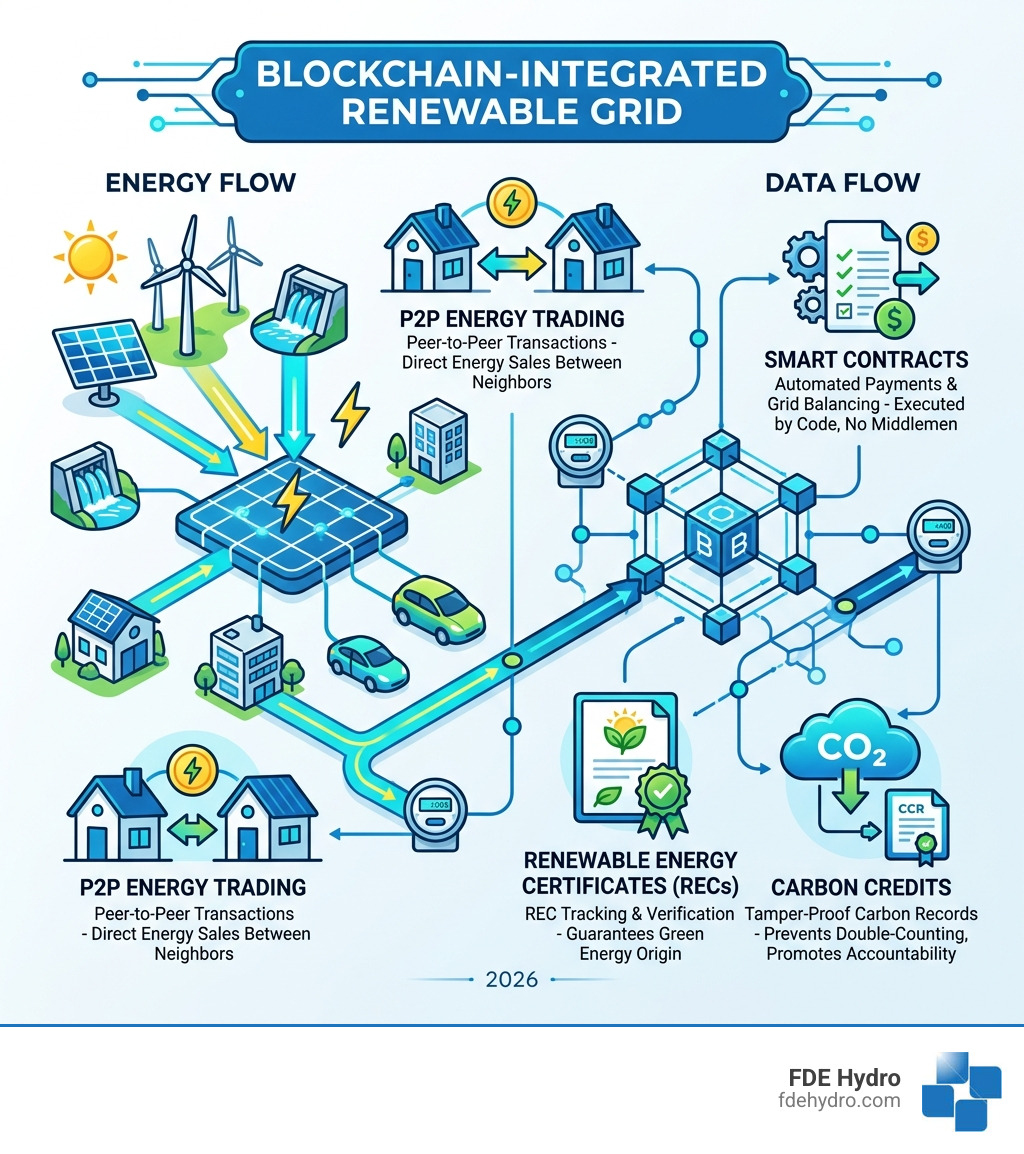
Renewable energy blockchain is a system that uses decentralized digital ledger technology to record, verify, and automate energy transactions — without relying on a central authority.
Here’s what it enables at a glance:
| Function |
What Blockchain Does |
| P2P Energy Trading |
Lets producers sell surplus power directly to neighbors |
| Smart Contracts |
Automates payments and grid balancing in real time |
| Renewable Energy Certificates |
Tracks and verifies green energy origin, preventing fraud |
| Carbon Credits |
Creates tamper-proof records to stop double-counting |
| Grid Management |
Monitors energy flows across distributed networks securely |
The global energy system is changing fast. Clean energy investment has surged by 40% since 2020. More than 500 GW of new renewable capacity was added in 2023 alone. But the infrastructure managing all that power — the billing systems, the verification processes, the trading markets — is still largely built on decades-old technology.
That mismatch is a real problem.
Renewable energy is intermittent by nature. Solar panels go dark at night. Wind turbines stop when the air is still. Managing that variability across a grid with millions of distributed producers and consumers requires fast, transparent, and trustworthy data — exactly what blockchain is designed to deliver.
The market is responding. Blockchain’s value in the energy sector was just $278 million in 2019. It is projected to reach over $81 billion by 2032, growing at a compound annual growth rate of 56.1%. Academic research in this space is growing at 47% per year — a signal that this is not a passing trend.
I’m Bill French, Sr., Founder and CEO of FDE Hydro™, where I’ve spent the last decade developing modular hydropower solutions at the intersection of civil construction innovation and renewable energy blockchain integration. My background in large-scale infrastructure projects gives me a practical lens on how decentralized energy technology can — and must — work alongside next-generation power generation assets like run-of-river hydro.
Explore more about Renewable energy blockchain:
How Renewable Energy Blockchain Technology Works
At its core, a renewable energy blockchain acts as a shared, digital “truth machine.” Instead of one utility company holding all the data in a private database, the information is spread across a decentralized ledger. This means every participant in the grid—from the homeowner with solar panels in California to a modular dam operator in Canada—sees the same immutable record of who produced what and who paid whom.
This immutability is key. Once a transaction is recorded, it cannot be altered or deleted. In the context of the energy transition, this provides a level of transparency that traditional systems simply can’t match. When we talk about Renewable Energy Solutions, we aren’t just talking about the hardware; we’re talking about the trust layer that makes the hardware viable in a modern market.
Interestingly, researchers are even exploring how physics-based cryptocurrency transmits energy, moving beyond just data to actually linking the laws of thermodynamics with digital tokens. This peer-to-peer (P2P) approach turns the traditional “top-down” utility model on its head, allowing energy to flow and be settled locally.
The Role of Smart Contracts in Renewable Energy Blockchain
If the blockchain is the ledger, “smart contracts” are the automated bookkeepers. These are self-executing lines of code that trigger automatically when certain conditions are met. For example, if your neighbor’s battery drops below 20% and your solar array is producing a surplus, a smart contract can execute a trade instantly.
This leads to a financial revolution in renewable energy by removing intermediaries. No more waiting 30 days for a utility bill or paying high processing fees to a third-party clearinghouse. Real-time settlement means better cash flow for producers—some solar providers have even seen payment processing times drop by 60% after switching to blockchain-based systems.
Data Integrity and Security in Distributed Grids
As we move toward “smart grids,” we also open the door to cyber threats. A centralized grid is a single point of failure; if the main server is hacked, the lights go out. A renewable energy blockchain, however, offers superior cyber resilience. Because the data is distributed, there is no central target for hackers to hit.
This tamper-proof nature is essential for unpacking the future of sustainable blockchain. It ensures that data from smart meters is accurate and that no one can “double-spend” a kilowatt-hour or forge a green certificate. For our work at FDE Hydro, ensuring that the data coming from a decentralized hydro facility is secure is just as important as the concrete we use to build it.
Primary Applications: From P2P Trading to Carbon Credits
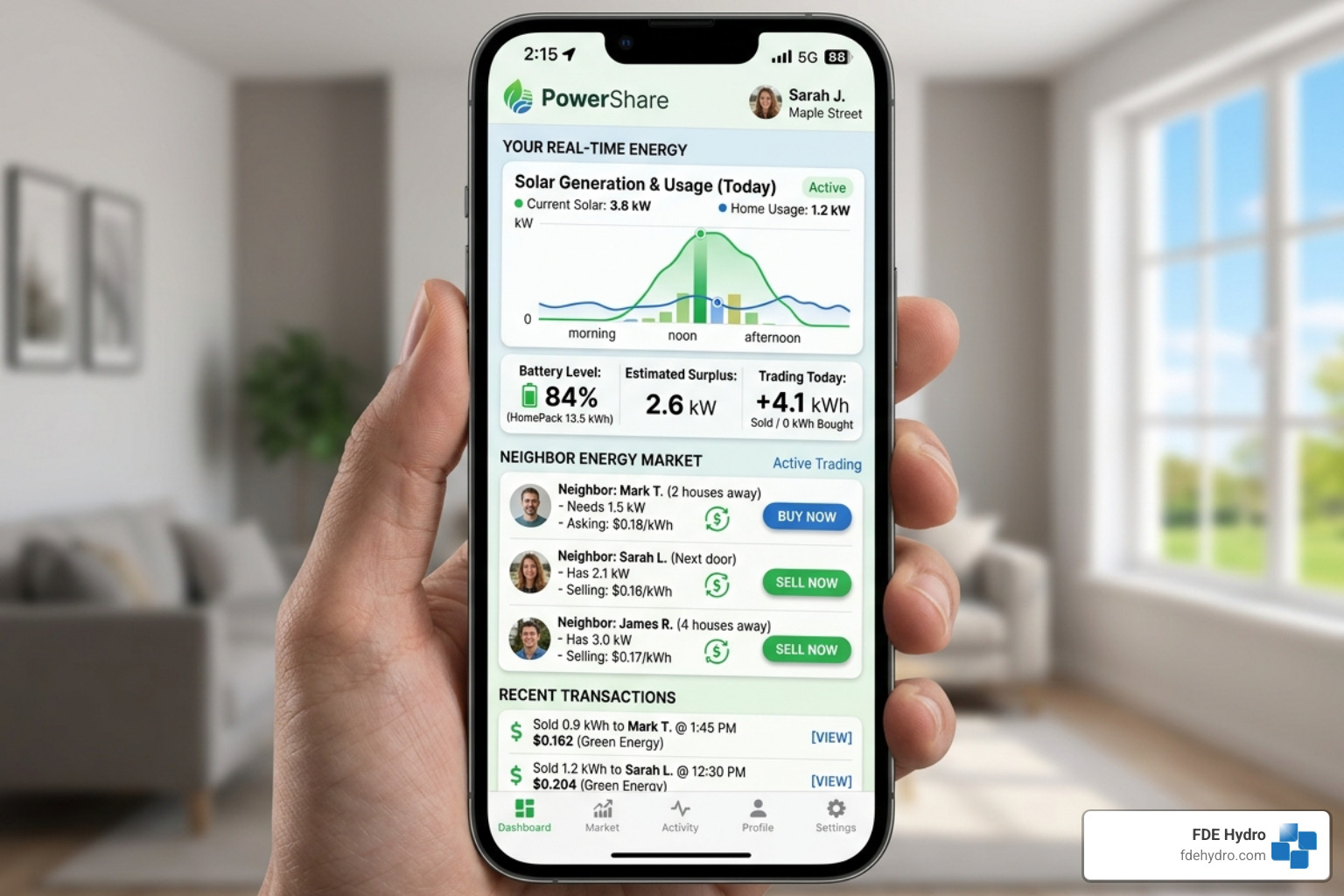
The most exciting part of this technology is how it changes the lives of everyday energy users. Through P2P trading, energy democratization becomes a reality. Instead of being a passive “consumer,” you become a “prosumer”—someone who both produces and consumes.
In projects like The Transactive Grid, we see how blockchain creates an end-to-end market service. This is vital for sustainable energy production because it incentivizes people to install more local renewables, knowing they can easily sell their excess to the house next door.
Tokenizing Assets and Renewable Energy Certificates (RECs)
Blockchain allows us to turn physical assets into digital tokens. Think of “Solar NFTs” or fractional ownership. Instead of needing $10 million to build a wind farm, a community can crowdfund the project. Each person owns a “token” representing a piece of the turbine and receives a share of the revenue.
This extends to Renewable Energy Certificates (RECs). Traditionally, RECs are a paperwork nightmare, prone to fraud and double-counting. With platforms like RECTOKEN, every certificate is a unique digital asset on the blockchain. This makes defining every renewable energy source in your portfolio transparent and verifiable for ESG reporting.
High-Integrity Carbon Credit Marketplaces
The carbon market has long struggled with “ghost credits”—credits for trees that were never planted or energy that wasn’t actually green. By integrating Industrial IoT (Internet of Things) with blockchain, we can achieve 100% data integrity.
Platforms like Blockvolt ERTH capture granular, 15-minute readings directly from the source. This creates a “provenance” or a digital birth certificate for every carbon credit.
| Feature |
Traditional RECs |
Blockchain-Based RECs |
| Verification |
Manual, slow audits |
Real-time, IoT-verified |
| Fraud Risk |
High (Double-counting) |
Extremely Low (Immutable) |
| Accessibility |
Large corporations only |
Open to small producers |
| Settlement |
Weeks or Months |
Instantaneous |
Several key players are building the infrastructure for this new economy. Ethereum was the pioneer, bringing smart contracts to the world. However, as the sector matures, we are seeing a shift toward more specialized and efficient chains.
- Energy Web: A non-profit focused specifically on the energy sector’s regulatory and technical needs.
- PowerLedger: An Australian-born platform that has facilitated over 1.67 GWh of energy trading globally.
- Solana: Known for its high speed (50,000 transactions per second) and low energy use, making it ideal for micro-transactions in clean energy solutions.
- R3 Corda: Often used for “consortium” blockchains where privacy and permissioned access are required between specific utilities.
Powering the energy sector through blockchain isn’t just a theory anymore; it’s a multi-billion dollar industry that is currently being scaled for global grids.
Scaling the Renewable Energy Blockchain for Global Grids
To handle millions of houses trading energy every second, the blockchain needs high throughput. Early versions of blockchain used “Proof of Work” (like Bitcoin), which consumed a lot of electricity. Modern energy-efficient crypto uses “Proof of Stake” or “Proof of Useful Generation.”
The Arkreen Network, for instance, uses Web3 to connect distributed resources, creating a “DeEnergy” data network. This allows the grid to scale without the massive carbon footprint associated with older blockchain models.
Real-World Case Studies and Market Statistics
The numbers are starting to back up the hype. In Thailand, a smart city project at Chiang Mai University used 12 MW of solar and blockchain trading to achieve 30% energy autonomy. In the UK, Rowan Blockchain is rewarding homeowners with rewards for every kWh of solar they generate, tracked via a custom “SmartMiner.”
As of 2024, more than 1.67 GWh of energy has been traded on P2P platforms. For a deeper dive into how these projects come together, check out our Renewable Energy Projects Complete Guide.
Benefits and Challenges of Decentralized Energy Management
The benefits are clear: lower costs, higher efficiency, and better transparency. By automating the “back office” of a utility, companies can pass those savings to consumers. In fact, blockchain-based platforms have the potential to reduce consumer electricity bills by up to 40%.
However, it’s not all sunshine and wind power. We face significant hurdles:
- Interoperability: Different blockchains need to “talk” to each other and to the existing grid hardware.
- Regulatory Hurdles: In many places, it is still illegal to sell electricity to your neighbor without a utility license.
- High Initial Costs: While cost-effective crypto mining is possible, the initial setup for IoT sensors and blockchain integration requires capital.
Overcoming Scalability and Regulatory Hurdles
Governments are beginning to catch up. The New York City Blockchain Plan is a great example of a major metro area looking at how to integrate these tools into urban life. Similarly, countries like Germany and India are testing “regulatory sandboxes” where companies can pilot P2P trading without the usual red tape.
Environmental Impact and Energy Consumption
We must address the elephant in the room: does blockchain use too much energy? When using “Proof of Stake” (PoS), the energy consumption is negligible—often 99% less than older systems. In Brazil, we’ve even seen a clean energy glut drawing cryptocurrency miners to use surplus wind and solar power, effectively acting as a “virtual battery” for the grid.
This focus on crypto mining sustainability ensures that the technology we use to save the planet doesn’t end up hurting it.
Frequently Asked Questions about Renewable Energy Blockchain
How does blockchain enable peer-to-peer energy trading?
It creates a secure, automated marketplace. When your solar panels produce more than you need, the blockchain records that surplus. A smart contract then matches your supply with a neighbor’s demand and handles the payment instantly. Platforms like ReNRG are already building these “Decentralised Physical Energy Networks.”
What are the main benefits of blockchain for renewable energy?
The big three are transparency (you know exactly where your power comes from), security (the grid is harder to hack), and lower costs (no middlemen). It’s about making the grid as efficient as the most efficient renewable energy resources we have available today.
Is blockchain technology energy-intensive?
Not anymore. While Bitcoin uses a lot of power, the renewable energy blockchain systems used for the grid are designed to be “green” from the ground up. By using eco-friendly crypto mining techniques and Proof of Stake consensus, the energy used to run the ledger is a tiny fraction of the energy being traded.
Conclusion
The “grid of the future” isn’t just about better batteries or more solar panels; it’s about a smarter way to manage the relationship between them. At FDE Hydro™, we believe that our patented “French Dam” modular technology is the perfect physical partner for this digital revolution. By building and retrofitting hydroelectric systems more quickly and cost-effectively in North America, Brazil, and Europe, we provide the steady, reliable base-load power that decentralized grids need to stay stable.
As we move toward a world of “transactive energy,” where every dam, turbine, and solar panel is part of a secure, transparent renewable energy blockchain, the goal remains the same: sustainable power generation that is accessible to everyone. The upgrade isn’t just coming—it’s already here. Let’s build it together.
by Adaptify Support | May 14, 2026 | Power Grid Articles
The Grid Never Sleeps: What Base Load Power Really Means
What is base load is one of the most fundamental questions in understanding how electricity grids work. Here is the short answer:
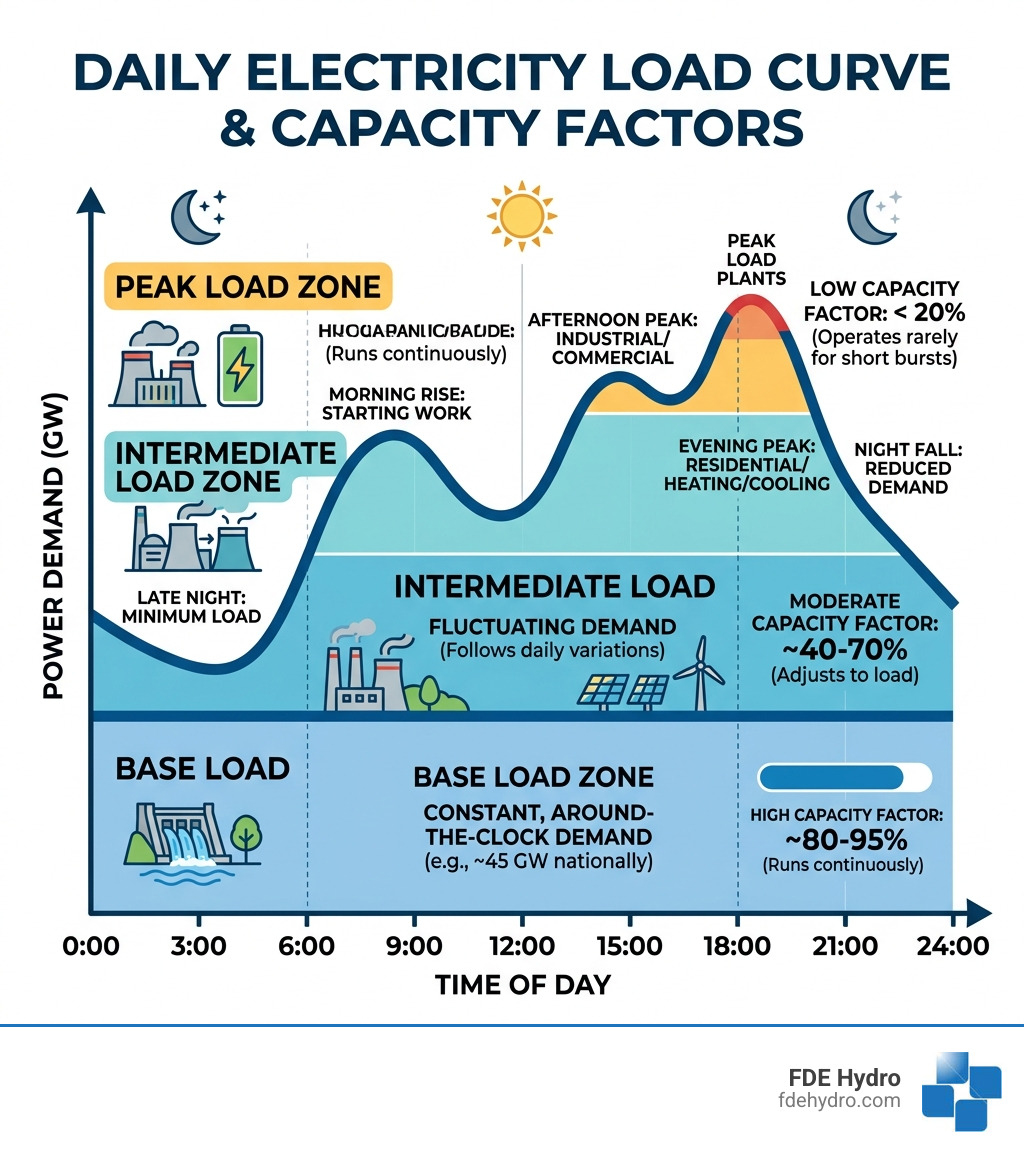
Base load is the minimum level of electricity demand on a grid at any given time — the steady, around-the-clock power requirement that never goes away, even at 3:00 in the morning.
| Term |
Simple Definition |
| Base Load |
The minimum power a grid needs at all times, delivered at a steady, constant rate |
| Base Load Plant |
A power station that runs continuously (often 5,000–8,000+ hours per year) to meet that minimum demand |
| Base Load Capacity |
The generating equipment operated on a 24/7 basis to keep the lights on |
Think about what stays on while a city sleeps — hospitals, streetlights, refrigerators, industrial equipment. That constant, unavoidable draw on the grid is base load.
It is the foundation everything else is built on. Peak demand and variable loads come and go, but base load is always there.
In Germany, for example, total base load runs at roughly 45 gigawatts across the entire country — a significant and non-negotiable slice of national power demand.
Understanding base load matters deeply for anyone planning large-scale power infrastructure, especially hydropower projects where continuous, reliable generation is a core value proposition.
I’m Bill French, Sr., Founder and CEO of FDE Hydro™, and my decades of experience in heavy civil construction and hydropower development — including work with the U.S. Department of Energy’s Water Power Technology Office — give me a practical, ground-level perspective on what is base load and how it shapes real infrastructure decisions. In this guide, I’ll walk you through everything you need to know, from core definitions to how the concept is evolving in modern grids.
Important what is base load terms:
What is Base Load? Defining the Grid’s Foundation
When we talk about the electrical grid, we often focus on the dramatic moments—the summer heatwaves that push demand to its limits or the sudden surge when everyone turns on their ovens for Thanksgiving dinner. But beneath those spikes lies a quiet, constant hum.
According to the Glossary – U.S. Energy Information Administration (EIA), base load is the minimum amount of electric power delivered or required over a given period of time at a steady rate. It is the “floor” of electricity consumption. Grid operators must ensure that there is enough base load capacity—generating equipment operated on an around-the-clock basis—to satisfy this minimum demand without interruption.
The Technical Definition of what is base load
Technically, what is base load refers to the lowest point on a load curve over a specific period, such as a day or a week. In the context of a power system, it represents the demand that exists before we even consider variable factors like heating, cooling, or the morning rush.
The Base load – Wikipedia entry clarifies that this isn’t just a theoretical number; it dictates how we build our world. To meet this constant rate of power delivery, engineers traditionally designed “base load plants.” These facilities are engineered to maximize system mechanical and thermal efficiency while minimizing operating costs. Because they are intended to run 24/7, they don’t need to be nimble—they just need to be reliable.
Comparing Base Load, Peak Load, and Plant Economics
To truly understand the grid, we have to look at the different “flavors” of demand. If base load is the foundation, peak load is the roof, and intermediate load (or load-following) is the walls. We have a great breakdown of these fundamental concepts in our Energy 101/ guide, but let’s look at the specifics here.
Distinguishing Peak Load from what is base load
While base load is the steady trickle that keeps your refrigerator running and your clocks ticking, peak load is the surge. Think about California’s energy demand. Even at 5:00 am, when most of the state is asleep, there is considerable standby consumption—this is the base load. As the day progresses, demand ramps up.
By the afternoon and evening, demand “peaks” as air conditioners roar to life and office buildings stay lit while homes power up. This difference between the minimum 5:00 am demand and the afternoon high is what grid operators call the “peak.”
In Germany, the average cost of maintaining this base load per household is at least 100 euros per year. It might seem like a small price for a refrigerator that stays cold, but across millions of homes, it adds up to a massive infrastructure requirement.
Economic Characteristics of Base Load Plants
The choice of which power plant to use for which type of load comes down to dollars and cents—or what we call fixed vs. marginal costs.
- Fixed Costs: These are the “entry fees.” Building a nuclear plant or a large-scale dam involves massive upfront investment.
- Marginal Costs: This is the cost of producing one more kilowatt-hour once the plant is built.
Traditional base load plants (like coal and nuclear) have very high fixed costs but very low marginal costs. Because the fuel is relatively cheap compared to the construction cost, it makes the most economic sense to run them at full capacity all the time. These plants usually achieve more than 5,000 full load hours per year, and in many cases, they exceed 8,000 hours.
In contrast, “peaker” plants—often powered by natural gas—are cheaper to build but more expensive to run. We only turn them on when we absolutely have to, such as during those afternoon spikes.
Can Renewables Provide Reliable Base Load Power?
For a long time, the industry consensus was that renewables like solar and wind couldn’t handle the base load because the sun sets and the wind stops blowing. However, as we move through 2026, that narrative is changing rapidly. The key isn’t just the source; it’s the management.
By combining intermittent sources with dispatchable generation (power that can be turned on or off on demand) and smart grids, we can meet base load requirements without relying solely on traditional fossil fuels. We explore these construction shifts in detail in our article on Powering Progress Understanding Renewable Energy Construction/.
Hydropower: A Renewable Answer to what is base load
If you’re looking for the “gold standard” of renewable base load, look no further than hydropower. Unlike wind or solar, Hydropower Electricity/ can be incredibly steady.
Run-of-river projects and large-scale dams provide a constant flow of energy. Because water is dense and manageable, hydro is highly dispatchable. If the grid needs a little more power, we open the gates. If demand drops, we throttle back. This unique ability to act as both a base load provider and a load-following source makes it the “Swiss Army Knife” of the grid. You can find a deeper dive into this in The Current Definition Understanding Hydroelectric Power/.
At FDE Hydro™, we’ve seen how our modular precast concrete technology—the “French Dam”—is making it faster and more cost-effective to build this reliable capacity in North America, Brazil, and Europe.
Traditional vs. Emerging Base Load Sources
Traditionally, the Base load power plant category was dominated by:
- Coal-fired plants: Reliable but environmentally taxing.
- Nuclear power: Zero-carbon but with high complexity and long lead times.
- Geothermal: Excellent base load where available, but geographically limited.
Today, we are seeing emerging players like biomass, biogas, and even solar thermal with salt storage beginning to chip away at the traditional monopoly of coal and nuclear.
Why the Traditional “Baseload” Concept is Evolving in 2026
The year 2026 marks a turning point. Many experts now argue that the very idea of a “baseload power plant” is becoming an outdated relic of the 20th century.
Steve Holliday, the former CEO of National Grid, famously remarked that “baseload is outdated.” What he meant was that in a world with high renewable penetration, we don’t need “unvarying” plants that run at one speed. Instead, we need flexibility.
When the wind is howling and solar panels are drenched in sun, we actually have too much power. If we have traditional coal plants that take days to turn off, we run into a problem called curtailment, where we have to literally throw away clean energy because the “baseload” plants won’t get out of the way.
This is why we are seeing a massive shift toward microgrids. If you’ve ever wondered Why Go Micro The Undeniable Advantages Of Microgrids/, it’s because they allow for localized balancing. Understanding What Is A Microgrid And How Does It Work/ is essential for anyone looking at the future of grid stability.
Environmental Implications and the Shift from Coal
The environmental cost of traditional base load is the elephant in the room. Coal plants, while steady, are major contributors to CO2 emissions. The International Energy Agency (IEA) has increasingly suggested that coal should no longer be used for base load due to its climate impact.
Interestingly, nuclear power is finding a new lease on life in this conversation. While early plants like the VVER-440 were designed to be “unvarying,” modern reactors—particularly in the French nuclear model—are being designed for load-following. This allows them to stay in the mix even as renewables take a larger share of the daily load.
Frequently Asked Questions about Grid Demand
How is base load calculated for a household?
You don’t need a PhD in engineering to find your own base load! You can calculate it by reading your electricity meter in the evening before bed and again in the morning before you start using appliances. The formula is: (Morning Reading – Evening Reading) / Number of Hours. Most of this consumption comes from “standby losses”—the little red lights on your TV, your router, and your refrigerator’s compressor. In Germany, this “vampire power” and basic refrigeration cost the average household at least 100 euros annually.
Why is the concept of “baseload plants” becoming outdated?
It’s becoming outdated because modern grids value agility over constancy. With high renewable penetration, we need plants that can “ramp” up and down quickly. Traditional coal and older nuclear plants are like large freight trains—they take a long time to start and stop. Modern grids prefer the “sports cars” of the energy world: fast-reacting hydro, battery storage, and flexible gas turbines.
What role does energy storage play in meeting base load?
Energy storage is the “bridge.” It allows us to take the variable power from the sun and wind and “smooth it out” to act like base load. Whether it’s massive lithium-ion battery arrays in California or pumped-storage hydro in Europe, storage allows us to meet that 24/7 demand using sources that aren’t inherently 24/7.
Conclusion
Understanding what is base load is about more than just knowing a definition; it’s about understanding the heartbeat of our civilization. While the way we meet this demand is changing—moving away from the “always-on” coal plants of the past toward a flexible mix of hydro, storage, and smart technology—the need for a reliable foundation remains.
At FDE Hydro™, we are proud to be part of this transition. Our modular precast concrete technology is designed to help grid operators and developers build the next generation of reliable, renewable infrastructure. By making hydropower more accessible and faster to deploy, we’re helping ensure that the grid’s foundation is as green as it is steady.
If you’re ready to learn more about how we’re powering the future, check out More info about hydropower services. The grid never sleeps, and neither do we when it comes to innovating for a cleaner tomorrow.
by Adaptify Support | May 5, 2026 | Power Grid Articles
What Is an Electrical Grid? Real-World Examples Explained
An electrical grid example can be found all around us — here are the most important ones at a glance:
| Grid Example |
Region |
Key Feature |
| Eastern Interconnection |
East of Rocky Mountains |
Largest U.S. grid |
| Western Interconnection |
West to Pacific Coast |
Spans multiple countries |
| ERCOT (Texas) |
~90% of Texas |
Operates independently |
| ENTSO-E |
Continental Europe |
667 GW capacity |
| PJM Interconnection |
13 U.S. states + D.C. |
65 million customers |
The electricity grid is often called the world’s largest machine — and for good reason. It connects thousands of power plants to hundreds of millions of homes, businesses, and industrial facilities through an intricate web of transmission lines, substations, and transformers. All of this happens invisibly, instantly, and continuously.
Think about what happens the moment you flip a light switch. Power generated potentially hundreds of miles away travels through high-voltage lines, gets stepped down through a series of transformers, and arrives at your outlet — all in a fraction of a second. That seamless delivery is no accident. It is the result of over a century of engineering, regulation, and infrastructure investment.
For large-scale energy infrastructure developers — especially those working in hydropower — understanding how the grid is structured is not just academic. It determines where power can be injected, how it gets priced, and what reliability standards must be met.
I’m Bill French, Sr., Founder and CEO of FDE Hydro™, and my decades of experience in heavy civil construction and hydropower innovation have given me a front-row seat to how electrical grid examples like run-of-river hydro facilities connect to and strengthen the broader power network. In the sections ahead, we’ll break down exactly how the grid works — from the three major U.S. interconnections to smart grid modernization — in plain, practical terms.
Electrical grid example word list:
The Three Pillars: A U.S. Electrical Grid Example
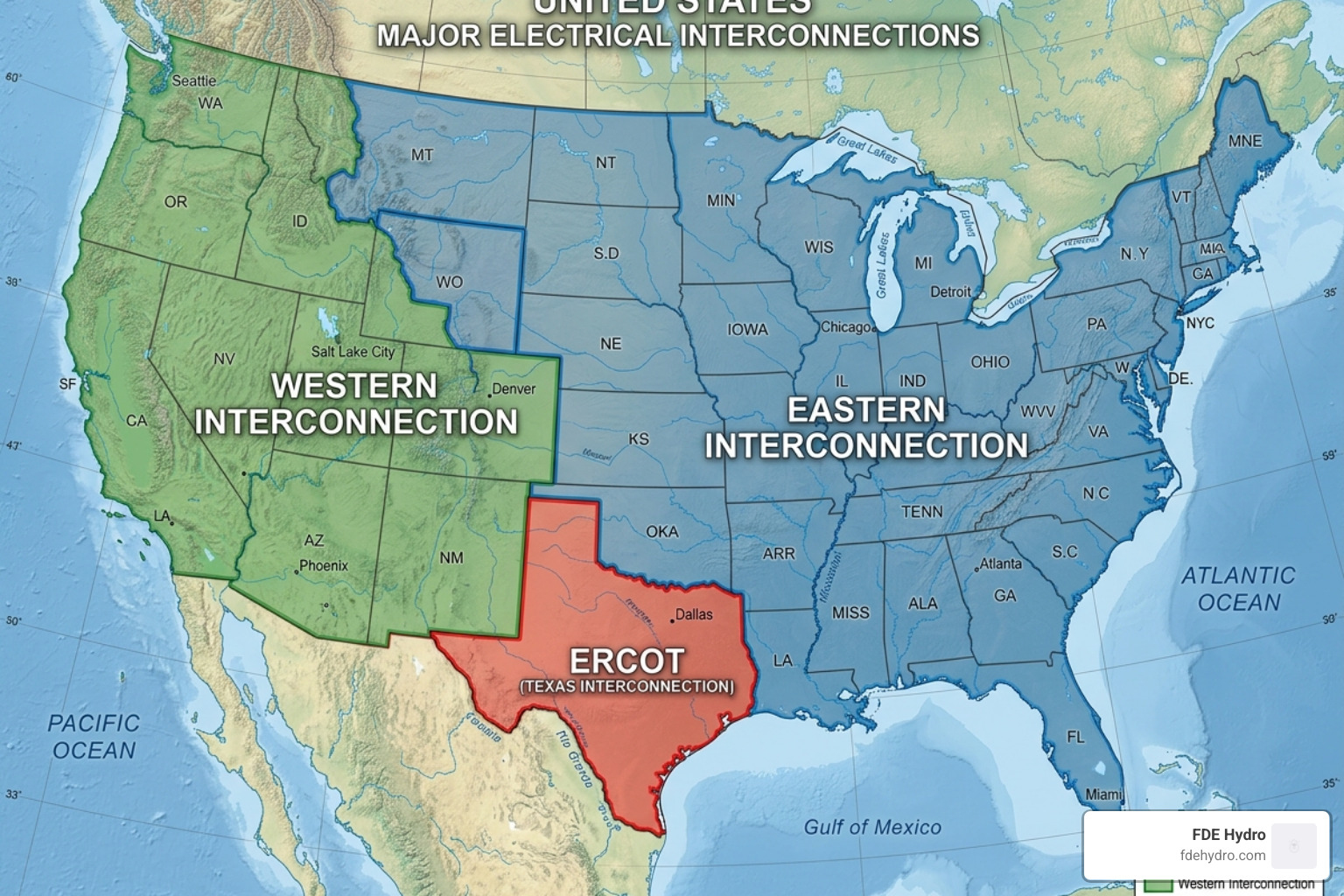
When we talk about the American power system, we aren’t talking about one single, giant web. Instead, the U.S. grid is divided into three major “interconnections.” These are essentially massive, independent islands of electricity that operate in sync within their own borders.
- The Eastern Interconnection: This is the heavyweight champion of the group. It covers everything east of the Rocky Mountains, stretching from the foot of the Rockies all the way to the Atlantic coast (excluding most of Texas).
- The Western Interconnection: This spans from the Pacific Ocean to the edge of the Rockies. It’s a truly international electrical grid example, linking parts of Western Canada and even a small slice of Mexico to the Western U.S.
- The Texas Interconnection (ERCOT): Texas famously likes to do things its own way, and its power grid is no exception. Most of the state operates on its own self-contained system.
To keep these massive machines running without a hitch, the North American Electric Reliability Corporation (NERC) steps in. NERC is a non-profit regulatory authority that oversees six regional reliability entities. Their job is to reduce risks to grid security and ensure that whether you are in New York City or a small town in Kansas, the lights stay on. You can find more technical details on these regions in The Electric Power Grid: Text-Only Version.
Understanding the Texas Electrical Grid Example (ERCOT)
The Electric Reliability Council of Texas (ERCOT) is a fascinating electrical grid example because of its isolation. By keeping its grid mostly within state lines, Texas avoids much of the federal jurisdiction from FERC (the Federal Energy Regulatory Commission).
ERCOT manages roughly 90% of the Texas electric load. It operates what we call a “nodal market,” which features over 9,000 different settlement points. This allows for incredibly precise pricing based on exactly where power is being generated and consumed. One unique feature of the Texas grid is its “energy-only” market design. Instead of paying power plants just to exist (capacity payments), it relies on “scarcity pricing.” When demand gets dangerously high, prices can skyrocket to $5,000 per MWh, which is meant to encourage more generation to come online. You can dive deeper into this unique setup at ERCOT and the Texas Electrical Grid: How the Lone Star Grid Operates.
A Global Electrical Grid Example: The European ENTSO-E
Across the pond, we find another massive electrical grid example: the Synchronous Grid of Continental Europe, managed by ENTSO-E. This is an engineering marvel that keeps dozens of countries perfectly synchronized at a frequency of 50 Hz.
With a staggering 667 GW of generation capacity, it facilitates massive cross-border energy trading. This interconnectedness allows a wind farm in the North Sea to help power a home in the Alps. The European Commission works hard to ensure these grids stay integrated to meet climate goals, as detailed in their overview of European grids.
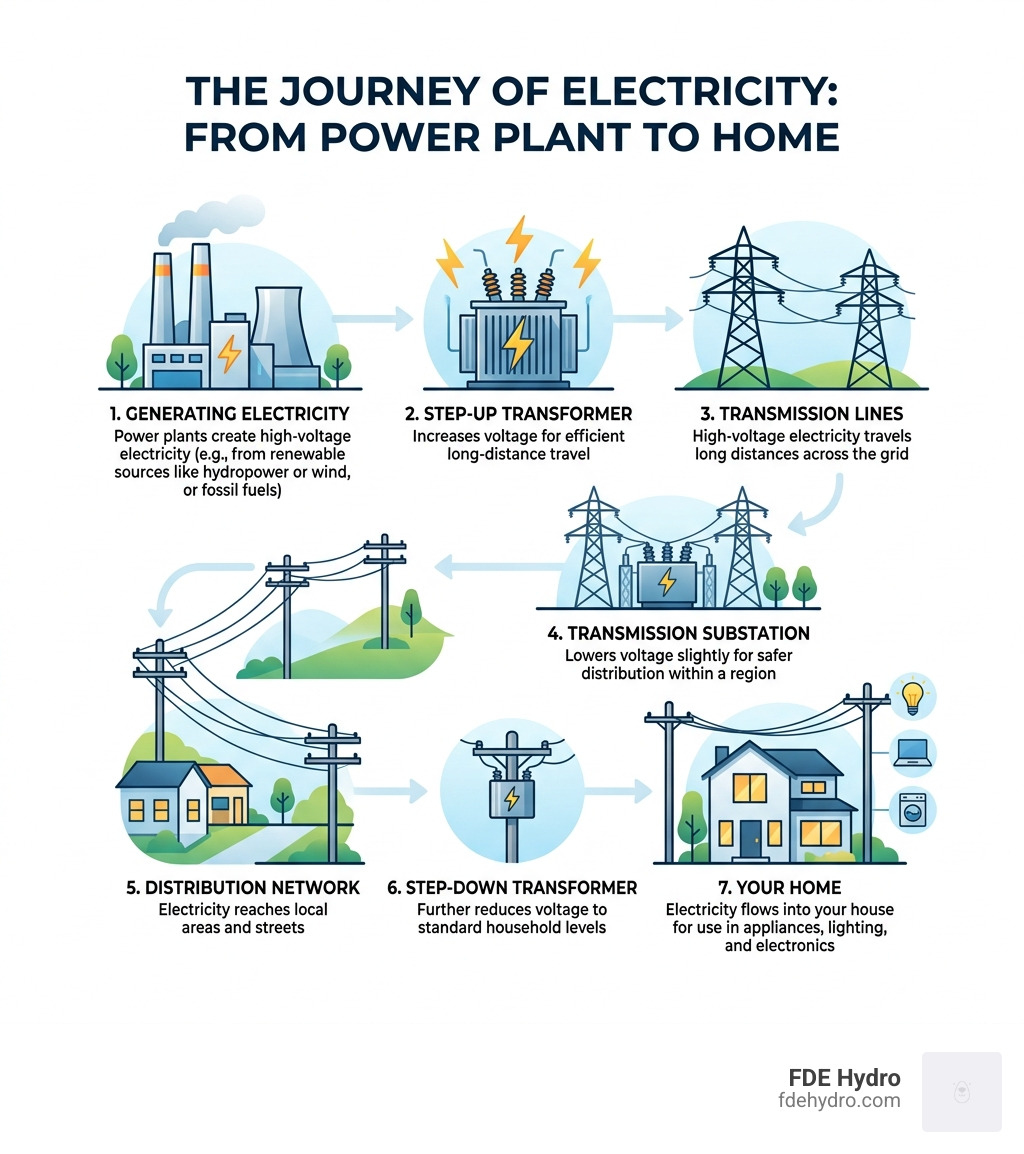
From Power Plant to Plug: The Journey of an Electron
Have you ever wondered how a spinning turbine at a dam becomes the energy that charges your phone? It’s a journey of several stages, each requiring specific infrastructure.
- Generation: This is where it starts. Whether it’s a nuclear plant, a wind farm, or one of our modular hydropower installations, energy is converted into electricity.
- Step-up Transformers: Generators usually produce electricity at lower voltages. To send it long distances, we use transformers to “step up” the voltage to hundreds of thousands of volts.
- Transmission Lines: These are the tall steel towers you see along highways. They carry high-voltage power over long distances with minimal loss.
- Subtransmission and Distribution: Once the power nears a city like Lawrence or New York, it enters a substation. Here, it’s stepped down to lower voltages for “primary distribution” along street lines, and finally “secondary distribution” (the 120V or 240V in your walls).
For a practical look at how this connects to your own property, check out our guide on how-to-power-start-your-home-connecting-to-the-grid. You can also find a great visual breakdown from the Union of Concerned Scientists.
Why High-Voltage AC Dominates the Electrical Grid Example
Why do we use such high voltages? It all comes down to physics. When you transmit electricity, some energy is lost as heat due to the resistance of the wires. By upping the voltage, we can lower the current. Since energy loss is proportional to the square of the current, doubling the voltage doesn’t just halve the loss—it cuts it by a factor of four!
This was the heart of the “War of Currents” in the late 1800s. Thomas Edison championed Direct Current (DC), but Nikola Tesla and George Westinghouse proved that Alternating Current (AC) was superior for the grid because AC can be easily stepped up or down using transformers. Without transformers, we couldn’t have a modern electrical grid example that serves millions of people from distant power sources.
Radial vs. Network Distribution Systems
Not all local grids are built the same. Depending on where you live, your electricity might arrive via a “radial” or “network” system.
| Feature |
Radial System |
Network System |
| Structure |
Like branches on a tree |
Like a spiderweb |
| Redundancy |
Low (Single path) |
High (Multiple paths) |
| Typical Use |
Rural areas / Small towns |
Dense cities (NYC, California) |
| Reliability |
If the branch breaks, power goes out |
If one line fails, power reroutes |
Balancing the Load: How Authorities Prevent Grid Failure
Electricity is a “just-in-time” product. Because we can’t yet store vast amounts of it cheaply, supply must match demand perfectly every second of the day. If people in California all turn on their AC at once, a power plant somewhere else must ramp up its output instantly.
This balancing act is managed by Balancing Authorities. A prime electrical grid example is PJM Interconnection. They act like the “air traffic controllers” of the grid, monitoring 88,000 miles of transmission lines and 183,000 MW of generating capacity. They use sophisticated computer models to forecast demand and dispatch the lowest-cost power plants first. You can read more about their balancing act in the PJM Power in Balance Fact Sheet.
Common Failure Scenarios and Mitigation
Despite our best efforts, things can go wrong.
- Brownouts: A intentional drop in voltage to prevent a full crash. Your lights might dim, but the system stays alive.
- Blackouts: A total loss of power. These can be localized or “cascading,” where one failure triggers a domino effect across the grid.
- Load Shedding: When demand exceeds supply, authorities may purposefully cut power to certain areas to save the rest of the grid.
In the absolute worst-case scenario, we use a black start procedure. This involves using small, self-starting generators (like some hydro plants) to “wake up” the larger power plants and restart the entire system from scratch.
Modernizing the Network: Smart Grids and Renewable Integration
The grid we have today was designed for big, steady power plants like coal and nuclear. But the future is about “distributed” and “intermittent” energy—like wind and solar. This is where Smart Grids come in.
A smart grid uses digital technology and two-way communication to adjust to changes in real-time. For example, a smart meter can tell your dishwasher to wait until 2:00 AM to run when electricity is cheapest and wind power is plentiful.
At FDE Hydro, we believe hydropower is the “guardian of the grid” in this new era. Unlike wind or solar, hydro is “dispatchable”—we can turn it on or off as needed to balance out the fluctuations of other renewables. Our modular precast concrete technology makes it faster and more affordable to build these stabilizing forces in North America, Brazil, and Europe. Learn more about why hydropower is the guardian of the grid.
The Rise of the Microgrid Example
One of the most exciting trends is the move toward the microgrid. A microgrid is a localized group of electricity sources and loads that normally operates connected to the traditional grid but can “island” itself and operate autonomously during an emergency.
If a storm knocks out the main grid in a city like Lawrence, a microgrid powered by local solar and hydro could keep the hospital and grocery stores running. This adds a massive layer of resilience to our infrastructure. If you’re curious about the technical side, we have a deep dive on what is a microgrid.
Frequently Asked Questions about Electrical Grid Examples
What are the three major interconnections in the United States?
The U.S. grid is split into the Eastern Interconnection, the Western Interconnection, and the Texas Interconnection (ERCOT). While they are linked by a few small ties, they mostly operate as independent electrical islands.
Why is electricity transmitted at such high voltages?
Transmitting at high voltage (up to 765,000 volts!) reduces the amount of energy lost as heat. It allows us to move massive amounts of power from distant generation sites to populated cities with very little waste.
What is the difference between a blackout and a brownout?
A blackout is a complete loss of power. A brownout is a partial drop in voltage—your electronics might act strangely and your lights will dim, but you still have some electricity. Brownouts are often used by utilities to reduce load during an emergency.
Conclusion
The grid is evolving. What started as a few thousand isolated “electric islands” over a century ago has become a continent-spanning machine that is now shifting toward a cleaner, smarter future. From the massive synchronous networks of Europe to the independent spirit of the Texas ERCOT system, every electrical grid example shows us that reliability requires constant innovation.
As we move toward decarbonization, the challenge will be maintaining that reliability while integrating more renewable sources. At FDE Hydro, we are proud to be part of that solution, providing the modular infrastructure needed to make hydropower a cornerstone of the modern grid. Whether it’s through smart meters, microgrids, or advanced “black start” capabilities, the goal remains the same: keeping the world powered, one electron at a time.
For more deep dives into how we keep the lights on, explore more power grid articles on our blog.
by Adaptify Support | Apr 13, 2026 | Power Grid Articles
Unplugging the Mystery: Understanding Electrical Energy Distribution
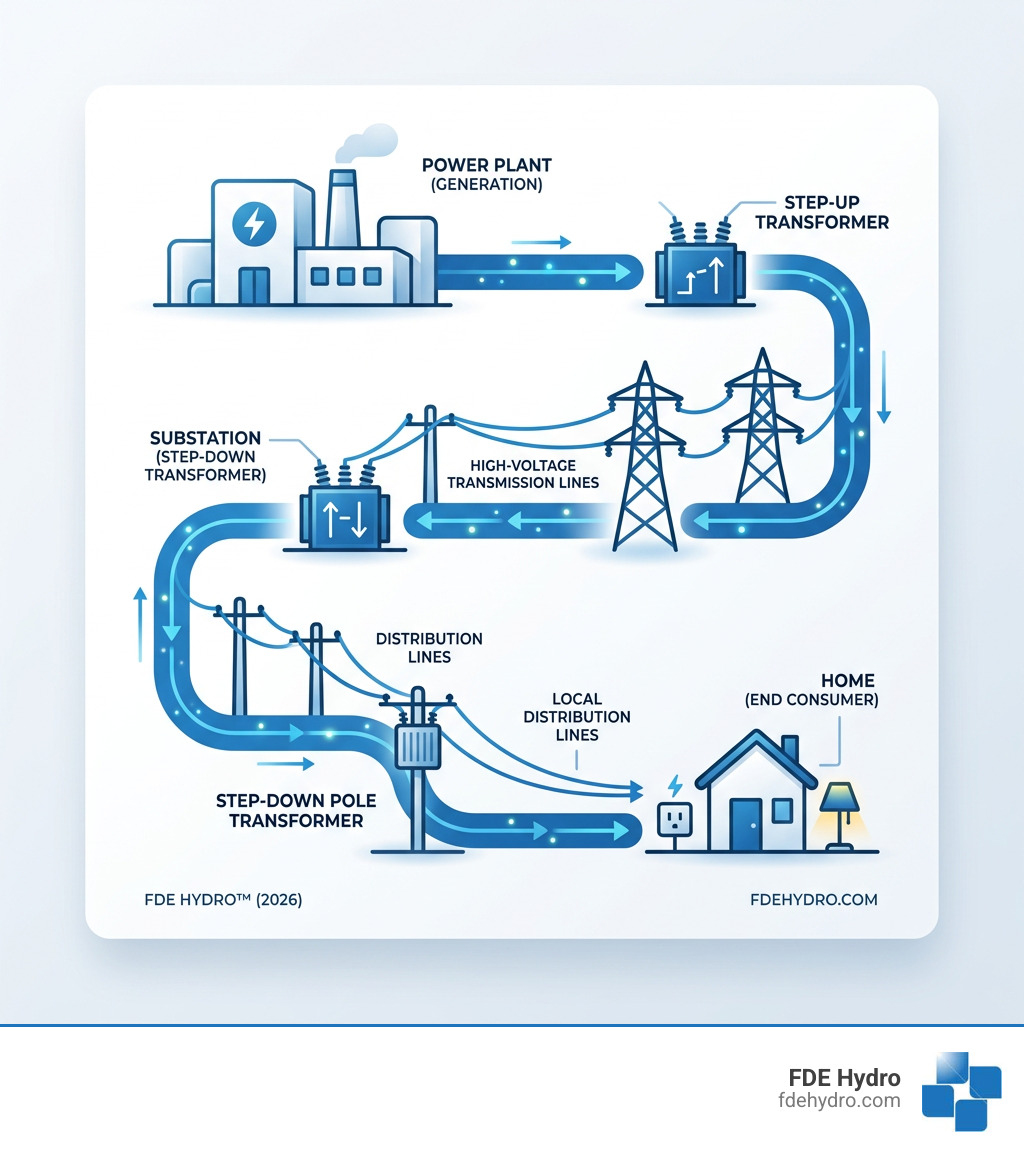
The electrical energy distribution system is the final step in delivering electricity to homes and businesses. It’s the crucial link that takes high-voltage power from transmission lines and makes it safe and usable for everyday needs.
Here’s a quick look at what electrical energy distribution means:
- Final Stage: It’s the last part of electricity delivery, connecting the grid to individual consumers.
- Voltage Reduction: It lowers electricity from high transmission voltages to safe levels for use.
- Local Networks: It includes substations, transformers, and local power lines running through neighborhoods.
- Everyday Power: It’s how electricity reaches your outlets and appliances.
Think of the electrical grid as a vast highway system for power. Electricity begins its journey at power plants, travels across country on giant transmission lines, and then reaches your local community. But it doesn’t just flow directly into your home. It needs a special network to transform that high-powered energy into the right voltage for your devices. This is where electrical distribution comes in. It’s a complex and vital system that keeps our modern world running. Without it, the electricity we generate would never safely reach us.
As Bill French Sr., Founder and CEO of FDE Hydro™, my five-decade career in heavy civil construction has often intersected with the foundational elements of our energy infrastructure, including the critical stage of electrical energy distribution. From constructing modular precast bridges to defining strategic plans for next-generation hydropower, my work focuses on robust, sustainable solutions that power communities efficiently.
Electrical energy distribution word roundup:
What is Electrical Energy Distribution?
When we talk about How Power Grids Work, we are looking at a massive, interconnected machine. In fact, the North American electric power system is often described as the largest and most complex machine ever built by humanity. Within this machine, electrical energy distribution represents the “last mile.” While transmission moves bulk power over long distances at incredibly high voltages, distribution is the local wiring that weaves through our streets in New York City, Lawrence, and across California.
According to the Electric Power Distribution Handbook, this stage is defined by its proximity to the end-user. Approximately 60 percent of all energy utilized in the United States passes through this interconnected system. The process involves taking electricity from the transmission grid—which usually operates at 69 kV or higher—and stepping it down to medium and then low voltages. This ensures that the 120/240V required by your toaster or the 480V required by a local factory is delivered reliably and safely.
The unsung hero of this entire process is the transformer. Without it, we would be stuck in the 1880s, unable to send power more than a mile or two. Transformers work on the principle of electromagnetic induction to change voltage levels. In the distribution phase, we primarily use “step-down” transformers.
You’ve likely seen these units—they are the gray “trash cans” mounted on utility poles or the green metal boxes sitting on concrete pads in suburban neighborhoods. Their job is to take the “primary” distribution voltage (often between 4 kV and 35 kV) and drop it down to the “utilization” voltage of 120/240V for residential use. In the UK and parts of Europe where we operate, these transformers are often sized to provide 1 to 2 kW per household, ensuring the local kettle and heater can run simultaneously without a hitch.
Distribution Substations: The Transition Point
The distribution substation is the handshake between the high-voltage transmission world and your local neighborhood. Think of it as a massive sorting facility. Here, high-voltage lines enter the station and connect to busbars—thick conductors that act as a common connection point.
At the substation, several key things happen:
- Voltage Reduction: Huge transformers drop the voltage from transmission levels (like 115 kV or 230 kV) down to primary distribution levels.
- Circuit Protection: High-voltage circuit breakers and relays stand ready to “trip” and cut power if a fault, like a lightning strike, occurs.
- Voltage Regulation: Because electricity loses pressure (voltage) as it travels down long wires, substations use regulators to keep the voltage steady for the customers furthest away.
- Monitoring: Modern substations use sophisticated equipment to send data back to a central control room, allowing utilities to see exactly how much power is being used in real-time.
The Anatomy of the Distribution System: Primary vs. Secondary
To understand the grid, we have to look at its two main layers. Primary Distribution Voltage Levels typically range from 2.4 kV to 35 kV. This is the “medium voltage” that travels from the substation to your street. The secondary distribution system is the final stretch—the wires that run from the local transformer directly into your meter box.
| Feature |
Primary Distribution |
Secondary Distribution |
| Voltage Range |
2 kV to 35 kV |
120 V to 600 V |
| Users |
Large industrial/commercial |
Residential/Small business |
| Infrastructure |
Large poles, heavy insulators |
Service drops, local transformers |
| Purpose |
Moving power through towns |
Delivering power to outlets |
In North America, the secondary standard is almost universally 120/240V split-phase. This allows a home to have 120V for standard lights and outlets, while providing 240V for heavy-duty appliances like clothes dryers or electric vehicle chargers.
Network Configurations: Radial, Loop, and Network
How we connect these wires matters for reliability. There are three main ways engineers design these layouts:
- Radial Systems: This is the simplest and most common setup, especially in suburban and rural areas. Power flows from the substation along a single path to the customers. It’s cost-effective, but if a tree falls on the main line, everyone “downstream” loses power.
- Loop Systems: Imagine a circle. Power can reach a customer from two different directions. If there’s a break in the line, switches can be flipped to “backfeed” the power from the other side, minimizing the duration of the outage.
- Network Systems: This is the gold standard for reliability, used in high-density areas like downtown New York City. Every customer is connected to multiple power sources simultaneously. If one transformer or line fails, the others pick up the slack instantly without the lights even flickering.
Research into Microgenetic multiobjective reconfiguration algorithms shows that utilities are now using AI and advanced math to constantly “reconfigure” these networks to reduce power loss and improve stability.
Urban vs. Rural Distribution Infrastructure
The geography of where we live dictates what the grid looks like. In urban centers, the electrical energy distribution system is largely invisible, tucked away in underground conduits to protect it from the elements and save space. This is expensive to build but very reliable.
In rural areas, the challenges are different. We have to move power over vast distances to reach just a few homes. To save on costs, rural systems often use higher primary voltages (like 12.47 kV or 34.5 kV) to reduce energy loss over long wires. In very remote areas, you might even see a Single-Wire Earth Return (SWER) system, which uses one wire and the literal ground to complete the circuit—a clever, though limited, way to bring power to the most isolated farms.
Historical Evolution: From the War of Currents to Modern Infrastructure
We didn’t always have a unified grid. In the late 1800s, the “War of Currents” pitted Thomas Edison against George Westinghouse. Edison’s Pearl Street Station, opened in 1882, provided 100V Direct Current (DC). It was safe, but DC couldn’t be easily transformed to higher voltages, meaning power plants had to be within 1.5 miles of the customer.
Westinghouse, utilizing the Notes on the Jablochkoff System and the transformer, championed Alternating Current (AC). AC could be stepped up to thousands of volts for efficient long-distance travel and then stepped down for use. Westinghouse’s “universal system” eventually won out, allowing us to build large power plants—like the massive hydropower facilities FDE Hydro™ supports—far away from cities and still deliver power efficiently.
Regional Variations in Electrical Energy Distribution
Even though AC won the war, the world didn’t agree on the details. This led to the regional variations we see today. North America settled on 60Hz and 120V for residential use. Most of Europe and Brazil use 50Hz and 230V.
One of the most fascinating cases is Japan. Because early power companies in the 1890s imported equipment from different places (German 50Hz gear for Tokyo and US 60Hz gear for Osaka), the country remains split. Japan’s incompatible power grids are still divided by a frequency line today. During the 2011 earthquake, this made it difficult to share power between the two halves of the country, requiring massive HVDC converter stations to bridge the gap.
Modern Challenges and the Future of Electrical Energy Distribution
Today, the grid is facing its biggest transformation since the time of Westinghouse. We are moving from a “one-way street” (power plant to consumer) to a “two-way highway.” This is driven by distributed energy resources (DERs) like rooftop solar panels and local wind farms.
One major trend we are seeing is the rise of the microgrid. A microgrid is a local energy system that can operate while connected to the main grid or “island” itself during a blackout. This is becoming essential for hospitals and military bases.
Furthermore, the surge in Electric Vehicles (EVs) is putting a new kind of pressure on our local wires. While a U.S. Department of Energy report on EV future suggests that our overall power generation is sufficient, the “coincident peak”—everyone plugging in their cars at 6:00 PM—could strain local transformers. We need smart charging and grid upgrades to handle this new load.
Smart Grids and SCADA Systems
To manage this complexity, we are building “Smart Grids.” This involves integrating microgrid-technology and digital sensors throughout the distribution network.
A key component is SCADA (Supervisory Control and Data Acquisition). These systems allow utility operators to monitor thousands of data points every second. If a tree branch touches a wire, an “automated recloser” can detect the fault, briefly disconnect the power to let the branch fall, and then automatically restore power in seconds. This prevents a temporary flicker from becoming a multi-hour blackout.
Reliability, Redundancy, and Environmental Impact
As we modernize, we are also focusing on the Environmental Impacts of Distributed Generation. Centralized power plants often lose about 5% to 6% of their energy just in transmission and distribution. By generating power closer to where it’s used—through small-scale hydropower or solar—we can significantly reduce these “line losses.”
However, we must balance this with land use and infrastructure needs. At FDE Hydro™, we believe that retrofitting existing water control systems with our modular technology is a prime example of how to increase “green” generation without the massive environmental footprint of a new, large-scale dam. This kind of distributed generation provides reliability and redundancy, making the entire grid more resilient to storms and physical threats.
Frequently Asked Questions about Electrical Distribution
What is the difference between transmission and distribution?
Transmission is the “bulk” movement of electricity at very high voltages (115 kV to 765 kV) over long distances from power plants to substations. Distribution is the “local” delivery of that power at lower voltages (under 35 kV) from substations to individual homes and businesses.
Why do different countries use different voltages and frequencies?
It largely comes down to history and which equipment was available when those countries first electrified. Europe adopted higher voltages (230V) because it was more efficient for their denser cities, while North America stayed with 120V for safety reasons during the early development of the grid.
How do electric vehicles affect the local distribution grid?
EVs don’t necessarily require more power plants, but they do require stronger local infrastructure. If many neighbors charge high-powered EVs at the same time, it can overheat the local neighborhood transformer. Utilities are solving this with “smart charging” programs that encourage charging during off-peak hours (like late at night).
Conclusion
The electrical energy distribution system is a marvel of engineering that we often take for granted. From the historical battles of the War of Currents to the high-tech SCADA systems of today, this network is the lifeblood of our modern society. As we look toward a future filled with EVs, microgrids, and renewable energy, the need for a resilient and modernized grid has never been greater.
At FDE Hydro™, we are proud to play a role in this energy evolution. Our innovative, patented modular precast concrete technology—the “French Dam”—is designed to make building and retrofitting hydroelectric systems faster and more cost-effective. By supporting renewable generation that can feed directly into these local distribution networks, we help ensure a stable, sustainable, and powerful future for communities across North America, Brazil, and Europe.
Curious to learn more about how we are hardening the grid for the next generation? Check out more power grid articles on our blog.
by Adaptify Support | Mar 25, 2026 | Power Grid Articles
Why Power Start Matters for Connecting Your Home to the Grid
Power start is the process of initializing electrical service — getting your home reliably connected to the grid and capable of running high-demand appliances from the moment power flows.
Here’s a quick overview of what that involves:
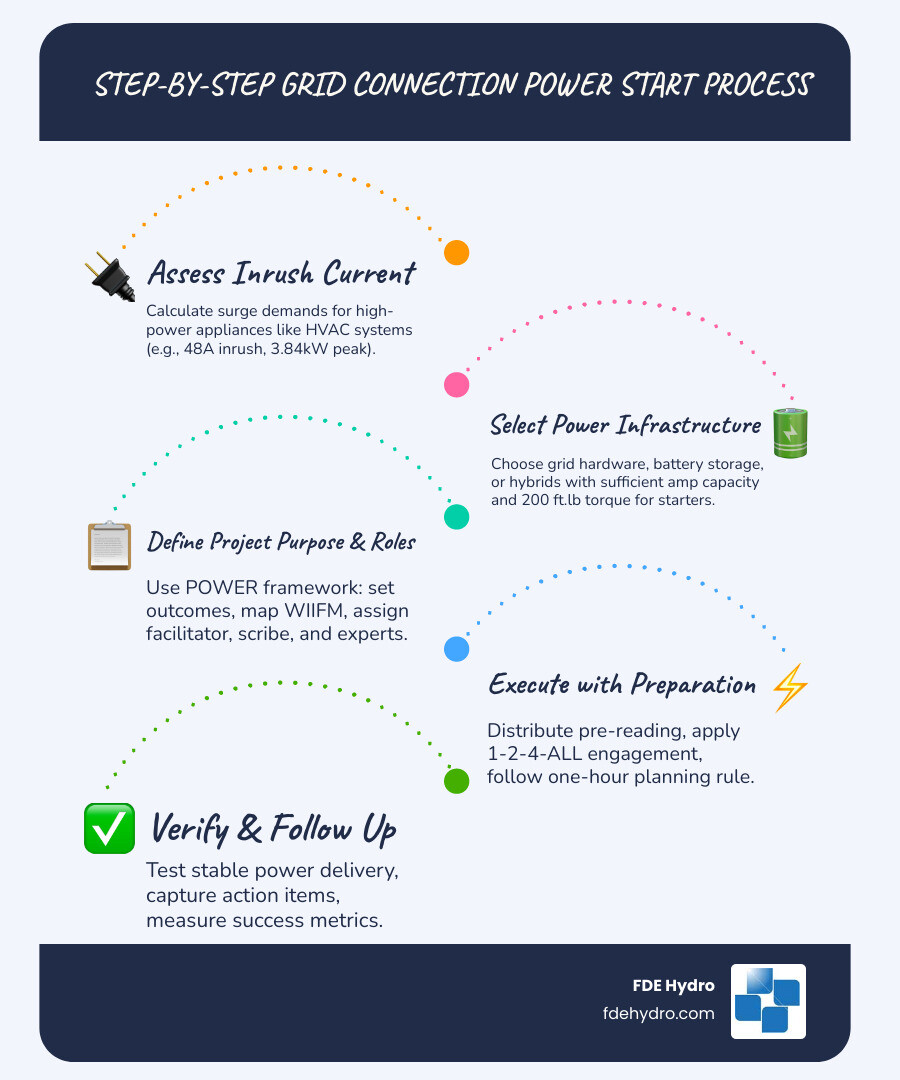
- Confirm your utility service requirements — voltage, amperage, and inrush capacity for appliances like HVACs
- Choose the right power infrastructure — battery storage, grid connection hardware, or hybrid systems
- Plan your project clearly — define purpose, outcomes, and roles before work begins
- Execute and verify — connect, test, and confirm stable power delivery
Most homeowners and project managers underestimate what a true power start requires. It’s not just flipping a switch. High-inrush appliances — like HVAC systems — demand a surge of current at startup that can overwhelm under-spec’d systems. A 7-person planning meeting that goes off the rails can waste $900 in labor time before a single wire is run. Poor preparation compounds every problem downstream.
Getting your power start right means aligning the technical side (amps, torque, storage capacity) with the planning side (clear goals, defined roles, stakeholder buy-in).
I’m Bill French, Sr., Founder and CEO of FDE Hydro™, and after five decades leading large-scale civil construction and hydropower development projects, I’ve seen how a well-executed power start — whether for a modular hydropower facility or a grid-connected home — determines the success of everything that follows. In this guide, I’ll walk you through both the technical and strategic frameworks you need to get it right.
Power start terms to remember:
Understanding the Technical Power Start Capability
When we talk about a power start in the context of home energy and grid connectivity, we are often referring to the system’s ability to handle “inrush current.” This is the sudden surge of electricity required to start heavy motors. If your system lacks this capability, your lights might flicker, or worse, your expensive HVAC system could sustain damage over time due to poor power quality.

Modern battery systems have revolutionized this. For instance, high-performance batteries now offer a 48 Amp power start capability. This means a single battery unit can provide the “kick” needed to get a power-hungry appliance running without relying on the grid. In a modular architecture, you can scale this from 5 kWh up to 80 kWh, providing roughly 3.84 kW of power for every 5 kWh of capacity. This scalability is vital for homes in places like New York or California, where energy independence and grid stability are top priorities.
The technical requirements for a power start aren’t limited to home batteries; they mirror the physics we see in mechanical starters. According to Starter Basics and Torque Requirements, the amount of torque required is dictated by the resistance of the system. For high-compression engines (over 12:1), a 200 ft.lb torque starter is recommended. Just as a racing engine needs massive torque to overcome internal resistance, your home electrical system needs high amperage to overcome the “rotational resistance” of an air conditioner compressor.
At FDE Hydro, we apply these same principles of high-capacity initialization to Hydroelectric Power Generation. Whether you are starting a home HVAC or a turbine, the physics of power delivery remain the same: you need enough initial force to move the needle.
The POWER Start Framework for Project Planning
While the technical side handles the electrons, the strategic side handles the people. In my experience, a project only succeeds if the initial “meeting of the minds” is as high-torque as the equipment. This is where the POWER Start technique comes in.
Originally developed by the Agile Coaching Institute, the POWER Start is a framework designed to eliminate the “vague meeting” syndrome. We’ve all been there: seven people sitting in a room for an hour with no clear goal. If those seven people average $100/hour in labor costs, that’s a $900 meeting (including prep and overhead) that yielded nothing.
The acronym breaks down as follows:
- Purpose: Why are we here?
- Outcomes: What specific things will we leave with?
- WIIFM (What’s In It For Me): Why should the stakeholders care?
- Engagement: How will we keep everyone involved?
- Roles: Who is doing what?
By investing about one hour of preparation for every hour of meeting time, you significantly boost Hydroelectric Dam Efficiency and project velocity. It turns a “talk shop” into a high-output engine.
Defining the Purpose of Your Power Start
The “Purpose” in a POWER Start should be a concise statement in plain language. Avoid corporate jargon like “aligning synergies.” Instead, try: “To decide on the specific battery capacity and grid connection point for the Lawrence project so we can order parts by Friday.”
A clear purpose acts as a north star. If the conversation drifts toward unrelated topics, anyone in the room can point back to the purpose statement and get the project back on track. This alignment is the first step in any successful utility service connection.
Roles and Engagement in a Power Start Project
Every participant in a power start meeting should have a defined role. This isn’t just about who is the boss; it’s about function. Common roles include:
- Facilitator: Keeps the meeting moving and follows the framework.
- Scribe: Captures decisions and action items.
- Subject Matter Experts (SMEs): Provide the technical “torque” regarding electrical codes or battery specs.
Engagement is the “fuel” of the meeting. To avoid the “strong personality” trap where one person dominates, use mapping techniques to ensure everyone’s “What’s In It For Me” (WIIFM) is addressed. If a stakeholder knows exactly how this grid connection benefits their specific department or budget, they are much more likely to contribute constructively.
Step-by-Step Guide to Implementing the Framework
Implementing a power start for your home or project isn’t a suggestion; it’s a requirement for efficiency. Whether you’re in Kansas or Europe, the steps remain remarkably consistent.
Phase 1: Pre-Meeting Preparation
The most important rule is the One-Hour Rule: for every hour of the meeting, spend one hour preparing. Use this time to:
- Draft Outcome Bulletpoints: Don’t just list “topics.” List “decisions to be made.”
- Prepare Pre-reading: Send out technical specs or Hydro Electric Dams data 24 hours in advance.
- Plan Engagement: Decide if you will use the 1-2-4-ALL technique (reflecting alone, then in pairs, then fours, then the whole group) to generate ideas quickly.
| Feature |
Traditional Agenda |
POWER Start Framework |
| Focus |
List of topics to discuss |
Specific outcomes to achieve |
| Engagement |
Passive listening |
Active participation (e.g., 1-2-4-ALL) |
| Roles |
Often undefined |
Clear roles (Facilitator, Scribe, SME) |
| Value |
“Why am I here?” |
WIIFM is clearly mapped |
Phase 2: During the Meeting
When the meeting begins, display your purpose and outcomes visually. This could be on a physical whiteboard or a shared digital screen for hybrid teams in New York City and Brazil.
Use Dot Voting to quickly find a consensus on hardware choices. For example, if you’re choosing between different battery configurations, have everyone “vote” with dots on the options that best meet the project’s amp requirements. To generate a high volume of ideas for troubleshooting a connection, try 25/10 Crowdsourcing, where participants rapidly rate ideas to find the top 10% most viable solutions.
Phase 3: Post-Meeting Follow-up
A power start doesn’t end when the meeting does. You must capture commitments immediately. Who is calling the utility company? Who is verifying the inrush current of the HVAC?
For hybrid or virtual meetings, use digital tools to track these success metrics. Ensure that the “Roles” defined earlier carry over into the execution phase. If the meeting was the “starter motor,” the follow-up is the “alternator” that keeps the project’s battery charged.
Avoiding Pitfalls in Utility Service Connections
The biggest pitfall in any power start is a vague purpose. If you don’t know exactly what “success” looks like, you will waste time and money. As mentioned earlier, a poorly managed 7-person meeting can cost $900 in lost productivity. Over the course of a large-scale project, these “small” wastes can balloon into tens of thousands of dollars.
Another common issue is allowing “strong personalities” to derail the technical requirements. Just because someone talks the loudest doesn’t mean their plan accounts for the 48 Amp inrush current needed for the home’s cooling system. By using the Hydroelectric Power Solutions Guide, you can keep the focus on data-driven decisions rather than opinions.
Frequently Asked Questions about Power Start
Who developed the POWER Start technique?
The POWER Start technique was originally developed by the Agile Coaching Institute. It grew out of a need for better facilitation in complex, fast-moving environments (like software development and renewable energy). It is now taught as a core framework for keeping meetings focused and delivering high-quality outcomes.
How does POWER Start differ from a standard agenda?
A standard agenda is usually just a list of things to talk about. A POWER Start is a commitment to what will be done. It focuses heavily on engagement and “What’s In It For Me” (WIIFM), ensuring that every person in the room is there for a reason and understands the value of the project.
You don’t need fancy software. A simple downloadable template or a visual board (like a whiteboard) is often most effective. The “tools” are really the techniques: check-in questions to gauge the room’s energy, visual agendas to keep everyone on track, and facilitation methods like dot voting to reach a consensus quickly.
Conclusion
At FDE Hydro, we believe that the way you start a project dictates how you finish it. Whether you are connecting a single home to the grid or building a massive modular dam, a power start ensures you have the technical capacity and the strategic clarity to succeed.
By combining high-amp hardware with the POWER planning framework, you reduce waste, protect your appliances, and ensure a reliable flow of Hydropower or grid energy for years to come. Don’t just flip a switch — start with power.
by Adaptify Support | Mar 4, 2026 | Power Grid Articles
Understanding the Black Start Process: Your Grid’s Emergency Restart System
Black start is the process of restoring an electric power grid to operation without relying on external electrical power after a complete or partial shutdown. When a widespread blackout occurs, power plants need electricity to restart themselves—creating what engineers call the “power to make power” paradox. Black start-capable units solve this problem by using on-site power sources like batteries or diesel generators to restart independently, then systematically bringing other plants back online until the entire grid is restored.
How Black Start Works:
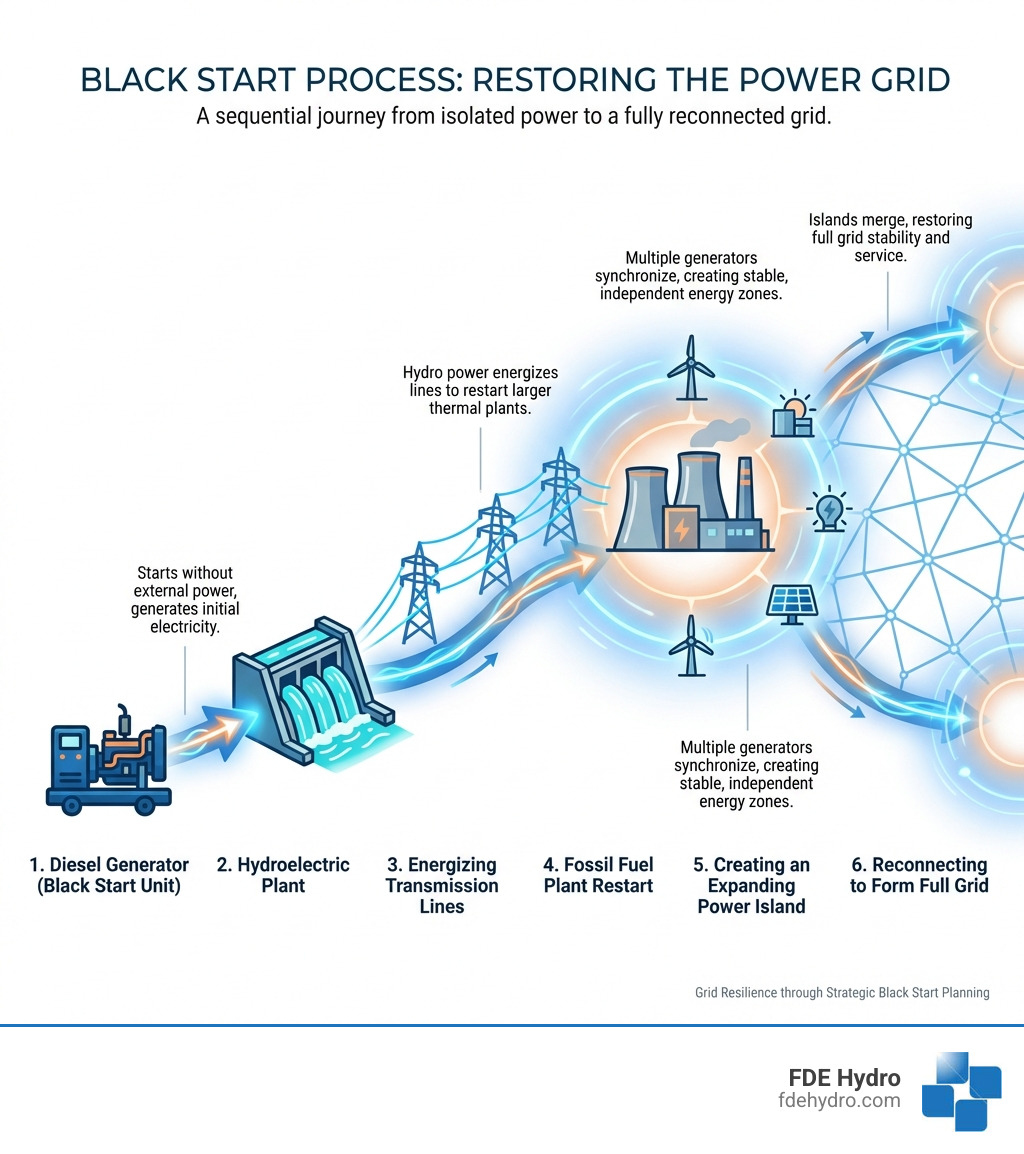
- Activation: A black start unit (BSU) uses on-site batteries or generators to restart without grid power
- Cranking Path: The BSU energizes transmission lines to reach larger power plants
- Power Islands: Multiple generators create stable “islands” of electricity
- Synchronization: Islands are carefully merged by matching frequency and phase
- Load Restoration: Customers are gradually reconnected to avoid overwhelming the system
On November 9, 1965, over 30 million people in the northeastern United States and parts of Ontario experienced one of history’s most widespread blackouts. A single misconfigured relay tripped a breaker on a key transmission line, cascading into a complete grid failure. Restoring power required a carefully choreographed black start procedure—a high-stakes process where one misstep could delay recovery by days or even weeks.
This isn’t just a technical curiosity. The 2021 Texas winter storms brought the ERCOT grid within minutes of a complete collapse that could have taken weeks to restore. Nine out of thirteen primary black start generators weren’t operating consistently during that crisis, exposing critical vulnerabilities in our energy infrastructure.
As Founder and CEO of FDE Hydro™, I’ve spent five decades in heavy civil construction and the past decade focused on next-generation hydropower solutions, including serving on the Department of Energy’s Hydro Power Vision Technology Task Force where black start capabilities were a key consideration. Understanding how black start systems work and evolve is essential for anyone involved in energy infrastructure development.
What is a Black Start and Why is it Crucial for Grid Restoration?
Imagine waking up to a world completely devoid of electricity. No lights, no internet, no running water, no heating or air conditioning, and eventually, no food as supply chains grind to a halt. This isn’t a scene from a dystopian movie; it’s the potential reality of a widespread, long-term power outage, or “blackout.” A black start is our grid’s ultimate insurance policy against such a catastrophe, the carefully planned process to bring an entire electrical system back from the brink.
A black start is the ability of generation to restart parts of the power system to recover from a blackout. It’s not merely about flipping a switch; it’s a complex, multi-stage operation. When a power grid collapses, power plants themselves often lose the electricity they need to operate their internal systems—pumps, fans, control systems, and even the excitation current needed to generate power. This “power to make power” paradox is why specialized black start units are so crucial.
The importance of black start capabilities cannot be overstated. Our modern civilization is fundamentally built upon the electrical grid. As one source states, “eight out of ten people would not survive a long-term loss of electricity.” Without electricity, critical infrastructure like hospitals, communication networks, and water treatment facilities would quickly go offline. The economic impact would be staggering, and public safety would be severely compromised.
Historical events underscore this criticality. The 1965 Northeast Blackout, which affected millions in the US and Canada, served as a stark reminder of our dependence on the grid and the need for robust restoration plans. More recently, the 2021 winter storms in Texas brought the ERCOT grid perilously close to a complete collapse. During that crisis, nine out of the thirteen primary black start generators were not operating consistently, highlighting vulnerabilities and the dire consequences if a full black start had been required.
The resilience of our Clean Energy Infrastructure relies heavily on effective black start strategies. Furthermore, the interdependencies between energy sectors, particularly electricity and natural gas, play a significant role. Many power plants rely on natural gas, and natural gas infrastructure often requires electricity to operate compressors and other equipment. This creates a challenging loop that must be carefully managed during a black start operation to ensure fuel supply to power plants. Robust black start capabilities are essential for maintaining the safe, reliable, and resilient operation of our electric power systems.
The Complete Black Start Process: From Darkness to Full Power
Bringing a power grid back to life after a total shutdown is one of the most high-stakes operations imaginable. It’s a carefully choreographed dance involving specialized equipment, highly trained personnel, and detailed procedures. This complex process unfolds in several critical stages, moving from complete darkness to the gradual restoration of power across vast regions.
At the heart of the challenge is the “station service power” paradox. Most large-scale power plants, whether coal, nuclear, or gas-fired, require a significant amount of electricity—up to 10% of their own generating capacity for steam turbines—just to run their internal systems. This includes everything from boiler feedwater pumps and combustion air blowers to cooling systems and control electronics. Without an external power source, these plants simply cannot start themselves. This is where the black start process begins.
A key component for any generator is the “excitation current,” which creates the magnetic field necessary to induce electricity. Without this initial current, the generator cannot produce power. Once a generator’s prime mover (like a turbine) is spun up, the excitation current allows it to begin producing voltage.
The entire system restoration process typically involves three phases:
- Stabilization: Assessing the extent of the outage, isolating faults, and preparing black start units.
- Critical Load Restoration: Energizing essential infrastructure, including additional power plants, and establishing stable “power islands.”
- Full Restoration: Gradually bringing more generation online, expanding the power islands, and finally reconnecting consumers in a controlled manner.
Our work in Energy Infrastructure Development Complete Guide emphasizes the importance of understanding these intricate steps to build a truly resilient grid.
The First Spark: Identifying and Activating Black Start Units (BSUs)
A black start unit (BSU) is a specially designated generating plant that can start up and operate without any external power from the grid. This means it must have its own on-site power source to get going. Traditionally, these have been smaller diesel generators or dedicated batteries that provide the initial “cranking power” to bring the main turbine or engine online.
In the United States, gas turbines represent the majority of NERC-registered black start units, accounting for 60% of the total. Hydropower units comprise another significant portion at 37%. These units are chosen for their ability to start quickly and often operate in an “islanded” mode, meaning they can produce power independently of the larger grid. For instance, ERCOT’s black start capabilities in Texas include 28 natural gas units at 13 sites, with some capable of being powered by oil if natural gas is unavailable.
Our expertise in Hydroelectric Power Solutions Guide highlights why hydropower plants are often ideal for this role, requiring minimal initial power to start compared to thermal plants.
Building Power Islands: Cranking Paths and Synchronization
Once a BSU is online and generating power, the next challenge is to extend that power to other plants and sections of the grid. This is done by creating “cranking paths”—isolated transmission lines that are energized by the BSU. These paths are carefully selected to connect the BSU to “next-start units,” which are larger power plants that can then be brought online using the power supplied by the BSU.
The goal is to gradually build stable “power islands”—sections of the grid where generation and load are balanced. A critical step in this process is “synchronization.” Before any two power islands or a newly started generator can be connected to an existing grid, their electrical frequency and phase must be perfectly matched. Failing to do so would result in massive power surges, potentially causing severe damage to equipment and restarting the blackout. This meticulous matching ensures a smooth and stable reconnection.
Our advanced Water Control Systems play a vital role in ensuring the precise control and reliability needed for hydropower facilities to function effectively as BSUs and participate in forming these crucial power islands.
The Challenge of Cold Load Pickup
Even after power islands are established and synchronized, the restoration process isn’t over. One of the trickiest aspects is “cold load pickup.” When power is restored to a section of the grid, all the electrical devices that were previously off—refrigerators, HVAC systems, water heaters, and industrial machinery—will attempt to draw power simultaneously. This creates a massive, instantaneous surge in demand, which can be 8 to 10 times higher than normal operating load.
This sudden surge can easily overwhelm the newly restored, fragile grid, causing it to collapse again. To prevent this, grid operators must carefully manage the restoration of customers, bringing them back online in small, controlled blocks. This gradual approach allows the system to stabilize and prevent another widespread outage, ensuring that the hard-won black start doesn’t go to waste.
Powering the Revival: Generation Sources and New Technologies
The ability to perform a black start has traditionally relied on a specific set of power generation sources. However, as our energy landscape transforms, so too do the strategies and technologies employed for grid restoration. We are seeing exciting advancements in how we approach Sustainable Energy Production and Energy Resource Development that also improve our black start capabilities.
Traditional Powerhouses: Hydropower and Gas Turbines
Historically, two types of generation sources have been the workhorses of black start operations:
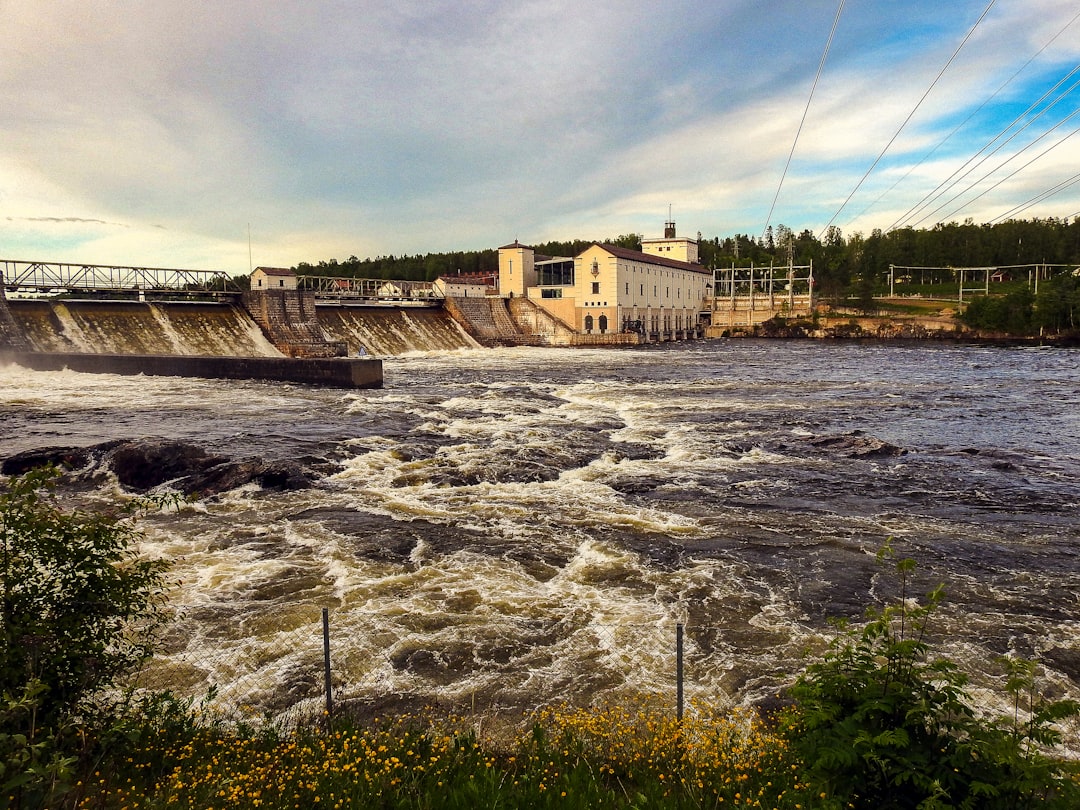
- Hydropower: Hydroelectric power plants are often considered the ideal black start units, and for good reason. They require very little initial power to start up—just enough for intake gates and hydraulic turbine adjustment. Once running, they can quickly inject large blocks of power into the grid, making them highly responsive and reliable for initiating the restoration process. For example, the Lake Lynn hydropower station in West Virginia (a US state) earns roughly $51,000 a year for its black start capabilities. This highlights their value, even though the same plant spends about $65,000 a year on regulatory compliance, showing the economic challenges involved. Our deep expertise in Hydropower and understanding 4 Reasons Why Hydropower is the Guardian of the Grid reinforces their critical role.
- Gas Turbines: These units are also excellent candidates for black start due to their quick start times and fuel flexibility. They can often be started with on-site diesel generators or batteries and can ramp up power relatively rapidly. In the United States, gas turbines constitute 60% of black start units registered with NERC. ERCOT, for instance, relies on 28 natural gas units across 13 sites, with 13 of these capable of running on oil if natural gas supplies are disrupted.
The New Wave: A Modern Black Start with Renewables and Batteries
The rise of renewable energy and the drive for a decarbonized grid are ushering in a paradigm shift in black start strategies. While traditional wind and solar farms were not inherently designed for black start due to their intermittent nature and reliance on the grid for synchronization, new technologies are changing the game.
The key lies in Inverter-Based Resources (IBRs) operating in a “grid-forming” mode. Unlike traditional grid-following inverters that need an existing grid signal to operate, grid-forming inverters can create their own stable AC voltage and frequency, essentially acting as a mini-grid unto themselves. This capability is crucial for black start, as it allows them to provide the initial “spark” without external power. NREL’s research on IBR-driven black start is at the forefront of this change.
Pioneering examples demonstrate this exciting potential:
- In 2020, ScottishPower Renewables achieved the world’s first black start using an onshore wind farm in Europe. This groundbreaking feat, detailed by The Scotsman, showcased how advanced wind turbine technology can contribute to grid restoration.
- Also in 2020, the Imperial Irrigation District (IID) in California made history as the first in the United States to use a 33MW/20MWh lithium-ion battery to start a 44 MW combined cycle natural gas turbine. This demonstration, hailed as a “major accomplishment in the energy industry” by Energy-Storage.news, proved the viability of battery energy storage systems (BESS) for this critical service.
These advancements highlight the growing role of Microgrids and energy storage systems. Microgrids, which can operate independently from the main grid, offer local reliability and can be used to start a system from the bottom up during widespread disruptions. Battery energy storage systems, with their rapid response and ability to provide stable voltage and frequency, are becoming invaluable for both initiating black start and stabilizing the nascent grid.
Governance, Economics, and Future-Proofing the Grid
Ensuring a robust black start capability for our power grids involves more than just technical prowess; it requires a sophisticated framework of regulations, economic incentives, and forward-thinking policy and planning. As we integrate more renewable energy and face new challenges like climate change, the governance and economics of black start are evolving rapidly. Furthermore, the intelligent application of solutions like AI Energy Management will be crucial in optimizing these complex processes.
Rules of the Road: Standards and Regulations
In the United States, the North American Electric Reliability Corporation (NERC) sets mandatory reliability standards that govern black start resources. Key standards like EOP-005-3 (System Restoration from Blackout), EOP-006-3 (System Restoration Coordination), and EOP-007-0 (Blackstart Resource Capability) ensure that grid operators and generation owners have comprehensive plans and capabilities in place. The Federal Energy Regulatory Commission (FERC) provides oversight.
Regional Transmission Organizations (RTOs) and Independent System Operators (ISOs) across the US translate these standards into specific operational requirements, which can vary significantly. These requirements often dictate parameters like the maximum allowable starting time for a black start unit and the minimum fuel inventory it must maintain.
Here’s a comparison of some RTO/ISO requirements in the US:
| RTO/ISO |
Starting Time Requirement |
Fuel Inventory Requirement |
| PJM |
3 to 4 hours |
>16 hours |
| CAISO |
10 minutes |
>12 hours |
| ERCOT |
6 hours |
72 hours preferred |
| ISO NE |
Not specified |
>2 hours (hydro), >12 hours (others) |
| MISO |
1 hour |
8-96 hours |
These varying standards reflect the diverse operational needs and resource mixes of different regions.
The Economics of Black Start: Costs, Compensation, and Market Models
Providing and maintaining black start capabilities is not cheap, and the economic considerations are a critical part of ensuring grid resilience. The ability to perform a black start requires complex technology and is economically costly.
Procurement models for black start services vary. Historically, in vertically integrated utilities, costs were simply rolled into tariffs. In deregulated markets, various models have emerged:
- Cost-of-service: Generators are reimbursed for their actual costs.
- Flat-rate payments: Fixed payments are made for the service.
- Competitive bidding: Generators bid into a market (like ERCOT’s Request for Proposal process) to provide the service, with selection based on factors like proximity, speed, and cost.
The annual costs can be substantial. For example, in Germany, the costs associated with black start capability amounted to 7.4 million euros in 2018. However, compensation for providing these services doesn’t always cover the full expense. The Lake Lynn hydropower station, as mentioned earlier, earned roughly $51,000 a year for its black start capabilities but spent about $65,000 a year on regulatory compliance. This disparity highlights a challenge where current monetary compensation mechanisms might not be adequate to recover all actual costs, potentially disincentivizing participation.
These services are often procured through ancillary service markets, where grid operators contract with generators to provide essential reliability services beyond just producing energy. A PNNL report on blackstart trends and challenges offers deeper insights into these evolving economic landscapes.
Future Challenges: Climate Change and Grid Modernization
The future of black start is deeply intertwined with two major trends: climate change and grid modernization. These present both significant challenges and opportunities.
- Climate Impacts: Climate change is increasing the frequency and intensity of extreme weather events, which are major drivers of widespread outages. Droughts, for example, severely impact hydropower’s ability to provide black start services. US hydropower generation declined by 14% in 2021 compared to 2020 due to drought, and California’s Edward Hyatt Power Plant shut down due to low water levels for the first time since 1967. Such events threaten a key traditional black start resource.
- Retirement of Conventional Plants: The ongoing retirement of older coal and nuclear power plants, while beneficial for decarbonization, reduces the number of traditional, synchronously connected black start units available. This necessitates finding new solutions.
- Integrating Variable Renewables: The increasing penetration of variable renewable energy (VRE) sources like solar and wind, while crucial for our clean energy future, poses challenges for black start. Their inherent unpredictability means they traditionally struggle to provide the stable voltage and frequency needed for grid restoration without advanced controls like grid-forming inverters and battery storage.
- Cybersecurity Threats: As grids become more digitized and interconnected, black start systems themselves become potential targets for cyberattacks. Robust cybersecurity measures are essential to protect these critical restoration capabilities.
- Interdependencies: The intricate links between electricity and other critical infrastructures, especially natural gas, are a growing concern. The Black Start Gas Coordination Group (BSGCG) in ERCOT, for example, works to ensure that natural gas facilities critical for supplying fuel to black start resources receive electricity during a blackout.
Policy and planning considerations for state energy offices, including those in New York, California, and Kansas, are crucial. These offices need to build and strengthen relationships with utilities and regional reliability organizations, include the impact of climate change on black start units in their State Energy Plans, and assess the resilience of these units, considering factors like fuel supply, weatherization, and cybersecurity. Understanding these challenges is key to realizing the Future of Hydropower and other energy resources.
Frequently Asked Questions about Black Start
We understand that black start is a complex topic, so let’s address some common questions:
How long does a black start take?
The duration of a black start operation can vary dramatically, ranging from hours to multiple days or even weeks, depending on the scale and nature of the outage, the complexity of the grid, and the availability of black start resources. For instance, the 1965 Northeast Blackout saw power restored to over 30 million people within 13 hours, but ERCOT’s 2021 experience showed that a full black start of their system could take “multiple days to weeks” to restore power to the entire region. It’s a meticulous, step-by-step process that cannot be rushed.
Traditionally, solar and wind farms were not considered ideal for black start because they require an existing grid signal to synchronize and operate, and their output can be intermittent. However, this is rapidly changing with new technology. As we discussed, grid-forming inverters and integrated battery energy storage systems are enabling these renewable resources to actively participate in black start. The ScottishPower wind farm in Europe’s 2020 achievement is a prime example, demonstrating that with the right technology, renewables can indeed perform a black start. Research and development in this area, including at institutions like NREL, are continuously expanding these capabilities.
What is the difference between a blackout and a black start?
A blackout is the event itself—a widespread loss of electrical power across a region or an entire grid. It’s the problem. A black start, on the other hand, is the solution. It is the specific, planned process of restoring the electric power system from that total shutdown, bringing generation units back online without external power and gradually rebuilding the grid. Essentially, a blackout is when the lights go out, and a black start is how we turn them back on.
Conclusion: Building a More Resilient Grid
The black start process is more than just a technical maneuver; it’s the ultimate insurance policy for our modern, electrified world. It represents our grid’s ability to recover from the most severe disruptions, ensuring that the essential services and comforts we rely on can be restored.
We’ve seen how black start has evolved from relying primarily on traditional hydropower and gas turbines to embracing innovative solutions like inverter-based resources, battery energy storage, and microgrids. This evolution is critical as we steer the challenges of climate change, grid modernization, and the increasing integration of renewable energy sources.
At FDE Hydro™, we are deeply committed to contributing to a more resilient and reliable grid. Our work in developing advanced Hydropower Advancements Innovations 2025 provides solutions that improve the very resources often best suited for black start capabilities. By leveraging cutting-edge modular technology for hydropower infrastructure in regions like North America (including the US and Canada) and Brazil, we help ensure that these vital resources are not only sustainable but also robust contributors to grid stability and restoration.
Understanding and continually improving black start capabilities requires robust planning, strategic investment, and a commitment to technological innovation. As we build the grids of tomorrow, the ability to bring them back to life, no matter the challenge, remains paramount. Learn more about the future of hydropower and how we’re working to secure our energy future.

