

Understanding the Microgrid: A New Era of Energy Independence
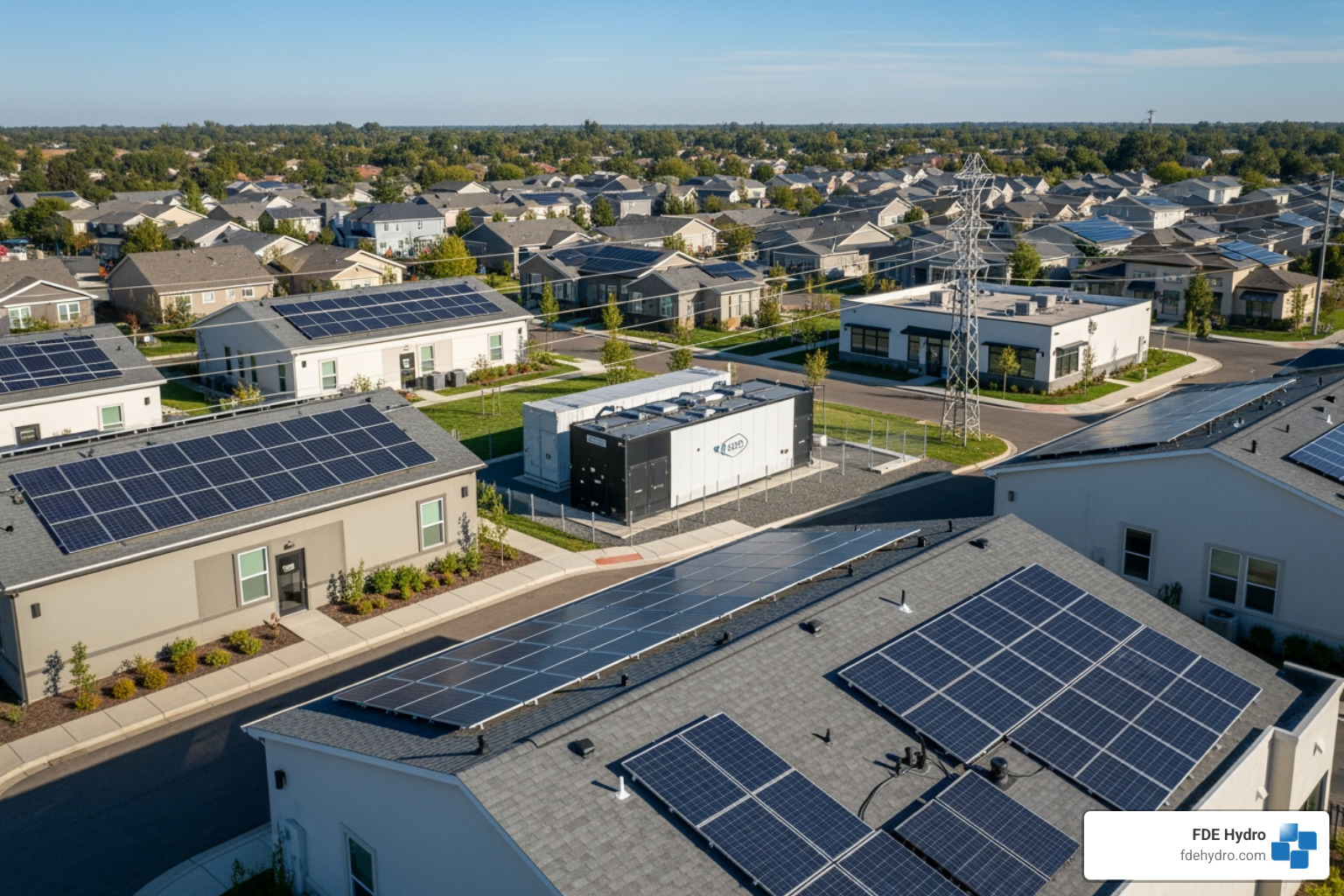
What is a micro grid? A microgrid is a local electrical network with its own power generation and storage. It acts as a single, controllable system that can connect to the main utility grid or run independently (“island mode”) to provide reliable power during outages.
Quick Answer:
- Definition: A self-contained local energy grid.
- Key Capability: Operates connected to or independently from the main grid (“island mode”).
- Core Components: Local power generation (solar, hydro), energy storage, and control systems.
- Primary Benefit: Ensures power reliability during outages and integrates renewable energy.
The traditional power grid is aging and vulnerable to power outages that cost the U.S. economy billions annually. Simultaneously, the need for climate action requires a rapid shift from fossil fuels to clean energy. Microgrids address both challenges.
By generating power locally with renewables like solar and hydropower, they reduce transmission losses, lower carbon emissions, and create energy independence for communities and facilities that need it most.
I’m Bill French Sr., Founder and CEO of FDE Hydro™, where we’ve spent years developing modular hydropower solutions that integrate seamlessly into microgrid systems. After participating in the Department of Energy’s Hydro Power Vision Task Force and five decades in infrastructure development, I’ve seen how what is a micro grid can transform energy delivery for critical facilities and remote communities.
What is a Microgrid and How Does It Work?
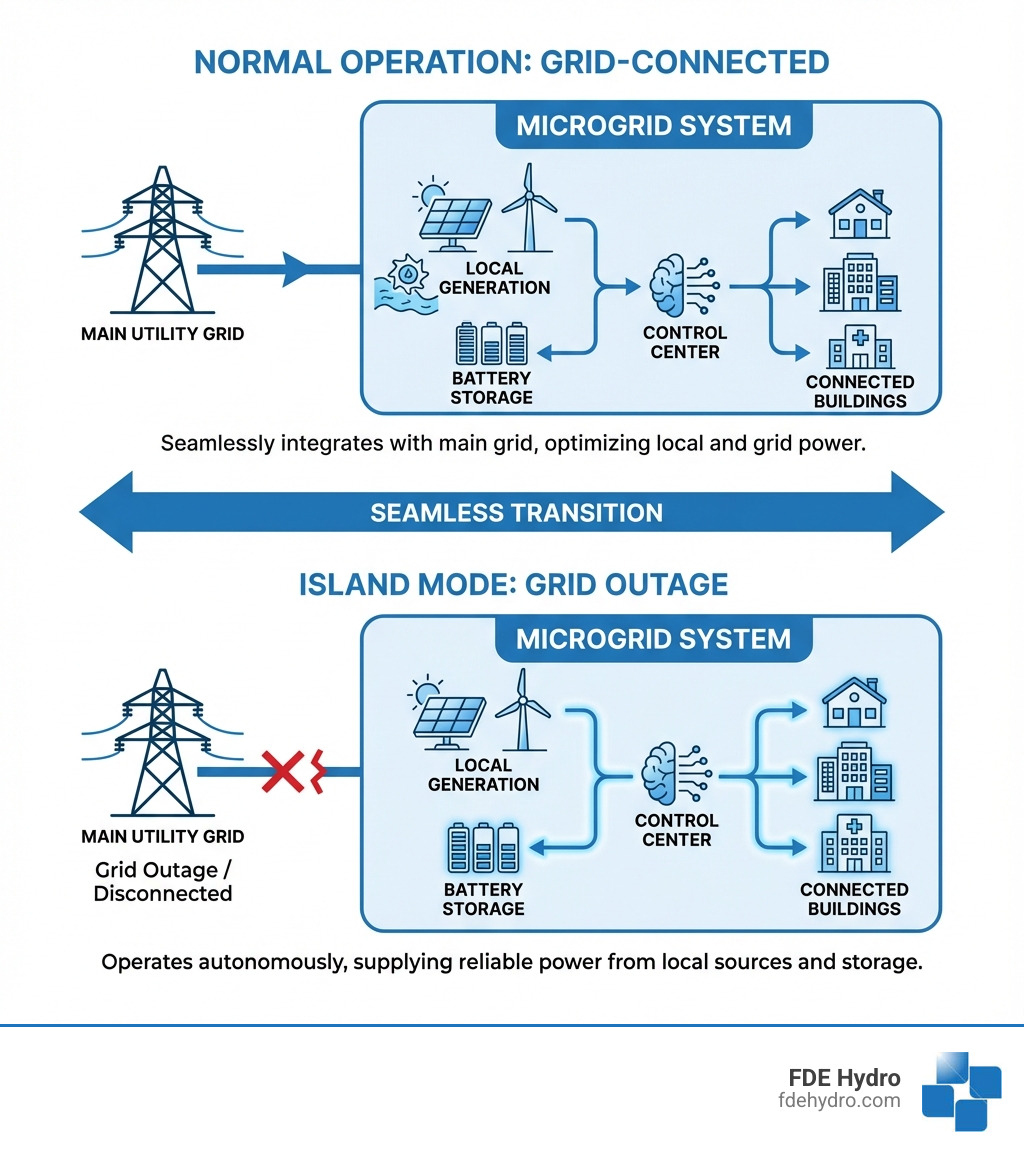
At its core, what is a micro grid? The U.S. Department of Energy (DoE) defines it as “a group of interconnected loads and distributed energy resources within clearly defined electrical boundaries that acts as a single controllable entity with respect to the grid.” It’s a miniature power grid that can separate from the larger utility grid to provide continuous power to its connected loads.
This “single controllable entity” manages all components—from power sources to storage to buildings—as one cohesive system, allowing for intelligent energy flow and dynamic response to changes in supply or demand.
A microgrid operates in two primary modes:
- Grid-connected mode: Its normal state, running in parallel with the main utility grid. The microgrid can draw power from the grid or send excess power back to it.
- Island mode: During a main grid outage, the microgrid can seamlessly disconnect, or “island,” and continue powering its local loads autonomously. This capability is the key resilience benefit of a microgrid.
The connection point to the main grid is the Point of Common Coupling (PCC). The microgrid’s controller manages the smooth transition between modes at the PCC, ensuring power quality is maintained.
For further reading, you can explore The US DoE’s Microgrid Initiative.
Defining the Different Types of Microgrids
Microgrids are customized for specific needs and locations. Understanding what is a micro grid involves knowing these common types:
- Remote Microgrids (Off-Grid Systems): These operate independently, serving areas where grid connection is unavailable or impractical, such as isolated communities in Northern Canada or the Brazilian Amazon. FDE Hydro’s modular hydropower is ideal for providing a stable, renewable base load for these systems.
- Grid-Connected Microgrids: The most common type, these are connected to the main grid but can island during outages. They offer a blend of resilience and grid interaction, common at university campuses, military bases, and industrial facilities.
- Networked Microgrids (Microgrid Clusters): These are multiple microgrids connected to the same utility circuit. These “nested” systems can share resources and support each other, enhancing regional resilience.
- Campus/Institutional Microgrids: These serve a single entity like a university, hospital, or military base. They improve energy security and often use combined heat and power (CHP) for greater efficiency.
- Community Microgrids: Designed for multiple homes, businesses, and critical facilities, these microgrids often prioritize local ownership and control, fostering “energy justice” and community resilience during blackouts.
What is a micro grid vs. a Smart Grid?
While related, “microgrid” and “smart grid” are different concepts. A microgrid is like a high-performance car, while a smart grid is the intelligent highway system it drives on.
| Feature | Microgrid | Smart Grid |
|---|---|---|
| Scope | Localized, self-contained energy system for a discrete area (e.g., campus, town, military base). Operates within clearly defined electrical boundaries. | Large-scale, modernized electrical grid covering a vast region (city, state, country). Integrates digital technology across the entire electricity delivery network. |
| Core Function | Provides reliable, resilient power to local loads, especially during main grid outages. Can operate independently (island mode). | Improves the efficiency, reliability, and sustainability of the entire electrical system. Optimizes energy generation, transmission, and distribution. |
| Components | Distributed Energy Resources (DERs), energy storage, local loads, microgrid controller, Point of Common Coupling (PCC). | Advanced sensors, smart meters, two-way communication networks, automation systems, information technology (IT) infrastructure, distributed generation (including microgrids), and control centers. |
| Control | Autonomous control for local energy management, balancing supply and demand within its boundaries. Can interact with the main grid. | Centralized and distributed control mechanisms that monitor and manage energy flow across the entire grid, from generation to consumption. |
| Relationship | A building block or component of a smart grid. Can operate within a larger smart grid framework, contributing to its overall resilience and efficiency. | An overarching concept that uses digital technology to improve the traditional grid. It can integrate and manage multiple microgrids, treating them as controllable assets to improve system-wide performance. |
| Primary Goal | Energy resilience, local reliability, integration of distributed generation. | System-wide efficiency, reliability, security, and sustainability through advanced communication and control. |
In short, the smart grid is a broad modernization of our electricity infrastructure. What is a micro grid is a specific, localized application of that modernization, acting as a resilient, renewable-powered cell within the larger system.
The Core Function: Islanding and Reconnecting
The ability to “island” is the superpower of what is a micro grid. When the main grid fails, a microgrid detects the anomaly and swiftly disconnects. This transition to island mode must be seamless, ensuring local loads experience little to no power interruption.
Once islanded, the microgrid’s control system works to maintain power quality with stable voltage and frequency, which is crucial for protecting sensitive equipment. This capability is vital for protecting critical loads—services like hospitals, emergency responders, and data centers that cannot afford to lose power.
Some microgrids also have black start capability, meaning they can restore power to themselves without any help from the external grid, an invaluable feature for remote or critical facilities needing absolute energy independence.
The Anatomy of a Microgrid: Key Components and Topologies
A microgrid’s effectiveness depends on the intelligent system integration of its components. Advanced power electronics, including inverters and converters, are crucial for managing energy flow and ensuring compatibility between different power sources and loads.
Key Components of a Microgrid
Let’s break down the essential building blocks:
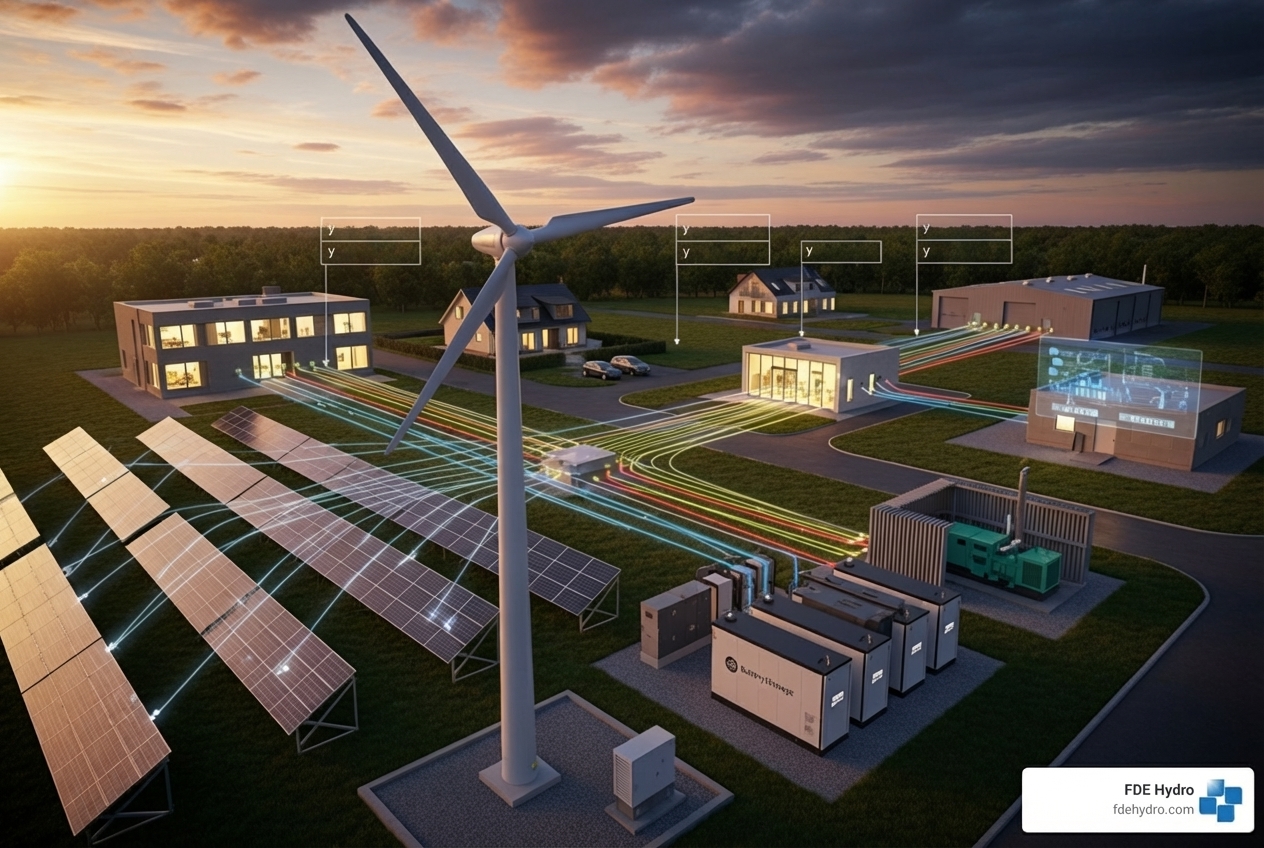
- Distributed Energy Resources (DERs): These are the smaller-scale power generators located near where electricity is consumed. They can include solar panels, wind turbines, conventional generators (diesel, natural gas), and Combined Heat and Power (CHP) systems.
- Hydropower: FDE Hydro’s modular “French Dam” technology enables cost-effective, rapid deployment of small to medium-scale hydroelectric systems. It provides reliable, continuous power, making it a valuable and stable component in microgrids that complements intermittent sources like solar or wind.
- Energy Storage Systems (BESS): The “battery” of the microgrid, these systems store excess energy and release it when needed. This balances supply and demand and provides power during outages. Common types include lithium-ion batteries, flywheels, and hydrogen storage.
- Microgrid Controller (the “brain”): This is the intelligent heart of the system. It monitors production, consumption, and storage, making real-time decisions to optimize performance, manage the transition to island mode, and prioritize critical loads.
- Loads (critical and non-critical): These are the electricity consumers. Critical loads (hospitals, emergency services) must always have power, while non-critical loads can be temporarily shut down to conserve energy.
Here’s a quick list of key components:
- Distributed Energy Resources (DERs)
- Energy Storage Systems (BESS)
- Microgrid Controller
- Electrical Loads (Critical & Non-Critical)
- Point of Common Coupling (PCC)
- Power Electronics (Inverters, Converters)
- Distribution Infrastructure
Understanding Microgrid Topologies
The way components are connected defines the microgrid’s topology:
- AC Microgrids: The most common type, operating with alternating current (AC) like the main grid. This makes it easy to integrate with existing infrastructure.
- DC Microgrids: These operate with direct current (DC), offering efficiency advantages for certain applications. Solar panels and batteries are naturally DC, as are modern electronics like LEDs, computers, and EV chargers. Using a DC microgrid reduces energy losses from AC/DC conversion, making it popular for data centers and EV charging hubs.
- Hybrid AC/DC Microgrids: These combine AC and DC buses connected by converters, offering the best of both worlds. This topology provides maximum flexibility, especially for microgrids with high levels of solar and battery storage.
The Role of Microgrid Control Systems
The intelligence of what is a micro grid lies in its control system. Most use a hierarchical control structure to ensure stability and efficiency:
- Primary Control: The fastest layer, providing instantaneous voltage and frequency stability by controlling individual DERs. It acts as the system’s reflexes.
- Secondary Control: This layer coordinates the primary controllers to restore the system to its normal operating state. It handles load balancing and ensures power is shared correctly among sources. You can read more in this article on secondary voltage and frequency control.
- Tertiary Control: The highest layer, focusing on economic dispatch and optimal energy management. It decides when to generate, store, buy, or sell power, considering market prices and other constraints.
The Power of Independence: Benefits and Challenges
The value of what is a micro grid goes beyond its technical design. It offers a path to energy resilience, economic benefits, clean energy integration, and community empowerment.
Primary Benefits of Microgrid Implementation
Microgrids bring several compelling advantages:
- Grid Resilience and Reliability: This is the most critical benefit. Microgrids can “island” from the main grid during disturbances, ensuring continuous power for critical facilities. This improves local reliability and reduces the economic impact of outages.
- Reduced Energy Costs: By generating power locally, microgrids lower costs by using cheaper local sources (like FDE Hydro’s hydropower), avoiding utility peak demand charges, and reducing transmission losses. For instance, Pittsburgh International Airport saved $1 million in its first year with its microgrid.
- Integration of Renewables: Microgrids are ideal for integrating renewable energy sources like solar, wind, and hydropower. This facilitates the transition from fossil fuels and reduces greenhouse gas emissions, a core mission for FDE Hydro.
- Grid Services Revenue: When connected to the grid, microgrids can provide services like voltage support and frequency regulation. This improves grid stability and creates revenue for microgrid owners.
How can communities benefit from what is a micro grid?
For communities in North America, Brazil, and Europe, microgrids offer profound advantages:
- Local Ownership and Energy Democracy: Communities can take control of their energy future instead of relying on distant utilities. This fosters local ownership and moves toward energy democracy, where energy decisions are made locally.
- Job Creation: The design, construction, and operation of microgrids create local jobs, stimulating regional economies.
- Powering Critical Facilities: A community microgrid ensures that essential services like hospitals, fire stations, and shelters remain operational during widespread outages.
- Increased Property Values: The reliability provided by a microgrid can be a significant selling point in areas prone to outages, potentially increasing property values.
Main Challenges and Design Considerations
Implementing what is a micro grid has its challenges, which FDE Hydro helps address with innovative solutions:
- High Initial Cost: The upfront investment can be substantial, with average costs ranging from $2 million to $5 million per megawatt in the U.S. However, long-term savings, resilience benefits, and government grants can offset these costs.
- Complex Design and Integration: Each microgrid is a unique, custom-engineered system requiring sophisticated integration of diverse components.
- Regulatory Problems: Evolving legal and regulatory frameworks, especially for interconnection with the main utility grid, can be complex to steer.
- Interconnection Standards (IEEE 2030.7): Adhering to technical standards for microgrid controllers adds complexity and cost to projects.
- Cybersecurity Risks: As intelligent, connected systems, microgrids require robust cybersecurity measures to protect them from malicious attacks.
- Sizing and Optimization: Correctly sizing generation and storage to meet demand while maximizing efficiency is a critical design challenge.
Microgrids in Action: Real-World Examples and Costs
The concept of what is a micro grid is moving from theory to tangible projects across North America and Europe. These systems are proving their worth, and the global market for microgrids is projected to grow to over USD 55 billion by 2032.
What is the cost associated with developing what is a micro grid?
The cost of developing what is a micro grid varies widely. A 2018 National Renewable Energy Laboratory study found that U.S. microgrids cost an average of $2 million to $5 million per megawatt.
Factors influencing this cost include:
- Size and Scope: A system for a single building costs less than one for an entire community.
- Technology Mix: The type of DERs and energy storage systems impacts cost. Hydropower, for example, offers a low operational cost and long lifespan.
- Location: Remote sites may incur higher construction and logistics costs.
- Complexity: Sophisticated controls and integration requirements add to the cost.
- Interconnection Requirements: Safely connecting to the main grid requires studies and equipment that can be costly.
Despite the investment, emerging financing models and government incentives, like the U.S. Bipartisan Infrastructure Law’s grant programs, are making microgrids more accessible.
Case Study: Community Microgrid with Hydropower
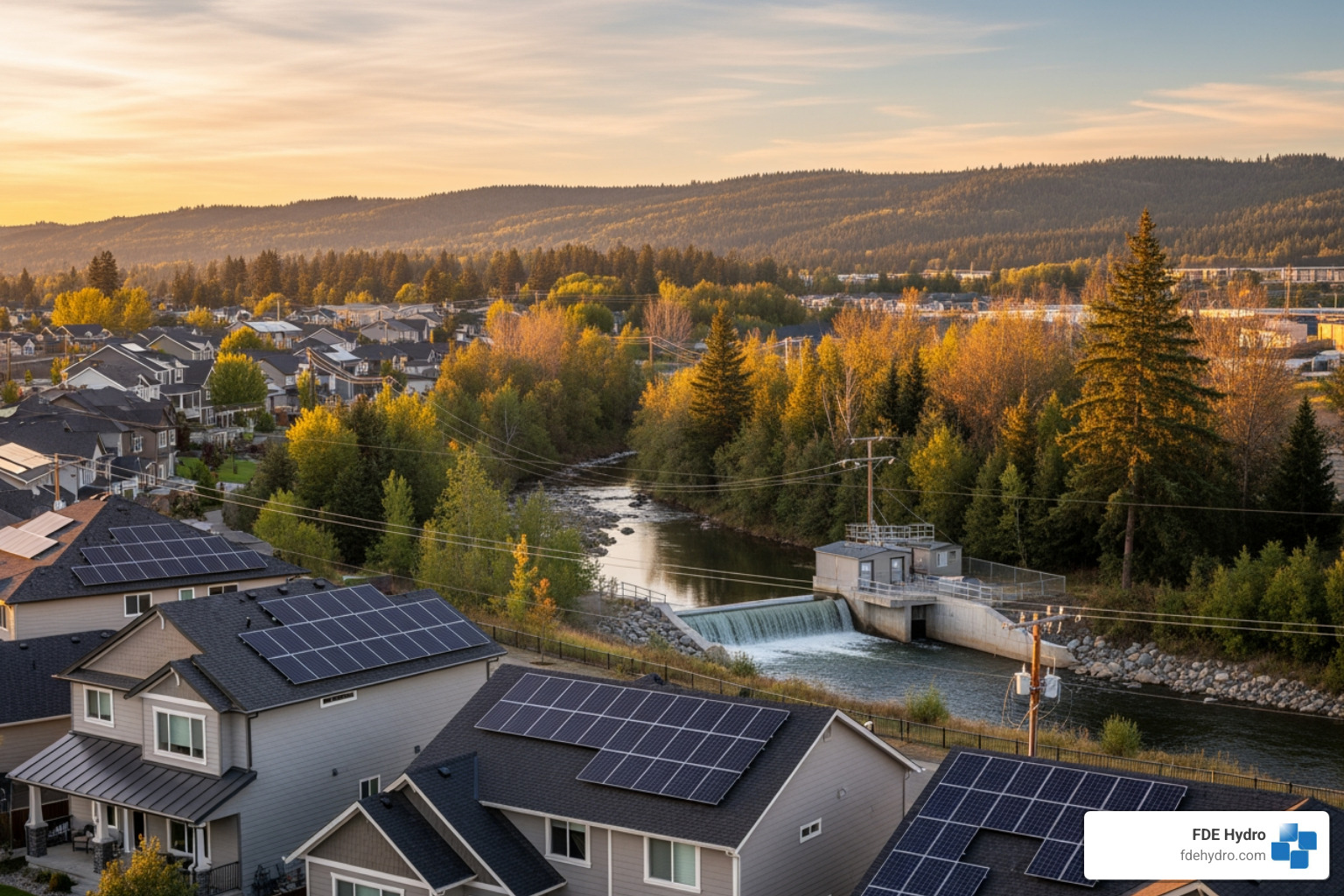
A prime example is a community microgrid project for a small town in rural New York. Historically facing frequent power outages, the community sought a resilient solution. The answer was a community microgrid incorporating FDE Hydro’s modular hydropower technology, a solar array, and battery storage.
This project achieved energy independence by using the river’s consistent flow for baseload power, supplemented by solar and battery storage. The microgrid was designed to island from the main grid during outages, ensuring continuous power to the town’s fire station, health clinic, and grocery store. The integration of hydropower provided consistent, clean power, leading to significant cost savings and improved reliability for critical operations. Our modular “French Dam” approach made the hydropower component economically attractive, demonstrating how innovative methods can enable sustainable energy solutions.
Case Study: Empowering Remote Communities in Europe
In Europe, the Harmon’Yeu project on the island of Île d’Yeu, France, addressed high electricity costs and grid instability. This smart grid pilot, functioning as a sophisticated microgrid, integrated local solar panels and battery storage, allowing homes to share electricity and optimize consumption.
The project significantly improved the island’s energy resilience and provided residents with more reliable power. It’s a powerful example of how what is a micro grid can deliver local energy autonomy and improved quality of life, even in grid-connected regions.
Conclusion: The Future is Local and Resilient
We’ve seen that what is a micro grid is more than a technological novelty; it represents a fundamental shift in our energy approach. Microgrids offer a compelling summary of benefits: resilience against outages, economic advantages, and environmental gains by integrating renewables. They empower communities, fostering local control and development.
The future of energy is increasingly decentralized. As FDE Hydro, we are committed to playing a pivotal role in this transition. Our expertise in developing innovative modular hydropower solutions, including our “French Dam” technology, allows us to provide the reliable, clean, and cost-effective generation needed for microgrid systems. This directly contributes to building a more robust and sustainable clean energy infrastructure across North America, Brazil, and Europe.
Microgrids are a proactive strategy for a more secure, efficient, and sustainable energy future. They are vital components in the broader grid modernization effort, ensuring our energy systems can withstand tomorrow’s challenges while delivering clean power today.
Ready to explore how a microgrid could benefit your community or facility? We invite you to learn more about how FDE Hydro’s sustainable power generation solutions can be integrated into resilient microgrid designs.
