

Why Eco Friendly Power Generation Is the Most Important Energy Shift of Our Time
Eco friendly power generation refers to producing electricity from natural, renewable sources that release little to no greenhouse gases — unlike coal, oil, and natural gas.
Here are the main sources at a glance:
| Source | How It Works | Share of Global Electricity |
|---|---|---|
| Solar PV | Converts sunlight into electricity | ~5.5% (growing fast) |
| Wind | Turbines capture kinetic energy from wind | ~7.8% |
| Hydropower | Moving water drives turbines | ~14.4% |
| Geothermal | Earth’s internal heat produces steam | Small but stable |
| Biomass | Organic matter burned or converted to gas | Small but dispatchable |
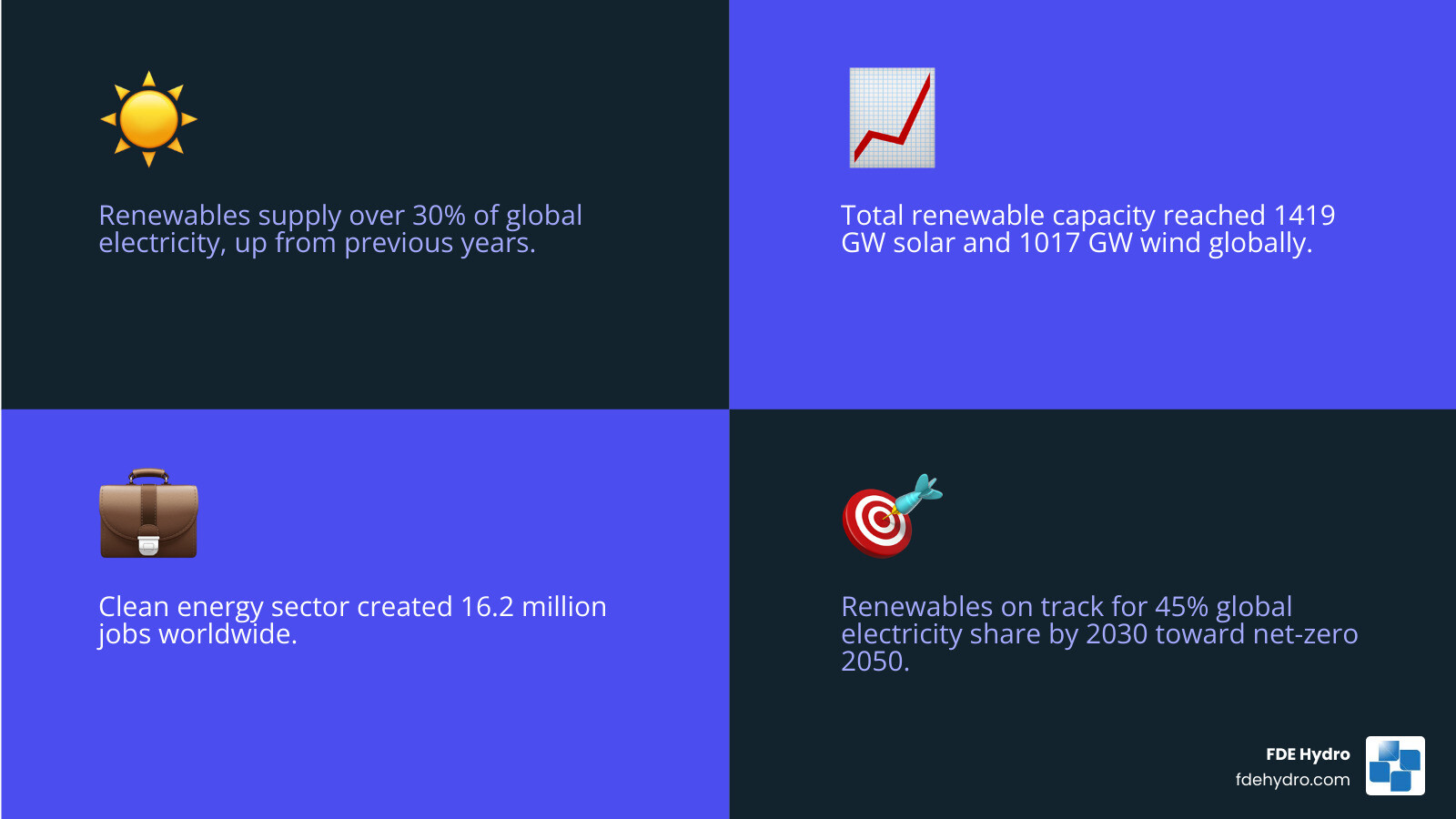
Together, renewables now supply over 30% of global electricity — and that share is climbing every year.
The stakes are high. Fossil fuels still account for nearly 60% of electricity generation worldwide, and the power sector is the single largest source of global greenhouse gas emissions. The consequences are real: air pollution alone causes an estimated 7 million premature deaths every year, while the economic damage runs into the trillions.
The good news? Cleaner alternatives exist, they are scaling fast, and — in most cases — they are now cheaper than the fuels they replace.
I’m Bill French Sr., Founder and CEO of FDE Hydro™, and I’ve spent decades in heavy civil construction before turning my focus to modular hydropower solutions that make eco friendly power generation faster, more affordable, and more practical to deploy at scale. In the sections below, I’ll walk you through the key sources, the real-world economics, and what it takes to accelerate this transition.
Eco friendly power generation word list:
5 Main Sources of Eco Friendly Power Generation
When we talk about Sustainable Power Generation, we are looking at a “Renewable Energy Universe” that transforms natural resources into the electricity that powers our homes in New York, our offices in Brazil, and our industries in Europe.
The International Renewable Energy Agency (IRENA) estimates that 90 percent of the world’s electricity can and should come from renewable sources by 2050. To get there, we rely on five heavy hitters:
- Solar PV: Using the photovoltaic effect to turn sunlight directly into current.
- Wind Energy: Capturing the breeze through massive blades, both on land and at sea.
- Hydropower: Using the weight and flow of water. This is where we at FDE Hydro™ focus our energy, using our French Dam technology to make Sustainable Energy Production more accessible.
- Geothermal: Tapping into the Earth’s core heat.
- Biomass: Converting organic waste into biopower through combustion or anaerobic digestion.
The Dominance of Solar in Eco Friendly Power Generation
Solar Photovoltaic (PV) technology isn’t just growing; it’s sprinting. In 2023, solar PV accounted for a staggering 70% of the global growth in renewable electricity generation. With a total capacity reaching 1419 GW, it has become the “people’s power,” appearing on rooftops from California to Kansas.
Why is it winning? It’s simple: economics. Solar has become the most affordable source of power in many parts of the world. Since 2010, the cost of solar energy has plummeted, following “Swanson’s Law,” which suggests that the cost of solar panels drops by about 20% every time the global manufacturing capacity doubles.
Harnessing Wind and Water
While solar grabs the headlines, wind and water provide the backbone of the grid. Global wind capacity has topped 1017 GW, with offshore wind becoming a major player in Europe and the coastal United States. Offshore winds are often stronger and more consistent than those on land, with speeds at sea being up to 90% greater than over land.
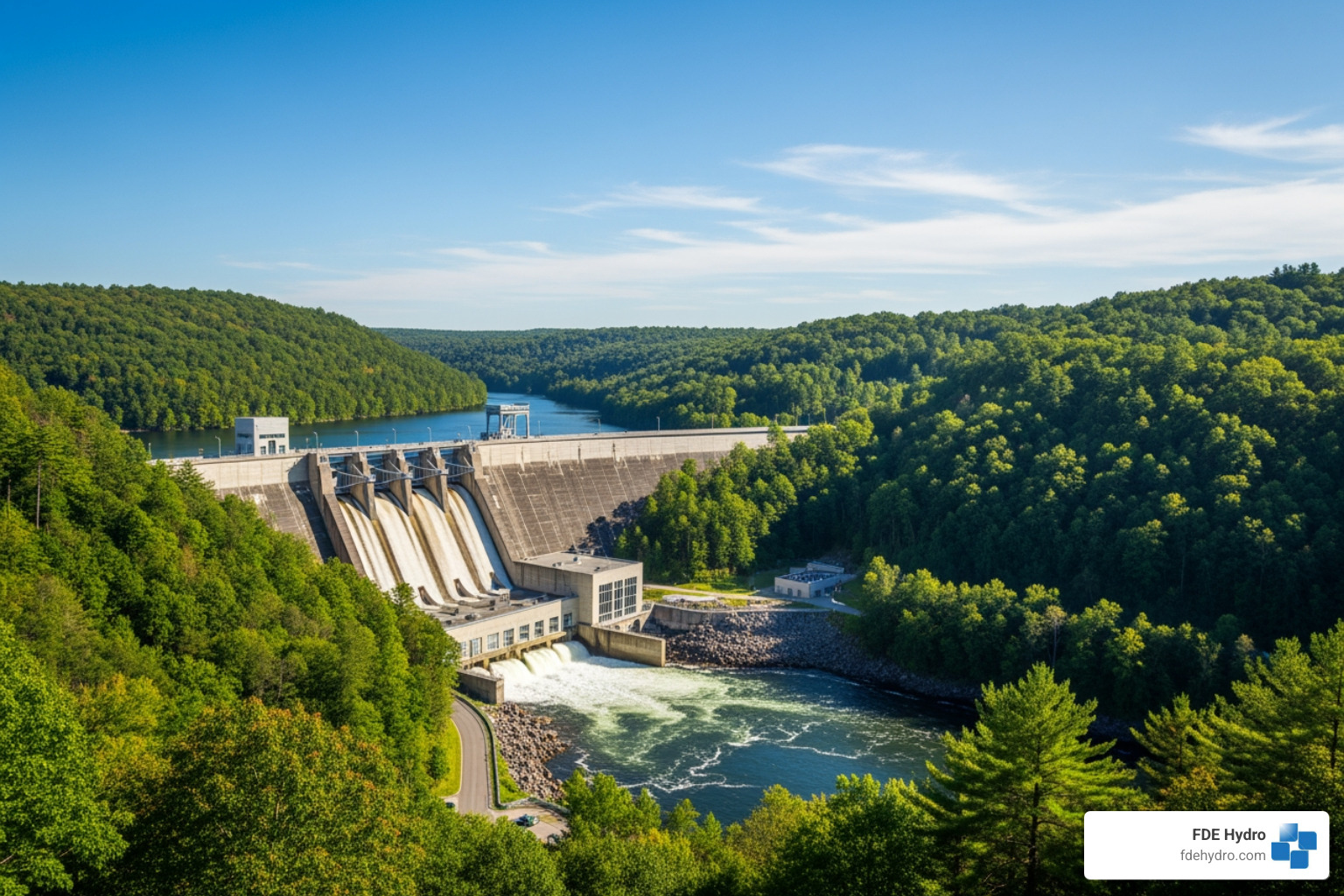
Then there is hydropower—the world’s largest source of renewable electricity, with a capacity of 1268 GW. Hydro is unique because it is “dispatchable,” meaning we can turn it on or off to balance the grid when the sun isn’t shining or the wind isn’t blowing.
At FDE Hydro™, we believe the future of hydro lies in Low Environmental Impact solutions. Traditional dam construction can be slow and expensive. Our patented French Dam technology uses modular precast concrete to retrofit existing structures or build new water control systems in a fraction of the time. Whether it’s in Lawrence, Kansas, or the river basins of Brazil, we are proving that you can have clean, reliable power without the decade-long construction wait.
The Economic and Health Case for Clean Energy
Switching to eco friendly power generation isn’t just about saving polar bears (though we like them, too). It’s about people and the economy.
The clean energy sector is a massive job engine. In 2023, 16.2 million people were employed in renewables—part of a larger 35 million-strong clean energy workforce. For every dollar invested, renewable energy creates three times as many jobs as the fossil fuel industry.
Then there’s the health factor. Fossil fuels aren’t just warming the planet; they are polluting our lungs. The World Health Organization (WHO) notes that air pollution is linked to 7 million premature deaths every year. Beyond the human tragedy, the economic health damage amounts to $8.1 trillion a year, which is roughly 6.1% of global GDP. When we choose Clean Energy Solutions, we aren’t just buying electricity; we are buying cleaner air and longer lives.
Global Trends in Eco Friendly Power Generation
We are currently in the middle of a massive pivot. Fossil fuels still dominate, but their grip is slipping. Between 2015 and 2024, renewable capacity increased by 140% (adding 2,600 GW).
Currently, renewables account for over 30% of global electricity. Current projections suggest we will hit 45% by 2030. However, to reach the ultimate goal of Net-Zero by 2050, we need to move even faster. The IEA reports that while 60 per cent of electricity generation still comes from fossil fuels, the investment trend has flipped: in 2024, $2 trillion went into clean energy—$800 billion more than what was spent on fossil fuels.
Navigating Challenges in the Renewable Transition
If eco friendly power generation is so great, why haven’t we switched 100% already? There are real hurdles to clear:
- Intermittency: The sun sets, and the wind dies down. We need ways to bridge the gap.
- Grid Modernization: Our current power grids were designed for a few massive, centralized coal plants, not millions of distributed solar panels and wind farms.
- Subsidies: Despite the progress, the fossil fuel industry received about $7 trillion in subsidies in 2022. That’s a lot of “old energy” momentum to fight against.
Overcoming Intermittency and Costs
The solution to intermittency is a mix of storage and diversity. Pumped-storage hydroelectricity—something we are very passionate about at FDE Hydro™—currently accounts for over 85% of all grid-scale energy storage. When we have extra solar power during the day, we use it to pump water uphill. When demand peaks at night, we let that water flow down through turbines.
Smart grids and AI are also helping by predicting demand and managing “sector coupling”—like using electric vehicle batteries to feed power back into the grid during peak hours. AI for Sustainability is no longer science fiction; it’s how we keep the lights on in NYC and California.
Is it expensive? Not anymore. Take a look at how the costs compare:
| Technology | Cost Trend | Comparison to Fossil Fuels |
|---|---|---|
| Solar PV | Down 80%+ since 2010 | 41% cheaper |
| Offshore Wind | Rapidly falling | 53% cheaper |
| Hydropower | Stable and low | Highly competitive |
Over 90% of new renewable projects are now cheaper than fossil fuels. The “upfront cost” might be high, but the “fuel” (sun, wind, water) is free forever.
Global Leadership and Emerging Innovations
Different regions are playing to their geographic strengths. Canada is a world leader in hydropower, which provides over 60% of its electricity. China has become a global innovator in solar and wind, while the EU is leading the charge in “Green Deals” and policy frameworks.
We are also seeing incredible “out of the box” thinking:
- Agrivoltaics: Growing crops underneath solar panels. The panels provide shade (reducing water evaporation), and the plants cool the panels (increasing efficiency).
- Enhanced Geothermal: Drilling deeper to access heat in areas without natural hot springs.
- Marine Energy: Tapping into the predictable power of tides and waves.
The power sector remains the largest source of global greenhouse gas emissions, but these innovations are the tools we need to close that gap.
Leading Nations in Sustainable Adoption
In North America, Canada’s reliance on moving water is a blueprint for others. According to the Open Maps Energy Factbook, renewables provided nearly 17% of Canada’s total primary energy supply in 2022.
In the U.S., states like California and New York are setting aggressive targets to phase out gas-fired power. These regions are moving toward Sustainable Infrastructure Development that prioritizes the long-term health of the environment over short-term convenience.
Frequently Asked Questions about Sustainable Energy
What is the difference between renewable and sustainable energy?
It’s a subtle but important distinction. Renewable energy comes from sources that are naturally replenished, like the sun and wind. They won’t run out.
Sustainable energy is a broader term. It includes renewables but also looks at the impact of that generation. For example, a massive hydro project that displaces thousands of people might be “renewable” (the water keeps flowing), but it might not be considered “sustainable” in a social or ecological sense. At FDE Hydro™, we focus on Renewable Energy Solutions that respect the local ecosystem, ensuring Hydropower Environmental Impact is kept to an absolute minimum.
Is eco-friendly power actually cheaper than fossil fuels?
Yes. In most of the world, building new solar or wind is now cheaper than continuing to run existing coal plants. Prices for these technologies are dropping so fast that over 90% of new projects are now cheaper than fossil fuels. When you factor in the $7 trillion in “hidden” costs (subsidies and health damages) that fossil fuels rack up, the choice becomes even clearer.
How many jobs are created by the clean energy sector?
The transition is a massive net-positive for workers. While some jobs in coal and oil production will decrease, the IEA estimates an overall increase in energy sector jobs. Currently, 16.2 million people work directly in renewables, and that number is expected to grow as we invest the $4.5 trillion annually needed to reach our 2050 goals.
Conclusion
The path to 100% eco friendly power generation by 2050 is a mountain we have to climb, but we already have the gear. From the solar arrays of California to the Sustainable Water Infrastructure projects we are leading in Europe and Brazil, the transition is well underway.
Decarbonizing the grid is the single most effective way to combat climate change. It’s not just about “saving the earth”—it’s about building a world where energy is abundant, affordable, and doesn’t make us sick. At FDE Hydro™, we are proud to be part of that solution with our modular French Dam technology, making hydropower faster and cheaper to deploy.
Learn more about French Dam modular technology and how we are changing the face of hydropower
