

The Electrical Grid: One System, Many Forms
The types of electrical grid that power our modern world are more varied — and more fascinating — than most people realize. From continent-spanning synchronous networks to small, self-sufficient local systems, each grid type plays a distinct role in how electricity gets from a generator to your outlet.
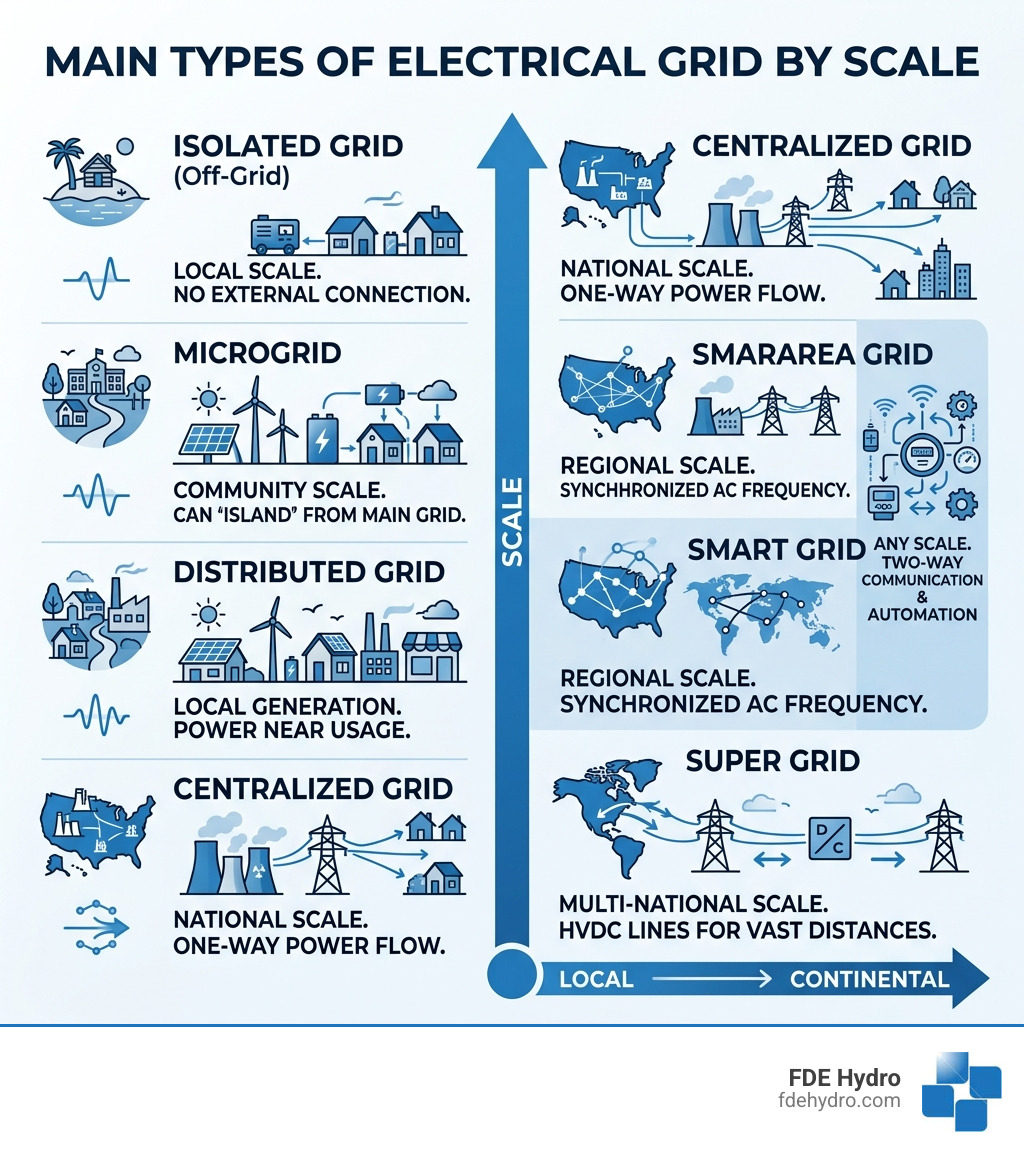
Here is a quick overview of the main types:
| Grid Type | Scale | Key Characteristic |
|---|---|---|
| Wide Area Synchronous Grid | Regional / Continental | Generators synchronized at same AC frequency |
| Super Grid | Multi-national | HVDC lines move huge amounts of power over vast distances |
| Microgrid | Local / Community | Can “island” and run independently from the main grid |
| Isolated Grid | Remote / Off-grid | No connection to a larger network |
| Centralized Grid | National | Power flows one-way from large plants to consumers |
| Smart Grid | Any scale | Two-way digital communication and automation |
| Distributed Grid | Local / Regional | Power generated close to where it is used |
Engineers often call the U.S. grid the biggest machine ever built — and they are not wrong. It links over one million megawatts of generating capacity across roughly 600,000 miles of transmission lines and 5.5 million miles of distribution lines. The story of how that machine grew, split into different forms, and is now evolving again is worth understanding — especially if you work with large-scale energy infrastructure.
Every grid, regardless of type, shares the same basic flow:
- Generation — Power is produced at a plant (coal, gas, nuclear, hydro, wind, solar)
- Transmission — High-voltage lines carry bulk electricity over long distances
- Distribution — Voltage is stepped down and delivered to neighborhoods and buildings
- Load — End users consume the electricity
What differs between grid types is how that flow is organized, how far it travels, who controls it, and how resilient it is when something goes wrong.
I’m Bill French Sr., Founder and CEO of FDE Hydro™, and over five decades in heavy civil construction — including hydropower development — I’ve seen how the types of electrical grid shape the decisions made around water infrastructure and energy delivery. That experience is what grounds everything you’ll read in this guide.
Types of electrical grid terms simplified:
Categorizing the Main Types of Electrical Grid by Scale
When we talk about an electrical grid, we aren’t just talking about wires on a pole. We are talking about a complex hierarchy of systems. The scale of a grid determines its operational independence—essentially, how much it relies on its neighbors to keep the lights on.
In North America and Europe, we primarily deal with massive interconnected systems, but as we move toward 2026, smaller, localized grids are becoming just as vital for resilience.
Wide Area Synchronous Grids: The Continental Giants
A wide area synchronous grid is the heavyweight champion of the energy world. These are regional or continental-scale networks where all connected generators operate at the exact same AC frequency. This synchronization is crucial; if one generator falls out of step, it can cause physical damage to equipment or trigger a cascading failure.
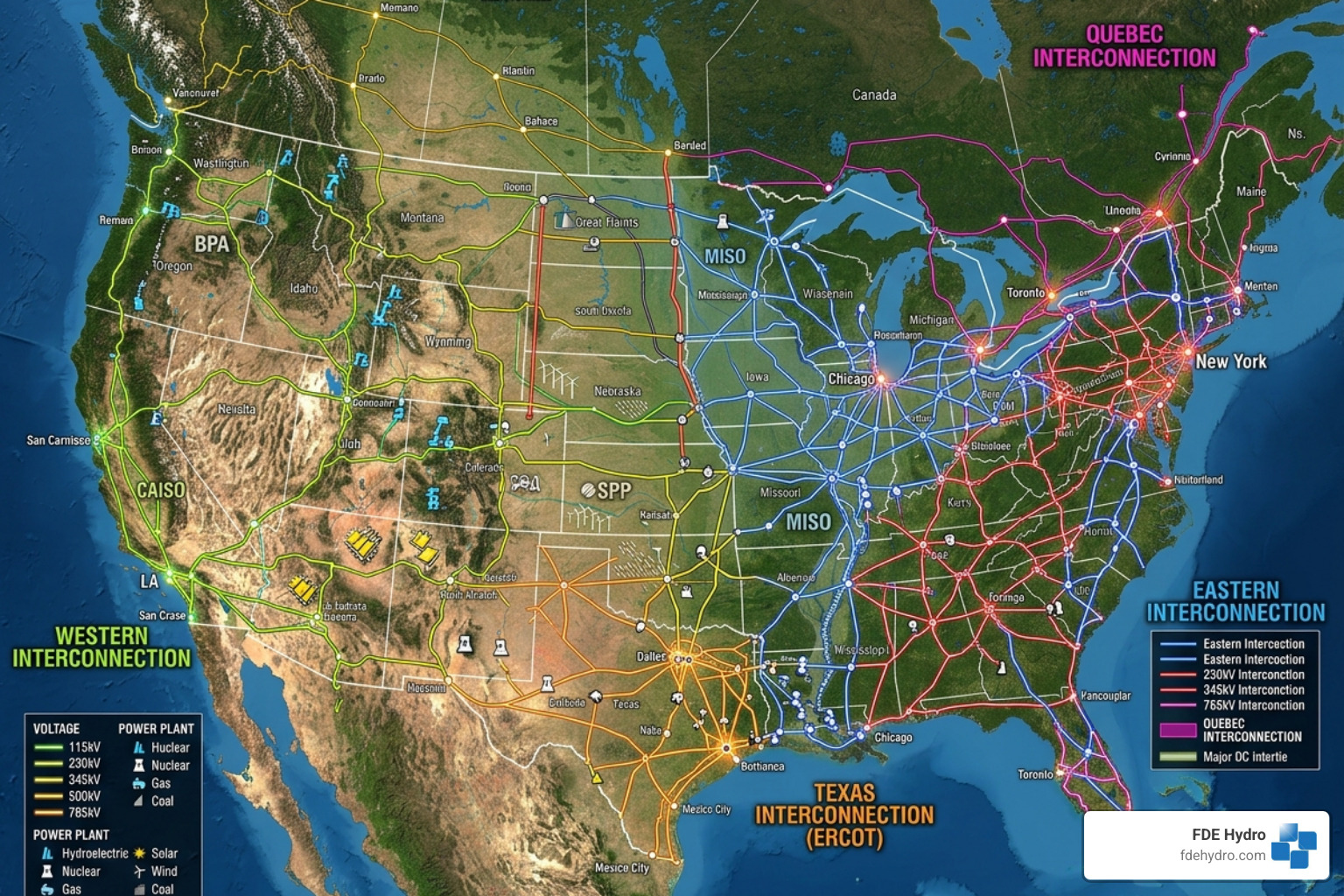
In our neck of the woods, the North American power transmission grid is divided into five main interconnections:
- The Eastern Interconnection: Covering the area east of the Rockies (excluding most of Texas and Quebec).
- The Western Interconnection: Covering the area from the Rockies to the Pacific Coast.
- The Texas Interconnection (ERCOT): Operating mostly independently within the state of Texas.
- The Quebec Interconnection: A distinct grid in Canada, known for its massive hydropower exports.
- The Alaska Interconnection: Which actually consists of several isolated grids rather than one giant loop.
One of the most interesting technical quirks is the frequency. North American interconnections operate at a nominal 60 Hz, while European grids operate at 50 Hz. This difference is a legacy of the early “War of Currents,” but it means that equipment from one continent often can’t be used on the other without significant conversion.
Super Grids: The Future of Global Energy Trade
As we look toward the future of the types of electrical grid, the “Super Grid” is the next logical step. These are wide-area transmission networks designed to trade high volumes of electricity across massive distances—think moving solar power from the Sahara to Northern Europe or hydropower from Northern Canada down to New York City.
The secret sauce for Super Grids is High-Voltage Direct Current (HVDC) technology. While AC is great for local distribution, it loses energy over long distances. Modern HVDC lines can transmit energy with losses of only 1.6% per 1000 km. This efficiency allows us to “smooth out” renewable energy. If the wind isn’t blowing in Kansas, a Super Grid can pull power from a hydroelectric dam in Quebec or a solar farm in California in real-time.
The European Union has even set targets for an Electricity Interconnection Level (EIL) of 15% by 2030, ensuring that national grids can share enough power to keep the entire continent stable.
Microgrids and Isolated Types of Electrical Grid
On the other end of the spectrum, we have the microgrid. If the wide area grid is a highway system, a microgrid is a private driveway. What is a microgrid and how does it work? Essentially, it is a local energy system that includes its own generation (like solar panels or a small hydro turbine) and storage.
The defining feature of a microgrid is its ability to “island.” This means it can disconnect from the main grid during a storm or blackout and continue to power a hospital, a campus, or a small town independently. We see undeniable advantages of microgrids in places like Northern Canada or remote parts of Brazil, where connecting to the main “giant” grid is too expensive or unreliable.
Understanding what “grid” means in electrical engineering helps us appreciate that these smaller systems aren’t just backups—they are the building blocks of a more resilient, decentralized future.
Centralized vs. Smart Grids: The Technological Evolution
For over a century, the types of electrical grid we used were “centralized.” Large power plants (coal, nuclear, or large hydro) sat far away from cities, and power flowed one way—downhill, so to speak—to the consumer. But the 21st century has brought us the “Smart Grid.”
| Feature | Centralized Grid | Smart Grid |
|---|---|---|
| Communication | One-way (Plant to Consumer) | Two-way (Digital & Real-time) |
| Monitoring | Manual/Reactive | Sensors/Proactive (SCADA) |
| Energy Flow | Unidirectional | Bidirectional (V2G, Solar export) |
| Restoration | Manual switching | Self-healing / Automated |
| Efficiency | Higher transmission losses (~6%) | Optimized via demand response |
The Rise of the Modern Smart Grid
A smart grid uses digital technology to monitor and manage the transport of electricity from all generation sources to meet the varying electricity demands of end-users. According to the Union of Concerned Scientists, this evolution is critical for reliability.
Smart grids rely on:
- SCADA (Supervisory Control and Data Acquisition): Systems that give operators a “god’s eye view” of the grid.
- Advanced Metering Infrastructure (AMI): Smart meters that tell the utility exactly when and where a lockout has occurred.
- Demand Response: Programs that incentivize users to shift their energy use (like running the dishwasher at night) to avoid overloading the grid during peak times.
Distributed Energy Resources (DERs) and Grid Modernization
The shift toward smart grids is being driven by Distributed Energy Resources (DERs). These are small-scale power generation sources—like rooftop solar PV, small wind turbines, and battery storage—located close to where the electricity is used.
Integrating these into the types of electrical grid is a challenge because the grid wasn’t originally designed for “two-way traffic.” However, navigating the hybrid microgrid market shows us that combining these resources creates a much more stable system. When you understand what is a micro grid in the context of a smart city, you see a network that is more efficient and less prone to total failure.
Distribution Network Topologies: Radial, Loop, and Network Systems
Once electricity reaches your city, it enters the distribution phase. The “topology”—or the physical layout of the wires—determines how reliable your power is. In places like New York City, these layouts are incredibly sophisticated.
Radial Systems: The Simple Standard
The radial system is the most common of the types of electrical grid layouts, especially in rural areas or small towns. It looks like a tree: power comes from a single source and branches out to customers.
- Advantages: It’s the cheapest and simplest to design.
- Disadvantages: It has a single point of failure. If a tree falls on the “trunk” of the line, everyone on the “branches” loses power.
Loop and Network Systems: High-Reliability Types of Electrical Grid
In dense urban areas like Manhattan or downtown Toronto, we use loop or network systems.
- Loop Systems: The distribution line forms a loop that connects back to the power source. If a fault occurs, switches can isolate the bad section and feed power from the other direction.
- Network Systems: This is the gold standard for reliability. Every customer is connected to at least two different power supplies. This is why you rarely see blackouts in major financial districts unless the entire regional grid goes down.
- Spot Networks: These are “mini-networks” used for single massive buildings, like skyscrapers, to ensure they never lose power.
As we move toward microgrid integration, these network topologies are becoming more “meshed,” allowing power to hop between different local sources as needed.
Challenges and Emerging Trends in Grid Design
The grids of April 2026 are facing challenges that Thomas Edison never dreamed of. From cybersecurity threats to the physical impacts of climate change, the way we design the types of electrical grid is changing rapidly.
Integrating Renewables and the “Duck Curve”
Renewable energy is great for the planet, but it’s tough on the grid. Solar power peaks at noon, but demand peaks in the evening when the sun goes down. This creates the “duck curve”—a sharp drop in net load during the day followed by a massive ramp-up at night.
To solve this, grid operators are looking at:
- Virtual Power Plants (VPP): Using software to link thousands of home batteries into one “virtual” plant.
- Vehicle-to-Grid (V2G): Using the batteries in electric cars to push power back into the grid during peak hours.
- Synthetic Inertia: Using power electronics to mimic the stabilizing “spinning weight” of traditional turbines.
Future-Proofing Different Types of Electrical Grid
Reliability is the name of the game. We are seeing a massive push toward “Black Start” capabilities—the ability to restart a grid from scratch after a total collapse. 4 reasons why hydropower is the guardian of the grid include its ability to provide this black start capability, as hydro turbines can start up without an external power source.
Decentralization and advanced microgrid articles highlight that the future isn’t one giant grid, but a “grid of grids”—interconnected systems that can support each other but also stand alone when necessary.
Frequently Asked Questions about Electrical Grids
What happens when the grid goes down?
When a grid fails, it usually starts with a “trip”—a generator or transmission line goes offline due to weather, a fault, or an accident. In an interconnected system, this can lead to a cascading failure where other lines become overloaded and shut down to protect themselves. Restoration is a prioritized process: hospitals and emergency services come first, followed by high-density residential areas. This often involves a black start procedure.
Can individuals live entirely off-grid?
Yes, but it requires significant planning. An off-grid system is essentially a personal “isolated grid.” You need a generation source (solar/wind), a way to store it (batteries), and usually a backup generator for long stretches of bad weather. While it offers energy independence, you become your own utility company—responsible for all maintenance and repairs.
Why is AC preferred over DC for most grids?
This goes back to the 1880s. Alternating Current (AC) won the “War of Currents” because it can be easily stepped up to high voltages using transformers. High voltage is essential for long-distance transmission because it reduces energy loss. While Direct Current (DC) is making a comeback in the form of HVDC for “Super Grids,” AC remains the standard for the wires that actually enter your home.
Conclusion
Understanding the various types of electrical grid is the first step in building a more resilient energy future. Whether it’s the continental giants of the North American interconnections or a local microgrid powering a rural community, each system must balance supply and demand with split-second precision.
At FDE Hydro™, we believe that the grid is only as strong as its most reliable components. Our modular precast concrete technology—the “French Dam”—is designed to make hydroelectric retrofitting and dam construction faster and more cost-effective. By integrating stable, carbon-free hydropower into these different grid types, we help ensure that the “biggest machine ever built” stays running for generations to come.
Explore more about the future of energy in our Power Grid Articles and join us in retrofitting the world’s infrastructure for a smarter, cleaner grid.
