

America’s Aging Dams: Why Dam Rehabilitation Can’t Wait
Dam rehabilitation is the process of repairing, upgrading, or restoring an aging or deteriorating dam to meet current safety standards and extend its useful life.
Here’s a quick summary of what you need to know:
- What it is: Structural repairs, spillway upgrades, seepage control, and safety improvements to an existing dam
- Why it’s needed: Most dams were built 50–100+ years ago and no longer meet modern safety or performance standards
- Who does it: Dam owners, local sponsors, and government agencies — often with federal cost-sharing support
- How it’s funded: USDA NRCS covers up to 65% of costs; FEMA’s High Hazard Potential Dams (HHPD) program has over $185 million available in FY 2024
- Key alternatives: Full rehabilitation, partial repair, dam removal, or no action
Dams are often called silent protectors. They sit quietly in remote locations, holding back floodwaters, storing irrigation supplies, and supporting hydropower — mostly out of sight and out of mind.
But that silence can be deceptive.
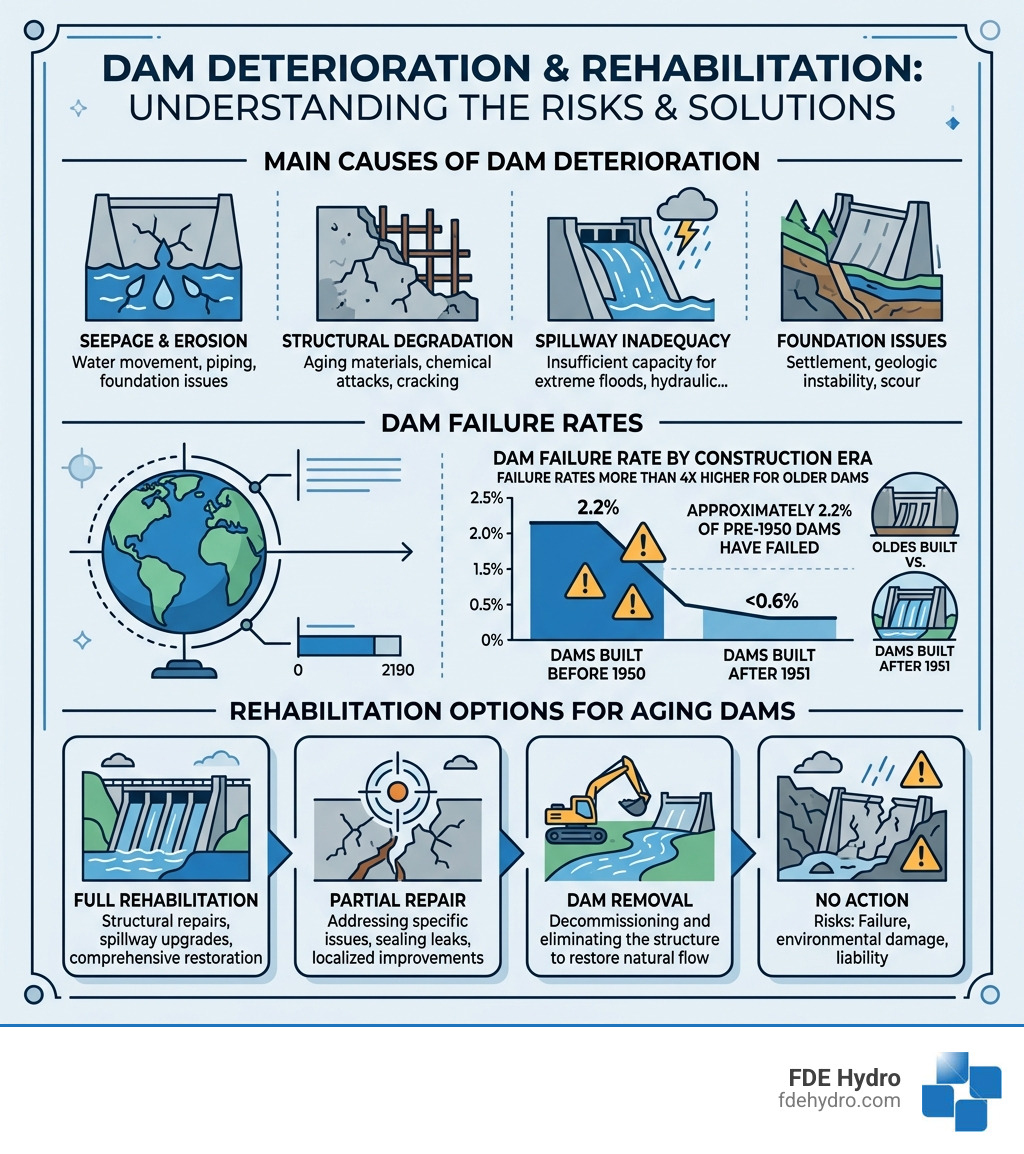
Across the United States and around the world, thousands of dams are approaching or exceeding their design life. In the U.S. alone, the USDA NRCS has assisted in building over 11,850 watershed dams since 1948. Globally, about 2.2% of large dams built before 1950 have failed — a rate more than four times higher than dams built after 1951.
The consequences of inaction are serious. When a dam fails, the results can include loss of life, destroyed property, and long-term environmental damage downstream.
That’s what makes dam rehabilitation one of the most urgent challenges in water infrastructure today.
I’m Bill French, Sr., Founder and CEO of FDE Hydro™, and I’ve spent decades in heavy civil construction — including work on large-scale infrastructure projects where cost, speed, and safety are non-negotiable. My work developing modular precast civil construction solutions gives me a unique perspective on how dam rehabilitation can be done smarter, faster, and with less financial risk than traditional approaches.
This guide will walk you through everything — from understanding why dams fail to navigating federal funding programs and choosing the right engineering approach for your project.
Basic Dam Rehabilitation glossary:
Why Dam Rehabilitation is Critical for Aging Infrastructure
When we look at the state of our water infrastructure, the numbers tell a sobering story. In regions like New York and Ohio, many dams were constructed in the 1800s to support canal systems that have long since been decommissioned. These structures now serve as recreational hubs or flood control barriers, but their “bones” are tired.
According to the Manual for Rehabilitation of Large Dams, approximately 80% of large dams are more than 25 years old. In some areas, hundreds of dams have already passed the century mark. As these structures age, they face several primary modes of deterioration:
- Overtopping: When a dam’s spillway cannot handle extreme rainfall, water flows over the crest, which can quickly erode embankment dams and lead to total failure.
- Piping: This is internal erosion where water seeps through the dam or its foundation, creating “pipes” or hollows that compromise structural integrity.
- Slope Failure: The saturation of embankment soils or seismic activity can cause the dam’s face to slide or collapse.
- Structural Cracking: Concrete dams often suffer from alkali-silica reaction (ASR), a chemical process that causes the concrete to swell and crack from the inside out.
The risk profile changes drastically based on when a dam was built. Modern engineering standards are significantly more rigorous than those used in the early 20th century.
| Construction Era | Failure Rate Percentage | Primary Causes |
|---|---|---|
| Pre-1950 | ~2.2% | Overtopping, internal erosion, lack of modern filters |
| Post-1951 | <0.5% | Foundation issues, extreme rare weather events |
In places like New York, high-hazard dams (Class C) are prioritized because a failure would cause severe downstream damage. Dam Rehabilitation isn’t just about patching cracks; it’s about extending the service life of these assets by another 50 to 100 years while ensuring they meet today’s Probable Maximum Flood (PMF) requirements.
The Dam Rehabilitation Process: From Assessment to Construction
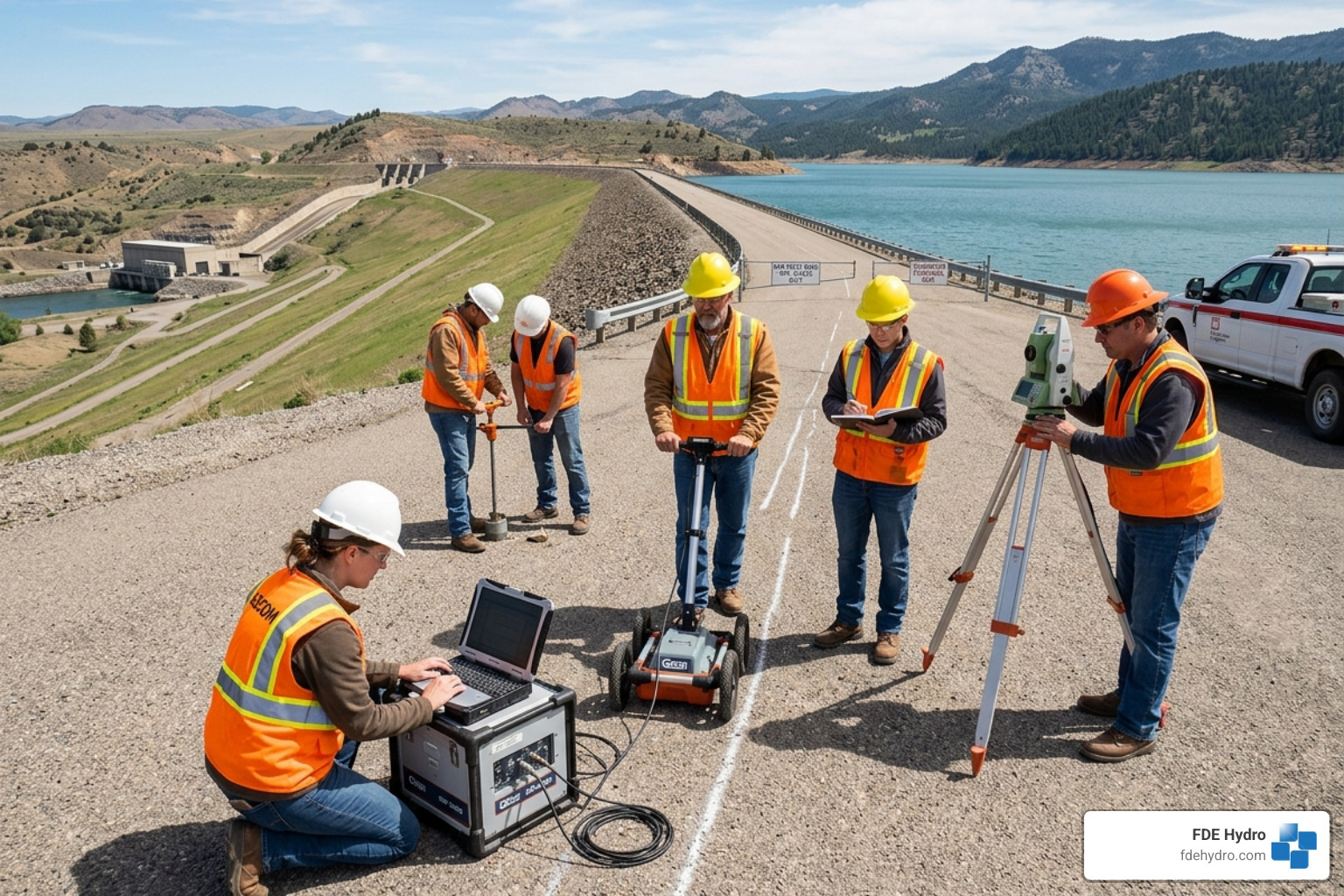
Rehabilitating a dam is a marathon, not a sprint. We can’t simply show up with a concrete truck and start pouring. The process begins with a deep dive into the dam’s “health records” and physical condition.
The first step is a Phase-I Assessment, which involves a visual inspection and a review of historical design documents. If red flags are raised—such as excessive seepage or concrete spalling—we move to Phase-II Testing. This includes core drilling, soil sampling, and geophysical methods like sonic tomography to identify hidden permeable zones within the dam body.
Throughout this process, we must ensure From Cracks To Control Advanced Dam Engineering Solutions are applied. This includes complying with the National Environmental Policy Act (NEPA) and state-specific safety laws.
Key Steps in the Dam Rehabilitation Process
Once the assessment is complete, the project typically follows these milestones:
- Eligibility Check: Determining if the dam qualifies for programs like USDA NRCS or FEMA grants.
- Funding Application: Submitting technical and financial assistance requests.
- Watershed Planning: Developing a comprehensive plan that evaluates alternatives, including “no action” and decommissioning.
- Technical Design: Engineering the specific repairs, such as new spillways or toe drains.
- Construction Oversight: Managing the bidding process and ensuring the work meets strict safety standards.
Effective Hydropower Asset Management requires constant communication between the dam owners (sponsors) and the engineering teams to ensure the project stays on schedule and within budget.
Risk Assessment and Probabilistic Analysis
Modern dam safety has shifted toward a risk-informed approach. Instead of just asking “Is it strong enough?”, we ask “What are the Potential Failure Modes (PFMs)?”
By using quantitative risk assessment, we can prioritize which dams need immediate attention. Tools like DamWatch provide web-based monitoring during extreme weather or seismic events, giving owners real-time data to make critical decisions. This level of Hydro Power Plant Maintenance ensures that resources are directed where they can save the most lives and property.
Funding and Grants for Dam Rehabilitation Projects
One of the biggest hurdles for dam owners is the price tag. Rehabilitation projects can easily run into the tens of millions of dollars. Fortunately, there are several federal and state-level programs designed to help.
The USDA NRCS Watershed REHAB program is a primary source of support. For dams originally built under specific USDA programs (like PL-534 or PL-566), the NRCS can provide up to 65% of the rehabilitation costs. The local sponsor is responsible for the remaining 35%, which can often be provided as “in-kind” contributions, such as land rights or easements.
Another critical resource is the Rehabilitation of High Hazard Potential Dams Grant Program (FEMA). Thanks to the Bipartisan Infrastructure Law, over $185 million was made available in FY 2024 alone. These grants specifically target dams where a failure would pose a high risk to human life.
Key points regarding funding:
- Cost-Sharing: Most federal programs operate on a 65/35 split.
- O&M Requirements: To qualify for funding, owners must prove they have been performing routine Operation and Maintenance (O&M). Poor maintenance can actually disqualify a dam from receiving federal aid.
- State Loans: States like New York and California often offer revolving loan funds or specific state grants for dam safety.
- Sponsor Responsibilities: Sponsors must sign agreements to maintain the rehabilitated dam for its new 50-to-100-year lifespan.
Engineering Techniques for Concrete and Embankment Dam Rehabilitation
The engineering approach depends entirely on the type of dam and the specific “ailment” it suffers from.
For embankment dams, the focus is often on seepage control and stability. This might involve excavating the downstream toe to install modern filter diaphragms and drainage systems. These systems allow water to pass through safely without carrying soil particles with it, preventing piping.
For concrete and masonry dams, the challenges often involve surface deterioration or foundation instability. Techniques include:
- Sealing: Using geomembranes to create an impermeable barrier on the upstream face.
- Anchoring: Installing post-tensioned anchors to tie the dam more securely into its bedrock foundation.
- Spillway Replacement: Many older dams have undersized spillways. Replacing them with a labyrinth spillway (a zig-zag design) allows for much higher water flow without increasing the height of the dam.
We often recommend Hydropower Retrofitting during this phase to maximize the value of the infrastructure.
Modern Materials Used in Dam Rehabilitation
The materials we use today are a far cry from the simple earth and unreinforced concrete of the past.
- High-Performance Concrete (HPC): Offers incredible durability and resistance to erosion in high-velocity spillways.
- Geomembranes: Synthetic liners that can reduce seepage by over 90%.
- Epoxy Grouts: Used to fill fine cracks and bond new concrete to old surfaces.
At FDE Hydro™, we specialize in modular precast concrete technology. Our “French Dam” system allows for the Dam Rehabilitation Encapsulation of existing structures. By using pre-manufactured components, we can significantly reduce the time spent on-site, which is critical when working around seasonal weather windows and reservoir drawdowns.
Real-World Case Studies: Madison Reservoir and Guilford Lake
Looking at actual projects helps illustrate these challenges. In New York, the Madison Reservoir Dam (Lake Moraine) is a classic example of a 19th-century earthen dam that required a total overhaul. The project involved a 10-foot reservoir drawdown to allow for the replacement of the spillway and the installation of a new labyrinth weir.
Similarly, in Ohio, the Guilford Lake Dam (built in 1846) faced significant concrete deterioration and insufficient spillway capacity. The $14 million rehabilitation project included a new labyrinth spillway and extensive embankment reinforcement. These projects show that Aging Infrastructure Being Replaced With Next Generation Civil Solutions is not just possible—it’s happening right now to protect our communities.
Environmental Impacts and Alternatives to Rehabilitation
A modern Dam Rehabilitation project must look beyond the concrete. We have to consider the entire ecosystem. This includes managing floodplain impacts and ensuring that the dam doesn’t become a permanent graveyard for local fish populations.
Aquatic organism passage is a major focus today. This might involve installing “fish ladders” or nature-like bypass channels that allow fish to migrate upstream. In some cases, we even design “eel ladders” for specific regional species.
Dam Removal and Decommissioning
Sometimes, the best way to “fix” a dam is to take it out. Every federal rehabilitation plan is required to consider decommissioning as an alternative.
According to About – Dam Removal Europe, removing a dam can be the most cost-effective way to eliminate a safety hazard while restoring natural river flow and sediment transport. If a dam no longer serves its original purpose—like an old mill dam that no longer grinds grain—removal might be the best path forward. For more on this, check out Dont Just Replace It Change It Out A Practical Guide.
Frequently Asked Questions about Dam Rehabilitation
Which dams are eligible for federal rehabilitation funding?
Not every dam qualifies for every pot of money.
- USDA NRCS Funding: Specifically for dams built under the Watershed Program (PL-534, PL-566), Pilot Watershed Program, or Resource Conservation and Development Program.
- FEMA HHPD Grants: Available for non-federal “high-hazard potential” dams.
- New Eligibility: Interestingly, 501(c)(4) Homeowner Associations are now eligible subrecipients for certain FEMA grants, which is a huge win for private lake communities.
What are the primary responsibilities of a dam owner?
Owning a dam is a major legal responsibility. Owners must:
- Conduct routine inspections (usually annually or bi-annually).
- Maintain a current Emergency Action Plan (EAP) that outlines what to do if the dam is failing.
- Perform long-term O&M to ensure drains aren’t clogged and vegetation isn’t growing on the embankment (trees are a big no-no on earth dams!).
How long does the typical rehabilitation project take?
It’s rarely a quick fix.
- Planning & Design: Can take 2–3 years, including environmental permits.
- Construction: Typically 1–3 years depending on the scale.
- Drawdowns: Many projects require the reservoir to be lowered for at least one full season to allow work on the upstream face or spillway.
Conclusion
The future of our water security depends on how we handle the infrastructure we already have. Dam Rehabilitation is a complex, multi-year commitment, but the benefits—reduced flood risk, protected property, and reliable water supplies—are immeasurable.
By combining federal funding with advanced engineering and modular construction techniques, we can transform these aging “silent protectors” into resilient assets for the next century. Whether you are a dam owner, a local official, or a concerned citizen, understanding this process is the first step toward a safer community.
To see how modern energy solutions integrate with water infrastructure, Learn more about Microgrid Solutions.
