

Defining Sustainable Modular Hydro Dams and Their Core Innovations
When we talk about sustainable modular hydro dams, we are describing a fundamental shift in how water infrastructure is conceived. For over a century, hydropower was synonymous with “bespoke.” Every dam was a custom engineering marvel, designed from scratch for a specific river reach, requiring massive on-site concrete pours, extensive dewatering of riverbeds, and years of labor.
Modular hydro changes the equation by prioritizing standardization. Instead of building a unique monument at every site, we utilize prefabricated components manufactured in a controlled factory environment. These “shop-built” products are then transported to the site—often on standard flatbed trailers—and assembled. This approach mirrors the success of the solar PV industry, which scaled rapidly by using standardized panels rather than custom-built solar collectors for every roof.
The core innovation lies in the transition from site-specific construction to a “kit-of-parts” philosophy. By using Modular Precast Concrete, we can eliminate many of the traditional barriers to entry. This method significantly reduces the need for cofferdams and extensive dewatering, which are often the most expensive and environmentally damaging phases of traditional dam building. According to the Standard Modular Hydropower Fact Sheet, this shift toward modularity is essential for unlocking the thousands of small-scale sites that were previously deemed economically unfeasible.
Engineering the Future of Sustainable Modular Hydro Dams
The engineering behind these systems isn’t just about the physical blocks; it’s about a comprehensive framework. Organizations like the Oak Ridge National Laboratory (ORNL) have pioneered the Standard Modular Hydropower (SMH) framework. This strategy focuses on three pillars: site classification, exemplary design, and advanced simulation.
By categorizing sites based on their hydraulic and ecological characteristics, we can deploy “exemplary designs” that are already optimized for those conditions. This reduces the heavy lifting during the licensing and design phases. Our Hydroelectric Dam Design Complete Guide highlights how modern 3D modeling and rules-based design tools allow us to “reconfigure” modules on the fly to meet specific environmental or social requirements without starting from zero.
Key Components of Sustainable Modular Hydro Dams
A modular dam is rarely a single monolithic wall. Instead, it is an assembly of functional units. Our Hydroelectric Dam Components Ultimate Guide breaks these down into several critical types:
- Module Stacks: These are vertical arrangements of prefabricated units that can scale from 0.5 MW to over 20 MW depending on the head and flow of the site.
- Pressure Boxes: Designed for fast installation, these can be dropped into existing non-powered dams or penstocks to begin generating power almost immediately.
- Siphon Systems: A brilliant innovation for irrigation drops or canals, these allow for hydropower generation without needing to dewater the site or breach existing structures.
- Generation and Sediment Modules: Discrete units dedicated to housing turbines or managing the flow of silt and debris, ensuring the river’s natural processes continue.
Environmental Mitigation and Ecological Continuity
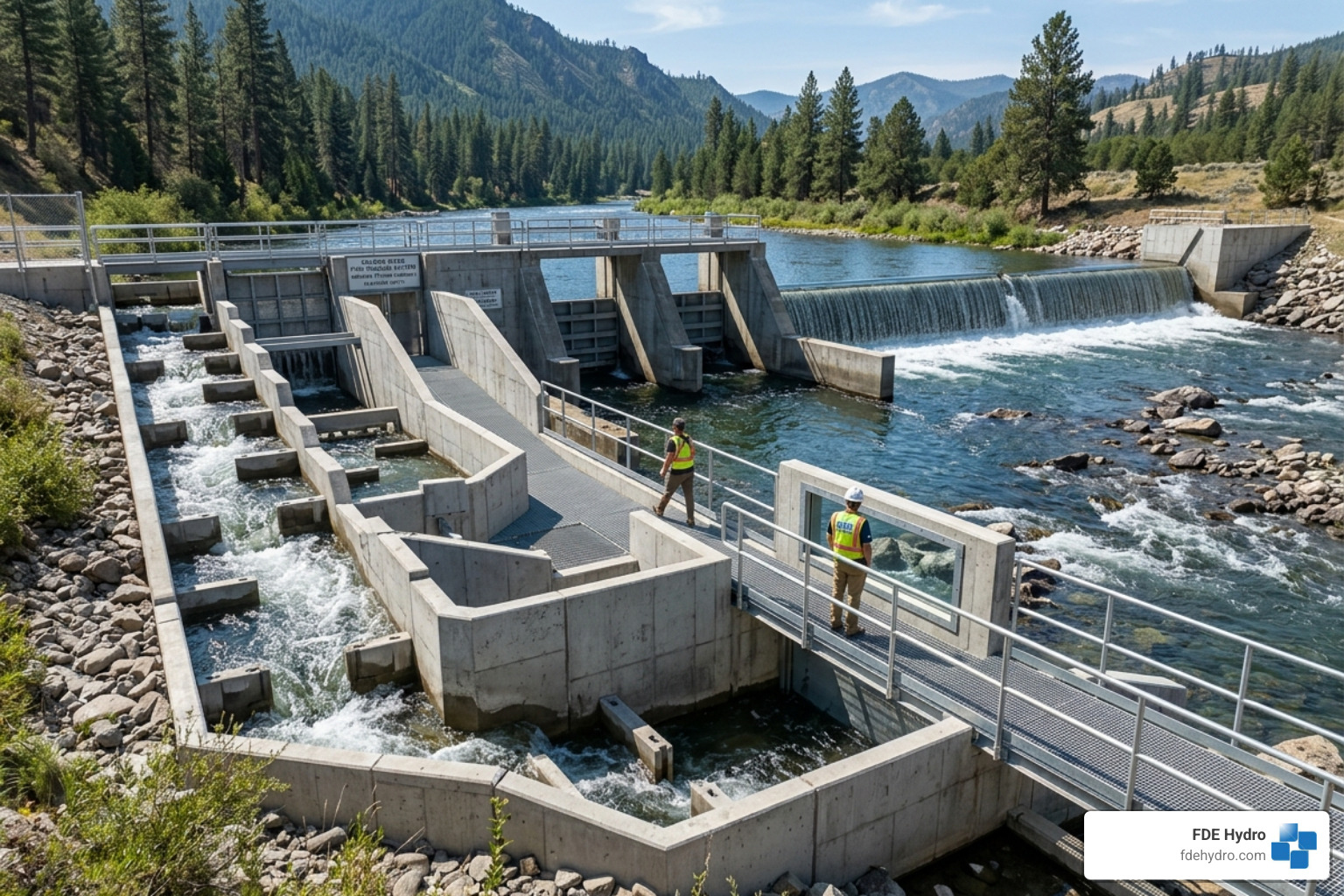
One of the loudest criticisms of traditional hydropower is its impact on river health. Large dams often act as “ecological scissors,” cutting off fish migration routes and trapping sediment that downstream ecosystems rely on. Sustainable modular hydro dams are designed to heal this rift.
By incorporating fish bypasses and sediment sluices directly into the module designs, we maintain “ecological continuity.” This means the river continues to function as a living system even while it generates electrons. Innovations like fish-safe turbines or “salmon cannons” are increasingly being integrated into modular layouts to ensure that local species can navigate the structure safely. Furthermore, modular systems allow for variable flow schedules that mimic natural seasonal pulses, a practice detailed in the research on how Advanced Modular Hydropower Technology Supports Watersheds.
Another often-overlooked benefit is the reduction of greenhouse gas emissions. Large reservoirs behind conventional dams can become hotspots for methane production as submerged vegetation decays. Modular designs often favor “run-of-river” or “closed-loop” configurations that have a much Low Environmental Impact, significantly reducing the carbon footprint of the reservoir itself.
Addressing the Legacy of Large-Scale Infrastructure
To understand why we need a new model, we only have to look at the Belo Monte Hydroelectric Dam complex in Brazil. While massive in scale, projects like Belo Monte have faced intense scrutiny for habitat disruption and their impact on indigenous communities.
In contrast, Sustainable Hydro Infrastructure Building For The Future focuses on smaller, distributed footprints. Instead of one giant dam that floods a valley, we can deploy multiple modular installations that provide the same cumulative power with a fraction of the ecological disruption. For existing reservoirs that struggle with water quality, modular “capping” and treatment solutions can even help remediate legacy pollutants like PCBs, turning a liability into a sustainable asset.
The Economic Case: Reducing Costs and Construction Timelines
The numbers behind sustainable modular hydro dams are, quite frankly, disruptive. In energy finance, “time is money,” and traditional hydro takes too much of both.
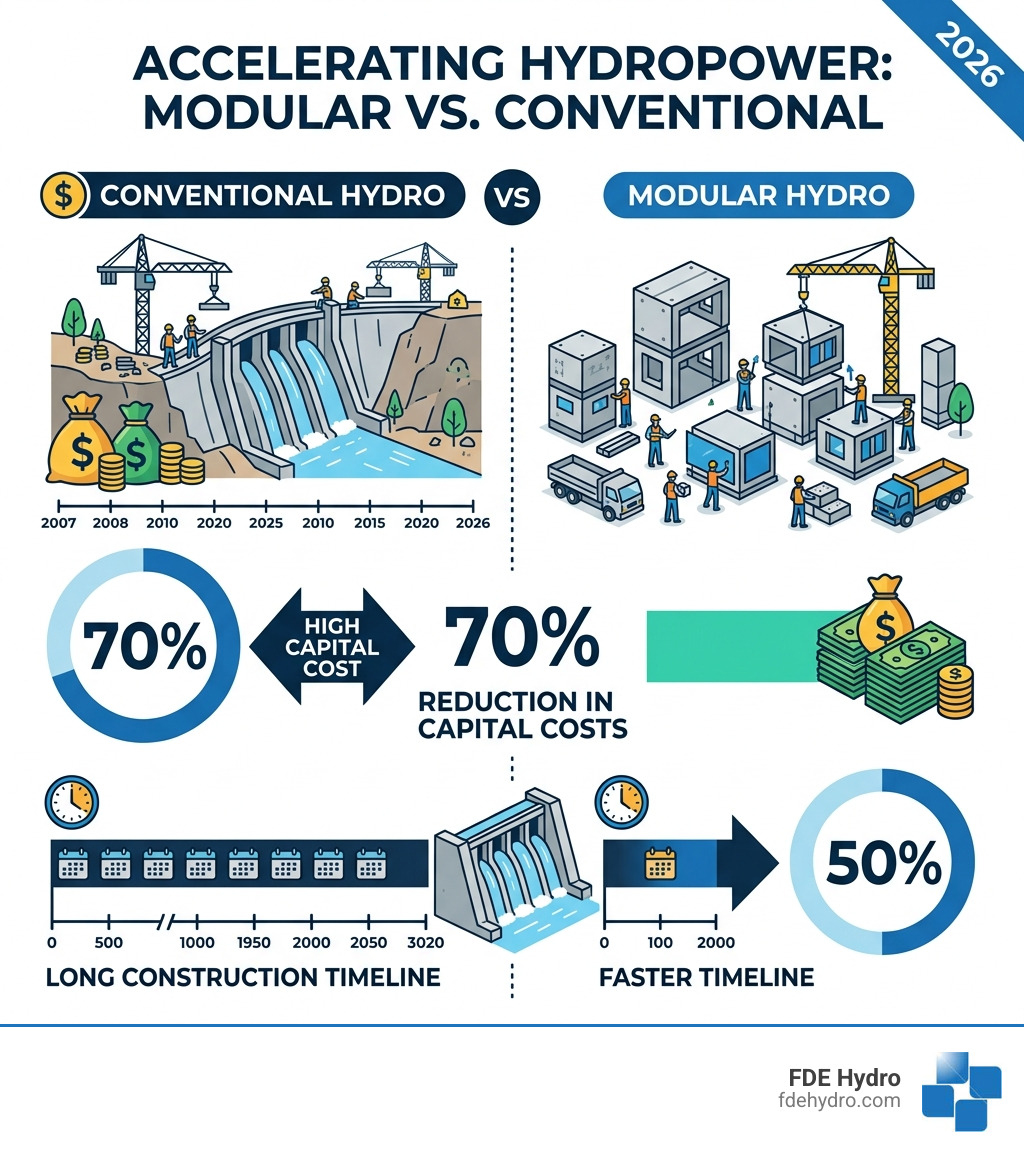
Conventional hydropower typically costs around $5,000 per kW of installed capacity. Modular designs, including advanced steel buttress systems or our own precast concrete solutions, are targeting costs as low as $1,500 to $2,100 per kW. This is a game-changer. It makes hydropower competitive with natural gas peaking plants and large-scale battery storage.
The Precast Concrete Advantages extend to the construction schedule as well. While a traditional dam might take a decade to commission, modular projects are hitting milestones in 42 to 58 weeks. By shifting the majority of the work to a factory, we avoid weather delays and the massive overhead of maintaining a remote construction site for years. Our approach to Modular Dam Construction ensures that the “civil works”—usually the most unpredictable part of a project—become a predictable, assembly-line process.
Rapid Deployment and ROI
For many developers, the most attractive feature is the Return on Investment (ROI). Small modular turbines, like those used for energy recovery in water networks, can see an ROI in as little as 1 to 5 years.
As noted in the recent report, Can a new generation of hydropower dams save the energy transition?, the ability to halve construction schedules means that projects can begin generating revenue years earlier than conventional builds. This “speed to power” is critical in 2026 as we race to meet aggressive climate goals. We’ve seen this firsthand; when the French Dam Technology Passes The Test, it proves that reliability doesn’t have to come at the cost of speed.
Strategic Deployment: From Non-Powered Dams to Closed-Loop Storage
Where do we put these systems? The opportunity is vast. In the United States alone, there are approximately 85,000 non-powered dams (NPDs). These are structures that already exist for navigation, irrigation, or flood control but don’t produce a single watt of electricity. The Department of Energy estimates that retrofitting just the top 1,800 of these could provide up to 12 GW of renewable energy.
Modular systems are the “plug-and-play” solution for these sites. Instead of a massive overhaul, we can use pressure boxes or siphon modules to add generation capacity to existing infrastructure. This is what we call a Micro Reservoirs and Hydroelectric Dams: A Synergistic Solution, where we leverage what is already built to minimize new environmental footprints. Whether it’s Building New Dams on greenfield sites or breathing life into an old lock, the modular model fits.
Enhancing Grid Stability with Pumped Storage
As we add more wind and solar to the grid, we face a problem: what happens when the sun sets or the wind stops? Energy storage is the answer, and Pumped Storage Hydropower (PSH) currently accounts for 95% of all energy storage in the U.S.
Modern PSH plants are incredibly efficient, with round-trip efficiencies approaching 80%. However, building them traditionally takes far too long. Sustainable modular hydro dams enable “closed-loop” PSH—two reservoirs separate from natural river systems. By using modular steel or concrete buttress dams, we can build these storage facilities in half the time, providing the “flexible power” needed to balance the intermittency of other renewables. This is the Modular Hydro The Future Of Flexible Power Generation, providing grid stability that batteries simply can’t match at scale.
Frequently Asked Questions about Modular Hydropower
How do modular dams handle fish migration?
This is a top priority for us. Modular systems are designed with dedicated “fish passage stacks.” These include bypasses that allow fish to move both upstream and downstream. We also utilize newer turbine designs that have much lower strike rates. For higher dams, we can even integrate systems like the “salmon cannon” or advanced lift systems at sites like the Patriot Hydro Lawrence Hydroelectric Project.
Can modular systems be installed on existing non-powered dams?
Absolutely. This is actually one of the most cost-effective ways to deploy the technology. By using tools like the “NPD Explorer” to classify the site, we can select a modular pressure box or siphon system that fits the existing structure. Projects like the Dashville Hydroelectric Project serve as excellent examples of how existing water infrastructure can be modernized for the 21st century.
What is the typical construction timeline for a modular hydro project?
While a conventional dam might take 10 years from conception to completion, a modular project is much faster. Once the modules are manufactured off-site, the actual installation can take as little as 42 to 58 weeks. For example, when the Prototype Of Modular Precast French Dam Completed, it demonstrated that the assembly of the primary structure is a matter of months, not years.
Conclusion
In April 2026, the energy transition is no longer a distant goal—it is an urgent reality. At FDE Hydro™, we believe that water remains our most reliable renewable resource, but only if we change how we harness it. Our patented French Dam technology is leading this charge across North America, Brazil, and Europe by proving that we can build infrastructure that is both economically disruptive and ecologically responsible.
By embracing the precast model, we are moving away from the era of “big hydro” and into the era of sustainable modular hydro dams. These systems are faster to build, cheaper to fund, and gentler on our planet. Whether we are retrofitting a 50-year-old non-powered dam in New York or establishing a new closed-loop storage facility in California, the goal remains the same: flexible, reliable, and truly sustainable power.
