

The World’s Most Powerful Battery Is Made of Water
Pumped storage hydro is the largest and most proven form of energy storage on the planet — and it works by moving water uphill and downhill between two reservoirs.
Quick answer: What is pumped storage hydro?
| Question | Answer |
|---|---|
| What is it? | A system that stores energy by pumping water to an upper reservoir, then releases it through turbines to generate electricity |
| How efficient is it? | 70–80% round-trip efficiency |
| How much storage exists globally? | ~200 GW of power capacity, ~9,000 GWh of energy storage |
| What share of grid storage is it? | Over 94% of the world’s long-duration energy storage |
| How long can it supply power? | Hours to days, depending on reservoir size |
| Main system types? | Open-loop (connected to natural water) and closed-loop (off-river, self-contained) |
Right now, the grid faces a serious problem. Wind and solar generate power when nature allows — not necessarily when people need it. That mismatch causes waste, instability, and rising costs for utilities and grid operators.
Pumped storage hydro solves that problem at a scale no other technology currently matches.
It has been doing so since the 1890s, when early systems appeared in Italy and Switzerland. The U.S. adopted the technology in 1930. Today, pumped storage accounts for 97% of utility-scale energy storage in the United States — 23 GW across 42 sites — and over 94% of long-duration storage capacity worldwide.
As Malcolm Turnbull has noted, the failure to adequately focus on long-duration electricity storage is “the ignored crisis within the energy crisis” — and pumped storage hydro has the unique capacity to resolve it at a scale far beyond what batteries alone can deliver.
I’m Bill French, Sr., Founder and CEO of FDE Hydro™ and a veteran of large-scale civil construction and hydropower innovation — including participation in the U.S. Department of Energy’s Hydropower Vision Task Force, where I helped define the next generation of pumped storage hydro solutions for Congress. In this guide, I’ll walk you through everything decision-makers need to know about this technology: how it works, where it fits, and how modern construction methods are removing the biggest barriers to building it faster and cheaper.
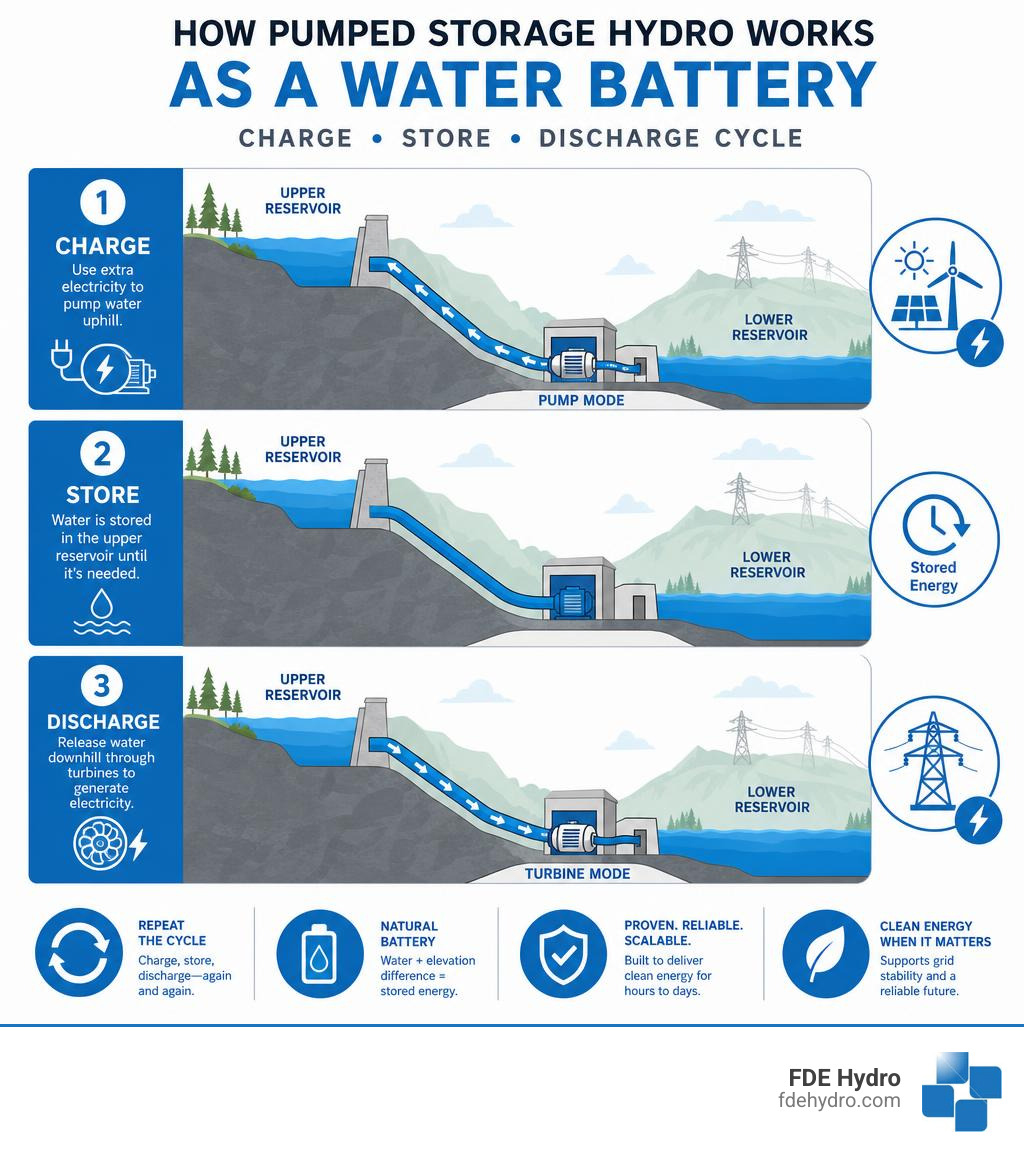
What is Pumped Storage Hydro and How Does It Work?
At its core, pumped storage hydro is gravity storage.
A project uses two reservoirs at different elevations. When there is extra electricity on the grid, the plant uses that power to pump water from the lower reservoir to the upper reservoir. That is the “charging” cycle. When the grid needs electricity, the water is released back downhill through turbines. That is the “discharging” cycle.
The stored energy is not in the water itself. It is in the water’s position. Engineers call this gravitational potential energy. The higher the reservoir and the more water it holds, the more energy can be stored.
The basic cycle is simple:
- Low demand or surplus renewable power: pumps move water uphill.
- High demand or low renewable output: water flows downhill.
- Reversible turbines spin generators to make electricity.
- The water collects in the lower reservoir and can be reused.
Most modern plants use reversible pump-turbines, often Francis-type machines, that can operate in both directions. In generation mode, water spins the turbine. In pumping mode, the machine reverses and pushes water uphill.
According to the U.S. Department of Energy’s overview of pumped storage hydropower, this is why PSH behaves like a giant battery. It does not create energy from nothing. It stores electricity when it is abundant and returns most of it when it is valuable.
Typical round-trip efficiency is about 70% to 80%. In plain English, if a plant uses 100 units of electricity to pump water uphill, it can usually return about 70 to 80 units later. The losses come from turbine, pump, motor, generator, friction, and evaporation effects.
For a deeper introduction to water-based storage, we also explain the concept in Pumped Up: Everything You Need to Know About Hydropower Energy Storage.
Key Components of a Pumped Storage Hydro Project
A pumped storage project looks simple from far away: two reservoirs and a powerhouse. Up close, it is a carefully integrated civil, mechanical, electrical, and control system.
The major components include:
- Upper reservoir: Stores water at elevation so it can be released for generation.
- Lower reservoir: Receives water after generation and supplies water for pumping.
- Dams and embankments: Create or support reservoir storage.
- Intake structures: Control water entry into tunnels or conduits.
- Penstock or water conveyance tunnel: Carries high-pressure water between reservoirs and turbines.
- Powerhouse: Contains pump-turbines, generators, motors, valves, transformers, and controls.
- Transmission connection: Moves power to and from the grid.
- Control systems: Coordinate pumping, generation, ramping, grid services, and protection systems.
The civil works are often the largest cost and schedule driver. That includes excavation, concrete, reservoir lining, dam construction, water conveyance, and site access. This is where modern construction methods matter.
At FDE Hydro, our patented modular precast concrete technology, known as French Dam, is designed to reduce the time, cost, and uncertainty involved in building and retrofitting hydroelectric dams and water control systems. For pumped storage, modular construction can help standardize critical structures, improve quality control, and reduce on-site construction complexity.
In an industry where “pour concrete on a remote mountain for years” has too often been the default plan, modularity is not just nice. It is overdue.
Open-Loop vs. Closed-Loop Pumped Storage Hydro Systems
There are two main categories of pumped storage hydro: open-loop and closed-loop.
Open-loop pumped storage has an ongoing hydrologic connection to a natural water body, such as a river, lake, or existing reservoir. Some open-loop projects are paired with conventional hydropower reservoirs. These systems can be efficient uses of existing infrastructure, but they may face more complex aquatic habitat, fish passage, water quality, and flow management requirements.
Closed-loop pumped storage uses two reservoirs that are not continuously connected to a natural river system. These are often called off-river systems. The same water is cycled between the reservoirs again and again, with periodic makeup water for evaporation, seepage, and maintenance losses.
The key differences are:
| Feature | Open-loop PSH | Closed-loop PSH |
|---|---|---|
| Water connection | Connected to natural water body | Generally off-river and self-contained |
| Environmental review | Often more aquatic impacts to evaluate | Often lower fish and river-flow impact |
| Siting | Can use existing lakes, rivers, or dams | Can be located away from rivers if topography works |
| Water reuse | Reuses water but interacts with natural flows | Reuses a mostly fixed water volume |
| Permitting | Often more complex hydrologic issues | Still rigorous, but usually fewer river impacts |
Closed-loop systems are receiving growing attention because they can reduce impacts to river ecosystems and expand the number of possible sites. We discuss this shift in Why Pumped Storage is Making a Huge Splash.
Common Pumped Storage Hydro Configurations
Pumped storage is not one-size-fits-all. In fact, that is part of its value.
Common configurations include:
- New-build closed-loop projects: Two purpose-built reservoirs, often off-river.
- Existing dam upgrades: Adding pumping and generation capability to existing water infrastructure.
- Non-powered dam conversions: Using dams that already hold water but do not currently generate electricity.
- Mine-site or quarry reservoirs: Repurposing excavated land, shafts, pits, or industrial sites.
- Brownfield redevelopment: Reusing disturbed sites with existing access roads, grid proximity, or water infrastructure.
- Hybrid hydropower projects: Combining conventional hydropower and pumped storage operations.
The most important physical factor is hydraulic head, meaning the vertical distance between the upper and lower reservoirs. More head means more energy from the same amount of water. Reservoir volume determines duration. A small reservoir with high head may provide a short burst of high power. A larger reservoir pair may provide many hours or even days of storage.
The Role of PSH in Modern Grid Reliability
A modern grid must do more than produce enough energy over a year. It must match supply and demand every second.
That is where pumped storage hydro shines.
Pumped storage can provide:
- Fast ramping: Increasing or decreasing output quickly as demand changes.
- Frequency control: Helping keep the grid near its required operating frequency.
- Voltage support: Stabilizing local and regional grid conditions.
- Grid inertia: Supporting system stability that can be reduced as conventional rotating generators retire.
- Black-start capability: Helping restart parts of the grid after an outage.
- Peak capacity: Supplying high-demand periods when power prices and reliability needs rise.
- Renewable integration: Absorbing excess wind and solar and delivering it later.
- Curtailment reduction: Preventing clean electricity from being wasted when generation exceeds demand.
Wind and solar are excellent resources, but they are variable. Solar ramps down in the evening just as homes, businesses, and industry may still need electricity. Wind can surge at night when demand is low. Pumped storage acts like the grid’s shock absorber.
The International Hydropower Association notes that pumped storage is the dominant long-duration storage technology globally, with nearly 200 GW of installed power capacity and up to about 9,000 GWh of stored energy worldwide. You can explore more global hydropower context through the International Hydropower Association.
For more on the storage role of hydropower, see our guide to Hydropower Energy Storage.
Why Pumped Storage Hydro is Valuable for Long-Duration Energy Storage
Batteries are important, especially for short-duration and fast-response applications. But pumped storage hydro brings different strengths. It is not a replacement for every battery. It is the heavy-duty storage workhorse for the grid.
| Benefit | Why it matters |
|---|---|
| Long asset life | Plants can operate for many decades with maintenance and upgrades |
| Large storage capacity | Reservoirs can store massive amounts of energy |
| Long duration | Many projects can discharge for 6, 8, 10, or more hours |
| Low degradation | Water does not wear out like battery cells |
| Scalable reservoirs | Energy capacity can often be increased by reservoir sizing |
| Dispatchable power | Operators can generate when the grid needs it |
| Water reuse | The same water cycles repeatedly between reservoirs |
| Domestic materials | Concrete, steel, aggregates, and civil works can often be sourced regionally |
| Grid reliability | Supports stability, reserves, and emergency response |
| O&M familiarity | Hydropower equipment is mature and well understood |
The main tradeoff is upfront cost. Pumped storage projects require significant civil construction, permitting, engineering, and interconnection work. They also take longer to develop than containerized battery projects.
However, the economics can be attractive over the full life of the asset. A pumped storage plant may earn revenue from multiple services:
- Energy arbitrage: pumping when electricity is cheap and generating when it is valuable.
- Capacity payments: being available during peak demand or reliability events.
- Ancillary services: frequency regulation, spinning reserve, voltage support, and other grid services.
- Transmission congestion relief: storing power where and when the grid cannot move it efficiently.
- Renewable firming: turning variable wind and solar into more dependable power portfolios.
The challenge is that many electricity markets still do not fully compensate long-duration flexibility. That is a policy problem, not a physics problem.
Global and U.S. Market Capacity
As of May 2026, pumped storage hydro remains the world’s largest grid-scale energy storage technology.
Key figures include:
- Global PSH power capacity is roughly 200 GW.
- Global PSH energy storage is estimated at up to about 9,000 GWh.
- PSH accounts for over 94% of global long-duration energy storage capacity.
- In the United States, pumped storage provides about 23 GW across roughly 42 to 43 facilities, depending on the reporting method.
- U.S. pumped storage represents the overwhelming majority of utility-scale energy storage capacity, often reported between 88% and 97% depending on how the category is counted.
The U.S. fleet includes some very large facilities. Bath County in Virginia is often described as one of the largest pumped storage plants in the world, with about 3 GW of generating capacity and many hours of storage. The Bad Creek facility in the Carolinas is another major U.S. project, with a proposed expansion that would increase storage and generation capability using existing infrastructure. More information is available from the Bad Creek Pumped Storage Project.
In North America, Canada also has pumped storage resources and opportunities. The Canada Energy Regulator has described pumped-storage hydro as the largest form of energy storage in Canada and an important contributor to grid reliability in its market snapshot.
Brazil is another important market to watch because of its large hydropower base, seasonal water patterns, and growing need for flexible storage as wind and solar expand. A recent academic review of pumped hydro storage in the Brazilian power industry highlights how PSH could support reliability and renewable integration in that market.
In Europe, pumped storage is already a core flexibility resource and is being evaluated as part of net-zero power system planning. The reason is straightforward: the more variable renewables a grid adds, the more it needs storage that can last longer than a quick battery burst.
Siting Challenges and Environmental Impacts
Pumped storage hydro is powerful, but it is not magic. You cannot build it just anywhere.
A strong site usually needs:
- Enough elevation difference between reservoirs.
- Stable geology for dams, tunnels, foundations, and slopes.
- Suitable reservoir locations with manageable land impact.
- Water for initial fill and periodic makeup.
- Access to transmission.
- Reasonable road, construction, and logistics access.
- Community support and transparent engagement.
- A viable permitting path.
Environmental impacts vary widely by project type. Open-loop systems may affect aquatic habitat, fish movement, water temperature, sediment, and natural flow patterns. Closed-loop systems can reduce many of those issues because they are often located away from rivers, but they still require land, water, construction disturbance, and careful management.
Important environmental topics include:
- Land use and habitat conversion.
- Wetlands and protected species.
- Water withdrawals for initial fill.
- Evaporation and seepage.
- Reservoir lining and water quality.
- Visual impacts.
- Cultural resources.
- Construction traffic, noise, and dust.
- Long-term dam safety.
Water use is often misunderstood. Pumped storage typically requires an initial fill, then reuses the same water repeatedly. It is not like a once-through water system. Losses mainly come from evaporation, seepage, and maintenance operations.
Permitting remains one of the largest barriers. In the U.S., projects may involve the Federal Energy Regulatory Commission, state water agencies, environmental review, dam safety agencies, local land-use approvals, and consultation with Tribes and communities. Early engagement matters. Surprises late in the process are expensive, and not the fun kind of surprise like finding cash in an old jacket.
We cover these issues further in Overcoming the Biggest Barriers to Cheap Pumped Storage and Why Your Old Dam Needs a Pumped Storage Makeover.
Repurposing Brownfield, Mine, and Existing Dam Sites
One of the most promising paths for new pumped storage is reusing sites that have already been disturbed.
That can include:
- Former mines.
- Quarries.
- Industrial sites.
- Existing reservoirs.
- Non-powered dams.
- Retired energy infrastructure sites.
Mine and quarry sites can be especially interesting because excavation has already created elevation differences or water-holding spaces. In some cases, an upper reservoir can be built on nearby high ground while a mine pit or underground void becomes the lower reservoir. In other cases, two existing voids can be adapted.
The U.S. Department of Energy has studied the potential for pumped storage hydropower at mine and brownfield sites because these projects may reduce greenfield disturbance, use existing roads, and create new economic activity in energy communities.
Existing dams are also a major opportunity. Many dams in North America do not generate electricity. Others generate power but do not include pumping. If the site has the right reservoir pairing, transmission access, and dam safety profile, a retrofit may be more practical than a fully new development.
How Modern Dam Construction Can Reduce Project Barriers
The traditional pumped storage development model can be slow and costly because so much depends on custom civil construction. Every site is different, and every delay compounds financing risk.
Modern modular dam construction can help.
At FDE Hydro, our French Dam technology uses patented modular precast concrete systems for building and retrofitting hydroelectric dams and water control structures. For pumped storage, this approach can support:
- Faster construction schedules.
- More predictable quality.
- Reduced on-site labor requirements.
- Less weather-dependent concrete work.
- Standardized components.
- Adaptable reservoir and water control designs.
- Better cost control.
- Easier retrofits at existing dams and non-powered sites.
This does not eliminate the need for engineering, permitting, geotechnical analysis, or environmental review. But it can reduce one of the biggest obstacles: the civil construction burden.
If pumped storage is the world’s biggest battery, then better dam construction is how we make the battery case faster, stronger, and more affordable.
Frequently Asked Questions about Pumped Storage
Pumped storage raises practical questions for utilities, developers, regulators, communities, and investors. Here are the ones we hear most often.
What is the round-trip efficiency of a pumped storage plant?
Most pumped storage plants recover about 70% to 80% of the electricity used to pump water uphill.
The lost energy is not mysterious. It comes from:
- Pump inefficiency.
- Turbine inefficiency.
- Motor and generator losses.
- Electrical transformer losses.
- Friction in tunnels and penstocks.
- Water turbulence.
- Evaporation and seepage.
Modern turbine design, variable-speed equipment, optimized controls, and efficient water conveyance can improve performance. But no storage technology is 100% efficient. The value of PSH is that it returns large amounts of energy when the grid needs it most.
How long can pumped storage hydro provide power?
It depends on three main factors:
- The volume of water in the upper reservoir.
- The elevation difference between reservoirs.
- The generating capacity of the turbines.
Many pumped storage plants are designed for 6 to 12 hours of discharge. Some can provide longer-duration storage depending on reservoir size and operating strategy.
A simple way to think about it:
- Power capacity is the size of the faucet.
- Energy capacity is the size of the tank.
- Duration is how long the tank can run through the faucet.
That is why pumped storage can be scaled for long-duration needs in a way that is difficult for many electrochemical batteries. If you need more storage duration, you can often increase reservoir volume rather than add entirely new power conversion systems.
What is the difference between open-loop and closed-loop systems?
Open-loop systems connect to a natural water body, such as a river, lake, or existing hydropower reservoir. They may use natural inflows and can interact with aquatic ecosystems.
Closed-loop systems are generally off-river. They cycle water between two reservoirs with little or no continuous connection to natural flowing water.
Closed-loop systems often have a smaller river impact, but they still require environmental review, land use planning, water sourcing, and dam safety analysis.
Can pumped storage hydro be added to existing dams?
Yes, in some cases.
Adding pumped storage to an existing dam depends on:
- Whether there is a suitable upper and lower reservoir pairing.
- The available elevation head.
- Dam safety and structural condition.
- Space for a powerhouse, tunnels, intakes, and equipment.
- Transmission access.
- Environmental and permitting constraints.
- Economics.
Non-powered dams are especially interesting because the water control structure already exists. A pumped storage retrofit can sometimes add energy storage value without creating an entirely new dam site.
This is one reason modular construction matters. Standardized precast components can make certain retrofits faster and more predictable. Learn more in How Precast Modules are Revolutionizing Pumped Storage and Small but Mighty: A Guide to Modular Pumped Storage and its Benefits.
Why is pumped storage hydro important for renewable energy integration?
Wind and solar are variable. The grid needs electricity on demand.
Pumped storage helps by:
- Storing excess solar during midday.
- Storing wind energy during low-demand periods.
- Reducing renewable curtailment.
- Supplying evening and morning demand peaks.
- Providing fast ramping when clouds, storms, or wind changes affect output.
- Supporting voltage and frequency stability.
- Reducing reliance on fossil peaking plants.
In other words, pumped storage turns renewable energy from “available when nature says so” into “available when the grid needs it.”
That is the heart of the energy transition.
Conclusion
Pumped storage hydro is not new. But its importance is growing fast.
As of May 2026, grids across the United States, Canada, Brazil, and Europe are adding more wind and solar, retiring older fossil assets, and searching for reliable long-duration storage. Batteries will play a major role, but they cannot carry the entire storage burden alone.
Pumped storage hydro offers something rare: massive capacity, long duration, proven equipment, long asset life, and grid reliability services in one package.
The barriers are real. Projects need the right sites, careful environmental review, community trust, strong market signals, and better construction economics. But those barriers are solvable.
At FDE Hydro, we believe the next generation of pumped storage will be built faster and more affordably through smarter civil design, modular precast concrete, and practical retrofits of existing water infrastructure. Our French Dam technology was developed for exactly this kind of future: one where hydropower infrastructure is cleaner, faster to build, easier to adapt, and ready to support renewable energy at grid scale.
To learn more about how we approach this work, visit our page on Pumped Storage Hydropower.
