

How a Hydroelectric Dam Turns Moving Water Into Electricity
A hydro electric dam is a structure built across a river to hold back water, create a reservoir, and release that water in a controlled way to generate electricity. Here’s the short version:
| Element | What It Does |
|---|---|
| Dam wall | Holds back water to create height (called “head”) |
| Reservoir | Stores the potential energy of water |
| Penstock | Channels water downward to the turbine |
| Turbine | Spins as water rushes through it |
| Generator | Converts that spin into electricity |
| Tailrace | Returns water to the river downstream |
In other words: water falls, blades spin, electricity flows.
Hydroelectric dams are one of the oldest and most reliable sources of reliable energy on the planet. They supply roughly 15% of the world’s electricity and account for nearly 29% of all U.S. renewable electricity generation. Unlike solar or wind, they can generate power on demand — day or night, rain or shine.
I’m Bill French, Sr., Founder and CEO of FDE Hydro™, and I’ve spent decades in heavy civil construction before launching FDE Hydro™ in 2015 to bring modular, precast construction methods to the hydro electric dam industry. In this guide, I’ll walk you through everything you need to know — from how these structures work to what it takes to build and operate them.
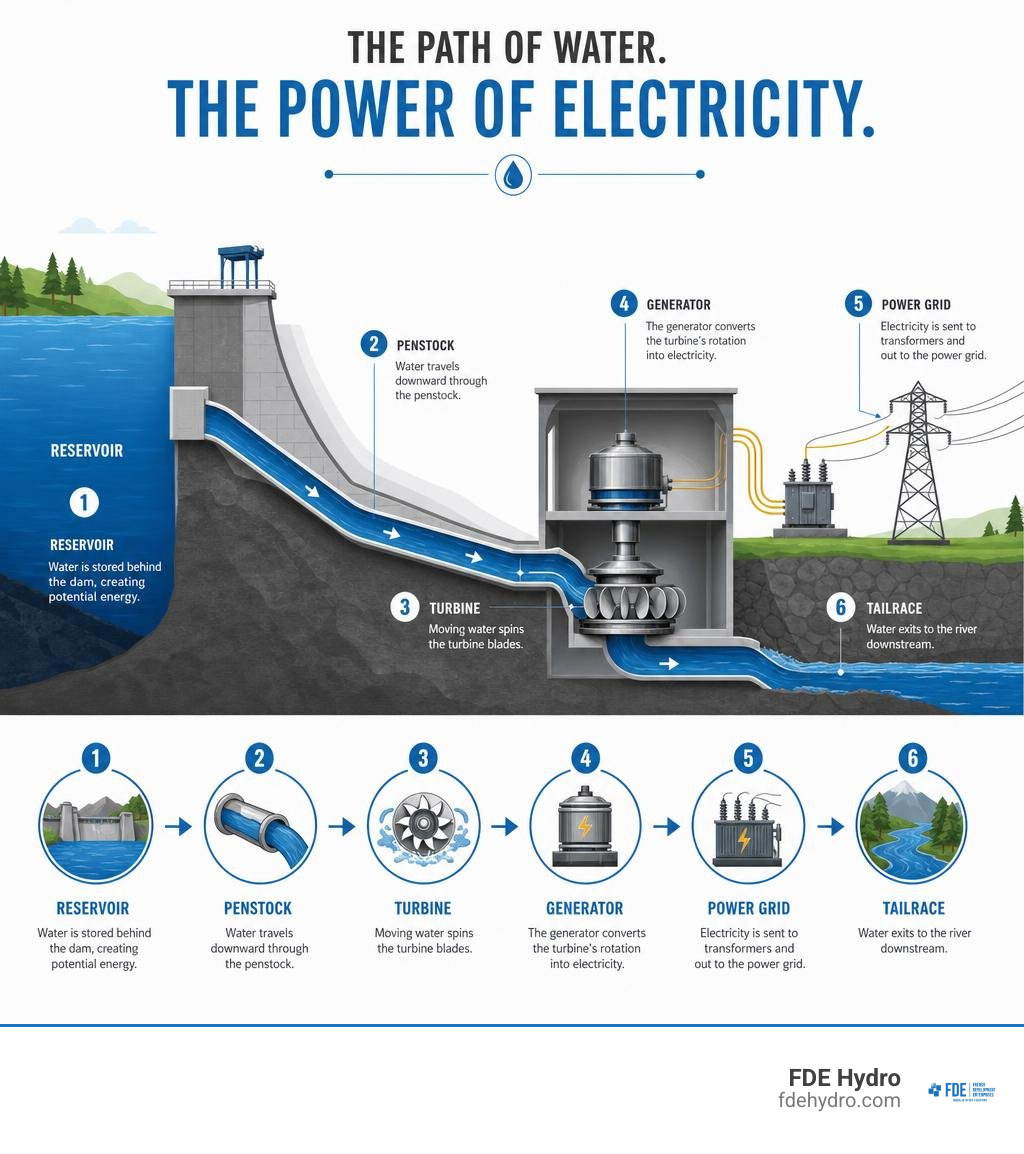
What is a hydro electric dam terms simplified:
What is a Hydro Electric Dam?

To truly understand what is a hydro electric dam, we have to look at it as a giant energy converter. It doesn’t actually “create” energy out of nothing; rather, it intercepts water moving through the natural water cycle and converts its physical energy into electrical current.
At its core, the system relies on two fundamental physics concepts: potential energy and kinetic energy.
- Potential Energy: Water stored high up in a reservoir behind a massive concrete wall possesses gravitational potential energy. The higher the water level rises, the more stored energy it accumulates.
- Kinetic Energy: When we open the gates, gravity pulls that water downward. As it rushes through the internal pipes, that stored potential energy transforms into kinetic energy—the energy of motion.
Two key factors dictate exactly how much electricity a facility can generate: head and flow.
- Head refers to the vertical distance the water falls. The greater the height difference between the reservoir surface and the turbine below, the higher the pressure, and the more power we can produce. For instance, the Oroville Dam in California stands at a staggering 230 meters tall, creating immense hydraulic head.
- Flow is the volume of water moving through the system over a given time. A massive volume of water moving slowly can sometimes produce just as much power as a small volume falling from a great height.
To dive deeper into the physics of how we capture this natural force, you can Learn more about how it works from the USGS or Read our guide on understanding hydroelectric power.
The Core Definition: What is a Hydro Electric Dam?
Stripped of its electrical components, a dam is simply a retaining structure. Humans have been building them for thousands of years to control the flow of local rivers. Beyond generating clean power, these structures serve several vital societal purposes:
- Water Supply & Irrigation: Reservoirs store water during wet seasons to supply municipal water systems and irrigate agricultural land during droughts. In fact, about 20% of the world’s arable land is irrigated by water from reservoirs impounded by dams.
- Flood Control: By acting as a giant safety valve, a dam can hold back sudden surges of rainwater or melting snow, protecting downstream communities from devastating floods.
- Recreation: Large reservoirs provide spaces for boating, fishing, and local tourism.
To explore the structural history of how these barriers are classified, you can Explore the definition of dams or Check out all about hydro dams to see how modern engineering has refined these ancient concepts.
How to Explain What is a Hydro Electric Dam to a Beginner
If you are explaining this to someone without an engineering degree, use the “bicycle generator” analogy. Remember those old bicycle lights that lit up when you pedaled? A small roller rubbed against the spinning tire, spinning a tiny magnet inside a coil of wire to power the bulb.
A hydroelectric dam works on that exact same principle of electromagnetic induction, first discovered by Michael Faraday.
Instead of your leg muscles spinning the bicycle wheel, the weight of falling water spins a massive water turbine (which looks like a giant metal fan). This turbine is connected by a heavy steel shaft to a generator above. Inside the generator, powerful electromagnets spin past heavy copper coils. This movement forces electrons to flow through the wire, creating an electrical current that can be sent straight to your living room.
If you want a step-by-step breakdown of this conversion process, you can Discover how hydro dams generate power.
Key Components of a Hydroelectric Dam Facility
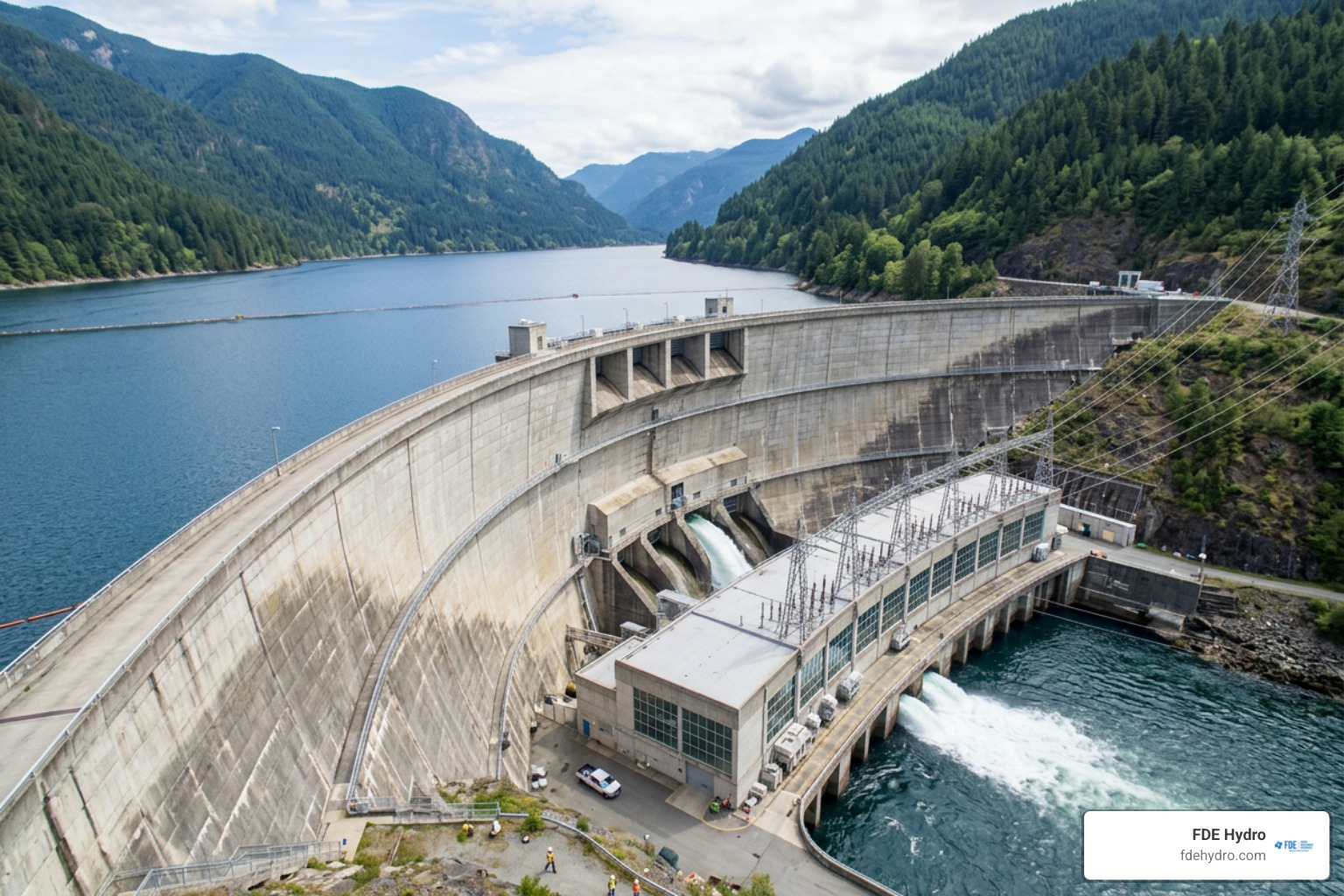
A functional hydroelectric facility is a complex ecosystem of mechanical and civil engineering. Let’s look inside the powerhouse and surrounding structures to see the core components that make it all happen:
- The Intake and Trash Racks: Water enters the system through gates located on the reservoir side of the dam. Before entering, it passes through heavy metal screens called trash racks, which prevent logs, rocks, and debris from entering and damaging the internal machinery.
- The Penstock: This is a long, heavy-duty steel or concrete pipe that channels water from the intake down to the turbine. The penstock is carefully designed to control the slope and build up maximum hydraulic pressure.
- The Turbine: Located at the bottom of the penstock, the turbine converts the kinetic energy of the rushing water into mechanical spin. Depending on the head and flow of the site, engineers use different turbine designs, such as Francis, Kaplan, or Pelton wheels.
- The Generator: Sitting directly above the turbine, this component uses Faraday’s principles of electromagnetism to convert the spinning mechanical energy into electrical energy.
- The Transformer: The electricity produced by the generator is relatively low voltage. Transformers step up this voltage so it can travel long distances over transmission lines with minimal energy loss.
- The Tailrace: After the water has passed through the turbine and surrendered its energy, it is discharged back into the natural river channel through an exit channel called the tailrace.
- The Spillway: If the reservoir gets too full during heavy storms, the spillway acts as an overflow safety valve, allowing excess water to bypass the turbines entirely and safely escape downstream.
To see how these individual parts fit together in a real-world design, Read our ultimate guide to dam components.
Types of Hydroelectric Power Systems
Not all hydroelectric plants look or operate the same way. Depending on the local geography, water availability, and grid demands, developers build different types of facilities.
| System Type | Water Storage | Primary Use | Grid Benefit |
|---|---|---|---|
| Impoundment | Large Reservoir | Baseload & Peak Power | High control, massive storage capacity |
| Diversion (Run-of-River) | Minimal to None | Baseload Power | Lower environmental footprint, constant output |
| Pumped Storage | Two Reservoirs (Upper/Lower) | Peak Demand Support | Acts as a giant water battery for grid stability |
To understand how these systems fit into the broader energy landscape, you can Learn about hydropower basics from the Department of Energy or Explore our hydroelectric power solutions guide.
Impoundment Facilities (Conventional Dams)
This is the classic image that comes to mind when you think of a hydroelectric dam. An impoundment facility uses a large dam structure to hold back a river and create a massive reservoir.
Because we can control exactly when and how much water passes through the gates, impoundment facilities offer unmatched flexibility. They can ramp electricity production up or down in a matter of minutes to match fluctuating grid demands. Famous examples of large conventional facilities include the Grand Coulee Dam on the Columbia River in Washington State (the largest U.S. hydropower facility with 6,765 MW of capacity) and the massive Itaipu Dam shared between Brazil and Paraguay.
To read more about the history and scale of these massive conventional structures, Read about conventional dams.
Diversion and Run-of-River Systems
A diversion, or run-of-river system, takes a completely different approach. Instead of blocking a river entirely with a massive wall, it channels a portion of the natural river flow through a canal or penstock to spin a turbine, before returning it directly to the main river channel.
These systems typically require little to no reservoir storage. Because they rely on the natural, seasonal flow of the river, they are highly dependent on local weather patterns and are generally used to provide steady baseload capacity. A great local example is the historic Bowersock Lawrence Hydroelectric Project in Lawrence, Kansas, which has harnessed the natural flow of the Kansas River for over a century.
To learn more about how these low-impact systems generate electricity without massive flooding, Learn about run-of-river systems.
Pumped Storage Hydropower
Pumped storage is not actually a primary energy source; instead, it acts as a giant, highly efficient physical battery.
These facilities use two reservoirs at different elevations:
- During low-demand periods (like 5:00 AM when everyone is asleep, or when solar and wind are producing excess power), we use cheap electricity from the grid to pump water from the lower reservoir up to the higher one.
- During peak-demand periods (like 5:00 PM on a hot summer day when air conditioners are humming), we release that water back down to the lower reservoir, spinning the turbines to generate high-value electricity when the grid needs it most.
While pumped-storage systems actually consume more electricity to pump the water than they generate (making them net negative energy devices), they provide crucial grid stability and account for roughly 88% of all utility-scale energy storage in the United States. To see how modern technology is optimizing these systems, Explore modern hydropower technology.
Advantages and Disadvantages of Hydropower
Like any energy source, hydroelectric power comes with trade-offs. Balancing the immense economic and grid benefits against the local environmental impacts is one of the most critical challenges of modern energy design.
The Advantages
- Renewable & Clean: Hydropower relies on the natural water cycle, meaning it won’t run out. Once constructed, these facilities produce virtually zero greenhouse gas emissions during operation.
- Grid Flexibility & Reliability: Unlike wind and solar, which depend on the weather, impoundment and pumped-storage facilities can provide immediate “firm capacity” to stabilize the grid.
- Low Operational Costs: Because the fuel (water) is free, operational and maintenance costs are incredibly low over the long term.
- Multipurpose Infrastructure: The reservoirs created by dams provide water storage, flood protection, and recreational spaces for local communities.
The Disadvantages
- Ecosystem Disruption: Blocking a river can disrupt natural fish migration patterns, particularly for species like salmon. (Though we can mitigate this using modern fish ladders and bypass systems).
- Siltation: Dams trap sediment that would naturally flow downstream, which can lead to reservoir siltation over decades and alter downstream habitats.
- High Initial Capital Costs: Traditional concrete dams are incredibly expensive and take years to construct.
- Drought Vulnerability: If water levels drop significantly due to severe droughts, electricity generation capacity can be severely limited.
To explore how modern engineering is working to maximize these benefits while minimizing ecological impacts, Discover the benefits of hydropower plants.
Construction, Design, and Global Capacity
Building a traditional hydroelectric dam is one of the most demanding civil engineering challenges on earth. The process typically begins by diverting the river using temporary structures called cofferdams so that workers can prepare a dry foundation. Heavy crews must excavate down to solid bedrock, grout any fissures to prevent under-dam seepage, and pour millions of cubic meters of concrete in carefully managed blocks to prevent cracking as the concrete cures.
In Canada, there are more than 10,000 dams, with 933 categorized as large dams. The tallest of these is the Mica Dam on the Columbia River, standing at an impressive 243 meters tall. In the United States, the highest dam is located near Oroville, California, standing at 230 meters tall and stretching 1.6 kilometers across.
However, traditional construction methods are slow, carbon-intensive, and expensive. That is why at FDE Hydro™, we developed our patented French Dam technology.
By utilizing modular precast concrete blocks manufactured in a controlled indoor environment, we can bypass the slow, unpredictable process of pouring mass concrete on-site. This innovative approach allows us to build and retrofit hydroelectric dams and water control systems in North America, Brazil, and Europe in a fraction of the time and at a significantly reduced cost.
To learn more about the engineering principles behind these massive structures, Read about hydroelectric dam design and Learn about hydroelectric dam construction.
Frequently Asked Questions about Hydroelectric Dams
What is the largest hydroelectric dam in the world?
The largest hydroelectric facility in the world by generating capacity is the Three Gorges Dam on the Yangtze River, boasting an incredible capacity of 22,500 megawatts (MW). For comparison, the largest facility in the United States is the Grand Coulee Dam at 6,765 MW. In South America, the Itaipu Dam on the border of Brazil and Paraguay is another global giant, with a capacity of 14,000 MW.
How efficient is hydroelectric power compared to other sources?
Hydroelectric turbines are incredibly efficient, often converting 90% or more of the water’s kinetic energy into electricity. By comparison, fossil-fuel plants (like coal or natural gas) are typically only 33% to 50% efficient because they lose a massive amount of energy as wasted heat. To read more about how we measure and optimize this output, Read about hydroelectric dam efficiency.
What is the lifespan of a typical hydroelectric dam?
A well-maintained hydroelectric dam is an incredibly long-term asset, with a typical lifespan of 65 to 85 years—and many can operate for over a century with proper retrofitting. While the mechanical components (like turbines and generators) may need to be refurbished or replaced every few decades, the concrete structure itself can last for generations.
To learn more about how we keep these aging facilities running efficiently, Learn about hydroelectric power generation.
Conclusion
As we navigate the global transition toward a clean energy future, the humble hydroelectric dam remains an indispensable cornerstone of our electrical grid. It provides the reliable, flexible, and renewable baseload power that wind and solar simply cannot match on their own.
At FDE Hydro™, we believe the future of hydropower lies in rapid, cost-effective modernization. Our patented modular precast concrete technology—the French Dam—is actively changing how communities across North America, Brazil, and Europe build, repair, and retrofit their water control infrastructure. By slashing construction timelines and reducing environmental footprints, we are helping to ensure that the power of moving water continues to light up our world for centuries to come.
To see how we can help bring your next water control or hydropower project to life, Visit FDE Hydro to learn more about our innovative hydroelectric dams.
