

What Is the High Voltage Grid — and Why Does It Matter?
The high voltage grid is the backbone of modern electricity supply — a vast network of transmission lines, substations, and transformers that moves bulk power from where it is generated to where it is needed.
Quick answer for those in a hurry:
| Question | Answer |
|---|---|
| What is the high voltage grid? | A network that transmits bulk electricity at voltages of 110 kV and above from power plants to local substations |
| Why use high voltage? | Higher voltage means lower current, which dramatically reduces energy lost to heat over long distances |
| AC or DC? | Mostly AC; HVDC is used for very long distances and undersea cables |
| Who manages it? | Transmission System Operators (TSOs) and Regional Transmission Organizations (RTOs) |
| How efficient is it? | US transmission losses have dropped from 6.6% in 1997 to around 5% by 2019 |
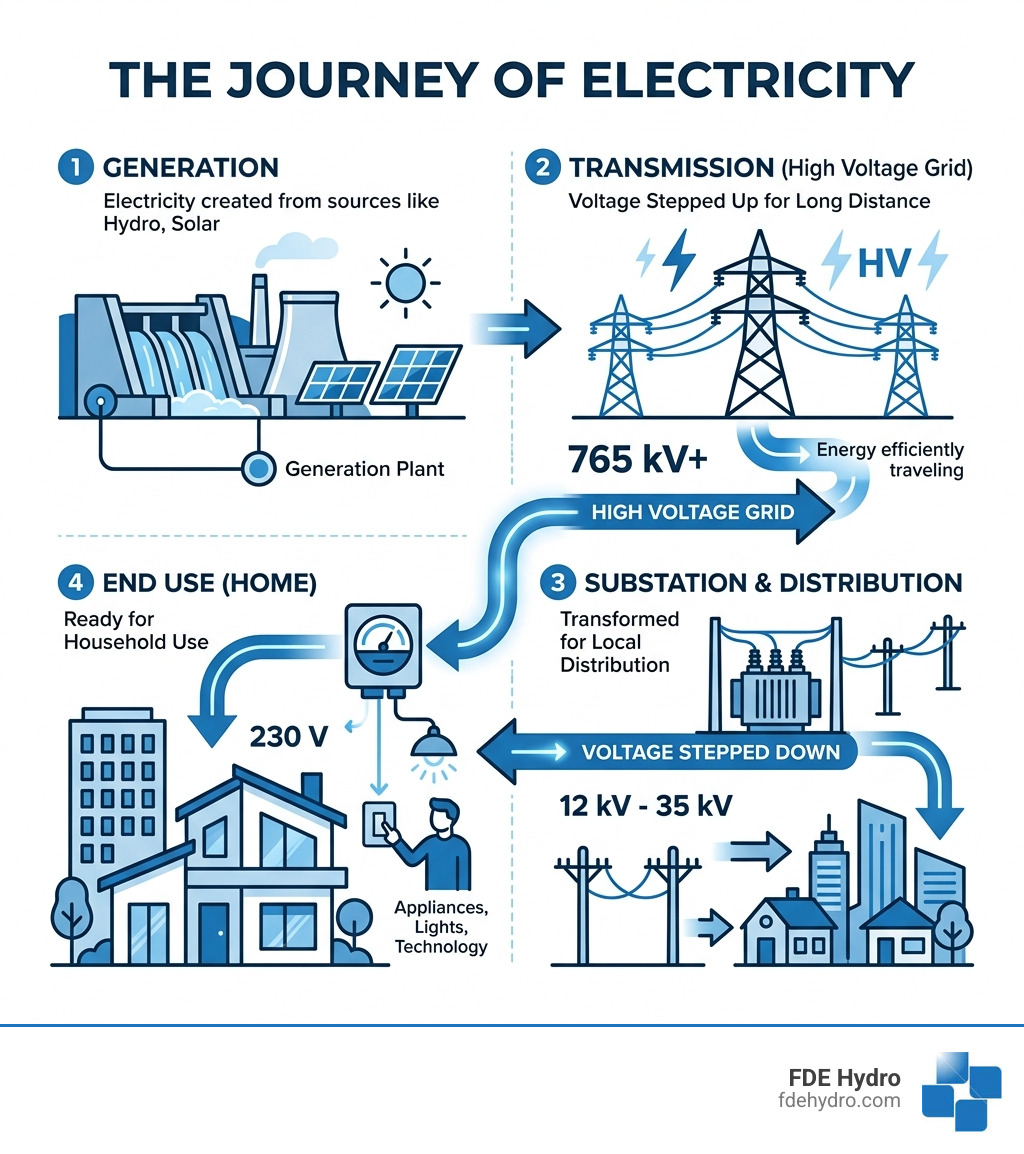
Every time you flip a switch, electricity has already traveled hundreds of miles through this system — often invisibly, silently, and at voltages that would be unrecognizable to the average household. Your home runs on roughly 230 volts. The lines outside your city carry up to 765,000 volts or more.
That gap is not an accident. It is engineering by design — and understanding it matters more than ever as grids strain under the weight of data centers, electrification, and the clean energy transition.
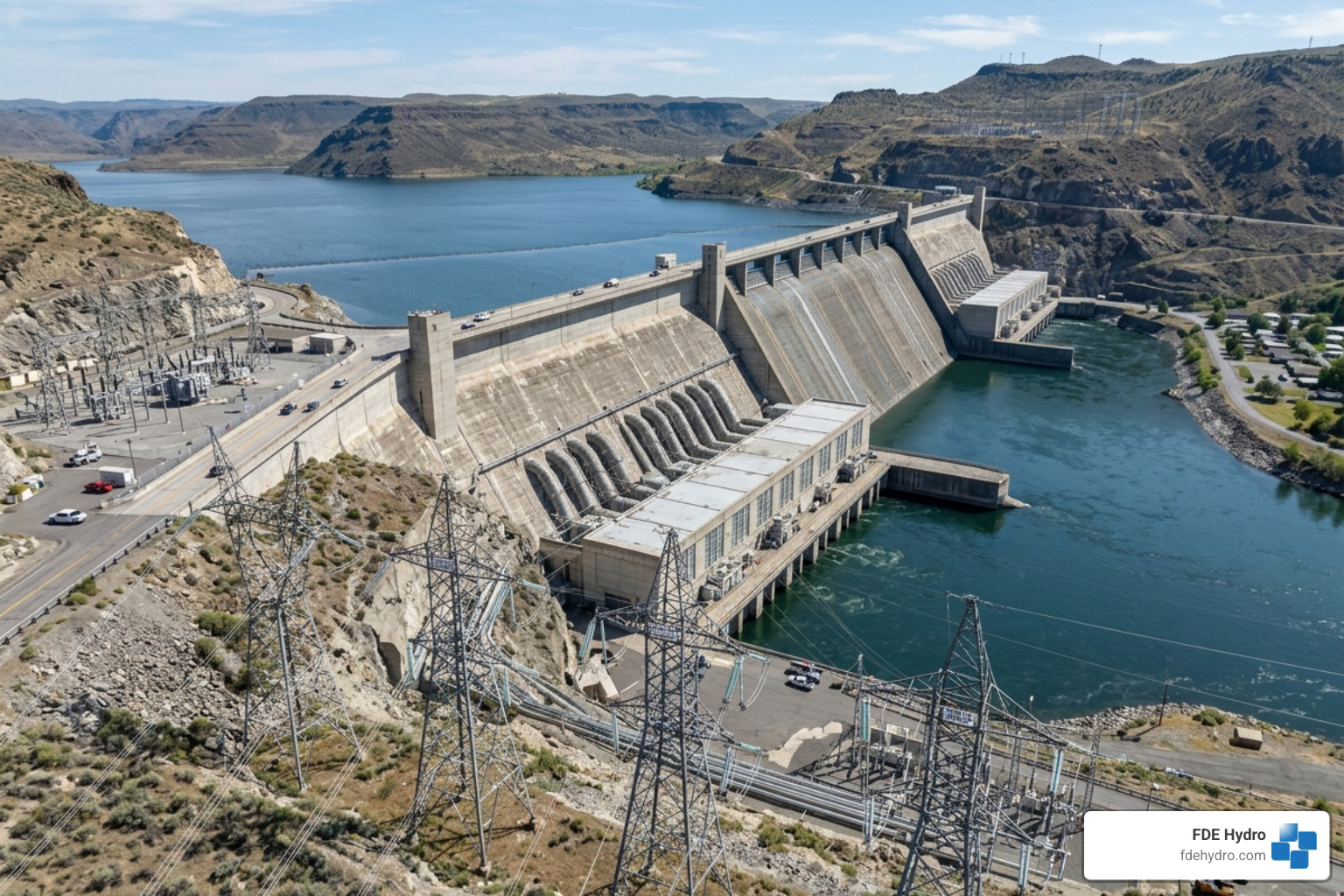
Consider Grand Coulee Dam: its 6,809 MW of generating capacity moves out through just six 500 kV transmission circuits. That single example captures the scale and precision the high voltage grid demands.
I’m Bill French, Sr., Founder and CEO of FDE Hydro™ — and for decades, my work in heavy civil construction and hydropower innovation has placed me squarely at the intersection of energy generation and the high voltage grid that delivers it. That experience shapes everything in this guide.
High voltage grid vocab explained:
Understanding the High Voltage Grid: Transmission vs. Distribution
When we talk about the power grid, it’s easy to picture it as one giant web of wires. However, it is actually divided into two distinct stages: transmission and distribution. Unplugging the mystery of the grid helps us see that these aren’t just different names for the same thing—they serve entirely different purposes.
Electric power transmission is the “bulk movement” of energy. Think of it as the interstate highway system for electricity. It carries massive amounts of power from generating sites, like large hydroelectric dams or wind farms, over long distances to electrical substations. These lines are built to handle extreme pressure. According to TenneT grid operations, transmission-level voltages are usually considered to be 110 kV (110,000 volts) and above. In the United States, common levels range from 230 kV to 500 kV.
Once that electricity reaches a local substation, it enters the distribution phase. This is the local street network. Here, step-down transformers reduce the voltage to levels safe for residential and commercial use—typically 230V or 400V. While distribution gets the power to your front door, the high voltage grid is what does the heavy lifting to get it across the country.
The Physics of Efficiency: Why High Voltages Reduce Energy Loss
You might wonder: why bother cranking the voltage up so high just to step it down later? The answer lies in the physics of efficiency.
When electricity travels through a wire, it meets resistance. This resistance turns some of the electrical energy into heat—a phenomenon known as Joule heating or $I^2R$ losses. The “I” stands for current, and the “R” stands for resistance. Because the loss is proportional to the square of the current, even a small reduction in current leads to a massive reduction in energy waste.
By increasing the voltage, we can transmit the same amount of power with much less current. It’s like increasing the pressure in a water pipe to move more water through a thinner hose.
Statistics of Scale
The impact of this efficiency is staggering. Electric power transmission fundamentals show that a 100-mile span at 765 kV carrying 1,000 MW of power might lose only 0.5% to 1.1% of its energy. In contrast, a 345 kV line carrying that same load across the same distance would lose about 4.2%.
To minimize these losses further, engineers use:
- Bundle Conductors: Using multiple cables for a single phase to reduce “corona discharge” (the hissing sound you sometimes hear near big lines).
- Kelvin’s Law: An economic principle used to find the “sweet spot” between the cost of thicker, more expensive wires and the cost of energy lost to resistance.
In the US, these strategies have paid off. Transmission and distribution losses were estimated at 6.6% in 1997, but improved grid management brought that down to a steady 5% between 2013 and 2019.
AC vs. DC: Comparing Current Types in Modern Transmission
For over a century, the “War of the Currents” between Thomas Edison (DC) and Nikola Tesla (AC) has shaped our world. Alternating Current (AC) won the early battle because it could be easily stepped up or down using transformers, making it the standard for the high voltage grid.
However, High-Voltage Direct Current (HVDC) has made a massive comeback in the 21st century. While AC is great for regional networks, HVDC is the champion of long-distance and specialized applications.
| Feature | Alternating Current (AC) | Direct Current (DC) |
|---|---|---|
| Best For | Regional grids & local distribution | Ultra-long distances & subsea cables |
| Distance Limit | Effective up to ~4,000 km | Effective up to ~7,000 km |
| Subsea Use | Limited by capacitance (>50km) | Excellent for long undersea links |
| Grid Linking | Requires synchronized frequency | Can link unsynchronized grids |
A prime example is the HVDC Itaipu project in Brazil, which moves massive amounts of hydropower over 800 km. Another modern marvel is the Viking Link, the longest land-and-subsea interconnector in the world, stretching 765 km between the UK and Denmark. HVDC is also essential for connecting grids that aren’t in sync, acting as a “firewall” that prevents a blackout in one region from cascading into another.
Managing Stability within the High Voltage Grid
Keeping the grid stable is a balancing act that happens every millisecond. The Brains Behind The Grid are the Transmission System Operators (TSOs). They must ensure that the supply of electricity exactly matches the demand.
In Europe, the grid frequency is maintained at 50 Hz, while in North America (including New York, California, and Canada), it is 60 Hz. If the frequency deviates too far because of an imbalance, equipment can be damaged, or the grid can collapse. TSOs use “reactive power” support—like capacitor banks and FACTS (Flexible AC Transmission Systems) devices—to stabilize voltage and keep the power flowing smoothly.
Infrastructure and Components: Overhead Lines vs. Underground Cables
If you look up, you’ll see the most common component of the high voltage grid: overhead lines. These are usually made of aluminum alloy, often reinforced with steel (ACSR). They aren’t insulated with rubber like the wires in your walls; instead, they use the air itself as an insulator, which is why they are hung high up on lattice steel pylons.
Overhead vs. Underground: The Great Debate
We are often asked: “Why don’t we just put everything underground?” It’s a fair question, especially in storm-prone areas of Kansas or crowded cities like New York City.
Overhead Lines:
- Pros: Much cheaper to build (US$128.9 billion was spent on T&D equipment globally in 2011 alone); easier to find and fix faults; cooled by the wind.
- Cons: Vulnerable to weather (wind speeds as low as 23 knots can cause issues); visual impact; requires large clearings.
Underground Cables:
- Pros: Hidden from view; protected from wind and ice; takes up less surface space in urban areas.
- Cons: Costs up to 10 times more than overhead lines; harder to repair; limited by “capacitance” in AC systems, which restricts how far they can carry power before losing it.
The North American power transmission grid relies heavily on overhead lines for its massive “backbone” because the sheer scale of the continent makes undergrounding cost-prohibitive for long-haul transmission.
Grid Management, Economics, and Security Challenges
The high voltage grid is a market as much as it is a machine. Long-distance transmission costs roughly US$0.005–0.02 per kWh. When you compare that to retail rates that can exceed $0.10 per kWh, it’s clear that transmission is a relatively small but vital part of your bill.
However, the grid is currently at a crossroads. We are seeing a massive surge in demand driven by:
- Data Centers: A single large data center can consume as much power as 80,000 homes.
- AI Expansion: AI and grid expansion are forcing utilities to build new lines faster than ever, often facing pushback from landowners.
- Electrification: The shift toward EVs and electric heating is changing when and where we need power.
Security and Future Tech for the High Voltage Grid
Modern grids face more than just weather threats. Cybersecurity is a top priority as hackers target the digital controls that manage power flow. Physical security is also a concern, as transmission towers are often located in remote, difficult-to-monitor areas.
To meet these challenges, the industry is looking toward Ultra High Voltage (UHV) development. China has already pioneered 1,100 kV DC systems that can move power across entire continents.
Other innovations include:
- Reconductoring: Replacing old wires with high-tech materials that can carry twice the power without needing new towers.
- Superconducting Cables: Wires cooled to extreme temperatures that have zero electrical resistance.
- Grid-Enhancing Technologies (GETs): Using sensors for “dynamic line ratings,” which allow operators to push more power through lines when the weather is cool and windy.
If the grid fails entirely, we rely on the Black Start Blueprint—a carefully choreographed plan to restart the grid using “firm” power sources like hydropower.
Frequently Asked Questions about High Voltage Transmission
Are there health risks associated with living near high-voltage lines?
This is a common concern. However, scientific evidence from decades of study has not established a direct link between the electromagnetic fields (EMF) from power lines and long-term health issues. Most countries follow international safety standards that require specific “setback” distances to ensure that EMF levels at ground level are well within safe limits.
Why don’t we put all high-voltage lines underground?
As mentioned, it’s mostly about economics and physics. Undergrounding costs about 10 times more than overhead lines. Furthermore, underground AC cables act like giant capacitors, which creates “phantom” power loads that make long-distance transmission nearly impossible without expensive compensation equipment.
What is the difference between High Voltage (HV) and Extra High Voltage (EHV)?
In the industry, we generally classify voltages as:
- High Voltage (HV): 110 kV to 230 kV. These are the workhorses of regional transmission.
- Extra High Voltage (EHV): 345 kV to 765 kV. These are used for moving massive amounts of power over hundreds of miles.
- Ultra High Voltage (UHV): Above 800 kV (DC) or 1,000 kV (AC), used for intercontinental “supergrids.”
Conclusion
The high voltage grid is the silent engine of our modern life. As we move toward a future powered by clean energy, the importance of this infrastructure will only grow. At FDE Hydro™, we understand that a reliable grid starts with reliable generation.
Our innovative, patented modular precast concrete technology—the “French Dam”—is designed to make building and retrofitting hydroelectric dams faster and more cost-effective. By providing “firm” power that can balance out intermittent wind and solar, hydropower remains one of the 4 Reasons Why Hydropower Is The Guardian Of The Grid.
Whether it’s in the United States, Canada, Brazil, or Europe, we are committed to strengthening the energy backbone that keeps our world running.
Ready to dive deeper into energy? Explore more power grid articles to learn how we’re building the future of sustainable power, one dam at a time.
