

Why Next Generation Fish Passage Protection Matters for Our Rivers and Ecosystems
Next generation fish passage protection refers to the latest technologies, engineering approaches, and collaborative strategies that help migratory fish safely navigate or bypass man-made barriers like dams, culverts, and levees.
Here’s a quick overview of what it includes:
- Advanced turbine designs that allow fish to pass through hydropower facilities with up to 99% survival rates
- Fish-friendly infrastructure such as nature-like fishways, improved fish ladders, and trap-and-haul systems
- Innovative monitoring tools like environmental DNA (eDNA) sampling and acoustic tracking sensors
- Strategic dam removal to restore free-flowing river connectivity
- Multi-agency collaboration between federal programs, Tribes, states, and private partners
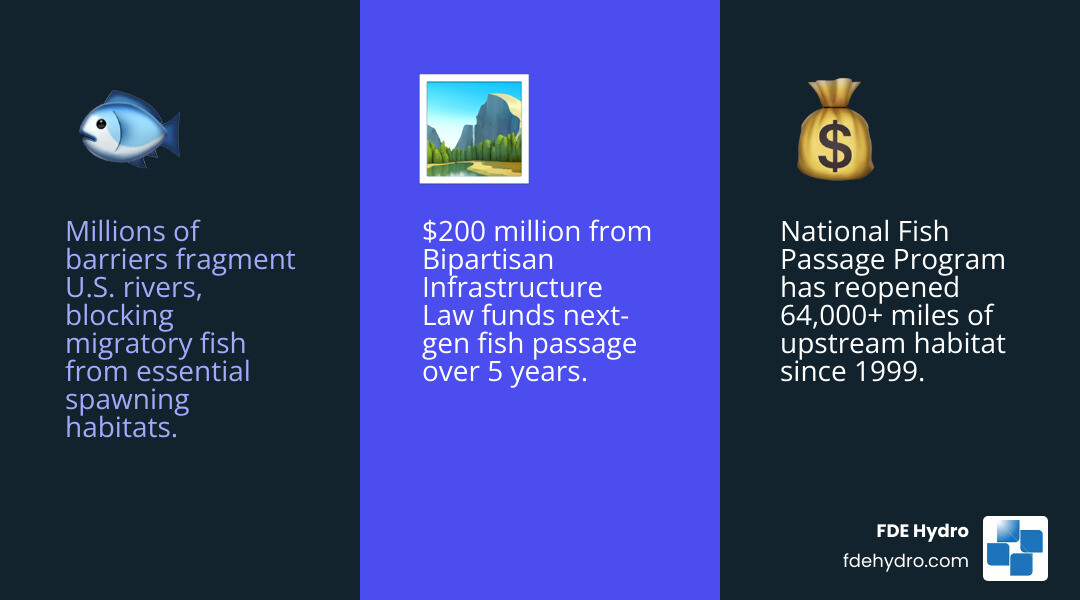
Across the United States, millions of barriers fragment rivers and block fish migration — cutting off species like Chinook salmon, American eel, and Pacific lamprey from the spawning and rearing habitats they need to survive. Since 1999, the National Fish Passage Program alone has removed or bypassed over 3,500 barriers, reopening access to more than 64,000 miles of upstream habitat. Yet the scale of the problem still far outpaces current solutions.
The good news? A new generation of technologies and funding — including $200 million over five years from the Bipartisan Infrastructure Law — is transforming how we protect aquatic ecosystems while keeping hydropower infrastructure productive and resilient.
I’m Bill French, Sr., Founder and CEO of FDE Hydro™ and a participant in the U.S. Department of Energy’s Hydropower Vision Technology and Performance Task Force, where I helped shape next-generation hydropower strategies for Congress — work that sits at the heart of next generation fish passage protection. In the sections below, I’ll walk you through the full landscape: from conventional passage methods and their limitations, to cutting-edge engineering, real-world case studies, and what the future holds for balancing energy production with healthy, connected waterways.
Terms related to next generation fish passage protection:
The Evolution of River Connectivity: From Ladders to Next Generation Fish Passage Protection
For over a century, the primary way we helped fish get past dams was through relatively simple mechanical structures. While these were at the time, our understanding of aquatic biology has evolved. We’ve moved from merely “getting fish over the wall” to ensuring they arrive at their destination healthy and ready to spawn.
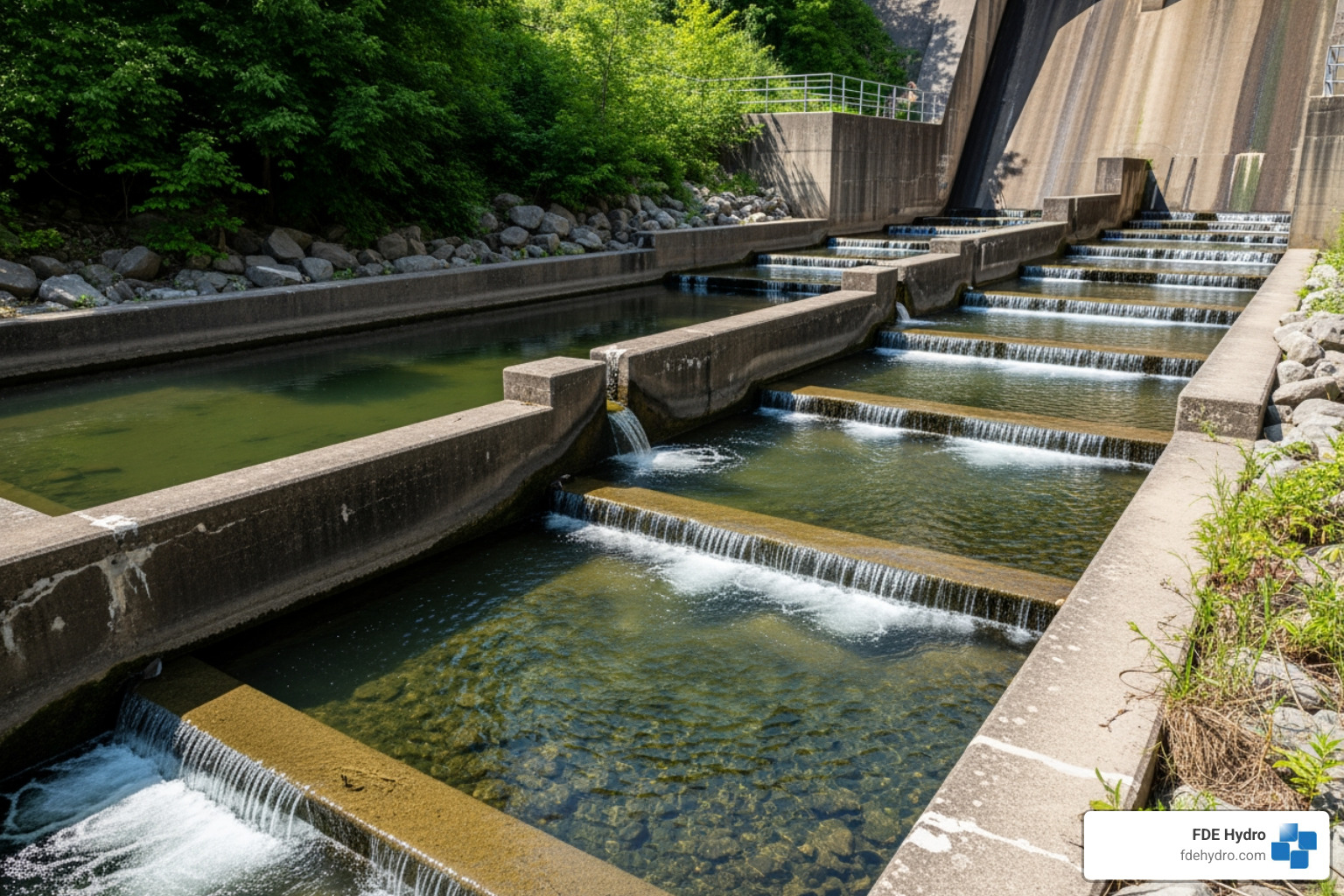
Historically, numerous fish passage technologies have been employed to mitigate the impact of dams. These include:
- Fish Ladders: A series of stepped pools that allow fish to leap or swim from one level to the next.
- Fish Lifts (Elevators): Mechanical hoppers that collect fish at the base of a dam and lift them to the reservoir above.
- Trap-and-Haul: Systems where fish are captured in tanks and driven by truck or barge to upstream release points.
- Spillways: Channels designed to allow water (and hopefully fish) to bypass the turbines during high-flow events.
While these methods have saved countless fish, they often cause migration delays and increase predation risks. If a fish spends three days trying to find the entrance to a ladder, it burns through energy reserves needed for spawning.
Limitations of Conventional Systems
Conventional systems are rarely “one size fits all.” A ladder designed for a powerful jumper like a Chinook salmon might be completely impassable for a Pacific lamprey, which uses a “burst-and-attach” suction method to move. Furthermore, scientific research on fishway performance shows that many technical fishways suffer from low attraction efficiency—meaning fish simply can’t find the door.
Environmental trade-offs also exist. For example, spillways can lead to gas supersaturation, where elevated dissolved gases in the water cause “the bends” in fish. Additionally, predators like sea lions often congregate at the base of these structures, turning a conservation tool into an ecological trap.
Innovative Monitoring in Next Generation Fish Passage Protection
To fix what isn’t working, we need data. Modern next generation fish passage protection relies on high-tech monitoring to see what’s happening beneath the surface.
One of the most exciting developments is collecting and analyzing RNA and DNA (eDNA) from water samples. By simply testing a cup of river water, scientists can identify which species are present and even estimate their population size with up to 98% accuracy. This non-invasive method is far safer than traditional netting or handling.
For individual tracking, researchers now use specialized sensors and acoustic transmitters. These tiny tags act like a “Fitbit for fish,” recording water pressure, temperature, and movement patterns as the fish navigates a hydropower facility.
Cutting-Edge Engineering for Fish-Friendly Hydropower
At FDE Hydro, we believe that clean energy and healthy rivers must go hand-in-hand. This is why we focus on aquatic-animal-and-recreational-passage as a core component of our modular dam technology. By using precast concrete sections, we can integrate passage solutions directly into the dam’s structure more efficiently than traditional construction allows.
The engineering world has seen a massive shift toward “fish-friendly” turbines. For example, the U.S. Army Corps of Engineers installed a new turbine at the Ice Harbor Dam on the Snake River that achieved a survival rate of 98%, a significant jump from the 90% seen with older designs. Other innovations, like the Restoration Hydro Turbine (RHT), use thicker, rounded blades and specific slants to allow fish like rainbow trout and American eel to pass through completely unharmed.
Future Digital Controls for Next Generation Fish Passage Protection
The next frontier isn’t just better concrete or steel; it’s better software. Digital, Information, Communication, and Control (DICC) technologies allow dam operators to track fish in real-time and adjust water flows instantly.
Imagine a system that detects a school of migrating salmon approaching and automatically opens a bypass gate or slows a turbine to ensure safe passage. These automated systems improve climate resilience by optimizing flow even during unpredictable weather patterns, ensuring that the dam works with the river’s natural rhythm rather than against it.
Balancing Energy Production and Biodiversity
Hydropower is a powerhouse of the American grid, providing 28.7% of all U.S. renewable energy and 6.2% of total electricity generation. Because it can provide steady “baseload” power, it’s the perfect partner for variable sources like wind and solar.
However, maintaining this grid reliability requires constant R&D. The Water Power Technologies Office (WPTO) recently announced $6.3 million for six projects aimed at advancing next generation fish passage protection. These projects use a new type of sensor to monitor small migratory fish like American Shad, which have historically been difficult to study due to their size and sensitivity.
Restoring Habitat Through Strategic Dam Removal and Infrastructure Upgrades
Sometimes, the best fish passage is no dam at all. For obsolete or dangerous structures that no longer provide significant power or flood control, removal is the gold standard for restoration.
The Bipartisan Infrastructure Law (BIL) has been a game-changer here, providing a once-in-a-generation $200 million investment. Recently, the U.S. Fish and Wildlife Service announced $70 million to support 43 projects across 29 states. These projects address outdated dams and culverts that have fragmented our watersheds for decades. To see the impact near you, you can ACCESS THE INTERAGENCY FISH PASSAGE PORTAL to view the data dashboard of ongoing work.
Case Studies in Connectivity Restoration
We are seeing incredible results from coast to coast:
- Penobscot River, Maine: Through the Penobscot Habitat Focus Area, NOAA and its partners removed dams and installed nature-like fishways, opening 3,100 acres and 30 miles of habitat. This has benefited Atlantic salmon and helped restore 100% of the historic habitat for the shortnose sturgeon.
- California’s Second Largest Dam Removal: On the South Fork Eel River, the removal of the Benbow Dam improved access to 100 miles of spawning habitat for Chinook salmon and steelhead.
- Rogue River, Oregon: The removal of three major dams restored 300 miles of migratory access, proving that large-scale restoration is possible when stakeholders work together.
Economic and Community Benefits of Passage Projects
Improving fish passage isn’t just good for the environment; it’s a smart investment for people. Outdated dams and undersized culverts are often “bottlenecks” that increase flood risks during heavy rains. By replacing a crumbling culvert with a wider, stream-simulation structure, we improve road resilience and protect local property.
Furthermore, Fish Passage Projects Address Climate Resilience by strengthening local economies. Healthy fish populations mean better recreational fishing opportunities, which support tourism and local tackle shops. In many cases, these projects also eliminate public safety hazards posed by “low-head” dams, which can create dangerous drowning machines for kayakers and swimmers.
Collaborative Frameworks and Global Lessons for Aquatic Biodiversity
Successful next generation fish passage protection requires a seat at the table for everyone. This includes federal agencies, state governments, local communities, and, crucially, Tribes. Indigenous knowledge of fish behavior and historical migration patterns is invaluable for designing passage that actually works.
In the Columbia-Snake River Basin (CSRB), for example, collaborative efforts have been essential for protecting the Pacific lamprey—a species of immense cultural importance to Pacific Northwest Tribes. These partnerships ensure that conservation goals are met while maintaining the hydropower that powers the region.
Scaling Success from North America to Southeast Asia
The lessons we learn in North America are now being exported to help protect global biodiversity. The future of fish passage science involves scaling these successes to regions like Southeast Asia, where massive hydropower development on the Mekong River threatens the food security of millions.
Through masterclasses and capacity-building programs, experts are training the next generation of professionals to use “The Big 5” criteria for fishway design: entrance location, tailwater range, headwater range, fishway dimensions, and exit location. This knowledge transfer ensures that as developing nations build their energy infrastructure, they don’t repeat the ecological mistakes of the past.
Addressing Environmental Trade-offs
No solution is perfect, and we must be honest about the trade-offs. Restoring “lateral connectivity” (connecting the river to its floodplain) is vital for species like the trispot darter, but it can also allow invasive species to spread more easily.
To manage this, we use Passage Guidelines for Select Native Fishes to create “selective” passage. This might involve using specific water velocities that native fish can handle but invasive species cannot, or using automated sorting gates. It’s a delicate balance, but with modern sensors and better engineering, we’re getting closer to a truly “smart” river.
Frequently Asked Questions about Next Generation Fish Passage Protection
What are the primary challenges posed by dams to fish migration?
Dams create physical barriers that block access to spawning grounds, but they also change the river’s environment. They can alter water temperatures, slow down the flow (making it harder for juvenile fish to navigate downstream), and concentrate predators at passage entrances.
How has the Bipartisan Infrastructure Law impacted fish passage projects?
The BIL provided a massive $200 million injection of funding over five years. This has allowed the National Fish Passage Program to scale up from small, local fixes to watershed-level restorations, such as removing multiple barriers in a single river system to reopen hundreds of miles of habitat at once.
What innovative technologies are improving fish survival at hydropower facilities?
Key innovations include advanced “fish-friendly” turbines with rounded blades, eDNA monitoring to track populations non-invasively, and acoustic sensors that provide real-time data on how fish interact with dam structures. These tools allow for “precision conservation” that was impossible 20 years ago.
Conclusion
The future of our rivers depends on our ability to innovate. At FDE Hydro, we are proud to contribute to this mission with our “French Dam” technology. By utilizing modular precast concrete, we make it faster and more cost-effective to build and retrofit dams with next generation fish passage protection in mind. Whether it’s in New York, California, or our projects in Brazil and Europe, our goal remains the same: sustainable hydropower that respects the life of the river.
We invite you to ACCESS THE INTERAGENCY FISH PASSAGE PORTAL to see how these national efforts are unfolding. If you’re interested in how we can help your community or facility, Learn more about modernizing hydropower infrastructure and join us in protecting our aquatic friends for generations to come.
