

Is a Mini Hydro Power Plant Worth the Investment in 2026?
The cost of mini hydro power plant projects is one of the most searched questions among infrastructure decision-makers right now — and for good reason. Here’s a quick answer before we dive deeper:
Mini and micro hydro system costs at a glance (2026):
| System Size | Estimated Total Cost | Cost per kW |
|---|---|---|
| 1-5 kW (pico/micro) | $5,000 – $55,000 | $2,500 – $5,000/kW |
| 5-100 kW (micro) | $15,000 – $500,000 | $1,500 – $5,000/kW |
| 100 kW – 1 MW (mini) | $500,000 – $10M+ | $5,000 – $10,000/kW |
Note: Costs vary significantly based on site conditions, head height, turbine type, and civil works complexity.
Small-scale hydropower sits at a fascinating crossroads in 2026. On one side, you have genuinely compelling economics — low operating costs, long asset life, and predictable output that solar and wind simply can’t match. On the other, the upfront price tag and project complexity can feel daunting, especially when conventional construction methods drive costs higher than they need to be.
The numbers tell an interesting story. A modest 5 kW micro hydro system typically runs between $15,000 and $55,000 all-in, while larger mini hydro projects in the 100 kW to 1 MW range can reach well into the millions. But the per-kilowatt cost doesn’t tell the whole story. Unlike solar panels sitting idle on a cloudy day, a well-sited hydro system runs around the clock — giving it a long-term economic edge that changes how you calculate real value.
This guide breaks down exactly where the money goes, what drives costs up or down, and where modern modular construction methods are reshaping the economics of small hydro development.
I’m Bill French, Sr., Founder and CEO of FDE Hydro™, and I’ve spent decades in heavy civil construction before focusing specifically on reducing the cost of mini hydro power plant development through patented modular and precast construction systems. My work with the U.S. Department of Energy’s Water Power Technology Office has given me a front-row seat to the real cost drivers in this industry — and where the biggest opportunities for savings lie.
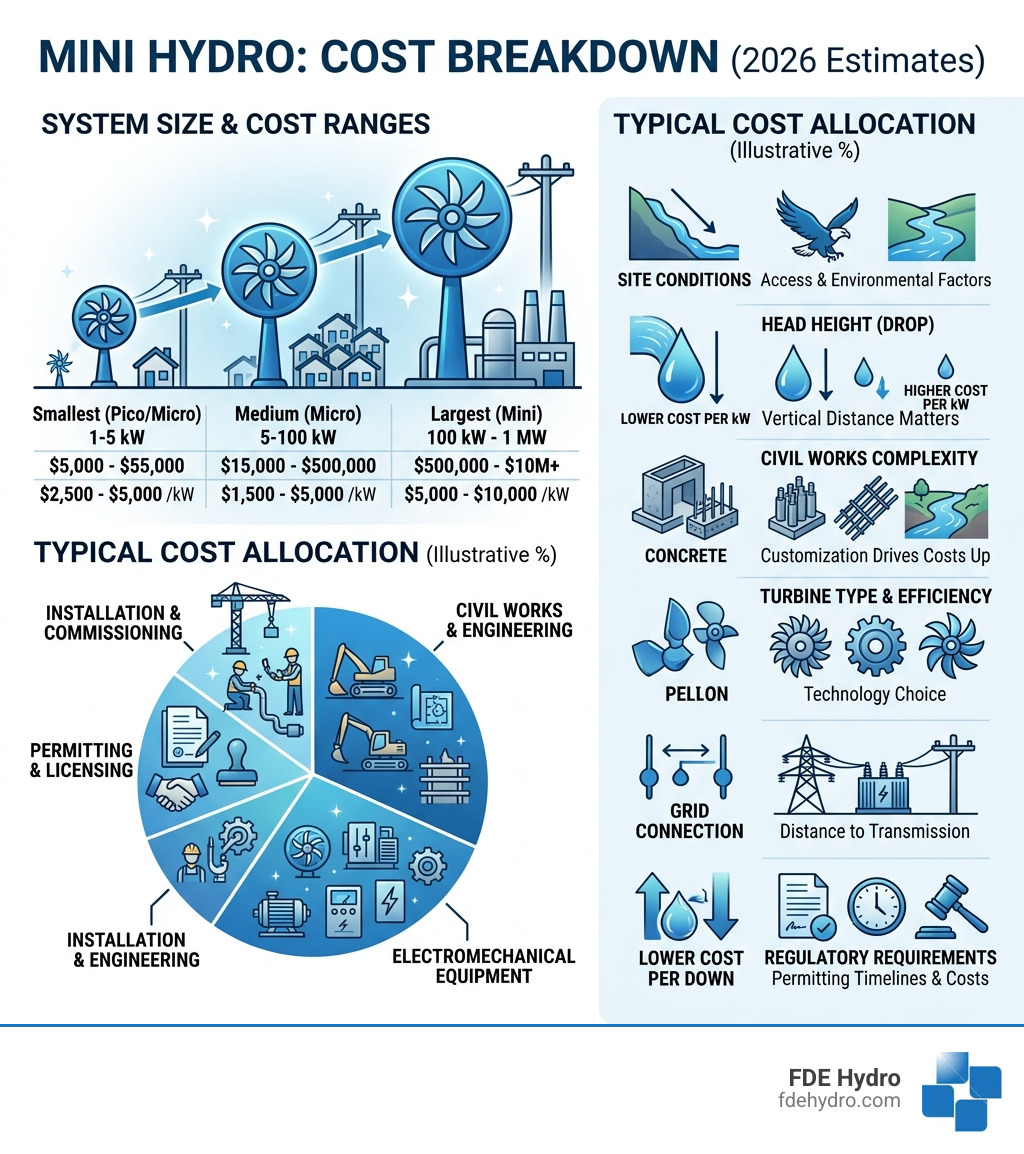
Quick look at cost of mini hydro power plant:
Breaking Down the Total Cost of Mini Hydro Power Plant Projects
When we look at the capital expenditure (CAPEX) for a hydroelectric project, it’s rarely just about the turbine. In fact, for many projects, the mechanical equipment is the smaller slice of the pie. The “hidden” costs often lie in the civil works—the concrete, the digging, and the infrastructure required to get water to the machine and power to the grid.
For a standard 5 kW micro system, you might spend $4,000 on the turbine but $20,000 on the powerhouse and $8,000 on the piping. As you scale up to a 100 kW mini hydro plant, the complexity grows. A deep dive into Hydro Power Project Costs A Deep Dive Into The Dollars And Cents reveals that site-specific civil engineering can account for up to 60% of the total budget.
| Component | 5 kW Micro System Cost | 100 kW Mini System Cost |
|---|---|---|
| Turbine | $4,000 – $13,000 | $40,000 – $150,000 |
| Generator | $800 – $6,000 | $15,000 – $60,000 |
| Powerhouse / Civil Works | $5,000 – $20,000 | $150,000 – $600,000 |
| Piping (Penstock) | $3,500 – $8,000 | $50,000 – $200,000 |
| Controls & Electrical | $800 – $3,000 | $20,000 – $80,000 |
| Installation & Labor | $3,000 – $8,000 | $100,000 – $300,000 |
Equipment and Component Cost of Mini Hydro Power Plant Systems
The mechanical heart of your plant—the turbine and generator—varies in price based on quality and origin. You can find a Cost of micro hydro power plant listing for a few thousand dollars on global marketplaces, but for long-term reliability in North American or European climates, industrial-grade components are essential.
Induction generators are often favored for their lower cost and simplicity, especially for grid-tied systems. However, if you are running an off-grid homestead or a remote industrial site, you might opt for more expensive permanent magnet generators that offer better efficiency at variable speeds. Control panels have also evolved; in 2026, most systems include digital governors and safety shut-offs as standard, adding a few thousand dollars to the equipment bill but potentially saving the turbine from catastrophic overspeed events.
Piping and Intake Infrastructure Expenses
The intake is where your project begins, and it’s often where environmental regulators focus their attention. High-quality Hydropower Project Costs include the price of specialized screens—like Coanda screens—which allow water through while keeping fish and debris out. These can cost between $1,500 and $4,000 for small systems but drastically reduce maintenance.
The penstock (the pipe that carries water to the turbine) is another major variable. While HDPE (High-Density Polyethylene) is popular for its durability and ease of installation in rugged terrain, the length of the run is the primary cost driver. A short, steep run is always more cost-effective than a long, shallow one.
Key Factors Influencing Small-Scale Hydropower Investment
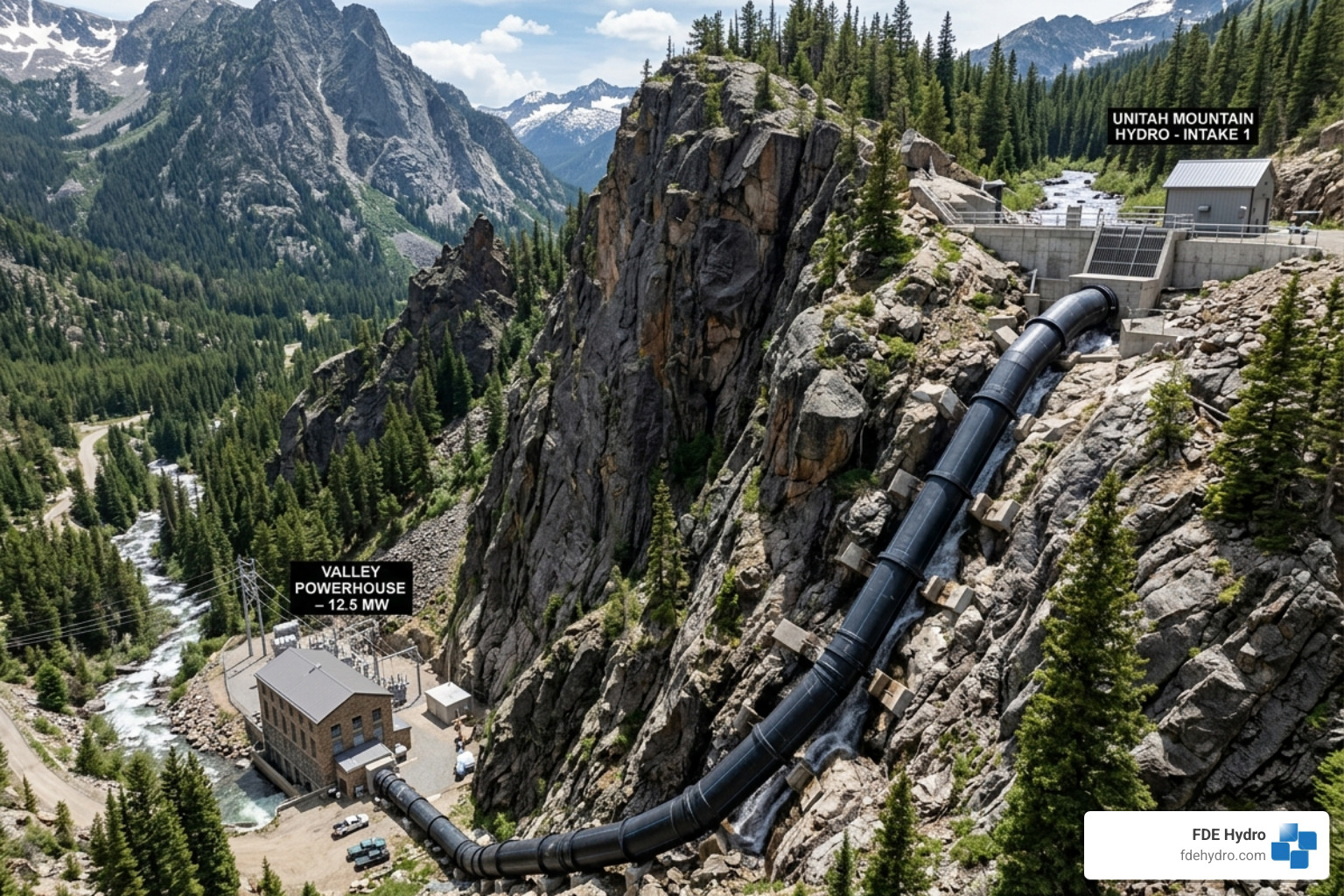
Hydropower is uniquely site-dependent. Unlike solar, where you can just add more panels, a hydro site is limited by the laws of physics: Power = Head x Flow x Efficiency.
- Head (Vertical Drop): This is the most critical factor. High head (a steep drop) allows you to use a smaller, faster, and cheaper turbine to generate the same amount of power as a low-head site.
- Flow Rate: This determines the volume of water available. More flow means a larger turbine and larger diameter piping, which increases the cost of mini hydro power plant construction.
- Site Accessibility: If we have to build a road to get a crane to your powerhouse site, your costs will skyrocket. This is where modular, smaller components become a financial lifesaver.
The U.S. Hydropower Market Report (2023 edition) highlights that while equipment costs have remained relatively stable, the labor and regulatory costs associated with site preparation have seen the most volatility.
Site-Specific Variables Affecting the Cost of Mini Hydro Power Plant Construction
Geological conditions can make or break a budget. Encountering solid bedrock during penstock trenching or finding unstable soil at the intake site can add tens of thousands in unforeseen expenses. This is a primary reason why we advocate for thorough site assessments before a single shovel hits the ground.
Environmental permitting is another “soft cost” that feels very “hard” when the bills arrive. Even for micro-scale projects, you may need water rights, fish passage studies, and interconnection agreements with your local utility. In North America, the regulatory landscape has improved—with expedited exemptions for certain small conduit projects—but budgeting $5,000 to $15,000 for “paperwork” is a realistic baseline for mini-scale projects. You can learn more about these complexities in our guide to Breaking Down The Dam Costs Of Hydropower Projects.
Automation and Remote Monitoring Requirements
In 2026, “unattended operation” is the goal for most small plants. Modern smart controls and IoT (Internet of Things) integration allow you to monitor bearing temperatures, vibration, and electrical output from your smartphone. While these systems add roughly 5-10% to the initial electrical budget, they significantly improve Hydroelectric Dam Efficiency and reduce the need for manual site visits, which is a major long-term saving.
Long-Term Financial Performance and Operational Costs
The real magic of hydropower is in the “O&M”—Operations and Maintenance. While a diesel generator or even a wind turbine has many high-wear moving parts, a well-designed hydro turbine is remarkably simple.
Ongoing annual maintenance for a micro hydro plant typically averages between $0.005 and $0.02 per kWh. For a 5 kW system running at a high capacity factor, you might only spend a few hundred dollars a year on grease, seal replacements, and clearing debris from the intake. This is significantly lower than the $213/kW average O&M cost seen in older, less efficient small-scale plants. For more on keeping these costs low, see our resource on Hydro Power Plant Maintenance.
Return on Investment and Levelized Cost of Energy
The Levelized Cost of Energy (LCOE) for micro hydro is among the lowest in the renewable world, often ranging from $0.05 to $0.15 per kWh over the life of the system. Compare that to the 25-30 cents per kWh some remote communities pay for grid power, and the investment starts to look very attractive.
With the 2025 federal Investment Tax Credit (ITC) offering a 30% credit for renewable energy property, many of our clients are seeing payback periods of 7 to 12 years. When you consider that a hydro plant can easily last 40 to 50 years with basic care, you’re looking at 30+ years of essentially free electricity. The Benefits Of Hydropower Plant ownership extend far beyond the initial balance sheet.
Strategies to Minimize Initial Capital Expenditure
We’ve spent years at FDE Hydro™ figuring out how to kill the “custom-built” cost trap. Traditionally, every hydro plant was a bespoke engineering project. By moving toward modular design and prefabricated components, we can slash construction timelines and labor costs.
Our patented “French Dam” technology uses precast concrete modules that act as both the water control structure and the foundation for the powerhouse. This approach eliminates the need for expensive on-site formwork and the “hurry up and wait” of pouring concrete in remote river environments. We’ve found that Why Precast Cost Less isn’t just about the material—it’s about the weeks of labor saved.
Utilizing Modular Powerhouses and Existing Infrastructure
One of the smartest ways to reduce the cost of mini hydro power plant development is to stop building new dams. North America is full of “non-powered dams”—structures that already exist for flood control or irrigation but don’t produce a single watt of power.
By using Modular Powerhouses, we can “plug in” a generation system to an existing canal drop or dam outlet. This avoids the most expensive and environmentally sensitive part of the project: the dam itself. This strategy is central to how we Reduce Construction Costs for our clients in New York, Canada, and Brazil.
Scalable Implementation and Project Cost Reduction
If the total budget is a hurdle, we often recommend a phased approach. Start with the “Minimum Viable System”—the intake and a single turbine—and design the civil works to accommodate a second turbine later as budget allows. Using local labor for simple tasks like penstock trenching while reserving experts for the turbine alignment is another classic Project Cost Reduction tactic.
Frequently Asked Questions about Small Hydro Costs
What is the estimated total cost for a 5 kW micro hydro system in 2026?
In 2026, a high-quality 5 kW system typically costs between $15,000 and $55,000. The lower end covers DIY-heavy installations with shorter penstocks, while the higher end reflects “turnkey” professional installations with significant civil works or complex terrain.
How do mini hydro costs compare to solar or wind installations?
While the upfront cost of hydro is often higher per watt than solar, the output is much higher. A 5 kW solar array might produce 15-20 kWh per day (depending on sun), but a 5 kW hydro system can produce 120 kWh per day because it runs 24/7. This makes the “cost per generated kWh” for hydro significantly lower over time.
What are the primary ongoing maintenance expenses for small plants?
The main expenses are bearing lubrication, intake cleaning (seasonal), and periodic seal replacements. For grid-tied systems, there may also be annual insurance and “interconnection” fees charged by the utility, but these are generally minimal compared to the energy savings.
Conclusion
As we look at the energy landscape of April 2026, the cost of mini hydro power plant technology is becoming more accessible than ever. The shift toward modular construction, combined with favorable tax incentives and high-efficiency smart controls, has turned small-scale hydro from a “hobbyist” pursuit into a serious infrastructure investment.
Whether you are a landowner in New York looking for energy independence or a developer in Brazil retrofitting existing water systems, the key to success is mitigating risk early. By focusing on accurate site data and utilizing modern construction methods like our precast modular systems, you can turn a mountain stream into a 50-year financial asset.
Secure your investment with long-term hydropower financing and risk mitigation and start your journey toward sustainable, 24/7 power today.
