

Why Low-Cost Precast Hydropower Is Changing the Economics of Clean Energy
Low-cost precast hydropower is a construction approach where concrete dam and powerhouse components are manufactured off-site in controlled factory conditions, then rapidly assembled on-site — cutting capital costs by 40–60% and project timelines by up to 50% compared to traditional cast-in-place methods.
Key benefits at a glance:
- Cost reduction: 40–60% lower construction costs vs. conventional dams
- Speed: Project duration cut up to 4x; saves 6–12 months on average
- Capital cost targets: $2,124–$3,419/kW at real project sites
- LCOE target: $0.05–$0.07/kWh for greenfield sites
- Durability: 100+ year certified service life
- Environmental impact: Minimal riverbed disruption, built-in fish and sediment passage
The U.S. sits on enormous untapped clean energy potential — 65 gigawatts in undeveloped rivers and streams, plus another 12 gigawatts at existing non-powered dams. Yet hydropower accounts for only about 7% of America’s electricity, and greenfield stream development makes up less than 10% of recent capacity growth.
The reason? Civil construction costs. Depending on project size, physical civil works can consume anywhere from 40% to 90% of total hydropower capital costs. Conventional cast-in-place concrete construction is slow, weather-dependent, and riddled with schedule and budget risk. That financial burden has kept hundreds of viable hydropower sites sitting idle.
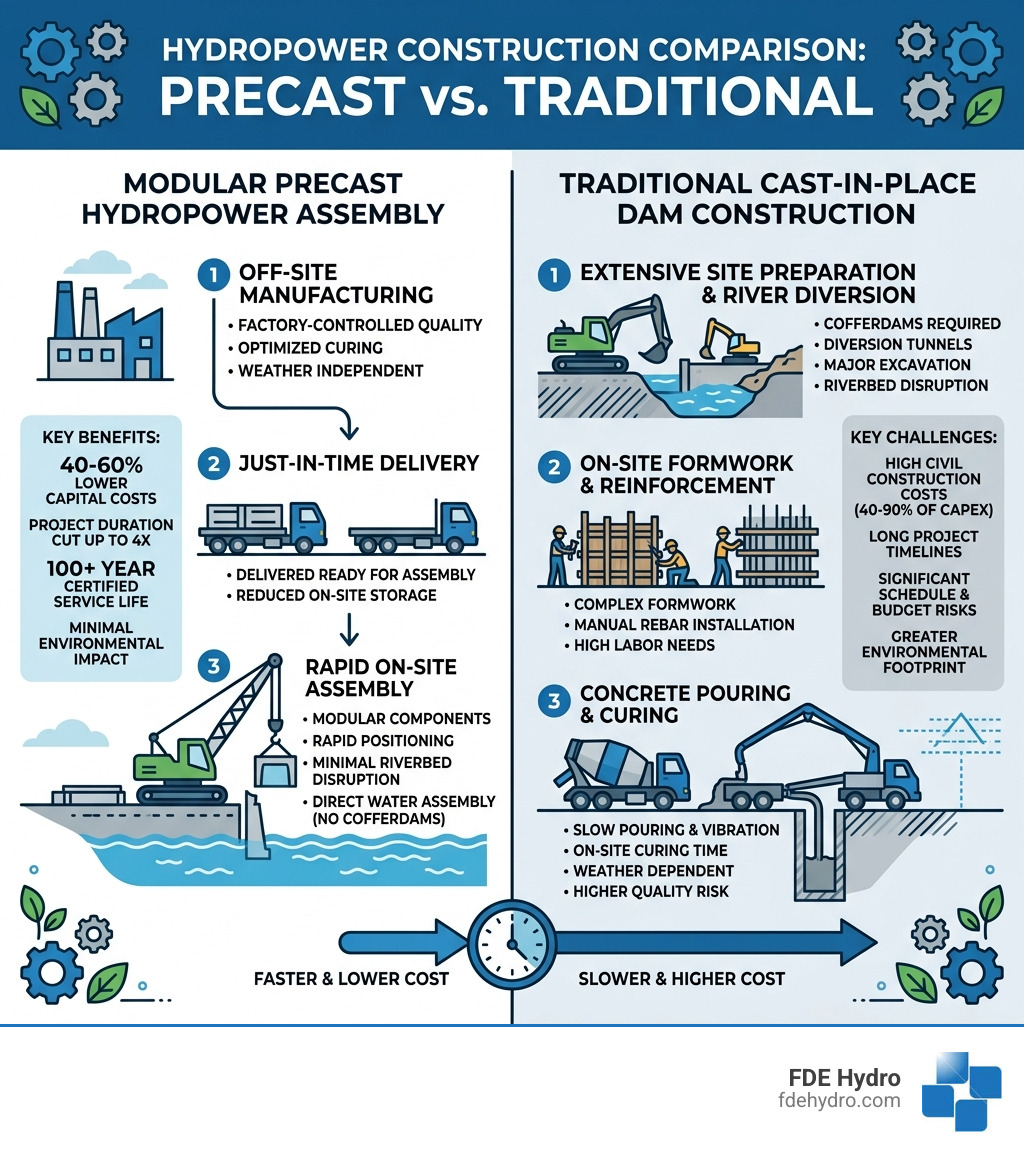
Precast modular construction flips that equation. Components are built in a factory — where quality is controlled, curing is optimized, and weather doesn’t matter — then delivered just-in-time and assembled on-site, even directly in the water without cofferdams or diversion tunnels. The result is a faster, cheaper, lower-risk path to clean hydropower generation.
I’m Bill French Sr., Founder and CEO of FDE Hydro™, and I’ve spent decades in heavy civil construction — including landmark modular infrastructure projects — before developing the patented French Dam technology to bring low-cost precast hydropower from concept to reality with U.S. Department of Energy support. In this guide, I’ll walk you through exactly how precast modular systems work, what they cost, and why they represent the most promising path to unlocking America’s untapped hydropower potential.
Related content about low-cost precast hydropower:
The Shift to Low-Cost Precast Hydropower
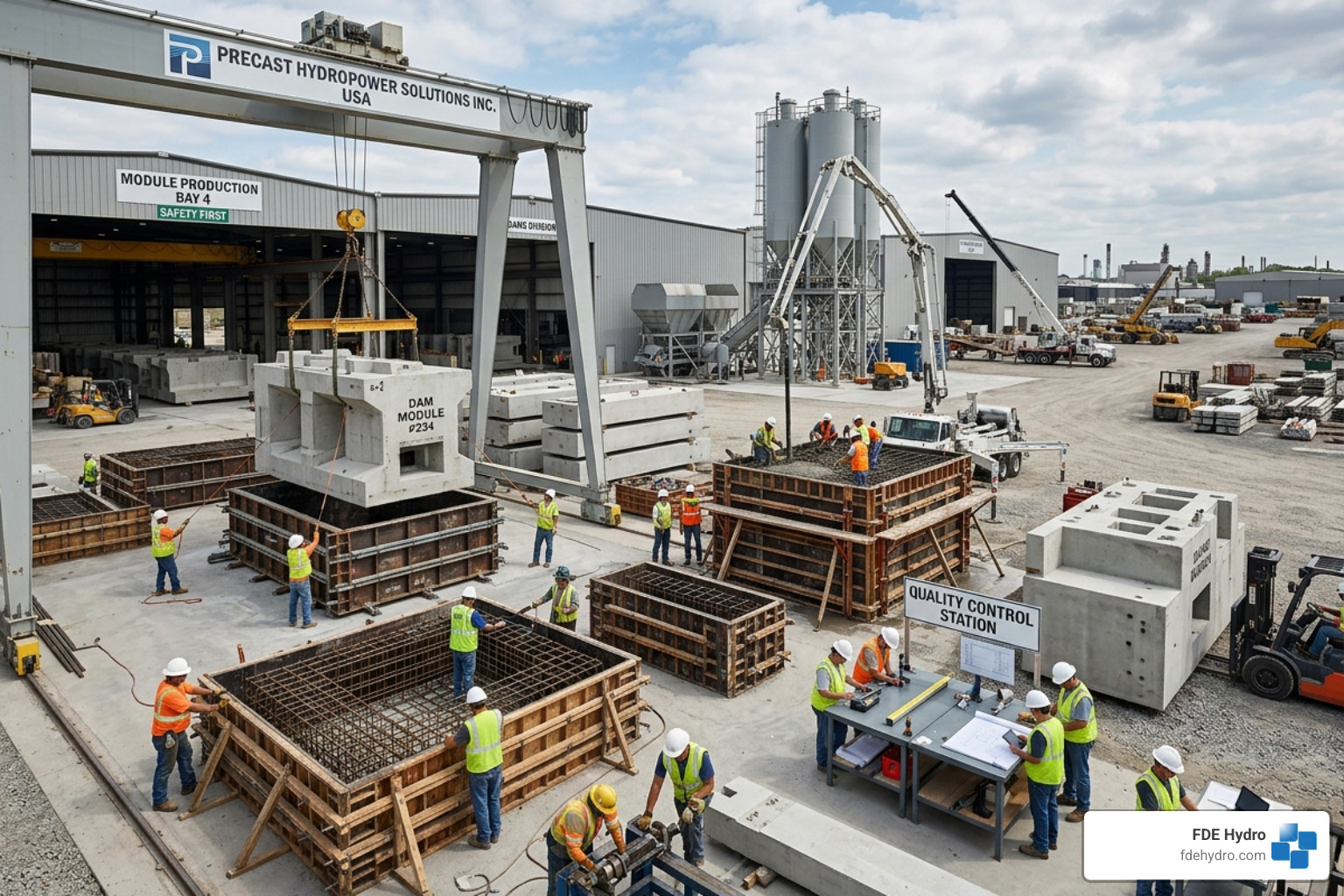
For decades, the hydroelectric industry has been stuck in a “bespoke” mindset. Every dam was a unique, site-specific engineering challenge requiring thousands of tons of concrete to be poured on-site. We are changing that by introducing precast modularity—a shift from construction to manufacturing.
In traditional construction, you are at the mercy of the river. You have to build expensive cofferdams to divert water, wait for dry weather to pour concrete, and hope the curing process isn’t ruined by a sudden cold snap or flood. With low-cost precast hydropower, we move the heavy lifting to a controlled factory environment.
By utilizing Precast Concrete Advantages, we eliminate the “unpredictable” from the environment. Our modules are manufactured to exact specifications, allowing for “in-the-wet” installation. This means we can often install structures directly into the waterway without massive diversion tunnels or temporary dams. This weather-independent scheduling ensures that if the factory is running, the project is moving forward. This is the core of Modular Precast Concrete: bringing industrial precision to the riverbank.
Standardizing Low-Cost Precast Hydropower Components
The key to lowering costs is standardization. In the past, turbines and dams were designed from scratch for every site. Our h-Modulor system changes this by using standardized, stackable modules.
We break the dam down into functional “blocks”:
- Generation modules: These house the turbomachinery and power electronics.
- Water passage modules: These include crest gates and spillway sections.
- Sediment passage modules: Essential for river health, these use sluice gates to allow natural river materials to move downstream.
By treating a dam like a sophisticated set of LEGOs, we use Precast Concrete Technology to create a system where components are interchangeable and scalable.
Rapid Deployment and Site Disturbance
One of the biggest hurdles for new hydro is the environmental “footprint” of construction. Traditional sites look like massive scars on the landscape for years. Because our modules are truck-transportable and ready for immediate assembly, we can complete on-site work in a fraction of the time.
Rapid installation means minimal riverbed disruption. Instead of a multi-year construction circus, we aim for a surgical strike. This approach is the hallmark of Modular Dam Construction, where the goal is to get in, get the power flowing, and let the river return to its natural state as quickly as possible.
Economic Advantages of Modular Systems
The math behind low-cost precast hydropower is hard to ignore. When civil works represent up to 90% of your budget, cutting those costs in half changes everything.
| Feature | Traditional Cast-in-Place | Precast Modular (French Dam) |
|---|---|---|
| Construction Time | 2–4 Years | 6–12 Months |
| Capital Cost (CapEx) | High ($5,000+/kW) | Low ($2,100–$3,500/kW) |
| Weather Risk | Significant | Minimal |
| Labor Costs | High (On-site specialized) | Lower (Off-site manufacturing) |
| Environmental Impact | High (Diversion/Cofferdams) | Low (In-the-wet assembly) |
We have seen Project Cost Reduction reach 40-60% in comparative studies. This isn’t just a theory; our work has been supported by the U.S. Department of Energy (DOE) under initiatives like FOA DE-FOA-0001286. The DOE set a “stretch goal” of getting installed capital costs below $2,000/kW. While traditional methods struggle to stay under $5,000/kW, our h-Modulor redesigns are already hitting estimates well below $3,500/kW. To understand the granular details of these savings, see Why Precast Cost Less.
Achieving Competitive LCOE Targets
The Levelized Cost of Energy (LCOE) is the ultimate metric for any power plant. For hydropower to compete with wind and solar in April 2026, it needs to hit a target of $0.05–$0.07/kWh.
We achieve this through:
- 80% Capacity Factor Sizing: Unlike wind or solar, hydro provides steady, baseload-like power.
- Early Commissioning: By saving a year on construction, you start selling electricity a year sooner, which drastically improves the project’s Internal Rate of Return (IRR).
For a deep dive into the financial modeling of these sites, check out Hydro Power Project Costs A Deep Dive Into The Dollars And Cents.
Long-Term Durability and Warranties
A common question we get is: “If it’s cheaper and faster, is it weaker?” Actually, the opposite is true. Concrete poured on a rainy job site is rarely as strong as concrete cured in a climate-controlled factory.
Because we control the batch consistency and curing environment, we can offer a 100-year warranty on civil structures. This high-strength concrete is engineered to outlast the very people who install it. The Precast Concrete Industry has proven this durability in bridges and skyscrapers for decades; we are simply applying those rigorous standards to the water.
Environmental and Performance Metrics
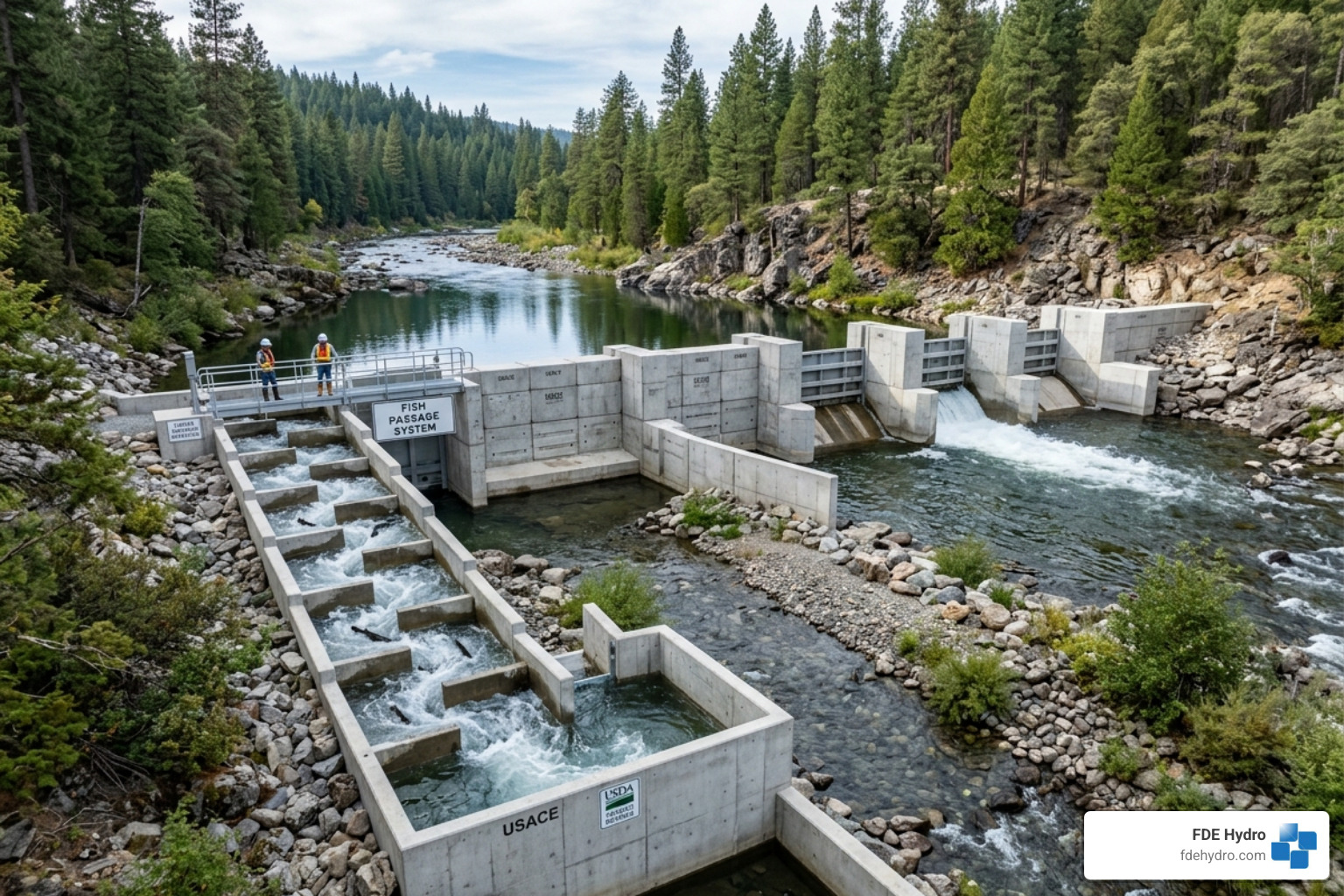
Modern hydropower must be “low-impact.” We don’t just want to generate green electrons; we want to preserve the river’s ecosystem. Our modular designs include dedicated stacks for fish bypass, sediment management, and maintaining water quality.
Projects like Canada’s $11BN Green Energy Project Is A Game Changer show the scale of what is possible, but our focus is on making that same impact at a local level with minimal land use. Furthermore, because our dams are modular and secured with underpinning rather than massive permanent excavation, they are much easier to decommission or reconfigure if environmental needs change in the future. This “easy-on, easy-off” approach is a core value of the Modular Precast Dam.
Innovations in Water and Sediment Passage
Our recent h-Modulor redesigns have focused on reducing the weight of generation modules by 45-56%, which reduces the number of truckloads needed for a project by a third. But the real innovation is in how the water moves. We’ve integrated:
- Sluice gates: To prevent sediment buildup that plagues traditional dams.
- Recreational passage: Allowing kayakers and boaters to navigate the river safely.
These features ensure that French Dam Technology Passes The Test for both engineers and environmentalists.
Supporting Green Energy Growth
There is a massive opportunity at “non-powered dams”—structures that already exist for flood control or irrigation but don’t produce a single watt of power. Adding our modular powerhouses to these sites is one of the fastest ways to grow the grid.
In places like New York, where New York doles out more low-cost hydropower allocations to spur job growth, the demand for clean, local energy is sky-high. By using Precast Models, we can turn these silent giants into clean energy engines without the massive costs of a new greenfield build.
Real-World Case Studies: Balcony Falls and LPS 566
To prove the viability of low-cost precast hydropower, we look at two primary design case studies: Balcony Falls and LPS 566.
Balcony Falls (James River, VA): This site served as our primary design case. By using the h-Modulor system, we estimated an installation cost of $3,419/kW. Perhaps more impressively, the construction timeline was projected at just 58 weeks. In hydropower, finishing a project in just over a year is nearly unheard of.
LPS 566 (Spokane River, WA): Our secondary case study showed even more dramatic savings. This site achieved an estimated cost of $2,124/kW with a lightning-fast 42-week construction timeline.
These aren’t just numbers on a page; they represent the Prototype Of Modular Precast French Dam Completed and tested under real-world conditions. We’ve proven that we can assemble a full-scale prototype (six 27,000lb blocks) in under 3.5 hours.
Scalability and Replication Potential
The beauty of a standardized design is that once you solve it for one river, you can replicate it for a hundred others. We use rules-based modeling to sift through thousands of potential sites. In our research, we narrowed down 7,000 potential U.S. sites to 168 high-priority candidates that are perfect for modular deployment. As Precast Pushes The Limits Of Scale, we see a future where hydropower isn’t a “one-off” project, but a repeatable product.
DOE Funding and R&D Milestones
Our journey has been marked by significant R&D milestones supported by the DOE (FOA-1836). We were awarded $1,421,666 to develop “Rapidly Deployable Hydropower Civil Works Technologies.” This funding allowed us to focus on weight reduction and “truck-transportable” modules that don’t require specialized oversized load permits for every single piece. These innovations are directly aimed at lowering Hydropower Project Costs across the board.
Frequently Asked Questions about Low-Cost Precast Hydropower
How does low-cost precast hydropower reduce environmental impact?
Traditional construction is loud, dirty, and disruptive. By manufacturing off-site, we reduce the time heavy machinery is active in the river. Our modules are designed with integrated fish bypass and sediment transport channels to maintain the biological “highway” of the river. We also use Modular Powerhouses that have a much smaller physical footprint than traditional concrete bunkers.
What are the specific cost savings of low-cost precast hydropower?
You can expect a 40-60% reduction in capital expenditures (CapEx). Most of this comes from eliminating cofferdams, reducing on-site labor by 50%, and shaving 6-12 months off the construction schedule. When you Reduce Construction Costs, you also lower the investment risk, making it easier to secure financing for your project.
How long do modular precast dams last?
They are engineered for a service life of 100+ years. Because the modules are cured in a controlled factory environment, the concrete reaches much higher strengths (often 6,000 psi or more) compared to on-site pours. This leads to a defect-free finish and superior resistance to freeze-thaw cycles. For more on the longevity of these systems, see The Future Is Modular Understanding Precast Concrete Systems.
Conclusion
The era of the $10,000/kW, decade-long hydropower project is coming to an end. At FDE Hydro, we believe that the French Dam and our low-cost precast hydropower systems are the disruptive innovations the industry has been waiting for.
By combining the speed of manufacturing with the permanence of concrete, we are unlocking the 65 GW of untapped potential in our rivers. Whether you are looking at a greenfield site in New York or retrofitting a non-powered dam in California, modular precast is the fastest, safest, and most cost-effective path to a clean energy future.
Explore Low-Cost Precast Hydropower Solutions and see how we can bring predictability to your next water infrastructure project.
