by | Mar 27, 2026 | Hydropower Articles
The High Stakes of Hydropower Cost and Investment
Hydropower cost is one of the most complex financial puzzles in the energy world. Here’s a quick breakdown of what you’re dealing with:
| Cost Category |
Typical Range |
| Global average installation cost |
~$2,881/kW (2022) |
| U.S. overnight capital cost (conventional) |
~$3,421/kW |
| U.S. NPD overnight capital cost |
$3,045–$20,043/kW |
| U.S. NSD overnight capital cost |
$6,574–$8,611/kW |
| Fixed O&M cost |
~$47.06/kW-year |
| Variable O&M cost |
~$1.57/MWh |
| Operational generation cost |
2–4 cents/kWh |
| LCOE (new plant entering service 2030) |
~$54–$65/MWh |
| Plant lifespan |
50–100 years |
Hydropower is one of the most widely used renewable energy sources on the planet — generating over 61% of Canada’s electricity alone and reaching 1.4 terawatts of global capacity in 2022. But the financial picture is far more complicated than the low operating costs suggest.
The upfront capital investment is enormous. Construction timelines stretch for years. Cost overruns are common — often running millions of dollars over budget. And as the easiest development sites get used up, new projects are being built in harder, more expensive locations with bigger environmental and social consequences.
At the same time, once a hydropower plant is running, it can generate electricity for 50 to 100 years with relatively low fuel and maintenance costs. That long-term stability is exactly why governments and developers keep investing — and why getting the cost equation right from the start matters so much.
This guide breaks down every layer of hydropower cost — from initial capital expenditures and regional variations to operational economics, cost overrun risks, aging infrastructure, and the innovations that are starting to change the math.
I’m Bill French, Sr., Founder and CEO of FDE Hydro™, with over five decades in heavy civil construction and a direct role in shaping next-generation hydropower solutions for the U.S. Department of Energy — experience that gives me a ground-level perspective on what actually drives hydropower cost in the real world. That background is what shapes everything you’ll read in this guide.
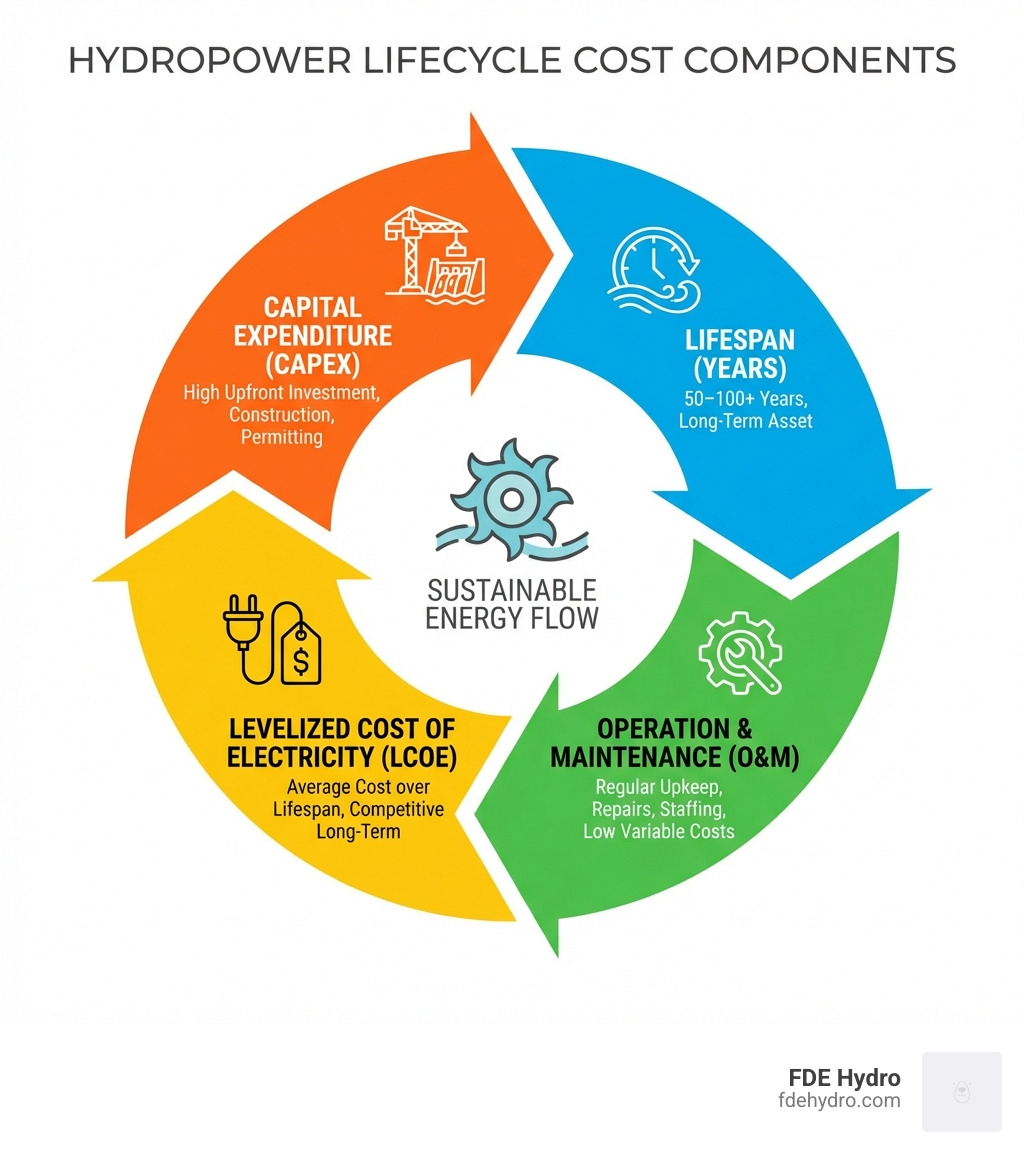
Hydropower cost vocab explained:
Upfront Capital Expenditures: Breaking Down Initial Investment
When we talk about the “sticker price” of a new power plant, we often use a term called “overnight capital cost” (OCC). This is essentially what it would cost to build the plant if you could snap your fingers and have it appear overnight, excluding interest during construction. For hydropower, this number is notoriously high compared to gas or solar.
The global average cost of setting up a hydroelectric plant was approximately $2,881 per kilowatt (kW) in 2022. However, this is just a baseline. Depending on the type of project, the costs can swing wildly:
- Nonpowered Dams (NPD): These projects involve adding generation capabilities to existing dams that don’t currently produce power. In the U.S., the OCC for these sites ranges from a manageable $3,045/kW to a staggering $20,043/kW for more difficult locations.
- New Stream-Reach Development (NSD): Building a brand-new facility where no dam exists. These are typically more expensive due to the massive civil engineering required, with U.S. estimates ranging from $6,574/kW to $8,611/kW.
- Pumped Storage: These act like giant water batteries, pumping water uphill when energy is cheap and releasing it when demand is high. While they are essential for grid stability, they require two reservoirs and complex pumping systems, making them capital-intensive.
- Conventional Hydropower: A standard 100 MW plant has a base overnight cost of about $3,421 per kilowatt (in 2022 dollars).
Regional Variations in Installation Costs
Location is everything. If you are building in the Pacific Northwest (NWPP region), you might see costs around $3,421/kW. However, try building in Florida (FRCC region), and that number can skyrocket to over $6,000/kW due to topography and labor rates.
We see these variations driven by a few key factors:
- Labor Productivity: Labor rates in New York City or California are significantly higher than in more rural areas, and the complexity of the site affects how many man-hours are required.
- Topography and Head: The “head” is the distance the water falls. Low-head sites often require more massive structures to generate the same amount of power as high-head sites, driving up detailed hydropower project costs.
- Grid Connection: If the ideal site is in the middle of a remote wilderness in Canada or Brazil, building the transmission lines to get that power to a city adds a massive line item to the budget.
Environmental and Social Capital Impacts
The “true” hydropower cost isn’t just about concrete and steel. It’s about the hurdles you have to jump over before the first shovel hits the ground. Large-scale impoundment projects often face:
- Permitting and Licensing: This can take years and cost millions in legal and environmental consulting fees.
- Social Displacement: In some regions, large reservoirs require relocating communities, which carries both high financial and ethical costs.
- Aquatic Life Mitigation: Building fish ladders or installing eco-friendly turbines to protect local ecosystems is now a standard — and expensive — requirement.
- Political Hurdles: Changes in government policy or environmental regulations mid-project can lead to delays that bleed money.
Operational Efficiency, LCOE, and Overrun Risks
Once you get past the “pain” of the initial investment, the financial story of hydropower gets much better. In fact, hydropower generation costing between 2 to 4 cents per kilowatt hour makes it one of the cheapest ways to keep the lights on.
Unlike fossil fuel plants, there are no fuel costs. You aren’t at the mercy of global natural gas or coal price spikes. The water flows for free. This stability allows hydropower to offer a very competitive Levelized Cost of Energy (LCOE). For plants entering service in 2030, the capacity-weighted LCOE is estimated at $54.40/MWh (including tax credits), which is quite impressive when you consider the 50–100 year lifespan of these assets.
Operational and Maintenance (O&M) costs are also relatively low:
- Fixed O&M: Roughly $47.06 per kilowatt-year.
- Variable O&M: A tiny $1.57 per megawatt-hour.
This makes it a more info on cost-effective energy source over the long haul, as the high initial debt is eventually paid off, leaving a low-cost “cash cow” for the grid.
Why Hydropower Projects Face Significant Cost Overruns
If the long-term math is so good, why is there so much hesitation? The answer lies in the “overrun.” Hydropower projects are notorious for finishing late and way over budget.
In Canada, where hydro provides over 61% of the power, researchers have pointed out that “easy” sites are gone. Modern projects like the W.A.C. Bennett Dam are massive engineering feats that face “strategic misrepresentation” — a fancy way of saying that risks are often downplayed to get projects approved.
When you ignore the potential for overruns in your energy modeling, you end up with economic trouble. Research on ignoring cost overruns in energy modeling shows that these hidden costs can lead to higher electricity prices for consumers and can even cause a country to miss its emissions targets because the “clean” energy took too long or cost too much to deploy.
Long-Term Economic Factors: Sediment and Aging Infrastructure
A dam built in 1924 is still a valuable asset in 2024, but it isn’t maintenance-free. Aging infrastructure requires significant reinvestment.
- Sediment Buildup: Over decades, dirt and silt settle behind the dam, reducing reservoir capacity and potentially damaging turbines. Clearing this is a major expense.
- Maintenance Cycles: Turbines and generators need overhauling every 20-30 years.
- Upgrades: Many existing facilities have the potential for capacity upgrades, which is often more cost-effective than building new ones.
Because of these long timelines, mitigating financial risks prior to ROI is essential. You have to plan for a century of operation, not just a decade.
Future Innovations to Reduce Hydropower Cost
The industry isn’t standing still. We are seeing a shift toward advanced manufacturing and digitalization to bring those scary upfront numbers down. “Smart” automation and remote monitoring are becoming standard, allowing us to optimize maintenance and reduce the need for large on-site crews.
The global market value of hydropower is projected to surpass $340 billion by 2030. To reach that, we have to find strategies for project cost reduction that make hydro as easy to deploy as solar or wind.
How Modularity Impacts Future Hydropower Cost
This is where things get exciting. Traditional dam building involves “stick-building” with poured-in-place concrete. It’s slow, weather-dependent, and labor-intensive.
By using modular precast concrete technology (like our patented “French Dam” system), we can move much of the construction into a controlled factory environment. This offers several advantages of precast concrete:
- Speed: Construction time can be cut by 50% or more.
- Predictability: Fewer weather delays and more consistent material quality.
- Scalability: You can “right-size” the dam for the specific site without starting the engineering from scratch every time.
- Cost: Reducing the time spent on-site directly slashes the labor and indirect costs that usually cause those massive overruns.
Projected Market Growth and Investment Justification
Is the investment worth it? Usually, yes. Despite the high entry price, hydropower provides something solar and wind can’t: baseload reliability. It is a “firm” resource that keeps the grid stable when the sun goes down or the wind stops blowing.
| Metric |
Hydropower |
Solar PV |
Onshore Wind |
| LCOE (Subsidized) |
~$54/MWh |
~$26/MWh |
~$30/MWh |
| Capacity Factor |
50-90% |
10-30% |
25-45% |
| Lifespan |
50-100 Years |
20-25 Years |
20-25 Years |
While solar and wind have lower LCOEs, they have shorter lifespans and lower capacity factors. When you look at the full lifecycle, hydropower’s ability to produce massive amounts of power for a century makes it a cornerstone of any serious renewable energy strategy.
Frequently Asked Questions
Understanding hydropower’s long-term cost competitiveness
Q: Is hydropower actually cheaper than wind or solar?
A: In terms of operating costs, yes. Hydropower generates electricity at 2–4 cents per kWh. However, because it lasts 4 times longer than a solar farm, the “cost per year of service” is often much lower. It also provides grid stabilization, which has a hidden financial value that intermittent sources don’t offer. You can find more ways to reduce construction costs to make the initial comparison even more favorable.
What is the average installation cost per kilowatt?
Q: What should I expect to pay for a new project?
A: Globally, the average is around $2,881/kW. However, for a new stream-reach development in the U.S., you should budget closer to $7,000–$8,000/kW when including all indirect and owner’s costs. Small-scale hydro often has a higher cost per kW than large-scale conventional plants because you can’t spread the fixed costs (like permitting and roads) over as many megawatts.
Why are upfront costs so high compared to fossil fuels?
Q: Why does a dam cost so much more to build than a gas plant?
A: It comes down to civil engineering. A gas plant is mostly a collection of machines in a building. A hydropower plant requires moving mountains of earth, diverting rivers, and building massive concrete structures that must withstand incredible water pressure for a century. The “fuel” (water) is free, but the “bucket” (the dam) is very expensive to build.
Conclusion
Navigating hydropower cost requires looking past the immediate price tag and focusing on the long-term value. While the initial capital requirements are significant and the risk of overruns is real, the 50-to-100-year lifespan and ultra-low operating costs make it an unrivaled investment for energy security.
At FDE Hydro™, we are committed to changing the “high cost” narrative. Our innovative, patented modular precast concrete technology — the French Dam — is designed to significantly reduce construction costs and time. Whether we are building new systems or retrofitting existing ones in North America, Brazil, or Europe, our goal is to make hydropower more accessible and economical for the next century of power generation.
Ready to see how modularity can change your project’s bottom line? Explore our innovative dam solutions today.
by | Mar 26, 2026 | Hydropower Articles
What “Definition for Hydroelectric Power” Actually Means (And Why It Matters)
The definition for hydroelectric power is straightforward: it is electricity generated by converting the energy of flowing or falling water into mechanical energy via a turbine, which then drives a generator to produce electrical power.
Quick answer:
Hydroelectric power is a form of renewable energy that harnesses the gravitational potential and kinetic energy of moving water to generate electricity. Water flows through a turbine, spinning it to drive a generator — with no fuel burned and no thermal pollution produced.
Here is a simple breakdown:
- Energy source: Flowing or falling water
- Conversion process: Water pressure and movement spin a turbine
- Output: Electricity fed into the grid
- Classification: Renewable energy (powered by the natural water cycle)
- Also called: Hydropower, hydroelectricity
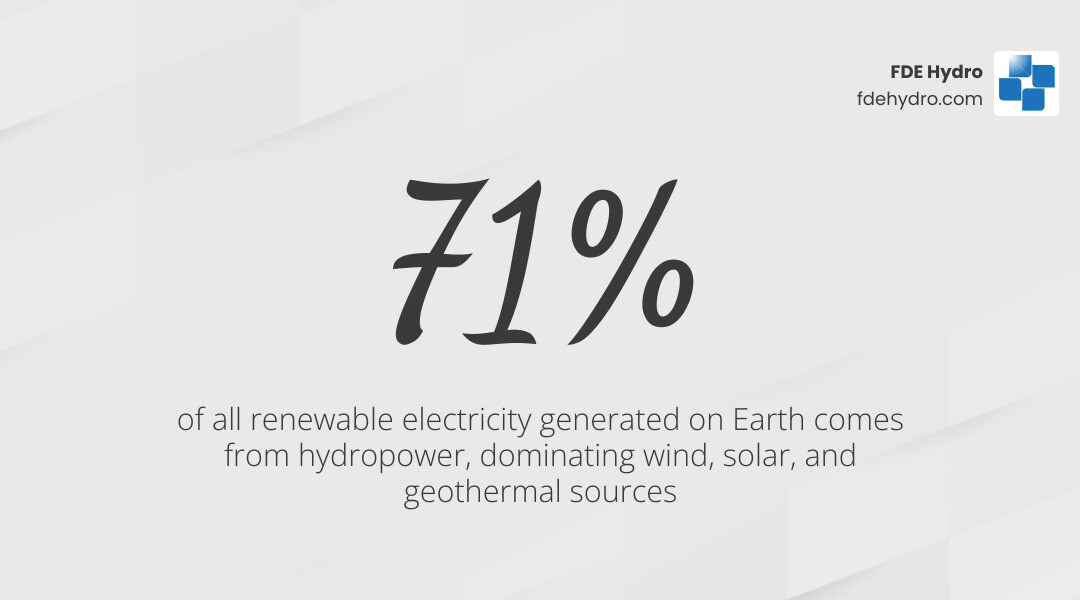
Hydropower is not a new idea. More than 2,000 years ago, ancient Greeks used flowing water to turn mill wheels for grinding grain. Today, that same basic principle powers roughly 15% of all electricity on Earth — and more than 71% of all renewable electricity globally.
For large-scale infrastructure decision-makers, understanding this energy source goes well beyond a textbook definition. It means grasping the engineering, economics, and environmental trade-offs that come with every project.
I’m Bill French, Sr., Founder and CEO of FDE Hydro™, and I’ve spent decades in heavy civil construction before turning my focus specifically to modular hydropower innovation — including being selected by the U.S. Department of Energy to help define next-generation hydropower solutions, which deepened my practical understanding of the definition for hydroelectric power far beyond theory. In this guide, I’ll walk you through everything you need to know, from the core mechanics to the real-world implications for modern hydro infrastructure.
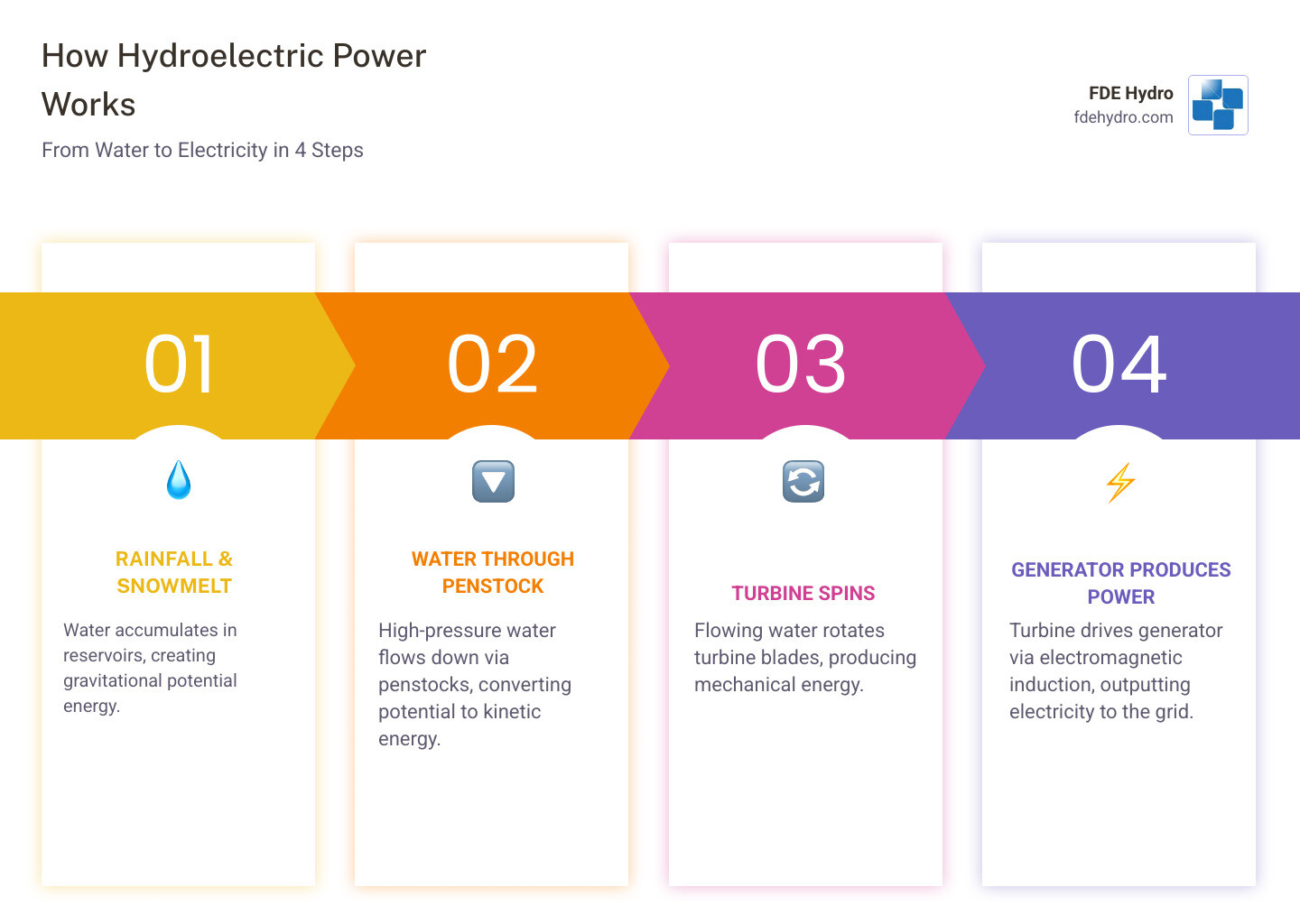
Related content about definition for hydroelectric power:
What is the Technical Definition for Hydroelectric Power?
When we look at the technical definition for hydroelectric power, we are really talking about energy transformation. It begins with gravitational potential. Imagine a large volume of water sitting in a reservoir behind a dam. Because that water is at a higher elevation than the river below, it possesses potential energy. When we release that water, gravity pulls it downward, converting that potential energy into kinetic energy (energy in motion).
This flowing water is directed toward a hydraulic turbine. As the water strikes the turbine blades, the kinetic energy becomes mechanical energy. Finally, the spinning turbine rotates a shaft connected to an electric generator. Inside the generator, magnets spin past copper coils to create the final product: electricity.
This cycle is fundamentally different from fossil fuel power plants. While a coal plant burns fuel to create steam to turn a turbine, we simply use the natural weight and movement of water. This makes it a premier form of renewable energy, as it relies on the Earth’s hydrologic cycle—evaporation, precipitation, and runoff—to “refuel” the reservoir.
Understanding the Scientific research on the diversity of hydropower projects reveals that there isn’t just one way to build these systems. From massive dams to small-scale Hydroelectric Electricity projects, the core energy transformation remains the same, but the application varies wildly depending on the geography of the region.
How Hydropower Works: From Gravity to Electricity
To understand how this process plays out in the real world, let’s look at the anatomy of a typical facility. Whether it is a massive structure like the Hoover Dam or a smaller modular installation, the components are remarkably consistent.
- The Intake and Penstocks: Water is drawn from the reservoir through an intake. It then travels through large pipes called penstocks. These pipes are designed to handle immense pressure as the water accelerates toward the powerhouse.
- The Powerhouse: This is the heart of the operation. It houses the turbines and generators. You can find more detail on these specific parts in our Hydroelectric Dam Components Ultimate Guide.
- Faraday’s Law in Action: Inside the generator, we utilize electromagnetic induction. According to Faraday’s Law, a changing magnetic field through a circuit induces an electromotive force. By spinning magnets (the rotor) inside a series of stationary wire coils (the stator), we create a steady flow of electrons.
- Transformers and Transmission: The electricity produced by the generator is usually at a lower voltage than what is needed for long-distance travel. Transformers “step up” the voltage so it can be sent efficiently across transmission lines to homes in New York City, Los Angeles, or Toronto.
Calculating Power: The Importance of Head and Flow
The amount of electricity we can generate isn’t a guessing game; it’s a matter of physics. Two primary factors dictate the power output: Hydraulic Head and Volumetric Flow.
- Hydraulic Head: This is the vertical distance the water falls. The higher the “head,” the more pressure the water exerts on the turbine. A high-head plant can produce a lot of power even with a relatively small amount of water. You can explore more on this in the Technical data on hydraulic head encyclopedia.
- Volumetric Flow: This is the volume of water passing through the system over a specific time (measured in cubic meters per second or cubic feet per second).
The basic formula for power (P) is:
P = η × ρ × Q × g × H
Where:
- η (eta) is the system efficiency.
- ρ (rho) is the density of water.
- Q is the flow rate.
- g is the acceleration due to gravity.
- H is the hydraulic head.
In simple terms: if you double the height of the dam or double the amount of water flowing through it, you effectively double the power potential.
The Role of Efficiency in the Definition for Hydroelectric Power
One reason we love hydropower is its incredible efficiency. While most fossil fuel plants struggle to reach 40% efficiency (losing most energy as heat), modern hydroelectric plants can be upwards of 90% efficient.
However, efficiency isn’t static. Over time, turbine blades can wear down, and mechanical losses can occur in the bearings or the generator. This is why modernization is such a hot topic in our industry today. By retrofitting older dams with newer, modular technology, we can significantly boost Hydroelectric Dam Efficiency without needing to build entirely new structures.
Improving generator performance through digital controls and better materials allows us to squeeze more “juice” out of every drop of water that passes through the system.
Main Types of Hydroelectric Power Plants
Not every hydroelectric plant looks like the massive concrete walls you see in movies. Depending on the river and the power needs of the local communities, different designs are used.
| Plant Type |
Key Feature |
Best Use Case |
| Impoundment |
Uses a large dam and reservoir |
Large-scale, steady power, flood control |
| Diversion (Run-of-River) |
Channels river water through a canal/penstock |
Smaller environmental footprint, constant flow rivers |
| Pumped-Storage |
Moves water between two reservoirs |
Acts as a “battery” for grid stability |
Each of these types plays a specific role in the energy grid. For a deeper dive into these structures, check out our guide on Hydroelectric Dams or consult the U.S. Bureau of Reclamation Hydroelectric Power Guide.
Pumped-Storage: Reusing Water for Peak Demand
Think of Pumped-Storage as a giant green battery. In most regions, electricity demand fluctuates. In a city like New York or Atlanta, demand might be low at 3:00 AM but sky-high at 5:00 PM when everyone turns on their air conditioning.
During off-peak hours, when there is excess electricity on the grid (perhaps from wind turbines spinning at night), we use that power to pump water from a lower reservoir back up to a higher one. When demand peaks, we release that water back down through the turbines to generate power instantly. This battery-like function is essential for grid stability and is one of the most cost-effective ways to store large-scale energy. You can read more about the More info on pumped-storage economics to see why it’s becoming the backbone of modern renewable grids.
Run-of-River and the Modern Definition for Hydroelectric Power
Run-of-river (or diversion) facilities are often seen as the “gentler” cousin of the large impoundment dam. These facilities don’t require a massive reservoir that floods thousands of acres. Instead, they divert a portion of a river’s natural flow through a canal or penstock to spin a turbine before returning the water to the main river downstream.
Because they have minimal impoundment, they are often easier to permit and have a lower impact on the local ecosystem. They rely on the natural flow of the river, meaning their output can vary with the seasons. When we talk about Hydroelectric Dam Design Complete Guide, we often emphasize these low-impact solutions for smaller communities or sensitive environmental zones in places like California or the Pacific Northwest.
The Global Significance and History of Water Power
The definition for hydroelectric power has evolved from simple mechanical work to high-tech digital generation.
- Ancient History: The Greeks and Romans used water wheels to grind grain and lift water.
- 19th Century: In 1878, the first hydroelectric scheme was developed in England to power a single lamp. By 1882, the Vulcan Street Plant in the U.S. began operating with a 12.5 kW output.
- 20th Century: This was the era of the “Mega-Dam.” Projects like the Norris Dam in Tennessee and the Hoover Dam became symbols of industrial progress.
- Modern Day: Today, China leads the world in capacity, with the Three Gorges Dam standing as the largest power station on the planet (22.5 GW).
In North America, Canada is a powerhouse. In 2022, hydroelectricity accounted for a staggering 61.7% of Canada’s total electricity generation. With 595 stations across the country, Canada remains the third-largest producer of hydropower globally.
Whether it is for massive industrial needs or small-scale Hydroelectric Dam Construction, water remains the most reliable renewable resource we have.
Advantages and Environmental Impacts of Hydro Energy
Like any energy source, hydropower comes with a balance of pros and cons.
The Advantages:
- Low-Carbon: Once built, a dam produces virtually no greenhouse gases during operation. It is a vital tool in fighting climate change.
- Reliable: Unlike solar or wind, which depend on the weather, hydro provides a “baseload” of power that we can turn on or off in seconds.
- Multi-Use: Reservoirs often provide irrigation for farms, flood control for cities, and recreation (boating and fishing) for families.
The Environmental Impacts:
- Ecosystem Disruption: Dams can block fish migration, particularly for species like salmon. This is why modern designs include “fish ladders” or bypasses.
- Methane Emissions: In tropical regions (like parts of Brazil), submerged vegetation in new reservoirs can rot, releasing methane—a potent greenhouse gas.
- Siltation: Dams trap sediment that would naturally flow downstream to nourish deltas.
- Displacement: Large projects often require the relocation of local communities.
We take these impacts seriously. Our Hydroelectric Power Solutions Guide explores how new technologies—like modular precast concrete—can help mitigate these issues by allowing for faster, less invasive construction and easier retrofitting of existing “non-powered” dams. You can also read more about the Research on how dams impact river ecosystems to understand the challenges we are working to solve.
Frequently Asked Questions about Hydropower
What is the most common definition for hydroelectric power?
The most common definition for hydroelectric power is the use of flowing water to spin a turbine that drives an electric generator. It is the process of turning the energy of the water cycle into usable electricity.
How does a hydroelectric generator differ from a coal turbine?
While both use a spinning turbine to drive a generator, the “prime mover” is different. A coal plant burns fuel to boil water into high-pressure steam. A hydroelectric plant uses the natural weight and flow of river water. This means hydro has no fuel costs and produces no smoke or ash.
Why is pumped storage considered a “green battery”?
It’s called a “green battery” because it stores energy for later use without using chemicals like lithium-ion batteries. It uses gravity and water to “save” excess electricity produced during low-demand periods and “release” it when the grid needs it most.
Conclusion
At FDE Hydro™, we believe the future of the definition for hydroelectric power lies in innovation and sustainability. Our patented French Dam technology—a modular precast concrete system—is changing how we think about water infrastructure. By significantly reducing construction time and costs, we make it feasible to bring renewable energy to more communities across the United States, Canada, Brazil, and Europe.
Whether we are building new low-impact facilities or retrofitting infrastructure that has been sitting idle for decades, our goal is to make Hydroelectric Power Generation accessible and environmentally responsible.
If you are a dam owner, a grid operator, or a policy-maker looking for faster, more cost-effective ways to harness the power of water, we invite you to Explore Hydropower Solutions with us. Together, we can ensure that the next century of hydropower is even more impactful than the last.
by | Mar 17, 2026 | Hydropower Articles
Understanding the True Investment Behind Hydroelectric Projects
The cost of building hydroelectric dams varies dramatically depending on project type, location, and scale. Here’s what you need to know upfront:
Quick Cost Overview:
| Project Type |
Typical Cost Range (per kW) |
Notes |
| Large Hydropower Dams |
$1,050 – $7,650 |
Conventional reservoir projects |
| Small Hydropower |
$1,300 – $8,000 |
Higher per-kW costs due to scale |
| Retrofitting Existing Dams |
$500 – $3,045 |
Most cost-effective option |
| New Stream Development |
$6,574 – $8,611 |
Greenfield projects |
| Global Average (2022) |
$2,881 |
Rose 25% in one year |
A brisk building boom of hydropower mega-dams is underway from China to Brazil. But whether the benefits of new dams will outweigh their costs remains hotly debated.
The numbers tell a sobering story. Hydropower projects regularly run millions over budget and years beyond their original timelines. In 2016, hydro had the highest average construction cost per kilowatt of any generating technology in the U.S.—$5,312, more than double solar’s $2,434. By 2022, the global weighted average total installed cost jumped 25% to $2,881 per kilowatt.
Yet these upfront figures don’t capture the full picture. Hydropower plants operate for 50 to 100+ years—two to four times longer than solar or wind installations. Their capacity factors consistently outperform intermittent renewables, and they provide essential grid stability services that are often undervalued or not compensated at all.
Understanding what drives hydropower costs—and how to control them—is critical for anyone evaluating these projects. The site-specific nature of dam construction cannot be overstated. A plant on stable bedrock near existing grid connections faces entirely different economics than one requiring extensive tunneling in a remote watershed.
I’m Bill French Sr., founder and CEO of FDE Hydro™, and I’ve spent decades in heavy civil construction before developing innovative solutions to address the cost of building hydroelectric dams through modular precast technology. Our work across North America, Brazil, and Europe has shown that standardized, factory-produced components can dramatically reduce both construction timelines and capital expenditures.
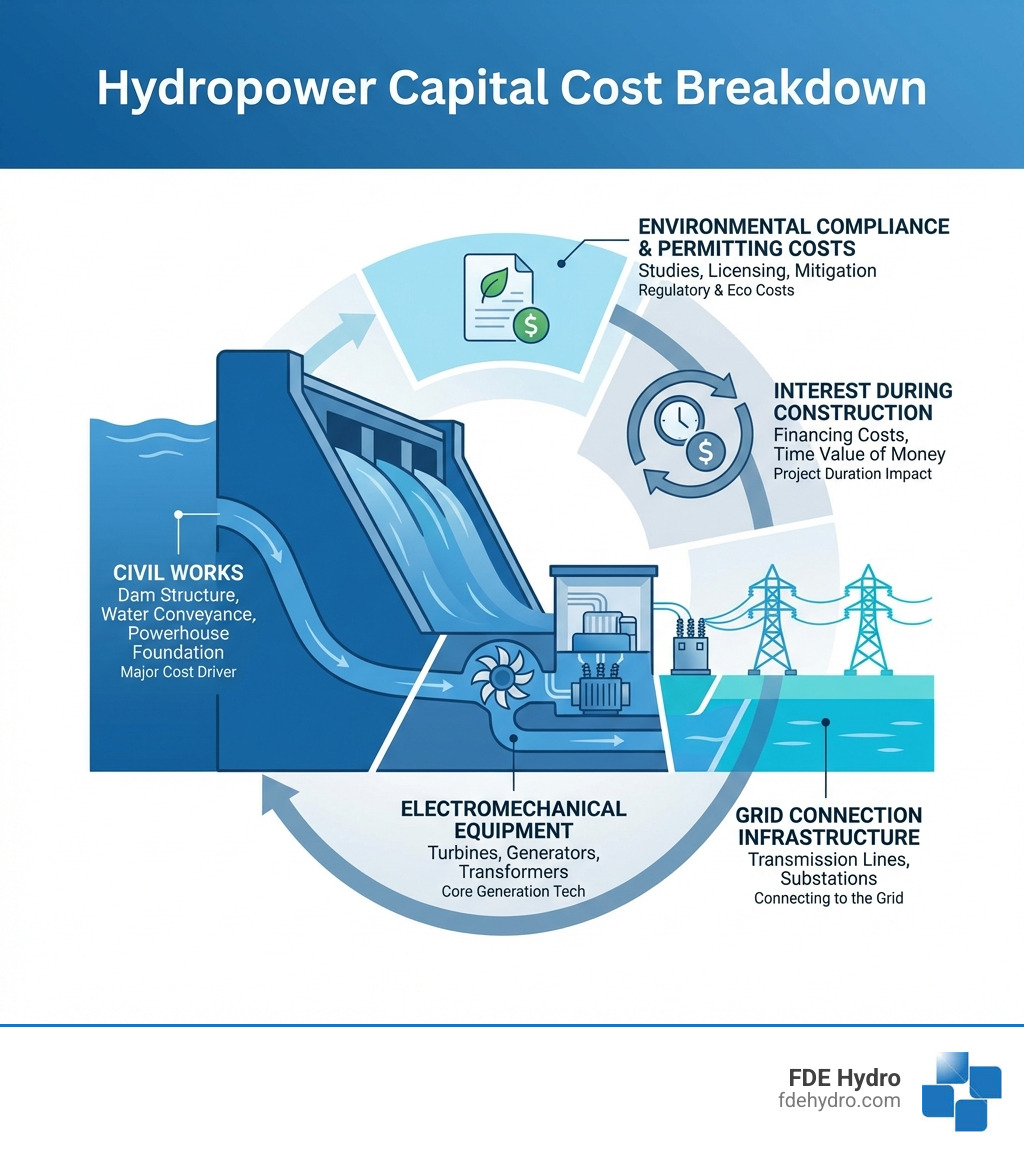
Cost of building hydroelectric dams word list:
Breaking Down the Capital Cost of Building Hydroelectric Dams
When we talk about the “price tag” of a dam, we are primarily discussing Capital Expenditure (CAPEX). This includes everything from the first shovel in the ground to the moment the turbines begin to spin. However, unlike a solar farm where costs are relatively predictable per panel, hydropower-project-costs are notoriously volatile.
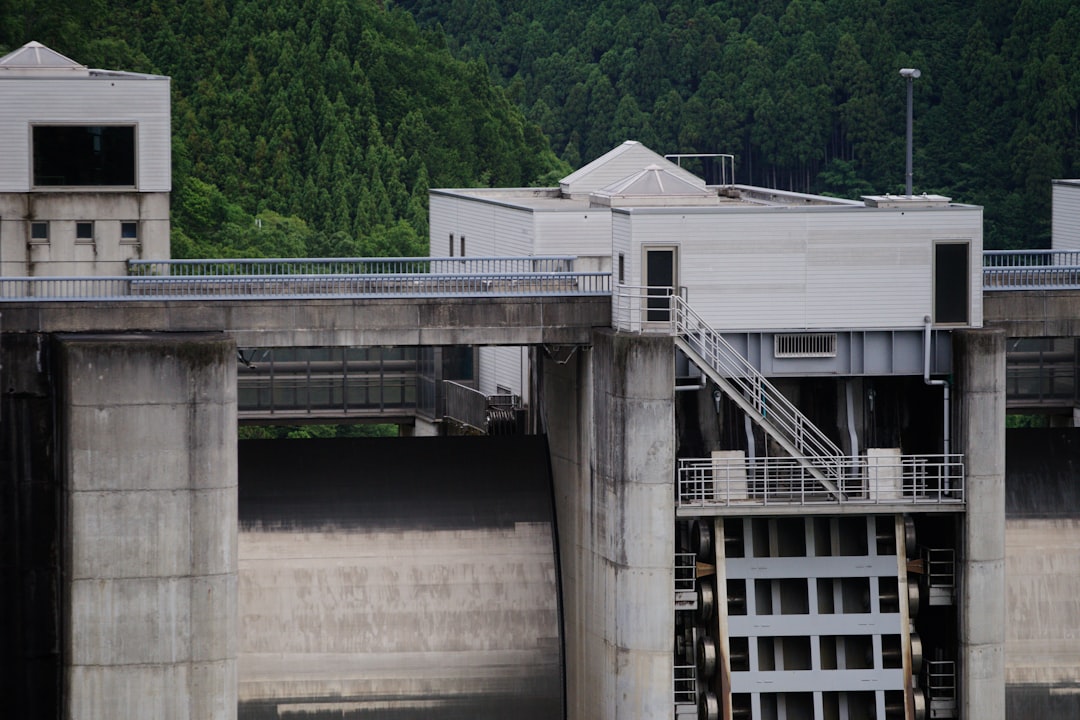
According to IRENA’s 2022 cost report, the global weighted average total installed cost for new hydropower projects reached $2,881/kW. This was a significant 25% jump from previous years, driven by supply chain disruptions and the increasing complexity of remaining viable sites. In the U.S., the U.S. Energy Information Administration data shows that hydropower often sits at the top of the construction cost pyramid, largely because you aren’t just buying equipment—you are reshaping the landscape.
Typical Investment Ranges for Different Project Types
Not all dams are created equal. The cost of building hydroelectric dams changes based on whether you are starting from scratch or utilizing existing infrastructure.
- Large Dams ($1,050 – $7,650/kW): These benefit from economies of scale but face massive civil engineering hurdles and environmental mitigation costs.
- Small Hydro ($1,300 – $8,000/kW): While the total check is smaller, the cost per kilowatt is often higher because the fixed costs of permitting and grid connection are spread over fewer units of power.
- Run-of-River: These typically avoid large reservoirs, potentially lowering land acquisition costs, though they remain vulnerable to seasonal flow variations.
One of the most exciting areas for cost reduction is the retrofitting of Non-Powered Dams (NPD). There are thousands of existing dams in the U.S. and Brazil that provide flood control or navigation but don’t produce a single watt of power. Retrofitting these is often the “low-hanging fruit” of the industry.
| Development Type |
Traditional Cost (per kW) |
FDE Hydro Modular Potential |
| New Stream-Reach (NSD) |
$6,574 – $8,611 |
N/A (Greenfield focus) |
| Non-Powered Dam (NPD) |
$3,045 – $20,043 |
Significant Reduction |
| Conduit/Canal |
$3,955 (Avg) |
Streamlined |
Estimating the Cost of Building Hydroelectric Dams by Capacity
If you were to ask us for an estimate on an 88 MW hydropower plant, the answer depends heavily on the “where” and “how.” Historically, a 120 MW facility built in the early 90s cost roughly $315 million—which translates to about $665 million in today’s dollars ($5,542/kW).
For an 88 MW project in a region like Canada, estimates range from $175 million to $440 million CAD depending on the terrain. However, as projects get smaller, the “unit price” goes up. A tiny 5 MW facility might cost $50 million ($10,000/kW). This is why we focus so heavily on project-cost-reduction strategies; without them, smaller, localized projects struggle to find financing.
Why Hydropower Projects Face Cost Overruns and Delays
If there is one thing the hydro industry is known for (besides clean energy), it’s the “budget blowout.” Research on cost overrun impacts suggests that large dams are systematically biased toward underestimating costs.
Historically, budgets often exclude inflation, debt servicing, and the true cost of environmental compliance. When a project is delayed by five years—which is common—the interest on the construction loans can become a larger line item than the concrete itself.
Site-Specific Variables and Hidden Expenses
The “hidden” cost of building hydroelectric dams usually hides underground. Geology is the great unknown; hitting a fault line or porous rock that requires extensive grouting can add millions to a budget overnight.
Furthermore, dam-construction-methods often rely on remote logistics. If you have to build a 50-mile road just to get your turbine to the site, your CAPEX will skyrocket. Then there is the “permitting paralysis.” In the U.S., the median duration for relicensing or original licensing is nearly six years. Every year spent in a boardroom instead of on the riverbank is a year of lost revenue and mounting overhead.
The Critical Role of Capital and WACC
Hydropower is a “front-loaded” investment. You pay almost everything upfront and get paid back over 80 years. This makes projects extremely sensitive to the Weighted Average Cost of Capital (WACC).
A mere 1% increase in WACC can raise the cost of the electricity generated by 7% to 14%. In developing markets like Brazil, where interest rates can be volatile, financing-long-term-hydropower-requires-mitigating-risks-prior-to-roi is the only way to make a project bankable. Investors need certainty, and traditional “stick-built” concrete dams offer very little of it.
Hydropower vs. Other Energy Sources: A Long-Term Value Analysis
It is easy to look at a solar farm’s $2,400/kW price tag and think hydropower is “too expensive.” But that is like comparing a car that lasts five years to a house that lasts a century.
Hydropower facilities often reach their 100th birthday while still using their original civil structures. When you look at the Levelized Cost of Electricity (LCOE), hydropower remains one of the cheapest sources of energy on the planet ($0.061/kWh global average in 2022).
Comparing the Cost of Building Hydroelectric Dams to Other Renewables
While wind and solar are excellent, they are intermittent. They don’t provide “inertia” or “black start” capabilities to the grid. Hydropower acts as a giant, natural battery. This is especially true for Pumped Storage Hydro (PSH), which currently accounts for 96% of utility-scale energy storage in the U.S.
When building-new-dams, we aren’t just looking at the cost per kilowatt-hour; we are looking at the value of being able to turn the power on exactly when the sun goes down or the wind stops blowing. Solar panels might occupy 13% of the land covered by a reservoir to produce the same energy, but they cannot provide the same grid stability.
Operations and Maintenance (O&M) Expenditures
Once the dam is built, the “fuel” (rain and snowmelt) is free. Typical hydroelectric-dam-construction leads to O&M costs that are only 1% to 2.5% of the initial CAPEX annually for large plants.
However, as plants age, hydropower asset management becomes vital. Refurbishing a turbine or upgrading a generator is significantly cheaper than building a new plant, often resulting in an LCOE as low as $0.01 to $0.05 per kWh. This is where the long-term ROI truly shines.
Reducing Construction Costs Through Technological Innovation
The traditional way of building dams—pouring massive amounts of wet concrete in situ—is slow, labor-intensive, and prone to weather delays. To reduce-construction-costs, the industry must move toward industrialization.
Modular Technology and Precast Solutions
At FDE Hydro™, we developed the “French Dam” system to solve the very problems we’ve discussed. By using modular-precast-dam-advantages-101, we can move the bulk of the construction work into a controlled factory environment.
- Standardization: Instead of a custom design for every foot of the dam, we use standardized modules that fit together like a high-tech puzzle.
- Timeline Acceleration: We can manufacture the dam components while the site is being prepared, cutting months or even years off the schedule.
- Reduced Labor: Fewer workers are needed on-site in hazardous conditions, which lowers insurance costs and site overhead.
This shift is why-precast-cost-less. When you reduce the “time at risk” on the river, you reduce the likelihood of a cost overrun. It changes the cost of building hydroelectric dams from an unpredictable gamble into a manageable infrastructure project.
Frequently Asked Questions about Hydropower Costs
What is the average cost per kilowatt for a new hydroelectric dam?
While it varies, the global average is approximately $2,881/kW. In the U.S., new “greenfield” projects often range between $5,000 and $10,000/kW, while retrofitting existing dams is much cheaper, often starting around $500 to $3,000/kW.
Why do hydropower projects frequently exceed their original budgets?
The primary drivers are “optimism bias” in early planning, unforeseen geological challenges, lengthy permitting processes that increase financing costs, and the sheer complexity of on-site civil engineering in remote or environmentally sensitive areas.
How does the cost of retrofitting an existing dam with FDE Hydro modular solutions compare to new construction?
Retrofitting is significantly more affordable because the primary “civil” cost—the dam itself—already exists. Using our modular precast technology further lowers costs by reducing on-site construction time and labor, often making a project viable that would otherwise be uneconomical.
Conclusion
The cost of building hydroelectric dams is undoubtedly high, but the price of ignoring our most reliable renewable resource is higher. As we move toward a carbon-free grid, the long-term value of hydropower—with its century-long lifespan and unmatched stability—is becoming more apparent to investors and policymakers alike.
By embracing innovation, from modular-dam-construction to smarter financing-long-term-hydropower-requires-mitigating-risks-prior-to-roi, we can overcome the historical hurdles of overruns and delays. At FDE Hydro™, we believe the future of hydro isn’t just about building bigger; it’s about building smarter.
If you are ready to explore how modular technology can de-risk your next project and provide a stable ROI for the next century, we invite you to look closer at our project-cost-reduction strategies. The water is flowing—it’s time we put it to work more efficiently.
by | Mar 16, 2026 | Hydropower Articles
Why Hydropower Project Management Is Critical to Clean Energy Success
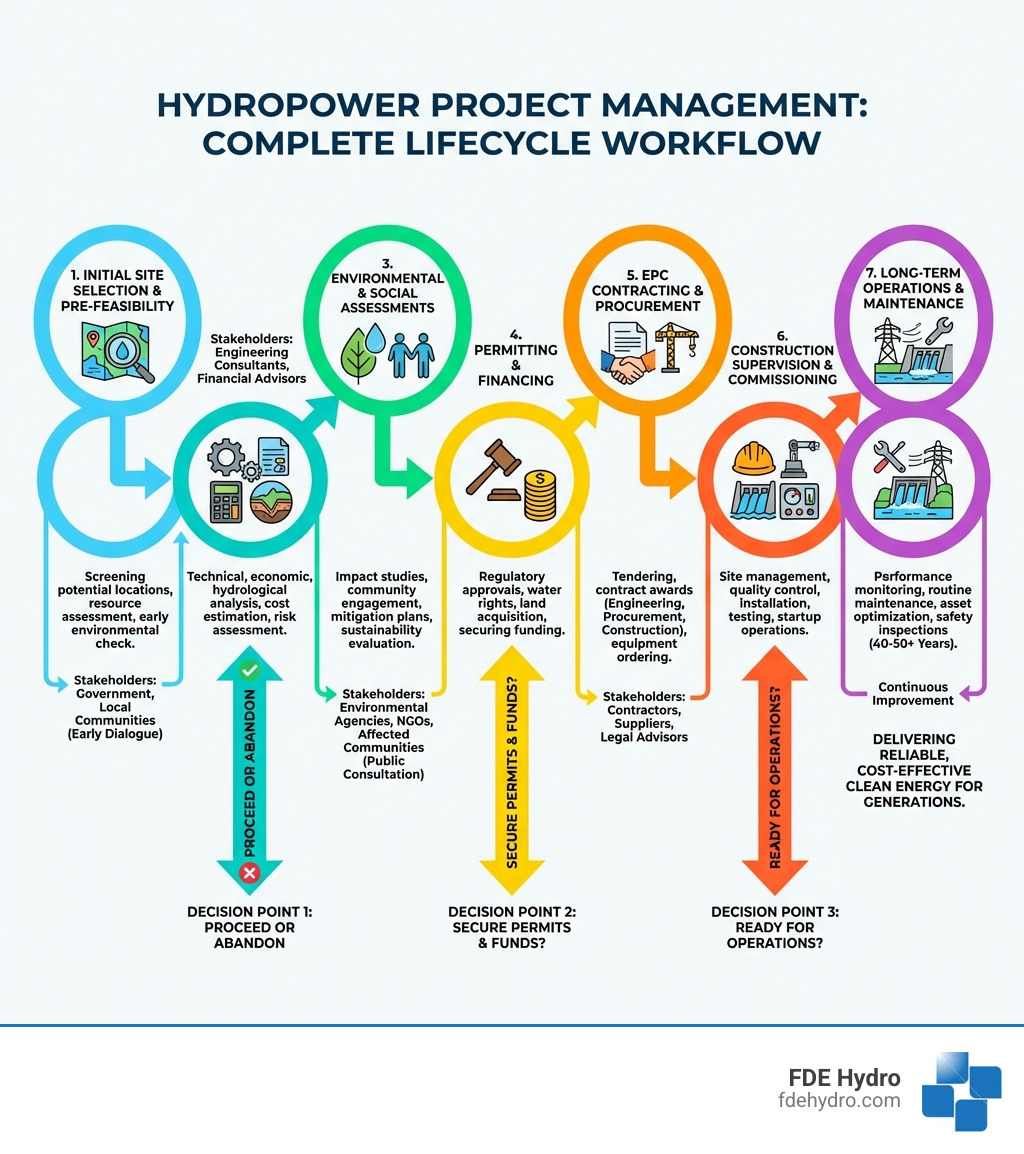
Hydropower project management is the coordinated oversight of planning, design, construction, and operation activities required to develop and maintain hydroelectric power facilities. It involves managing technical teams, environmental assessments, stakeholder engagement, permitting, construction contracts, and long-term asset performance to deliver reliable, cost-effective renewable energy.
Core responsibilities of a hydropower project manager include:
- Planning and coordination – Overseeing feasibility studies, site selection, hydrological analysis, and engineering design across civil, mechanical, and electrical disciplines
- Regulatory compliance – Securing environmental clearances, water rights, construction permits, and maintaining safety standards throughout the project lifecycle
- Stakeholder engagement – Consulting with communities, government agencies, contractors, and investors to address concerns and ensure project acceptance
- Risk management – Mitigating uncertainties related to hydrology, geology, costs, schedules, and environmental impacts
- Construction oversight – Managing EPC contracts, supervising civil works, equipment installation, and commissioning activities
- Operations and maintenance – Monitoring performance, maintaining equipment, optimizing production, and ensuring facilities operate for 40-50 years or longer
Hydropower represents the world’s largest source of renewable electricity, accounting for over 60% of global renewable generation. With installed capacity reaching 1,290 GW in 2018 and projected to nearly double to 1,947 GW by 2050, effective project management has never been more important. Sub-Saharan Africa alone holds over 400 GW of undeveloped hydro potential—enough to quadruple the continent’s existing 80 GW capacity.
The stakes are high. Large greenfield projects typically cost between $1,000 and $3,500 per kilowatt, requiring substantial capital investment. Poor management leads to cost overruns, schedule delays, environmental damage, and community conflicts. The 2009 Sayano-Shushenskaya accident in Russia—caused by neglected maintenance—resulted in 75 deaths and the loss of 6 GW of generating capacity, demonstrating the catastrophic consequences of inadequate oversight.
Yet hydropower facilities can operate for over 100 years with proper management, offering extremely low operating costs and reliable dispatchable power that enables integration of intermittent renewables like wind and solar. Electricity generation costs range from just $0.02 to $0.085 per kWh, making hydropower one of the most cost-effective energy sources globally.
I’m Bill French Sr., Founder and CEO of FDE Hydro™, where I’ve applied five decades of heavy civil construction experience to develop modular solutions that address the core challenges of Hydropower project management—reducing costs, accelerating timelines, and mitigating risks for developers and investors. This guide draws on industry best practices, international standards, and real-world case studies to help you successfully steer every phase of hydropower development.
Relevant articles related to Hydropower project management:
Core Responsibilities in Hydropower Project Management
The role of a project manager (PM) in the hydroelectric industry is as diverse as the rivers we harness. In Hydropower project management, the PM is the glue that holds together scientific data, engineering precision, and community relations. Whether you are called a facility operator, a hydro station supervisor, or a power project manager, the core mission remains the same: producing sustainable electricity at competitive rates while keeping everyone safe.
Daily Duties and Equipment Oversight
No two days are the same. A PM might start the morning reviewing water flow and pressure data and end it coordinating an emergency response for a power system glitch. Key daily responsibilities include:
- Equipment Monitoring: Overseeing hydro-turbines, generators, and control systems to ensure they are running at peak efficiency.
- Production Optimization: Adjusting operations based on seasonal flow variations to meet peak power demand.
- Reporting: Keeping meticulous records of maintenance activities and production levels for both internal review and external compliance.
- Safety Leadership: Enforcing strict safety standards during inspections to protect the workforce and the public.
Integrated Project Management
Effective Integrated Project Management refers to a developer’s capacity to coordinate all project components simultaneously. This means thinking about how a construction decision today will affect hydropower asset management thirty years from now. We focus on meeting budget and timing objectives while managing the “interface issues”—the friction points where different contractors or phases of work meet.
Key Phases of Hydropower Development and Execution
Developing a hydropower plant is a marathon, not a sprint. From the first topographic survey to the final commissioning, each phase requires specialized oversight.
Site Selection and Pre-Feasibility
Success starts with the right location. Project managers must evaluate topography, geology, and access to the power grid. A critical rule of thumb in the industry is to use at least 15 years of hydrological data. Why? Because rivers are fickle. You need to understand the 90% dependable year—the flow rate you can count on almost all the time—to optimize the plant’s installed capacity without overbuilding.
Detailed Project Reports (DPR) and Design
According to Guidelines for formulation of DPR, a project must be technically viable and economically justified before a single cubic yard of concrete is poured. This phase involves:
- Geological Mapping: Identifying rock stability to avoid “geological surprises” during excavation.
- Layout Alternatives: Comparing different dam heights or tunnel lengths to find the most cost-effective path.
- Cost Estimation: Factoring in everything from the turbines to the access roads.
Execution and Contracting
Once the design is set, hydroelectric dam construction begins. Most large projects use Engineering, Procurement, and Construction (EPC) contracts. These “turnkey” agreements help transfer schedule and budget risks to the contractors. For new hydro facilities, we often recommend dividing work into civil works, electro-mechanical (E&M) equipment, and grid connection to maintain better control over specialized tasks.
Technical and Environmental Considerations for Hydropower Project Management
Technical excellence and environmental stewardship are two sides of the same coin. A project manager must ensure the facility is built to last while respecting the ecosystem.
- Sediment Management: Intakes should be positioned in straight river sections to avoid sediment buildup. If you don’t manage silt, your turbines won’t last their intended 40-60 years.
- Spillway Design: Safety is paramount. Spillways are often designed to handle “1,000-year flood” events to ensure the dam remains stable even in extreme weather.
- Water Control Systems: Implementing advanced water control systems allows for precise management of reservoir levels, which is crucial for both power generation and downstream safety.
- Standards: We adhere to IFC Performance Standards and Equator Principles to manage hydropower environmental impact mitigation effectively. This includes everything from fish passage solutions to water quality monitoring.
Ensuring Sustainability and Stakeholder Engagement
Sustainability in Hydropower project management isn’t just about “being green”—it’s about the long-term viability of the project in its social and environmental context.
The Sustainability Protocol
The Hydropower Sustainability Assessment Protocol (HSAP) is our gold standard. It evaluates projects across 23 topics, including community health, biodiversity, and labor conditions. To score high, we don’t just “avoid the negative”; we strive for positive outcomes. This might include creating bird sanctuaries, improving local water quality, or providing new health services to the community.
Engaging Hard-to-Reach Stakeholders
Stakeholder engagement is often where projects succeed or fail. “Hard-to-reach” groups—such as remote indigenous communities or vulnerable populations who may not read standard project notices—require custom communication.
- Early Consultation: We start talking to people years before construction begins.
- Transparency: Proactively addressing concerns about resettlement or changes to the river flow helps build the “social license” to operate.
- Inclusion: Ensuring that sustainable energy production goals align with local needs, such as irrigation or flood control.
By focusing on clean energy infrastructure that benefits everyone, project managers reduce the risk of legal delays and protests that can derail even the best-engineered projects.
Managing Different Types of Hydropower Project Management
Not all hydro is created equal. The management approach changes significantly depending on the technology used.
| Project Type |
Primary Management Focus |
Environmental Footprint |
Grid Benefit |
| Run-of-River |
Managing seasonal flow variations; minimal storage. |
Lower; preserves natural river flow. |
Constant “baseload” power. |
| Storage Dams |
Reservoir management; multi-purpose use (irrigation/flood). |
Higher; requires land inundation. |
High dispatchability (peak power). |
| Pumped Storage |
Energy arbitrage; managing two reservoirs. |
Moderate; often closed-loop. |
“Giant battery” for the grid. |
Pumped storage hydropower benefits are particularly vital today. With 80% efficiency, these plants act as the “guardian of the grid,” storing excess wind or solar energy and releasing it when the sun goes down. Managing these requires a deep understanding of grid integration and rapid-response operations.
The “ultimate success” of a project is measured over decades. Hydropower plants are capital-intensive upfront, but their O&M (Operation and Maintenance) costs are remarkably low—typically only 1% to 4% of the initial investment annually.
Addressing Uncertainty
The biggest risks in Hydropower project management are often hidden underground or in the clouds.
- Hydrological Uncertainty: If the rains don’t come, the revenue doesn’t either. We mitigate this through conservative financial modeling and 15+ years of data.
- Cost Overruns: Civil works are notorious for surprises. We use project cost reduction strategies, such as modular construction, to keep budgets predictable.
Maintenance Strategies
To ensure a facility lasts 100 years, we move beyond “fix it when it breaks.” We follow the World Bank’s Operation and Maintenance Strategies for Hydropower guidelines, emphasizing:
- Reliability-Centered Maintenance (RCM): Focusing resources on the components most likely to cause a failure.
- Root Cause Analysis: If a turbine vibrates, we don’t just tighten the bolts; we find out why it’s vibrating to prevent a catastrophic failure like Sayano-Shushenskaya.
- KPIs: We track the Availability Factor (aiming for >95%) and the Forced Outage Rate (aiming for <4%) to gauge hydro power plant maintenance success.
Frequently Asked Questions about Hydropower Project Management
What are the primary risks in hydropower development?
The “Big Three” risks are hydrological (not enough water), geological (bad soil or rock conditions), and regulatory (delays in permits). These can lead to massive financing long-term hydropower risks if the project cannot start generating revenue on time. We mitigate these through exhaustive pre-construction studies and robust contingency funds.
How long is the typical lifespan of a hydropower plant?
The initial mechanical equipment (turbines and generators) usually lasts 40-50 years. However, the civil structures—the dam and intake—can last 100 years or more. With modern dam rehabilitation and encapsulation techniques, we can “refresh” older plants to operate for another century at a fraction of the cost of a new build.
How do project managers handle hard-to-reach stakeholders?
We use custom communication strategies. This means going to where the people are, rather than expecting them to come to us. For vulnerable groups, we provide translators, hold small-group meetings in local community centers, and ensure our sustainable water infrastructure plans include local benefits like improved roads or access to clean drinking water.
Conclusion
The future of hydropower is bright, but it requires a new generation of project management. As we strive to meet global capacity targets and integrate more wind and solar into our grids, the need for reliable, flexible hydro has never been greater.
At FDE Hydro™, we believe the path to Hydropower project management success lies in innovation. Our patented “French Dam” modular precast technology is designed to solve the very problems this guide addresses: it reduces construction time, slashes costs, and provides a safer, more predictable way to build or retrofit dams. Whether you are in New York, California, Brazil, or Europe, we are here to help you build the clean energy solutions of tomorrow.
Ready to take your project from the drawing board to the river? Let’s work together to create a sustainable, high-performing asset that will power communities for the next century.
Start your hydropower project with FDE Hydro today
by Adaptify Support | Mar 9, 2026 | Hydropower Articles
Why the World Needs Innovative Water Solutions Now
Innovative water solutions are technologies and approaches that address water scarcity through advanced methods like solar-powered desalination, atmospheric water harvesting, greywater recycling, and AI-driven leak detection. These solutions aim to close the projected 40% gap between global water supply and demand by 2030 while reducing costs, energy use, and environmental impact.
Key Categories of Innovative Water Solutions:
- Desalination & Purification – Solar-powered systems producing 5,000+ liters daily with 94% energy efficiency
- Water Harvesting – Atmospheric generators extracting 6 liters per kilo of material at 30% humidity
- Greywater Recycling – Onsite systems recovering up to 95% of water for non-potable reuse
- Smart Management – Digital twins and AI reducing water loss by 50% through precision monitoring
- Decentralized Treatment – Modular systems treating 300,000 liters monthly per building
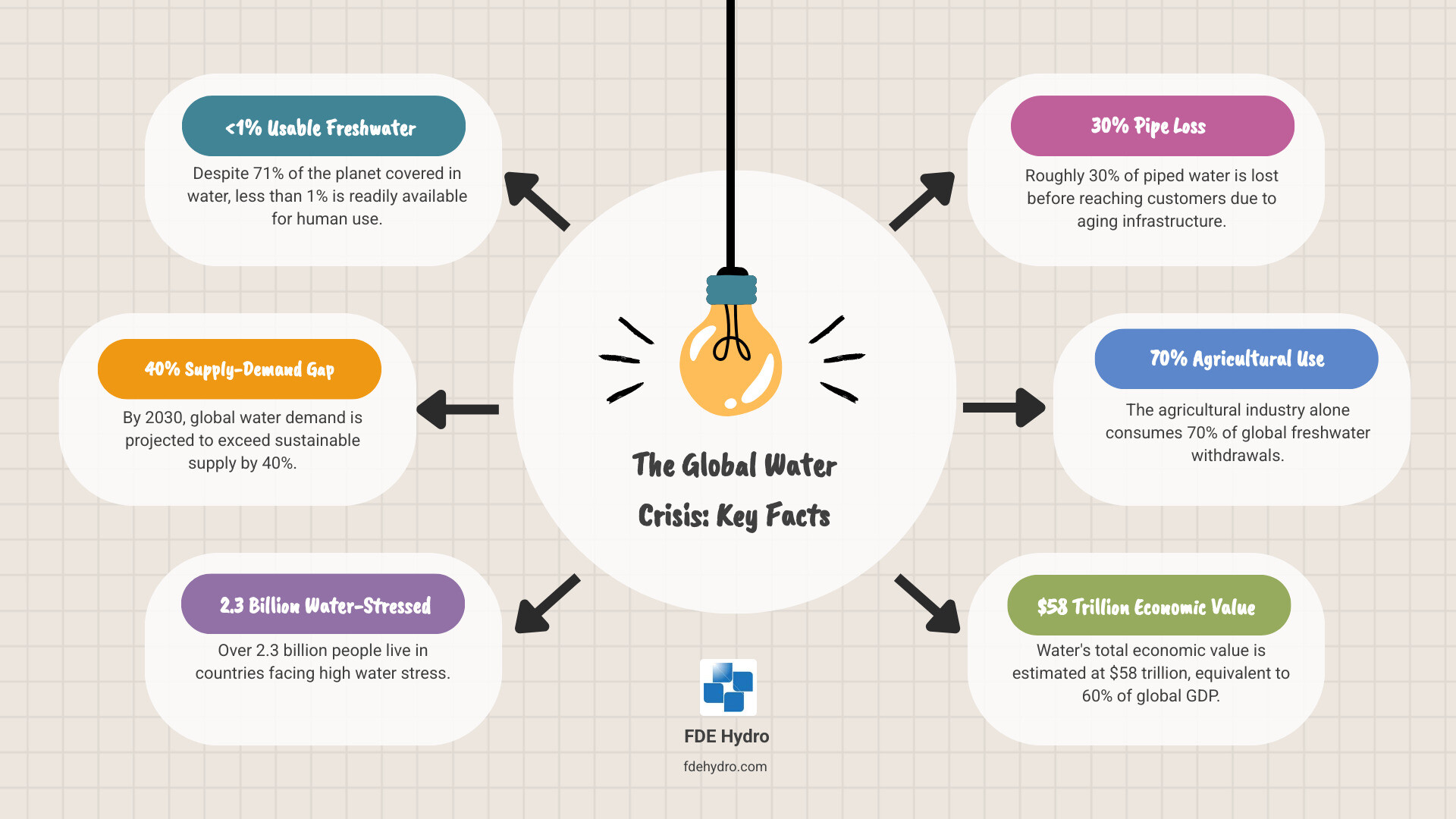
The numbers paint a stark picture. Water covers 71% of our planet, yet less than 1% is usable freshwater. By 2030, global water demand will exceed sustainable supply by 40%. Meanwhile, 2.3 billion people live in water-stressed countries, and roughly 30% of piped water is lost before reaching customers.
This isn’t just an environmental crisis—it’s an economic one. Water’s value has been priced at approximately $58 trillion, equivalent to 60% of global GDP. Yet 80% of wastewater still flows untreated back into the environment, and the agricultural industry alone consumes 70% of global freshwater withdrawals.
The challenge isn’t a lack of water—it’s how we capture, treat, manage, and reuse it.
Traditional water infrastructure faces three critical problems: high capital costs, extended construction timelines, and significant operational risks. Conventional desalination plants are energy-intensive and produce toxic brine. Legacy pipe networks leak at alarming rates. And new water technology can take up to 14 years to disseminate due to regulatory barriers and risk-averse adoption patterns.
But change is accelerating. Previously an overlooked corner of clean tech, water-focused technologies are now attracting venture capital, innovative financing models, and breakthrough engineering. From machines that pull water from air to AI systems that detect leaks in real-time, the solutions exist—and they’re becoming economically viable.
I’m Bill French Sr., Founder and CEO of FDE Hydro, where we’ve spent decades delivering modular civil construction solutions to the hydropower industry, including our patented “French Dam” technology that reduces costs and environmental impact through innovative water solutions. My experience managing major infrastructure projects has shown me how modular, technology-driven approaches can transform what’s possible in water management.
Related content about innovative water solutions:
The Global Crisis Driving Innovative Water Solutions

The global water crisis is a multifaceted challenge, driven by a growing population, climate change, and aging infrastructure. As we’ve seen, over a quarter of the world’s population, about 2.3 billion people, live in water-stressed countries. This means that these territories use 25% or more of their renewable freshwater resources, a clear indicator of unsustainable consumption patterns.
One of the biggest culprits in this scenario is the agricultural industry, which is responsible for a staggering 70% of global freshwater withdrawals. Imagine that—nearly three-quarters of our precious freshwater goes to growing food, much of it through inefficient irrigation methods. This isn’t just about crops; it’s about the entire ecosystem supported by these water sources.
Adding to the complexity is our decaying infrastructure. The World Bank estimates that about 30% of piped water is lost before it even reaches the customer. That’s a massive amount of treated water, simply vanishing due to leaks, old pipes, and inefficient distribution systems. This not only wastes a vital resource but also represents a significant economic loss. Addressing these issues requires robust Water Resources Management strategies that incorporate modern solutions.
The economic value of water has been priced at approximately US$58 trillion, equivalent to 60% of global GDP. This astounding figure underscores just how integral water is to every aspect of our economy, from agriculture and industry to public health and energy production. When water resources are strained, the economic ripple effects are profound.
Despite the urgency, the adoption of new water policies is notoriously slow. Paul O’Callaghan, Founder & CEO of BlueTech Research, notes that new water technology can take up to 14 years to be disseminated. Governments often face challenges in managing their water resources effectively, hindering much-needed water policy reform. This inertia is a significant barrier to implementing the innovative water solutions we desperately need. We need to overcome these systemic problems to ensure a sustainable water future for all. For more insights on this, you can review scientific research on water policy reform.
Breakthrough Technologies in Water Conservation and Management
Thankfully, human ingenuity is rising to meet these challenges. A wave of breakthrough technologies is changing how we conserve and manage water, offering hope for regions struggling with scarcity. We are seeing remarkable advancements that are not only efficient but also environmentally conscious.
One of the most exciting areas is solar-powered desalination. MIT engineers, for instance, have built a new system that runs with the rhythms of the sun, generating up to 5,000 liters of potable water per day from brackish groundwater. What makes this particularly innovative is its ability to harness over 94 percent of the electrical energy from solar panels without needing extra batteries, even with large swings in weather and sunlight. This is a game-changer for inland communities in places like the American Southwest or parts of Europe, where access to seawater and grid power might be limited. This technology directly addresses the issue of increasing groundwater salinity due to climate change. You can dig deeper into this research on solar-powered desalination systems.
Another fascinating development is atmospheric water generation. Imagine pulling freshwater directly from the air! Researchers have demonstrated systems that can extract nearly 6 liters of freshwater per kilo of material from air with just 30% relative humidity in 24 hours. This technology holds immense promise for arid and semi-arid regions, providing a decentralized and renewable water source.
Beyond these, we’re seeing other innovative water solutions emerge:
- Wave-powered desalination: Companies like Oneka Technologies in Canada are developing solutions that use renewable energy from ocean waves to produce drinking water, requiring no land space and producing no greenhouse gas emissions.
- Advanced filtration: Innovations like electro-ceramic desalination membranes are achieving up to 98% water recovery, making it possible to recycle water even in challenging industrial conditions.
- Nanobubbles: These extremely small bubbles improve gas transfer, making water treatment more efficient and energy-saving. Water treatment is a highly energy-intensive process, accounting for a whopping 4% of global electricity consumption, so any efficiency gains here are huge.
These technologies, alongside our commitment to Sustainable Water Infrastructure, are paving the way for a more water-secure future.
Decentralized Innovative Water Solutions for Buildings
While large-scale projects capture headlines, many innovative water solutions are making a significant impact at the building and community level. Decentralized systems offer flexibility, reduce reliance on vast centralized infrastructure, and promote local resource management.
Greywater recycling is a prime example. This involves treating lightly used water from sinks, showers, and washing machines for non-potable purposes like toilet flushing, irrigation, and cleaning. Companies like Epic Cleantec (USA) are deploying onsite water treatment and reuse systems in buildings, capable of re-using up to 95% of water for such applications. This drastically reduces a building’s freshwater demand. For instance, AQUAKIT SRL, a greywater treatment system, can reclaim up to 300,000 liters per month from a single 12-story building. Imagine the cumulative impact across cities like New York or Los Angeles! This is a massive untapped opportunity, especially as regulations, like those in California, begin to support wider adoption.
Rainwater capture and reuse is another “no-brainer,” particularly as climate change brings more intense rainfall events. Systems are being developed to transform rain into a dependable local freshwater source, combating urban flooding, drought, and heat stress. For residential and commercial properties, this means collecting rooftop runoff and storing it for later use in irrigation or even for indoor non-potable uses.
At home, we can contribute significantly through smart design:
- Low-flow fixtures: Modern low-flow toilets use 6 liters of water or less per flush, a vast improvement over older models that used 13.25 liters. Dual-flush toilets can save up to 20% more water. Low-flow showerheads use as little as 6.6 liters per minute, well below the federal maximum of 9.46 liters.
- Laundry-to-landscape systems: A simple, gravity-based setup that redirects water from your washing machine to your yard for around $200-$300.
- Rainwater harvesting: Collecting rainwater for garden use or even filtering it for indoor non-potable applications.
These decentralized and localized approaches are crucial components of comprehensive Water Control Solutions Complete Guide. You can find more info on onsite water treatment and reuse and how it’s changing urban water management.
Digital Twins and AI in Innovative Water Solutions
The digital revolution is profoundly impacting water management, bringing unprecedented levels of efficiency and insight. Digital technologies, Artificial Intelligence (AI), and data analytics are being leveraged to create truly innovative water solutions.
One of the most pressing issues in water distribution is leakage. As we noted, about 30% of piped water is lost before it reaches the customer. This is where AI and digital twins shine. Companies like PYDRO (Germany) are pioneering self-powered sensing and acting systems to combat water loss in smart water networks. Their flagship product, the PT1, revolutionizes data transmission by eliminating the need for external power or battery exchange, making leak detection and anomaly identification swift and accurate. Fluid Analytics Inc. (India/US) is also leveraging robotics and AI to monitor urban water pollution and infrastructure health at scale.
In agriculture, the sector responsible for 70% of global freshwater withdrawals, digital twins and AI are enabling precision irrigation. SEABEX (France), for example, uses AI algorithms to allow for sensor-less precision irrigation, enhancing crop yields while enabling farmers to reduce water waste by up to 50%. This is a huge leap forward from traditional, often wasteful, irrigation practices.
Digital twins, which are virtual representations of a real-world object or system, are gaining traction. SmartTerra (India) is deploying digital twin technology in water networks to improve efficiency, reduce water losses, and improve revenue streams by swiftly detecting leaks and anomalies. This allows for real-time modeling and experimentation, optimizing water flow and distribution.
For building managers and homeowners, IoT-enabled SaaS solutions, like those from Shayp (Belgium), empower them to eradicate leaks and mitigate damages through precise, real-time water consumption monitoring. This helps us move towards a future of Water Management AI and AI for Sustainability.
Here’s a quick comparison of how AI is changing water management:
| Feature |
Traditional Water Management |
AI-Driven Water Management |
| Leak Detection |
Manual inspections, pressure drops, reactive repairs |
Real-time sensor data, predictive analytics, precise leak localization |
| Irrigation Efficiency |
Scheduled watering, generalized crop needs |
Precision irrigation, sensor-less optimization, 50% water savings |
| Infrastructure Monitoring |
Periodic physical checks, reactive maintenance |
Robotics and AI for continuous health monitoring, predictive maintenance |
| Water Quality |
Lab testing, delayed results |
Remote biosensors, real-time bacterial detection |
| Resource Allocation |
Static models, historical data |
Dynamic optimization, real-time demand forecasting |
| Energy Consumption |
Inefficient pumping, high treatment energy |
Optimized pump schedules, energy-efficient treatment, nanobubbles |
Sustainability and the Economic Value of Water Innovation
The drive for innovative water solutions isn’t just about addressing scarcity; it’s deeply intertwined with our global sustainability goals. These solutions are designed to reduce waste, lower energy consumption, and decrease carbon emissions, contributing to a more circular and resilient economy.
The economic implications are immense. As noted earlier, the economic value of water has been priced at approximately US$58 trillion, equivalent to 60% of global GDP. This staggering figure highlights that investing in water innovation isn’t merely an environmental cost; it’s a critical economic investment with a significant potential return. For businesses and communities adopting these solutions, this translates to reduced operational costs, increased resource security, and improved brand reputation. Understanding the Economic value of freshwater ecosystems is paramount.
Consider the energy footprint of water. Water treatment is an incredibly energy-intensive process, accounting for a whopping 4% of global electricity consumption. Any innovation that reduces this energy demand has a massive positive impact. For example, VVater’s technology is 43% more energy-efficient (fewer kWh/MG) than traditional reverse osmosis (RO). Similarly, nanobubbles, which are extremely small, allow for more efficient gas transfer, making wastewater treatment more energy-efficient. Integrating renewable energy sources, like the MIT solar-powered desalination system, further slashes the carbon footprint associated with water purification.
Reducing waste is another pillar of sustainability. Onsite greywater and wastewater treatment systems, which recover up to 95% of water for non-potable uses, dramatically cut down on the amount of water discharged and the energy required to treat it at centralized facilities. Companies like Vivreau exemplify how innovative water solutions can lead to tangible carbon footprint reductions. Their client, the Atlantis Casino Resort Spa, saved 1 million single-use water bottles per year by switching to Vivreau’s sustainable water solution. Another hotel saved 60,000 plastic bottles annually, reducing over 60 truck deliveries and saving $42,000, all while significantly cutting their carbon footprint. Vivreau’s high-volume bottlers produce 86% less CO2 emissions than single-use plastic bottles and 64% less than traditional water coolers.
These innovations cater to diverse needs across sectors:
- Agriculture: Precision irrigation systems reduce water waste by up to 50%.
- Industry: Advanced wastewater treatment and reuse systems enable companies to recover and reuse water, shrinking their environmental footprint.
- Municipalities: Smart water networks reduce leaks and optimize distribution, safeguarding public health and conserving resources.
- Residential: Low-flow fixtures, greywater recycling, and smart home water management reduce household consumption and bills.
At FDE Hydro, our focus on Hydroelectric Power Solutions Guide directly contributes to clean energy generation, which can power these water treatment processes sustainably.
Overcoming Barriers to Scaling Water Technology
Despite the incredible progress in developing innovative water solutions, significant barriers hinder their widespread adoption and scaling. The water sector is notoriously risk-averse, which isn’t entirely surprising given the critical nature of water for public health and safety. This caution often translates into slow adoption rates; as we noted, new water technology can take up to 14 years to be disseminated.
We face several key challenges:
- Low Understanding and Jargon: The technical complexities and specialized terminology of the water sector can be off-putting to potential investors and policymakers.
- Regulatory Problems: Existing policies and regulations are often not designed to accommodate novel technologies, creating roadblocks for innovation. Governments still struggle with effective water resource management, which hinders necessary water policy reform.
- Financing Gaps: While venture capital interest in water is increasing, financial investment still lags significantly behind other sectors like energy. Clean energy investment topped $1.4 trillion in 2022, while venture investment in water innovation hovers around $100-$200 million per year. Much of the funding that does exist often targets seed or pilot-phase projects, leaving a gap for later-stage scaling.
Overcoming these barriers requires a concerted effort from all stakeholders. We believe we can tackle these by focusing on:
- Enabling Policies: Governments must foster creative and flexible regulations that encourage, rather than impede, the proliferation of water technologies. This could include subsidizing “kiloliters saved” in the same way we subsidize “kWh produced,” incentivizing conservation and reuse.
- Innovative Financing Models: We need new models that support water technologies beyond their initial development phases. This means attracting more diverse investors, including public funding, for later-stage technologies that are ready for market. For us, Financing Long-Term Hydropower Requires Mitigating Risks Prior to ROI is a familiar challenge.
- Public Engagement and Collaboration: Building public buy-in and fostering collaboration among diverse actors—from businesses and governments to NGOs and local communities—is essential. Initiatives like the 2030 Water Resources Group, which helps close the gap between global water demand and supply, and the 50L Home Coalition, aimed at solving the urban water crisis, demonstrate the power of partnerships. Transparent communication about the benefits and safety of new technologies is crucial to gain public trust.
The journey of water technology from lab to widespread implementation highlights these challenges. As the research on water technology dissemination suggests, this path is long, but with collective will and strategic investment, we can accelerate the pace of change.
Frequently Asked Questions about Water Innovation
What are the most effective ways to reduce industrial water waste?
Reducing industrial water waste is critical, given that industrial water use accounts for 20% of global water withdrawals. We find that the most effective strategies involve a combination of advanced treatment, reuse, and smart management:
- Onsite Wastewater Treatment and Reuse: Companies like Epic Cleantec (USA) offer systems that treat industrial wastewater for reuse within the facility, significantly reducing freshwater intake and discharge. Specialized treatment processes are needed for industrial wastewater, which can contain heavy metals and toxic chemicals.
- Advanced Filtration Technologies: Innovations like electro-ceramic desalination, such as those from Membrion (US), can recover up to 98% of water from challenging industrial waste streams, enabling high-purity recycling.
- Energy-Efficient Treatment: Utilizing technologies like nanobubbles can make industrial wastewater treatment more energy-efficient, reducing the substantial energy footprint of water processing.
- Digital Twins and AI for Process Optimization: Implementing digital twins and AI analytics allows industries to monitor water usage in real-time, identify inefficiencies, predict equipment failures, and optimize processes to minimize waste.
- Water-as-a-Service (WaaS) Models: These models, offered by companies like VVater, reduce upfront capital expenditure for industries, making it easier to adopt advanced water treatment and reuse systems. Their consumable-free technology offers a lower operating cost.
How does climate change impact the future of water management?
Climate change is fundamentally altering global water cycles, creating unprecedented challenges for water management. Its impacts are diverse and far-reaching:
- Increased Water Stress and Droughts: Many regions, including parts of California and the American Midwest, are experiencing more frequent and severe droughts, leading to chronic water scarcity. This intensifies competition for limited resources.
- More Intense Rainfall and Flooding: Conversely, other areas are facing heavier rainfall events, overwhelming existing infrastructure and leading to increased flooding. This necessitates innovative water solutions for stormwater management and flood control.
- Rising Groundwater Salinity: As sea levels rise and droughts persist, freshwater aquifers, especially in coastal areas like parts of California or Florida, are becoming increasingly saline, rendering them unsuitable for drinking or agriculture. The MIT solar desalination system is specifically designed to tackle this.
- Impact on Water Quality: Changes in temperature and precipitation patterns can degrade water quality, promoting harmful algal blooms and increasing the concentration of pollutants.
- Need for Resilient Infrastructure: Climate change demands more resilient and adaptive water infrastructure, capable of withstanding extreme weather events and fluctuating water availability. This includes investing in technologies like modular dams and advanced water control systems that can adapt to changing conditions.
The future of water management will require a proactive, adaptive approach, heavily reliant on forecasting, data analytics, and flexible, decentralized innovative water solutions.
What role does renewable energy play in water purification?
Renewable energy plays a pivotal and increasingly critical role in water purification, especially given twhat water treatment accounts for 4% of global electricity consumption. Integrating renewables into water purification offers multiple benefits:
- Reduced Carbon Footprint: By powering desalination and treatment plants with solar, wind, or hydropower, we significantly reduce the greenhouse gas emissions associated with these energy-intensive processes. This aligns directly with global climate goals.
- Decentralized Solutions: Renewable energy sources, particularly solar, enable the deployment of off-grid water purification systems in remote or underserved areas. The MIT solar-powered desalination system, for example, operates without batteries, directly utilizing variable solar power to produce up to 5,000 liters of water daily.
- Cost Savings: While initial investment can be higher, renewable energy often leads to lower operational costs in the long run, as fuel expenses are eliminated. This makes clean water more affordable and accessible.
- Energy Independence: Relying on local renewable sources for water treatment improves energy security and reduces vulnerability to grid outages or fuel price volatility.
- Innovative Technologies: We’re seeing innovations like wave-powered desalination from Oneka Technologies (Canada), which directly uses ocean energy to produce freshwater, eliminating the need for land space and emissions.
Renewable energy is not just a cleaner alternative; it’s an enabler of truly sustainable and resilient innovative water solutions, particularly for communities where traditional energy grids are unreliable or non-existent.
Conclusion
The challenges facing our global water resources are immense, but so too is the human capacity for innovation. From the staggering 40% projected gap between water supply and demand by 2030 to the 70% of freshwater consumed by agriculture, the statistics paint a clear picture: we need to act now. We’ve explored how innovative water solutions—from solar-powered desalination and atmospheric water harvesting to AI-driven leak detection and decentralized greywater recycling—are providing tangible pathways toward a water-secure future.
These technologies not only promise to alleviate scarcity but also contribute significantly to sustainability goals by reducing energy consumption, cutting carbon emissions, and fostering a circular water economy. While barriers like risk-aversion, slow policy adoption, and financing gaps persist, collaborative efforts and smart investments are beginning to accelerate the pace of change.
At FDE Hydro, we are proud to be part of this innovative landscape. Our patented “French Dam” technology, utilizing modular precast concrete, offers a approach to building and retrofitting hydroelectric dams and water control systems. This innovation significantly reduces construction costs and timelines, while minimizing environmental impact—critical factors for developing resilient and sustainable water infrastructure in North America, Brazil, and and Europe. Our work in modular construction for hydropower is a testament to how innovative engineering can address complex infrastructure challenges efficiently and sustainably.
The future outlook for water innovation is bright, with emerging trends in digital twins, advanced materials, and renewable energy integration ready to reshape the water landscape. We are committed to pushing these boundaries, ensuring that future generations have access to clean, abundant water.
Ready to learn more about how cutting-edge engineering can support our water future? Explore Innovative Water Control Structures and find our commitment to Sustainable Infrastructure Development.
by Adaptify Support | Feb 23, 2026 | Hydropower Articles
Why the Future of Hydropower Technology Matters Now
Future of hydropower technology is being reshaped by urgent demands for grid flexibility, climate adaptation, and renewable energy integration. Here’s what’s driving this change:
Key Innovations Shaping Hydropower’s Future:
- Digital Operations – AI and machine learning are cutting maintenance costs by 90% and boosting productivity by 80%
- Variable-Speed Turbines – New designs allow hydropower to ramp up and down quickly, balancing solar and wind
- Pumped Storage Growth – Accounts for 96% of U.S. energy storage capacity, with significant expansion potential
- Fish-Friendly Technology – Turbines like the Archimedes Screw achieve 100% fish survival rates
- Modular Construction – Advanced manufacturing and precast systems reduce costs and installation time
Hydropower has been America’s renewable energy workhorse for over a century. Today, it accounts for nearly 30% of U.S. renewable electricity generation despite an aging fleet averaging more than 60 years old. With more than 2,000 hydropower dams generating 103,000 MW of combined capacity, the infrastructure is substantial—but it faces critical pressures.
Climate change is altering water availability through persistent droughts. Grid operators need flexible power sources to balance the rise of variable solar and wind energy. And the sheer age of existing facilities demands modernization. These challenges are pushing the industry toward breakthrough innovations that could nearly double U.S. hydropower capacity to 150 GW by 2050.
The good news? Technology is catching up to the challenge. Digitalization could add 42 TWh to global hydropower production annually—equivalent to $5 billion in operational savings. New turbine designs are improving efficiency while protecting fish populations. And modular construction techniques are slashing the time and cost of new installations.
As Bill French Sr., Founder and CEO of FDE Hydro™, I’ve spent decades in heavy civil construction before focusing on the future of hydropower technology through modular, environmentally-conscious solutions. After participating in the Department of Energy’s Hydropower Vision Task Force, I’ve seen how next-generation innovations can transform this essential renewable resource.
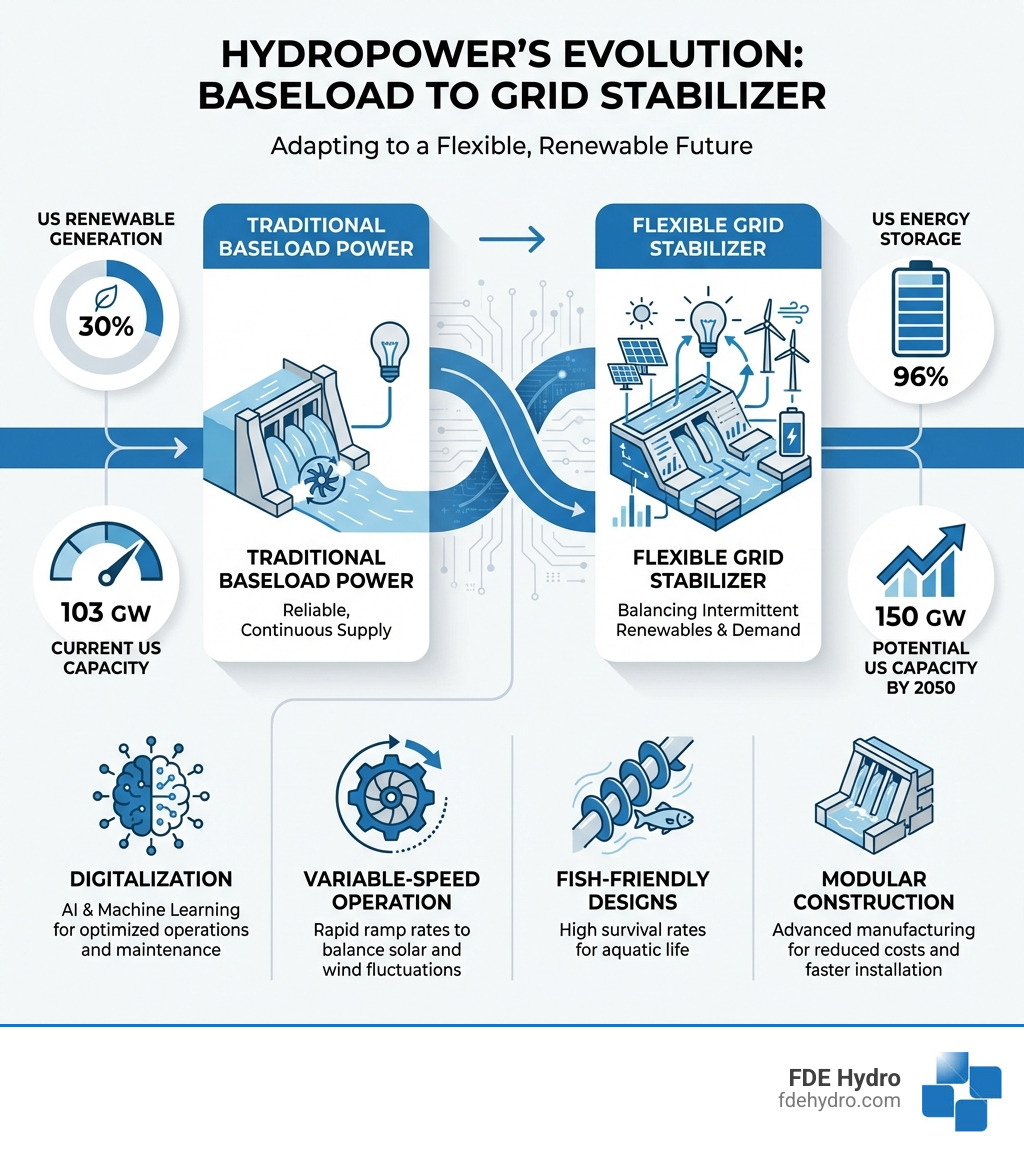
Future of hydropower technology terms to know:
Drivers of Change: Why Hydropower Innovation is Accelerating
The world is undergoing a profound energy transition, moving rapidly towards renewable sources to combat climate change. In this dynamic landscape, hydropower, our oldest renewable energy source, is experiencing a renaissance driven by a confluence of factors. These primary drivers are not just pushing for incremental improvements but are catalyzing a fundamental reshaping of the future of hydropower technology.
One of the most significant drivers is the urgent need to balance the grid as more intermittent renewable energy sources, such as solar and wind, come online. Hydropower’s inherent flexibility—its ability to quickly ramp up or down power generation—makes it an invaluable partner for these variable sources. It provides critical ancillary services, like frequency regulation and voltage support, which are essential for maintaining grid stability and reliability. Without flexible resources like hydropower, integrating large amounts of solar and wind would be far more challenging, risking grid instability and blackouts. This is why significant potential exists for new pumped storage hydropower (PSH) to meet grid flexibility, reliability, and security needs, as noted by the U.S. Department of Energy.
Climate change itself is another powerful catalyst for innovation. We are witnessing changing water availability patterns, including persistent droughts in regions like California and parts of Canada and Brazil. This unpredictability necessitates hydropower technologies that can adapt to lower or more volatile water flows. Cloud seeding operations, while not directly hydropower technology, offer a glimpse into innovative approaches to water management that could indirectly benefit hydropower by increasing snowpack and precipitation in key watersheds. For instance, cloud seeding in Australia has shown to increase precipitation by 14% in seeded areas. Such strategies, combined with advanced forecasting, are becoming crucial for optimizing operations in a climate-altered world.
Our existing hydropower infrastructure also presents both a challenge and an opportunity. The average age of hydropower facilities in the U.S. is over 60 years, with many exceeding a century. This aging fleet requires modernization to improve efficiency, extend operational life, and incorporate new technologies. This is where innovation steps in, enabling us to optimize the value and power generation of our existing fleet, rather than solely focusing on new construction.
Finally, supportive policy and regulatory frameworks are crucial in accelerating the adoption of new hydropower technologies. In the U.S., the Inflation Reduction Act (IRA), signed into law in 2022, includes provisions to drive hydropower growth, offering tax credits for new facilities and retrofits. Furthermore, legislative efforts like the proposed Hydropower Clean Energy Future Act aim to streamline the Federal Energy Regulatory Commission’s (FERC) licensing process, which has historically been a significant hurdle for new projects and upgrades. These policies, coupled with a growing emphasis on environmental stewardship, are creating an environment ripe for innovation, ensuring that hydropower remains a cornerstone of our clean energy future.
The Digital Dam: How Data and AI are Changing Operations
The digital revolution is sweeping across industries, and hydropower is no exception. The future of hydropower technology is inextricably linked to advancements in digitalization, Artificial Intelligence (AI), and machine learning. These technologies are changing how we operate, maintain, and even design hydropower facilities, promising unprecedented levels of efficiency, reliability, and safety.

The Power of Predictive Maintenance
Imagine knowing exactly when a piece of equipment needs servicing before it breaks down. That’s the promise of predictive maintenance, powered by digitalization. By collecting and processing real-world data, we can adjust the actual working conditions of hydropower turbines, providing advanced grid supporting services without compromising reliability and safety.
The impact of this is profound. It’s estimated that implementing hydropower digitalization could add a total of 42 TWh to present global hydropower energy production annually. This isn’t just about more power; it’s about significant operational savings, potentially reaching $5 billion annually. A compelling study found that plants implementing advanced analytics and continuous monitoring for predictive maintenance experienced a remarkable 90% decrease in corrective maintenance costs and an 80% increase in labor productivity. This means fewer unexpected shutdowns, optimized resource allocation, and a more efficient workforce.
AI, Machine Learning, and Smart Control
Beyond predictive maintenance, AI and machine learning are enabling a new era of smart hydropower. This includes the development of “digital twins”—virtual replicas of physical hydropower plants that use real-time data to simulate operations, predict performance, and identify potential issues. These digital avatars allow operators to test scenarios, optimize settings, and make data-driven decisions without impacting the actual plant.
AI is also being leveraged in the design phase, with “AI dam designers” exploring new configurations and optimizing hydraulic performance. Smart monitoring systems, including dam condition tracking by satellite radar, help operators identify problems and implement solutions early on. This cuts machine downtime and streamlines processes, leading to increased plant safety, compliance, and agility. Our own work at FDE Hydro™ in AI for Sustainability, AI Energy Management, and Water Management AI demonstrates our commitment to using these powerful tools to improve hydropower’s efficiency and environmental footprint.
Core Component Innovations: The Heart of Modern Hydropower
At the core of any hydropower plant are its turbines and generators, the workhorses that convert the energy of flowing water into electricity. The future of hydropower technology is seeing significant innovation in these components, driven by the need for greater efficiency, flexibility, and environmental compatibility.
Advanced Turbines and Generators for a Flexible Grid
For hydropower to truly shine in a grid dominated by variable renewables, it needs to be more agile. This means turbines and generators that can operate efficiently across a wider range of flows and rapidly adjust their output. Here’s how we’re seeing advancements:
- Improved Efficiency: Continuous advancements in turbine design, often aided by advanced computational fluid dynamics (CFD) modeling, are squeezing every last drop of energy from the water.
- Variable-Speed Turbines: These are game-changers, particularly for pumped storage hydropower (PSH). Enabled by power electronic converters, variable-speed turbines can operate at different rotational speeds, significantly improving efficiency and operational flexibility. This allows them to better adapt to fluctuating hydrological regimes and provide superior grid ancillary services. For example, the Goldisthal PHS plant in Germany and the Frades II plant in Portugal use variable-speed technology to improve grid stability.
- Wider Operating Ranges: Modern turbines are designed to perform optimally not just at peak flow, but also at partial loads, reducing wear and tear and extending the operational life of the unit.
- Segmented Generator Rotors: Innovations in generators include segmented rotors with individually controlled magnetization currents. This technology offers the potential for active rotordynamic control and vibration reduction, leading to more reliable and longer-lasting equipment.
Environmentally-Smarter and Fish-Friendly Designs
The environmental impact of hydropower has always been a key consideration. The future of hydropower technology emphasizes designs that minimize ecological disruption, particularly concerning fish migration. We are seeing exciting breakthroughs in this area:
- Fish-Friendly Turbines: These designs are engineered to allow fish to pass through with minimal injury or mortality. The Hanover Pond Dam Project in Meriden, Connecticut, is a pioneering example, utilizing an Archimedes Screw Turbine that achieved a 100% survival rate for migrating fish.
- Restoration-Focused Turbines: Projects like the Freedom Falls Project in Maine use advanced runner blade designs, such as Restoration Hydro turbines, which have resulted in an estimated 100% 48-hour survival rate for juvenile alewives with less than 3% injury.
- Aerating Turbines: Some designs incorporate aeration capabilities to improve water quality downstream, addressing concerns about dissolved oxygen levels.
- Oil-Free Components: To prevent water contamination, there’s a growing trend towards oil-free turbine and generator components.
These innovations demonstrate a clear commitment to sustainable hydropower, ensuring that our energy generation harmonizes with river ecosystems.
New Materials and Manufacturing for the Future of Hydropower Technology
The durability and cost-effectiveness of hydropower infrastructure are heavily influenced by the materials and manufacturing techniques used. Advances here are crucial for modernization and new development.
- Advanced Composites and Coatings: New materials are being explored for tunnel linings, penstocks, and turbine components. These offer improved durability, corrosion resistance, and reduced maintenance needs, even in harsh environments.
- Additive Manufacturing (3D Printing): While still emerging, 3D printing holds promise for producing complex turbine parts more efficiently, potentially reducing lead times and customization costs.
- Modular Precast Concrete Construction: This is where FDE Hydro™ truly shines. Our patented modular precast concrete technology, often referred to as “French Dam” technology, revolutionizes the construction and retrofitting of hydroelectric dams and water control systems. This approach significantly reduces construction costs and time in key regions like North America (including New York, California, Kansas), Brazil, and Europe. Our modular construction techniques and precast concrete technology offer substantial project cost reduction compared to traditional methods, addressing the challenges of aging infrastructure and making new projects more economically viable. The U.S. Department of Energy has highlighted the opportunities for hydropower to capitalize on advanced manufacturing, and our modular systems are a prime example of this.
The Future of Hydropower Technology: Storage, Stability, and Scale
As we look ahead, the future of hydropower technology is increasingly defined by its role as a flexible energy storage solution, a cornerstone of grid stability, and a scalable contributor to our clean energy goals.
Flexible Hydropower Storage Solutions
Hydropower is already the undisputed leader in large-scale energy storage. Pumped storage hydropower (PSH) facilities account for approximately 96% of commercial energy storage capacity in the U.S. These “giant batteries” store excess electricity from variable renewables like solar and wind by pumping water uphill to a reservoir. When demand is high, the water is released, flowing downhill through turbines to generate electricity.
Innovations are making these storage solutions even more effective:
- Variable-Speed Pump-Turbines: As discussed, these improve efficiency and flexibility, allowing PSH plants to respond to grid signals with greater precision.
- Modular and Closed-Loop Systems: These designs can reduce the environmental footprint and construction complexity of PSH, potentially opening up new development sites.
- Underwater Pumped-Hydro Energy Storage (UPHES): A truly novel concept, UPHES proposes using the sea as the upper reservoir and hollow deposits on the seabed as the lower. While still in early stages, projects like the StEnSea (Stored Energy in the Sea) initiative in Germany and studies in Spain are exploring its technical feasibility, potentially expanding PSH opportunities in coastal regions of Europe.
The Department of Energy Hydropower Program recognizes the immense potential of PSH to support grid reliability and the integration of variable renewable energy.
Integrating Advanced Hydropower into the Modern Grid
Integrating advanced hydropower technologies into our existing grid infrastructure presents both challenges and unparalleled opportunities. The challenge lies in modernizing an aging fleet and connecting new, often smaller-scale, projects efficiently. The opportunity, however, is immense:
- Ancillary Services: Hydropower’s fast response times make it ideal for providing critical ancillary services, such as frequency regulation, voltage support, and black-start capability (the ability to restart a grid after a blackout).
- Grid Infrastructure Support: By providing reliable, dispatchable power, hydropower reduces the strain on transmission lines and improves overall grid resilience. Our modular construction systems, such as those we develop at FDE Hydro™, can be rapidly deployed to support clean energy infrastructure projects and strengthen water infrastructure projects in North America, Brazil, and Europe.
- Optimized Operations: Digitalization and AI, as discussed earlier, allow for real-time optimization of hydropower operations, ensuring they provide maximum value to the grid. NREL’s vision emphasizes hydropower’s evolving role, open uping its full potential as a flexible, reliable, and sustainable energy source.
Adapting for the Future of Hydropower Technology
Climate change resilience is paramount. Hydropower technologies must adapt to impacts such as droughts and changing water availability. This involves:
- Improved Forecasting: More accurate hydrological forecasting, often improved by AI and machine learning, allows for better water management and optimized power generation schedules.
- Low-Head and Variable Flow Sites: Emerging technologies, including advanced designs for pumps as turbines (PATs) and gravity hydraulic machines like water wheels and Archimedes screws, are making it feasible to generate power from sites with very low heads or variable flows. This opens up vast potential in existing non-powered dams and water conveyance systems across the U.S., Canada, Brazil, and Europe.
- Growth Projections: The potential for hydropower growth is significant. The U.S. hydropower capacity could grow from its current ~80 GW to nearly 150 GW by 2050. Globally, hydropower could double its contribution by 2050, reaching 2,000 GW of capacity and over 7,000 TWh. Achieving this will require an average annual generation growth of 3.5% between 2023 and 2030, necessitating over 40 GW of new hydropower plants connected to the grid annually—almost double the average of the last five years. The IEA Hydropower Technology Roadmap outlines this ambitious, yet achievable, path towards a cleaner energy future.
Frequently Asked Questions about Hydropower’s Future
What is the biggest challenge facing hydropower?
The biggest challenge facing hydropower is a multifaceted one, encompassing aging infrastructure, the impacts of climate change on water availability, lengthy regulatory processes, and the need for improved environmental mitigation. Many existing hydropower plants in the U.S. and parts of Europe are over 60 years old, requiring significant modernization and investment to remain efficient and reliable. Climate change introduces unpredictable water flows, with droughts impacting generation in hydropower-rich regions like California and Canada. Additionally, complex and time-consuming licensing and permitting processes can delay crucial upgrades and new developments. The industry must also continue to innovate to minimize environmental impacts and ensure harmonious coexistence with aquatic ecosystems.
How is hydropower becoming more environmentally friendly?
Hydropower is making significant strides in environmental friendliness through several key innovations. The development and adoption of fish-friendly turbines, such as the Archimedes Screw Turbine, are achieving high survival rates for migrating fish. Advanced fish passage solutions, including nature-like fishways, are being implemented to ensure safe upstream and downstream movement. Technologies that aerate water to improve dissolved oxygen levels are enhancing water quality downstream of facilities. Furthermore, there’s a focus on smaller footprint designs and the powering of non-powered dams, which leverages existing infrastructure without creating new environmental disturbances. These efforts reflect a growing commitment to sustainable hydropower development.
Can hydropower work with solar and wind power?
Absolutely, hydropower is not just compatible with solar and wind power; it’s a key enabler for their widespread integration into the grid. Hydropower’s unique ability to act as a large-scale energy storage solution, particularly through pumped storage hydropower (PSH), allows it to store excess electricity generated by intermittent solar and wind when production outstrips demand. This stored energy can then be released back into the grid when solar and wind output drops or demand increases. Beyond storage, conventional hydropower provides essential fast-ramping power, quickly adjusting its output to balance the grid fluctuations inherent with variable renewables. This complementary relationship ensures a stable, reliable, and increasingly clean energy supply.
Conclusion: Powering a Sustainable Tomorrow
The future of hydropower technology is bright, dynamic, and essential for a sustainable energy future. We’ve explored how a blend of urgent drivers—the need for grid flexibility, climate change adaptation, and renewable energy integration—is accelerating innovation across the sector.
Digitalization, with its promise of AI-driven predictive maintenance and smart operational control, is revolutionizing how we manage our hydropower assets, leading to increased efficiency and significant cost savings. Innovations in core components, from advanced variable-speed turbines that offer unparalleled flexibility to fish-friendly designs ensuring ecological harmony, are reshaping the very heart of hydropower generation. Furthermore, advancements in materials and manufacturing, including our own modular precast concrete technology at FDE Hydro™, are making new construction and modernization projects faster, more cost-effective, and more sustainable.
Hydropower’s evolving role is shifting from a traditional baseload power source to a critical flexible grid stabilizer and the backbone of large-scale energy storage. Its ability to integrate seamlessly with intermittent renewables like solar and wind, provide vital ancillary services, and adapt to changing environmental conditions positions it as an indispensable component of the clean energy future.
At FDE Hydro™, we are proud to be at the forefront of this change. Our modular precast concrete technology is designed to facilitate the rapid, cost-effective, and environmentally responsible construction and retrofitting of hydroelectric dams and water control systems in North America, Brazil, and Europe. By embracing these cutting-edge innovations, we are not just building infrastructure; we are building the next generation of hydropower facilities that will power a sustainable tomorrow for generations to come.

