by Adaptify Support | Apr 2, 2026 | Hydro Facility Articles
Why Water Control Solutions Are the Backbone of Modern Infrastructure
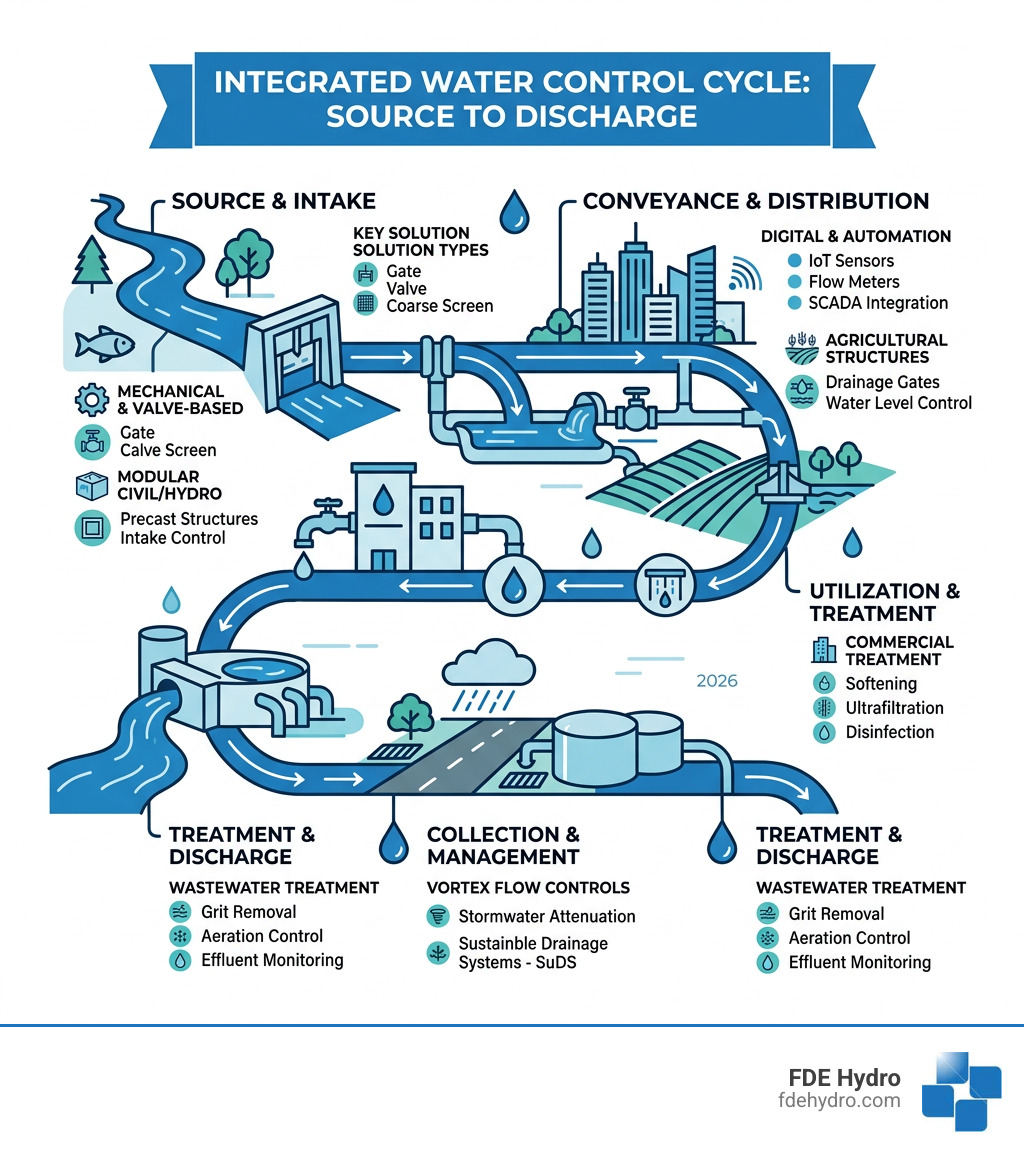
Water control solutions are the systems, devices, and technologies used to manage the flow, pressure, quality, and distribution of water across utilities, agriculture, industry, and civil infrastructure.
Here’s a quick overview of the main types:
| Category |
Examples |
Best For |
| Mechanical & valve-based |
Sluice gates, pressure reducing valves, check valves |
Utilities, wastewater, flood control |
| Vortex flow controls |
Vortex valves, flow regulators |
Stormwater, sustainable drainage |
| Digital & automation |
IoT sensors, cloud SCADA, smart metering |
Remote monitoring, efficiency |
| Agricultural structures |
Water level control structures, drainage gates |
Irrigation, field drainage |
| Commercial treatment |
Softeners, ultrafiltration, high-purity systems |
Institutional and industrial use |
| Modular civil/hydro |
Precast structures, run-of-river systems |
Hydropower, large infrastructure |
Water is one of the most critical — and most mismanaged — resources on the planet. Aging infrastructure, climate change, tighter regulations, and shrinking budgets are putting enormous pressure on the people responsible for managing it.
The good news? The range of solutions available today is broader and smarter than ever. From simple gate valves to cloud-connected automation systems, there’s a tool for virtually every water management challenge.
I’m Bill French, Sr., Founder and CEO of FDE Hydro™ and a decades-long leader in heavy civil construction and modular hydropower innovation — including developing patented water control solutions for natural run-of-river hydro facilities across the US, Canada, Europe, and Brazil. In this guide, I’ll walk you through the full landscape of options so you can make smarter decisions for your next project.
Essential Water control solutions terms:
Diverse Categories of Water Control Solutions
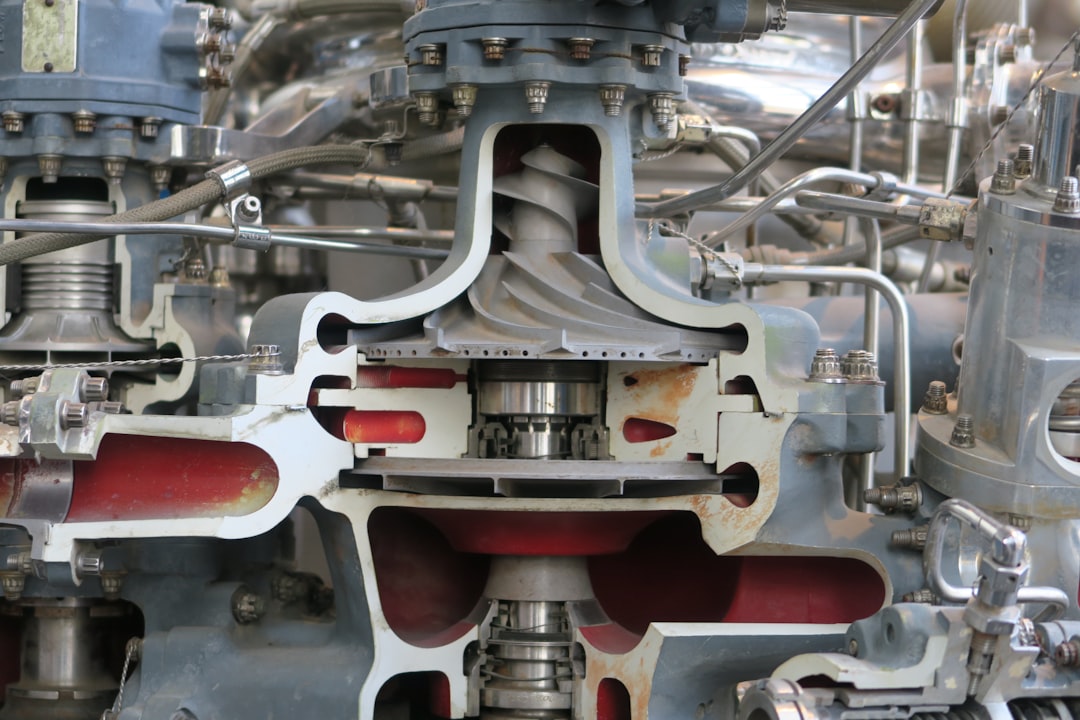
When we talk about managing our liquid assets, we aren’t just talking about turning a tap on and off. Modern Water Management Solutions encompass a massive spectrum of hardware and software designed to handle everything from a trickle of irrigation to a thundering flood.
The primary goal of these solutions is resource optimization. In places like California or New York, where water demand is high and weather patterns are becoming increasingly unpredictable, efficiency isn’t just a “nice to have”—it is a regulatory requirement. Whether you are managing a municipal utility or a large-scale hydropower facility, the right equipment ensures that every drop of water is accounted for and utilized effectively.
Mechanical and Valve-Based Water Control Solutions
The “muscle” of any water system lies in its mechanical components. These are the gates and valves that physically direct the flow.
Sluice gates and slide gates are the heavy hitters here. They are used in navigation locks, canals, and water treatment plants to block or allow passage. In the past, these were almost exclusively made of heavy cast iron. However, modern engineering has shifted toward more resilient materials.
Stainless steel and aluminum have become the preferred choices for modern infrastructure. Why? Because they don’t just sit there and rust. In environments where hydrogen sulfide (H2S) gas is present—common in wastewater treatment—traditional cast iron can fail prematurely.
| Feature |
Stainless Steel (900 Series) |
Aluminum (800 Series) |
Cast Iron (Traditional) |
| Corrosion Resistance |
Excellent (H2S resistant) |
High |
Poor (requires coating) |
| Weight |
Moderate |
Light |
Very Heavy |
| Maintenance |
Minimal |
Low |
High |
| Drinking Water Safety |
NSF-61 Compliant |
Generally Safe |
Requires Linings |
Beyond gates, we rely on specialized valves to maintain system health. Pressure reducing valves (PRV) prevent pipe bursts by keeping downstream pressure stable, while surge protection valves act like a “fuse” for your plumbing, absorbing the shock of water hammer.
Vortex Flow Controls for Sustainable Drainage
One of the most fascinating advancements in Water control solutions is the use of vortex technology. Advanced vortex flow control devices use the power of the vortex to manage stormwater without any moving parts or external power.
These units are self-activating. When flow is low, the device acts like a large pipe, letting water pass freely. As the water level rises during a storm, a vortex forms inside the unit, creating a “back pressure” that restricts the flow to a pre-set limit. This allows for smaller upstream storage requirements, which is a huge win for developers in cramped urban areas like New York City.
To ensure these systems won’t fail when the clouds open up, look for independent certifications. BBA Certification and WRc Certification are the gold standards, proving that the equipment has been rigorously tested for strength, durability, and hydraulic performance.
We live in the age of the “Smart City,” and water is finally catching up. Water Control Systems are no longer just “dumb” iron pipes buried in the ground. They are now integrated networks of sensors and software that can tell you exactly what is happening miles away.
Automation and IoT-Driven Water Control Solutions
The integration of the Internet of Things (IoT) has changed the game for utility managers. With cloud-based SCADA (Supervisory Control and Data Acquisition) systems, you can monitor lift stations or treatment plants from a smartphone.
This digital shift addresses one of the biggest headaches in the industry: Non-Revenue Water (NRW). This is water that is treated but “lost” before it reaches the customer due to leaks or theft. By using smart metering and real-time flow measurement, utilities can pinpoint exactly where a leak is occurring and fix it before it becomes a sinkhole.
If you want to dive deeper into how to turn raw sensor data into actionable plans, I highly recommend checking out this Webinar: Maximizing Performance. It covers how utilities are using data to do more with fewer staff members—a critical need as the workforce ages.
Improving Efficiency with Intelligent Process Controls
Efficiency isn’t just about stopping leaks; it’s about saving energy. Pumping water is incredibly energy-intensive. By using Variable Frequency Drives (VFDs) and intelligent process controls, systems can adjust pump speeds based on actual demand rather than running at 100% all the time.
Modern controllers can even perform predictive maintenance. By analyzing vibration and heat signatures, these systems can detect a pump failure before it actually happens. This reduces emergency call-outs and extends the life of the equipment, which is a massive cost-saver for any municipality.
Specialized Applications for Commercial and Agricultural Needs
Water control isn’t just for big cities. In the fields of Kansas or the commercial hubs of California, the requirements are much more specialized.
Agricultural Drainage and Level Control
In agriculture, it’s all about balance. Too much water drowns the crops; too little withers them. Water Control Structures allow farmers to manage the water table in their fields. By using adjustable structures, a farmer can hold water back during the growing season to keep soil moisture high and then release it before harvest to ensure the ground is firm enough for heavy machinery.
These structures are field-proven and designed to last decades in harsh outdoor environments. For a deeper look at how these are configured, our Water Control Structures Guide provides a comprehensive breakdown.
Precision irrigation also plays a huge role here. Using high-efficiency low-flow control zone kits ensures that water is delivered directly to the root zone without “weeping” or waste. These kits often include anti-siphon valves to prevent backflow, ensuring that fertilizers or pesticides don’t migrate back into the clean water supply.
Industrial and Institutional Water Treatment
Commercial buildings, hospitals, and labs have their own set of rules. Hard water can destroy expensive boilers and HVAC systems in a matter of months. This is where commercial water softeners and high-purity systems come in.
For institutions like hospitals, water control is a matter of life and death. Advanced ultrafiltration acts as a physical firewall against pathogens like Legionella. Specialized monitoring systems can now track water quality in real-time throughout a facility’s piping, ensuring compliance with strict health regulations.
Overcoming Infrastructure Challenges with Modern Engineering
We are currently facing a “perfect storm” of challenges. Much of the water infrastructure in North America was built 50 to 100 years ago. Combine that aging iron with “urban creep”—where concrete replaces soil, leading to more runoff—and you have a recipe for disaster.
Building Sustainable Water Infrastructure requires a shift in how we think about construction. We can’t always rely on the slow, expensive methods of the past.
Future-Proofing with Adjustable Water Control Solutions
One of the smartest features in modern water design is adjustability. For example, some vortex flow controls now come with adjustable inlets. This allows a site manager to change the flow rate by up to 20% post-installation.
Why does this matter? Because regulations change. Climate change might bring heavier rains than the original engineers predicted. If your system is adjustable, you can adapt to these changes without digging up the entire street to replace a pipe. For more on these adaptive strategies, see our Water Infrastructure Projects Guide.
Material Advantages in Corrosive Environments
We’ve touched on this, but it bears repeating: material choice is the difference between a 10-year lifespan and a 50-year lifespan.
In the wastewater industry, H2S gas creates a highly acidic environment that eats through traditional cast iron gates. Stainless steel (specifically the 900 series) and aluminum are the modern standard. They offer:
- Corrosion Resistance: No need for expensive, toxic coatings that eventually peel.
- Ease of Installation: Aluminum gates are significantly lighter, meaning they require smaller hoists and less labor to install.
- Safety: Stainless steel is NSF-61 compliant, making it safe for use in drinking water distribution.
Investing in these materials upfront might cost slightly more, but the ROI is clear when you factor in the lack of maintenance and replacement costs. You can find more details in our Water Infrastructure Solutions section.
Frequently Asked Questions about Water Control
How do vortex flow controls manage different flow levels?
Vortex flow controls typically operate in three distinct phases. In the Low Flow phase, the device acts like a standard orifice. As levels rise to the Design Point, a stable air-filled vortex forms, creating a “choke” effect that limits discharge. Finally, during the Drain Down phase, the vortex collapses as the water level drops, allowing the system to empty quickly and efficiently.
Why is stainless steel preferred over cast iron in corrosive environments?
Cast iron is prone to “graphitization” and heavy rusting, especially when exposed to the gases found in sewage. Stainless steel is inherently resistant to these chemical attacks. Furthermore, stainless steel gates are typically custom-fabricated, allowing for tighter seals and more precise flow control than traditional cast-molded iron.
What role does IoT play in reducing operational costs?
IoT reduces costs by moving utilities from “reactive” to “proactive” maintenance. Instead of sending a crew to check a remote pump station every week, sensors send data to the cloud. If the data shows a pump is drawing too much current (a sign of a coming clog), the crew is sent only when needed. This saves thousands in labor and fuel costs annually.
Conclusion
At FDE Hydro™, we believe that the future of water management lies in speed, modularity, and intelligence. Our patented modular precast concrete technology, known as the “French Dam,” is a prime example of how we are reimagining Water control solutions. By using pre-fabricated sections, we can build or retrofit hydroelectric dams and water control systems in a fraction of the time it takes for traditional poured-in-place concrete.
Whether you are looking to optimize a small irrigation canal or build a multi-megawatt hydropower facility, the principles remain the same: use the best materials, embrace automation, and always design for the future.
If you’re ready to modernize your infrastructure, explore our Water Control Infrastructure Guide 2025 or learn about the next generation of power in Modular Hydro: The Future of Flexible Power Generation.
Taking control of your liquid assets isn’t just about managing water—it’s about securing the future of our communities. Let’s build something that lasts.
by Adaptify Support | Mar 30, 2026 | Hydro Facility Articles
Why Next Generation Fish Passage Protection Matters for Our Rivers and Ecosystems
Next generation fish passage protection refers to the latest technologies, engineering approaches, and collaborative strategies that help migratory fish safely navigate or bypass man-made barriers like dams, culverts, and levees.
Here’s a quick overview of what it includes:
- Advanced turbine designs that allow fish to pass through hydropower facilities with up to 99% survival rates
- Fish-friendly infrastructure such as nature-like fishways, improved fish ladders, and trap-and-haul systems
- Innovative monitoring tools like environmental DNA (eDNA) sampling and acoustic tracking sensors
- Strategic dam removal to restore free-flowing river connectivity
- Multi-agency collaboration between federal programs, Tribes, states, and private partners
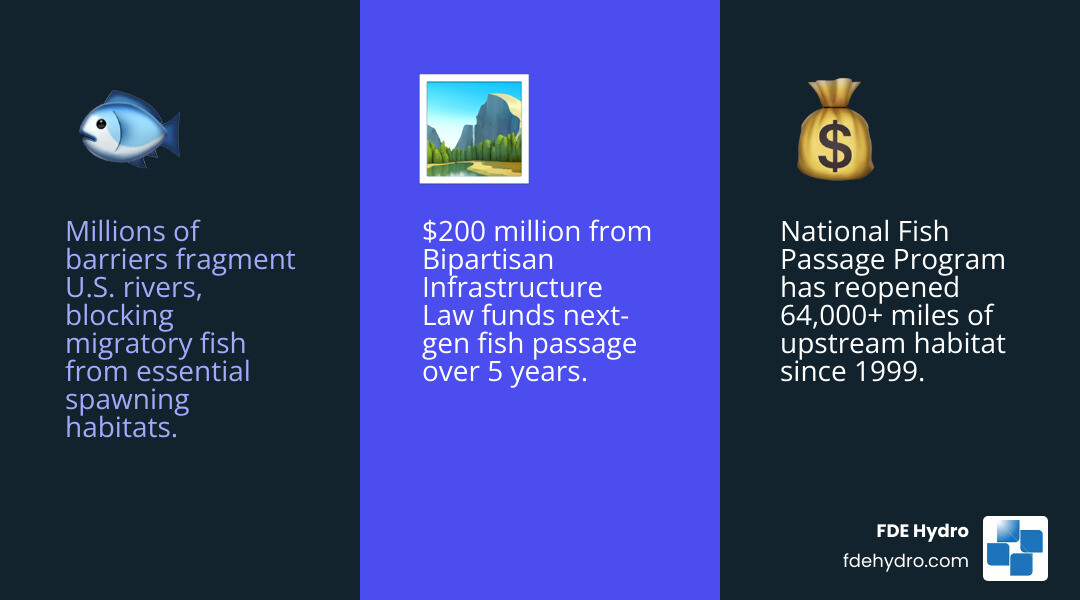
Across the United States, millions of barriers fragment rivers and block fish migration — cutting off species like Chinook salmon, American eel, and Pacific lamprey from the spawning and rearing habitats they need to survive. Since 1999, the National Fish Passage Program alone has removed or bypassed over 3,500 barriers, reopening access to more than 64,000 miles of upstream habitat. Yet the scale of the problem still far outpaces current solutions.
The good news? A new generation of technologies and funding — including $200 million over five years from the Bipartisan Infrastructure Law — is transforming how we protect aquatic ecosystems while keeping hydropower infrastructure productive and resilient.
I’m Bill French, Sr., Founder and CEO of FDE Hydro™ and a participant in the U.S. Department of Energy’s Hydropower Vision Technology and Performance Task Force, where I helped shape next-generation hydropower strategies for Congress — work that sits at the heart of next generation fish passage protection. In the sections below, I’ll walk you through the full landscape: from conventional passage methods and their limitations, to cutting-edge engineering, real-world case studies, and what the future holds for balancing energy production with healthy, connected waterways.
Terms related to next generation fish passage protection:
The Evolution of River Connectivity: From Ladders to Next Generation Fish Passage Protection
For over a century, the primary way we helped fish get past dams was through relatively simple mechanical structures. While these were at the time, our understanding of aquatic biology has evolved. We’ve moved from merely “getting fish over the wall” to ensuring they arrive at their destination healthy and ready to spawn.
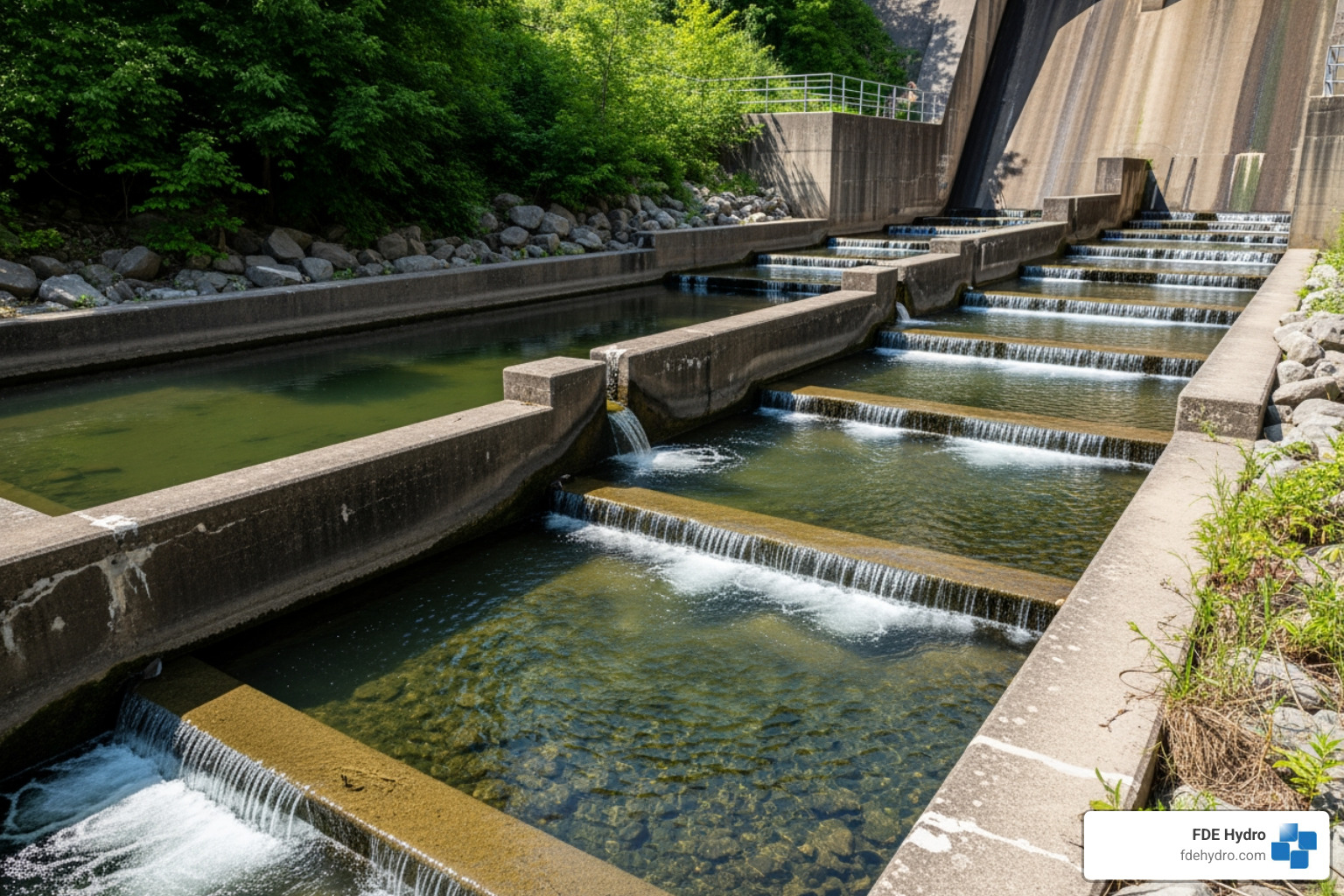
Historically, numerous fish passage technologies have been employed to mitigate the impact of dams. These include:
- Fish Ladders: A series of stepped pools that allow fish to leap or swim from one level to the next.
- Fish Lifts (Elevators): Mechanical hoppers that collect fish at the base of a dam and lift them to the reservoir above.
- Trap-and-Haul: Systems where fish are captured in tanks and driven by truck or barge to upstream release points.
- Spillways: Channels designed to allow water (and hopefully fish) to bypass the turbines during high-flow events.
While these methods have saved countless fish, they often cause migration delays and increase predation risks. If a fish spends three days trying to find the entrance to a ladder, it burns through energy reserves needed for spawning.
Limitations of Conventional Systems
Conventional systems are rarely “one size fits all.” A ladder designed for a powerful jumper like a Chinook salmon might be completely impassable for a Pacific lamprey, which uses a “burst-and-attach” suction method to move. Furthermore, scientific research on fishway performance shows that many technical fishways suffer from low attraction efficiency—meaning fish simply can’t find the door.
Environmental trade-offs also exist. For example, spillways can lead to gas supersaturation, where elevated dissolved gases in the water cause “the bends” in fish. Additionally, predators like sea lions often congregate at the base of these structures, turning a conservation tool into an ecological trap.
Innovative Monitoring in Next Generation Fish Passage Protection
To fix what isn’t working, we need data. Modern next generation fish passage protection relies on high-tech monitoring to see what’s happening beneath the surface.
One of the most exciting developments is collecting and analyzing RNA and DNA (eDNA) from water samples. By simply testing a cup of river water, scientists can identify which species are present and even estimate their population size with up to 98% accuracy. This non-invasive method is far safer than traditional netting or handling.
For individual tracking, researchers now use specialized sensors and acoustic transmitters. These tiny tags act like a “Fitbit for fish,” recording water pressure, temperature, and movement patterns as the fish navigates a hydropower facility.
Cutting-Edge Engineering for Fish-Friendly Hydropower
At FDE Hydro, we believe that clean energy and healthy rivers must go hand-in-hand. This is why we focus on aquatic-animal-and-recreational-passage as a core component of our modular dam technology. By using precast concrete sections, we can integrate passage solutions directly into the dam’s structure more efficiently than traditional construction allows.
The engineering world has seen a massive shift toward “fish-friendly” turbines. For example, the U.S. Army Corps of Engineers installed a new turbine at the Ice Harbor Dam on the Snake River that achieved a survival rate of 98%, a significant jump from the 90% seen with older designs. Other innovations, like the Restoration Hydro Turbine (RHT), use thicker, rounded blades and specific slants to allow fish like rainbow trout and American eel to pass through completely unharmed.
Future Digital Controls for Next Generation Fish Passage Protection
The next frontier isn’t just better concrete or steel; it’s better software. Digital, Information, Communication, and Control (DICC) technologies allow dam operators to track fish in real-time and adjust water flows instantly.
Imagine a system that detects a school of migrating salmon approaching and automatically opens a bypass gate or slows a turbine to ensure safe passage. These automated systems improve climate resilience by optimizing flow even during unpredictable weather patterns, ensuring that the dam works with the river’s natural rhythm rather than against it.
Balancing Energy Production and Biodiversity
Hydropower is a powerhouse of the American grid, providing 28.7% of all U.S. renewable energy and 6.2% of total electricity generation. Because it can provide steady “baseload” power, it’s the perfect partner for variable sources like wind and solar.
However, maintaining this grid reliability requires constant R&D. The Water Power Technologies Office (WPTO) recently announced $6.3 million for six projects aimed at advancing next generation fish passage protection. These projects use a new type of sensor to monitor small migratory fish like American Shad, which have historically been difficult to study due to their size and sensitivity.
Restoring Habitat Through Strategic Dam Removal and Infrastructure Upgrades
Sometimes, the best fish passage is no dam at all. For obsolete or dangerous structures that no longer provide significant power or flood control, removal is the gold standard for restoration.
The Bipartisan Infrastructure Law (BIL) has been a game-changer here, providing a once-in-a-generation $200 million investment. Recently, the U.S. Fish and Wildlife Service announced $70 million to support 43 projects across 29 states. These projects address outdated dams and culverts that have fragmented our watersheds for decades. To see the impact near you, you can ACCESS THE INTERAGENCY FISH PASSAGE PORTAL to view the data dashboard of ongoing work.
Case Studies in Connectivity Restoration
We are seeing incredible results from coast to coast:
- Penobscot River, Maine: Through the Penobscot Habitat Focus Area, NOAA and its partners removed dams and installed nature-like fishways, opening 3,100 acres and 30 miles of habitat. This has benefited Atlantic salmon and helped restore 100% of the historic habitat for the shortnose sturgeon.
- California’s Second Largest Dam Removal: On the South Fork Eel River, the removal of the Benbow Dam improved access to 100 miles of spawning habitat for Chinook salmon and steelhead.
- Rogue River, Oregon: The removal of three major dams restored 300 miles of migratory access, proving that large-scale restoration is possible when stakeholders work together.
Economic and Community Benefits of Passage Projects
Improving fish passage isn’t just good for the environment; it’s a smart investment for people. Outdated dams and undersized culverts are often “bottlenecks” that increase flood risks during heavy rains. By replacing a crumbling culvert with a wider, stream-simulation structure, we improve road resilience and protect local property.
Furthermore, Fish Passage Projects Address Climate Resilience by strengthening local economies. Healthy fish populations mean better recreational fishing opportunities, which support tourism and local tackle shops. In many cases, these projects also eliminate public safety hazards posed by “low-head” dams, which can create dangerous drowning machines for kayakers and swimmers.
Collaborative Frameworks and Global Lessons for Aquatic Biodiversity
Successful next generation fish passage protection requires a seat at the table for everyone. This includes federal agencies, state governments, local communities, and, crucially, Tribes. Indigenous knowledge of fish behavior and historical migration patterns is invaluable for designing passage that actually works.
In the Columbia-Snake River Basin (CSRB), for example, collaborative efforts have been essential for protecting the Pacific lamprey—a species of immense cultural importance to Pacific Northwest Tribes. These partnerships ensure that conservation goals are met while maintaining the hydropower that powers the region.
Scaling Success from North America to Southeast Asia
The lessons we learn in North America are now being exported to help protect global biodiversity. The future of fish passage science involves scaling these successes to regions like Southeast Asia, where massive hydropower development on the Mekong River threatens the food security of millions.
Through masterclasses and capacity-building programs, experts are training the next generation of professionals to use “The Big 5” criteria for fishway design: entrance location, tailwater range, headwater range, fishway dimensions, and exit location. This knowledge transfer ensures that as developing nations build their energy infrastructure, they don’t repeat the ecological mistakes of the past.
Addressing Environmental Trade-offs
No solution is perfect, and we must be honest about the trade-offs. Restoring “lateral connectivity” (connecting the river to its floodplain) is vital for species like the trispot darter, but it can also allow invasive species to spread more easily.
To manage this, we use Passage Guidelines for Select Native Fishes to create “selective” passage. This might involve using specific water velocities that native fish can handle but invasive species cannot, or using automated sorting gates. It’s a delicate balance, but with modern sensors and better engineering, we’re getting closer to a truly “smart” river.
Frequently Asked Questions about Next Generation Fish Passage Protection
What are the primary challenges posed by dams to fish migration?
Dams create physical barriers that block access to spawning grounds, but they also change the river’s environment. They can alter water temperatures, slow down the flow (making it harder for juvenile fish to navigate downstream), and concentrate predators at passage entrances.
How has the Bipartisan Infrastructure Law impacted fish passage projects?
The BIL provided a massive $200 million injection of funding over five years. This has allowed the National Fish Passage Program to scale up from small, local fixes to watershed-level restorations, such as removing multiple barriers in a single river system to reopen hundreds of miles of habitat at once.
What innovative technologies are improving fish survival at hydropower facilities?
Key innovations include advanced “fish-friendly” turbines with rounded blades, eDNA monitoring to track populations non-invasively, and acoustic sensors that provide real-time data on how fish interact with dam structures. These tools allow for “precision conservation” that was impossible 20 years ago.
Conclusion
The future of our rivers depends on our ability to innovate. At FDE Hydro, we are proud to contribute to this mission with our “French Dam” technology. By utilizing modular precast concrete, we make it faster and more cost-effective to build and retrofit dams with next generation fish passage protection in mind. Whether it’s in New York, California, or our projects in Brazil and Europe, our goal remains the same: sustainable hydropower that respects the life of the river.
We invite you to ACCESS THE INTERAGENCY FISH PASSAGE PORTAL to see how these national efforts are unfolding. If you’re interested in how we can help your community or facility, Learn more about modernizing hydropower infrastructure and join us in protecting our aquatic friends for generations to come.
by Adaptify Support | Mar 18, 2026 | Hydro Facility Articles
Why Energy Storage is Critical for Tomorrow’s Grid
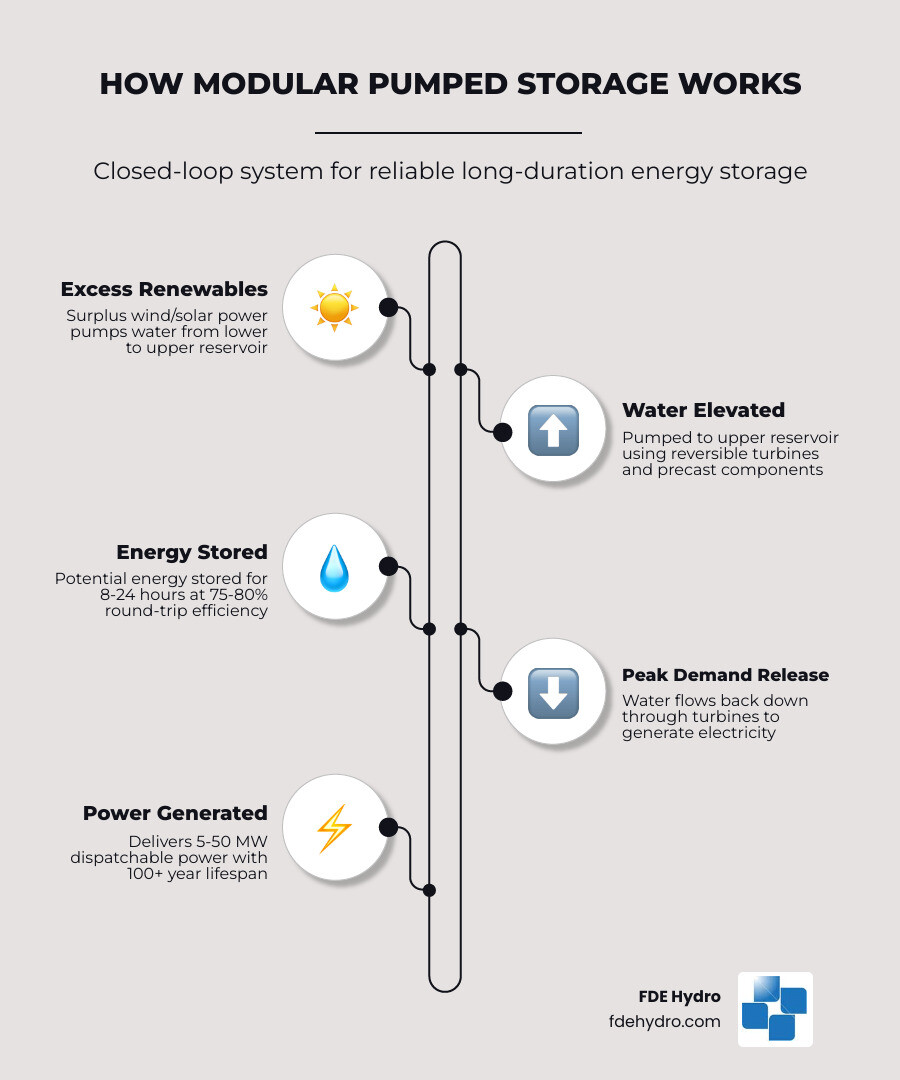
Modular pumped storage is a smaller-scale version of traditional pumped hydro that stores energy by moving water between two reservoirs at different elevations. Unlike massive utility-scale plants, modular systems typically range from 5-50 MW with 8-24 hours of storage capacity, using off-the-shelf components and standardized designs that can be deployed faster and in more locations.
Key characteristics of modular pumped storage:
- Size: 5-50 MW capacity (vs. 100+ MW for traditional PSH)
- Storage duration: 8-24 hours of energy delivery
- Design: Uses precast components and modular construction
- Location: Can be built as closed-loop systems away from natural waterways
- Efficiency: 75-80% round-trip efficiency
- Lifespan: 100+ years with minimal degradation
- Deployment: Faster construction timelines than conventional PSH
As wind and solar generation floods the grid, utilities face a critical challenge: how do you keep the lights on when the sun sets and the wind stops blowing? Short-duration storage technologies can handle 4-10 hours of storage, but they often degrade quickly and become prohibitively expensive for longer durations. Traditional pumped hydro offers the right duration and lifespan, but projects take a decade to permit and cost billions to build.
This is where modular pumped storage changes the equation.
The energy storage gap is real. Pumped storage hydropower currently provides 97% of all utility-scale energy storage in the United States—about 23 GW from just 43 operating projects. But no major new pumped storage has been built in the US for over 30 years, despite a FERC queue with 90+ proposed projects representing 50+ GW of capacity.
The barriers are clear: high upfront capital costs, 8-10 year permitting timelines, and the massive scale required to achieve economies of scale. A typical pumped storage project costs $1-3 billion and requires unique site-specific engineering.
Modular pumped storage offers a different path forward. By using standardized precast components, closed-loop designs that don’t impact natural waterways, and smaller scales that reduce capital risk, m-PSH can be deployed where traditional pumped storage cannot. These systems preserve the 100+ year lifespan and proven reliability of conventional pumped hydro while addressing the speed, cost, and flexibility challenges that have stalled development.
I’m Bill French Sr., Founder and CEO of FDE Hydro, where we’ve developed patented modular precast construction technologies specifically designed to accelerate modular pumped storage deployment and reduce costs. Our innovations address the core barriers that have prevented pumped storage from keeping pace with grid storage needs.
Modular pumped storage terms made easy:
The Future of Grid Reliability: Modular Pumped Storage
The modern electrical grid is going through a bit of an identity crisis. For a century, we relied on large, spinning turbines powered by coal or gas to provide a steady “baseload.” Today, we’re moving toward a cleaner, more variable future dominated by wind and solar. While this is great for the planet, it’s a headache for grid operators who need to balance supply and demand every second.
Modular pumped storage (m-PSH) is emerging as the “Swiss Army Knife” of grid reliability. By operating at a 5-50 MW scale, these facilities are small enough to be sited near load centers (like cities in New York or California) or renewable energy hubs, yet large enough to provide 8-24 hours of firm, dispatchable power. This makes them a cornerstone of decarbonization goals across North America, Brazil, and Europe.
Unlike their giant predecessors, these systems don’t require damming a major river. Most modern designs utilize a “closed-loop” configuration. Think of it as a giant, rechargeable water battery that just sits there, ready to go. The Scientific research on PSH trends and challenges highlights that while traditional PSH is incredibly efficient, the shift toward modularity is essential to overcome the massive site-specific hurdles that have frozen the industry for decades.
How Modular Pumped Storage Differs from Traditional PSH
If traditional pumped storage is a bespoke, hand-built mansion, modular pumped storage is a high-quality, architecturally designed prefab home. Both serve the same purpose, but one is much easier to build.
- Closed-Loop vs. Open-Loop: Traditional plants often use existing rivers (open-loop), which involves complex environmental impacts on fish and water quality. Modular systems are almost exclusively closed-loop, using two artificial reservoirs that recirculate the same water.
- Precast Components: This is where we at FDE Hydro see the biggest shift. Instead of pouring massive amounts of concrete on-site—which is slow and weather-dependent—m-PSH can use precast concrete sections (like our French Dam technology). This allows for “Lego-style” assembly, drastically reducing construction time.
- Reduced Footprint: A traditional 1,000 MW plant might require hundreds of acres. A modular 10 MW plant can fit into a much smaller footprint, sometimes even utilizing existing industrial sites or abandoned mines.
- Site Flexibility: You don’t need a massive canyon. You just need a bit of elevation change (topographic relief) and a water source to fill the loop once.
- Construction Speed: Traditional PSH takes 10+ years. Modular designs aim to cut that significantly by using standardized, off-the-shelf turbines and precast structures.
Key Components and Operational Characteristics
At its heart, modular pumped storage relies on a few high-tech but proven components:
- Reversible Pump-Turbines: These are the workhorses. During the day, when solar power is cheap and plentiful, they act as pumps to push water uphill. At night, they spin the other direction to generate electricity.
- Standardized Motor-Generators: By using smaller, modular units, we can avoid the “one-off” engineering costs that plague large projects.
- Pressure Vessels (in some designs): Some innovative systems use pressure vessels to store energy. In these systems, water is pumped into a tank, compressing a gas. When power is needed, the gas pushes the water back out through a turbine.
- Round-Trip Efficiency: Most m-PSH systems achieve 75-80% efficiency. This means for every 100 kWh you spend pumping water up, you get 80 kWh back. This beats most long-duration alternatives.
The Research on gravity storage efficiency confirms that mechanical losses in these systems are well-understood and manageable, making them far more predictable than the degradation found in other chemical storage systems.
Advantages of Modular Energy Storage Solutions
Why choose water over other storage methods? Or over a giant traditional dam? The advantages of modular pumped storage boil down to longevity and locational freedom.
100-Year Lifespan
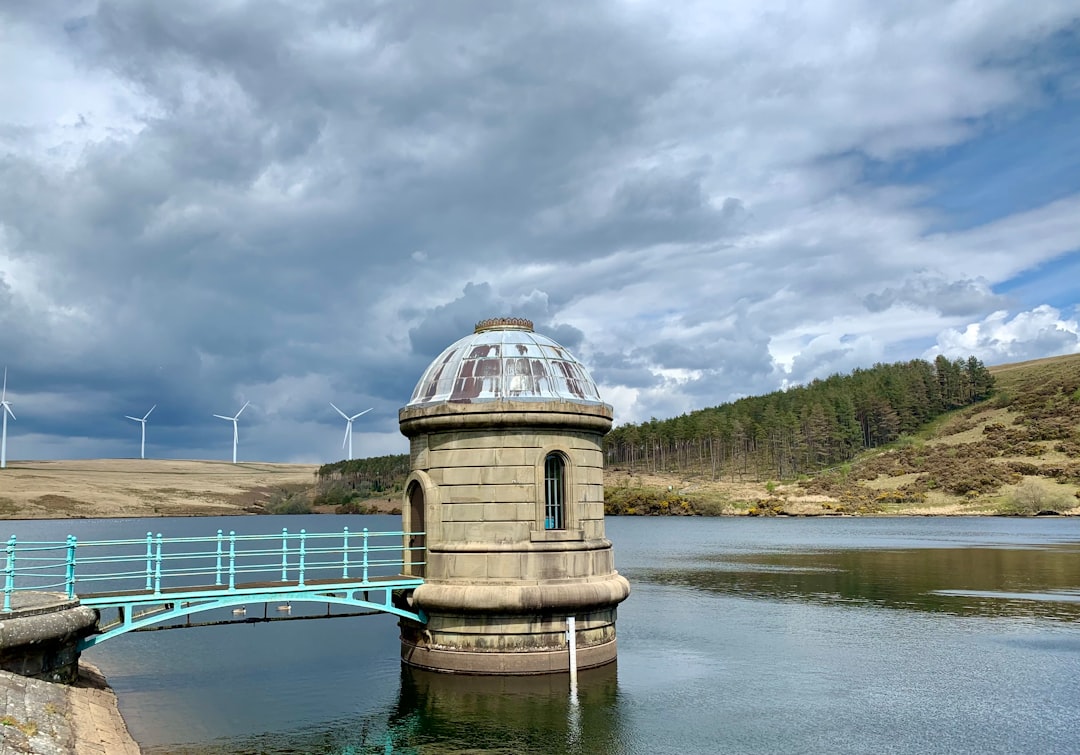
While some storage systems might last 10-15 years before they need expensive recycling and replacement, a pumped storage facility is built to last. Many PSH plants built in the 1920s are still running today. With modular precast concrete, we are building infrastructure that our grandchildren’s grandchildren will use.
Locational Flexibility
Because m-PSH is smaller and often closed-loop, we can put it in places where a 1,000 MW plant would be impossible. This includes:
- Abandoned Mines: High elevation changes already exist underground.
- Industrial Brownfields: Reusing land that already has transmission lines.
- Hilly Terrain: Small 50-acre plots can support a modular system.
Ancillary Services
These plants don’t just “store” energy. They provide “Black Start” capabilities (restarting the grid after a blackout), voltage regulation, and spinning reserves. These are services that keep the grid stable, and m-PSH does them better than almost any other tech.
Comparison Table: Modular vs. Traditional PSH
| Feature |
Modular PSH (m-PSH) |
Traditional PSH |
| Capacity |
5 – 50 MW |
100 – 3,000+ MW |
| Construction |
Precast/Modular |
Site-specific/Cast-in-place |
| Timeline |
3 – 5 years |
10 – 15 years |
| Water Source |
Closed-loop (Lined) |
Often Open-loop (Rivers) |
| Environmental Impact |
Minimal |
Significant |
| Cost Risk |
Low (Standardized) |
High (Bespoke) |
Integration with Renewables and Existing Infrastructure
We don’t just build these in a vacuum. modular pumped storage works best when it’s part of a “Hybrid Energy System.”
- Floating Solar: By putting solar panels on the reservoirs of an m-PSH plant, you reduce water evaporation and use the same transmission connection for two types of power. It’s a win-win.
- Run-of-River Plants: We can retrofit existing run-of-river hydropower plants in places like New York or Brazil with modular storage units. This allows a plant that used to just “flow with the river” to suddenly store energy and sell it when prices are highest.
- Grid Stability: In regions like California, where “The Duck Curve” (midday solar oversupply) is a major issue, m-PSH can soak up that excess solar and spit it back out during the evening peak.
Overcoming Deployment Challenges
If m-PSH is so great, why isn’t it everywhere? Like any infrastructure project, there are hurdles. But for the first time in decades, the wind is at our backs.
The Capital and Permitting Problem
The biggest challenge has always been the “Upfront CapEx.” It costs a lot of money to move dirt and pour concrete. Furthermore, the US permitting process via FERC can take 4-5 years for the federal level alone, even for low-impact closed-loop projects.
However, the Infrastructure Investment and Jobs Act (IIJA) has set aside $355 million specifically to support energy storage demonstration projects. This is a huge signal to investors that the government is serious about long-duration storage. You can read more about Federal funding for energy storage and how it’s helping move these projects from the lab to the field.
The Economic Viability of Modular Pumped Storage
When you look at the Levelized Cost of Storage (LCOS), modular pumped storage is incredibly competitive over its lifetime.
- Recoupment Periods: Some research suggests that a well-placed modular system can recoup its costs in as little as 3 to 6 years depending on the market.
- Revenue Streams: These plants make money through “Arbitrage” (buying low, selling high) and by getting paid for “Ancillary Services” by the grid operator.
- Market Design: We are seeing a shift in market rules in North America and Europe to better value “firm” power. As these rules change, the economic case for m-PSH becomes a slam dunk.
Innovative m-PSH Technologies and Projects
The world of modular pumped storage is evolving with new methods that make it easier to deploy storage in diverse environments without the need for traditional large-scale damming.
Closed-Loop Atlas and Site Identification
Researchers have identified over 800,000 potential sites globally for closed-loop pumped hydro. Many of these are in North America and Brazil, often using abandoned mines or existing reservoirs. This “Bluefield” development is the next frontier for modular precast technology, allowing for the rapid conversion of existing topography into high-capacity energy storage.
Modular Precast Reservoir Systems
One of the most significant innovations is the shift from site-specific civil engineering to standardized, modular construction. By using precast concrete components, developers can now implement “plug-and-play” reservoir structures. This approach reduces the environmental footprint and allows for the creation of storage facilities in locations previously thought unsuitable for hydropower, such as industrial brownfields or remote off-grid locations. These systems leverage the same proven physics of traditional pumped hydro but with the speed and flexibility of modern manufacturing.
Frequently Asked Questions about Modular Pumped Storage
What is the typical size of a modular pumped storage project?
Most modular projects fall into the 5-50 MW range. To put that in perspective, 10 MW can power roughly 7,500 to 10,000 homes. These systems are designed to be “scalable,” meaning if you need 100 MW, you might build two 50 MW modules side-by-side. The storage duration is typically 8-24 hours, which is the “sweet spot” for balancing solar and wind.
How long do modular pumped storage systems last?
This is the “killer app” of the technology. While many storage technologies are effectively “consumables” that wear out, m-PSH is “infrastructure.” These systems have a 100-year+ lifespan. The mechanical parts (turbines and pumps) might need a tune-up every 20-30 years, but the concrete structures—especially our modular precast French Dam components—are built for the long haul.
Can m-PSH be built away from natural rivers?
Yes! In fact, that is the whole point of “closed-loop” design. By using lined reservoirs or underground storage options, we don’t need to touch a single fish or disturb a natural riverbed. We can build them in the desert, on old coal mines in Kansas, or near industrial parks in New York City. They have minimal water consumption because the water just moves back and forth in a loop, with only a tiny bit of “makeup water” needed to account for evaporation.
Conclusion: Building the Backbone of the Clean Grid
The transition to 100% renewable energy isn’t just a dream; it’s a massive engineering project. But we can’t build that future on the back of short-lived, chemically intensive storage systems alone. We need the “Small but Mighty” power of modular pumped storage.
By shrinking the scale and standardizing the construction, we are making the world’s most proven storage technology accessible to everyone. Whether it’s retrofitting an old dam in Brazil or building a new closed-loop system in California, modularity is the key to speed and affordability.
At FDE Hydro, we are proud to be at the forefront of this movement. Our patented French Dam technology and modular precast concrete methods are designed to slash construction times and costs, making m-PSH a reality for utilities and private developers alike. We aren’t just building dams; we’re building energy security for the next century.
If you’re interested in how we can help your next project, or if you just want to learn more about the future of water-based energy storage, explore our modular dam construction solutions and let’s build a more resilient grid together.
Ready to take the next step in sustainable infrastructure? Contact us today to learn more about our French Dam technology
by Adaptify Support | Mar 13, 2026 | Hydro Facility Articles
The Case for Micro Hydro Power Plants in Modern Energy Infrastructure
Micro hydro power plants are small-scale hydroelectric systems that generate between 5 kW and 100 kW of electricity using the natural flow of water — no large dams required.
Here’s a quick snapshot of what you need to know:
| Feature |
Details |
| Power output |
5 kW to 100 kW (below 5 kW = pico hydro) |
| How it works |
Flowing water drives a turbine connected to a generator |
| Plant factor |
Up to 90% (vs. 10–30% for solar) |
| Typical cost |
$1,500–$2,500 per kW installed |
| System lifespan |
20–30 years with low maintenance |
| Best for |
Remote communities, off-grid sites, rural electrification |
| Environmental impact |
Minimal — most systems are run-of-river |
For large infrastructure decision-makers, micro hydro is increasingly hard to ignore. It delivers continuous, reliable power around the clock — something intermittent renewables like solar and wind simply cannot match on their own. With over 229 GW of small hydropower potential identified globally and only 78 GW installed as of 2019, the opportunity gap is significant.
Unlike conventional hydropower, micro hydro systems work with the natural water flow. They use a fraction of a stream’s flow, return water downstream, and avoid the massive civil works and ecological disruption tied to large dam projects. That makes them faster to permit, cheaper to build, and easier to justify — especially in environmentally sensitive areas.
The challenge, historically, has been the cost and complexity of civil construction. That’s exactly where innovation is changing the equation.
I’m Bill French, Sr., Founder and CEO of FDE Hydro™, and over the past decade I’ve focused specifically on solving the civil construction bottlenecks that have held micro hydro power plants back from their full potential through patented modular and precast construction technologies. My work building FDE Hydro™ follows five decades leading major heavy civil and infrastructure projects across New England, giving me a ground-level understanding of what it takes to deliver these systems efficiently and at scale.
Simple guide to micro hydro power plants terms:
Understanding Micro Hydro Power Plants: A Sustainable Energy Solution
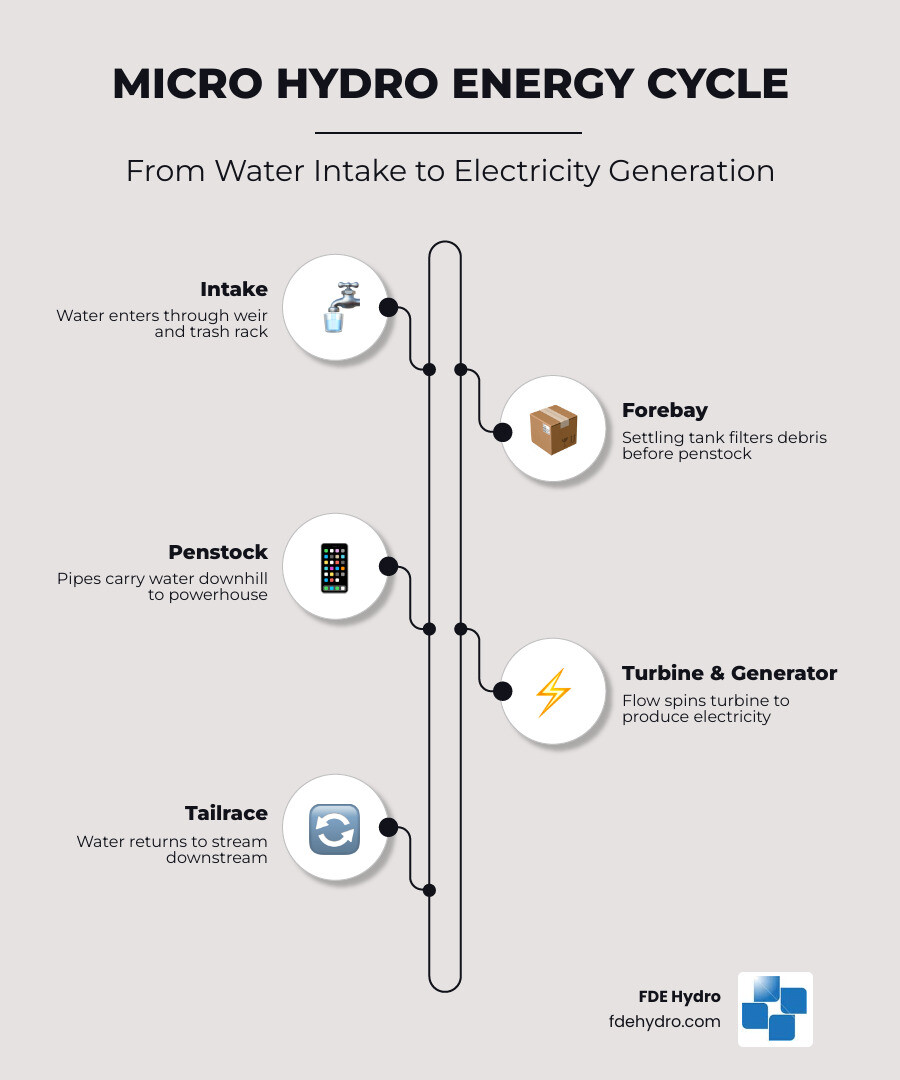
At its core, a micro hydro power plant is a marvel of efficiency. While we often think of massive concrete walls and flooded valleys when we hear “hydropower,” micro systems are different. They are primarily “run-of-river” installations. This means we don’t need to stop the river in its tracks; instead, we divert a small portion of the flow through a pipe, extract its energy, and pop it right back into the stream further down.
The power range for these systems is strictly defined: they generate between 5 kW and 100 kW. If you go below 5 kW, you’re looking at “pico hydro,” which might power a single off-grid cabin. If you scale up toward 200 kW, you’re entering the “mini-hydro” territory.
What makes these plants truly shine is their plant factor. In the energy world, plant factor describes how much power a plant actually produces versus its maximum potential. Solar panels usually hover around 10% to 30% because the sun likes to take nights and cloudy days off. Micro hydro power plants, however, can reach a plant factor of up to 90%. They are the “steady Eddies” of the renewable world, providing a continuous baseload of electricity. This reliability is one of the reasons hydropower has played a significant role in global energy expansion for over a century. To see where this technology is headed, you can read more about the future of hydropower.
Distinguishing Micro from Large-Scale Hydro
The biggest difference between micro and large-scale hydro is the footprint. Large-scale hydro requires massive reservoirs that can displace communities and alter local climates. Micro hydro, by contrast, requires minimal to no reservoir.
These systems are often integrated into existing infrastructure, such as irrigation canals or small streams. Because they only use a fraction of the stream flow, the ecological impact on fish and local flora is significantly reduced. We aren’t building a barrier; we’re building a bypass.
Engineering and Components of Micro Hydro Systems
Building a micro hydro system is like putting together a high-performance puzzle. Every piece must be sized correctly to ensure the water does its job without wearing out the equipment.

The key components include:
- Intake/Weir: A small structure that diverts water into the system.
- Trash Rack: A screen that keeps leaves, sticks, and the occasional adventurous fish out of the machinery.
- Penstock: The pipe that carries water under pressure down to the turbine.
- Powerhouse: The “brain” of the operation, housing the turbine and generator.
- Tailrace: The channel that safely returns the water to the stream.
Modern approaches to infrastructure construction have revolutionized how we install these components. Traditionally, building a powerhouse or intake meant weeks of pouring concrete on-site, often in remote, hard-to-reach locations. At FDE Hydro™, we’ve pioneered modular and precast solutions—like our “French Dam” technology—that allow these structures to be manufactured in a controlled environment and then assembled on-site. This reduces construction time from months to days and slashes costs for developers in North America and Europe.
Power Calculation and System Efficiency
How do we know how much “juice” a stream can give us? It comes down to a simple physics formula: P = Q × H × g × e
Where:
- P is Power in kilowatts (kW).
- Q is the Flow Rate (how much water is moving, measured in cubic meters per second).
- H is the Static Head (the vertical drop from the intake to the turbine).
- g is the Gravitational Constant (9.8 m/s²).
- e is the Efficiency Factor (usually between 0.5 and 0.7 for the whole system).
Basically, if you have a 10-meter drop (head) and a flow of 0.3 cubic meters per second, and your system is 50% efficient, you’ll generate about 15 kW. That’s enough to power several modern homes or a small rural clinic!
Common Turbine Technologies
Choosing the right turbine depends entirely on your site’s “personality”—specifically, its head and flow.
| Turbine Type |
Best For… |
Head Level |
Flow Level |
| Pelton Wheel |
High mountain streams |
High |
Low |
| Francis Turbine |
Versatile, mid-range sites |
Medium |
Medium |
| Kaplan/Propeller |
Large rivers or canals |
Low |
High |
| Archimedes Screw |
Debris-heavy water |
Very Low |
High |
| Banki (Cross-flow) |
Variable water levels |
Low to Medium |
Low to Medium |
For a deep dive into these mechanics, check out this technical guide on micro-hydro power systems.
Advantages and Challenges of Micro Hydropower
The “Pros” list for micro hydro power plants is long. First, there’s the 24/7 reliability. Unlike wind or solar, water doesn’t stop flowing just because it’s dark or the air is still. This makes it a perfect partner for microgrids. Furthermore, once the initial capital is paid off, the operating costs are incredibly low. A well-maintained turbine can last 20 to 30 years, providing decades of nearly free energy. You can learn more about the benefits of modular hydro to see how we maximize these advantages.
However, it isn’t all smooth sailing. The primary challenge is site specificity. You can’t just put a hydro plant anywhere; you need a consistent water source and a vertical drop. Seasonal variations are also a factor. In the summer months, a stream might slow to a trickle, reducing your power output. This is why gathering at least a year’s worth of flow data is non-negotiable during the planning phase.
Environmental and Social Benefits
Micro hydro is one of the cleanest ways to generate power. There are zero emissions and no radioactive waste. Because it’s a non-consumptive use of water, every drop that goes into the turbine comes back out, unchanged.
Socially, these plants are transformative for remote communities. By providing electricity for lighting, refrigeration (for medicines), and machinery (like rice mills), they can lift entire villages out of energy poverty. Studies have shown that large dams can have significant environmental impacts, but small-scale, run-of-river systems bypass most of these issues by maintaining the natural river health.
Planning and Implementing Micro Hydro Power Plants
Planning a system requires a mix of “boots on the ground” work and careful engineering. We start by assessing the site’s potential.
Site Assessment for Micro Hydro Power Plants
To see if your stream is a “power player,” you need two numbers: Head and Flow.
- Gross Head: This is the total vertical distance the water falls. You can estimate this using USGS maps or the “hose-tube” method (measuring pressure at the bottom of a water-filled hose).
- Net Head: This is what’s left after you subtract “friction losses”—the energy lost as water rubs against the sides of your pipes.
- Flow Data: You need to know the minimum flow during the driest part of the year to ensure your system doesn’t go dark when you need it most.
The Economic Viability of Micro Hydro Power Plants
Installing a micro hydro power plant typically costs between $1,500 and $2,500 per kW of installed capacity. For very small systems (under 5 kW), that price can jump to $2,500 or more because the fixed costs of the intake and powerhouse are spread over fewer kilowatts.
While the upfront cost might seem higher than a few solar panels, the long-term ROI is often superior due to the high plant factor. In many cases, a 200 kW mini-hydro turbine can power up to 1,750 households. When you divide the installation cost by the number of households served, it becomes one of the most affordable ways to electrify a community. For more global perspectives, UNIDO’s World Small Hydropower Development Report offers excellent case studies on successful implementations.
Global Impact and Future Potential
Micro hydro is a global game-changer. In regions like Sub-Saharan Africa and Southeast Asia, where the central grid often doesn’t reach, these plants are the backbone of rural development. Projects like the IBEKA initiative in Indonesia have shown that when a community owns and manages its own hydro plant, the sense of belonging ensures the system stays running for decades.
This decentralized approach is part of a larger trend toward microgrid technology, where local power sources provide resilience against grid failures.
Integration with Modern Grids and Renewables
The future isn’t just hydro; it’s hybrid. Micro hydro is the perfect “battery” for solar power. During the day, solar can handle the heavy lifting. At night, or during the rainy season when the sun is hidden but the rivers are full, hydro takes over.
Many modern systems are now grid-connected using net metering. This allows owners to sell excess power back to the utility company during high-flow months, further improving the project’s economics. To understand the “how” behind these setups, explore how microgrids work.
Frequently Asked Questions about Micro Hydro Power Plants
What maintenance is required for a micro hydro system?
While these systems are “low maintenance,” they aren’t “no maintenance.” You’ll need to:
- Clear the intake: Check the trash rack weekly to remove leaves and debris.
- Lubricate bearings: Most turbines have moving parts that need grease every few months.
- Inspect the penstock: Look for leaks or sediment buildup.
- Annual checkup: Once a year, have a technician inspect the generator and electrical controls.
Can I install a micro hydro plant on any stream?
Not quite. You generally need at least 2 feet (0.6 meters) of vertical drop to make it feasible. You also need a legal right to the water and, in most jurisdictions like New York or Canada, a water license and environmental permits. Distance to the “load” (the place where you use the electricity) also matters—if the powerhouse is too far away, you’ll lose too much energy in the transmission wires.
How does micro hydro compare to solar power?
Think of solar as a sprinter and hydro as a marathon runner. Solar is easy to install almost anywhere, but it only works when the sun is out (10-30% plant factor). Micro hydro power plants run 24/7 (up to 90% plant factor). In many northern climates, water flow is highest in the winter when solar production is at its lowest, making hydro a crucial winter energy source.
Conclusion
The transition to a sustainable future requires infrastructure that is as resilient as it is renewable. Micro hydro power plants offer a proven, high-efficiency solution for decentralized energy. By moving away from massive, disruptive dams and toward smart, run-of-river systems, we can protect our waterways while powering our communities.
At FDE Hydro™, we are committed to making this technology more accessible through our modular precast concrete designs. Our “French Dam” approach removes the traditional barriers of high cost and long construction timelines, making sustainable hydro a reality for more sites across North America and beyond.
Ready to see how modular construction can bring your hydro project to life? Explore our precast models for hydro infrastructure and join us in building a more reliable, water-powered future.
by Adaptify Support | Mar 10, 2026 | Hydro Facility Articles
Water flow control is the practice of regulating fluid movement through pipes and channels using specialized valves. These devices maintain predetermined flow rates regardless of pressure fluctuations, protecting infrastructure and ensuring optimal performance across residential, commercial, and industrial applications.
Key Types of Water Flow Control Devices:
| Device Type |
Primary Function |
Typical Application |
| Flow Control Valves |
Maintain constant GPM regardless of pressure |
Hydronic heating, irrigation |
| Pressure-Compensated Regulators |
Use flexible orifice to adjust automatically |
Plumbing systems, distribution |
| Pilot-Operated Valves |
Sense differential pressure for precise control |
Large-scale infrastructure |
| Dual-Chamber Designs |
Operate at low pressures (as low as 3m head) |
Low-pressure waterworks |
Modern flow control technology has evolved into sophisticated hydraulic and electronic systems. Today’s valves remain accurate within 15% of their rated Gallon Per Minute (GPM) capacity and handle pressures up to 125 PSI. They often employ flexible orifices that constrict with increasing pressure and relax as pressure decreases to maintain a constant flow without moving parts.
Uncontrolled water flow leads to wasted resources, damaged equipment, and unpredictable system performance. Whether managing a municipal network or an industrial process, selecting the right flow control mechanism determines operational efficiency and long-term cost savings. Improper control can cause cavitation—where pressure drops create bubbles that collapse and damage piping.
I’m Bill French Sr., founder of FDE Hydro. We develop modular civil construction solutions that integrate advanced water flow control principles into renewable energy infrastructure. My experience with the Department of Energy’s Hydro Power Vision task force has reinforced that effective water flow control is the foundation of reliable water infrastructure.
Understanding the Mechanics of Water Flow Control
At its core, a water flow control valve regulates fluid movement to ensure a consistent flow rate. Its primary function is to maintain this rate irrespective of system pressure fluctuations. This precision is vital for everything from residential plumbing comfort to optimizing complex industrial processes, including Water Control Systems in large-scale infrastructure.
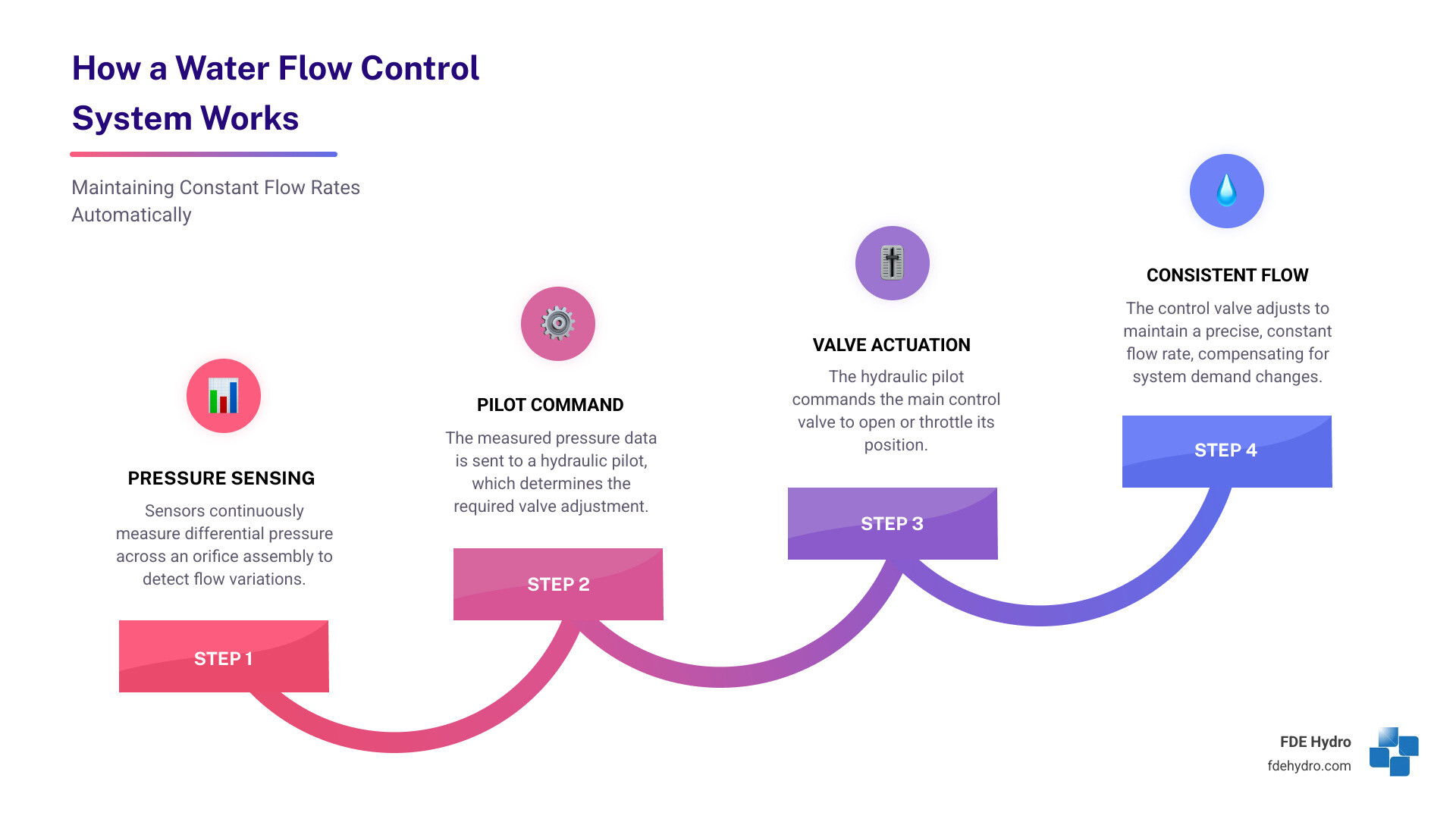
Most flow control valves operate using pressure-compensated mechanisms, such as a flexible orifice or an O-ring that dynamically adjusts to upstream and downstream pressure. When pressure increases, the component constricts to reduce the opening; as pressure decreases, it relaxes to widen the opening. This self-adjusting gatekeeper ensures the correct volume passes through at all times.
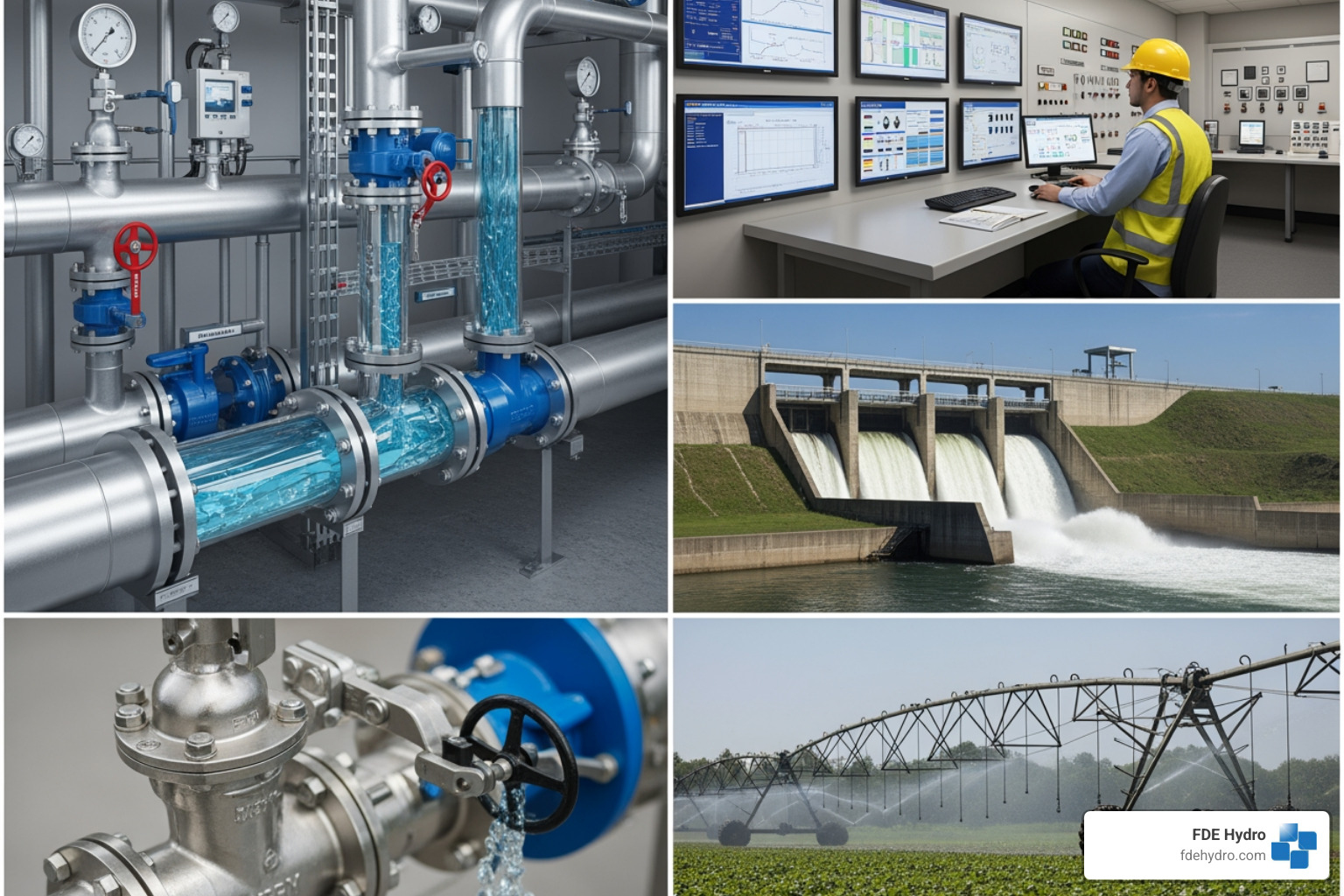
Advanced systems, like the FC3W controller, use Karman vortex flow sensors to provide feedback. This data allows a motor-driven valve to establish a flow rate corresponding to an analog input signal. This level of control is essential when a single supply is divided into multiple lines, ensuring each receives a consistent flow. For more on these principles, explore Flow control valve principles.
How Flow Control Valves Maintain Constant Rates
Water flow control valves are engineered for accuracy, typically within 15% of their rated GPM, even with significant pressure drops up to 125 PSI. Their internal mechanisms often rely on material elasticity rather than traditional moving parts. As upstream pressure pushes more water toward the valve, the flexible orifice constricts to compensate. Conversely, if pressure drops, the element relaxes to maintain the target GPM.
In industrial settings, controllers can adjust flow on each line to a constant rate using analog signals. This ensures that even when a supply is split, each point receives the precise amount of water needed, contributing to system stability.
The Role of Actuators and Pilots in Water Flow Control
Sophisticated water flow control often involves actuators and pilots for automated regulation in complex systems. Actuators physically move the valve’s modulating element. Pneumatically-actuated globe valves use compressed air, while hydraulic actuators leverage system fluid pressure to operate without external power.
Pilot-operated valves use a smaller control mechanism to sense conditions like differential pressure. The pilot then commands the main valve to throttle or open. If demand exceeds the set point, the pilot signals the valve to throttle back, maintaining constant flow. This progressive throttling optimizes energy efficiency, a principle we use in our Water Management Solutions.
Control solenoids can also be integrated for immediate response. For example, a controller can be paired with a VXZ 2-port solenoid valve for complete flow stoppage. For technical details, refer to Rate of Flow Control technical details.
Comparing Types of Water Flow Control Valves
Selecting the right water flow control valve requires understanding design specifications. Key considerations include GPM ratings, PSI limits, and material composition.
| Feature/Type |
Single-Hole Design |
Three-Hole Design |
Mechanical Valves |
Electronic Valves |
| Noise Levels |
Generally noisier |
Quieter |
Varies |
Often quieter |
| Plugging Risk |
Less prone |
Greater chance |
Susceptible to debris |
Less susceptible |
| Maintenance |
Potentially longer |
Potentially shorter |
Regular checks |
Diagnostics-driven |
| GPM Ratings |
Varies |
Varies |
2-20 GPM typical |
Precise digital |
| PSI Specs |
Up to 125 PSI |
Up to 125 PSI |
Up to 125 PSI |
0.2-0.4 MPa |
Single-hole designs feature one orifice. While generally noisier, they are less prone to plugging because they lack small crevices where sediment accumulates. This makes them robust for systems with variable water quality.
Three-hole designs are engineered for quiet operation by distributing flow across multiple orifices, reducing turbulence. However, these smaller openings are more susceptible to mineral buildup and debris, potentially requiring more frequent maintenance. Choosing between them involves balancing noise tolerance against clogging risks.
Selecting Specifications for Residential and Commercial Water Flow Control
Choosing a water flow control valve requires matching GPM, PSI, and material to the application. Flow rates are measured in GPM or liters per minute (lpm). Valves might restrict flow to 5 US GPM for common uses or provide precise ranges like 0.5-4.0 lpm for specialized systems.
Pressure handling is critical; most valves operate between 0 and 125 PSI. Material selection, such as brass or stainless steel, impacts durability. Lead-free options are now standard for potable water. Connection types, such as 1/2″ or 3/4″ FNPT, and maximum working temperatures (typically 150F) must also be verified to ensure compatibility with Sustainable Water Infrastructure.
Preventing System Failure: Cavitation and Maintenance
Cavitation is a major threat to water flow control systems. It occurs when liquid experiences a sharp pressure drop, often at the “vena contracta.” If pressure falls below the vapor pressure, vapor bubbles form. As the water moves downstream and pressure recovers, these bubbles implode, generating shockwaves that damage internal surfaces.
The sound of cavitation—a hiss or rattle like gravel in the pipes—is a warning of ongoing erosion. Over time, this leads to pitting and material loss on valve seats and pipe walls. For a deeper understanding of these failures, the Control Valve Handbook research is an essential resource for Water Resources Management.
Identifying Potential Issues and Improper Selection
Improper selection of water flow control valves leads to several common issues:
- Incorrect Sizing: Small valves cause excessive velocity and cavitation; large valves lack control at low flows.
- Pressure Extremes: Operating outside the 125 PSI range compromises accuracy.
- Debris: Three-hole designs are particularly vulnerable to scale and sediment blockage.
- Installation Errors: Installing a valve against the directional flow arrow impairs function.
- Material Incompatibility: Corrosive water can degrade unsuitable materials, leading to leaks.
Best Practices for Avoiding Cavitation Damage
Preventing cavitation is essential for system longevity. We advocate these best practices:
- Maintain Pressure: Ensure downstream pressure stays above the liquid’s vapor pressure through proper hydraulic design.
- Dual-Chamber Configurations: These designs operate with minimal head loss even at low pressures (3m head), reducing cavitation risk.
- Pilot-Operated Precision: Pilots make fine adjustments to maintain favorable pressure conditions and optimize energy efficiency.
- Proper Sizing: Engineers must consider flow rates and pressure differentials under all operating conditions.
- Hydraulic Modeling: For complex Water Control Structures, modeling helps predict and mitigate risks during the design phase.
The Economic Impact of Efficient Water Flow Control
Effective water flow control translates into significant economic advantages. By preventing over-consumption, these valves save water and money. In municipal networks or large irrigation systems, precise control ensures only the necessary amount of water is delivered, even during pressure surges.
These valves also protect infrastructure. By mitigating cavitation and excessive pressure, they extend the lifespan of pipes and pumps, reducing repair costs. This proactive protection is a primary benefit of integrating flow control into any water system.
Maximizing Efficiency with Water Flow Control
Efficient control is vital for Energy Resource Development. In hydronic heating, flow control valves limit water to equipment, ensuring optimal heat transfer without overworking the system. In tankless water heaters, they ensure water moves at a rate that allows for proper temperature rise, preventing energy waste. By keeping systems within designed parameters, these valves contribute to significant energy savings and a smaller environmental footprint, as detailed in our Energy Infrastructure Development Complete Guide.
Long-term Benefits for Large-Scale Infrastructure
For large-scale projects, robust water flow control protects multi-million dollar investments. In municipal distribution, valves manage reservoir inlets and balance mixing junctions, protecting aging infrastructure from pressure surges that cause bursts.
In irrigation, efficient flow control ensures crops receive precise water amounts, optimizing yields while conserving resources. In flood control, these structures manage discharge rates to protect communities. High-quality flow control is the backbone of any Water Infrastructure Projects Guide, ensuring resilience and sustainability for decades.
Frequently Asked Questions about Flow Regulation
What is the primary difference between a flow regulator and a flow restrictor?
A flow restrictor is a passive device that limits the maximum flow rate by creating a fixed obstruction. The actual flow rate will still fluctuate if upstream pressure changes. A flow regulator (or flow control valve) is an active device that maintains a constant flow rate regardless of pressure changes. It uses internal mechanisms to dynamically adjust, ensuring the flow remains at its predetermined GPM.
How do pressure variations affect the accuracy of a flow control valve?
Modern flow control valves are specifically engineered to counteract pressure variations. Their internal flexible orifices or O-rings are pressure-compensated. If upstream pressure increases, the orifice constricts; if it drops, the orifice relaxes. This allows the valve to remain accurate within 15% of its rated GPM, even at pressures up to 125 PSI.
Why is a self-cleaning mechanism important for water flow devices?
A self-cleaning mechanism is vital for maintaining accuracy and reducing maintenance. Over time, water carries sediment and mineral deposits. In valves without this feature, particles accumulate and cause blockages. A self-cleaning design flushes these deposits away, ensuring the internal mechanisms operate freely and preserving the valve’s accuracy over its entire lifespan.
Conclusion
Water flow control is a triumph of engineering that ensures constant flow rates, prevents cavitation, and promotes conservation across the globe. At FDE Hydro, we believe mastering water flow is essential for building sustainable infrastructure.
Our patented “French Dam” technology integrates these advanced water control principles into modular precast concrete systems for hydroelectric dams. By reducing construction time and costs, we are facilitating the implementation of the Water Control Infrastructure Guide 2025. Combining intelligent flow control with modern construction secures our water and energy resources for the future. To see how we are revolutionizing the industry, Learn more about our Means and Methods.
by Bill French Sr. | Feb 11, 2026 | Hydro Facility Articles
Why Water Resource Management Matters More Than Ever
Water resource management is the coordinated control of water to minimize harm, maximize beneficial use, and ensure sustainable access. It involves protecting water sources, managing supply systems, treating wastewater, preventing floods, and ensuring equitable distribution across competing demands like agriculture, industry, and urban needs.
Key Components of Water Resource Management:
- Water Supply Development – Building infrastructure like dams and reservoirs to capture, store, and deliver water.
- Demand Management – Using conservation and efficiency to reduce consumption.
- Quality Protection – Preventing pollution and treating wastewater to match quality with use.
- Disaster Risk Reduction – Managing floods and droughts with early warning systems and resilient infrastructure.
- Governance and Planning – Establishing policies and regulations for equitable allocation.
- Ecosystem Preservation – Maintaining the health of watersheds, rivers, and aquifers.
The stakes have never been higher. The global water crisis isn’t primarily about scarcity—it’s about poor governance. This stems from fragmented institutions, single-objective planning, and top-down decision-making that excludes affected communities. The drying of the Aral Sea is a stark example, caused not by a lack of water, but by a failure to manage competing demands on the system.
This is where Integrated Water Resources Management (IWRM) comes in. IWRM is a paradigm shift toward managing water as part of an interconnected system including land, climate, and human needs, aligning with UN Sustainable Development Goal 6.
Water resource managers must balance economic productivity, social equity, and ecosystem health amid drought and scarcity. They use diverse strategies—from demand management and water reuse to desalination—but these tools only work within a framework of strong governance and cooperation.
For decision-makers in large-scale water infrastructure, conventional approaches are increasingly untenable due to climate change, aging infrastructure, and transboundary conflicts. Communities now demand greater equity and resilience.
The path forward requires integrating technology with policy, economic incentives with environmental protection, and top-down planning with bottom-up participation. Water security is about safeguarding sustainable access for all while preserving the ecosystems that make it possible.
I’m Bill French Sr., Founder and CEO of FDE Hydro. I’ve spent decades developing innovative solutions for water resource management, including modular construction that reduces costs and timelines for hydropower infrastructure. My experience shows that the future lies in combining smart technology with flexible, sustainable systems that can adapt to our changing world.
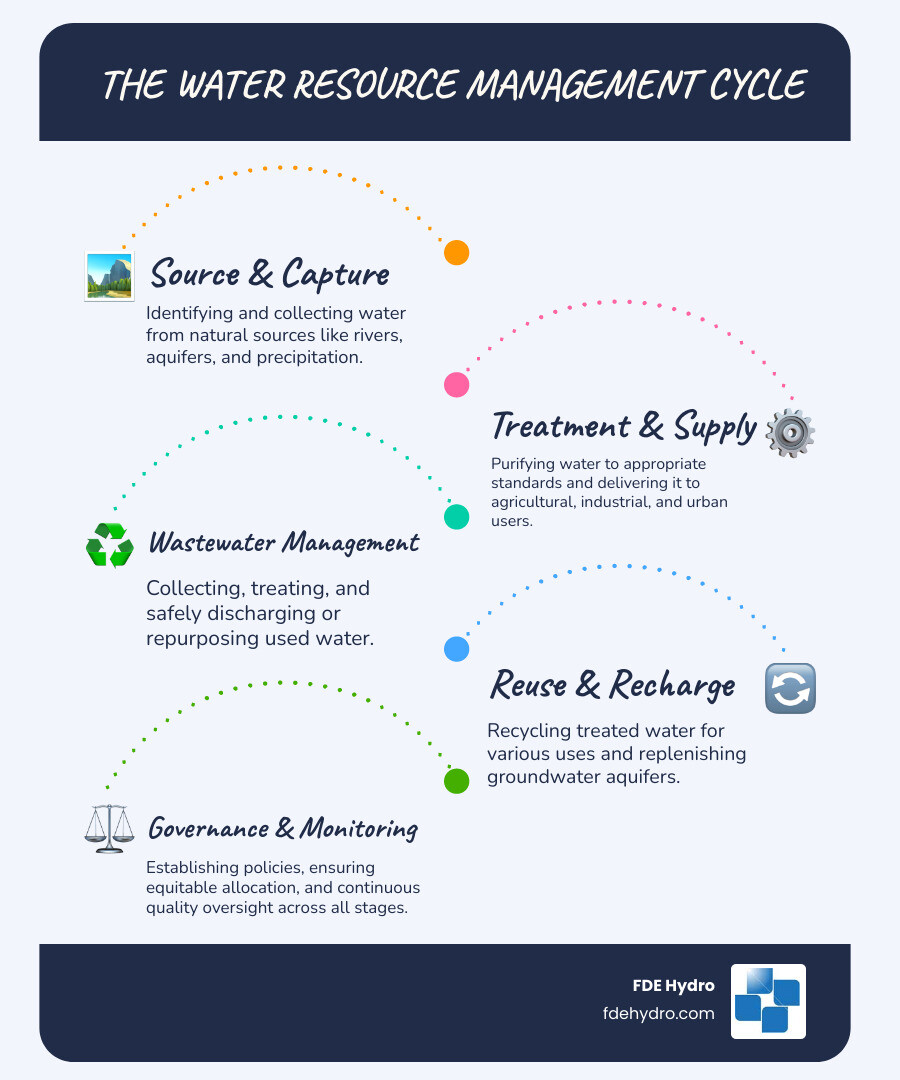
Know your water resource management terms:
The Global Water Challenge and the Rise of IWRM
The global water crisis is a multifaceted challenge of poor governance, not just scarcity. Fragmented institutions manage water without coordination, leading to inefficiencies, while narrow planning ignores the interconnectedness of water systems. Climate change exacerbates these issues by intensifying the water cycle, causing extreme droughts in places like California and Canada and devastating floods across Europe and Brazil. Combined with population growth and rising demand in regions like New York and Kansas, the pressure on finite water resources is immense.
This is precisely why Integrated Water Resources Management (IWRM) has emerged as a critical paradigm. IWRM is a process that champions the coordinated development and management of water, land, and related resources to maximize economic and social welfare equitably, while safeguarding vital ecosystems. The principles of IWRM, originating from the 1992 Dublin-Rio Principles, have evolved to align with global frameworks like the UN’s Sustainable Development Goal 6 (SDG 6), making it a dynamic framework for today’s water challenges.
What is Integrated Water Resources Management (IWRM)?
At its core, IWRM is a holistic approach that recognizes water’s intrinsic connections to land, climate, energy, and human systems. It shifts away from fragmented, sectoral management toward a coordinated strategy to maximize economic and social welfare without compromising ecosystem sustainability.
By fostering coordination, moving beyond single-objective planning, and encouraging bottom-up participation, IWRM aims to create resilient water systems. This approach is fundamental to achieving water security—the capacity of a population to safeguard sustainable access to adequate quantities of acceptable quality water for livelihoods, well-being, and socio-economic development, while protecting against water-related disasters and preserving ecosystems.
For more insights into global strategies, we often look to resources like the World Bank’s initiatives for Water for Planet. This integrated perspective is also what drives us at FDE Hydro, as we contribute to developing sustainable water infrastructure that supports these comprehensive management goals.
IWRM, Governance, and Sustainable Development
The link between IWRM, governance, and sustainable development is clear. The global water crisis is a governance crisis, where fragmented institutions and short-sighted technical fixes have failed. For instance, reports show up to one-third of handpumps in sub-Saharan Africa are dysfunctional, proving that infrastructure alone is insufficient without sustainable management.
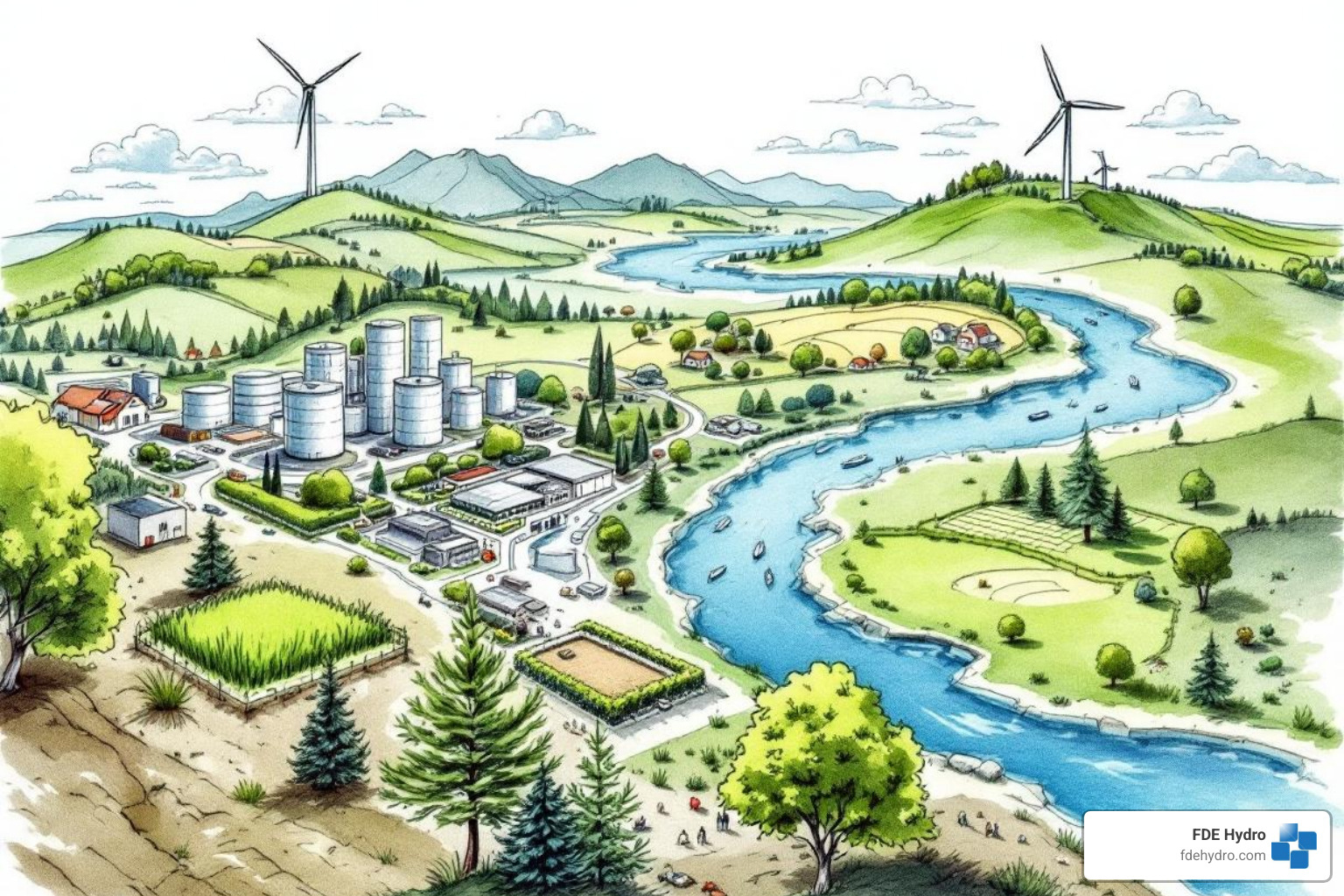
IWRM offers a remedy by shifting from top-down decision-making to one that incorporates bottom-up participation, ensuring diverse values are recognized. Its key principles advocate for a holistic approach, focusing on water as a finite resource, participatory management, and water as an economic good.
IWRM is a cornerstone for achieving the UN’s SDG 6: “ensuring access to water and sanitation for all.” Its principles also resonate with Agenda 2030, the UN Declaration on the Human Right to Water, and the Paris Agreement. Organizations like the United Nations Development Programme (UNDP) are crucial in implementing these principles through their work on UNDP Waters and Ocean Governance. Their projects, such as helping farmers in Somaliland gain water access, show how IWRM directly contributes to human well-being.
An IWRM action framework typically involves strengthening policies, building institutions, providing management tools, and mobilizing financial resources. Integrating these elements helps steer water governance toward a water-secure world.
Key Strategies for Effective Water Resource Management
Facing drought and scarcity in places like California and Kansas, water managers use a blend of supply-side management (increasing available water) and demand-side management (reducing consumption). The most effective water resource management plans integrate both to create a resilient system.
For example, California’s Resource Management Strategies (RMSes) provide a comprehensive framework, updated in 2023 to reflect climate change impacts and a new focus on equity. These strategies are not one-size-fits-all; their success depends on regional factors. At FDE Hydro, we know these regional specifics are vital when designing water infrastructure.
At the heart of these strategies are water efficiency (using technology to reduce water use) and conservation (behavioral changes to reduce consumption). Both are crucial for sustainability.
Here are some key management strategies:
- Demand management (conservation and efficiency)
- Reclamation and reuse of wastewater
- Acquisition of diverse water supplies
- Utilization of renewable surface water
- Development and rehabilitation of reservoirs
- Aquifer replenishment and recharge (Managed Aquifer Recharge – MAR)
- Stormwater capture and green infrastructure
- Crop management and agricultural drainage water management
- Water transfers, leases, and exchanges
- Desalination for brackish groundwater or seawater
- Rehabilitation and replacement of aging water infrastructure
Augmenting Supply: Capture, Reuse, and Desalination
Augmenting our water supply is vital in water-stressed regions. These strategies help us make the most of every drop.
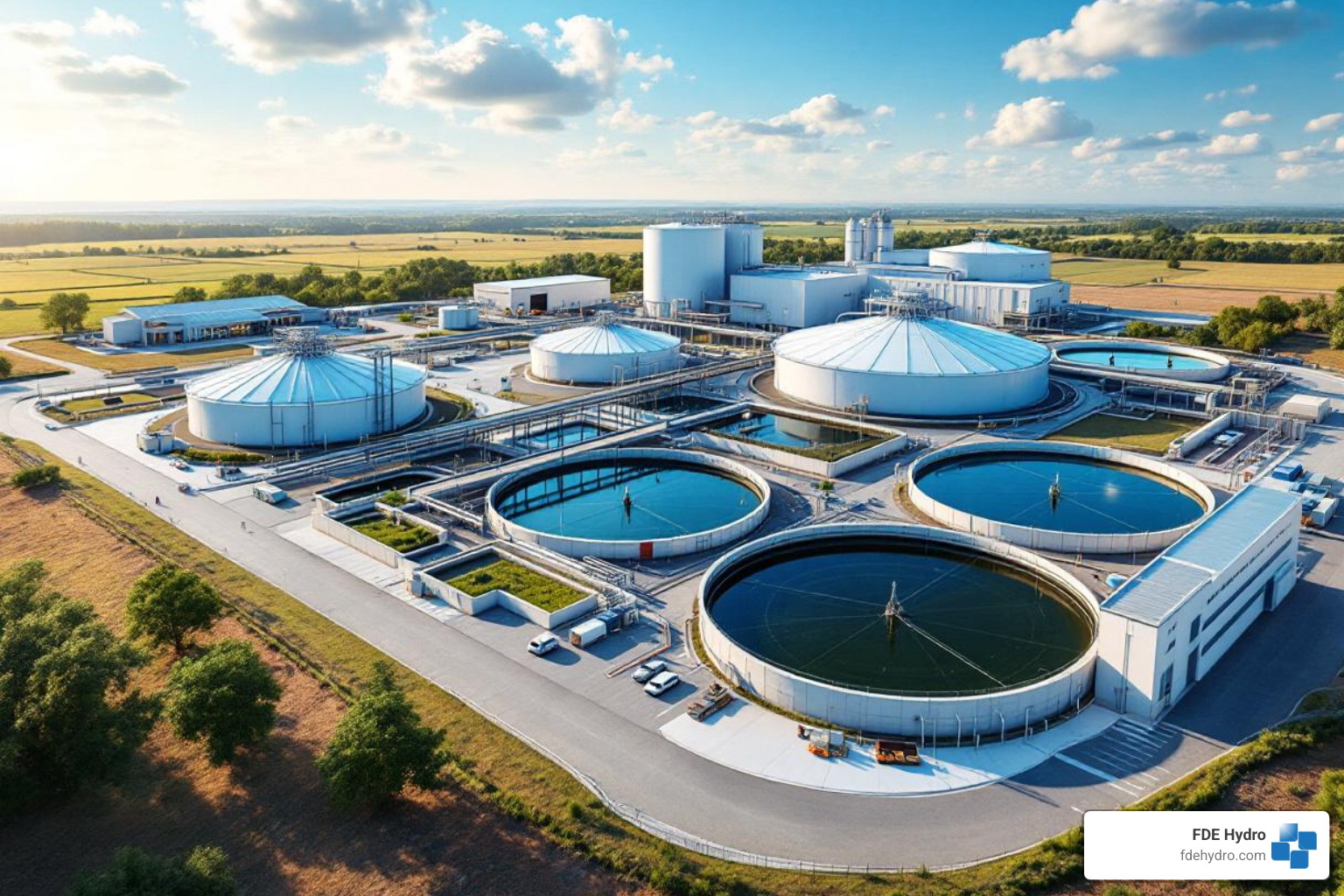
Water capture and stormwater harvesting collect rainwater or urban runoff through green infrastructure like rain gardens and permeable pavements. These systems provide water for use, reduce flood risks, and replenish local groundwater. Our work on water control systems often integrates with these methods for efficient storage.
Managed Aquifer Recharge (MAR) is a set of strategies to replenish aquifers using surface or underground techniques, such as spreading grounds or injection wells. MAR is invaluable for offsetting aquifer depletion in agricultural regions like California and Kansas, but requires careful consideration of source water quality. You can learn more from the American Geosciences Institute’s information on MAR.
Water reuse, or recycling, is a cornerstone of sustainable management. It involves treating wastewater for beneficial uses. Planned reuse takes this further by treating water to be “fit-for-purpose.” Non-potable uses like irrigation may use water from “purple pipe systems,” while indirect potable reuse involves highly treated water being introduced into aquifers or reservoirs before being withdrawn for drinking.
Desalination creates a new water source by removing salt from seawater or brackish groundwater, typically using reverse osmosis. While a game-changer for coastal areas, desalination is energy-intensive and produces a hypersaline brine byproduct that requires careful environmental management. The high upfront capital costs are also a significant factor. Despite these challenges, desalination can be a vital part of a diverse water portfolio for communities in coastal California and other water-stressed regions.
Managing Demand and Improving Quality
Effective water resource management also relies on managing demand and protecting water quality.
In agriculture, a major water user, improving efficiency is key. This includes high-efficiency drip irrigation and selecting low-water crop species. Canadian farmers, for example, are adopting farming practices to protect groundwater and optimize water use. Agricultural drainage water management also protects water quality by reducing nutrient runoff into rivers and lakes, with practices like denitrifying bioreactors promoted by agencies like the NRCS in the US.
In urban areas, water efficiency programs, like the EPA WaterSense program, encourage low-flush toilets and efficient appliances. Public education on fixing leaks and promoting xeriscaping also reduces consumption. The EPA offers guidance on water efficiency for water suppliers.
Pollution prevention is a proactive approach that focuses on reducing waste at the source. This protects water sources and reduces the need for costly downstream treatment. Our expertise in water control structures supports these efforts by enabling precise management of water flows.
California’s updated RMSes highlight key approaches to demand and quality management, including:
- Urban Water Use Efficiency: A permanent strategy, not just a drought response.
- Matching Water Quality to Use: Optimizing treatment and allocation.
- Pollution Prevention: Emphasizing source reduction.
- Salinity Management: Crucial for maintaining usable water supplies.
- Urban Stormwater Runoff Management: Improving water quality and augmenting supply.
- Conjunctive Management: Coordinated use of surface and groundwater to maximize reliability, a practice also vital in regions like Kansas.
These integrated strategies are essential for securing our water future.
The Framework: Governance, Policy, and Global Cooperation
Effective water resource management is rooted in robust governance, clear policies, and international cooperation. The World Bank Group, for instance, focuses on reducing flood and drought impacts, managing and restoring water bodies, and strengthening ecological outcomes. This holistic view recognizes that water challenges are intertwined with climate resilience, economic stability, and environmental health.
Disaster risk reduction involves preparedness, early warning systems, and strategic investments in both green and grey infrastructure—like our modular dam solutions—to buffer against floods and droughts. Protecting and restoring degraded water systems like catchments, rivers, and aquifers is also fundamental for long-term security.
Strong institutions and transparent planning are critical. Basin-level governance enables fair allocation and monitoring, especially in transboundary river basins affecting multiple countries like Canada or Brazil. International cooperation, through bodies like the Global Facility for Transboundary Water Cooperation, helps countries establish legal frameworks for joint management, turning water into a source of stability.
Finally, private sector partnerships and advanced financial tools help drive innovation. The integration of technology, including solutions like AI for Resource Management, is also becoming vital for optimizing these complex systems.
The Role of Institutions in Water Resource Management
Institutions are the backbone of effective water resource management. On the global stage, organizations like the United Nations Development Programme (UNDP) and the World Bank Group play pivotal roles. The UNDP’s work on UNDP Waters and Ocean Governance supports countries in achieving water-related SDGs. The World Bank’s priorities guide significant investments and policy aimed at reducing water risks globally, often leading to robust hydropower asset management frameworks.
Beyond these bodies, academic institutions and specialized associations are crucial. The European Water Resources Association (EWRA) fosters collaboration and knowledge exchange. Academic journals like ‘Water Resources Management,’ published for the EWRA, are vital for disseminating research on water resource assessment, development, and conservation. The journal is an international, multidisciplinary forum for original contributions that support UN Sustainable Development Goals. For those in the field, submitting a manuscript to the Water Resources Management Journal is a way to advance the collective understanding of these critical issues.
These institutions collectively build the global capacity for sustainable water resource management through policy, funding, and scientific research.
Legal and Economic Levers for Sustainable Water Resource Management
Legal and economic frameworks are powerful levers for sustainable water resource management. Without clear water rights and proper economic incentives, even the best technology can fail.
Judicial decisions and the resulting water rights certainty are foundational. Ambiguous rights create uncertainty and hinder long-term investment. For example, a landmark Arizona Supreme Court ruling provided crucial certainty for reusing treated wastewater, enabling significant investment in reclamation projects. In regions like California and Kansas, such clarity is vital for fostering water transfers, leases, and exchanges.
Economic incentives are critical for influencing behavior. These can include financial assistance for adopting efficient technologies, water pricing that reflects its true cost, and market policies that allow for flexible allocation.
Here’s a quick comparison of some economic incentives:
| Economic Incentive |
Pros |
Cons |
| Tiered Water Pricing |
Encourages conservation; generates revenue for infrastructure; promotes equity for basic needs. |
Can disproportionately affect large families or industries; may be politically unpopular; complex to implement fairly. |
| Subsidies/Grants |
Encourages adoption of water-saving tech; supports vulnerable users; stimulates innovation. |
Can be costly to administer; may create dependency; risk of market distortion if not carefully targeted. |
| Water Markets |
Efficient allocation to highest value uses; flexible in drought; creates clear value for water. |
Can lead to speculation; raises equity concerns for small users; requires robust legal and monitoring frameworks. |
| Tax Incentives |
Encourages investment in efficient equipment; less direct government intervention. |
Benefits may not reach all users; can be complex to administer; less immediate impact on daily consumption. |
Public outreach and engagement are also powerful levers. Educating citizens and industries about water scarcity and conservation fosters a culture of responsible water use. This bottom-up approach, combined with top-down policies, creates a robust framework for sustainable infrastructure development in water.
Frequently Asked Questions about Water Resource Management
What is the main cause of the global water crisis?
The global water crisis is primarily considered a crisis of governance, not just scarcity. It stems from issues like fragmented institutions, poor planning, lack of coordination between sectors (like agriculture, energy, and urban development), and insufficient investment in sustainable infrastructure and management practices.
How does climate change affect water resources?
Climate change intensifies the water cycle, leading to more extreme weather events. This includes more severe droughts, intense rainfall and flooding, and changes in snowfall and snowmelt patterns, all of which disrupt traditional water availability and increase risks to communities and ecosystems.
Can technology alone solve our water problems?
While technology like desalination, advanced water treatment, and smart irrigation are crucial tools, they are not a silver bullet. Sustainable water management requires a holistic approach that combines technology with effective governance, sound policy, economic incentives, and public participation to ensure equitable and long-lasting solutions.
Conclusion: Building a Water-Secure Future
As we’ve explored, water resource management is a complex, dynamic field that requires an integrated and forward-thinking approach. The concept of Integrated Water Resources Management (IWRM) stands as our guiding principle, advocating for the coordinated development and management of water, land, and related resources to achieve economic, social, and environmental sustainability. The global water crisis is a governance challenge, and our collective response must address this fundamental issue.
The future of water resource management relies on building resilient, adaptable, and sustainable water infrastructure. This means embracing innovative solutions that improve our capacity to manage water during periods of drought and scarcity, protect against floods, and ensure equitable access for all. From advanced water capture and reuse techniques to the strategic implementation of Managed Aquifer Recharge and responsible desalination, every tool in our arsenal must be considered.
At FDE Hydro, we are committed to being part of this solution. Our innovative modular dam construction technology, the “French Dam,” exemplifies how we can reduce costs and timelines for building and retrofitting hydroelectric dams and water control systems in North America, Brazil, and Europe. These advancements are not just about efficiency; they are about enabling the rapid deployment of critical infrastructure that can adapt to the intensifying impacts of climate change and support comprehensive water resource management strategies.
The path to water security is a collective effort, demanding collaboration across sectors, robust governance, and continuous innovation. By integrating technology with policy, economic incentives with environmental protection, and top-down planning with bottom-up participation, we can build a water-secure future for generations to come. We invite you to explore how next-generation hydropower and water control solutions are shaping this future.

